Upgrade to Pro — share decks privately, control downloads, hide ads and more …

Python Turns 35: The Language That Refused to Die

Sponsored · Your Podcast. Everywhere. Effortlessly. Share. Educate. Inspire. Entertain. You do you. We'll handle the rest.
Avatar for Wallace Espindola Wallace Espindola
February 20, 2026
2

Python Turns 35: The Language That Refused to Die

Python was created by Guido van Rossum in February 1991. Thirty-five years later, it's more relevant than ever -- powering AI systems, backend APIs, cloud automation and scientific computing worldwide.

This slide deck walks through Python's remarkable journey across four distinct phases, from a niche scripting language to a universal platform. It also compares Python at 35 with Java at 30, showing how both languages survived by optimizing for different things.

What's Covered:
- Python's four evolutionary phases (1991-2026)
- The five factors behind Python's longevity
- Current strong points and where it still has room to grow
- A side-by-side comparison with Java at 30
- Why these two languages complement rather than compete
- What's next for both in the coming decade

Key Takeaway:
Python survived by optimizing for humans. Java survived by optimizing for systems. Together they represent two complementary visions of software engineering -- productivity and reliability.

Author:
Wallace Espindola
Senior Software Engineer, Brussels, Belgium

GitHub: github.com/wallaceespindola
LinkedIn: linkedin.com/in/wallaceespindola
Medium: medium.com/@wallaceespindola
Dev.to: dev.to/wallaceespindola

Tags:
Python, Java, Programming Languages, Software Engineering, AI, Machine Learning

Avatar for Wallace Espindola

Wallace Espindola

February 20, 2026
Tweet

More Decks by Wallace Espindola

Transcript

  1. Python Turns 35 The Language That Refused to Die 1991

    - 2026 Wallace Espindola Senior Software Engineer | Brussels, Belgium speakerdeck.com/wallacese
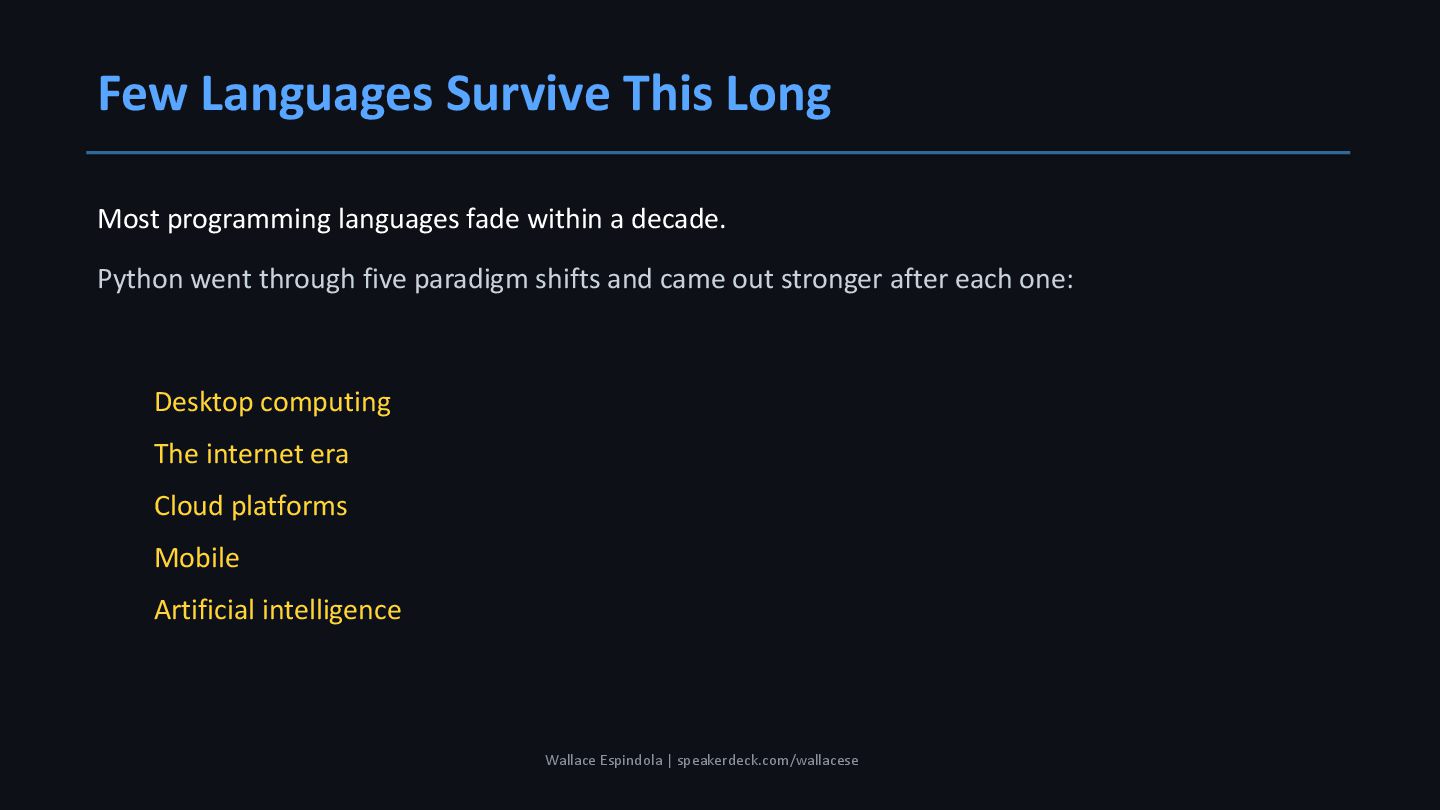
  2. Few Languages Survive This Long Most programming languages fade within

    a decade. Python went through five paradigm shifts and came out stronger after each one: Desktop computing The internet era Cloud platforms Mobile Artificial intelligence Wallace Espindola | speakerdeck.com/wallacese
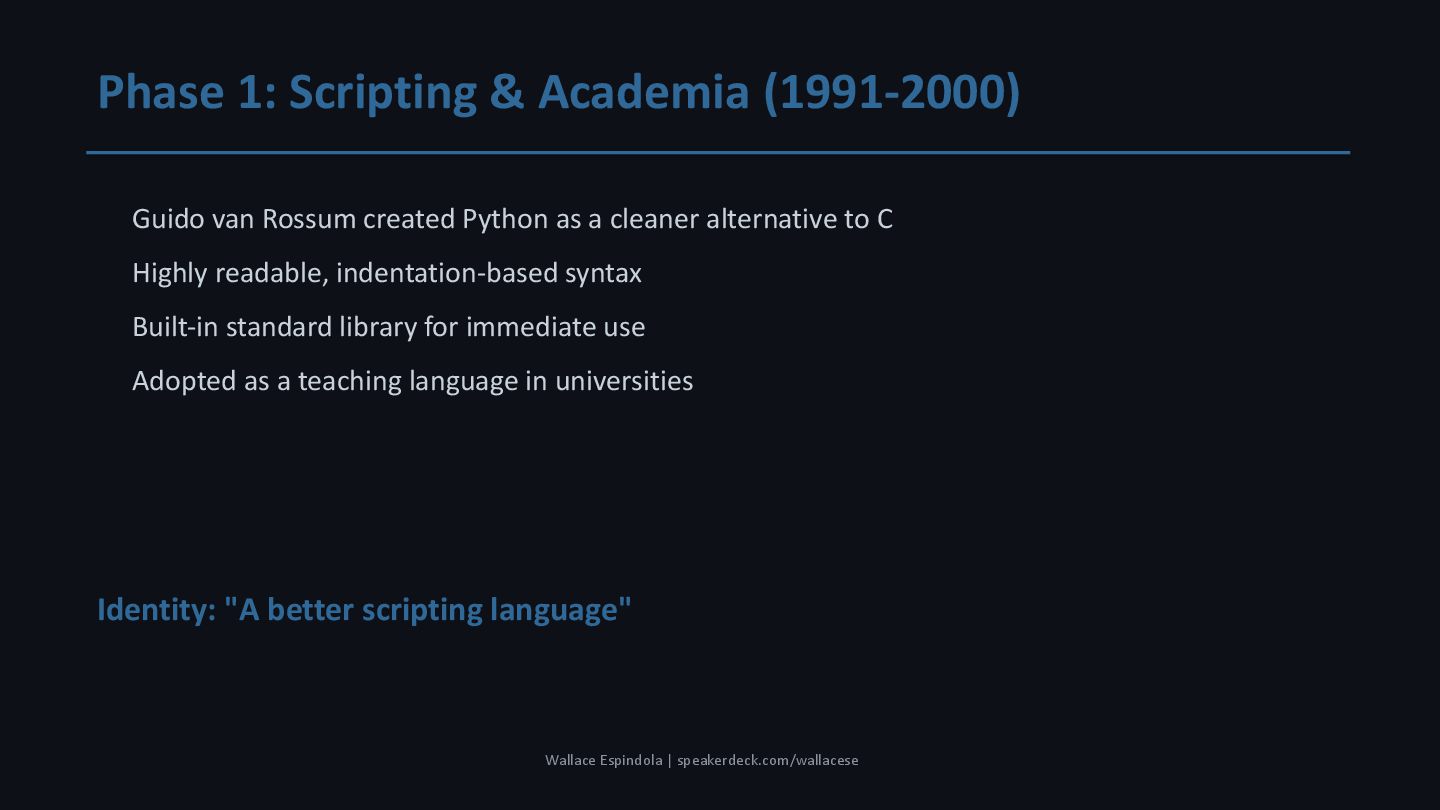
  3. Phase 1: Scripting & Academia (1991-2000) Guido van Rossum created

    Python as a cleaner alternative to C Highly readable, indentation-based syntax Built-in standard library for immediate use Adopted as a teaching language in universities Identity: "A better scripting language" Wallace Espindola | speakerdeck.com/wallacese
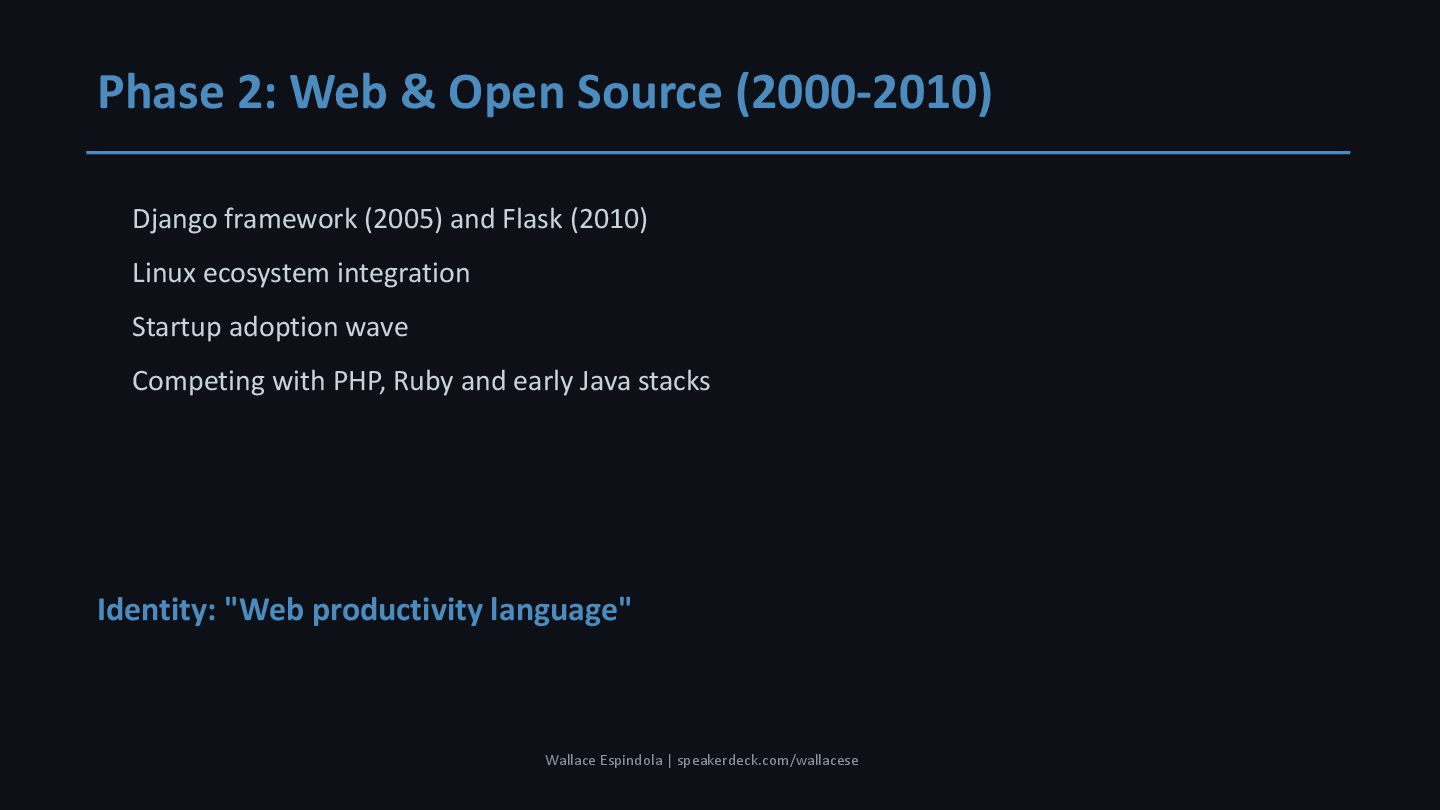
  4. Phase 2: Web & Open Source (2000-2010) Django framework (2005)

    and Flask (2010) Linux ecosystem integration Startup adoption wave Competing with PHP, Ruby and early Java stacks Identity: "Web productivity language" Wallace Espindola | speakerdeck.com/wallacese
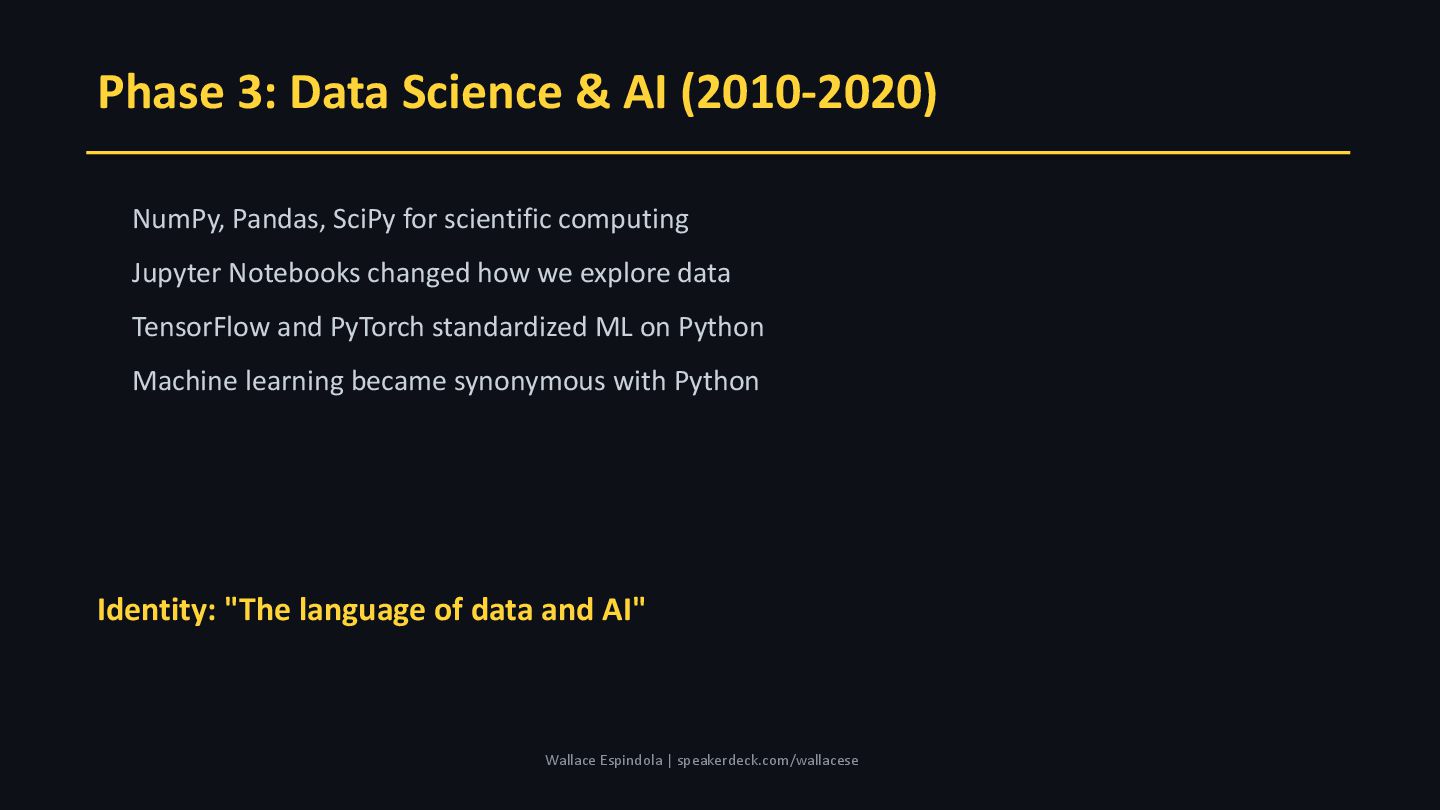
  5. Phase 3: Data Science & AI (2010-2020) NumPy, Pandas, SciPy

    for scientific computing Jupyter Notebooks changed how we explore data TensorFlow and PyTorch standardized ML on Python Machine learning became synonymous with Python Identity: "The language of data and AI" Wallace Espindola | speakerdeck.com/wallacese
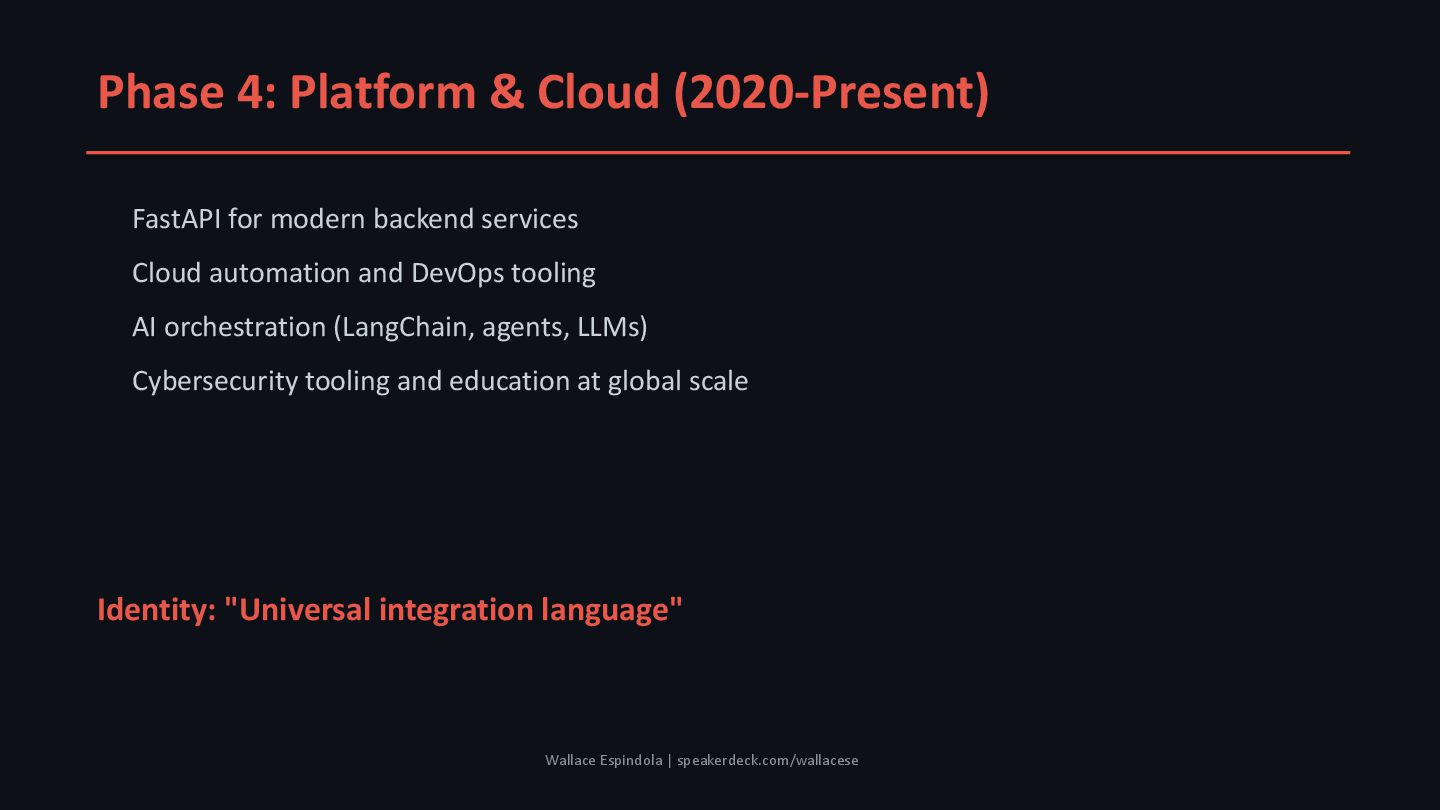
  6. Phase 4: Platform & Cloud (2020-Present) FastAPI for modern backend

    services Cloud automation and DevOps tooling AI orchestration (LangChain, agents, LLMs) Cybersecurity tooling and education at global scale Identity: "Universal integration language" Wallace Espindola | speakerdeck.com/wallacese
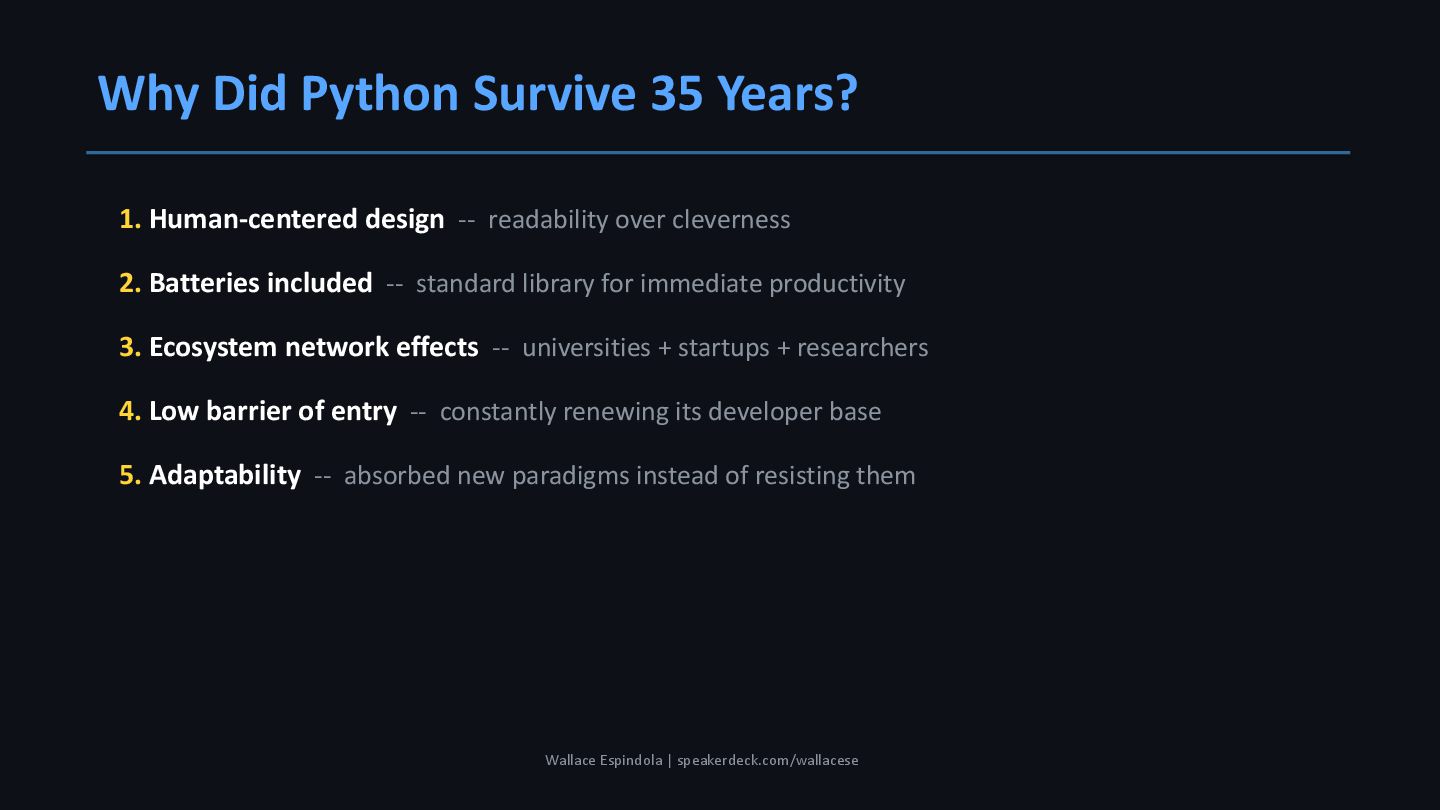
  7. Why Did Python Survive 35 Years? 1. Human-centered design --

    readability over cleverness 2. Batteries included -- standard library for immediate productivity 3. Ecosystem network effects -- universities + startups + researchers 4. Low barrier of entry -- constantly renewing its developer base 5. Adaptability -- absorbed new paradigms instead of resisting them Wallace Espindola | speakerdeck.com/wallacese
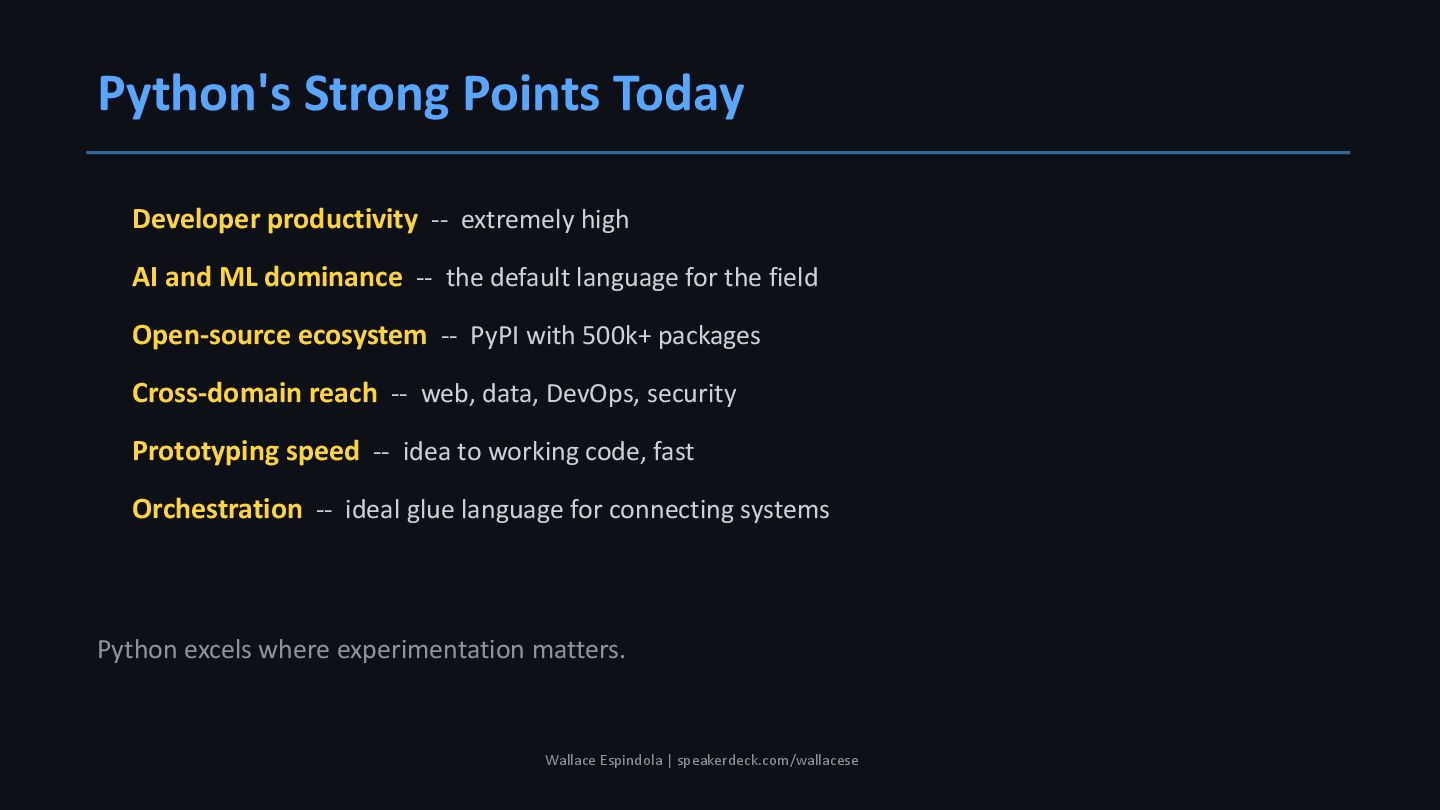
  8. Python's Strong Points Today Developer productivity -- extremely high AI

    and ML dominance -- the default language for the field Open-source ecosystem -- PyPI with 500k+ packages Cross-domain reach -- web, data, DevOps, security Prototyping speed -- idea to working code, fast Orchestration -- ideal glue language for connecting systems Python excels where experimentation matters. Wallace Espindola | speakerdeck.com/wallacese
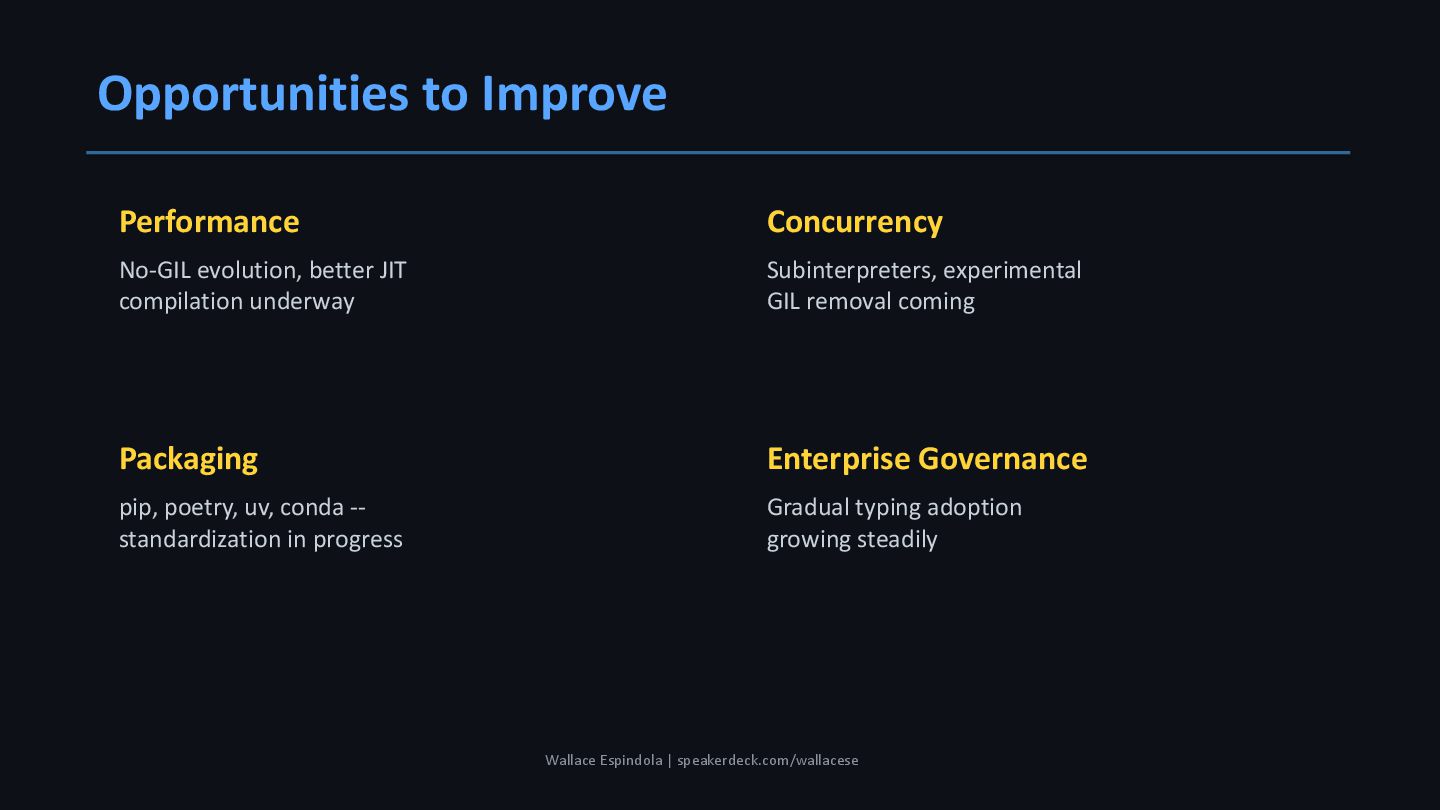
  9. Opportunities to Improve Performance No-GIL evolution, better JIT compilation underway

    Packaging pip, poetry, uv, conda -- standardization in progress Concurrency Subinterpreters, experimental GIL removal coming Enterprise Governance Gradual typing adoption growing steadily Wallace Espindola | speakerdeck.com/wallacese
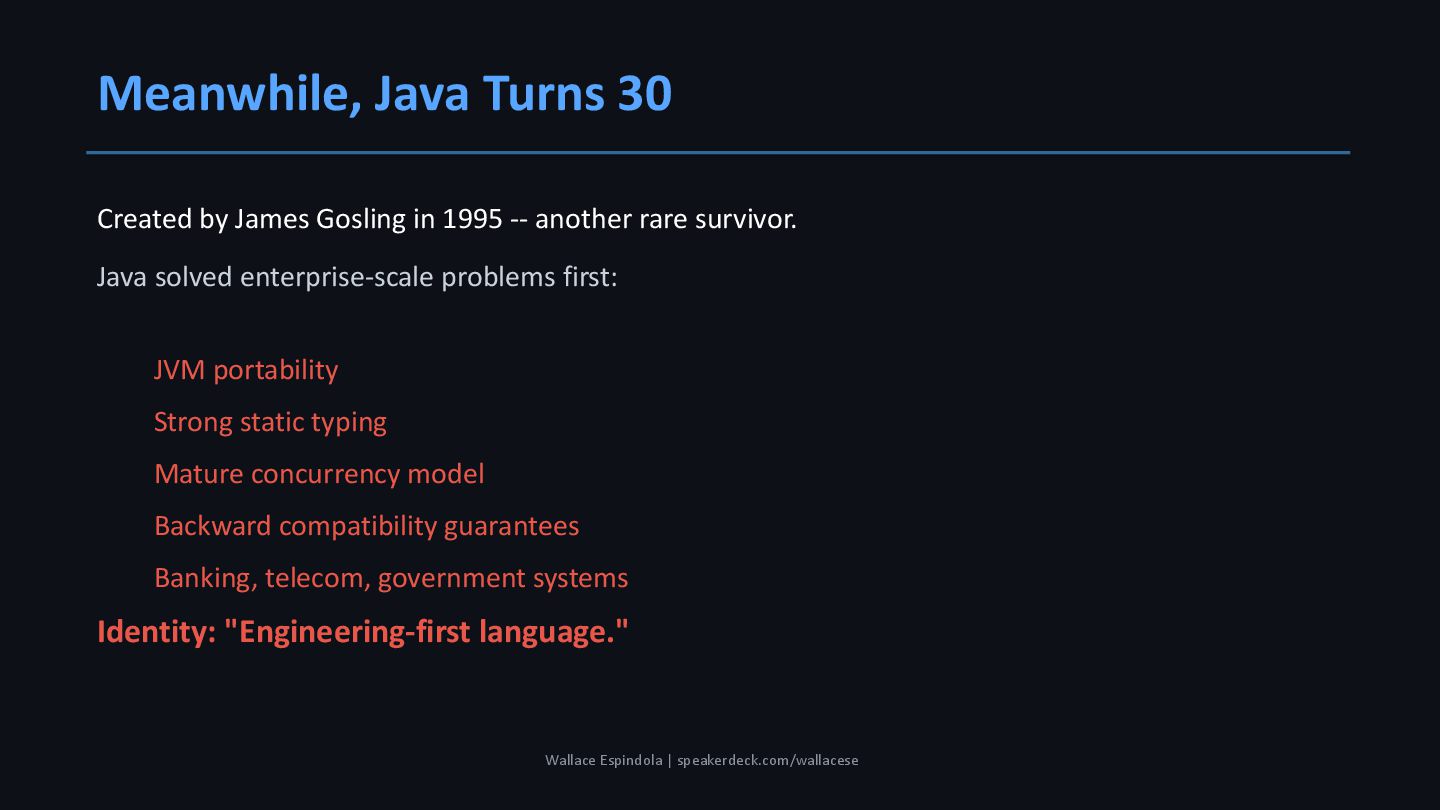
  10. Meanwhile, Java Turns 30 Created by James Gosling in 1995

    -- another rare survivor. Java solved enterprise-scale problems first: JVM portability Strong static typing Mature concurrency model Backward compatibility guarantees Banking, telecom, government systems Identity: "Engineering-first language." Wallace Espindola | speakerdeck.com/wallacese
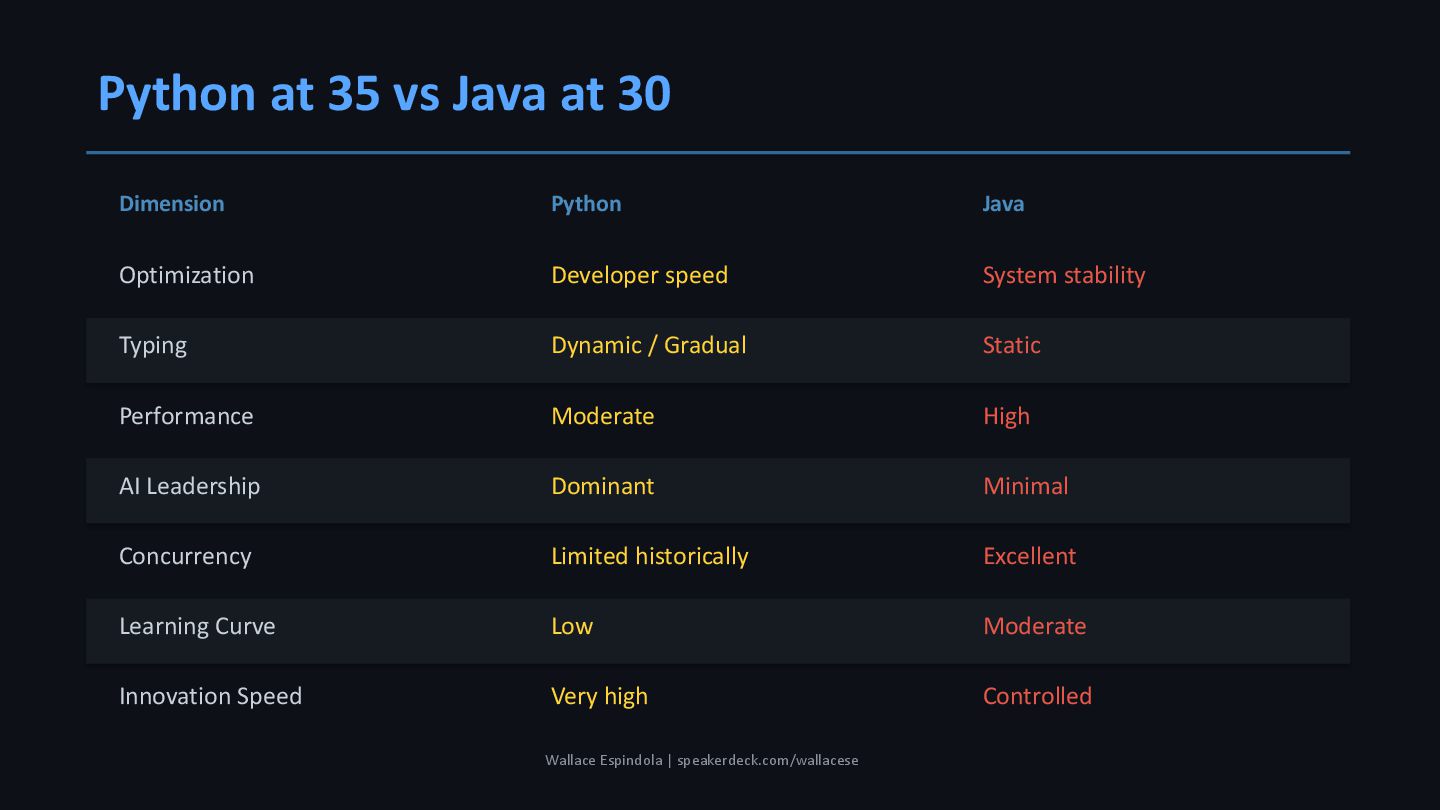
  11. Python at 35 vs Java at 30 Dimension Python Java

    Optimization Developer speed System stability Typing Dynamic / Gradual Static Performance Moderate High AI Leadership Dominant Minimal Concurrency Limited historically Excellent Learning Curve Low Moderate Innovation Speed Very high Controlled Wallace Espindola | speakerdeck.com/wallacese
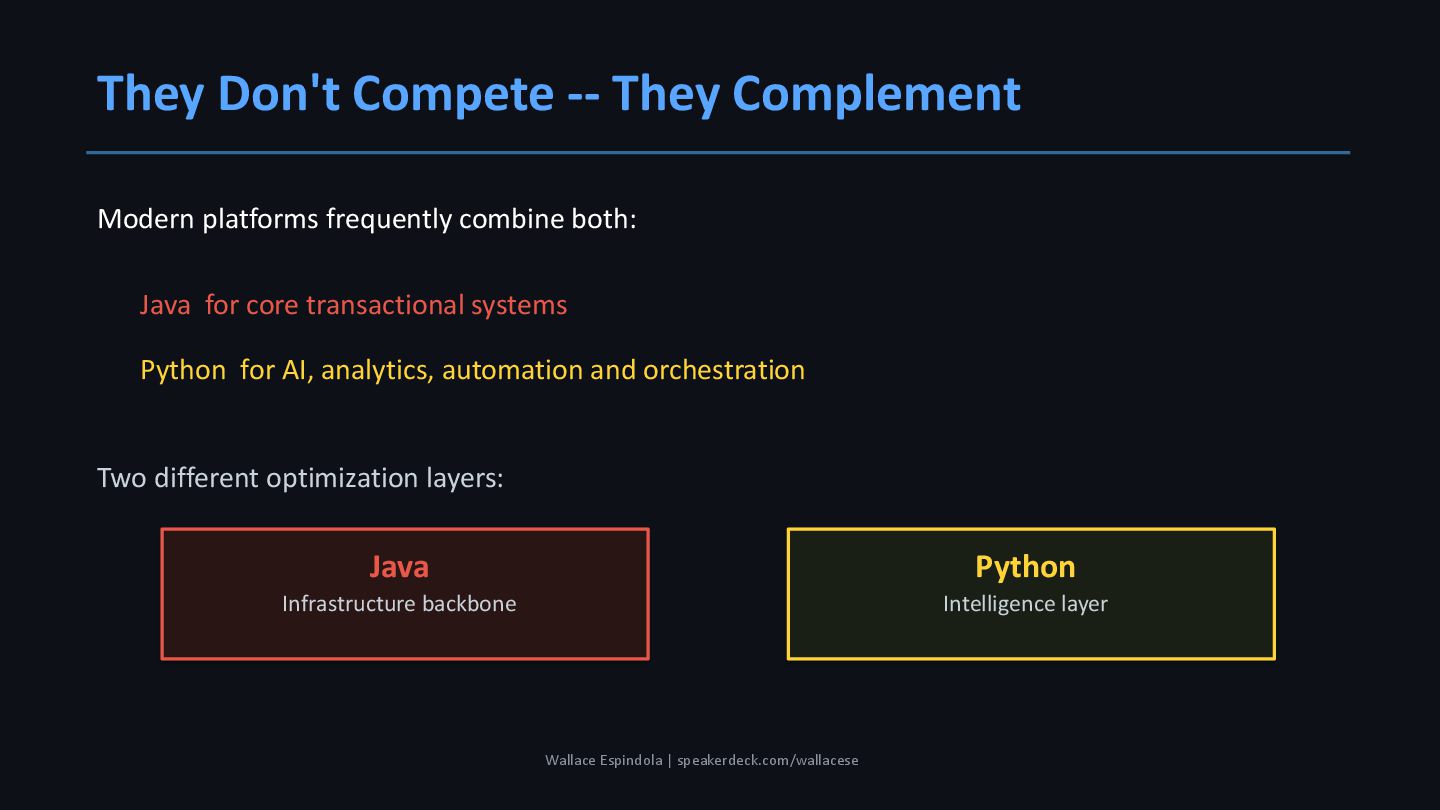
  12. They Don't Compete -- They Complement Modern platforms frequently combine

    both: Java for core transactional systems Python for AI, analytics, automation and orchestration Two different optimization layers: Java Infrastructure backbone Python Intelligence layer Wallace Espindola | speakerdeck.com/wallacese
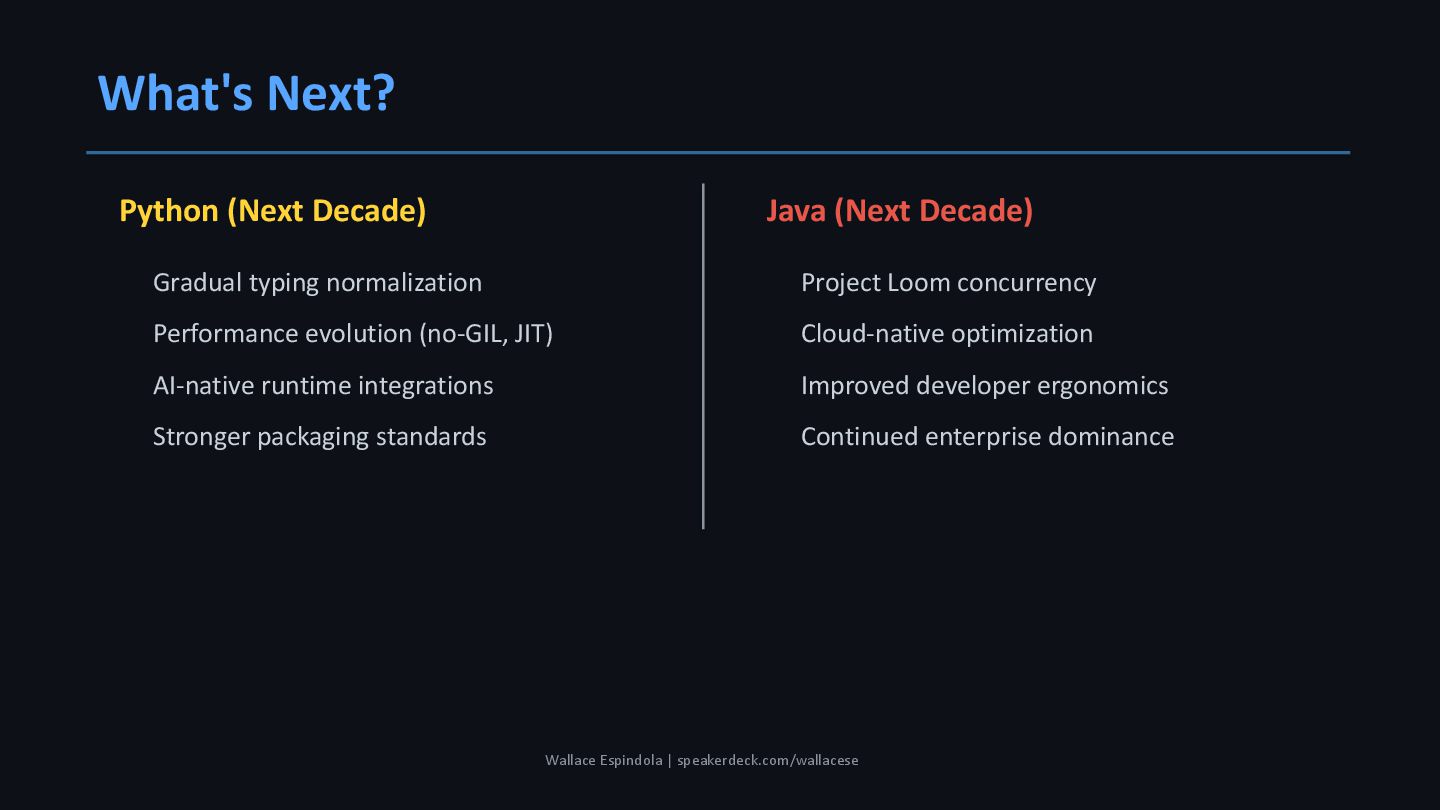
  13. What's Next? Python (Next Decade) Gradual typing normalization Performance evolution

    (no-GIL, JIT) AI-native runtime integrations Stronger packaging standards Java (Next Decade) Project Loom concurrency Cloud-native optimization Improved developer ergonomics Continued enterprise dominance Wallace Espindola | speakerdeck.com/wallacese
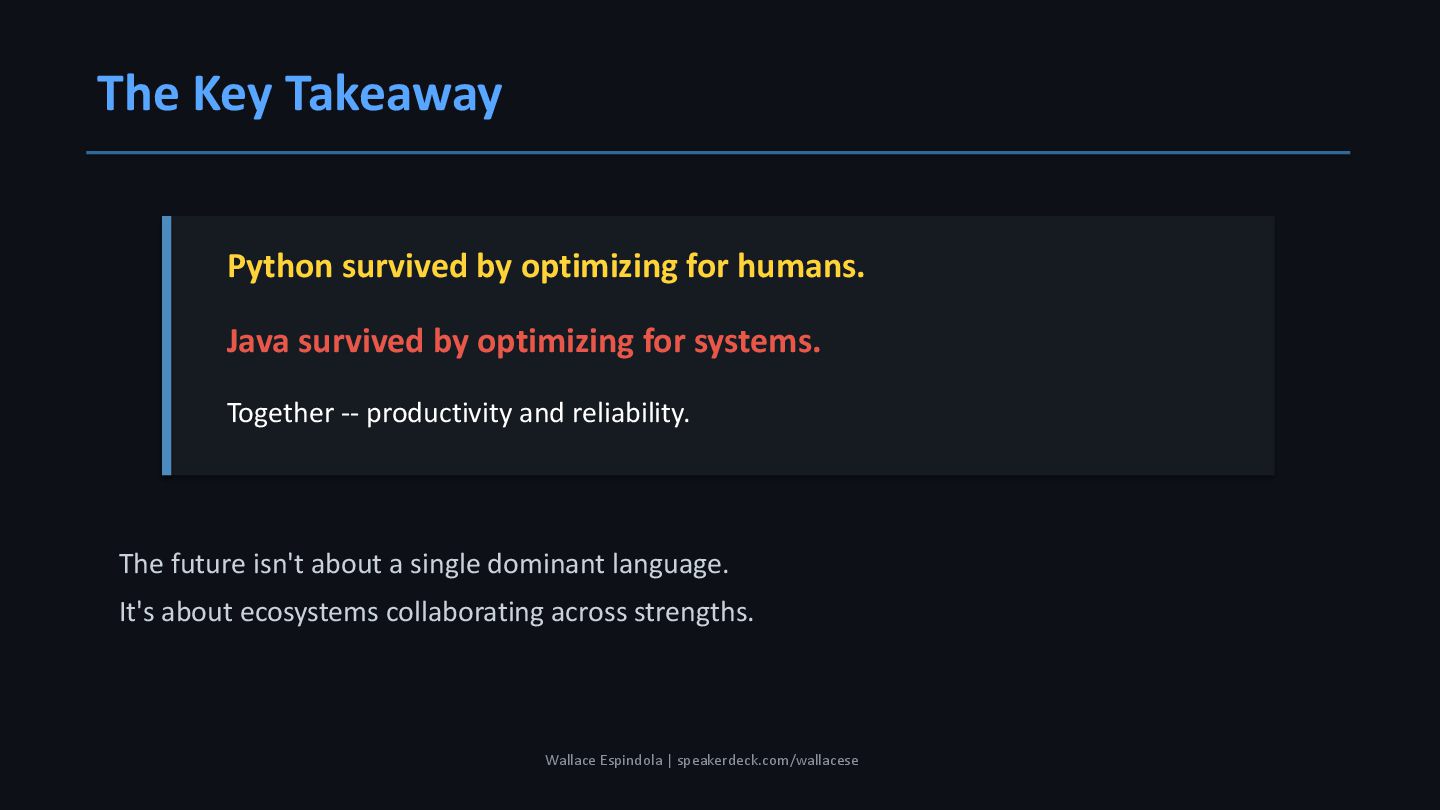
  14. The Key Takeaway Python survived by optimizing for humans. Java

    survived by optimizing for systems. Together -- productivity and reliability. The future isn't about a single dominant language. It's about ecosystems collaborating across strengths. Wallace Espindola | speakerdeck.com/wallacese
  15. Thank You Happy 35th birthday, Python! Wallace Espindola Senior Software

    Engineer | Brussels, Belgium GitHub: github.com/wallaceespindola LinkedIn: linkedin.com/in/wallaceespindola Medium: medium.com/@wallaceespindola Dev.to: dev.to/wallaceespindola Speaker Deck: speakerdeck.com/wallacese