Upgrade to Pro — share decks privately, control downloads, hide ads and more …

Share Copilot Capacity, Not Accounts

Share Copilot Capacity, Not Accounts

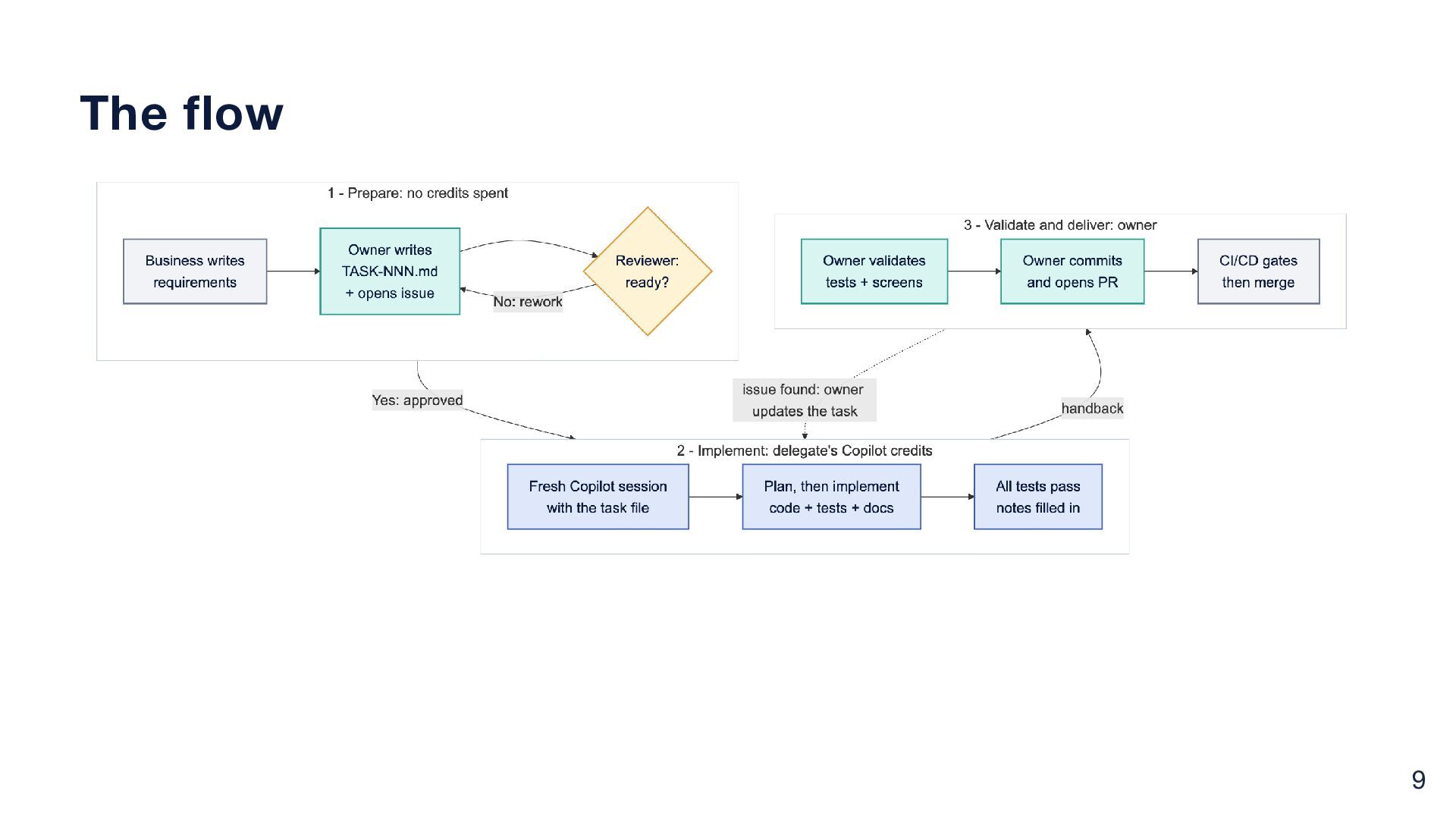
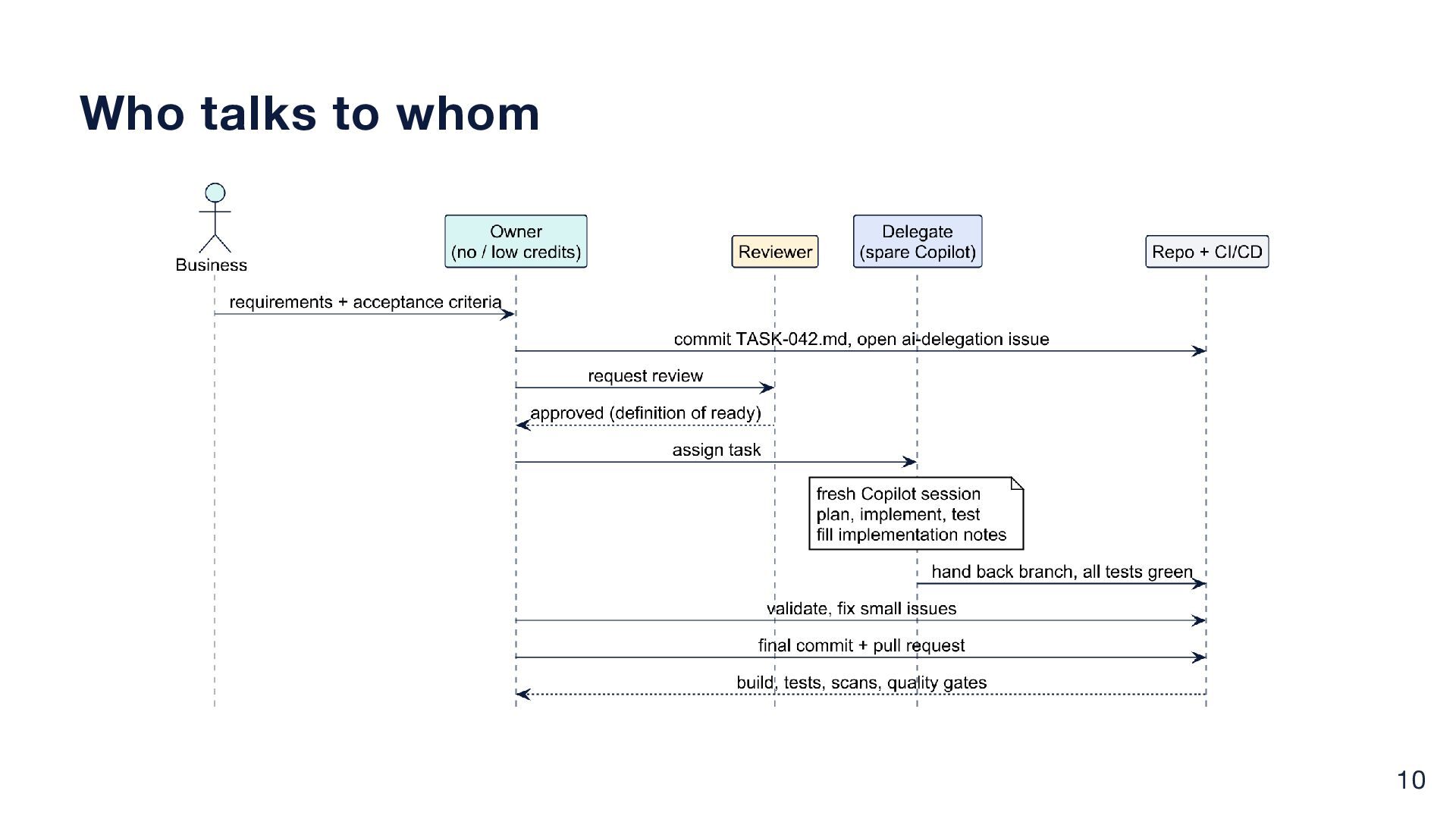
Some developers run out of GitHub Copilot credits early while teammates end the period with credits left, and some have no license at all. This talk shows a spec-driven process for sharing that capacity without sharing accounts: the owner writes a versioned TASK.md spec, a reviewer checks it against a definition of ready, a teammate with spare credits implements it with Copilot, and the owner validates and opens the PR through the same CI/CD gates. Examples: https://github.com/wallaceespindola/share-tokens-using-spec-driven-dev

Avatar for Wallace Espindola

Wallace Espindola

October 19, 2026

More Decks by Wallace Espindola

Other Decks in Technology

Transcript

  1. Share Copilot Capacity, Not Accounts Spec-driven delegation for teams with

    uneven AI budgets Wallace Espindola Solution Architect [email protected] linkedin.com/in/wallaceespindola | github.com/wallaceespindola
  2. The problem: one contract, uneven use Copilot usually comes through

    a company contract with Microsoft/GitHub Each developer works against a personal limit per billing period: a per-user allowance, or a per-user budget admins set on the pool Some developers hit their limit early, others end the period with credits left A limit belongs to one user: leftover credits do nothing for a colleague who ran out Some developers have no license at all 2
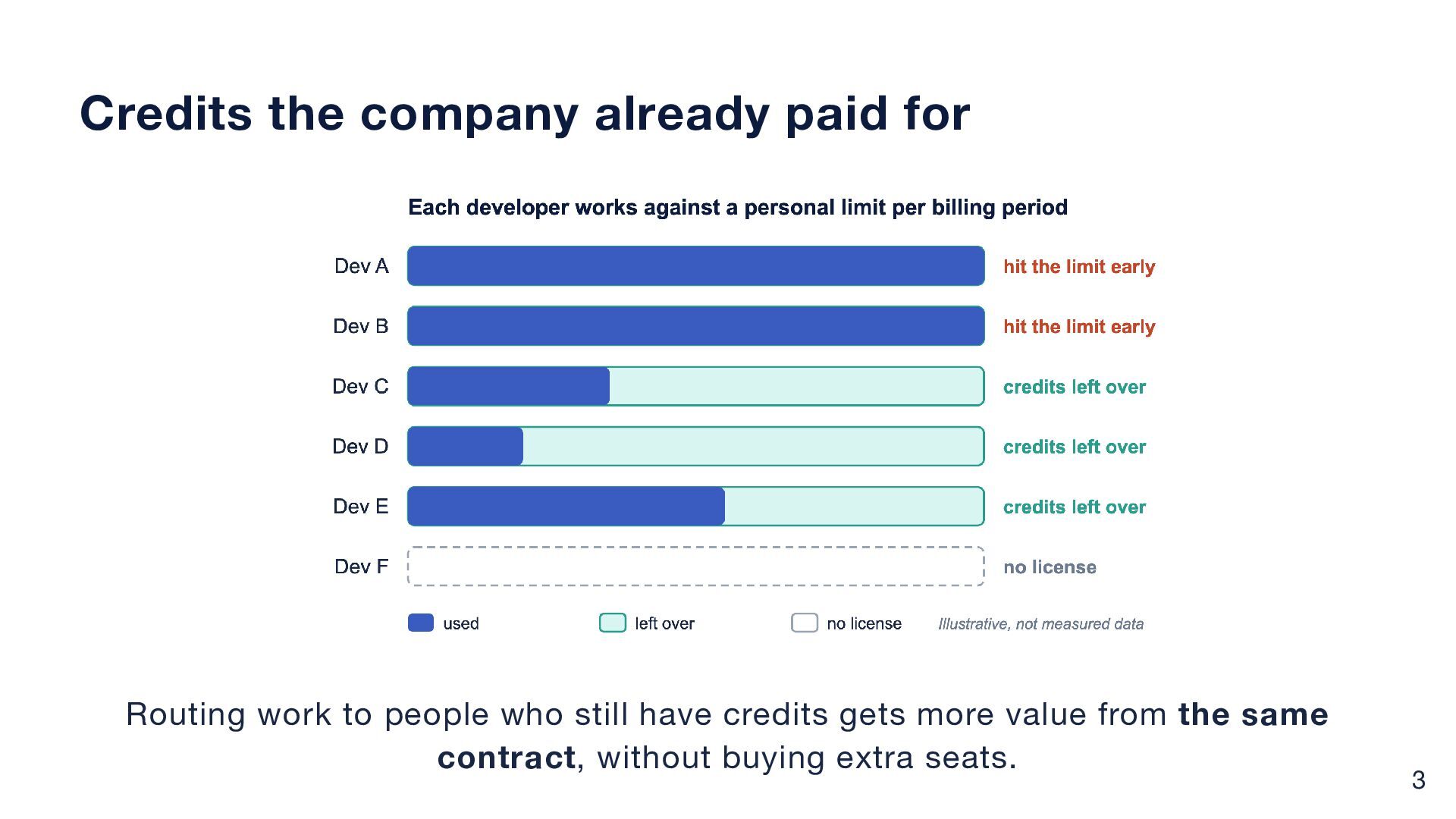
  3. Credits the company already paid for Routing work to people

    who still have credits gets more value from the same contract, without buying extra seats. 3
  4. "Can you run this through Copilot for me?" The informal

    version does not scale: The request lives in a chat message The context is incomplete, so Copilot guesses The delegate burns credits on clarifying questions The knowledge disappears with the Copilot conversation Nobody can see who is waiting on whom 4
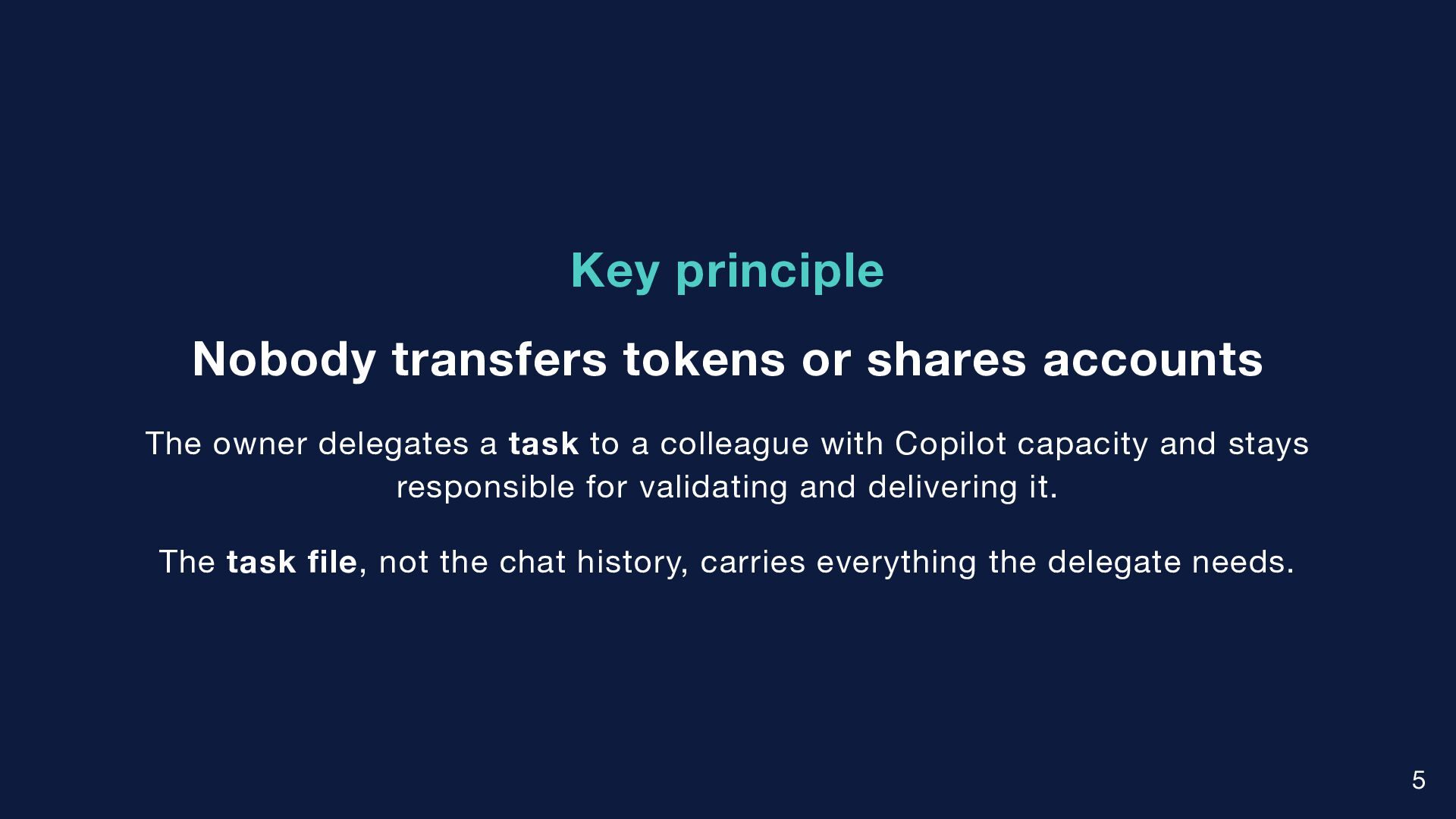
  5. Key principle Nobody transfers tokens or shares accounts The owner

    delegates a task to a colleague with Copilot capacity and stays responsible for validating and delivering it. The task file, not the chat history, carries everything the delegate needs. 5
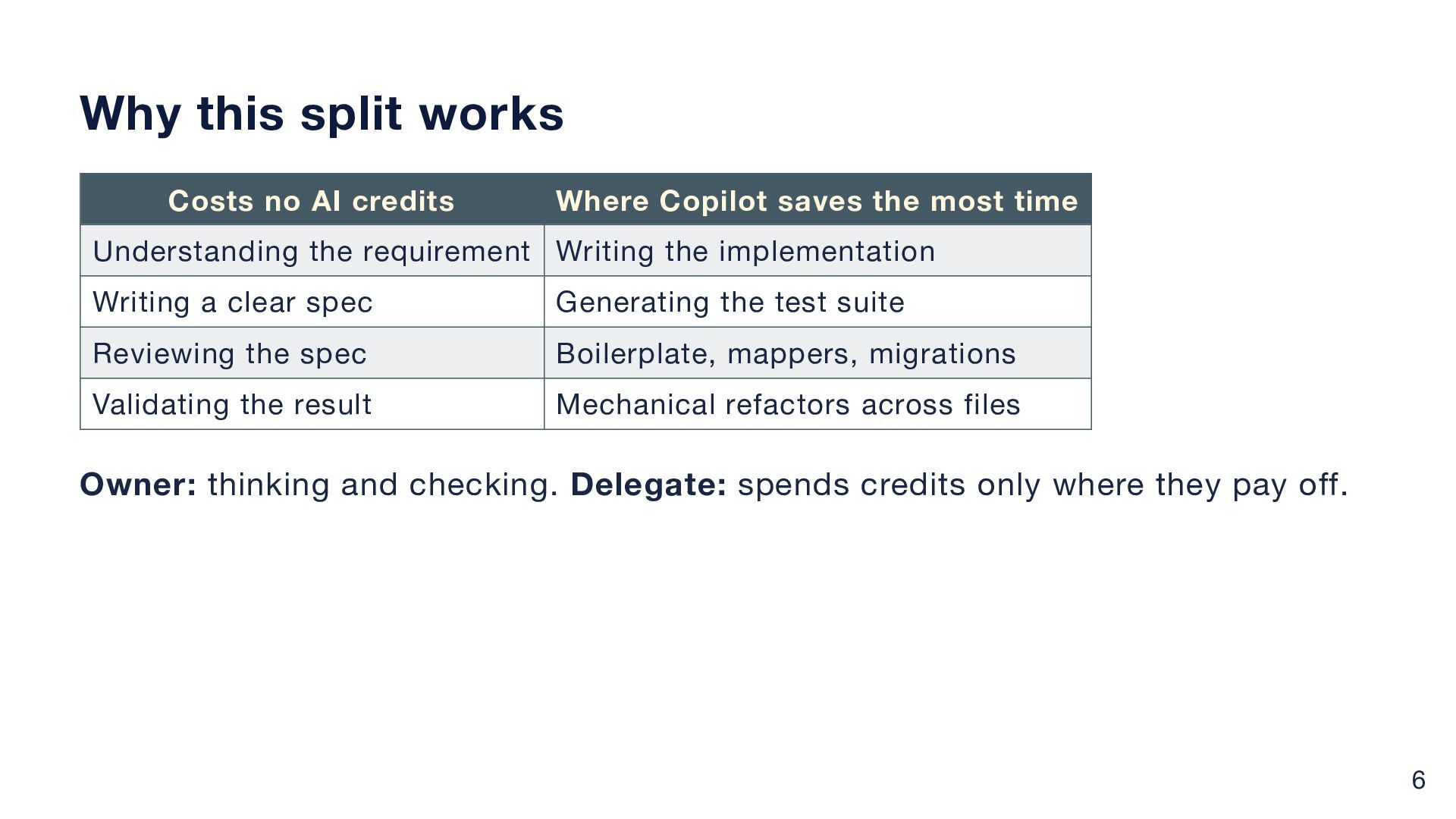
  6. Why this split works Costs no AI credits Where Copilot

    saves the most time Understanding the requirement Writing the implementation Writing a clear spec Generating the test suite Reviewing the spec Boilerplate, mappers, migrations Validating the result Mechanical refactors across files Owner: thinking and checking. Delegate: spends credits only where they pay off. 6
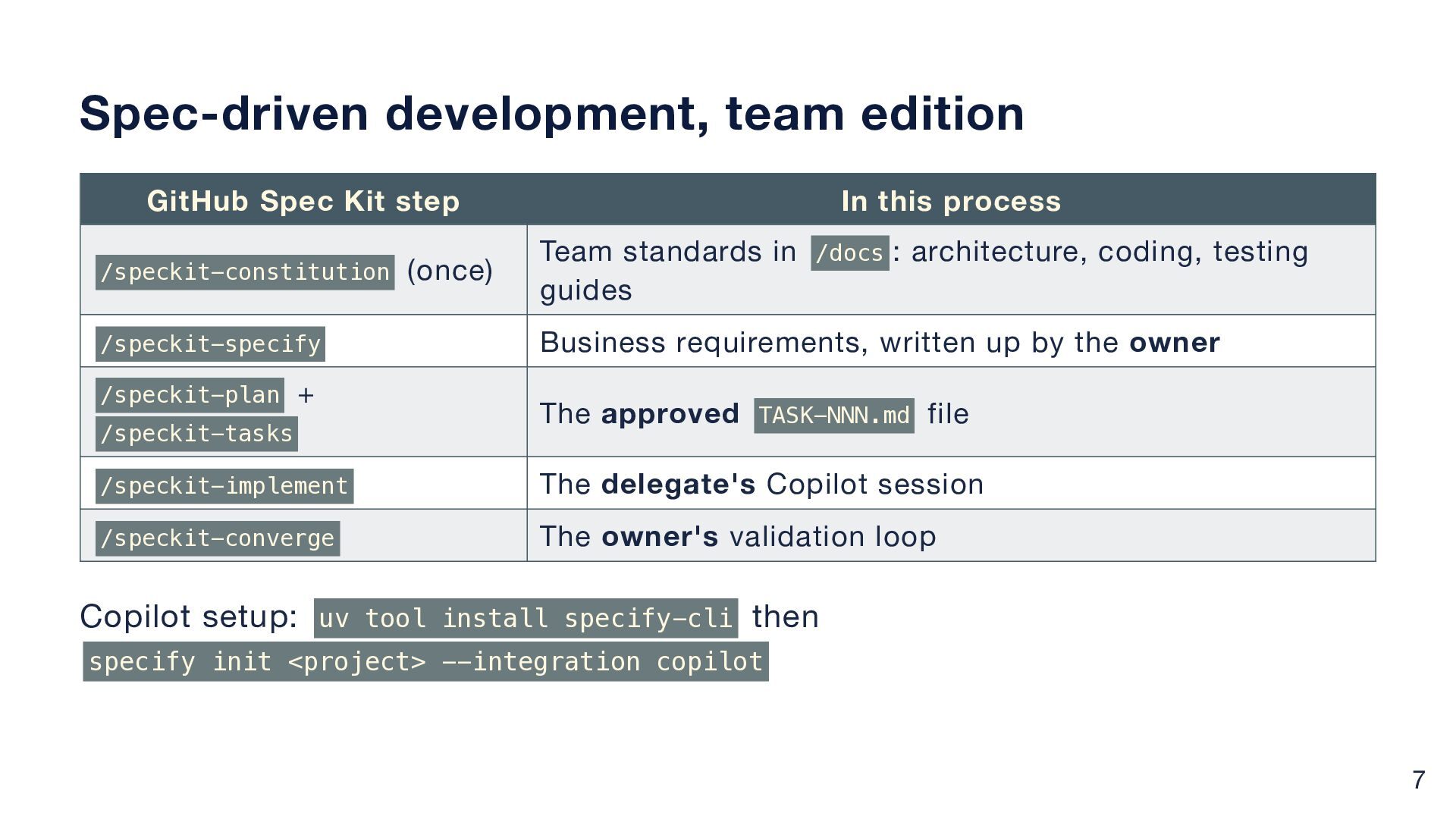
  7. Spec-driven development, team edition GitHub Spec Kit step /speckit-constitution /speckit-specify

    /speckit-plan + /speckit-tasks (once) In this process Team standards in /docs : architecture, coding, testing guides Business requirements, written up by the owner The approved TASK-NNN.md file /speckit-implement The delegate's Copilot session /speckit-converge The owner's validation loop Copilot setup: uv tool install specify-cli then specify init <project> --integration copilot 7
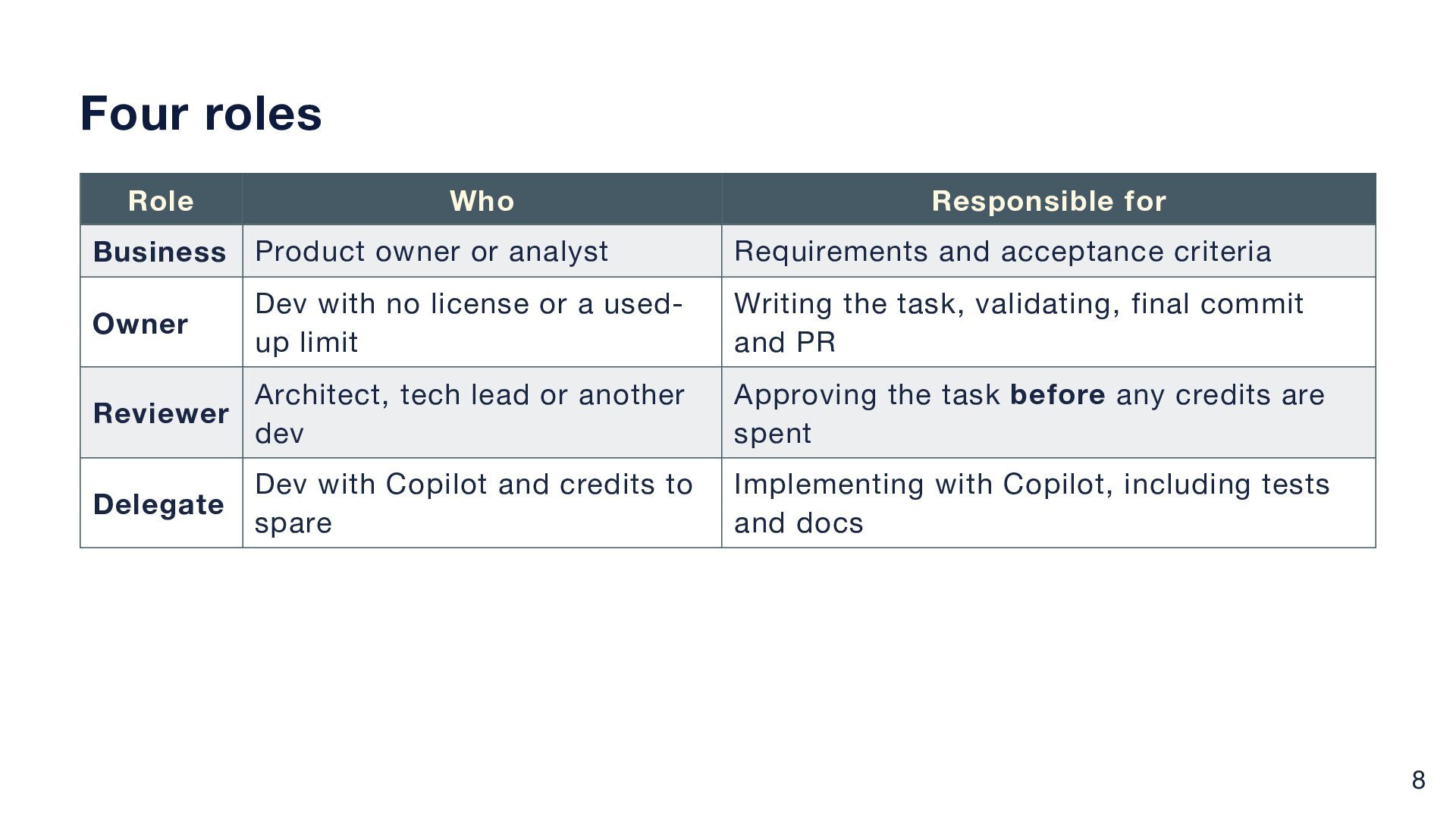
  8. Four roles Role Who Business Product owner or analyst Responsible

    for Requirements and acceptance criteria Owner Dev with no license or a usedup limit Writing the task, validating, final commit and PR Reviewer Architect, tech lead or another dev Approving the task before any credits are spent Delegate Dev with Copilot and credits to spare Implementing with Copilot, including tests and docs 8
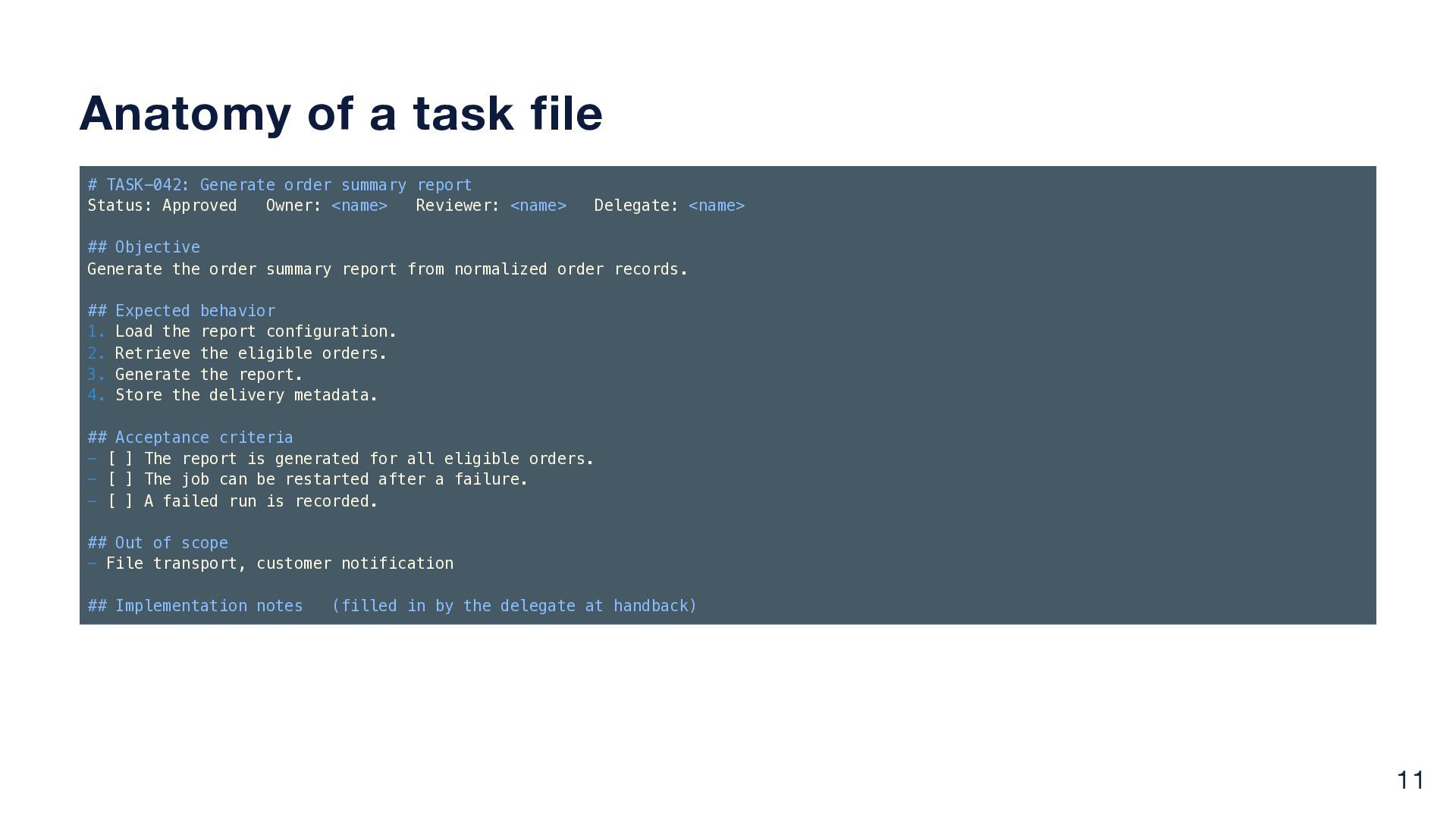
  9. Anatomy of a task file # TASK-042: Generate order summary

    report Status: Approved Owner: <name> Reviewer: <name> Delegate: <name> ## Objective Generate the order summary report from normalized order records. ## Expected behavior 1. Load the report configuration. 2. Retrieve the eligible orders. 3. Generate the report. 4. Store the delivery metadata. ## Acceptance criteria - [ ] The report is generated for all eligible orders. - [ ] The job can be restarted after a failure. - [ ] A failed run is recorded. ## Out of scope - File transport, customer notification ## Implementation notes (filled in by the delegate at handback) 11
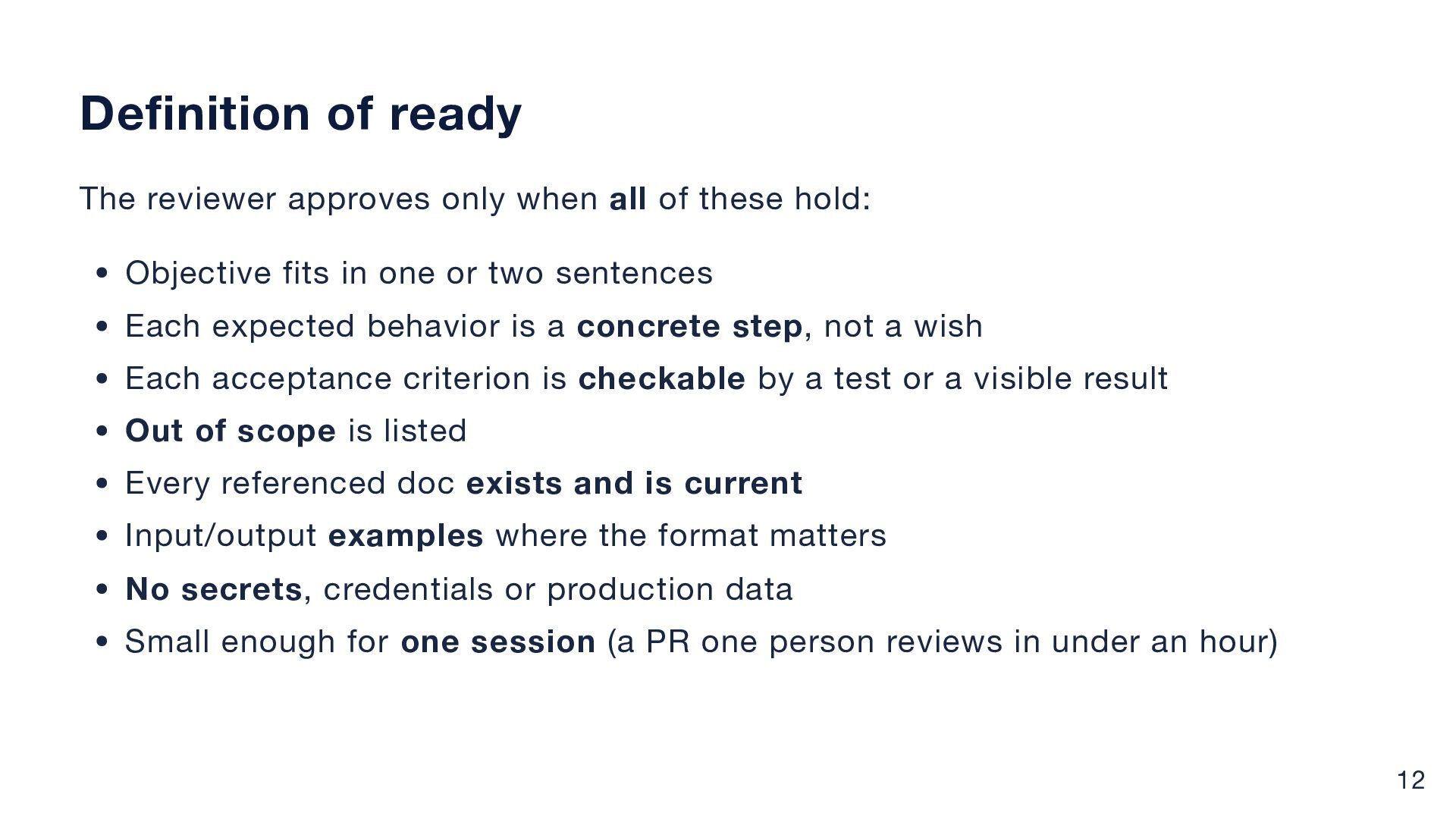
  10. Definition of ready The reviewer approves only when all of

    these hold: Objective fits in one or two sentences Each expected behavior is a concrete step, not a wish Each acceptance criterion is checkable by a test or a visible result Out of scope is listed Every referenced doc exists and is current Input/output examples where the format matters No secrets, credentials or production data Small enough for one session (a PR one person reviews in under an hour) 12
  11. What to delegate, what to keep Delegate Keep with the

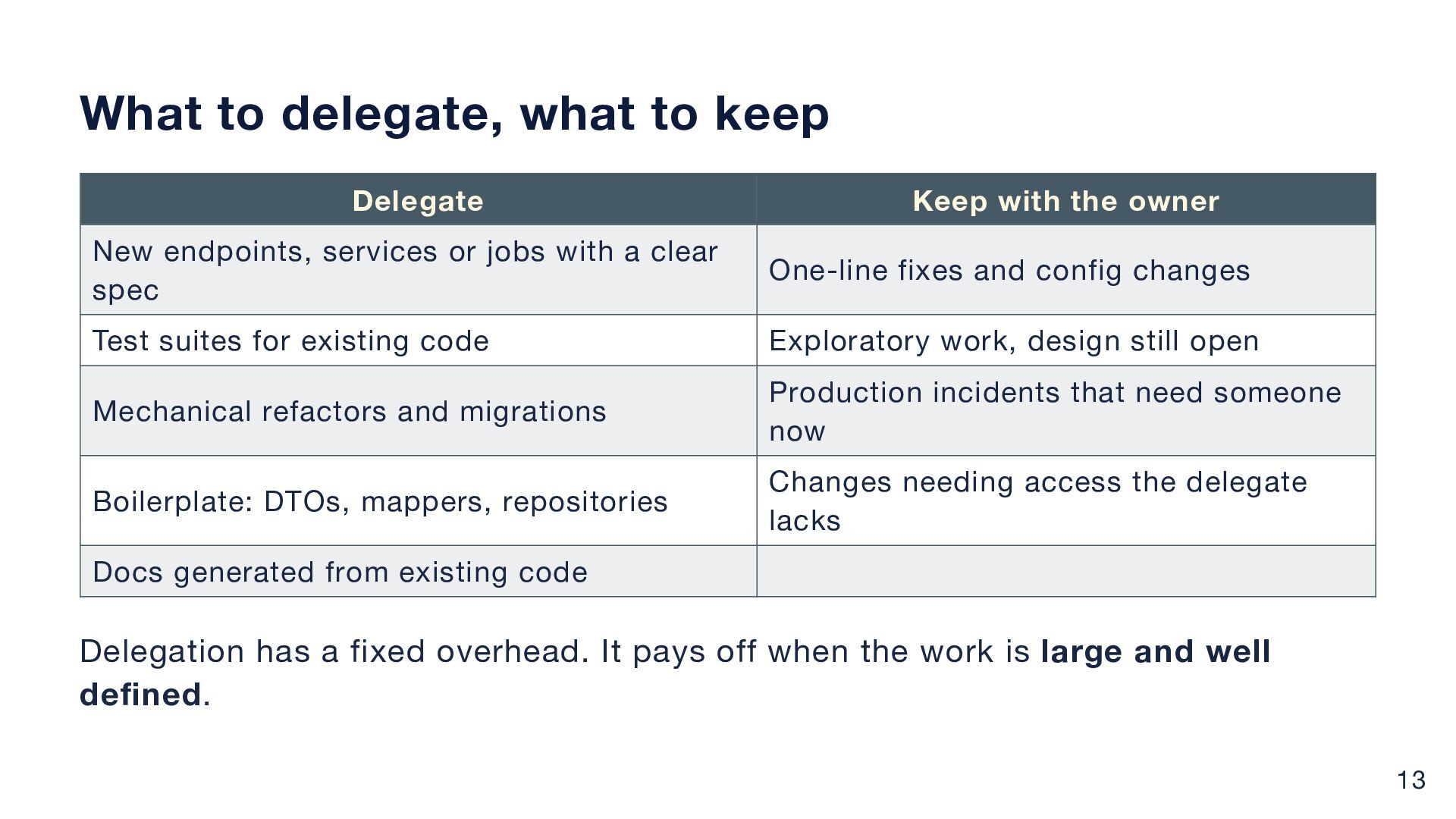
    owner New endpoints, services or jobs with a clear spec One-line fixes and config changes Test suites for existing code Exploratory work, design still open Mechanical refactors and migrations Production incidents that need someone now Boilerplate: DTOs, mappers, repositories Changes needing access the delegate lacks Docs generated from existing code Delegation has a fixed overhead. It pays off when the work is large and well defined. 13
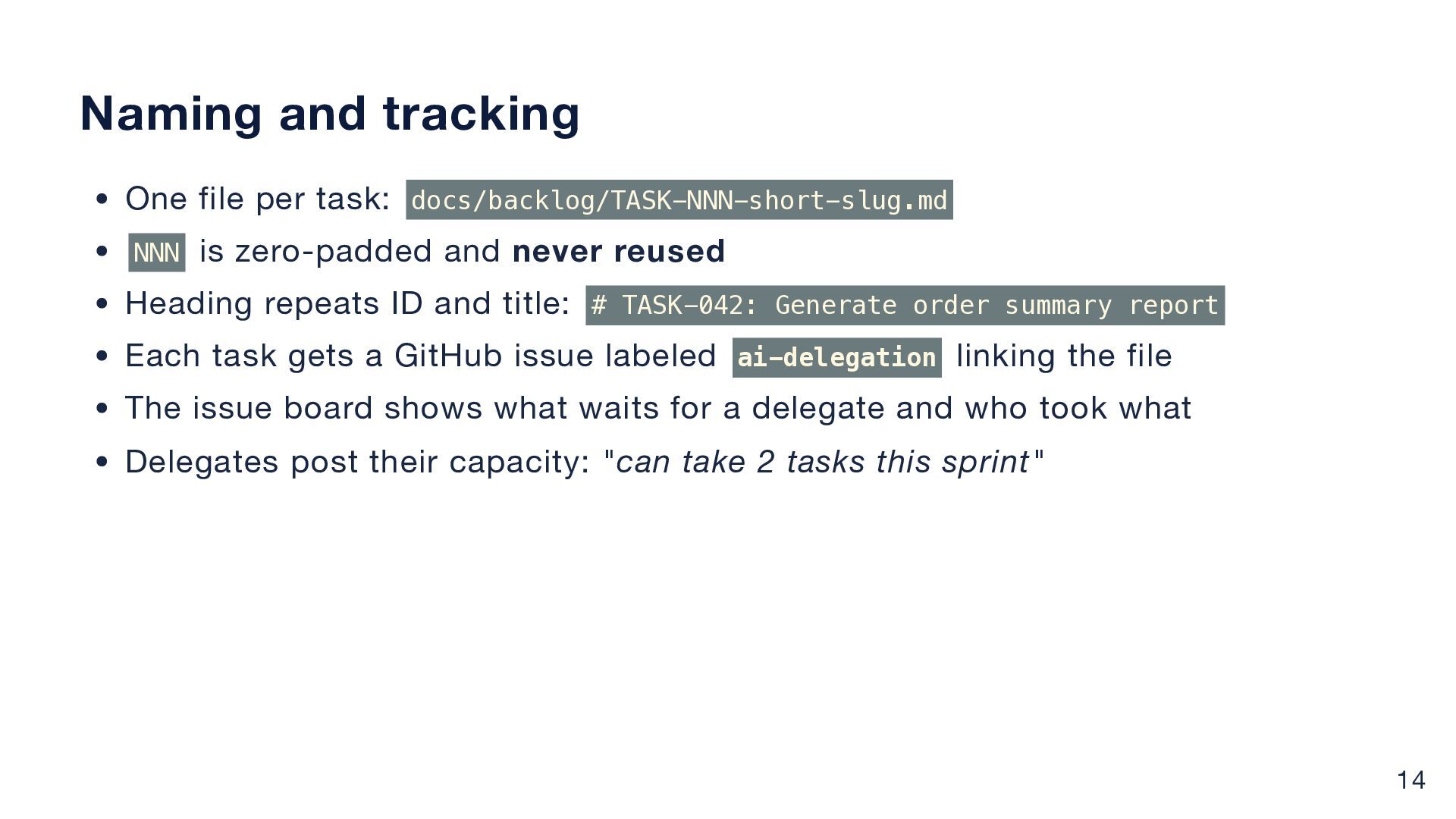
  12. Naming and tracking One file per task: docs/backlog/TASK-NNN-short-slug.md NNN is

    zero-padded and never reused Heading repeats ID and title: # TASK-042: Generate order summary report Each task gets a GitHub issue labeled ai-delegation linking the file The issue board shows what waits for a delegate and who took what Delegates post their capacity: "can take 2 tasks this sprint" 14
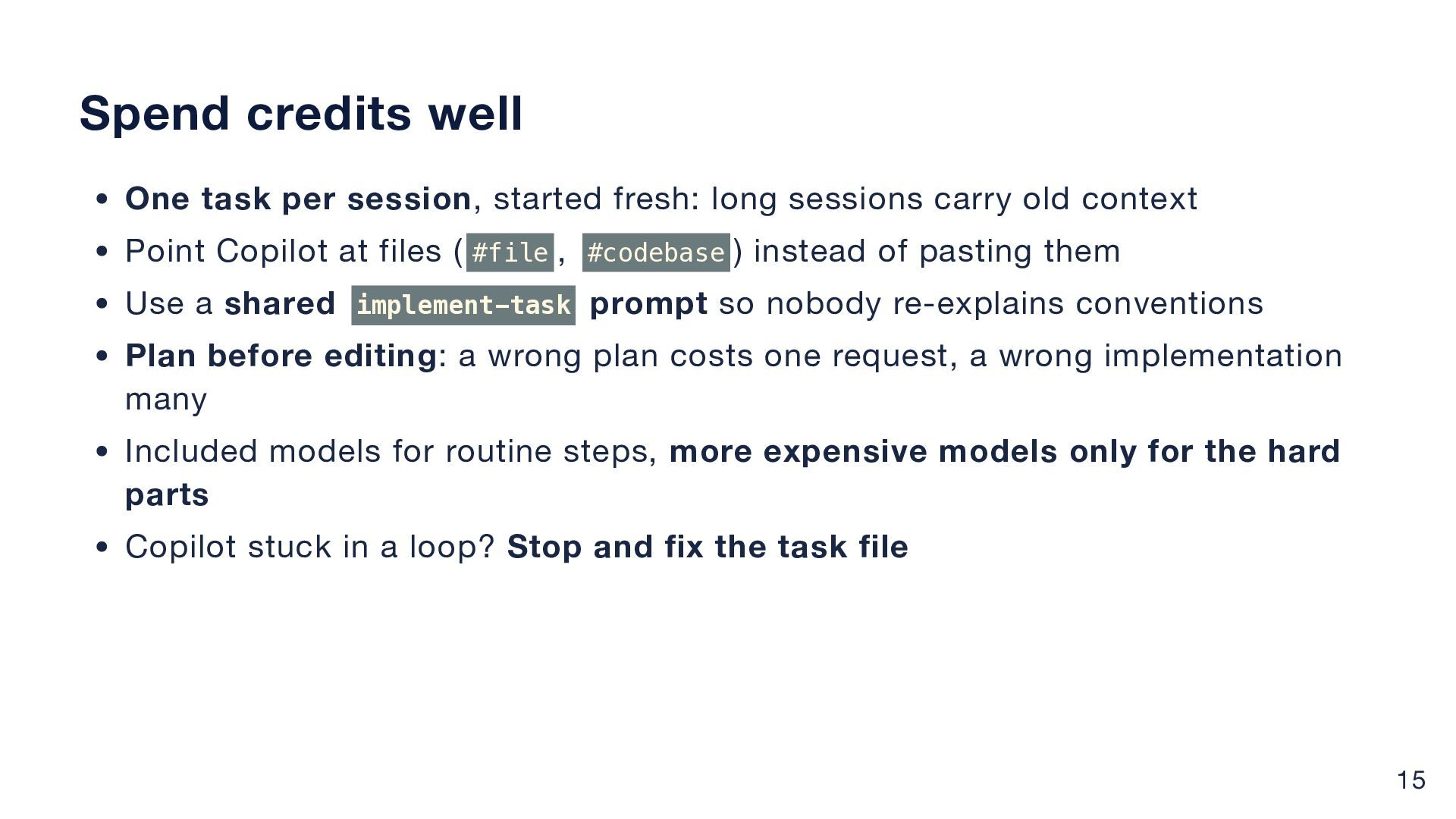
  13. Spend credits well One task per session, started fresh: long

    sessions carry old context Point Copilot at files ( #file , #codebase ) instead of pasting them Use a shared implement-task prompt so nobody re-explains conventions Plan before editing: a wrong plan costs one request, a wrong implementation many Included models for routine steps, more expensive models only for the hard parts Copilot stuck in a loop? Stop and fix the task file 15
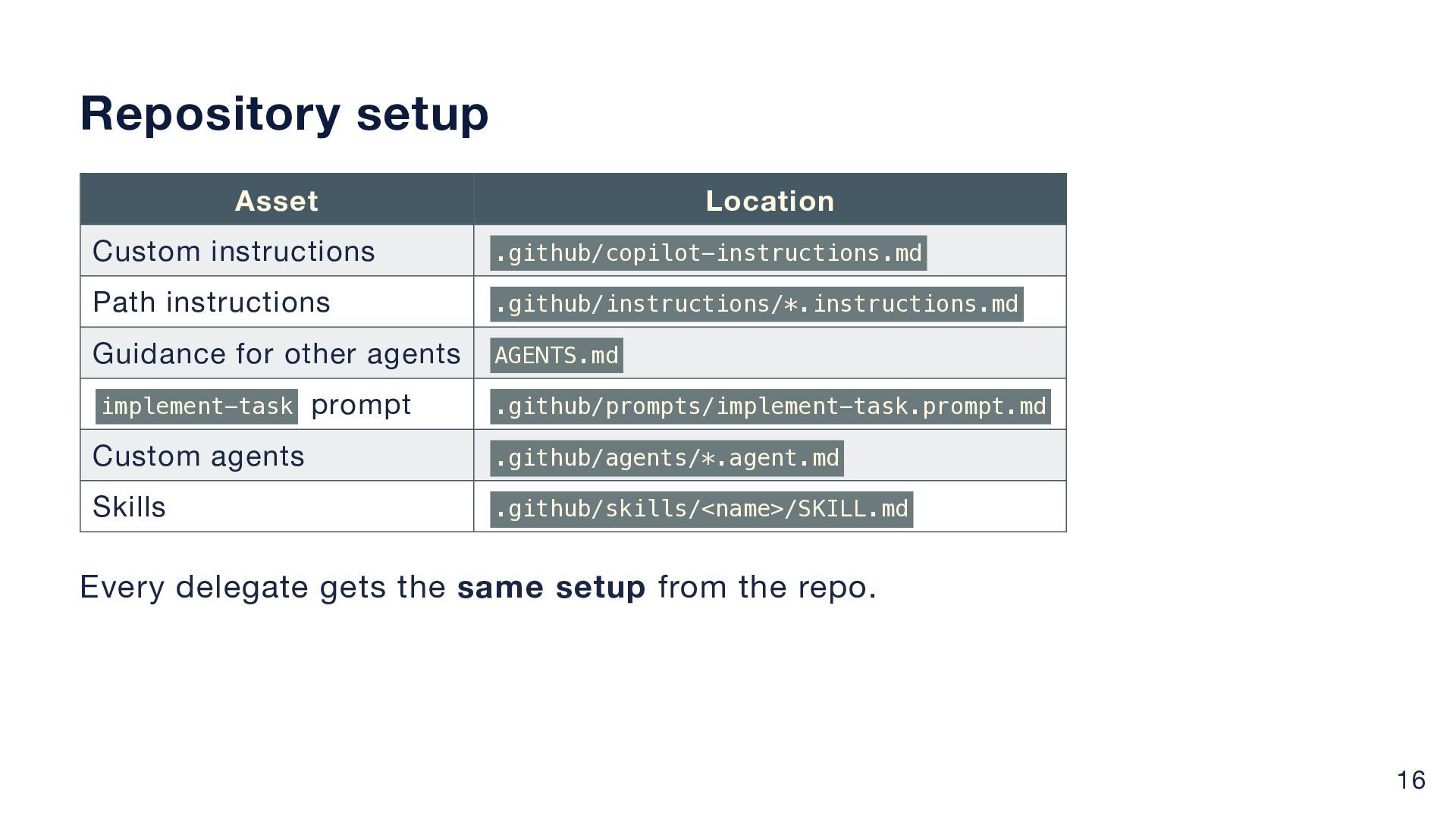
  14. Repository setup Asset Location Custom instructions .github/copilot-instructions.md Path instructions .github/instructions/*.instructions.md

    Guidance for other agents AGENTS.md implement-task prompt .github/prompts/implement-task.prompt.md Custom agents .github/agents/*.agent.md Skills .github/skills/<name>/SKILL.md Every delegate gets the same setup from the repo. 16
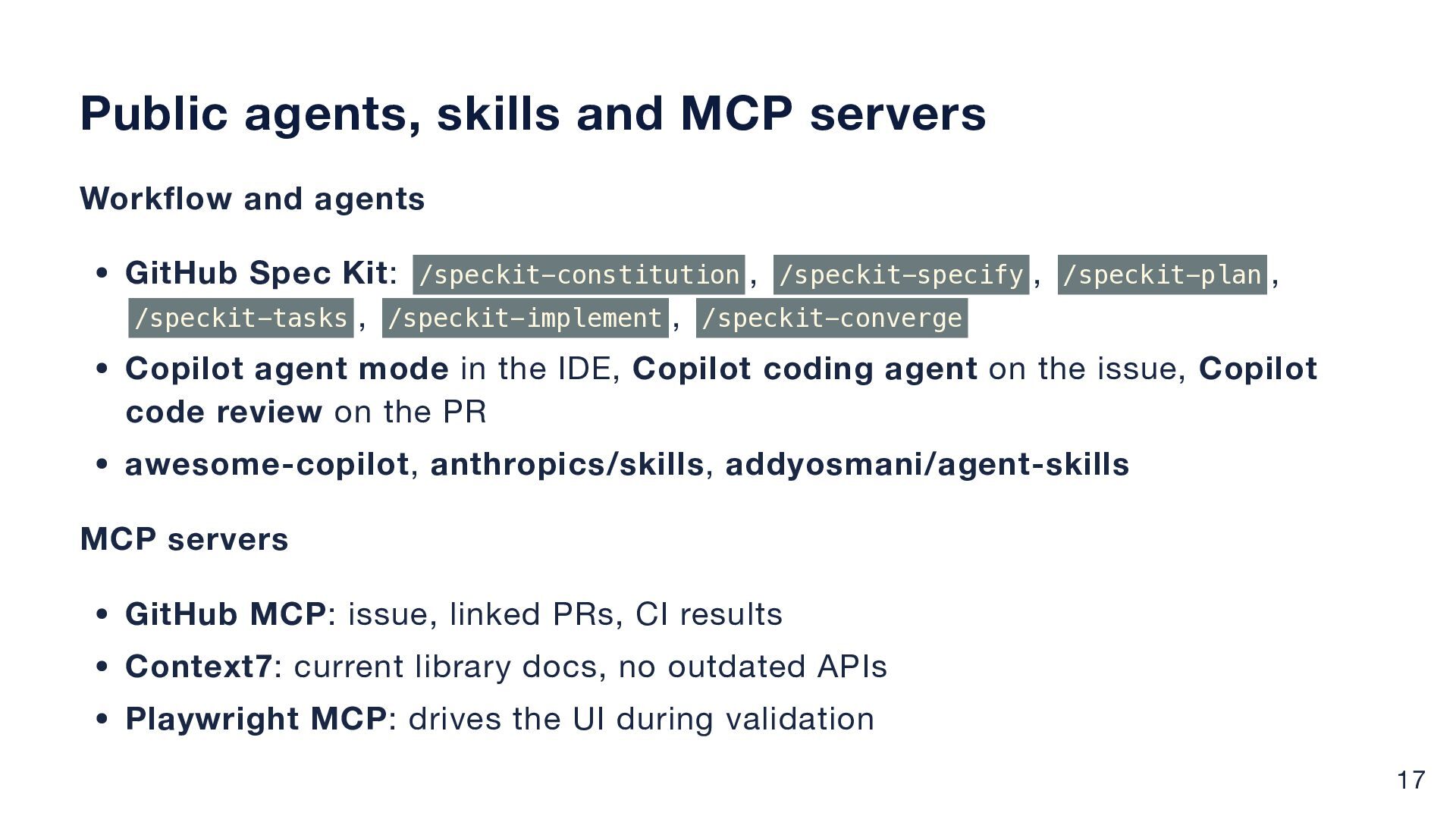
  15. Public agents, skills and MCP servers Workflow and agents GitHub

    Spec Kit: /speckit-constitution , /speckit-specify , /speckit-plan , /speckit-tasks , /speckit-implement , /speckit-converge Copilot agent mode in the IDE, Copilot coding agent on the issue, Copilot code review on the PR awesome-copilot, anthropics/skills, addyosmani/agent-skills MCP servers GitHub MCP: issue, linked PRs, CI results Context7: current library docs, no outdated APIs Playwright MCP: drives the UI during validation 17
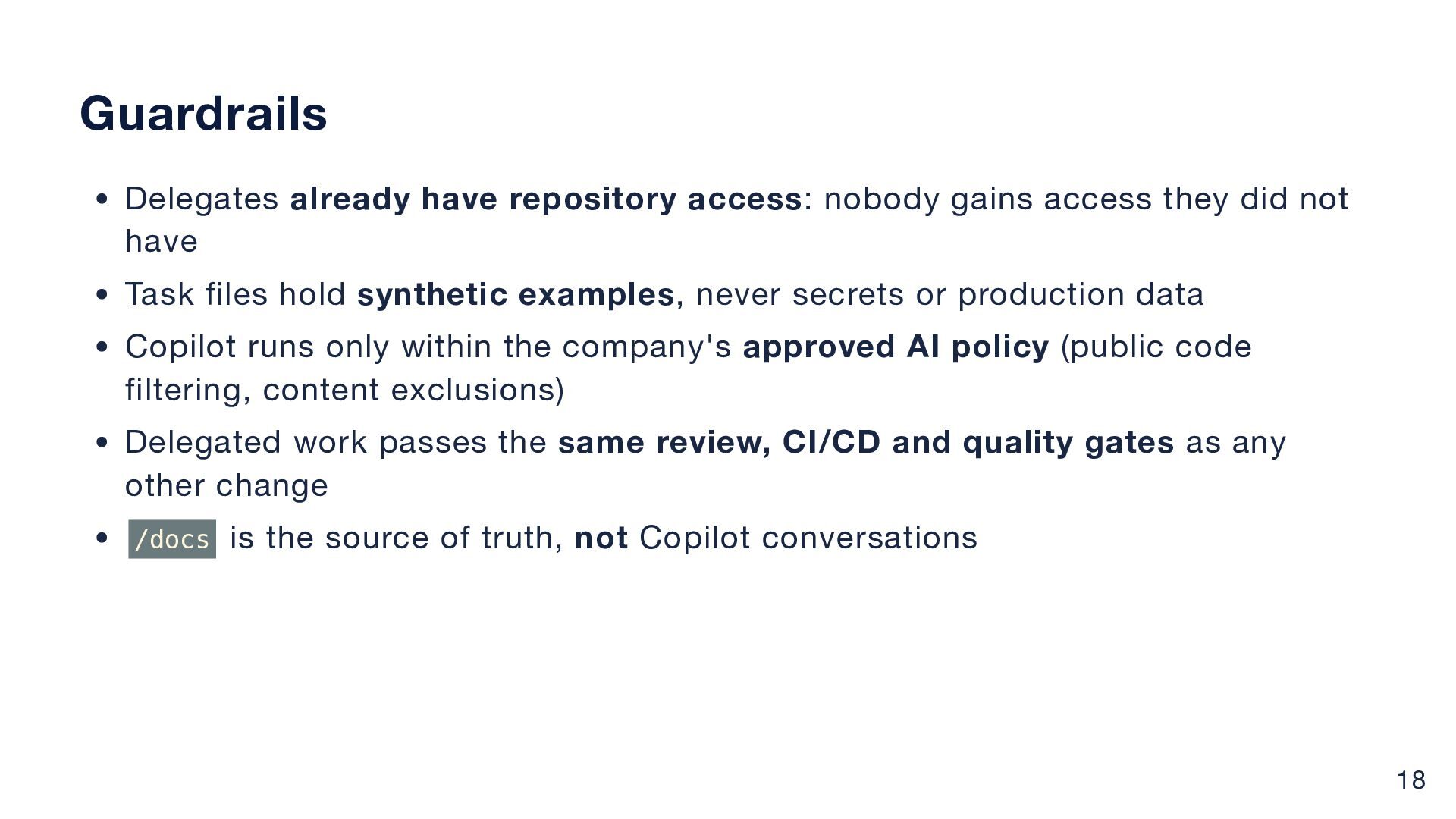
  16. Guardrails Delegates already have repository access: nobody gains access they

    did not have Task files hold synthetic examples, never secrets or production data Copilot runs only within the company's approved AI policy (public code filtering, content exclusions) Delegated work passes the same review, CI/CD and quality gates as any other change /docs is the source of truth, not Copilot conversations 18
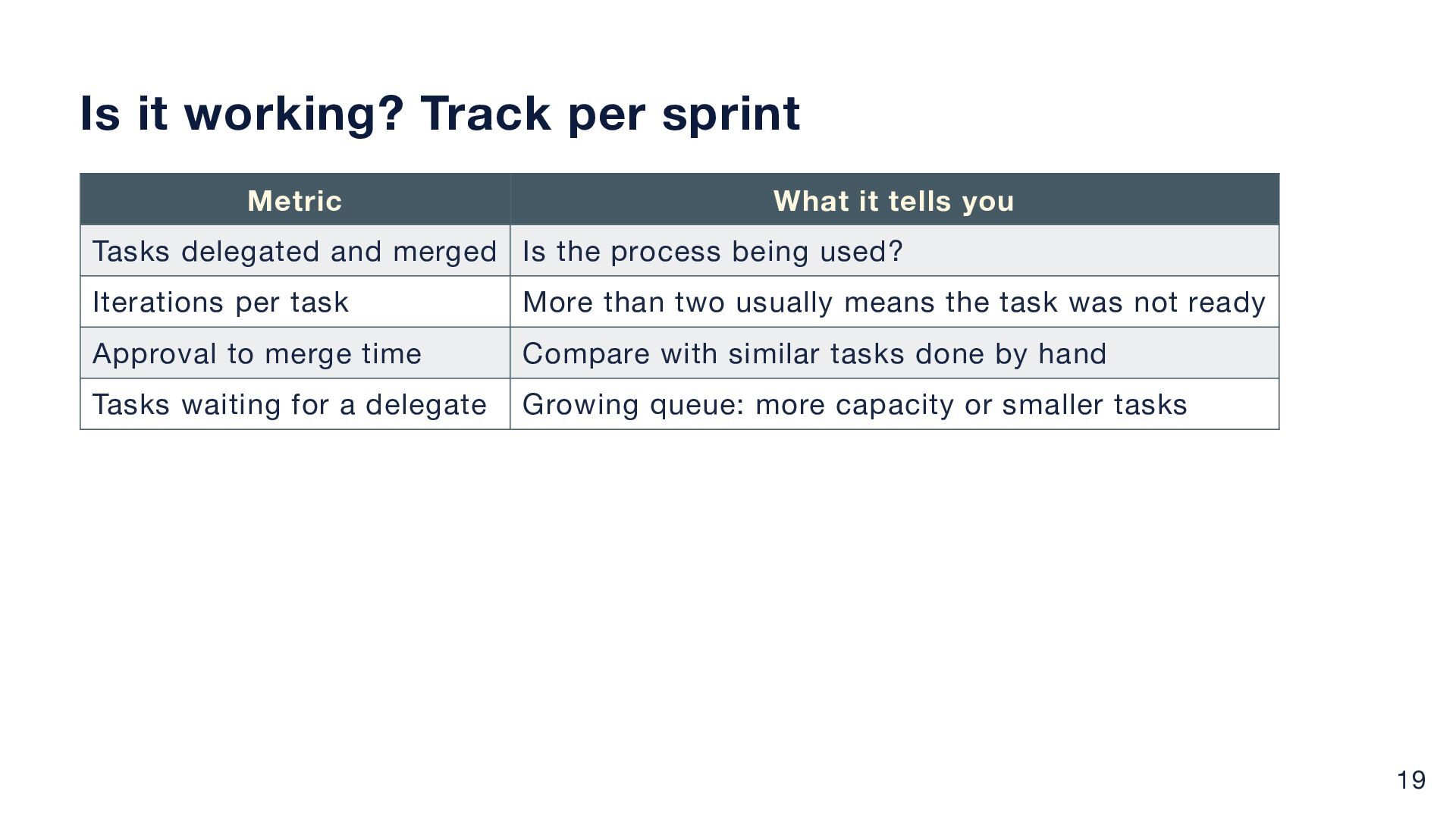
  17. Is it working? Track per sprint Metric What it tells

    you Tasks delegated and merged Is the process being used? Iterations per task More than two usually means the task was not ready Approval to merge time Compare with similar tasks done by hand Tasks waiting for a delegate Growing queue: more capacity or smaller tasks 19
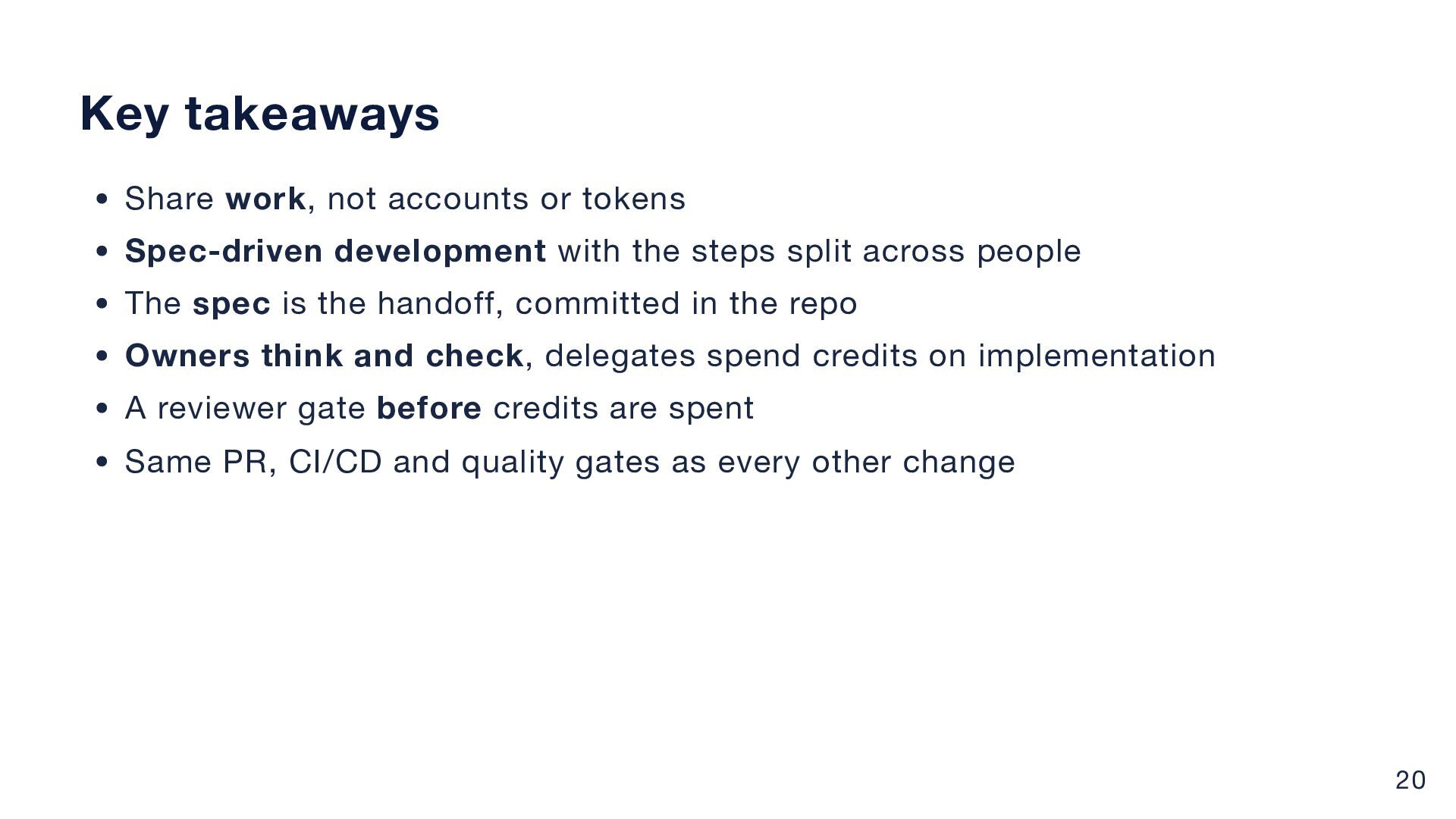
  18. Key takeaways Share work, not accounts or tokens Spec-driven development

    with the steps split across people The spec is the handoff, committed in the repo Owners think and check, delegates spend credits on implementation A reviewer gate before credits are spent Same PR, CI/CD and quality gates as every other change 20
  19. Resources Repo (PRD + sample task + design doc): github.com/wallaceespindola/share-tokens-using-spec-driven-dev

    GitHub Spec Kit: github.com/github/spec-kit Wallace Espindola, Solution Architect [email protected] linkedin.com/in/wallaceespindola | github.com/wallaceespindola Thanks! Questions? 21