Share
Embed
Understand, Then Modernize: AI and the Solution Architect in Banking Legacy
Modernizing a bank's legacy core is mostly an understanding problem, not a rewrite problem. This talk shows where AI speeds up discovery and rule extraction, and why deterministic tooling, domain experts and the legacy system as test oracle still decide correctness. It covers the modernization loop, strategy options per capability, strangler coexistence, AI controls, a one-cent COBOL rounding example with its Java port and golden-master test, and a first 90-day plan.
Repo with the context, rule catalog, COBOL and Java examples: https://github.com/wallaceespindola/banking-modernization-with-ai
Wallace Espindola
November 13, 2026
Transcript
21 slides
-
Understand, Then Modernize AI and the solution architect in banking
legacy Wallace Espindola Solution Architect [email protected] linkedin.com/in/wallaceespindola | github.com/wallaceespindola -
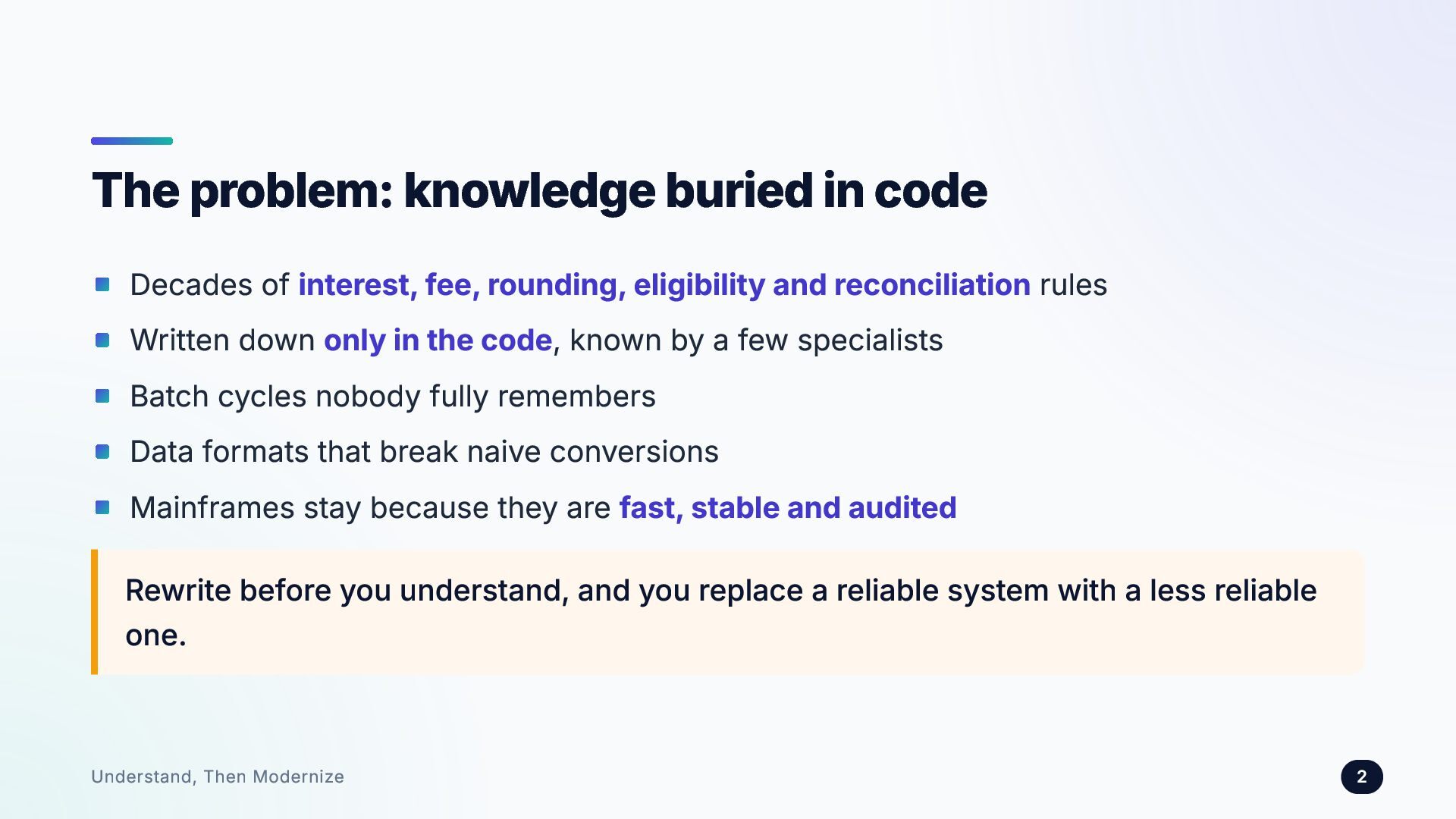
The problem: knowledge buried in code Decades of interest, fee,
rounding, eligibility and reconciliation rules Written down only in the code, known by a few specialists Batch cycles nobody fully remembers Data formats that break naive conversions Mainframes stay because they are fast, stable and audited Rewrite before you understand, and you replace a reliable system with a less reliable one. Understand, Then Modernize 2 -
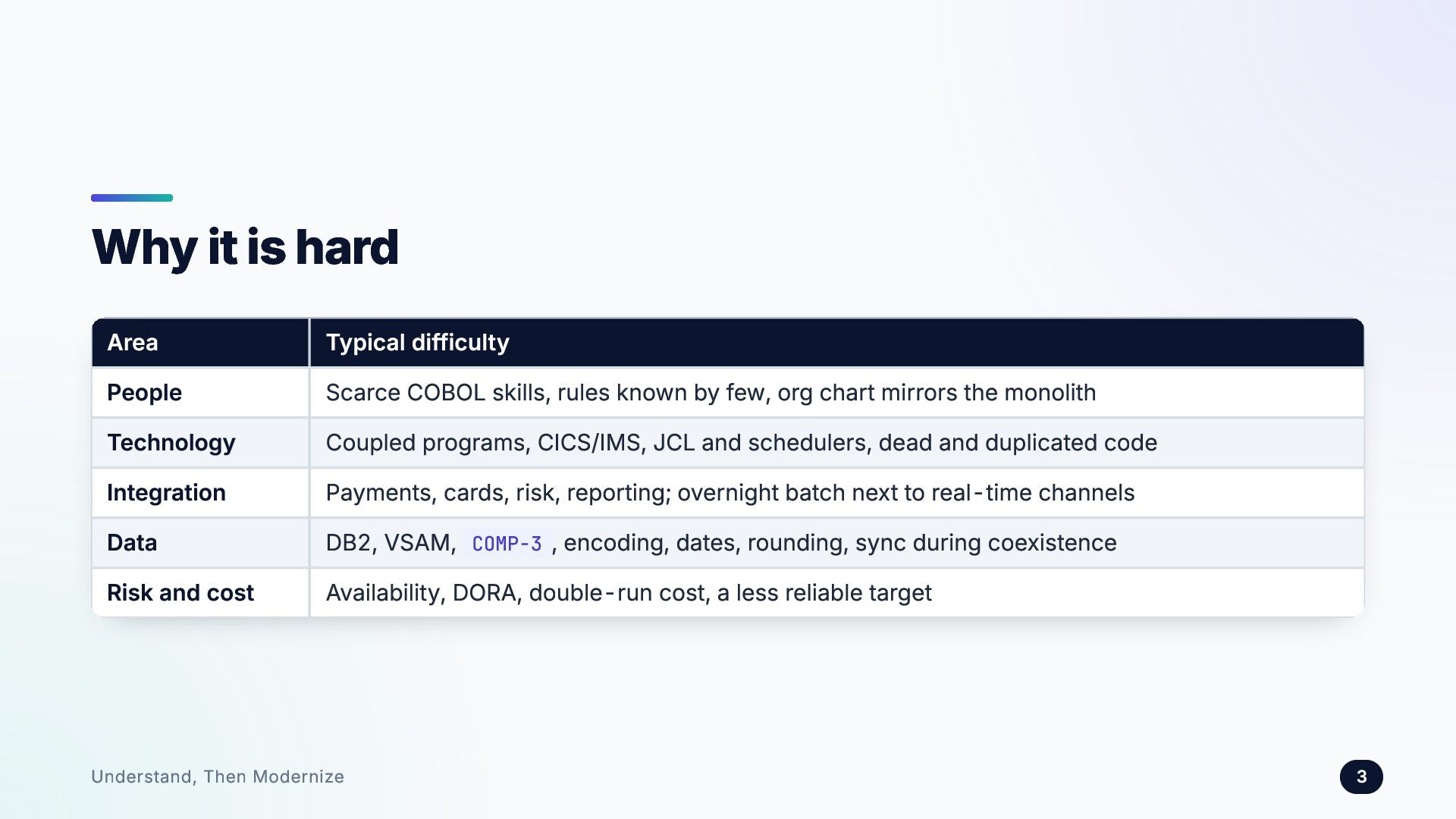
Why it is hard Area Typical difficulty People Scarce COBOL
skills, rules known by few, org chart mirrors the monolith Technology Coupled programs, CICS/IMS, JCL and schedulers, dead and duplicated code Integration Payments, cards, risk, reporting; overnight batch next to real-time channels Data DB2, VSAM, COMP-3 , encoding, dates, rounding, sync during coexistence Risk and cost Availability, DORA, double-run cost, a less reliable target Understand, Then Modernize 3 -
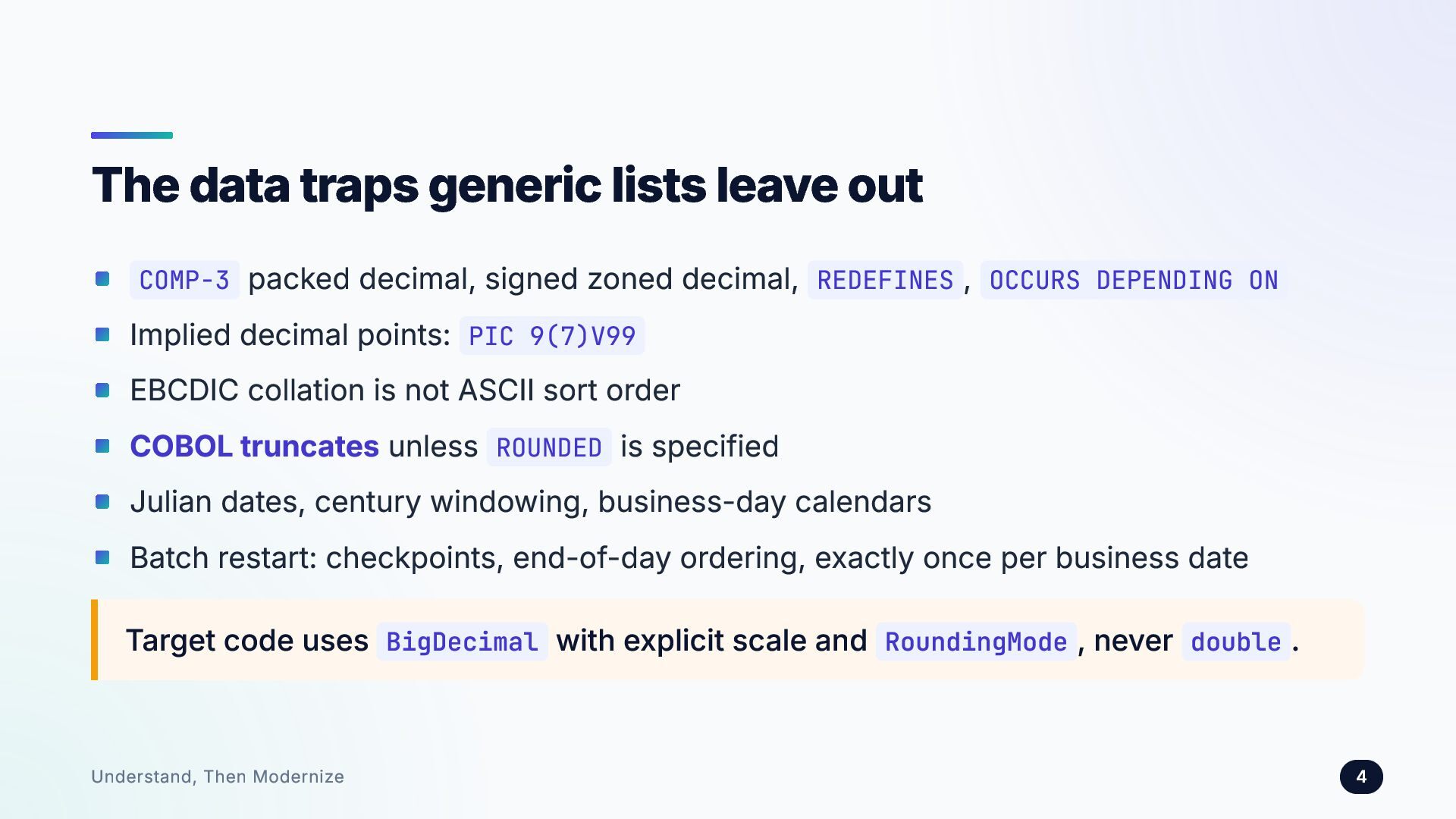
The data traps generic lists leave out COMP-3 packed decimal,
signed zoned decimal, REDEFINES , OCCURS DEPENDING ON Implied decimal points: PIC 9(7)V99 EBCDIC collation is not ASCII sort order COBOL truncates unless ROUNDED is specified Julian dates, century windowing, business-day calendars Batch restart: checkpoints, end-of-day ordering, exactly once per business date Target code uses BigDecimal with explicit scale and RoundingMode , never double . Understand, Then Modernize 4 -
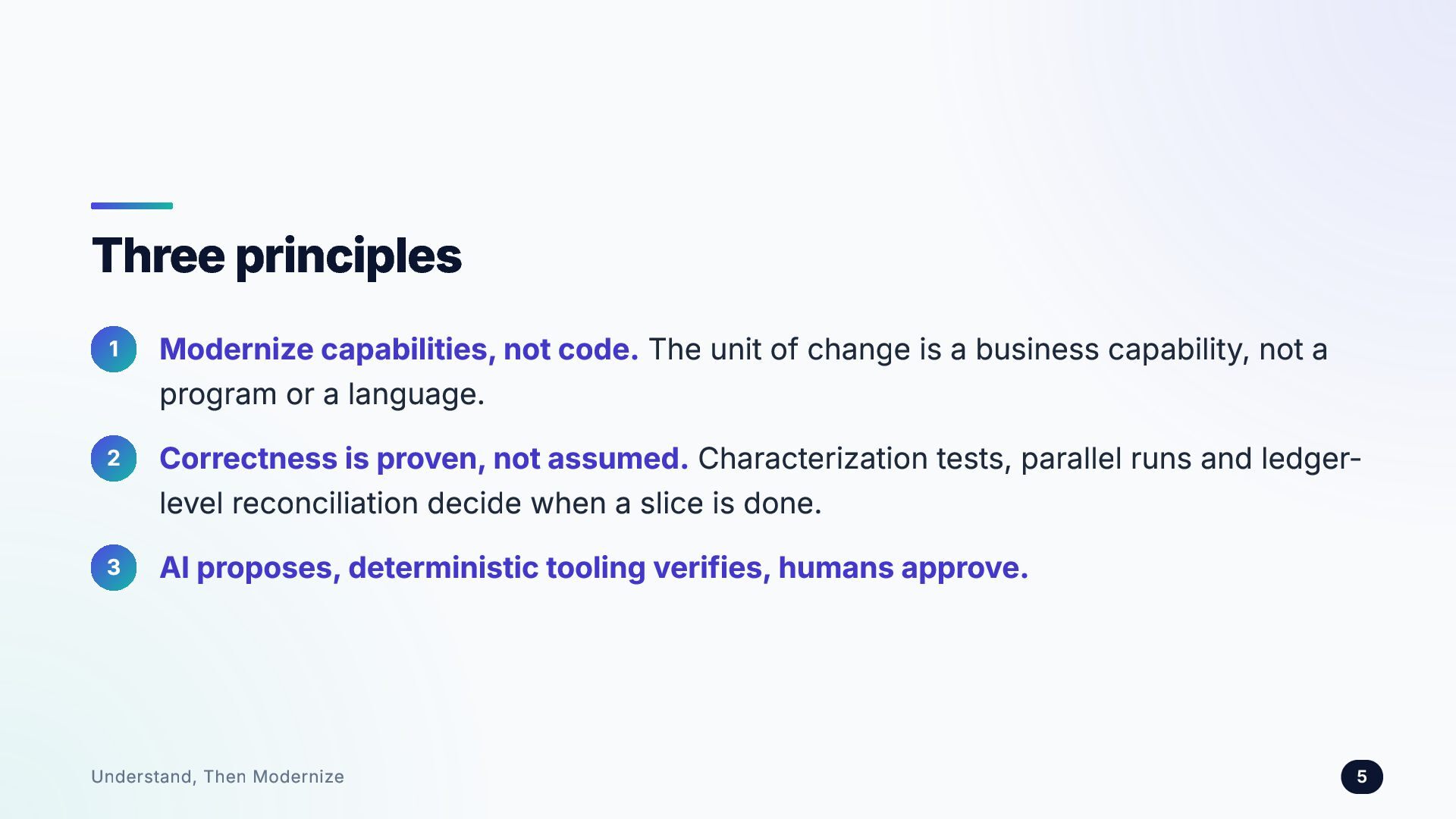
Three principles 1 Modernize capabilities, not code. The unit of
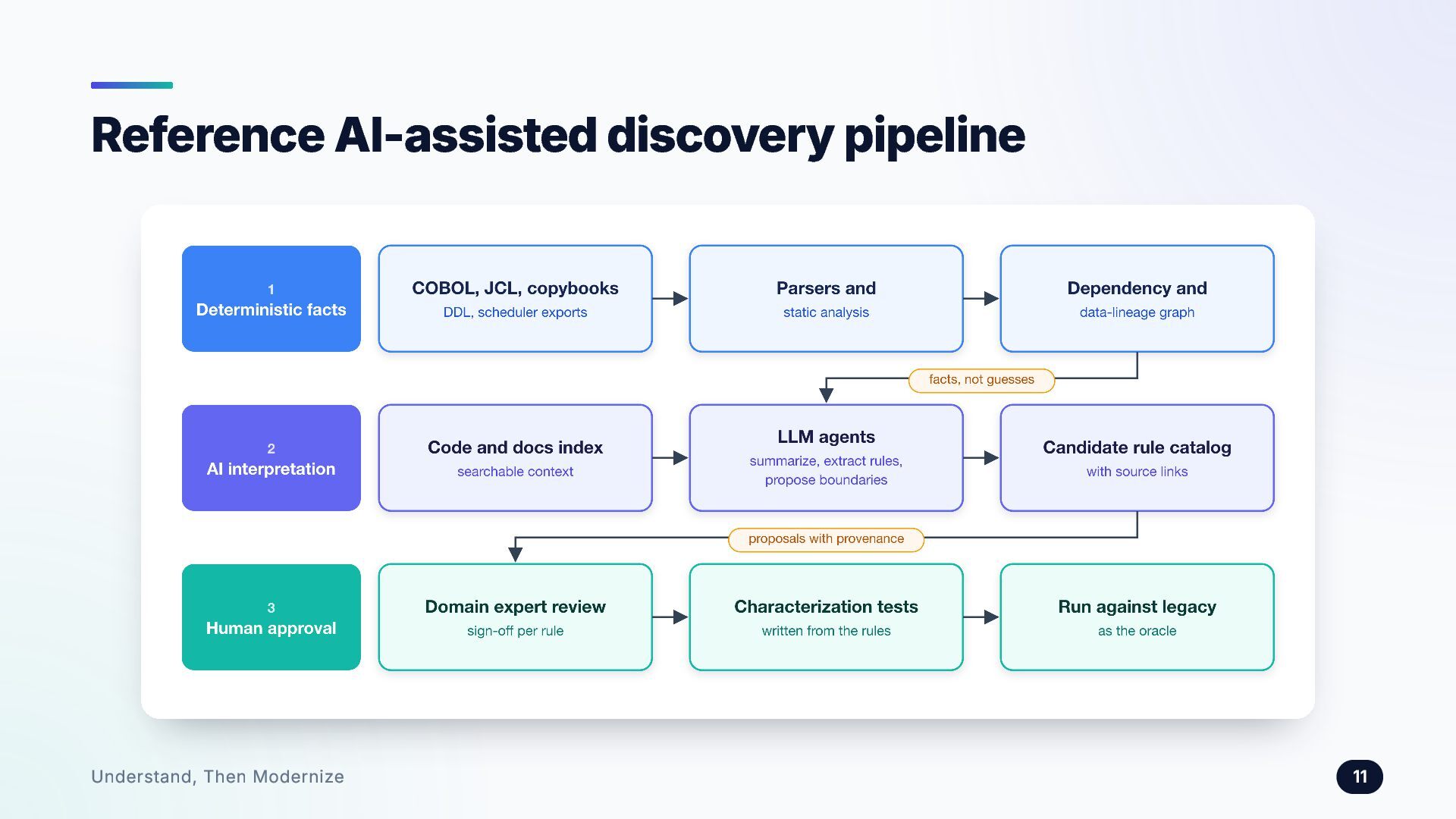
change is a business capability, not a program or a language. 2 Correctness is proven, not assumed. Characterization tests, parallel runs and ledgerlevel reconciliation decide when a slice is done. 3 AI proposes, deterministic tooling verifies, humans approve. Understand, Then Modernize 5 -
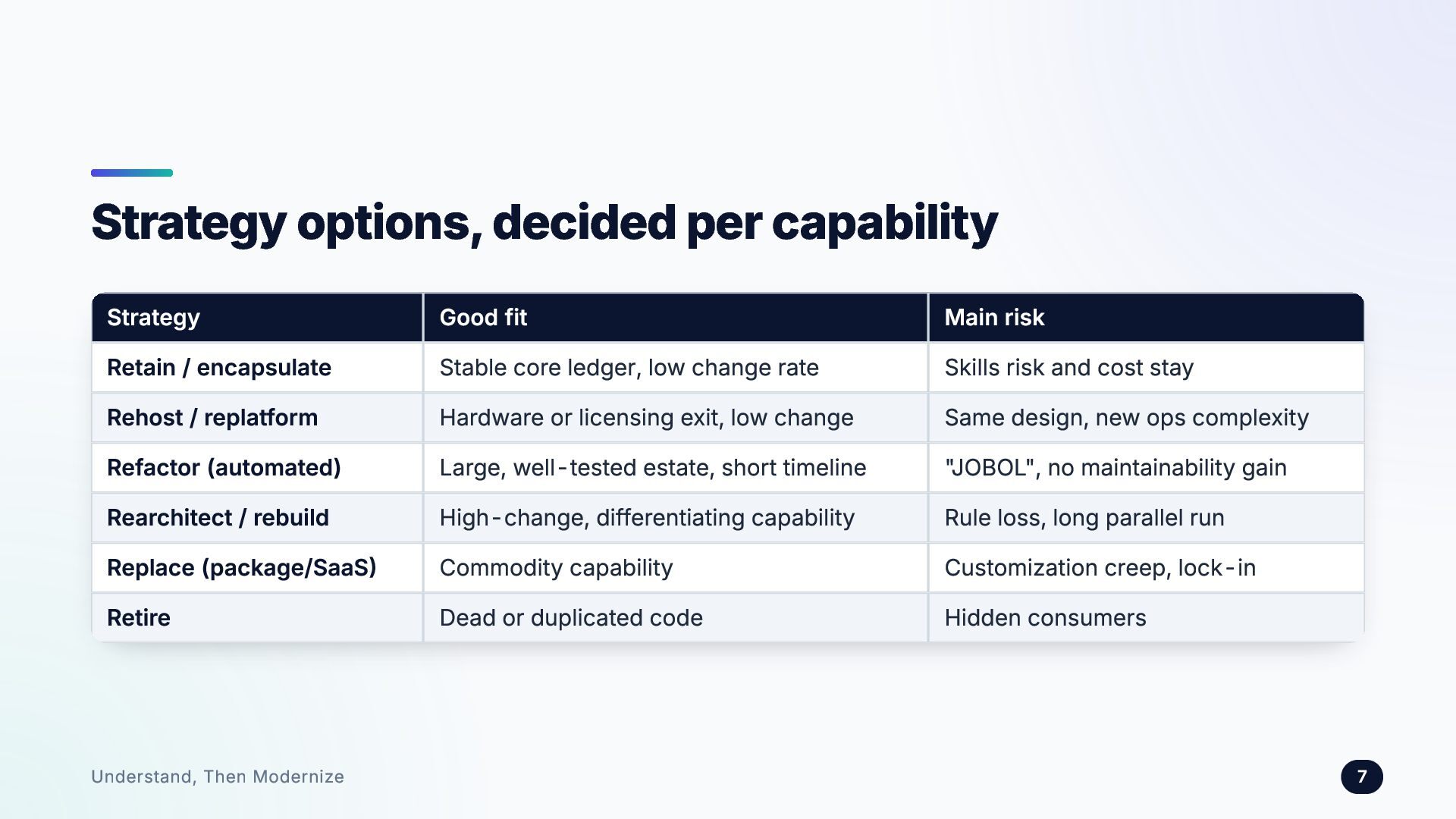
Strategy options, decided per capability Strategy Good fit Main risk
Retain / encapsulate Stable core ledger, low change rate Skills risk and cost stay Rehost / replatform Hardware or licensing exit, low change Same design, new ops complexity Refactor (automated) Large, well-tested estate, short timeline "JOBOL", no maintainability gain Rearchitect / rebuild High-change, differentiating capability Rule loss, long parallel run Replace (package/SaaS) Commodity capability Customization creep, lock-in Retire Dead or duplicated code Hidden consumers Understand, Then Modernize 7 -
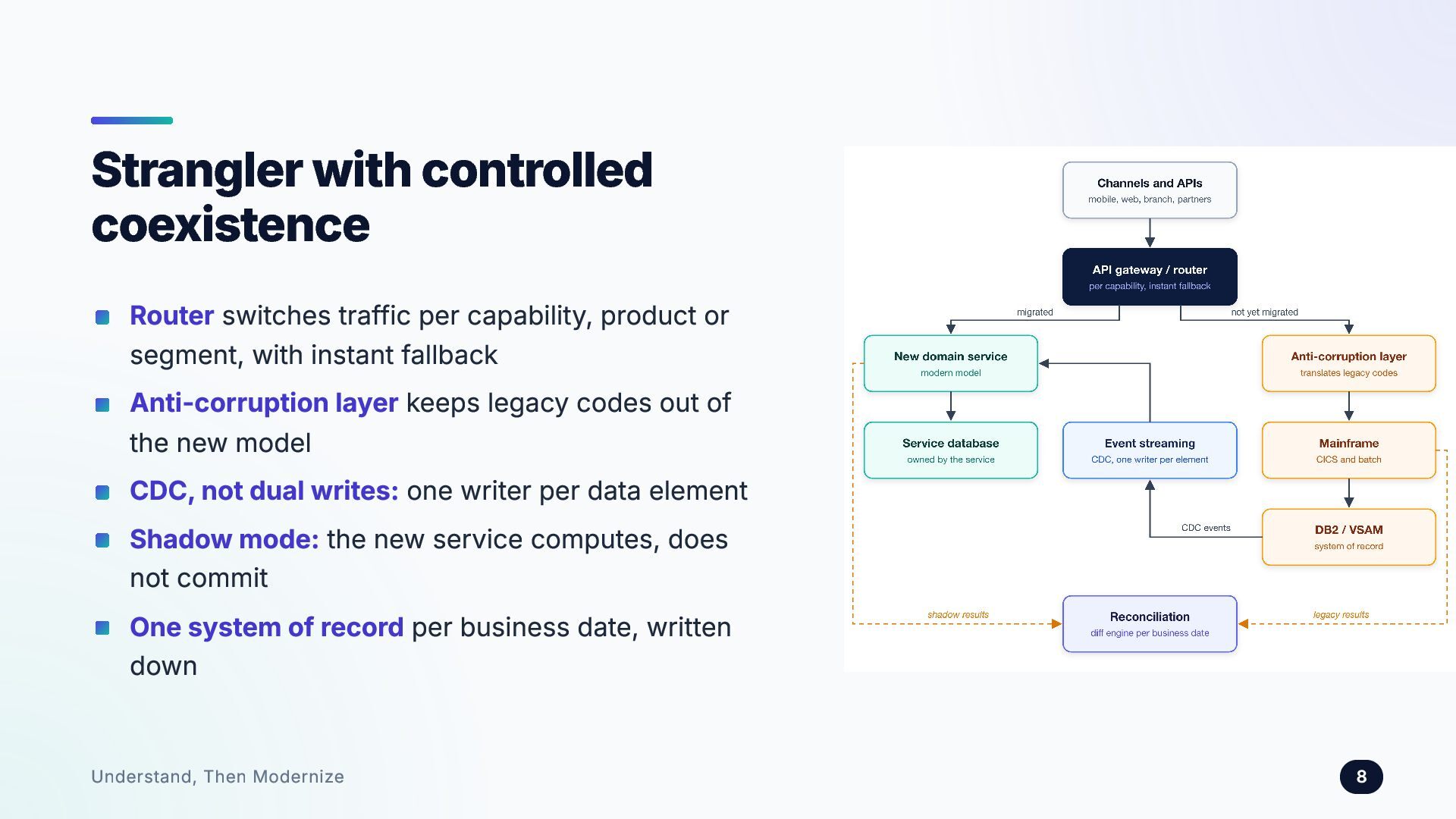
Strangler with controlled coexistence Router switches traffic per capability, product
or segment, with instant fallback Anti-corruption layer keeps legacy codes out of the new model CDC, not dual writes: one writer per data element Shadow mode: the new service computes, does not commit One system of record per business date, written down Understand, Then Modernize 8 -
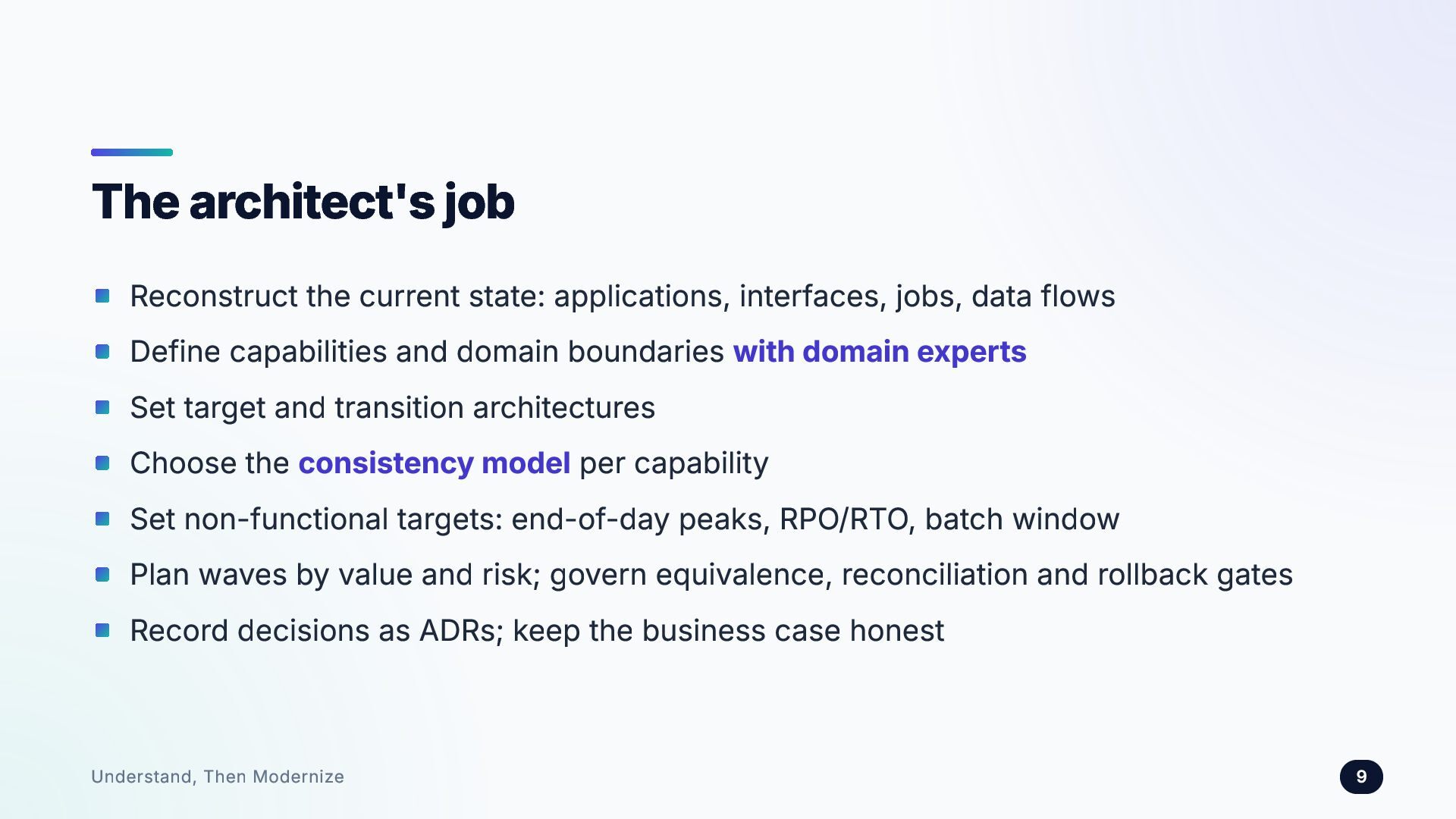
The architect's job Reconstruct the current state: applications, interfaces, jobs,
data flows Define capabilities and domain boundaries with domain experts Set target and transition architectures Choose the consistency model per capability Set non-functional targets: end-of-day peaks, RPO/RTO, batch window Plan waves by value and risk; govern equivalence, reconciliation and rollback gates Record decisions as ADRs; keep the business case honest Understand, Then Modernize 9 -
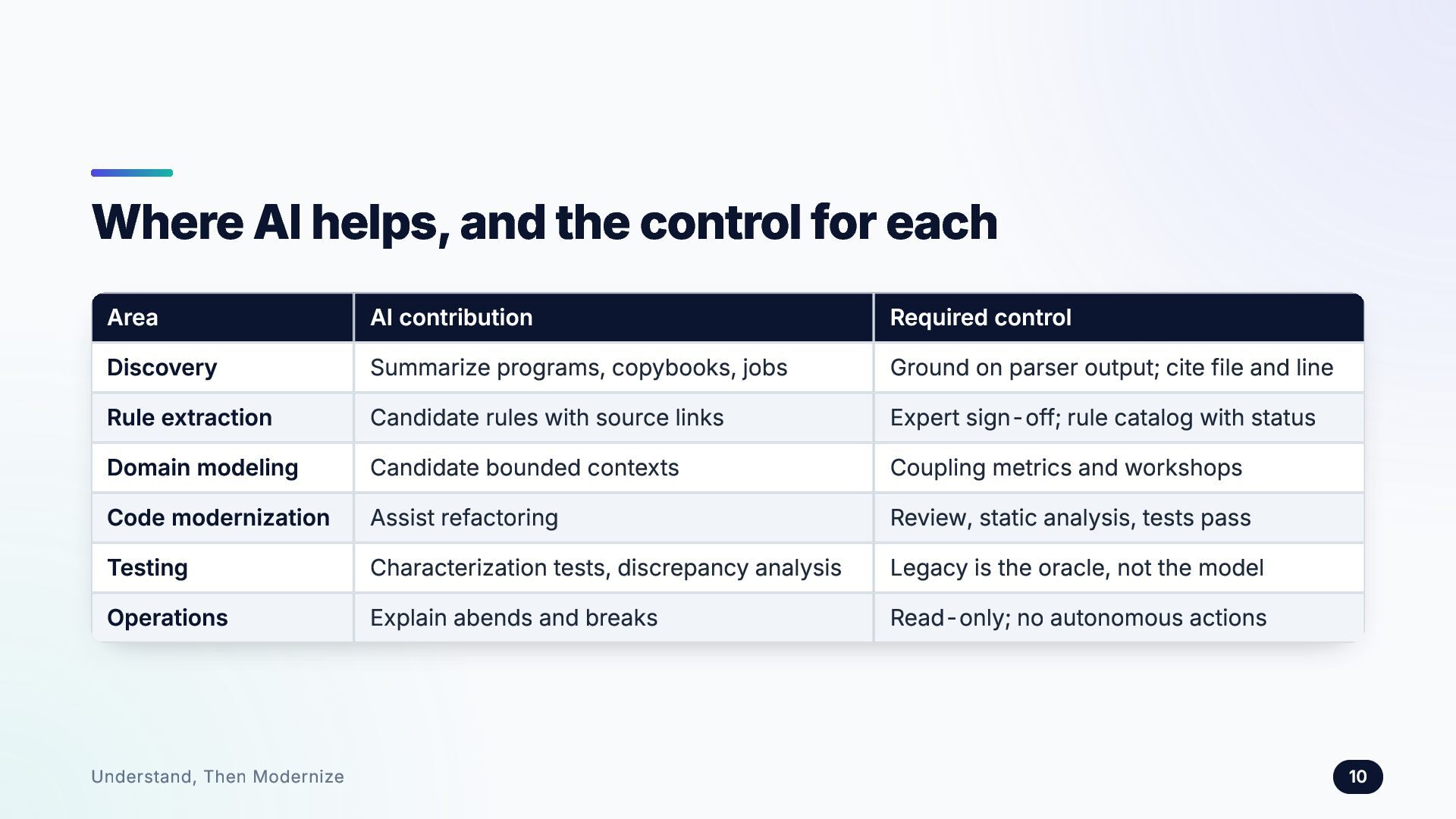
Where AI helps, and the control for each Area AI
contribution Required control Discovery Summarize programs, copybooks, jobs Ground on parser output; cite file and line Rule extraction Candidate rules with source links Expert sign-off; rule catalog with status Domain modeling Candidate bounded contexts Coupling metrics and workshops Code modernization Assist refactoring Review, static analysis, tests pass Testing Characterization tests, discrepancy analysis Legacy is the oracle, not the model Operations Explain abends and breaks Read-only; no autonomous actions Understand, Then Modernize 10 -
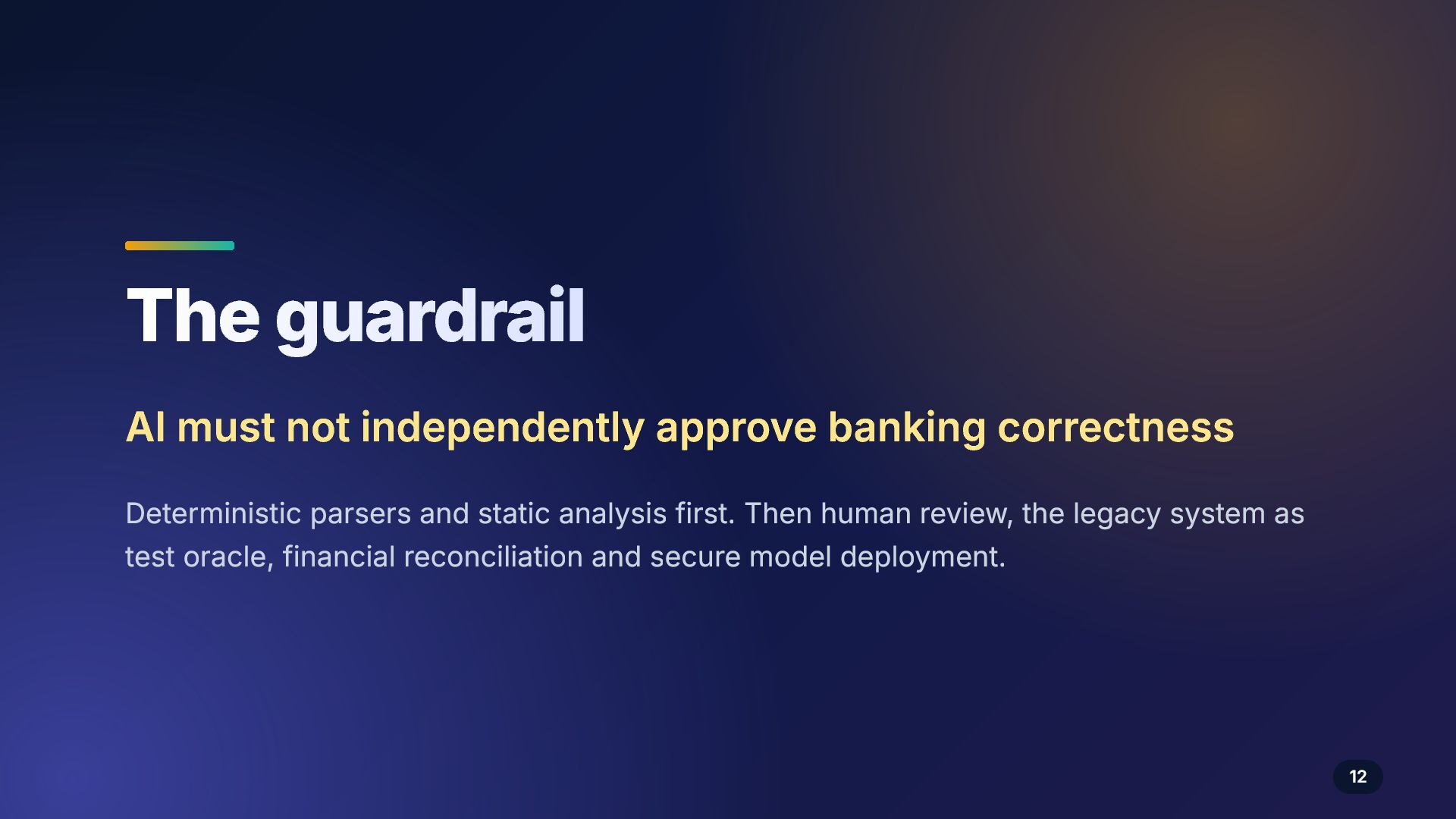
The guardrail AI must not independently approve banking correctness Deterministic
parsers and static analysis first. Then human review, the legacy system as test oracle, financial reconciliation and secure model deployment. 12 -
One cent: the legacy rule Rule BR-INT-001, monthly interest, from
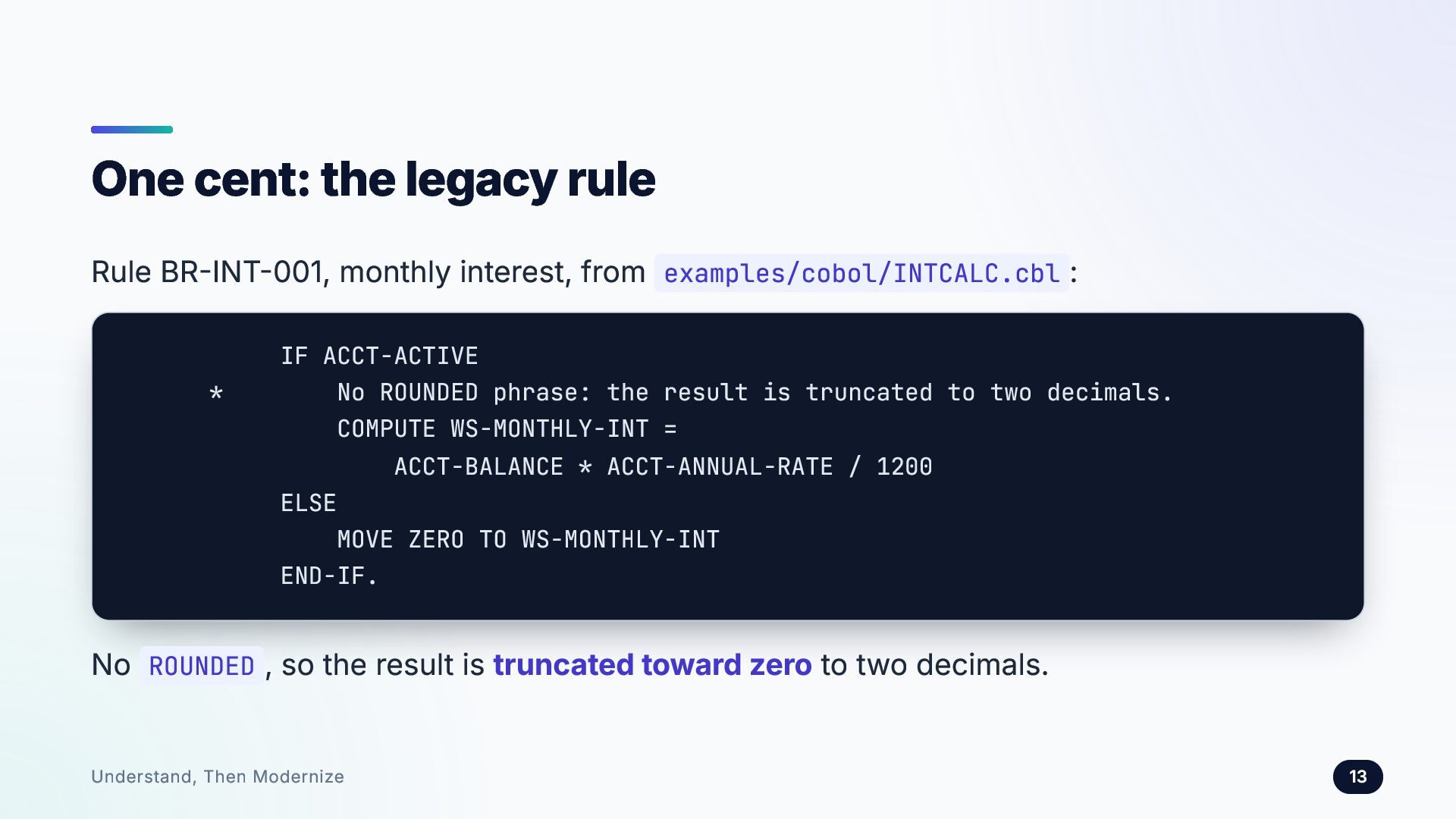
examples/cobol/INTCALC.cbl : * IF ACCT-ACTIVE No ROUNDED phrase: the result is truncated to two decimals. COMPUTE WS-MONTHLY-INT = ACCT-BALANCE * ACCT-ANNUAL-RATE / 1200 ELSE MOVE ZERO TO WS-MONTHLY-INT END-IF. No ROUNDED , so the result is truncated toward zero to two decimals. Understand, Then Modernize 13 -
Two Java ports, one of them wrong From InterestRule.java :
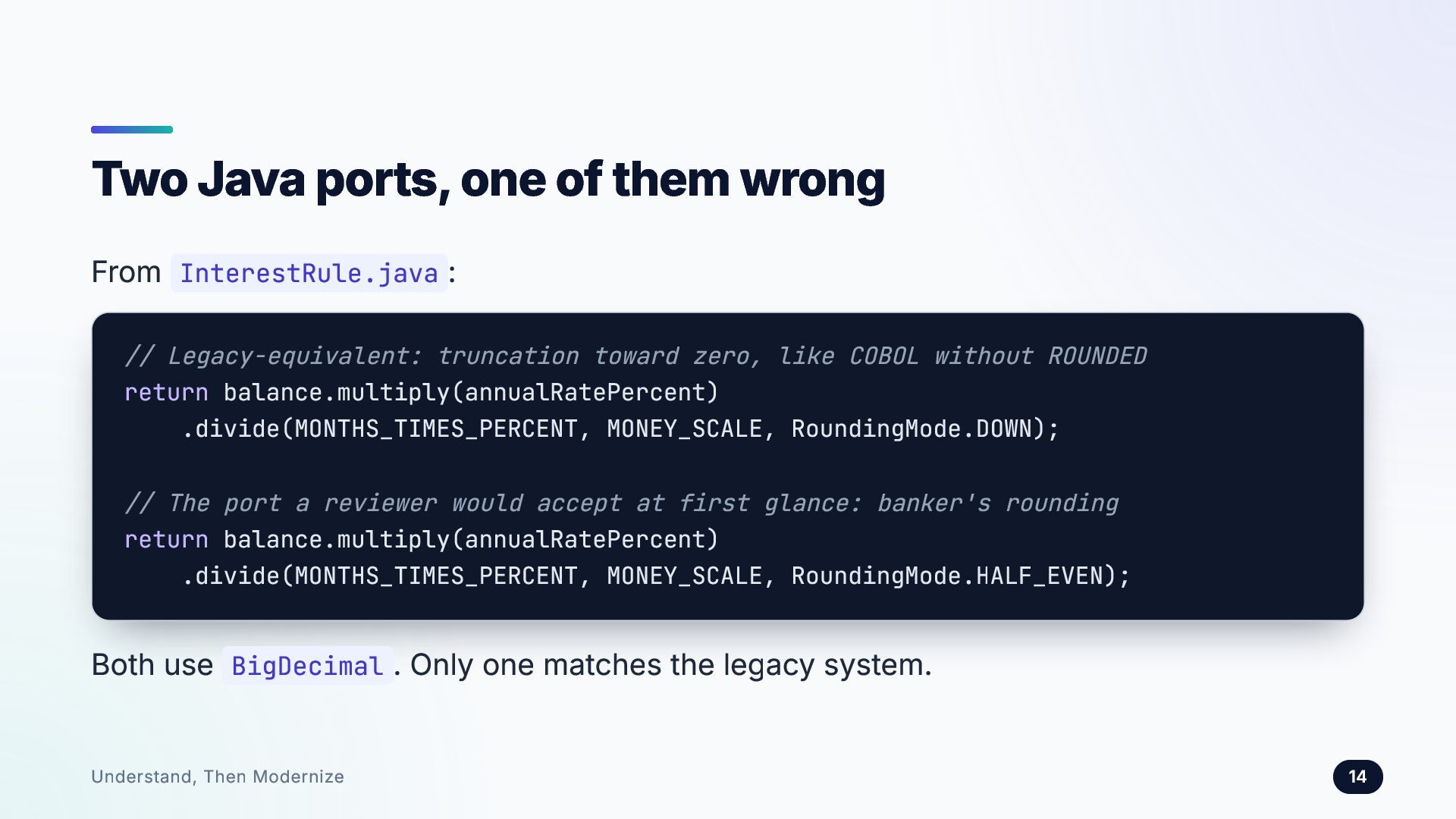
// Legacy-equivalent: truncation toward zero, like COBOL without ROUNDED return balance.multiply(annualRatePercent) .divide(MONTHS_TIMES_PERCENT, MONEY_SCALE, RoundingMode.DOWN); // The port a reviewer would accept at first glance: banker's rounding return balance.multiply(annualRatePercent) .divide(MONTHS_TIMES_PERCENT, MONEY_SCALE, RoundingMode.HALF_EVEN); Both use BigDecimal . Only one matches the legacy system. Understand, Then Modernize 14 -
The golden master catches it: 3 of 8 accounts break
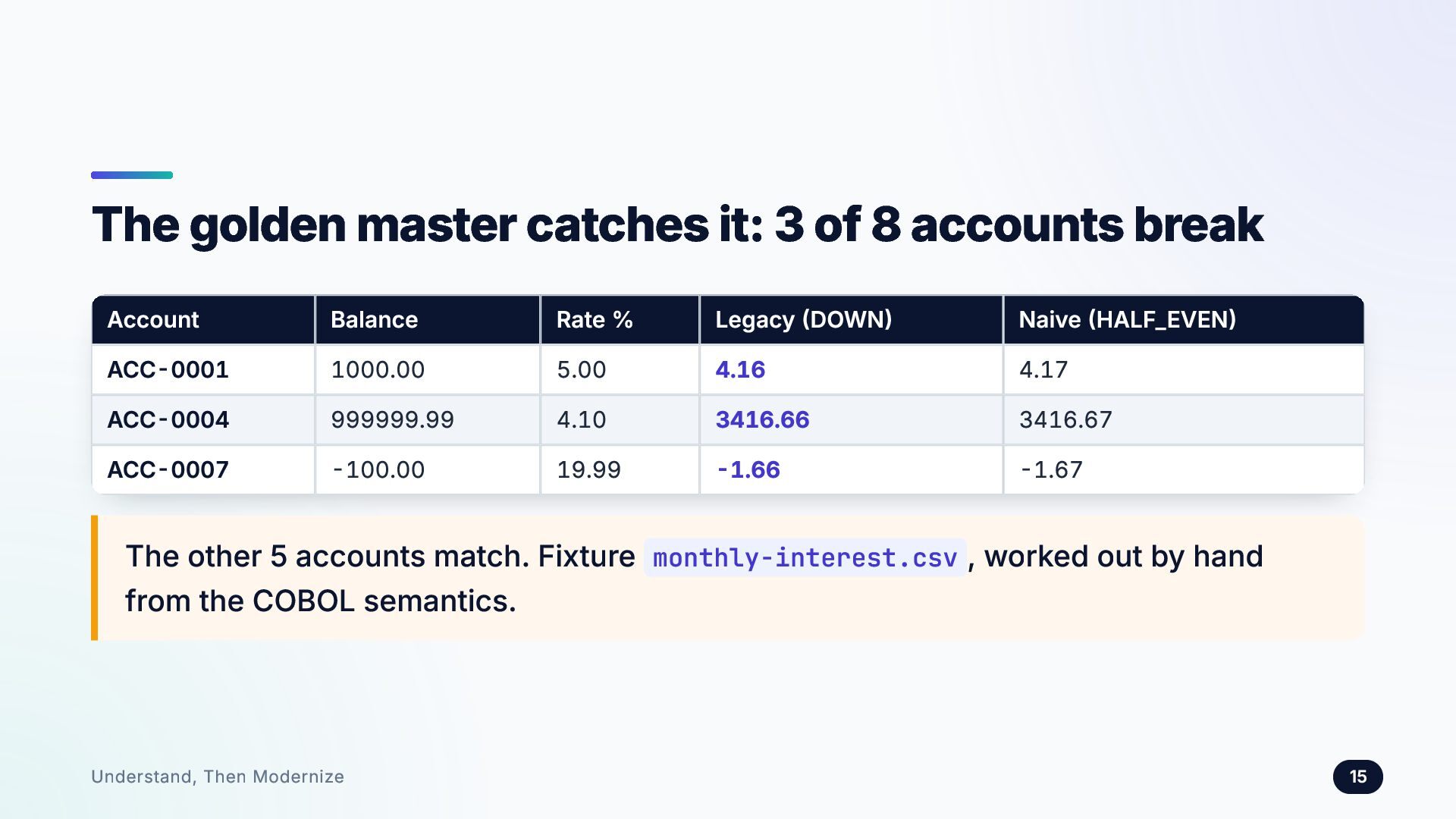
Account Balance Rate % Legacy (DOWN) Naive (HALF_EVEN) ACC-0001 1000.00 5.00 4.16 4.17 ACC-0004 999999.99 4.10 3416.66 3416.67 ACC-0007 -100.00 19.99 -1.66 -1.67 The other 5 accounts match. Fixture monthly-interest.csv , worked out by hand from the COBOL semantics. Understand, Then Modernize 15 -
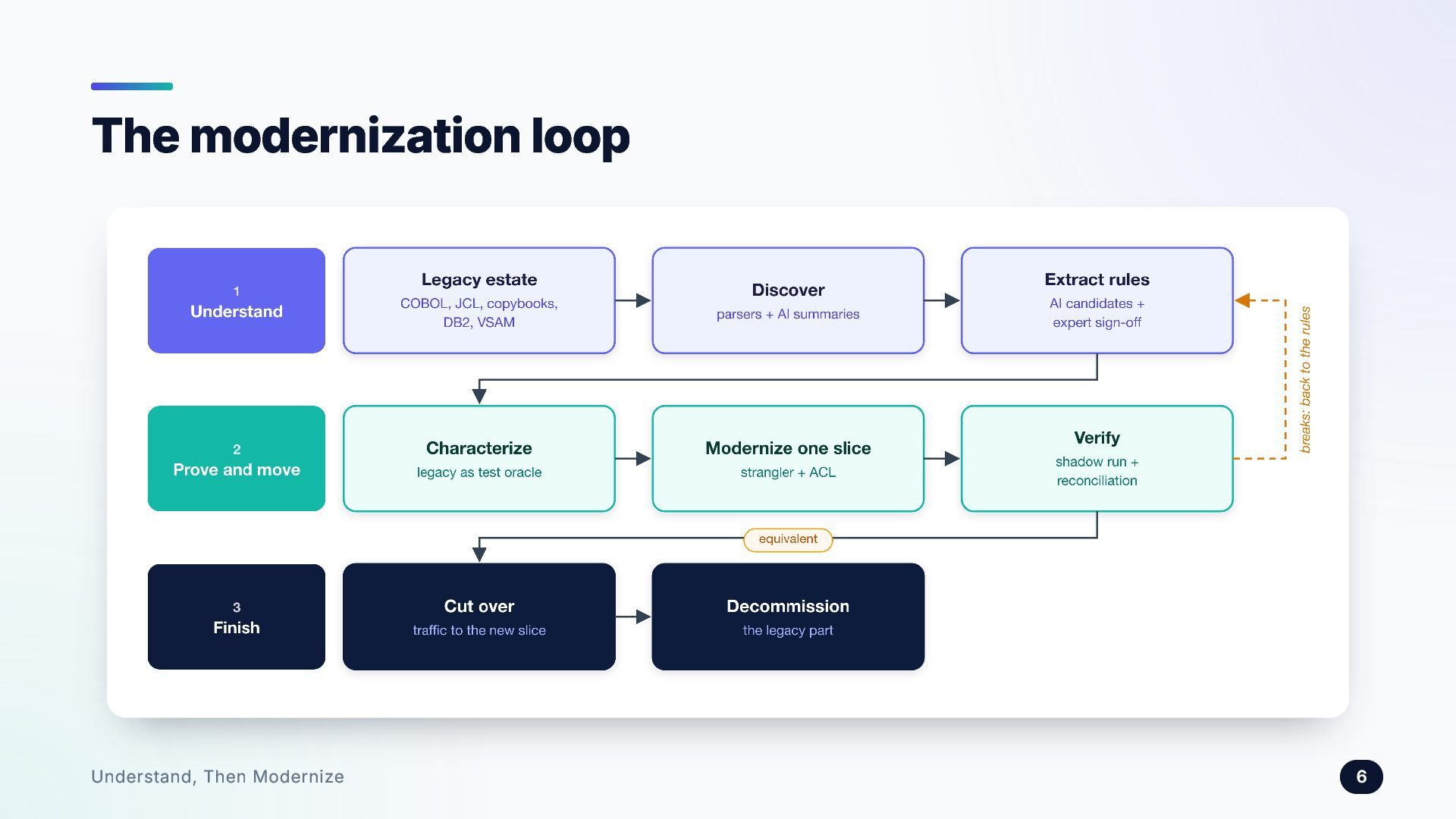
Testing and reconciliation Golden master: capture legacy outputs before changing
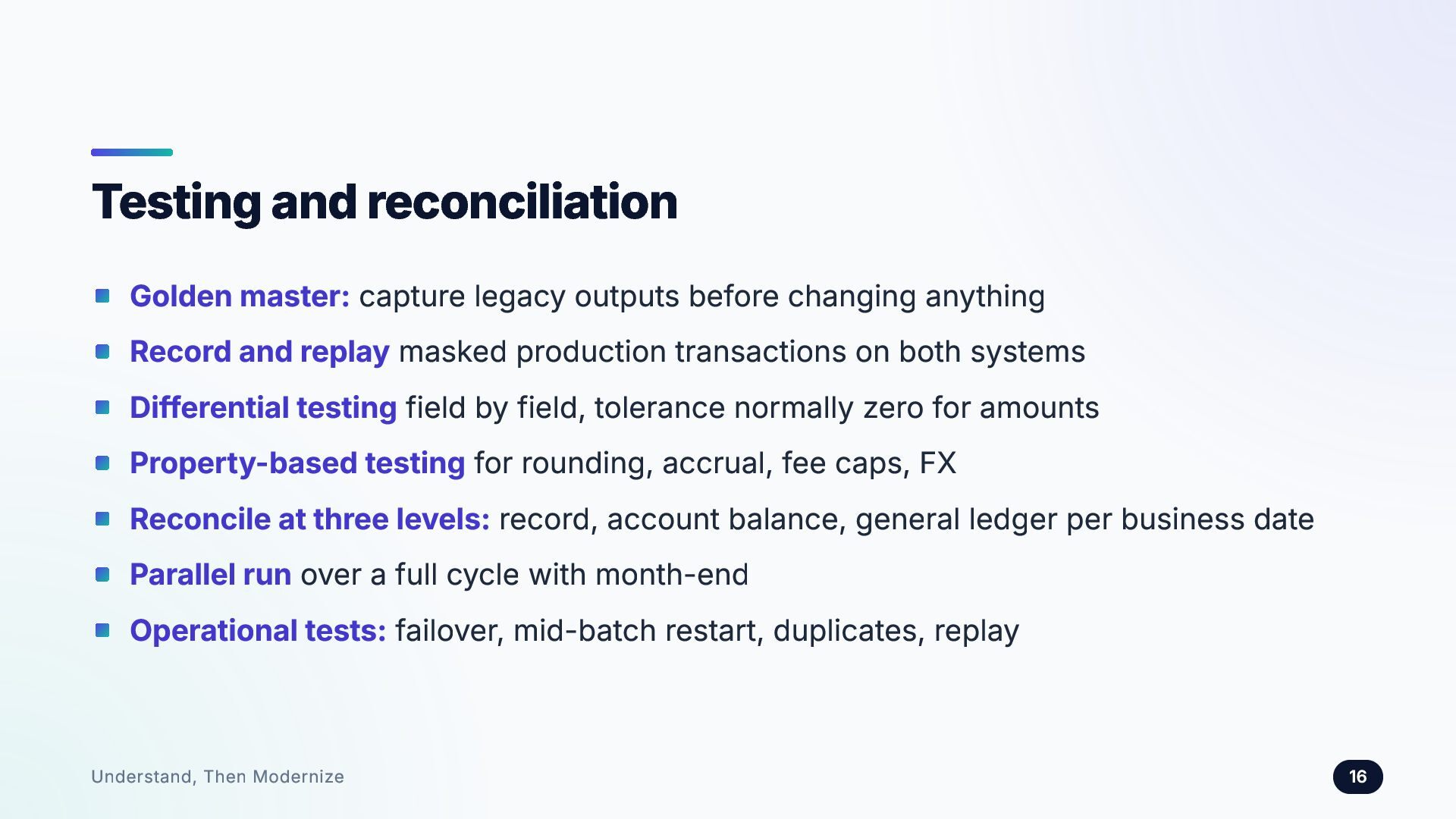
anything Record and replay masked production transactions on both systems Differential testing field by field, tolerance normally zero for amounts Property-based testing for rounding, accrual, fee caps, FX Reconcile at three levels: record, account balance, general ledger per business date Parallel run over a full cycle with month-end Operational tests: failover, mid-batch restart, duplicates, replay Understand, Then Modernize 16 -
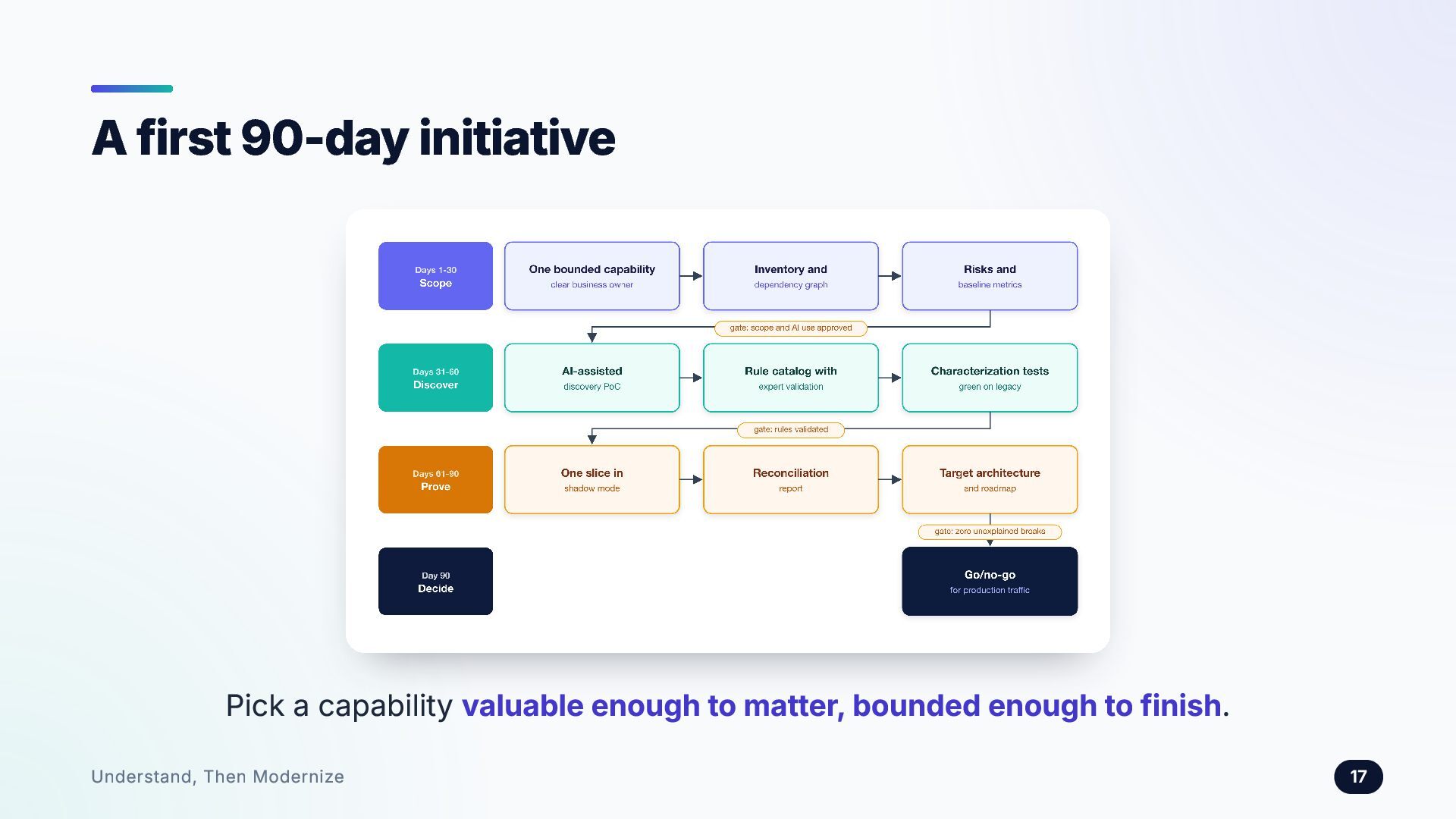
A first 90-day initiative Pick a capability valuable enough to
matter, bounded enough to finish. Understand, Then Modernize 17 -
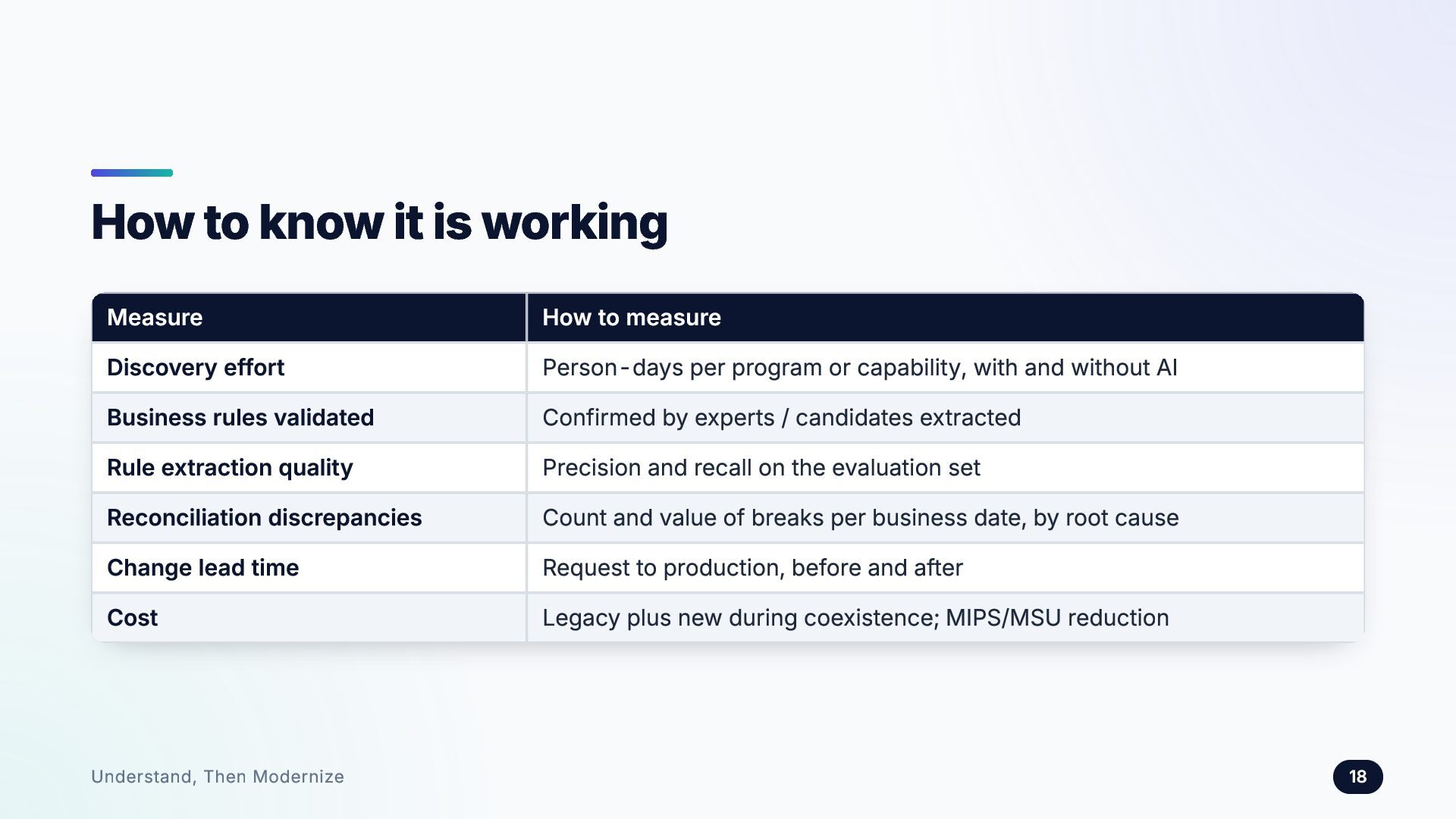
How to know it is working Measure How to measure
Discovery effort Person-days per program or capability, with and without AI Business rules validated Confirmed by experts / candidates extracted Rule extraction quality Precision and recall on the evaluation set Reconciliation discrepancies Count and value of breaks per business date, by root cause Change lead time Request to production, before and after Cost Legacy plus new during coexistence; MIPS/MSU reduction Understand, Then Modernize 18 -
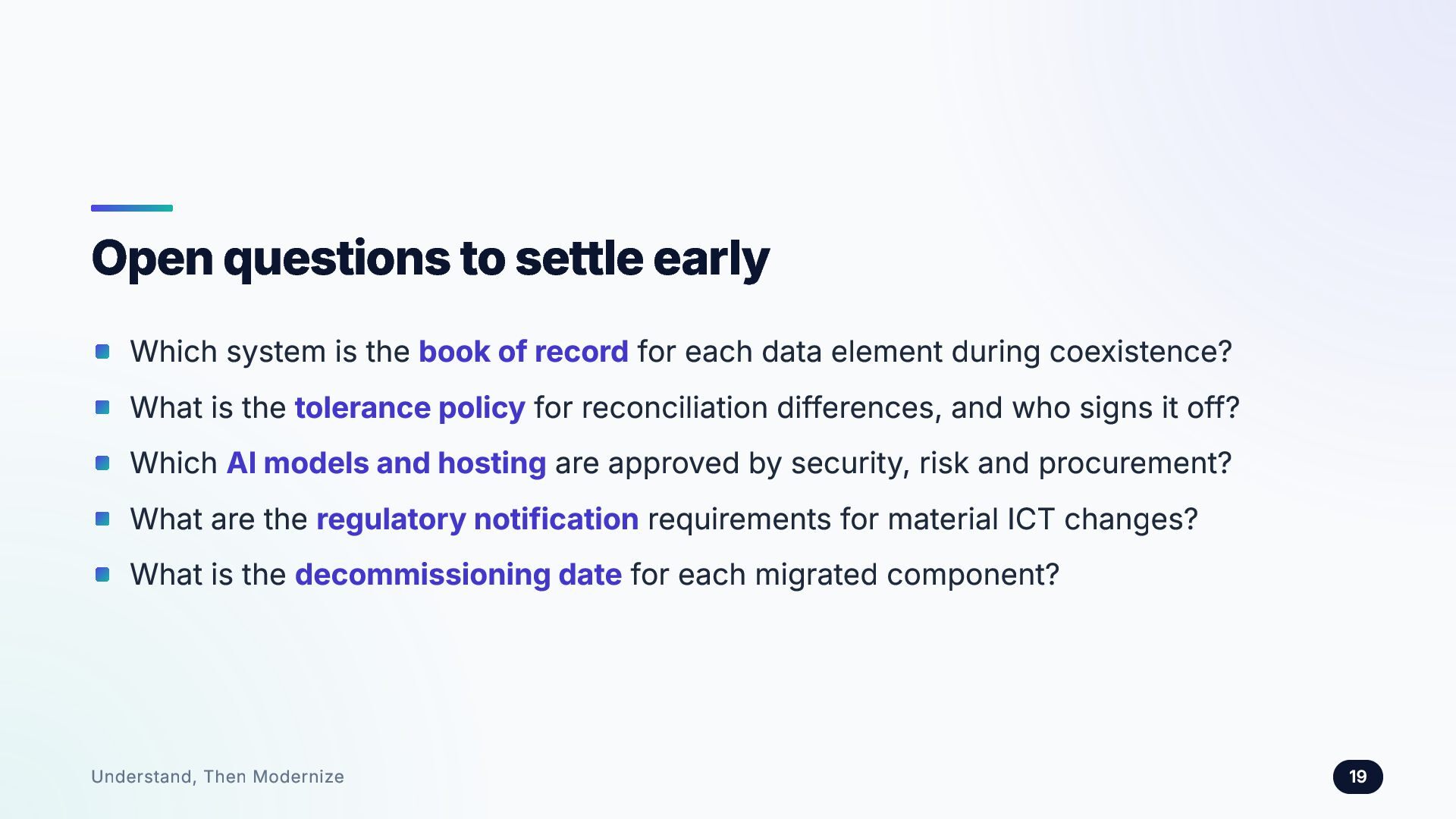
Open questions to settle early Which system is the book
of record for each data element during coexistence? What is the tolerance policy for reconciliation differences, and who signs it off? Which AI models and hosting are approved by security, risk and procurement? What are the regulatory notification requirements for material ICT changes? What is the decommissioning date for each migrated component? Understand, Then Modernize 19 -
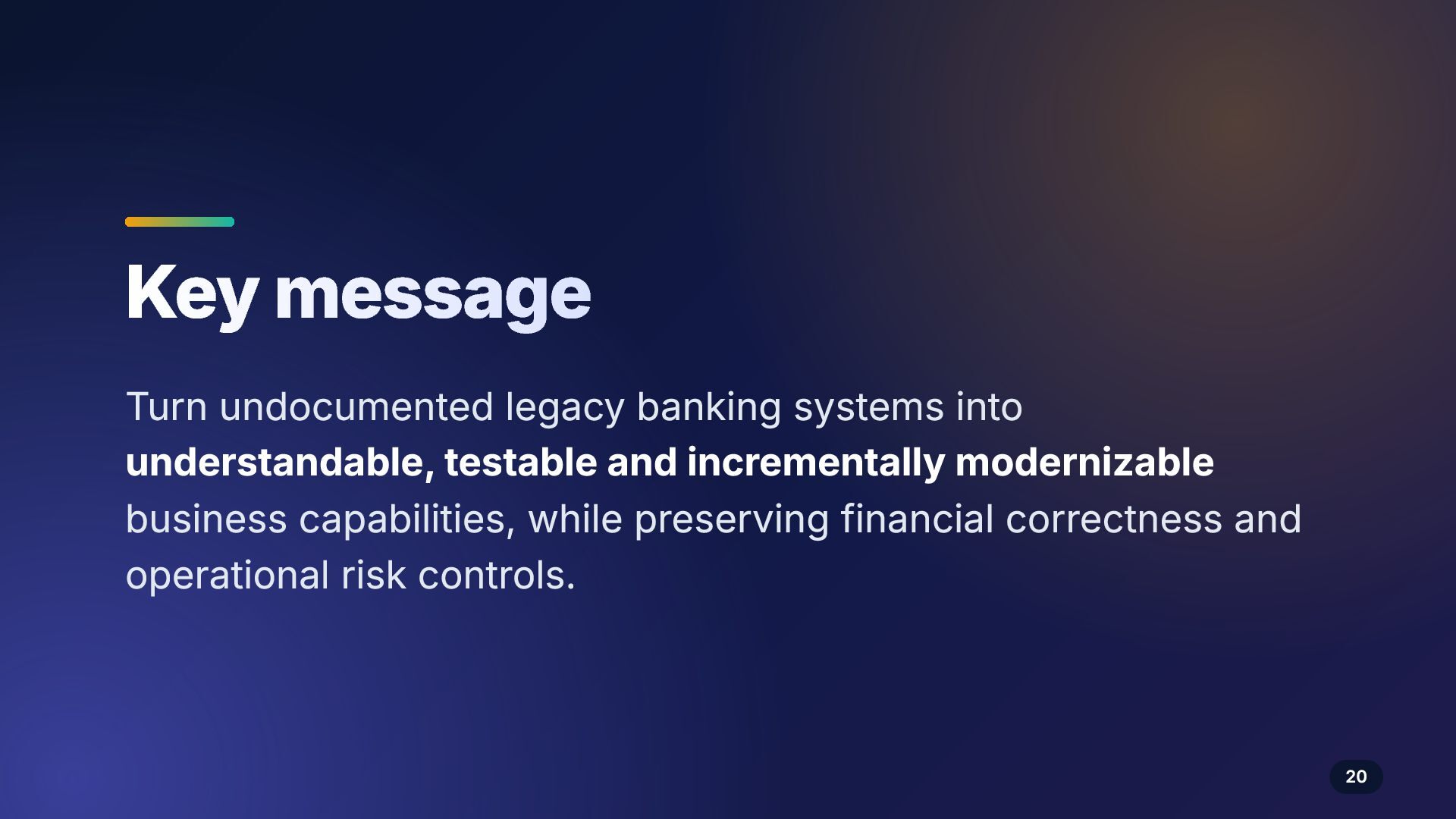
Key message Turn undocumented legacy banking systems into understandable, testable
and incrementally modernizable business capabilities, while preserving financial correctness and operational risk controls. 20 -
Resources Repo (context, rule catalog, COBOL and Java examples): github.com/wallaceespindola/banking-modernization-with-ai
Wallace Espindola, Solution Architect GitHub: github.com/wallaceespindola LinkedIn: linkedin.com/in/wallaceespindola Speaker Deck: speakerdeck.com/wallacese Thanks! Questions?