Upgrade to Pro — share decks privately, control downloads, hide ads and more …

Professional Legal Skills Development for Lawyers

Sponsored · Your Podcast. Everywhere. Effortlessly. Share. Educate. Inspire. Entertain. You do you. We'll handle the rest.
Avatar for webpage webpage
December 17, 2025
8

Professional Legal Skills Development for Lawyers

The Courtroom Advocacy Skill Training Programme is for the knowledge of the law, plus the way a lawyer can apply it in a courtroom. As it makes him or her shine in any courtroom. The Courtroom Advocacy Skill Training Programme assists in closing the gap between theory and practice in the field of law. Whether it is taking arguments, questioning witnesses. It is speaking to the judge, or any other thing that is involved in the courtroom, advocacy skills. These are what make the legal knowledge translate into winning.
visit here- https://www.lawlearningbench.com/courses/691797

Avatar for webpage

webpage

December 17, 2025

Transcript

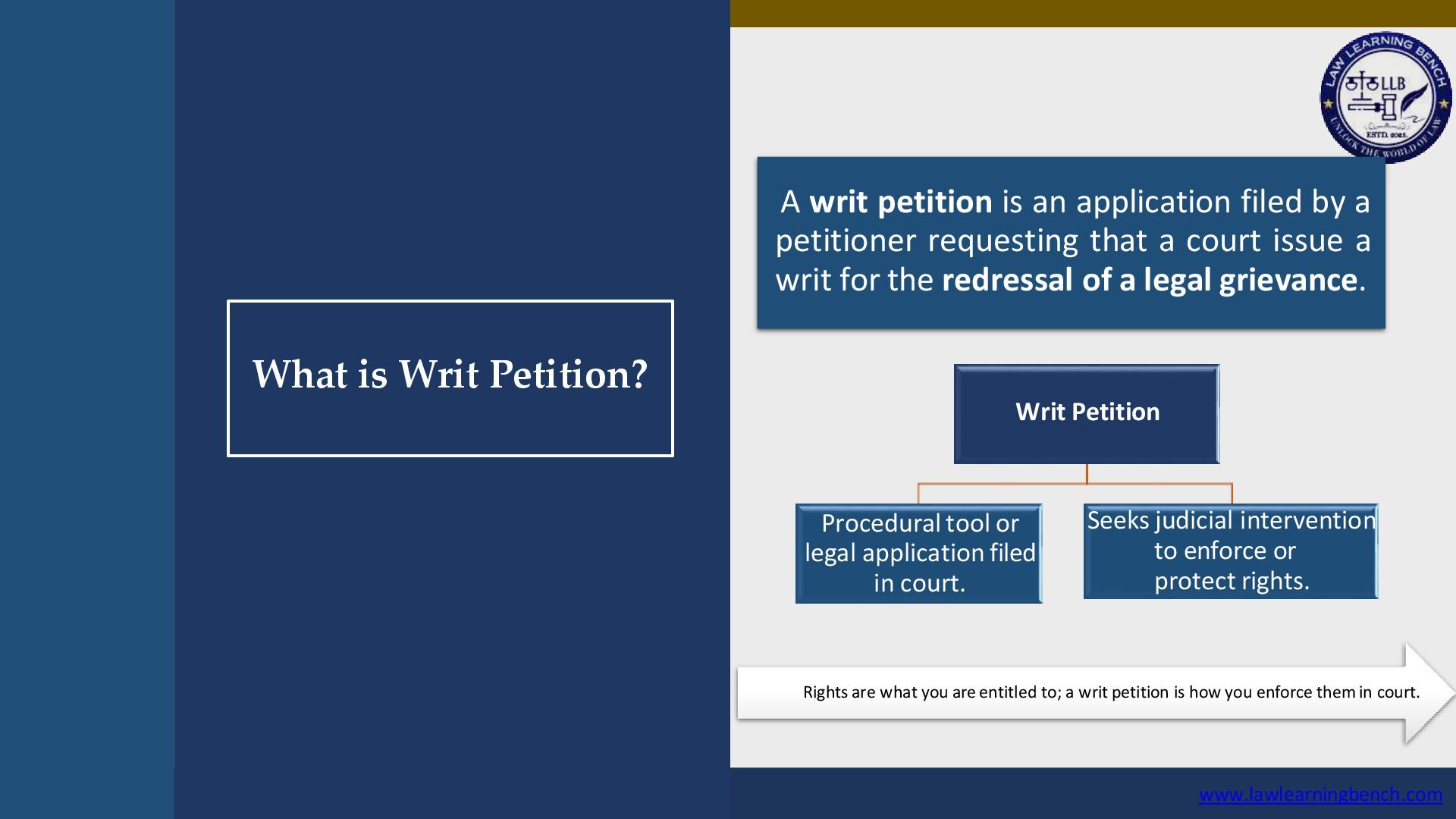
  1. www.lawlearningbench.com What is Writ Petition? A writ petition is an

    application filed by a petitioner requesting that a court issue a writ for the redressal of a legal grievance. Writ Petition Procedural tool or legal application filed in court. Seeks judicial intervention to enforce or protect rights. Rights are what you are entitled to; a writ petition is how you enforce them in court.
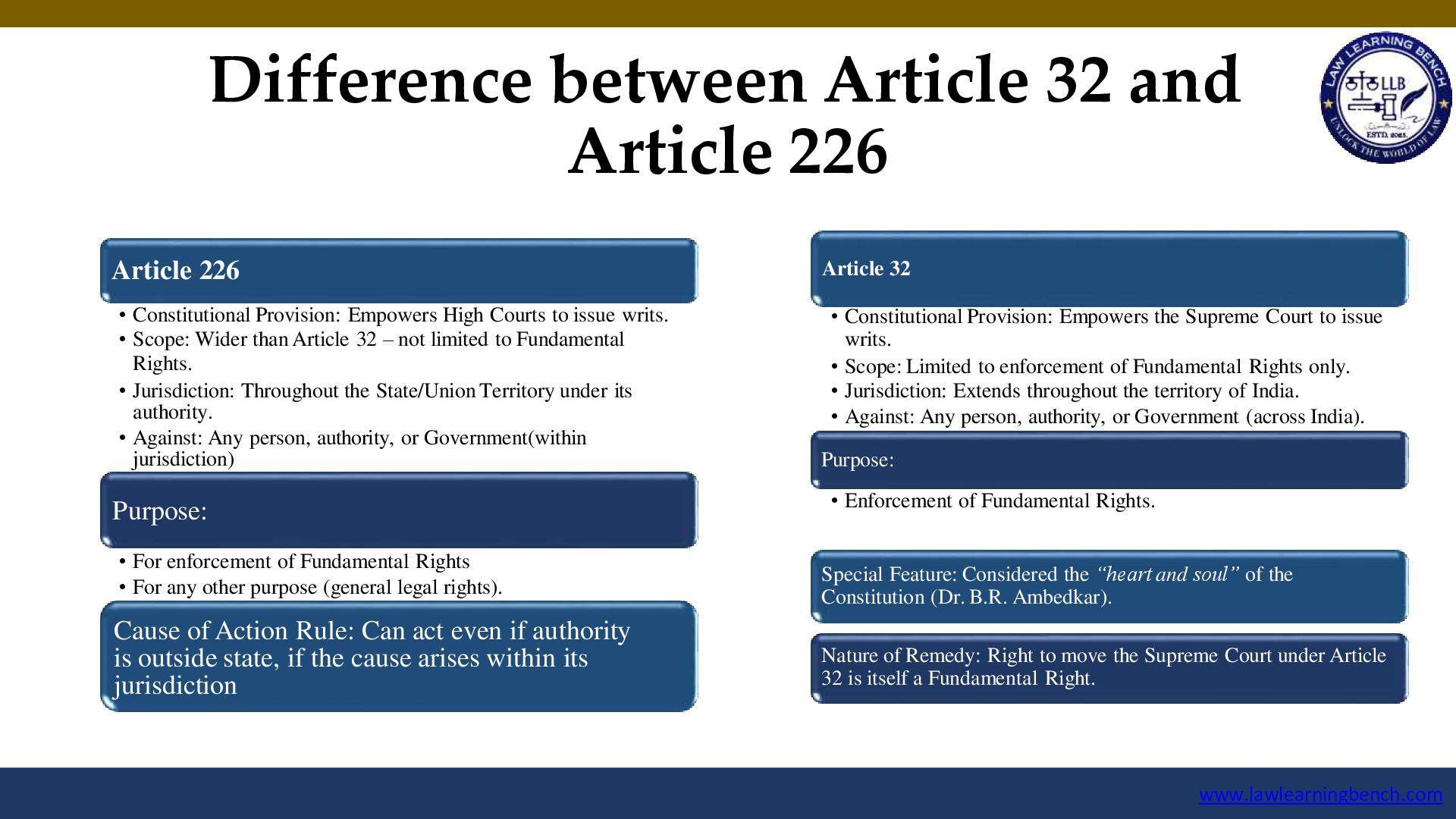
  2. www.lawlearningbench.com Difference between Article 32 and Article 226 Article 226

    • Constitutional Provision: Empowers High Courts to issue writs. • Scope: Wider than Article 32 – not limited to Fundamental Rights. • Jurisdiction: Throughout the State/Union Territory under its authority. • Against: Any person, authority, or Government(within jurisdiction) Purpose: • For enforcement of Fundamental Rights • For any other purpose (general legal rights). Cause of Action Rule: Can act even if authority is outside state, if the cause arises within its jurisdiction Article 32 • Constitutional Provision: Empowers the Supreme Court to issue writs. • Scope: Limited to enforcement of Fundamental Rights only. • Jurisdiction: Extends throughout the territory of India. • Against: Any person, authority, or Government (across India). Purpose: • Enforcement of Fundamental Rights. Special Feature: Considered the “heart and soul” of the Constitution (Dr. B.R. Ambedkar). Nature of Remedy: Right to move the Supreme Court under Article 32 is itself a Fundamental Right.
  3. www.lawlearningbench.com Types of Writ • Habeas Corpus – “You may

    have the body”; issued to release a person unlawfully detained. • Mandamus – “We command”; directs a public authority to perform a duty it has failed to do. • Prohibition – Issued to a lower court or tribunal to stop proceedings exceeding its jurisdiction. • Certiorari – Issued to quash an order of a lower court/tribunal passed without or in excess of jurisdiction. • Quo Warranto – “By what authority”; challenges unlawful occupation of a public office.
  4. When and Why to File a Writ Petition • Violation

    of Fundamental Rights: If the state or its authorities infringe any fundamental right under Part III of the Constitution. • Illegal or Unconstitutional Acts: When a government action, order, or decision is beyond the authority’s legal powers or unconstitutional. • Abuse or Excess of Power: When an authority acts arbitrarily, oppressively, or beyond its legal powers. • Failure to Perform Public/Legal Duty: If a statutory or constitutional duty is neglected, a writ (e.g., Mandamus) can compel its performance. • NoAdequate Alternative Remedy: Writs are typically sought when other legal remedies are unavailable or ineffective. • Breach of Natural Justice: If a decision is made without due process, like denying a fair hearing. • Public Interest Enforcement: To enforce public duties or protect rights that affect the wider community.
  5. Key components Of Writ Petions under Article 226 • Title

    and Jurisdiction: Name the specific High Court and mention Article 226. • Parties: Details of petitioner(s) and respondent(s). • Synopsis and List of Dates: A brief case summary and chronological events. • Statement of Facts: Clear, concise facts leading to the petition. • Grounds for Filing: Legal/constitutional basis highlighting rights violated or duties neglected. • Writ Claimed: The specific writ(s) sought—Habeas Corpus, Mandamus, Prohibition, Certiorari, or Quo Warranto. • Prayer Clause: Relief sought from the court. • Affidavit: A sworn statement verifying facts in the petition. • Annexures: Supporting documents like orders and evidence. • Index: Listing all annexures for reference.
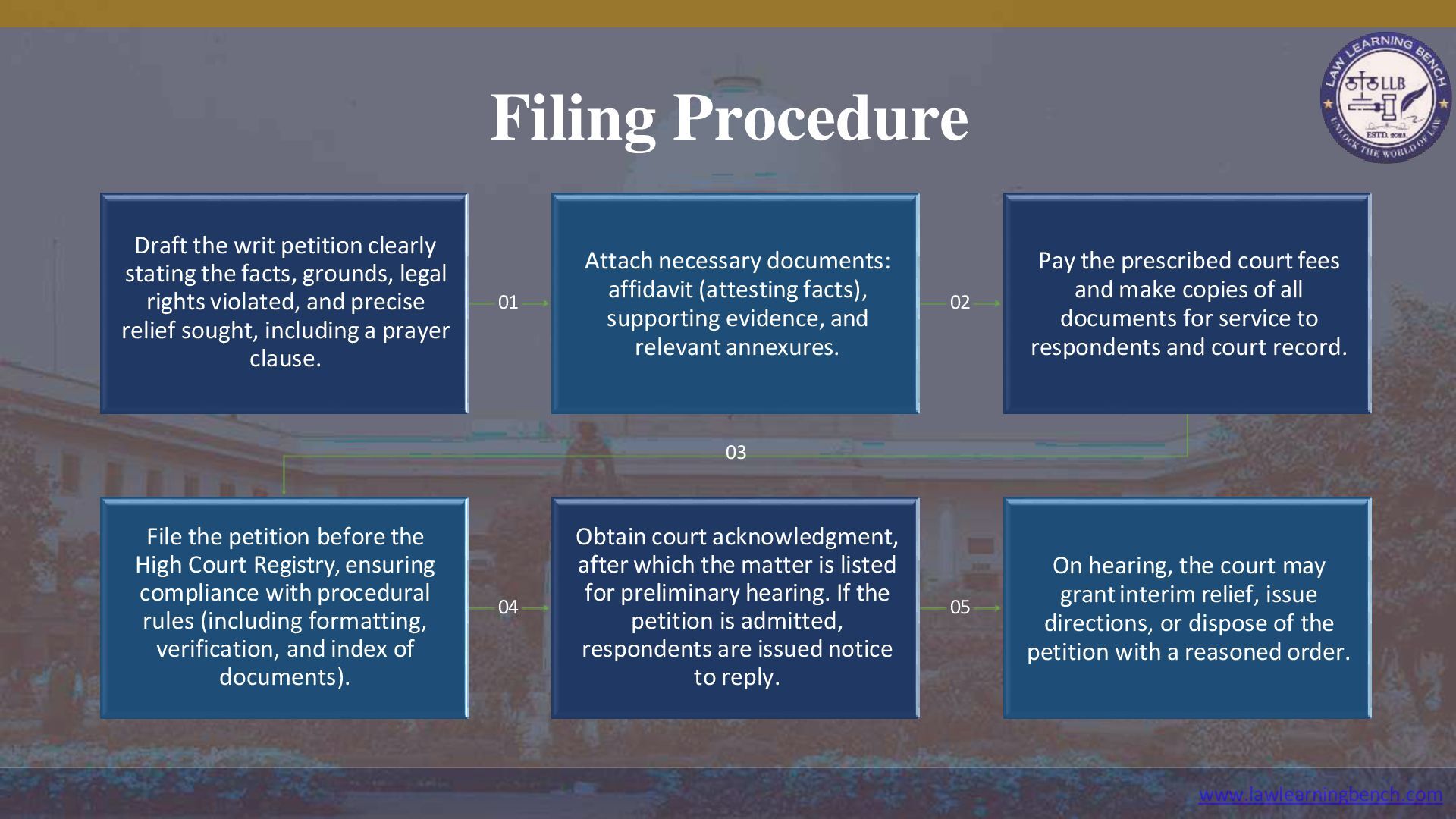
  6. www.lawlearningbench.com Filing Procedure 01 Draft the writ petition clearly stating

    the facts, grounds, legal rights violated, and precise relief sought, including a prayer clause. 02 Attach necessary documents: affidavit (attesting facts), supporting evidence, and relevant annexures. 03 Pay the prescribed court fees and make copies of all documents for service to respondents and court record. 04 File the petition before the High Court Registry, ensuring compliance with procedural rules (including formatting, verification, and index of documents). 05 Obtain court acknowledgment, after which the matter is listed for preliminary hearing. If the petition is admitted, respondents are issued notice to reply. On hearing, the court may grantinterim relief, issue directions, or dispose of the petition with a reasoned order.
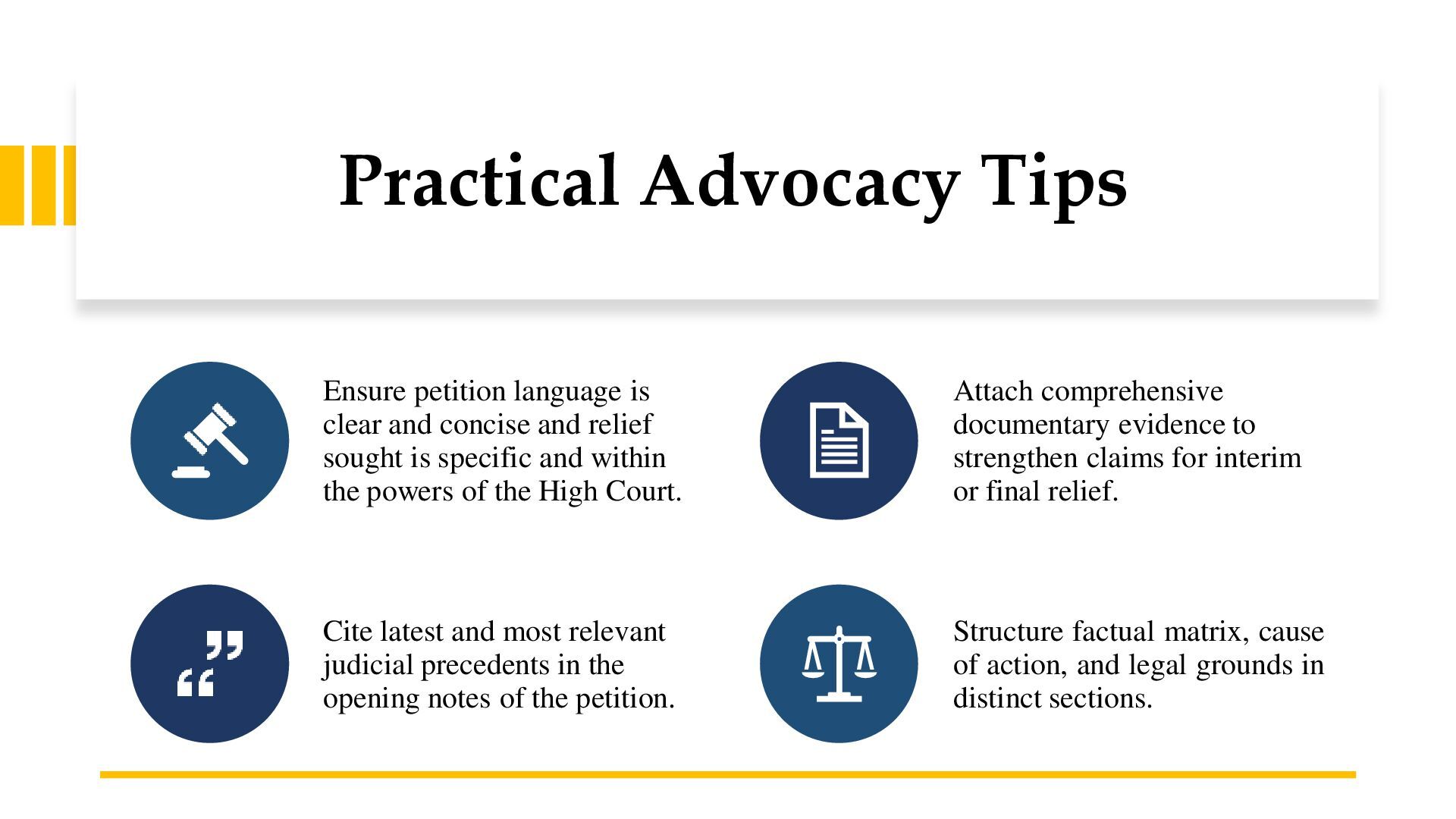
  7. Practical Advocacy Tips Ensure petition language is clear and concise

    and relief sought is specific and within the powers of the High Court. Attach comprehensive documentary evidence to strengthen claims for interim or final relief. Cite latest and most relevant judicial precedents in the opening notes of the petition. Structure factual matrix, cause of action, and legal grounds in distinct sections.