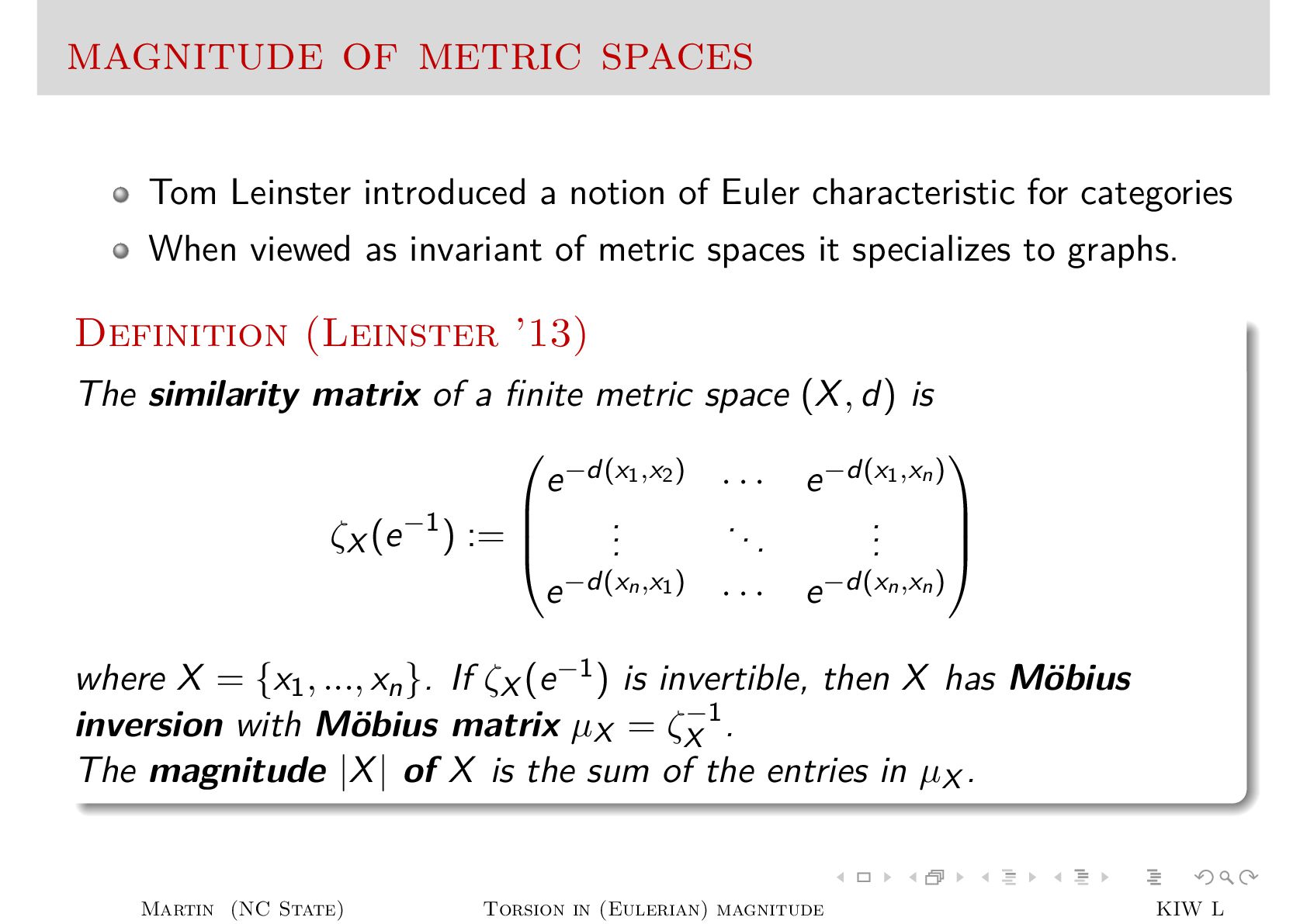
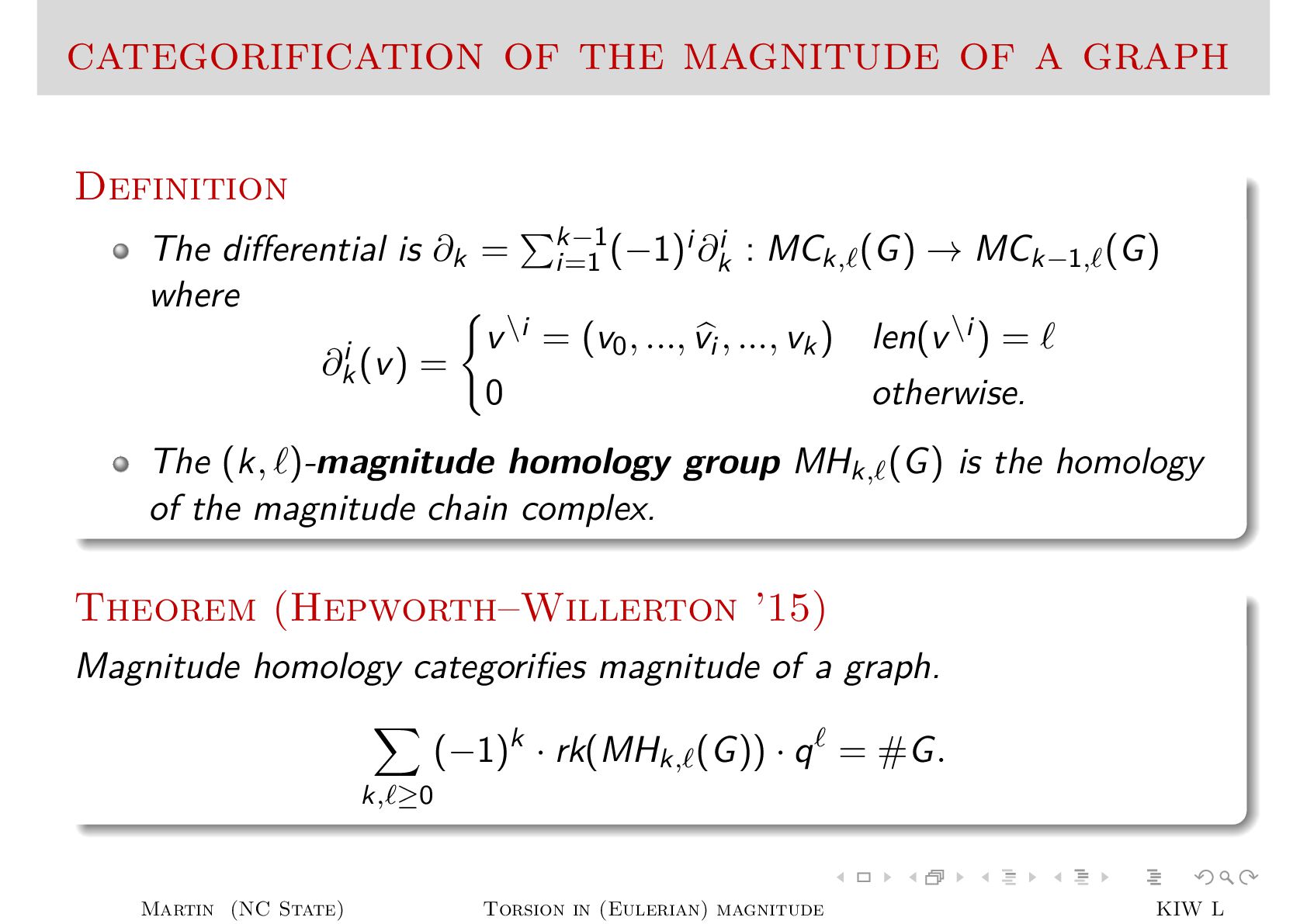
Euler characteristic for categories When viewed as invariant of metric spaces it specializes to graphs. Definition (Leinster ’13) The similarity matrix of a finite metric space (X , d) is ζX (e −1 ) := e −d(x1 ,x2 ) .. . e −d(xn ,x1 ) ··· .. . ··· e −d(x1 ,xn ) .. . e −d(xn ,xn ) where X = {x1 , ..., xn }. If ζX (e −1 ) is invertible, then X has Möbius inversion with Möbius matrix µX = ζX−1 . The magnitude |X | of X is the sum of the entries in µX . Martin (NC State) Torsion in (Eulerian) magnitude KIW L
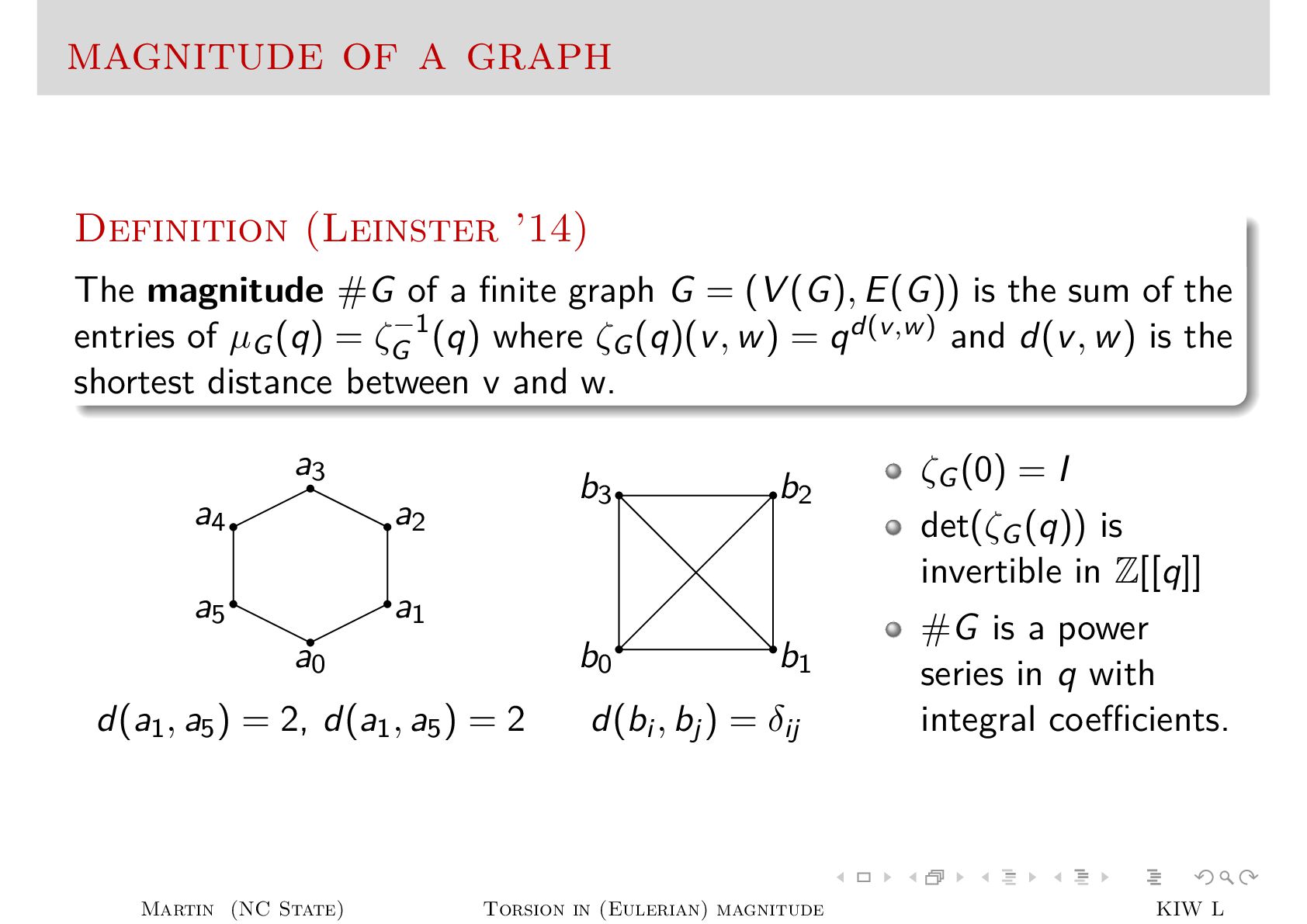
of a finite graph G = (V (G), E (G)) is the sum of the entries of µG (q) = ζG−1 (q) where ζG (q)(v , w ) = q d(v ,w ) and d(v , w ) is the shortest distance between v and w. a3 a4 a2 a5 a1 b3 ζG (0) = I det(ζG (q)) is invertible in Z[[q]] a0 b0 d(a1 , a5 ) = 2, d(a1 , a5 ) = 2 Martin (NC State) b2 b1 d(bi , bj ) = δij Torsion in (Eulerian) magnitude #G is a power series in q with integral coefficients. KIW L
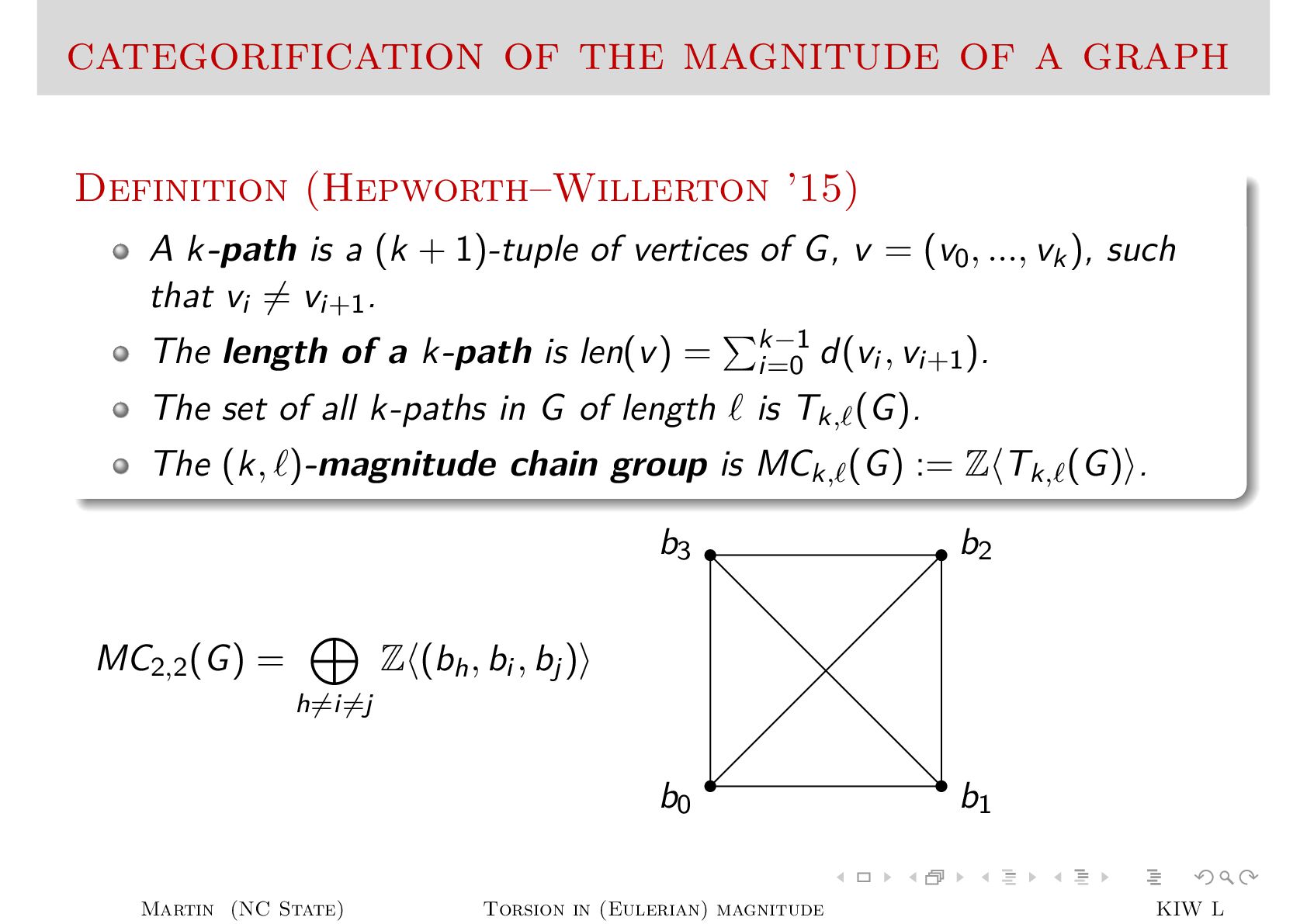
A k-path is a (k + 1)-tuple of vertices of G, v = (v0 , ..., vk ), such that vi ̸= vi+1 . The length of a k-path is len(v ) = Pk−1 i=0 d(vi , vi+1 ). The set of all k-paths in G of length ℓ is Tk,ℓ (G). The (k, ℓ)-magnitude chain group is MCk,ℓ (G) := Z⟨Tk,ℓ (G)⟩. MC2,2 (G) = M b3 b2 b0 b1 Z⟨(bh , bi , bj )⟩ h̸=i̸=j Martin (NC State) Torsion in (Eulerian) magnitude KIW L
differential is ∂k = i=1 (−1)i ∂ki : MCk,ℓ (G) → MCk−1,ℓ (G) where ( \i = (v , ..., vb , ..., v ) len(v \i ) = ℓ v 0 i k ∂ki (v ) = 0 otherwise. The (k, ℓ)-magnitude homology group MHk,ℓ (G) is the homology of the magnitude chain complex. Theorem (Hepworth–Willerton ’15) Magnitude homology categorifies magnitude of a graph. X (−1)k · rk(MHk,ℓ (G)) · q ℓ = #G. k,ℓ≥0 Martin (NC State) Torsion in (Eulerian) magnitude KIW L
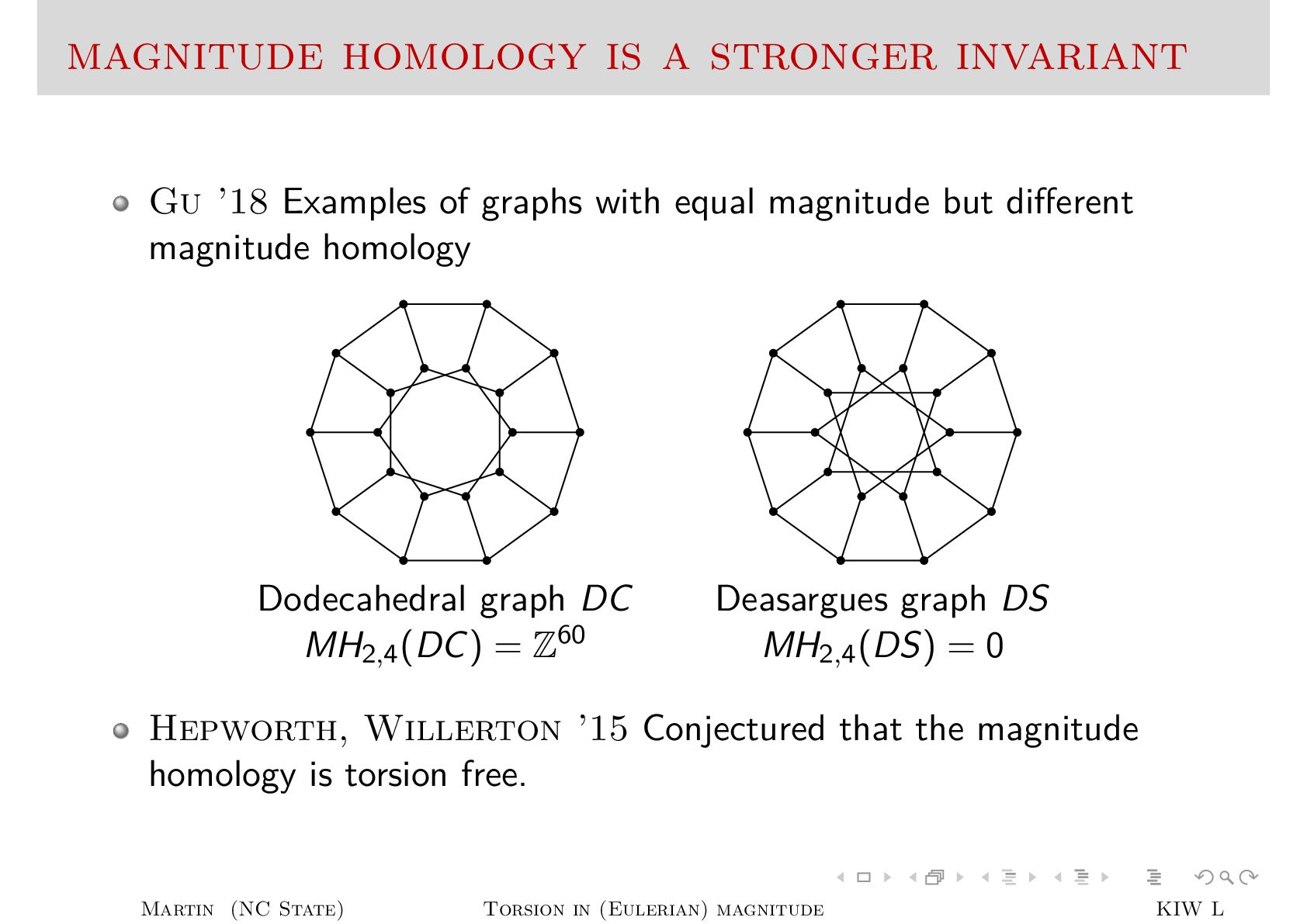
graphs with equal magnitude but different magnitude homology Dodecahedral graph DC MH2,4 (DC ) = Z60 Deasargues graph DS MH2,4 (DS) = 0 Hepworth, Willerton ’15 Conjectured that the magnitude homology is torsion free. Martin (NC State) Torsion in (Eulerian) magnitude KIW L
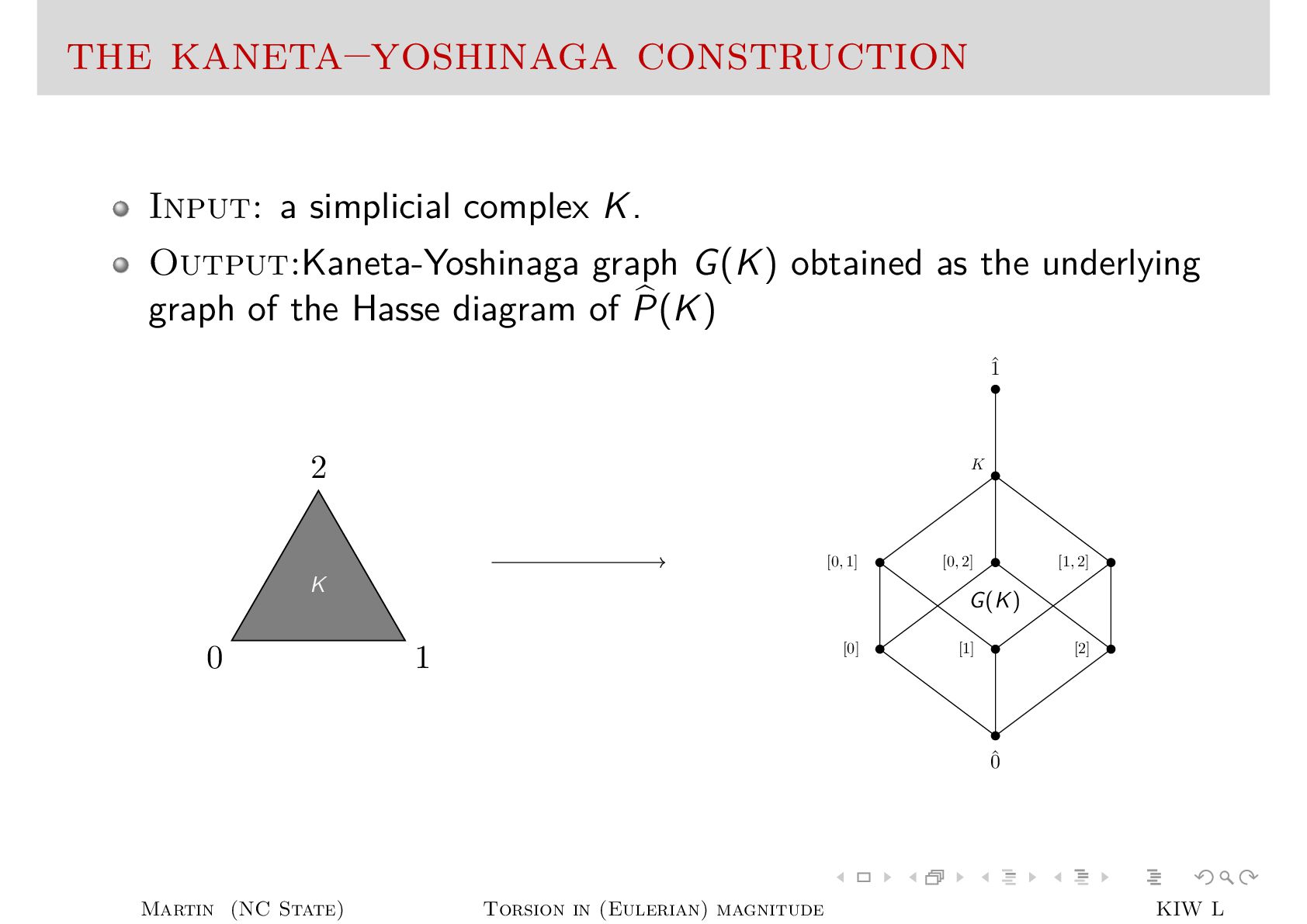
graph G(K ) obtained as the underlying b ) graph of the Hasse diagram of P(K 1̂ 2 K [0, 1] K 0 [0, 2] [1, 2] G(K ) [0] 1 [1] [2] 0̂ Martin (NC State) Torsion in (Eulerian) magnitude KIW L
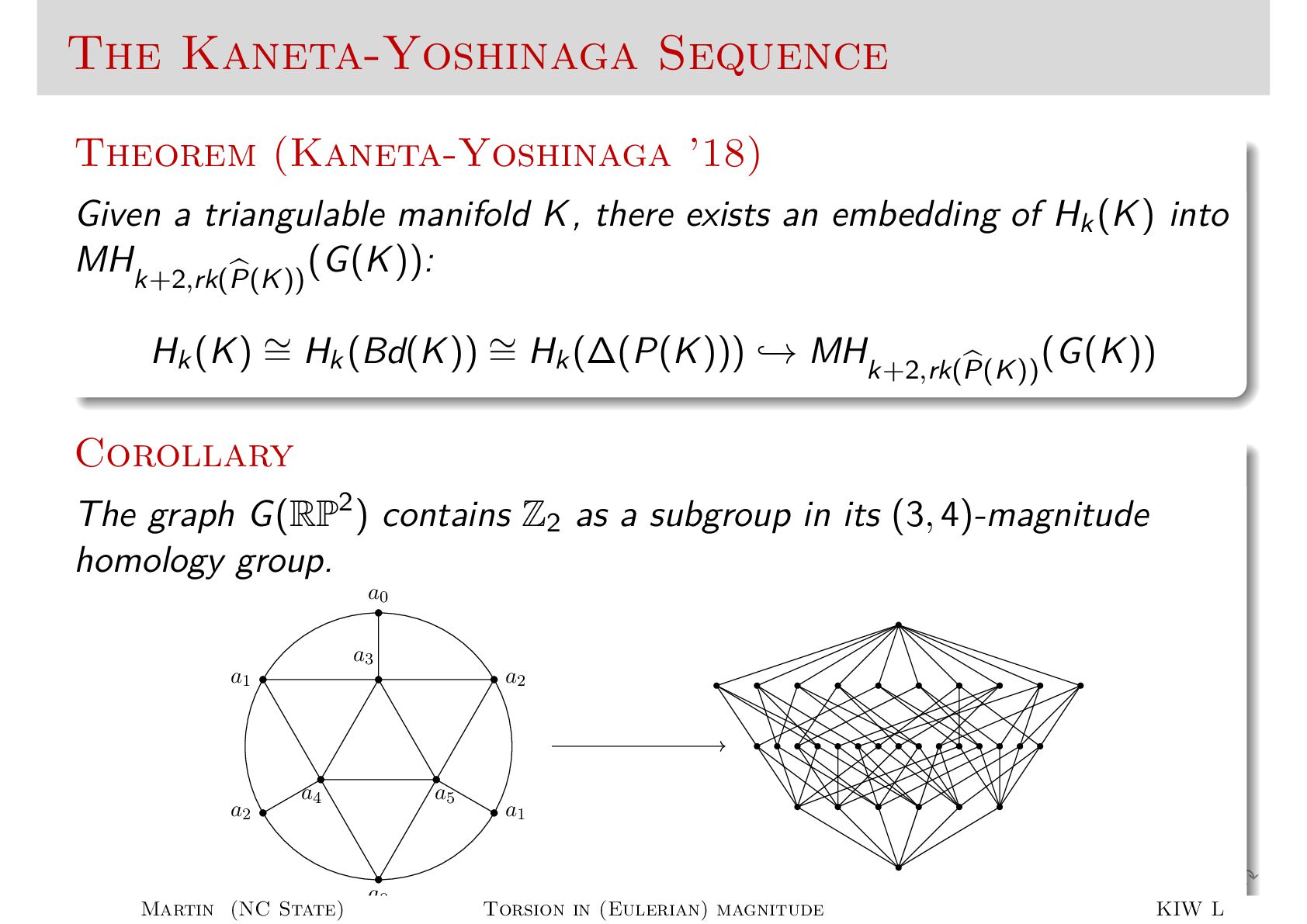
K , there exists an embedding of Hk (K ) into MHk+2,rk(Pb(K )) (G(K )): ∼ Hk (Bd(K )) ∼ Hk (K ) = = Hk (∆(P(K ))) ,→ MHk+2,rk(Pb(K )) (G(K )) Corollary The graph G(RP2 ) contains Z2 as a subgroup in its (3, 4)-magnitude homology group. a0 a3 a1 a2 a2 a4 Martin (NC State) a5 a0 a1 Torsion in (Eulerian) magnitude KIW L
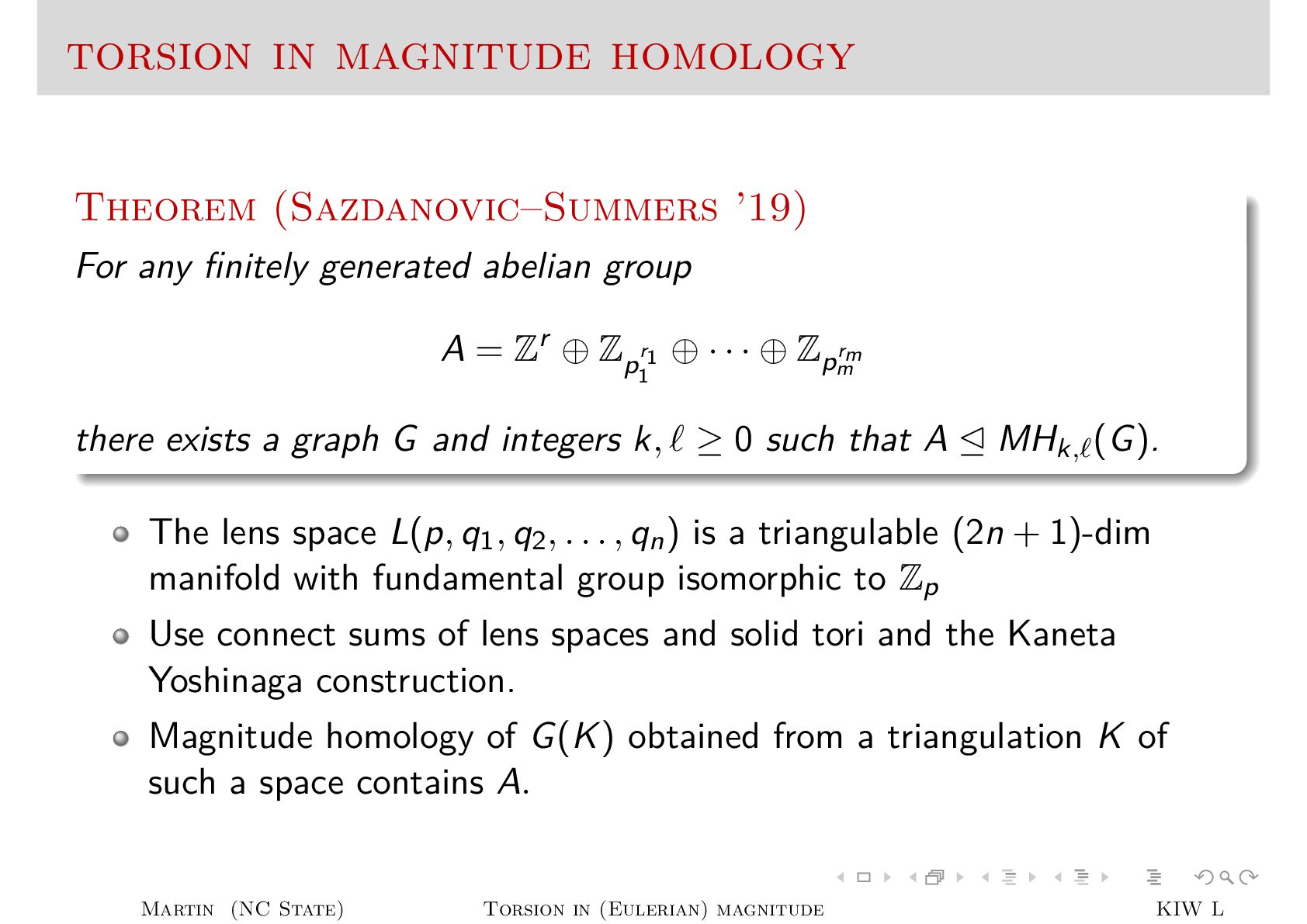
generated abelian group A = Zr ⊕ Zp r1 ⊕ · · · ⊕ Zpmrm 1 there exists a graph G and integers k, ℓ ≥ 0 such that A ⊴ MHk,ℓ (G). The lens space L(p, q1 , q2 , . . . , qn ) is a triangulable (2n + 1)-dim manifold with fundamental group isomorphic to Zp Use connect sums of lens spaces and solid tori and the Kaneta Yoshinaga construction. Magnitude homology of G(K ) obtained from a triangulation K of such a space contains A. Martin (NC State) Torsion in (Eulerian) magnitude KIW L
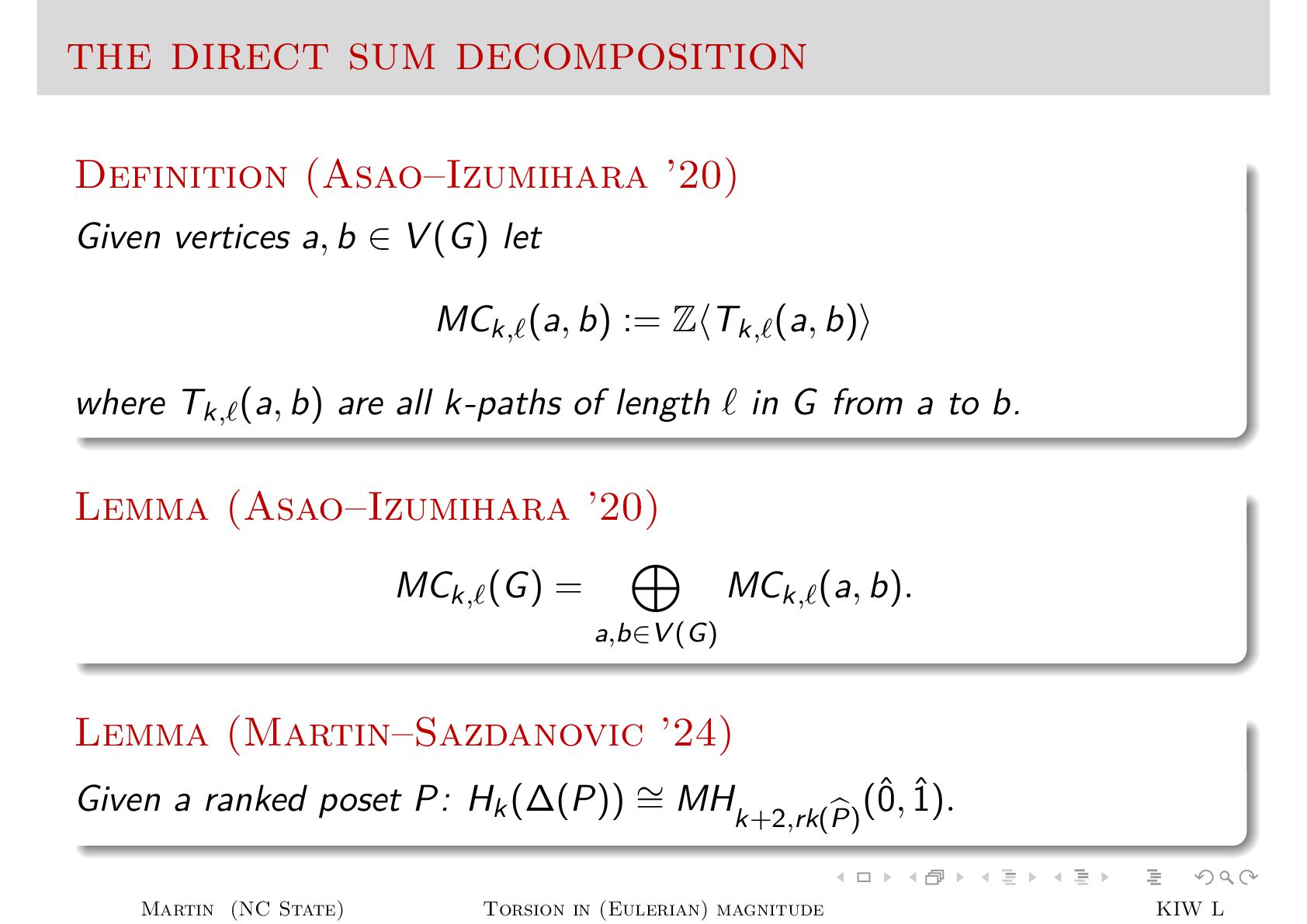
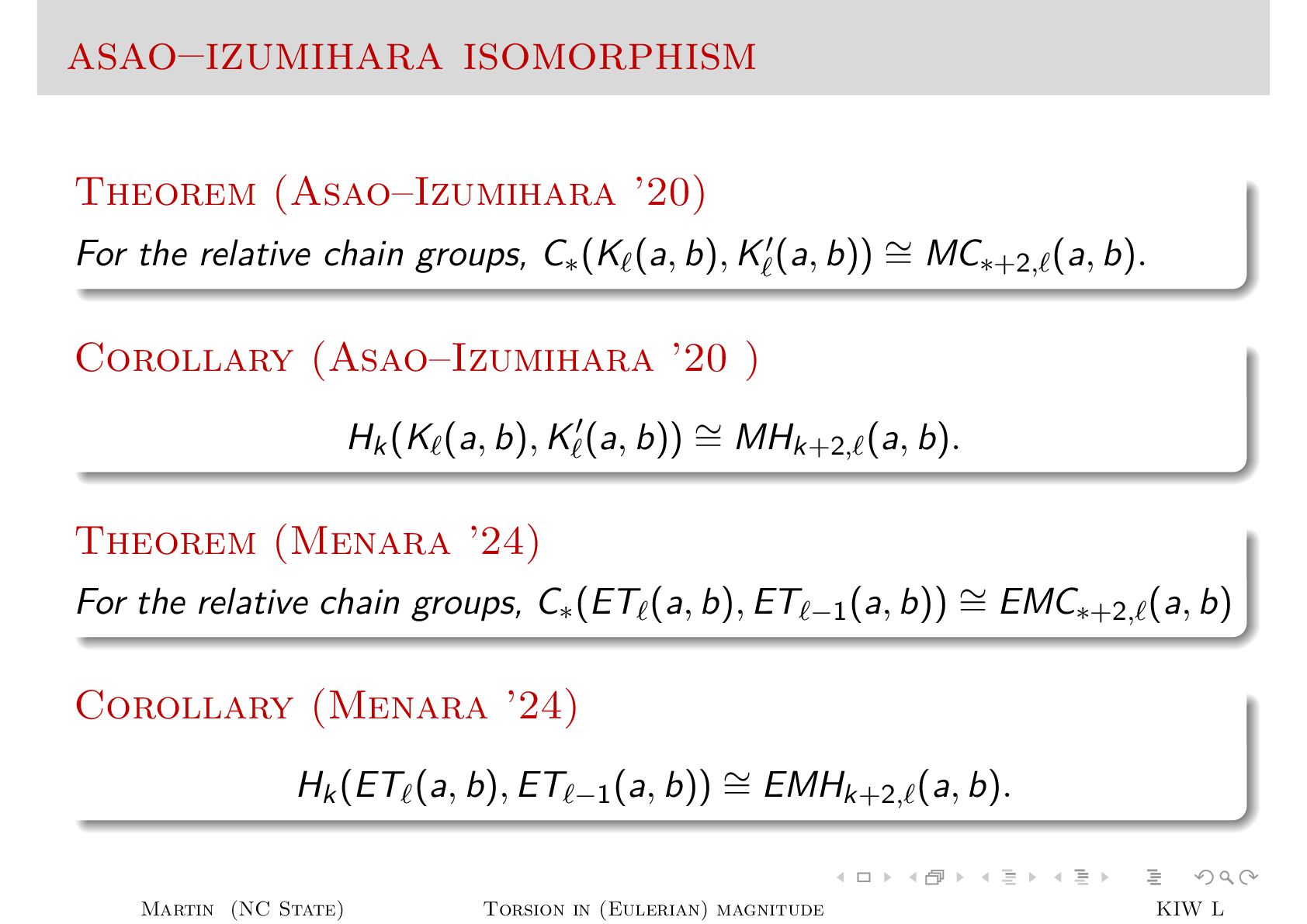
b ∈ V (G) let MCk,ℓ (a, b) := Z⟨Tk,ℓ (a, b)⟩ where Tk,ℓ (a, b) are all k-paths of length ℓ in G from a to b. Lemma (Asao–Izumihara ’20) MCk,ℓ (G) = M MCk,ℓ (a, b). a,b∈V (G) Lemma (Martin–Sazdanovic ’24) ∼ MH Given a ranked poset P: Hk (∆(P)) = b) (0̂, 1̂). k+2,rk(P Martin (NC State) Torsion in (Eulerian) magnitude KIW L
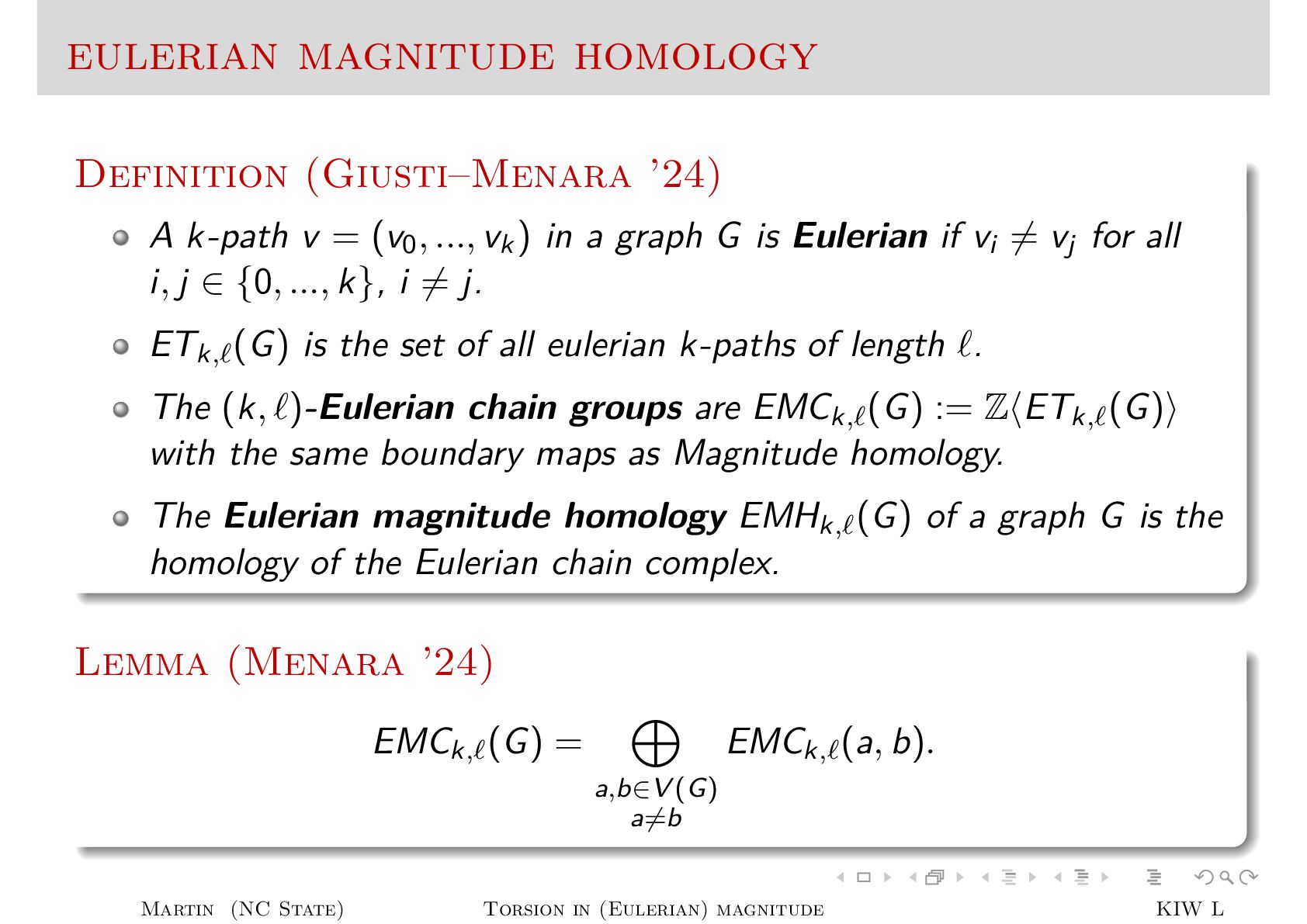
(v0 , ..., vk ) in a graph G is Eulerian if vi ̸= vj for all i, j ∈ {0, ..., k}, i ̸= j. ETk,ℓ (G) is the set of all eulerian k-paths of length ℓ. The (k, ℓ)-Eulerian chain groups are EMCk,ℓ (G) := Z⟨ETk,ℓ (G)⟩ with the same boundary maps as Magnitude homology. The Eulerian magnitude homology EMHk,ℓ (G) of a graph G is the homology of the Eulerian chain complex. Lemma (Menara ’24) EMCk,ℓ (G) = M EMCk,ℓ (a, b). a,b∈V (G) a̸=b Martin (NC State) Torsion in (Eulerian) magnitude KIW L
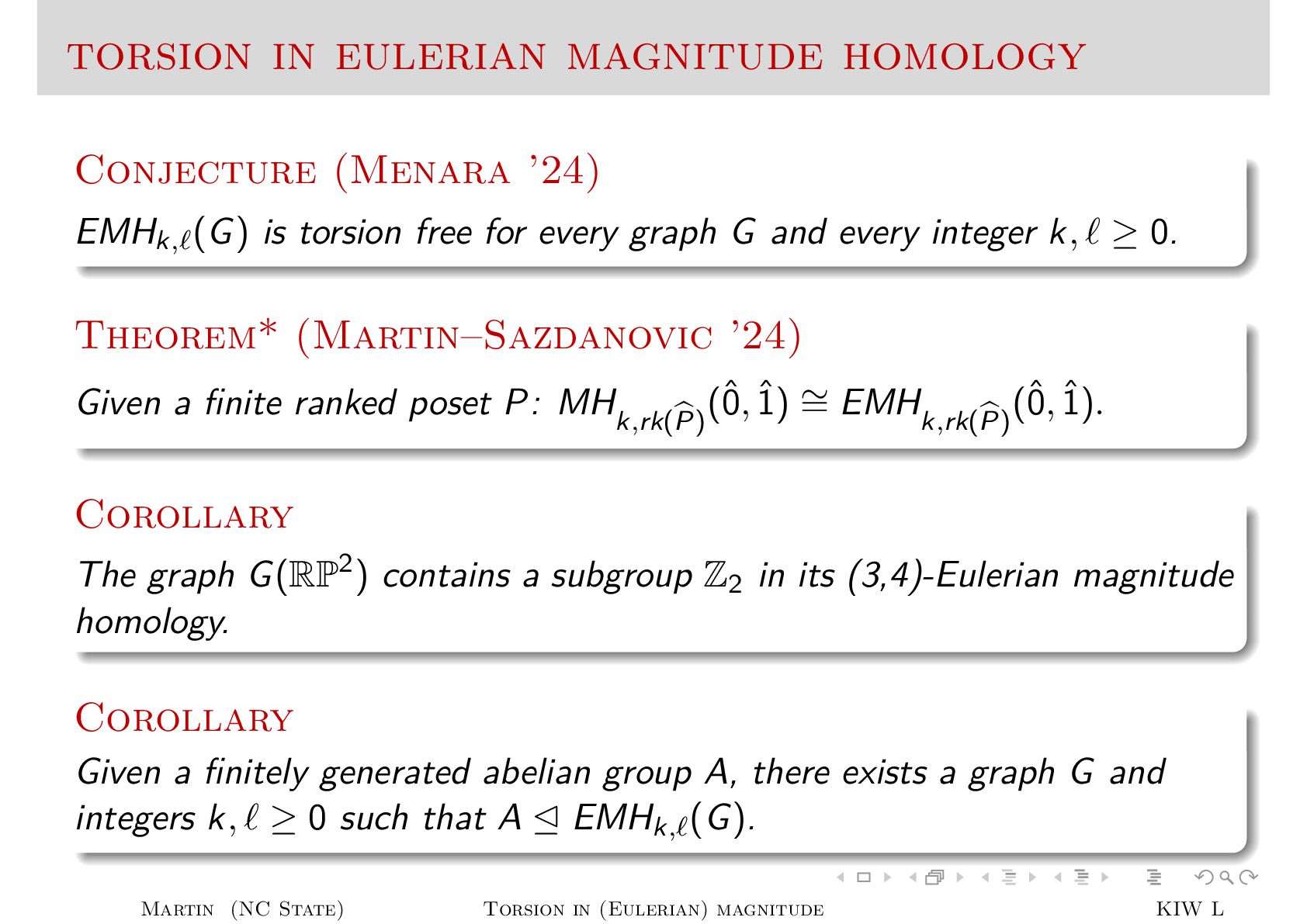
is torsion free for every graph G and every integer k, ℓ ≥ 0. Theorem* (Martin–Sazdanovic ’24) Given a finite ranked poset P: MHk,rk(Pb) (0̂, 1̂) ∼ = EMHk,rk(Pb) (0̂, 1̂). Corollary The graph G(RP2 ) contains a subgroup Z2 in its (3,4)-Eulerian magnitude homology. Corollary Given a finitely generated abelian group A, there exists a graph G and integers k, ℓ ≥ 0 such that A ⊴ EMHk,ℓ (G). Martin (NC State) Torsion in (Eulerian) magnitude KIW L
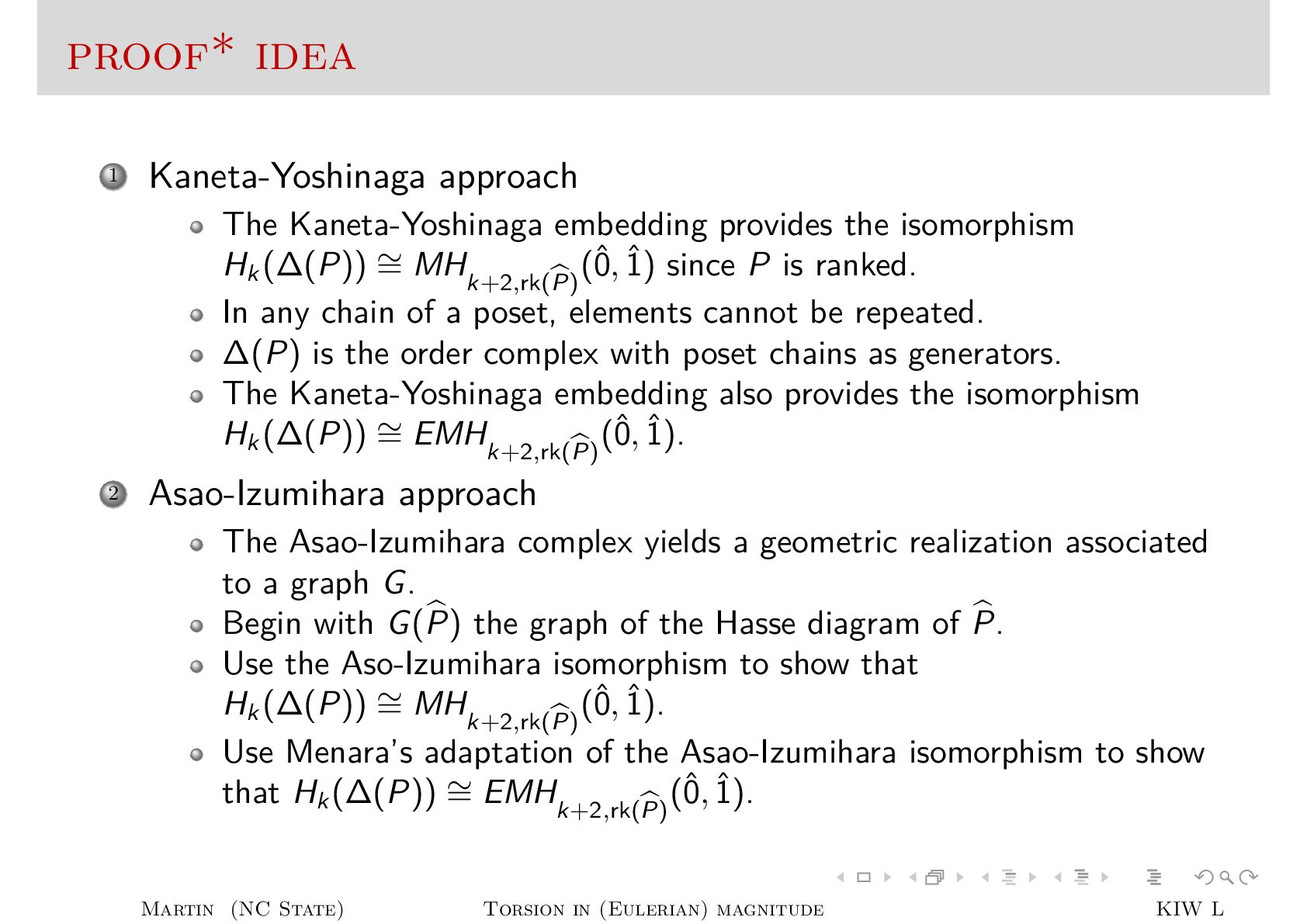
isomorphism Hk (∆(P)) ∼ (0̂, 1̂) since P is ranked. = MHk+2,rk(b P) In any chain of a poset, elements cannot be repeated. ∆(P) is the order complex with poset chains as generators. The Kaneta-Yoshinaga embedding also provides the isomorphism Hk (∆(P)) ∼ (0̂, 1̂). = EMHk+2,rk(b P) 2 Asao-Izumihara approach The Asao-Izumihara complex yields a geometric realization associated to a graph G. b the graph of the Hasse diagram of P. b Begin with G(P) Use the Aso-Izumihara isomorphism to show that (0̂, 1̂). Hk (∆(P)) ∼ = MHk+2,rk(b P) Use Menara’s adaptation of the Asao-Izumihara isomorphism to show that Hk (∆(P)) ∼ (0̂, 1̂). = EMHk+2,rk(b P) Martin (NC State) Torsion in (Eulerian) magnitude KIW L
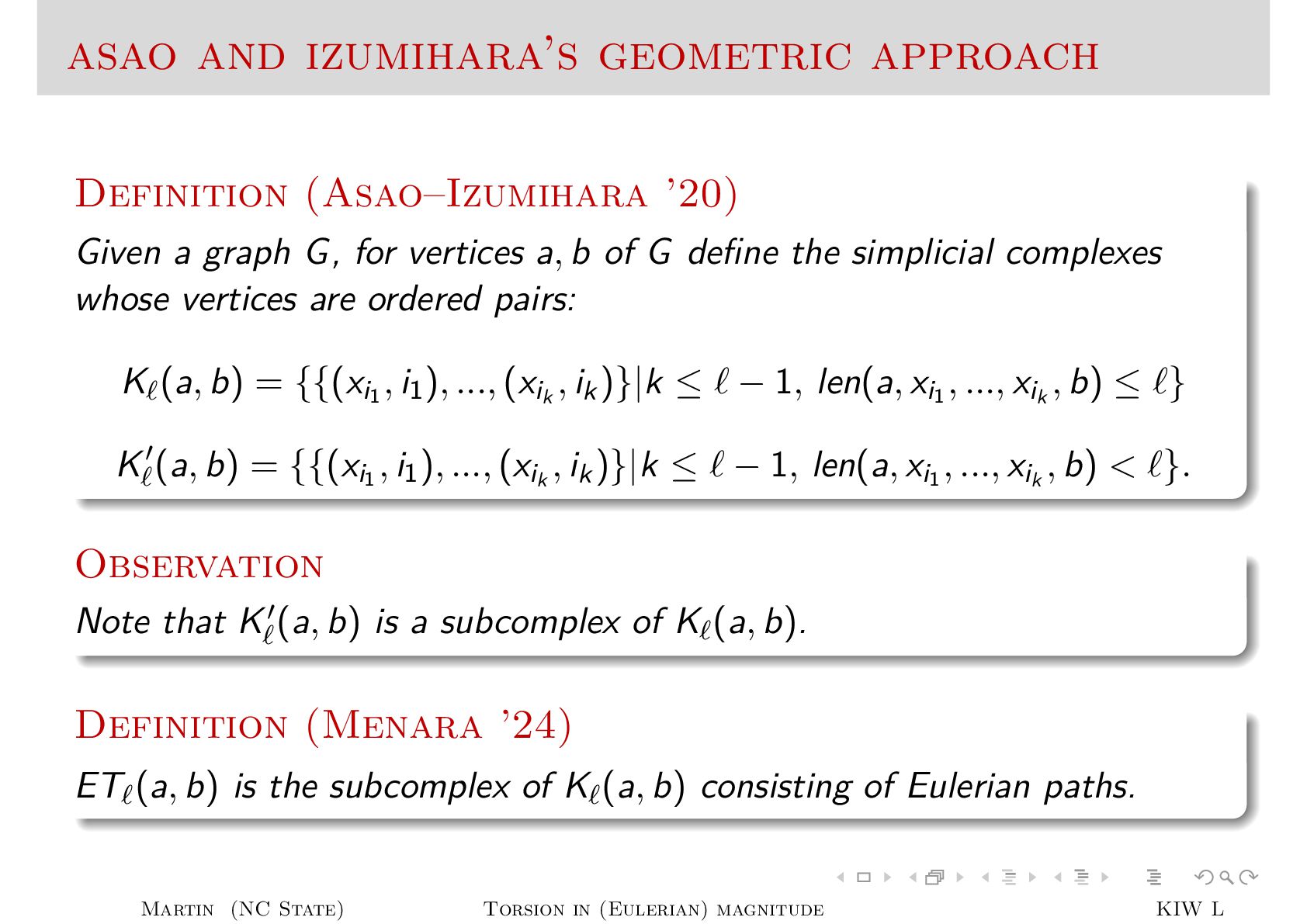
graph G, for vertices a, b of G define the simplicial complexes whose vertices are ordered pairs: Kℓ (a, b) = {{(xi1 , i1 ), ..., (xik , ik )}|k ≤ ℓ − 1, len(a, xi1 , ..., xik , b) ≤ ℓ} Kℓ′ (a, b) = {{(xi1 , i1 ), ..., (xik , ik )}|k ≤ ℓ − 1, len(a, xi1 , ..., xik , b) < ℓ}. Observation Note that Kℓ′ (a, b) is a subcomplex of Kℓ (a, b). Definition (Menara ’24) ETℓ (a, b) is the subcomplex of Kℓ (a, b) consisting of Eulerian paths. Martin (NC State) Torsion in (Eulerian) magnitude KIW L
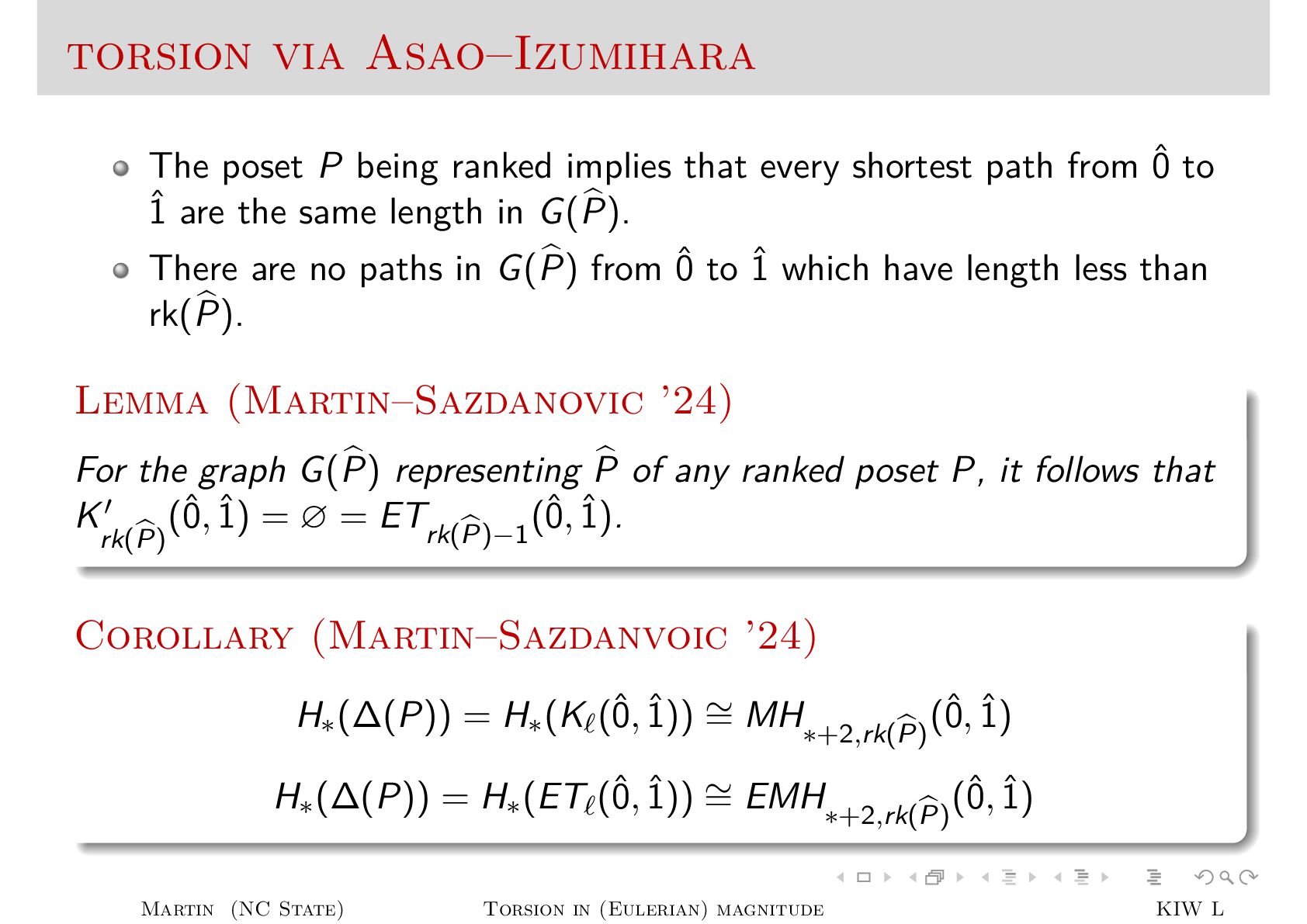
every shortest path from 0̂ to b 1̂ are the same length in G(P). b from 0̂ to 1̂ which have length less than There are no paths in G(P) b rk(P). Lemma (Martin–Sazdanovic ’24) b representing P b of any ranked poset P, it follows that For the graph G(P) K ′ b (0̂, 1̂) = ∅ = ETrk(Pb)−1 (0̂, 1̂). rk(P ) Corollary (Martin–Sazdanvoic ’24) H∗ (∆(P)) = H∗ (Kℓ (0̂, 1̂)) ∼ = MH∗+2,rk(Pb) (0̂, 1̂) ∼ EMH H∗ (∆(P)) = H∗ (ETℓ (0̂, 1̂)) = b) (0̂, 1̂) ∗+2,rk(P Martin (NC State) Torsion in (Eulerian) magnitude KIW L
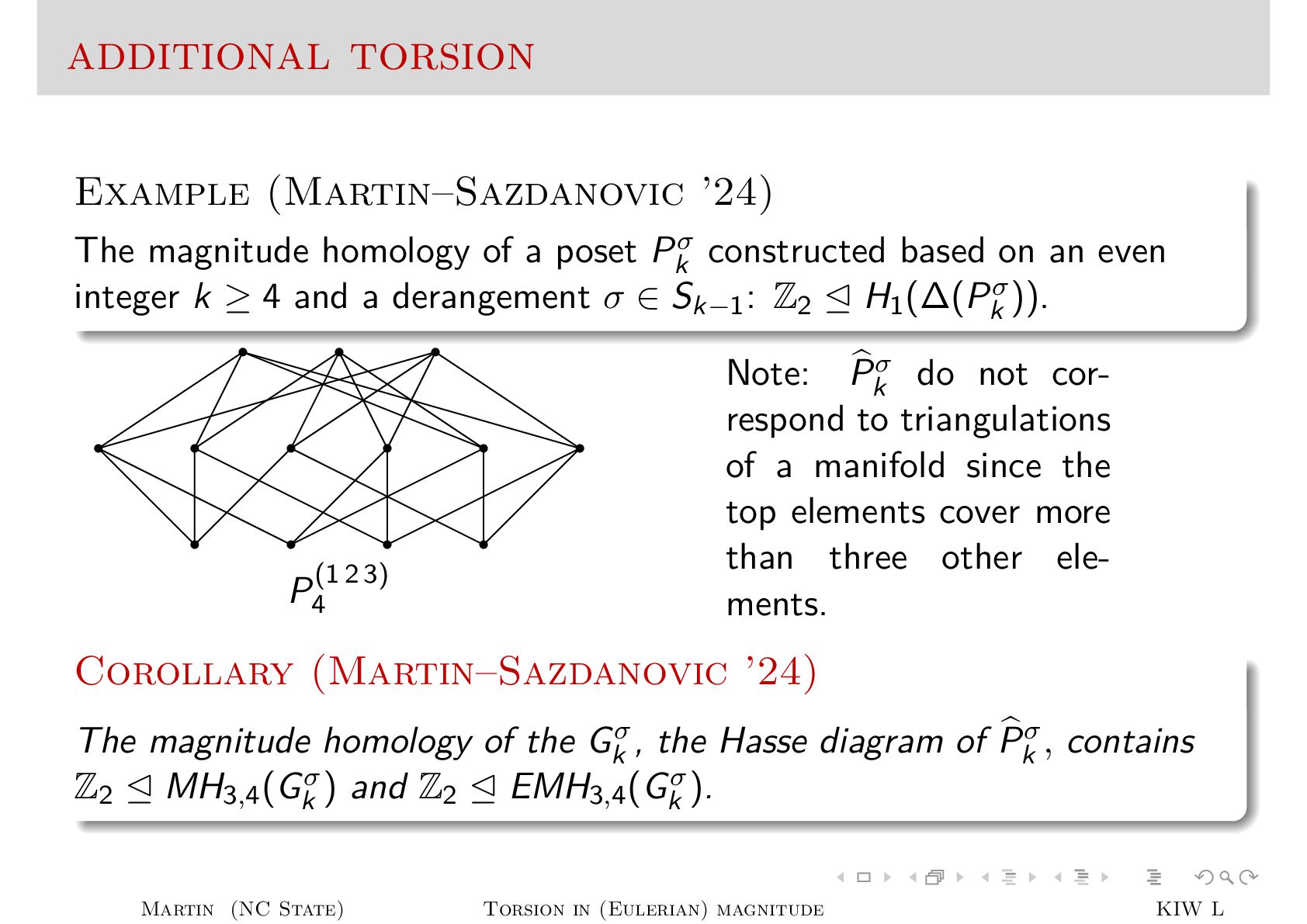
poset Pkσ constructed based on an even integer k ≥ 4 and a derangement σ ∈ Sk−1 : Z2 ⊴ H1 (∆(Pkσ )). (1 2 3) P4 b σ do not corNote: P k respond to triangulations of a manifold since the top elements cover more than three other elements. Corollary (Martin–Sazdanovic ’24) b σ , contains The magnitude homology of the Gkσ , the Hasse diagram of P k Z2 ⊴ MH3,4 (Gkσ ) and Z2 ⊴ EMH3,4 (Gkσ ). Martin (NC State) Torsion in (Eulerian) magnitude KIW L
What properties does torsion in (Eulerian) magnitude homology detect in a graph? Menara was able to write an algorithm to compute EMH(G) in non-exponential super-polynomial time [Menara, Manzoni ’24]. Are there ways to improve on this algorithm to reduce computational complexity? Is torsion from Magnitude homology preserved in Eulerian magnitude? Discriminate magnitude is the homology of the quotient complex DMCk,ℓ (G) = MCk,ℓ (G)/EMCk,ℓ (G) [Menara ’24] and fits in a long exact sequence. Relationships between magnitude homology and other homology theories? Martin (NC State) Torsion in (Eulerian) magnitude KIW L


 winterstorm7
 inesmontani
 portentint
 skipperchong
 thirion
 nmsamuel
 holman
 livdayseo
 chrisshort
 vanstee
 lara
 baasie
 destraynor