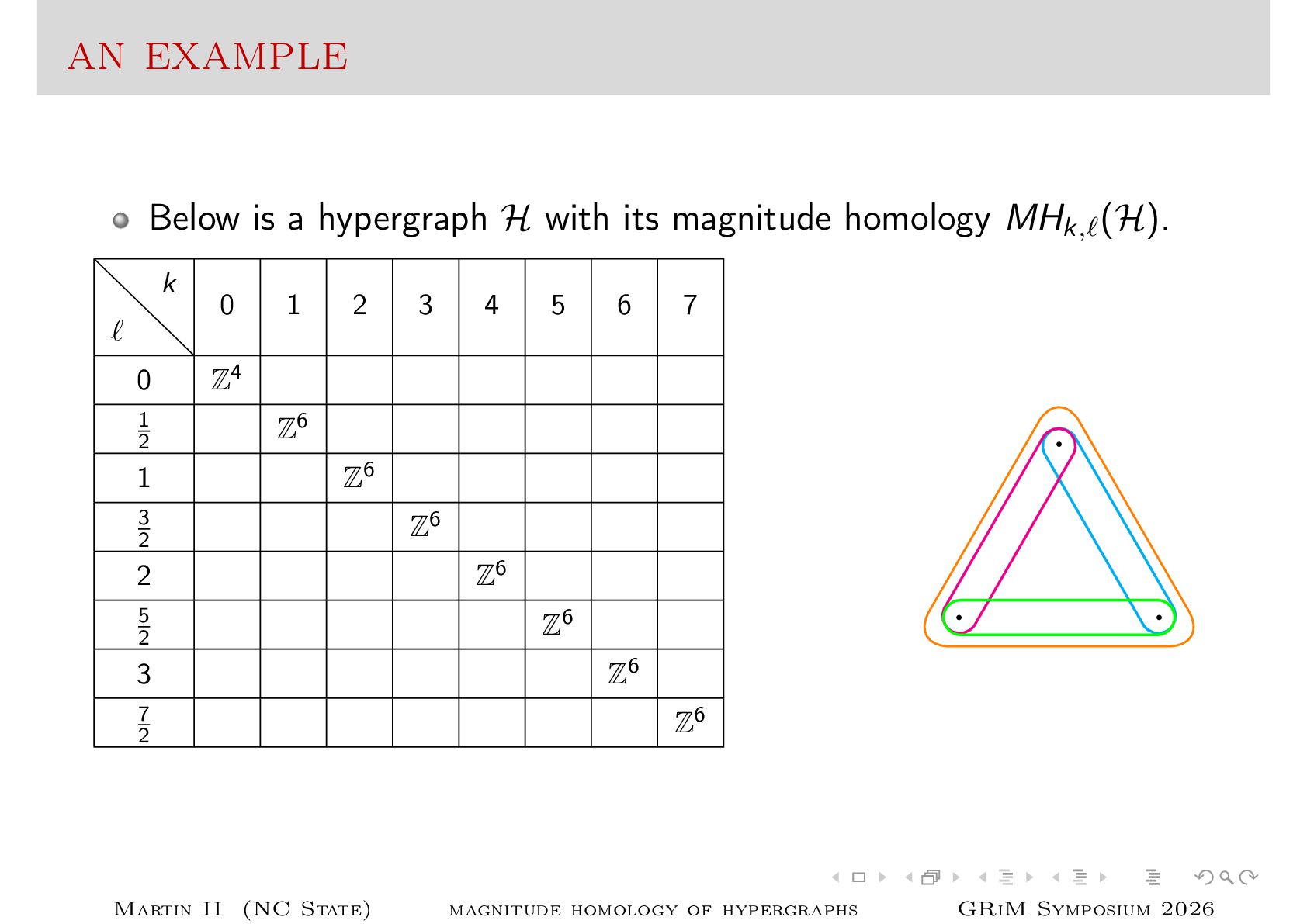
Magnitude homology MHk,ℓ (X ) Computational tools: Mayer-Vietoris & Künneth sequences Part II: Hypergraphs 1 2 3 4 5 Hypergraphs as a metric space Constraint graphs as a metric space M-moves MV for hypergraph magnitude homology Künneth for hypergraph magnitude homology Part III: Future Directions 1 Avenues for research Martin II (NC State) magnitude homology of hypergraphs GRiM Symposium 2026
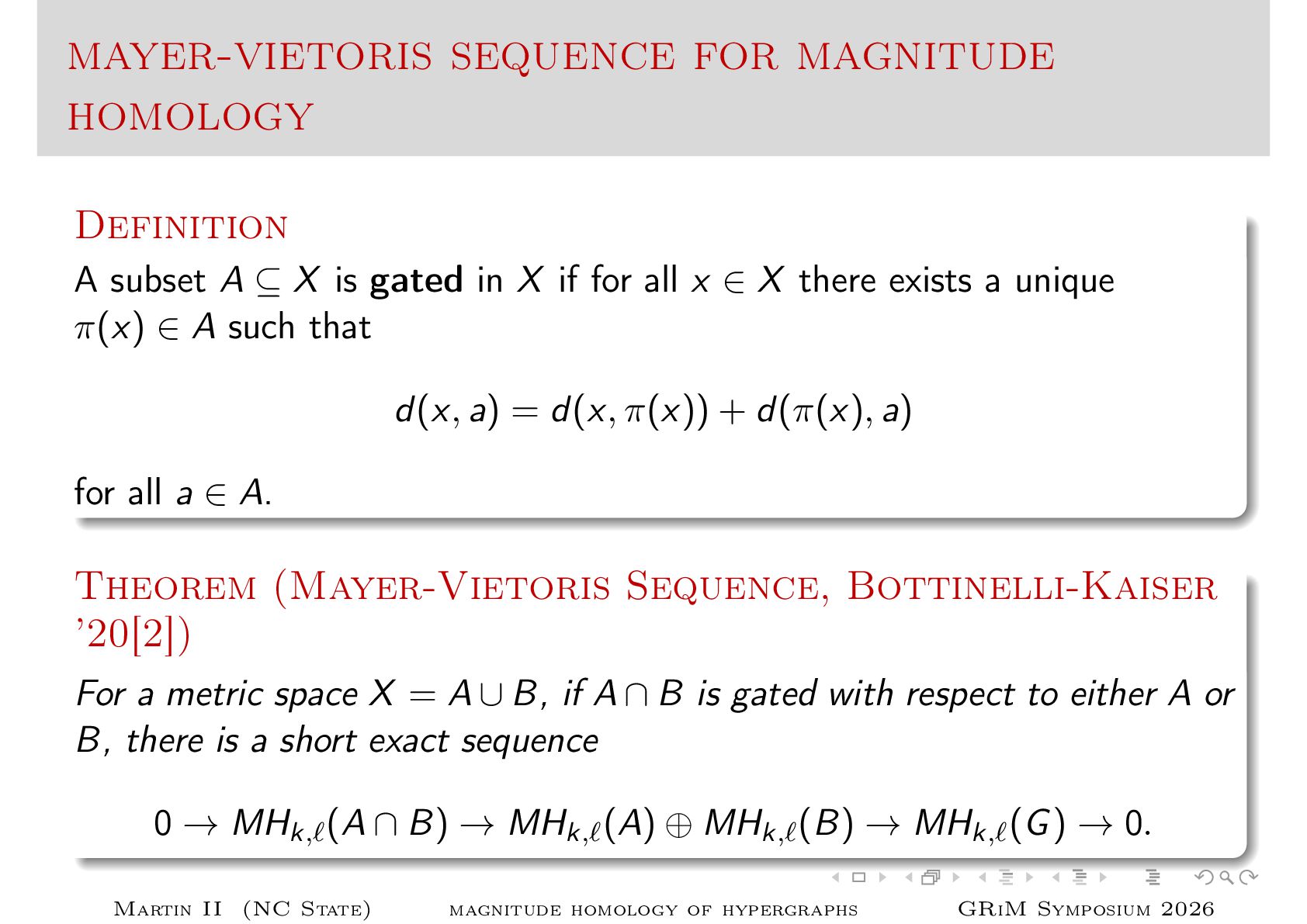
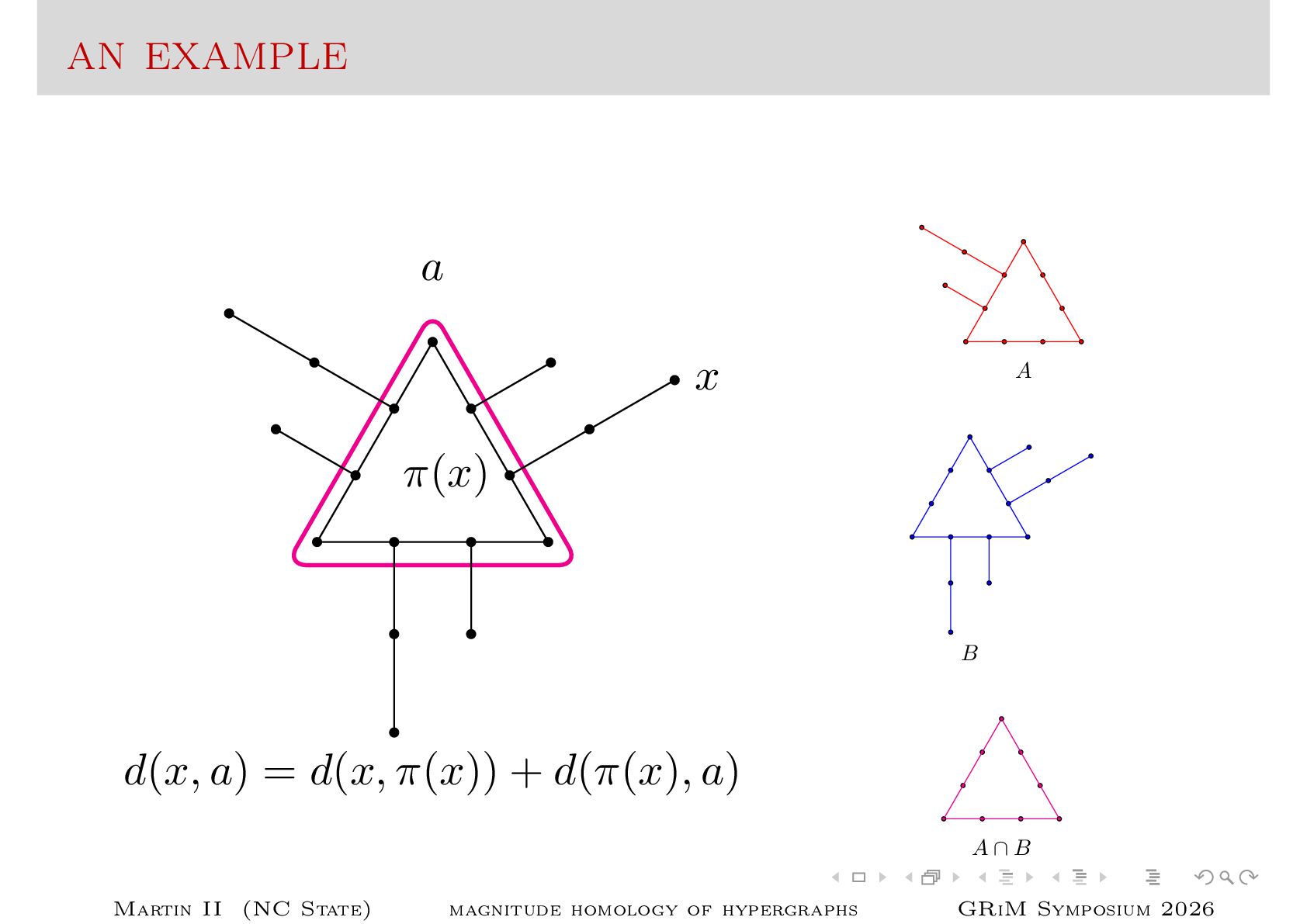
X is gated in X if for all x ∈ X there exists a unique π(x) ∈ A such that d(x, a) = d(x, π(x)) + d(π(x), a) for all a ∈ A. Theorem (Mayer-Vietoris Sequence, Bottinelli-Kaiser ’20[2]) For a metric space X = A ∪ B, if A ∩ B is gated with respect to either A or B, there is a short exact sequence 0 → MHk,ℓ (A ∩ B) → MHk,ℓ (A) ⊕ MHk,ℓ (B) → MHk,ℓ (G ) → 0. Martin II (NC State) magnitude homology of hypergraphs GRiM Symposium 2026
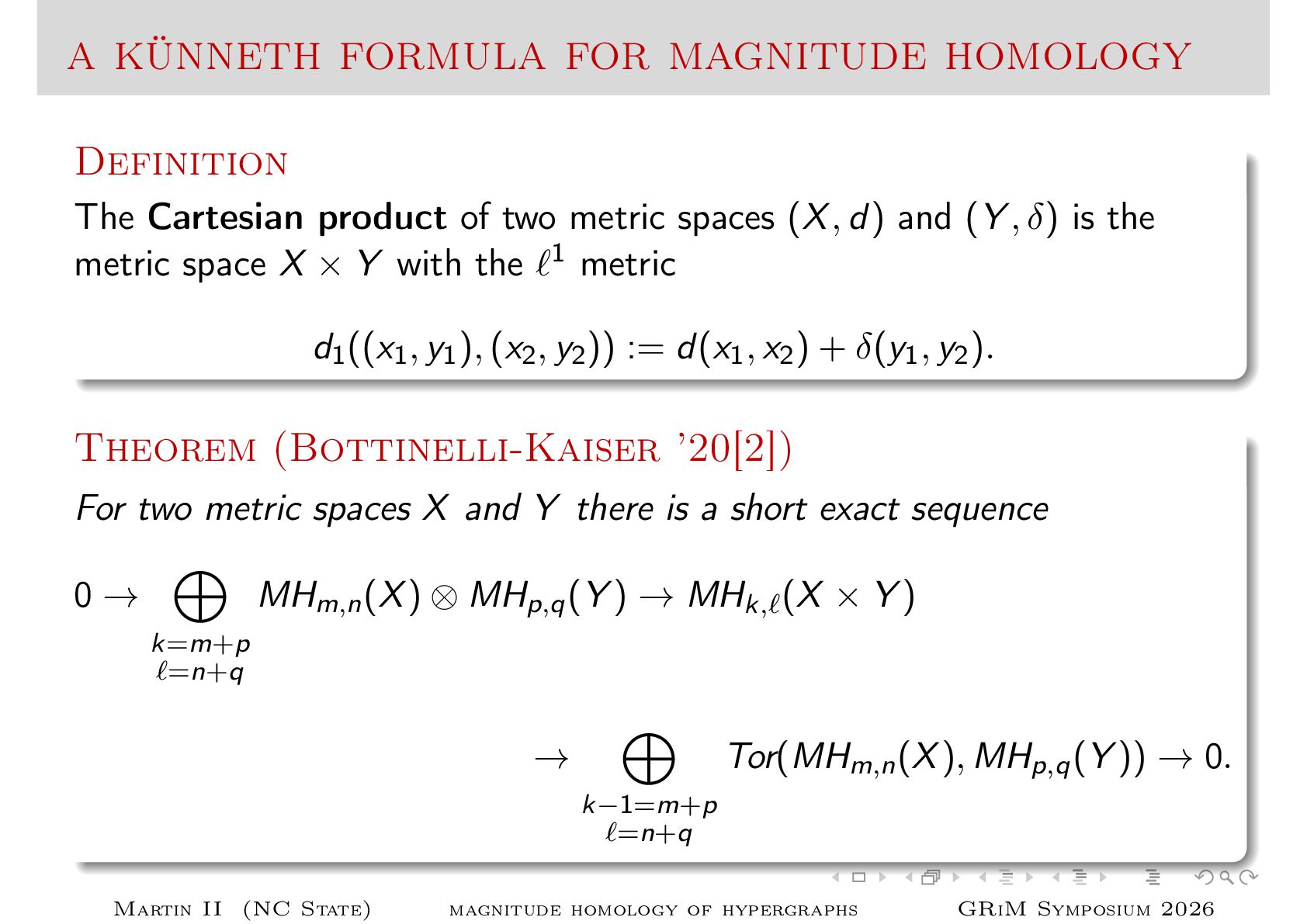
of two metric spaces (X , d) and (Y , δ) is the metric space X × Y with the ℓ1 metric d1 ((x1 , y1 ), (x2 , y2 )) := d(x1 , x2 ) + δ(y1 , y2 ). Theorem (Bottinelli-Kaiser ’20[2]) For two metric spaces X and Y there is a short exact sequence M 0→ MHm,n (X ) ⊗ MHp,q (Y ) → MHk,ℓ (X × Y ) k=m+p ℓ=n+q → M Tor(MHm,n (X ), MHp,q (Y )) → 0. k−1=m+p ℓ=n+q Martin II (NC State) magnitude homology of hypergraphs GRiM Symposium 2026
to metric spaces. There exist Mayer-Vietoris and Künneth sequences for magnitude homology. Graphs are metric spaces under the shortest-path distance. How can this be generalized to hypergraphs? Martin II (NC State) magnitude homology of hypergraphs GRiM Symposium 2026
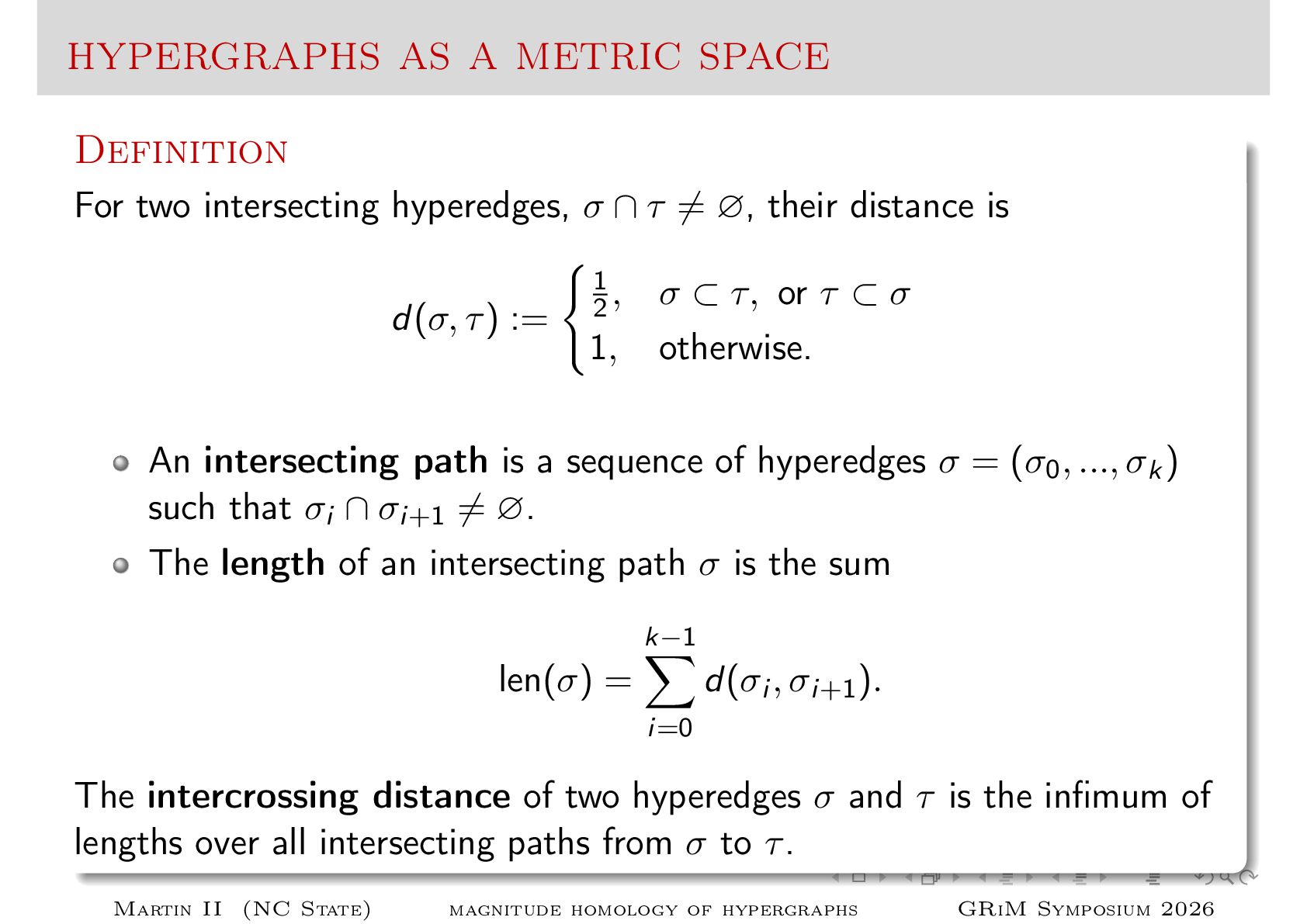
σ ∩ τ ̸= ∅, their distance is ( 1 , σ ⊂ τ, or τ ⊂ σ 2 d(σ, τ ) := 1, otherwise. An intersecting path is a sequence of hyperedges σ = (σ0 , ..., σk ) such that σi ∩ σi+1 ̸= ∅. The length of an intersecting path σ is the sum len(σ) = k−1 X d(σi , σi+1 ). i=0 The intercrossing distance of two hyperedges σ and τ is the infimum of lengths over all intersecting paths from σ to τ . Martin II (NC State) magnitude homology of hypergraphs GRiM Symposium 2026
first to study the magnitude homology of hypergraphs using this construction [1]. Avenues left open for research: Did a Mayer-Vietoris sequence exist for hypergraph magnitude homology? In their research, they discovered no such product on hypergraphs which could fit into a Künneth formula for hypergraph magnitude homology. Could a new hypergraph product be constructed to fit into a Künneth short exact sequence in magnitude homology? Martin II (NC State) magnitude homology of hypergraphs GRiM Symposium 2026
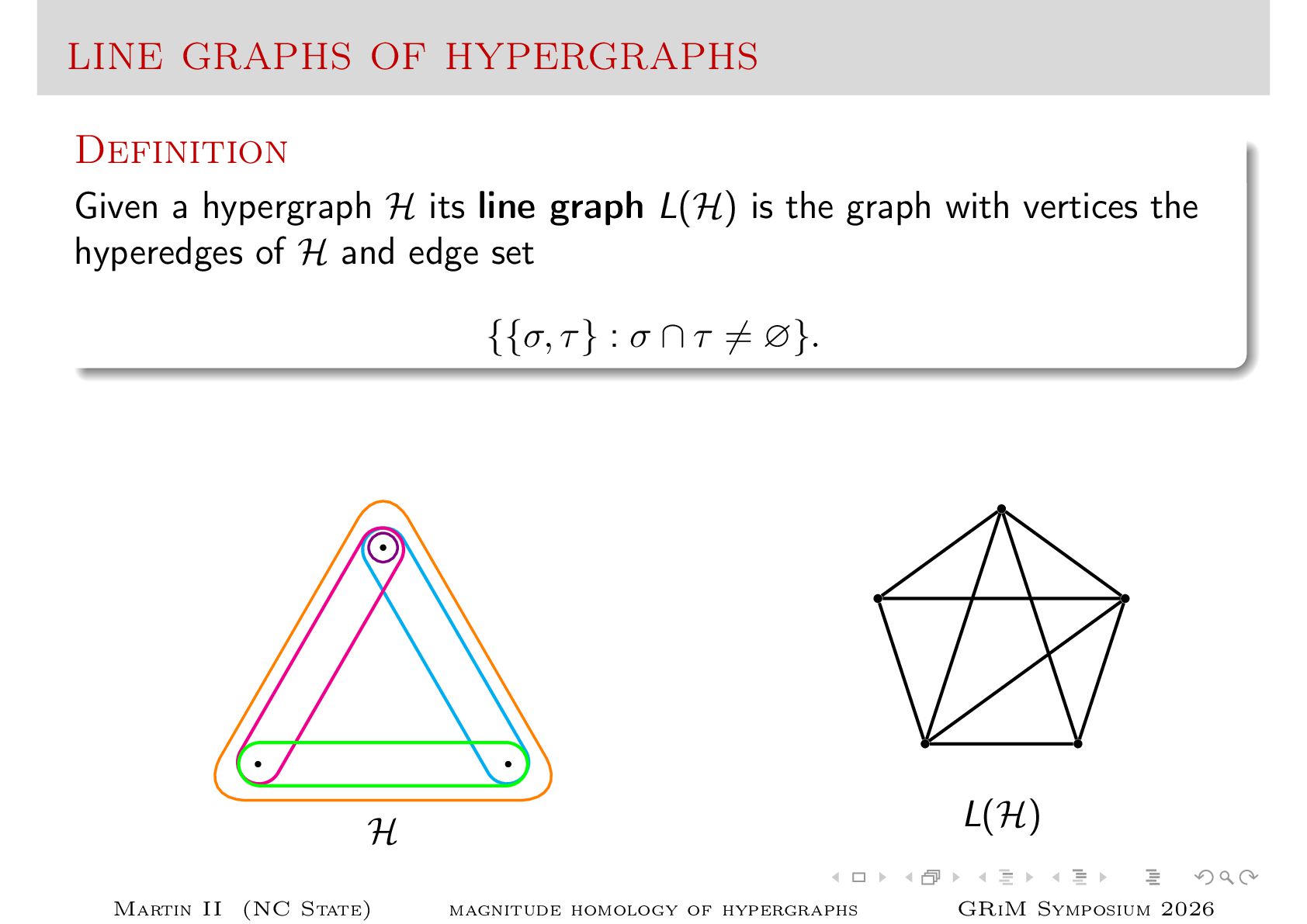
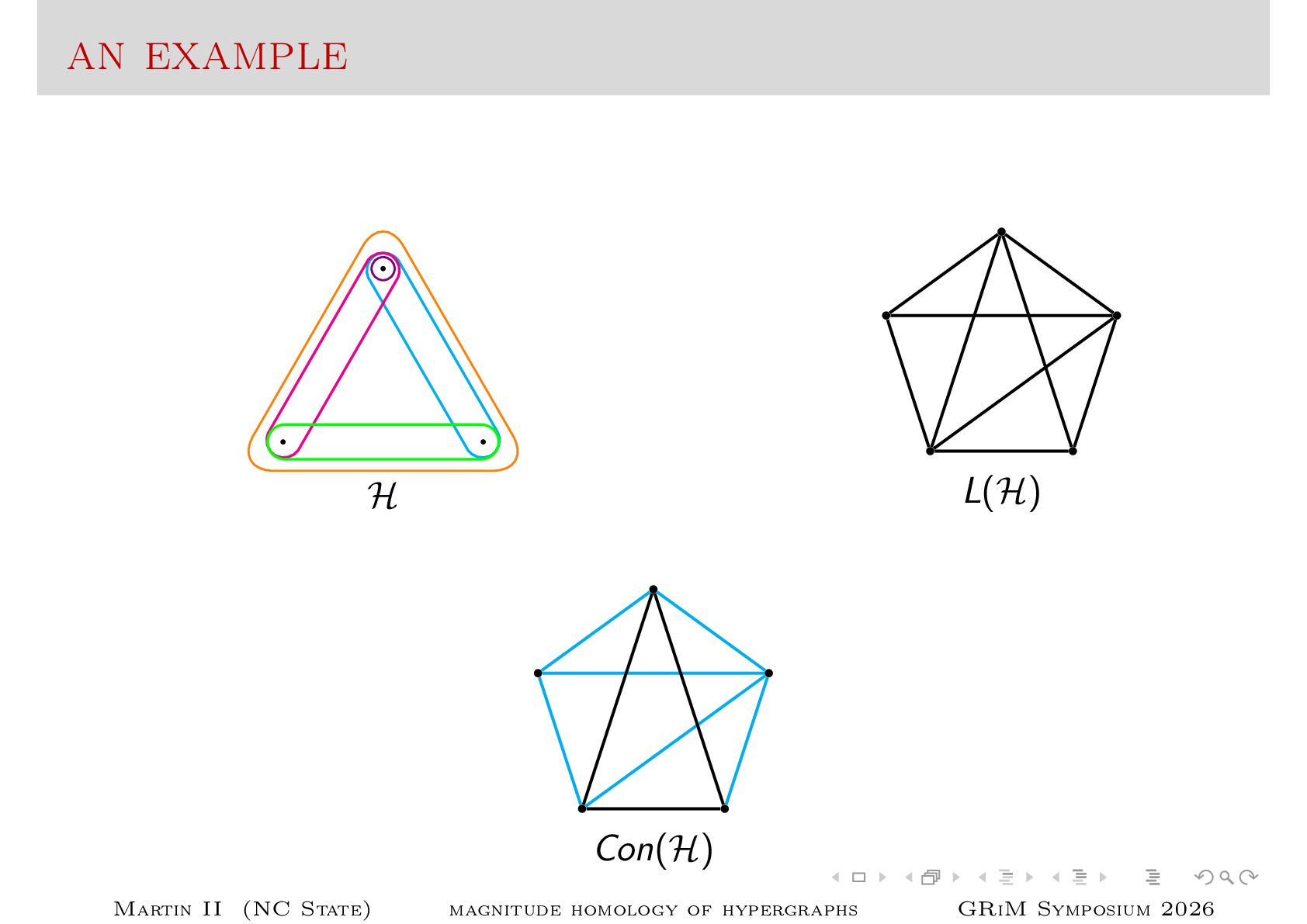
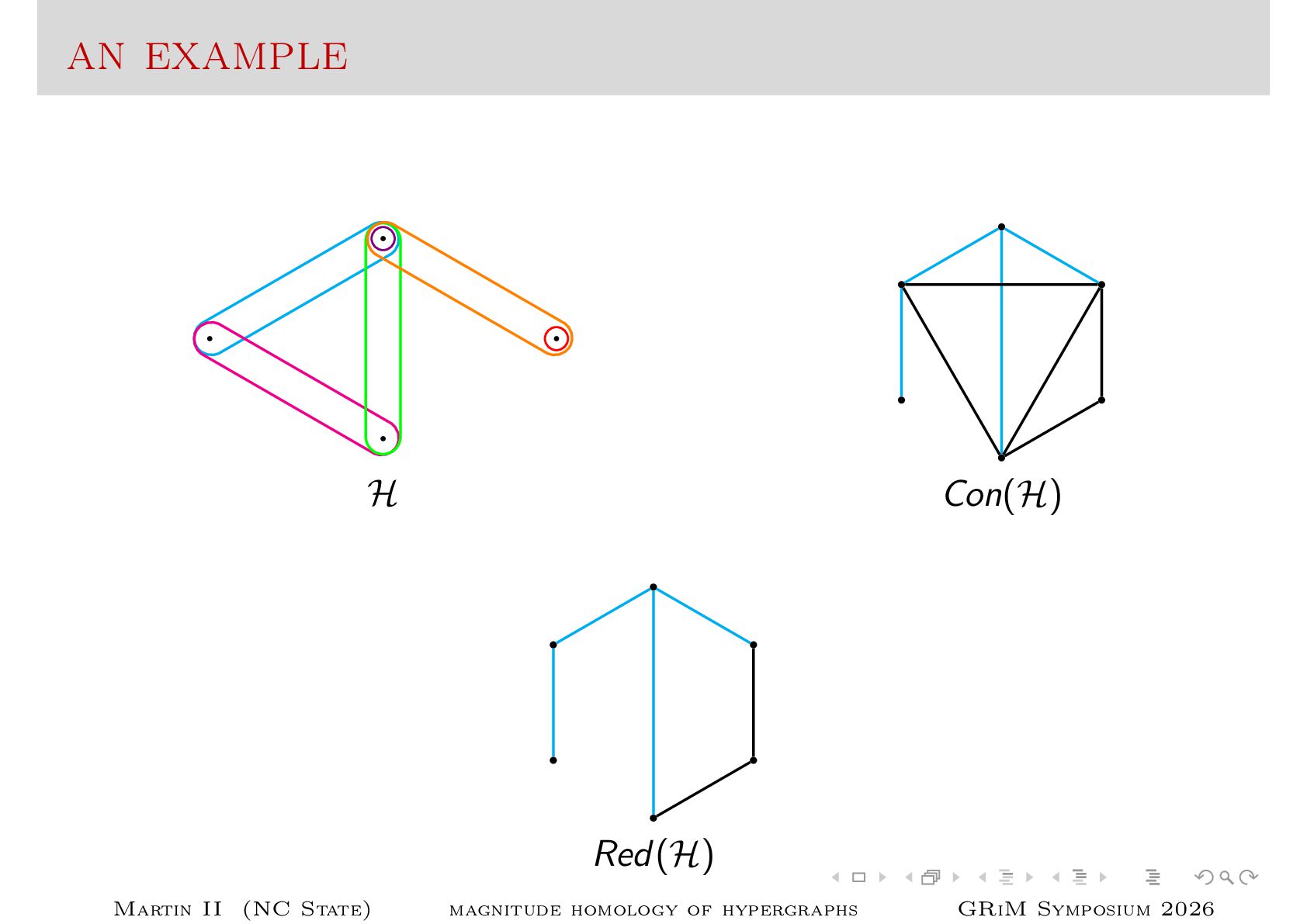
line graph L(H) is the graph with vertices the hyperedges of H and edge set {{σ, τ } : σ ∩ τ ̸= ∅}. L(H) H Martin II (NC State) magnitude homology of hypergraphs GRiM Symposium 2026
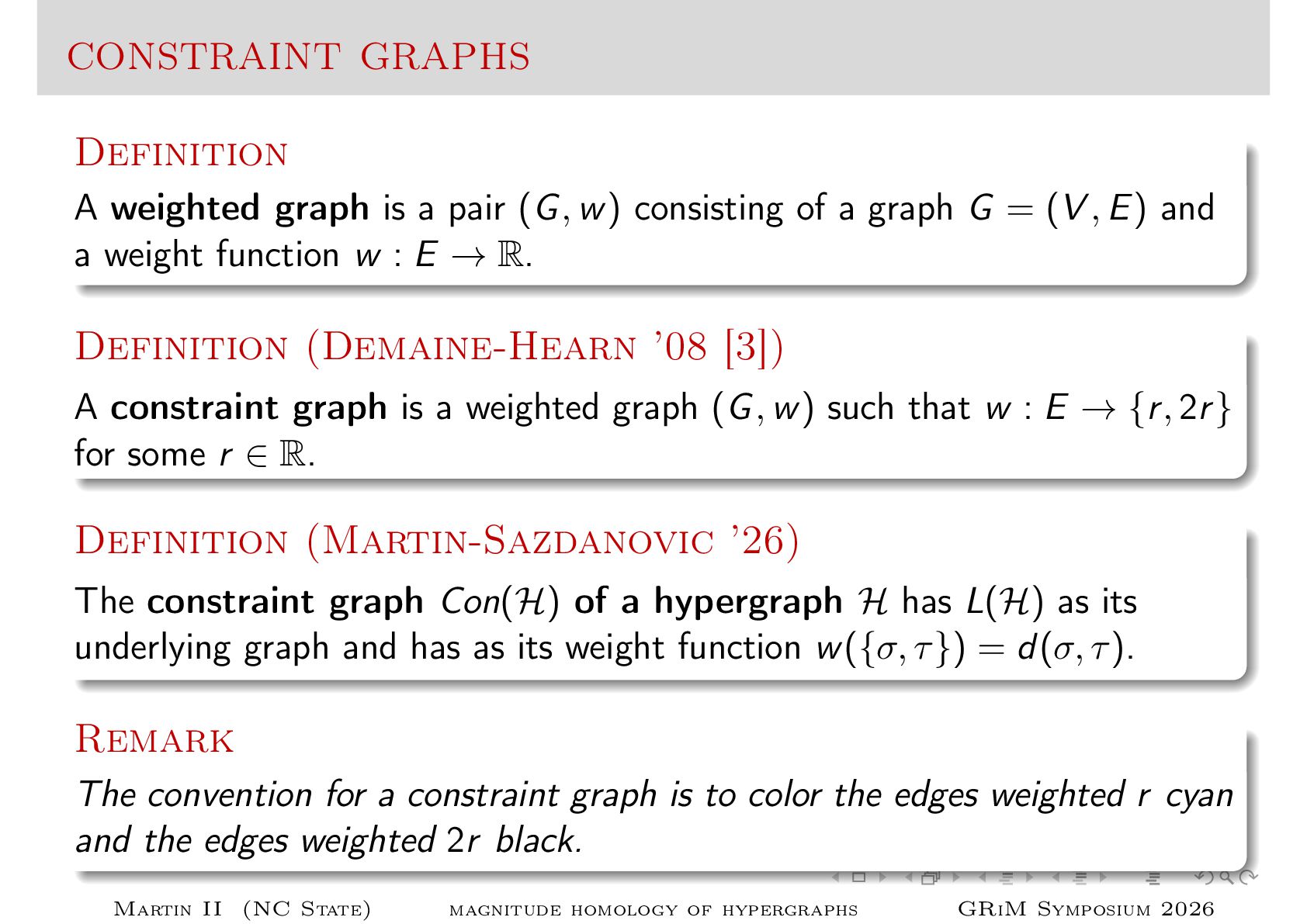
, w ) consisting of a graph G = (V , E ) and a weight function w : E → R. Definition (Demaine-Hearn ’08 [3]) A constraint graph is a weighted graph (G , w ) such that w : E → {r , 2r } for some r ∈ R. Definition (Martin-Sazdanovic ’26) The constraint graph Con(H) of a hypergraph H has L(H) as its underlying graph and has as its weight function w ({σ, τ }) = d(σ, τ ). Remark The convention for a constraint graph is to color the edges weighted r cyan and the edges weighted 2r black. Martin II (NC State) magnitude homology of hypergraphs GRiM Symposium 2026
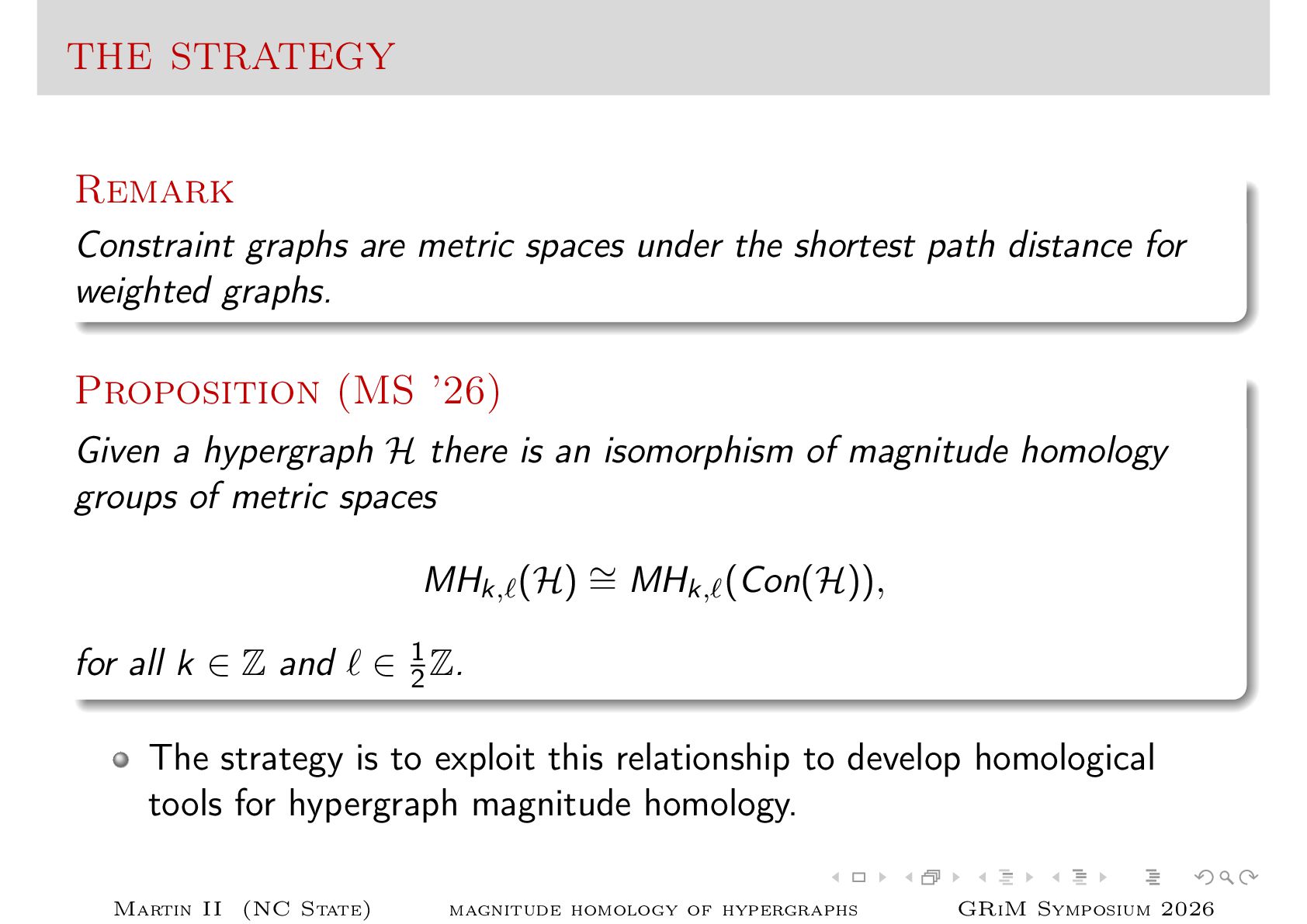
shortest path distance for weighted graphs. Proposition (MS ’26) Given a hypergraph H there is an isomorphism of magnitude homology groups of metric spaces MHk,ℓ (H) ∼ = MHk,ℓ (Con(H)), for all k ∈ Z and ℓ ∈ 12 Z. The strategy is to exploit this relationship to develop homological tools for hypergraph magnitude homology. Martin II (NC State) magnitude homology of hypergraphs GRiM Symposium 2026
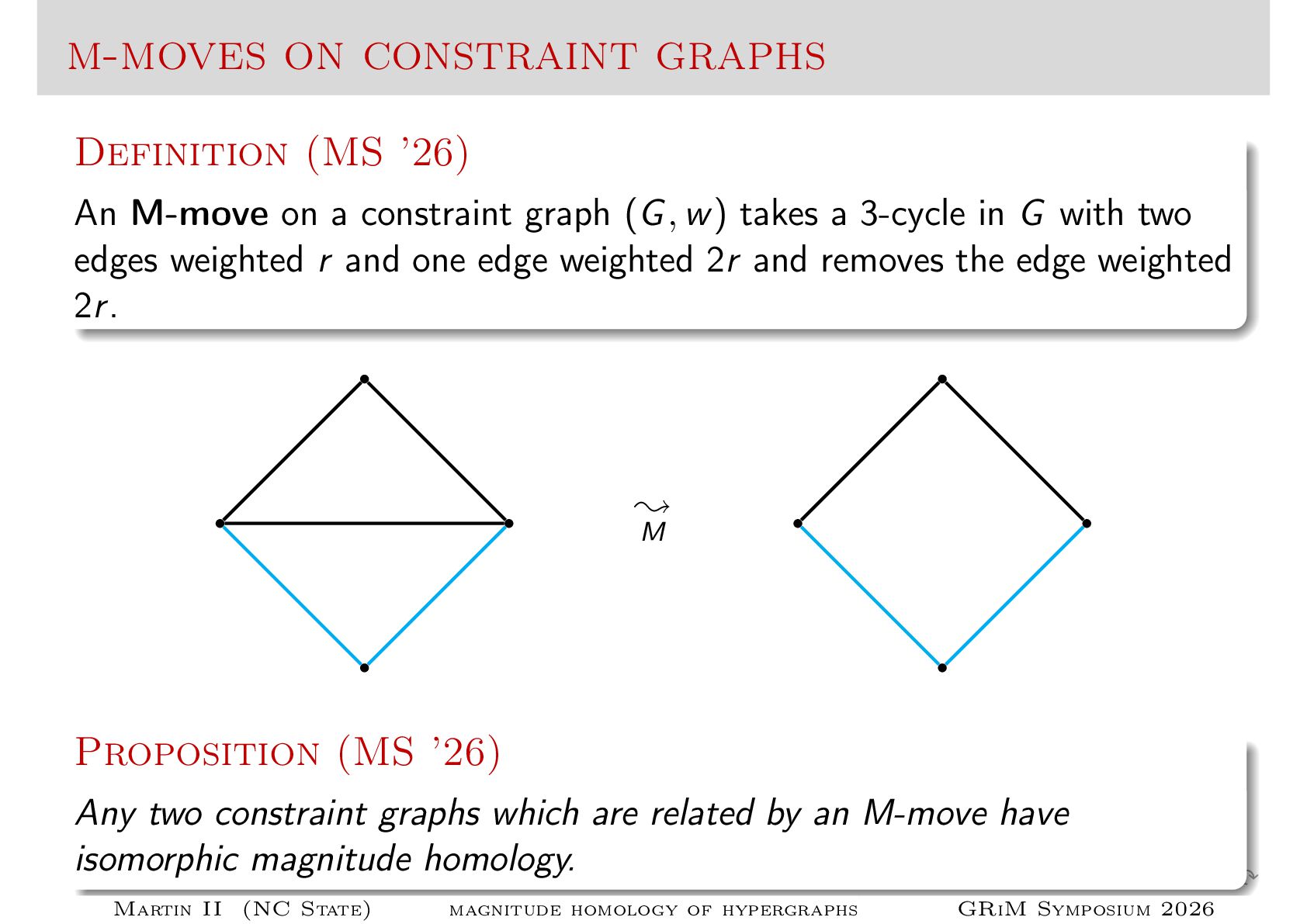
a constraint graph (G , w ) takes a 3-cycle in G with two edges weighted r and one edge weighted 2r and removes the edge weighted 2r . ; M Proposition (MS ’26) Any two constraint graphs which are related by an M-move have isomorphic magnitude homology. Martin II (NC State) magnitude homology of hypergraphs GRiM Symposium 2026
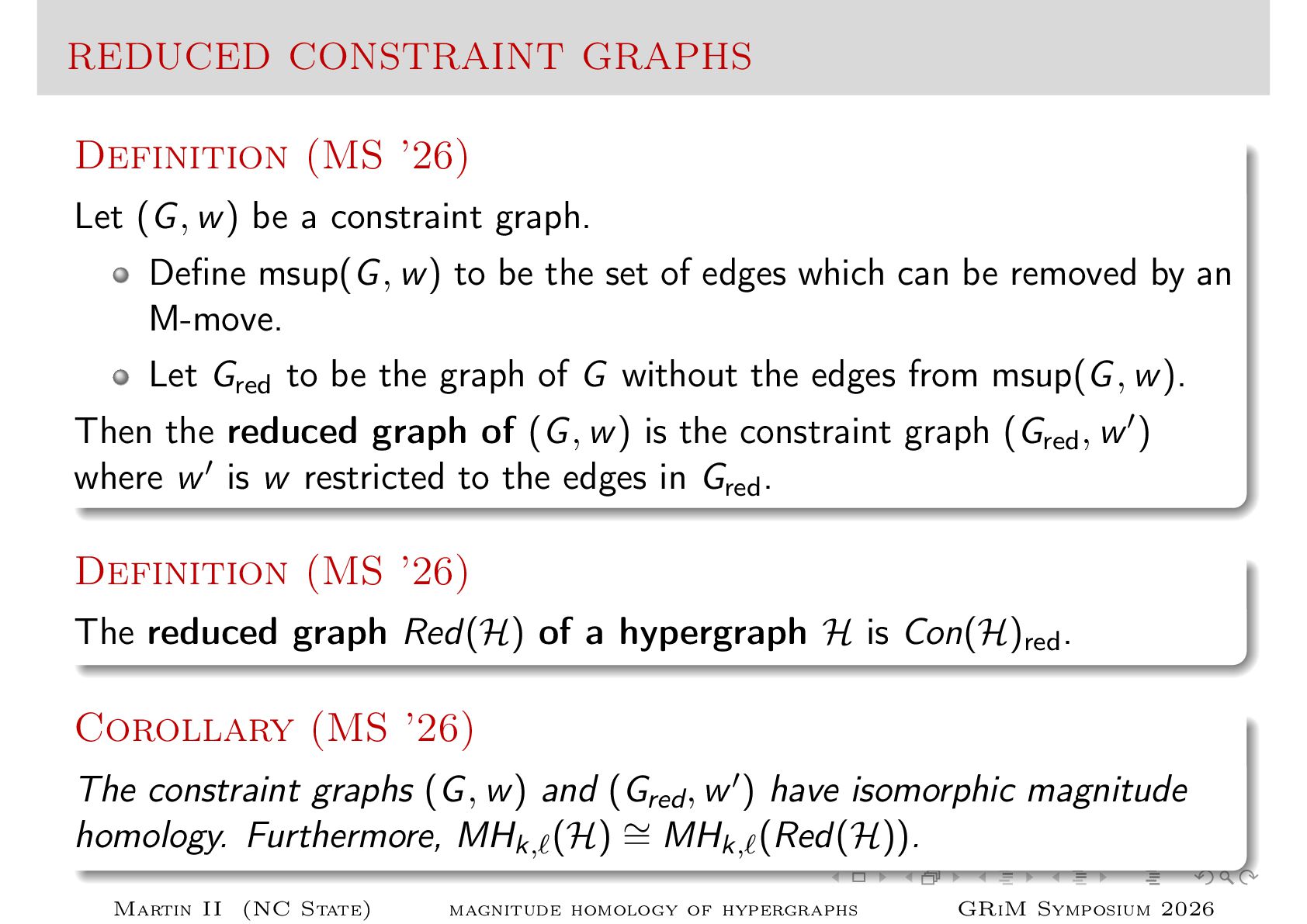
) be a constraint graph. Define msup(G , w ) to be the set of edges which can be removed by an M-move. Let Gred to be the graph of G without the edges from msup(G , w ). Then the reduced graph of (G , w ) is the constraint graph (Gred , w ′ ) where w ′ is w restricted to the edges in Gred . Definition (MS ’26) The reduced graph Red(H) of a hypergraph H is Con(H)red . Corollary (MS ’26) The constraint graphs (G , w ) and (Gred , w ′ ) have isomorphic magnitude homology. Furthermore, MHk,ℓ (H) ∼ = MHk,ℓ (Red(H)). Martin II (NC State) magnitude homology of hypergraphs GRiM Symposium 2026
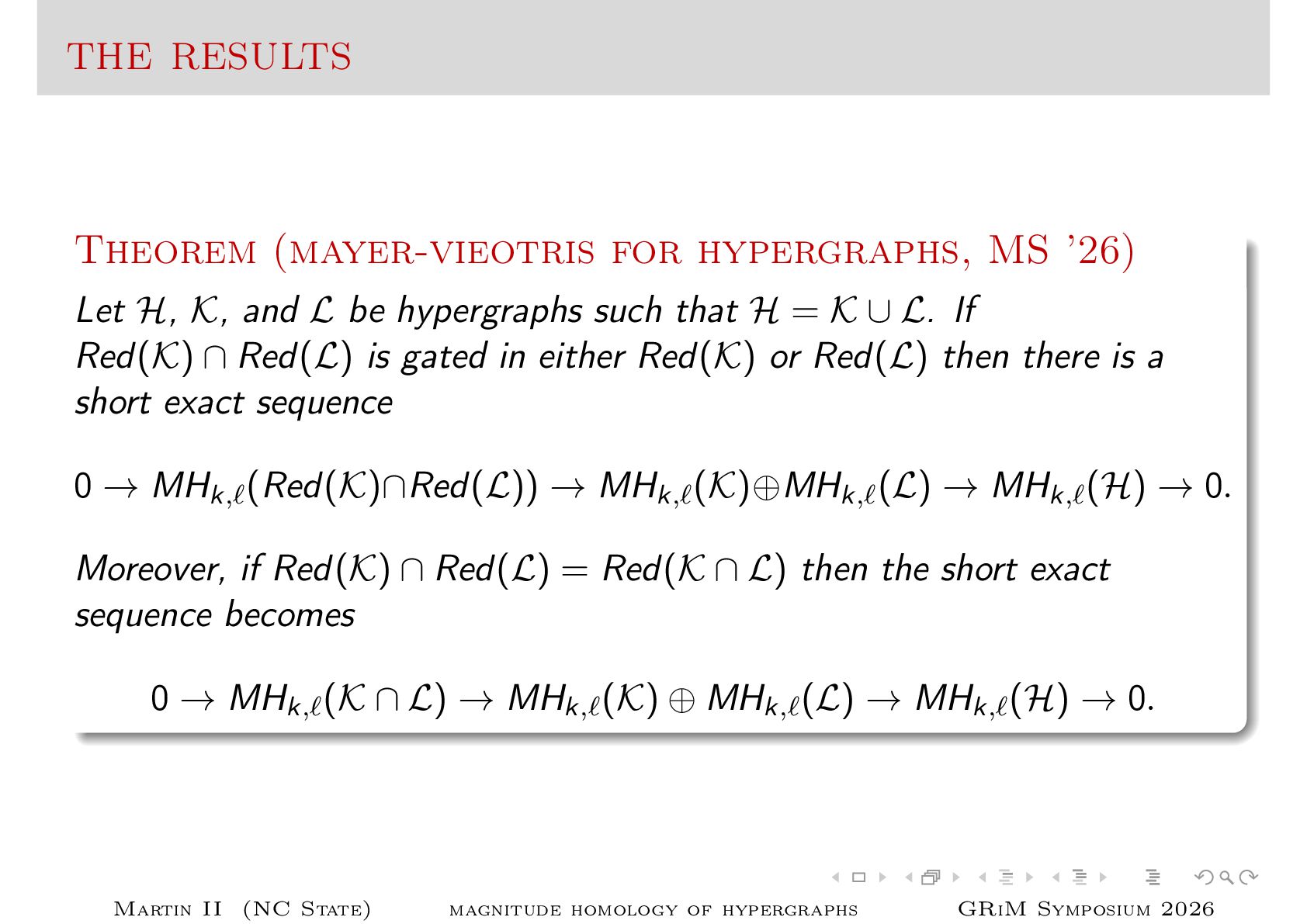
K, and L be hypergraphs such that H = K ∪ L. If Red(K) ∩ Red(L) is gated in either Red(K) or Red(L) then there is a short exact sequence 0 → MHk,ℓ (Red(K)∩Red(L)) → MHk,ℓ (K)⊕MHk,ℓ (L) → MHk,ℓ (H) → 0. Moreover, if Red(K) ∩ Red(L) = Red(K ∩ L) then the short exact sequence becomes 0 → MHk,ℓ (K ∩ L) → MHk,ℓ (K) ⊕ MHk,ℓ (L) → MHk,ℓ (H) → 0. Martin II (NC State) magnitude homology of hypergraphs GRiM Symposium 2026
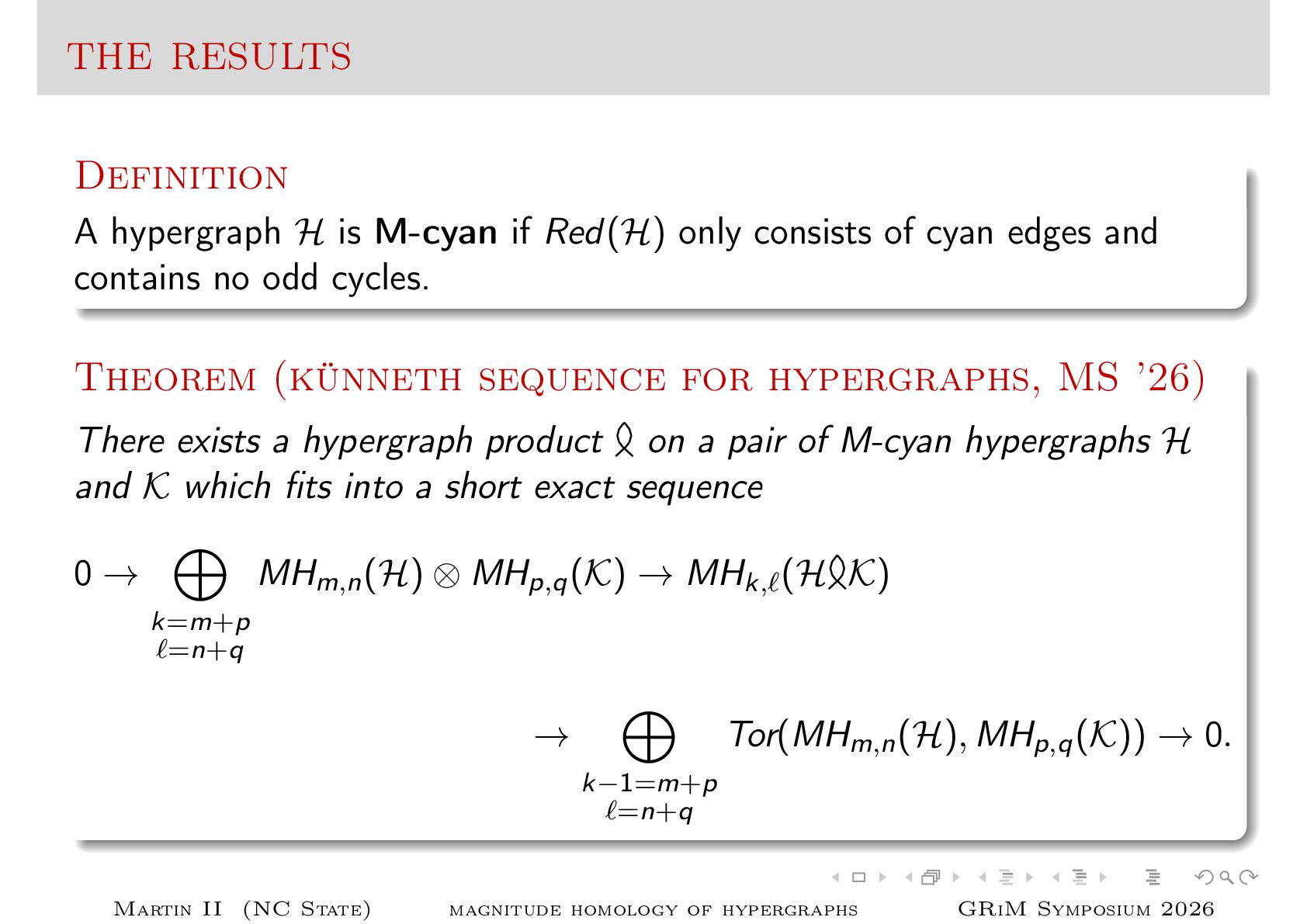
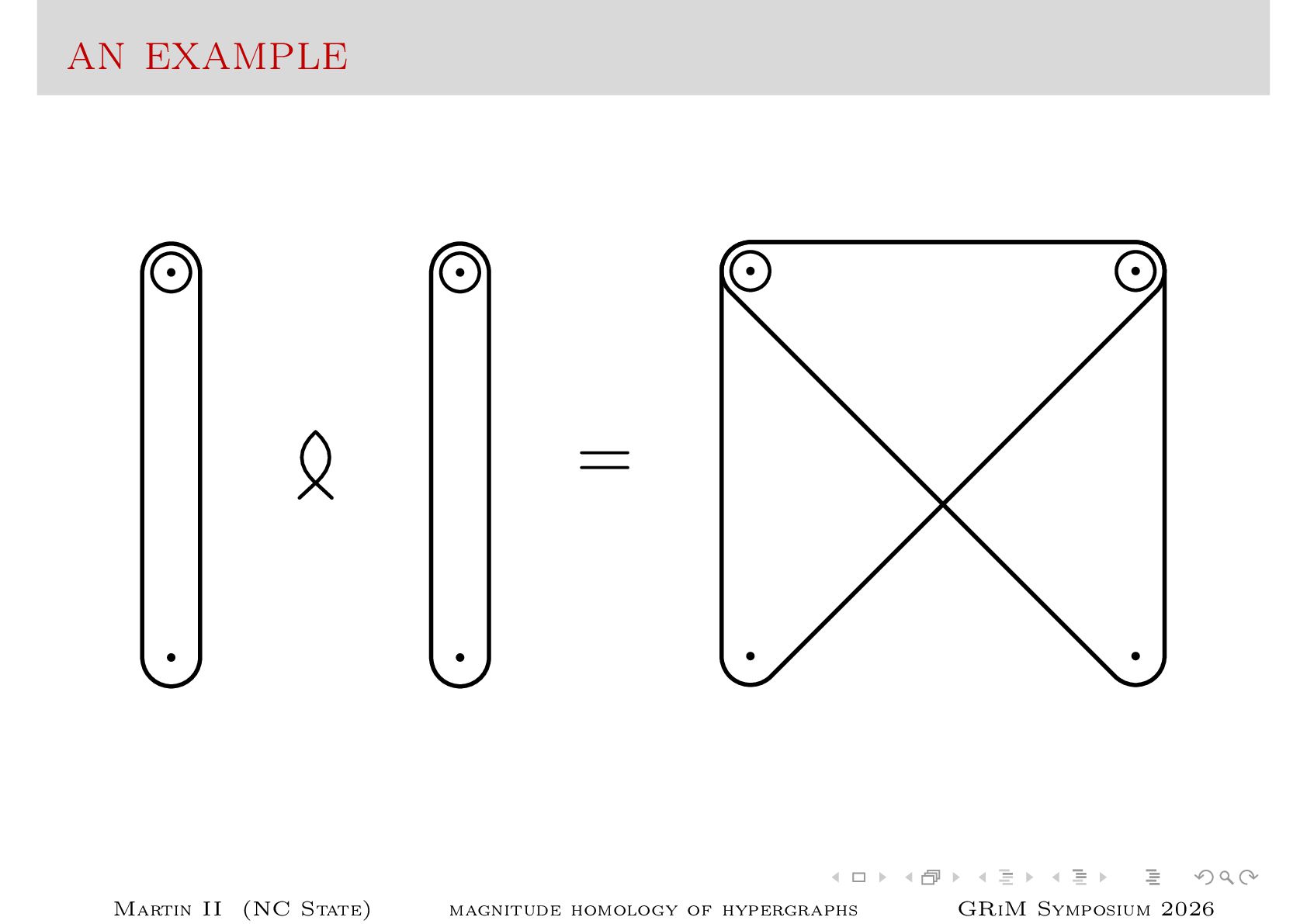
only consists of cyan edges and contains no odd cycles. Theorem (künneth sequence for hypergraphs, MS ’26) There exists a hypergraph product on a pair of M-cyan hypergraphs H and K which fits into a short exact sequence M 0→ MHm,n (H) ⊗ MHp,q (K) → MHk,ℓ (H K) k=m+p ℓ=n+q → M Tor(MHm,n (H), MHp,q (K)) → 0. k−1=m+p ℓ=n+q Martin II (NC State) magnitude homology of hypergraphs GRiM Symposium 2026
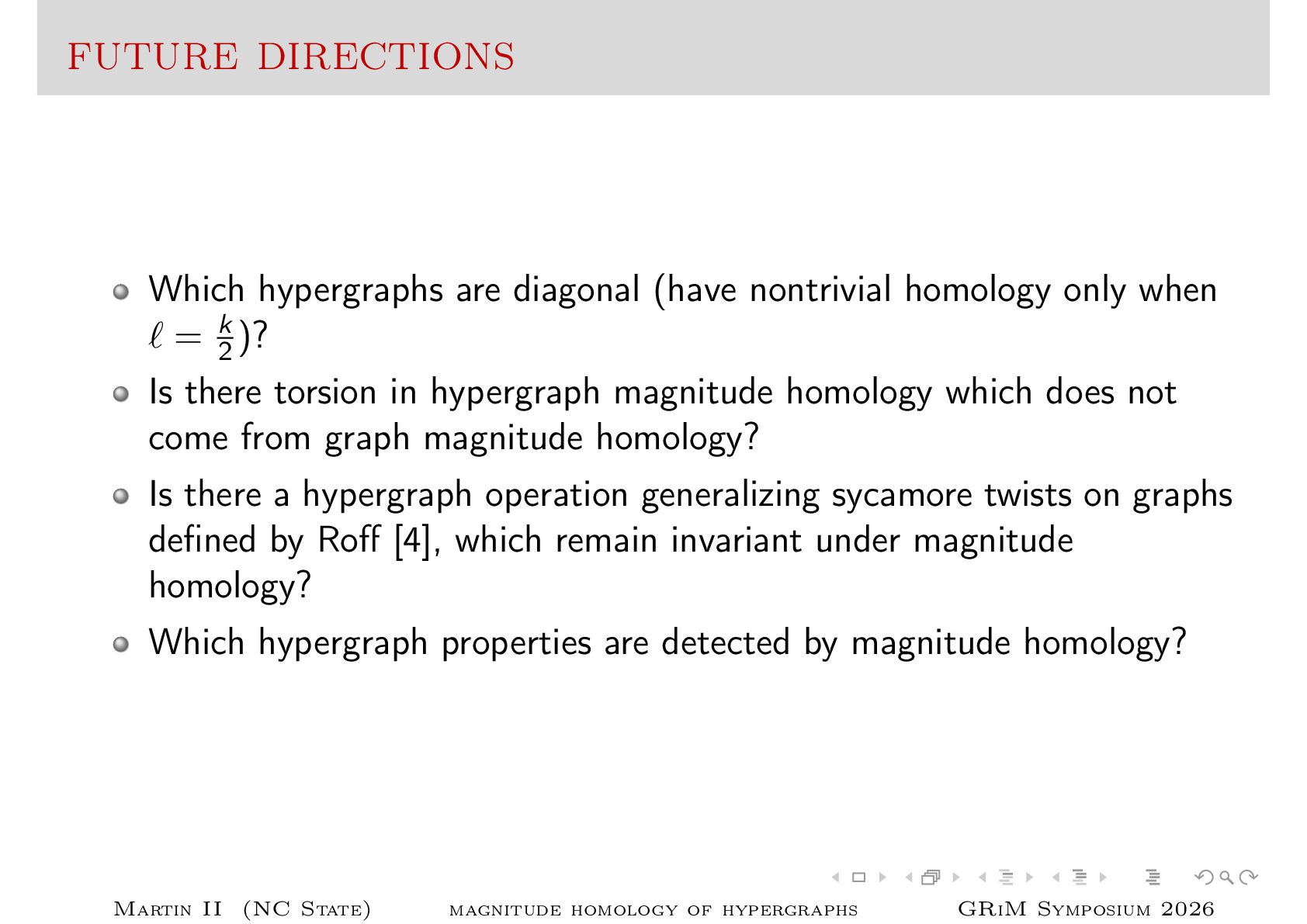
when ℓ = k2 )? Is there torsion in hypergraph magnitude homology which does not come from graph magnitude homology? Is there a hypergraph operation generalizing sycamore twists on graphs defined by Roff [4], which remain invariant under magnitude homology? Which hypergraph properties are detected by magnitude homology? Martin II (NC State) magnitude homology of hypergraphs GRiM Symposium 2026
“The magnitude homology of a hypergraph”. In: Homology, Homotopy and Applications 26.2 (2024), pp. 325–348. issn: 1532-0081. doi: 10.4310/hha.2024.v26.n2.a16. url: http://dx.doi.org/10.4310/HHA.2024.v26.n2.a16. [2] Rémi Bottinelli and Tom Kaiser. Magnitude Homology, Diagonality, Medianness, Künneth and Mayer-Vietoris. 2020. arXiv: 2003.09271 [math.CO]. url: https://arxiv.org/abs/2003.09271. [3] Erik D. Demaine and Robert A. Hearn. “Constraint Logic: A Uniform Framework for Modeling Computation as Games”. In: 2008 23rd Annual IEEE Conference on Computational Complexity. 2008, pp. 149–162. doi: 10.1109/CCC.2008.35. [4] Emily Roff. “Magnitude, homology, and the Whitney twist”. In: arXiv preprint arXiv:2211.02520 (2022). Martin II (NC State) magnitude homology of hypergraphs GRiM Symposium 2026


 winterstorm7
 keavy
 tmiket
 oripsolob
 codingconduct
 aemeredith
 pwiseman
 coloredviolet
 gr2m
 minecr
 marketingsoph
 zakiyama
 takai