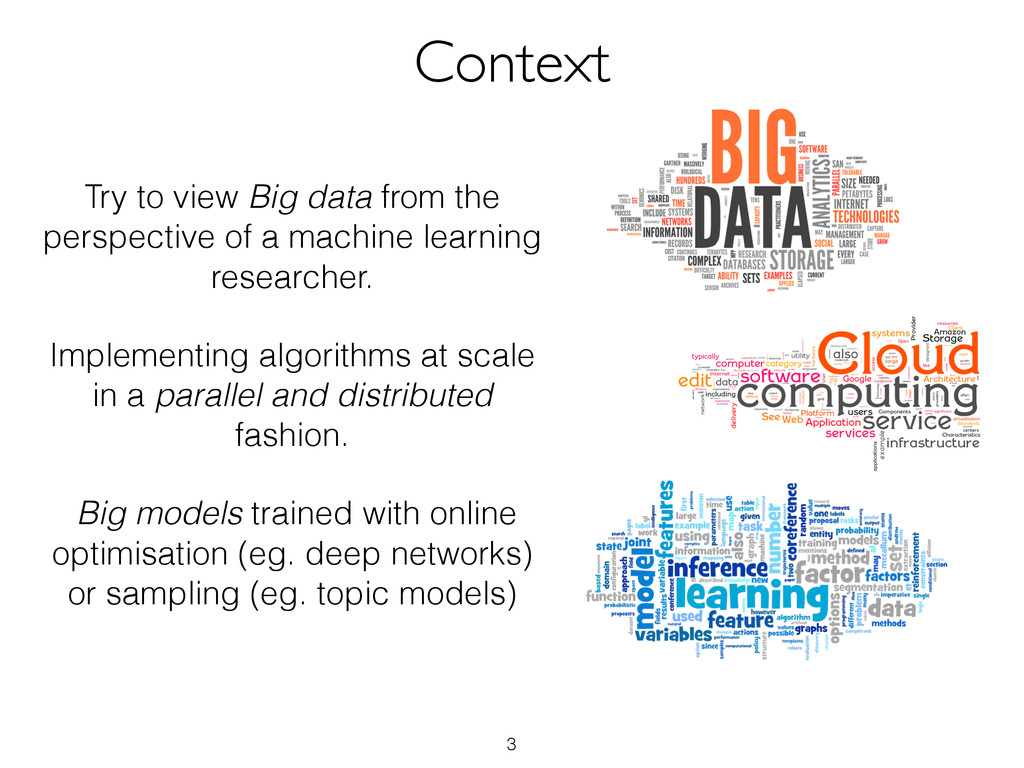
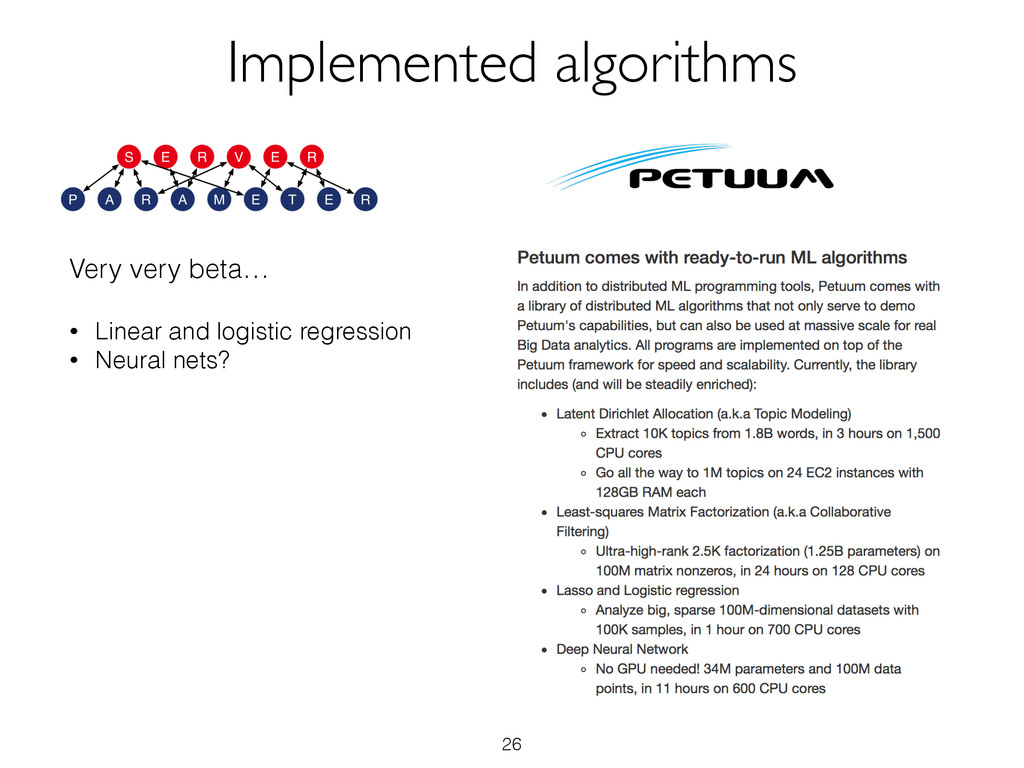
perspective of a machine learning researcher. Implementing algorithms at scale in a parallel and distributed fashion. Big models trained with online optimisation (eg. deep networks) or sampling (eg. topic models)
this is a short talk I’ll go very quickly over a lot of the interesting details of the frameworks. ! If you are interested in knowing more and have ~2hours to spare, you should definitely check J. Gonzalez’s talk: !
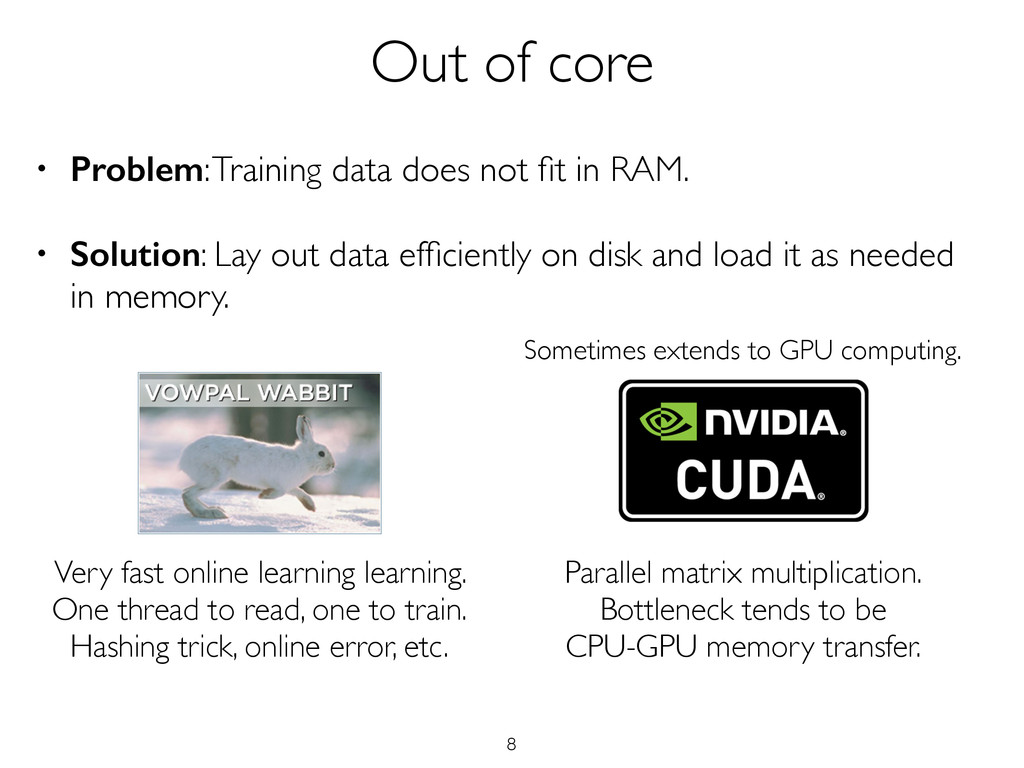
fit in RAM. • Solution: Lay out data efficiently on disk and load it as needed in memory. 8 Very fast online learning learning. One thread to read, one to train. Hashing trick, online error, etc. Parallel matrix multiplication. Bottleneck tends to be CPU-GPU memory transfer. Sometimes extends to GPU computing.
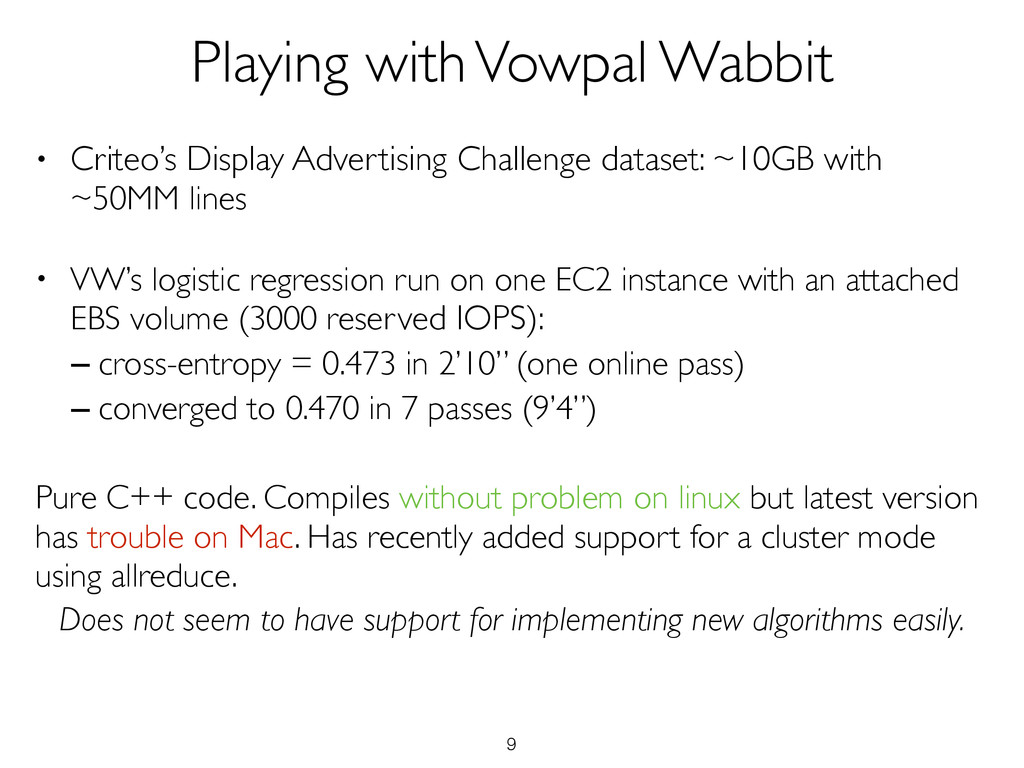
~10GB with ~50MM lines • VW’s logistic regression run on one EC2 instance with an attached EBS volume (3000 reserved IOPS): – cross-entropy = 0.473 in 2’10” (one online pass) – converged to 0.470 in 7 passes (9’4”) ! Pure C++ code. Compiles without problem on linux but latest version has trouble on Mac. Has recently added support for a cluster mode using allreduce. Does not seem to have support for implementing new algorithms easily. 9
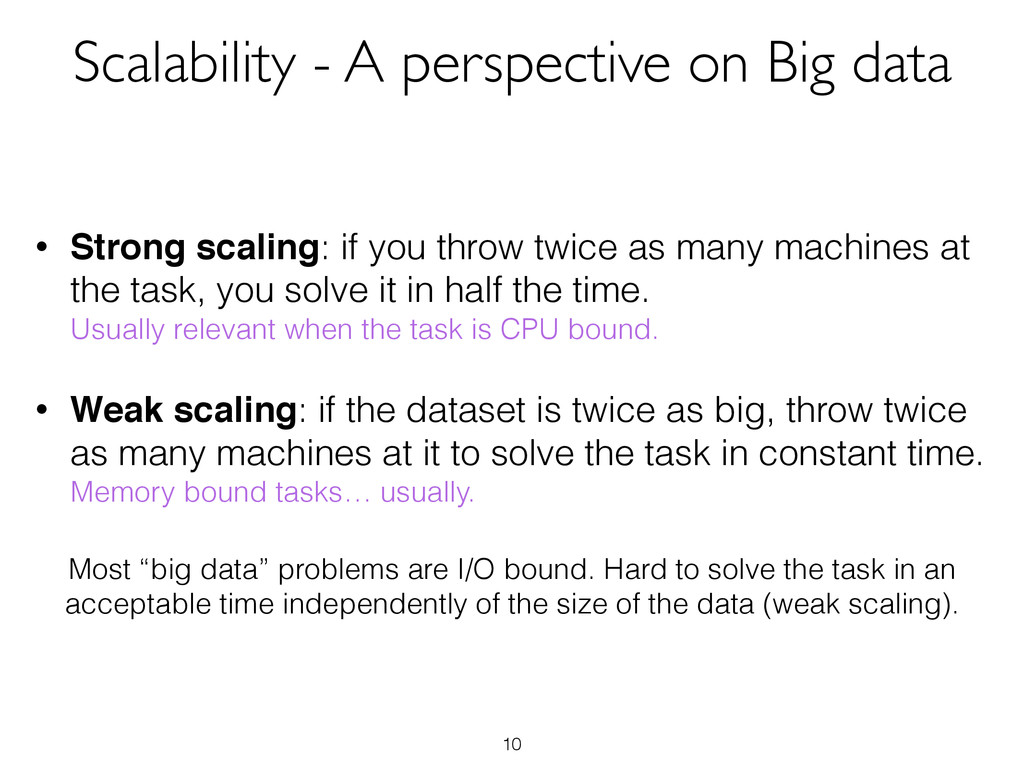
scaling: if you throw twice as many machines at the task, you solve it in half the time. Usually relevant when the task is CPU bound. • Weak scaling: if the dataset is twice as big, throw twice as many machines at it to solve the task in constant time. Memory bound tasks… usually. Most “big data” problems are I/O bound. Hard to solve the task in an acceptable time independently of the size of the data (weak scaling). 10
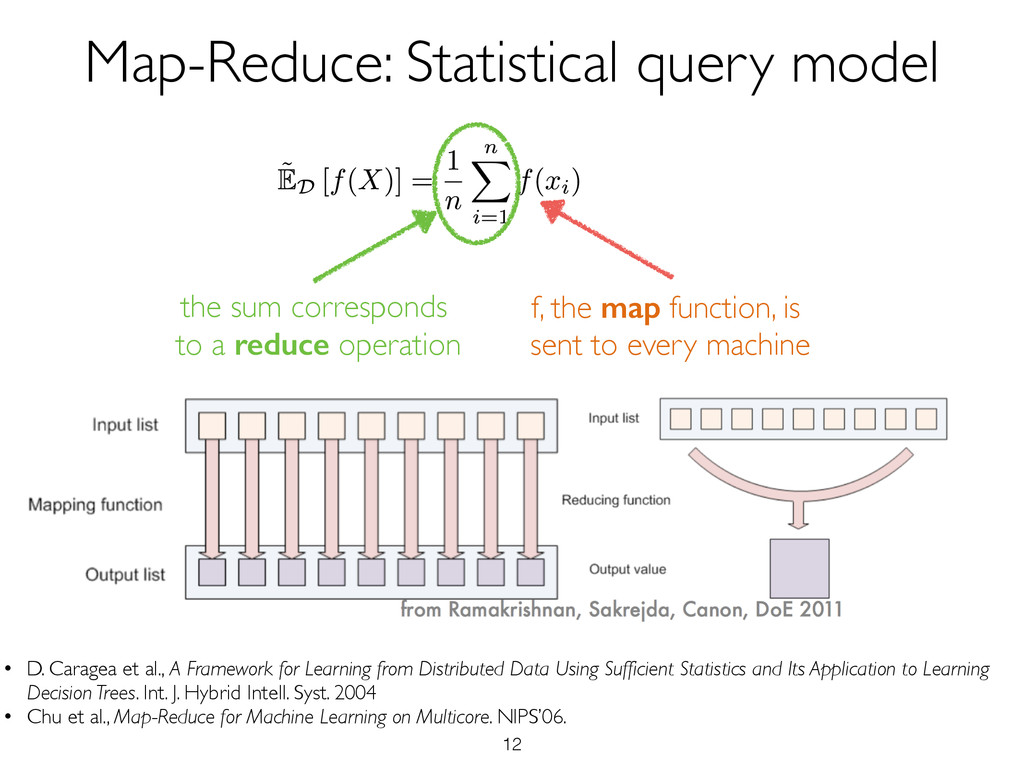
sent to every machine the sum corresponds to a reduce operation • D. Caragea et al., A Framework for Learning from Distributed Data Using Sufficient Statistics and Its Application to Learning Decision Trees. Int. J. Hybrid Intell. Syst. 2004 • Chu et al., Map-Reduce for Machine Learning on Multicore. NIPS’06.
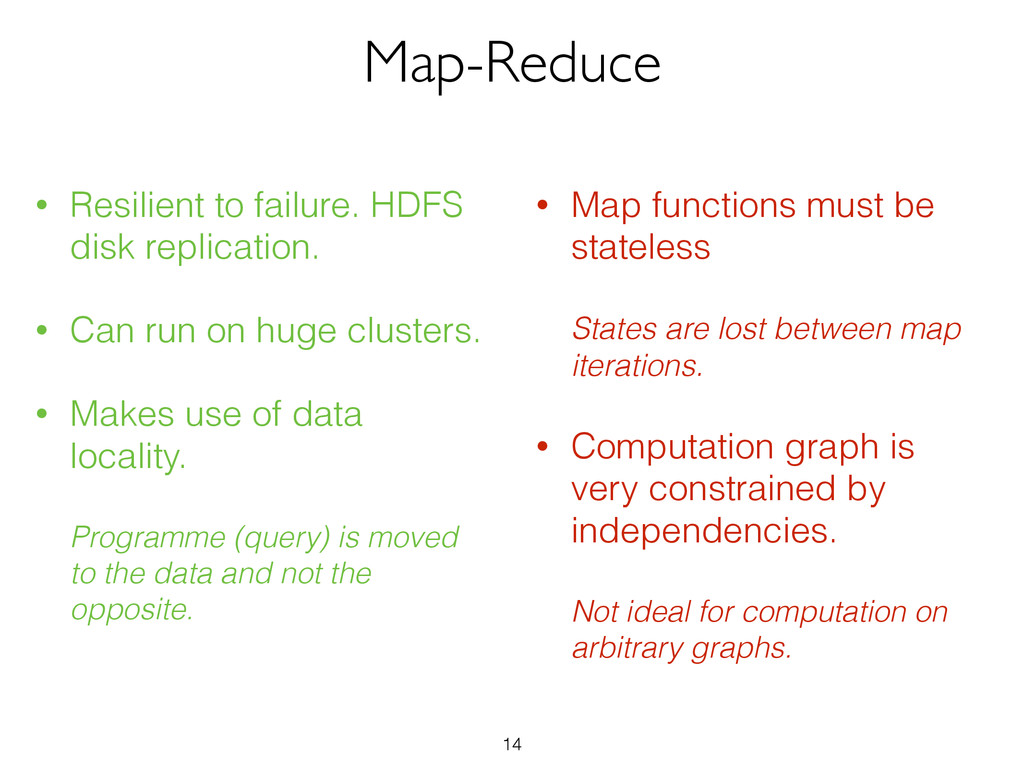
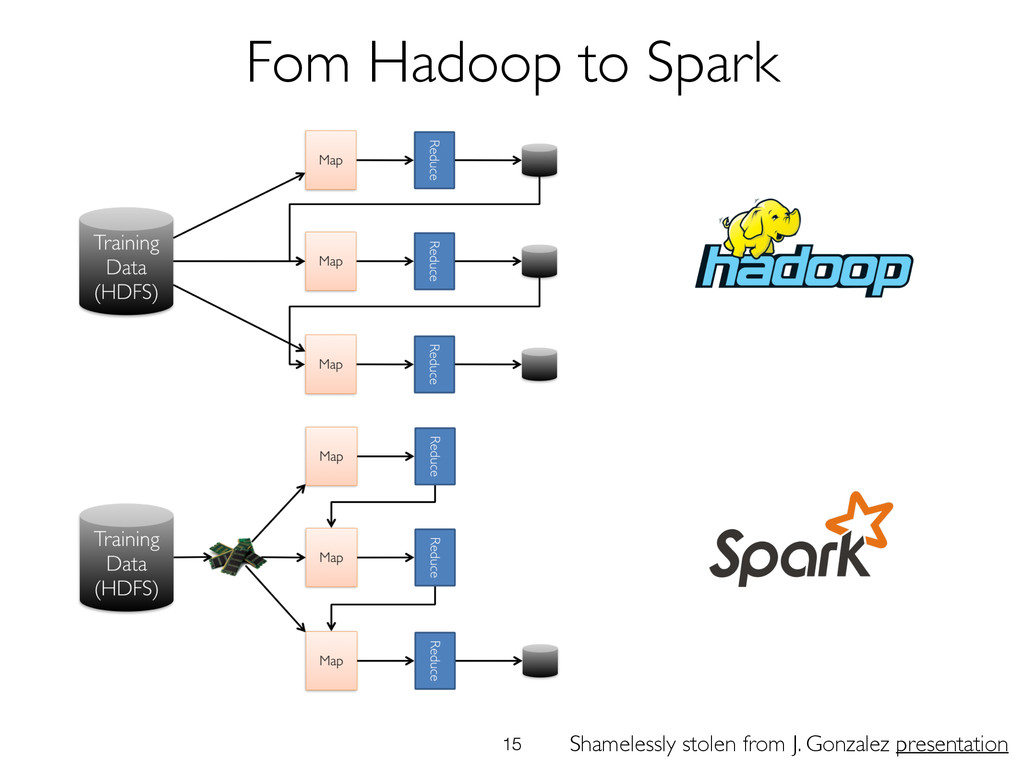
Can run on huge clusters. • Makes use of data locality. Programme (query) is moved to the data and not the opposite. • Map functions must be stateless States are lost between map iterations. • Computation graph is very constrained by independencies. Not ideal for computation on arbitrary graphs.
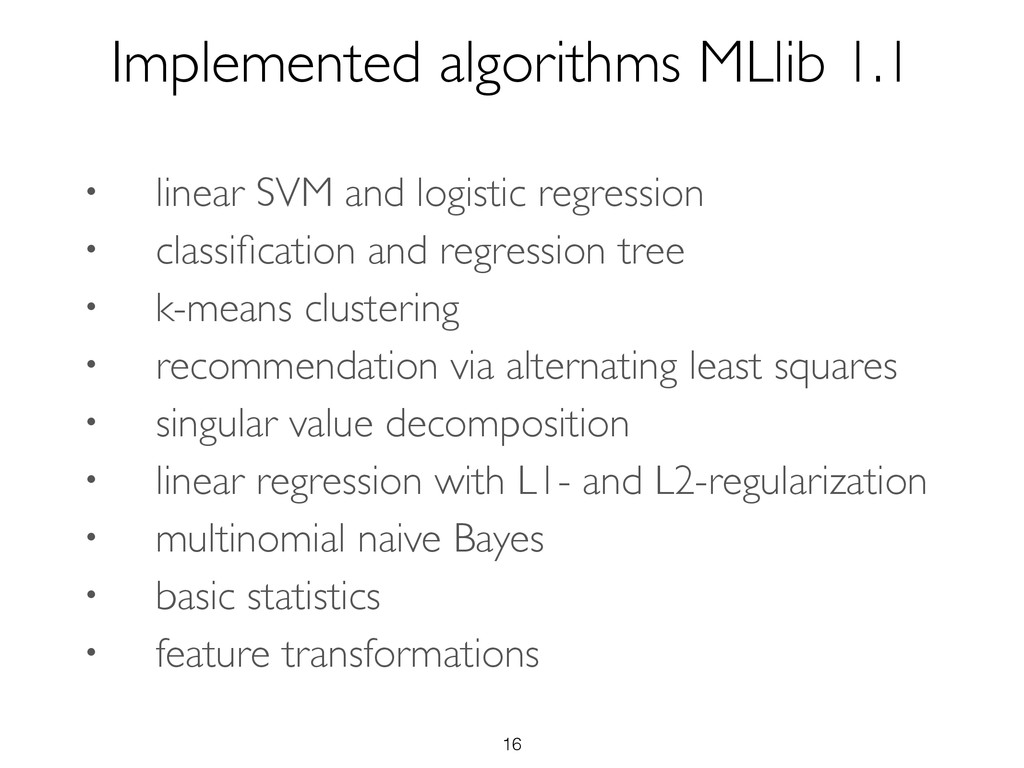
regression • classification and regression tree • k-means clustering • recommendation via alternating least squares • singular value decomposition • linear regression with L1- and L2-regularization • multinomial naive Bayes • basic statistics • feature transformations
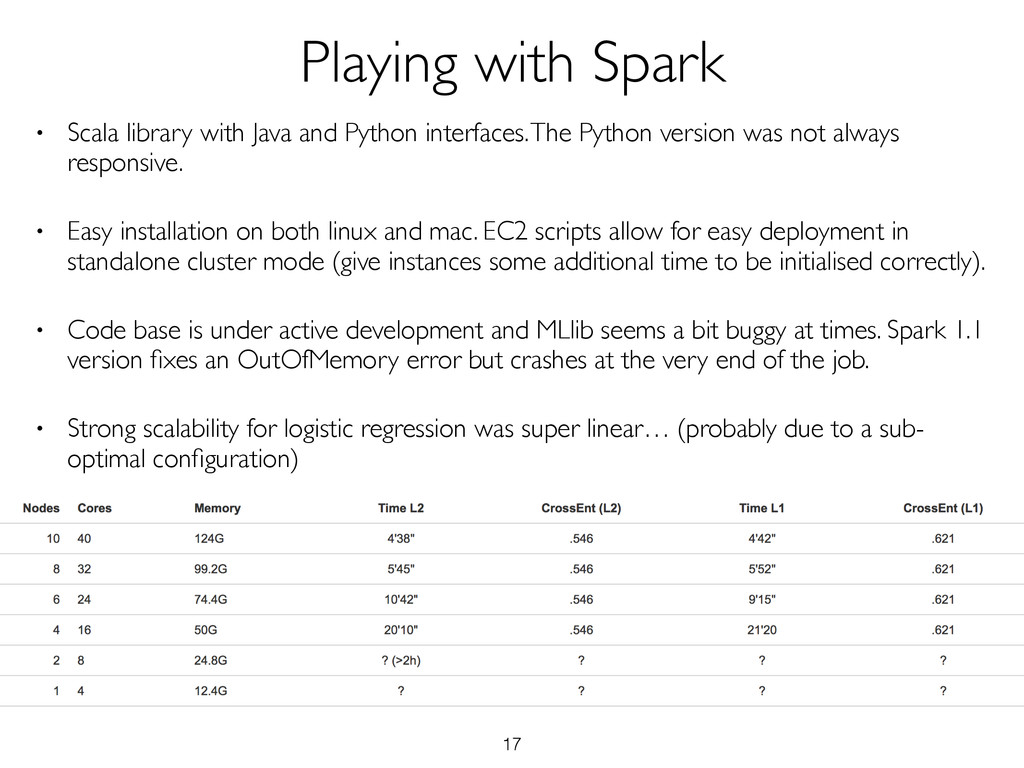
interfaces. The Python version was not always responsive. • Easy installation on both linux and mac. EC2 scripts allow for easy deployment in standalone cluster mode (give instances some additional time to be initialised correctly). • Code base is under active development and MLlib seems a bit buggy at times. Spark 1.1 version fixes an OutOfMemory error but crashes at the very end of the job. • Strong scalability for logistic regression was super linear… (probably due to a sub- optimal configuration) 17
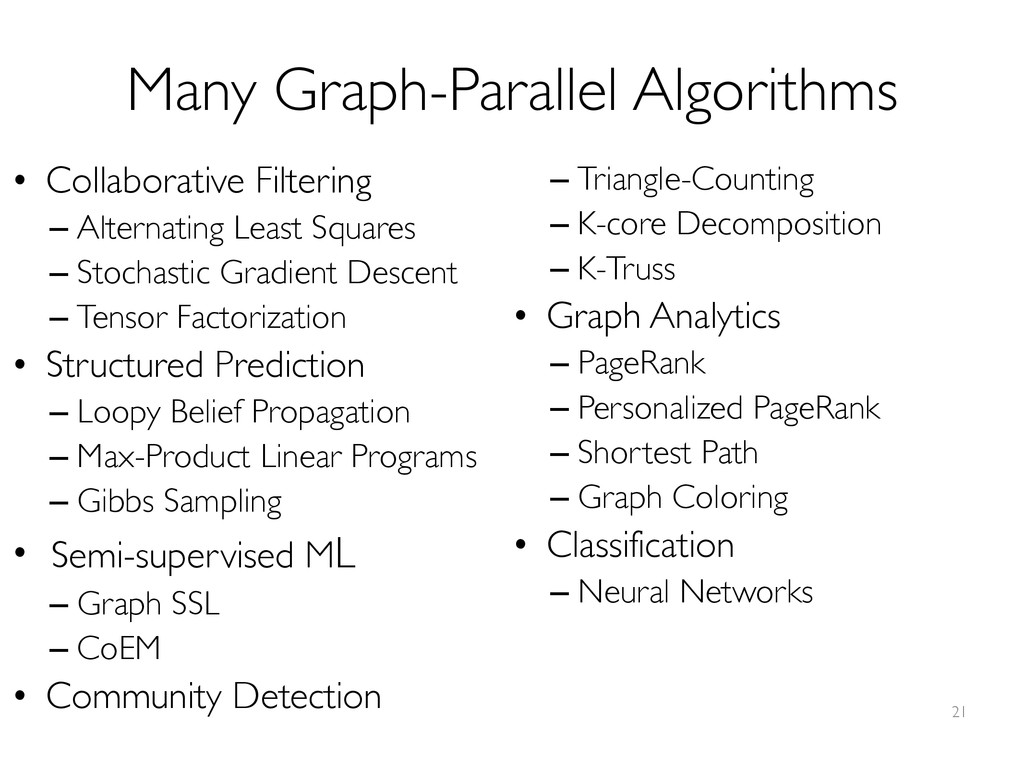
• Compiles without problem on linux. Works on Mac but a bit more involved (surprisingly since it seems to be developed mainly on Mac.) • Easy deployment on a cluster. Basic ALS on small Netflix subset works. No logistic regression implemented (it is a graph oriented framework after all). • Nice API for vertex programming. Would like to try collapsed Gibbs sampling on a larger dataset (Wikipedia?). • Data input is constrained and preprocessing can be cumbersome (Spark could be used to take care of this part). 22
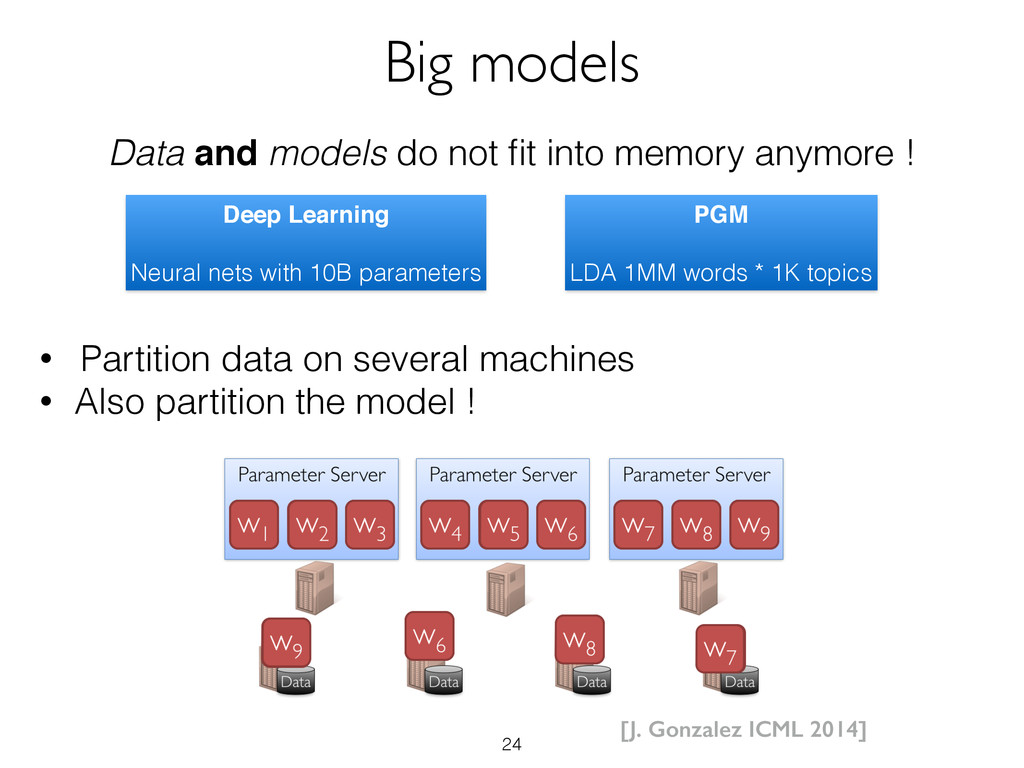
memory anymore ! Deep Learning ! ! Neural nets with 10B parameters PGM ! LDA 1MM words * 1K topics • Partition data on several machines • Also partition the model ! [J. Gonzalez ICML 2014]
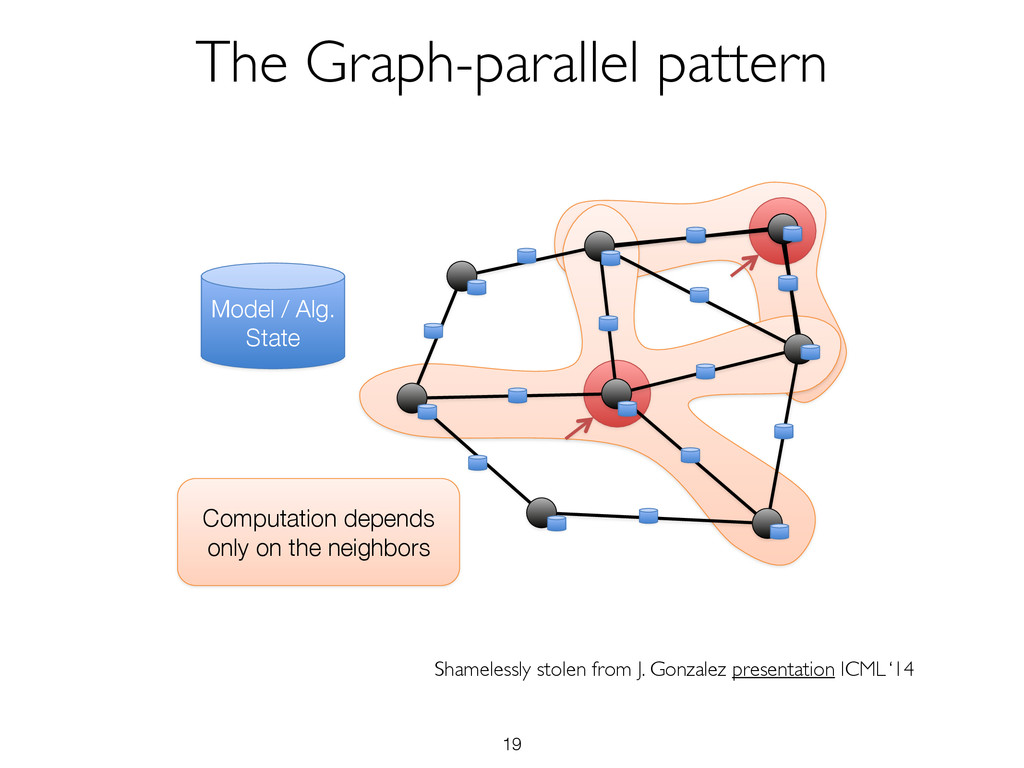
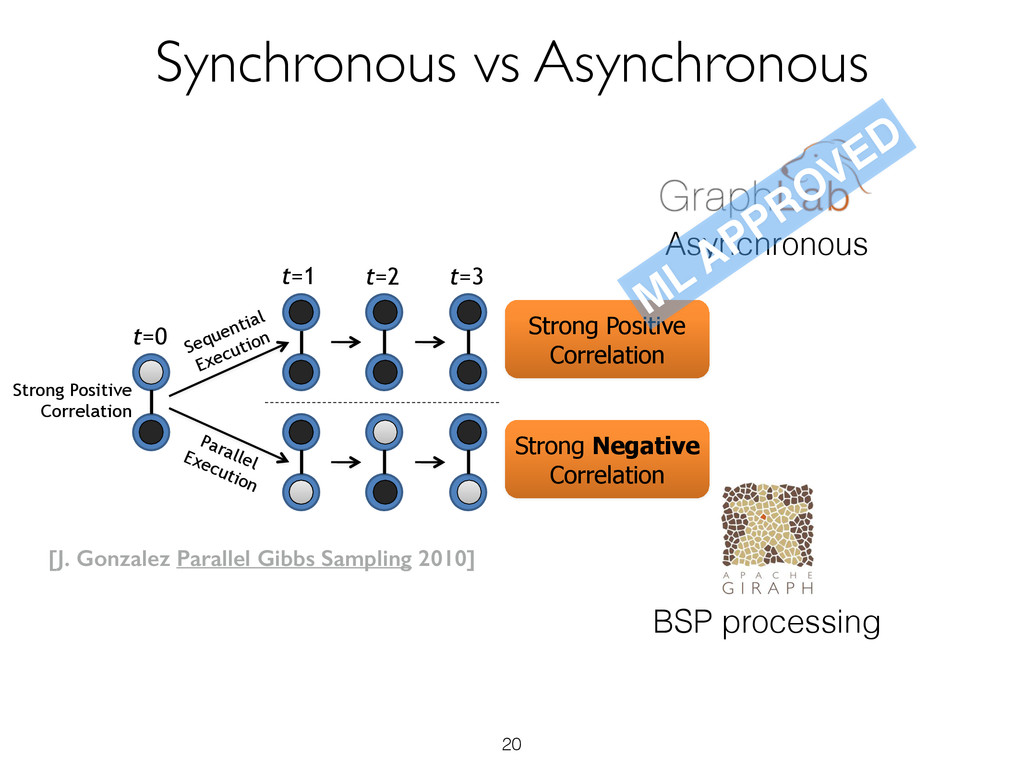
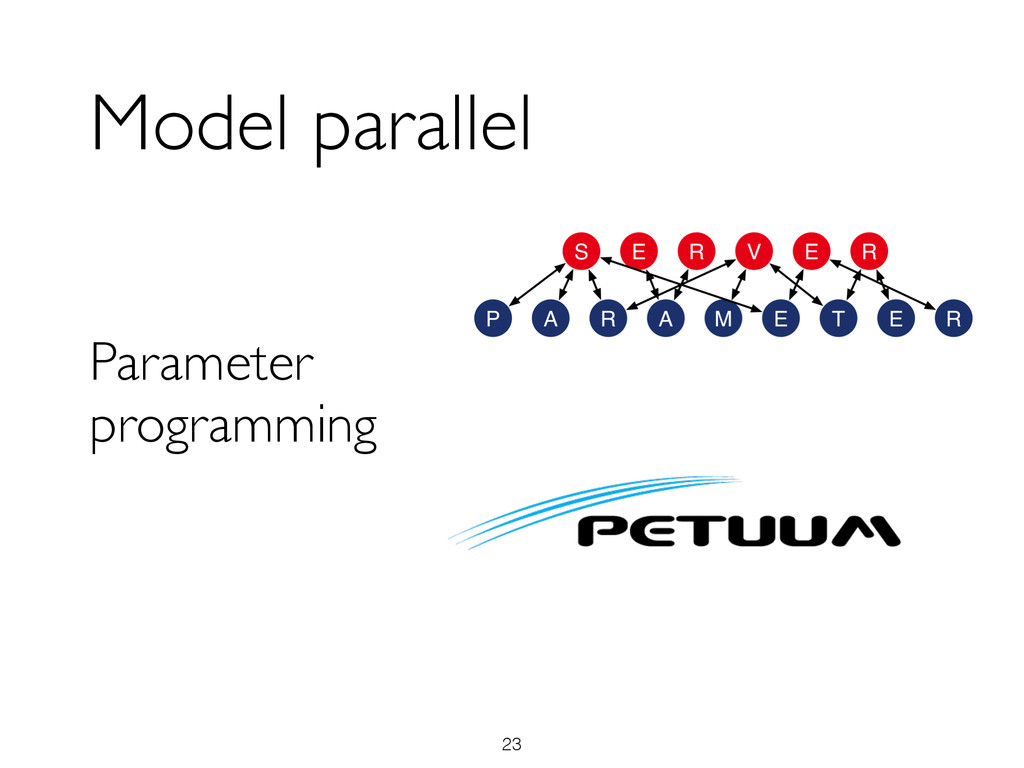
scale ML: 1. asynchronous (for online learning), 2. flexible consistency models (for Hogwild! algorithms) • With Hadoop/Spark you program on parallel collections. • With GraphLab/Pregel you program on vertices. ParameterServer lets you program on parameters Two implementations, both from Carnegie Mellon University http://parameterserver.org http://petuum.github.io But it is for VERY large scale problems.
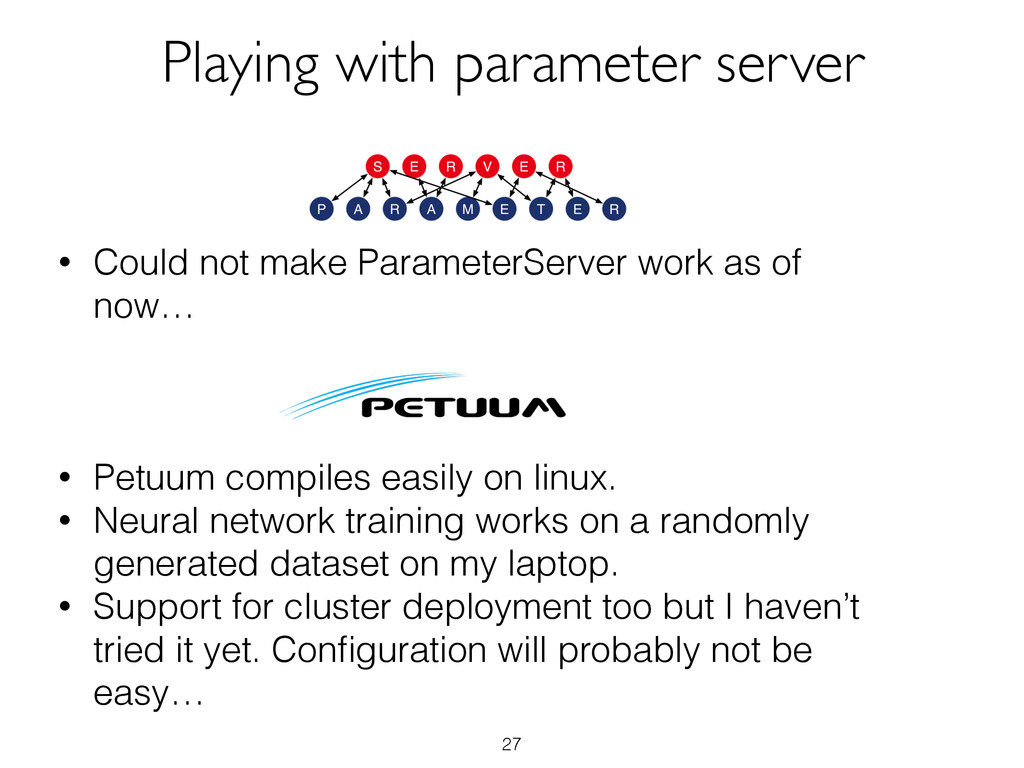
work as of now… ! ! ! • Petuum compiles easily on linux. • Neural network training works on a randomly generated dataset on my laptop. • Support for cluster deployment too but I haven’t tried it yet. Configuration will probably not be easy…
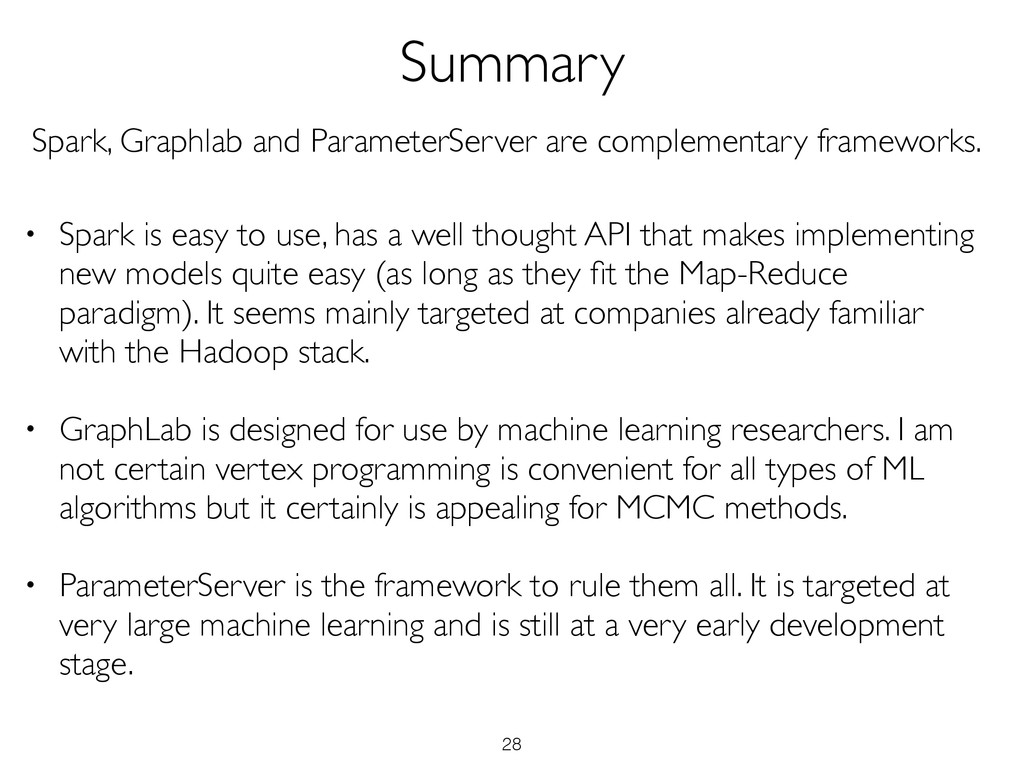
• Spark is easy to use, has a well thought API that makes implementing new models quite easy (as long as they fit the Map-Reduce paradigm). It seems mainly targeted at companies already familiar with the Hadoop stack. ! • GraphLab is designed for use by machine learning researchers. I am not certain vertex programming is convenient for all types of ML algorithms but it certainly is appealing for MCMC methods. ! • ParameterServer is the framework to rule them all. It is targeted at very large machine learning and is still at a very early development stage.


 takonda
 makocchi
 takuroabe
 yamanoku
 teamlab
 yut0naga1_fa
 yu23ki14
 onk
 kentapapa
 greenmidori
 yazm
 daidaidai
 yeseniaperezcruz
 panda_program
 akademiya2063
 ipullrank
 samanthasiow
 helenjbeal
 deanohume
 garrettdimon
 colly
 chrislema
 caitiem20
 asonas