one and is aimed at anyone who wants to get familiar with digital forensics and penetration testing or refresh their knowledge in these areas with tools available in Kali Linux • Note! I’ve tried to gather as much information as possible, however, even despite that, some entries don’t have information, which I might update if I get more information. Also, mistakes are inevitable • The purpose was to create the most detailed source of every tool in Kali Linux for quick reference and better understanding • Some tools fall under several categories, which means that duplicate entries exist in the full ~670 pages long source • The information about every tool usually consists of: DESCRIPTION, USAGE, EXAMPLE and sometimes OPTIONS and TIPs • Kali Linux tools are not limited to Kali Linux / Backtrack (most can be installed on other Linux distributions taking into consideration all the necessary dependencies. Additionally, some tools are also available on other types of operating systems such as Windows and Mac OS) • Kali Linux is a new and developing OS – some tools may be added, some - updated, some – removed over time • It is assumed that all tools are run as root (or as administrator) (in Kali Linux you are root by default) • All the information gathered about each tool has been found freely on the Internet and is publicly available • Sources of information are referenced at the end • Most command line tools include options, however, due to space considerations, only some tools have options listed (search the internet for options, read documentation/manual, use –h or --help) • For more information on each tool - search the internet, click on links or check the references at the end • PLEASE DO NOT USE KALI LINUX AND THE TOOLS LISTED HERE FOR ANY ILLEGAL OPERATION! • Tools which are specifically aimed at DOS, DDOS or anonymity are rarely used in legitimate engagements, and are therefore not installed by default in Kali Linux List of Tools for Kali Linux 2013 2
thc-ipv6 - THC-IPV6-ATTACK-TOOLKIT - just run the tools without options and they will give you help and show the command line options. denial6 - tests various known IPv6 vulnerabilities against a target. Performs various denial of service attacks on a target. If a system is vulnerable, it can crash or be under heavy load, so be careful! USAGE n/a EXAMPLE n/a TIP DETECTION Most tools can easily be detected by an IDS or specialized detection software. This is done on purpose to make rogue usage detection easier. The tools either specify a fixed packet signature, or generically sniff for packets (e.g. therefore also answering to icmp6 neighbour solicitations which are sent to a non-existing mac, and are therefore very easy to detect). If you don't want this, change the code.
thc-ipv6 - THC-IPV6-ATTACK-TOOLKIT - just run the tools without options and they will give you help and show the command line options. Dos-new-ip6 - this tool prevents new ipv6 interfaces to come up, by sending answers to duplicate ip6 checks (DAD). This results in a DOS for new ipv6 devices. USAGE dos-new-ip6 interface EXAMPLE n/a TIP DETECTION Most tools can easily be detected by an IDS or specialized detection software. This is done on purpose to make rogue usage detection easier. The tools either specify a fixed packet signature, or generically sniff for packets (e.g. therefore also answering to icmp6 neighbour solicitations which are sent to a non-existing mac, and are therefore very easy to detect). If you don't want this, change the code.
thc-ipv6 - THC-IPV6-ATTACK-TOOLKIT - just run the tools without options and they will give you help and show the command line options. flodd_advertise6- floods the local network with neighbour advertisements USAGE flodd_advertise6 interface EXAMPLE n/a TIP DETECTION Most tools can easily be detected by an IDS or specialized detection software. This is done on purpose to make rogue usage detection easier. The tools either specify a fixed packet signature, or generically sniff for packets (e.g. therefore also answering to icmp6 neighbour solicitations which are sent to a non-existing mac, and are therefore very easy to detect). If you don't want this, change the code.
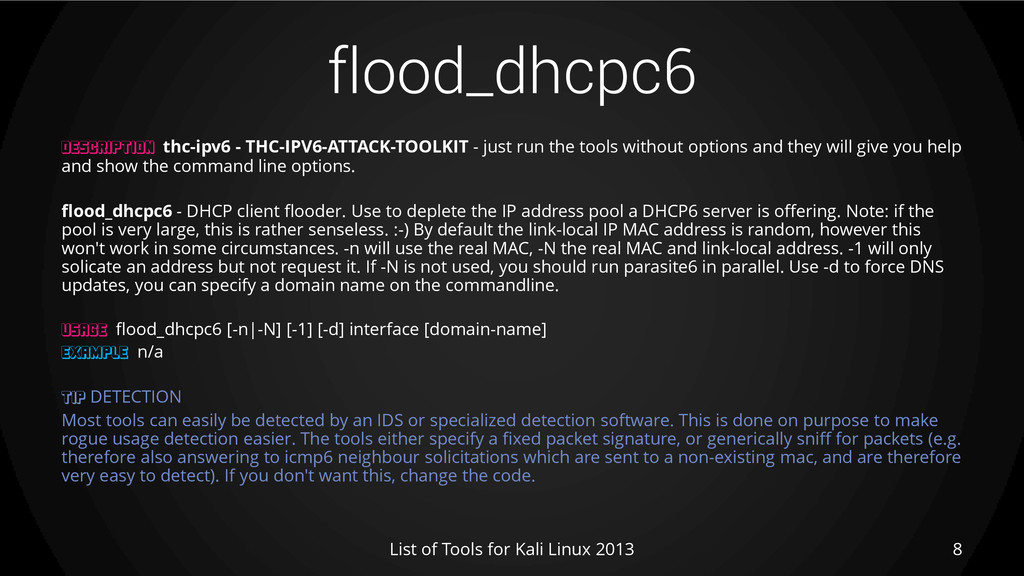
thc-ipv6 - THC-IPV6-ATTACK-TOOLKIT - just run the tools without options and they will give you help and show the command line options. flood_dhcpc6 - DHCP client flooder. Use to deplete the IP address pool a DHCP6 server is offering. Note: if the pool is very large, this is rather senseless. :-) By default the link-local IP MAC address is random, however this won't work in some circumstances. -n will use the real MAC, -N the real MAC and link-local address. -1 will only solicate an address but not request it. If -N is not used, you should run parasite6 in parallel. Use -d to force DNS updates, you can specify a domain name on the commandline. USAGE flood_dhcpc6 [-n|-N] [-1] [-d] interface [domain-name] EXAMPLE n/a TIP DETECTION Most tools can easily be detected by an IDS or specialized detection software. This is done on purpose to make rogue usage detection easier. The tools either specify a fixed packet signature, or generically sniff for packets (e.g. therefore also answering to icmp6 neighbour solicitations which are sent to a non-existing mac, and are therefore very easy to detect). If you don't want this, change the code.
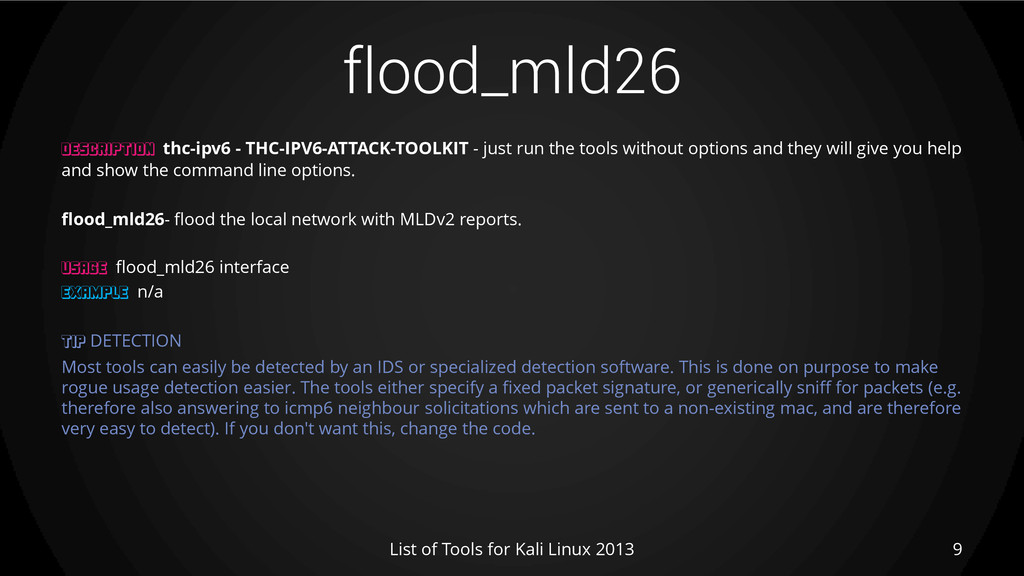
thc-ipv6 - THC-IPV6-ATTACK-TOOLKIT - just run the tools without options and they will give you help and show the command line options. flood_mld26- flood the local network with MLDv2 reports. USAGE flood_mld26 interface EXAMPLE n/a TIP DETECTION Most tools can easily be detected by an IDS or specialized detection software. This is done on purpose to make rogue usage detection easier. The tools either specify a fixed packet signature, or generically sniff for packets (e.g. therefore also answering to icmp6 neighbour solicitations which are sent to a non-existing mac, and are therefore very easy to detect). If you don't want this, change the code.
thc-ipv6 - THC-IPV6-ATTACK-TOOLKIT - just run the tools without options and they will give you help and show the command line options. flood_mld6- flood the local network with router advertisements. USAGE flood_mld6 [-HFD] interface OPTIONS -F/-D/-H add fragment/destination/hopbyhop header to bypass RA guard security. EXAMPLE n/a TIP DETECTION Most tools can easily be detected by an IDS or specialized detection software. This is done on purpose to make rogue usage detection easier. The tools either specify a fixed packet signature, or generically sniff for packets (e.g. therefore also answering to icmp6 neighbour solicitations which are sent to a non-existing mac, and are therefore very easy to detect). If you don't want this, change the code.
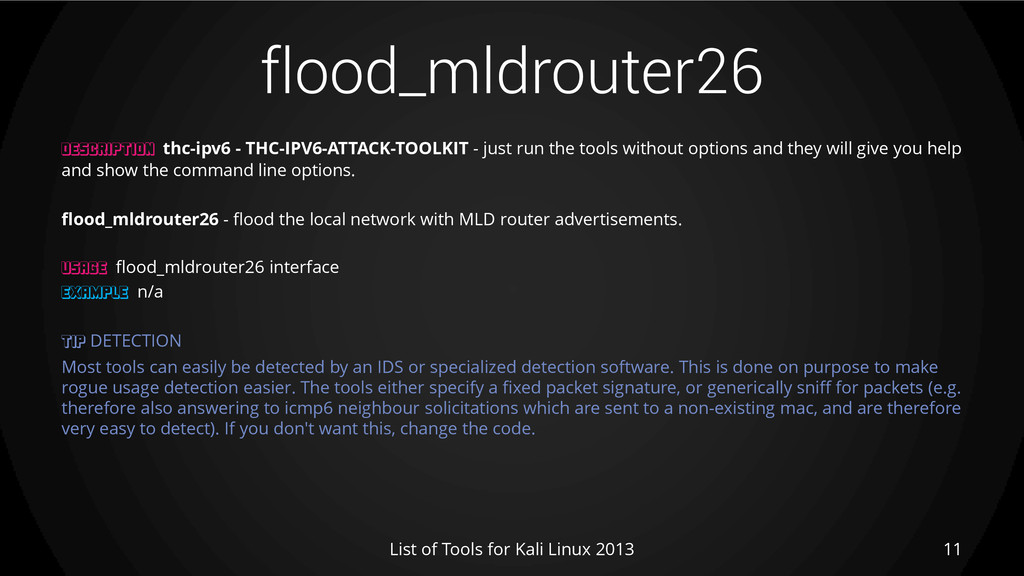
thc-ipv6 - THC-IPV6-ATTACK-TOOLKIT - just run the tools without options and they will give you help and show the command line options. flood_mldrouter26 - flood the local network with MLD router advertisements. USAGE flood_mldrouter26 interface EXAMPLE n/a TIP DETECTION Most tools can easily be detected by an IDS or specialized detection software. This is done on purpose to make rogue usage detection easier. The tools either specify a fixed packet signature, or generically sniff for packets (e.g. therefore also answering to icmp6 neighbour solicitations which are sent to a non-existing mac, and are therefore very easy to detect). If you don't want this, change the code.
thc-ipv6 - THC-IPV6-ATTACK-TOOLKIT - just run the tools without options and they will give you help and show the command line options. flood_router6- flood the local network with router advertisements. USAGE flood_router6 [-HFD] interface OPTIONS -F/-D/-H add fragment/destination/hopbyhop header to bypass RA guard security. EXAMPLE n/a TIP DETECTION Most tools can easily be detected by an IDS or specialized detection software. This is done on purpose to make rogue usage detection easier. The tools either specify a fixed packet signature, or generically sniff for packets (e.g. therefore also answering to icmp6 neighbour solicitations which are sent to a non-existing mac, and are therefore very easy to detect). If you don't want this, change the code.
thc-ipv6 - THC-IPV6-ATTACK-TOOLKIT - just run the tools without options and they will give you help and show the command line options. flood_solicitate6- flood the network with neighbor solicitations. USAGE flood_solicitate6 interface [target] EXAMPLE n/a TIP DETECTION Most tools can easily be detected by an IDS or specialized detection software. This is done on purpose to make rogue usage detection easier. The tools either specify a fixed packet signature, or generically sniff for packets (e.g. therefore also answering to icmp6 neighbour solicitations which are sent to a non-existing mac, and are therefore very easy to detect). If you don't want this, change the code.
thc-ipv6 - THC-IPV6-ATTACK-TOOLKIT - just run the tools without options and they will give you help and show the command line options. fragmentation6- this tool prevents new ipv6 interfaces to come up, by sending answers to duplicate ip6 checks (DAD). This results in a DOS for new ipv6 devices. USAGE fragmentation6[-fp] [-n number] interface destination [test-case-no] OPTIONS -f activates flooding mode, no pauses between sends; -p disables first and final pings, -n number specifies how often each test is performed. Performs fragment firewall and implementation checks, incl. denial- of-service. EXAMPLE n/a TIP DETECTION Most tools can easily be detected by an IDS or specialized detection software. This is done on purpose to make rogue usage detection easier. The tools either specify a fixed packet signature, or generically sniff for packets (e.g. therefore also answering to icmp6 neighbour solicitations which are sent to a non-existing mac, and are therefore very easy to detect). If you don't want this, change the code.
Inundator is a multi-threaded, queue-driven, anonymous intrusion detection false positives generator with support for multiple targets. Usage • Before, during, and after a real attack to bury any potential alerts among a flood of false positives. • Seriously mess with an IDS analyst and keep an InfoSec department busy for days investigating false positives. • Test the effectiveness of an intrusion detection or prevention system. Less alerts means a better product; more alerts means a horrible product. USAGE ./inundator.pl --verbose --threads 10 <IP> EXAMPLE inundator 68.177.102.20 EXAMPLE inundator -r /etc/snort/rules -p localhost:9050 victim_ip where -r is the path to the snort rules location where -p is the SOCKS proxy configuration and the last argument is the victim ip
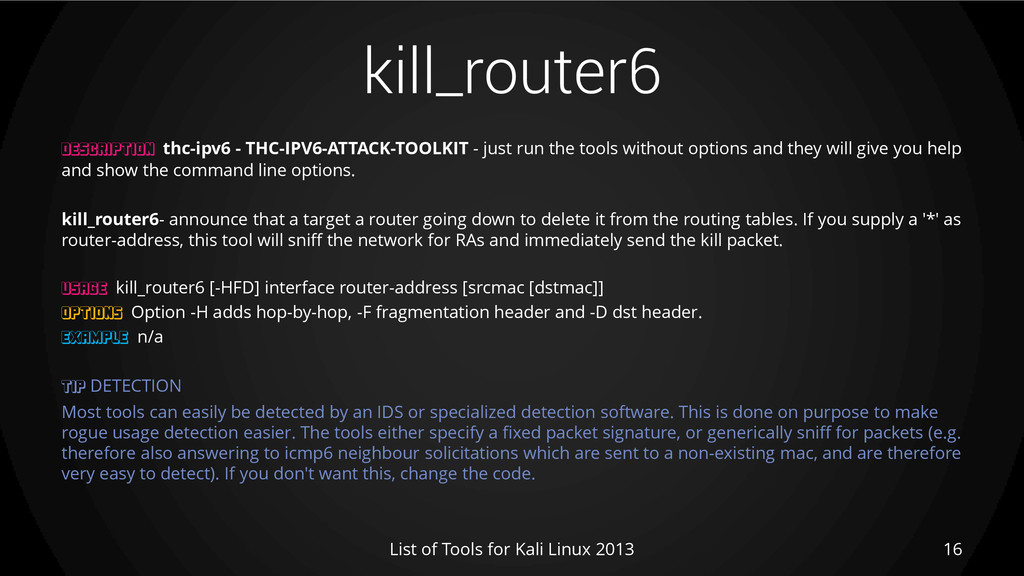
thc-ipv6 - THC-IPV6-ATTACK-TOOLKIT - just run the tools without options and they will give you help and show the command line options. kill_router6- announce that a target a router going down to delete it from the routing tables. If you supply a '*' as router-address, this tool will sniff the network for RAs and immediately send the kill packet. USAGE kill_router6 [-HFD] interface router-address [srcmac [dstmac]] OPTIONS Option -H adds hop-by-hop, -F fragmentation header and -D dst header. EXAMPLE n/a TIP DETECTION Most tools can easily be detected by an IDS or specialized detection software. This is done on purpose to make rogue usage detection easier. The tools either specify a fixed packet signature, or generically sniff for packets (e.g. therefore also answering to icmp6 neighbour solicitations which are sent to a non-existing mac, and are therefore very easy to detect). If you don't want this, change the code.
macof floods the local network with random MAC addresses (causing some switches to fail open in repeating mode, facilitating sniffing). This program could cause problems on your network. This program could hang, crash or reboot network devices. Switches could start sending packages to all ports making it possible to intercept network traffic. USAGE macof [-i interface] [-s src] [-d dst] [-e tha] [-x sport] [-y dport] [-n times] OPTIONS -i interface Specify the interface to send on. -s src Specify source IP address. -d dst Specify destination IP address. -e tha Specify target hardware address. -x sport Specify TCP source port. -y dport Specify TCP destination port. -n times Specify the number of packets to send. Values for any options left unspecified will be generated randomly. EXAMPLE ./macof -e <mac_of_def_gate> -n 1000000 EXAMPLE ./macof -r -n 1000000
thc-ipv6 - THC-IPV6-ATTACK-TOOLKIT - just run the tools without options and they will give you help and show the command line options. rsmurf6- smurfs the local network of the victim. Note: this depends on an implementation error, currently only verified on Linux. Evil: "ff02::1" as victim will DOS your local LAN completely. USAGE rsmurf6 interface victim-ip EXAMPLE n/a TIP DETECTION Most tools can easily be detected by an IDS or specialized detection software. This is done on purpose to make rogue usage detection easier. The tools either specify a fixed packet signature, or generically sniff for packets (e.g. therefore also answering to icmp6 neighbour solicitations which are sent to a non-existing mac, and are therefore very easy to detect). If you don't want this, change the code.
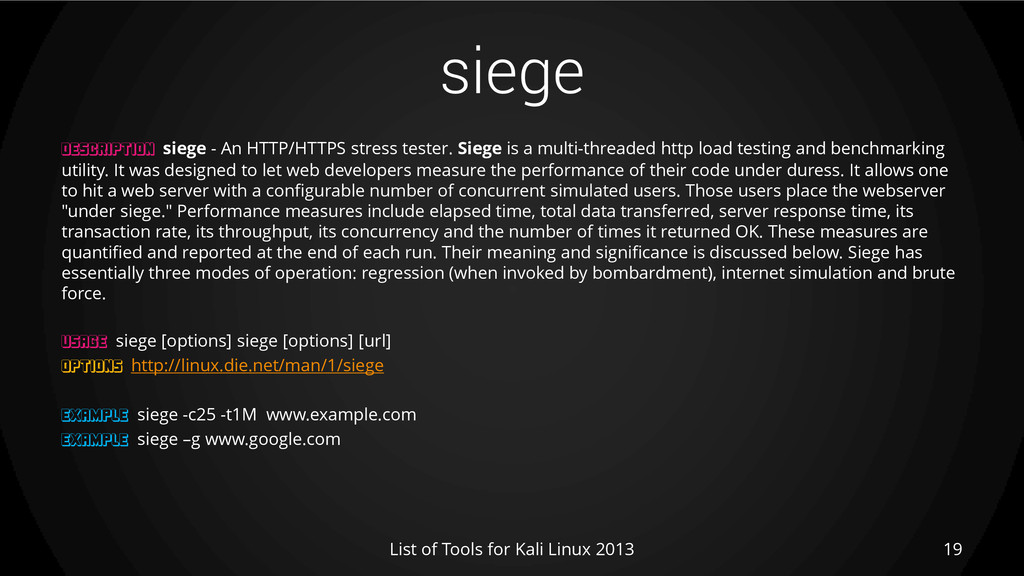
siege - An HTTP/HTTPS stress tester. Siege is a multi-threaded http load testing and benchmarking utility. It was designed to let web developers measure the performance of their code under duress. It allows one to hit a web server with a configurable number of concurrent simulated users. Those users place the webserver "under siege." Performance measures include elapsed time, total data transferred, server response time, its transaction rate, its throughput, its concurrency and the number of times it returned OK. These measures are quantified and reported at the end of each run. Their meaning and significance is discussed below. Siege has essentially three modes of operation: regression (when invoked by bombardment), internet simulation and brute force. USAGE siege [options] siege [options] [url] OPTIONS http://linux.die.net/man/1/siege EXAMPLE siege -c25 -t1M www.example.com EXAMPLE siege –g www.google.com
thc-ipv6 - THC-IPV6-ATTACK-TOOLKIT - just run the tools without options and they will give you help and show the command line options. smurf6- smurf the target with icmp echo replies. Target of echo request is the local all-nodes multicast address if not specified. USAGE smurf6 interface victim-ip [multicast-network-address] EXAMPLE n/a TIP DETECTION Most tools can easily be detected by an IDS or specialized detection software. This is done on purpose to make rogue usage detection easier. The tools either specify a fixed packet signature, or generically sniff for packets (e.g. therefore also answering to icmp6 neighbour solicitations which are sent to a non-existing mac, and are therefore very easy to detect). If you don't want this, change the code.


 achudars
 codmoninc
 pfn
pfn
 techtekt
 kaminashi
 gionn
gionn
 prog893
 iktakahiro
 bgpat
bgpat
 terapyon
 puhitaku
 carta_engineering
 thirion
 smashingmag
 tammyeverts
 codingconduct
 lara
lara
 jnunemaker
 samlambert
 aleyda
 jct
jct
 tmiket
 signer


![[56] STRESS TESTING: NETWORK STRESS TESTING • denial6 • dhcpig](https://files.speakerdeck.com/presentations/7a053100906d01300c611e948e71a639/slide_2.jpg)