Lock in $30 Savings on PRO—Offer Ends Soon! ⏳

PyOhio2022- Beyond Velocity: 3 Metrics for Engi...

PyOhio2022- Beyond Velocity: 3 Metrics for Engineering Team Success

Velocity is an important metric to a lot of software teams, but in my experience, it’s often been the most important metric to management — often at the expense of missing out on the rest of the story. In this talk, we'll explore Earned Business Value, Lead Time, and Cumulative Flow to examine how these metrics might deliver additional insight into teams' development lifecycles.

The content of this talk is available as an article here.

If you'd like to learn more about software metrics, I recommend these two books:
* Software Development Metrics by David Nicolette
* Agile Metrics in Action by Christopher Davis

Charts built in:
* DevStride
* Scrumage’s Burn Down Template

Avatar for Amanda Quint

Amanda Quint

July 30, 2022
Tweet

Other Decks in Programming

Transcript

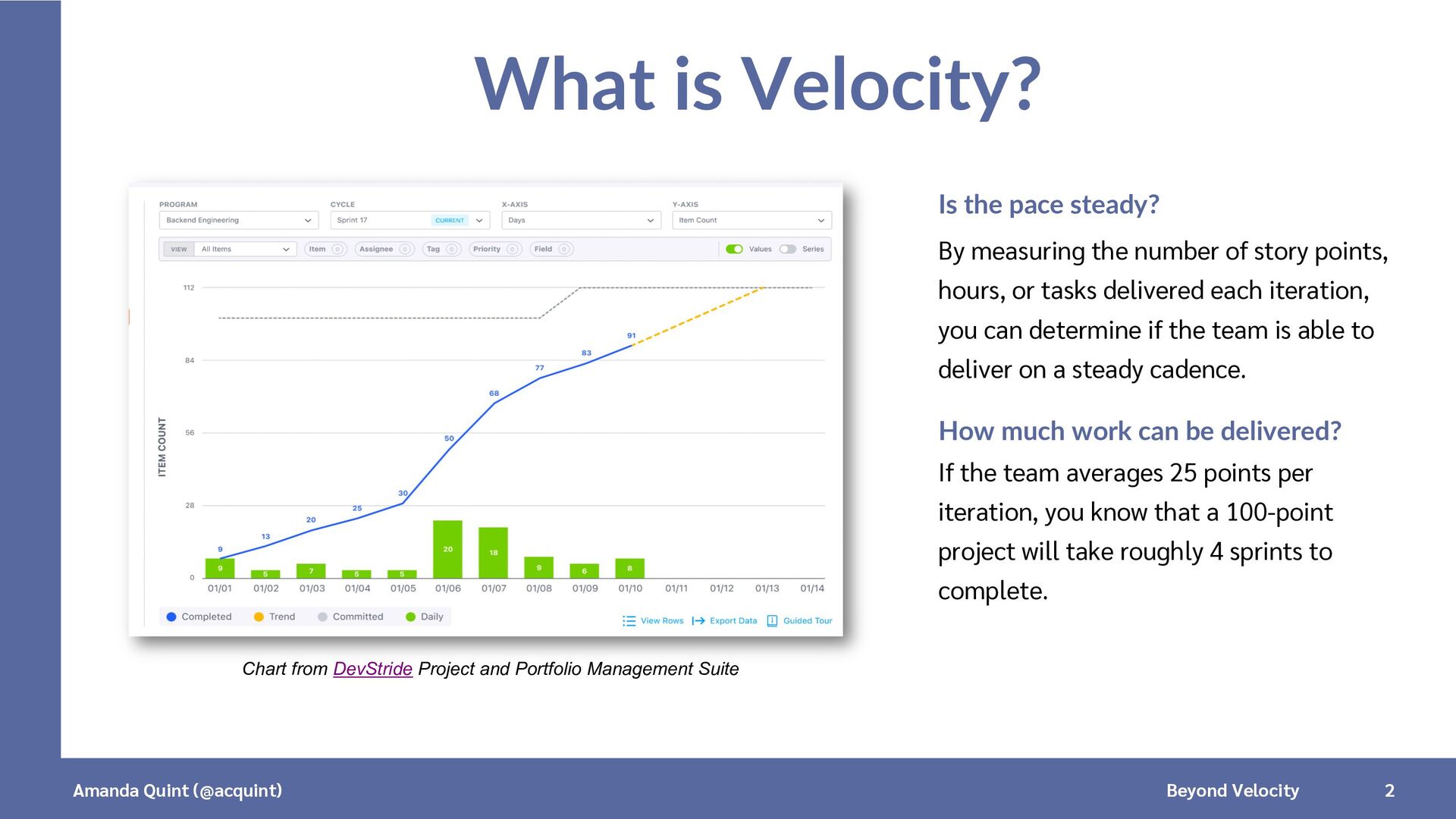
  1. If the team averages 25 points per iteration, you know

    that a 100-point project will take roughly 4 sprints to complete. How much work can be delivered? By measuring the number of story points, hours, or tasks delivered each iteration, you can determine if the team is able to deliver on a steady cadence. Is the pace steady? What is Velocity? Amanda Quint (@acquint) Beyond Velocity 2 Amanda Quint (@acquint) Beyond Velocity 2 Chart from DevStride Project and Portfolio Management Suite
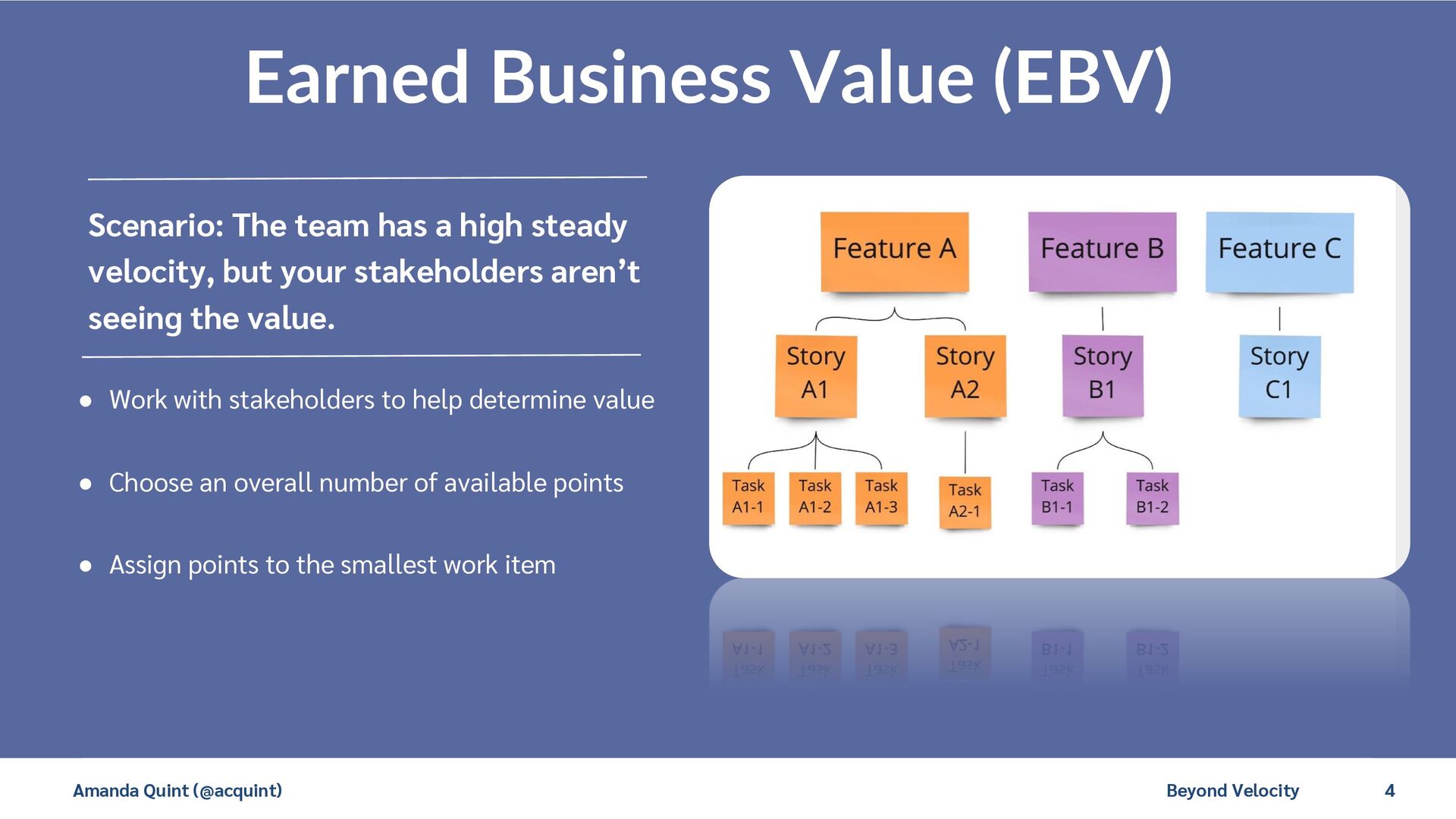
  2. Scenario: The team has a high steady velocity, but your

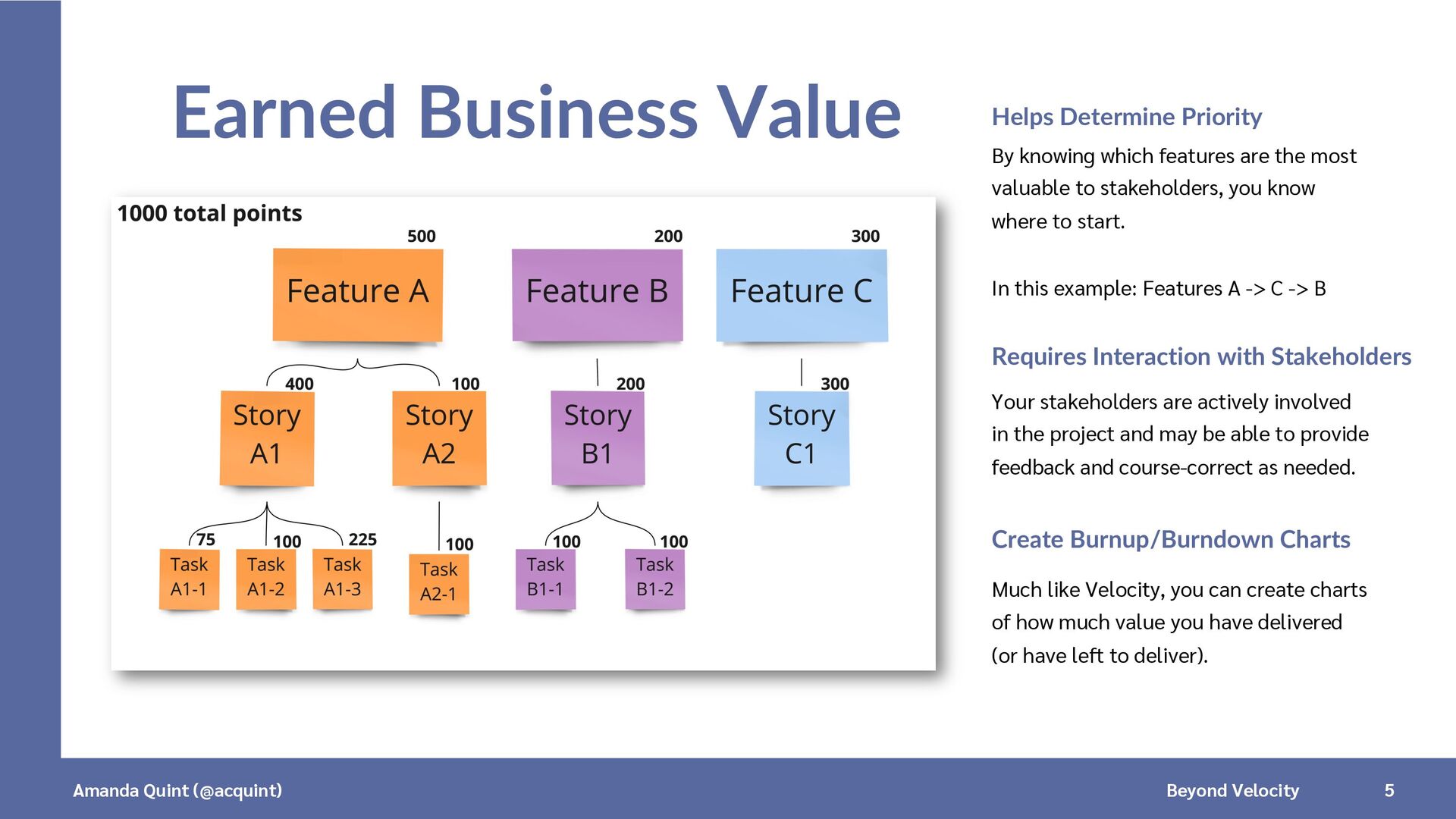
    stakeholders aren’t seeing the value. • Work with stakeholders to help determine value • Choose an overall number of available points • Assign points to the smallest work item Earned Business Value (EBV) Amanda Quint (@acquint) Beyond Velocity Amanda Quint (@acquint) Beyond Velocity 4
  3. Much like Velocity, you can create charts of how much

    value you have delivered (or have left to deliver). Create Burnup/Burndown Charts Your stakeholders are actively involved in the project and may be able to provide feedback and course-correct as needed. Requires Interaction with Stakeholders Helps Determine Priority By knowing which features are the most valuable to stakeholders, you know where to start. In this example: Features A -> C -> B Amanda Quint (@acquint) Beyond Velocity 5 Earned Business Value
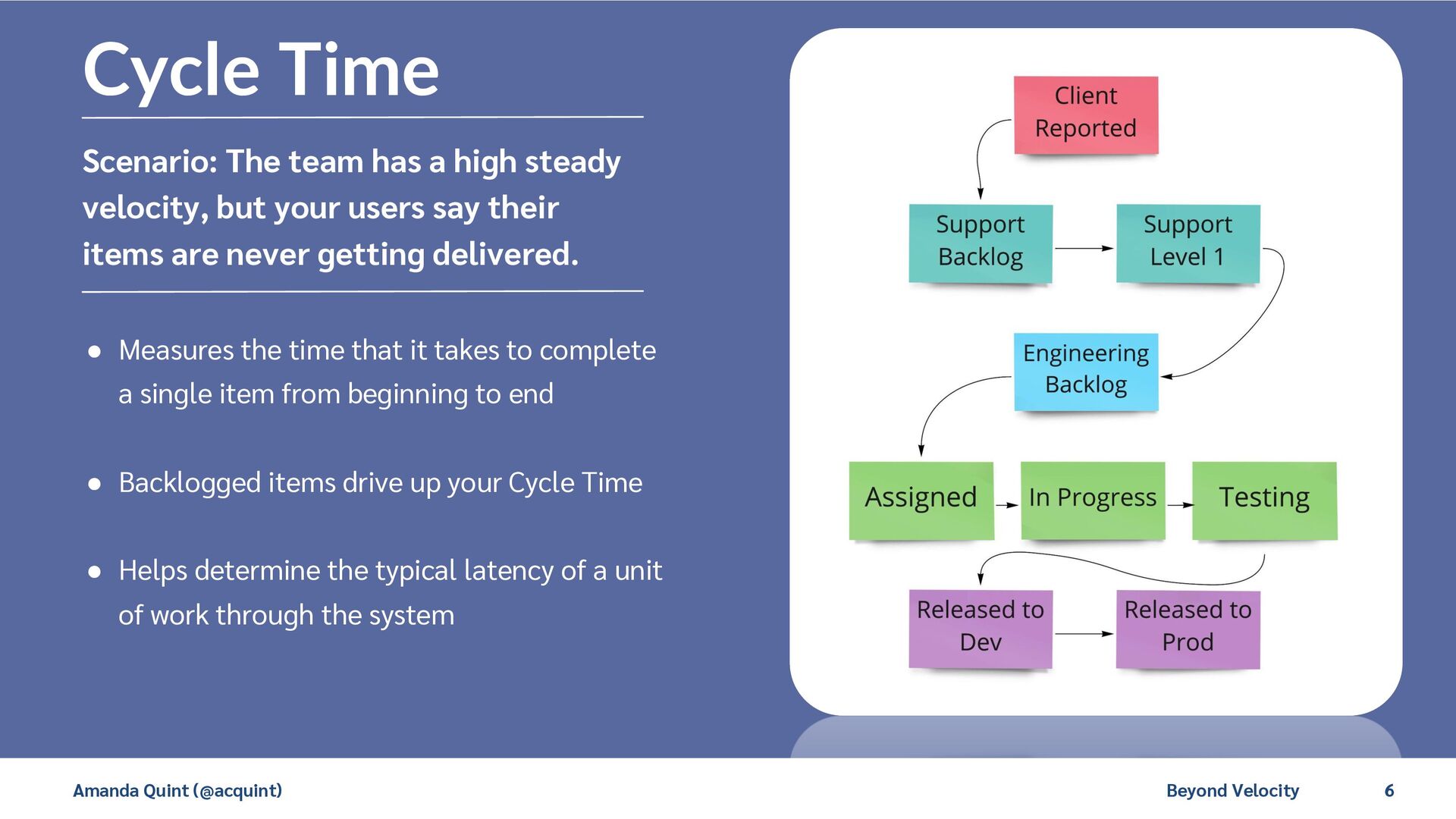
  4. Scenario: The team has a high steady velocity, but your

    users say their items are never getting delivered. • Measures the time that it takes to complete a single item from beginning to end • Backlogged items drive up your Cycle Time • Helps determine the typical latency of a unit of work through the system Cycle Time Amanda Quint (@acquint) Beyond Velocity 6
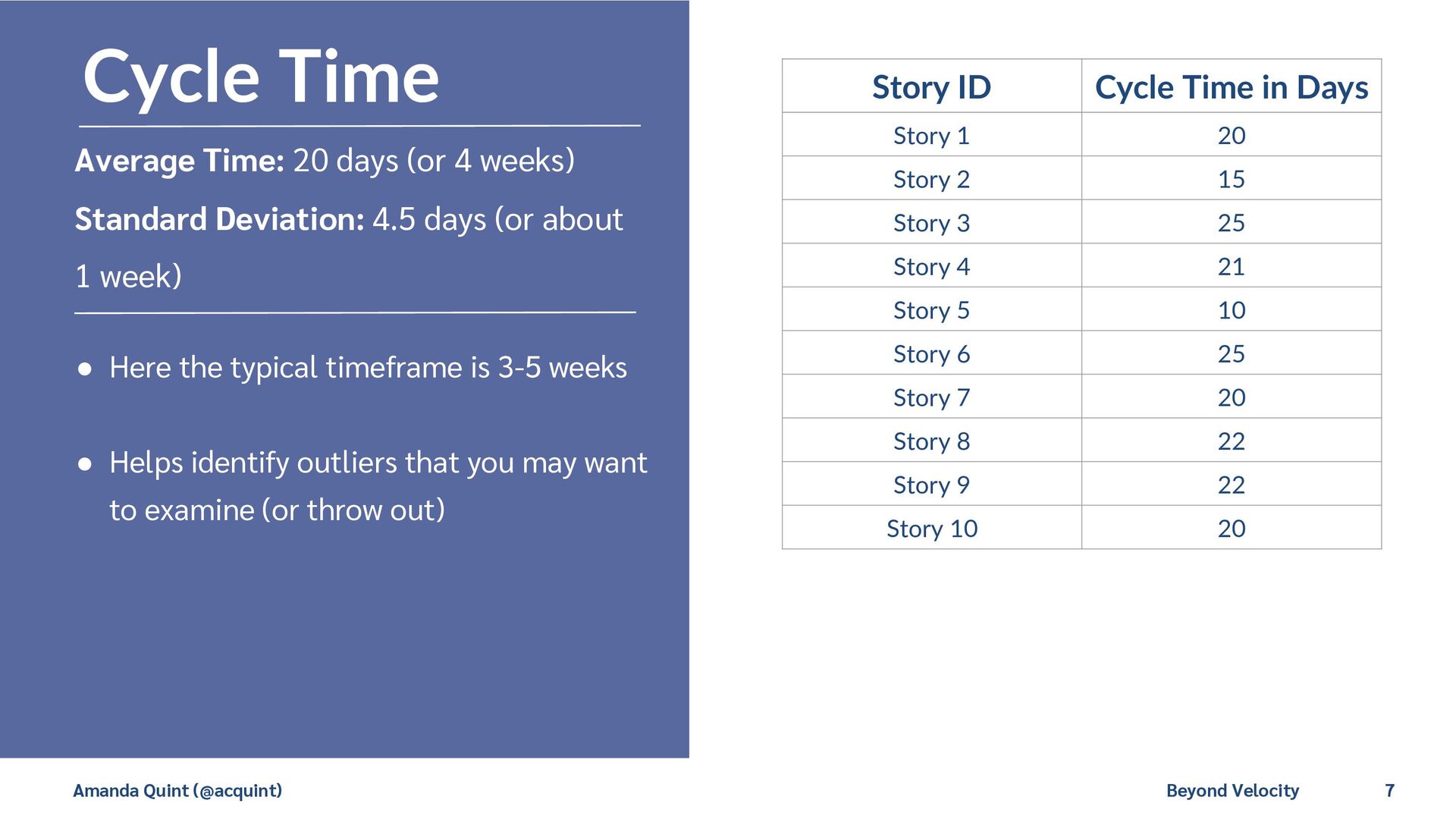
  5. Average Time: 20 days (or 4 weeks) Standard Deviation: 4.5

    days (or about 1 week) Cycle Time Story ID Cycle Time in Days Story 1 20 Story 2 15 Story 3 25 Story 4 21 Story 5 10 Story 6 25 Story 7 20 Story 8 22 Story 9 22 Story 10 20 • Here the typical timeframe is 3-5 weeks • Helps identify outliers that you may want to examine (or throw out) Amanda Quint (@acquint) Beyond Velocity 7
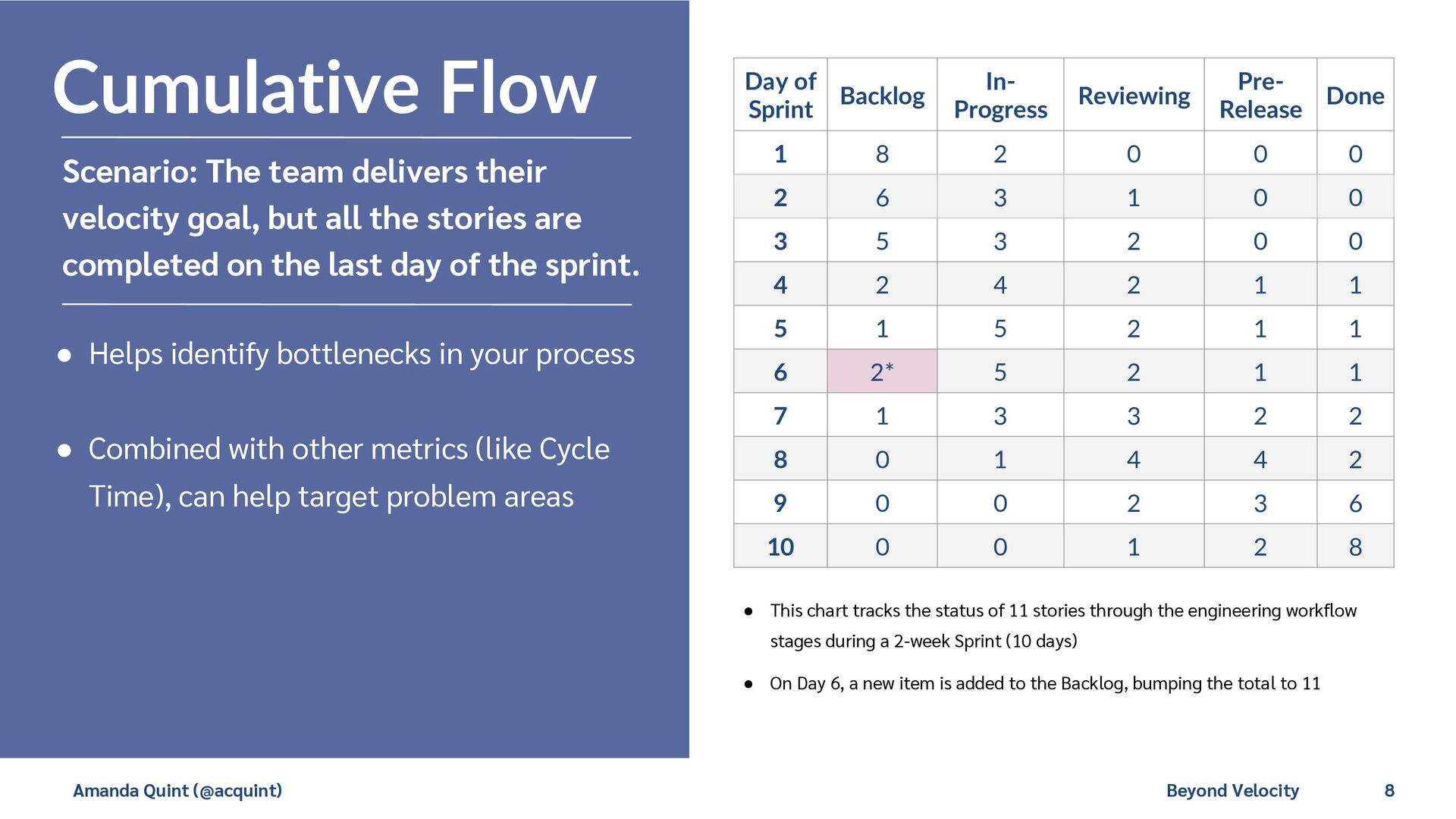
  6. Scenario: The team delivers their velocity goal, but all the

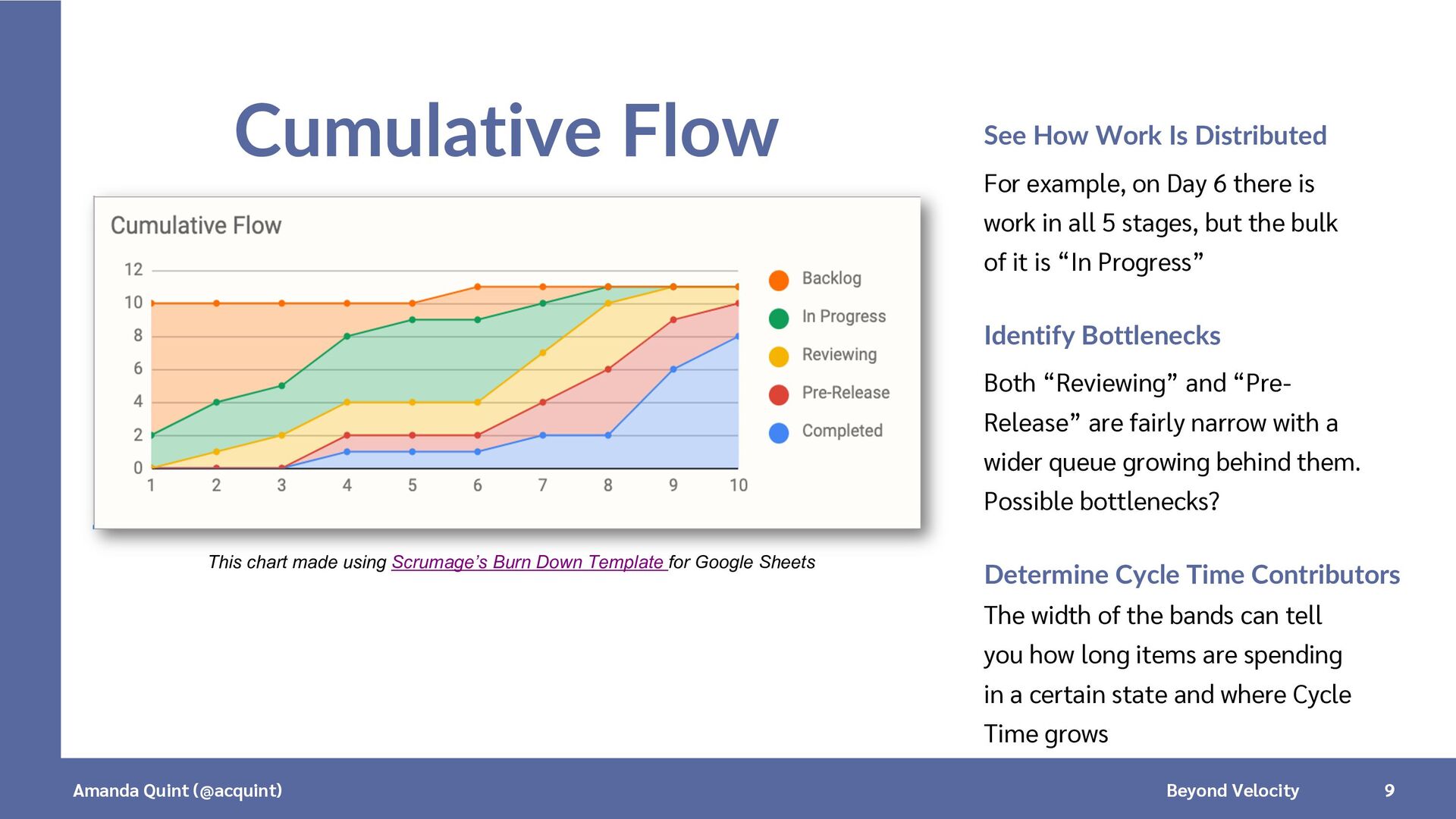
    stories are completed on the last day of the sprint. Cumulative Flow • Helps identify bottlenecks in your process • Combined with other metrics (like Cycle Time), can help target problem areas Day of Sprint Backlog In- Progress Reviewing Pre- Release Done 1 8 2 0 0 0 2 6 3 1 0 0 3 5 3 2 0 0 4 2 4 2 1 1 5 1 5 2 1 1 6 2* 5 2 1 1 7 1 3 3 2 2 8 0 1 4 4 2 9 0 0 2 3 6 10 0 0 1 2 8 • This chart tracks the status of 11 stories through the engineering workflow stages during a 2-week Sprint (10 days) • On Day 6, a new item is added to the Backlog, bumping the total to 11 Amanda Quint (@acquint) Beyond Velocity 8
  7. The width of the bands can tell you how long

    items are spending in a certain state and where Cycle Time grows Determine Cycle Time Contributors Both “Reviewing” and “Pre- Release” are fairly narrow with a wider queue growing behind them. Possible bottlenecks? Identify Bottlenecks See How Work Is Distributed For example, on Day 6 there is work in all 5 stages, but the bulk of it is “In Progress” Cumulative Flow This chart made using Scrumage’s Burn Down Template for Google Sheets Amanda Quint (@acquint) Beyond Velocity 9
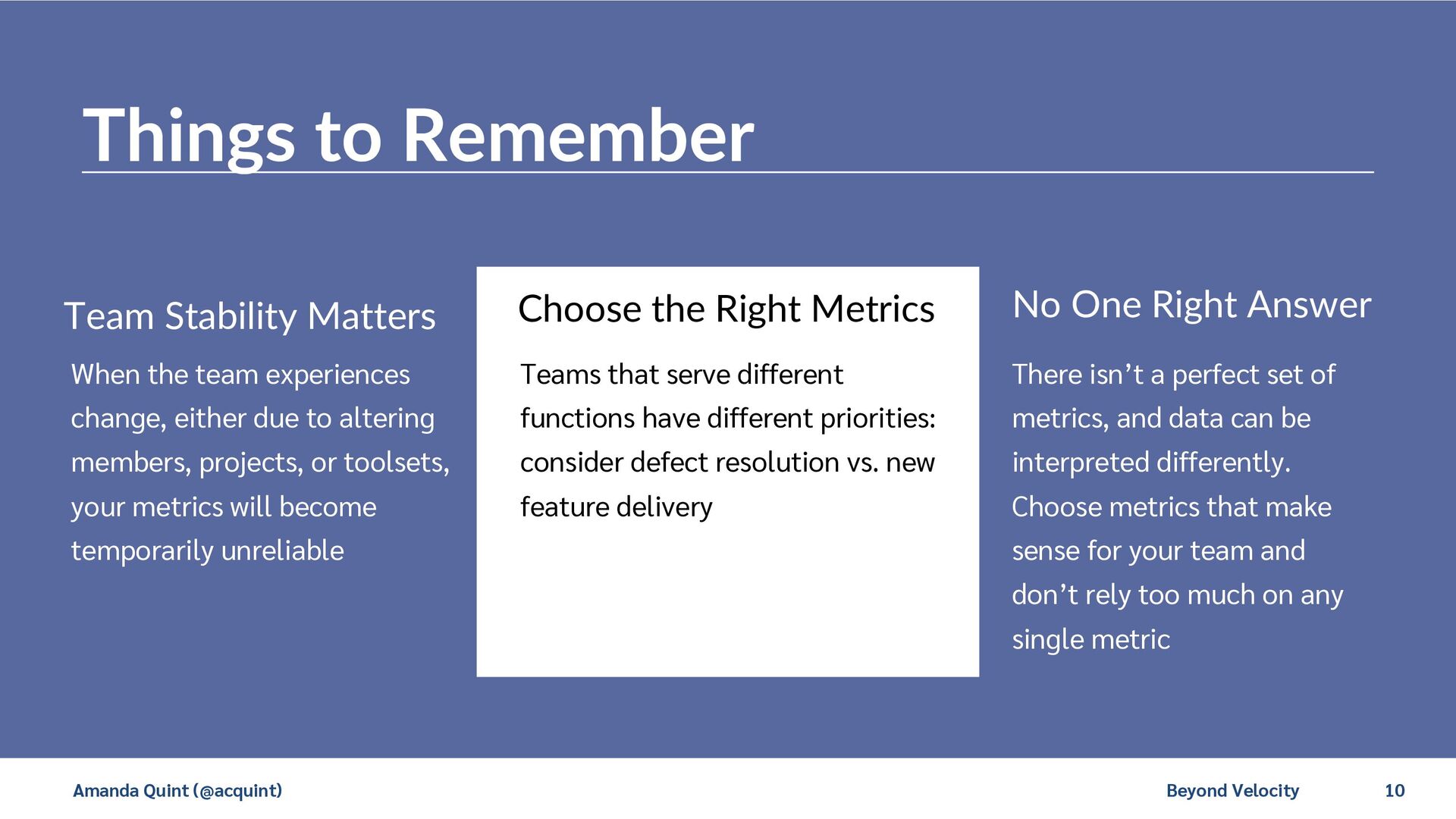
  8. Things to Remember When the team experiences change, either due

    to altering members, projects, or toolsets, your metrics will become temporarily unreliable Team Stability Matters Teams that serve different functions have different priorities: consider defect resolution vs. new feature delivery Choose the Right Metrics There isn’t a perfect set of metrics, and data can be interpreted differently. Choose metrics that make sense for your team and don’t rely too much on any single metric No One Right Answer Amanda Quint (@acquint) Beyond Velocity 10
  9. • Software Development Metrics by David Nicolette • Agile Metrics

    in Action by Christopher Davis • Article on Medium: 3 Metrics for Engineering Team Success Other Than Velocity Learn More • Twitter: @acquint • Github: @acq688 • Email: [email protected] Contact Me THANK YOU! Amanda Quint (@acquint) Beyond Velocity 11