stated, this past year has been the Year of Privacy. • The year of realizations and revelations in privacy issues and in fighting back against forced exposure. • With everything that has occurred, this much is clear: We have learned a lot this last year.
proprietary consumer products. • PRISM • We now have explicit examples of voluntary contributions. • Verizon is collecting millions of phone records daily • In 2012 The Huffington Post had reported that Verizon and AT&T had set up shop to make money from the frequent data requests coming from the government. • EFF issued a security report on the state of web encryption (bit.ly/1f1eeYd) • For alternatives, check out http://prism-break.org
• This is the unwilling side, where PRISM was the more willing side. • In the case where everyone fought back against this data collection, the NSA would still find a loophole. • This shines a bright light on the fallacies of centralized power on the web.
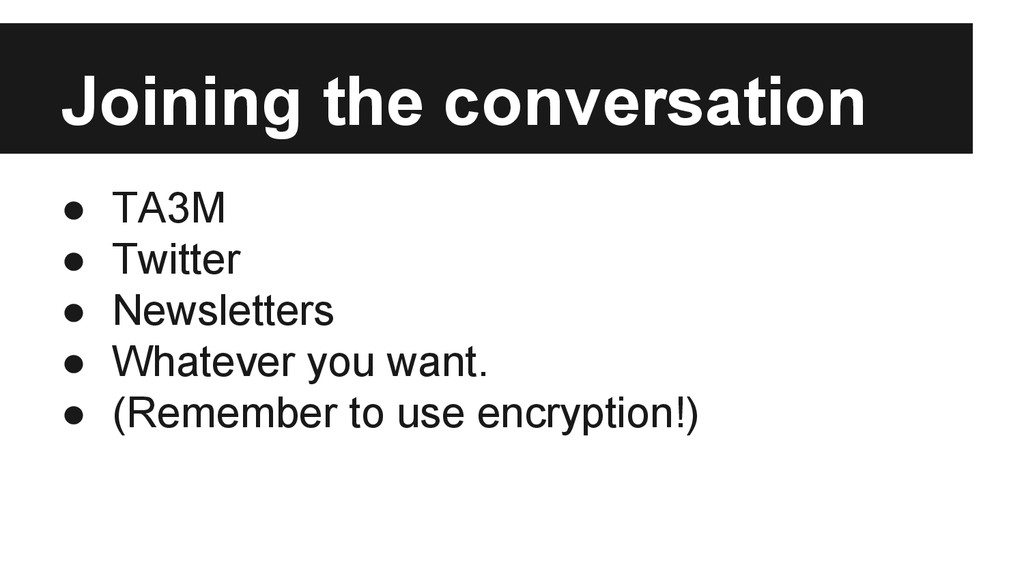
there is mass surveillance going on does not mean that we need to stop communicating electronically. We just need to be smarter about it. • Snowden said that "good encryption still works". • OTR (https://otr.cypherpunks.ca/), Truecrypt (http://www.truecrypt. org/), and GnuPG (http://www.gnupg.org/). Also, The EFF’s Surveillance Self-Defense project (https://ssd.eff.org/) contains more in-depth information on this topic.
us. • Personally, this one was the most heartbreaking revelations of the year. • Mediastan • Do-Not-Track • The tech giants that were targeted in PRISM and MUSCULAR took far too long to take a stand. • EFF, the ACLU, the Open Technology Institute, EPIC, Glenn Greenwald, Jacob Appelbaum, and Laura Poitras, Der Spiegel, The Guardian, and O Globo.
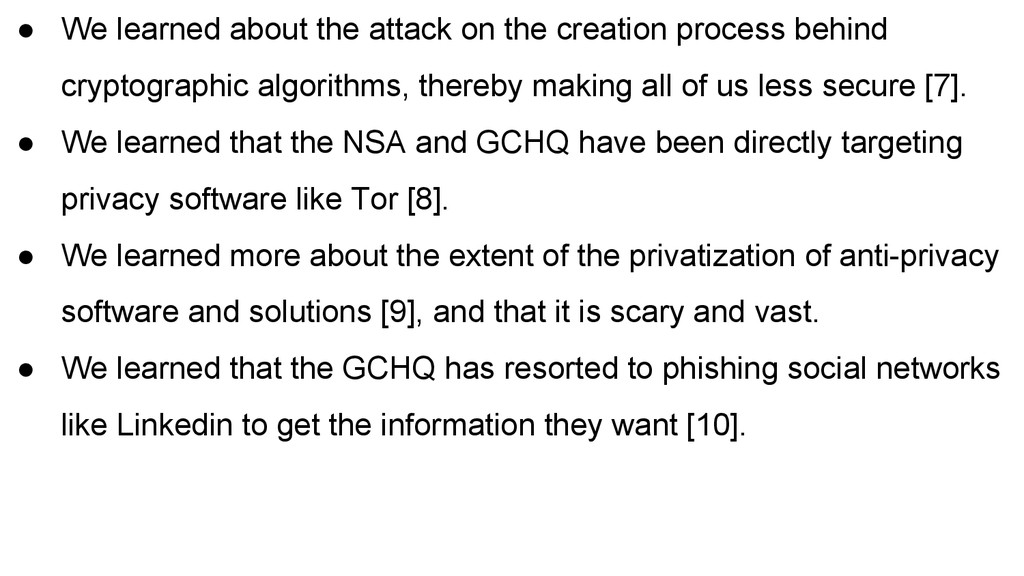
in fact a reality [1]. • We learned about the willing and unwilling interception of data from consumer software [2]. • We learned about the recording of all of our phone calls [3], and that the same companies that are providing us with this technology are now profiting from this interception [4]. • We learned about forced tapping of the major telecom companies in the European Union [5]. • We learned that many public webmail providers are lacking up- to-date web security measures in their software [6].
behind cryptographic algorithms, thereby making all of us less secure [7]. • We learned that the NSA and GCHQ have been directly targeting privacy software like Tor [8]. • We learned more about the extent of the privatization of anti-privacy software and solutions [9], and that it is scary and vast. • We learned that the GCHQ has resorted to phishing social networks like Linkedin to get the information they want [10].
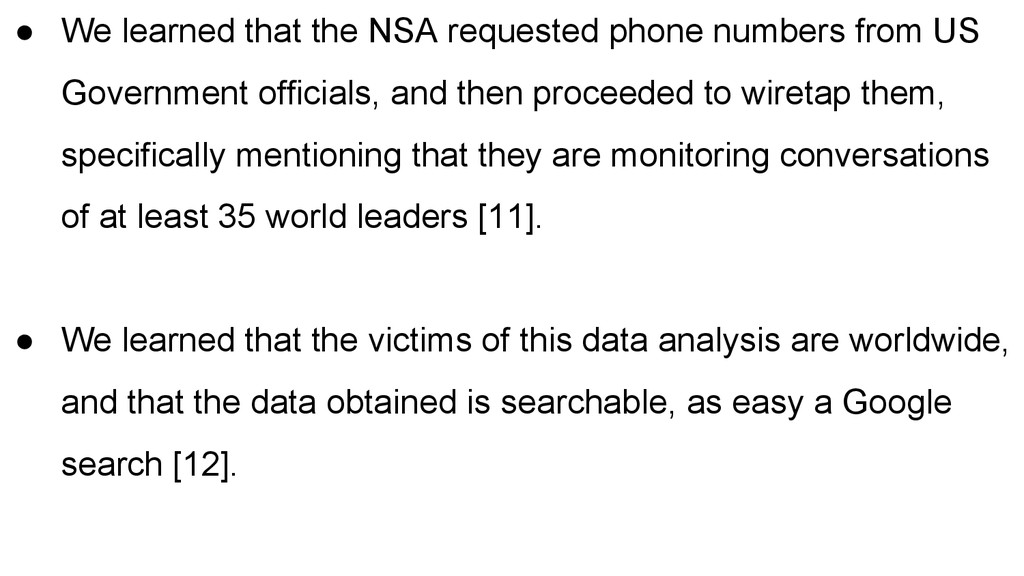
US Government officials, and then proceeded to wiretap them, specifically mentioning that they are monitoring conversations of at least 35 world leaders [11]. • We learned that the victims of this data analysis are worldwide, and that the data obtained is searchable, as easy a Google search [12].
inside the US are afraid of speaking against the government, and for this reason choose to self-censor their publications [13]. • We watched the Congress dance around Do-Not-Track, an “agreed standard” band-aid for ad companies which has continued to go nowhere [14]. • We watched the targets of programs like PRISM conveniently ignore these issues until they realized they were victims as well, and even then, only some started to raise concerns [15]. • We watched the Five Eyes work hard to soften the language of surveillance resolutions at the UN [16].
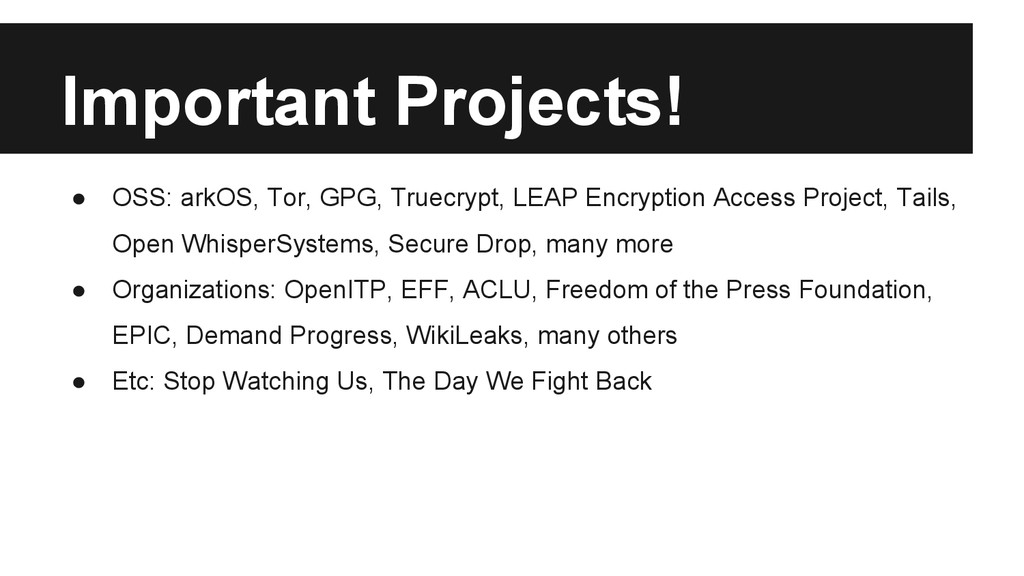
Access Project, Tails, Open WhisperSystems, Secure Drop, many more • Organizations: OpenITP, EFF, ACLU, Freedom of the Press Foundation, EPIC, Demand Progress, WikiLeaks, many others • Etc: Stop Watching Us, The Day We Fight Back


 raspython3
 techtekt
 yut0naga1_fa
 jtakeda
 makocchi
 teamlab
 taketakekaho
 y0hgi
 yuuuuuuu168
 genda
 oikon48
 pfn
 lara
 bkeepers
 caitiem20
 inesmontani
 addyosmani
 zakiyama
 morganepeng
 mayunak
 nmsamuel
 sergeychernyshev
 samlambert
 bermonpainter