Upgrade to Pro — share decks privately, control downloads, hide ads and more …

BSidesLV 2013 - Using Machine Learning to Suppo...

Sponsored · SiteGround - Reliable hosting with speed, security, and support you can count on. →
Avatar for Alex Pinto Alex Pinto
August 01, 2013

BSidesLV 2013 - Using Machine Learning to Support Information Security

Big Data, Data Science, Machine Learning and Analytics are a few of the new buzzwords that have invaded out industry of late. Again we are being sold a unicorn-laden, silver-bullet panacea by heavy handed marketing folks, evoking an expected pushback from the most enlightened members of our community. However, as was the case before, there might just be enough technical meat in there to help out with our security challenges and the overwhelming odds we face everyday. And if so, what do we as a community have to know about these technologies in order to be better professionals? Can we really use the data we have been collecting to help automate our security decision making? Is a robot going to steal my job?

If you are interested in what is behind this marketing buzz and are not scared of a little math, this talk would like to address some insights into applying Machine Learning techniques to data any of us have easy access to, and try to bring home the point that if all of this technology can be used to show us “better” ads in social media and track our behavior online (and a bit more than that) it can also be used to defend our networks as well.

Avatar for Alex Pinto

Alex Pinto

August 01, 2013

More Decks by Alex Pinto

Other Decks in Technology

Transcript

  1. Using Machine Learning to support Information Security Alexandre Pinto [email protected]

    @alexcpsec @MLSecProject Proving Ground (Many Thanks to Joel Wilbanks)
  2. • This is a talk about DEFENDING not attacking –

    NO systems were harmed on the development of this talk. – This is NOT about some vanity hack that will be patched tomorrow – We are actually trying to BUILD something here. • This talk includes more MATH thank the daily recommended assumption by the FDA. • You have been warned... WARNING!
  3. • 12 years in Information Security, done a little bit

    of everything. • Past 7 or so years leading security consultancy and monitoring teams in Brazil, London and the US. – If there is any way a SIEM can hurt you, it did to me. • Researching machine learning and data science in general for the past year or so. Participates in Kaggle machine learning competitions (for fun, not for profit). • First presentation in a real Infosec conference! (give or take a few hours) Who’s Alex?
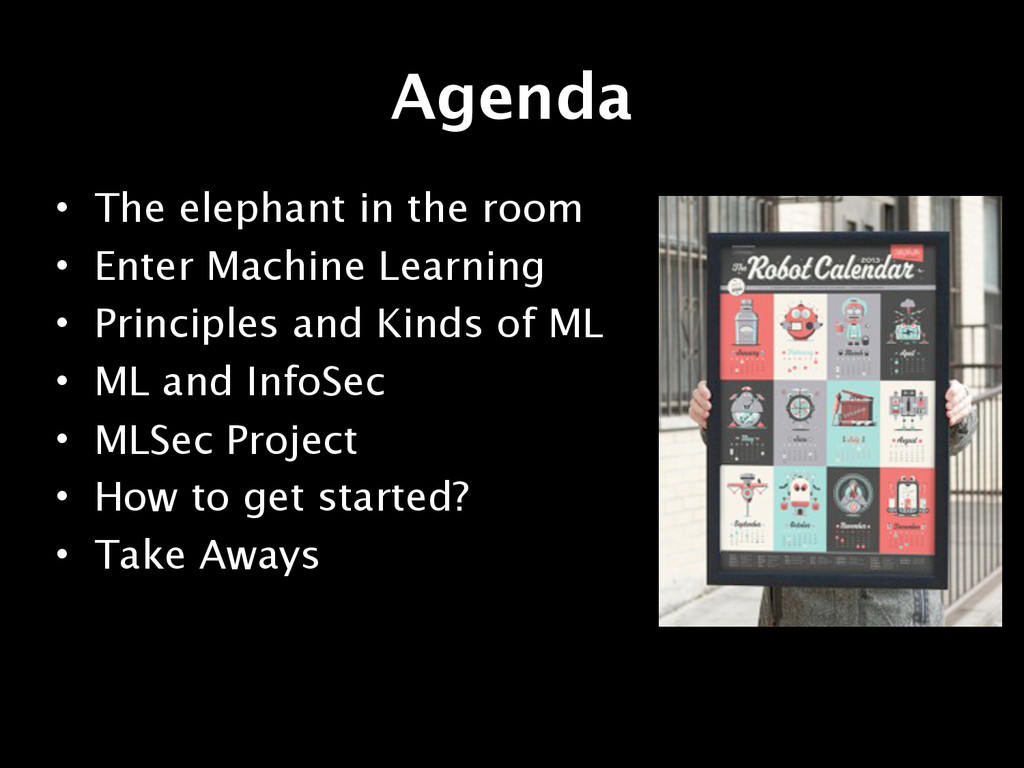
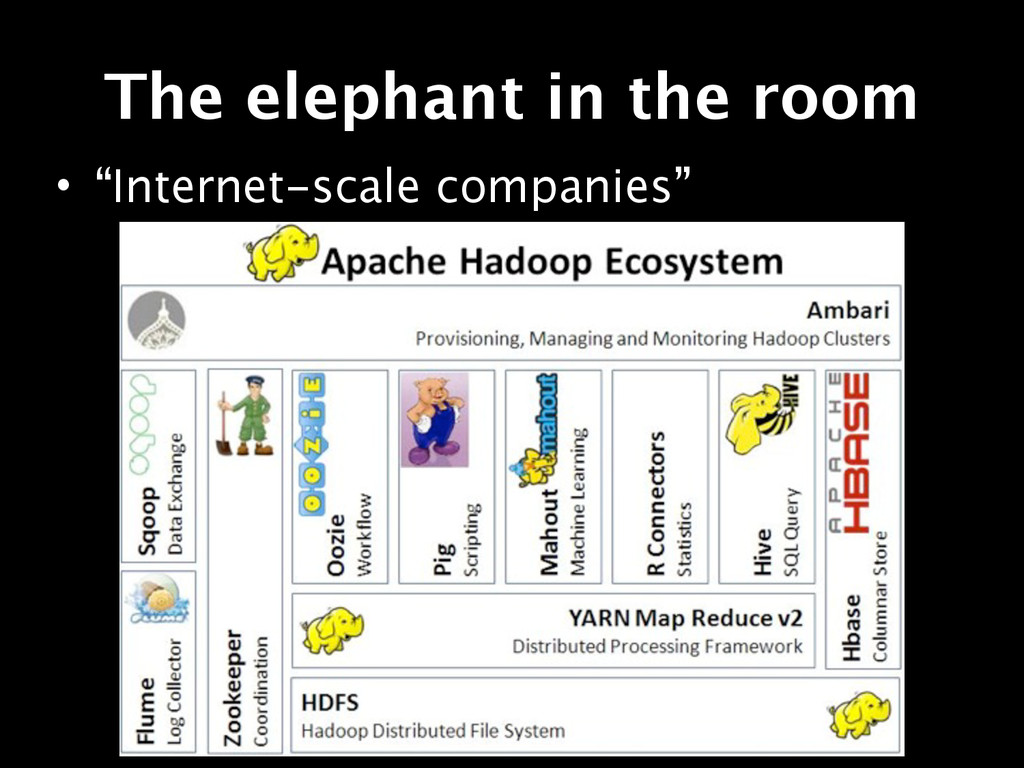
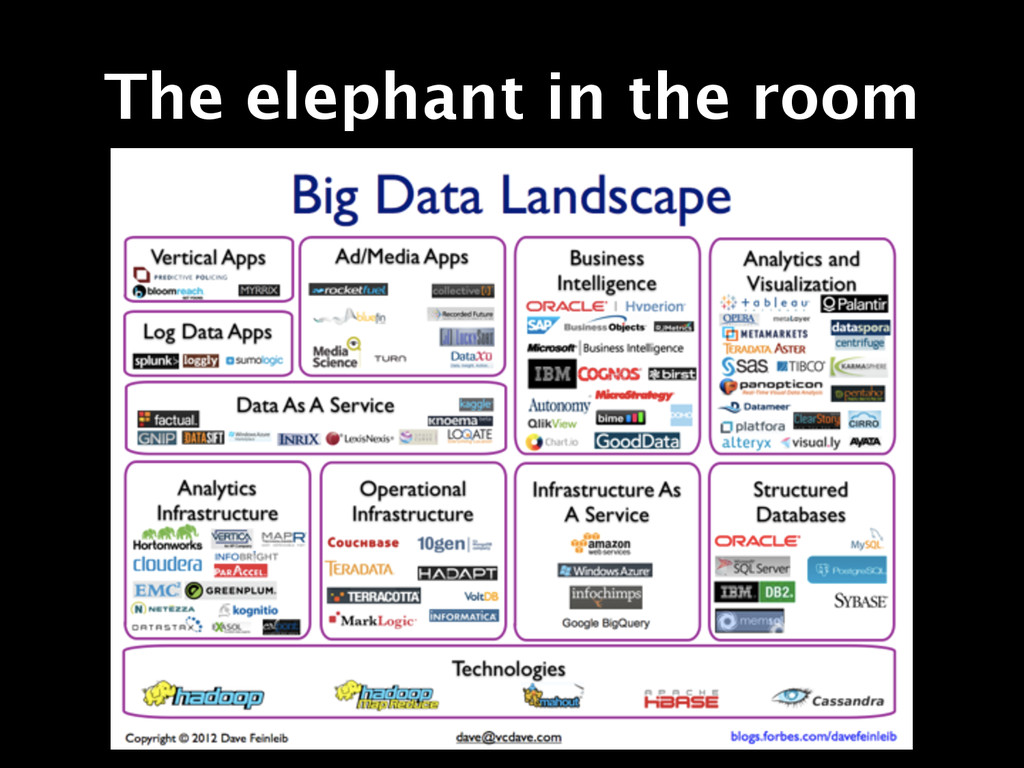
  4. • The elephant in the room • Enter Machine Learning

    • Principles and Kinds of ML • ML and InfoSec • MLSec Project • How to get started? • Take Aways Agenda
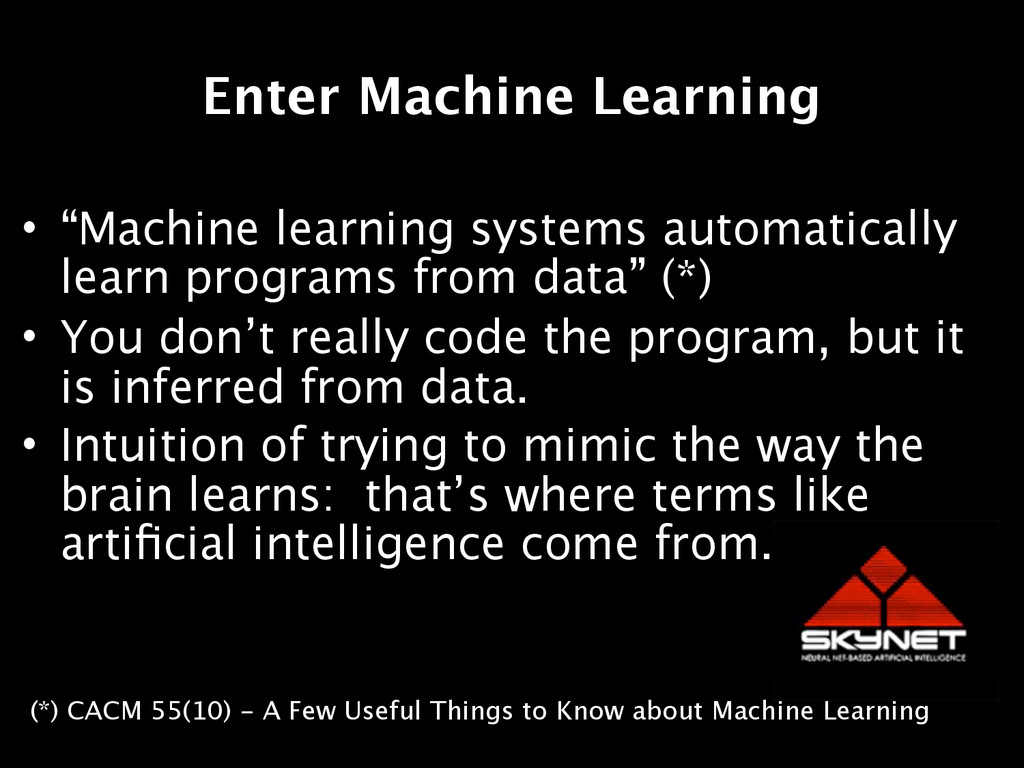
  5. • “Machine learning systems automatically learn programs from data” (*)

    • You don’t really code the program, but it is inferred from data. • Intuition of trying to mimic the way the brain learns: that’s where terms like artificial intelligence come from. Enter Machine Learning (*) CACM 55(10) - A Few Useful Things to Know about Machine Learning
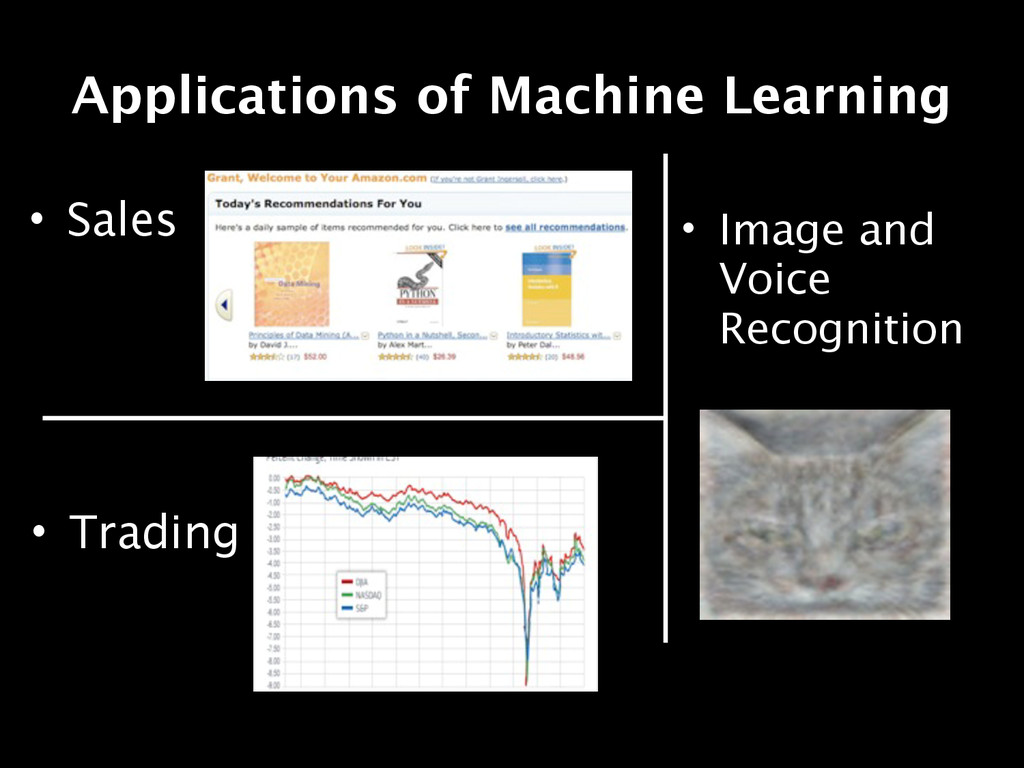
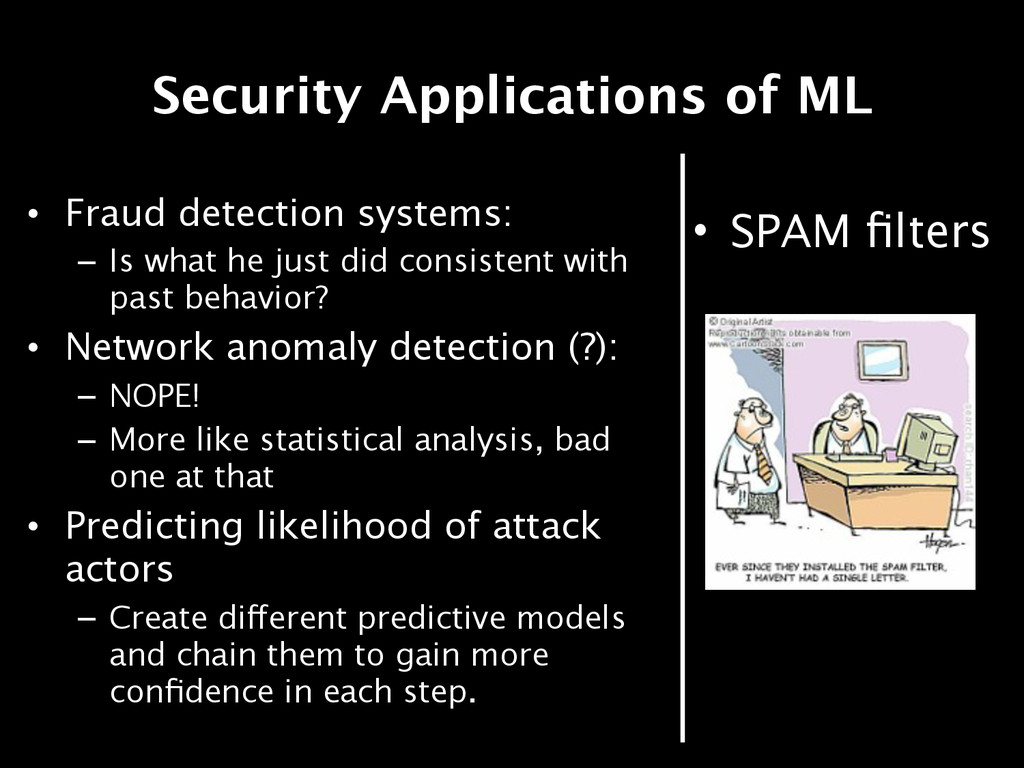
  6. • Fraud detection systems: – Is what he just did

    consistent with past behavior? • Network anomaly detection (?): – NOPE! – More like statistical analysis, bad one at that • Predicting likelihood of attack actors – Create different predictive models and chain them to gain more confidence in each step. Security Applications of ML • SPAM filters
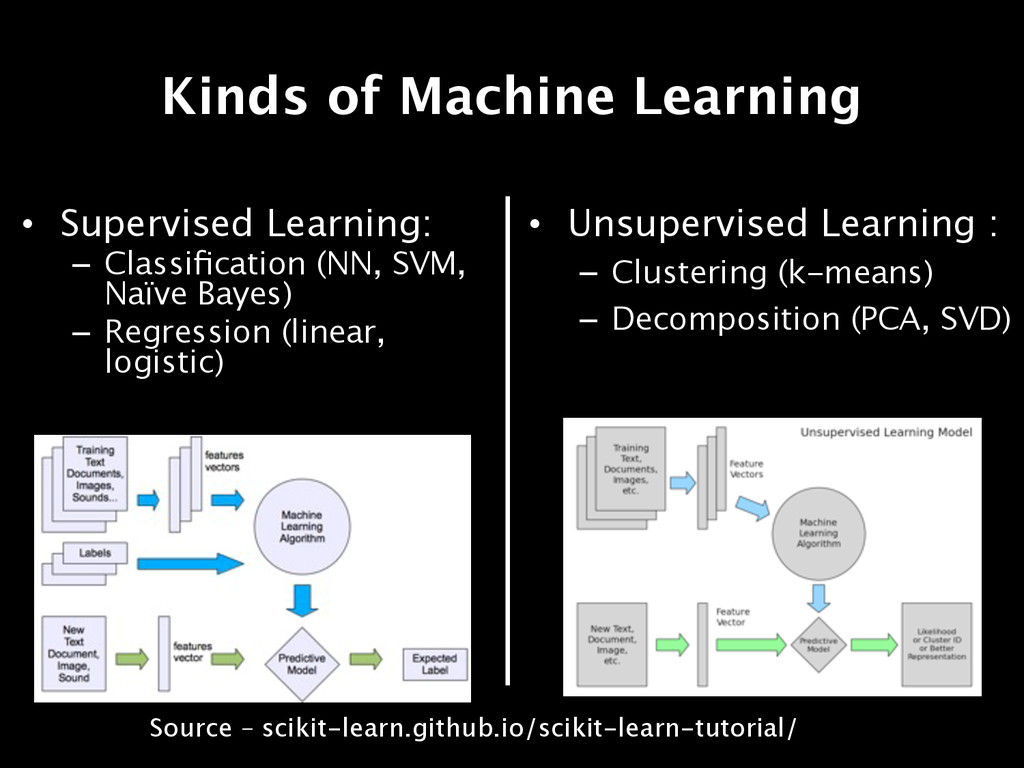
  7. • Supervised Learning: – Classification (NN, SVM, Naïve Bayes) –

    Regression (linear, logistic) Kinds of Machine Learning Source – scikit-learn.github.io/scikit-learn-tutorial/ • Unsupervised Learning : – Clustering (k-means) – Decomposition (PCA, SVD)
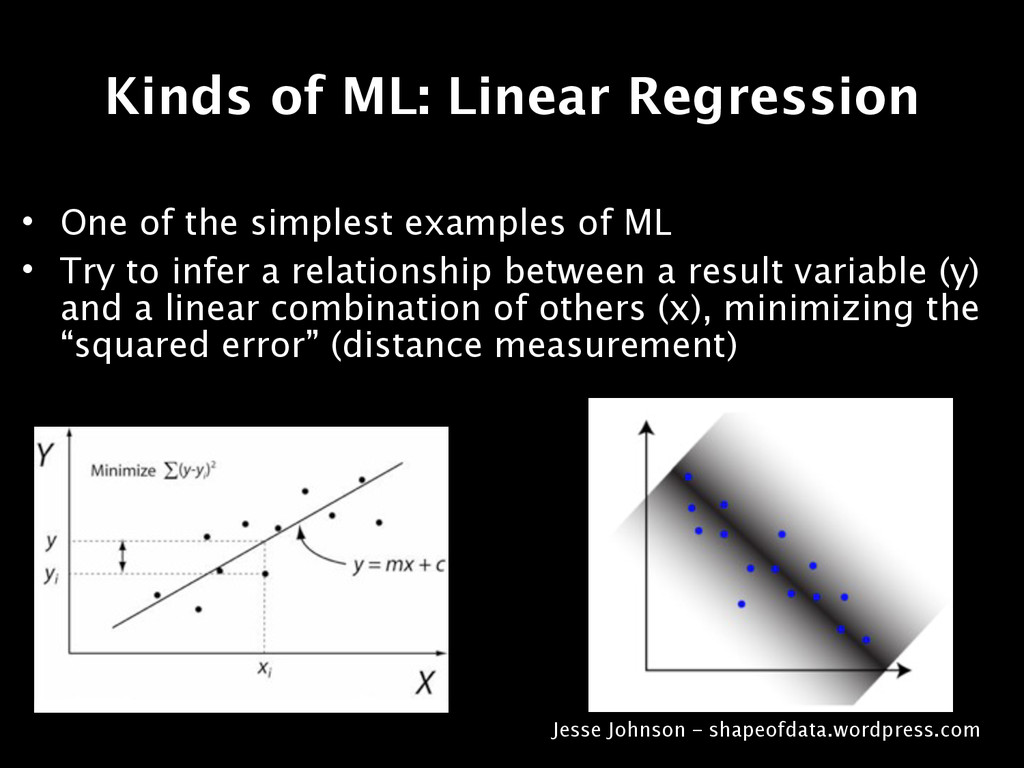
  8. • One of the simplest examples of ML • Try

    to infer a relationship between a result variable (y) and a linear combination of others (x), minimizing the “squared error” (distance measurement) Kinds of ML: Linear Regression Jesse Johnson – shapeofdata.wordpress.com
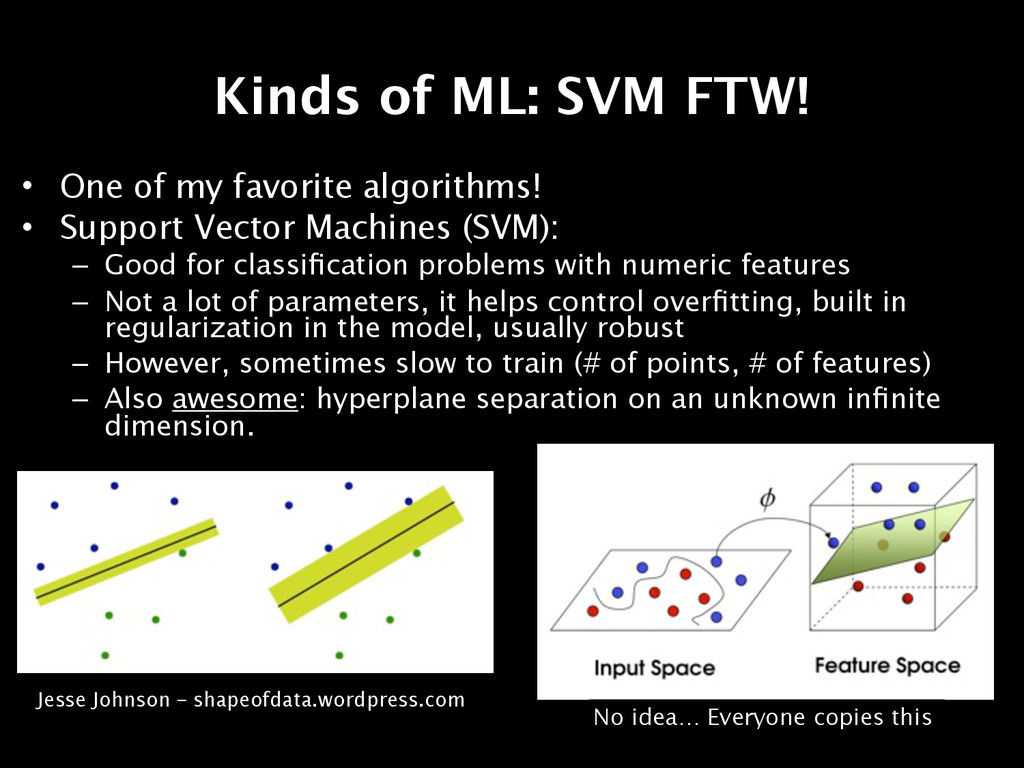
  9. Kinds of ML: SVM FTW! • One of my favorite

    algorithms! • Support Vector Machines (SVM): – Good for classification problems with numeric features – Not a lot of parameters, it helps control overfitting, built in regularization in the model, usually robust – However, sometimes slow to train (# of points, # of features) – Also awesome: hyperplane separation on an unknown infinite dimension. Jesse Johnson – shapeofdata.wordpress.com No idea… Everyone copies this
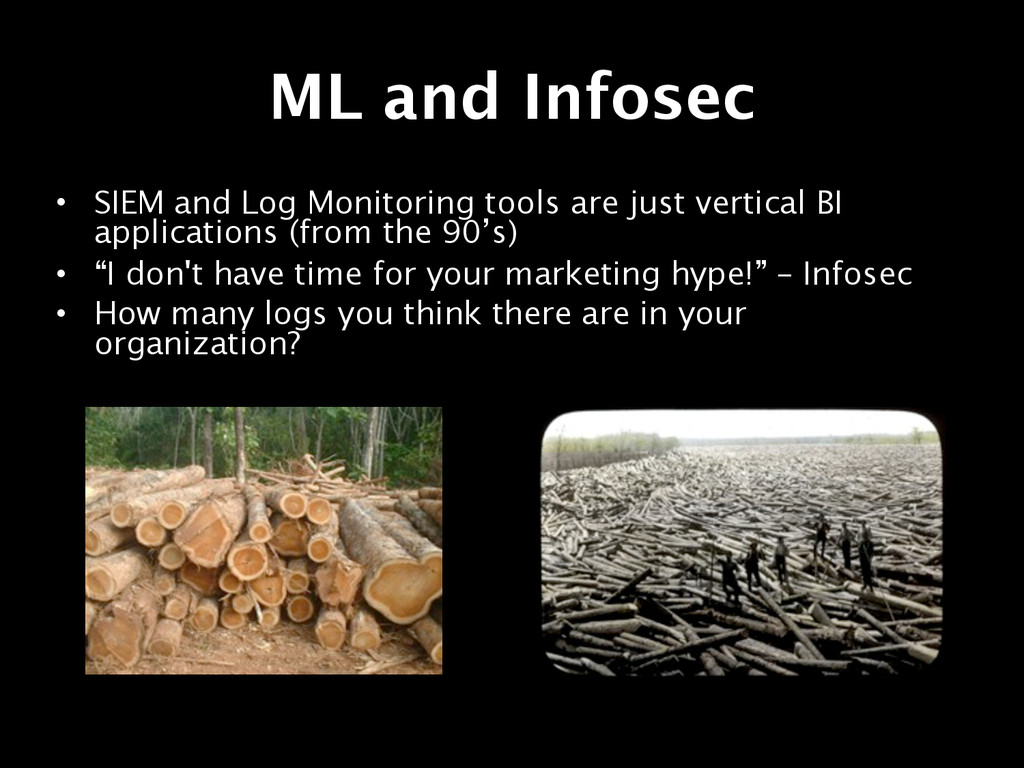
  10. • SIEM and Log Monitoring tools are just vertical BI

    applications (from the 90’s) • “I don't have time for your marketing hype!” – Infosec • How many logs you think there are in your organization? ML and Infosec
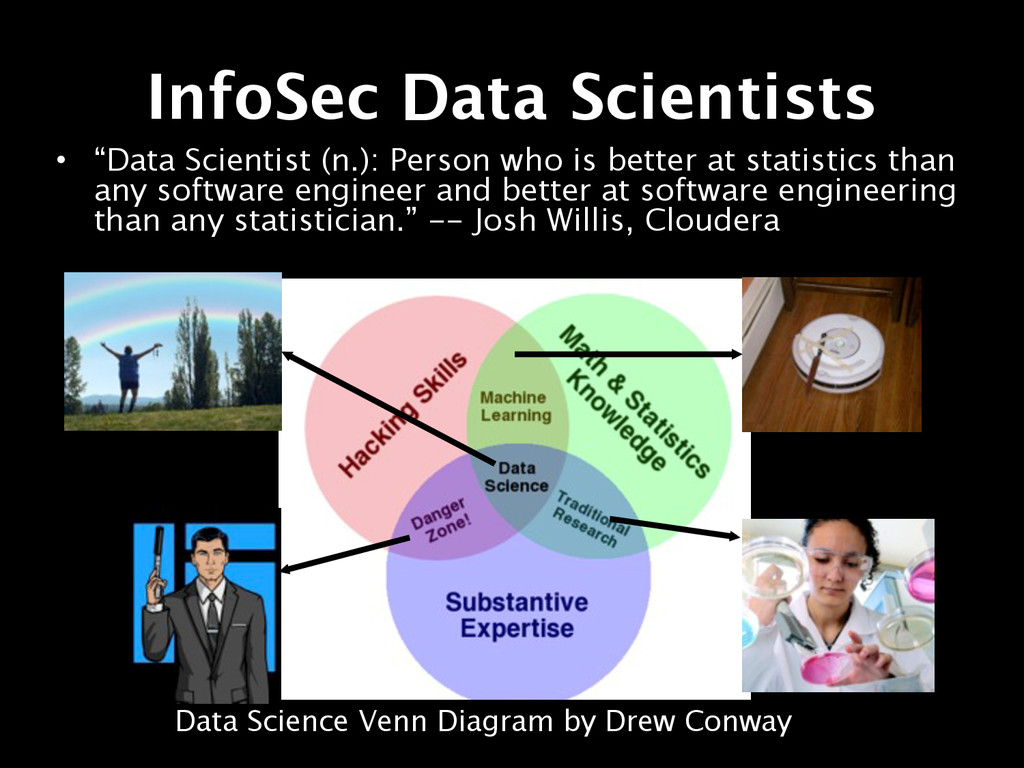
  11. InfoSec Data Scientists Data Science Venn Diagram by Drew Conway

    • “Data Scientist (n.): Person who is better at statistics than any software engineer and better at software engineering than any statistician.” -- Josh Willis, Cloudera
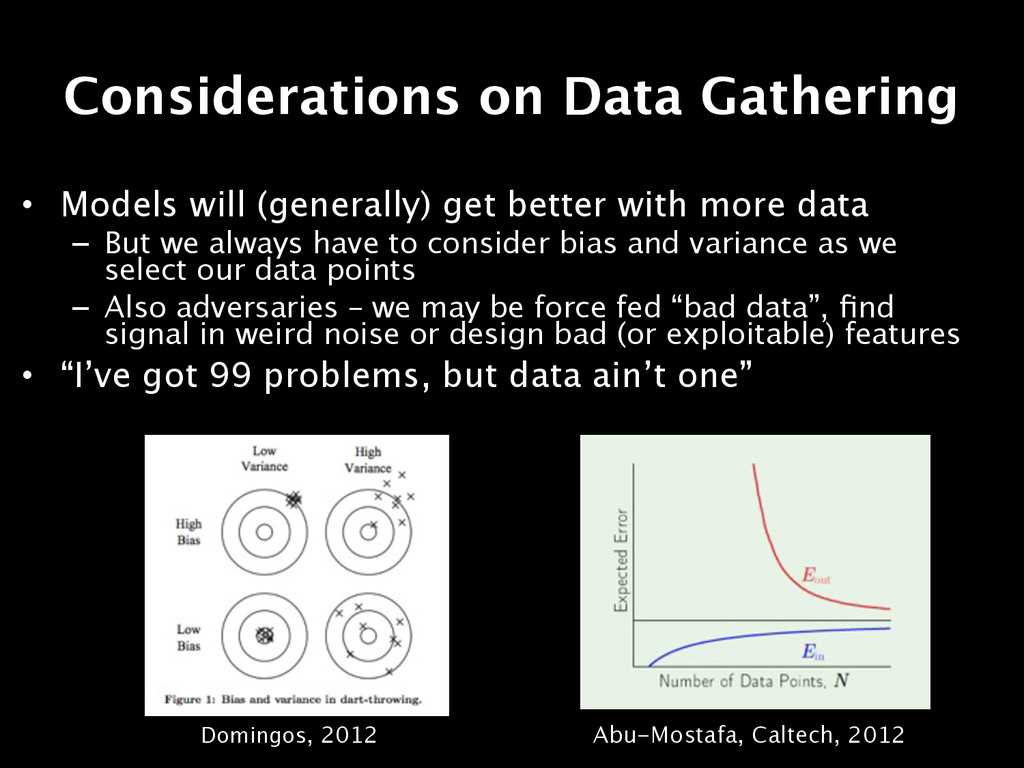
  12. Considerations on Data Gathering • Models will (generally) get better

    with more data – But we always have to consider bias and variance as we select our data points – Also adversaries – we may be force fed “bad data”, find signal in weird noise or design bad (or exploitable) features • “I’ve got 99 problems, but data ain’t one” Domingos, 2012 Abu-Mostafa, Caltech, 2012
  13. • Adversaries - Exploiting the learning process • Understand the

    model, understand the machine, and you can circumvent it • Something InfoSec community knows very well • Any predictive model on Infosec will be pushed to the limit (LIMIT!) • Again, think back on the way SPAM engines evolved. Considerations on Data Gathering
  14. MLSec Project • Sign up, send logs, receive reports generated

    by robots machine learning models! – FREE! I need the data! Please help! ;) • Looking for contributors, ideas, skeptics to support project as well. • Visit https://www.mlsecproject.org , message @MLSecProject or just e-mail me.
  15. • We developed an algorithm to detect malicious behavior from

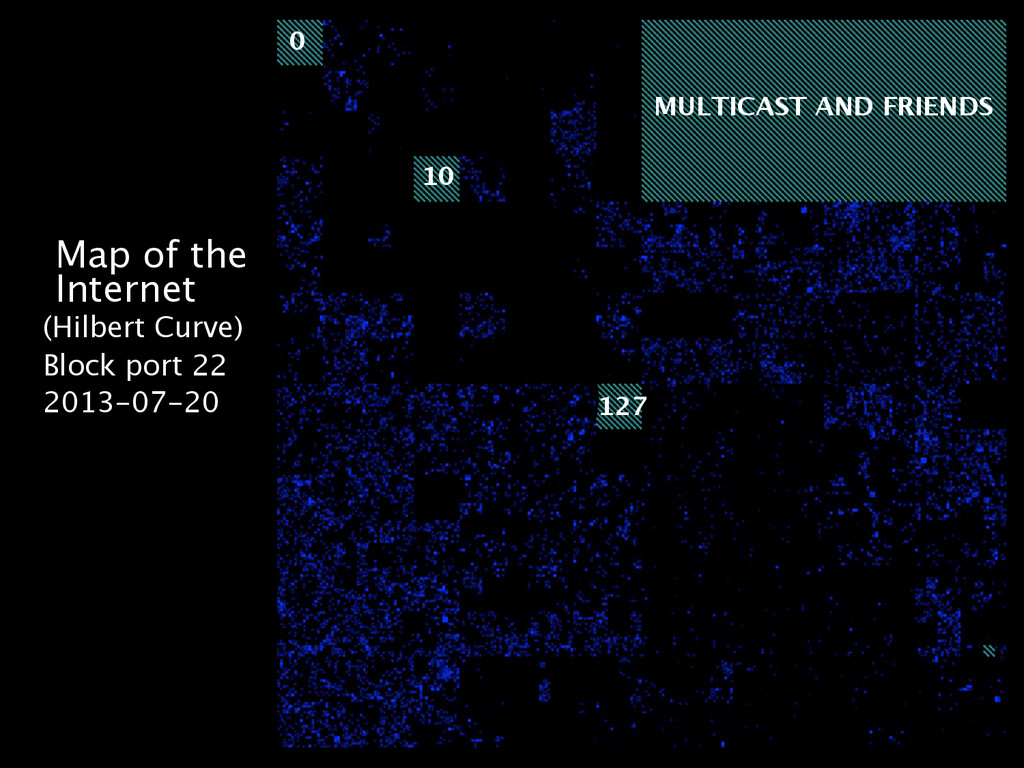
    log entries of firewall blocks • Over 6 months of data from SANS DShield • We don’t focus on frequency or network anomaly detection. Get ground truth “badness” and roll with it. • After a lot of statistical-based math (true positive ratio, true negative ratio, odds likelihood), it can pinpoint actors that would be 13x-18x more likely to attack you. MLSec Project
  16. Map of the Internet • (Hilbert Curve) • Block port

    22 • 2013-07-20 0 10 127 MULTICAST AND FRIENDS
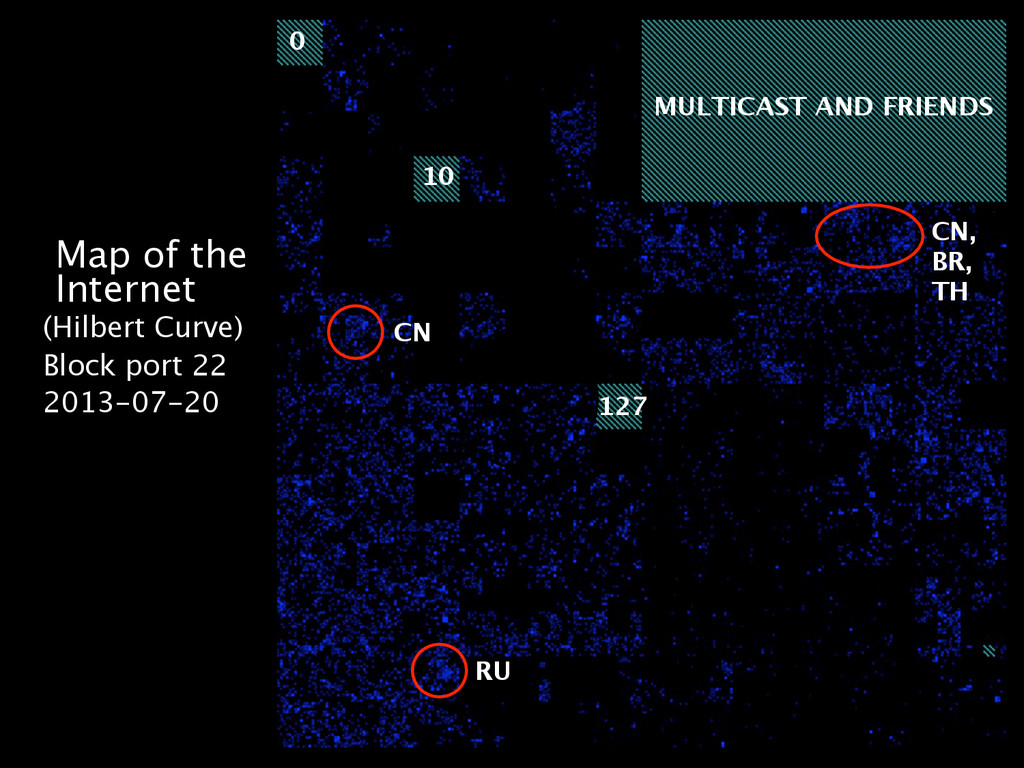
  17. Map of the Internet • (Hilbert Curve) • Block port

    22 • 2013-07-20 0 10 127 MULTICAST AND FRIENDS CN RU CN, BR, TH
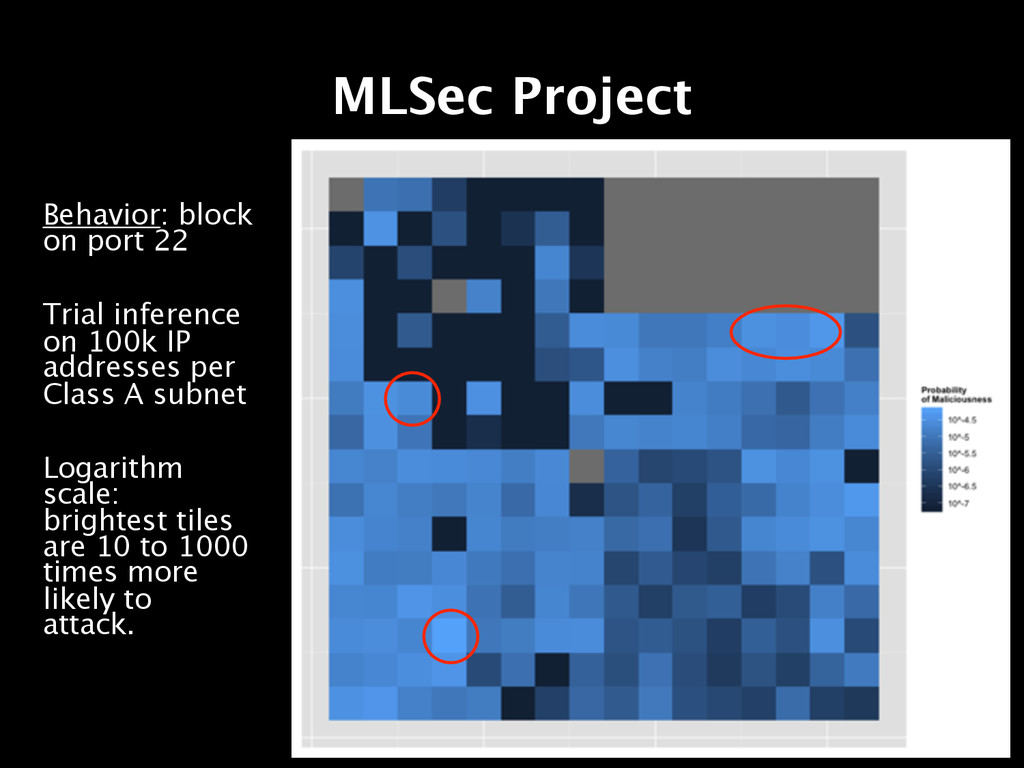
  18. • Behavior: block on port 22 • Trial inference on

    100k IP addresses per Class A subnet • Logarithm scale: brightest tiles are 10 to 1000 times more likely to attack. MLSec Project
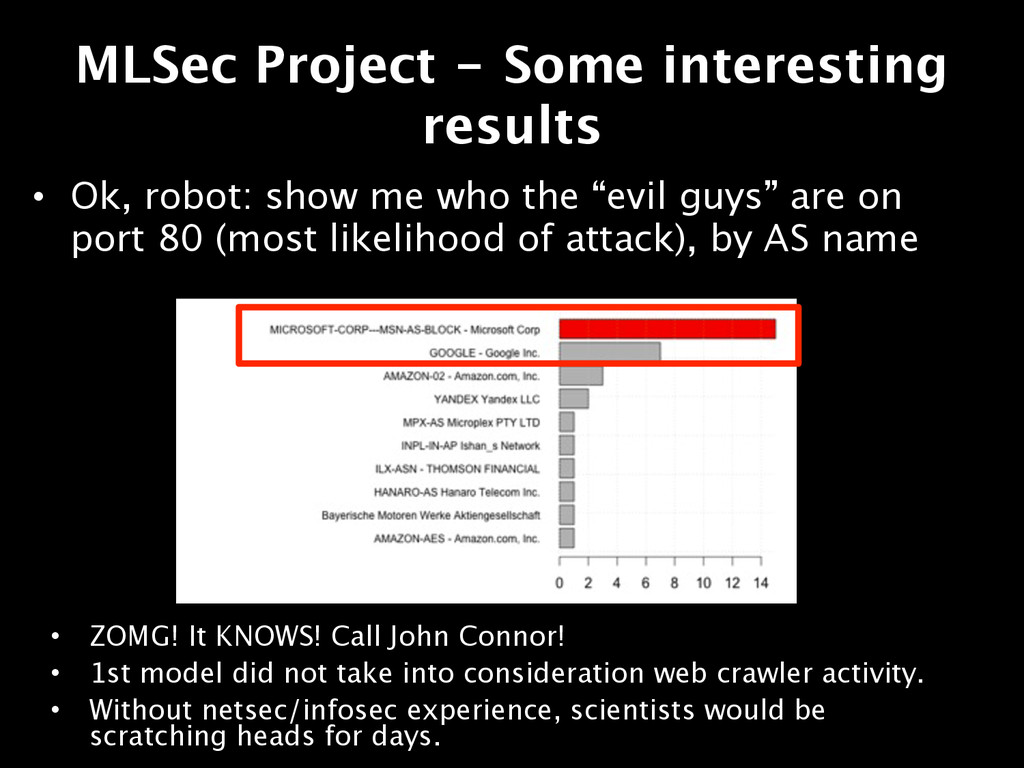
  19. MLSec Project - Some interesting results • Ok, robot: show

    me who the “evil guys” are on port 80 (most likelihood of attack), by AS name
  20. MLSec Project - Some interesting results • ZOMG! It KNOWS!

    Call John Connor! • 1st model did not take into consideration web crawler activity. • Without netsec/infosec experience, scientists would be scratching heads for days. • Ok, robot: show me who the “evil guys” are on port 80 (most likelihood of attack), by AS name
  21. • Programming is a must (Python / R) • Statistical

    knowledge keeps you from making dumb mistakes • Specific machine learning courses and books: – Coursera (ML/ Data Analysis / Data Science) • Practice, Practice, Practice: – Kaggle – KDD, VAST, VizSec How to get started?
  22. • Big data is here! *BUZZWORD ALERT* • Machine learning

    / predictive analytics are coming. • In 6-12 months, everyone will wish they were a Data Scientist (not really!) • There is a lot of applicability in InfoSec • Embrace the change: the correct applicability of ML models can greatly enhance defensive practices. • MLSec Project is cool, check out my talk in BH/DC • And MOST IMPORTANTLY… Take Aways
  23. Thanks! • Q&A? • Feedback is welcome! • (bad =

    Joel’s fault :P) Alexandre Pinto [email protected] @alexcpsec @MLSecProject "Prediction is very difficult, especially if it's about the future." - Niels Bohr