Upgrade to Pro — share decks privately, control downloads, hide ads and more …

Internet System Kudaibergenov Alisher Verified ...

Internet System Kudaibergenov Alisher Verified by Physics Teacher Telman Askeraliyev , Fizika Muellimi, Azerbaijan ,Baku

This presentation examines the Internet from a systems analysis perspective. It defines the Internet as a global system of interconnected networks and describes its purpose, elements, environment and key properties, such as integrity, hierarchy, decentralization and emergence.

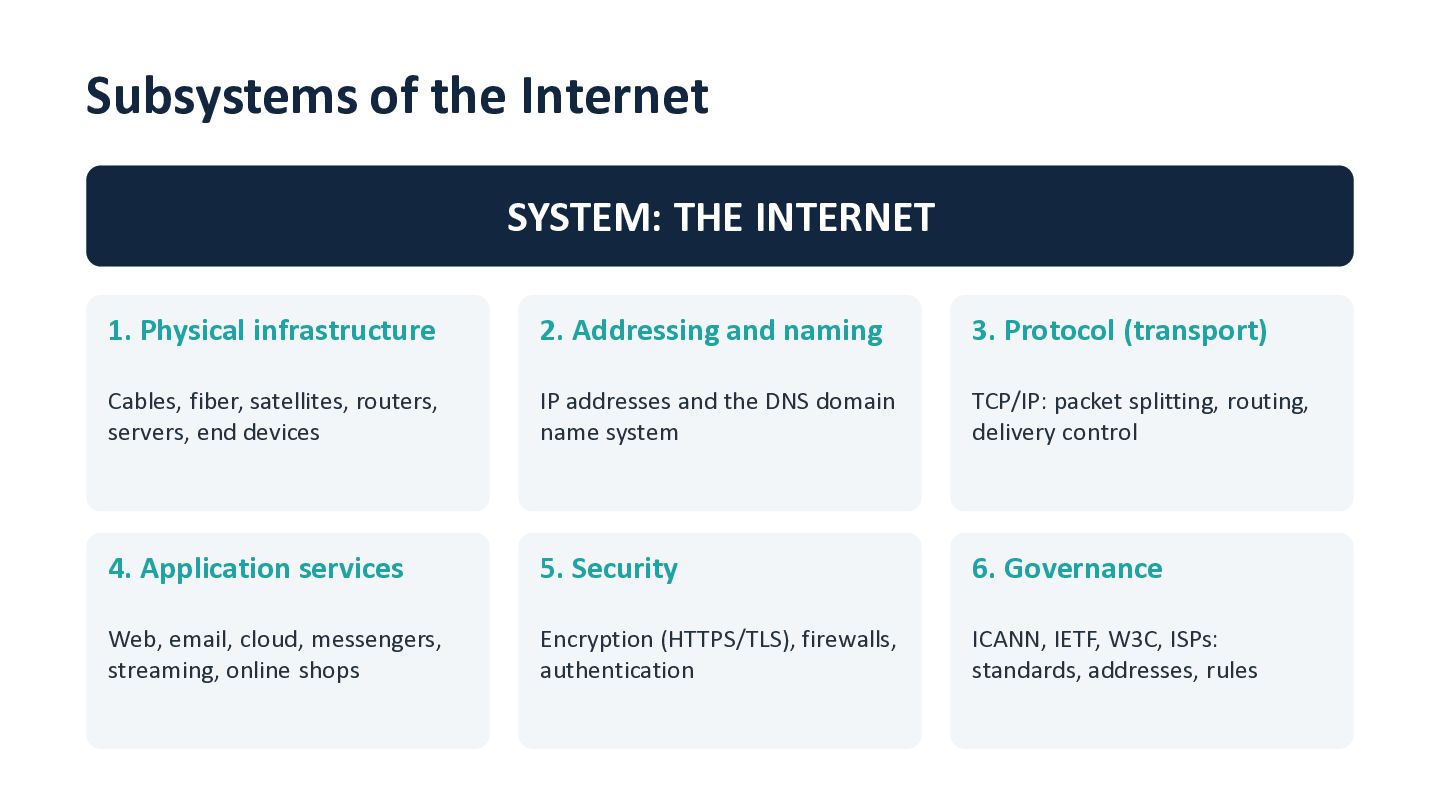
The system is then divided into six subsystems: physical infrastructure, addressing and naming (IP and DNS), protocols (TCP/IP and routing), application services (Web, email, cloud), security (encryption, firewalls, authentication) and governance (ICANN, IETF, W3C). Each subsystem is described with its function and main components. The final slide shows how the subsystems interact, using the example of opening a website.
Student: Kudaibergenov Alisher
Verified by Physics Teacher Telman Askeraliyev , Fizika Muellimi, Azerbaijan ,Baku

Other Decks in Programming

Transcript

  1. The Internet as a System System analysis: structure and subsystems

    Alisher | MenK-201 | K. Zhubanov Aktobe Regional University
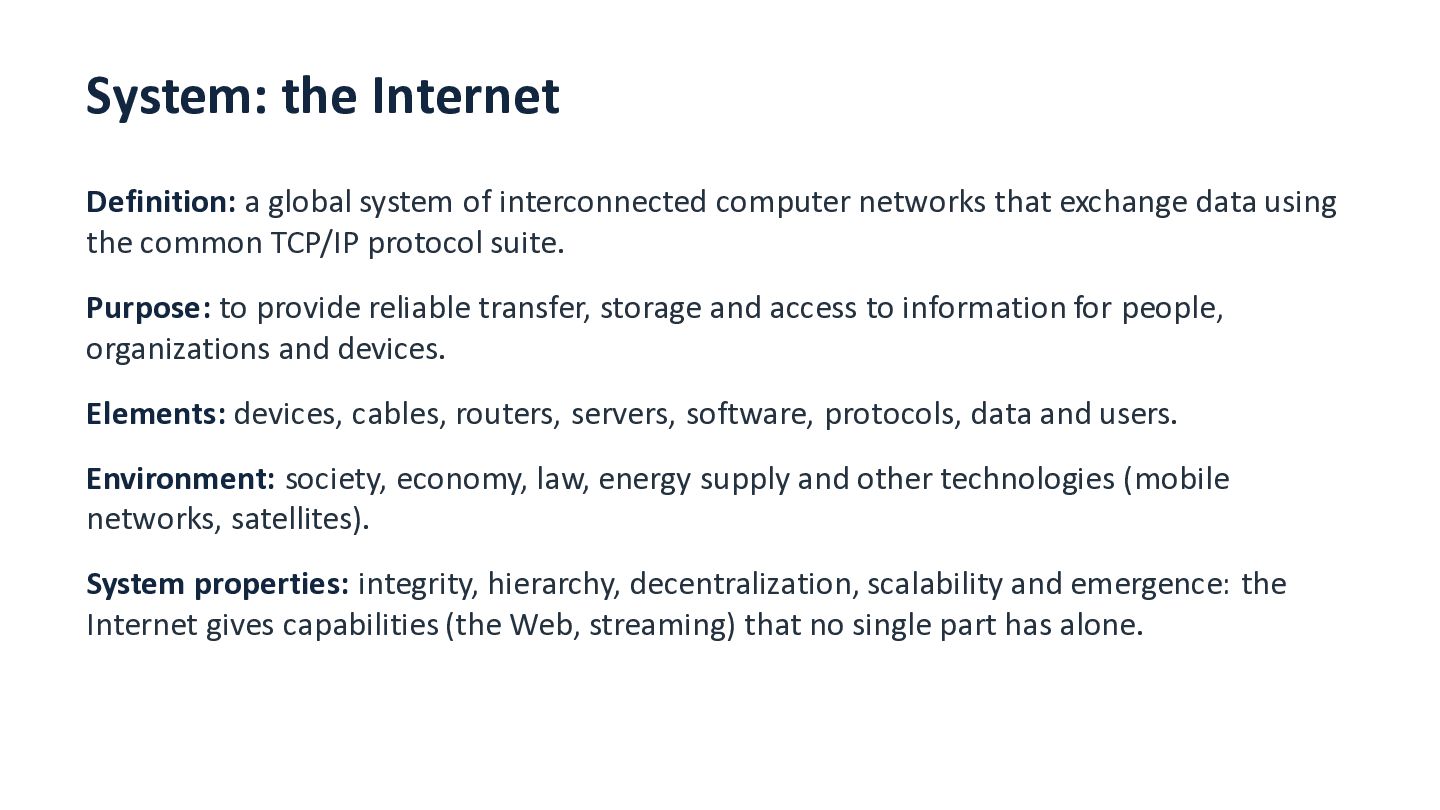
  2. System: the Internet Definition: a global system of interconnected computer

    networks that exchange data using the common TCP/IP protocol suite. Purpose: to provide reliable transfer, storage and access to information for people, organizations and devices. Elements: devices, cables, routers, servers, software, protocols, data and users. Environment: society, economy, law, energy supply and other technologies (mobile networks, satellites). System properties: integrity, hierarchy, decentralization, scalability and emergence: the Internet gives capabilities (the Web, streaming) that no single part has alone.
  3. Subsystems of the Internet SYSTEM: THE INTERNET 1. Physical infrastructure

    2. Addressing and naming 3. Protocol (transport) Cables, fiber, satellites, routers, servers, end devices IP addresses and the DNS domain name system TCP/IP: packet splitting, routing, delivery control 4. Application services 5. Security 6. Governance Web, email, cloud, messengers, streaming, online shops Encryption (HTTPS/TLS), firewalls, authentication ICANN, IETF, W3C, ISPs: standards, addresses, rules
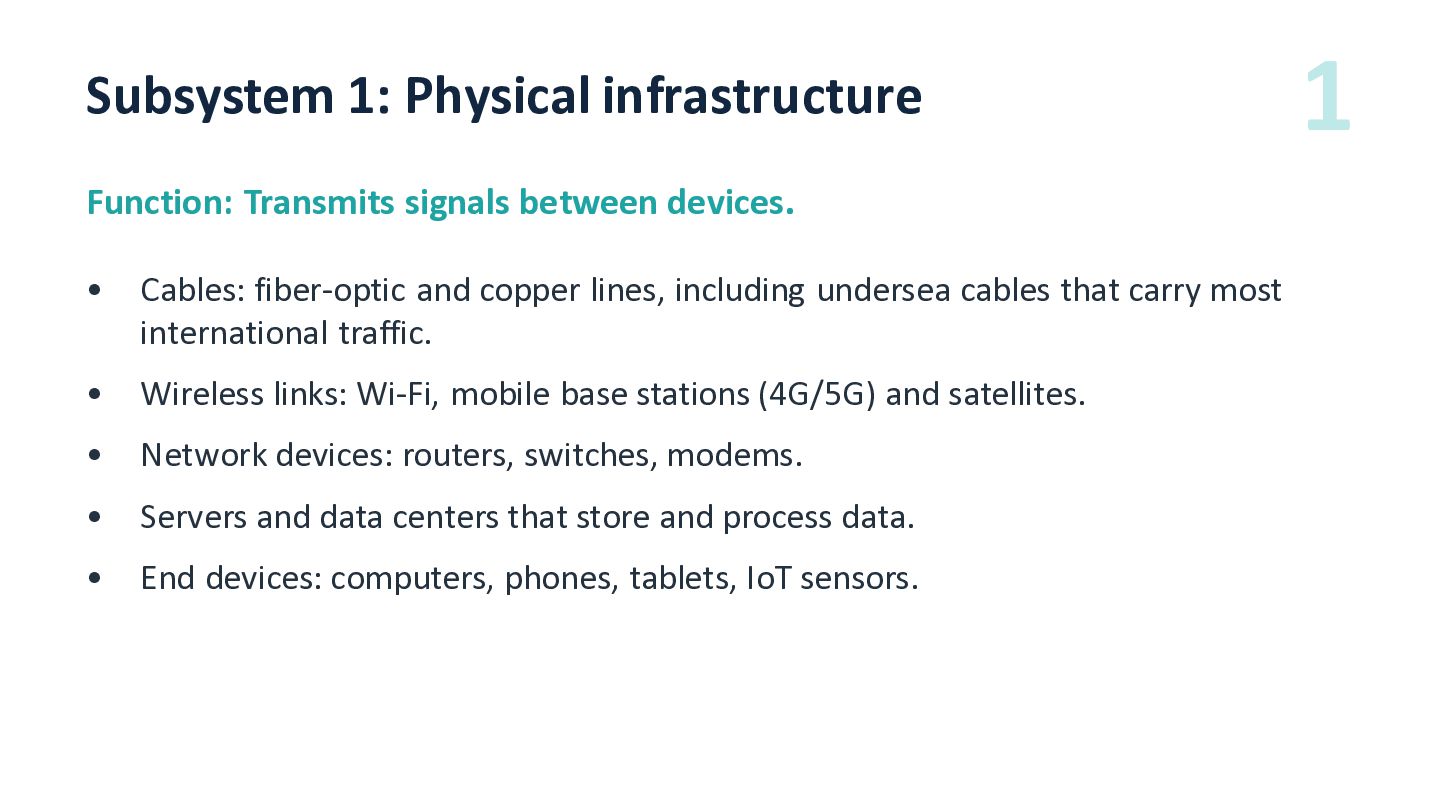
  4. Subsystem 1: Physical infrastructure Function: Transmits signals between devices. •

    Cables: fiber-optic and copper lines, including undersea cables that carry most international traffic. • Wireless links: Wi-Fi, mobile base stations (4G/5G) and satellites. • Network devices: routers, switches, modems. • Servers and data centers that store and process data. • End devices: computers, phones, tablets, IoT sensors. 1
  5. Subsystem 2: Addressing and naming 2 Function: Identifies every device

    and resource on the network. • IP address: a unique number of a device (IPv4 has about 4.3 billion addresses, IPv6 is much larger). • DNS (Domain Name System) translates names like example.com into IP addresses. • Works like a phone book: people remember names, machines use numbers. • Domains are organized in a hierarchy: root, top-level (.kz, .com), second-level. • If DNS fails, sites become unreachable even though the servers work.
  6. Subsystem 3: Protocol (transport) 3 Function: Sets the rules for

    exchanging data between devices. • TCP splits data into packets, numbers them, checks delivery and resends lost ones. • IP adds addresses to packets and sends them through the network. • Routing protocols (e.g. BGP) choose the best path between networks. • Packets may travel different routes and are reassembled at the destination. • Common rules let different hardware and software work together.
  7. Subsystem 4: Application services Function: Serves the needs of users.

    • World Wide Web: websites and web apps over HTTP/HTTPS. • Email (SMTP, IMAP) and messengers for fast communication. • Cloud storage, video calls and online streaming. • E-commerce, online banking and social networks. • Online education platforms and digital libraries. 4
  8. Subsystem 5: Security Function: Protects data, devices and users. •

    Encryption (TLS/HTTPS) keeps traffic private and unchanged. • Firewalls and intrusion detection block unauthorized access. • Antivirus and regular updates protect against malware. • Authentication (passwords, two-factor) confirms user identity. • Main threats: phishing, ransomware, fake websites, data leaks. 5
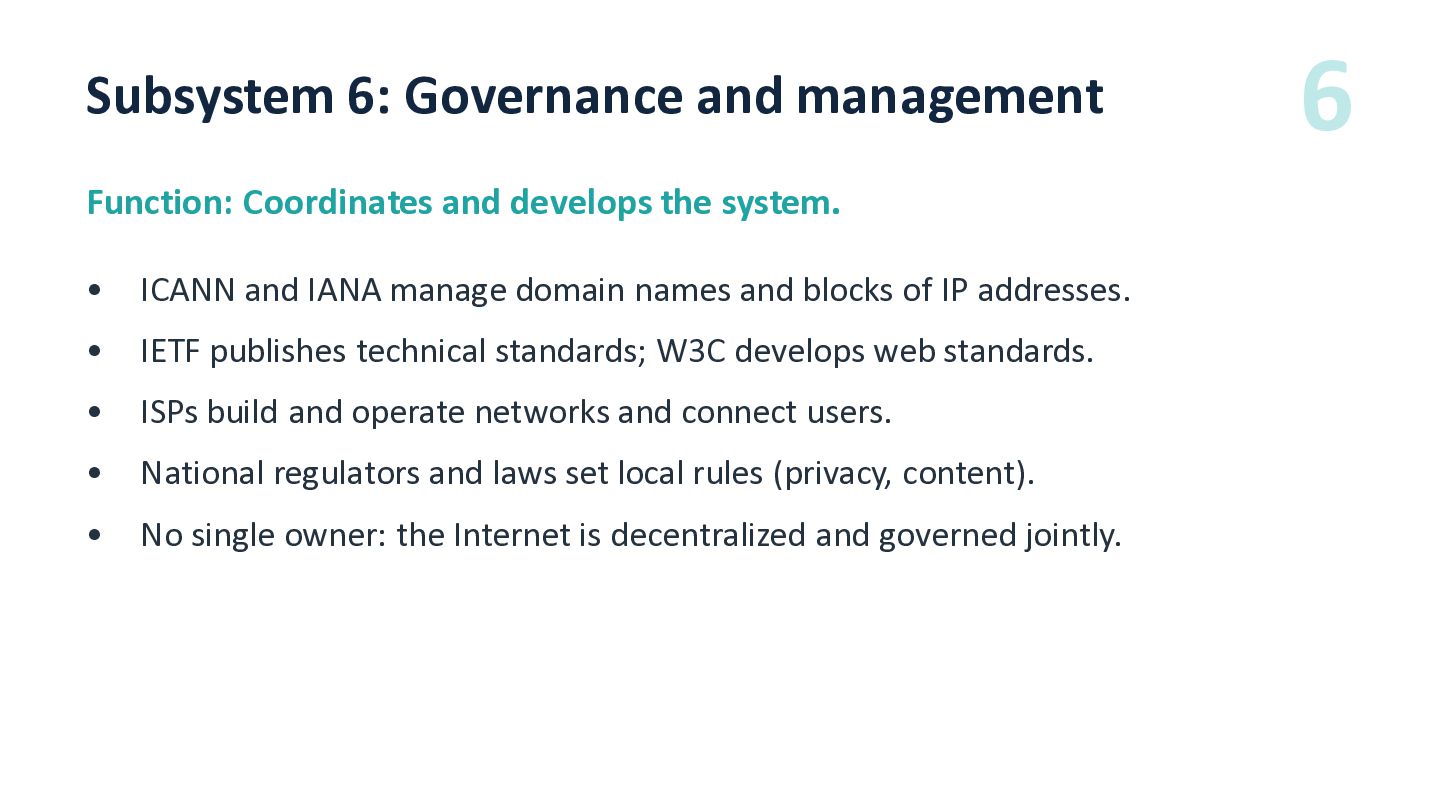
  9. Subsystem 6: Governance and management Function: Coordinates and develops the

    system. • ICANN and IANA manage domain names and blocks of IP addresses. • IETF publishes technical standards; W3C develops web standards. • ISPs build and operate networks and connect users. • National regulators and laws set local rules (privacy, content). • No single owner: the Internet is decentralized and governed jointly. 6
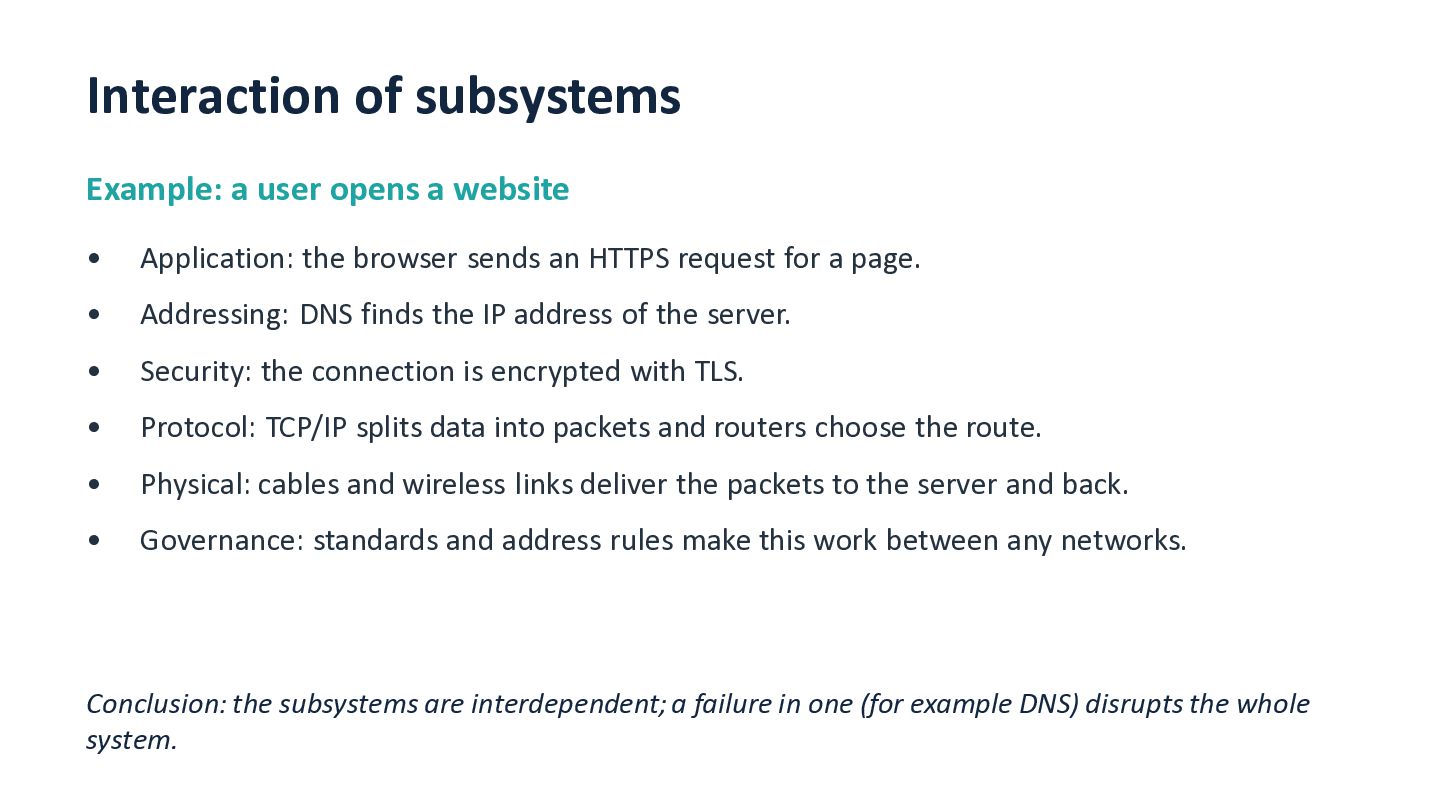
  10. Interaction of subsystems Example: a user opens a website •

    Application: the browser sends an HTTPS request for a page. • Addressing: DNS finds the IP address of the server. • Security: the connection is encrypted with TLS. • Protocol: TCP/IP splits data into packets and routers choose the route. • Physical: cables and wireless links deliver the packets to the server and back. • Governance: standards and address rules make this work between any networks. Conclusion: the subsystems are interdependent; a failure in one (for example DNS) disrupts the whole system.