Upgrade to Pro — share decks privately, control downloads, hide ads and more …

Critical Engineering: The Myth of Ireneo Funes ...

Avatar for almo almo
August 15, 2026

Critical Engineering: The Myth of Ireneo Funes — Redefining the SDLC, Operations (SRE), and Engineering Education

“To think is to forget differences, to generalize, to abstract. In Funes’s crowded world, there were only details, almost immediate ones.” — Jorge Luis Borges

When autonomous agents make writing code nearly free, the cost of verifying and integrating that code becomes infinite. This presentation examines the modern computing crisis: running AI-scale agentic workloads on legacy, human-centric architectures.

As AI code generation accelerates into a high-throughput firehose, traditional CI/CD pipelines, SRE verification methods, and syntax-heavy academic curricula are defaulting under the weight of unbridled technical debt.

The talk introduces Adversarial & Critical Engineering—a paradigm shift moving engineers from line-by-line coders to system architects who enforce strict structural invariants, machine-scale verification, and zero-trust delivery pipelines

Key Themes & Takeaways

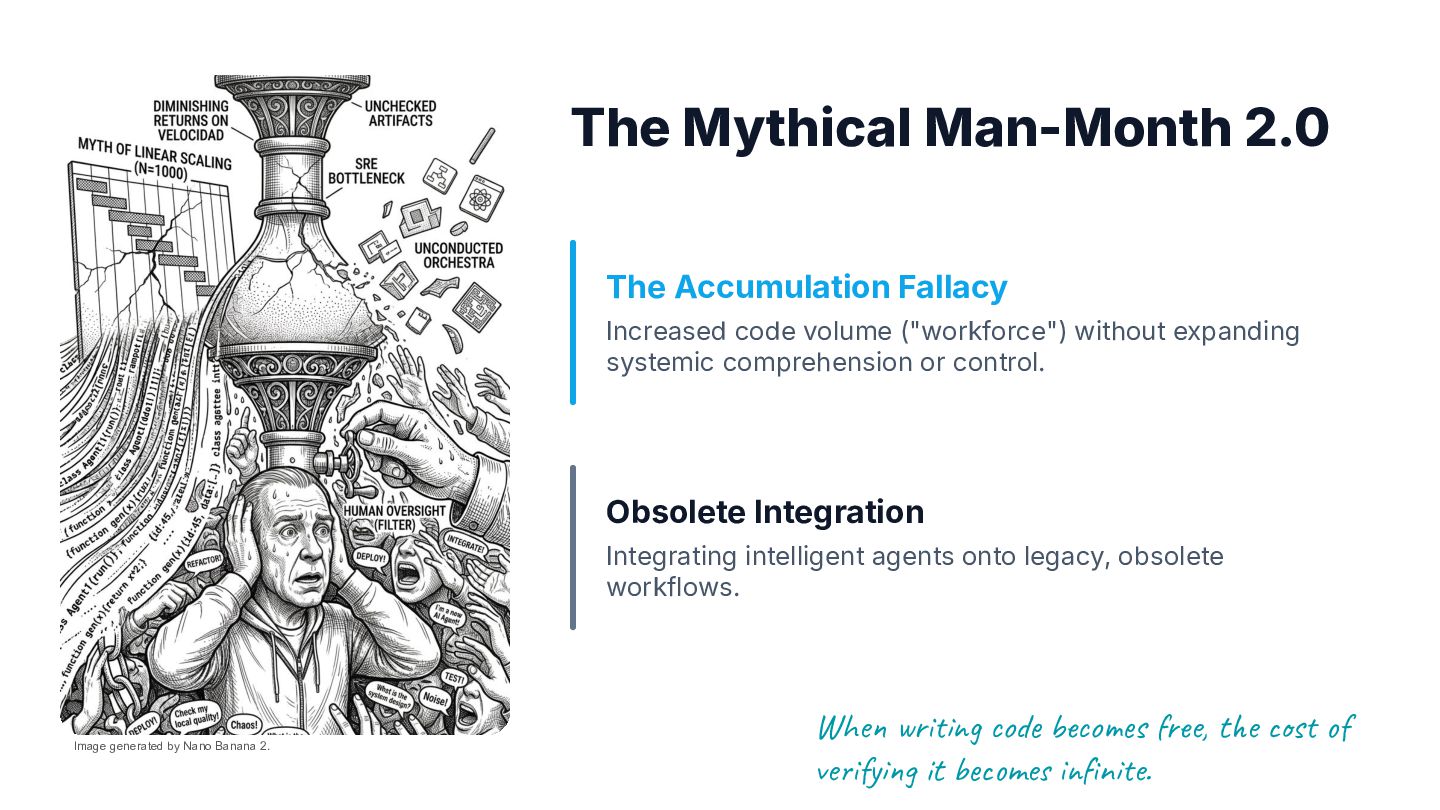
The Agentic Shift & The Accumulation Fallacy: Why flooding repositories with unmanaged AI-generated code leads to systemic breakdown rather than linear productivity gains.
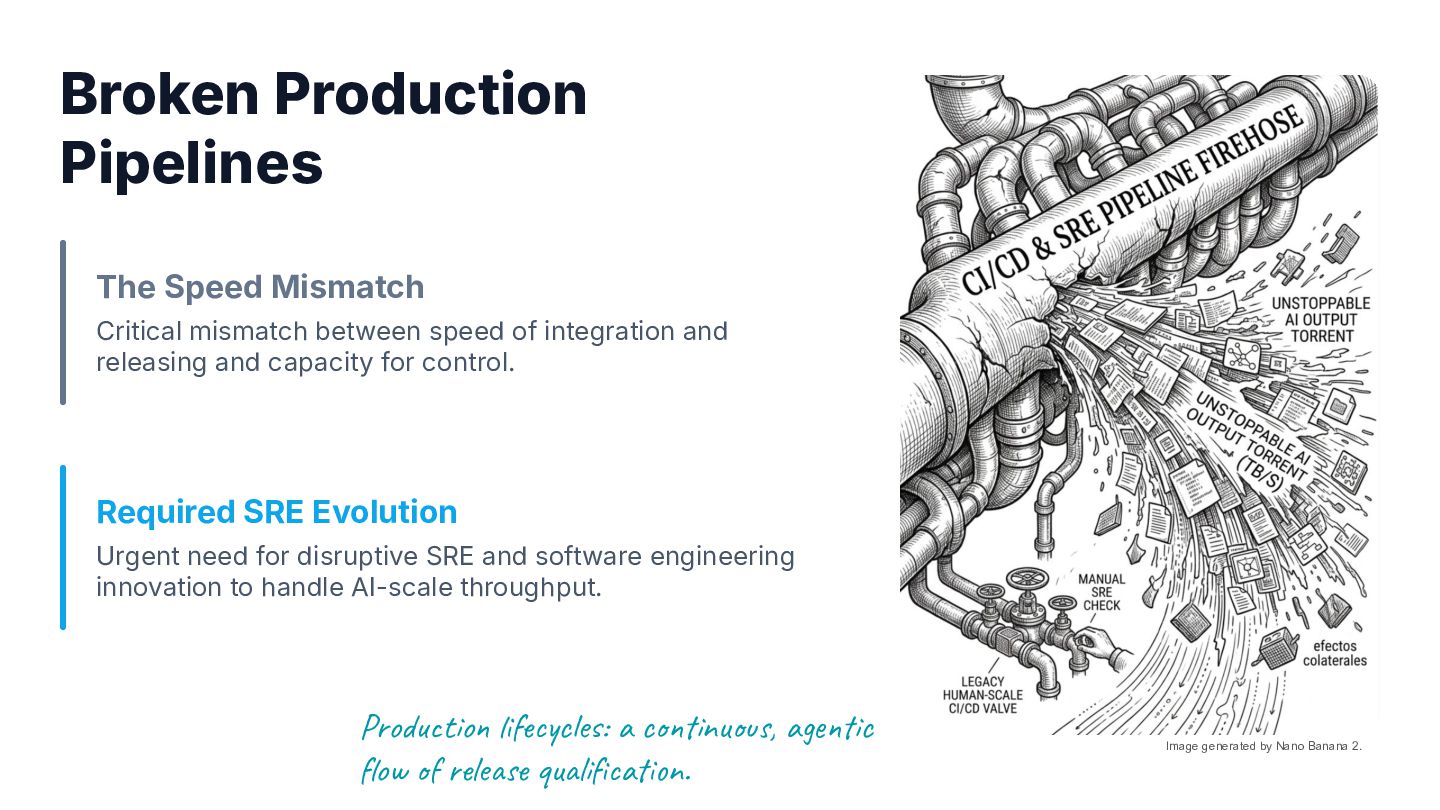
Broken CI/CD & SRE Pipelines: The urgent need to evolve Site Reliability Engineering with automated canary analysis (ACA), automated chaos engineering loops, and machine-scale validation gates.
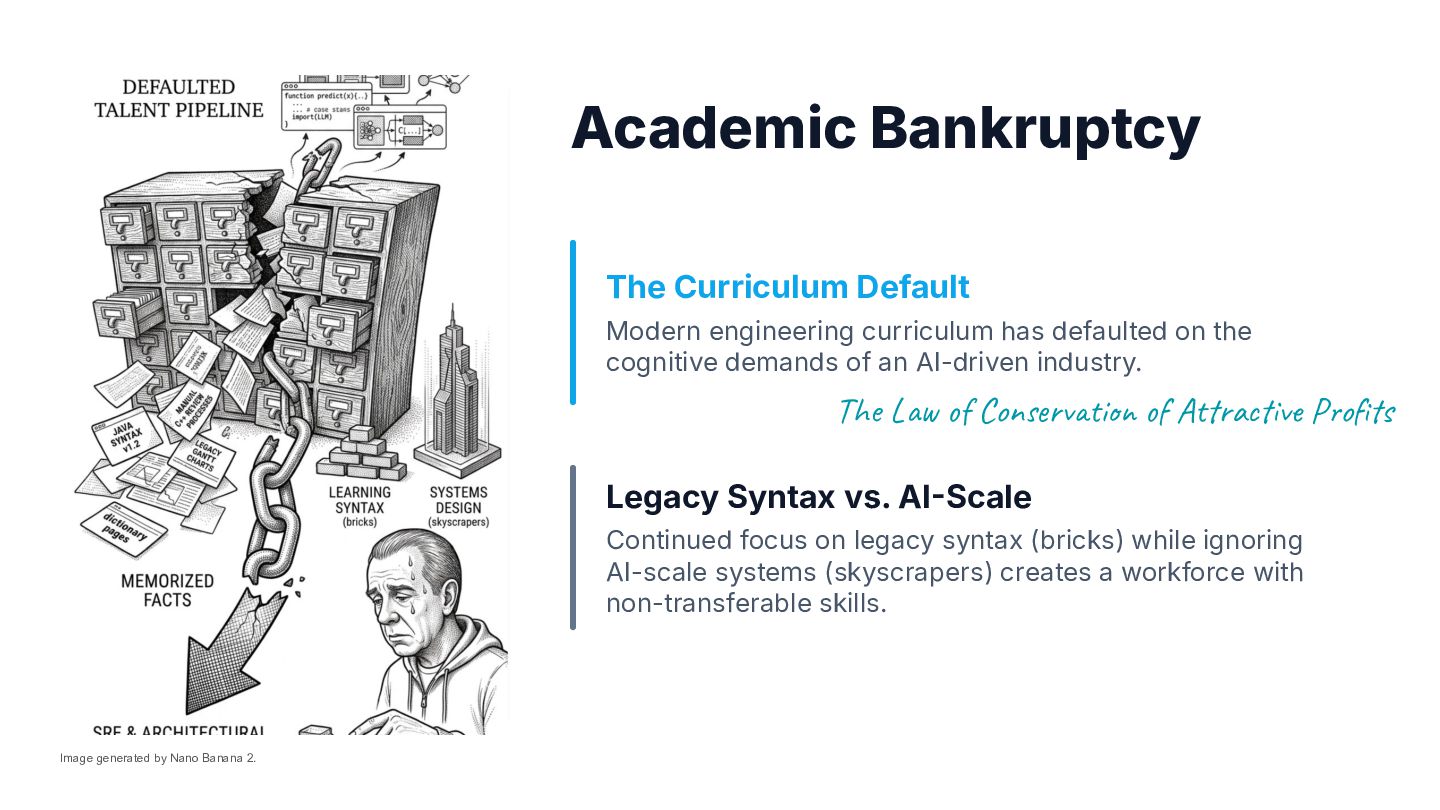
Academic Bankruptcy: The growing gap between university curricula focusing on syntax ("bricks") and modern industry demands for system architecture and abstraction ("skyscrapers").
Adversarial Engineering Framework: Enforcing hard architectural invariants, isolated sandboxes (e.g., eBPF, sandboxed runtimes), and immutable Policy-as-Code (PaC).
The Critical Engineer’s Manifesto: Shifting focus from syntax mastery to systemic verification, abstraction, and deliberate boundary enforcement.

#SoftwareEngineering #SRE #GenerativeAI #DevOps #SystemDesign #AgenticWorkflows #CNEISI2026

Avatar for almo

almo

August 15, 2026

More Decks by almo

Other Decks in Technology

Transcript

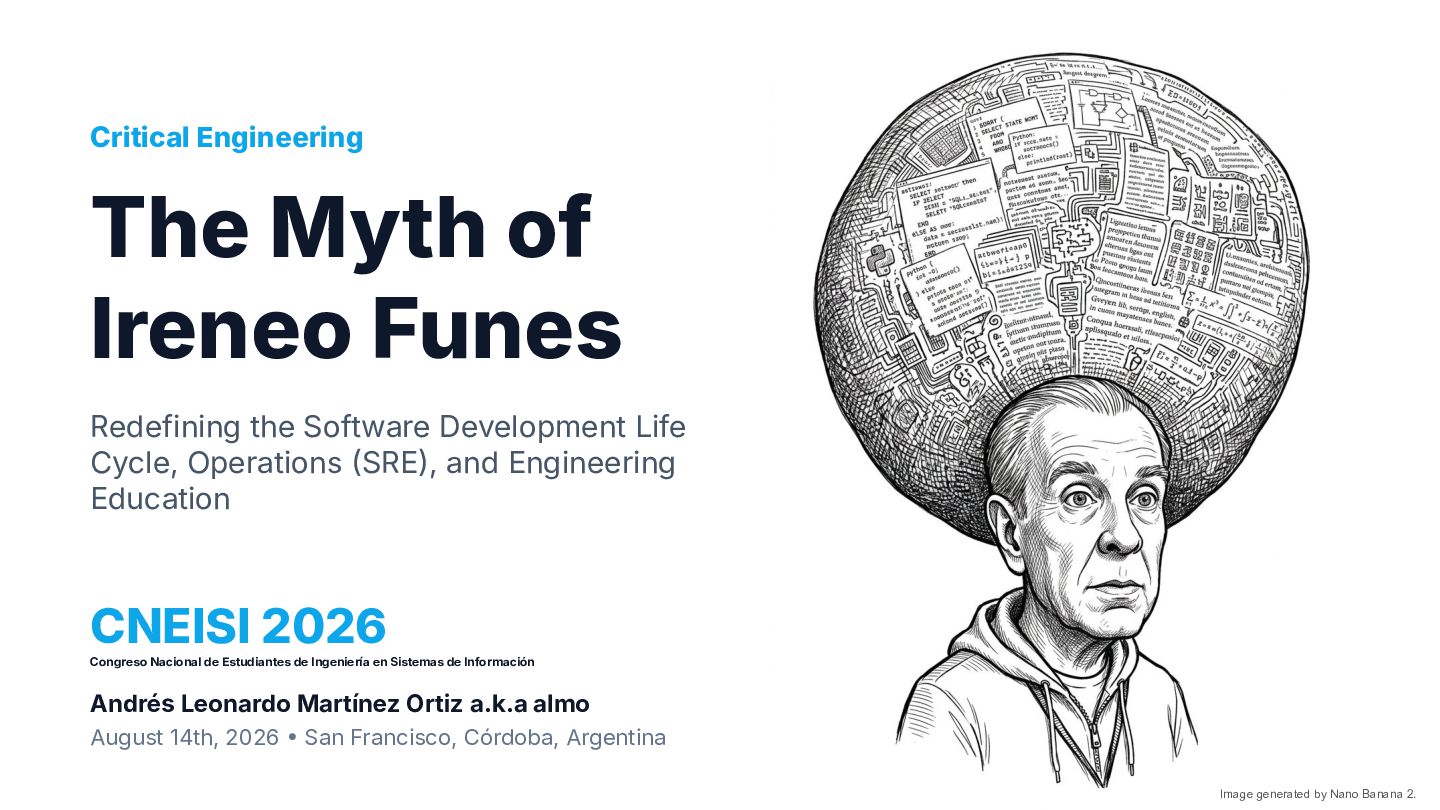
  1. Critical Engineering The Myth of Ireneo Funes Redefining the Software

    Development Life Cycle, Operations SRE, and Engineering Education CNEISI 2026 Congreso Nacional de Estudiantes de Ingeniería en Sistemas de Información Andrés Leonardo Martínez Ortiz a.k.a almo August 14th, 2026  San Francisco, Córdoba, Argentina Image generated by Nano Banana 2.
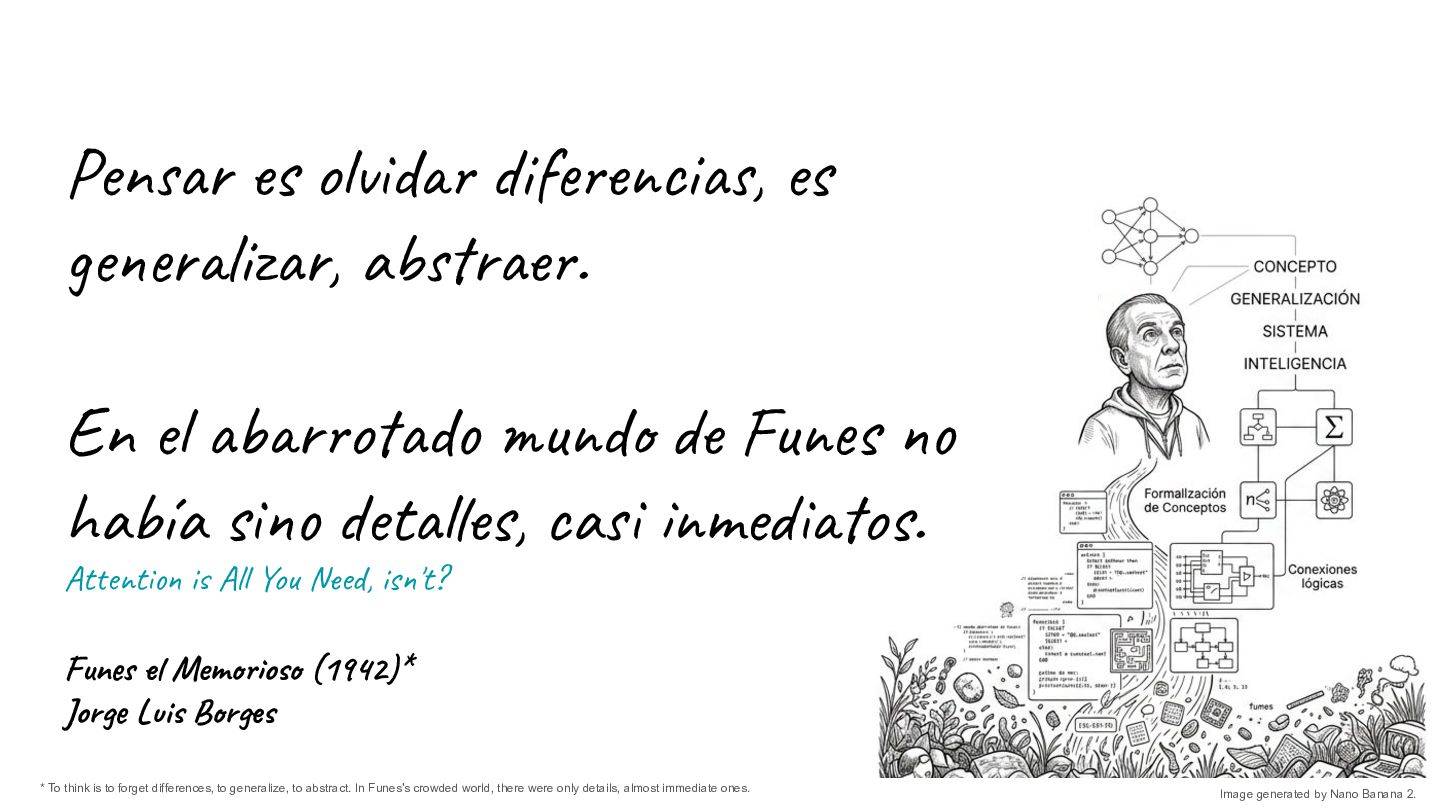
  2. Pensar es olvidar diferencias, es generalizar, abstraer. En el abarrotado

    mundo de Funes no había sino detalles, casi inmediatos. Attention is All You Need, isn't? Funes el Memorioso (1942)* Jorge Luis Borges * To think is to forget differences, to generalize, to abstract. In Funes's crowded world, there were only details, almost immediate ones. Image generated by Nano Banana 2.
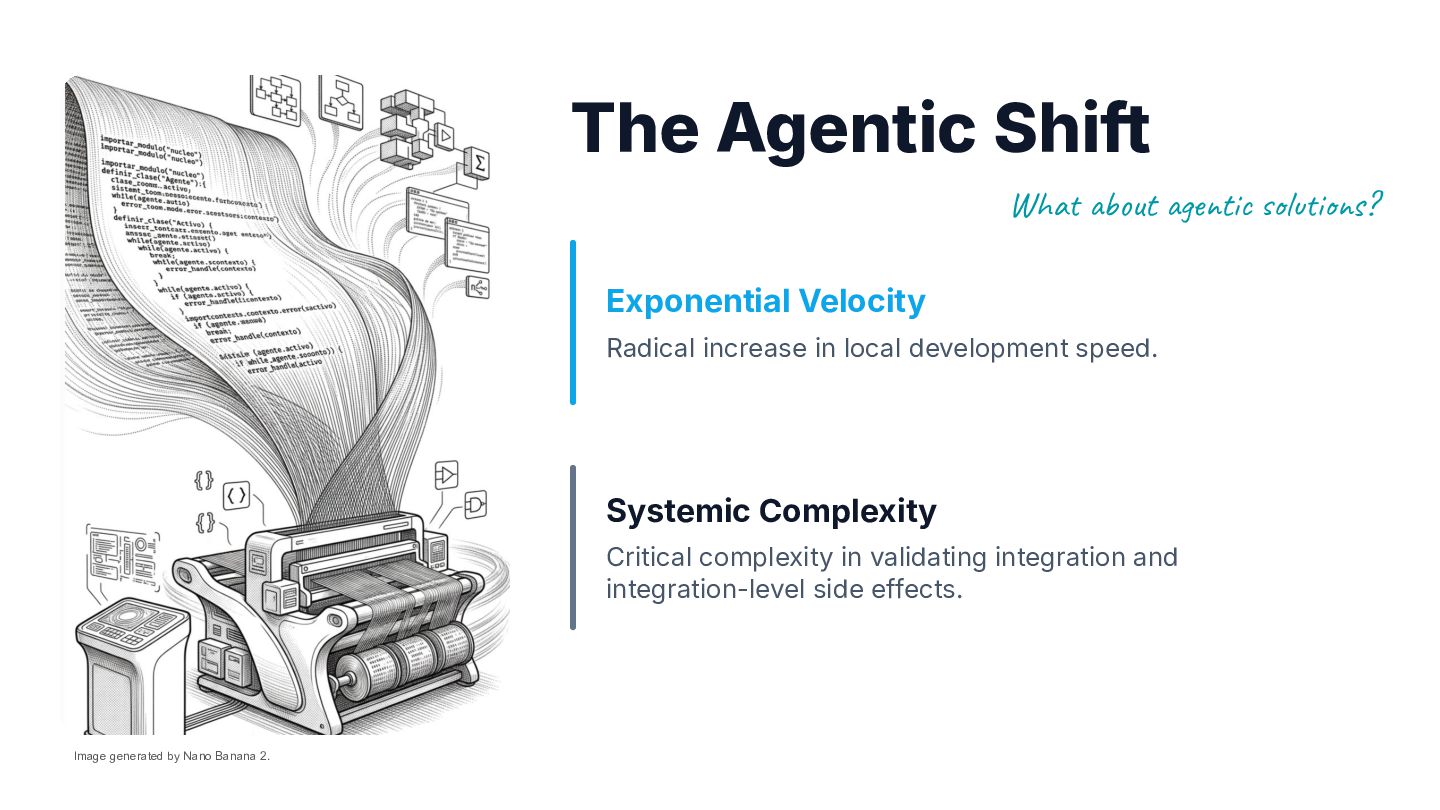
  3. The Agentic Shift What about agentic solutions? Exponential Velocity Radical

    increase in local development speed. Systemic Complexity Critical complexity in validating integration and integration-level side effects. Image generated by Nano Banana 2.
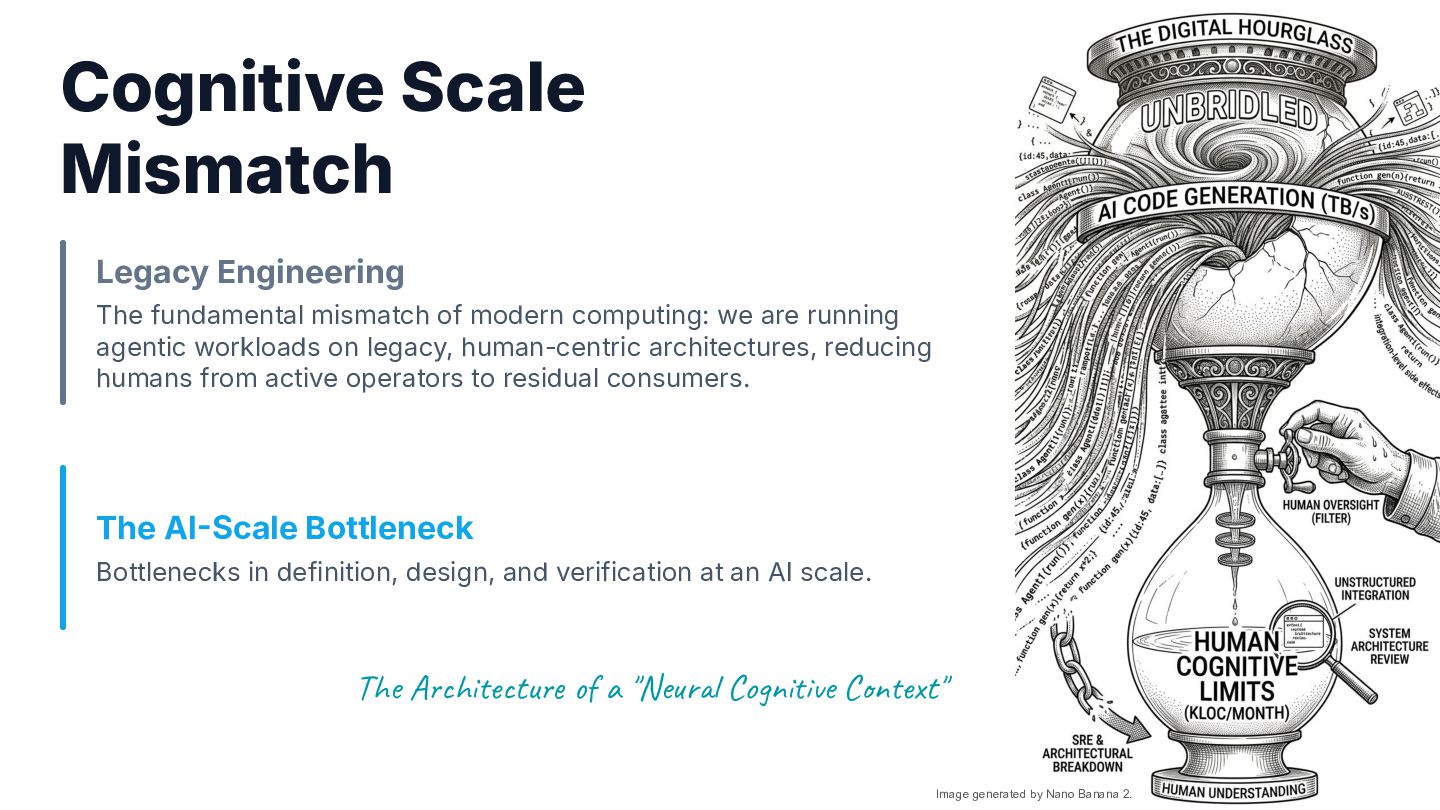
  4. Cognitive Scale Mismatch Legacy Engineering The fundamental mismatch of modern

    computing: we are running agentic workloads on legacy, human-centric architectures, reducing humans from active operators to residual consumers. The AIScale Bottleneck Bottlenecks in definition, design, and verification at an AI scale. The Architecture of a "Neural Cognitive Context" Image generated by Nano Banana 2.
  5. The Mythical Man-Month 2.0 The Accumulation Fallacy Increased code volume

    ("workforce") without expanding systemic comprehension or control. Obsolete Integration Integrating intelligent agents onto legacy, obsolete workflows. Image generated by Nano Banana 2. When writing code becomes free, the cost of verifying it becomes infinite.
  6. Broken Production Pipelines The Speed Mismatch Critical mismatch between speed

    of integration and releasing and capacity for control. Required SRE Evolution Urgent need for disruptive SRE and software engineering innovation to handle AI-scale throughput. Production lifecycles: a continuous, agentic flow of release qualification. Image generated by Nano Banana 2.
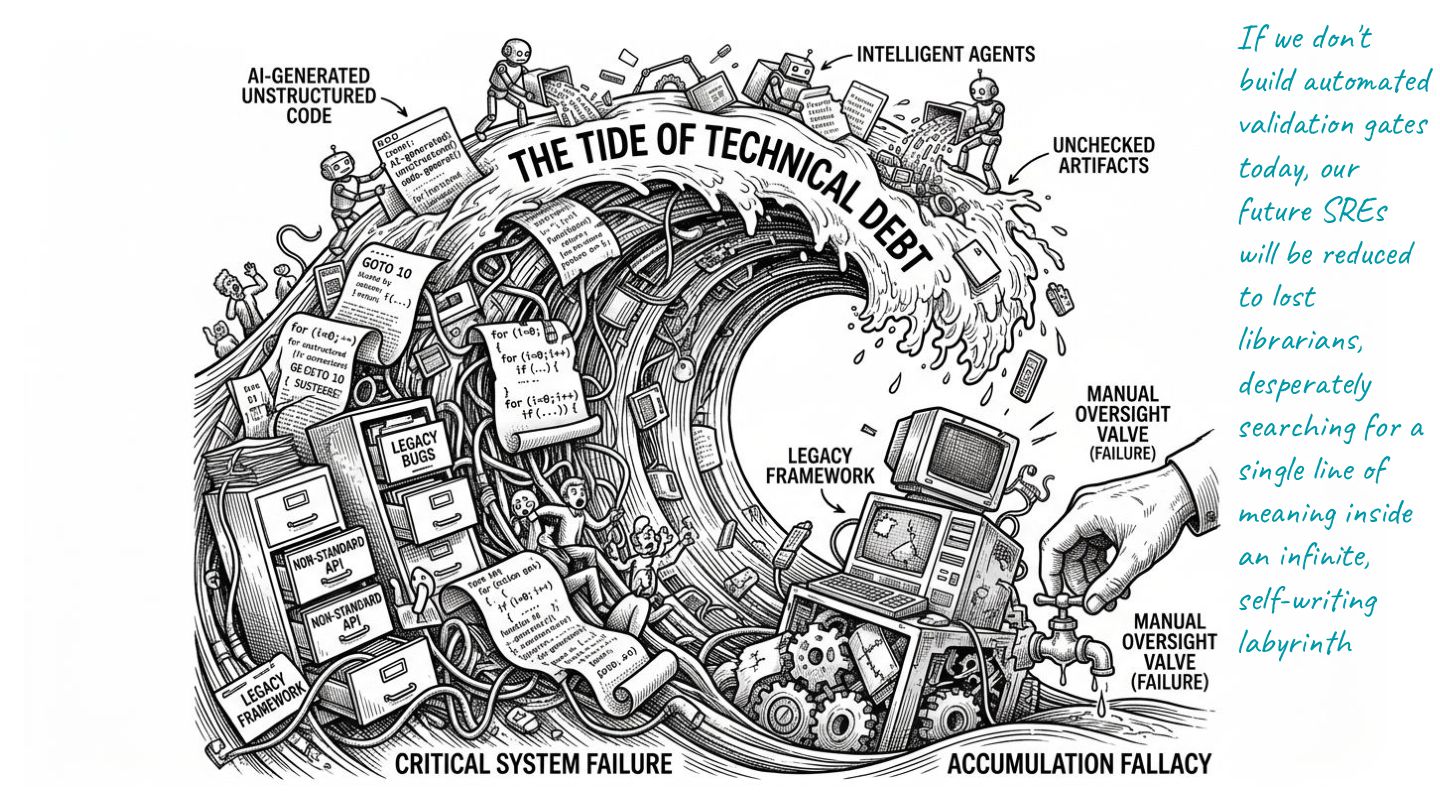
  7. If we don't build automated validation gates today, our future

    SREs will be reduced to lost librarians, desperately searching for a single line of meaning inside an infinite, self-writing labyrinth
  8. Academic Bankruptcy The Curriculum Default Modern engineering curriculum has defaulted

    on the cognitive demands of an AI-driven industry. The Law of Conservation of Attractive Profits Legacy Syntax vs. AIScale Continued focus on legacy syntax (bricks) while ignoring AI-scale systems (skyscrapers) creates a workforce with non-transferable skills. Image generated by Nano Banana 2.
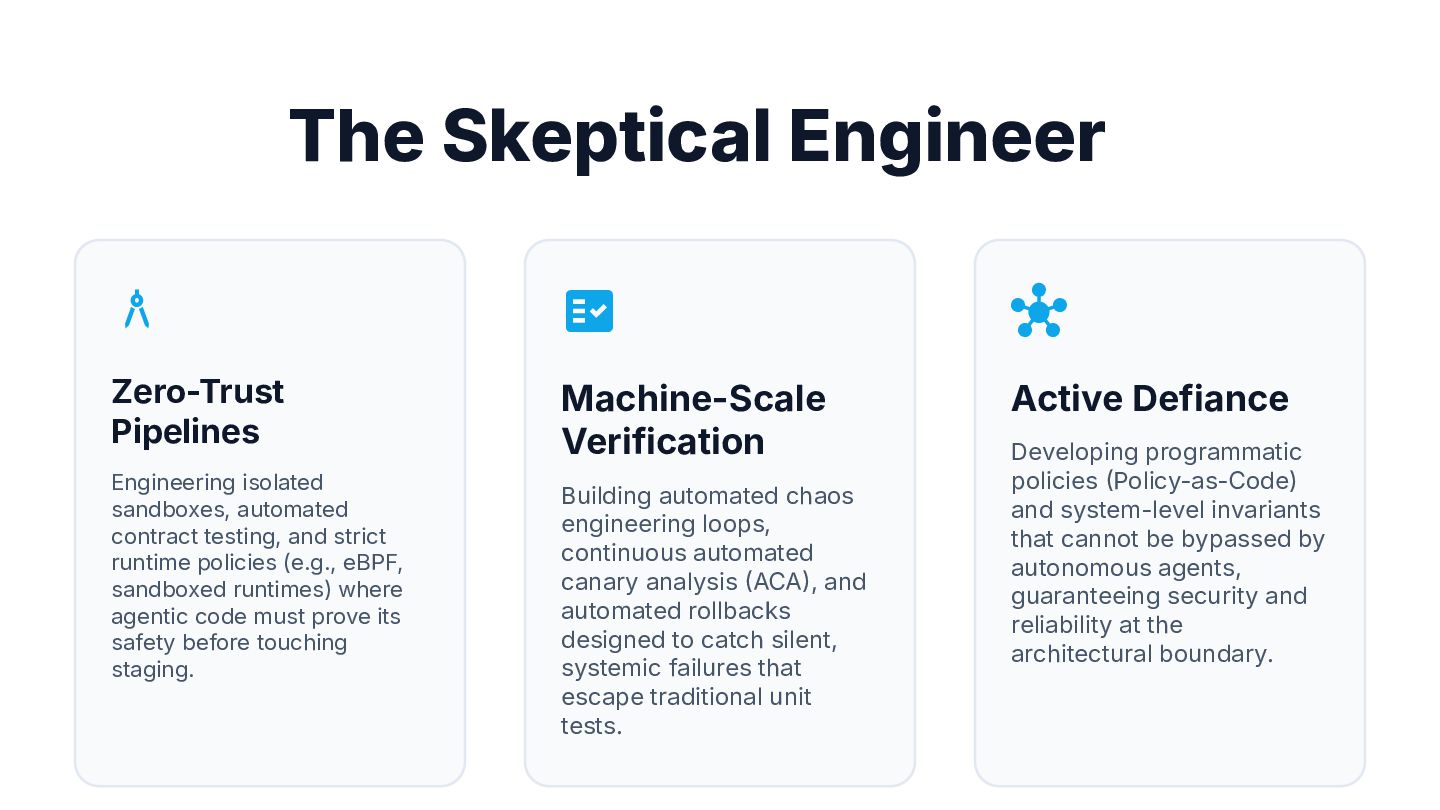
  9. The Skeptical Engineer    Zero-Trust Pipelines Machine-Scale Verification

    Active Defiance Engineering isolated sandboxes, automated contract testing, and strict runtime policies (e.g., eBPF, sandboxed runtimes) where agentic code must prove its safety before touching staging. Building automated chaos engineering loops, continuous automated canary analysis ACA, and automated rollbacks designed to catch silent, systemic failures that escape traditional unit tests. Developing programmatic policies Policy-as-Code) and system-level invariants that cannot be bypassed by autonomous agents, guaranteeing security and reliability at the architectural boundary.
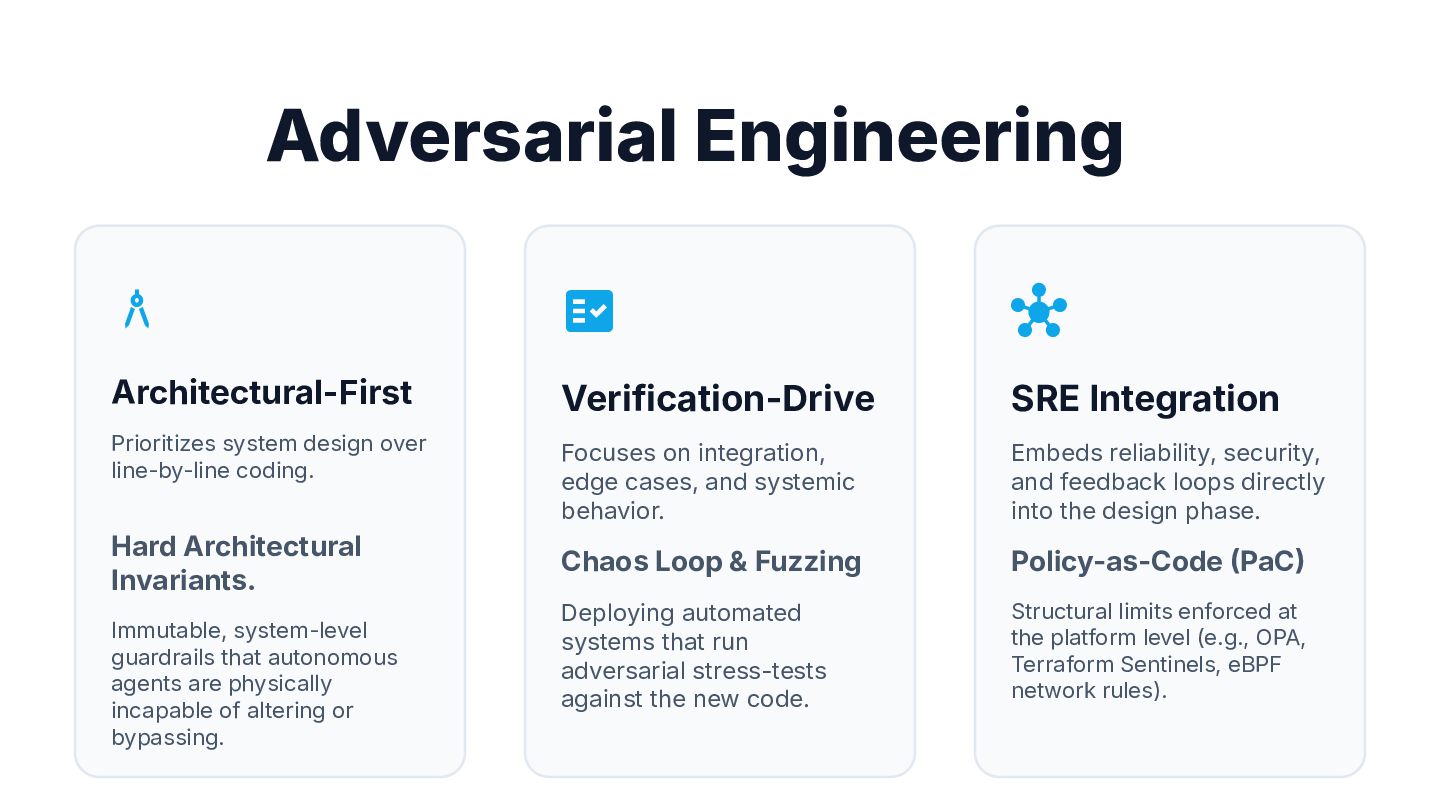
  10. Adversarial Engineering    Architectural-First Verification-Drive SRE Integration Prioritizes

    system design over line-by-line coding. Focuses on integration, edge cases, and systemic behavior. Embeds reliability, security, and feedback loops directly into the design phase. Chaos Loop & Fuzzing Policy-as-Code PaC Deploying automated systems that run adversarial stress-tests against the new code. Structural limits enforced at the platform level (e.g., OPA, Terraform Sentinels, eBPF network rules). Hard Architectural Invariants. Immutable, system-level guardrails that autonomous agents are physically incapable of altering or bypassing.
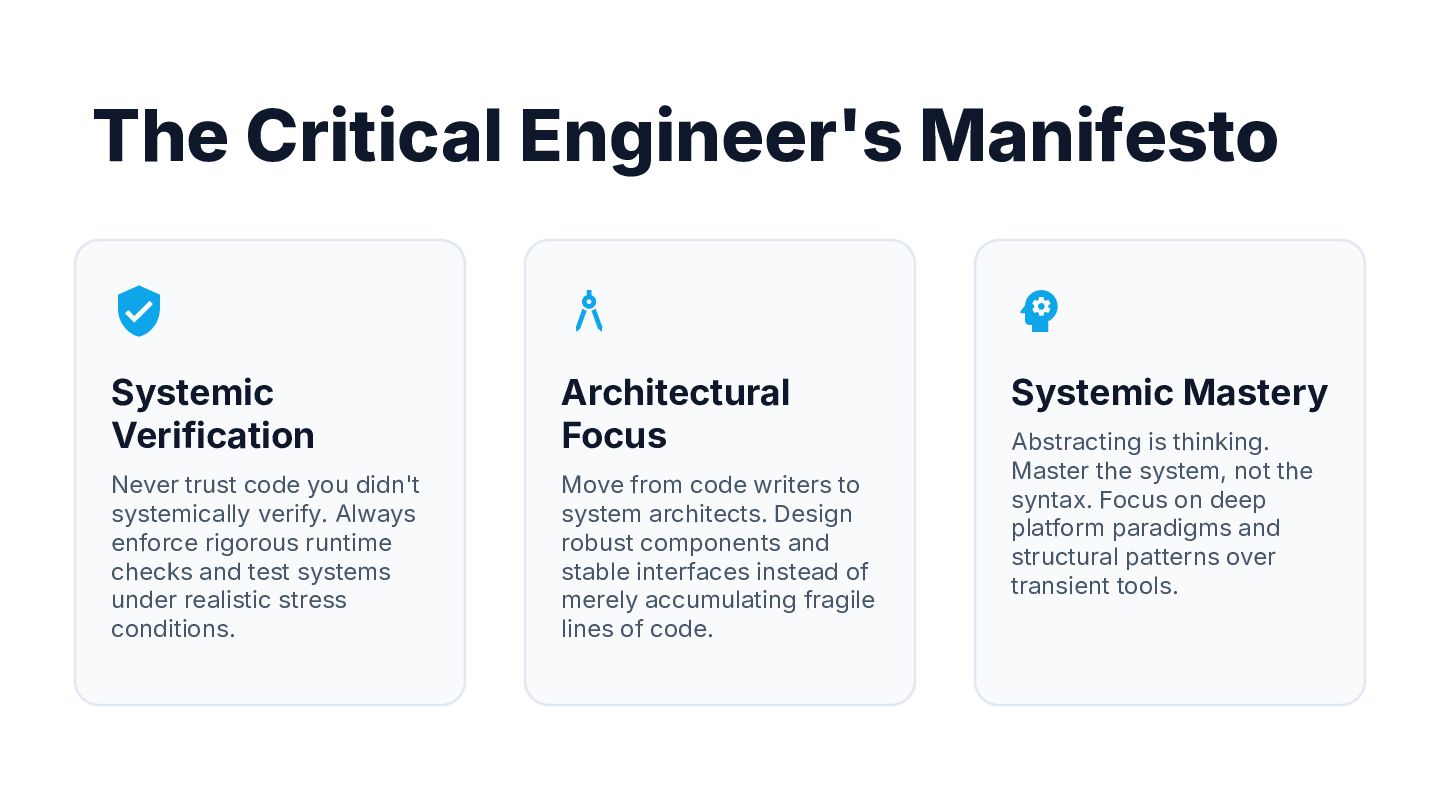
  11. The Critical Engineer's Manifesto    Systemic Verification Architectural

    Focus Systemic Mastery Never trust code you didn't systemically verify. Always enforce rigorous runtime checks and test systems under realistic stress conditions. Move from code writers to system architects. Design robust components and stable interfaces instead of merely accumulating fragile lines of code. Abstracting is thinking. Master the system, not the syntax. Focus on deep platform paradigms and structural patterns over transient tools.
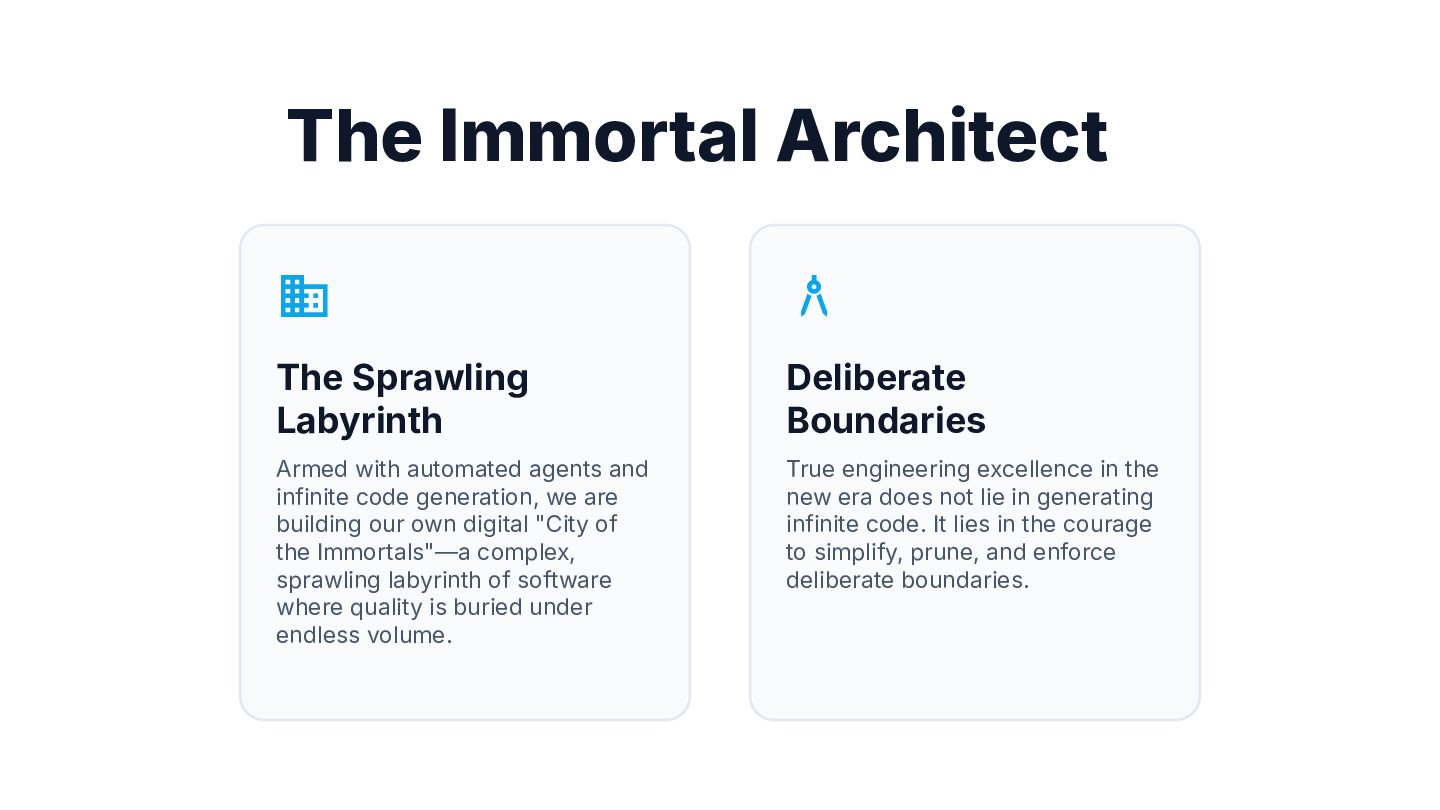
  12. The Immortal Architect   The Sprawling Labyrinth Deliberate Boundaries

    Armed with automated agents and infinite code generation, we are building our own digital "City of the Immortals"—a complex, sprawling labyrinth of software where quality is buried under endless volume. True engineering excellence in the new era does not lie in generating infinite code. It lies in the courage to simplify, prune, and enforce deliberate boundaries.