Upgrade to Pro — share decks privately, control downloads, hide ads and more …

Does an AI Watermark Survive Translation?

Avatar for Es C Es C
August 28, 2026

Does an AI Watermark Survive Translation?

Anthropic's AI watermark is confirmed for single-model translation, but what happens when multiple AI models vote on the same sentence is still an open question. Anthropic's AI watermark is confirmed for single-model translation, but what happens when tools like MachineTranslation.com run multiple AI models on the same sentence is still an open question.

Avatar for Es C

Es C

August 28, 2026

Other Decks in Technology

Transcript

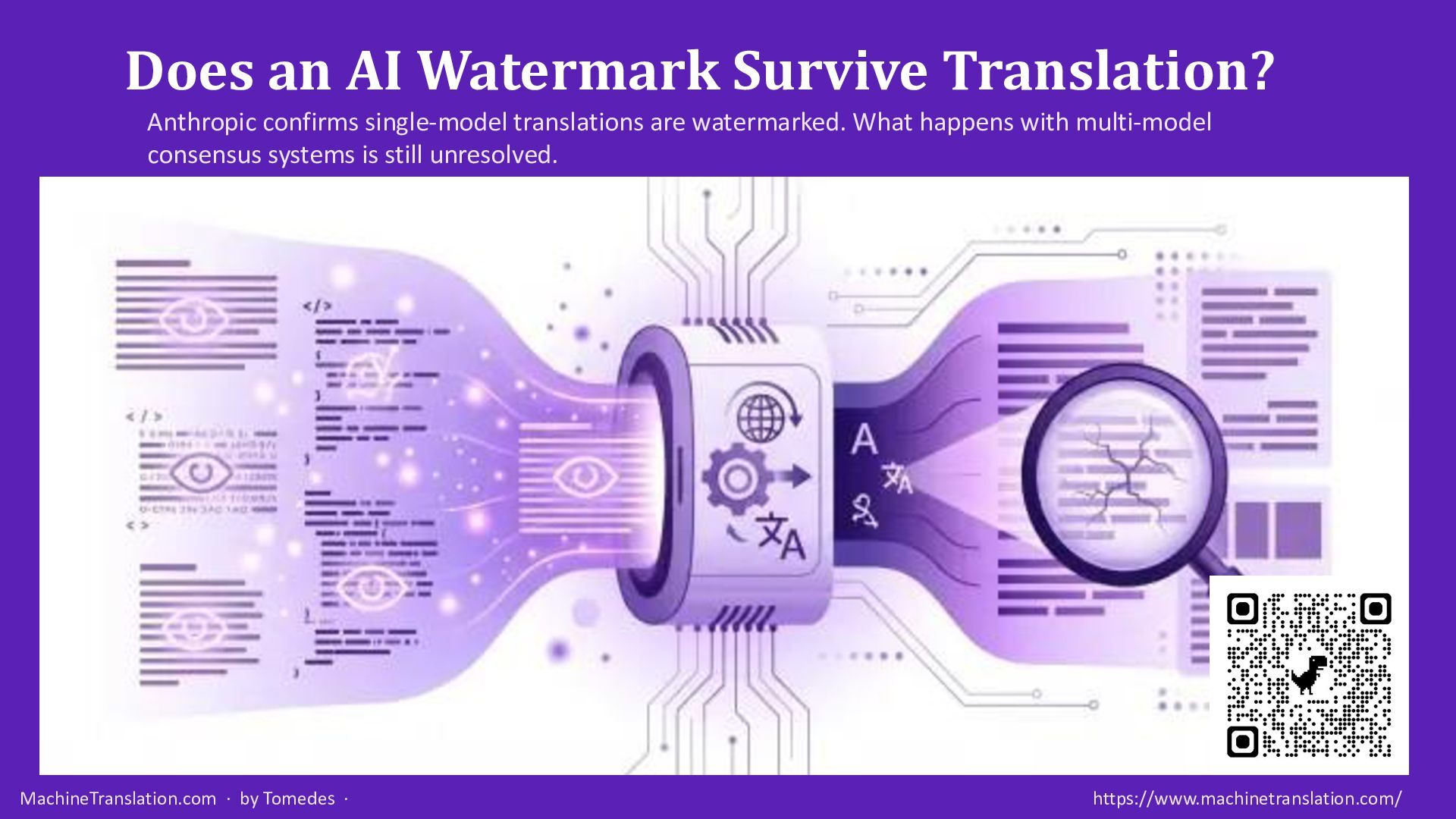
  1. Does an AI Watermark Survive Translation? Anthropic confirms single-model translations

    are watermarked. What happens with multi-model consensus systems is still unresolved. MachineTranslation.com · by Tomedes · https://www.machinetranslation.com/
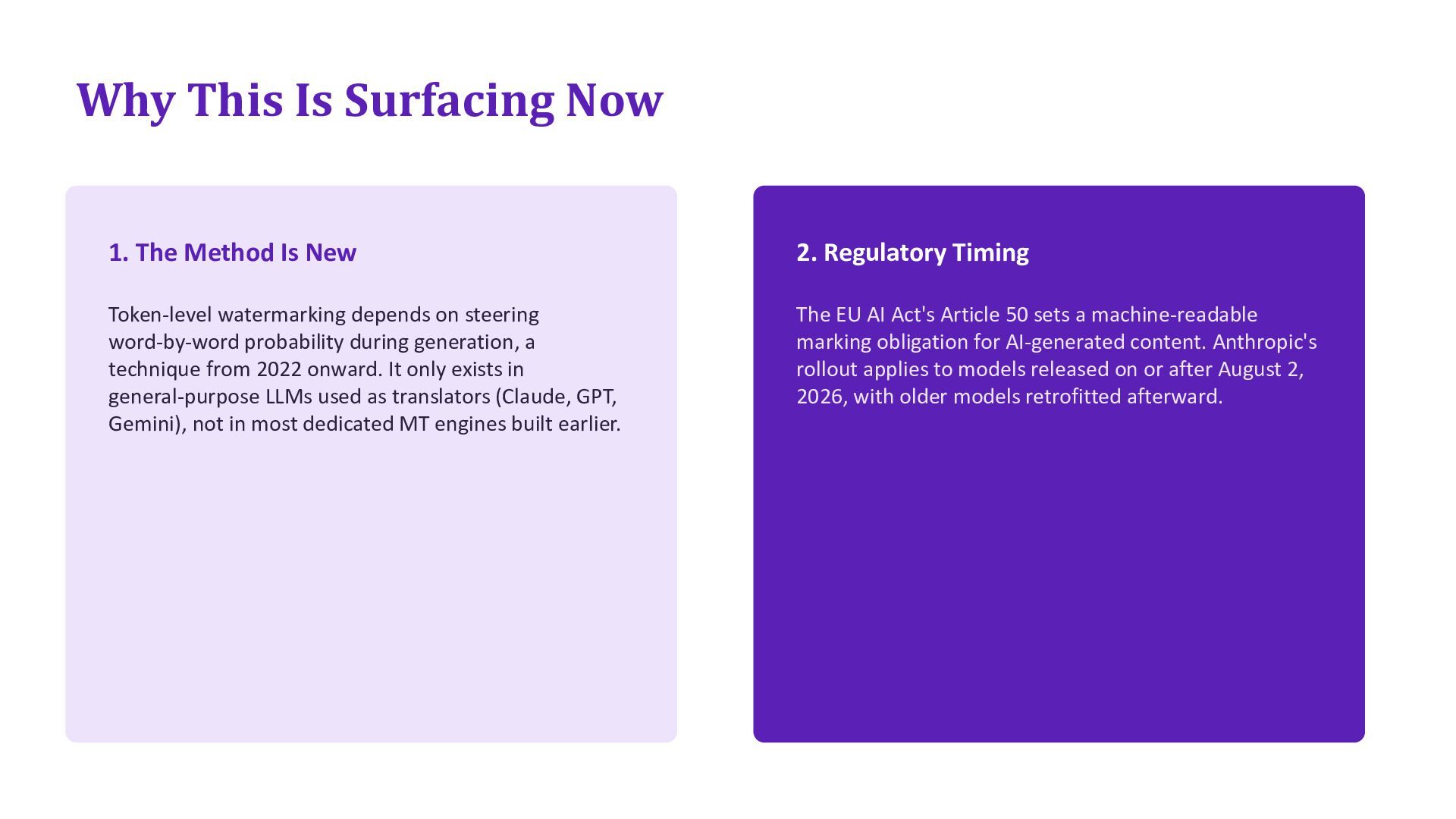
  2. Why This Is Surfacing Now 1. The Method Is New

    2. Regulatory Timing Token-level watermarking depends on steering word-by-word probability during generation, a technique from 2022 onward. It only exists in general-purpose LLMs used as translators (Claude, GPT, Gemini), not in most dedicated MT engines built earlier. The EU AI Act's Article 50 sets a machine-readable marking obligation for AI-generated content. Anthropic's rollout applies to models released on or after August 2, 2026, with older models retrofitted afterward.
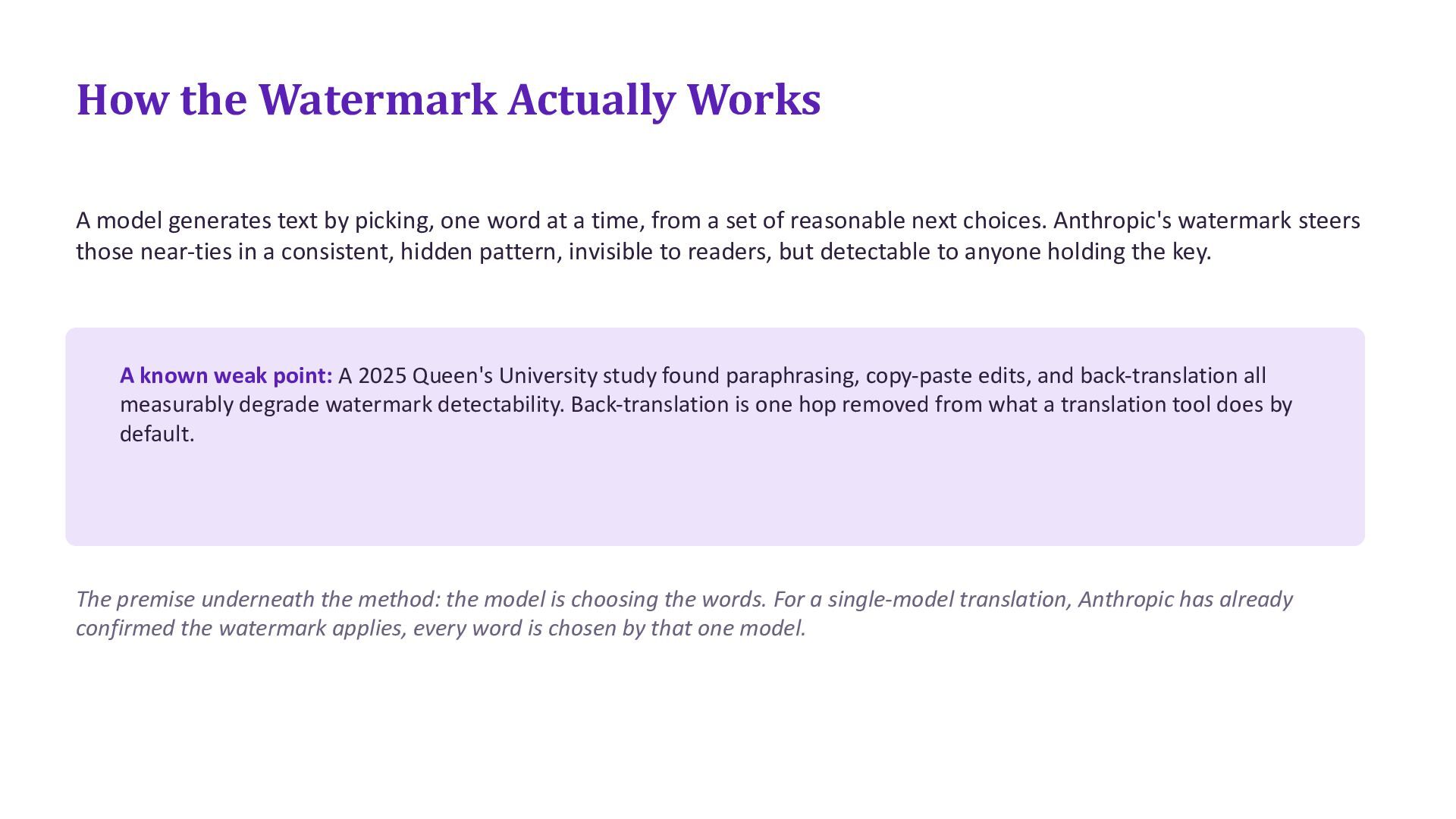
  3. How the Watermark Actually Works A model generates text by

    picking, one word at a time, from a set of reasonable next choices. Anthropic's watermark steers those near-ties in a consistent, hidden pattern, invisible to readers, but detectable to anyone holding the key. A known weak point: A 2025 Queen's University study found paraphrasing, copy-paste edits, and back-translation all measurably degrade watermark detectability. Back-translation is one hop removed from what a translation tool does by default. The premise underneath the method: the model is choosing the words. For a single-model translation, Anthropic has already confirmed the watermark applies, every word is chosen by that one model.
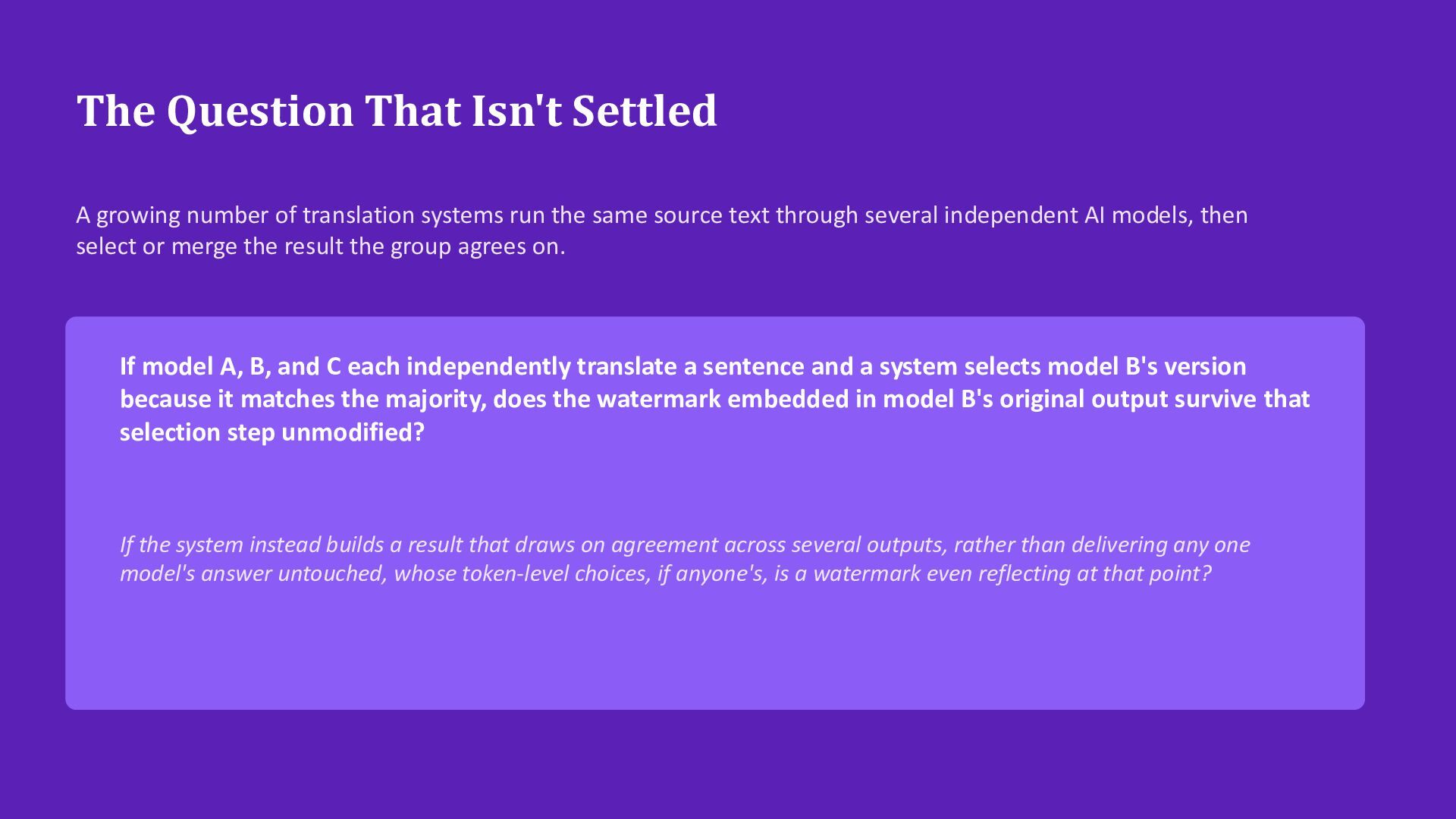
  4. The Question That Isn't Settled A growing number of translation

    systems run the same source text through several independent AI models, then select or merge the result the group agrees on. If model A, B, and C each independently translate a sentence and a system selects model B's version because it matches the majority, does the watermark embedded in model B's original output survive that selection step unmodified? If the system instead builds a result that draws on agreement across several outputs, rather than delivering any one model's answer untouched, whose token-level choices, if anyone's, is a watermark even reflecting at that point?
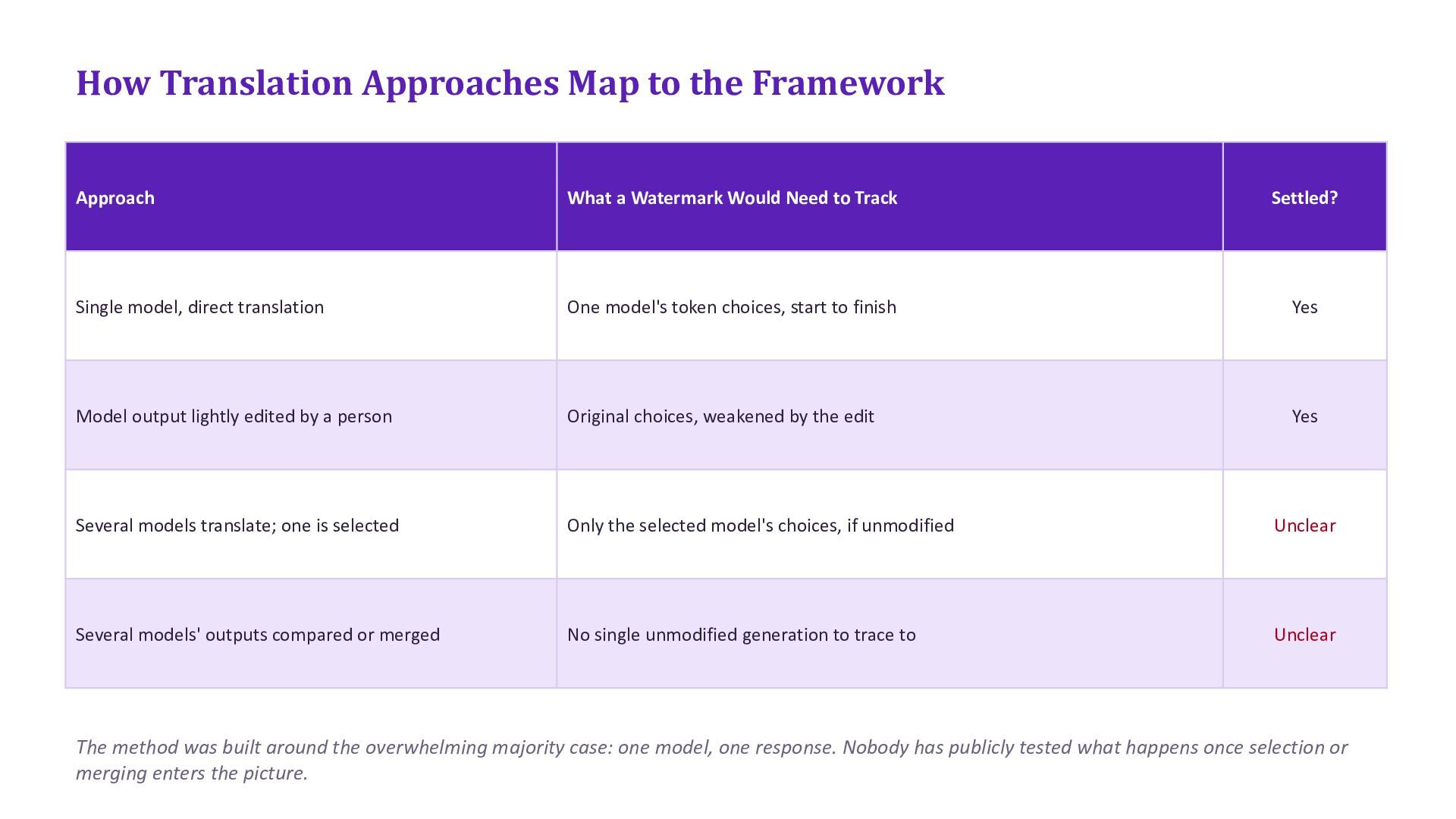
  5. How Translation Approaches Map to the Framework Approach What a

    Watermark Would Need to Track Settled? Single model, direct translation One model's token choices, start to finish Yes Model output lightly edited by a person Original choices, weakened by the edit Yes Several models translate; one is selected Only the selected model's choices, if unmodified Unclear Several models' outputs compared or merged No single unmodified generation to trace to Unclear The method was built around the overwhelming majority case: one model, one response. Nobody has publicly tested what happens once selection or merging enters the picture.
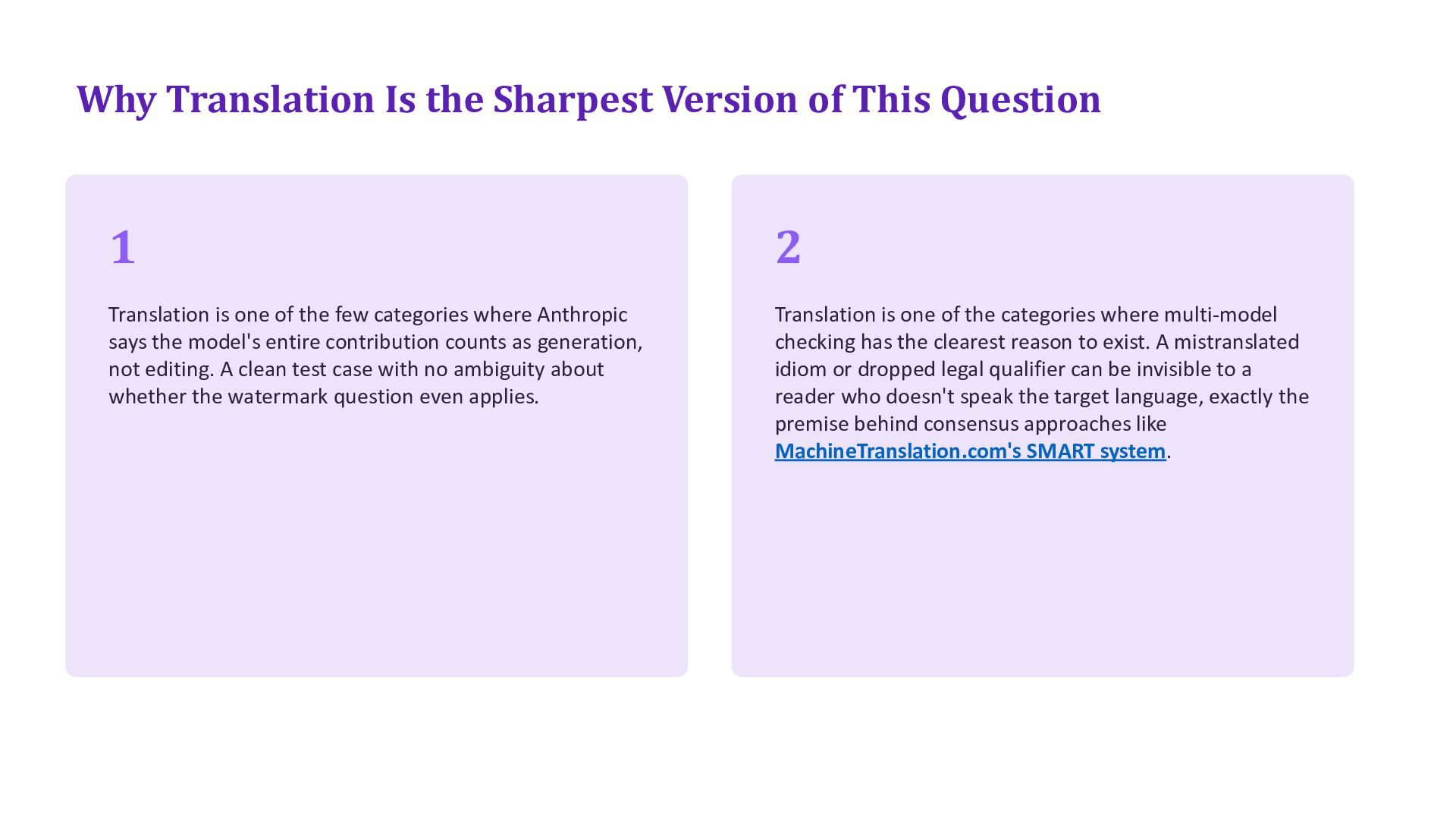
  6. Why Translation Is the Sharpest Version of This Question 1

    2 Translation is one of the few categories where Anthropic says the model's entire contribution counts as generation, not editing. A clean test case with no ambiguity about whether the watermark question even applies. Translation is one of the categories where multi-model checking has the clearest reason to exist. A mistranslated idiom or dropped legal qualifier can be invisible to a reader who doesn't speak the target language, exactly the premise behind consensus approaches like MachineTranslation.com's SMART system.
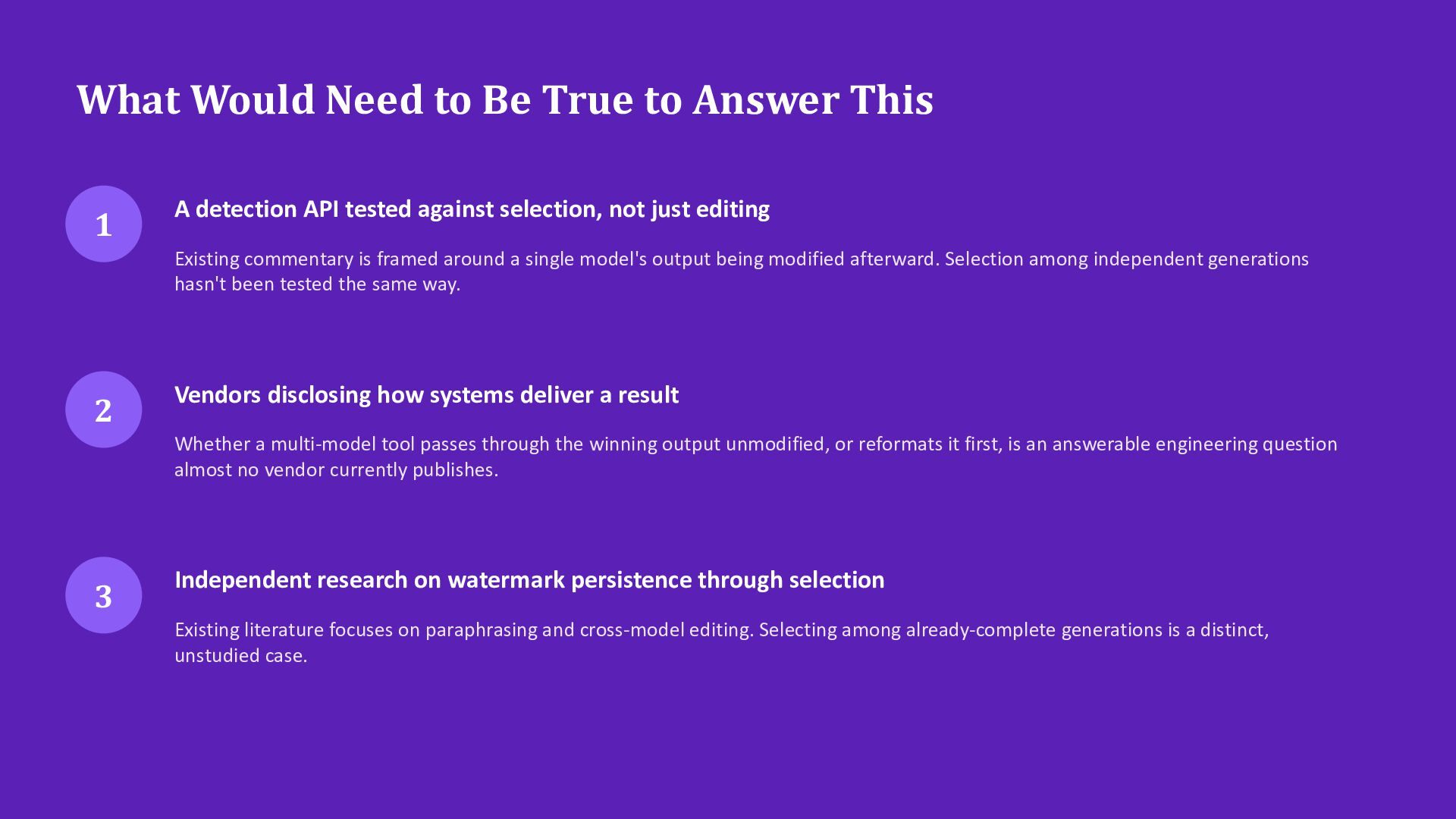
  7. What Would Need to Be True to Answer This 1

    A detection API tested against selection, not just editing Existing commentary is framed around a single model's output being modified afterward. Selection among independent generations hasn't been tested the same way. 2 Vendors disclosing how systems deliver a result Whether a multi-model tool passes through the winning output unmodified, or reformats it first, is an answerable engineering question almost no vendor currently publishes. 3 Independent research on watermark persistence through selection Existing literature focuses on paraphrasing and cross-model editing. Selecting among already-complete generations is a distinct, unstudied case.
  8. The Straightforward Test, Once It Exists Run a single-model translation

    and a consensus translation of the same sentence through a detection tool side by side: both marked, one marked, or neither. Nobody has run that test yet. Until someone does, a confident answer about how watermarking behaves inside a consensus translation system is ahead of the evidence, not behind it. Read the full article on MachineTranslation.com MachineTranslation.com · by Tomedes