Share
Embed
Dart for Java Developers
Dart is a new language for the Web created by Google. Its syntax will look very familiar for Java developers. It allows both object-oriented and functional programming and can be used both on the client-side as well as on the server-side in the Dart VM. It comes with a top notch Dart-to-JavaScript compiler, which makes it production ready today. Dart was developed by the same people who were working on HotSpot JVM and V8 – the fastest JavaScript engine.
In this session you’ll learn the syntax of Dart language, and we’ll compare it side-by-side with Java 8. We’ll also go over the Dart ecosystem, and you’ll see an example of Dart to Java communication.
Anton Moiseev
May 23, 2014
Transcript
57 slides
-
About Me • C# since 2005 till 2012 • Java
since 2012 • JavaScript, Dart since 2013 • Working at Farata Systems • Conduct trainings 2 -
What is Dart? 3 New programming language and platform created
by for Web development 3 -
Dart is Truly OSS • Public commits • Public issue
tracker • Public code reviews • Accept contributions 5 -
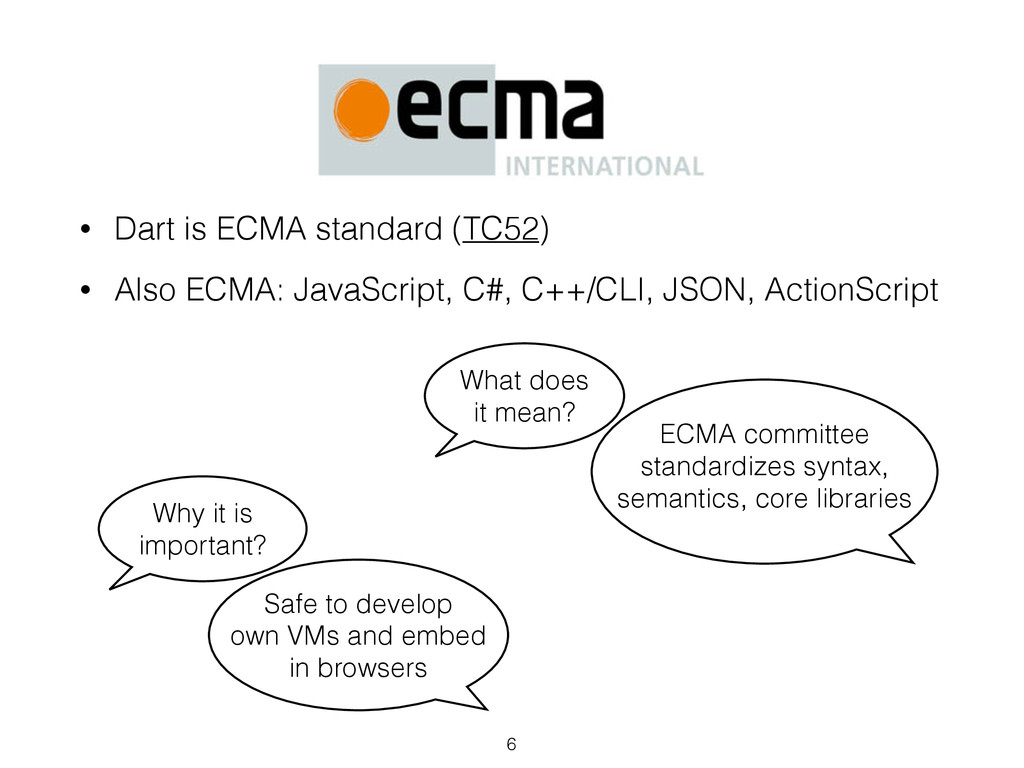
• Dart is ECMA standard (TC52) • Also ECMA: JavaScript,
C#, C++/CLI, JSON, ActionScript 6 What does it mean? ECMA committee standardizes syntax, semantics, core libraries Why it is important? Safe to develop own VMs and embed in browsers -
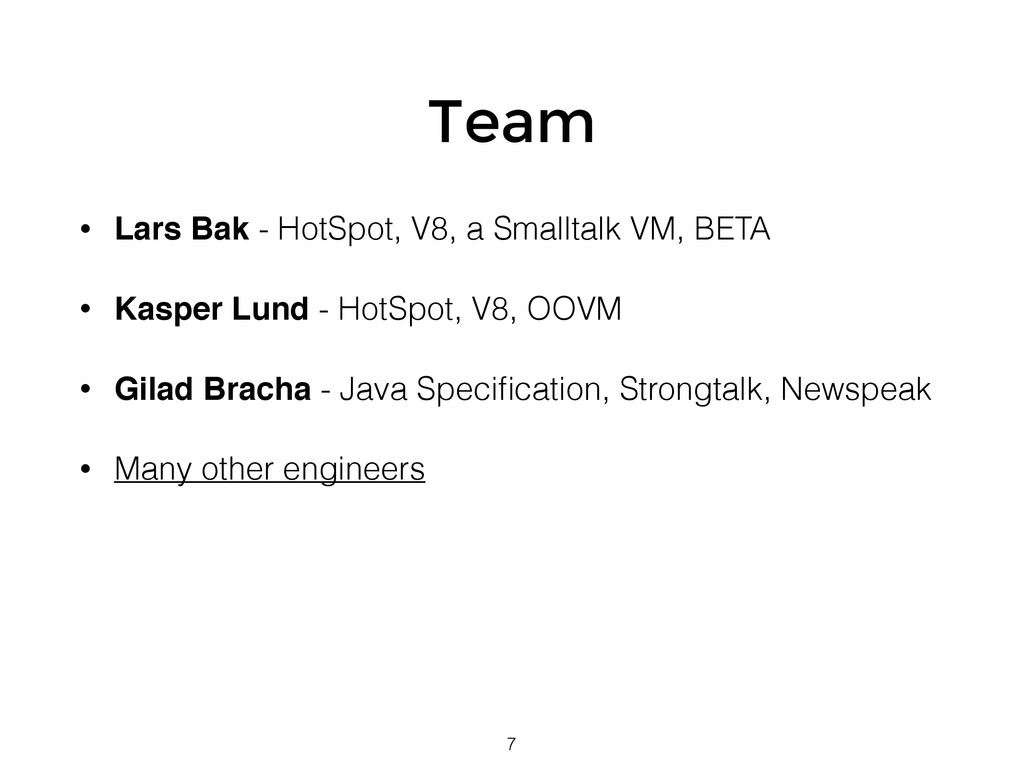
Team • Lars Bak - HotSpot, V8, a Smalltalk VM,
BETA • Kasper Lund - HotSpot, V8, OOVM • Gilad Bracha - Java Specification, Strongtalk, Newspeak • Many other engineers 7 -
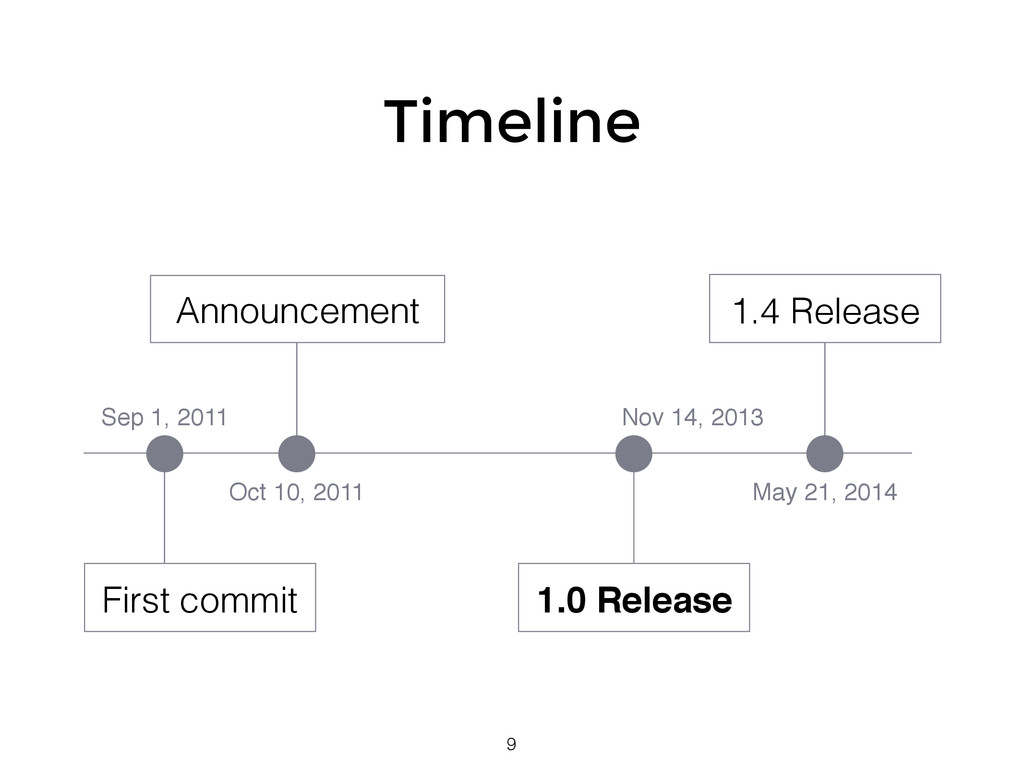
Timeline 9 Sep 1, 2011 Oct 10, 2011 May 21,
2014 1.0 Release First commit Announcement Nov 14, 2013 1.4 Release -
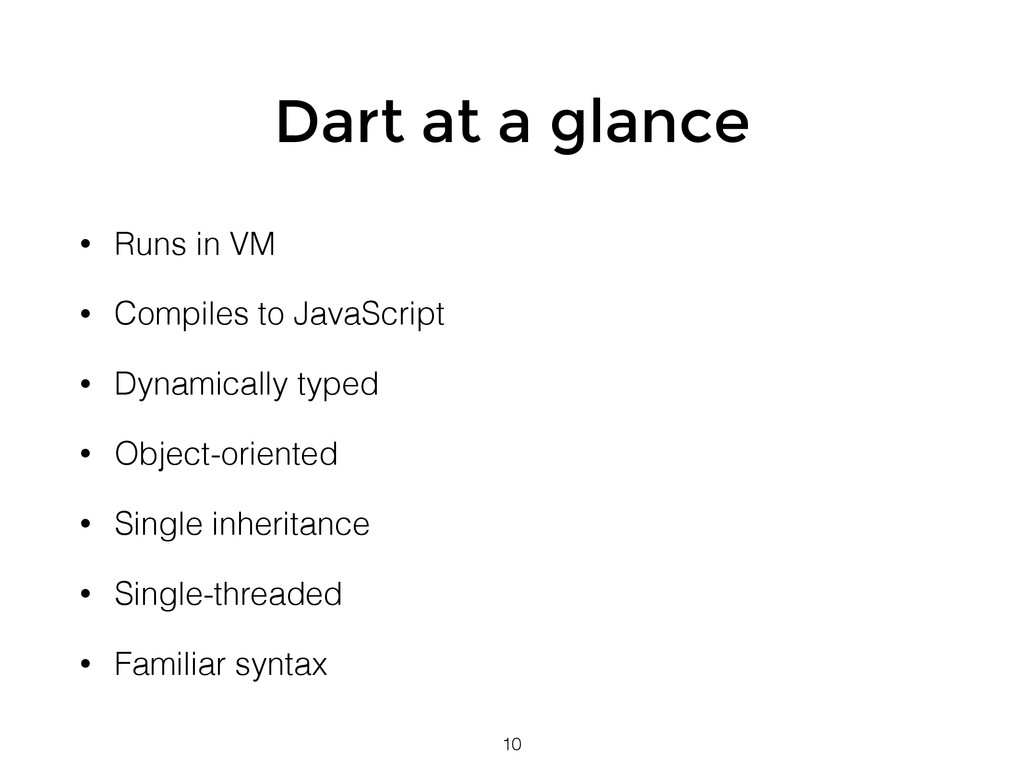
Dart at a glance • Runs in VM • Compiles
to JavaScript • Dynamically typed • Object-oriented • Single inheritance • Single-threaded • Familiar syntax 10 -
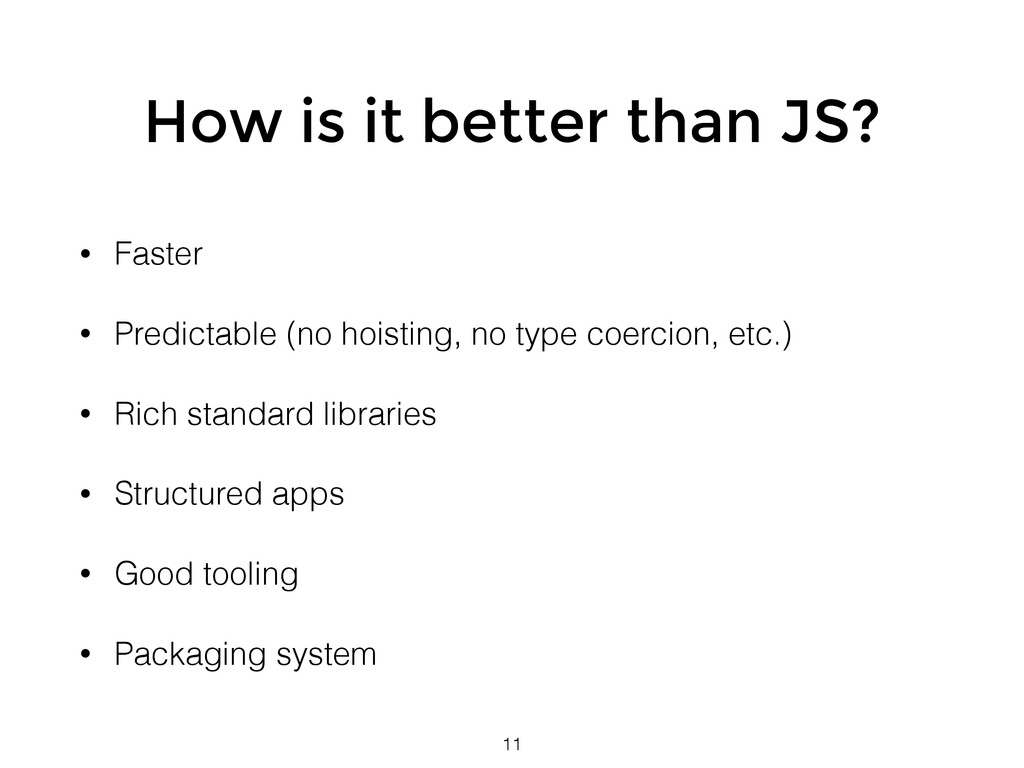
How is it better than JS? • Faster • Predictable
(no hoisting, no type coercion, etc.) • Rich standard libraries • Structured apps • Good tooling • Packaging system 11 -
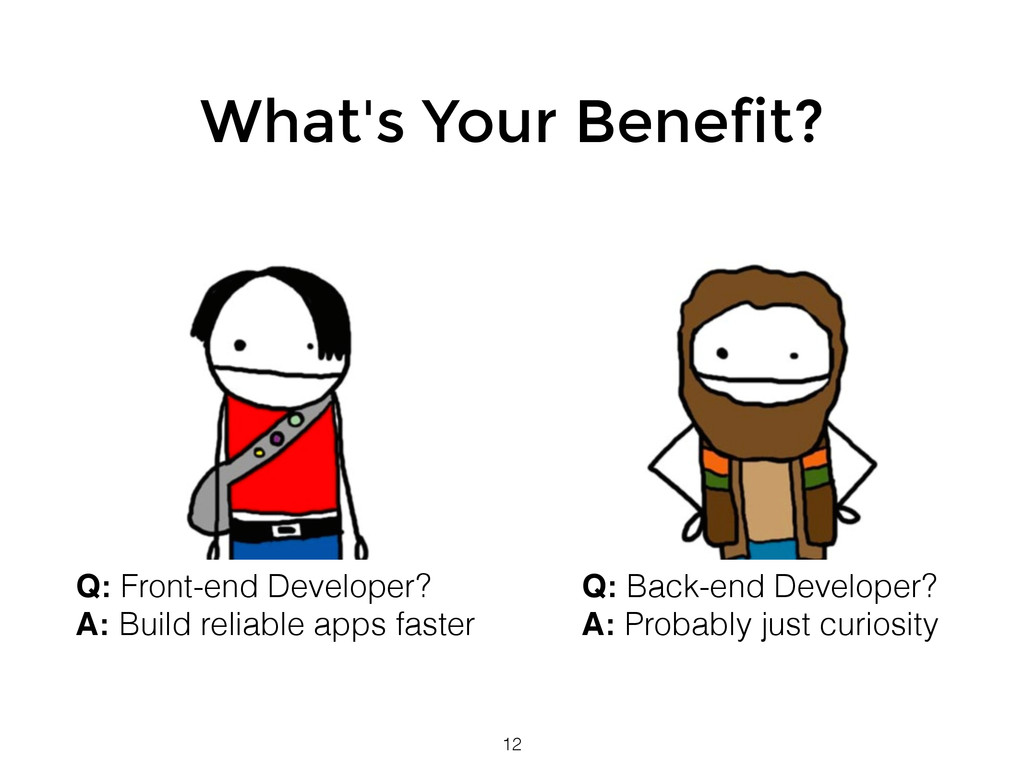
What's Your Benefit? 12 Q: Front-end Developer? A: Build reliable
apps faster Q: Back-end Developer? A: Probably just curiosity -
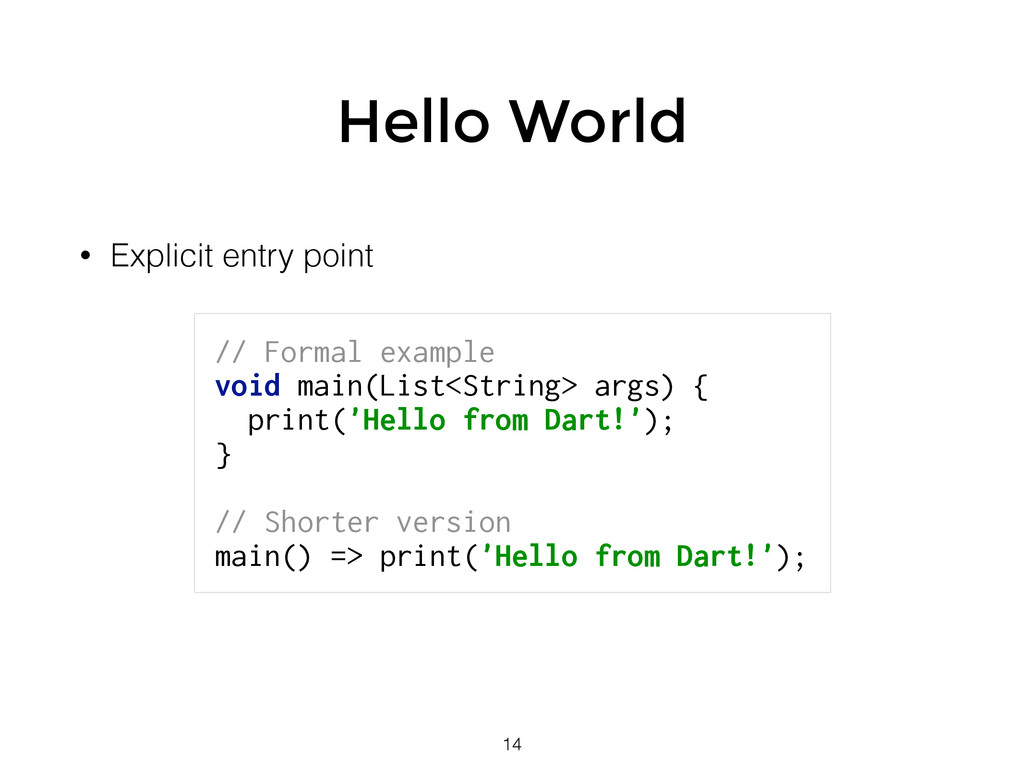
Hello World 14 // Formal example void main(List<String> args) {
print('Hello from Dart!'); } // Shorter version main() => print('Hello from Dart!'); • Explicit entry point -
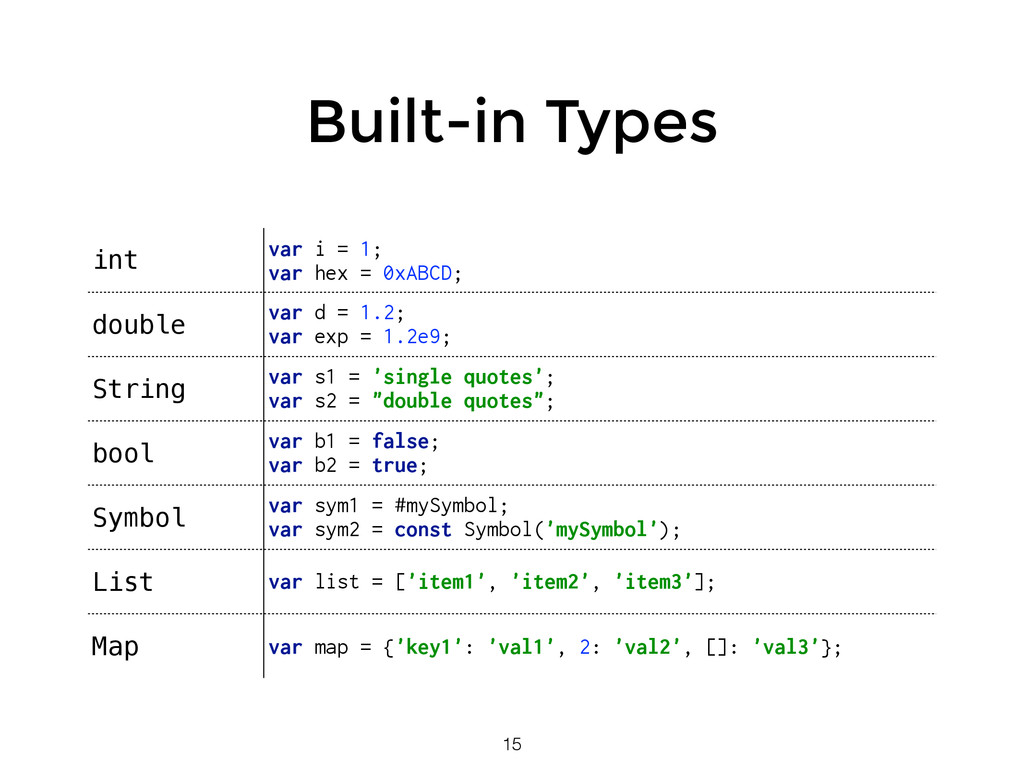
Built-in Types 15 int var i = 1; var hex
= 0xABCD; double var d = 1.2; var exp = 1.2e9; String var s1 = 'single quotes'; var s2 = "double quotes"; bool var b1 = false; var b2 = true; Symbol var sym1 = #mySymbol; var sym2 = const Symbol('mySymbol'); List var list = ['item1', 'item2', 'item3']; Map var map = {'key1': 'val1', 2: 'val2', []: 'val3'}; -
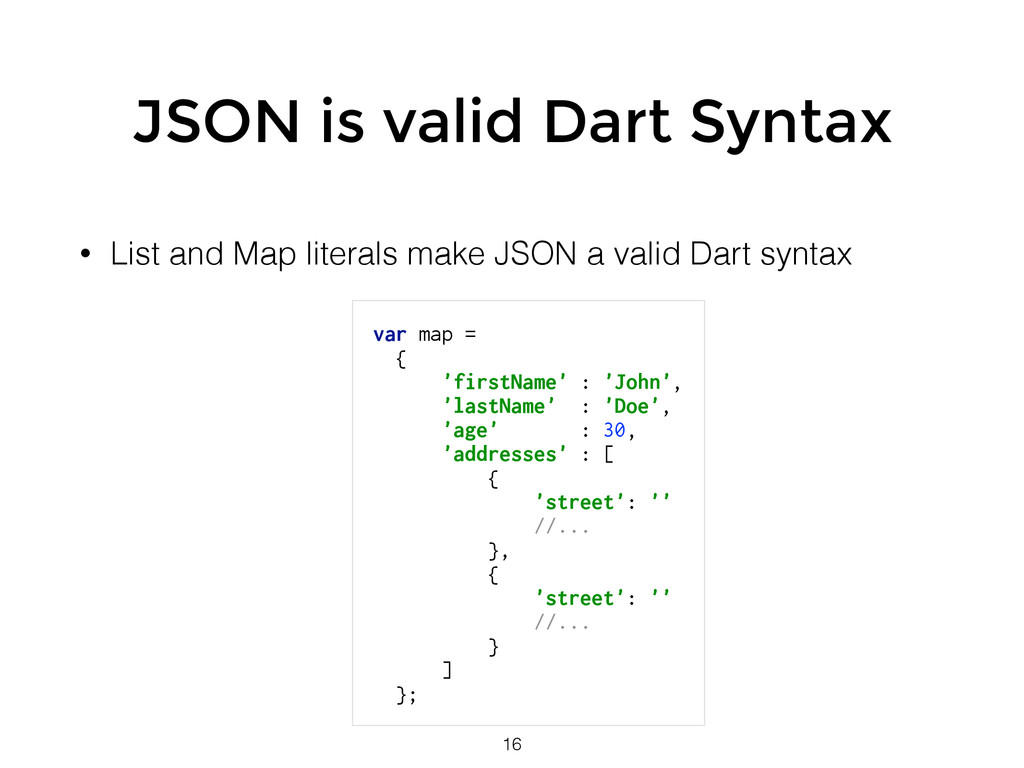
JSON is valid Dart Syntax 16 var map = {
'firstName' : 'John', 'lastName' : 'Doe', 'age' : 30, 'addresses' : [ { 'street': '' //... }, { 'street': '' //... } ] }; • List and Map literals make JSON a valid Dart syntax -
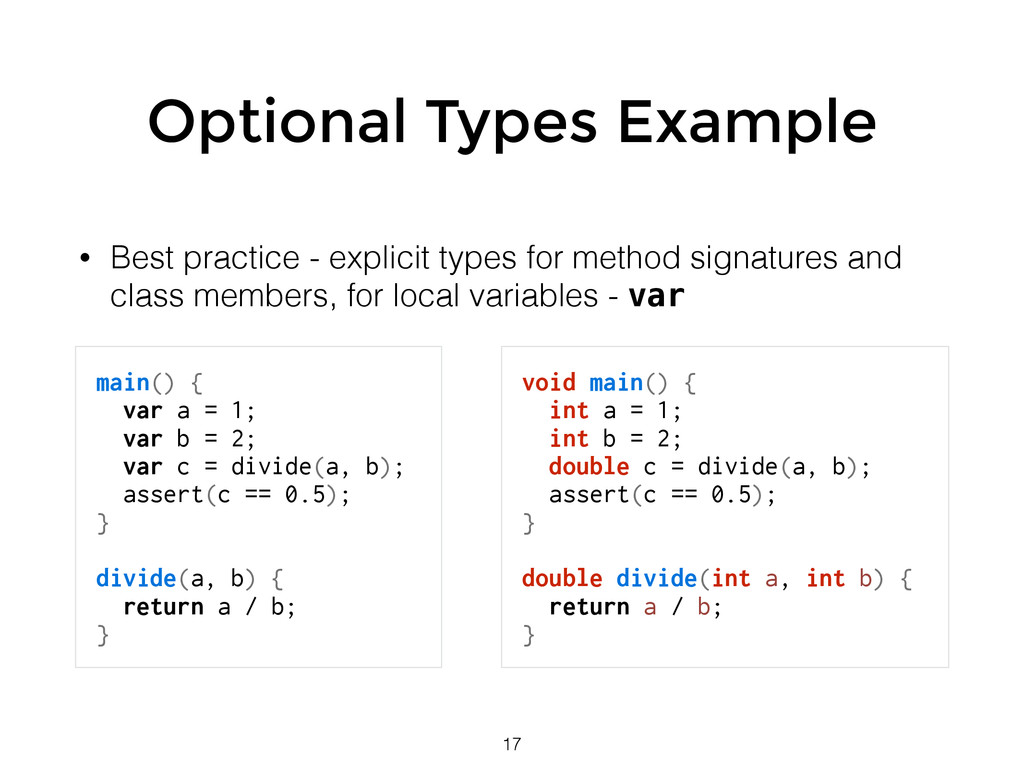
Optional Types Example • Best practice - explicit types for
method signatures and class members, for local variables - var main() { var a = 1; var b = 2; var c = divide(a, b); assert(c == 0.5); } ! divide(a, b) { return a / b; } void main() { int a = 1; int b = 2; double c = divide(a, b); assert(c == 0.5); } ! double divide(int a, int b) { return a / b; } 17 -
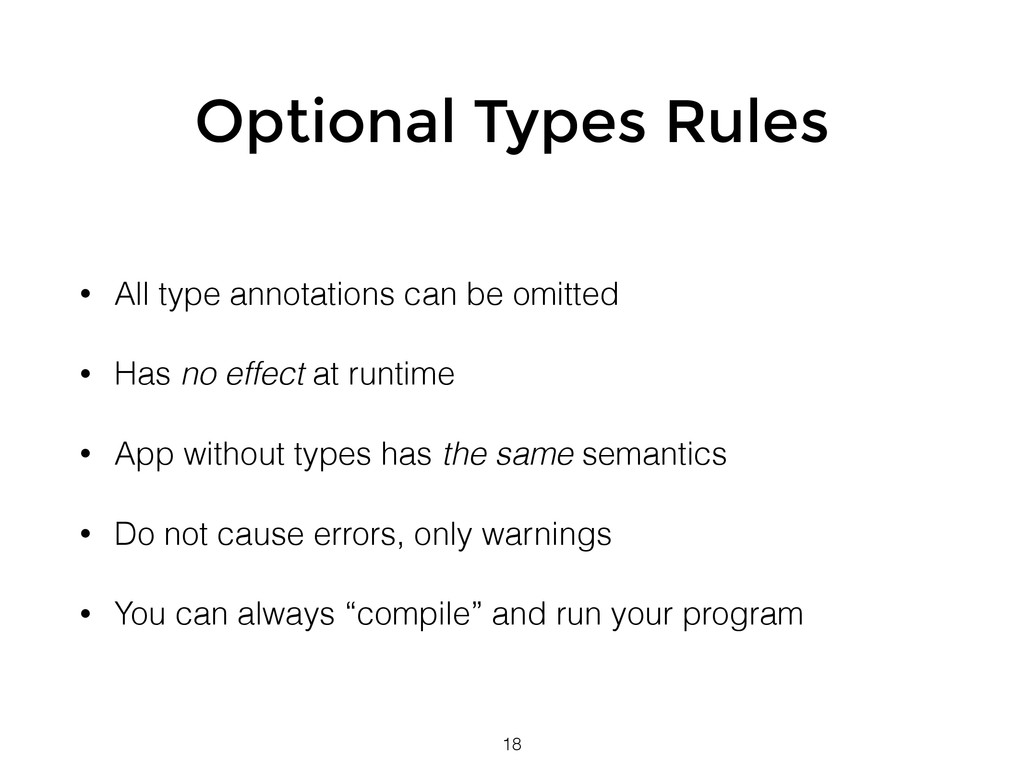
Optional Types Rules • All type annotations can be omitted
• Has no effect at runtime • App without types has the same semantics • Do not cause errors, only warnings • You can always “compile” and run your program 18 -
Benefits of Type Annotations • Act as documentation • Advanced
tools support (completion, code navigation, etc.) • Error detection via type checker • Can improve performance while compiling to JavaScript 19 -
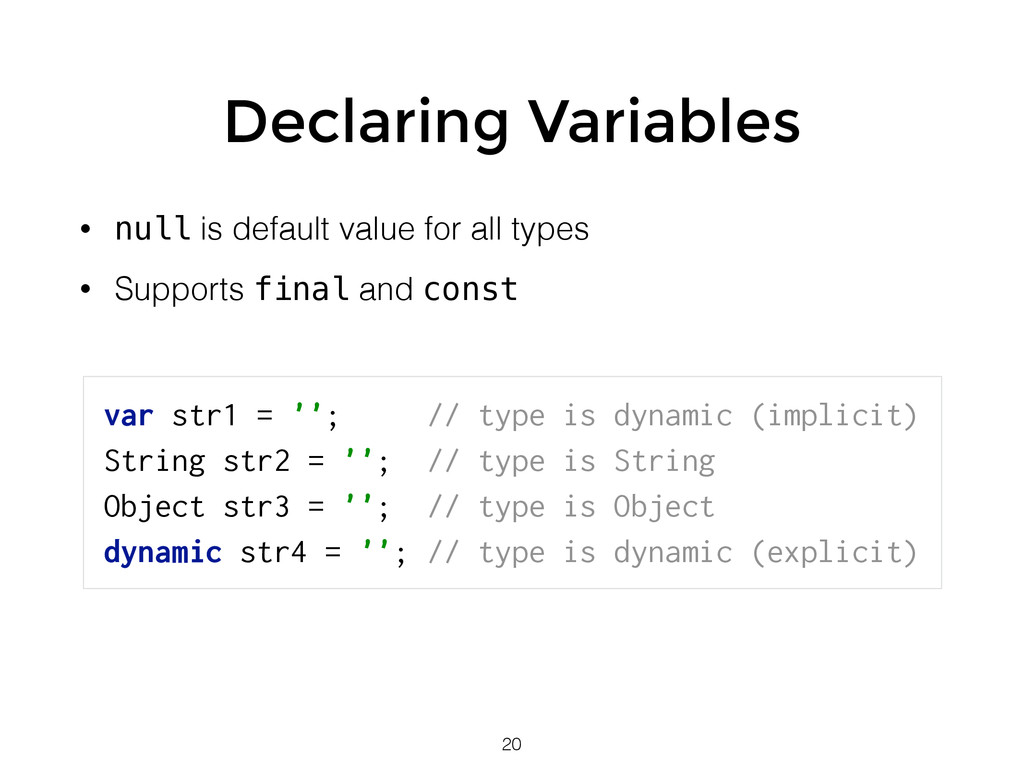
Declaring Variables 20 • null is default value for all
types • Supports final and const var str1 = ''; // type is dynamic (implicit) String str2 = ''; // type is String Object str3 = ''; // type is Object dynamic str4 = ''; // type is dynamic (explicit) -
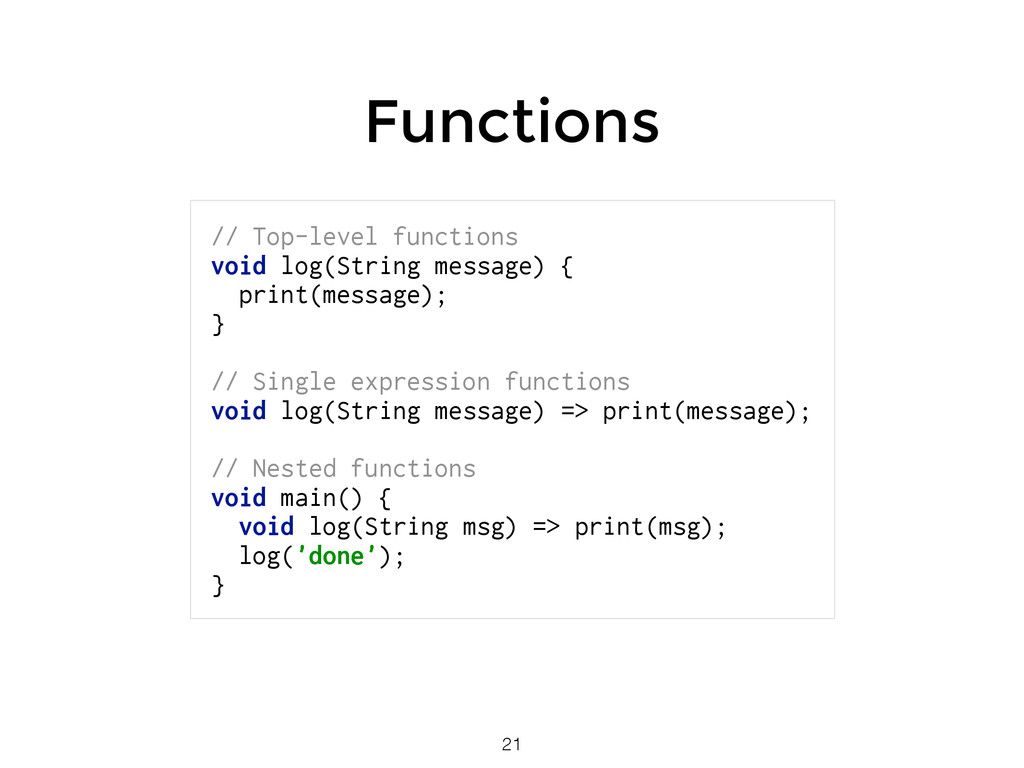
Functions 21 // Top-level functions void log(String message) { print(message);
} // Single expression functions void log(String message) => print(message); // Nested functions void main() { void log(String msg) => print(msg); log('done'); } -
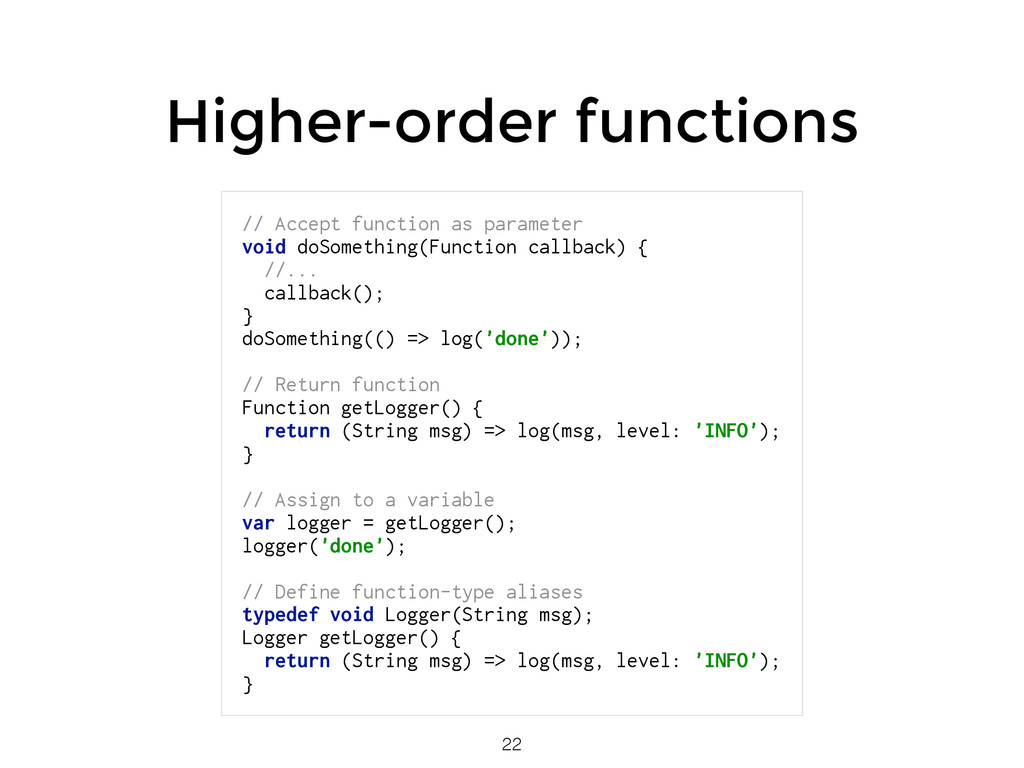
Higher-order functions 22 // Accept function as parameter void doSomething(Function
callback) { //... callback(); } doSomething(() => log('done')); // Return function Function getLogger() { return (String msg) => log(msg, level: 'INFO'); } // Assign to a variable var logger = getLogger(); logger('done'); // Define function-type aliases typedef void Logger(String msg); Logger getLogger() { return (String msg) => log(msg, level: 'INFO'); } -
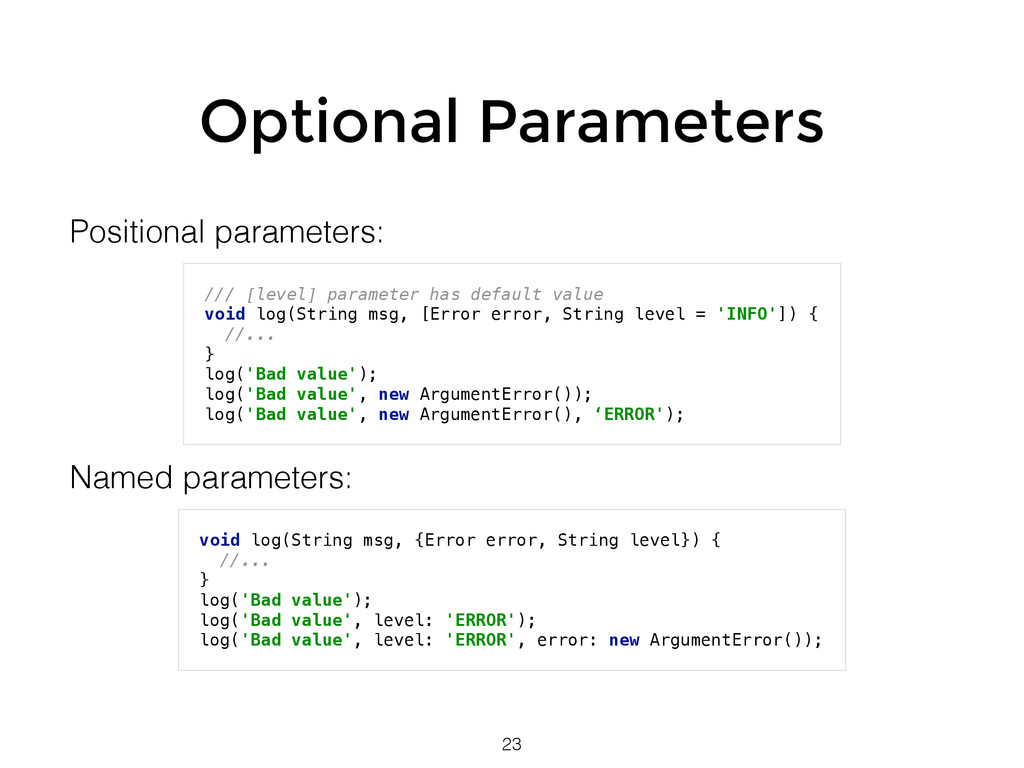
Optional Parameters 23 /// [level] parameter has default value void
log(String msg, [Error error, String level = 'INFO']) { //... } log('Bad value'); log('Bad value', new ArgumentError()); log('Bad value', new ArgumentError(), ‘ERROR'); Positional parameters: void log(String msg, {Error error, String level}) { //... } log('Bad value'); log('Bad value', level: 'ERROR'); log('Bad value', level: 'ERROR', error: new ArgumentError()); Named parameters: -
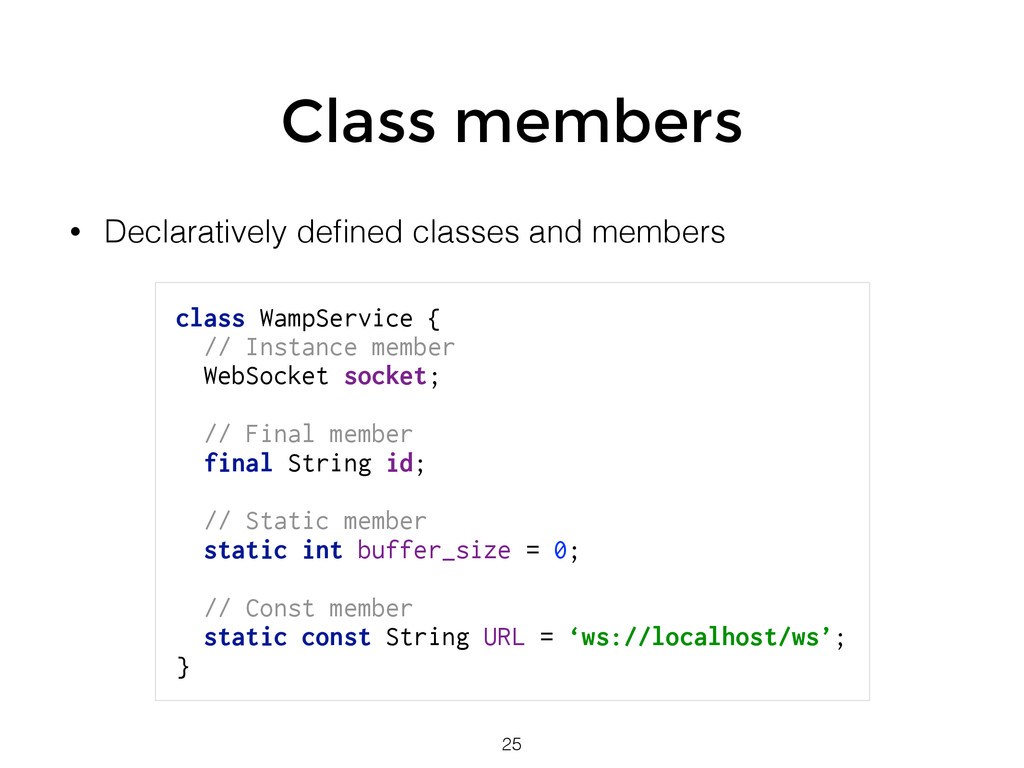
Class members 25 class WampService { // Instance member WebSocket
socket; // Final member final String id; // Static member static int buffer_size = 0; // Const member static const String URL = ‘ws://localhost/ws’; } • Declaratively defined classes and members -
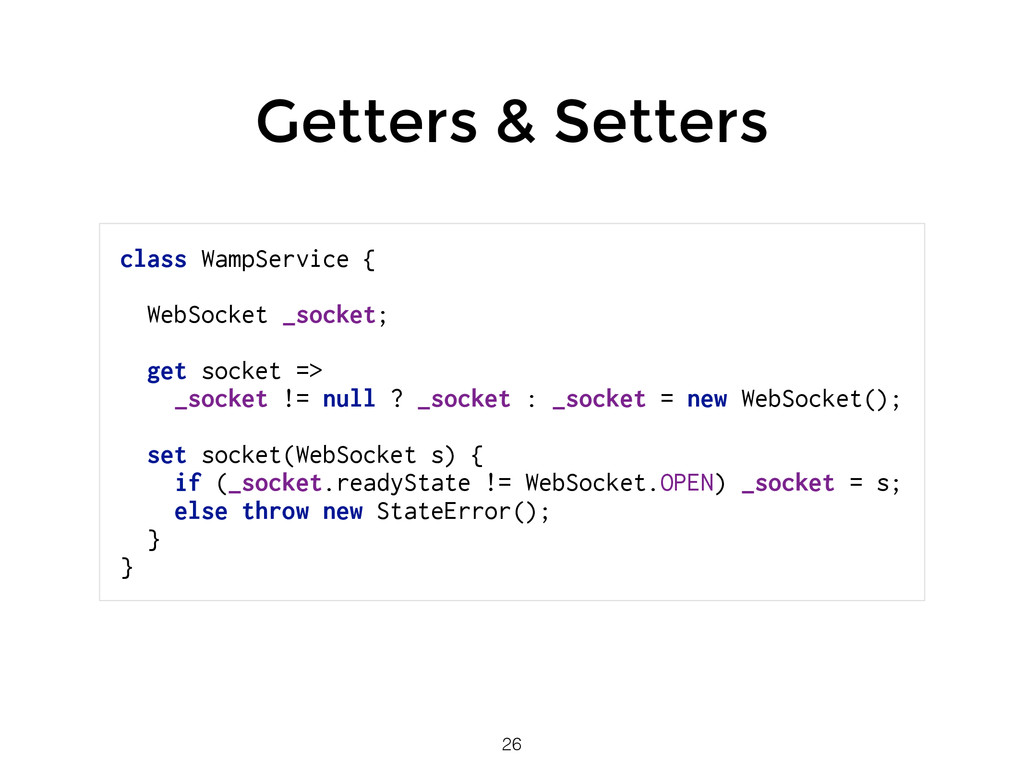
Getters & Setters 26 class WampService { WebSocket _socket;
get socket => _socket != null ? _socket : _socket = new WebSocket(); set socket(WebSocket s) { if (_socket.readyState != WebSocket.OPEN) _socket = s; else throw new StateError(); } } -
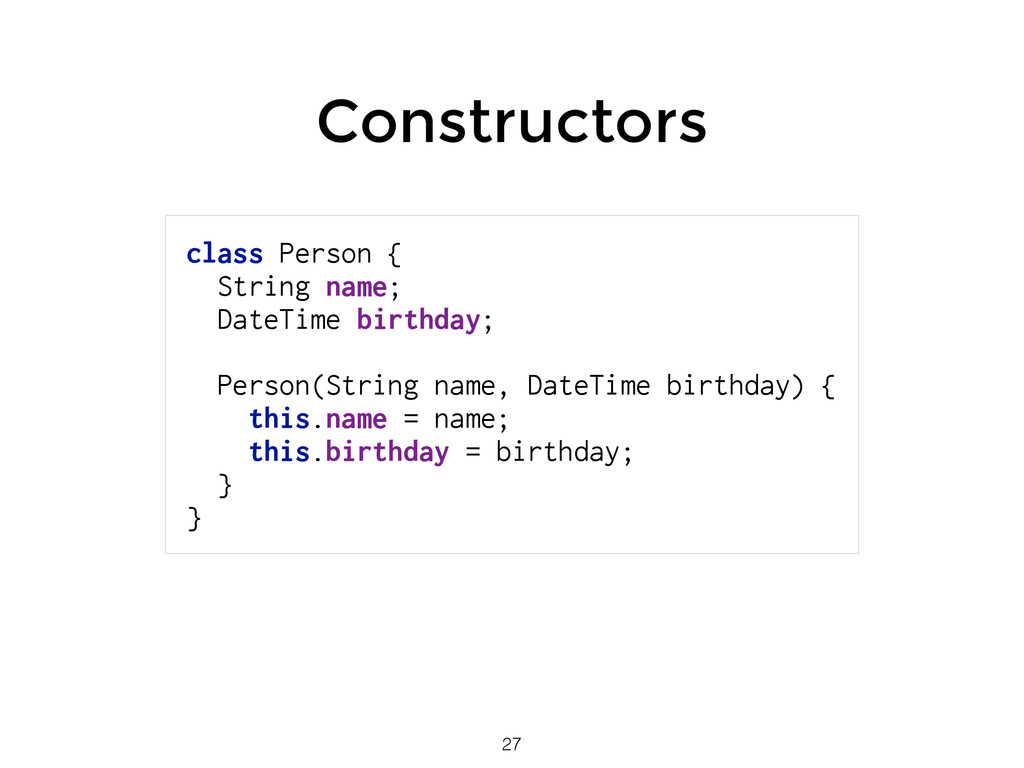
Constructors 27 class Person { String name; DateTime birthday;
Person(String name, DateTime birthday) { this.name = name; this.birthday = birthday; } } -
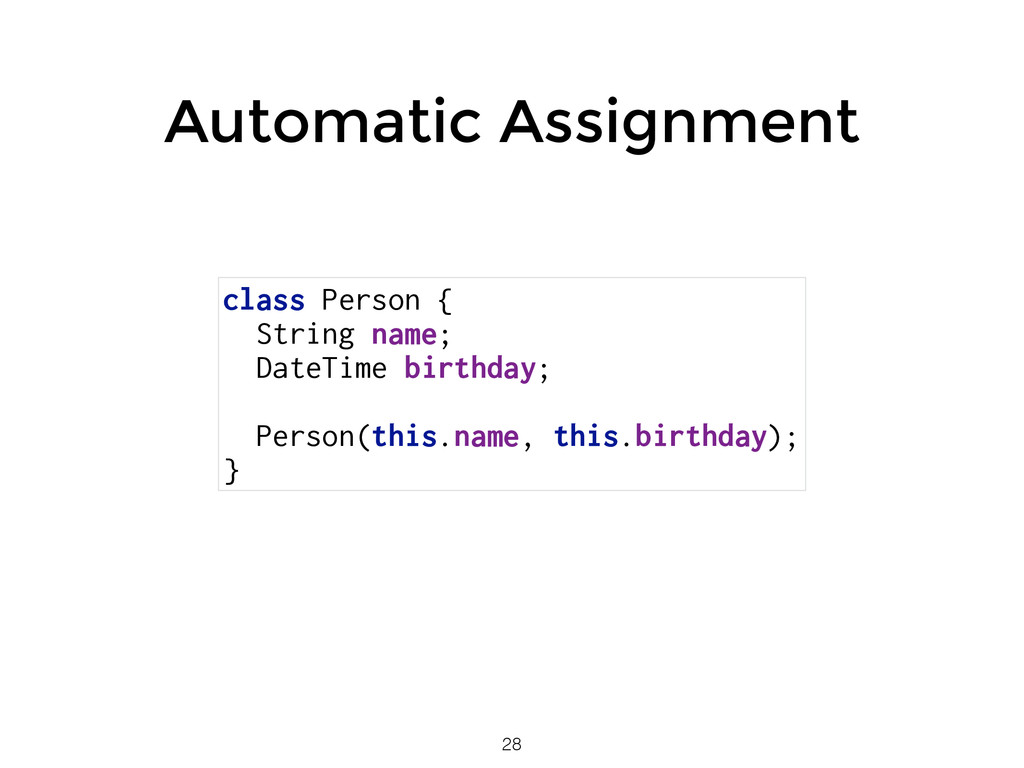
Automatic Assignment 28 class Person { String name; DateTime birthday;
Person(this.name, this.birthday); } -
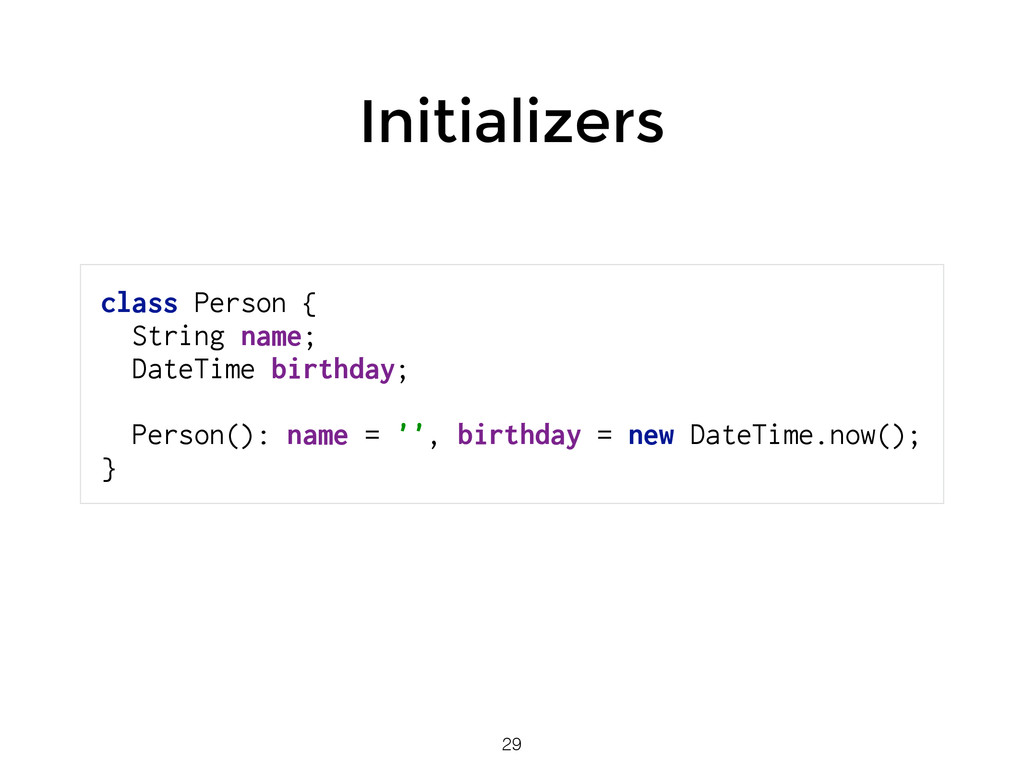
Initializers 29 class Person { String name; DateTime birthday;
Person(): name = '', birthday = new DateTime.now(); } -
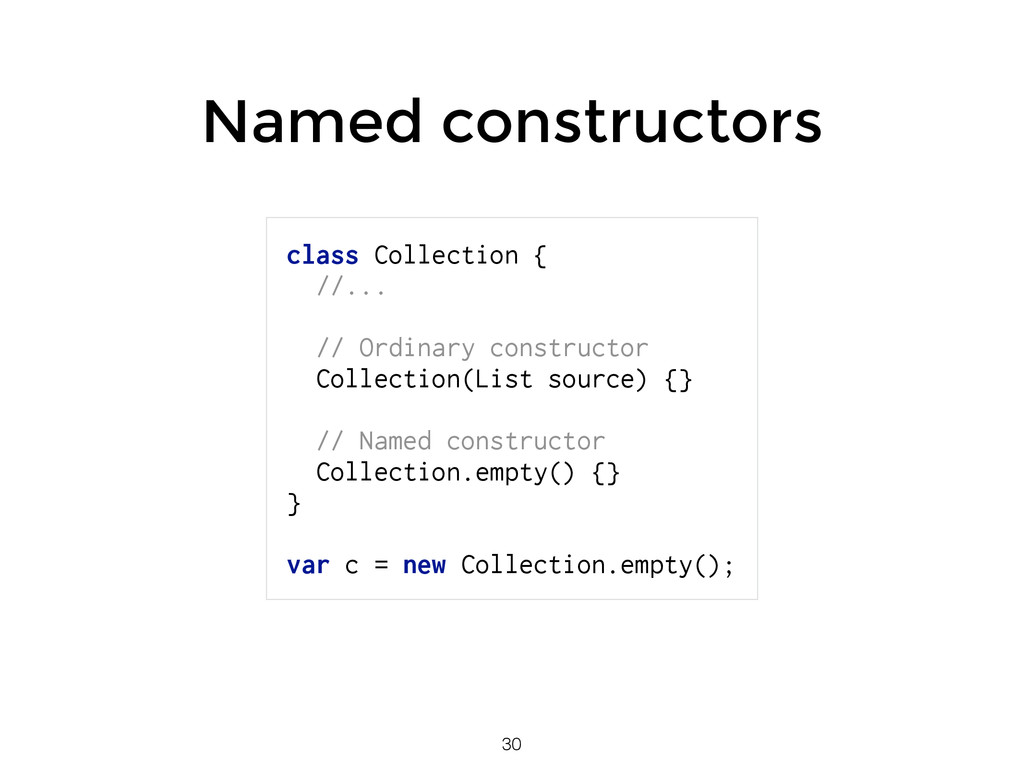
Named constructors 30 class Collection { //... // Ordinary
constructor Collection(List source) {} // Named constructor Collection.empty() {} } var c = new Collection.empty(); -
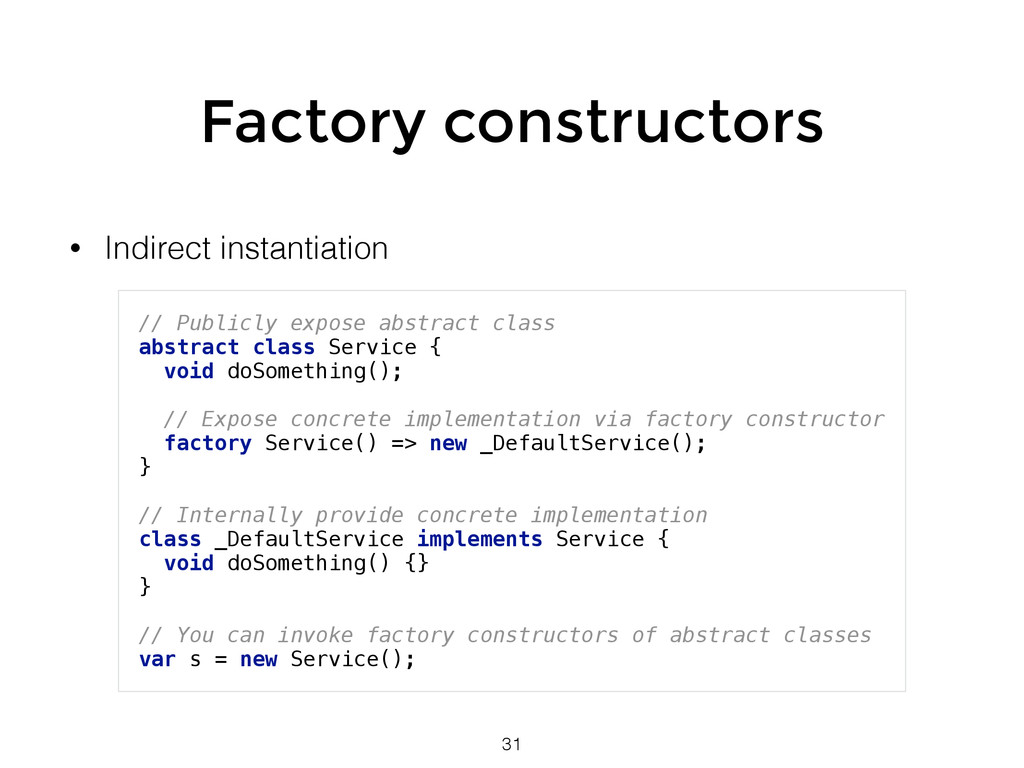
Factory constructors 31 // Publicly expose abstract class abstract class
Service { void doSomething(); // Expose concrete implementation via factory constructor factory Service() => new _DefaultService(); } // Internally provide concrete implementation class _DefaultService implements Service { void doSomething() {} } // You can invoke factory constructors of abstract classes var s = new Service(); • Indirect instantiation -
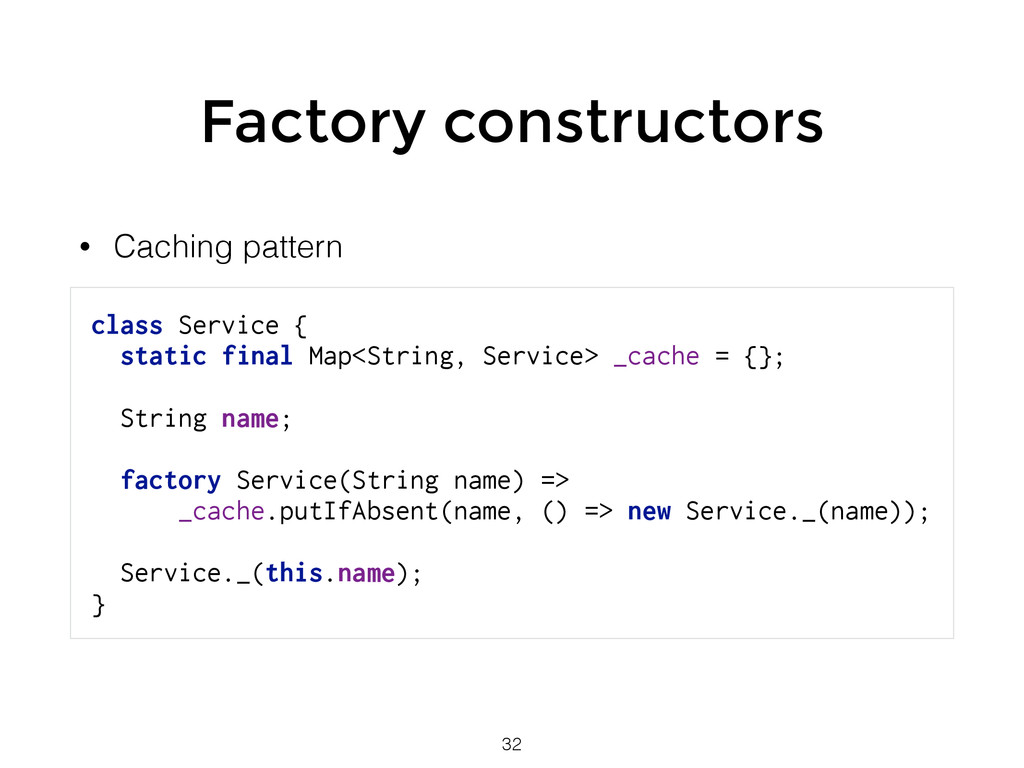
Factory constructors 32 class Service { static final Map<String, Service>
_cache = {}; String name; factory Service(String name) => _cache.putIfAbsent(name, () => new Service._(name)); Service._(this.name); } • Caching pattern -
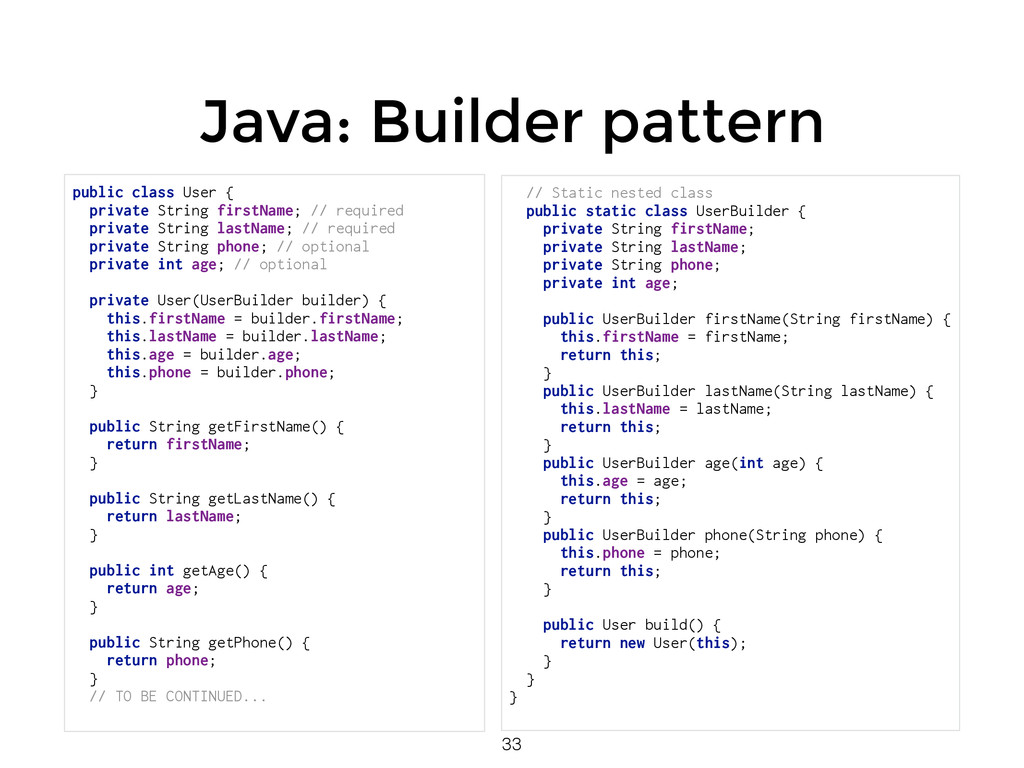
Java: Builder pattern 33 public class User { private String
firstName; // required private String lastName; // required private String phone; // optional private int age; // optional private User(UserBuilder builder) { this.firstName = builder.firstName; this.lastName = builder.lastName; this.age = builder.age; this.phone = builder.phone; } public String getFirstName() { return firstName; } public String getLastName() { return lastName; } public int getAge() { return age; } public String getPhone() { return phone; } // TO BE CONTINUED... // Static nested class public static class UserBuilder { private String firstName; private String lastName; private String phone; private int age; ! public UserBuilder firstName(String firstName) { this.firstName = firstName; return this; } public UserBuilder lastName(String lastName) { this.lastName = lastName; return this; } public UserBuilder age(int age) { this.age = age; return this; } public UserBuilder phone(String phone) { this.phone = phone; return this; } public User build() { return new User(this); } } } -
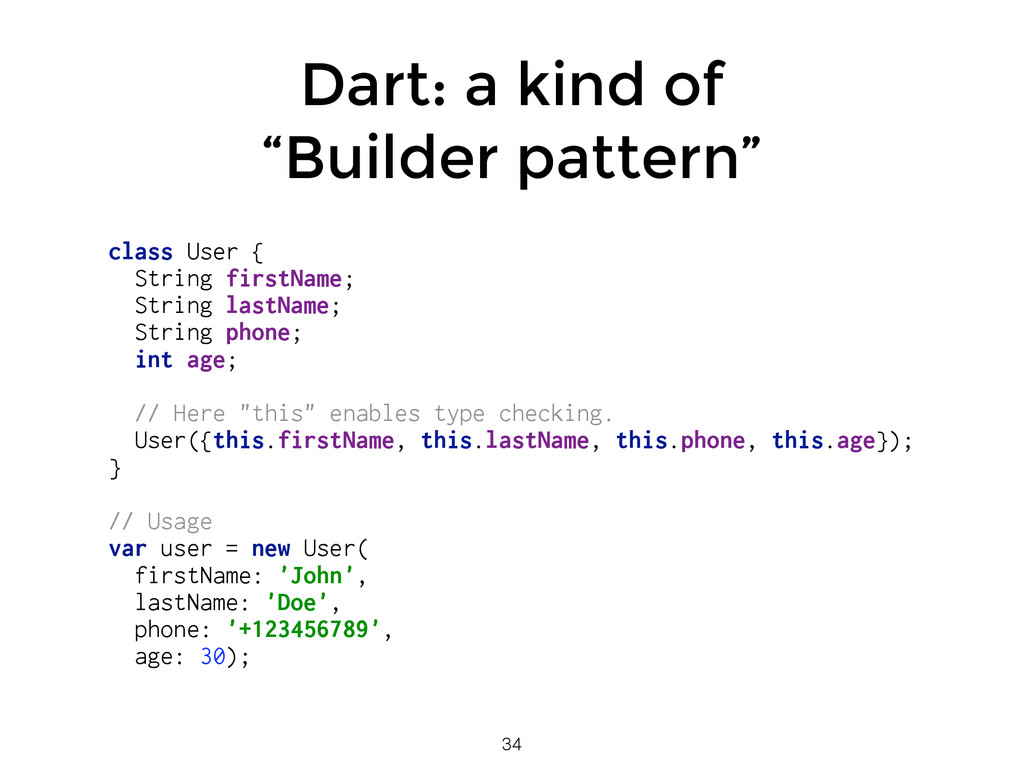
Dart: a kind of “Builder pattern” 34 class User {
String firstName; String lastName; String phone; int age; // Here "this" enables type checking. User({this.firstName, this.lastName, this.phone, this.age}); } // Usage var user = new User( firstName: 'John', lastName: 'Doe', phone: '+123456789', age: 30); -
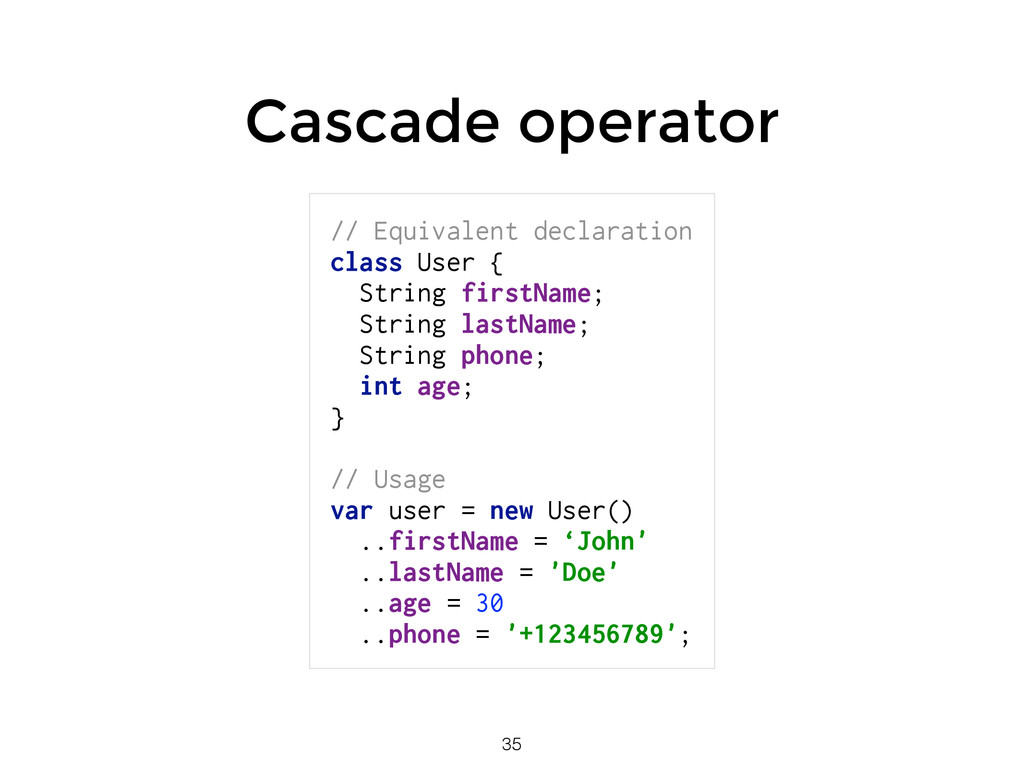
Cascade operator 35 // Equivalent declaration class User { String
firstName; String lastName; String phone; int age; } // Usage var user = new User() ..firstName = ‘John' ..lastName = 'Doe' ..age = 30 ..phone = '+123456789'; -
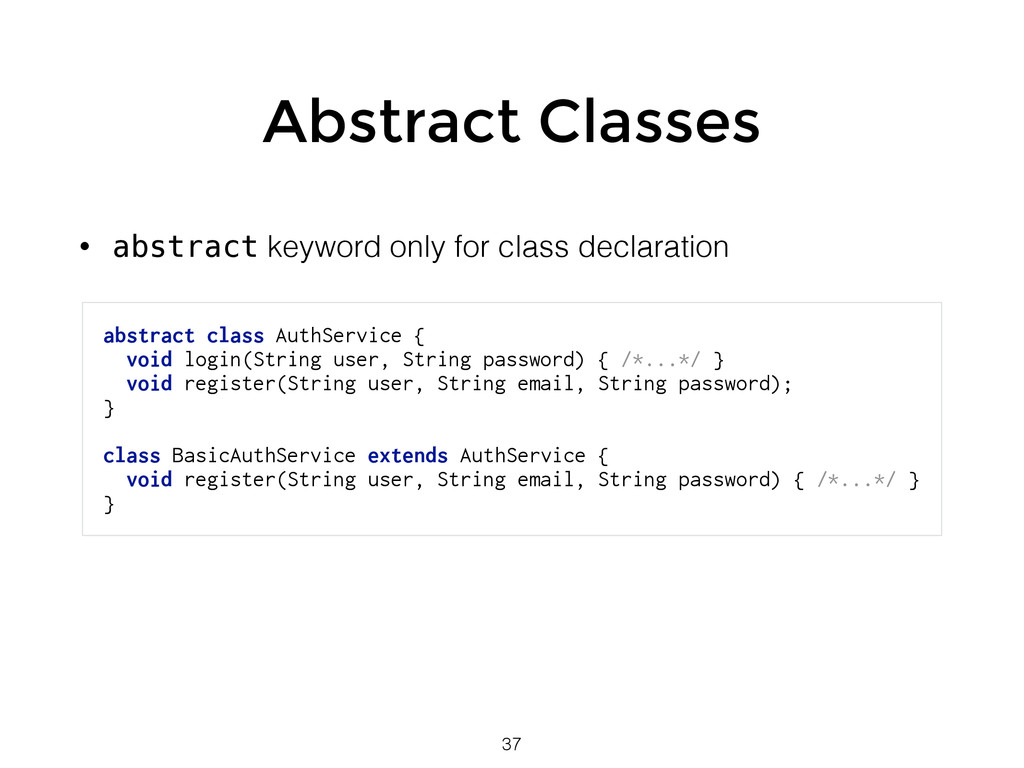
Abstract Classes 37 abstract class AuthService { void login(String user,
String password) { /*...*/ } void register(String user, String email, String password); } class BasicAuthService extends AuthService { void register(String user, String email, String password) { /*...*/ } } • abstract keyword only for class declaration -
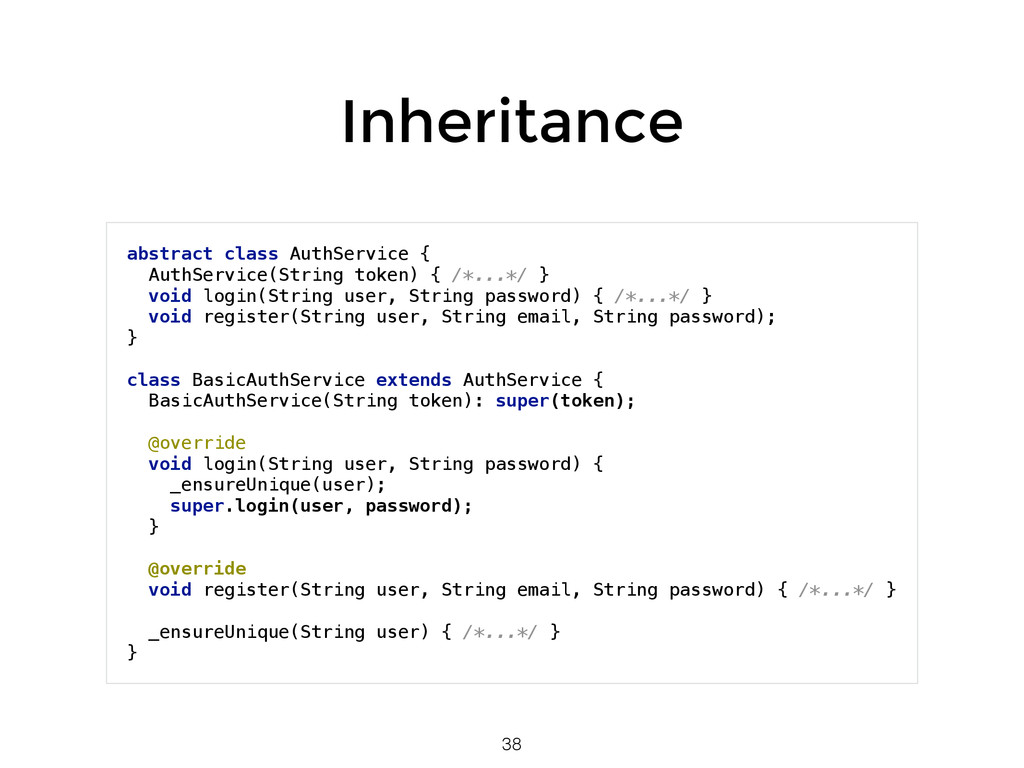
Inheritance 38 abstract class AuthService { AuthService(String token) { /*...*/
} void login(String user, String password) { /*...*/ } void register(String user, String email, String password); } class BasicAuthService extends AuthService { BasicAuthService(String token): super(token); @override void login(String user, String password) { _ensureUnique(user); super.login(user, password); } @override void register(String user, String email, String password) { /*...*/ } _ensureUnique(String user) { /*...*/ } } -
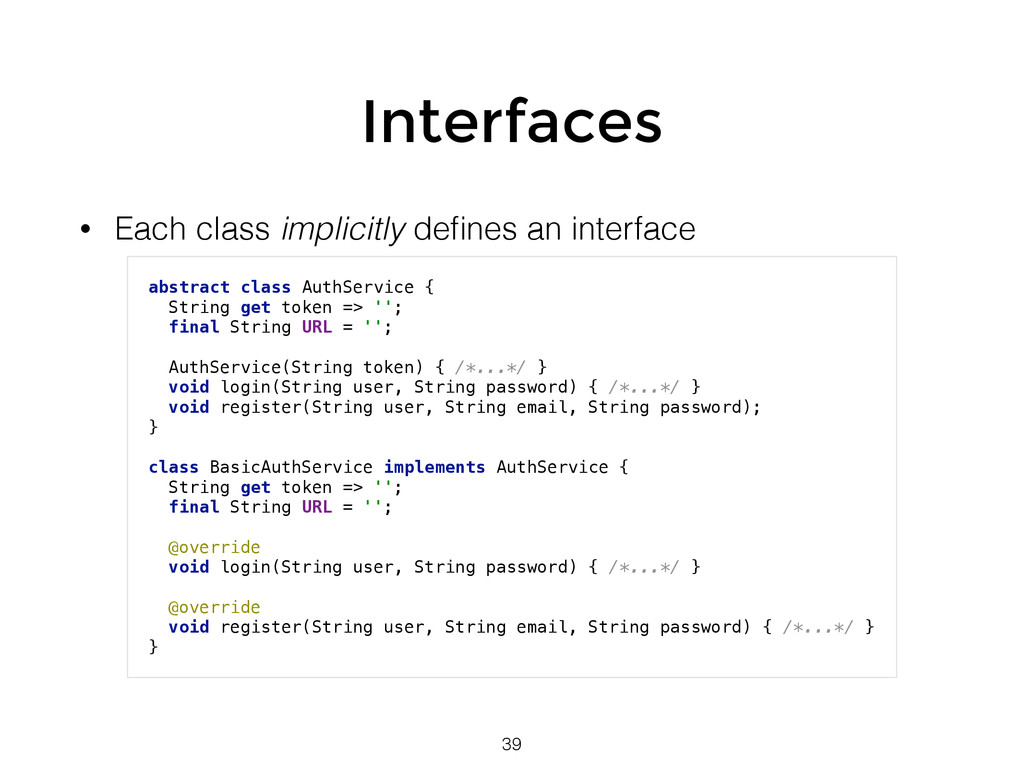
Interfaces • Each class implicitly defines an interface 39 abstract
class AuthService { String get token => ''; final String URL = ''; AuthService(String token) { /*...*/ } void login(String user, String password) { /*...*/ } void register(String user, String email, String password); } class BasicAuthService implements AuthService { String get token => ''; final String URL = ''; @override void login(String user, String password) { /*...*/ } @override void register(String user, String email, String password) { /*...*/ } } -
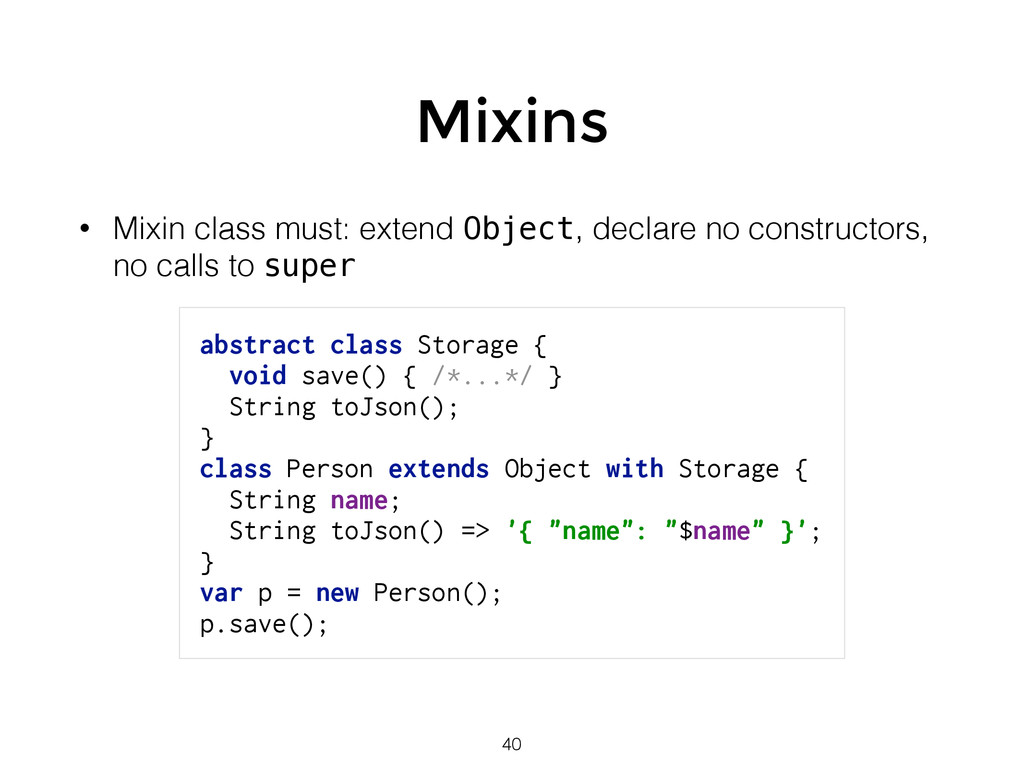
Mixins 40 abstract class Storage { void save() { /*...*/
} String toJson(); } class Person extends Object with Storage { String name; String toJson() => '{ "name": "$name" }'; } var p = new Person(); p.save(); • Mixin class must: extend Object, declare no constructors, no calls to super -
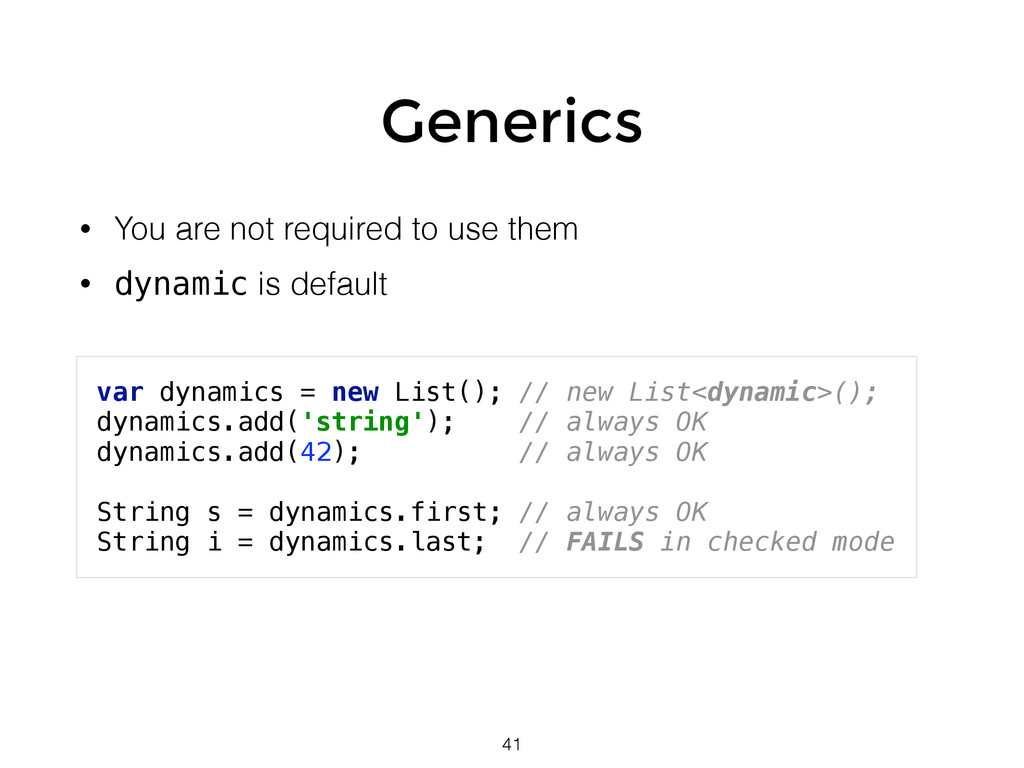
Generics 41 var dynamics = new List(); // new List<dynamic>();
dynamics.add('string'); // always OK dynamics.add(42); // always OK String s = dynamics.first; // always OK String i = dynamics.last; // FAILS in checked mode • You are not required to use them • dynamic is default -
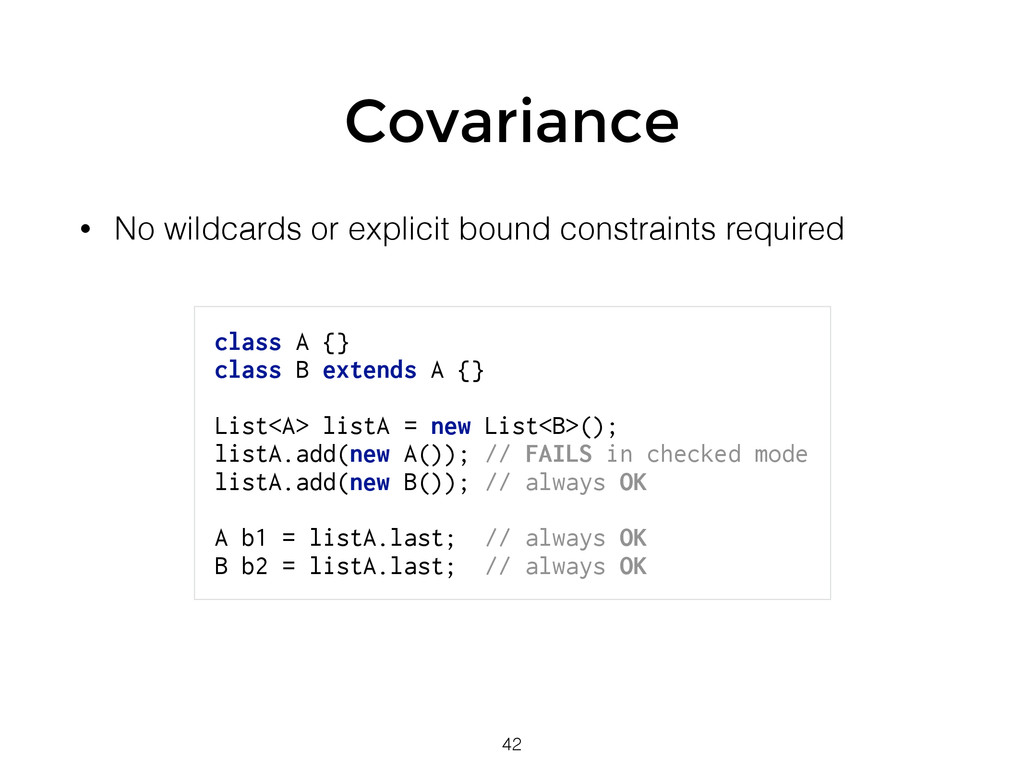
Covariance 42 class A {} class B extends A {}
! List<A> listA = new List<B>(); listA.add(new A()); // FAILS in checked mode listA.add(new B()); // always OK A b1 = listA.last; // always OK B b2 = listA.last; // always OK • No wildcards or explicit bound constraints required -
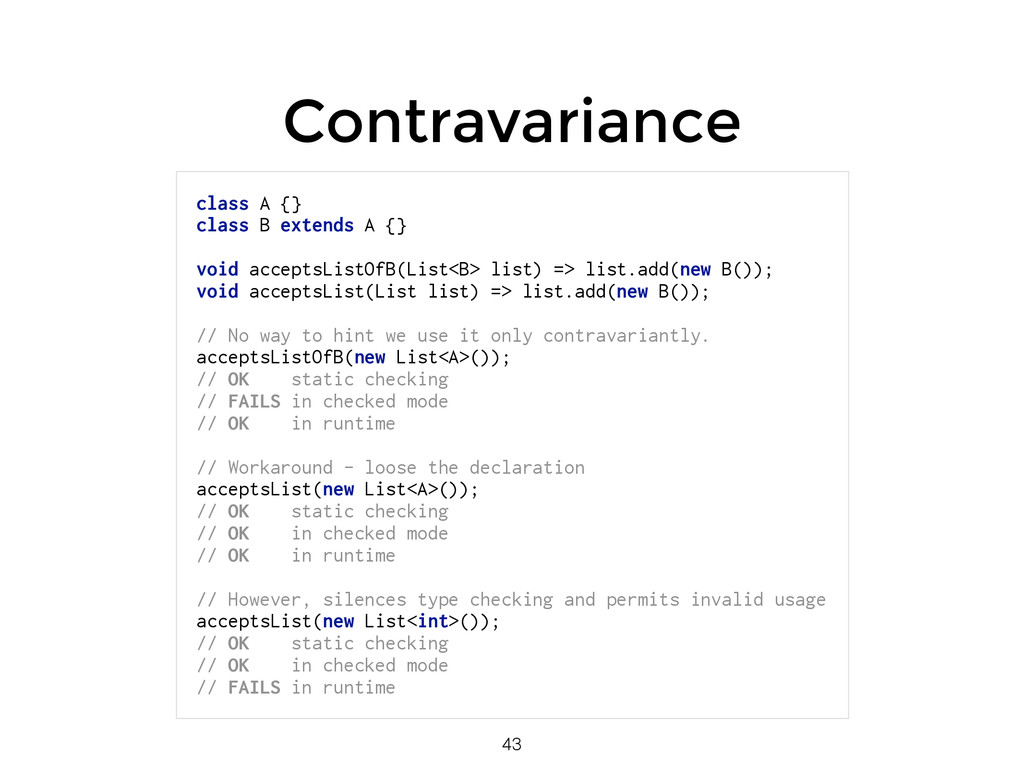
Contravariance 43 class A {} class B extends A {}
void acceptsListOfB(List<B> list) => list.add(new B()); void acceptsList(List list) => list.add(new B()); // No way to hint we use it only contravariantly. acceptsListOfB(new List<A>()); // OK static checking // FAILS in checked mode // OK in runtime // Workaround - loose the declaration acceptsList(new List<A>()); // OK static checking // OK in checked mode // OK in runtime // However, silences type checking and permits invalid usage acceptsList(new List<int>()); // OK static checking // OK in checked mode // FAILS in runtime -
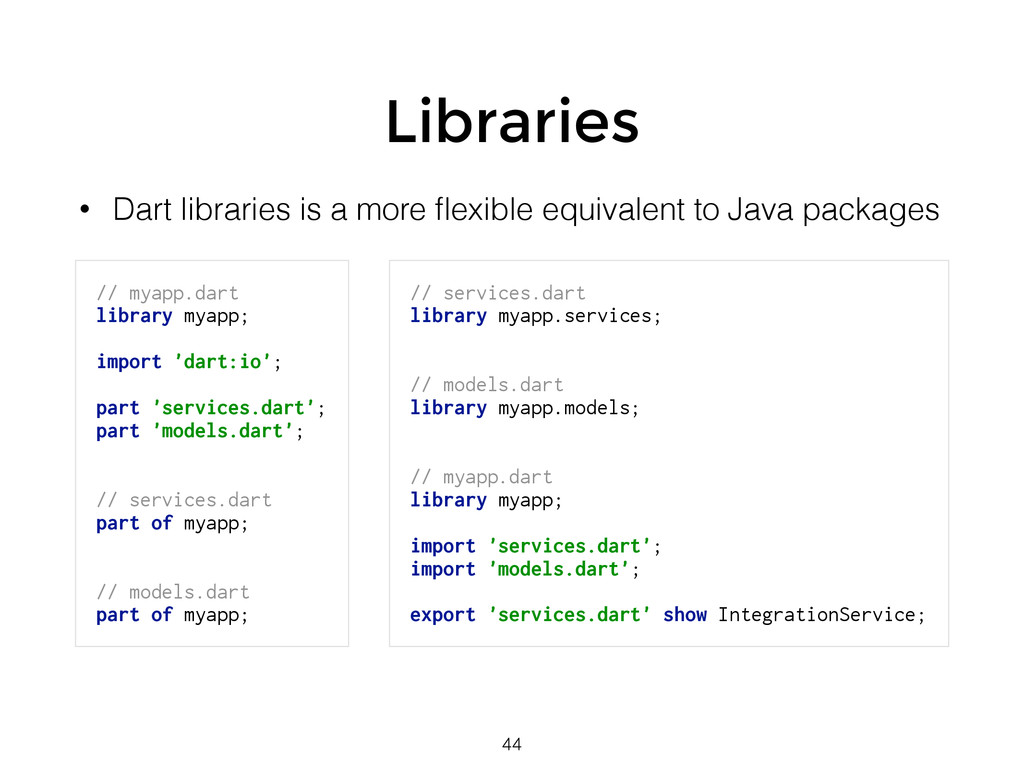
Libraries • Dart libraries is a more flexible equivalent to
Java packages 44 // myapp.dart library myapp; import 'dart:io'; part 'services.dart'; part 'models.dart'; ! // services.dart part of myapp; ! // models.dart part of myapp; // services.dart library myapp.services; ! // models.dart library myapp.models; ! // myapp.dart library myapp; import 'services.dart'; import 'models.dart'; export 'services.dart' show IntegrationService; -
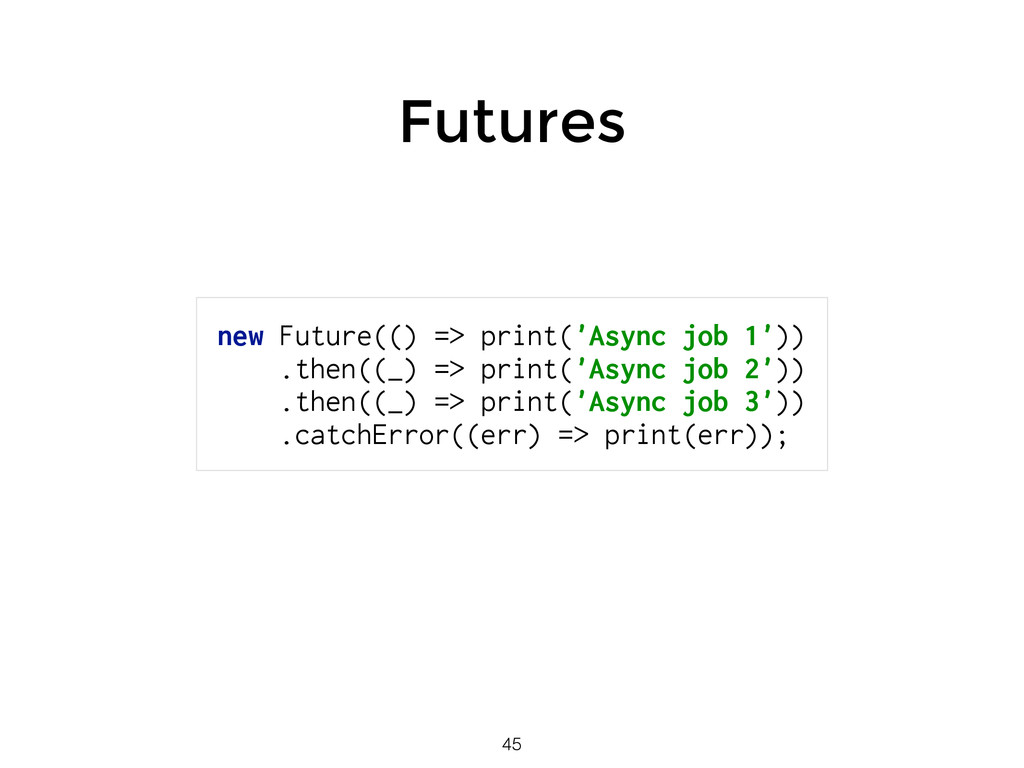
Futures 45 new Future(() => print('Async job 1')) .then((_) =>
print('Async job 2')) .then((_) => print('Async job 3')) .catchError((err) => print(err)); -
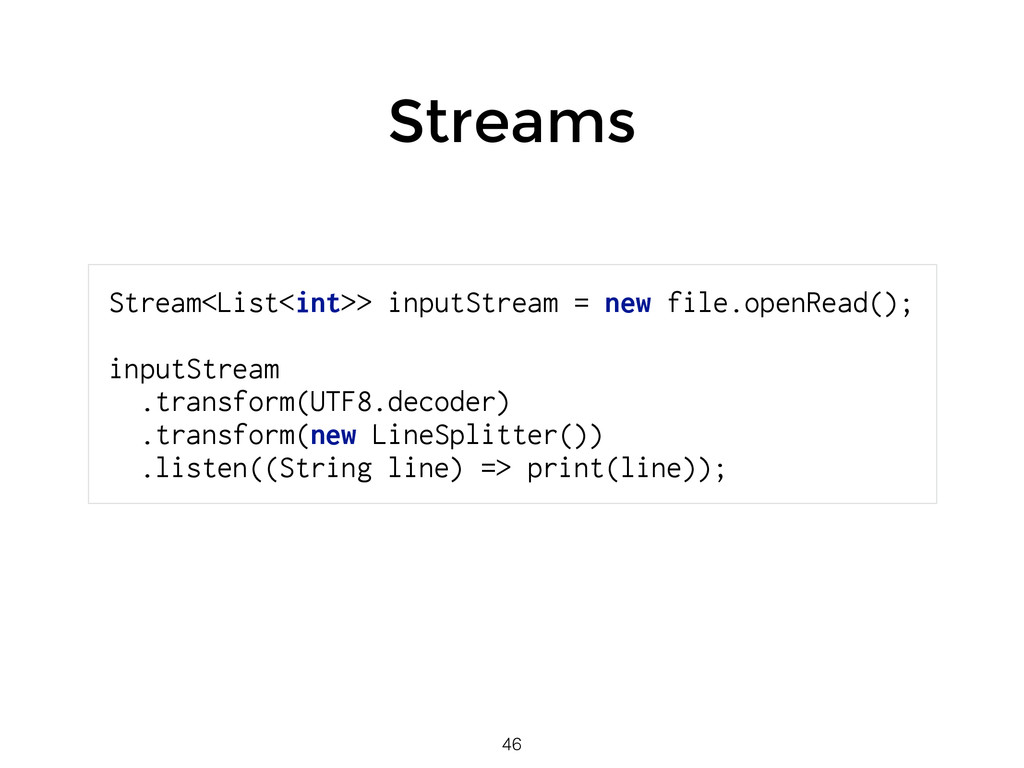
Streams 46 Stream<List<int>> inputStream = new file.openRead(); inputStream .transform(UTF8.decoder)
.transform(new LineSplitter()) .listen((String line) => print(line)); -
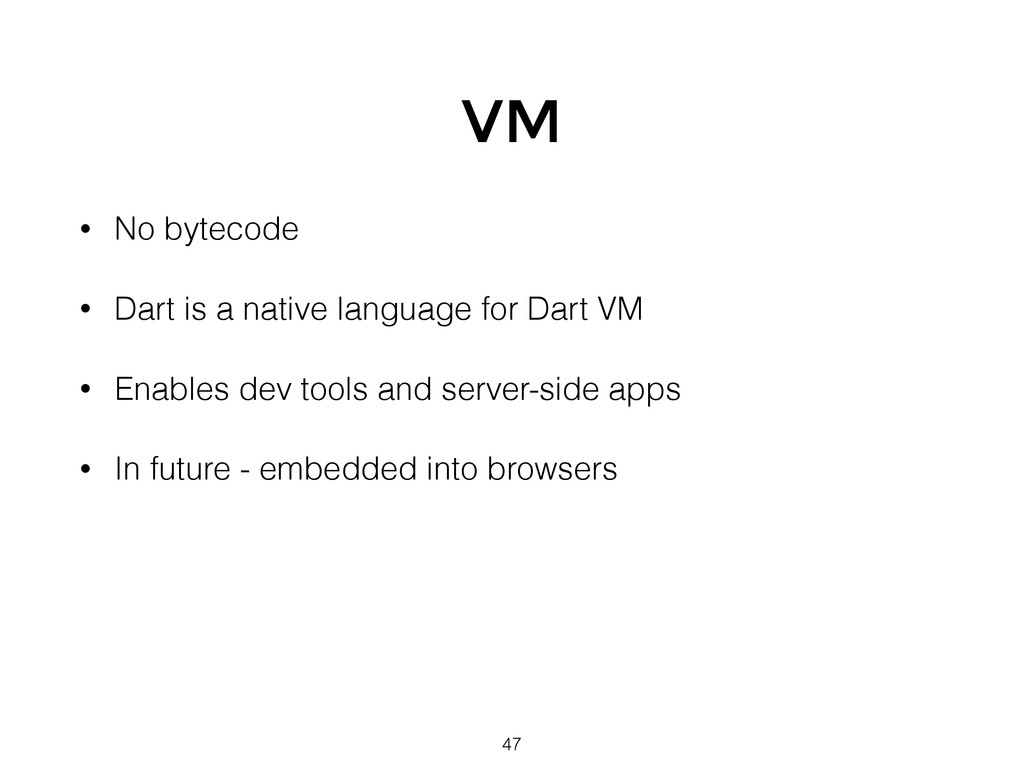
VM • No bytecode • Dart is a native language
for Dart VM • Enables dev tools and server-side apps • In future - embedded into browsers 47 -
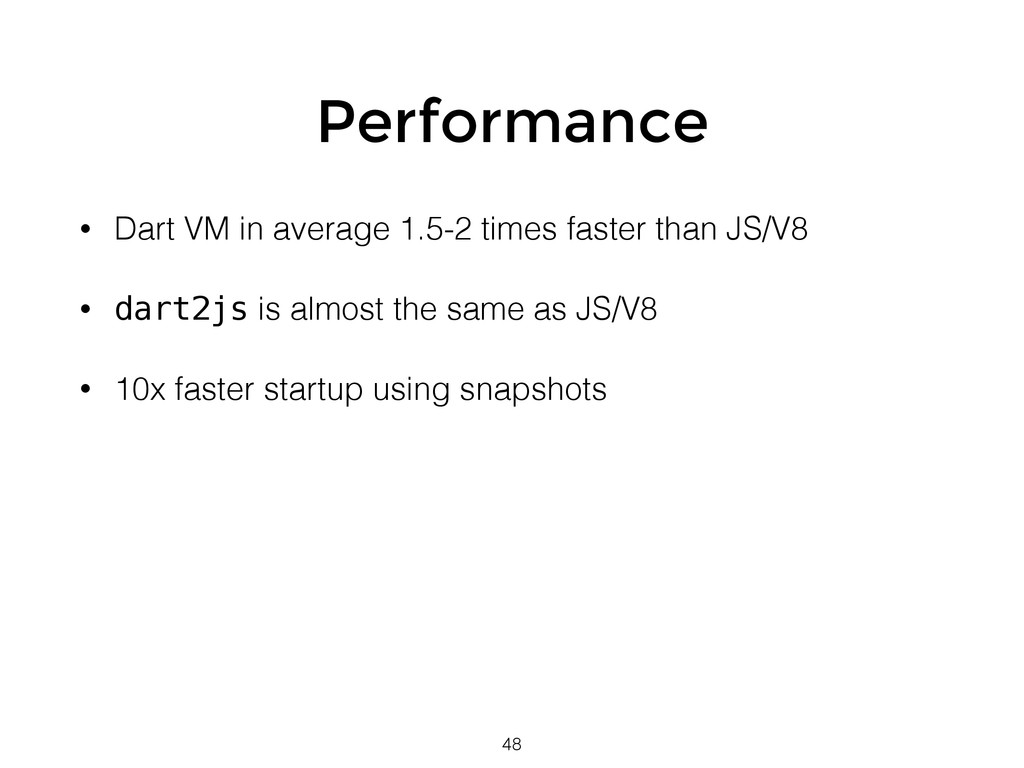
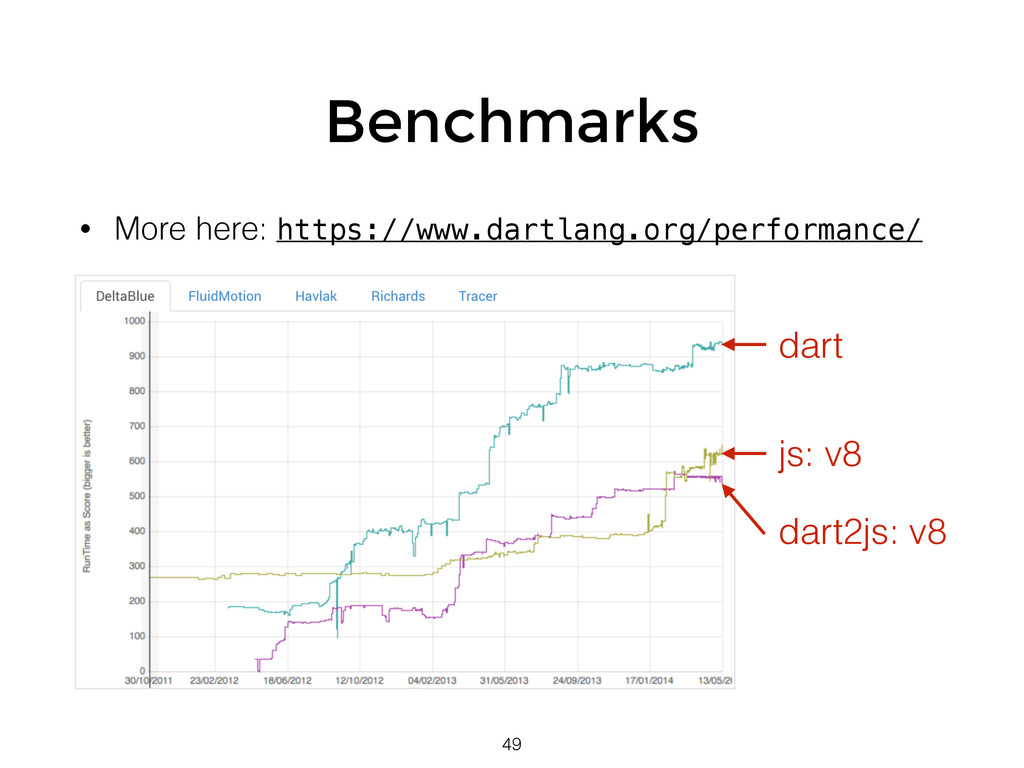
Performance • Dart VM in average 1.5-2 times faster than
JS/V8 • dart2js is almost the same as JS/V8 • 10x faster startup using snapshots 48 -
Benchmarks 49 dart js: v8 dart2js: v8 • More here:
https://www.dartlang.org/performance/ -
Resources • https://www.dartlang.org • Articles • Benchmarks • AngularDart •
DartlangTV YouTube channel 56