Upgrade to Pro — share decks privately, control downloads, hide ads and more …

apidays Australia 2025 | Advanced GraphQL Secur...

Sponsored · Your Podcast. Everywhere. Effortlessly. Share. Educate. Inspire. Entertain. You do you. We'll handle the rest.
Avatar for apidays apidays PRO
February 07, 2026

apidays Australia 2025 | Advanced GraphQL Security with AI Driven Threat Detection

Advanced GraphQL Security with AI-Driven Threat Detection
Speaker: Hiranya Kavishani, Technical Lead at WSO2

This talk by Hiranya Kavishani, Technical Lead at WSO, explores how AI and machine learning can be applied to secure GraphQL APIs from advanced threats that traditional security mechanisms often miss. While GraphQL enables precise data access and developer efficiency, it also opens the door to complex attack vectors like deeply nested queries, alias overloading, query injections, and denial-of-service attacks. Many of these threats slip past REST-era protections or static validations.

The presentation covers how intelligent models—trained on query behaviour patterns and schema structures—can detect anomalies, identify zero-day attacks, and adapt to evolving threat landscapes in real time. We’ll discuss approaches such as graph-based anomaly detection, few-shot payload classifiers, and explainable AI (XAI) to make detection more accurate, lightweight, and transparent.

Key Takeaways:

• A clear understanding of the unique security challenges in GraphQL

• Practical methods to integrate AI-driven threat detection at the query layer

• Strategies to improve detection accuracy while maintaining developer agility and system performance

• As APIs grow more dynamic and data-rich, security must evolve too. This talk shows how AI can play a crucial role in defending GraphQL APIs without slowing innovation.
Conference Details:
Conference: apidays Australia 2025
Theme: Platforms, Products, and People: The Power of APIs in the Age of AI
Date: 29 - 30 October 2025 • MCEC, Melbourne Australia

--------------------------

Resources from apidays:
Join our upcoming conferences: https://www.apidays.global/
Read the latest API news: https://www.apiscene.io
Explore the API Landscape: https://apilandscape.apiscene.io/

Avatar for apidays

apidays PRO

February 07, 2026
Tweet

More Decks by apidays

Other Decks in Technology

Transcript

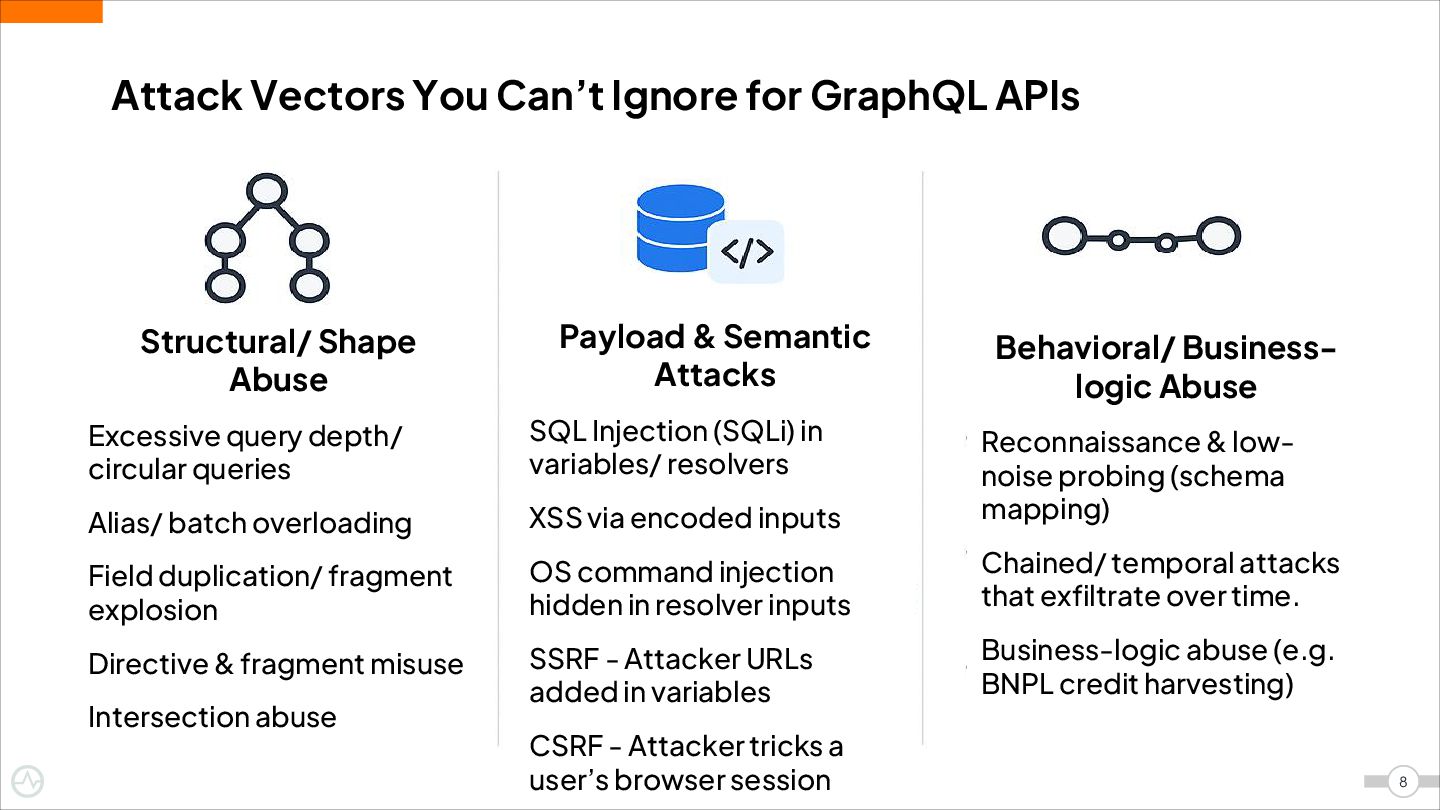
  1. Attack Vectors You Can’t Ignore for GraphQL APIs 8 Structural/

    Shape Abuse Excessive query depth/ circular queries Alias/ batch overloading Field duplication/ fragment explosion Directive & fragment misuse Intersection abuse Payload & Semantic Attacks SQL Injection (SQLi) in variables/ resolvers XSS via encoded inputs OS command injection hidden in resolver inputs SSRF - Attacker URLs added in variables CSRF - Attacker tricks a user’s browser session Behavioral/ Business- logic Abuse Reconnaissance & low- noise probing (schema mapping) Chained/ temporal attacks that exfiltrate over time. Business-logic abuse (e.g. BNPL credit harvesting)
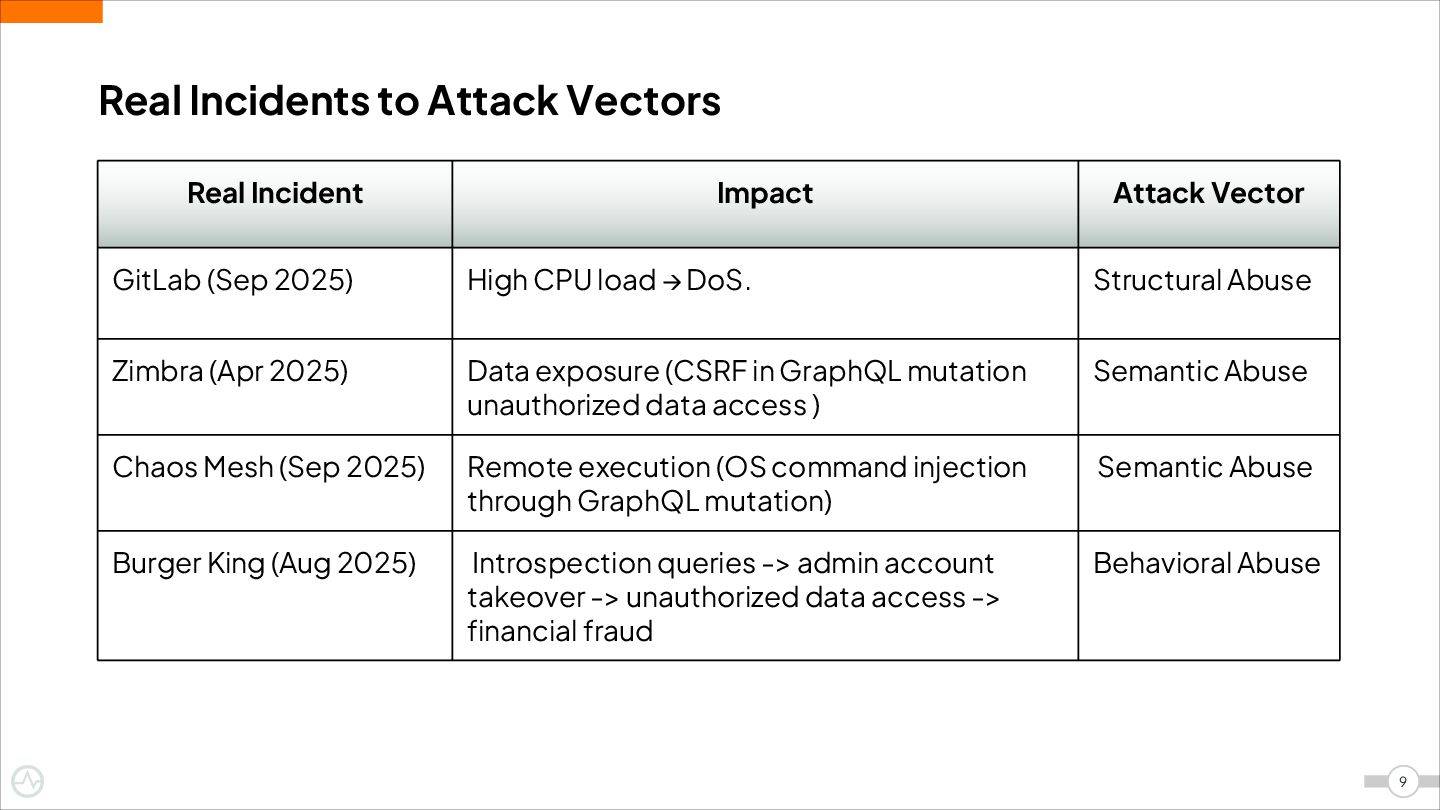
  2. Real Incidents to Attack Vectors 9 Real Incident Impact Attack

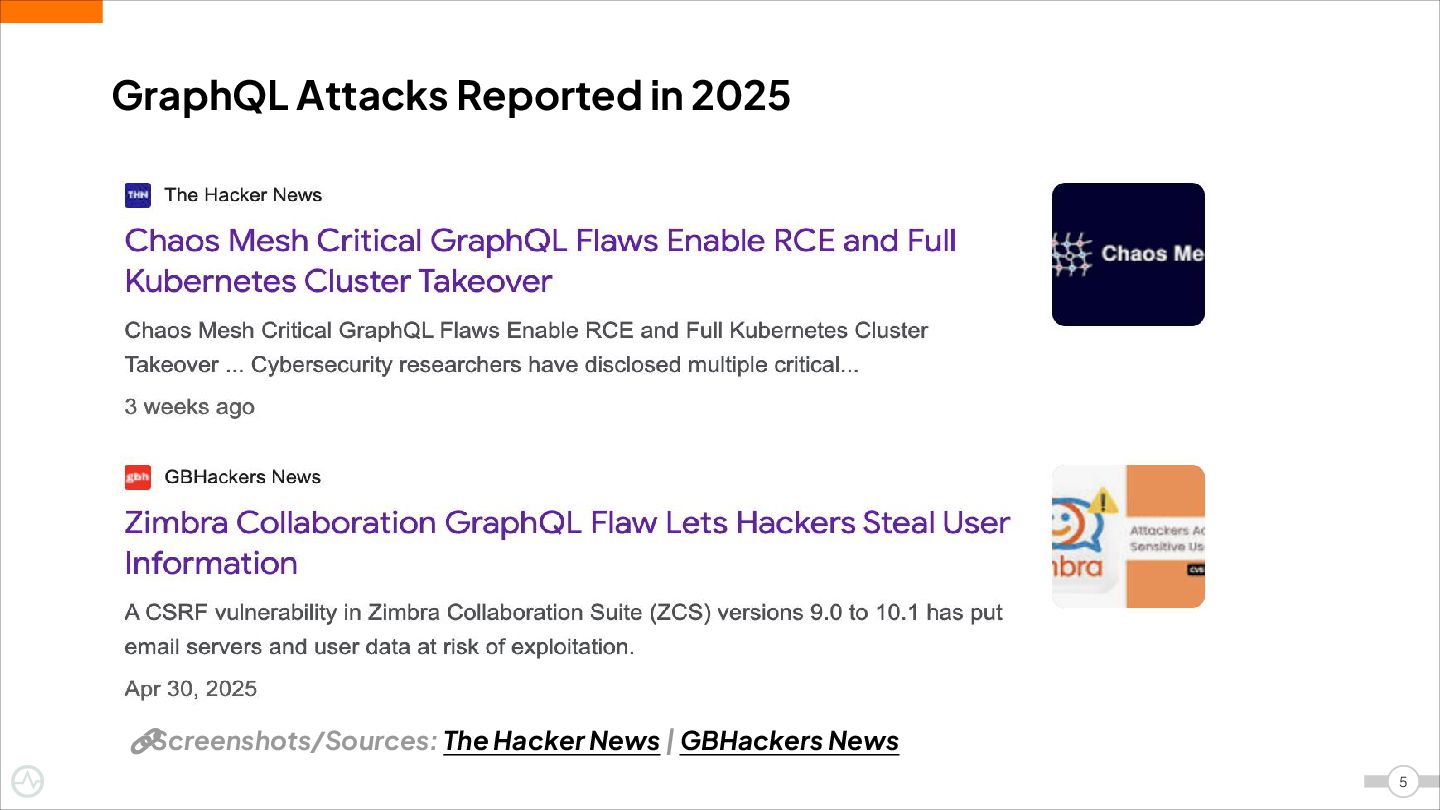
    Vector GitLab (Sep 2025) High CPU load → DoS. Structural Abuse Zimbra (Apr 2025) Data exposure (CSRF in GraphQL mutation unauthorized data access ) Semantic Abuse Chaos Mesh (Sep 2025) Remote execution (OS command injection through GraphQL mutation) Semantic Abuse Burger King (Aug 2025) Introspection queries -> admin account takeover -> unauthorized data access -> financial fraud Behavioral Abuse
  3. • Static query analysis tools ◦ Fixed thresholds → catch

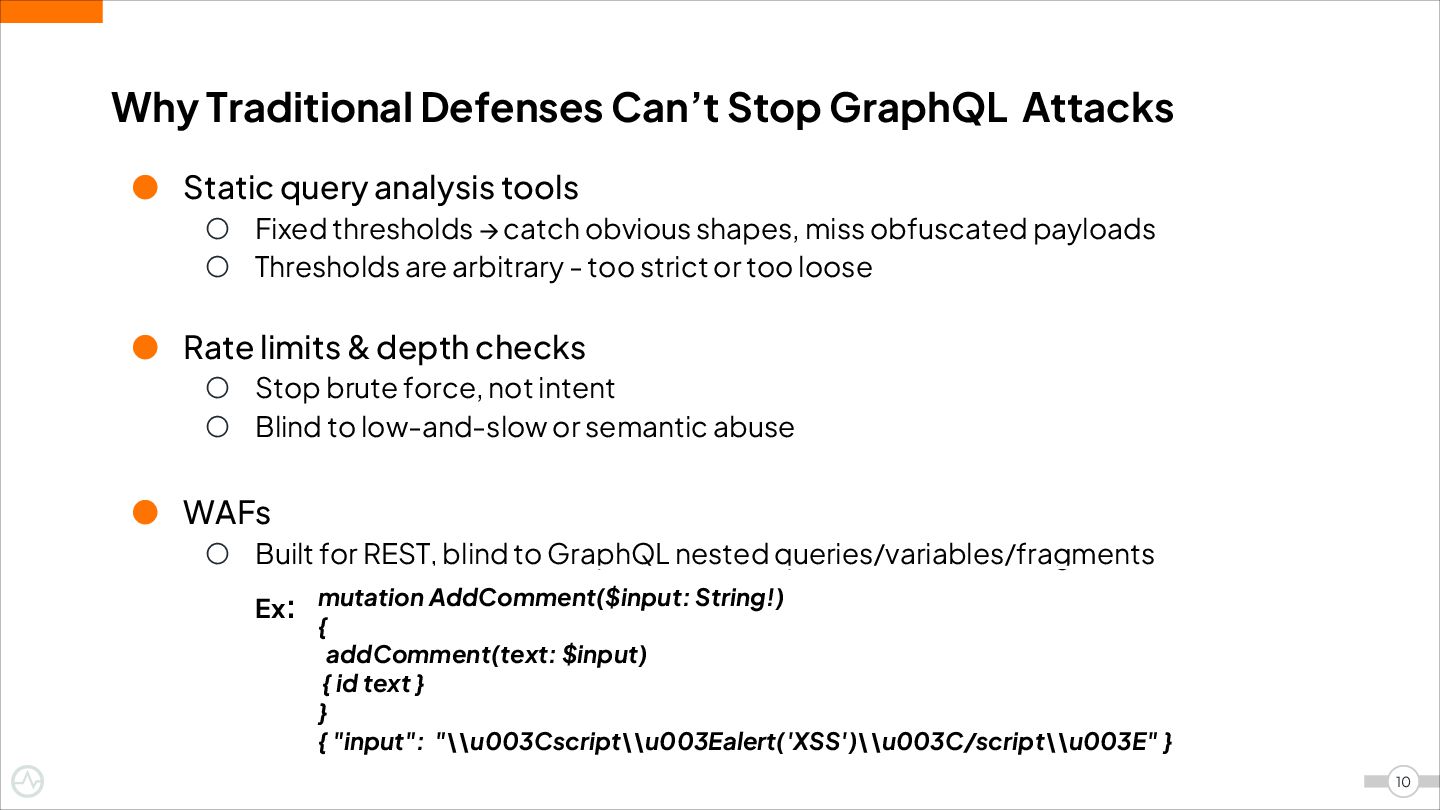
    obvious shapes, miss obfuscated payloads ◦ Thresholds are arbitrary - too strict or too loose • Rate limits & depth checks ◦ Stop brute force, not intent ◦ Blind to low-and-slow or semantic abuse • WAFs ◦ Built for REST, blind to GraphQL nested queries/variables/fragments Ex: Why Traditional Defenses Can’t Stop GraphQL Attacks 10 mutation AddComment($input: String!) { addComment(text: $input) { id text } } { "input": "\\u003Cscript\\u003Ealert('XSS')\\u003C/script\\u003E" }
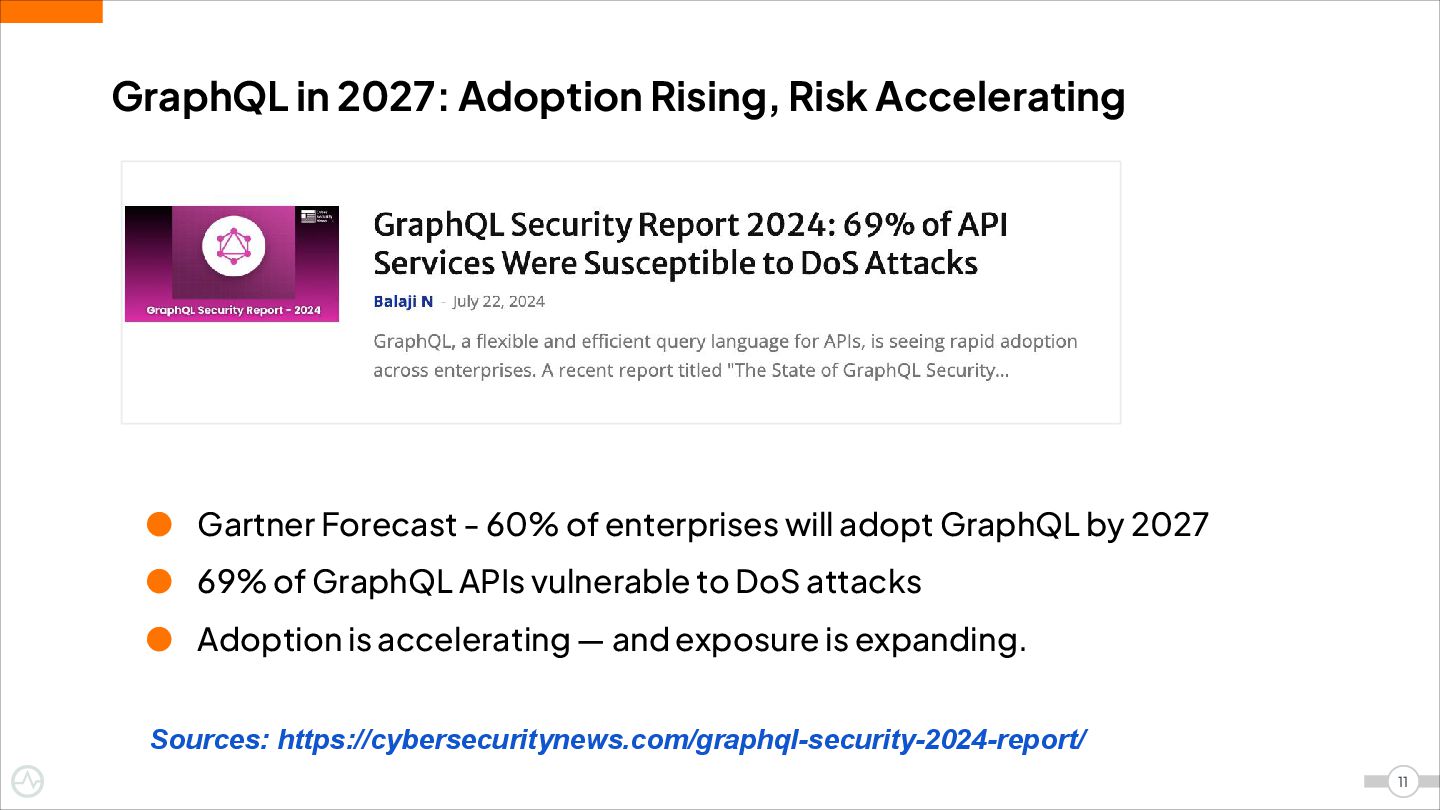
  4. GraphQL in 2027: Adoption Rising, Risk Accelerating 11 Sources: https://cybersecuritynews.com/graphql-security-2024-report/

    • Gartner Forecast - 60% of enterprises will adopt GraphQL by 2027 • 69% of GraphQL APIs vulnerable to DoS attacks • Adoption is accelerating — and exposure is expanding.
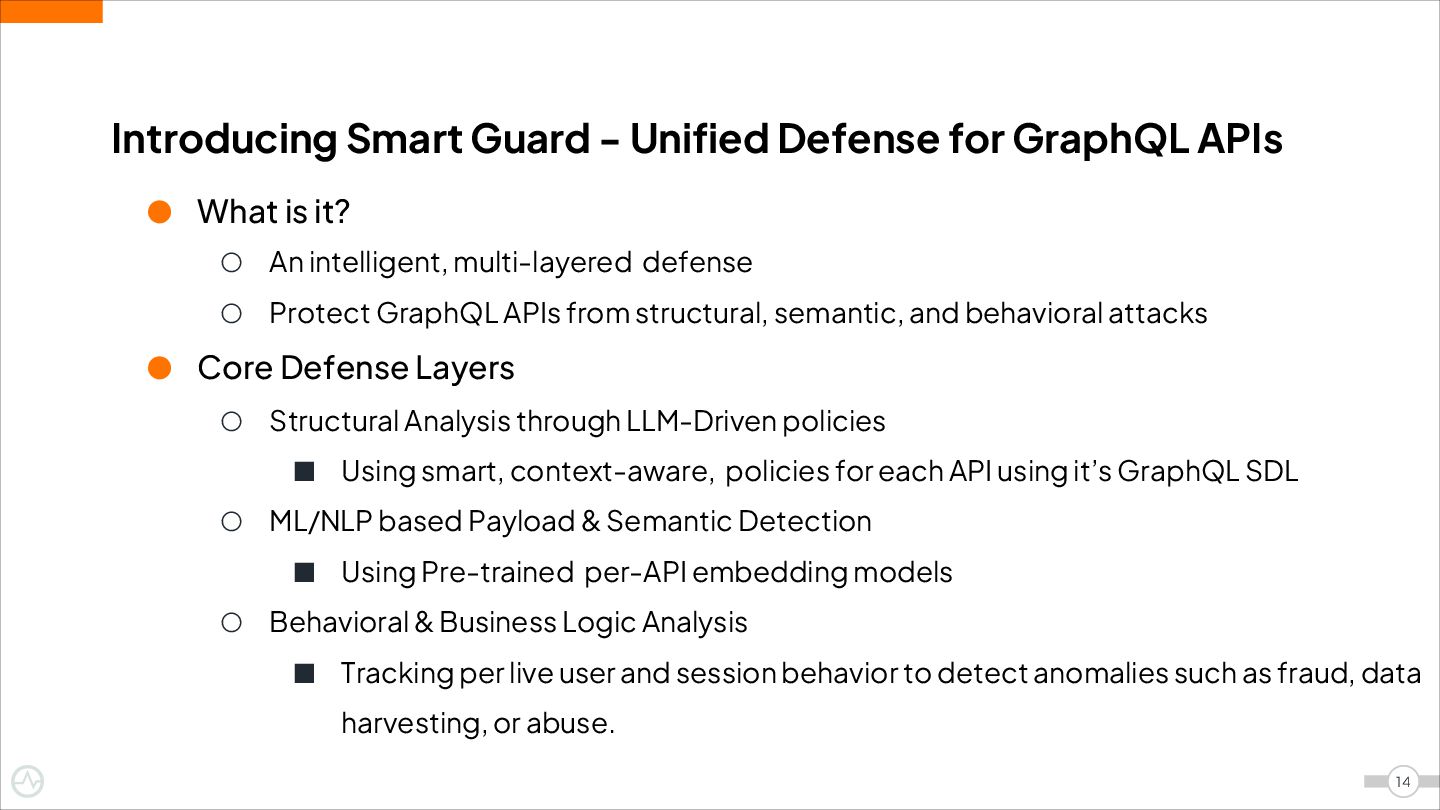
  5. Introducing Smart Guard - Unified Defense for GraphQL APIs 14

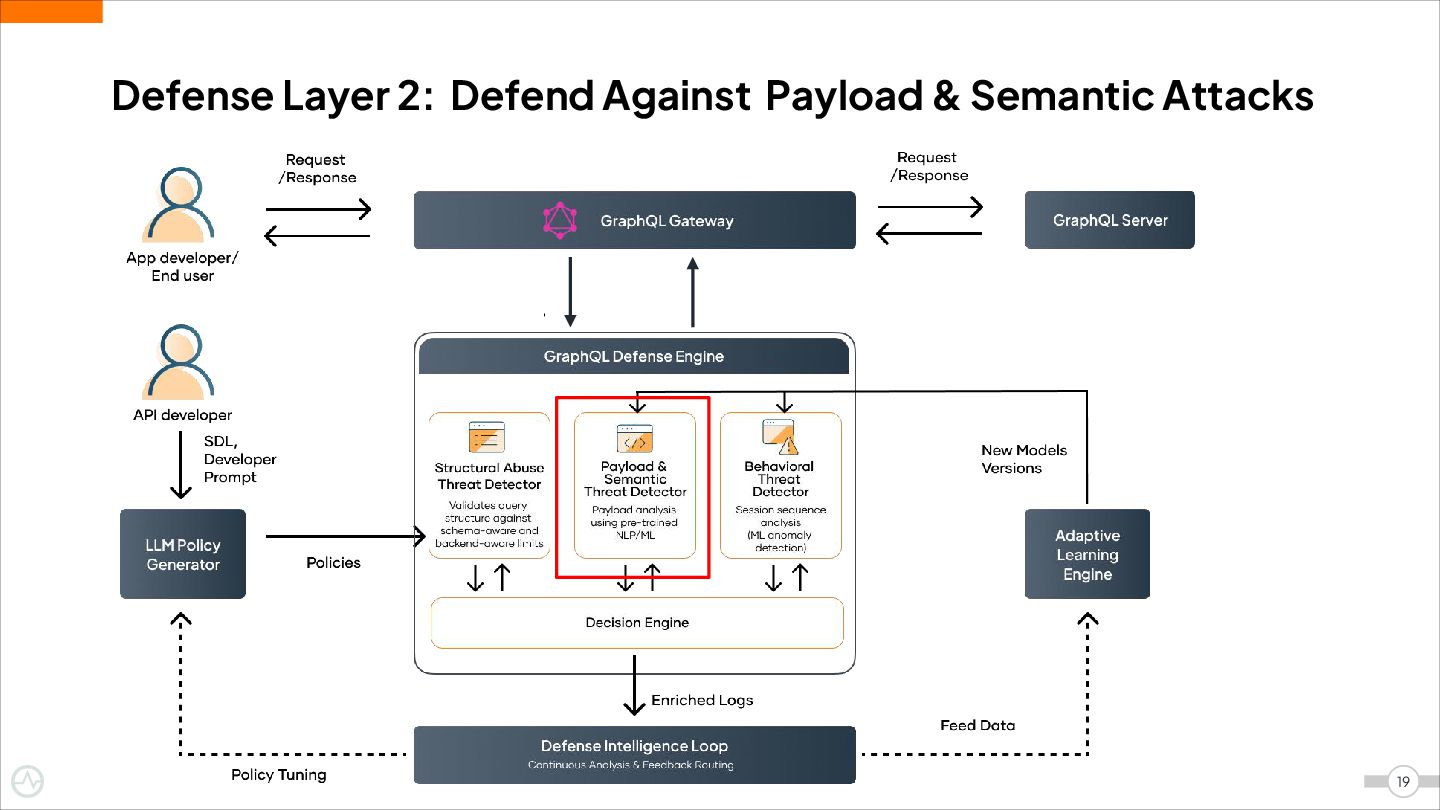
    • What is it? ◦ An intelligent, multi-layered defense ◦ Protect GraphQL APIs from structural, semantic, and behavioral attacks • Core Defense Layers ◦ Structural Analysis through LLM-Driven policies ▪ Using smart, context-aware, policies for each API using it’s GraphQL SDL ◦ ML/NLP based Payload & Semantic Detection ▪ Using Pre-trained per-API embedding models ◦ Behavioral & Business Logic Analysis ▪ Tracking per live user and session behavior to detect anomalies such as fraud, data harvesting, or abuse.
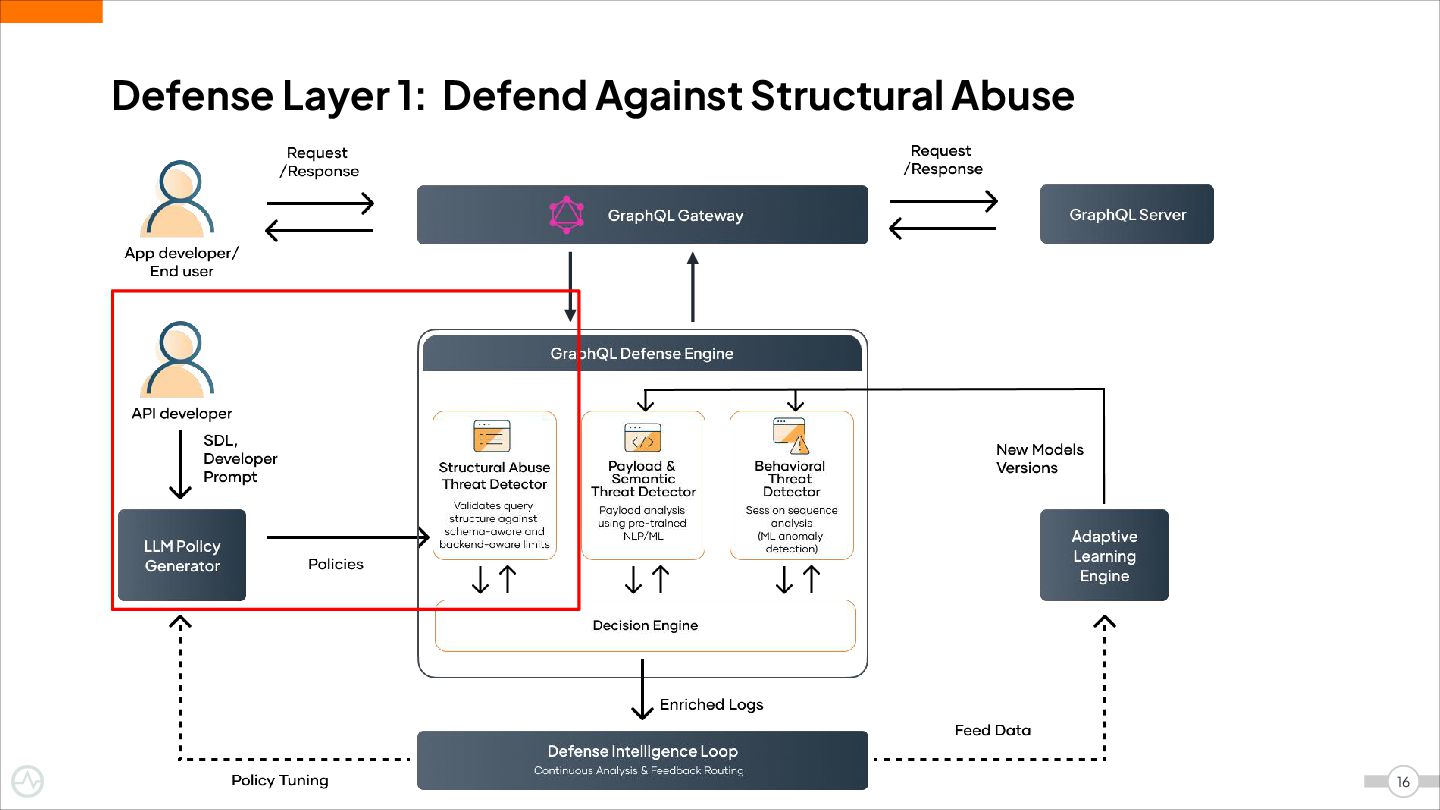
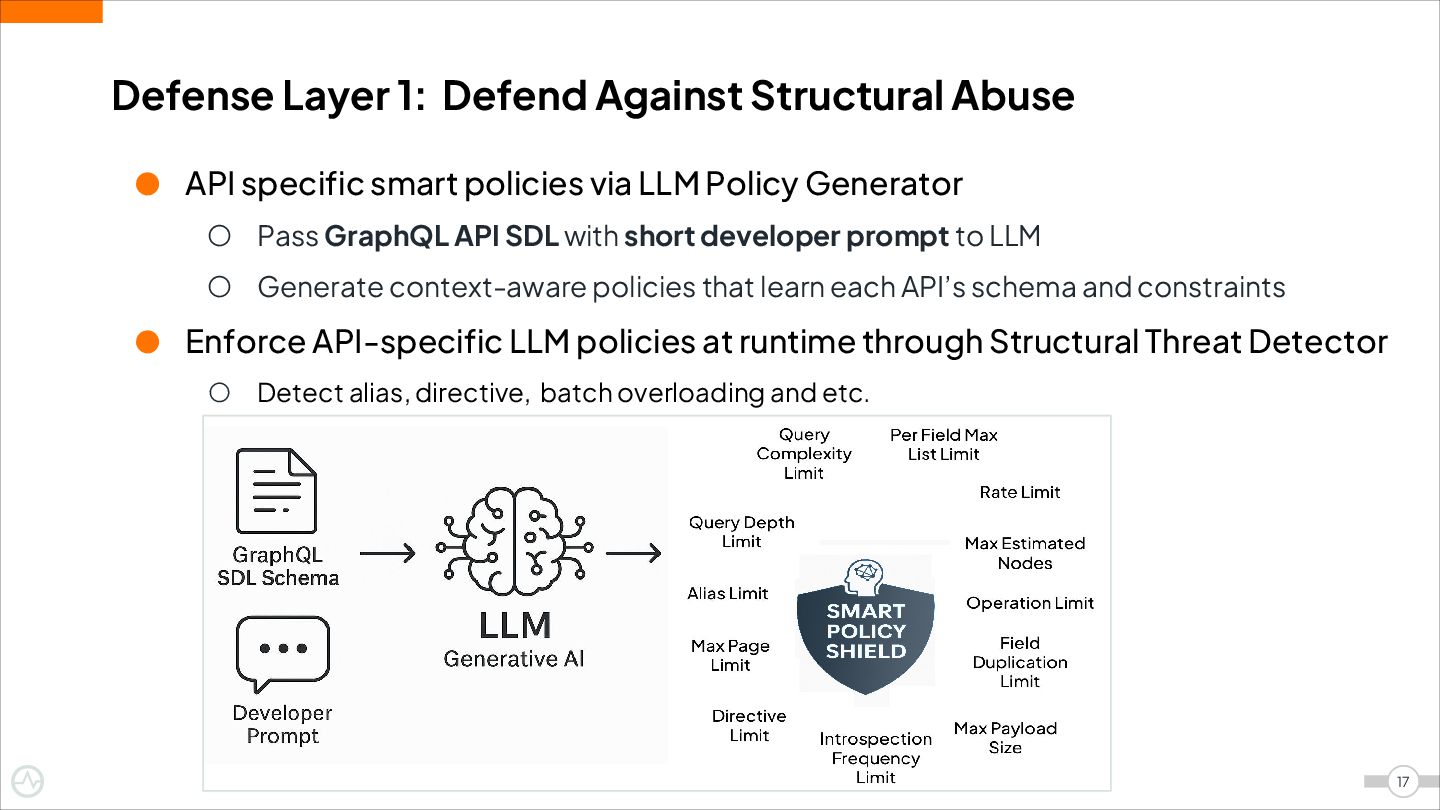
  6. Defense Layer 1: Defend Against Structural Abuse • API specific

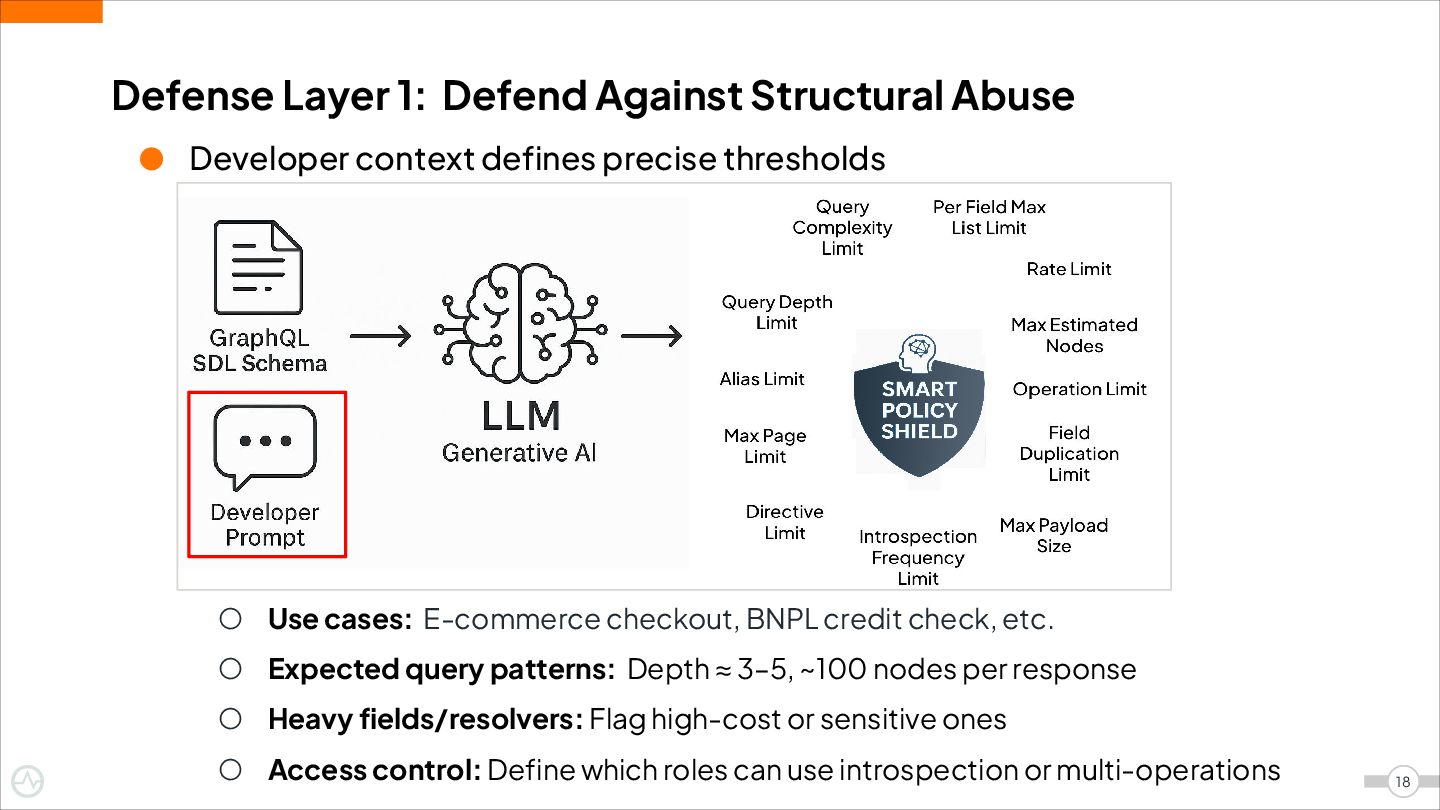
    smart policies via LLM Policy Generator ◦ Pass GraphQL API SDL with short developer prompt to LLM ◦ Generate context-aware policies that learn each API’s schema and constraints • Enforce API-specific LLM policies at runtime through Structural Threat Detector ◦ Detect alias, directive, batch overloading and etc. 17
  7. Defense Layer 1: Defend Against Structural Abuse 18 ◦ Use

    cases: E-commerce checkout, BNPL credit check, etc. ◦ Expected query patterns: Depth ≈ 3–5, ~100 nodes per response ◦ Heavy fields/resolvers: Flag high-cost or sensitive ones ◦ Access control: Define which roles can use introspection or multi-operations • Developer context defines precise thresholds
  8. Defense Layer 2: Defend Against Payload & Semantic Attacks •

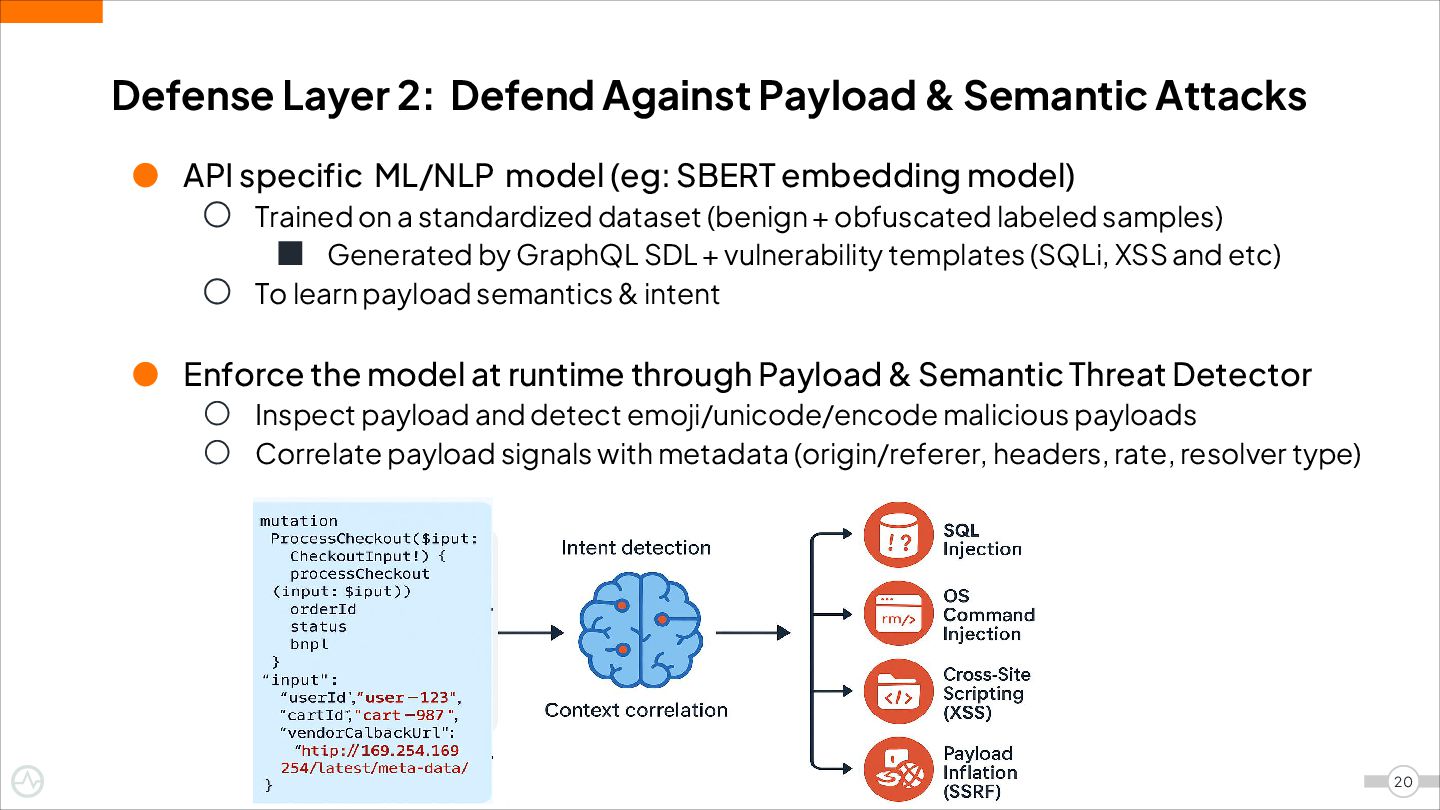
    API specific ML/NLP model (eg: SBERT embedding model) ◦ Trained on a standardized dataset (benign + obfuscated labeled samples) ▪ Generated by GraphQL SDL + vulnerability templates (SQLi, XSS and etc) ◦ To learn payload semantics & intent • Enforce the model at runtime through Payload & Semantic Threat Detector ◦ Inspect payload and detect emoji/unicode/encode malicious payloads ◦ Correlate payload signals with metadata (origin/referer, headers, rate, resolver type) 20
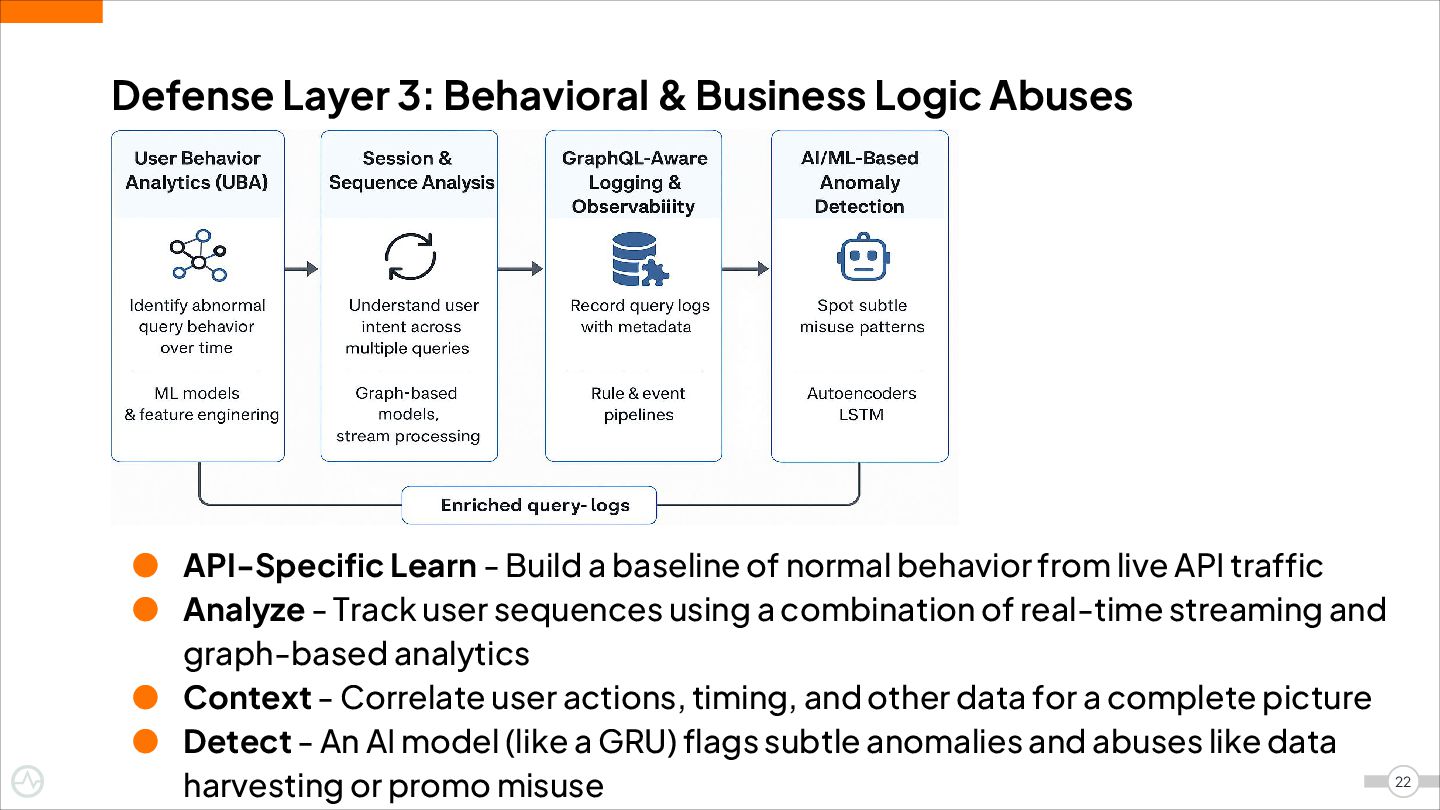
  9. Defense Layer 3: Behavioral & Business Logic Abuses • API-Specific

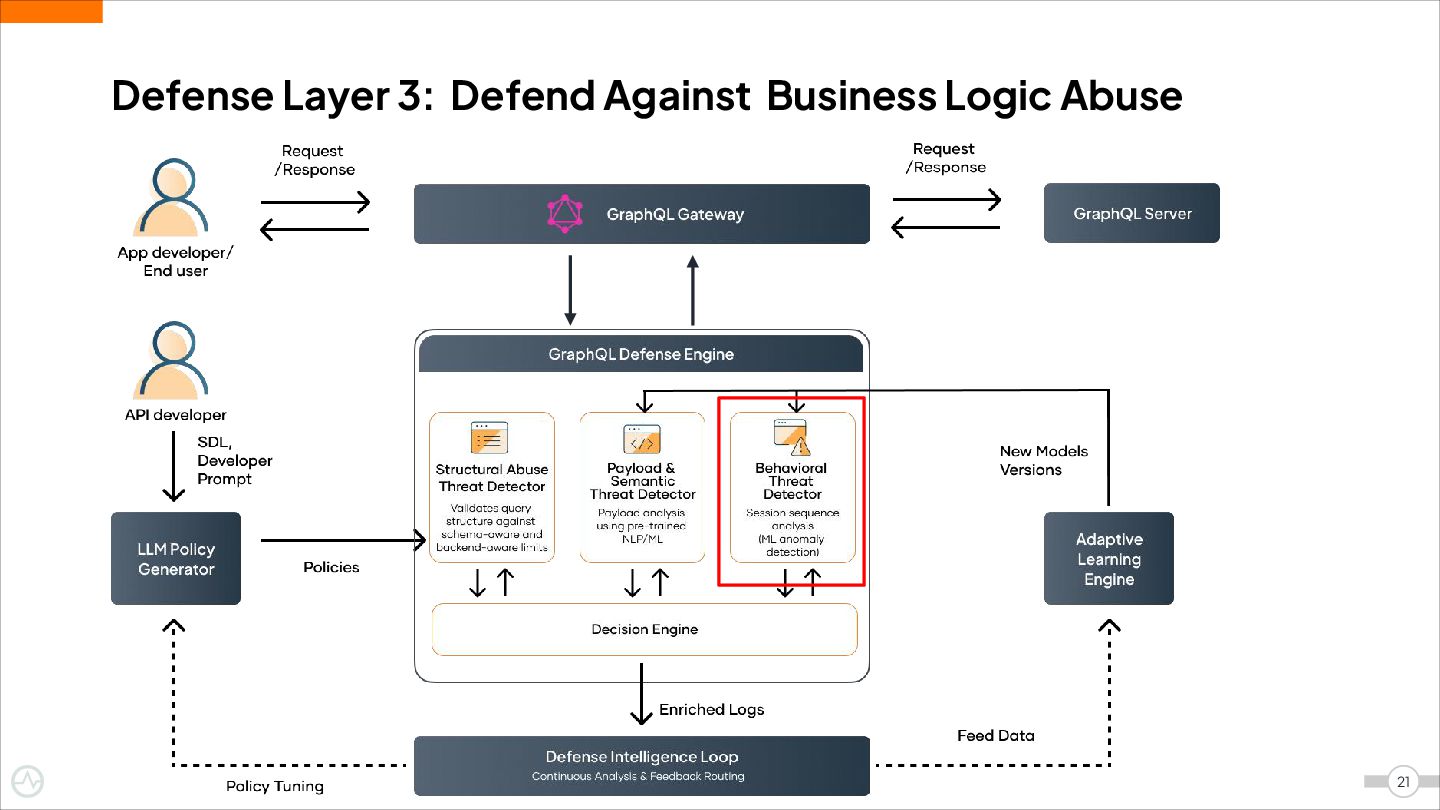
    Learn - Build a baseline of normal behavior from live API traffic • Analyze - Track user sequences using a combination of real-time streaming and graph-based analytics • Context - Correlate user actions, timing, and other data for a complete picture • Detect - An AI model (like a GRU) flags subtle anomalies and abuses like data harvesting or promo misuse 22
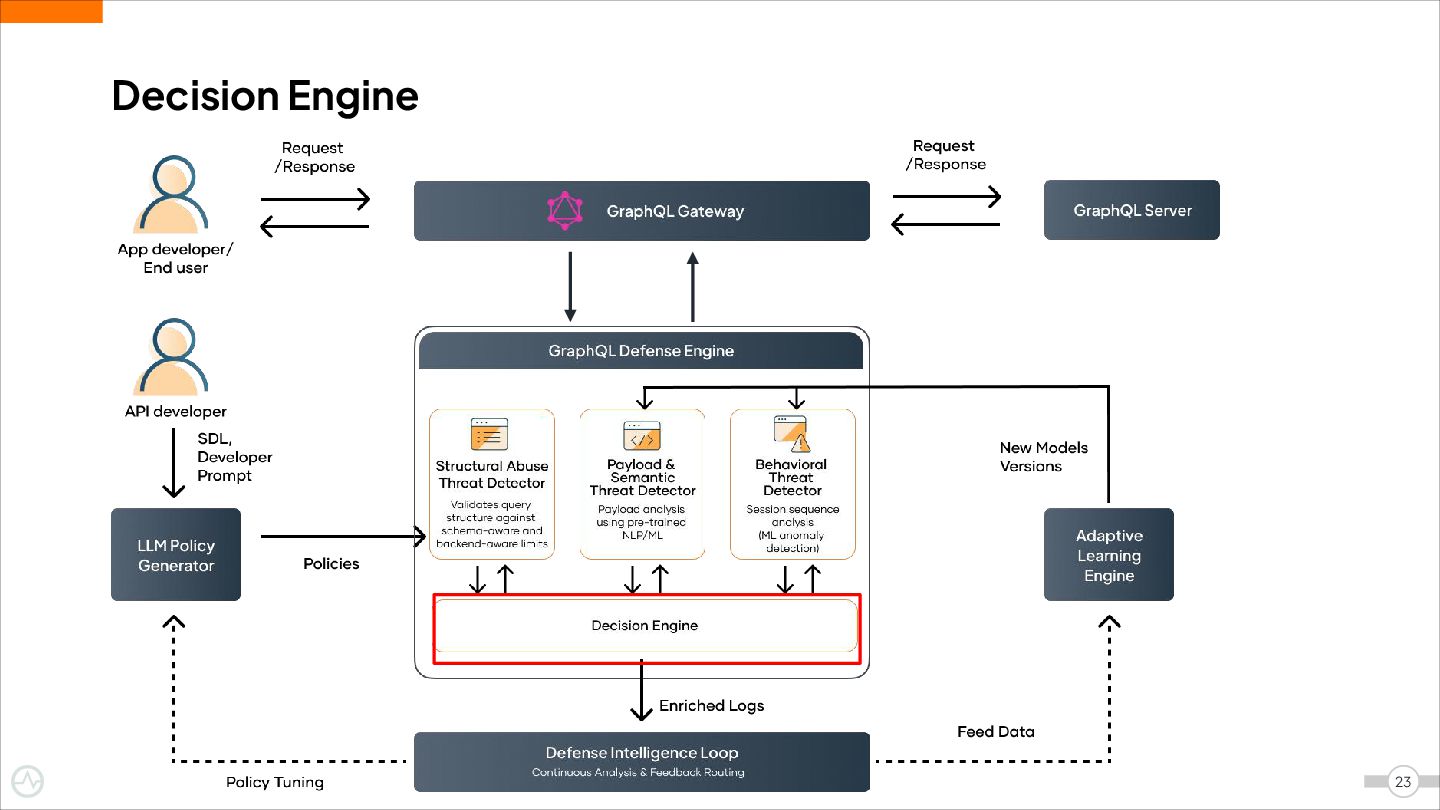
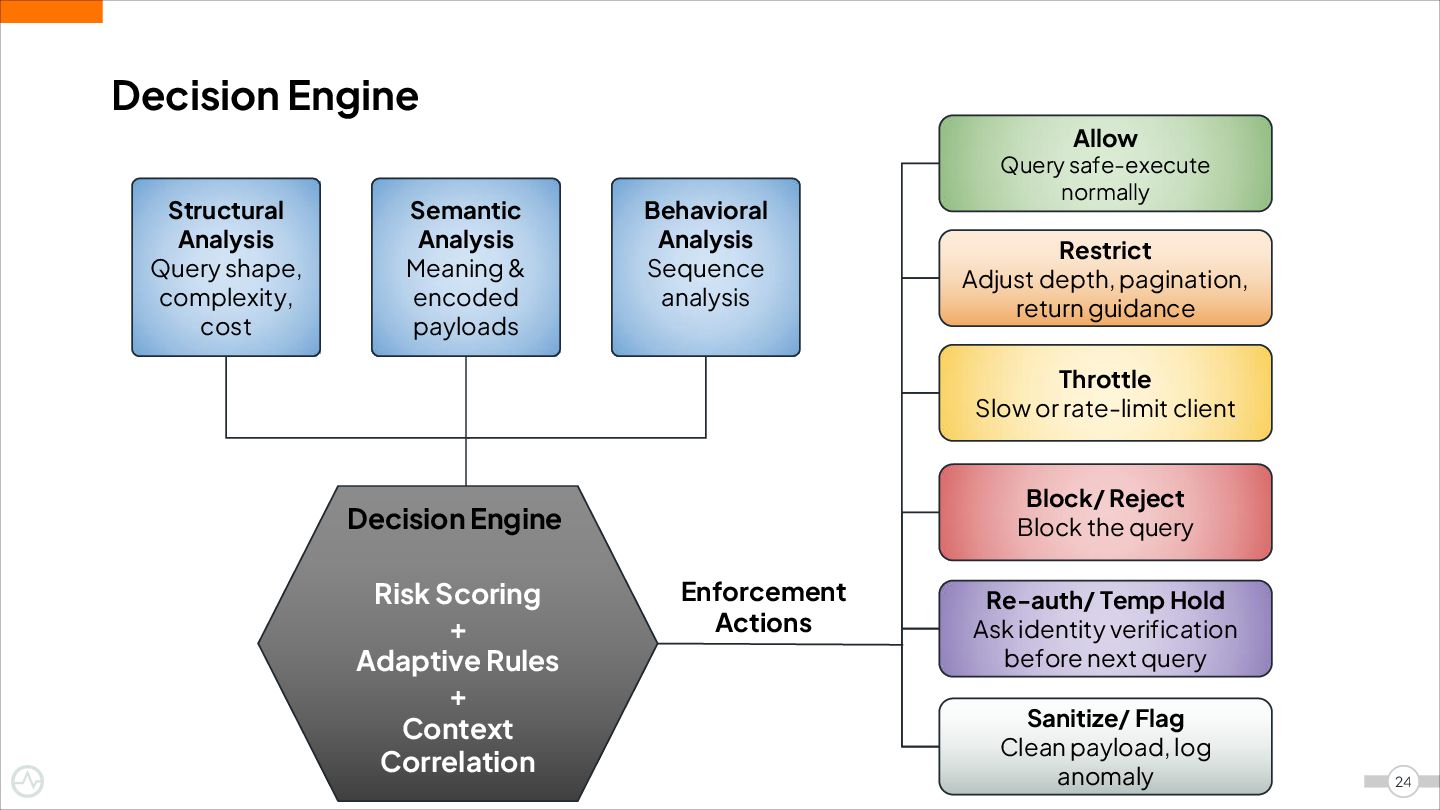
  10. Decision Engine 24 Behavioral Analysis Sequence analysis Allow Query safe-execute

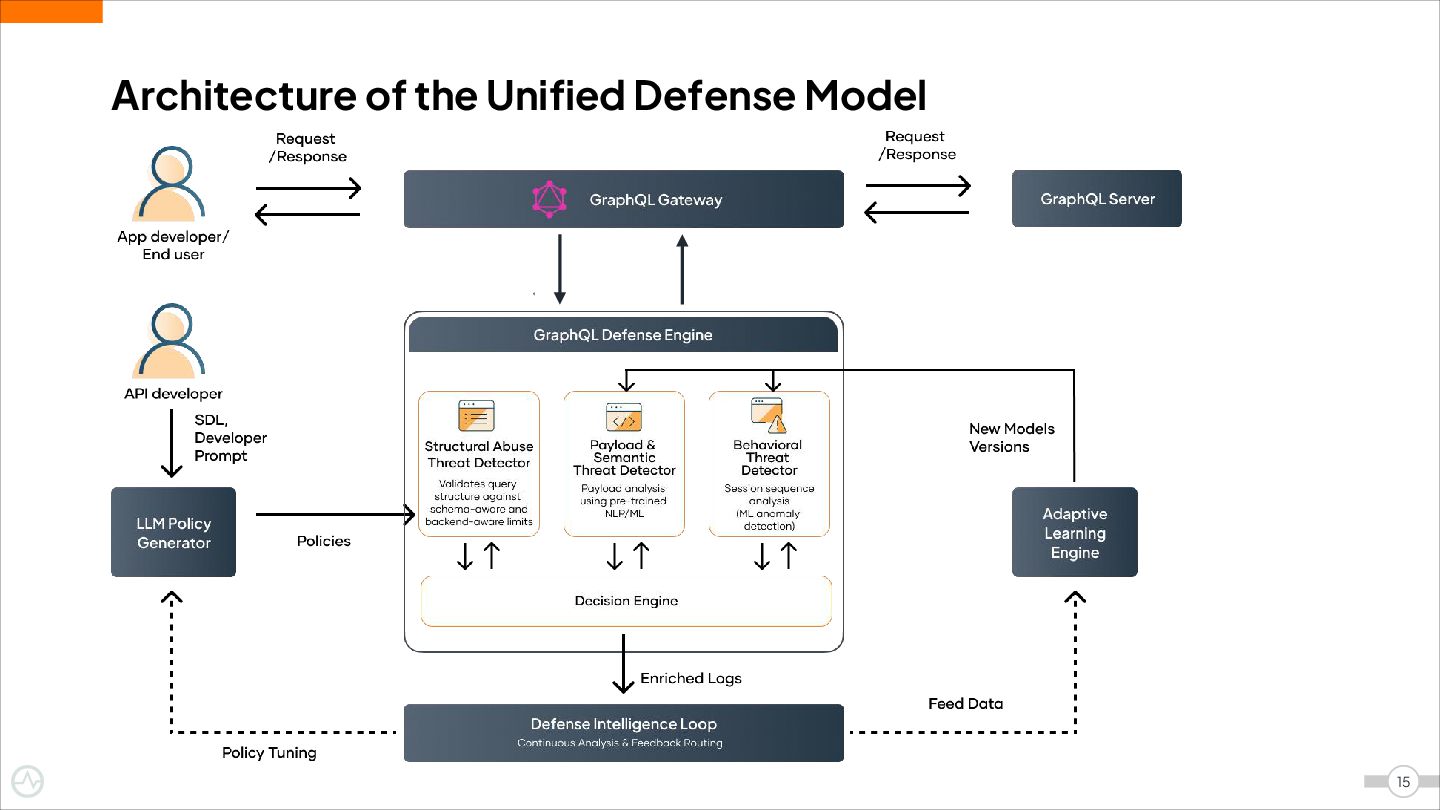
    normally Restrict Adjust depth, pagination, return guidance Throttle Slow or rate-limit client Sanitize/ Flag Clean payload, log anomaly Re-auth/ Temp Hold Ask identity verification before next query Block/ Reject Block the query Enforcement Actions Semantic Analysis Meaning & encoded payloads Structural Analysis Query shape, complexity, cost Risk Scoring + Adaptive Rules + Context Correlation Decision Engine
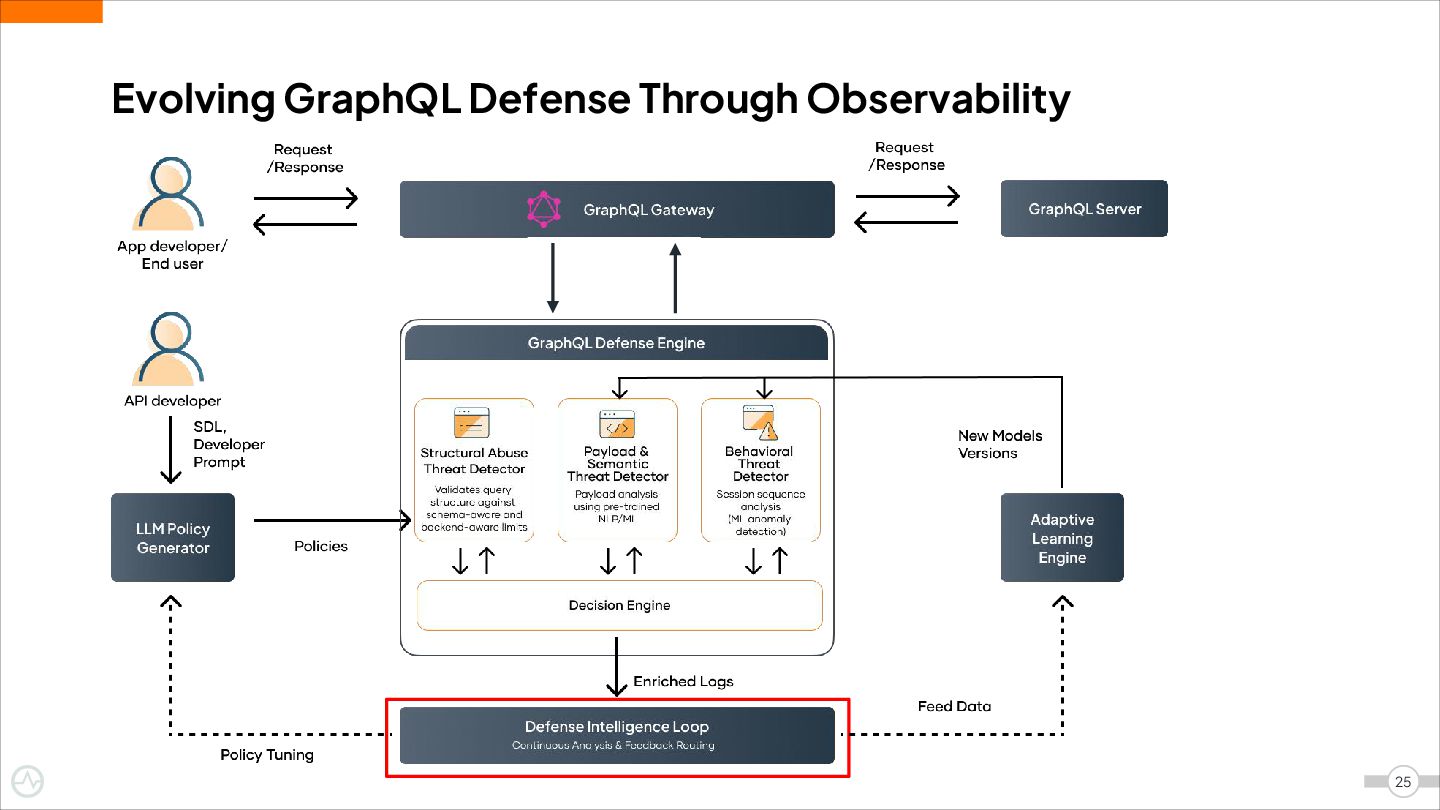
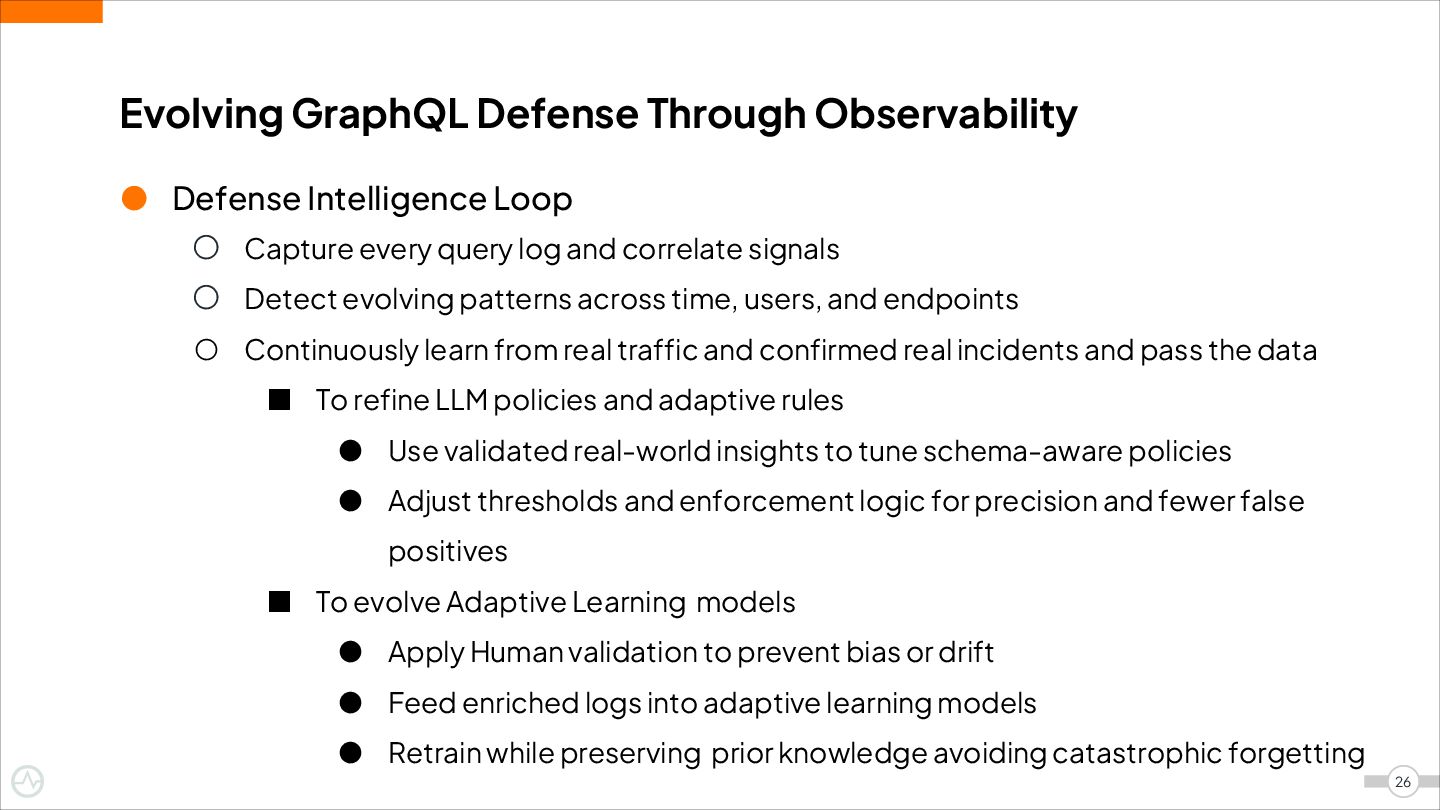
  11. Evolving GraphQL Defense Through Observability • Defense Intelligence Loop ◦

    Capture every query log and correlate signals ◦ Detect evolving patterns across time, users, and endpoints ◦ Continuously learn from real traffic and confirmed real incidents and pass the data ▪ To refine LLM policies and adaptive rules • Use validated real-world insights to tune schema-aware policies • Adjust thresholds and enforcement logic for precision and fewer false positives ▪ To evolve Adaptive Learning models • Apply Human validation to prevent bias or drift • Feed enriched logs into adaptive learning models • Retrain while preserving prior knowledge avoiding catastrophic forgetting 26
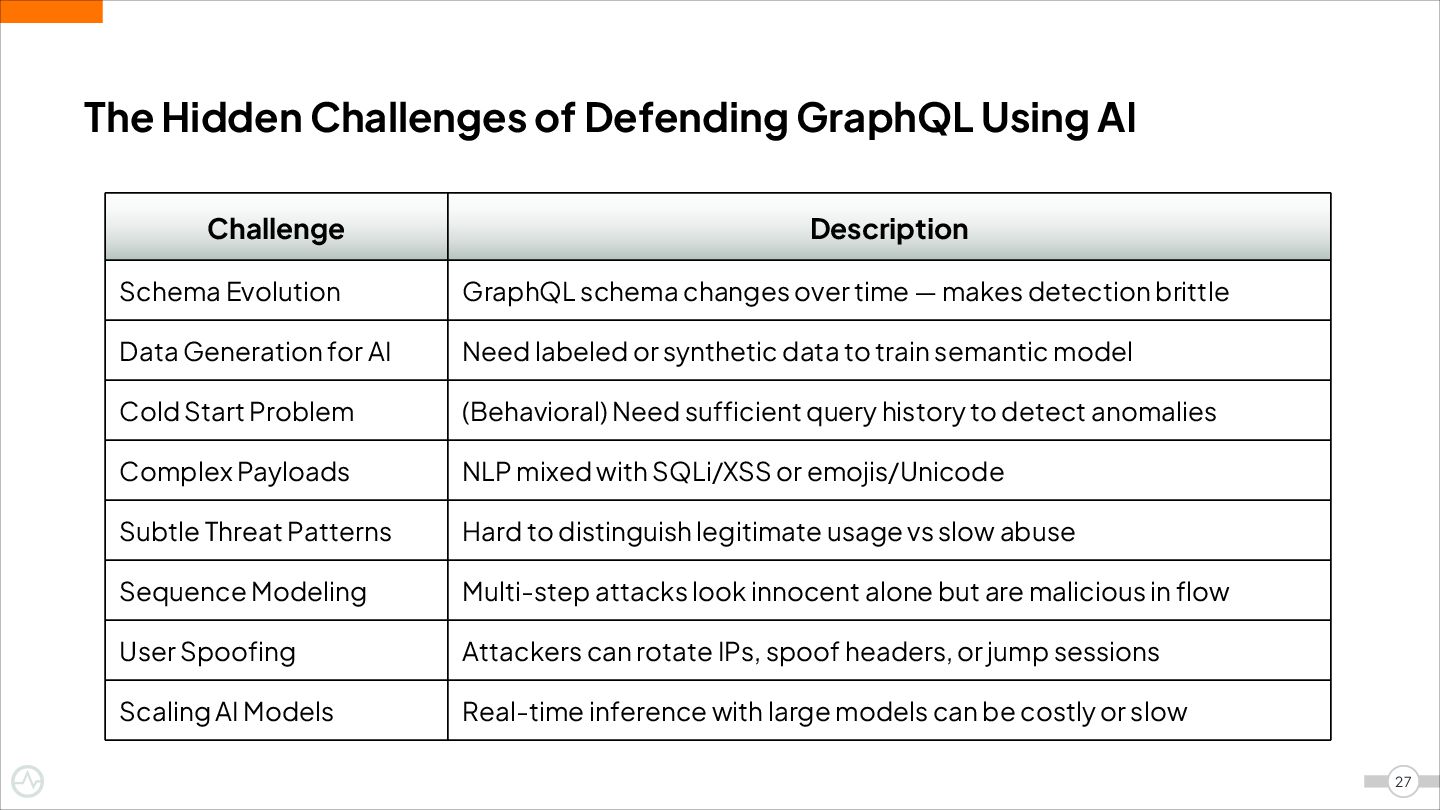
  12. The Hidden Challenges of Defending GraphQL Using AI 27 Challenge

    Description Schema Evolution GraphQL schema changes over time — makes detection brittle Data Generation for AI Need labeled or synthetic data to train semantic model Cold Start Problem (Behavioral) Need sufficient query history to detect anomalies Complex Payloads NLP mixed with SQLi/XSS or emojis/Unicode Subtle Threat Patterns Hard to distinguish legitimate usage vs slow abuse Sequence Modeling Multi-step attacks look innocent alone but are malicious in flow User Spoofing Attackers can rotate IPs, spoof headers, or jump sessions Scaling AI Models Real-time inference with large models can be costly or slow
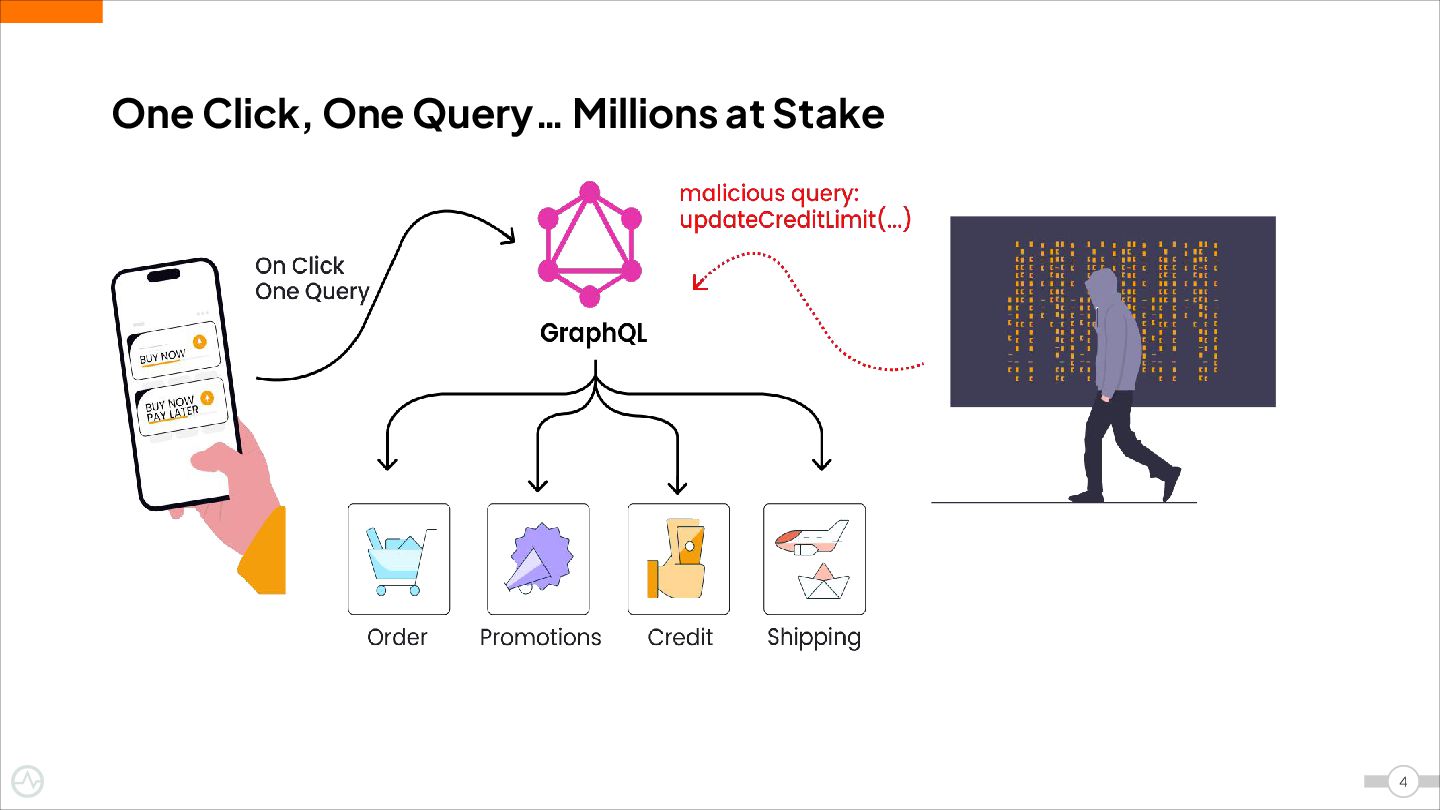
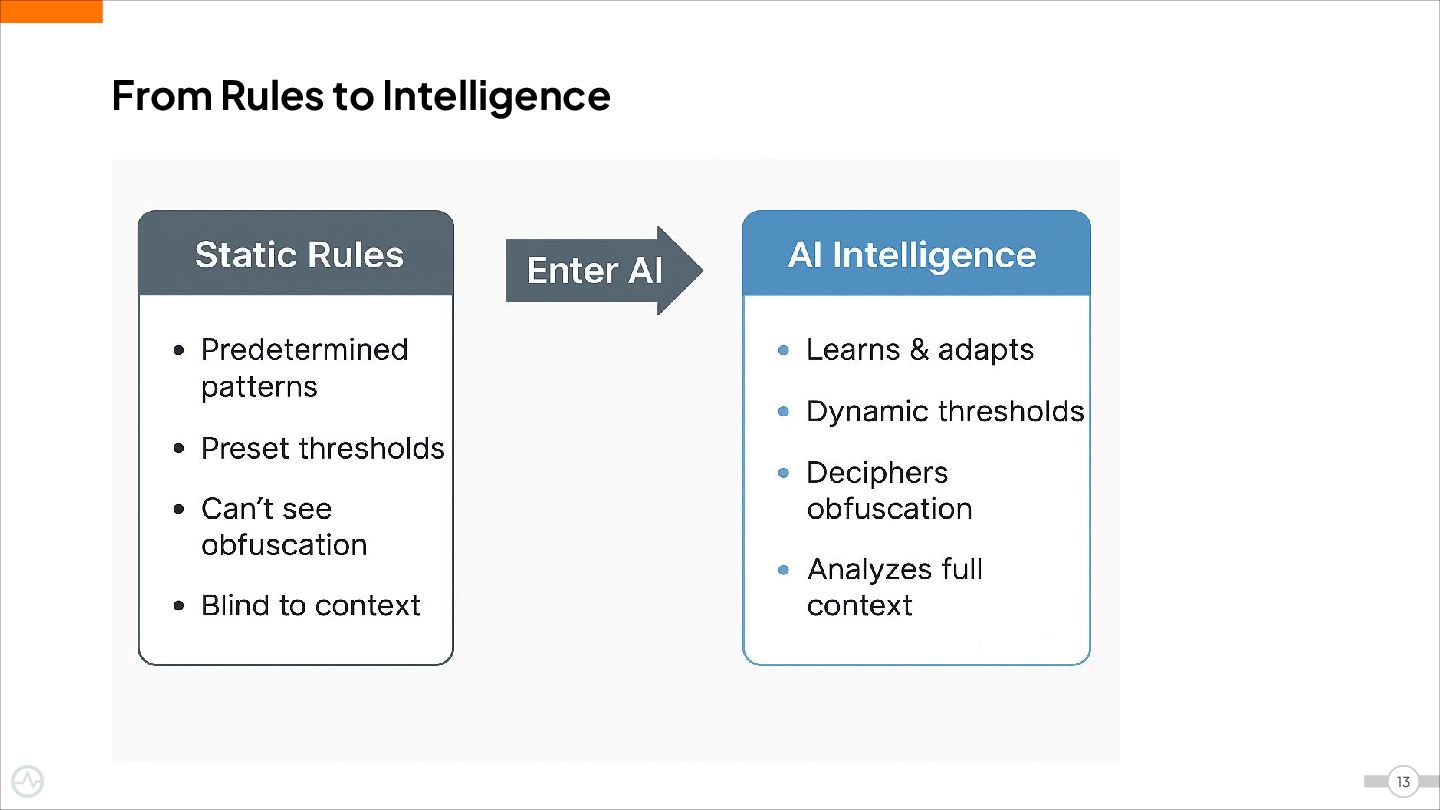
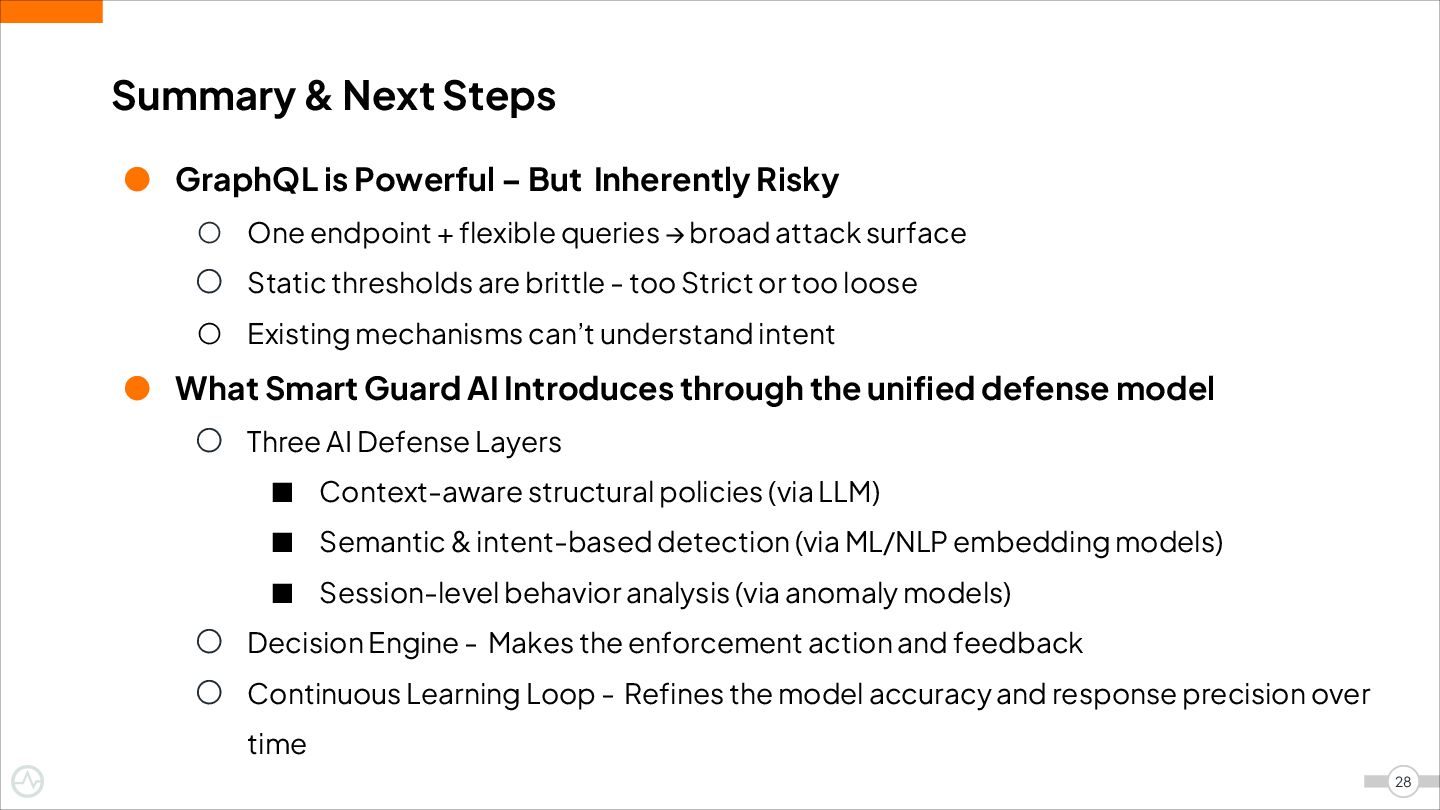
  13. Summary & Next Steps • GraphQL is Powerful – But

    Inherently Risky ◦ One endpoint + flexible queries → broad attack surface ◦ Static thresholds are brittle - too Strict or too loose ◦ Existing mechanisms can’t understand intent • What Smart Guard AI Introduces through the unified defense model ◦ Three AI Defense Layers ▪ Context-aware structural policies (via LLM) ▪ Semantic & intent-based detection (via ML/NLP embedding models) ▪ Session-level behavior analysis (via anomaly models) ◦ Decision Engine - Makes the enforcement action and feedback ◦ Continuous Learning Loop - Refines the model accuracy and response precision over time 28