Upgrade to Pro — share decks privately, control downloads, hide ads and more …

Vision Arena Online: Evaluating Vision Language...

Vision Arena Online: Evaluating Vision Language Models

Evaluating visual AI models, multimodal performance benchmarking, and modern web development strategies. Researching cutting-edge digital technologies to build intelligent software solutions.

Explore full research & guides: https://visionarenaonline.nl

Avatar for Vision Arena

Vision Arena

August 31, 2026

Other Decks in Technology

Transcript

  1. Vision Arena Online: Evaluating Vision Language Models Evaluating Vision Language

    Models (VLMs) used to rely almost entirely on static academic benchmarks like MMMU or MathVista. While these tests measure raw spatial logic, optical character recognition, and image classification, they rarely predict how a model handles everyday human prompts. That shift in evaluation methodology is exactly why access to vision arena online platforms has become vital for developers, AI researchers, and tech enthusiasts tracking multimodal progress. Instead of relying on rigid multiple-choice exams, an online vision arena lets users compare top-tier multimodal AI models through blind, side-by-side testing. By analyzing dynamic leaderboards built on human preference votes, the AI community gets a clear picture of which models perform best in real-world visual tasks.
  2. What Is Vision Arena Online? A vision arena online is

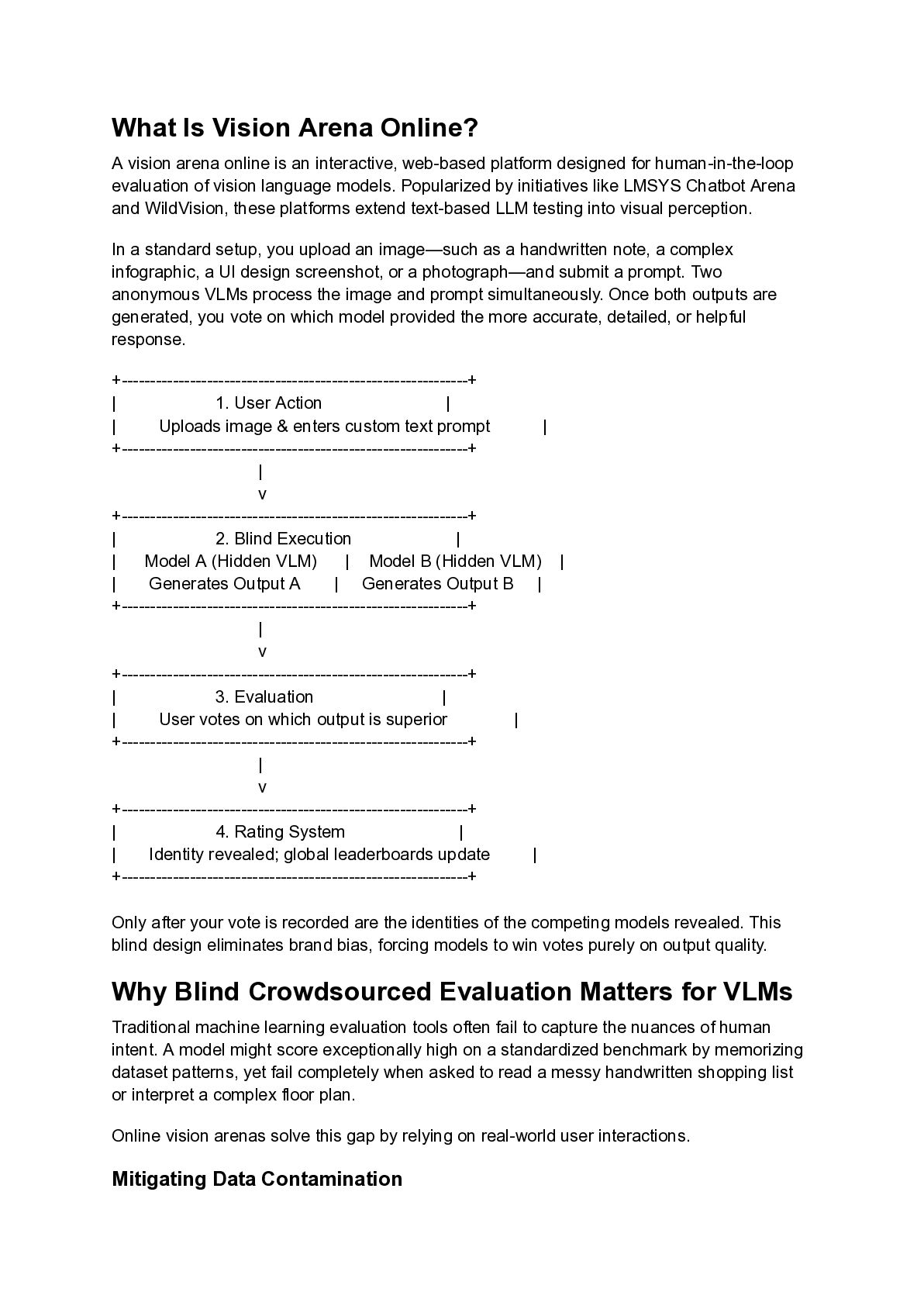
    an interactive, web-based platform designed for human-in-the-loop evaluation of vision language models. Popularized by initiatives like LMSYS Chatbot Arena and WildVision, these platforms extend text-based LLM testing into visual perception. In a standard setup, you upload an image—such as a handwritten note, a complex infographic, a UI design screenshot, or a photograph—and submit a prompt. Two anonymous VLMs process the image and prompt simultaneously. Once both outputs are generated, you vote on which model provided the more accurate, detailed, or helpful response. +-------------------------------------------------------------+ | 1. User Action | | Uploads image & enters custom text prompt | +-------------------------------------------------------------+ | v +-------------------------------------------------------------+ | 2. Blind Execution | | Model A (Hidden VLM) | Model B (Hidden VLM) | | Generates Output A | Generates Output B | +-------------------------------------------------------------+ | v +-------------------------------------------------------------+ | 3. Evaluation | | User votes on which output is superior | +-------------------------------------------------------------+ | v +-------------------------------------------------------------+ | 4. Rating System | | Identity revealed; global leaderboards update | +-------------------------------------------------------------+ Only after your vote is recorded are the identities of the competing models revealed. This blind design eliminates brand bias, forcing models to win votes purely on output quality. Why Blind Crowdsourced Evaluation Matters for VLMs Traditional machine learning evaluation tools often fail to capture the nuances of human intent. A model might score exceptionally high on a standardized benchmark by memorizing dataset patterns, yet fail completely when asked to read a messy handwritten shopping list or interpret a complex floor plan. Online vision arenas solve this gap by relying on real-world user interactions. Mitigating Data Contamination
  3. When static benchmarks sit public on GitHub for months, open-source

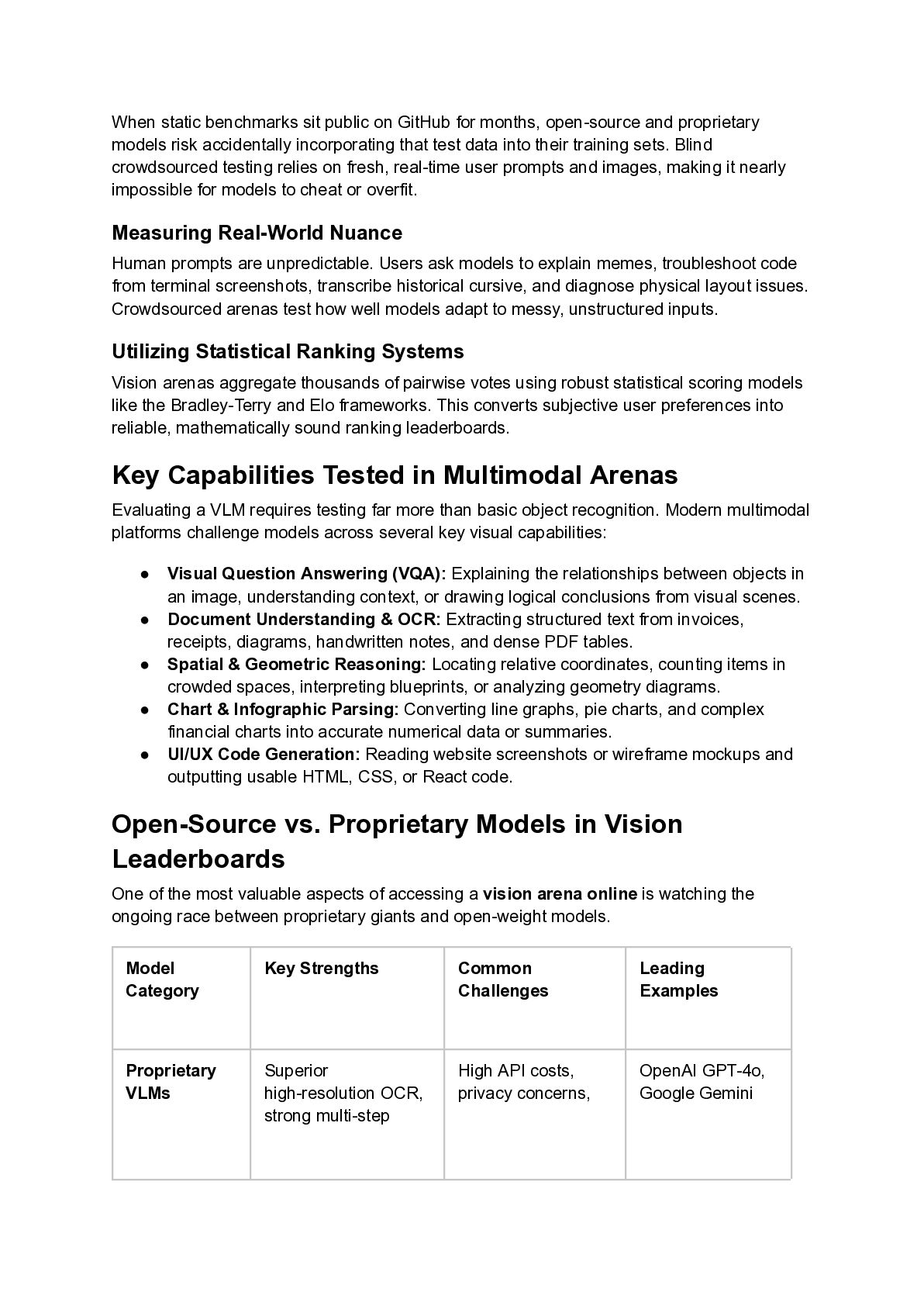
    and proprietary models risk accidentally incorporating that test data into their training sets. Blind crowdsourced testing relies on fresh, real-time user prompts and images, making it nearly impossible for models to cheat or overfit. Measuring Real-World Nuance Human prompts are unpredictable. Users ask models to explain memes, troubleshoot code from terminal screenshots, transcribe historical cursive, and diagnose physical layout issues. Crowdsourced arenas test how well models adapt to messy, unstructured inputs. Utilizing Statistical Ranking Systems Vision arenas aggregate thousands of pairwise votes using robust statistical scoring models like the Bradley-Terry and Elo frameworks. This converts subjective user preferences into reliable, mathematically sound ranking leaderboards. Key Capabilities Tested in Multimodal Arenas Evaluating a VLM requires testing far more than basic object recognition. Modern multimodal platforms challenge models across several key visual capabilities: •​ Visual Question Answering (VQA): Explaining the relationships between objects in an image, understanding context, or drawing logical conclusions from visual scenes. •​ Document Understanding & OCR: Extracting structured text from invoices, receipts, diagrams, handwritten notes, and dense PDF tables. •​ Spatial & Geometric Reasoning: Locating relative coordinates, counting items in crowded spaces, interpreting blueprints, or analyzing geometry diagrams. •​ Chart & Infographic Parsing: Converting line graphs, pie charts, and complex financial charts into accurate numerical data or summaries. •​ UI/UX Code Generation: Reading website screenshots or wireframe mockups and outputting usable HTML, CSS, or React code. Open-Source vs. Proprietary Models in Vision Leaderboards One of the most valuable aspects of accessing a vision arena online is watching the ongoing race between proprietary giants and open-weight models. Model Category Key Strengths Common Challenges Leading Examples Proprietary VLMs Superior high-resolution OCR, strong multi-step High API costs, privacy concerns, OpenAI GPT-4o, Google Gemini
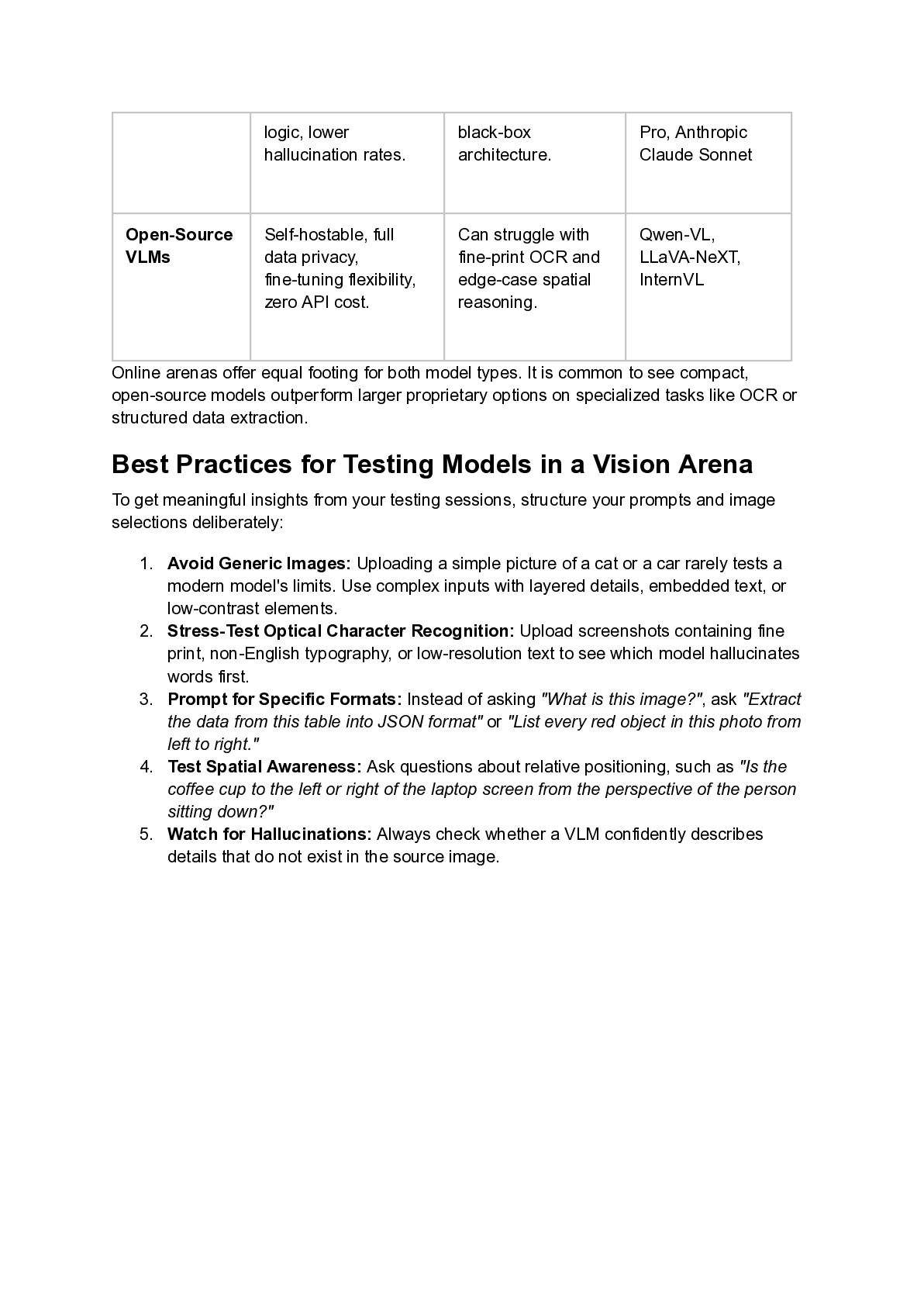
  4. Open-Source VLMs logic, lower hallucination rates. black-box architecture. Pro, Anthropic

    Claude Sonnet Self-hostable, full data privacy, fine-tuning flexibility, zero API cost. Can struggle with fine-print OCR and edge-case spatial reasoning. Qwen-VL, LLaVA-NeXT, InternVL Online arenas offer equal footing for both model types. It is common to see compact, open-source models outperform larger proprietary options on specialized tasks like OCR or structured data extraction. Best Practices for Testing Models in a Vision Arena To get meaningful insights from your testing sessions, structure your prompts and image selections deliberately: 1.​ Avoid Generic Images: Uploading a simple picture of a cat or a car rarely tests a modern model's limits. Use complex inputs with layered details, embedded text, or low-contrast elements. 2.​ Stress-Test Optical Character Recognition: Upload screenshots containing fine print, non-English typography, or low-resolution text to see which model hallucinates words first. 3.​ Prompt for Specific Formats: Instead of asking "What is this image?", ask "Extract the data from this table into JSON format" or "List every red object in this photo from left to right." 4.​ Test Spatial Awareness: Ask questions about relative positioning, such as "Is the coffee cup to the left or right of the laptop screen from the perspective of the person sitting down?" 5.​ Watch for Hallucinations: Always check whether a VLM confidently describes details that do not exist in the source image.
  5. 6.​ Limitations of Online Vision Arenas While crowdsourced arena testing

    provides vital real-world signals, it is not without drawbacks: •​ Subjective Voting Bias: Casual voters may prefer longer, visually detailed answers over concise, accurate ones—a phenomenon known as length bias. •​ Image Privacy Concerns: Never upload confidential personal documents, trade secrets, or sensitive personal data to public arena web applications. •​ Latency Variance: A model that processes images slowly might lose votes from impatient users, even if its final response is more accurate. •​ Cost Constraints for Operators: Running dozens of high-end VLMs side-by-side requires substantial GPU infrastructure and API funding. Frequently Asked Questions
  6. 1. What is the difference between Chatbot Arena and Vision

    Arena? Standard chatbot arenas evaluate text-only LLMs on writing, coding, and general conversation. A vision arena incorporates an image input layer, testing how models process visual data alongside text prompts. 2. Are vision arena online platforms free to use? Yes, popular public platforms hosted by LMSYS, Hugging Face, or research labs are generally free for community testing and voting. 3. How do vision arenas prevent voters from picking a specific brand? The evaluation process is strictly double-blind. The model names are hidden while outputs are generated and reviewed, appearing only after a vote is submitted. 4. Can open-source models compete with proprietary models in vision tasks? Yes. While proprietary models often lead overall rankings, recent open-weight models like Qwen-VL and InternVL frequently match or beat commercial APIs in specific visual tasks like document parsing and OCR. 5. Why do vision arena rankings change frequently? Leaderboards update continuously as new models are released, existing models receive fine-tuning updates, and community members contribute thousands of new vote samples.