Upgrade to Pro — share decks privately, control downloads, hide ads and more …

Papers We Love Kyiv Spring 2018 - Parsing with ...

Papers We Love Kyiv Spring 2018 - Parsing with derivatives

Avatar for Artem Mishchenko

Artem Mishchenko

April 05, 2018

Other Decks in Programming

Transcript

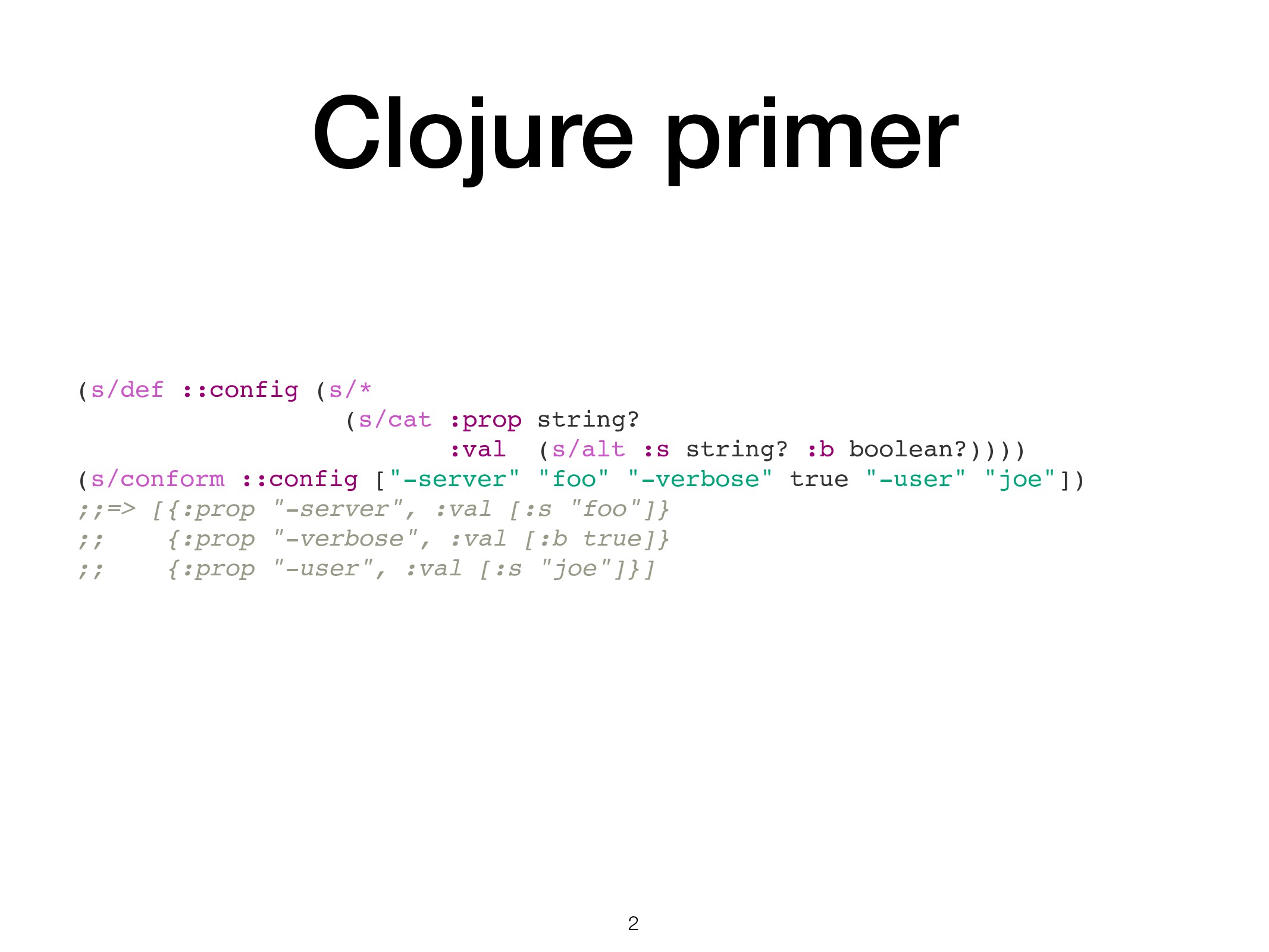
  1. Clojure primer (s/def ::config (s/* (s/cat :prop string? :val (s/alt

    :s string? :b boolean?)))) (s/conform ::config ["-server" "foo" "-verbose" true "-user" "joe"]) ;;=> [{:prop "-server", :val [:s "foo"]} ;; {:prop "-verbose", :val [:b true]} ;; {:prop "-user", :val [:s "joe"]}] !2
  2. Agenda • Preliminary • Brzozowski’s derivative • Derivatives of context-free

    languages • Parsers and parser combinators • Derivatives of parser combinators • Performance and complexity • Compaction !3
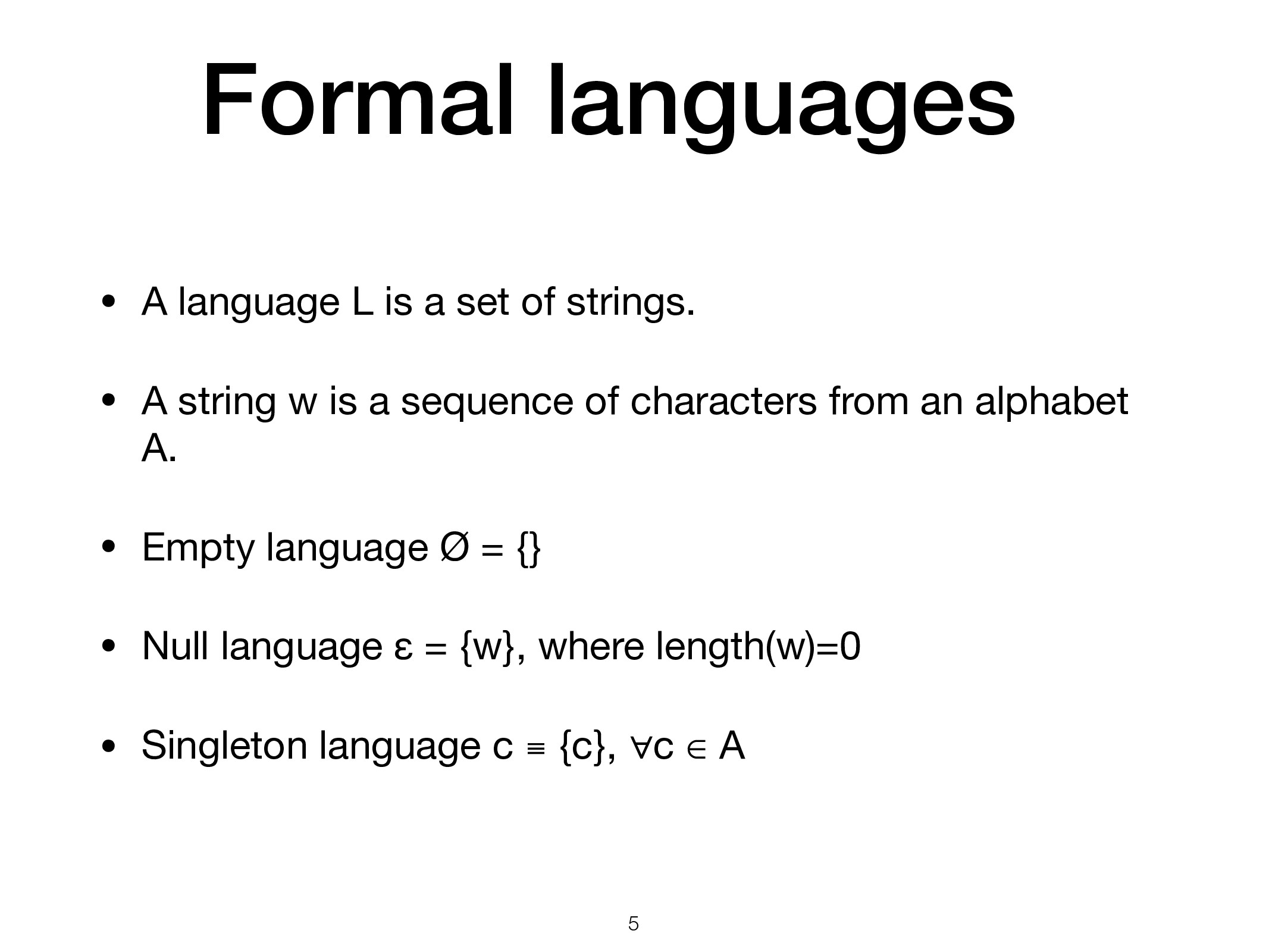
  3. Formal languages • A language L is a set of

    strings. • A string w is a sequence of characters from an alphabet A. • Empty language Ø = {} • Null language ε = {w}, where length(w)=0 • Singleton language c ≡ {c}, ∀c ∈ A !5
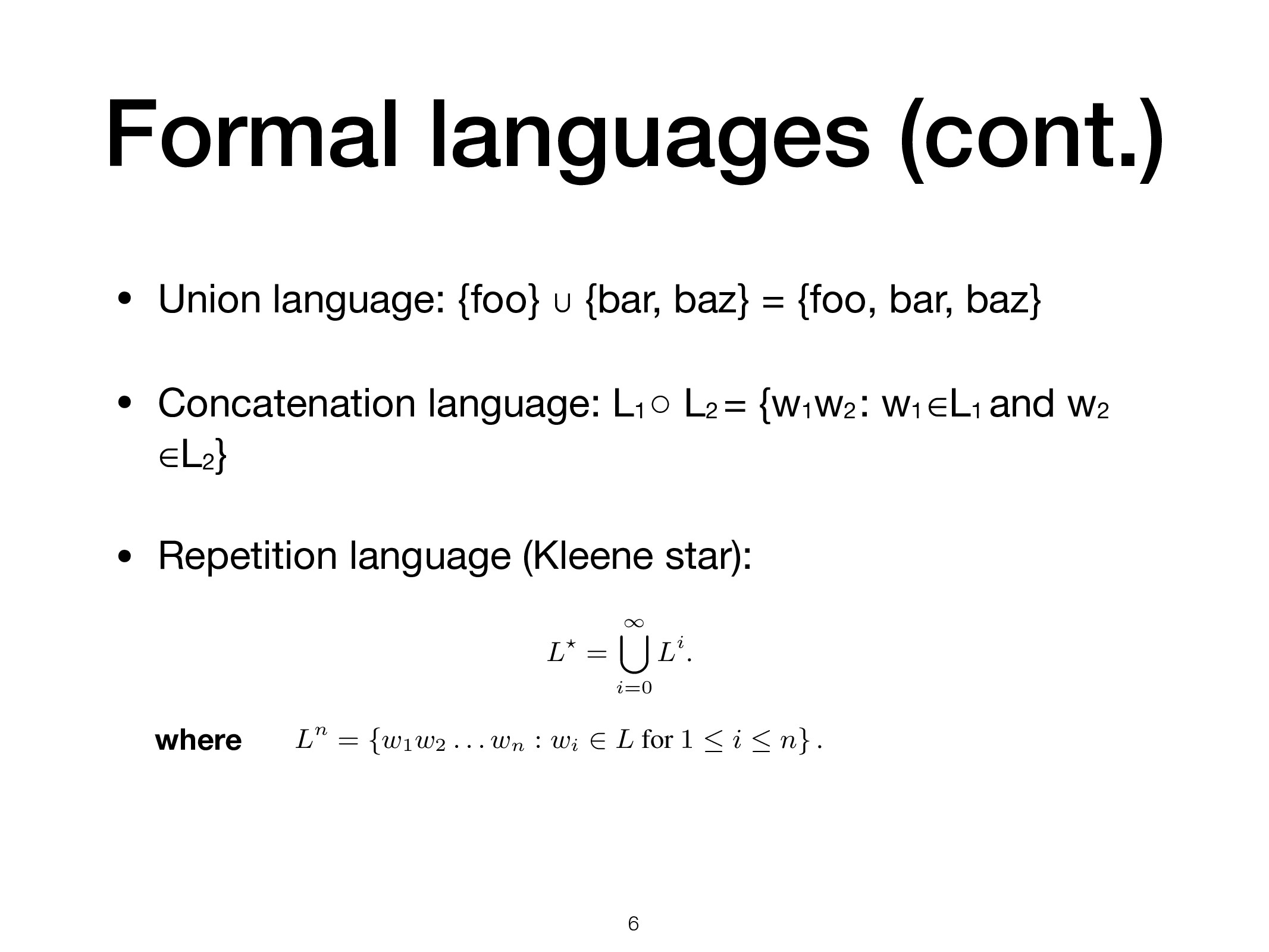
  4. Formal languages (cont.) • Union language: {foo} ∪ {bar, baz}

    = {foo, bar, baz} • Concatenation language: L1 ◦ L2 = {w1 w2 : w1 ∈L1 and w2 ∈L2 } • Repetition language (Kleene star): the null string. Given an alphabet A, there is a singleton language for every char- acter c in that alphabet. Where it is clear from context, we use the character itself to denote that language; that is: c ⌘ {c} . 2.1 Operations on languages Because languages are sets, set operations like union apply: {foo} [ {bar, baz} = {foo, bar, baz} . Concatenation ( ) appends the product of the two languages: L1 L2 = {w1w2 : w1 2 L1 and w2 2 L2 } . The nth power of a language is the set of strings of n consecutive words from that language: L n = {w1w2 . . . wn : wi 2 L for 1  i  n} . And, the non-empty repetition of a language (its Kleene star) is the infinite union of all its powers: L ? = 1 [ i=0 L i. 2.2 Regular languages and context-free languages If a language is non-recursively definable from atomic sets using only union, concatenation and repetition, that language is regular. If we allow mutually recursive definitions, then the set of de- scribable languages is exactly the set of context-free languages. (Even without Kleene star, the resulting set of languages is context- free.) We assume, of course, a least-fixed-point interpretation of 1. First, retain only 2. Second, chop th Formally: Examples Db Df Da 3.1 Recognition w The simplicity of th can compute succes ward to determine thanks to the follow To determine memb character, and check yes, the original stri 3.2 A recursive d Brzozowski noted guages, and admits where Or, using C notation for strings, ✏ = {""}. For convenience, we may use the symbol ✏ to refer to both the null language and the null string. Given an alphabet A, there is a singleton language for every char- acter c in that alphabet. Where it is clear from context, we use the character itself to denote that language; that is: c ⌘ {c} . 2.1 Operations on languages Because languages are sets, set operations like union apply: {foo} [ {bar, baz} = {foo, bar, baz} . Concatenation ( ) appends the product of the two languages: L1 L2 = {w1w2 : w1 2 L1 and w2 2 L2 } . The nth power of a language is the set of strings of n consecutive words from that language: L n = {w1w2 . . . wn : wi 2 L for 1  i  n} . And, the non-empty repetition of a language (its Kleene star) is the infinite union of all its powers: L ? = 1 [ i=0 L i. of a language L with resp has been “filtered” and “ 1. First, retain only the 2. Second, chop that fir Formally: Dc( Examples Db {fo Df {fo Da {fo 3.1 Recognition with The simplicity of the der can compute successive ward to determine the m thanks to the following p cw To determine membersh !6
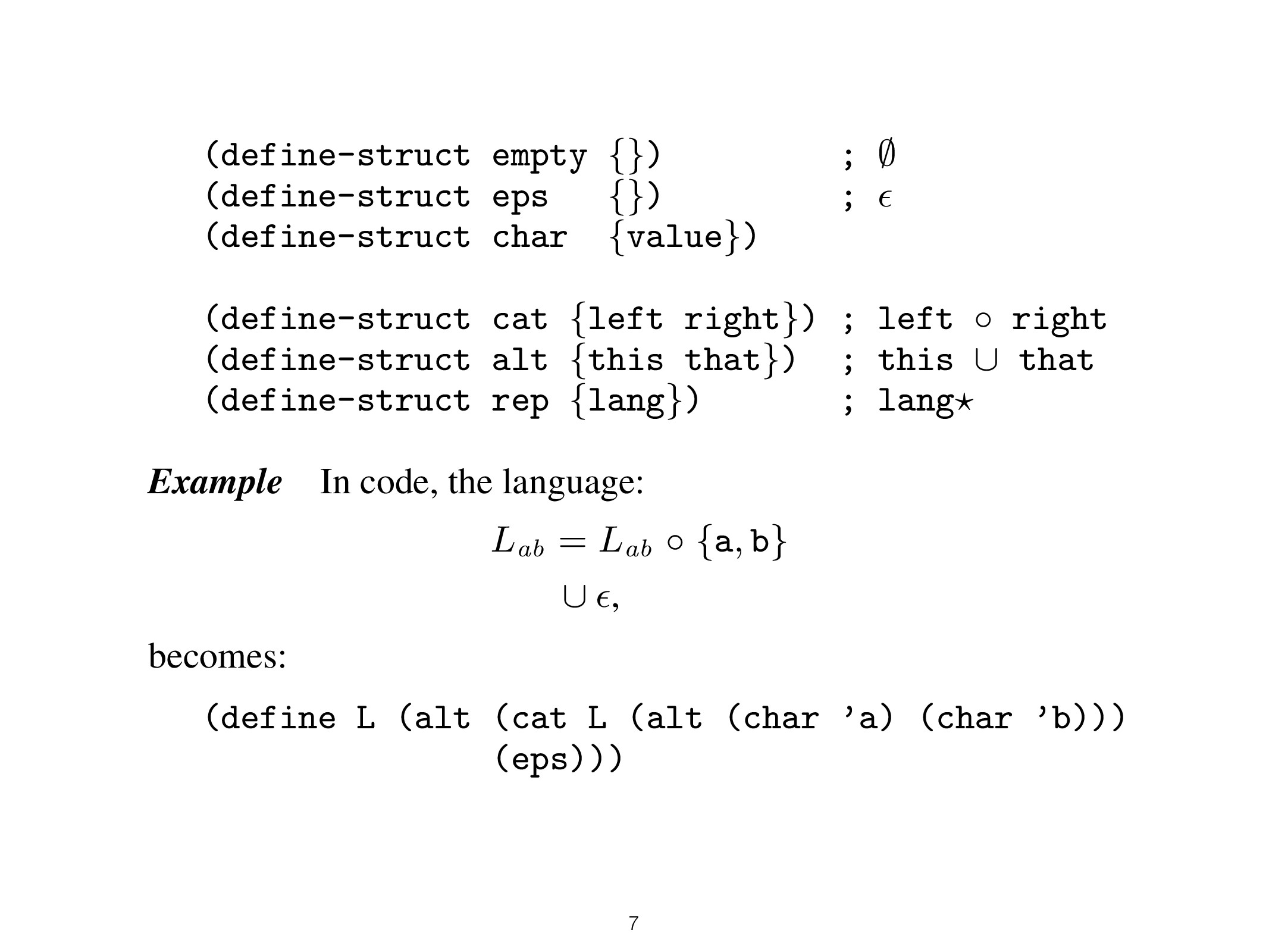
  5. 2.3 Encoding languages To represent the atomic and complex languages

    in code, there is a struct for each kind of language: (define-struct empty {}) ; ; (define-struct eps {}) ; ✏ (define-struct char {value}) (define-struct cat {left right}) ; left right (define-struct alt {this that}) ; this [ that (define-struct rep {lang}) ; lang? Example In code, the language: Lab = Lab {a, b} [ ✏, becomes: (define L (alt (cat L (alt (char ’a) (char ’b))) (eps))) 3. Brzozowski’s derivative Brzozowski defined the derivative of regular expressions in his • • • !7
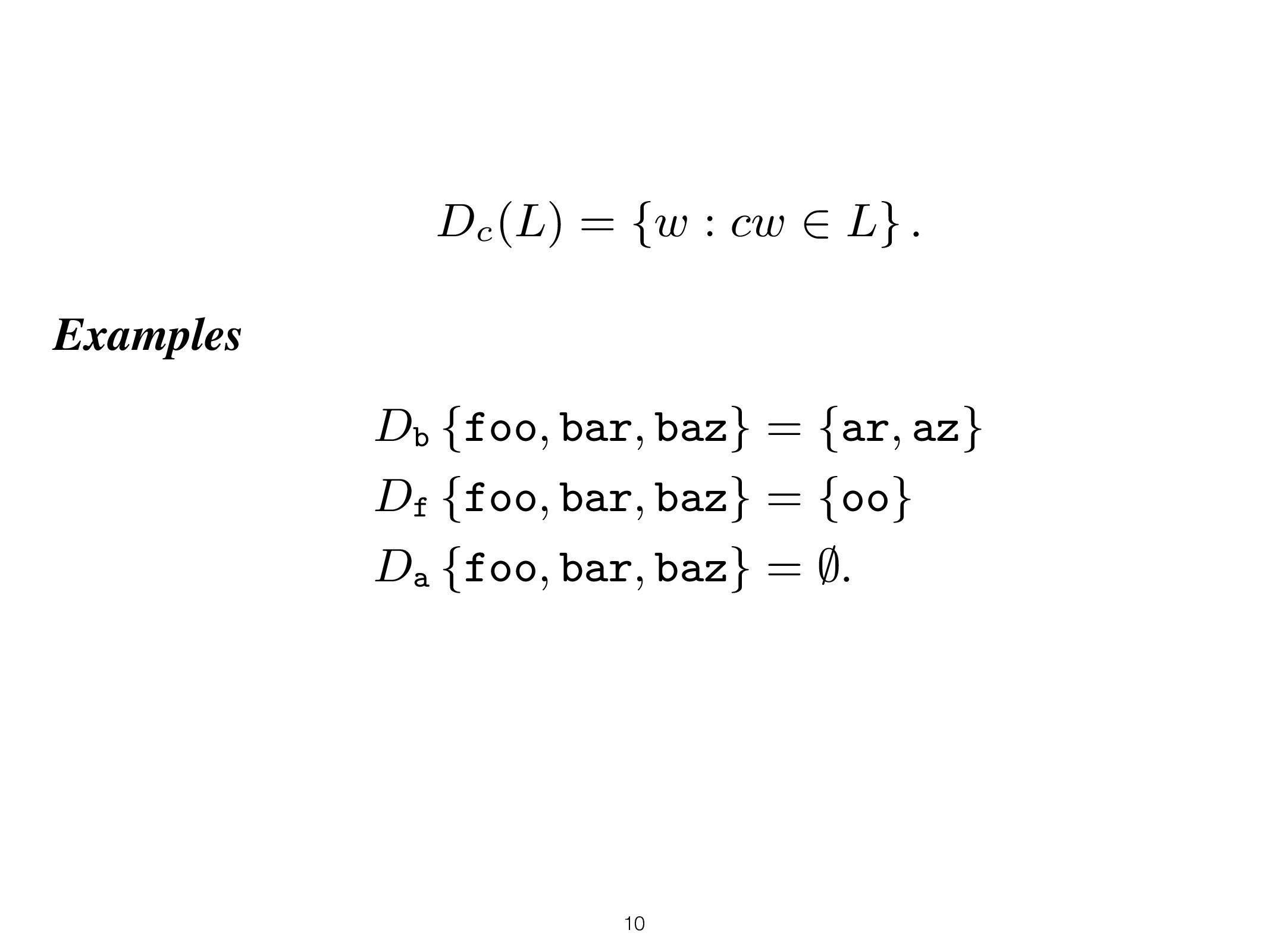
  6. 2. Second, chop that first character off every string. Formally:

    Dc(L) = {w : cw 2 L} . Examples Db {foo, bar, baz} = {ar, az} Df {foo, bar, baz} = {oo} Da {foo, bar, baz} = ;. 3.1 Recognition with the derivative The simplicity of the derivative’s definition masks its power. If on can compute successive derivatives of a language, it is straightfo ward to determine the membership of a string within a languag thanks to the following property: !10
  7. text- n of finite ains of L is a ht

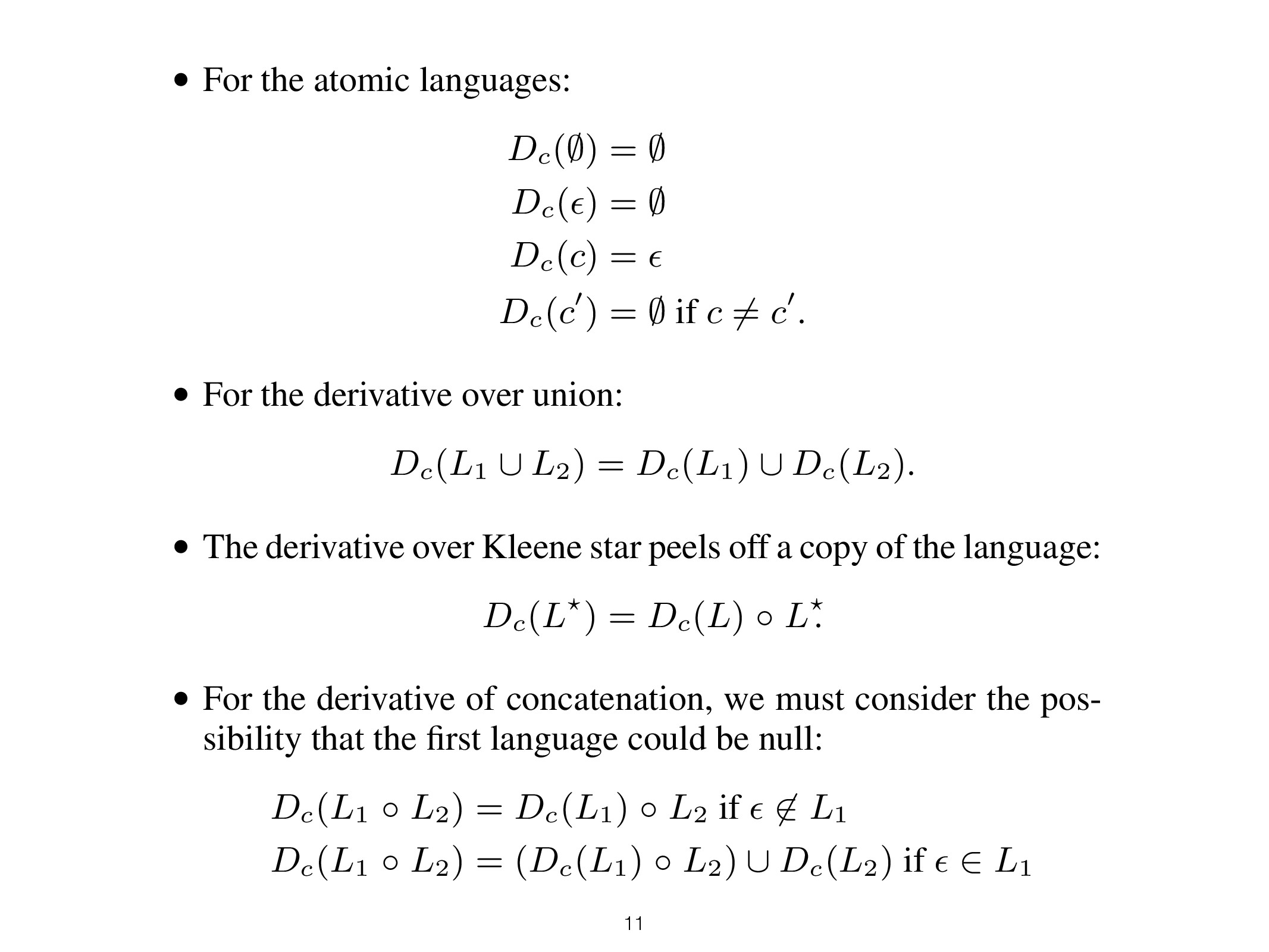
    at guages, and admits a recursive implementation: • For the atomic languages: Dc(;) = ; Dc(✏) = ; Dc(c) = ✏ Dc(c 0) = ; if c 6= c 0. • For the derivative over union: Dc(L1 [ L2) = Dc(L1) [ Dc(L2). • The derivative over Kleene star peels off a copy of the language: Dc(L ?) = Dc(L) L ? . • For the derivative of concatenation, we must consider the pos- sibility that the first language could be null: Dc(L1 L2) = Dc(L1) L2 if ✏ 62 L1 Dc(L1 L2) = (Dc(L1) L2) [ Dc(L2) if ✏ 2 L1 We can express concatenation without a conditional through the !11
  8. ’b))) s in his erivative We can express concatenation without

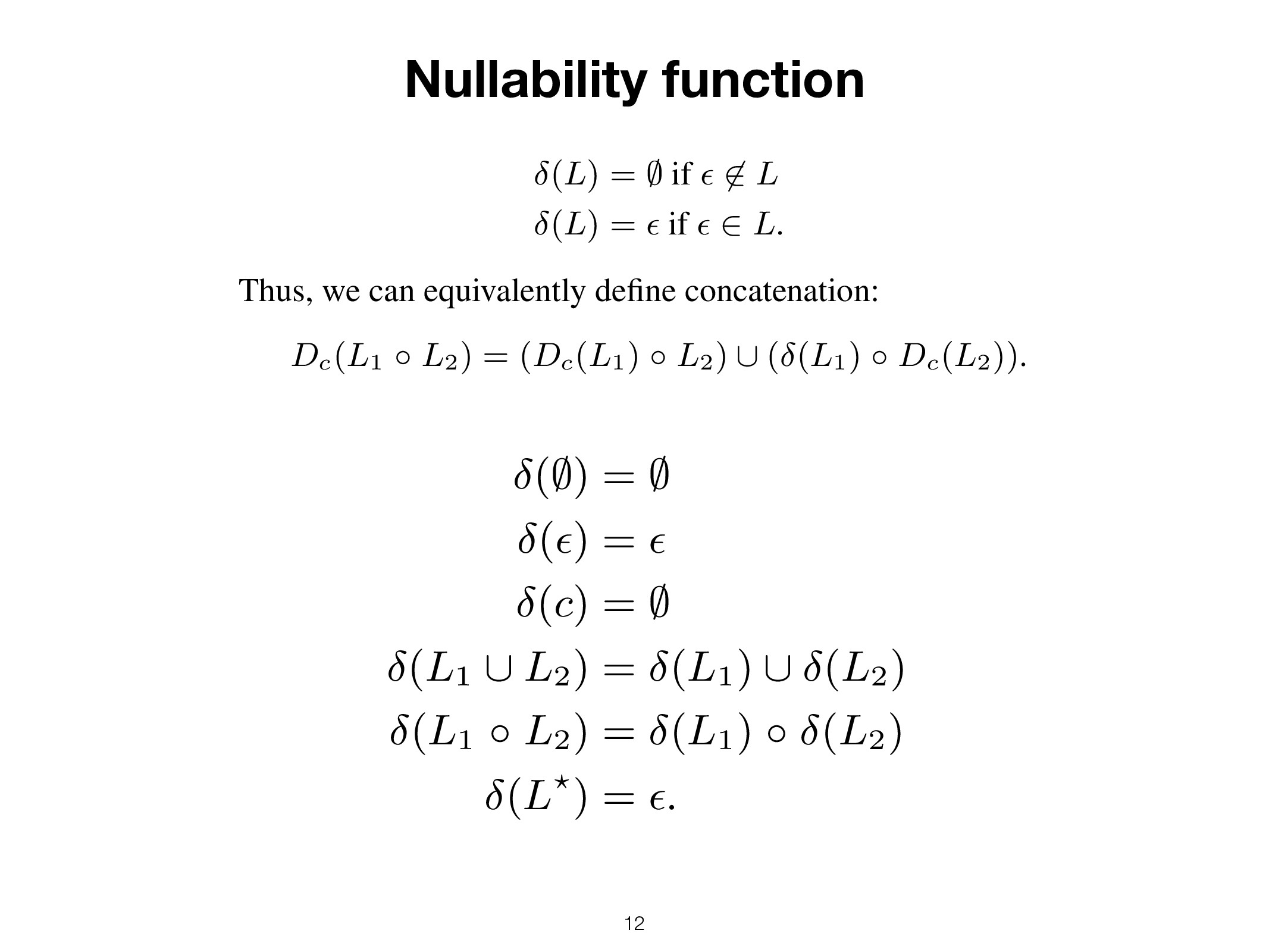
    a conditional through the nullability function: . This function returns the null language if its input language contains the null string, and the empty set otherwise: (L) = ; if ✏ 62 L (L) = ✏ if ✏ 2 L. Thus, we can equivalently define concatenation: Dc(L1 L2) = (Dc(L1) L2) [ ( (L1) Dc(L2)). 3.3 Nullability of regular languages Conveniently, nullability may also be computed using structural recursion on regular languages: (;) = ; (✏) = ✏ (c) = ; (L1 [ L2) = (L1) [ (L2) (L1 L2) = (L1) (L2) (L ?) = ✏. A recursive implementation of the Boolean variant of the nullability function is straightforward: Nullability function !12
  9. [(empty) #f] [(eps) #t] [(char _) #f] [(rep _) #t]

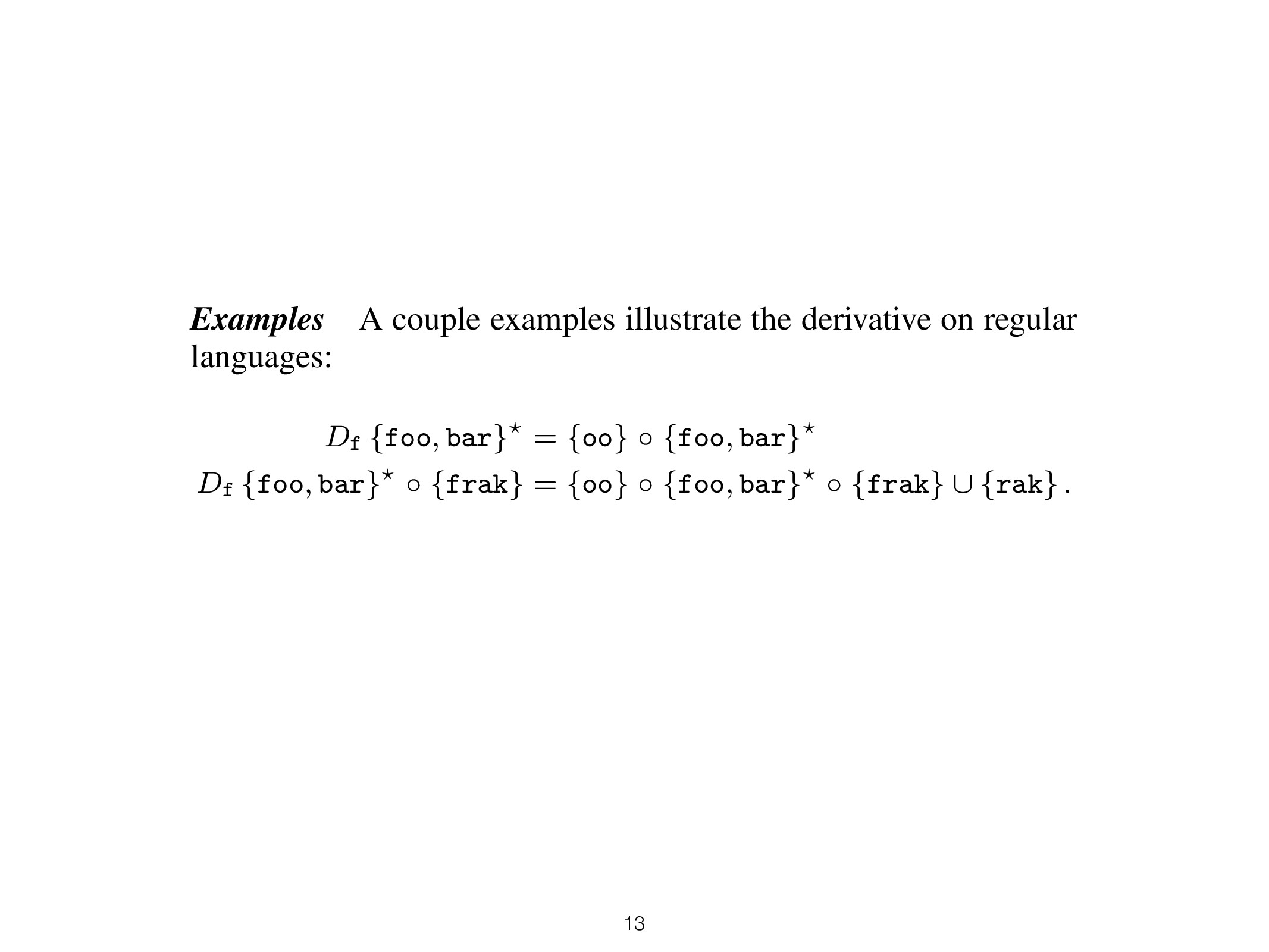
    [(alt L1 L2) (or ( L1) ( L2))] [(cat L1 L2) (and ( L1) ( L2))])) Examples A couple examples illustrate the derivative on regular languages: Df {foo, bar}? = {oo} {foo, bar}? Df {foo, bar}? {frak} = {oo} {foo, bar}? {frak} [ {rak} . 3.4 An implementation of the derivative As the description of a regular language is not recursive, it is straightforward to transliterate the derivative into working code: (define (D c L) (match L [(empty) (empty)] [(eps) (empty)] [(char a) (if (equal? c a) (eps) Mathem code fro compute 4.1 St Preventi infinite Specific and rep tentially until the 4.2 St With laz bility (a gerly w fails to t need the memoiz languag (def #: (m !13
  10. (empty))] [(alt L1 L2) (alt (D c L1) (D c

    L2))] [(cat (and (? ) L1) L2) (alt (D c L2) (cat (D c L1) L2))] [(cat L1 L2) (cat (D c L1) L2)] [(rep L1) (cat (D c L1) L)])) Matching a regular language L against a consed list of characters w is straightforward: (define (matches? w L) (if (null? w) ( L) (matches? (cdr w) (D (car w) L)))) 4. Derivatives of context-free languages Since a context-free language is a recursive regular language, it is tempting to use the same code for computing the derivative. From the perspective of parsing, this has two chief drawbacks: 1. It doesn’t work. [( [( [( [( [( [( The defin that memo value equa 4.3 Step The compu putation of it’s looking 1 Lisp imple transparently !14
  11. using structural f the nullability ))] ))])) ative on regular

    2. It wouldn’t produce a parse forest even if it did. The first problem comes from the recursive implementation of the derivative running into the recursive nature of context-free grammars. It leads to non-termination. The second comes from the fact that our regular implementation recognizes whether a string is in a language rather than parsing the string. We tackle the termination problem in this section, and the parsing problem in the next. Example Consider the following left-recursive language: L = L {x} [ ✏. If we take the derivative of L, we get a new language: DxL = DxL {x} [ ✏. Mathematically, this is sensible. Computationally, it is not. The code from the previous section recurs forever as it attempts to compute the derivative of the language L. 4.1 Step 1: Laziness Preventing the implementation of the derivative from making an infinite descent on a recursive grammar requires targeted laziness. Specifically, it requires making the fields of the structs cat, alt and rep by-need.1 With by-need fields, the computation of any (po- !16
  12. FP techniques • Laziness (prevent infinite descent on a recursive

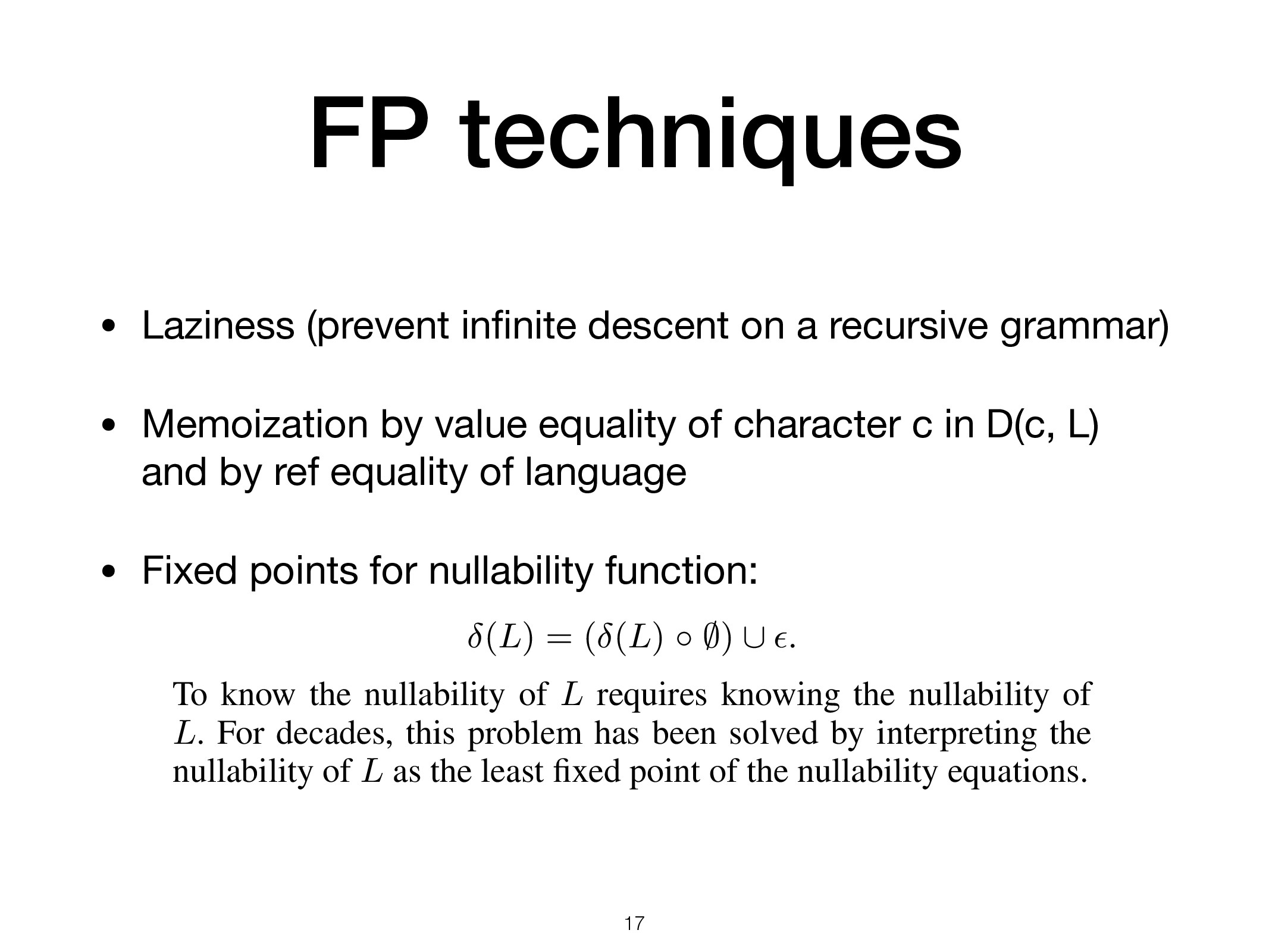
    grammar) • Memoization by value equality of character c in D(c, L) and by ref equality of language • Fixed points for nullability function: not.” As such, laziness and memoization can’t help side-step self- dependencies the way they did for the derivative. Consider the nul- lability of the left-recursive language L: (L) = ( (L) ;) [ ✏. To know the nullability of L requires knowing the nullability of L. For decades, this problem has been solved by interpreting the nullability of L as the least fixed point of the nullability equations. To bare only the essence of nullability, we can hide the com- putation of a least fixed point behind a purely functional abstrac- tion: define/fix. The define/fix form uses Kleene’s theorem to compute the least fixed point of a monotonic recursive definition, Of cou by disc 5.1 S Simple • A c !17
  13. the derivative from regular languages to context-free languages. If recognition

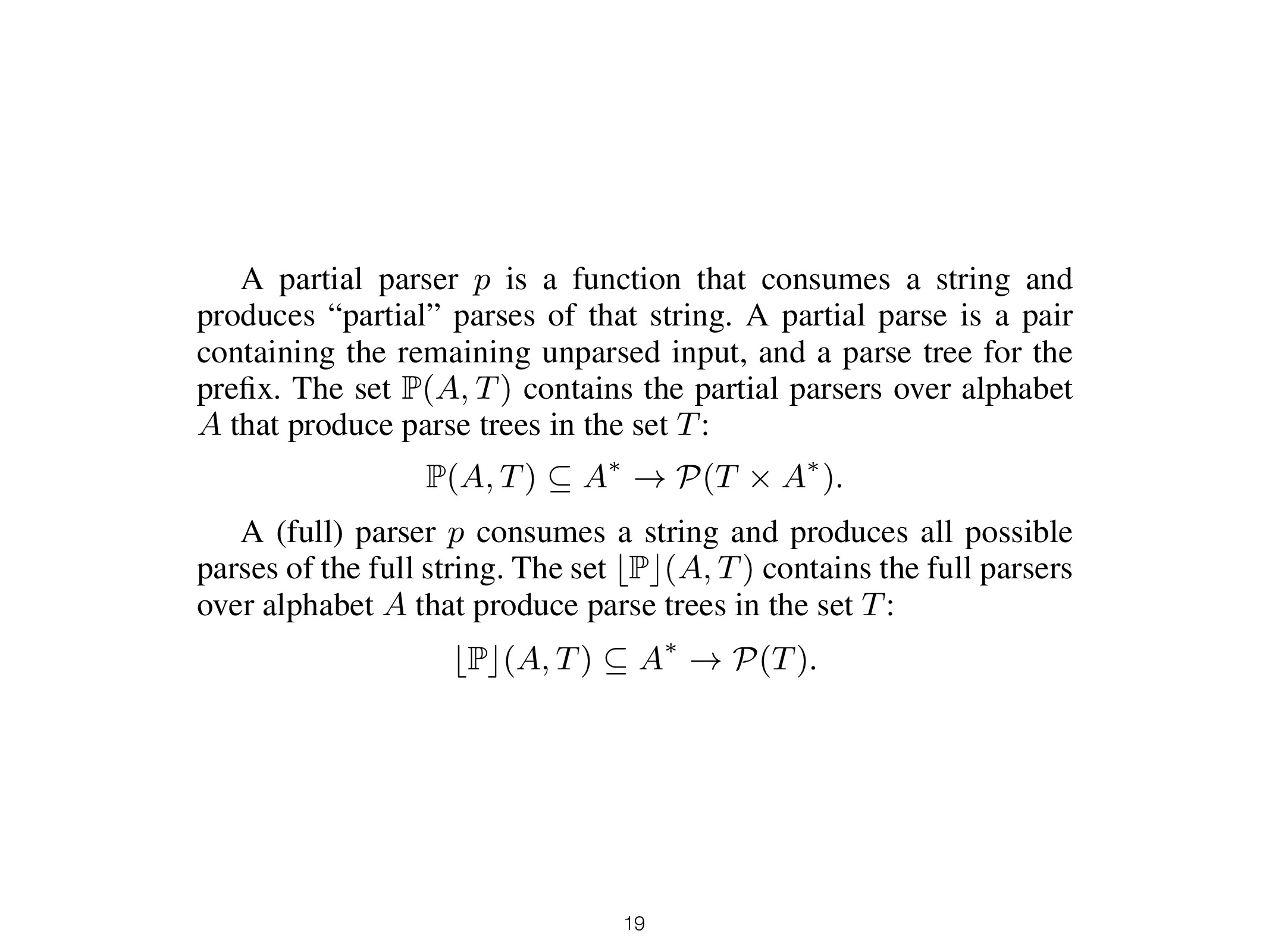
    of strings in context-free languages were our goal, we would be done. But, our goal is parsing. So, our next step is to generalize the derivative to parsers. This section reviews parsers and parser combinators. (For a more detailed treatment, we refer the reader to [15, 16].) In the next section, we explore their derivative. A partial parser p is a function that consumes a string and produces “partial” parses of that string. A partial parse is a pair containing the remaining unparsed input, and a parse tree for the prefix. The set P(A, T) contains the partial parsers over alphabet A that produce parse trees in the set T: P(A, T) ✓ A ⇤ ! P(T ⇥ A ⇤). A (full) parser p consumes a string and produces all possible parses of the full string. The set bPc(A, T) contains the full parsers over alphabet A that produce parse trees in the set T: bPc(A, T) ✓ A ⇤ ! P(T). derivativ language We can a (de Once ag the funct 5.4 Th To imple null redu parse the A new st (de !19
  14. p self- he nul- ility of ing the ations. e

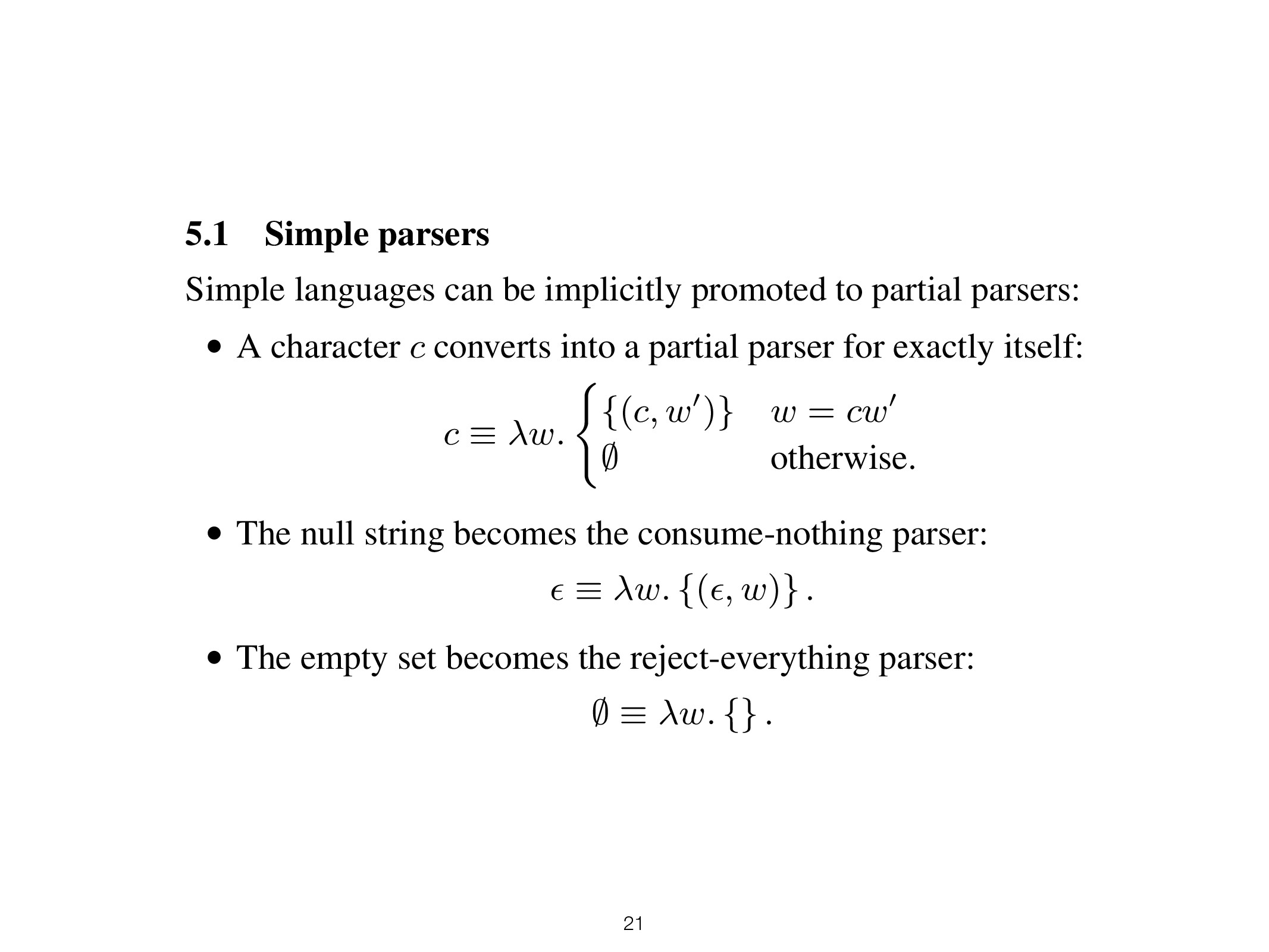
    com- bstrac- heorem nition, h little Of course, we can treat a partial parser p 2 P(A, T) as a full parser: bpc(w) = {t : (t, ✏) 2 p(w)}, by discarding any partial parse that did not exhaust the input. 5.1 Simple parsers Simple languages can be implicitly promoted to partial parsers: • A character c converts into a partial parser for exactly itself: c ⌘ w. ( {(c, w 0)} w = cw 0 ; otherwise. • The null string becomes the consume-nothing parser: ✏ ⌘ w. {(✏, w)} . • The empty set becomes the reject-everything parser: ; ⌘ w. {} . 5.2 Combining parsers Parsers combine in the same fashion as languages: • The union of two parsers, p, q 2 P(A, X), combines all parse trees together, so that p [ q 2 P(A, X): !21
  15. terative des in a nce: d point: tion. It omput-

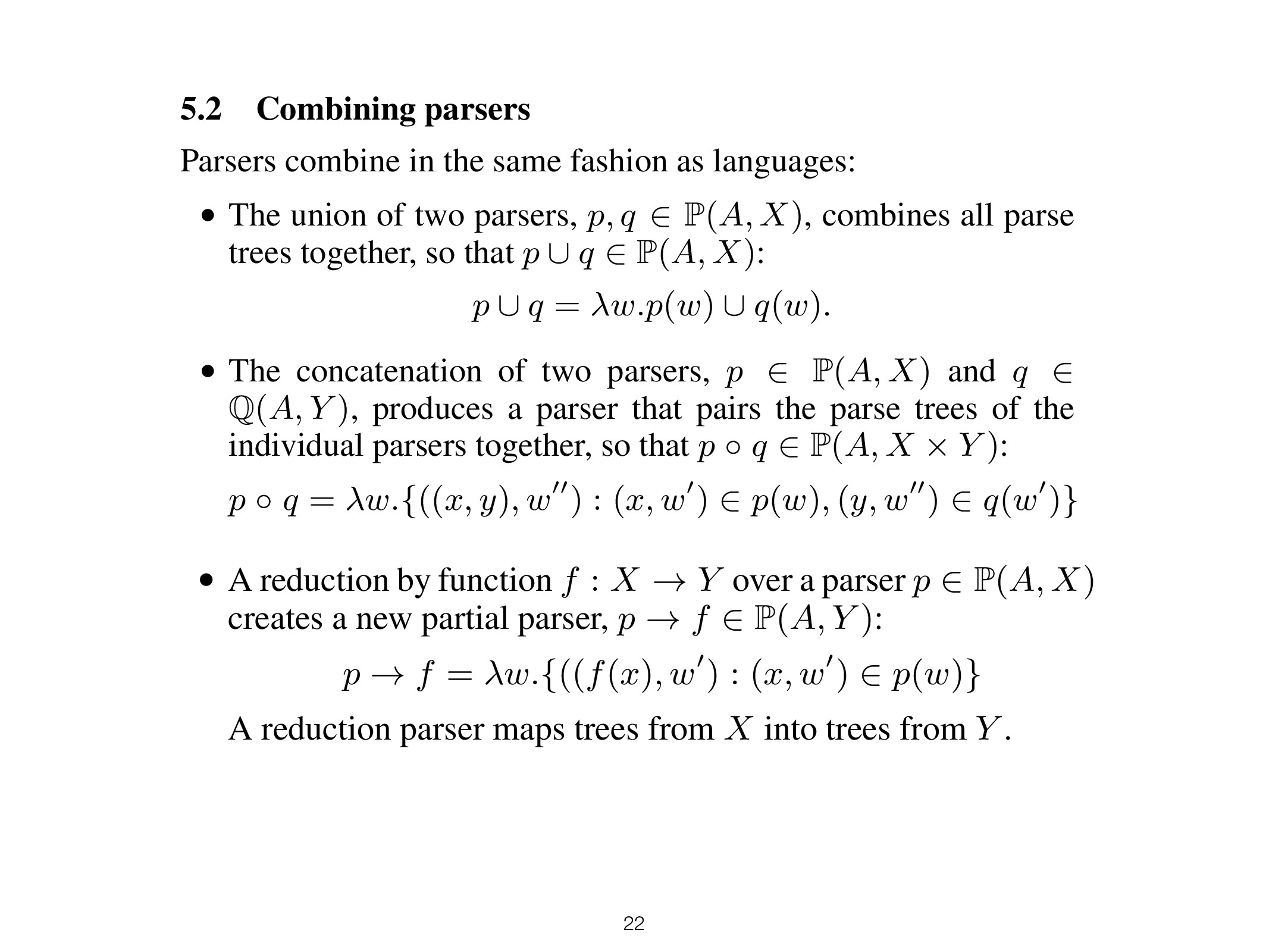
    The empty set becomes the reject-everything parser: ; ⌘ w. {} . 5.2 Combining parsers Parsers combine in the same fashion as languages: • The union of two parsers, p, q 2 P(A, X), combines all parse trees together, so that p [ q 2 P(A, X): p [ q = w.p(w) [ q(w). • The concatenation of two parsers, p 2 P(A, X) and q 2 Q(A, Y ), produces a parser that pairs the parse trees of the individual parsers together, so that p q 2 P(A, X ⇥ Y ): p q = w.{((x, y), w 00) : (x, w 0) 2 p(w), (y, w 00) 2 q(w 0)} In effect, the first parser consumes a prefix of the input and produces a parse tree. It passes the remainder of that input to the second parser, which produces another parse tree. The result is the left-over input paired with both of those parse trees. • A reduction by function f : X ! Y over a parser p 2 P(A, X) creates a new partial parser, p ! f 2 P(A, Y ): p ! f = w.{((f(x), w 0) : (x, w 0) 2 p(w)} A reduction parser maps trees from X into trees from Y . In code, a new struct represents reduction parsers: erative es in a ce: point: tion. It omput- gnizing Parsers combine in the same fashion as languages: • The union of two parsers, p, q 2 P(A, X), combines all parse trees together, so that p [ q 2 P(A, X): p [ q = w.p(w) [ q(w). • The concatenation of two parsers, p 2 P(A, X) and q 2 Q(A, Y ), produces a parser that pairs the parse trees of the individual parsers together, so that p q 2 P(A, X ⇥ Y ): p q = w.{((x, y), w 00) : (x, w 0) 2 p(w), (y, w 00) 2 q(w 0)} In effect, the first parser consumes a prefix of the input and produces a parse tree. It passes the remainder of that input to the second parser, which produces another parse tree. The result is the left-over input paired with both of those parse trees. • A reduction by function f : X ! Y over a parser p 2 P(A, X) creates a new partial parser, p ! f 2 P(A, Y ): p ! f = w.{((f(x), w 0) : (x, w 0) 2 p(w)} A reduction parser maps trees from X into trees from Y . In code, a new struct represents reduction parsers: (define-struct red {lang f}) Once again, the field lang should be lazy. !22
  16. on. It mput- izing ifted es. If l, we alize

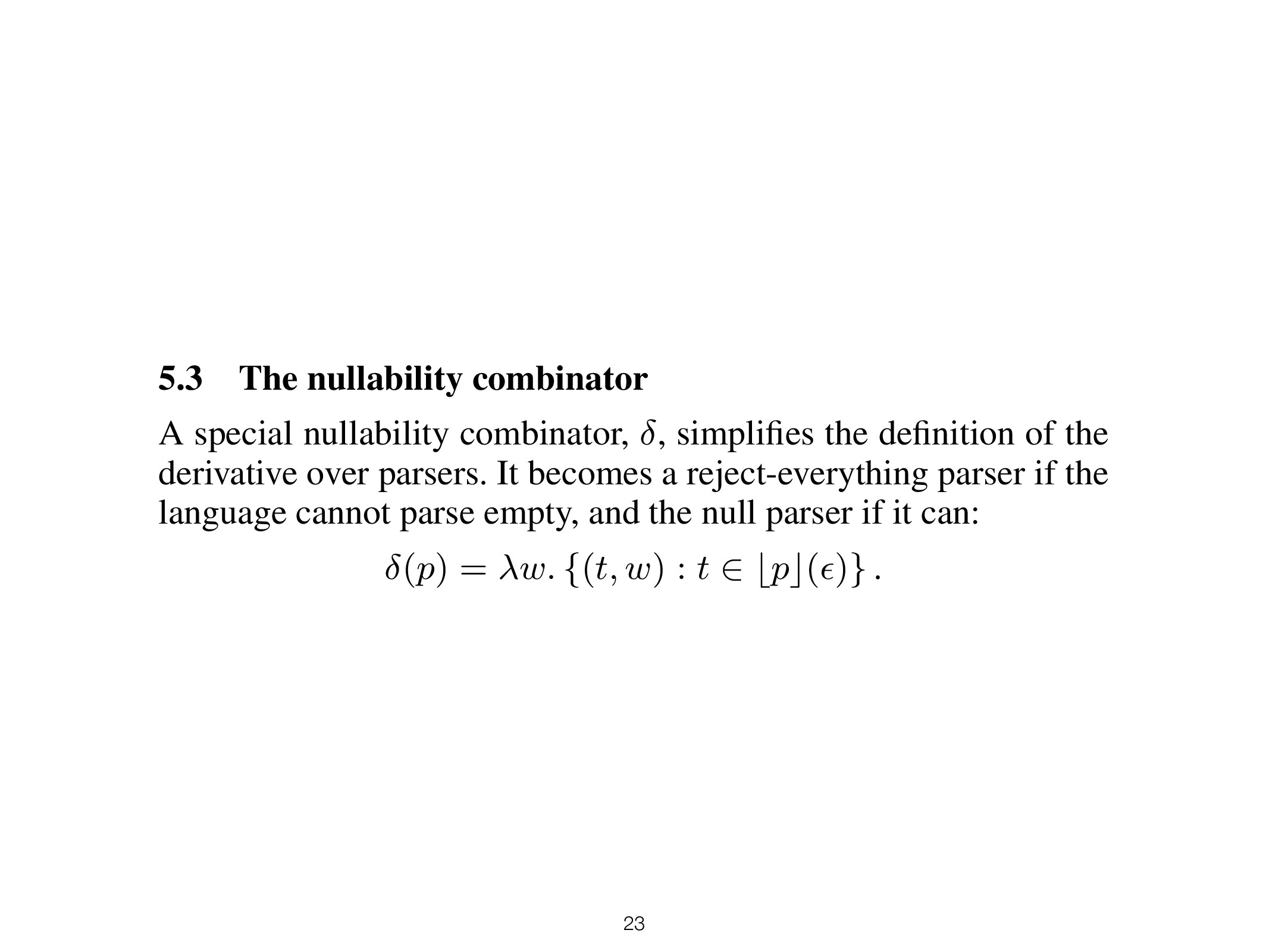
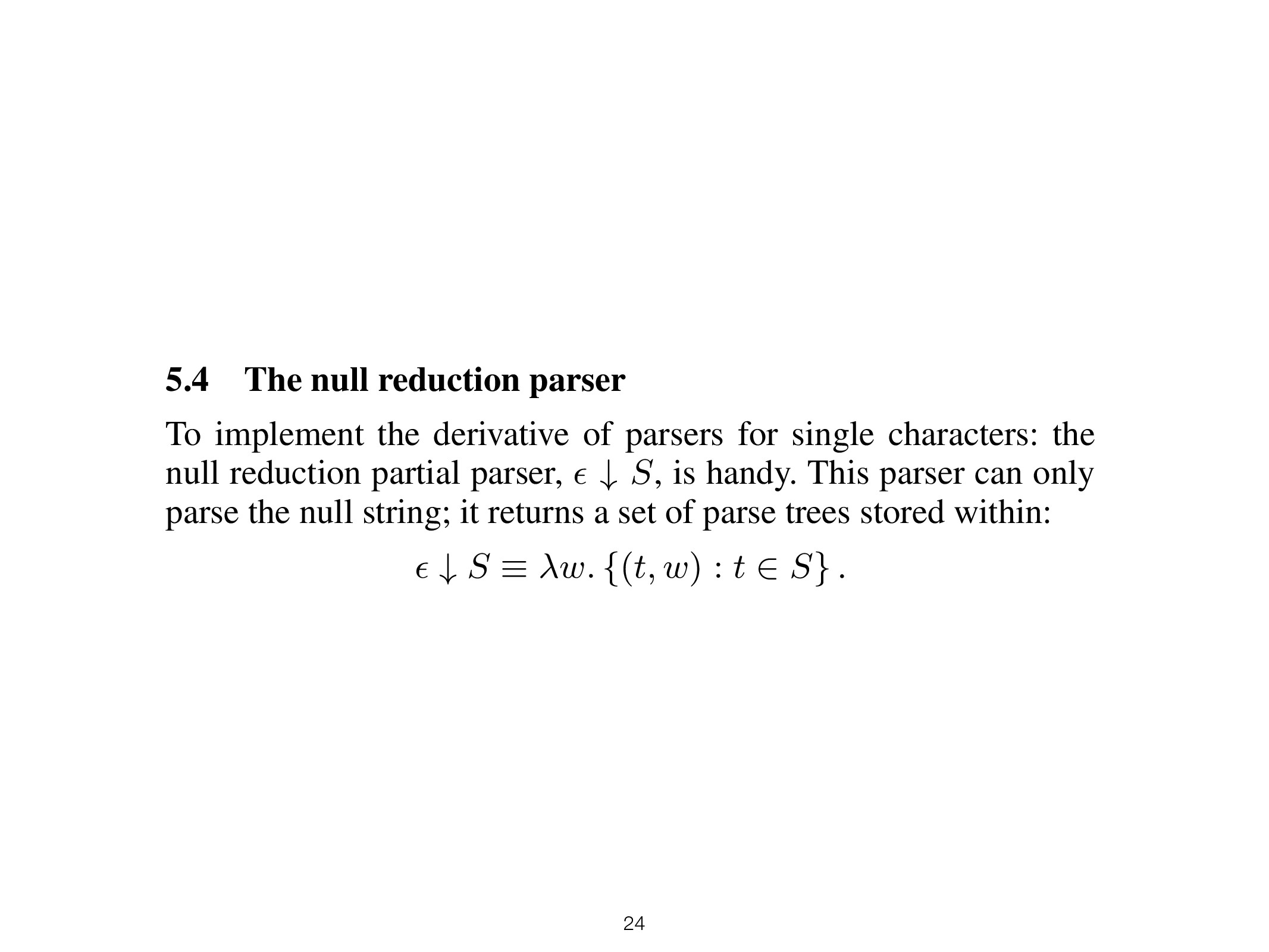
    arser er to and pair r the habet • A reduction by function f : X ! Y over a parser p 2 P(A, X) creates a new partial parser, p ! f 2 P(A, Y ): p ! f = w.{((f(x), w 0) : (x, w 0) 2 p(w)} A reduction parser maps trees from X into trees from Y . In code, a new struct represents reduction parsers: (define-struct red {lang f}) Once again, the field lang should be lazy. 5.3 The nullability combinator A special nullability combinator, , simplifies the definition of the derivative over parsers. It becomes a reject-everything parser if the language cannot parse empty, and the null parser if it can: (p) = w. {(t, w) : t 2 bpc(✏)} . We can add a new kind of language node to represent these: (define-struct {lang}) Once again, the field lang is lazy. (Please note that is no longer the function from the previous section.) 5.4 The null reduction parser To implement the derivative of parsers for single characters: the null reduction partial parser, ✏ # S, is handy. This parser can only !23
  17. lifted ges. If al, we ralize parser der to g

    and a pair or the habet ssible arsers derivative over parsers. It becomes a reject-everything parser if the language cannot parse empty, and the null parser if it can: (p) = w. {(t, w) : t 2 bpc(✏)} . We can add a new kind of language node to represent these: (define-struct {lang}) Once again, the field lang is lazy. (Please note that is no longer the function from the previous section.) 5.4 The null reduction parser To implement the derivative of parsers for single characters: the null reduction partial parser, ✏ # S, is handy. This parser can only parse the null string; it returns a set of parse trees stored within: ✏ # S ⌘ w. {(t, w) : t 2 S} . A new struct provides null-reduction nodes: (define-struct eps* {trees}) !24
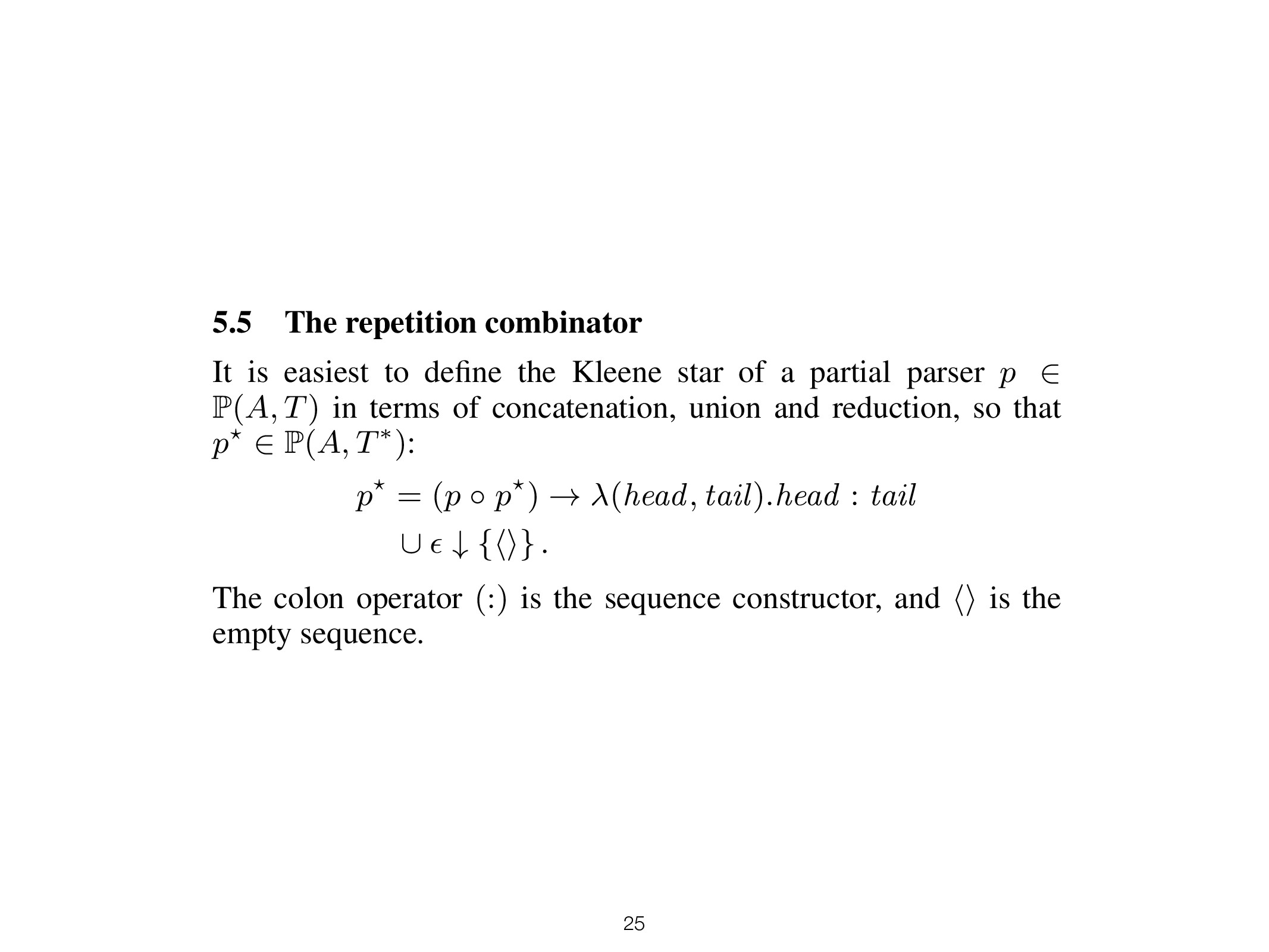
  18. 5.5 The repetition combinator It is easiest to define the

    Kleene star of a partial parser p 2 P(A, T) in terms of concatenation, union and reduction, so that p ? 2 P(A, T ⇤): p ? = (p p ?) ! (head, tail).head : tail [ ✏ # {hi} . The colon operator (:) is the sequence constructor, and hi is the empty sequence. 6. Derivatives of parser combinators If we can generalize the derivative to parsers and over parser com- binators, then we can construct parse forests using derivatives. But first, we must consider the question: “What is the derivative of a parser?” deriva into a • The de • The de • The de first pa • The de The rules !25
  19. original parser; that is, if the original parser consumed the

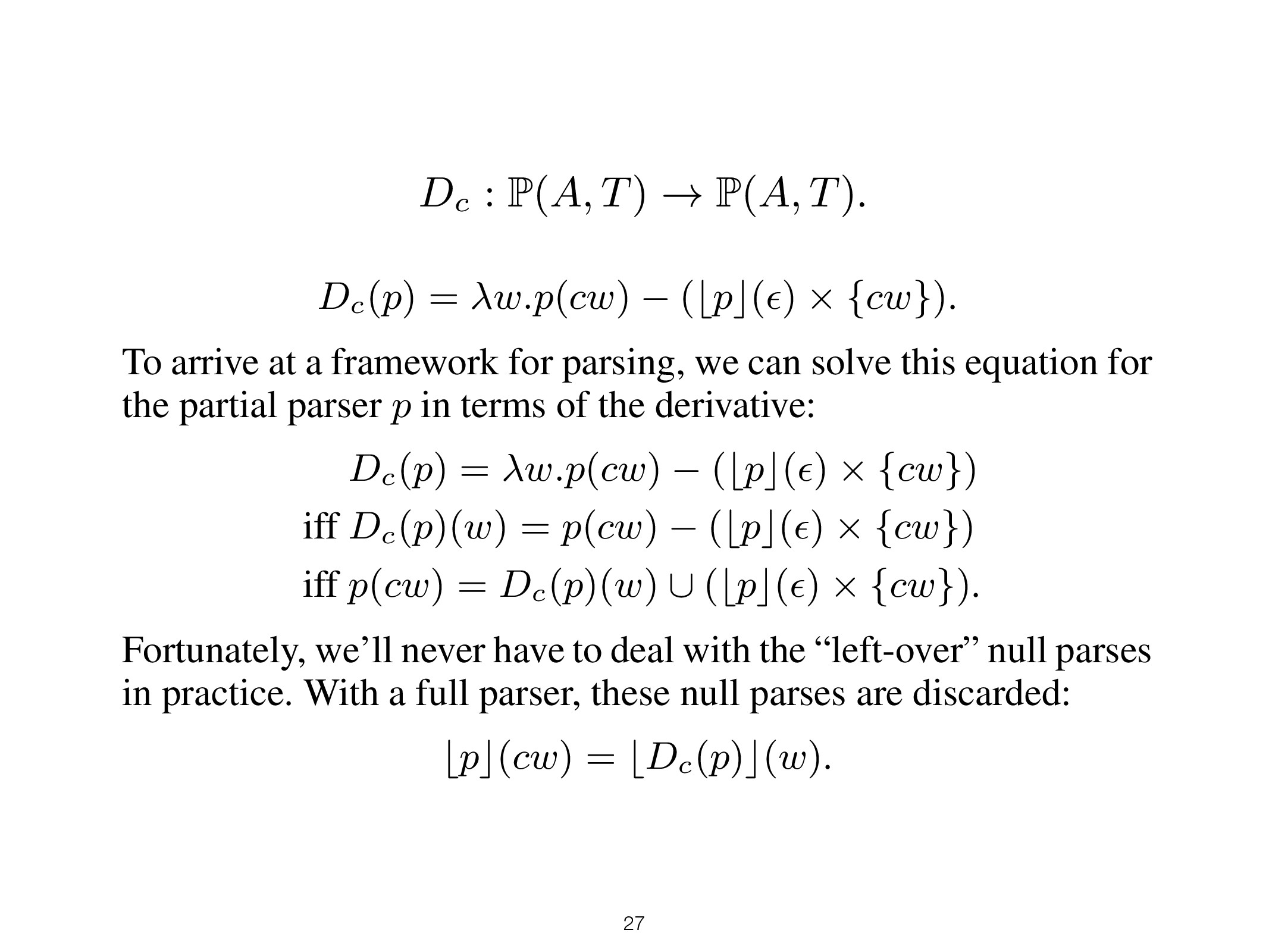
    alphabet A to construct parse trees of type X, then the new parser should do the same. Formally: Dc : P(A, T) ! P(A, T). But, how should the derived parser behave? It should act as though the character c has been consumed, so that if the string w is supplied, it returns parses for the string cw. However, it also needs to strip away any null parses that come back. If it didn’t strip these, then null parses containing cw would return when trying to parse w with the derived parser. It is nonsensical for a partial parser to expand its input. Thus: Dc(p) = w.p(cw) (bpc(✏) ⇥ {cw}). To arrive at a framework for parsing, we can solve this equation for the partial parser p in terms of the derivative: Dc(p) = w.p(cw) (bpc(✏) ⇥ {cw}) iff Dc(p)(w) = p(cw) (bpc(✏) ⇥ {cw}) iff p(cw) = Dc(p)(w) [ (bpc(✏) ⇥ {cw}). It should act as though the character c has been consumed, so that if the string w is supplied, it returns parses for the string cw. However, it also needs to strip away any null parses that come back. If it didn’t strip these, then null parses containing cw would return when trying to parse w with the derived parser. It is nonsensical for a partial parser to expand its input. Thus: Dc(p) = w.p(cw) (bpc(✏) ⇥ {cw}). To arrive at a framework for parsing, we can solve this equation for the partial parser p in terms of the derivative: Dc(p) = w.p(cw) (bpc(✏) ⇥ {cw}) iff Dc(p)(w) = p(cw) (bpc(✏) ⇥ {cw}) iff p(cw) = Dc(p)(w) [ (bpc(✏) ⇥ {cw}). Fortunately, we’ll never have to deal with the “left-over” null parses in practice. With a full parser, these null parses are discarded: bpc(cw) = bDc(p)c(w). Given their similarity, it should not surprise that the derivative of a partial parser resembles the derivative of a language: • The derivative of the empty parser is empty: (B n 6 P h th th c !27
  20. iff p(cw) = Dc(p)(w) [ (bpc(✏) ⇥ {cw}). Fortunately, we’ll

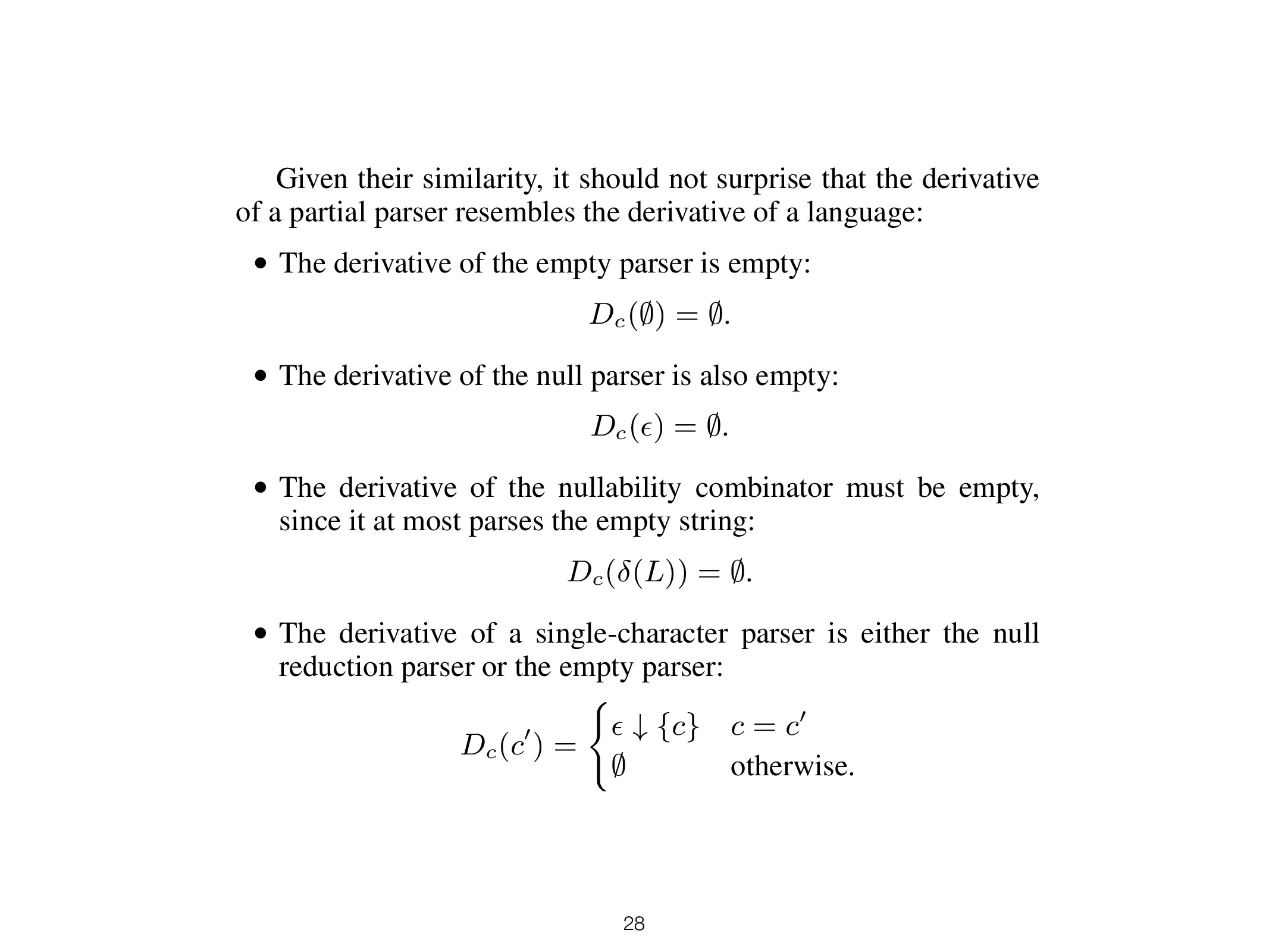
    never have to deal with the “left-over” null parses in practice. With a full parser, these null parses are discarded: bpc(cw) = bDc(p)c(w). Given their similarity, it should not surprise that the derivative of a partial parser resembles the derivative of a language: • The derivative of the empty parser is empty: Dc(;) = ;. • The derivative of the null parser is also empty: Dc(✏) = ;. • The derivative of the nullability combinator must be empty, since it at most parses the empty string: Dc( (L)) = ;. • The derivative of a single-character parser is either the null reduction parser or the empty parser: Dc(c 0) = ( ✏ # {c} c = c 0 ; otherwise. This rule is important: it allows the derived parser to retain frag- ments of the input string within itself. Over time, as successive 6.1 Parsin Parsing with has been con the top-level the string is code, the par (defin (if ( ( ( The question duces a parse Yet again b !28
  21. rser p 2 n, so that d hi is the

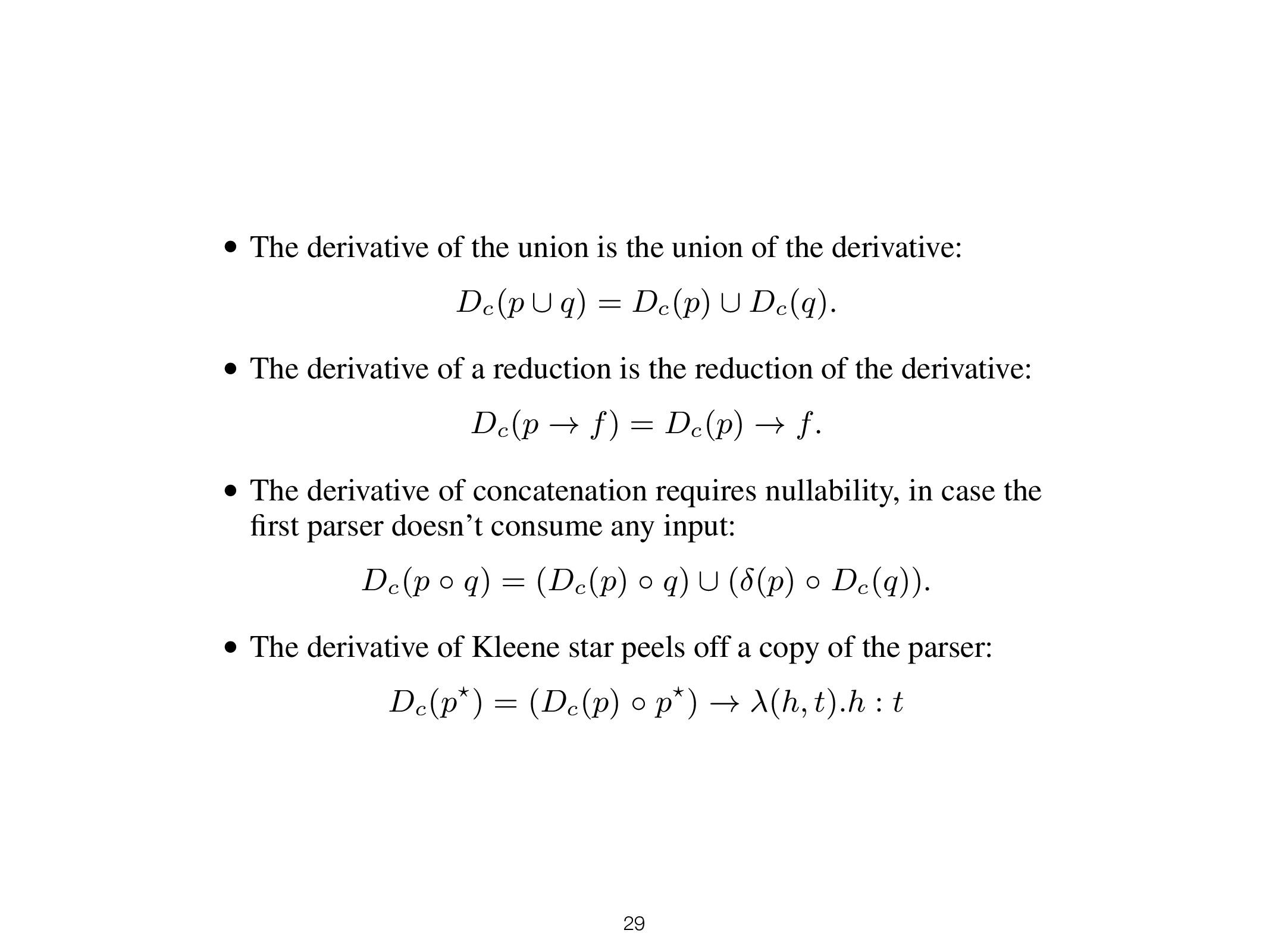
    arser com- atives. But he charac- ype as the e alphabet should do derivatives are taken, the parser is steadily transforming itself into a parse forest with nodes like this. • The derivative of the union is the union of the derivative: Dc(p [ q) = Dc(p) [ Dc(q). • The derivative of a reduction is the reduction of the derivative: Dc(p ! f) = Dc(p) ! f. • The derivative of concatenation requires nullability, in case the first parser doesn’t consume any input: Dc(p q) = (Dc(p) q) [ ( (p) Dc(q)). • The derivative of Kleene star peels off a copy of the parser: Dc(p ?) = (Dc(p) p ?) ! (h, t).h : t The rules are so similar to the derivative for languages that we can modify the implementation of the derivative for languages to arrive at a derivative suitable for parsers: (define/memoize (D c L) #:order ([L #:eq] [c #:equal]) !29
  22. 6.1 Parsing with derivatives Parsing with derivatives is straightforward—until the

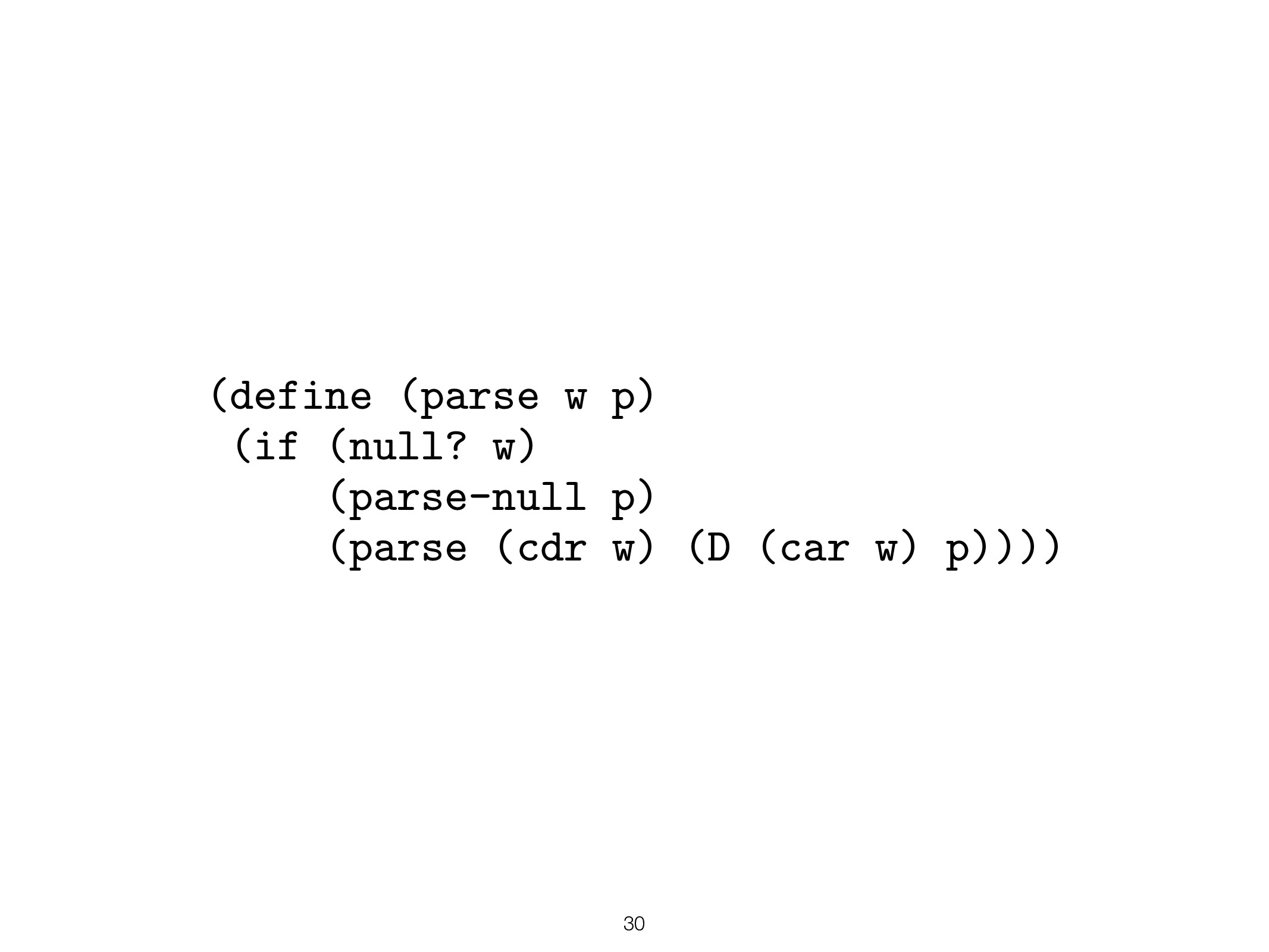
    last charac has been consumed. To parse, compute successive derivatives the top-level parser with respect to each character in a string. Wh the string is depleted, supply the null string to the final parser. code, the parse function has the same structure as matches?: (define (parse w p) (if (null? w) (parse-null p) (parse (cdr w) (D (car w) p)))) The question of interest is how to define parse-null, which p duces a parse forest for the null parses of its input. Yet again, an equational theory guides: b;c(✏) = {} b✏ # Tc(✏) = T !30
  23. mpty, null frag- ssive (if (null? w) (parse-null p) (parse

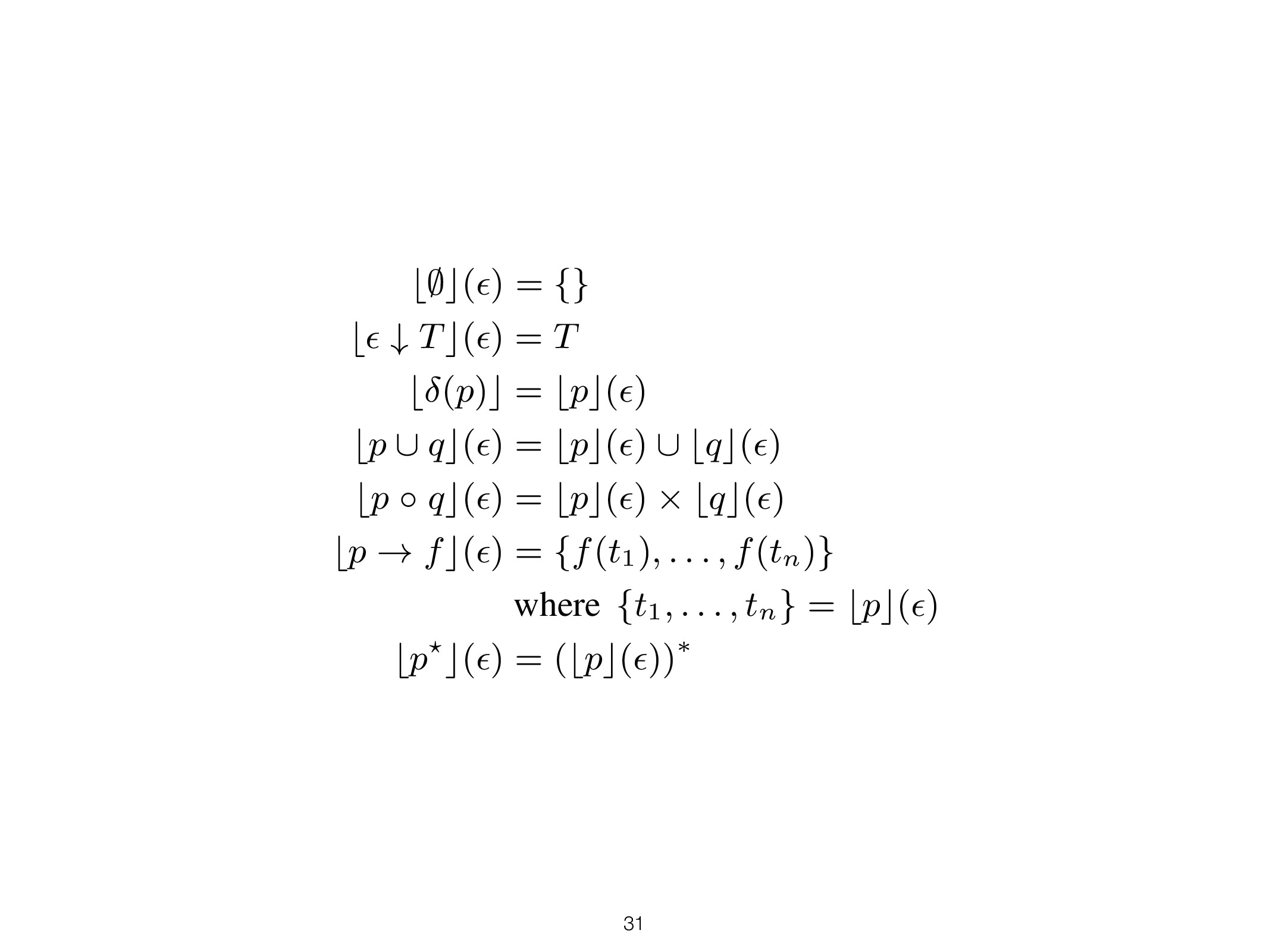
    (cdr w) (D (car w) p)))) The question of interest is how to define parse-null, which pro- duces a parse forest for the null parses of its input. Yet again, an equational theory guides: b;c(✏) = {} b✏ # Tc(✏) = T b (p)c = bpc(✏) bp [ qc(✏) = bpc(✏) [ bqc(✏) bp qc(✏) = bpc(✏) ⇥ bqc(✏) bp ! fc(✏) = {f(t1), . . . , f(tn)} where {t1, . . . , tn } = bpc(✏) bp ?c(✏) = (bpc(✏))⇤ !31
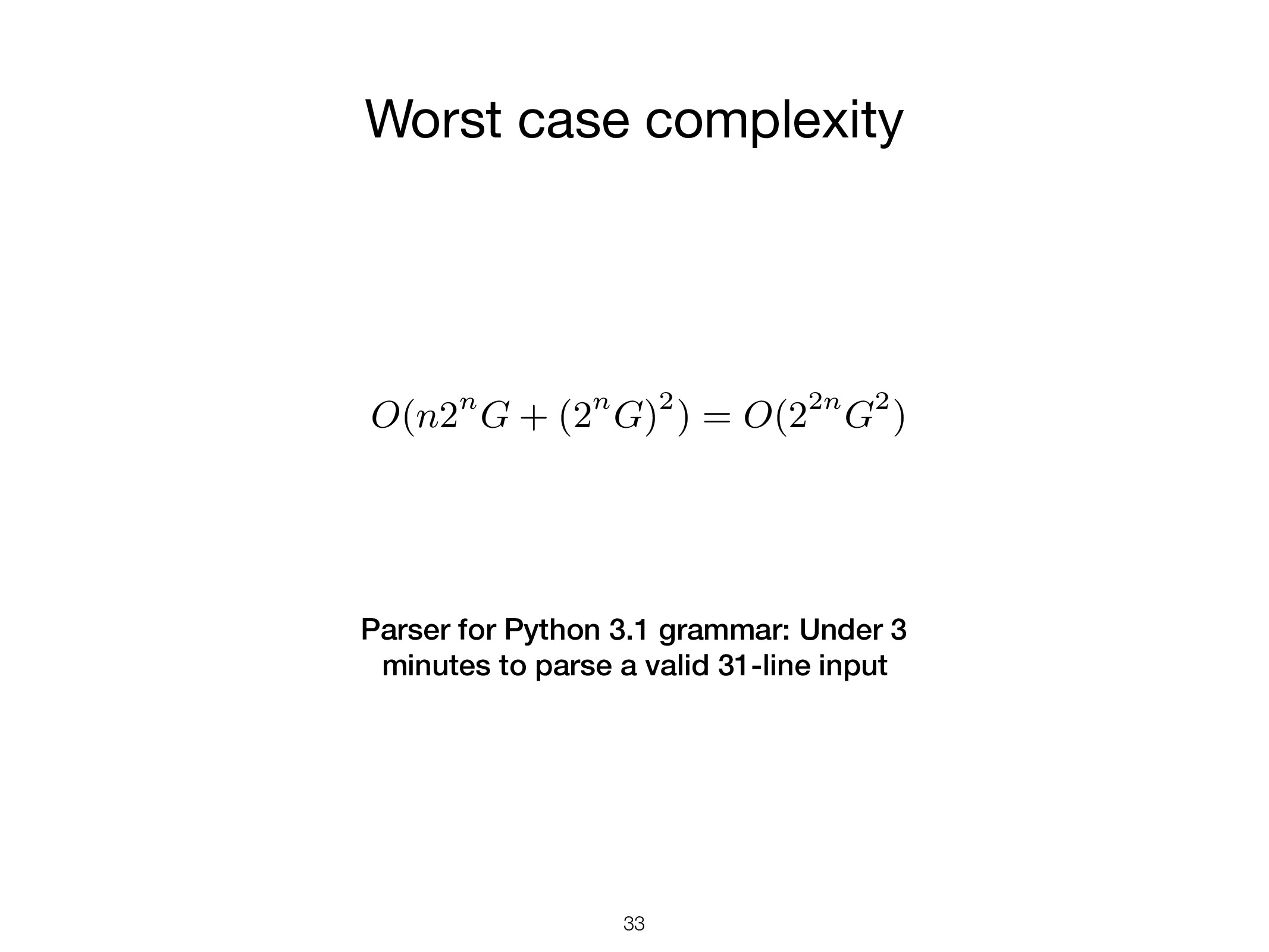
  24. Worst case complexity number of derivatives ⇥ cost of derivative

    + cost of fixed point at the end. The cost of the derivative is proportional to the size of the current grammar. The cost of the fixed point is quadratic in the size of the grammar for unambiguous parses in the worst case. Thus, the worst-case complexity of parsing a grammar of size G over an input of length n is: O(n2n G + (2n G)2) = O(22n G 2). Considering this complexity, it is remarkable that our example finished at all. That it finished in three minutes is astonishing. 7.1 Example: Growth in the grammar A glance at run-time behavior on the left-recursive list grammar exposes the nature of the problem. The image on the left represents the grammar at the start; the image on the right represents the grammar after ten derivatives: T co iz w ex Parser for Python 3.1 grammar: Under 3 minutes to parse a valid 31-line input !33
  25. -null p1) -null p2))] arse-null p1)] arse-null p2)]) 1 t2))]

    se-null p1)]) lly empty. he theory is ele- ef, it is awful. e-line examples, hree minutes to ulprit? The size entially with the on is to blame.) er the derivative. ze of the current ic in the size of t case. Thus, the It is possible to aggressively perform reductions as pieces of parse trees emerge. Our implementation utilizes the following sim- plifications; we use ()) in lieu of (=) to emphasize direction: ; p = p ; ) ; ; [ p = p [ ; ) p (✏ # {t1 }) p ) p ! t2.(t1, t2) p (✏ # {t2 }) ) p ! t1.(t1, t2) (✏ # {t1, . . . , tn }) ! f ) ✏ # {f(t1), . . . , f(tn)} ((✏ # {t1 }) p) ! f ) p ! t2.f(t1, t2) (p ! f) ! g ) p ! (g f) ;? ) ✏ # {hi} . We can implement these simplification rules in a memoized, recursive simplification function. When simplification is deeply recursive and memoized, we term it compaction. If the algorithm compacts after every derivative, then the time to parse the 31-line Python file drops from three minutes to two seconds. A graph of the size of the residual Python grammar with respect to each derivative hints as to why: 800 300 400 500 600 700 rammar size Result: time to parse drop from 3 minutes to 2 seconds In practice ~O(nG), where n is input length and G size of the grammar !35