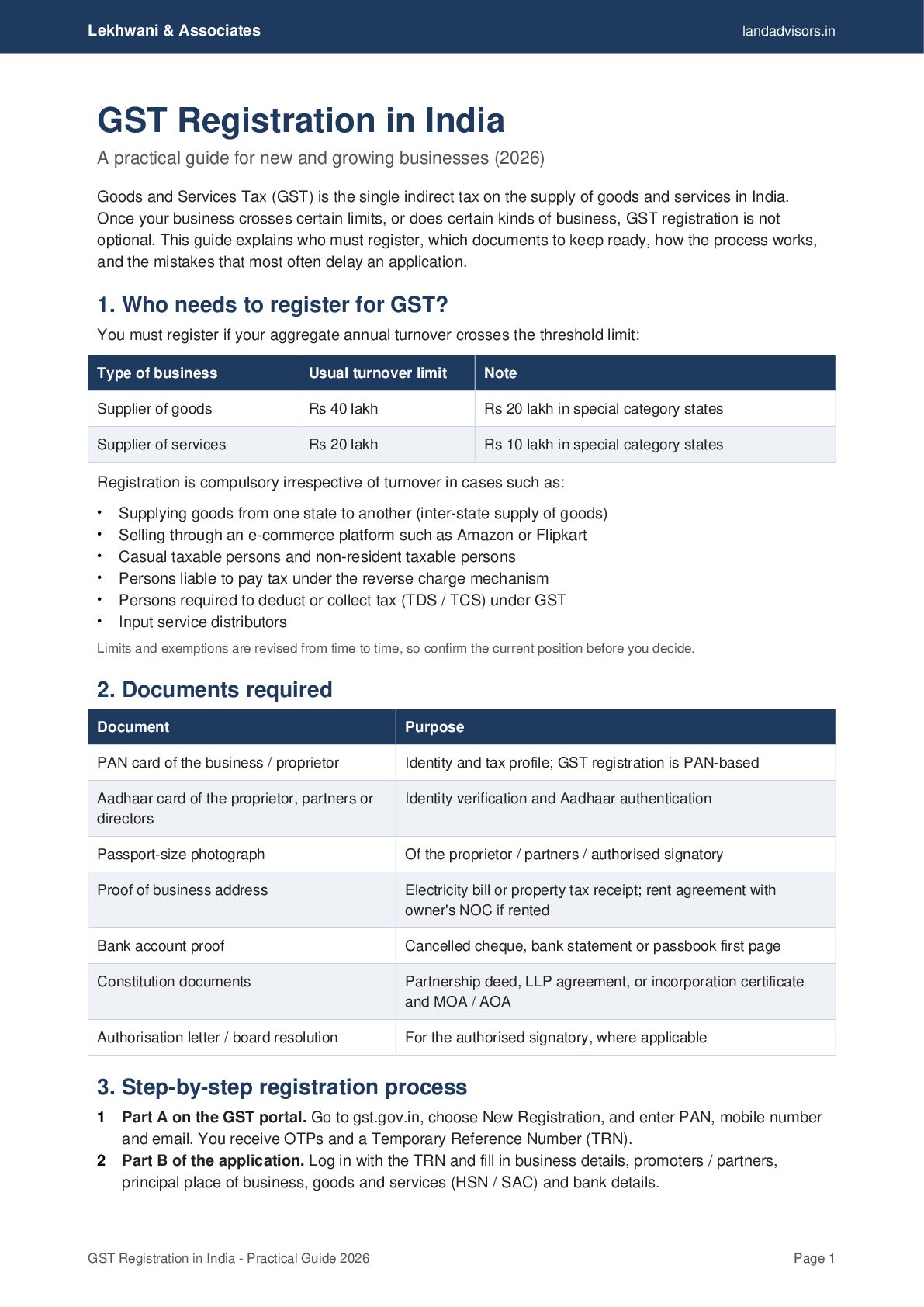
guide for new and growing businesses (2026) Goods and Services Tax (GST) is the single indirect tax on the supply of goods and services in India. Once your business crosses certain limits, or does certain kinds of business, GST registration is not optional. This guide explains who must register, which documents to keep ready, how the process works, and the mistakes that most often delay an application. 1. Who needs to register for GST? You must register if your aggregate annual turnover crosses the threshold limit: Type of business Usual turnover limit Note Supplier of goods Rs 40 lakh Rs 20 lakh in special category states Supplier of services Rs 20 lakh Rs 10 lakh in special category states Registration is compulsory irrespective of turnover in cases such as: • • • • • • Supplying goods from one state to another (inter-state supply of goods) Selling through an e-commerce platform such as Amazon or Flipkart Casual taxable persons and non-resident taxable persons Persons liable to pay tax under the reverse charge mechanism Persons required to deduct or collect tax (TDS / TCS) under GST Input service distributors Limits and exemptions are revised from time to time, so confirm the current position before you decide. 2. Documents required Document Purpose PAN card of the business / proprietor Identity and tax profile; GST registration is PAN-based Aadhaar card of the proprietor, partners or directors Identity verification and Aadhaar authentication Passport-size photograph Of the proprietor / partners / authorised signatory Proof of business address Electricity bill or property tax receipt; rent agreement with owner's NOC if rented Bank account proof Cancelled cheque, bank statement or passbook first page Constitution documents Partnership deed, LLP agreement, or incorporation certificate and MOA / AOA Authorisation letter / board resolution For the authorised signatory, where applicable 3. Step-by-step registration process 1 2 Part A on the GST portal. Go to gst.gov.in, choose New Registration, and enter PAN, mobile number and email. You receive OTPs and a Temporary Reference Number (TRN). Part B of the application. Log in with the TRN and fill in business details, promoters / partners, principal place of business, goods and services (HSN / SAC) and bank details. GST Registration in India - Practical Guide 2026 Page 1
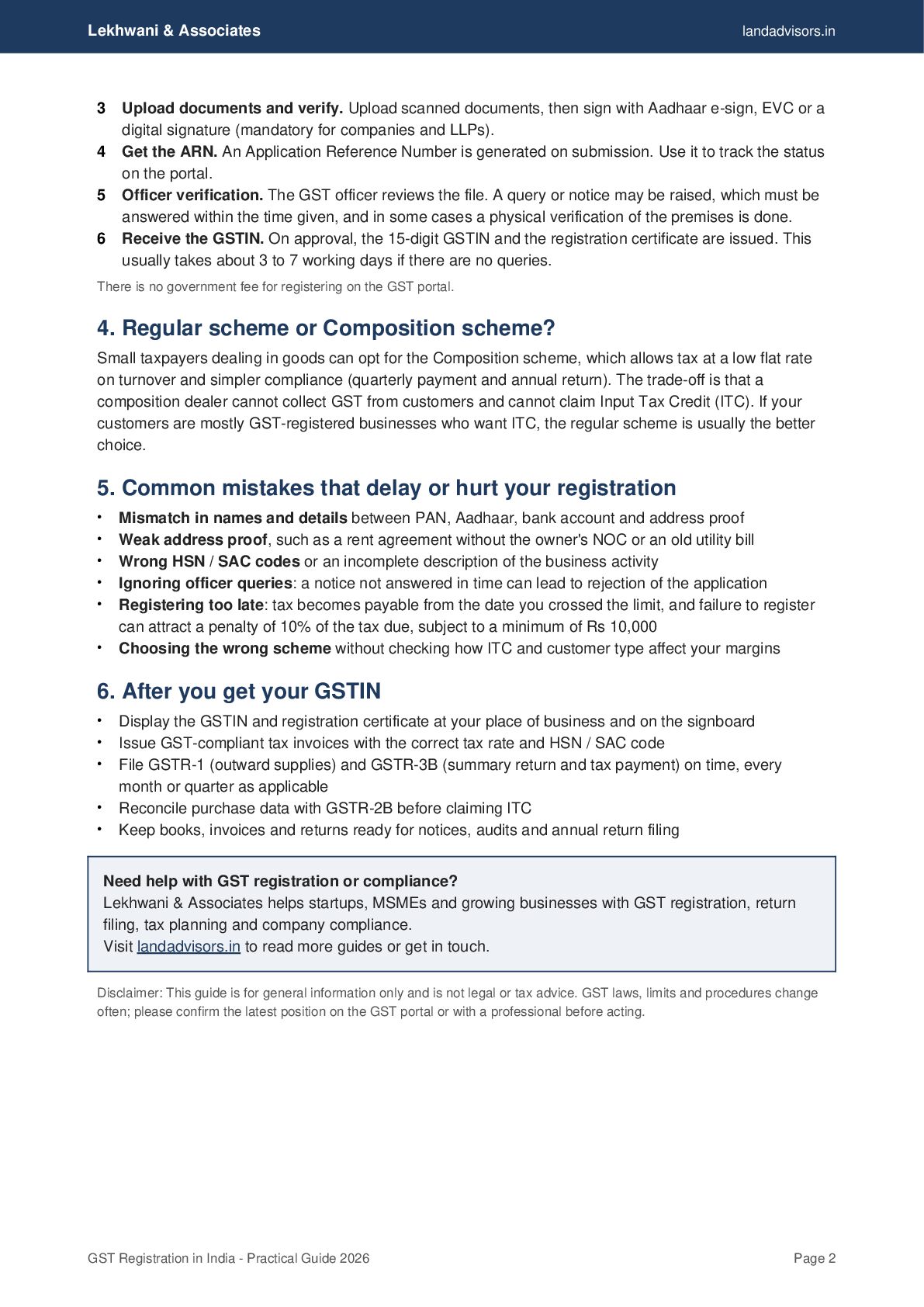
and verify. Upload scanned documents, then sign with Aadhaar e-sign, EVC or a digital signature (mandatory for companies and LLPs). Get the ARN. An Application Reference Number is generated on submission. Use it to track the status on the portal. Officer verification. The GST officer reviews the file. A query or notice may be raised, which must be answered within the time given, and in some cases a physical verification of the premises is done. Receive the GSTIN. On approval, the 15-digit GSTIN and the registration certificate are issued. This usually takes about 3 to 7 working days if there are no queries. There is no government fee for registering on the GST portal. 4. Regular scheme or Composition scheme? Small taxpayers dealing in goods can opt for the Composition scheme, which allows tax at a low flat rate on turnover and simpler compliance (quarterly payment and annual return). The trade-off is that a composition dealer cannot collect GST from customers and cannot claim Input Tax Credit (ITC). If your customers are mostly GST-registered businesses who want ITC, the regular scheme is usually the better choice. 5. Common mistakes that delay or hurt your registration • • • • • • Mismatch in names and details between PAN, Aadhaar, bank account and address proof Weak address proof, such as a rent agreement without the owner's NOC or an old utility bill Wrong HSN / SAC codes or an incomplete description of the business activity Ignoring officer queries: a notice not answered in time can lead to rejection of the application Registering too late: tax becomes payable from the date you crossed the limit, and failure to register can attract a penalty of 10% of the tax due, subject to a minimum of Rs 10,000 Choosing the wrong scheme without checking how ITC and customer type affect your margins 6. After you get your GSTIN • • • • • Display the GSTIN and registration certificate at your place of business and on the signboard Issue GST-compliant tax invoices with the correct tax rate and HSN / SAC code File GSTR-1 (outward supplies) and GSTR-3B (summary return and tax payment) on time, every month or quarter as applicable Reconcile purchase data with GSTR-2B before claiming ITC Keep books, invoices and returns ready for notices, audits and annual return filing Need help with GST registration or compliance? Lekhwani & Associates helps startups, MSMEs and growing businesses with GST registration, return filing, tax planning and company compliance. Visit landadvisors.in to read more guides or get in touch. Disclaimer: This guide is for general information only and is not legal or tax advice. GST laws, limits and procedures change often; please confirm the latest position on the GST portal or with a professional before acting. GST Registration in India - Practical Guide 2026 Page 2


 mayatellez
 cassininazir
 katarinadahlin
 stuffmc
 holman
 marktimemedia
 chriscoyier
 auna
 samlambert
 tapps
 mlcsv
 rasmusluckow