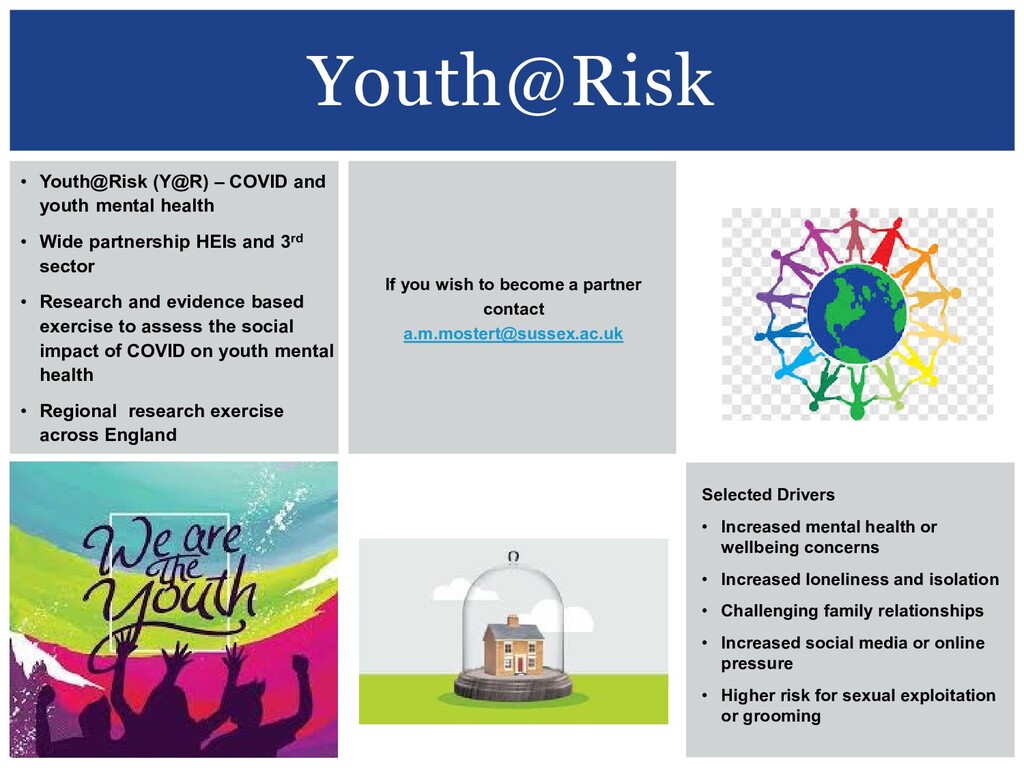
• Wide partnership HEIs and 3rd sector • Research and evidence based exercise to assess the social impact of COVID on youth mental health • Regional research exercise across England Selected Drivers • Increased mental health or wellbeing concerns • Increased loneliness and isolation • Challenging family relationships • Increased social media or online pressure • Higher risk for sexual exploitation or grooming If you wish to become a partner contact [email protected]
as we are just at home, some of it is fake news and we’re getting so scared, some people I know are having panic attacks. We’re trying to figure out how to stay safe while still staying mentally healthy, Depression is going to go up during this outbreak you don’t realise it’s here until it’s too late.” The UK Youth Movement “Not everyone has a family to support them through this. Lots of people’s friends are their family and now they can’t see them at all, only online. People will be feeling so isolated more than they have ever done before.” The UK Youth Movement Please consider joining our Youth Against Fake News Erasmus+ Project – contact Dr Pascoe (DICE Consortium) – [email protected])
University • Clod Ensemble • Design Against Crime Research Centre (University of Arts London) • DICE Consortium (Brazil, Egypt, Indonesia, Pakistan & South Africa) • GoVox • Institute of Community Safety • Le Menach Foundation • LOOKOUT Brighton • Making It Out • Sussex Crime Research Centre • University of Southern Queensland • University of Sunderland • Expanding international partners (All welcome)
(Youth@Risk- MiO) • Submitted to Nuffield Foundation March 2020 • Feedback - not research intensive enough (delivery focus) • Apply feedback and resubmitted • Awaiting outcome
communications alleviate, exacerbate and shift vulnerability, and affect concepts of trust, evidence, and authority • In what ways do factors such as socio-economic status, gender, ethnicity, community, and geography affect the vulnerability of people to different types of risk, and how can this be mitigated? • What interventions might promote opportunity and reduce adversity through different life stages, and promote social inclusion between and across generations? • What are the social and economic implications of physical and mental disability and chronic illness?
to selected agencies (AHRC, Nuffield, British Academy, Erasmus+, etc) • Exploring other areas associated with Youth@Risk Existing Projects: • Youth Against Fake News ( • Signing Banks – Enhancing access to financial services for the deaf’ ( New submissions: • Online Safety for Vocational Education Students • Employability 4 World in Post COVID World • STEM and STEAM Career Development • Cloud Computing and Digital Pedagogy


 aspectnetwork
 szymonslowik
 tanoku
 eileencodes
 3n
3n
 inesmontani
 bluesmoon
 sabderemane
 codingconduct
.jpg) cargoodrich
cargoodrich
 skipperchong
 tammielis
 elsirapls