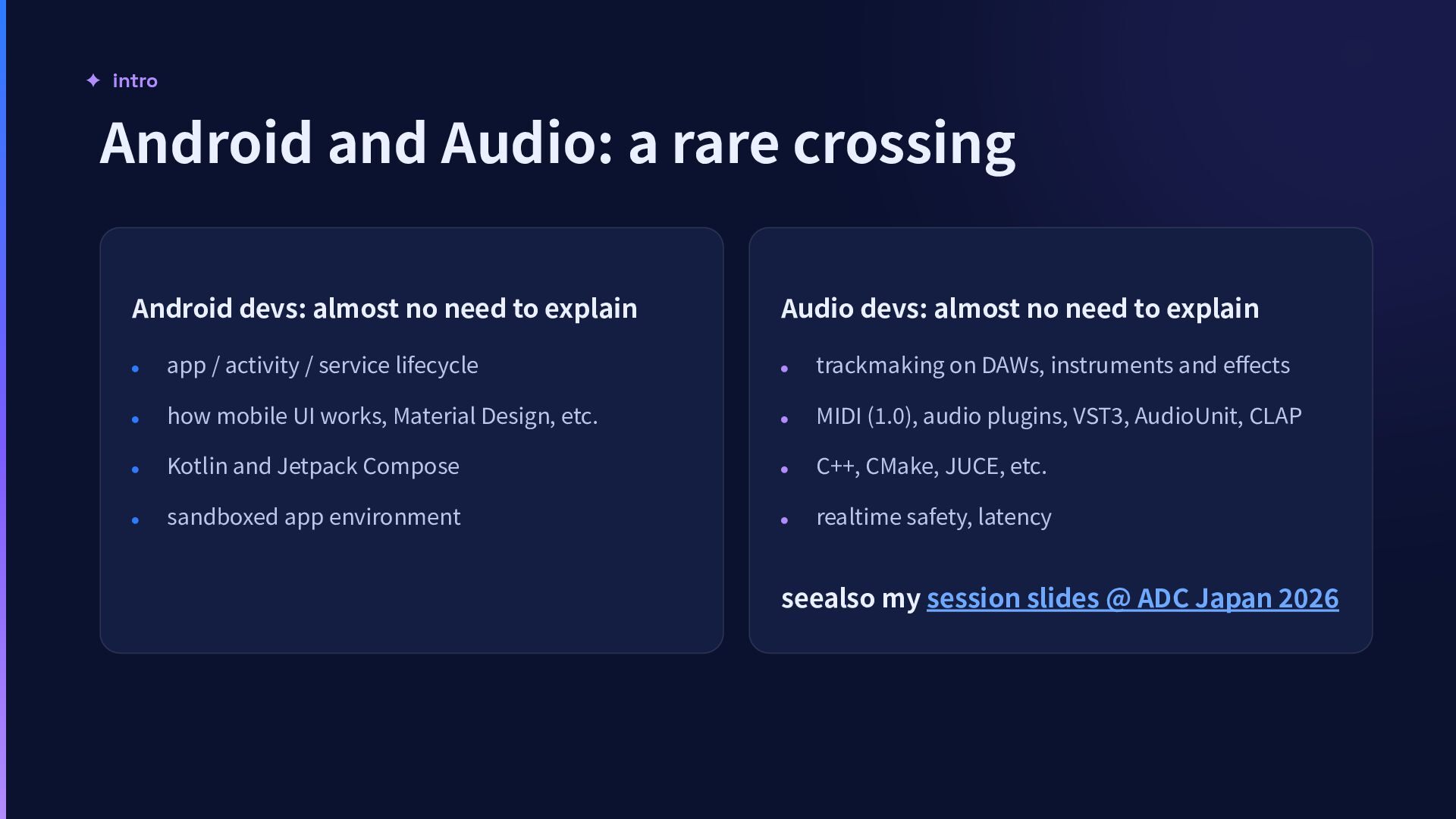
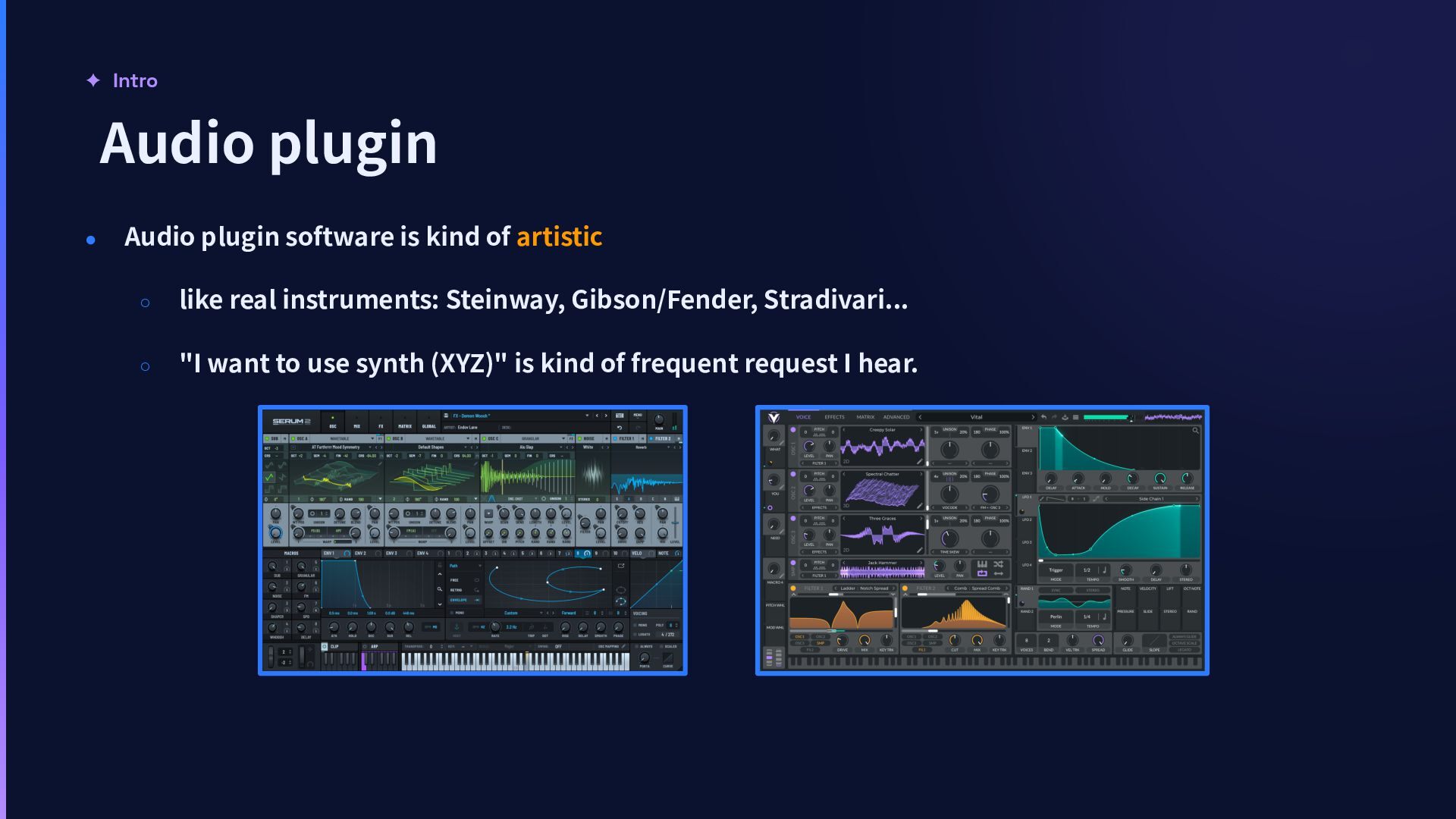
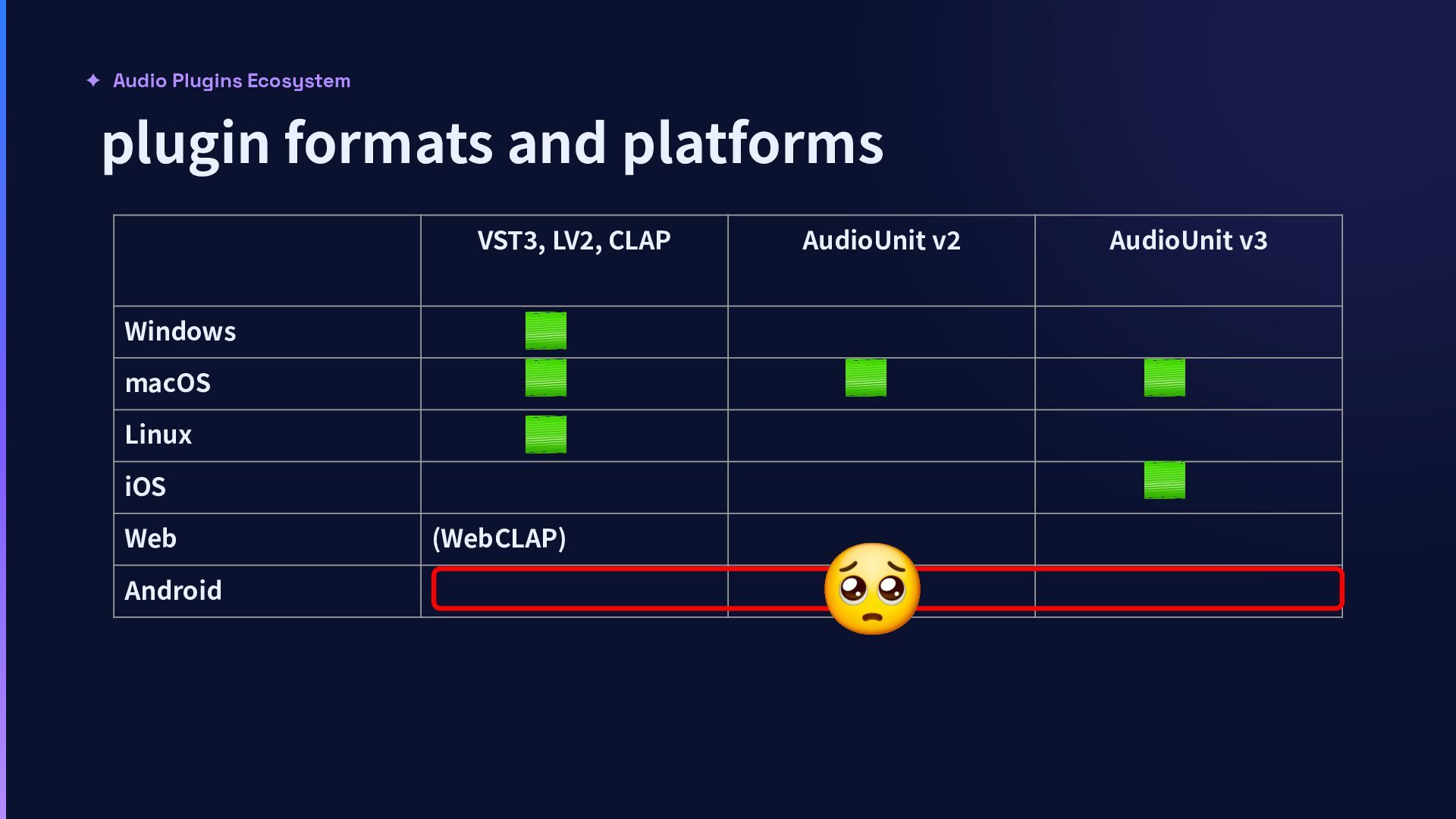
almost no need to explain Audio devs: almost no need to explain • app / activity / service lifecycle • trackmaking on DAWs, instruments and effects • how mobile UI works, Material Design, etc. • MIDI (1.0), audio plugins, VST3, AudioUnit, CLAP • Kotlin and Jetpack Compose • C++, CMake, JUCE, etc. • sandboxed app environment • realtime safety, latency seealso my session slides @ ADC Japan 2026
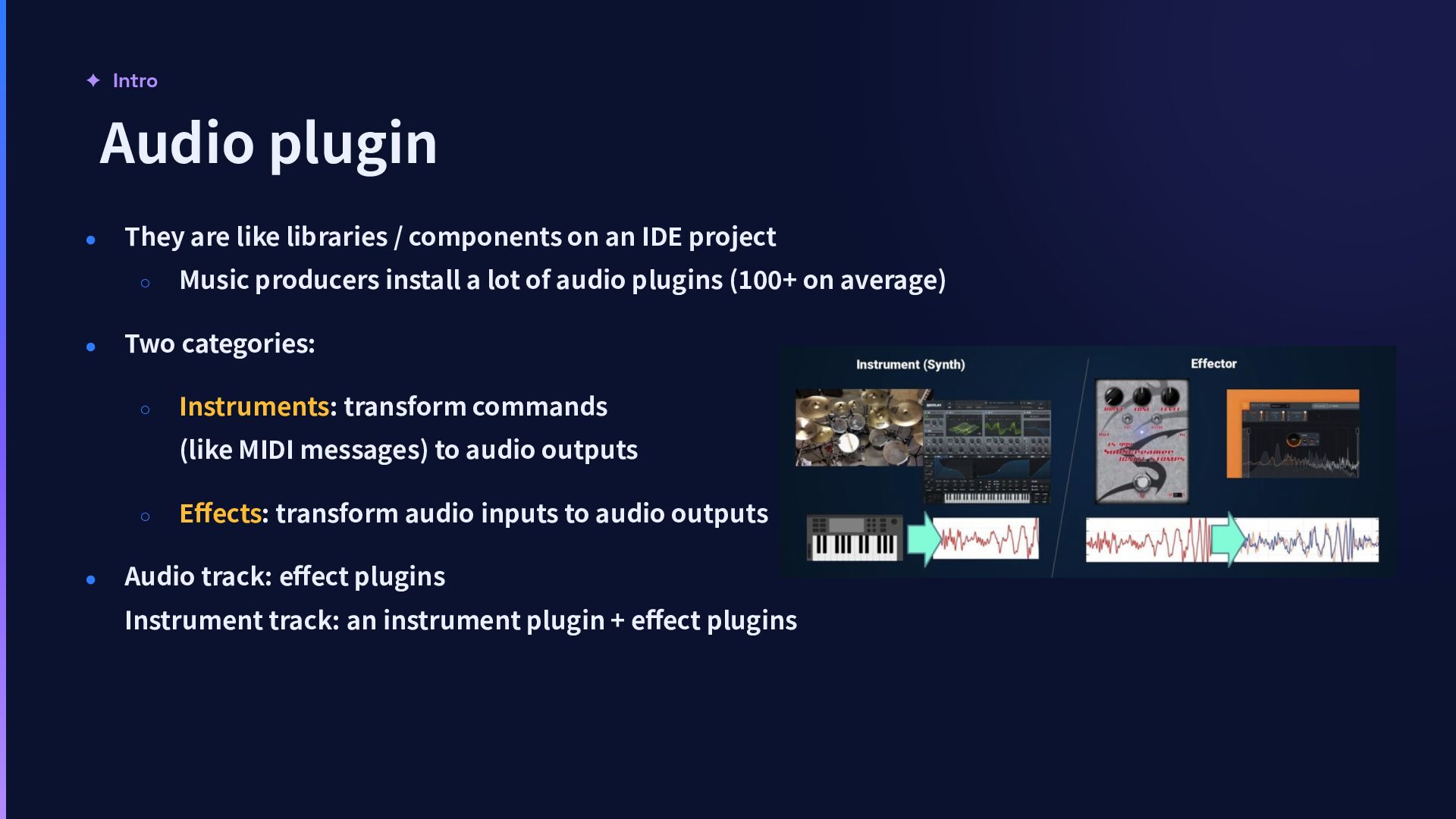
components on an IDE project ◦ • Music producers install a lot of audio plugins (100+ on average) Two categories: ◦ Instruments: transform commands (like MIDI messages) to audio outputs ◦ • Effects: transform audio inputs to audio outputs Audio track: effect plugins Instrument track: an instrument plugin + effect plugins
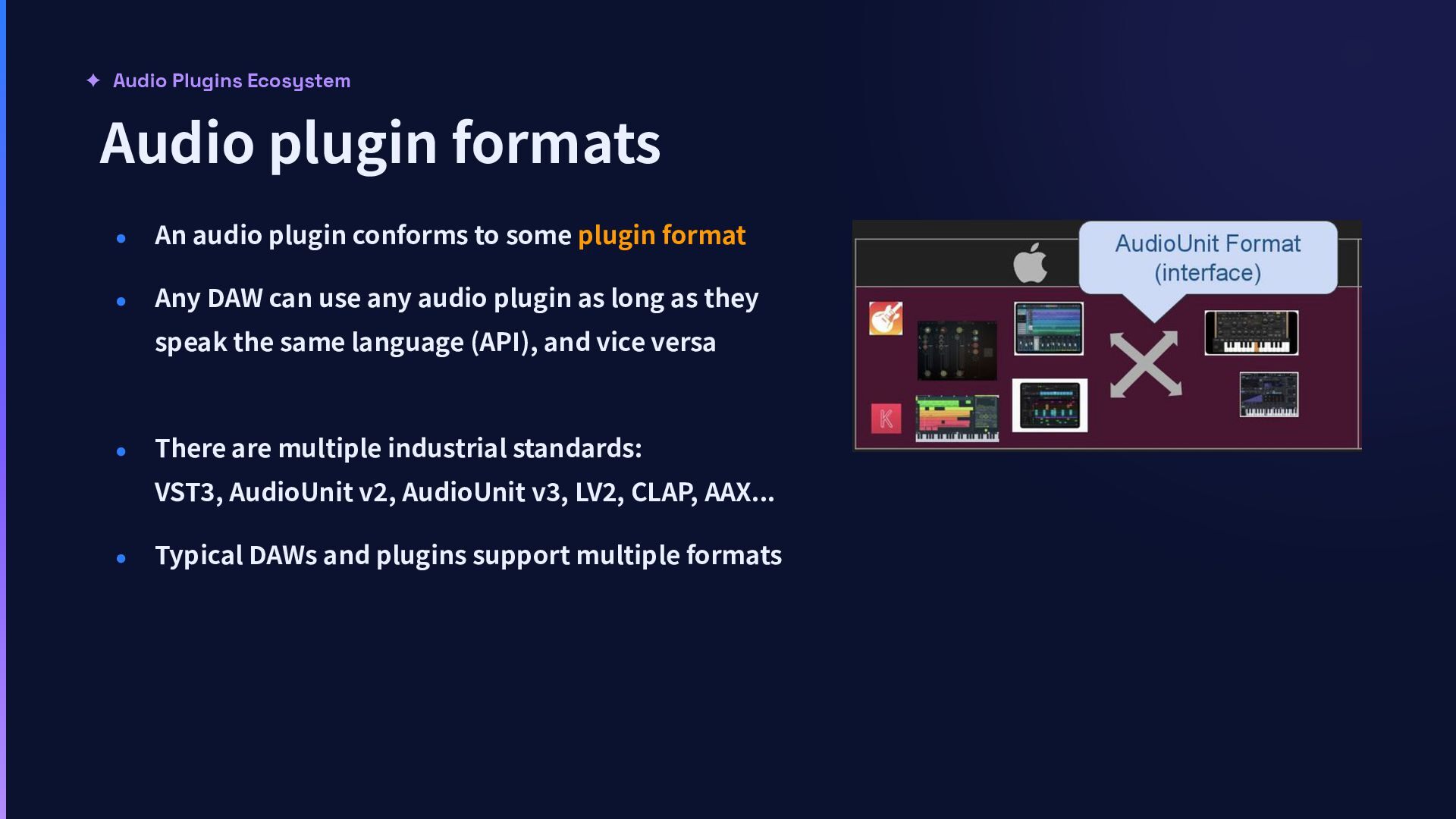
plugin conforms to some plugin format • Any DAW can use any audio plugin as long as they speak the same language (API), and vice versa • There are multiple industrial standards: VST3, AudioUnit v2, AudioUnit v3, LV2, CLAP, AAX... • Typical DAWs and plugins support multiple formats
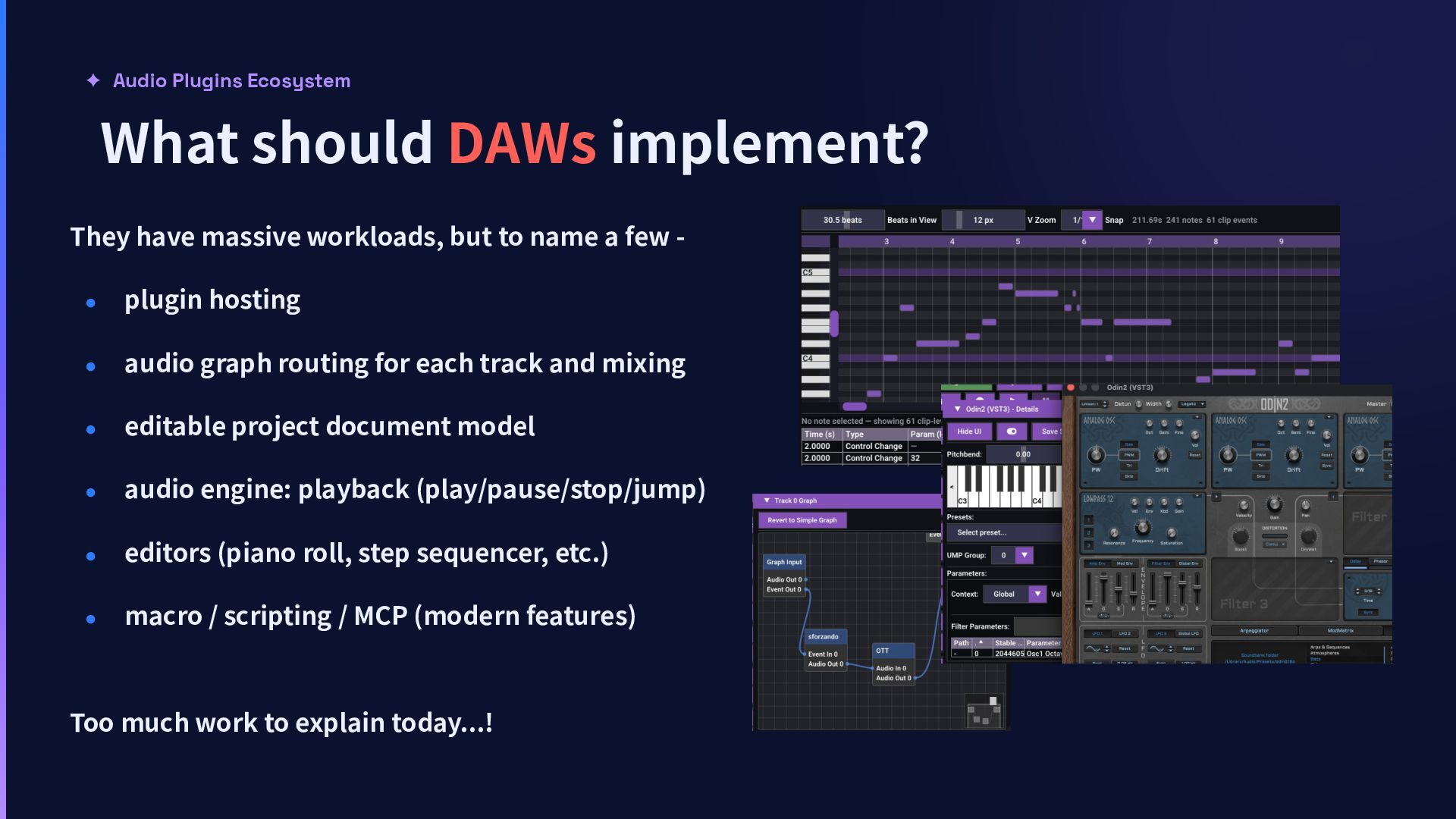
massive workloads, but to name a few • plugin hosting • audio graph routing for each track and mixing • editable project document model • audio engine: playback (play/pause/stop/jump) • editors (piano roll, step sequencer, etc.) • macro / scripting / MCP (modern features) Too much work to explain today...!
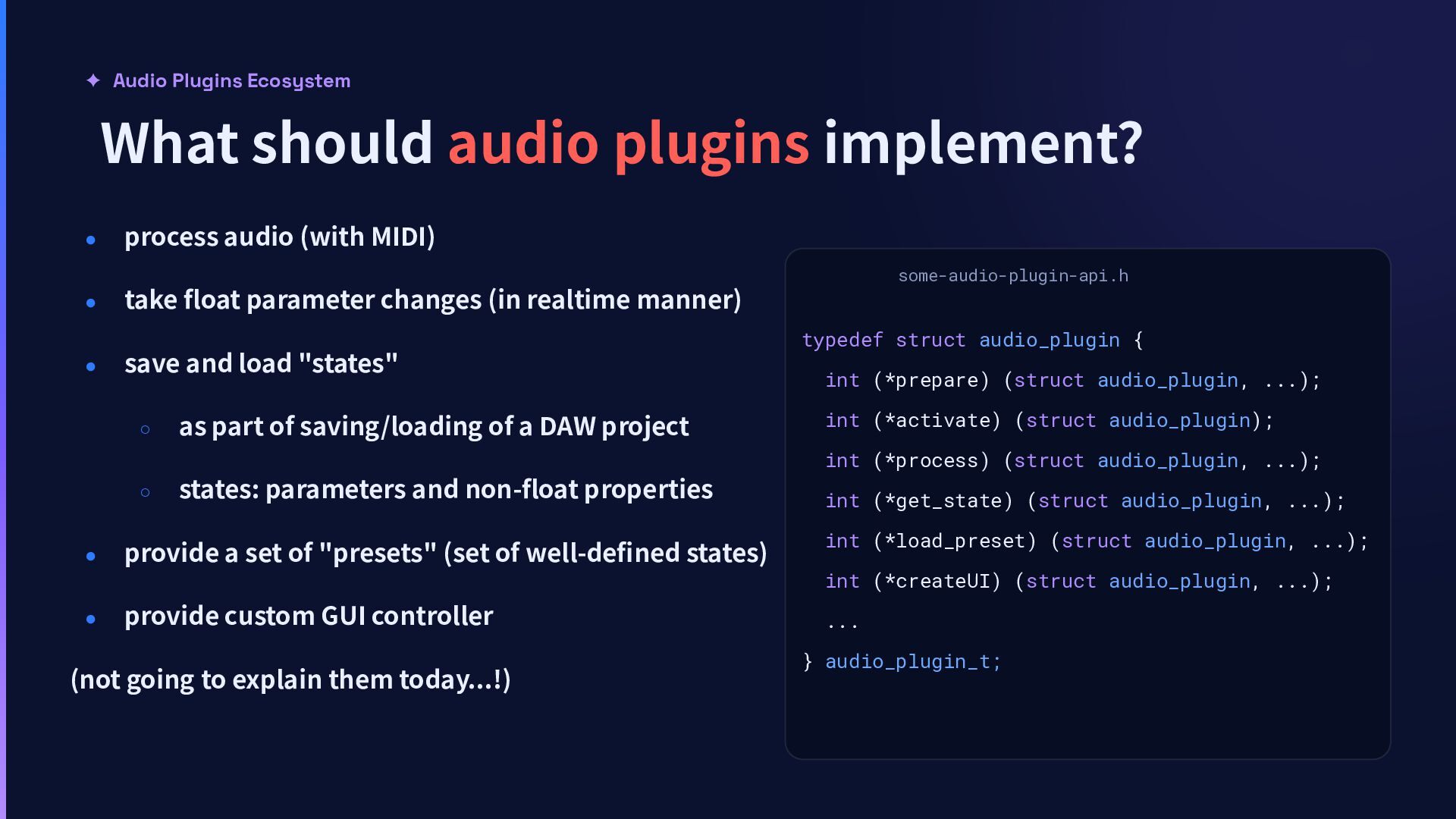
process audio (with MIDI) some-audio-plugin-api.h • • take float parameter changes (in realtime manner) save and load "states" ◦ as part of saving/loading of a DAW project typedef struct audio_plugin { int (*prepare) (struct audio_plugin, ...); int (*activate) (struct audio_plugin); int (*process) (struct audio_plugin, ...); ◦ • states: parameters and non-float properties provide a set of "presets" (set of well-defined states) int (*get_state) (struct audio_plugin, ...); int (*load_preset) (struct audio_plugin, ...); int (*createUI) (struct audio_plugin, ...); • provide custom GUI controller (not going to explain them today...!) ... } audio_plugin_t;
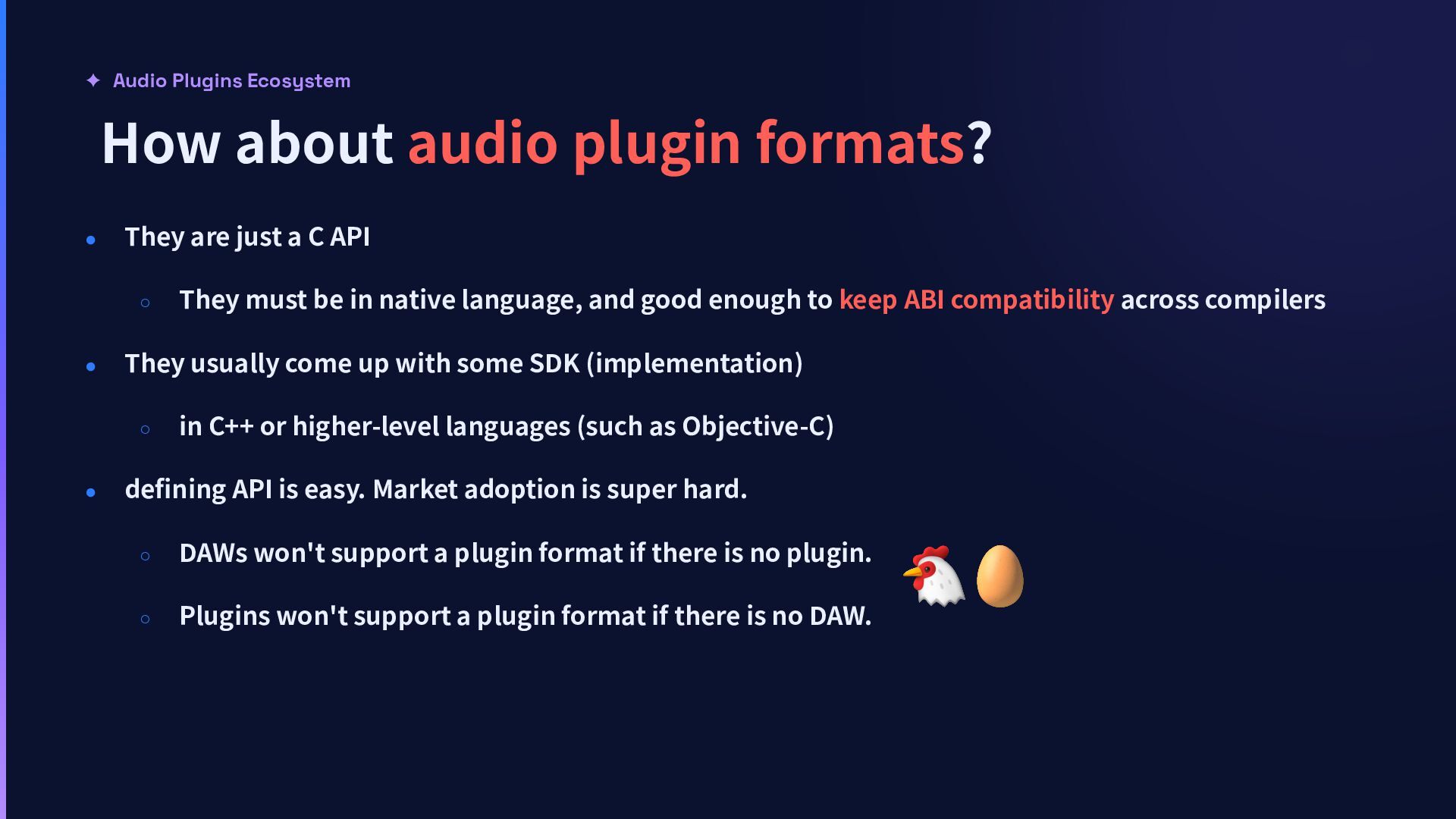
They are just a C API ◦ • They usually come up with some SDK (implementation) ◦ • They must be in native language, and good enough to keep ABI compatibility across compilers in C++ or higher-level languages (such as Objective-C) defining API is easy. Market adoption is super hard. ◦ DAWs won't support a plugin format if there is no plugin. ◦ Plugins won't support a plugin format if there is no DAW.
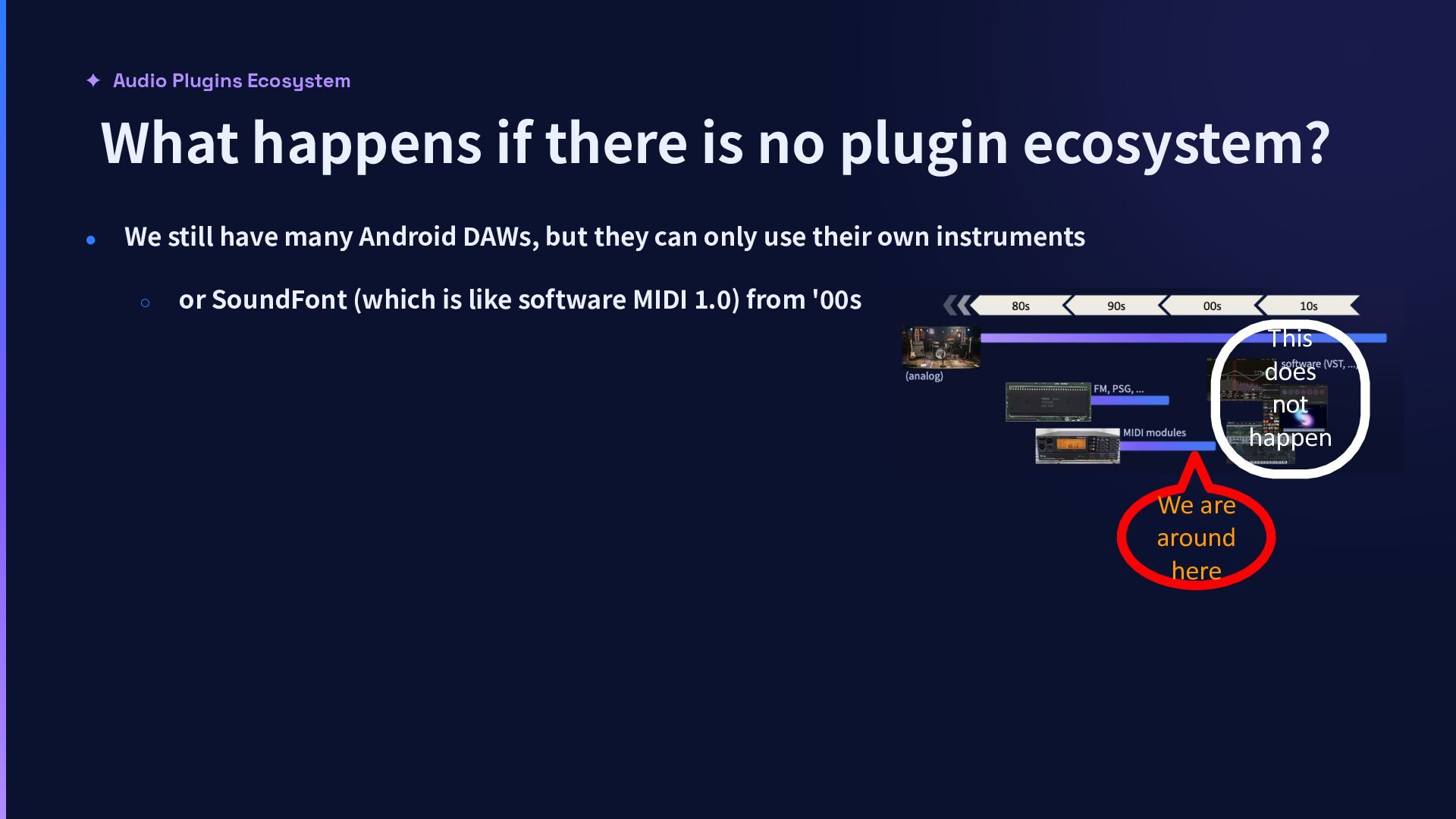
plugin ecosystem? • We still have many Android DAWs, but they can only use their own instruments ◦ or SoundFont (which is like software MIDI 1.0) from '00s This does not happen We are around here
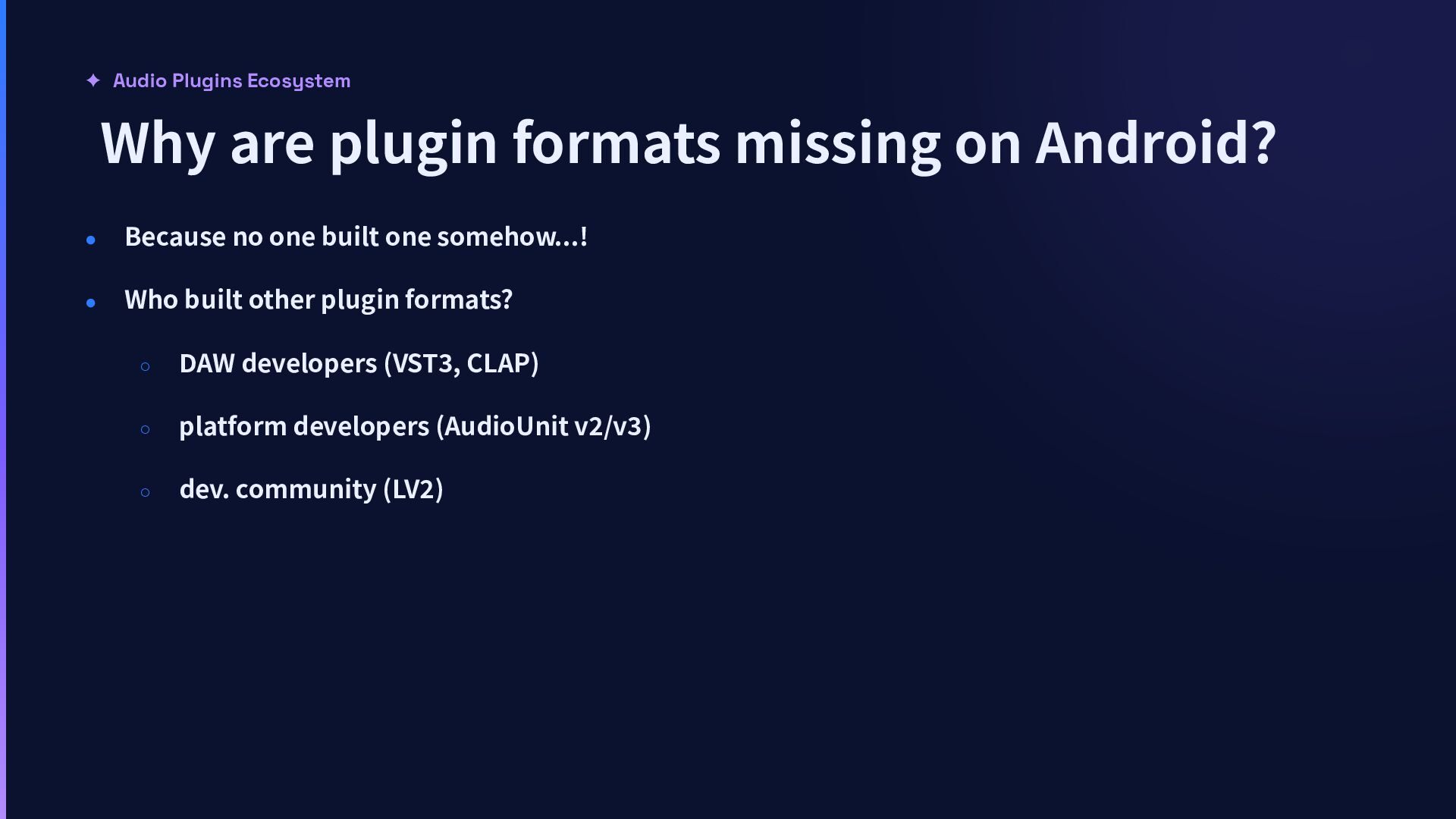
Android? • Because no one built one somehow...! • Who built other plugin formats? ◦ DAW developers (VST3, CLAP) ◦ platform developers (AudioUnit v2/v3) ◦ dev. community (LV2)
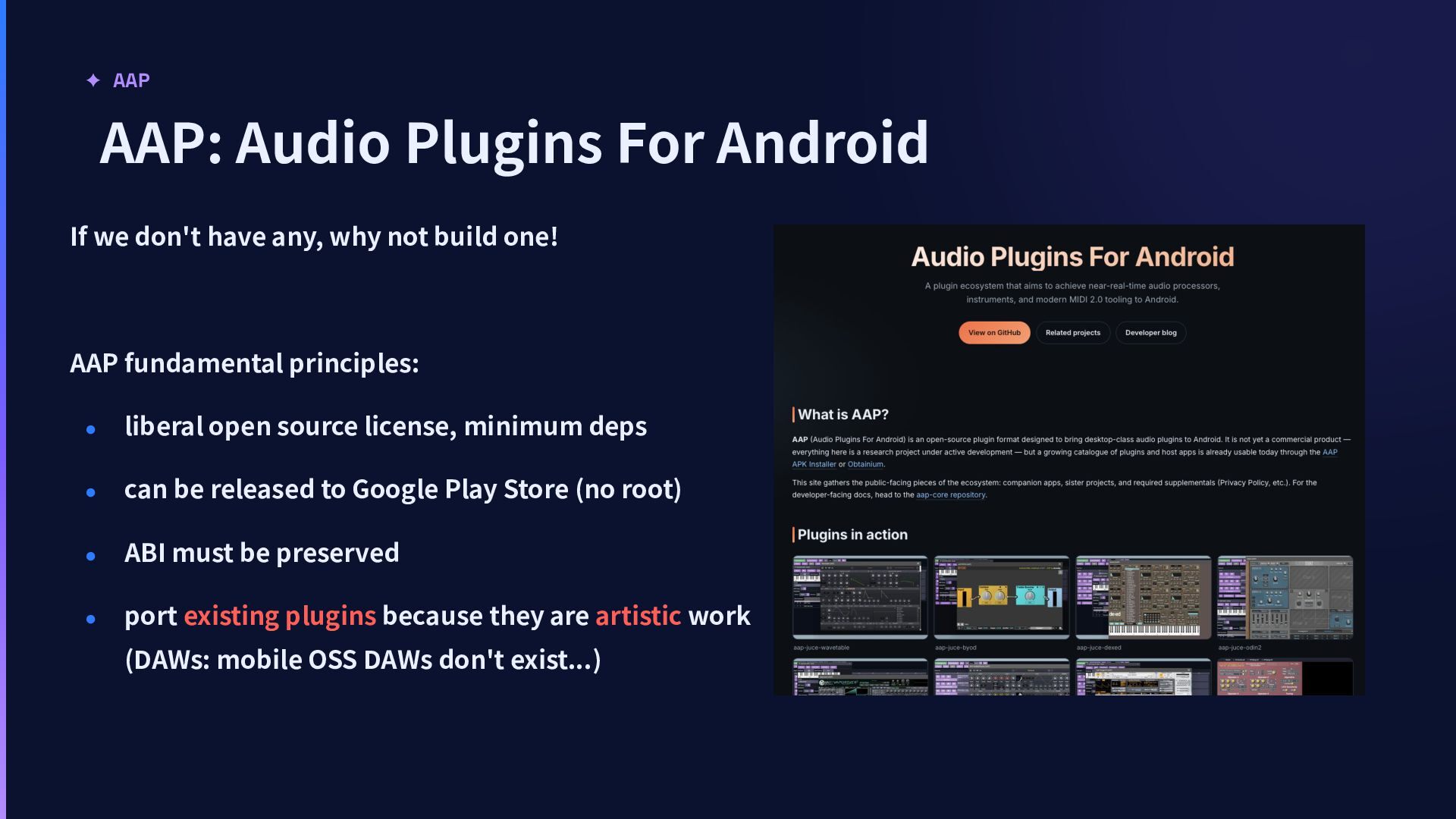
have any, why not build one! AAP fundamental principles: • liberal open source license, minimum deps • can be released to Google Play Store (no root) • ABI must be preserved • port existing plugins because they are artistic work (DAWs: mobile OSS DAWs don't exist...)
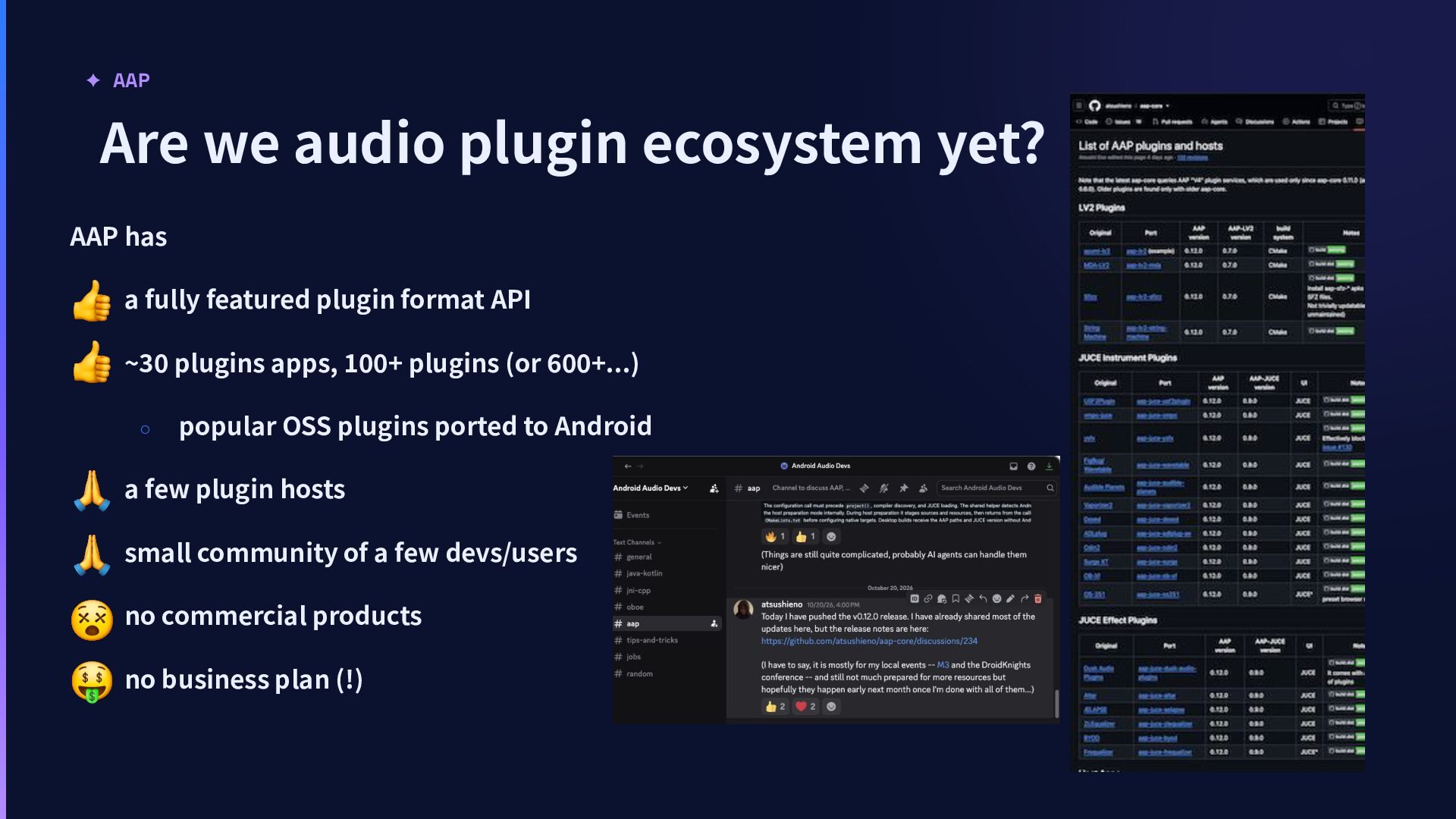
• a fully featured plugin format API • ~30 plugins apps, 100+ plugins (or 600+...) ◦ popular OSS plugins ported to Android • a few plugin hosts • small community of a few devs/users • no commercial products • no business plan (!)
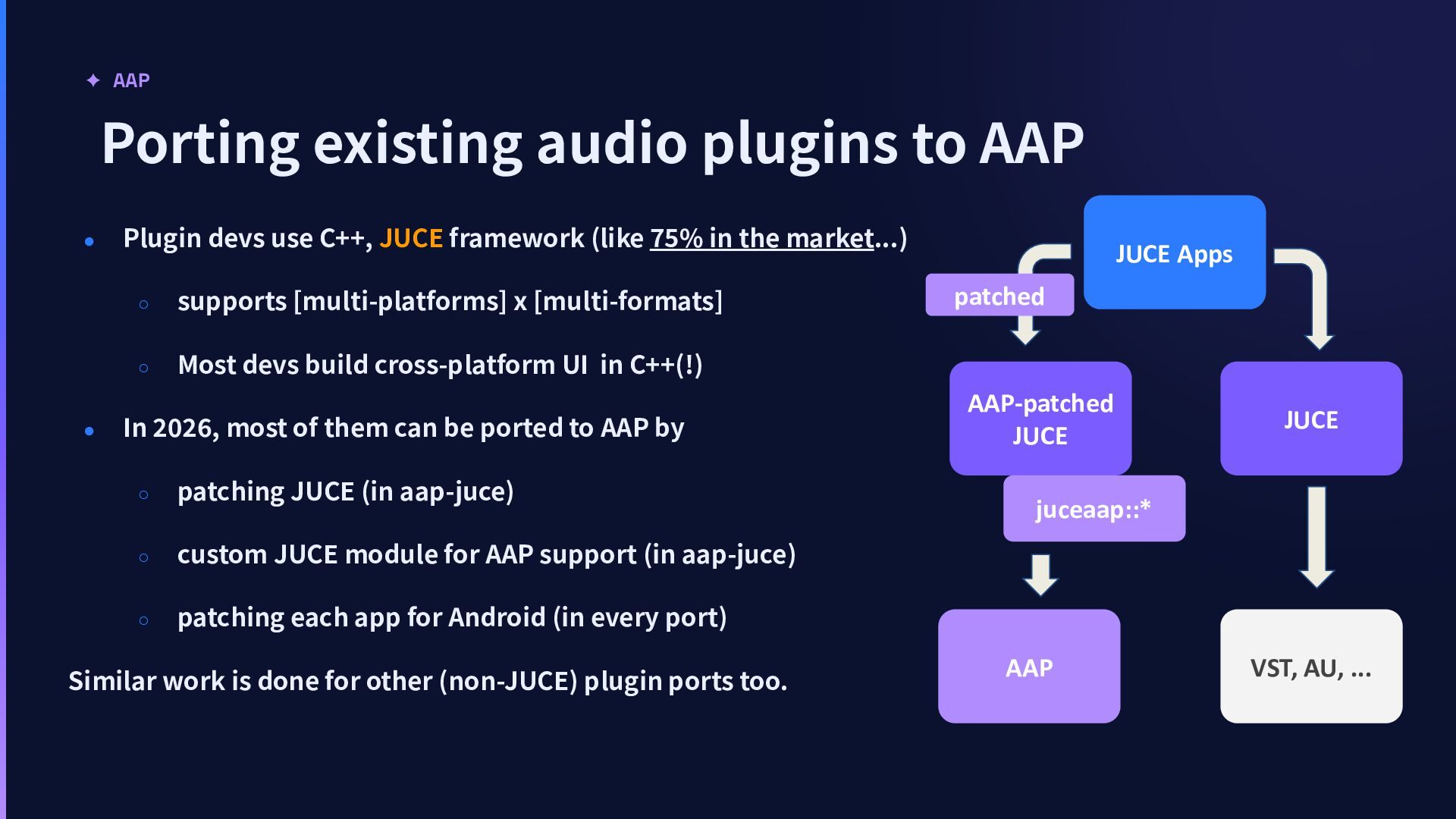
Plugin devs use C++, JUCE framework (like 75% in the market...) ◦ supports [multi-platforms] x [multi-formats] ◦ Most devs build cross-platform UI in C++(!) In 2026, most of them can be ported to AAP by ◦ patching JUCE (in aap-juce) ◦ custom JUCE module for AAP support (in aap-juce) ◦ patching each app for Android (in every port) Similar work is done for other (non-JUCE) plugin ports too. JUCE Apps patched AAP-patched JUCE JUCE juceaap::* AAP VST, AU, ...
rule in API: keep ABI compatibility But there are always requests for new features. • Therefore, most plugin features are defined as "extensions" (state extension, parameters extension, presets extension, GUI extension, ...) • AAP avoids extensions API in Binder AIDL because its ABI maintainability is uncertain. • Instead, they are defined in a binary protocol (like gRPC) over two transports: ◦ Binder (non-realtime) ◦ MIDI 2.0 data buffer in audio processing (realtime)
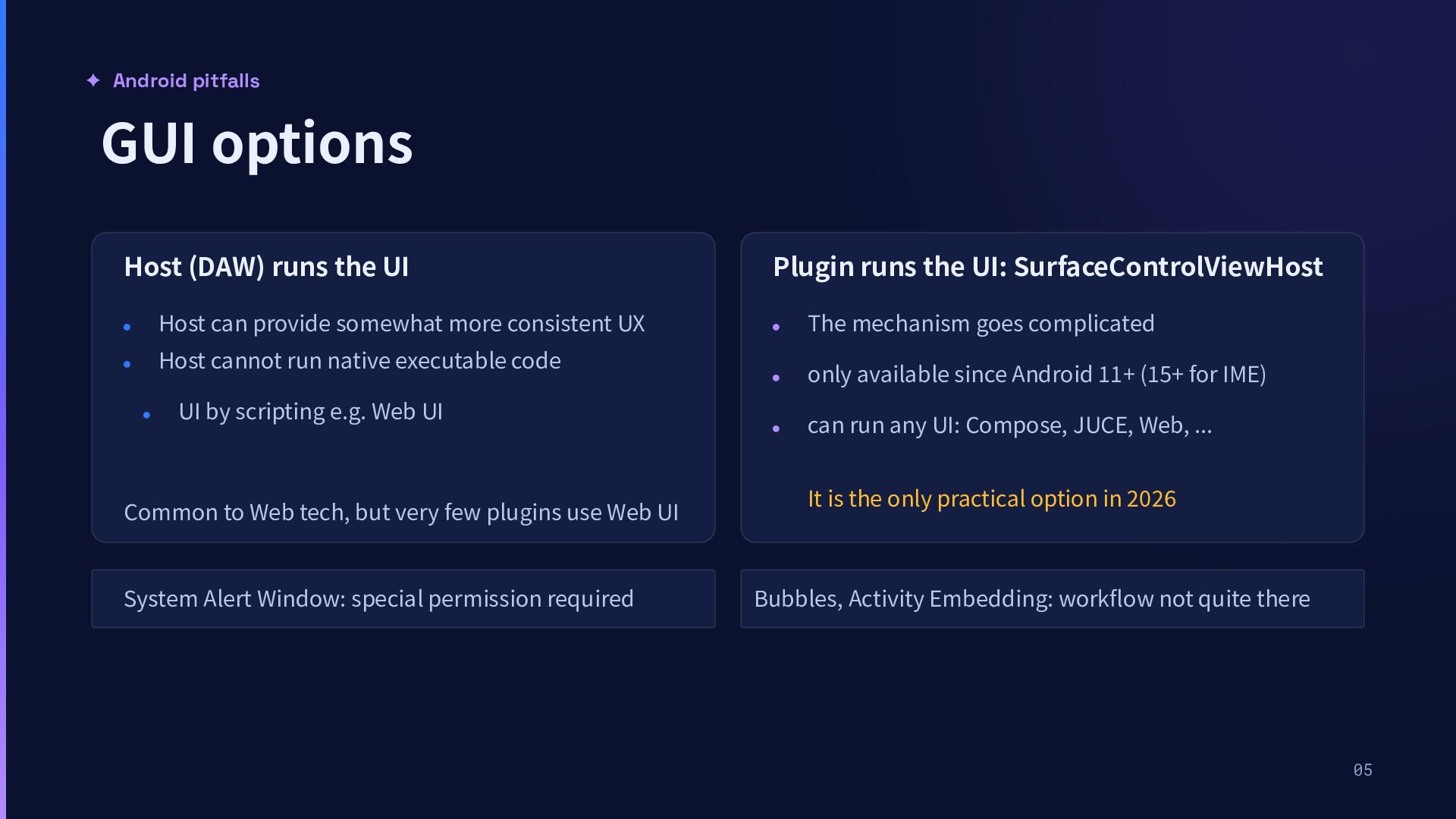
• Host can provide somewhat more consistent UX • Host cannot run native executable code • UI by scripting e.g. Web UI Common to Web tech, but very few plugins use Web UI System Alert Window: special permission required Plugin runs the UI: SurfaceControlViewHost • The mechanism goes complicated • only available since Android 11+ (15+ for IME) • can run any UI: Compose, JUCE, Web, ... It is the only practical option in 2026 Bubbles, Activity Embedding: workflow not quite there 05
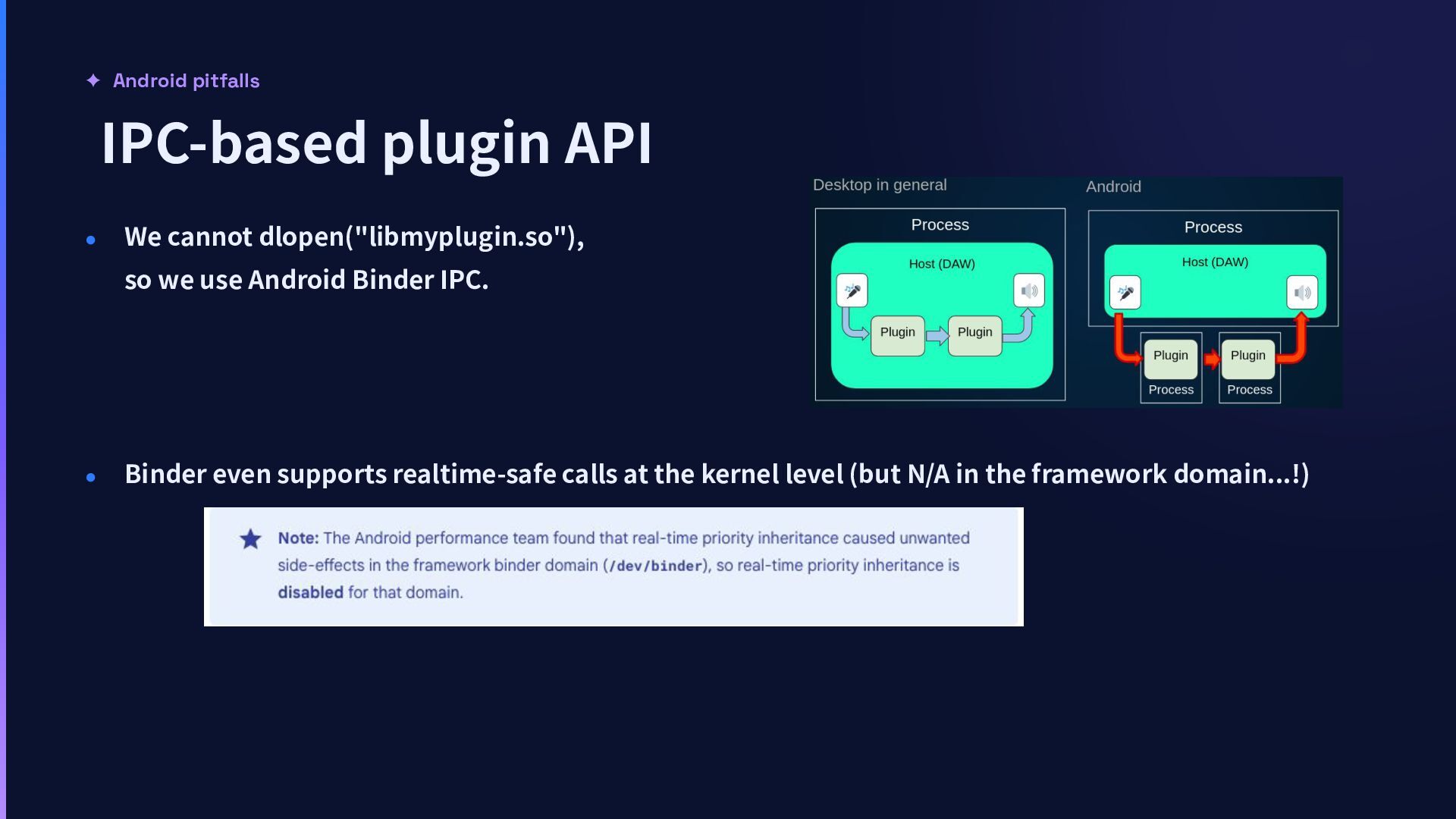
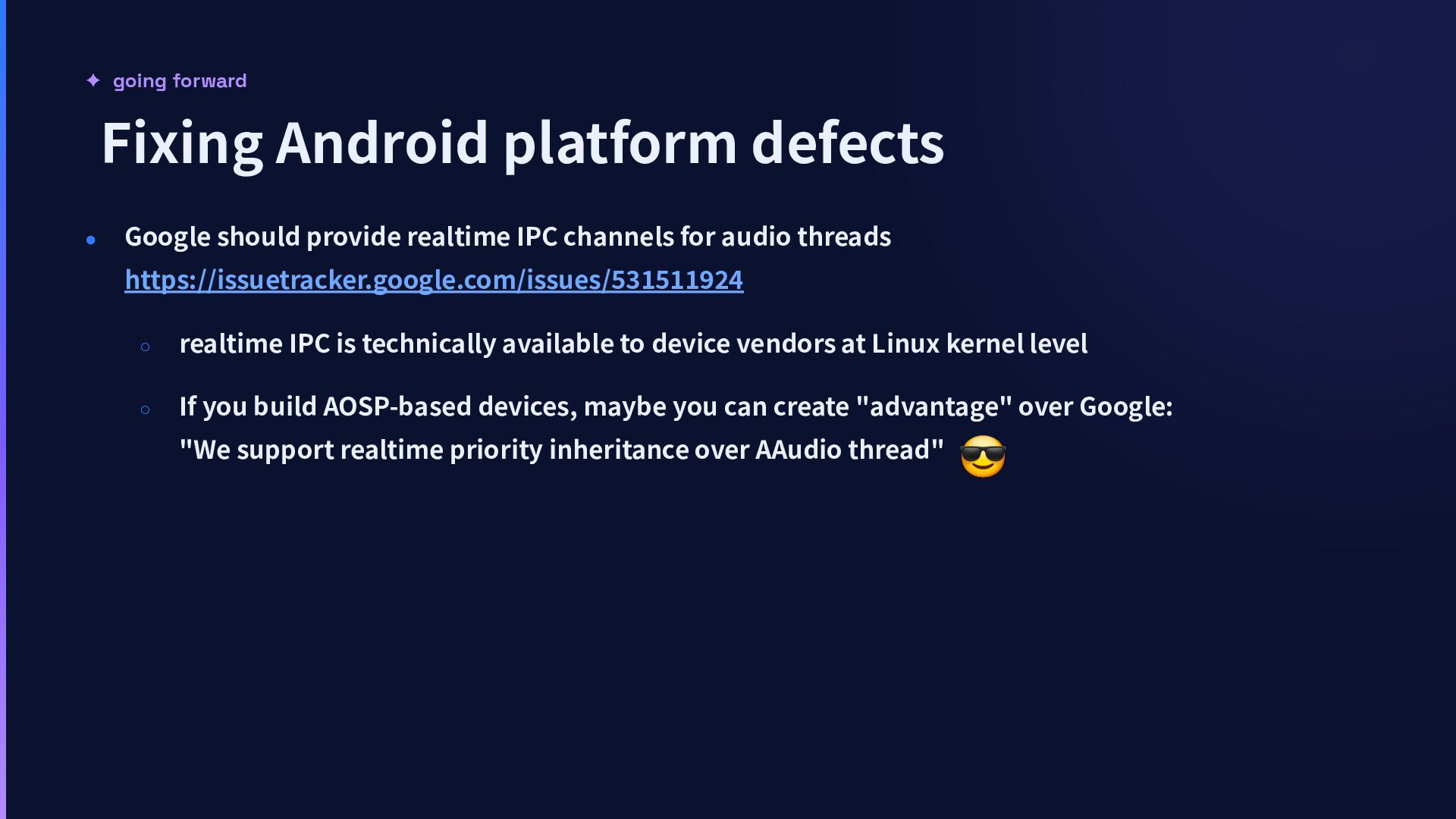
provide realtime IPC channels for audio threads https://issuetracker.google.com/issues/531511924 ◦ realtime IPC is technically available to device vendors at Linux kernel level ◦ If you build AOSP-based devices, maybe you can create "advantage" over Google: "We support realtime priority inheritance over AAudio thread"
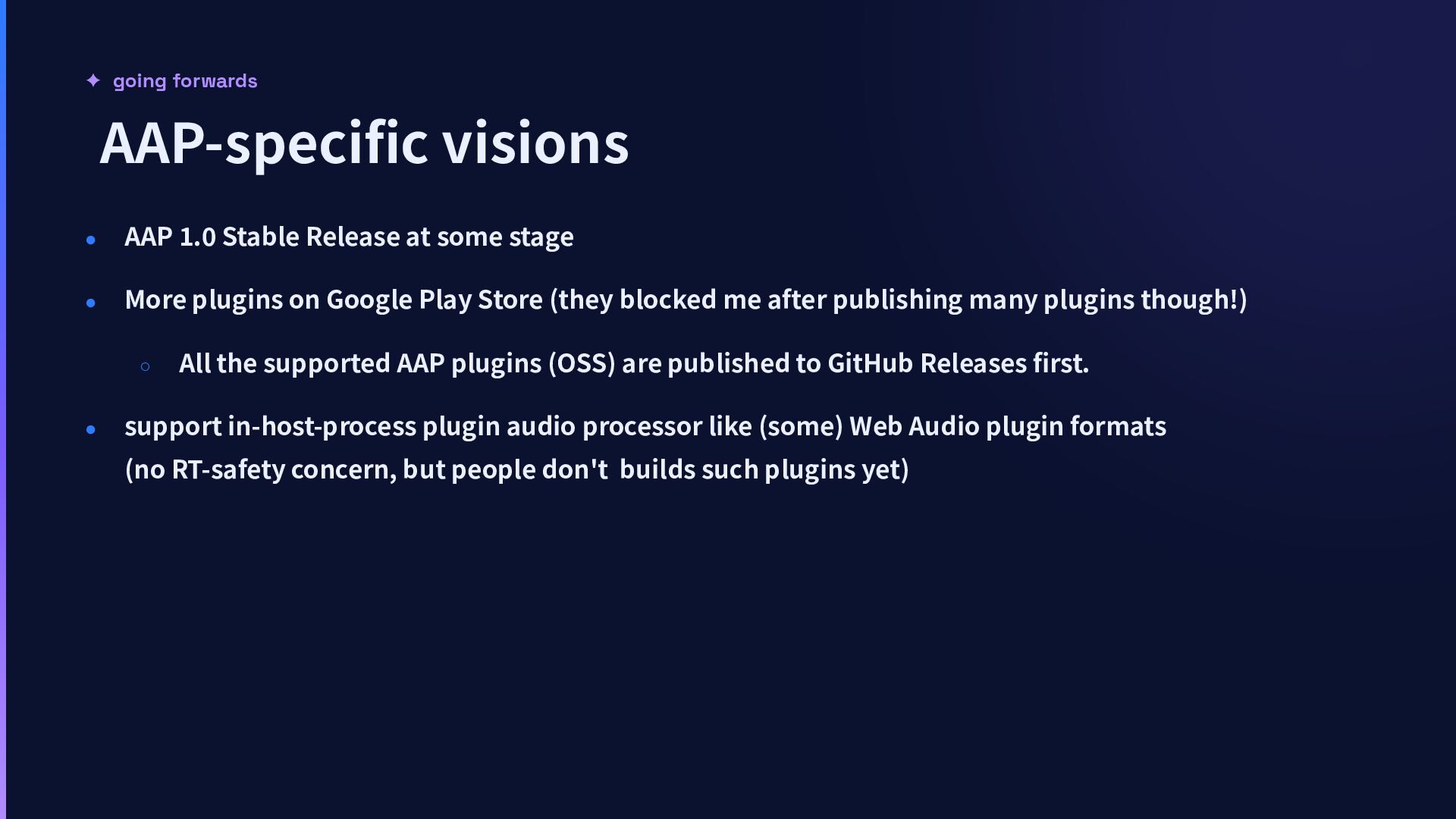
at some stage • More plugins on Google Play Store (they blocked me after publishing many plugins though!) ◦ • All the supported AAP plugins (OSS) are published to GitHub Releases first. support in-host-process plugin audio processor like (some) Web Audio plugin formats (no RT-safety concern, but people don't builds such plugins yet)
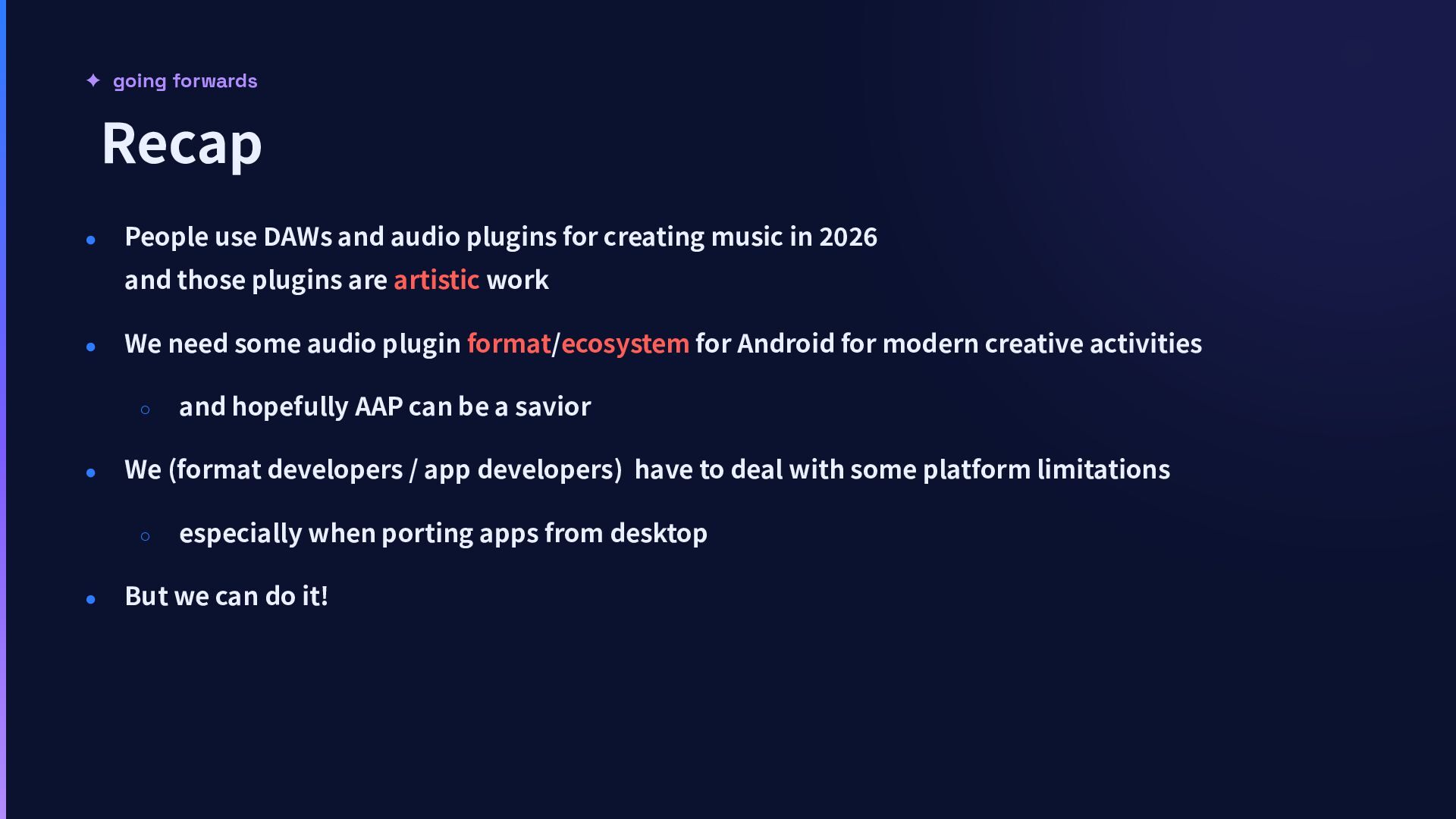
plugins for creating music in 2026 and those plugins are artistic work • We need some audio plugin format/ecosystem for Android for modern creative activities ◦ • We (format developers / app developers) have to deal with some platform limitations ◦ • and hopefully AAP can be a savior especially when porting apps from desktop But we can do it!
• AAP: Audio Plugins For Android • UAPMD, uapmd-kmp : MIDI 2.0 native DAW/host engine • ktmidi, compose-audio-controls, etc. • used to work on XML, WS, g11n, RX, msbuild, Android API in C#, etc. at mono / xamarin team (~2018)


 atsushieno
 lehupa
 kintotechdev
 legalontechnologies
 yappli_developers
 skydoves
 sato4mi
 kentarofujii
 tacck
 yuj1osm
 sogaoh
 miu_crescent
 kai0707
 tmiket
 ammeep
 lauravandoore
 tammyeverts
 jonoalderson
 danielanewman
 rasagy
 tamaranovitovic
 rkaga
 marketingsoph
 samtorres
 62gerente