Upgrade to Pro — share decks privately, control downloads, hide ads and more …

Bradford College Student Rep Training 2017-18

Avatar for bcsu bcsu
October 28, 2017

Bradford College Student Rep Training 2017-18

© Bradford College Students' Union. Some rights reserved. Presented to 80 student reps over 2 sessions in October/November 2017. Thanks to Tony Payne, Jim Dickinson, and Laura Pike for their contributions. Photo credits from PicJumbo, StartupStock, Unsplash, and Bradford College Marketing on request. Best viewed in full screen.

Avatar for bcsu

bcsu

October 28, 2017
Tweet

Other Decks in Education

Transcript

  1. WHAT DID YOU EXPECT… • When you signed up to

    be a rep We hope this presentation covers a lot of what you expected I’m happy to answer any questions you have after this: Robson [email protected] If you decide not to be a rep, then let me and your tutor or progress coach know as soon as possible
  2. Your rights – College Charter (FE) Student Contract (HE) It

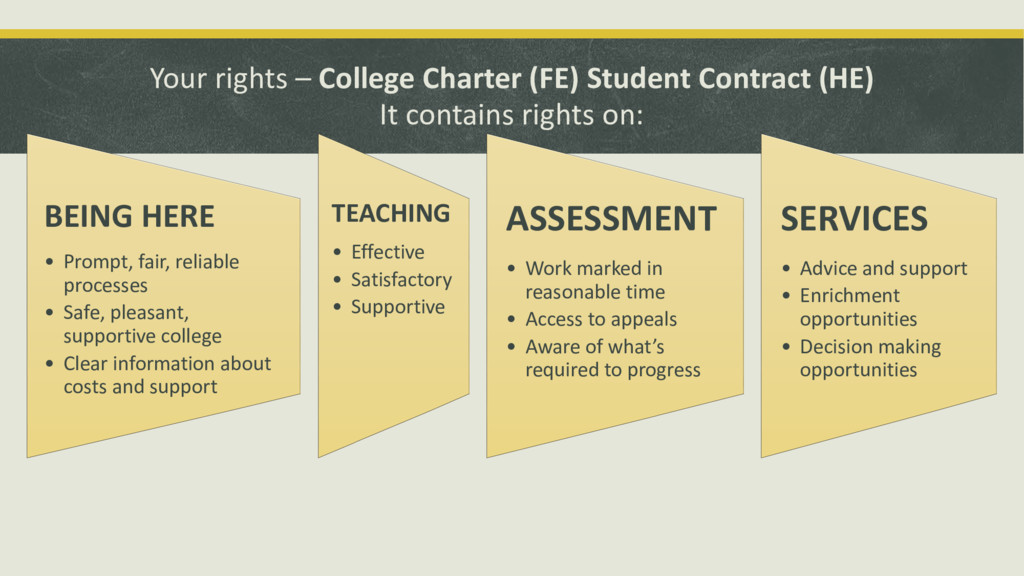
    contains rights on: BEING HERE • Prompt, fair, reliable processes • Safe, pleasant, supportive college • Clear information about costs and support TEACHING • Effective • Satisfactory • Supportive ASSESSMENT • Work marked in reasonable time • Access to appeals • Aware of what’s required to progress SERVICES • Advice and support • Enrichment opportunities • Decision making opportunities
  3. Your rights – College Charter (FE) Student Contract (HE) It

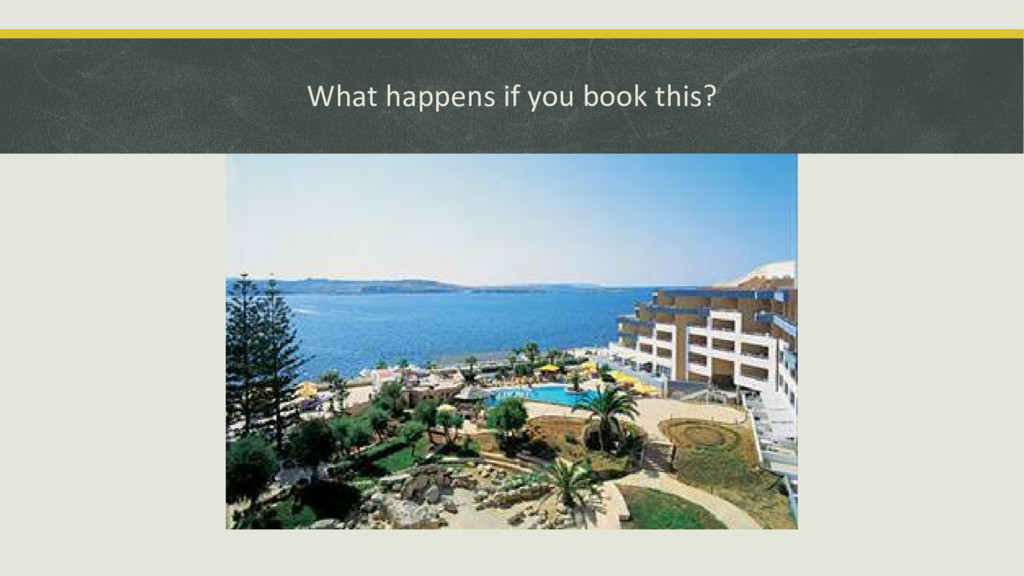
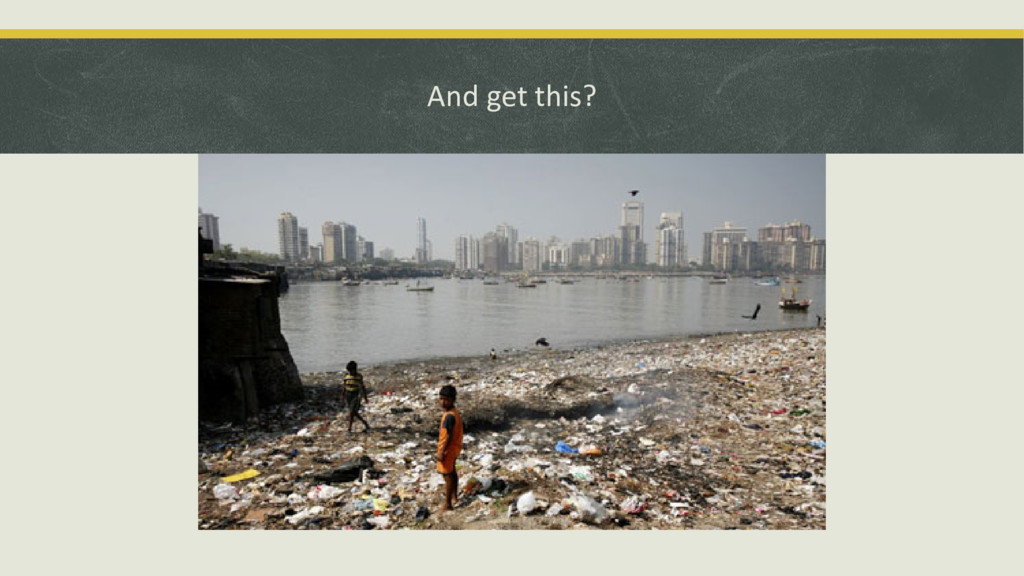
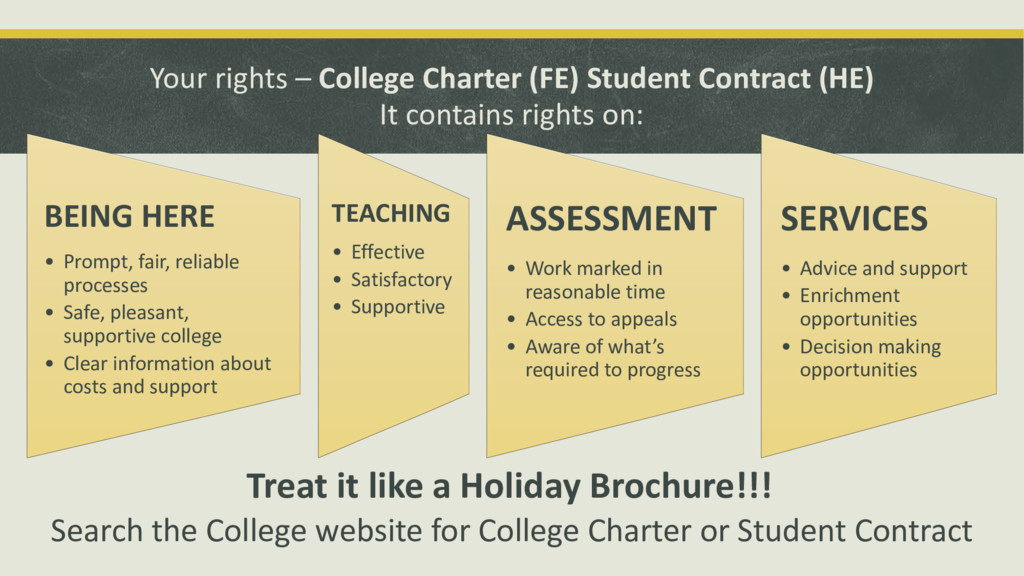
    contains rights on: BEING HERE • Prompt, fair, reliable processes • Safe, pleasant, supportive college • Clear information about costs and support TEACHING • Effective • Satisfactory • Supportive ASSESSMENT • Work marked in reasonable time • Access to appeals • Aware of what’s required to progress SERVICES • Advice and support • Enrichment opportunities • Decision making opportunities Treat it like a Holiday Brochure!!! Search the College website for College Charter or Student Contract
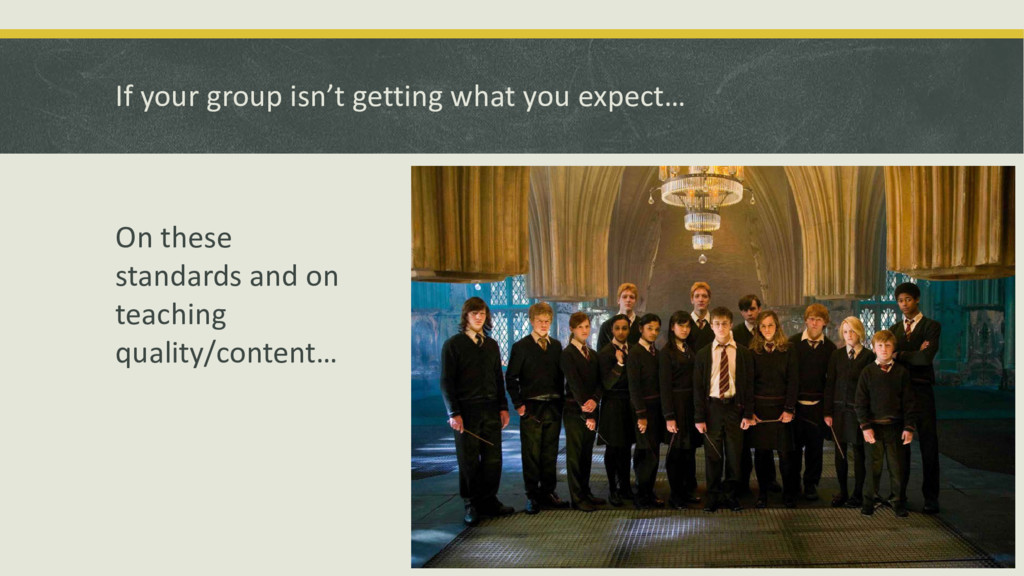
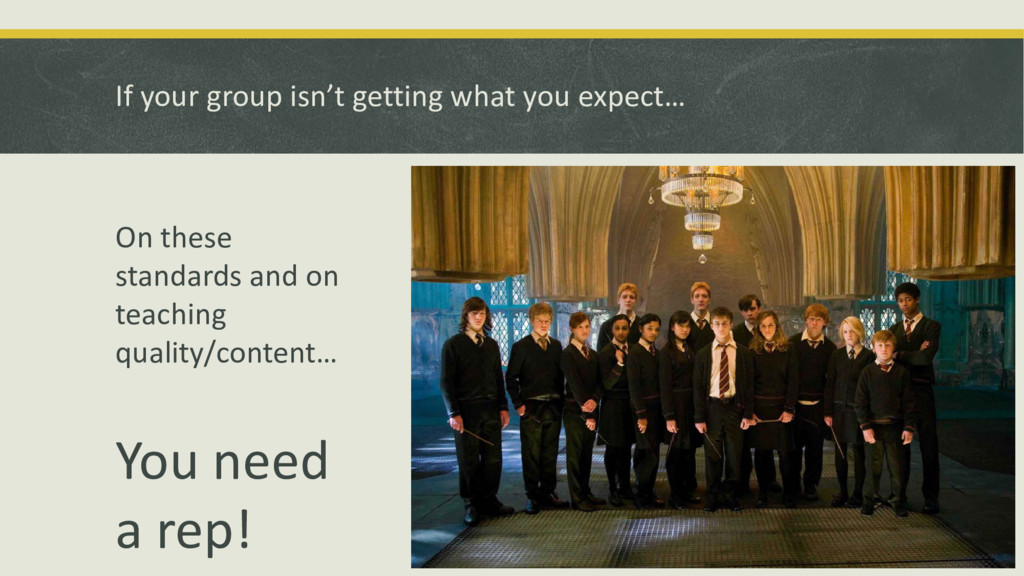
  4. If your group isn’t getting what you expect… On these

    standards and on teaching quality/content…
  5. If your group isn’t getting what you expect… You need

    a rep! On these standards and on teaching quality/content…
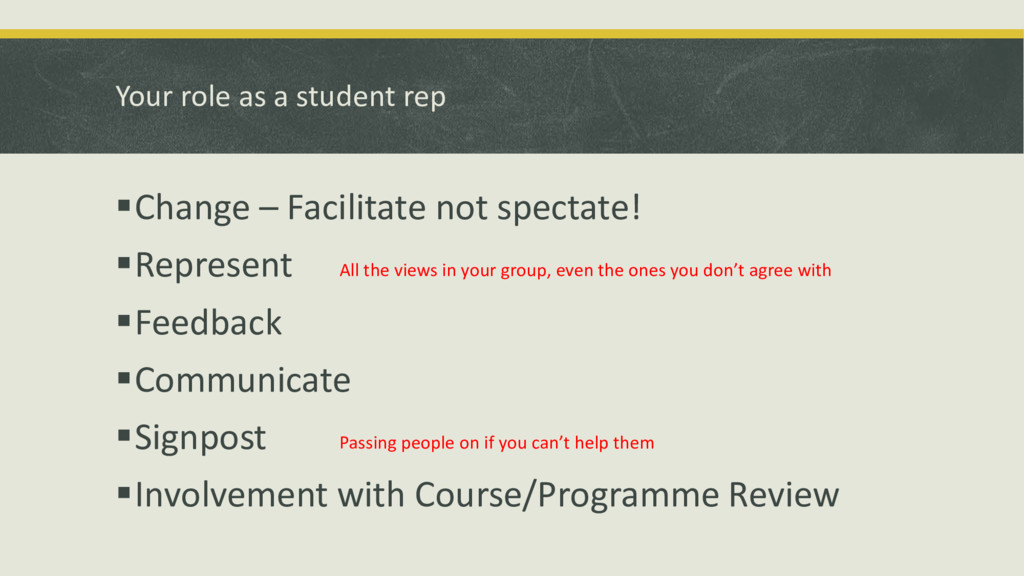
  6. Your role as a student rep Change – Facilitate not

    spectate! Represent Feedback Communicate Signpost Involvement with Course/Programme Review All the views in your group, even the ones you don’t agree with Passing people on if you can’t help them
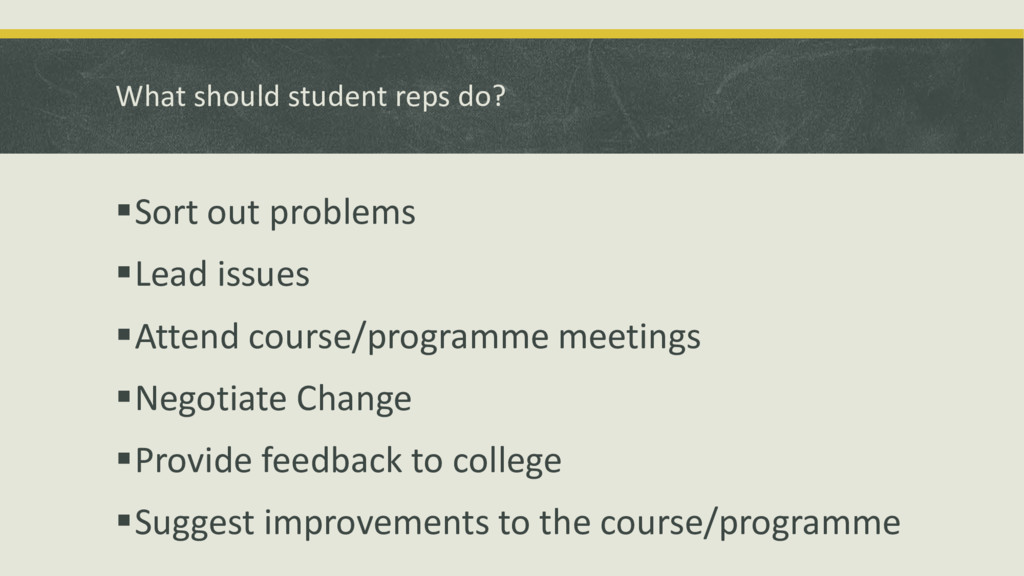
  7. What should student reps do? Sort out problems Lead issues

    Attend course/programme meetings Negotiate Change Provide feedback to college Suggest improvements to the course/programme
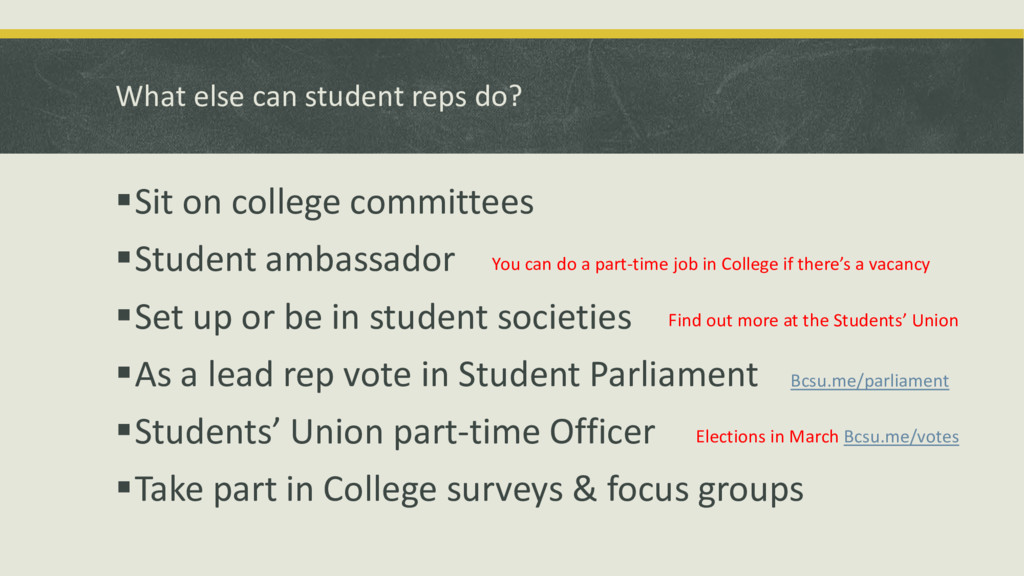
  8. What else can student reps do? Sit on college committees

    Student ambassador Set up or be in student societies As a lead rep vote in Student Parliament Students’ Union part-time Officer Take part in College surveys & focus groups You can do a part-time job in College if there’s a vacancy Find out more at the Students’ Union Bcsu.me/parliament Elections in March Bcsu.me/votes
  9. What SHOULDN’T student reps do? Deal with other students personal

    problems – refer them to the Students’ Union Advice Service Lead cross college issues e.g. Catering, Parking, Social Space – refer them to the SU or Parliament Pet projects or “personal crusades” – you need to have evidence that other students feel the same
  10. Changes to what gets taught Students on travel and tourism

    courses, previously structured mostly around air travel from Leeds Bradford airport, wanted more content about the cruise industry instead. This might take a bit longer than you want – but it can still happen
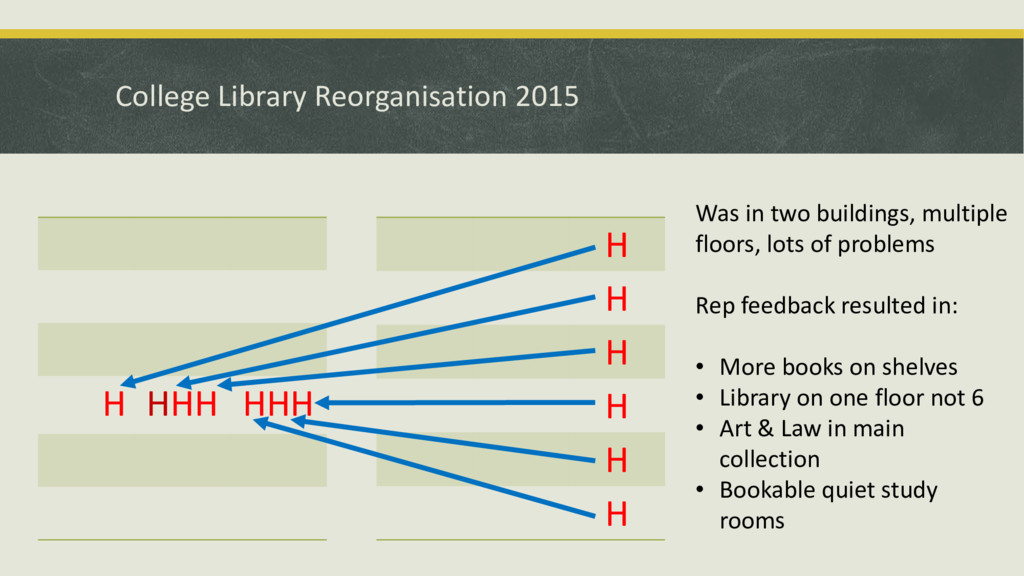
  11. College Library Reorganisation 2015 H H H H H H

    H HHH HHH Was in two buildings, multiple floors, lots of problems Rep feedback resulted in: • More books on shelves • Library on one floor not 6 • Art & Law in main collection • Bookable quiet study rooms
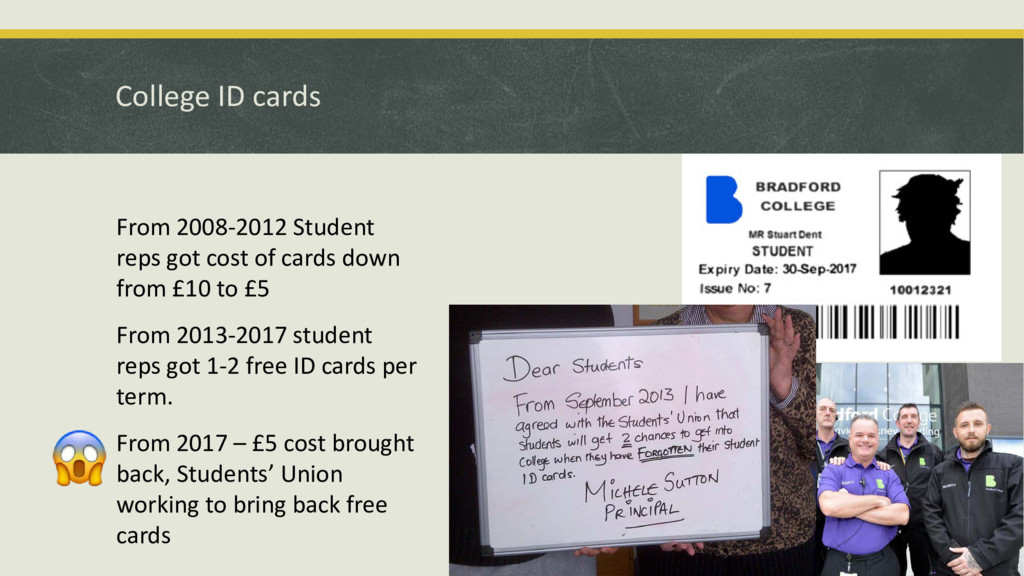
  12. College ID cards From 2008-2012 Student reps got cost of

    cards down from £10 to £5 From 2013-2017 student reps got 1-2 free ID cards per term. From 2017 – £5 cost brought back, Students’ Union working to bring back free cards
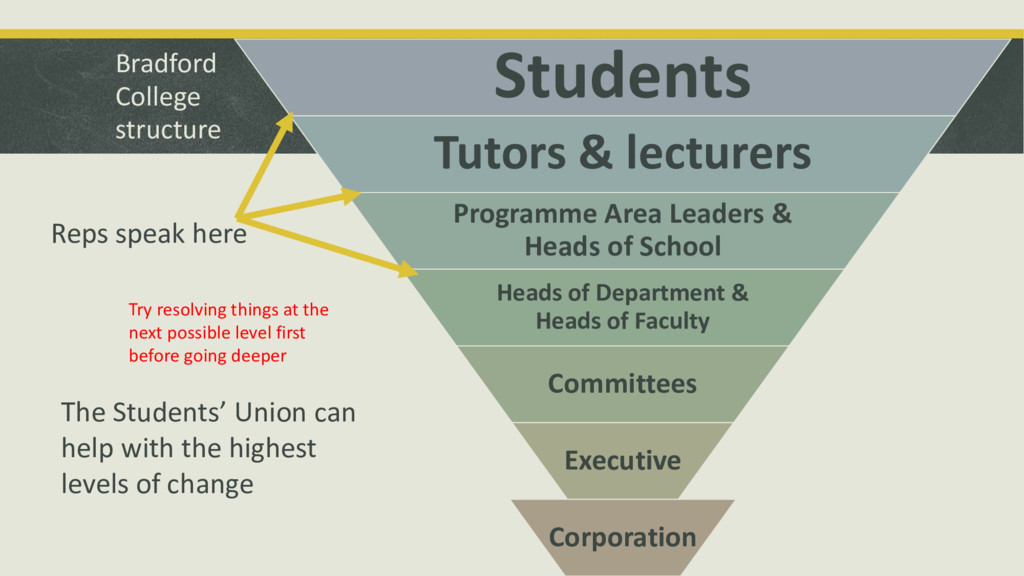
  13. Bradford College structure Students Tutors & lecturers Programme Area Leaders

    & Heads of School Heads of Department & Heads of Faculty Committees Executive Corporation The Students’ Union can help with the highest levels of change Reps speak here Try resolving things at the next possible level first before going deeper
  14. Your Role as Student Rep  What does your group

    want?  What does your group need?  What is the #1 Priority  How do we get to Outstanding?
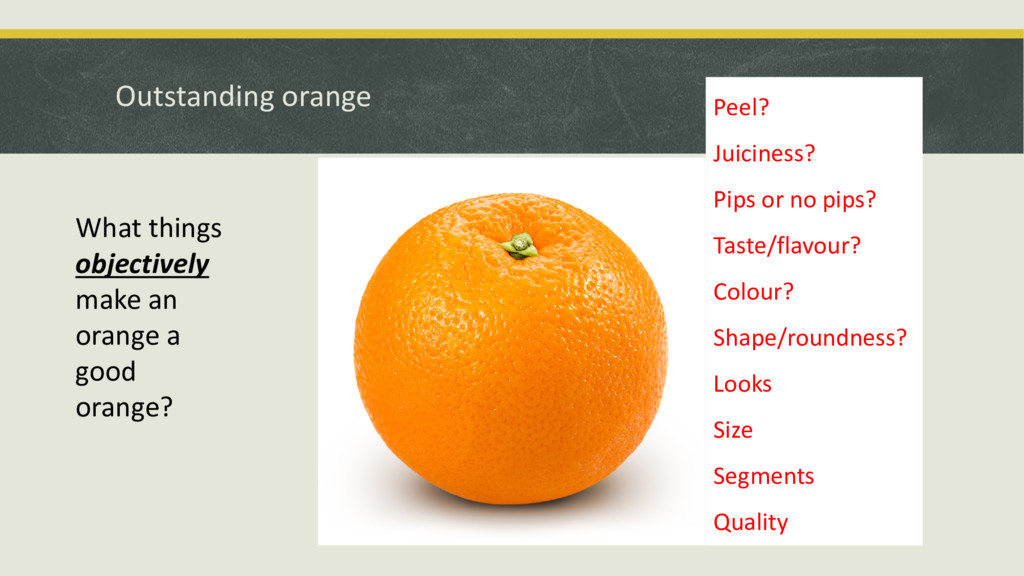
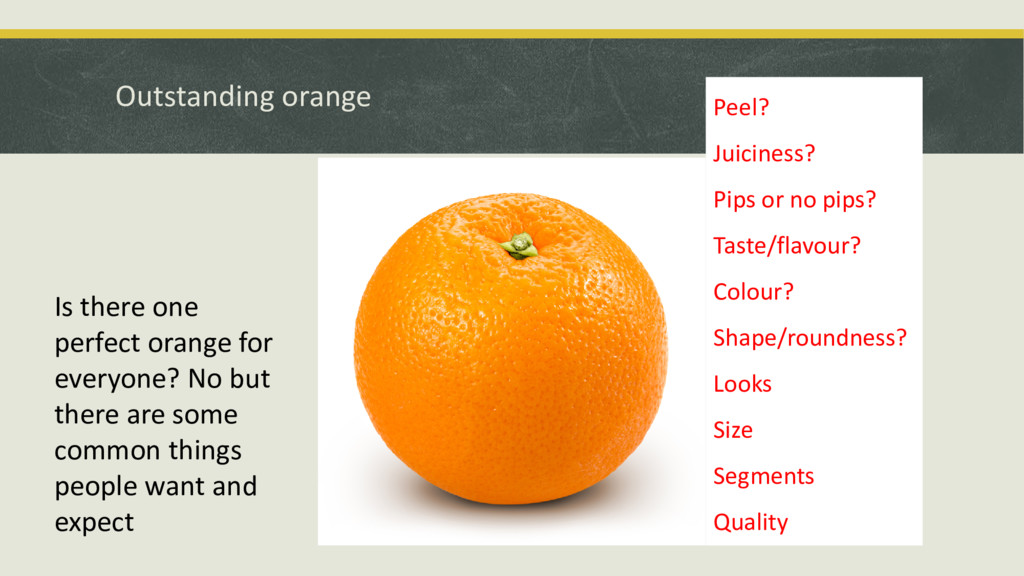
  15. Outstanding orange Peel? Juiciness? Pips or no pips? Taste/flavour? Colour?

    Shape/roundness? Looks Size Segments Quality What things objectively make an orange a good orange?
  16. Outstanding orange Is there one perfect orange for everyone? No

    but there are some common things people want and expect Peel? Juiciness? Pips or no pips? Taste/flavour? Colour? Shape/roundness? Looks Size Segments Quality
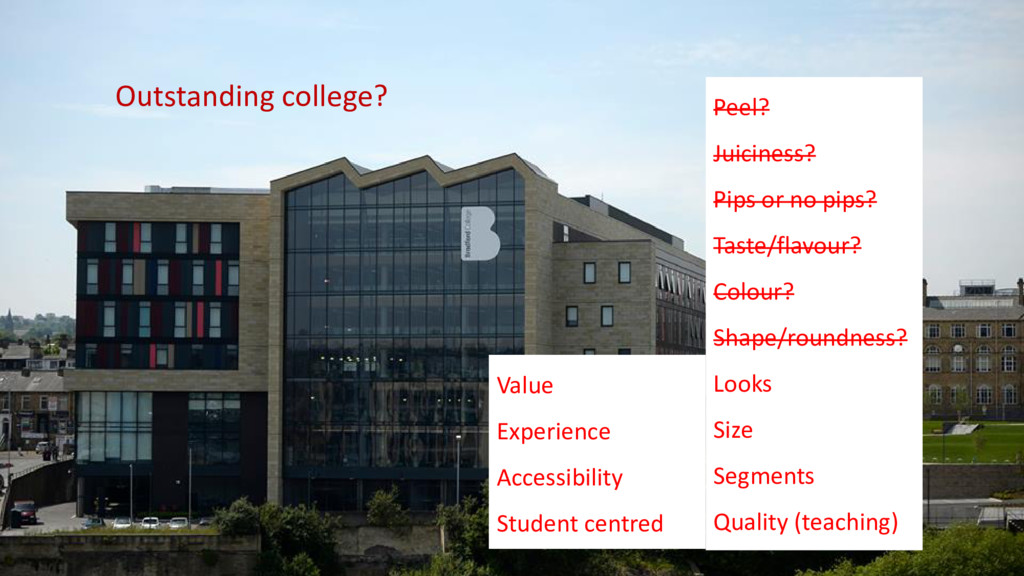
  17. Outstanding college? Peel? Juiciness? Pips or no pips? Taste/flavour? Colour?

    Shape/roundness? Looks Size Segments Quality (teaching) Value Experience Accessibility Student centred
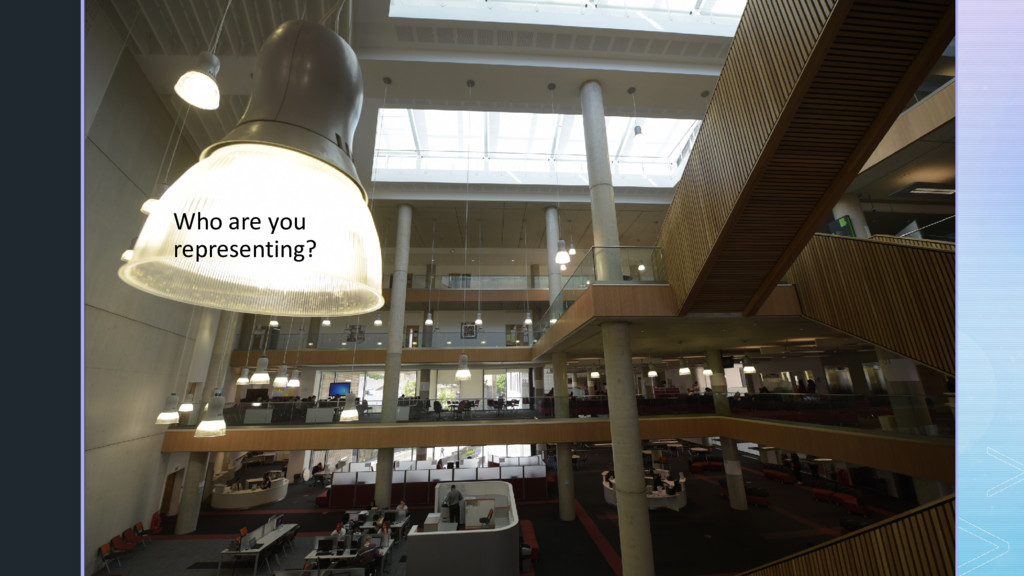
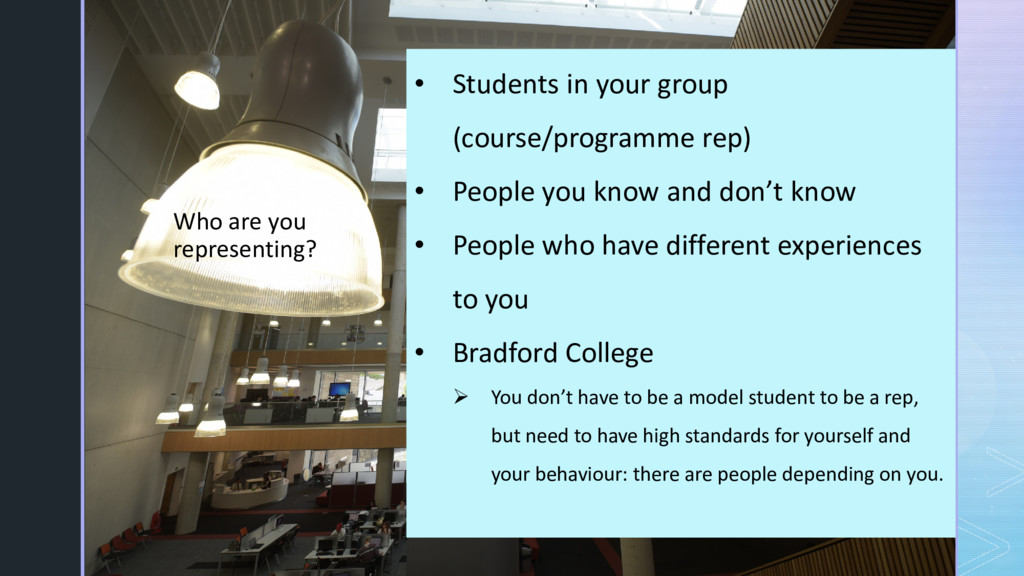
  18.  Who are you representing? • Students in your group

    (course/programme rep) • People you know and don’t know • People who have different experiences to you • Bradford College  You don’t have to be a model student to be a rep, but need to have high standards for yourself and your behaviour: there are people depending on you.
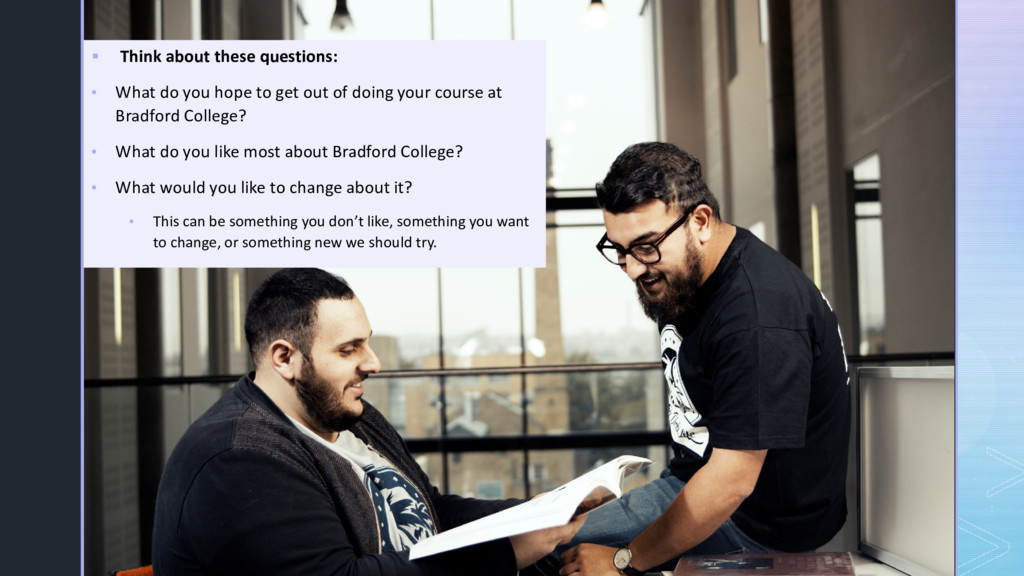
  19.  Think about these questions: • What do you hope

    to get out of doing your course at Bradford College? • What do you like most about Bradford College? • What would you like to change about it? • This can be something you don’t like, something you want to change, or something new we should try.
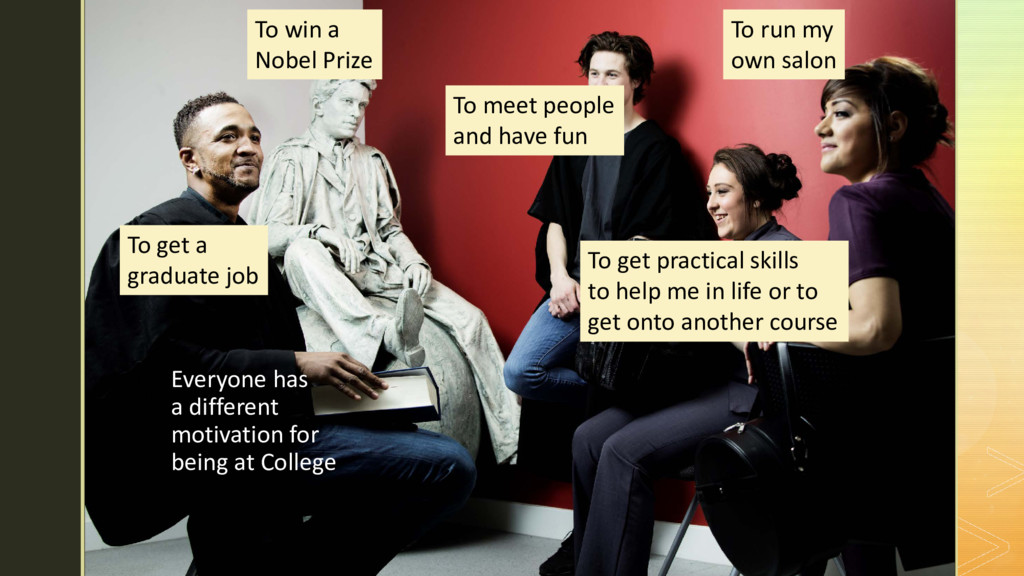
  20.  Everyone has a different motivation for being at College

    To win a Nobel Prize To get a graduate job To meet people and have fun To run my own salon To get practical skills to help me in life or to get onto another course
  21.  To win a Nobel Prize To get a graduate

    job To meet people and have fun To run my own salon To get practical skills to help me in life or to get onto another course These affect what’s most important to people – such as social space or good careers advice
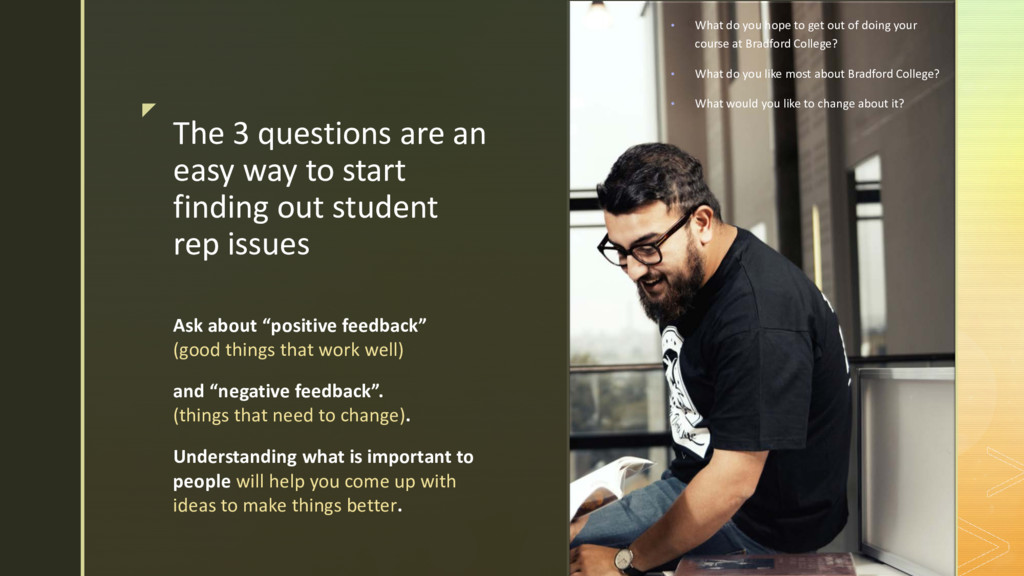
  22.  The 3 questions are an easy way to start

    finding out student rep issues Ask about “positive feedback” (good things that work well) and “negative feedback”. (things that need to change). Understanding what is important to people will help you come up with ideas to make things better. • What do you hope to get out of doing your course at Bradford College? • What do you like most about Bradford College? • What would you like to change about it?
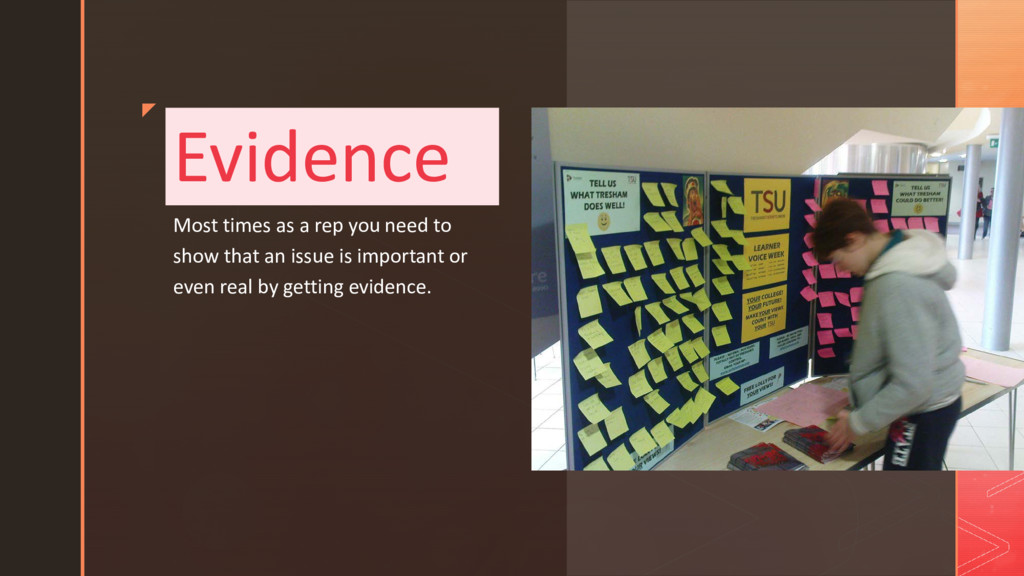
  23.  Evidence Most times as a rep you need to

    show that an issue is important or even real by getting evidence.
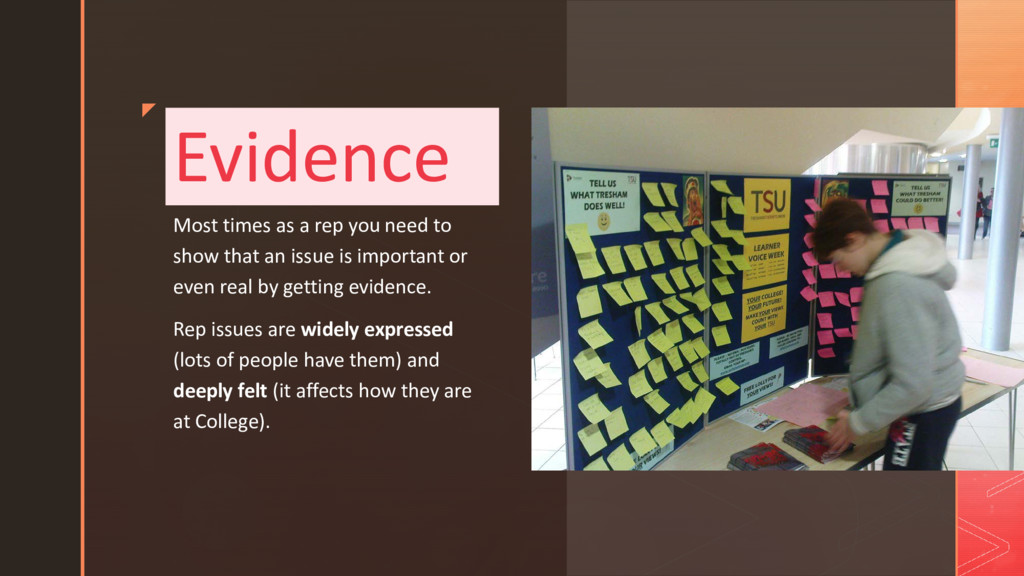
  24.  Evidence Most times as a rep you need to

    show that an issue is important or even real by getting evidence. Rep issues are widely expressed (lots of people have them) and deeply felt (it affects how they are at College).
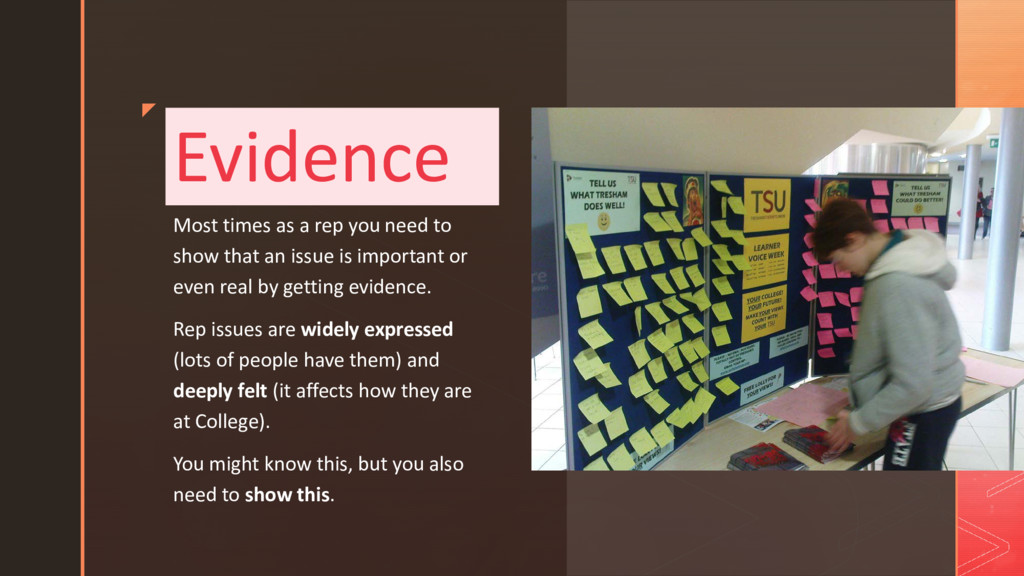
  25.  Evidence Most times as a rep you need to

    show that an issue is important or even real by getting evidence. Rep issues are widely expressed (lots of people have them) and deeply felt (it affects how they are at College). You might know this, but you also need to show this.
  26.  Gathering opinions  Think of ways, methods, and things

    that would help you would find out from your groups about whether or not they agree or disagree with the answers you have to these questions.
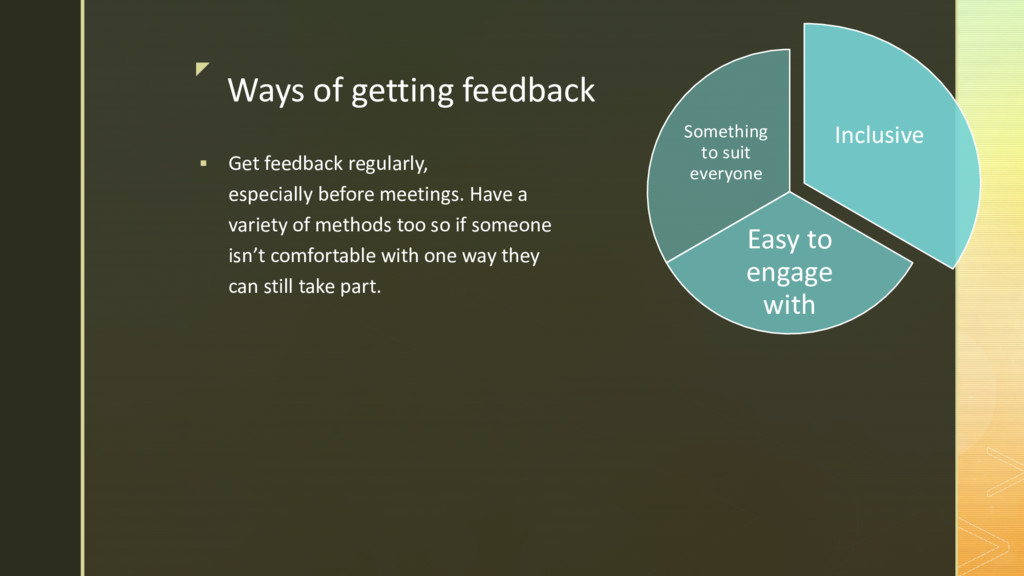
  27.  Ways of getting feedback  Get feedback regularly, especially

    before meetings. Have a variety of methods too so if someone isn’t comfortable with one way they can still take part. Inclusive Easy to engage with Something to suit everyone
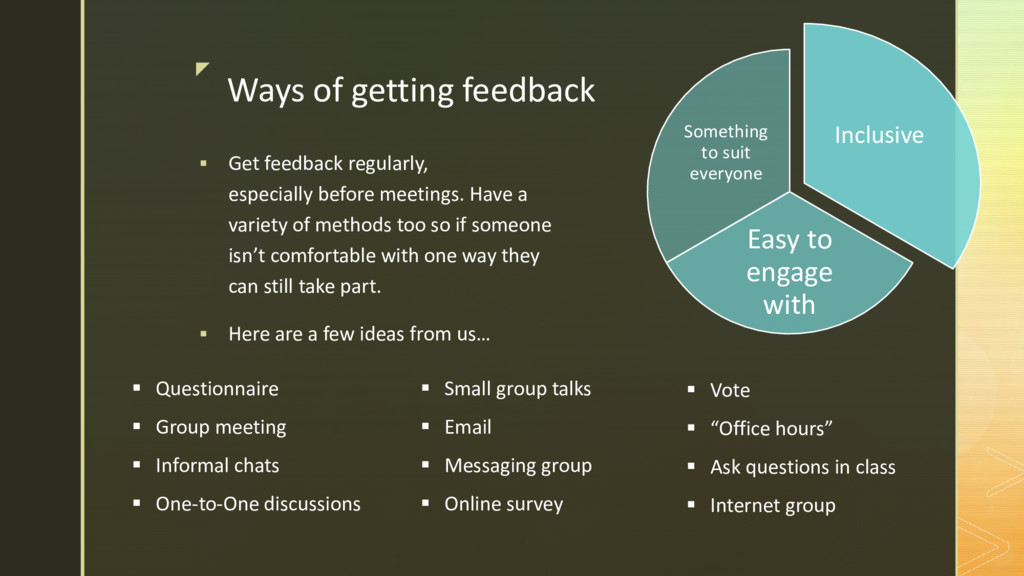
  28.  Ways of getting feedback  Get feedback regularly, especially

    before meetings. Have a variety of methods too so if someone isn’t comfortable with one way they can still take part.  Here are a few ideas from us… Inclusive Easy to engage with Something to suit everyone  Questionnaire  Group meeting  Informal chats  One-to-One discussions  Small group talks  Email  Messaging group  Online survey  Vote  “Office hours”  Ask questions in class  Internet group
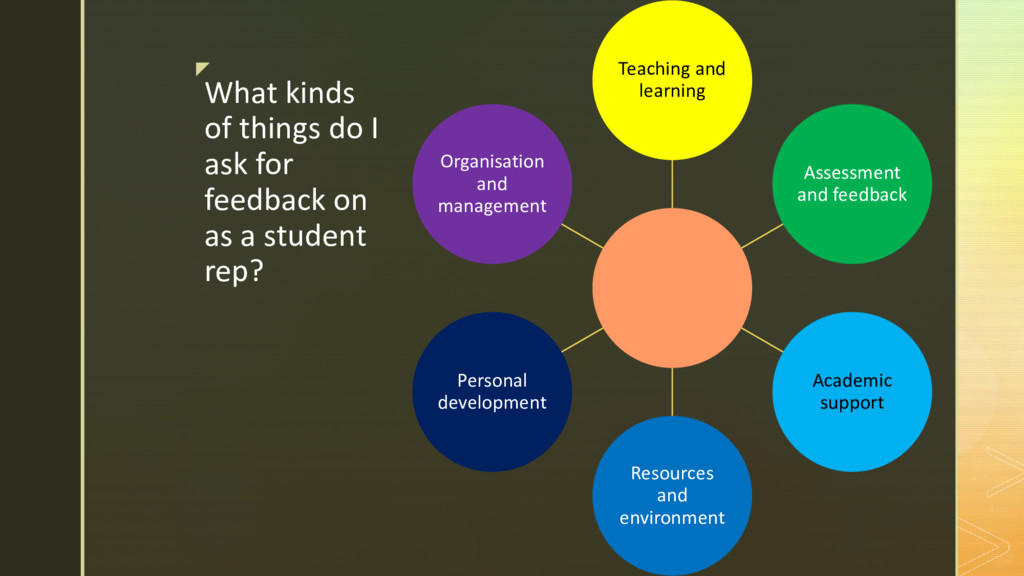
  29.  What kinds of things do I ask for feedback

    on as a student rep? Teaching and learning Assessment and feedback Academic support Resources and environment Personal development Organisation and management
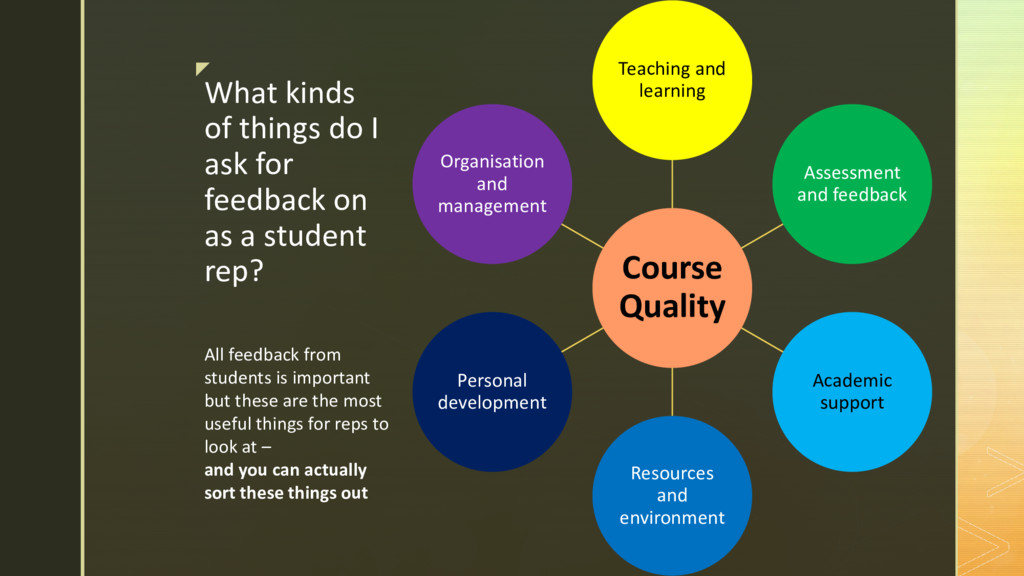
  30.  What kinds of things do I ask for feedback

    on as a student rep? Course Quality Teaching and learning Assessment and feedback Academic support Resources and environment Personal development Organisation and management All feedback from students is important but these are the most useful things for reps to look at – and you can actually sort these things out
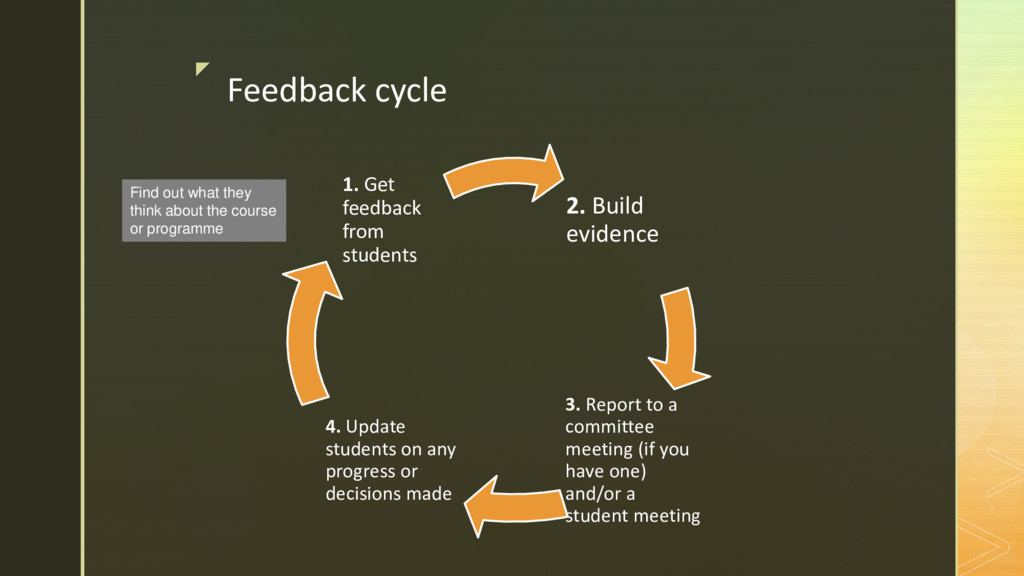
  31.  Feedback cycle 2. Build evidence 3. Report to a

    committee meeting (if you have one) and/or a student meeting 4. Update students on any progress or decisions made 1. Get feedback from students Find out what they think about the course or programme
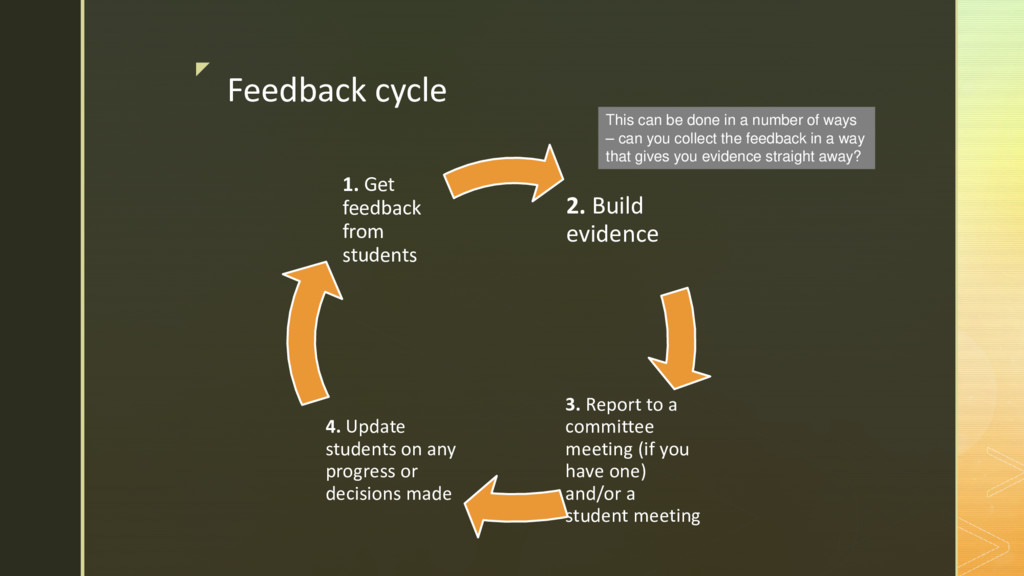
  32.  Feedback cycle 2. Build evidence 3. Report to a

    committee meeting (if you have one) and/or a student meeting 4. Update students on any progress or decisions made 1. Get feedback from students This can be done in a number of ways – can you collect the feedback in a way that gives you evidence straight away?
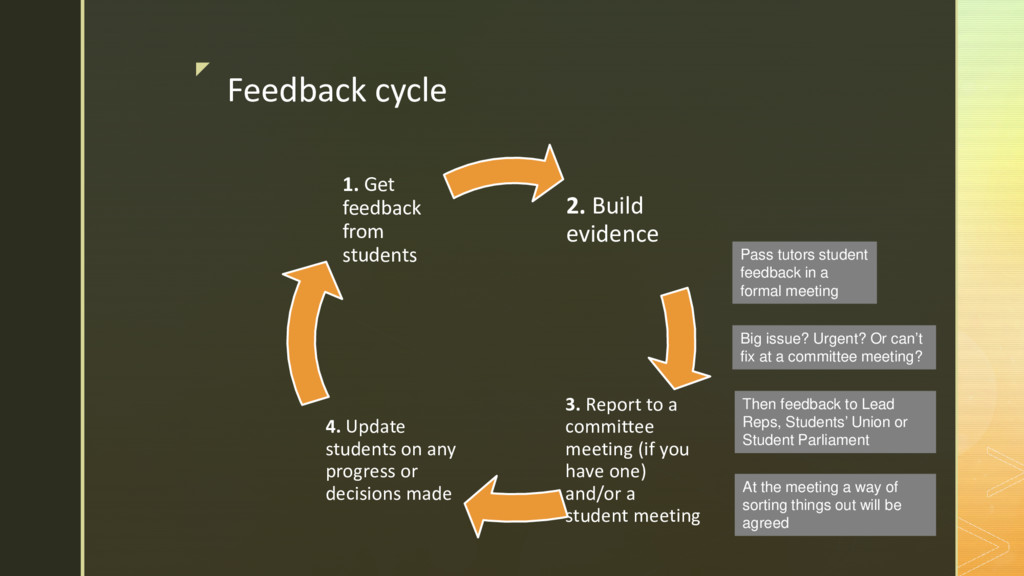
  33.  Feedback cycle 2. Build evidence 3. Report to a

    committee meeting (if you have one) and/or a student meeting 4. Update students on any progress or decisions made 1. Get feedback from students Pass tutors student feedback in a formal meeting Big issue? Urgent? Or can’t fix at a committee meeting? Then feedback to Lead Reps, Students’ Union or Student Parliament At the meeting a way of sorting things out will be agreed
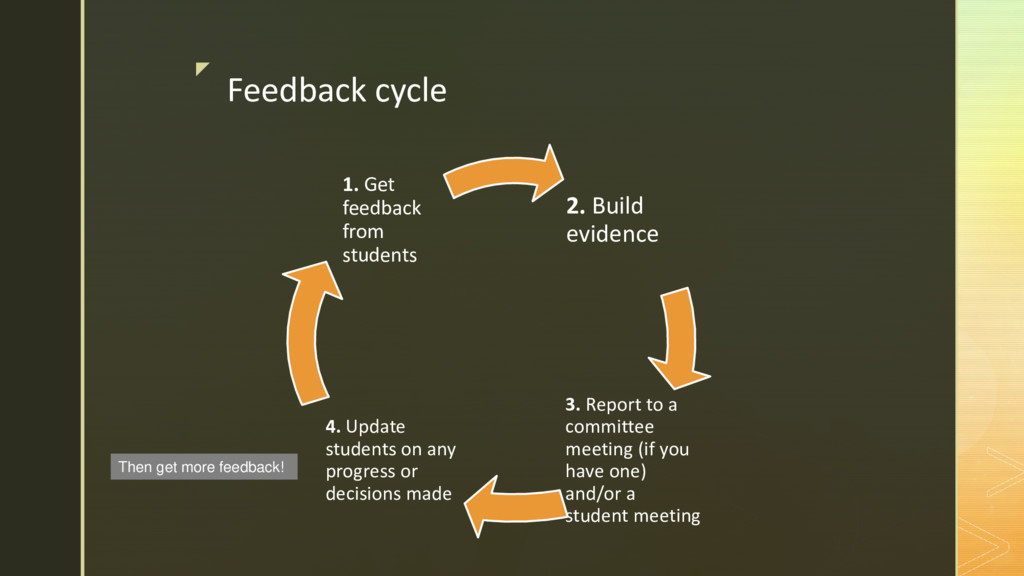
  34.  Feedback cycle 2. Build evidence 3. Report to a

    committee meeting (if you have one) and/or a student meeting 4. Update students on any progress or decisions made 1. Get feedback from students Then get more feedback!
  35.  As a student rep one of your main jobs

    is to translate “Studentese” into “Collegish”… and back Not just explaining what the College wants to do for students to your groups, but giving them the feedback you get in a form they can do something with.
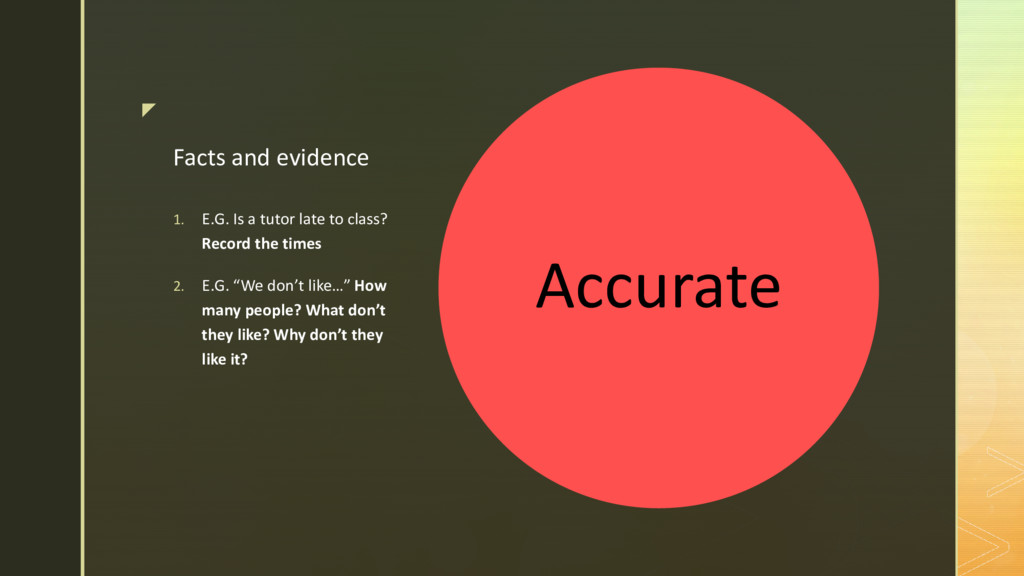
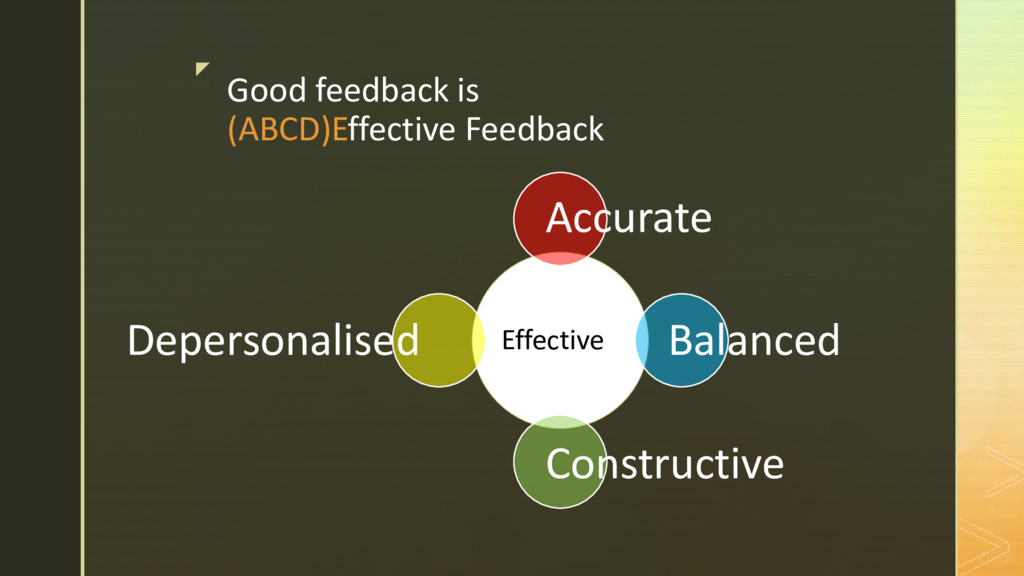
  36.  Facts and evidence Accurate 1. E.G. Is a tutor

    late to class? Record the times 2. E.G. “We don’t like…” How many people? What don’t they like? Why don’t they like it?
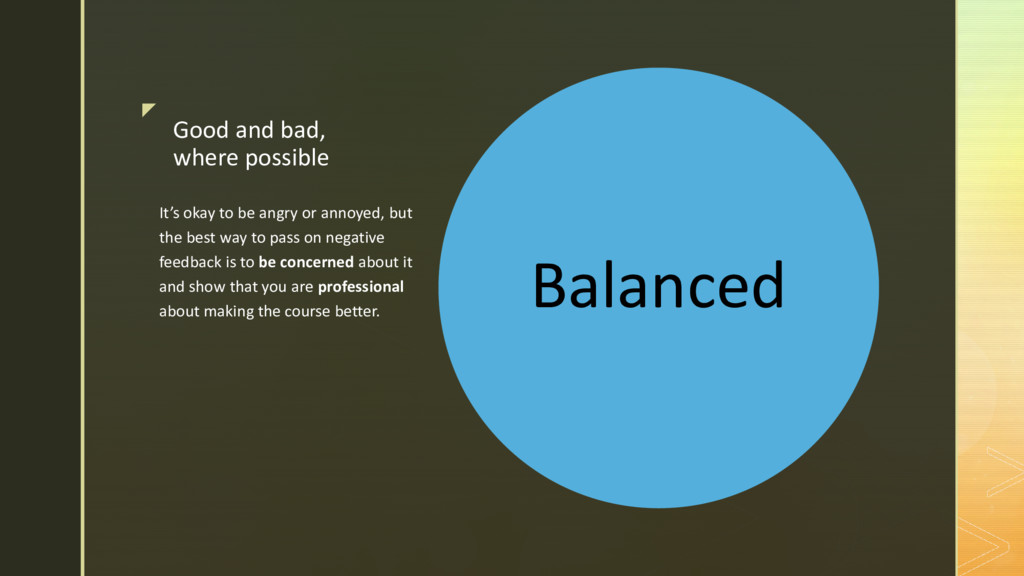
  37.  Good and bad, where possible Balanced It’s okay to

    be angry or annoyed, but the best way to pass on negative feedback is to be concerned about it and show that you are professional about making the course better.
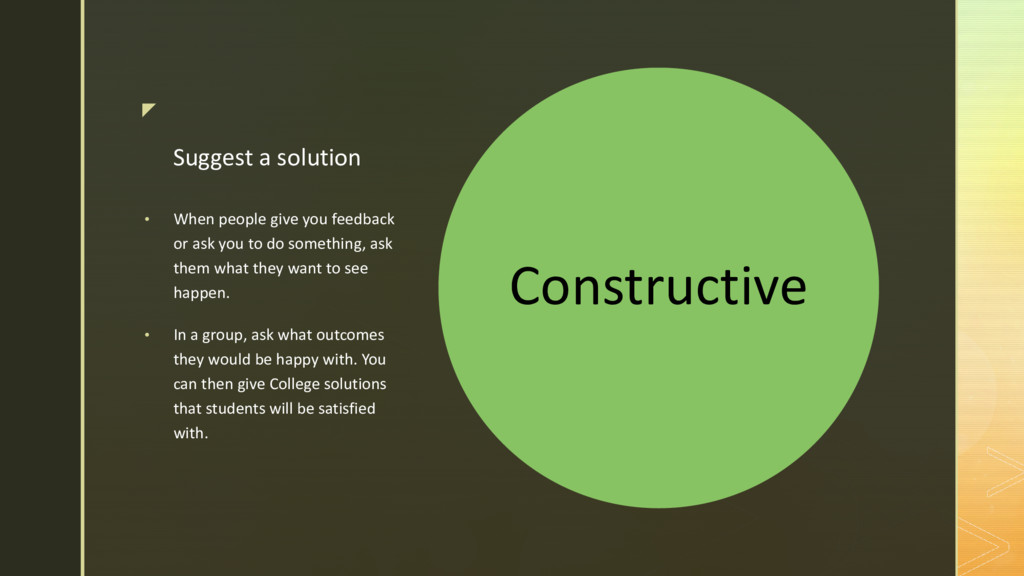
  38.  Suggest a solution Constructive • When people give you

    feedback or ask you to do something, ask them what they want to see happen. • In a group, ask what outcomes they would be happy with. You can then give College solutions that students will be satisfied with.
  39.  Your feedback is about issues, roles, and students –

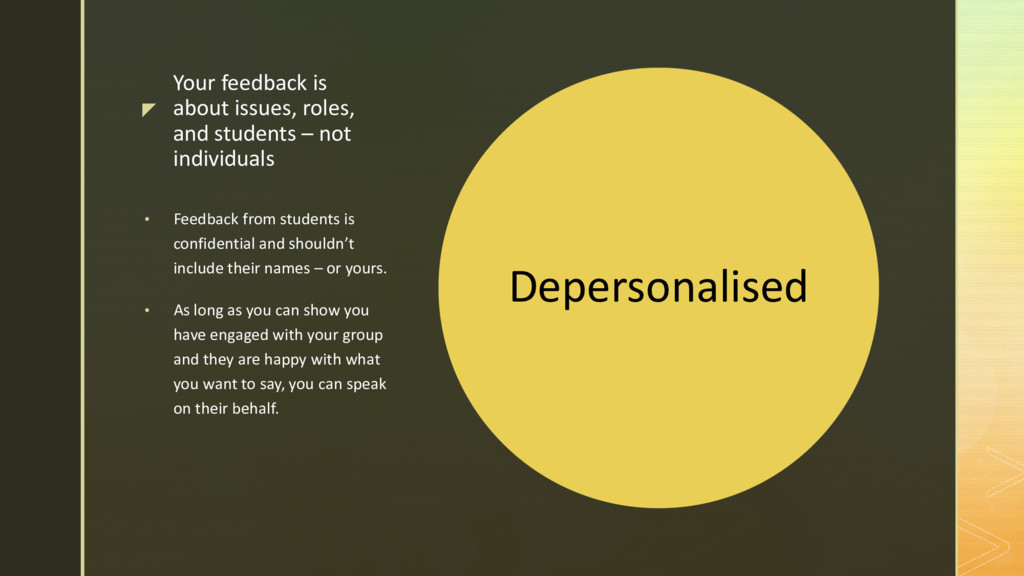
    not individuals Depersonalised • Feedback from students is confidential and shouldn’t include their names – or yours. • As long as you can show you have engaged with your group and they are happy with what you want to say, you can speak on their behalf.
  40.  #1 tip for effective feedback Surveys are great for

    getting evidence – you can easily see how many people agree whether something is good or an issue, and get information about possible solutions too
  41.  More tips for effective feedback Giving feedback  Be

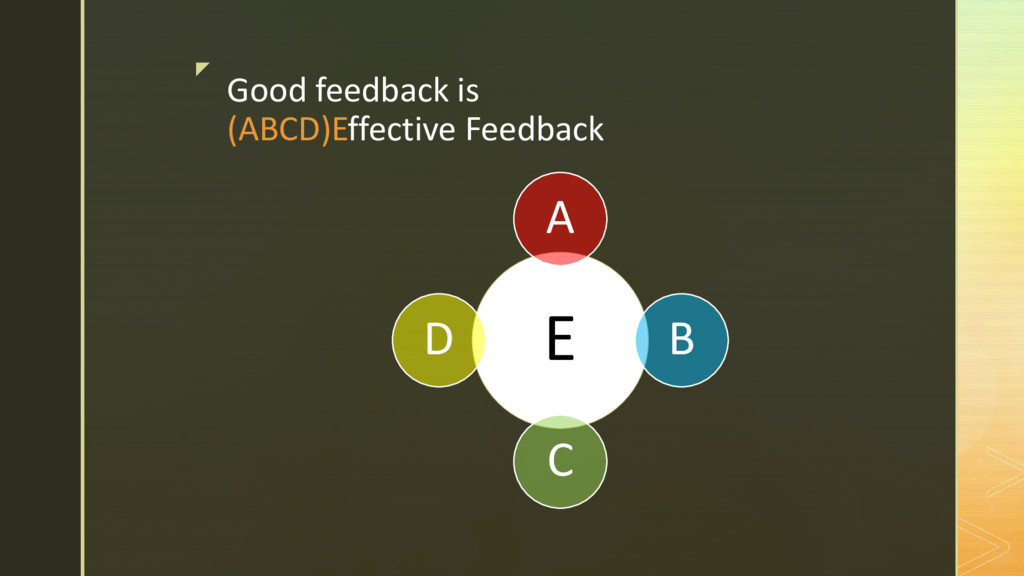
    clear  Be honest  Be behaviour focused  Remember ABCDE
  42.  More tips for effective feedback Responding to feedback 

    Avoid blocking out feedback that may appear negative  See it from the other person’s point of view  Welcome the feedback, even the negative  Ask them to say it another way
  43.   The course is rubbish, we don’t learn anything!

     We are generally happy with the tutorials and taught part of the course. 67% said there are no issues with these. However, 81% of the students feel they are not learning enough new material from the practical part of the course. We already cover most of this module before, so we could replace it with a new taught module about these things instead.
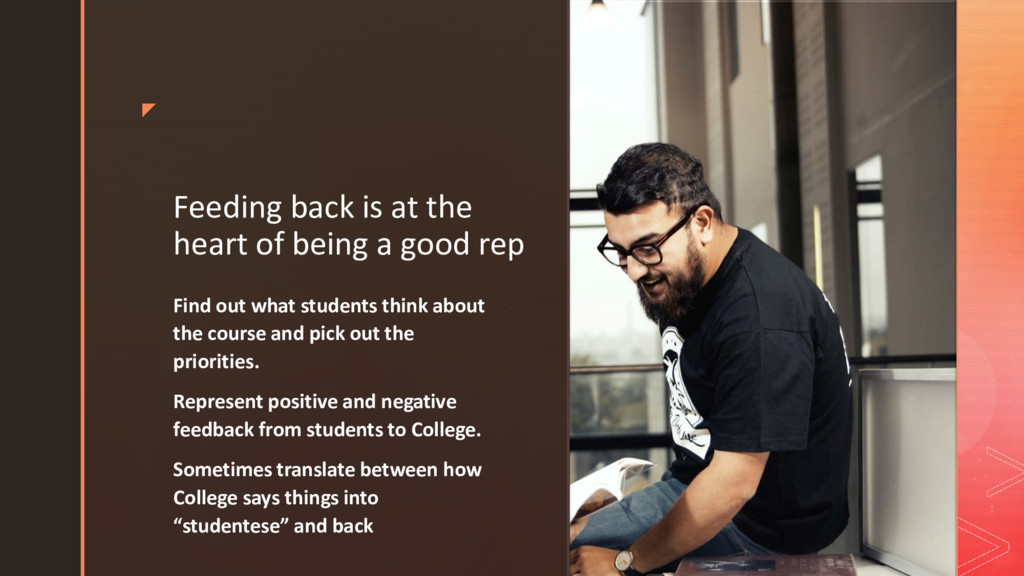
  44.  Feeding back is at the heart of being a

    good rep Find out what students think about the course and pick out the priorities. Represent positive and negative feedback from students to College. Sometimes translate between how College says things into “studentese” and back
  45. AS REPS, HOW DO WE SORT THINGS OUT?  Lots

    of ways!  Through the committee meetings if you have them, which are at least once per term/semester.
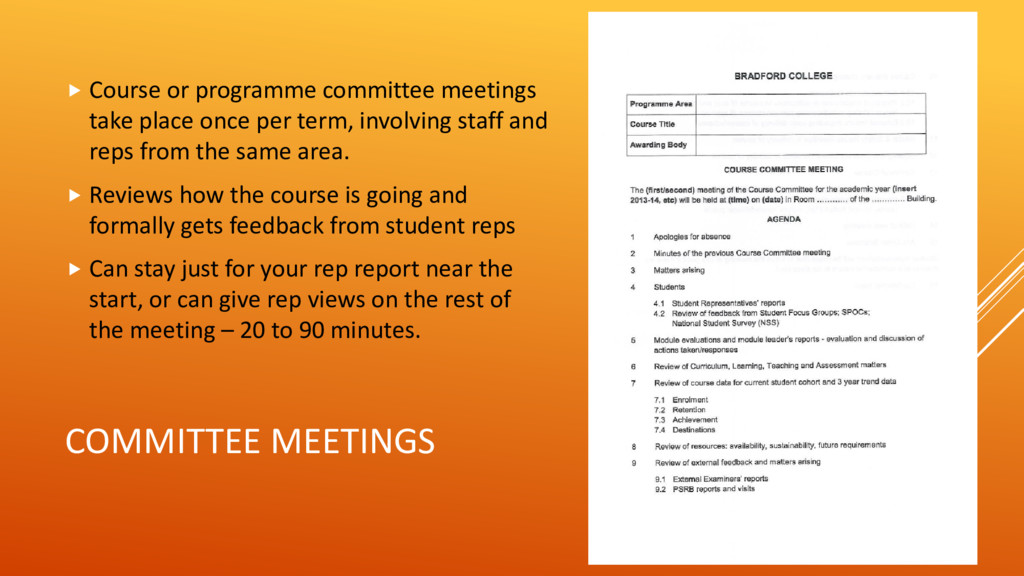
  46. COMMITTEE MEETINGS  Course or programme committee meetings take place

    once per term, involving staff and reps from the same area.  Reviews how the course is going and formally gets feedback from student reps  Can stay just for your rep report near the start, or can give rep views on the rest of the meeting – 20 to 90 minutes.
  47. REPORTING AT COMMITTEE MEETINGS  A rep report is a

    written or verbal summary of all the feedback brought up by your group, discussing in detail the most important issues and briefly talking about the rest.  You only need to write a rep report if no reps from your group can attend the committee meeting.  It’s not like any other reports you might write at College for your work. Keep it short and in clear bullet points.  Remember the ABCD of effective feedback!
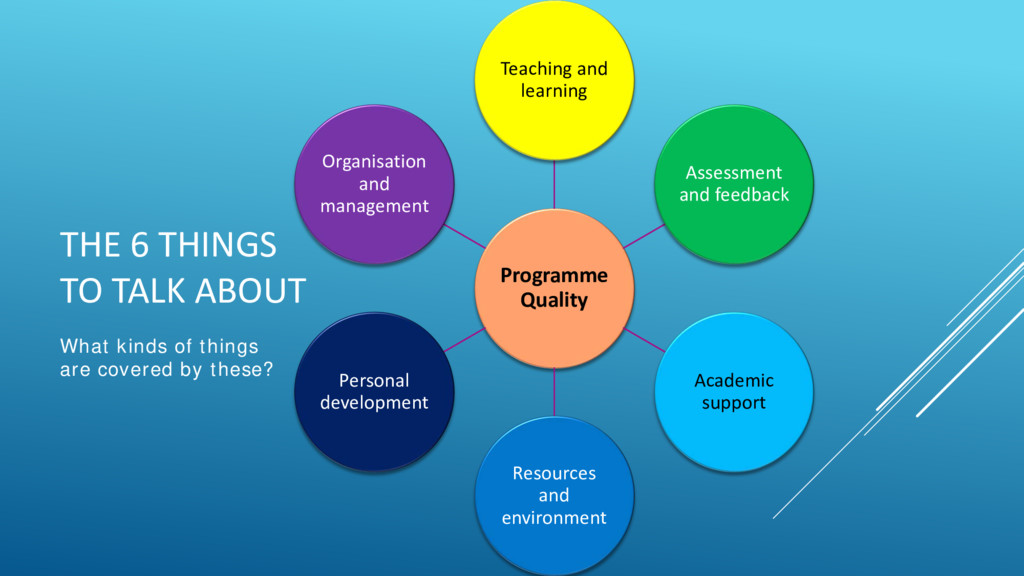
  48. THE 6 THINGS TO TALK ABOUT Programme Quality Teaching and

    learning Assessment and feedback Academic support Resources and environment Personal development Organisation and management What kinds of things are covered by these?
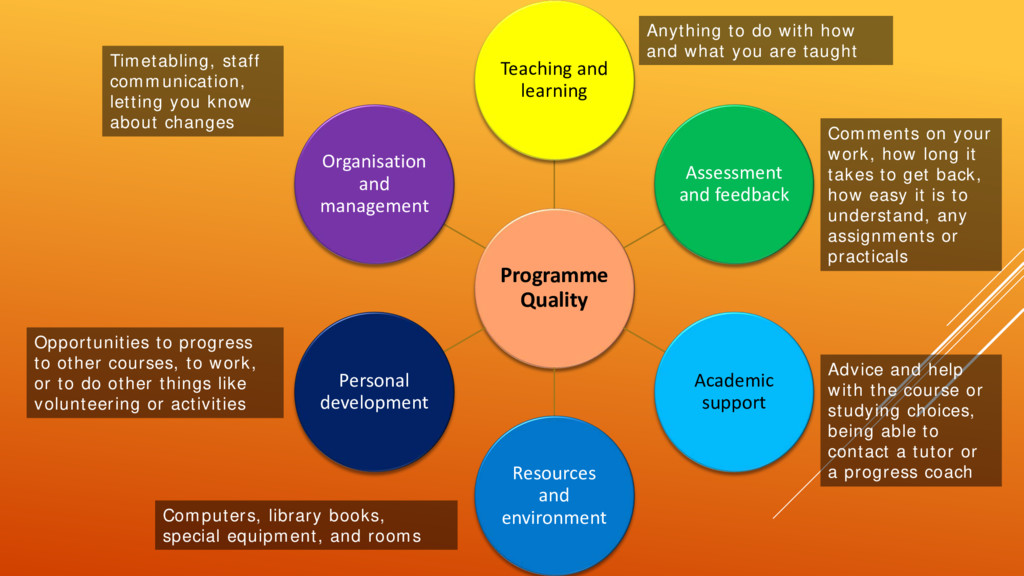
  49. Programme Quality Teaching and learning Assessment and feedback Academic support

    Resources and environment Personal development Organisation and management Anything to do with how and what you are taught Comments on your work, how long it takes to get back, how easy it is to understand, any assignments or practicals Advice and help with the course or studying choices, being able to contact a tutor or a progress coach Computers, library books, special equipment, and rooms Opportunities to progress to other courses, to work, or to do other things like volunteering or activities Timetabling, staff communication, letting you know about changes
  50. COMMITTEE MEETING MINUTES  “Minutes” from committee meetings are a

    record of what was said in the meeting. A staff member at the meeting will be taking notes on behalf of everyone.  The templates College use are designed to be easy to read and understand. They show what was said about each specific item on the “agenda” of meeting topics.  Minutes for meetings are available on Moodle, or the Moodle Archive Site for last year. If you can’t find a meeting’s minutes ask us.
  51. BEFORE COMMITTEE MEETINGS  Where and when is the committee

    meeting going to take place? Ask your tutor, the Students’ Union or anyone else will not know!  Read the previous meeting’s minutes and any other papers that have been sent round.  Find out what your classmates think about their learning experience.  Is there anything you want to put on the agenda (so you can get an answer from staff at the meeting?) How long do you need for your report? Get in touch with your tutor.  Speak to other student reps!
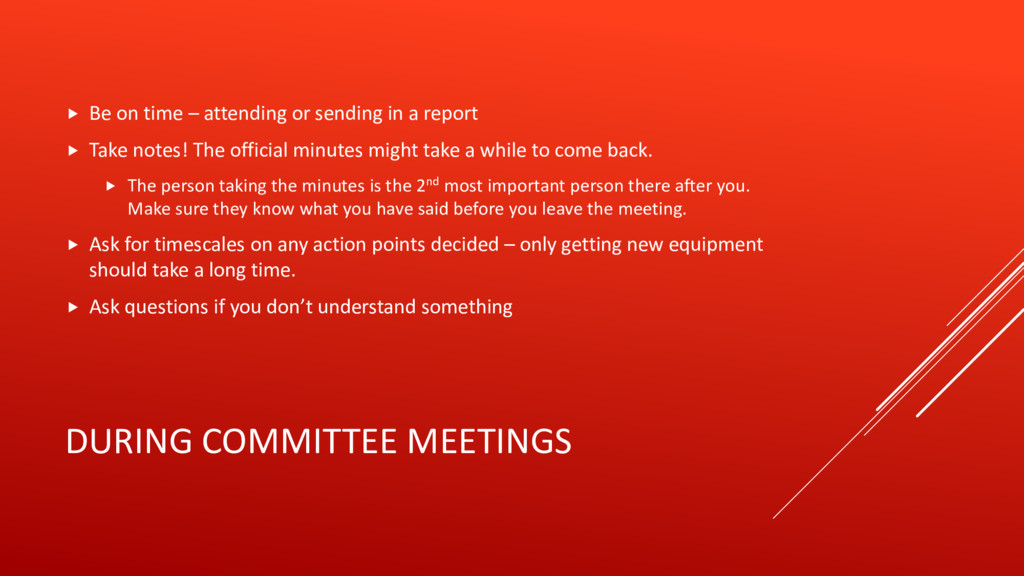
  52. DURING COMMITTEE MEETINGS  Be on time – attending or

    sending in a report  Take notes! The official minutes might take a while to come back.  The person taking the minutes is the 2nd most important person there after you. Make sure they know what you have said before you leave the meeting.  Ask for timescales on any action points decided – only getting new equipment should take a long time.  Ask questions if you don’t understand something
  53. AFTER COMMITTEE MEETINGS  Report back to your classmates 

    Check the minutes  Do anything you have been asked to do  Follow up on any areas of concern  Did you achieve what you wanted to achieve?  If not what are you going to do about it?
  54. AS REPS, HOW DO WE SORT THINGS OUT?  Lots

    of ways!  Through the committee meetings, which are at least once per term/semester.  Report problems and be the solution
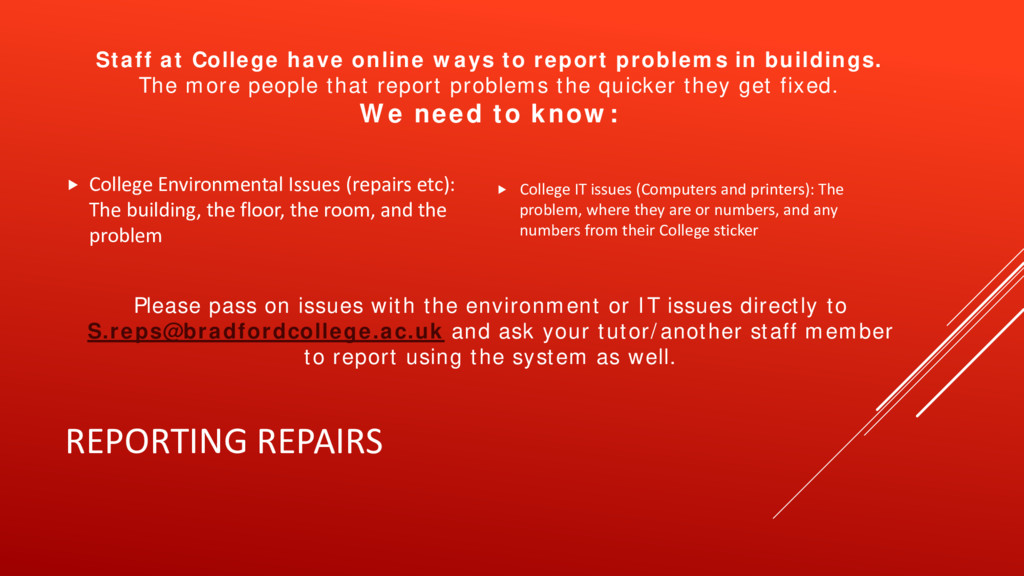
  55. REPORTING REPAIRS  College Environmental Issues (repairs etc): The building,

    the floor, the room, and the problem  College IT issues (Computers and printers): The problem, where they are or numbers, and any numbers from their College sticker Staff at College have online ways to report problems in buildings. The more people that report problems the quicker they get fixed. We need to know: Please pass on issues with the environment or IT issues directly to [email protected] and ask your tutor/another staff member to report using the system as well.
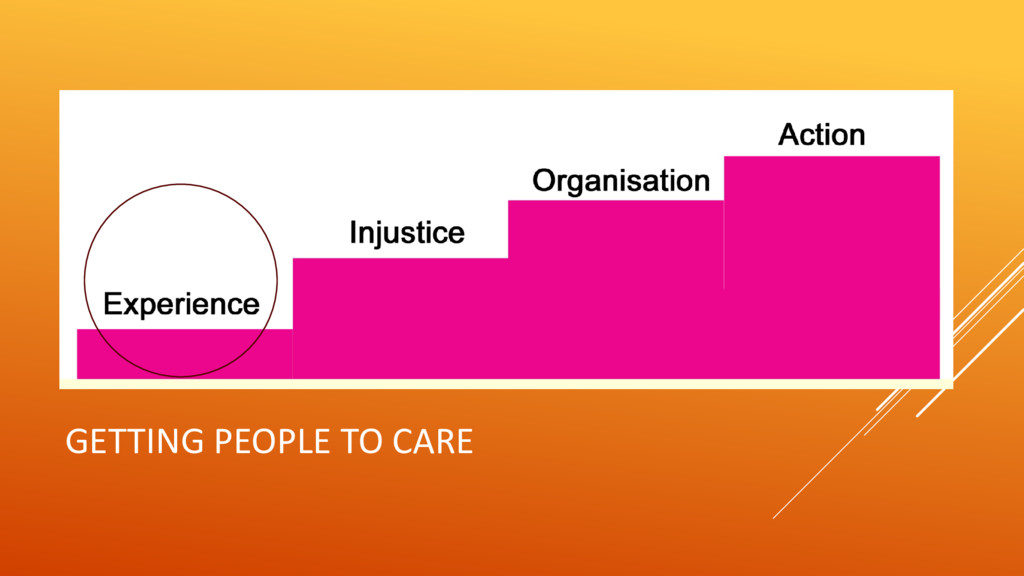
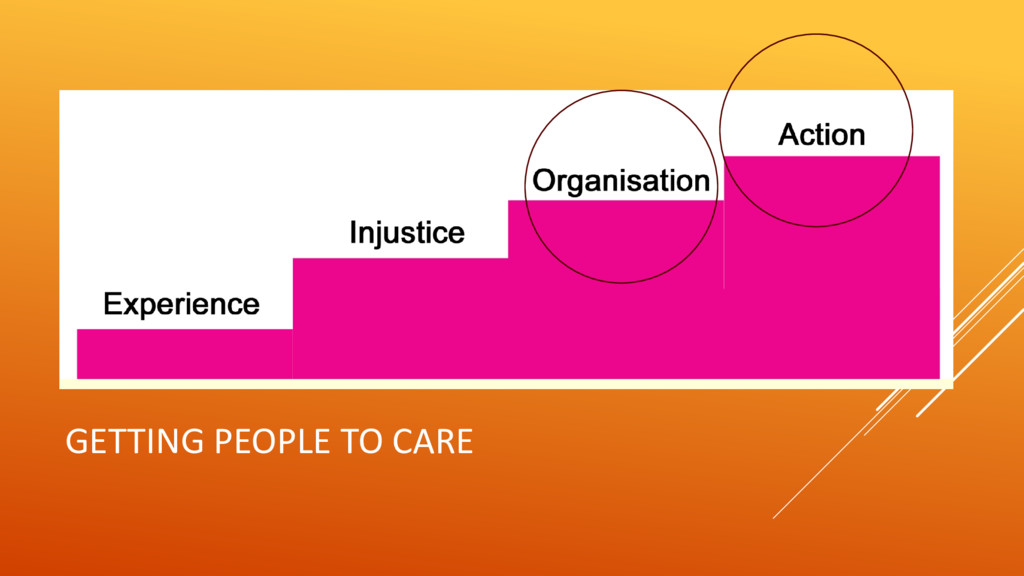
  56. EXPERIENCE  The questions from earlier today can help to

    start you off, but what if you talk to someone who doesn’t know they have a problem at College?  Most people don’t think they have problems  Asking people what something is like is much more powerful for you.  You might have to “dig around” to find something people want to talk about – think about the ways our student experience is broken into smaller bits, like using the library, getting to a class, being in a lesson.
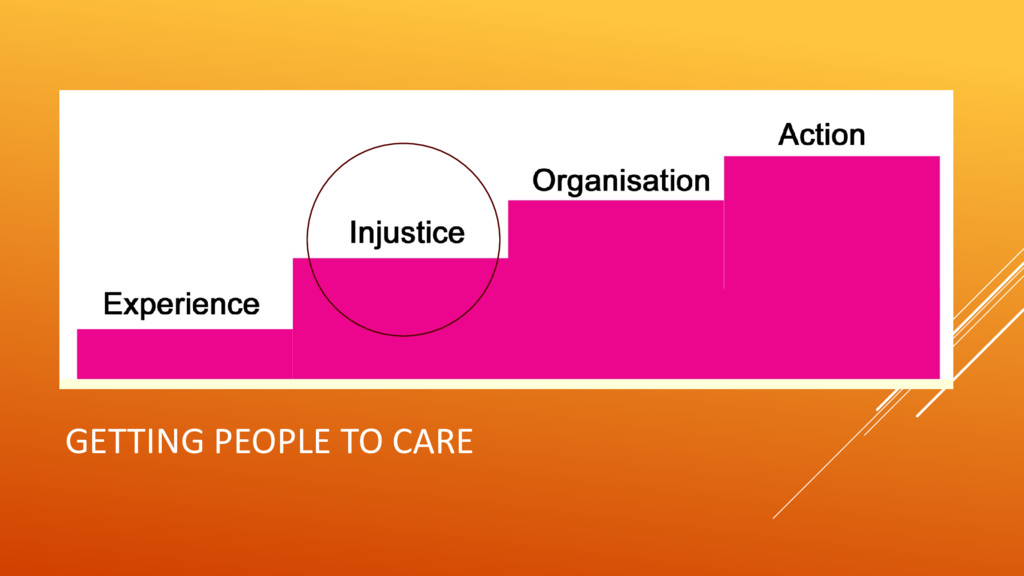
  57. INJUSTICE  Sometimes you will find something obvious that people

    don’t like – an injustice  Other times you might have to “inject” a sense of injustice. You might spot something that is unacceptable that people have gotten used to. So let them know it doesn’t have to be like that.  Think back to the holiday brochures, your course handbook, or the prospectus. Is their experience what they were promised?  You might want to research what other courses offer here (talking to other reps) or find out about other Colleges and Universities. The SU can point you where to look.
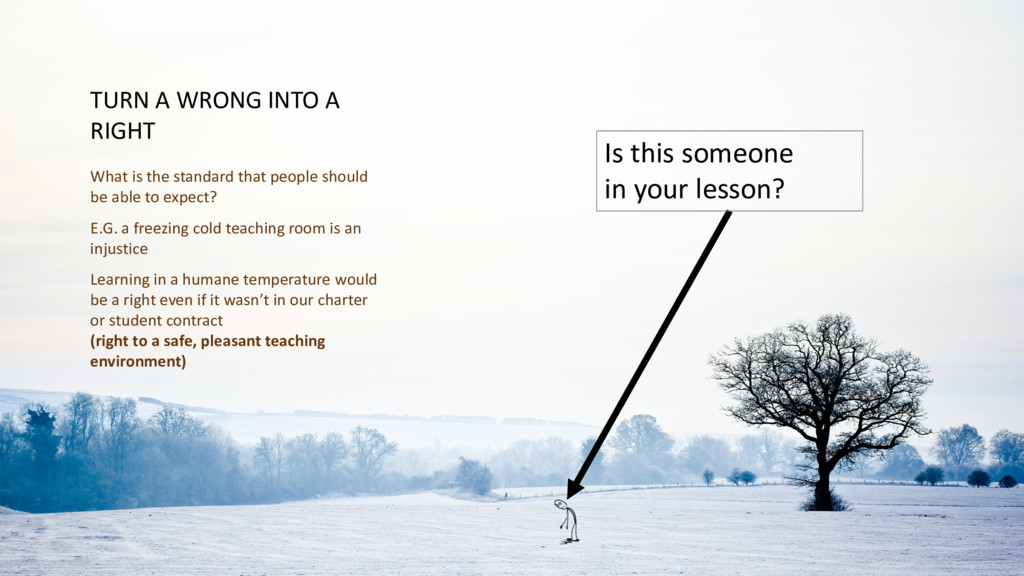
  58. TURN A WRONG INTO A RIGHT What is the standard

    that people should be able to expect? E.G. a freezing cold teaching room is an injustice Learning in a humane temperature would be a right even if it wasn’t in our charter or student contract (right to a safe, pleasant teaching environment) Is this someone in your lesson?
  59. ORGANISE FOR ACTION What are you going to do about

    it?  Meeting  Petition  Survey  Creative protest  Keep the Students’ Union “in the loop” with what you want to do – we can offer advice and support  What are your goals?  What do your group want to see?  Don’t do anything that could get you or people on your course thrown out of College – there’s only so much we can do to help
  60. SUGGEST A SOLUTION Think of a way to fix it

     Suggest the change! As a rep it’s always a good idea to bring a solution for College to try.  Break down the issue:  What is the problem?  What are the options to sort it out?  What are the consequence of those options?
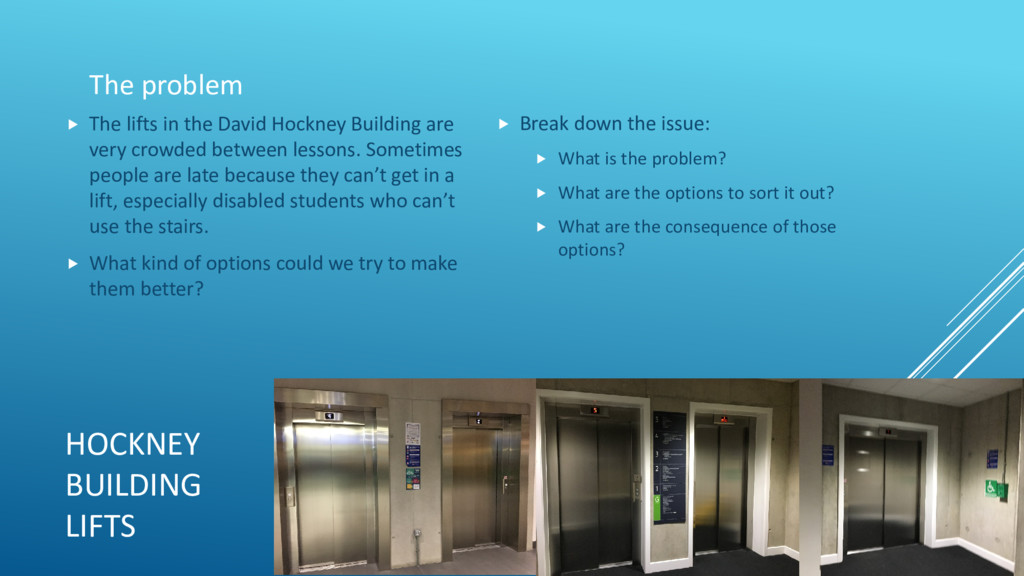
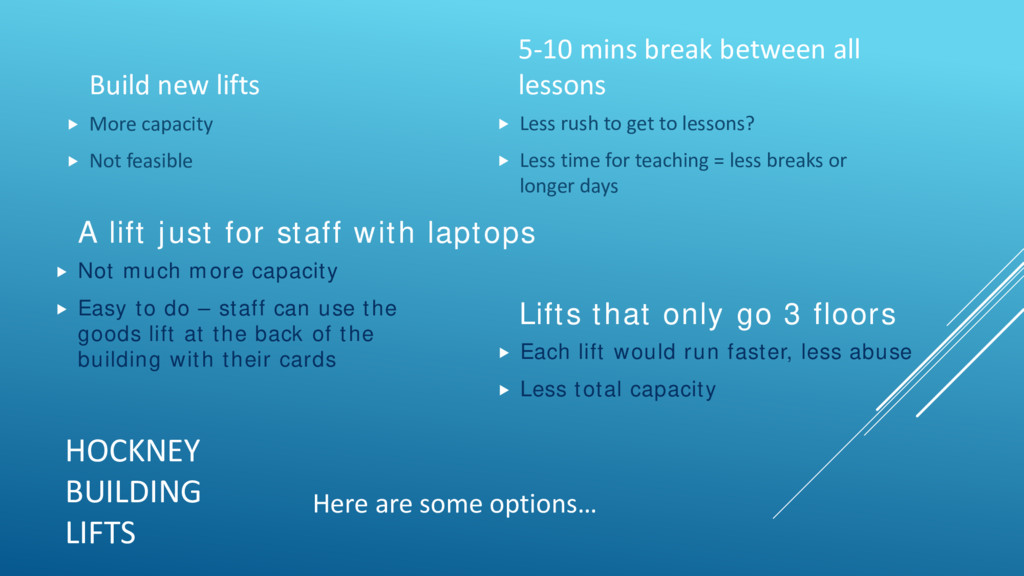
  61. HOCKNEY BUILDING LIFTS The problem  The lifts in the

    David Hockney Building are very crowded between lessons. Sometimes people are late because they can’t get in a lift, especially disabled students who can’t use the stairs.  What kind of options could we try to make them better?  Break down the issue:  What is the problem?  What are the options to sort it out?  What are the consequence of those options?
  62. HOCKNEY BUILDING LIFTS Build new lifts  More capacity 

    Not feasible 5-10 mins break between all lessons  Less rush to get to lessons?  Less time for teaching = less breaks or longer days A lift just for staff with laptops  Not much more capacity  Easy to do – staff can use the goods lift at the back of the building with their cards Lifts that only go 3 floors  Each lift would run faster, less abuse  Less total capacity Here are some options…
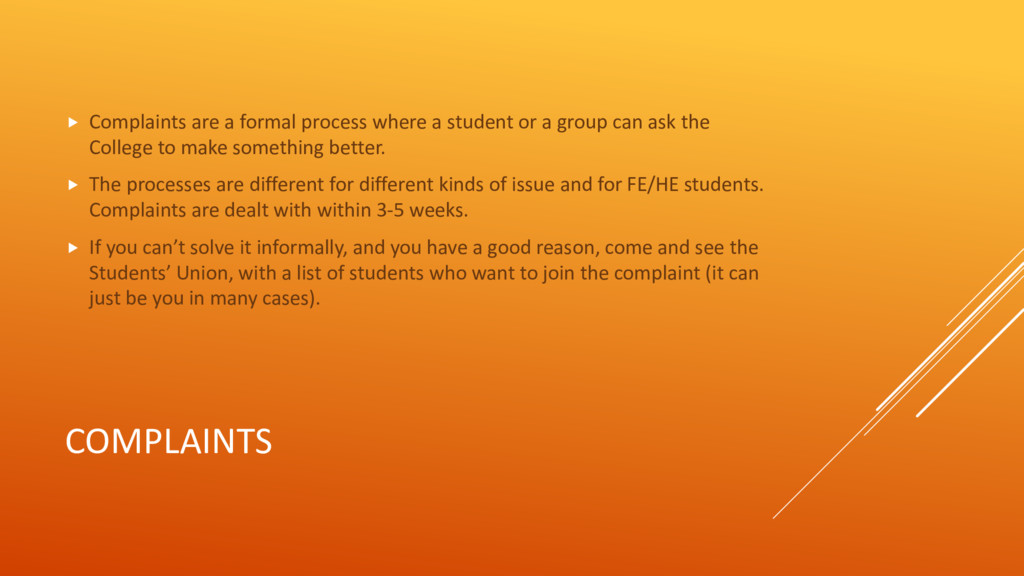
  63. COMPLAINTS  Complaints are a formal process where a student

    or a group can ask the College to make something better.  The processes are different for different kinds of issue and for FE/HE students. Complaints are dealt with within 3-5 weeks.  If you can’t solve it informally, and you have a good reason, come and see the Students’ Union, with a list of students who want to join the complaint (it can just be you in many cases).
  64. STUDENT PARLIAMENT  Meets twice every term and semester 

    Students can decide policy and to make changes that affect them as students  Hold Students’ Union and College Executive to account
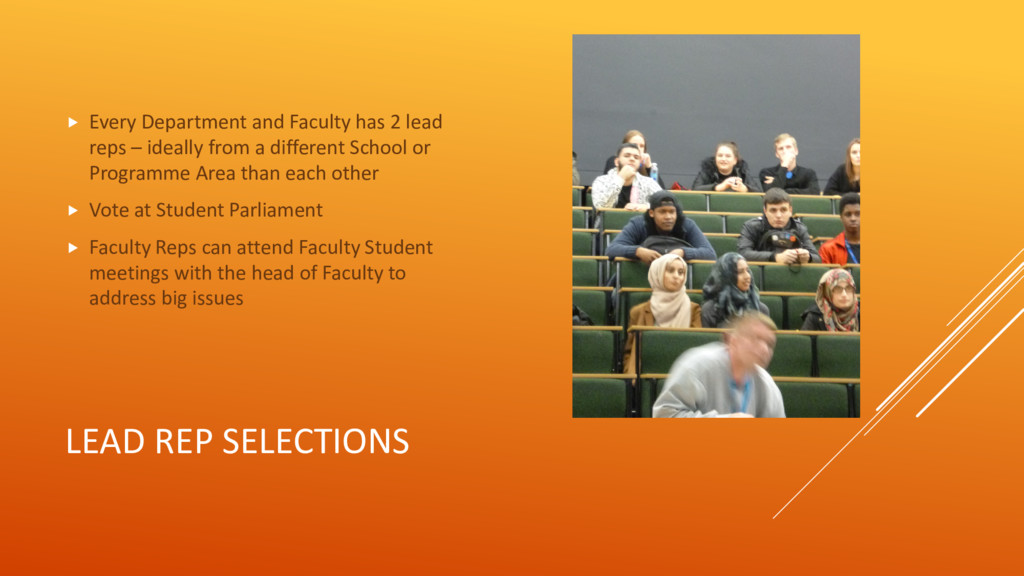
  65. LEAD REP SELECTIONS  Every Department and Faculty has 2

    lead reps – ideally from a different School or Programme Area than each other  Vote at Student Parliament  Faculty Reps can attend Faculty Student meetings with the head of Faculty to address big issues
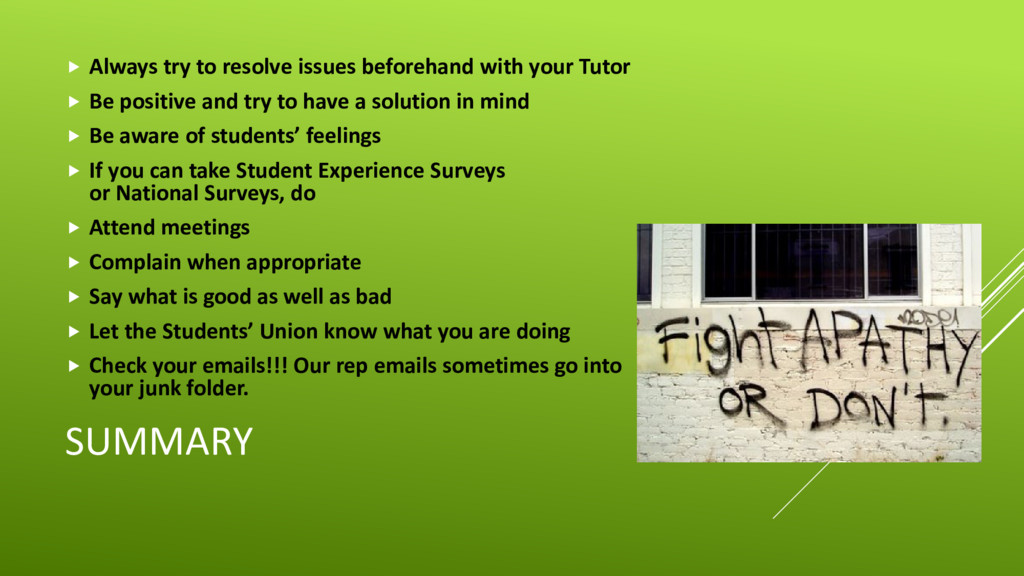
  66. SUMMARY  Always try to resolve issues beforehand with your

    Tutor  Be positive and try to have a solution in mind  Be aware of students’ feelings  If you can take Student Experience Surveys or National Surveys, do  Attend meetings  Complain when appropriate  Say what is good as well as bad  Let the Students’ Union know what you are doing  Check your emails!!! Our rep emails sometimes go into your junk folder.
  67. Students’ Union Rep Support  Robson Brown – Student Rep

    Coordinator – [email protected]  Manages s.reps email queries and sends out rep newsletters  Can book department/faculty meetings  Supports Student Parliament and students preparing for college committees  Can see reps for 10 minute catchups if they want  Sohaib Ashraf – FE Rep Development – [email protected]  Matt Peel – HE Rep Development – [email protected]  Was Siddique – Students Union President – [email protected]  Kath Denison – Students’ Union Advice Service – [email protected]
  68. THANK YOU FOR TAKING THE REP TRAINING Now visit www.bcsu.me/reps

    to take a short quiz. Let us know a contact email address so we can keep you up to date.