tail objects between multiple head objects which is a form of deduplication • The S3 object identity (name, attributes...) is maintained in the Head-Object and must be unique • The Tail objects holds plain data and can be shared • The first 4MB in the Head Object is duplicated • Is it possible to split the head object into two separate objects? • The first object holding only the attributes (and the name) • The second object will be a new tail object holding only data? • This could be utilized in **future** release as an enhancement
encrypted objects • Doesn’t support Copy between 2 remote objects • Doesn’t support Copy between 2 different pools • Doesn’t support Copy with different placement rules • Why can’t we simply override the TGT placement rules?
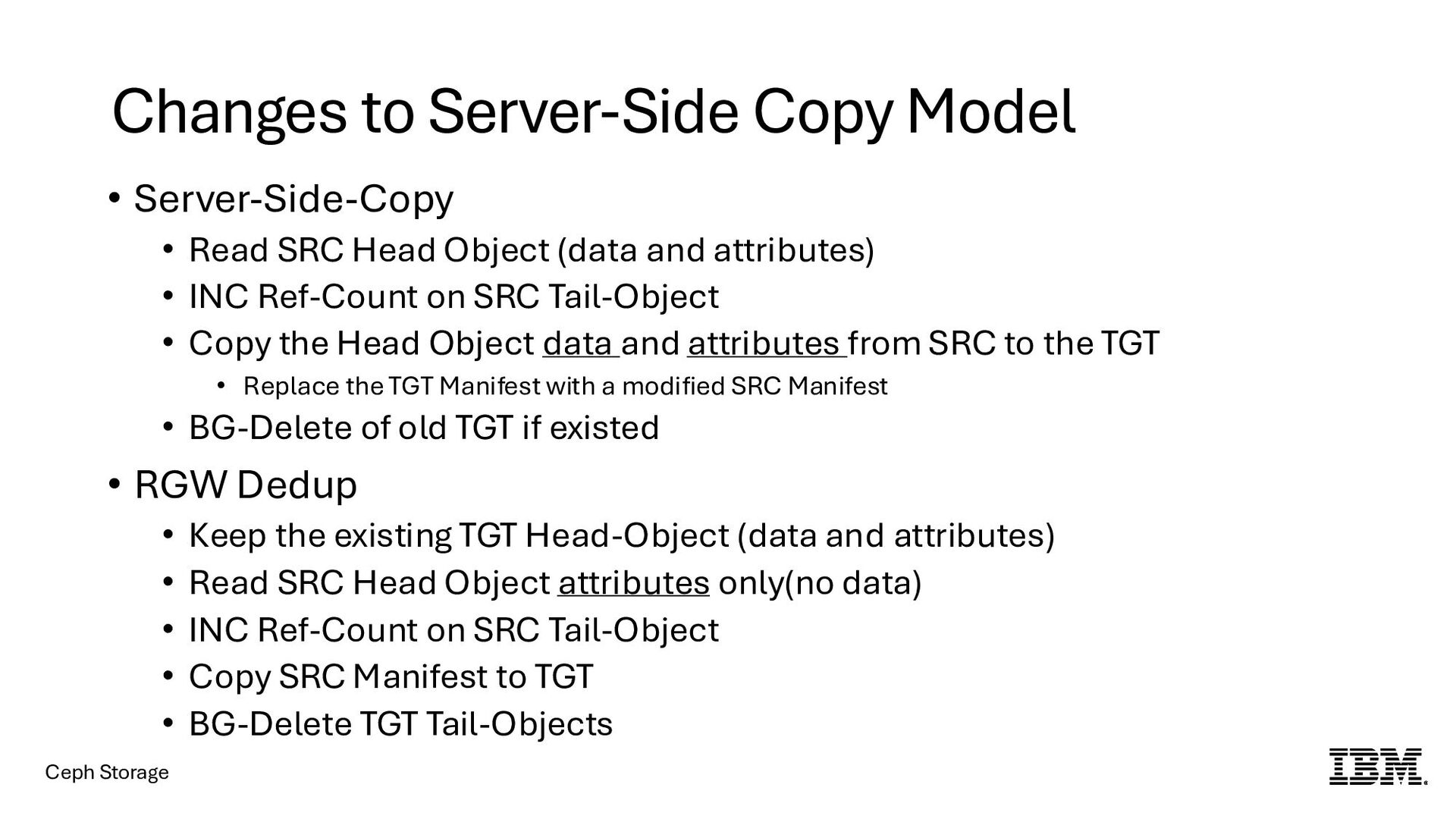
Read SRC Head Object (data and attributes) • INC Ref-Count on SRC Tail-Object • Copy the Head Object data and attributes from SRC to the TGT • Replace the TGT Manifest with a modified SRC Manifest • BG-Delete of old TGT if existed • RGW Dedup • Keep the existing TGT Head-Object (data and attributes) • Read SRC Head Object attributes only(no data) • INC Ref-Count on SRC Tail-Object • Copy SRC Manifest to TGT • BG-Delete TGT Tail-Objects
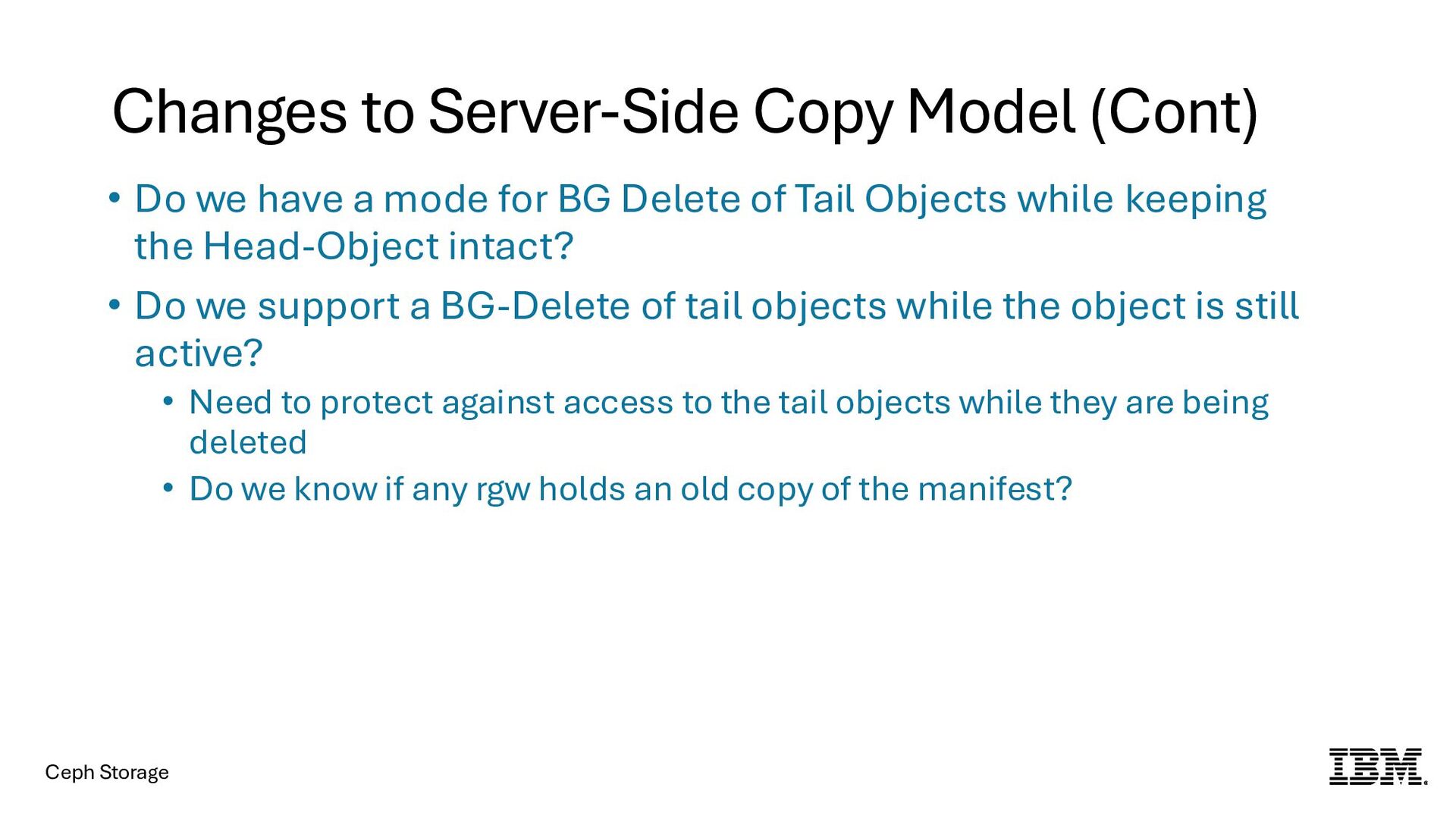
we have a mode for BG Delete of Tail Objects while keeping the Head-Object intact? • Do we support a BG-Delete of tail objects while the object is still active? • Need to protect against access to the tail objects while they are being deleted • Do we know if any rgw holds an old copy of the manifest?
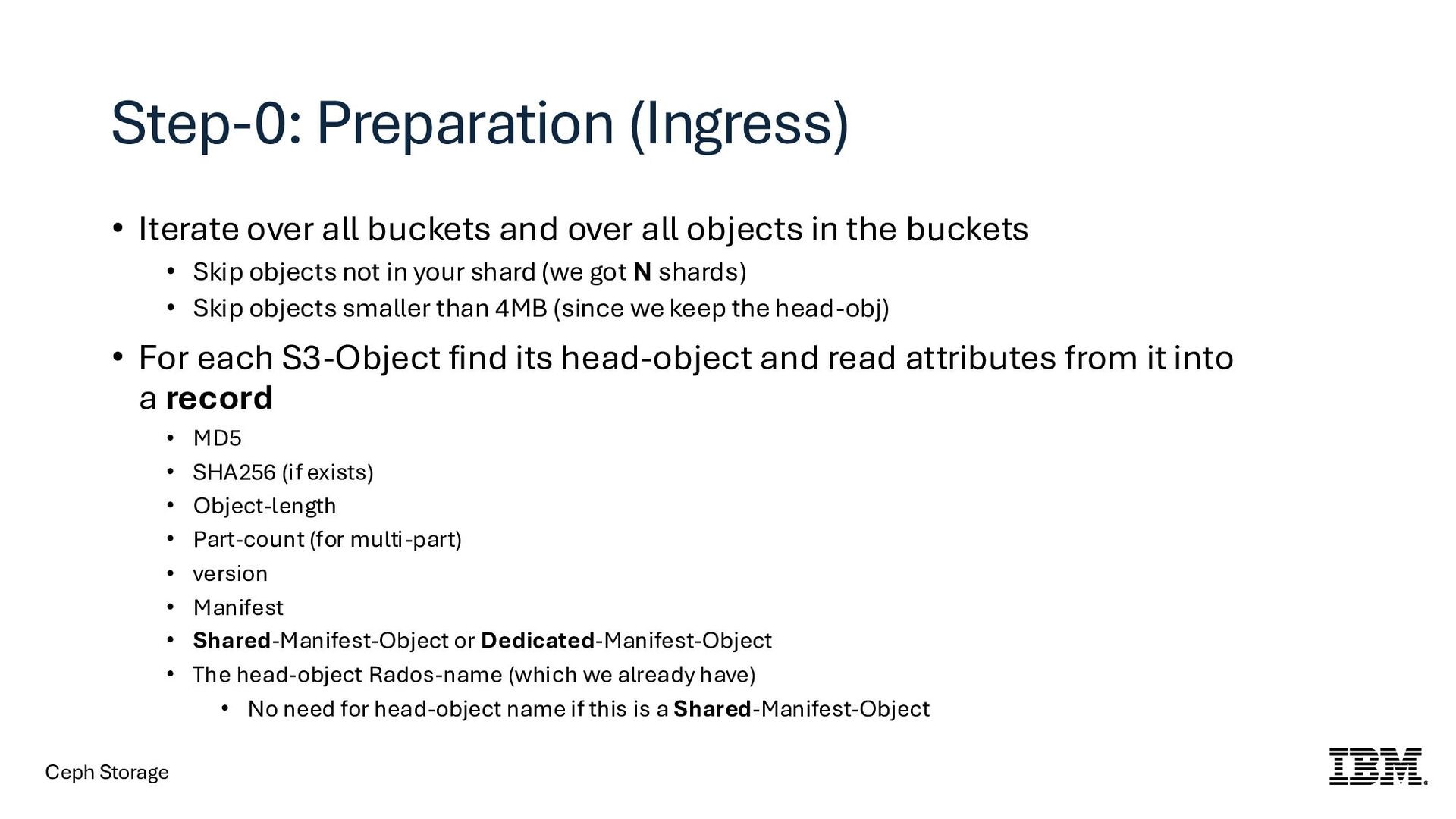
and over all objects in the buckets • Skip objects not in your shard (we got N shards) • Skip objects smaller than 4MB (since we keep the head-obj) • For each S3-Object find its head-object and read attributes from it into a record • MD5 • SHA256 (if exists) • Object-length • Part-count (for multi-part) • version • Manifest • Shared-Manifest-Object or Dedicated-Manifest-Object • The head-object Rados-name (which we already have) • No need for head-object name if this is a Shared-Manifest-Object
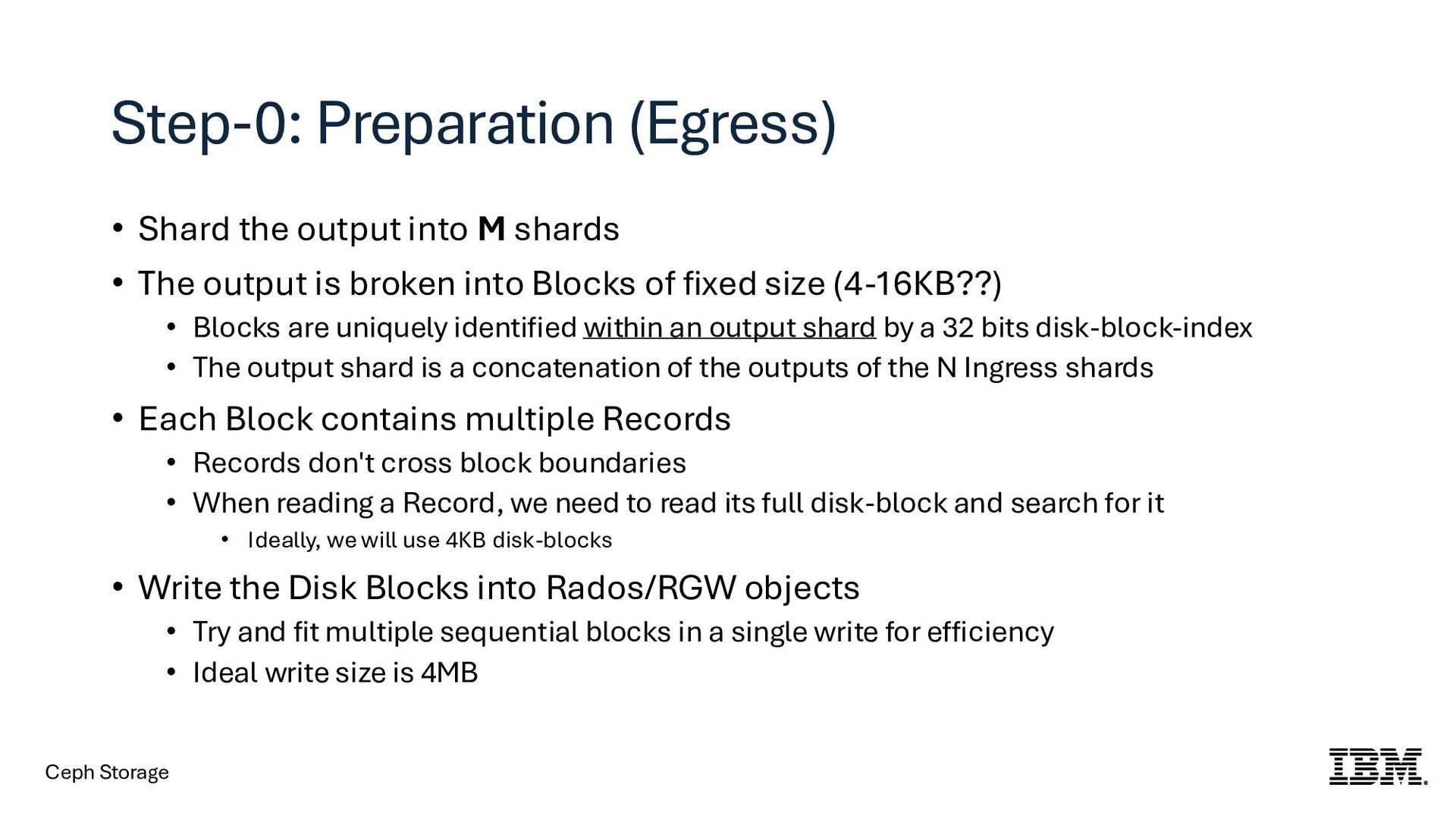
M shards • The output is broken into Blocks of fixed size (4-16KB??) • Blocks are uniquely identified within an output shard by a 32 bits disk-block-index • The output shard is a concatenation of the outputs of the N Ingress shards • Each Block contains multiple Records • Records don't cross block boundaries • When reading a Record, we need to read its full disk-block and search for it • Ideally, we will use 4KB disk-blocks • Write the Disk Blocks into Rados/RGW objects • Try and fit multiple sequential blocks in a single write for efficiency • Ideal write size is 4MB
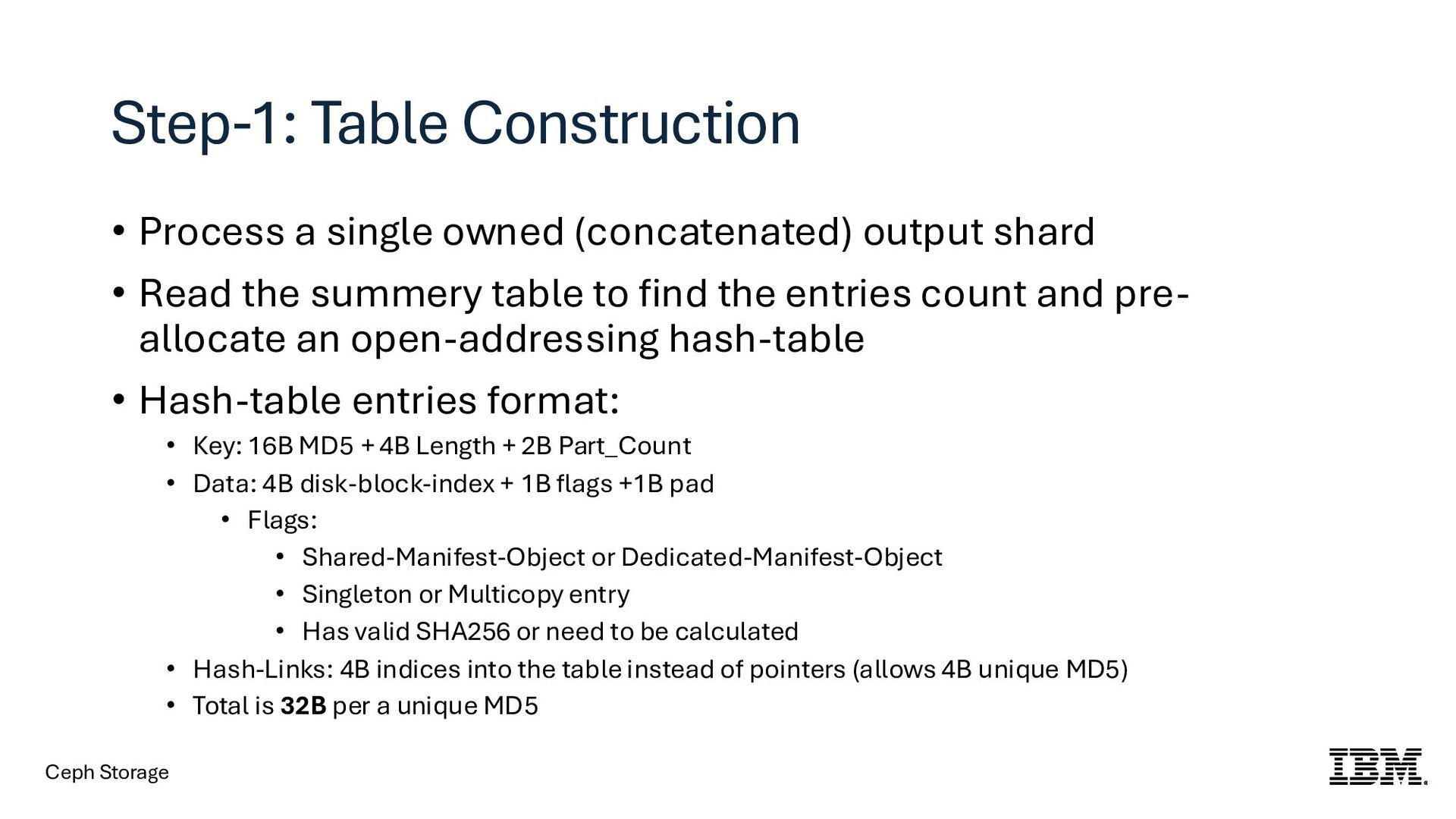
(concatenated) output shard • Read the summery table to find the entries count and pre- allocate an open-addressing hash-table • Hash-table entries format: • Key: 16B MD5 + 4B Length + 2B Part_Count • Data: 4B disk-block-index + 1B flags +1B pad • Flags: • Shared-Manifest-Object or Dedicated-Manifest-Object • Singleton or Multicopy entry • Has valid SHA256 or need to be calculated • Hash-Links: 4B indices into the table instead of pointers (allows 4B unique MD5) • Total is 32B per a unique MD5
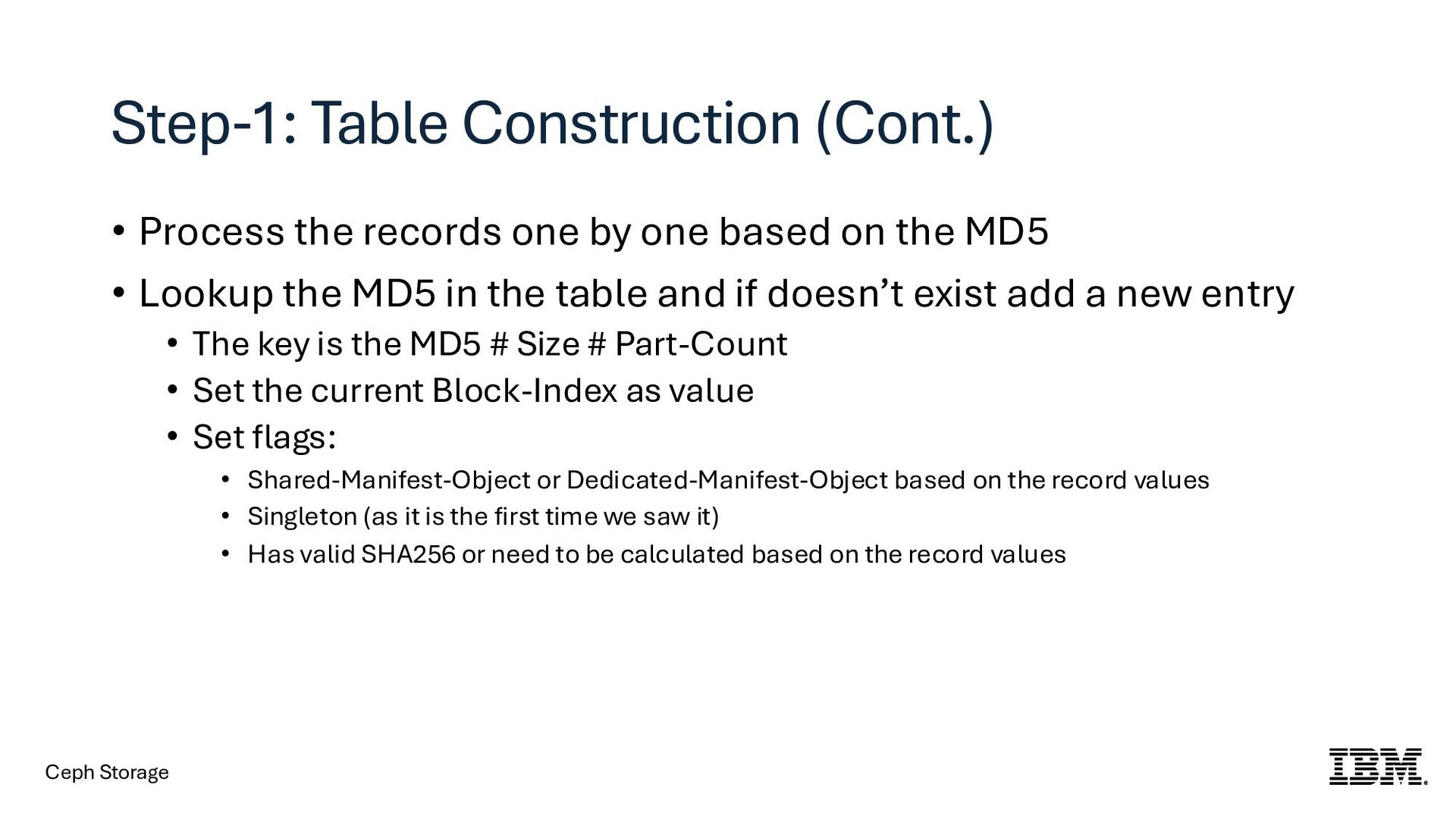
one by one based on the MD5 • Lookup the MD5 in the table and if doesn’t exist add a new entry • The key is the MD5 # Size # Part-Count • Set the current Block-Index as value • Set flags: • Shared-Manifest-Object or Dedicated-Manifest-Object based on the record values • Singleton (as it is the first time we saw it) • Has valid SHA256 or need to be calculated based on the record values
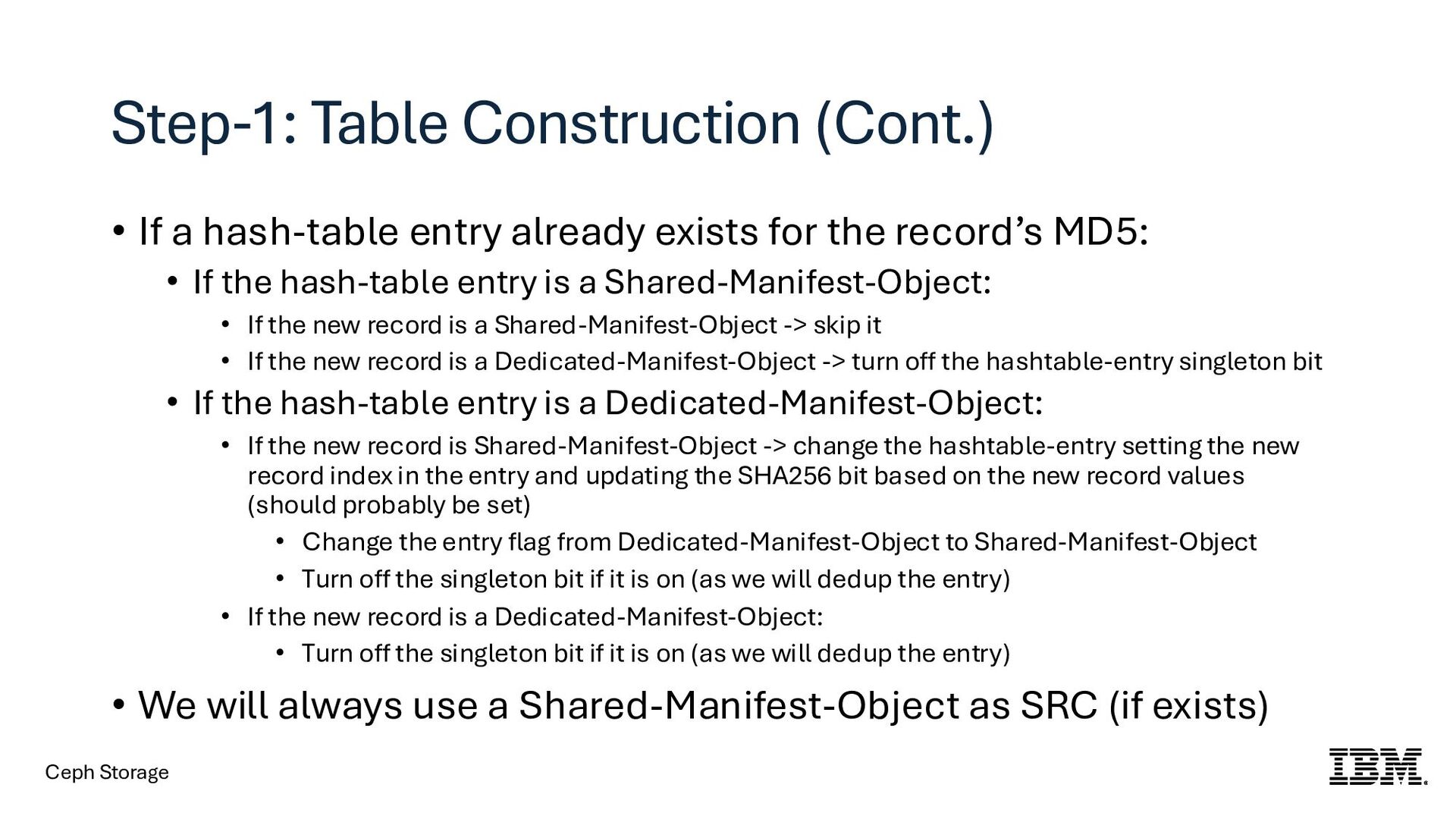
entry already exists for the record’s MD5: • If the hash-table entry is a Shared-Manifest-Object: • If the new record is a Shared-Manifest-Object -> skip it • If the new record is a Dedicated-Manifest-Object -> turn off the hashtable-entry singleton bit • If the hash-table entry is a Dedicated-Manifest-Object: • If the new record is Shared-Manifest-Object -> change the hashtable-entry setting the new record index in the entry and updating the SHA256 bit based on the new record values (should probably be set) • Change the entry flag from Dedicated-Manifest-Object to Shared-Manifest-Object • Turn off the singleton bit if it is on (as we will dedup the entry) • If the new record is a Dedicated-Manifest-Object: • Turn off the singleton bit if it is on (as we will dedup the entry) • We will always use a Shared-Manifest-Object as SRC (if exists)
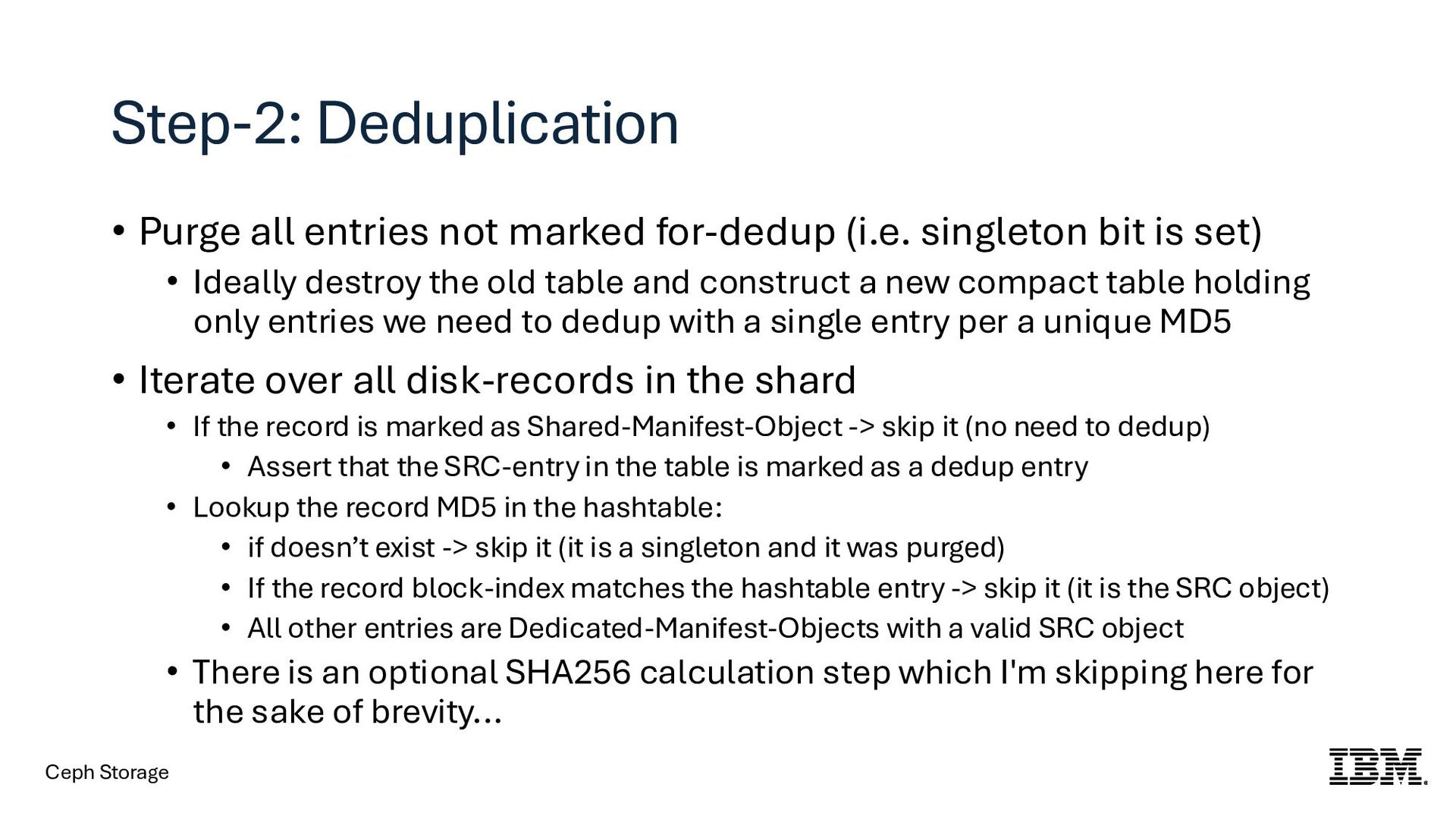
for-dedup (i.e. singleton bit is set) • Ideally destroy the old table and construct a new compact table holding only entries we need to dedup with a single entry per a unique MD5 • Iterate over all disk-records in the shard • If the record is marked as Shared-Manifest-Object -> skip it (no need to dedup) • Assert that the SRC-entry in the table is marked as a dedup entry • Lookup the record MD5 in the hashtable: • if doesn’t exist -> skip it (it is a singleton and it was purged) • If the record block-index matches the hashtable entry -> skip it (it is the SRC object) • All other entries are Dedicated-Manifest-Objects with a valid SRC object • There is an optional SHA256 calculation step which I'm skipping here for the sake of brevity...
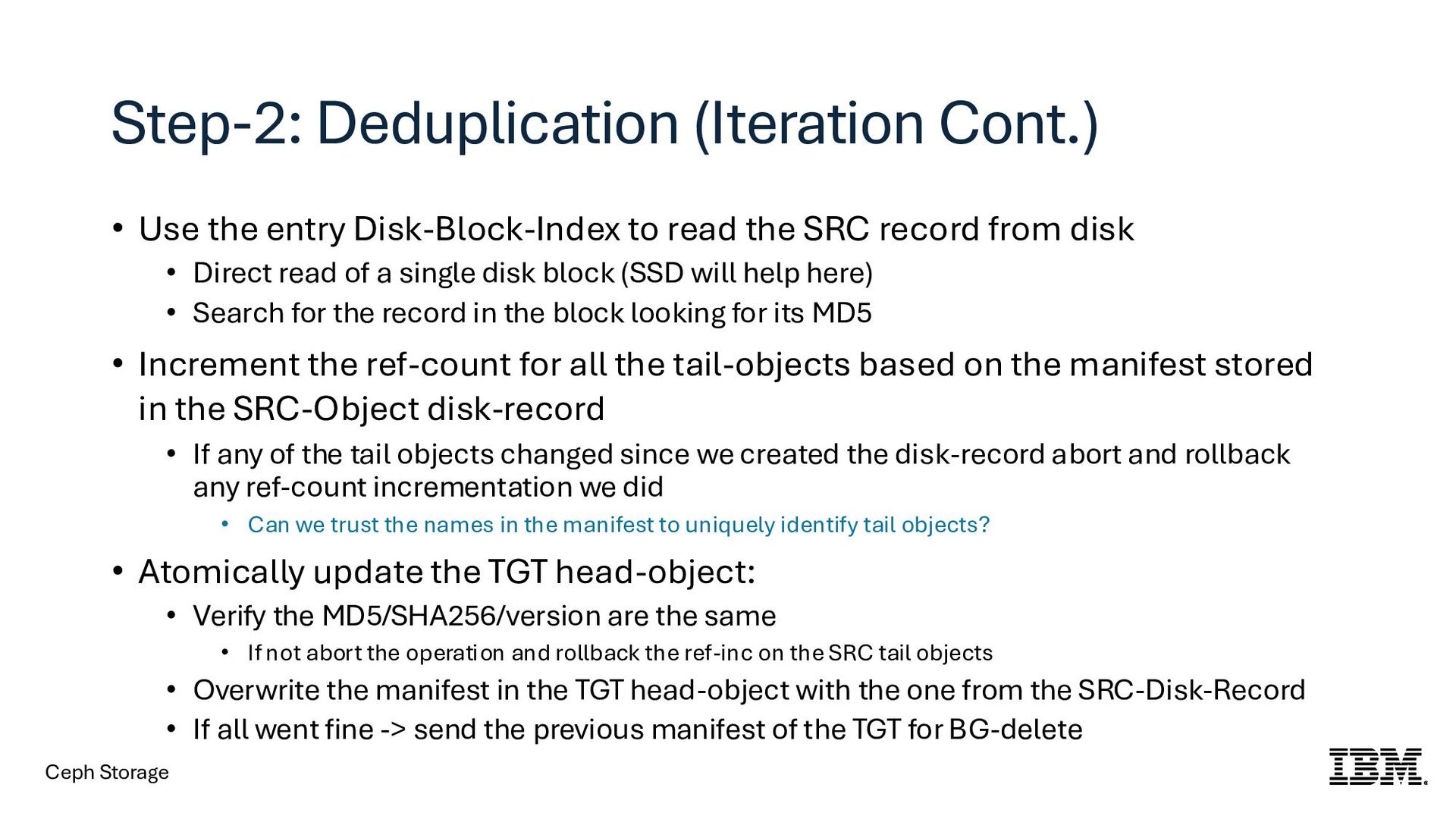
Disk-Block-Index to read the SRC record from disk • Direct read of a single disk block (SSD will help here) • Search for the record in the block looking for its MD5 • Increment the ref-count for all the tail-objects based on the manifest stored in the SRC-Object disk-record • If any of the tail objects changed since we created the disk-record abort and rollback any ref-count incrementation we did • Can we trust the names in the manifest to uniquely identify tail objects? • Atomically update the TGT head-object: • Verify the MD5/SHA256/version are the same • If not abort the operation and rollback the ref-inc on the SRC tail objects • Overwrite the manifest in the TGT head-object with the one from the SRC-Disk-Record • If all went fine -> send the previous manifest of the TGT for BG-delete
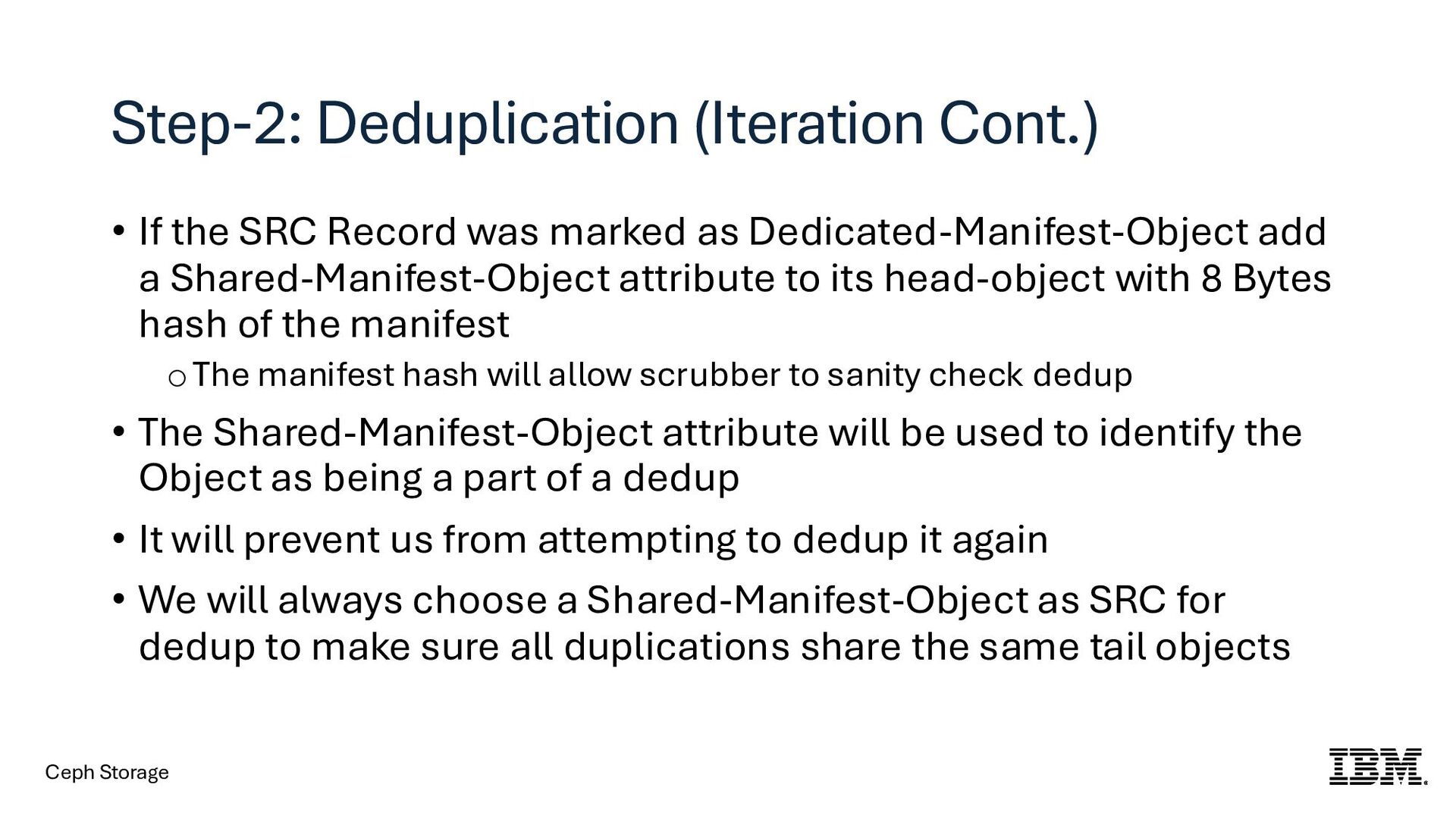
Record was marked as Dedicated-Manifest-Object add a Shared-Manifest-Object attribute to its head-object with 8 Bytes hash of the manifest oThe manifest hash will allow scrubber to sanity check dedup • The Shared-Manifest-Object attribute will be used to identify the Object as being a part of a dedup • It will prevent us from attempting to dedup it again • We will always choose a Shared-Manifest-Object as SRC for dedup to make sure all duplications share the same tail objects
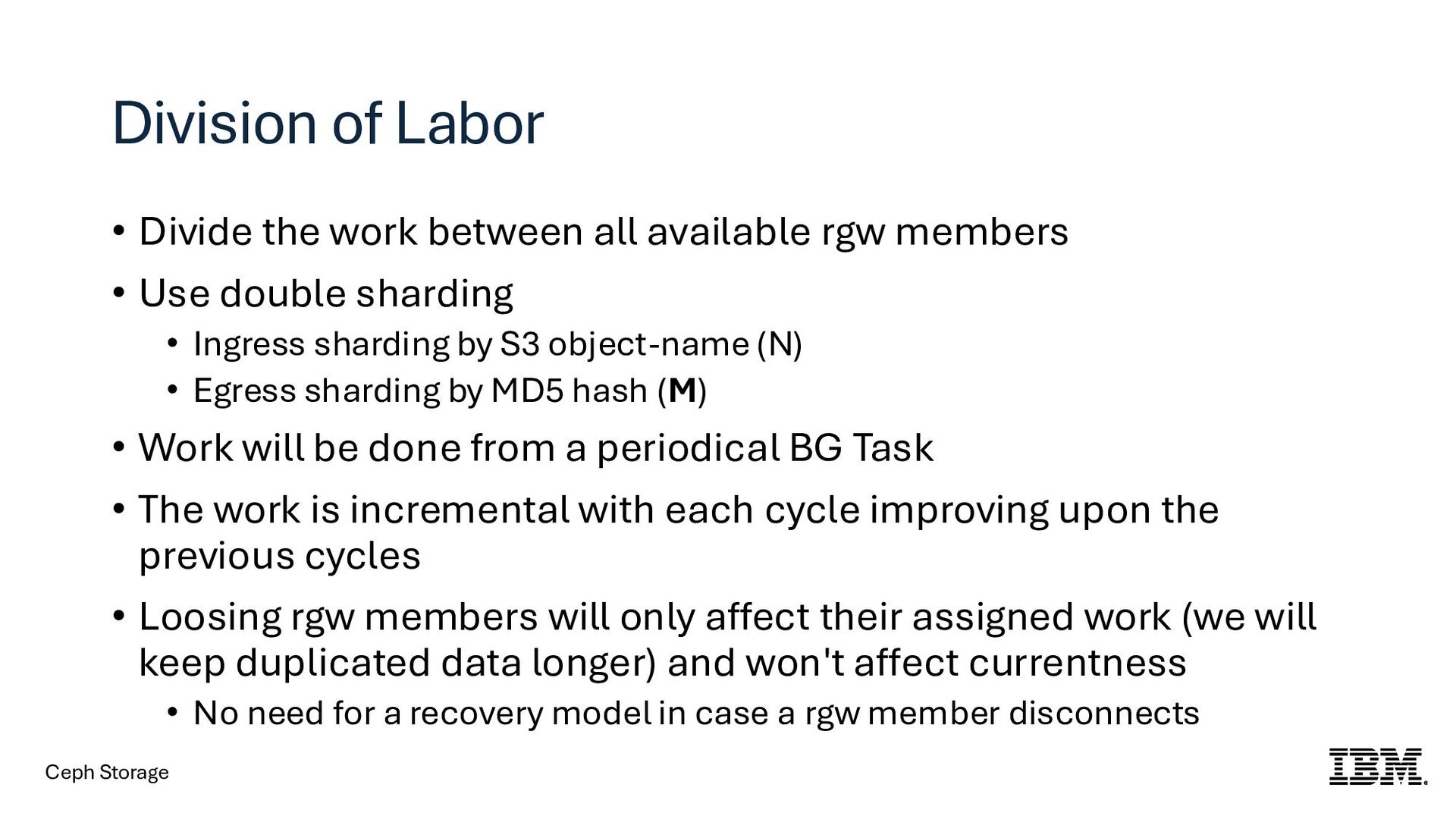
all available rgw members • Use double sharding • Ingress sharding by S3 object-name (N) • Egress sharding by MD5 hash (M) • Work will be done from a periodical BG Task • The work is incremental with each cycle improving upon the previous cycles • Loosing rgw members will only affect their assigned work (we will keep duplicated data longer) and won't affect currentness • No need for a recovery model in case a rgw member disconnects
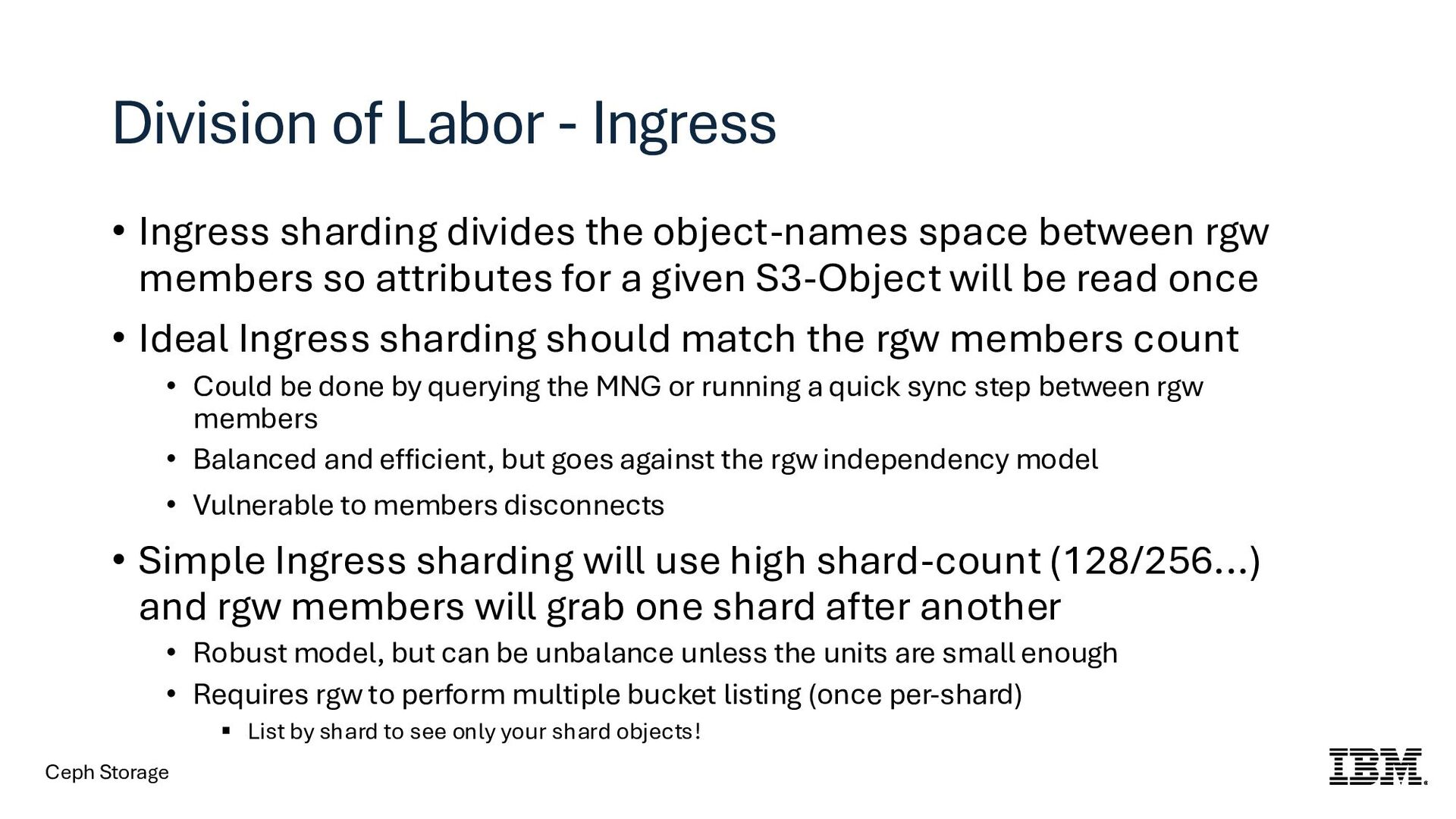
divides the object-names space between rgw members so attributes for a given S3-Object will be read once • Ideal Ingress sharding should match the rgw members count • Could be done by querying the MNG or running a quick sync step between rgw members • Balanced and efficient, but goes against the rgw independency model • Vulnerable to members disconnects • Simple Ingress sharding will use high shard-count (128/256...) and rgw members will grab one shard after another • Robust model, but can be unbalance unless the units are small enough • Requires rgw to perform multiple bucket listing (once per-shard) ▪ List by shard to see only your shard objects!
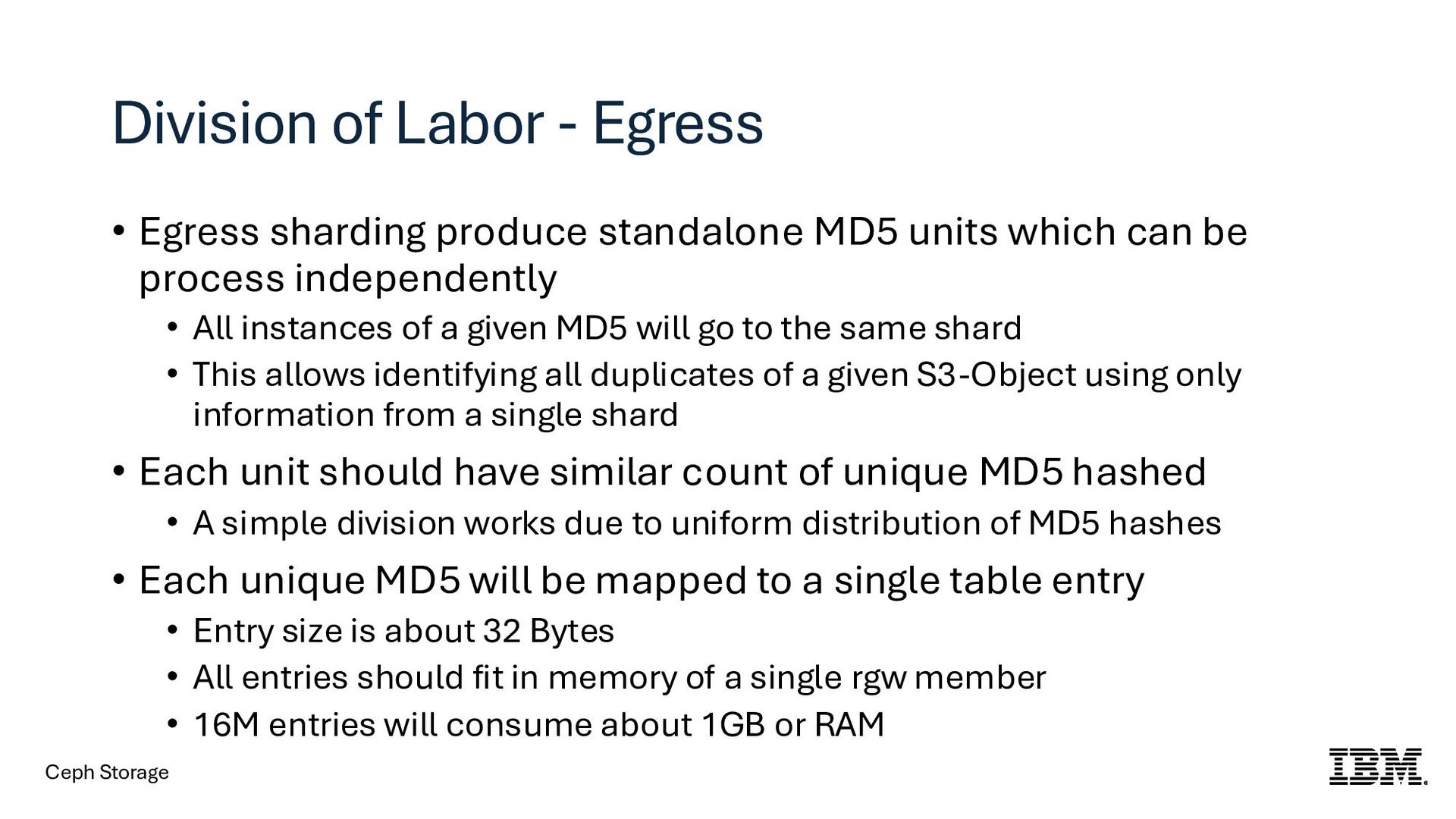
produce standalone MD5 units which can be process independently • All instances of a given MD5 will go to the same shard • This allows identifying all duplicates of a given S3-Object using only information from a single shard • Each unit should have similar count of unique MD5 hashed • A simple division works due to uniform distribution of MD5 hashes • Each unique MD5 will be mapped to a single table entry • Entry size is about 32 Bytes • All entries should fit in memory of a single rgw member • 16M entries will consume about 1GB or RAM


 sachag
 moore
 holman
 erikaheidi
 csswizardry
 soudai
 danielanewman
 kristinabergwall1
 bermonpainter
 kneath
 axbom