Upgrade to Pro
— share decks privately, control downloads, hide ads and more …
Speaker Deck
Sign up for free
Menu
Search
Features
All features
Private URLs
Password Protection
Custom URLS
Scheduled publishing
Remove Branding
Restrict embedding
Deck Collections
Notes
Features
All features
Private URLs
Password Protection
Custom URLS
Scheduled publishing
Remove Branding
Restrict embedding
Deck Collections
Notes
Explore
Featured decks
Featured speakers
Programming
Technology
Storyboards
Explore
Featured decks
Featured speakers
Programming
Technology
Storyboards
Pricing
Search
Sign in
Sign up for free
Pres 1
Search
Sponsored
·
Your Podcast. Everywhere. Effortlessly.
Share. Educate. Inspire. Entertain. You do you. We'll handle the rest.
→
benwhately
October 09, 2012
4.3k
0
Share
Embed
Copy iframe code
Copy JS code
Copy link
Start on current slide
Pres 1
benwhately
October 09, 2012
More Decks by benwhately
See All by benwhately
how_to_type_in_chinese.pdf
benwhately
0
170
how to type in chinese.pdf
benwhately
0
15k
Futurism - Cristina Bogdan
benwhately
0
600
slideshow 1.pdf
benwhately
0
160
slideshow2.pdf
benwhately
0
120
menu3
benwhately
0
71
menu1
benwhately
0
96
menu2
benwhately
0
76
How to type in Chinese
benwhately
0
1.2k
Featured
See All Featured
From π to Pie charts
rasagy
1
400
The State of eCommerce SEO: How to Win in Today's Products SERPs - #SEOweek
aleyda
2
12k
[Rails World 2023 - Day 1 Closing Keynote] - The Magic of Rails
eileencodes
38
3.1k
ラッコキーワード サービス紹介資料
rakko
1
5.3M
The browser strikes back
jonoalderson
0
1.8k
The Curse of the Amulet
leimatthew05
3
16k
Breaking role norms: Why Content Design is so much more than writing copy - Taylor Woolridge
uxyall
1
450
Building AI with AI
inesmontani
PRO
1
1.3k
Tell your own story through comics
letsgokoyo
1
1.1k
Highjacked: Video Game Concept Design
rkendrick25
PRO
1
480
Accessibility Awareness
sabderemane
1
250
Writing Fast Ruby
sferik
630
63k
Transcript
Well done! You just learned 10 of the most common
Chinese characters.
If you are a bit of a pessimist though, you
might be wondering...
“how many more characters will I have to learn before
I can read something really useful?”
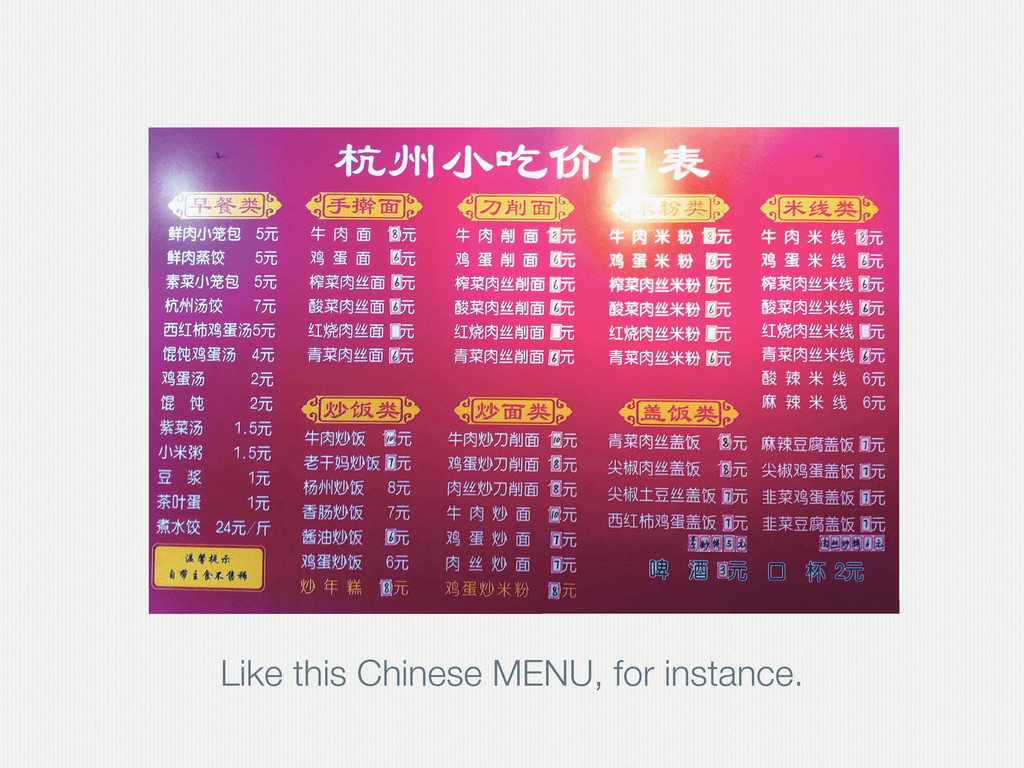
Like this Chinese MENU, for instance.
That is the menu on the wall of a little
restaurant near where I used to live on Dongsi Sitiao, in Beijing. The food is indescribably delicious.
And the answer to you question is, “not actually that
many.”
You have already learned about a tenth of the characters
you need. You should be reading the whole thing by the end of the week...
...or perhaps even sooner! So let’s get started!
Today’s Chinese characters have ancient origins: originally they were pictures
of the objects or ideas they represented.
Many characters have changed their shape and their meaning over
the last 2000 years. So sometimes the characters now look pretty different to what they represent.
But with a bit of imagination you can often nd
your way back to the original pictures and meanings
In the rst level, you learned a few of the
most commonly used characters using some pretty neat animations. Now you are going to learn a few more!
Some of the pictures are a perfect t... some are
a bit more elaborate. But that just makes them more interesting, and so more memorable!
So see if you can make sense of these next
ones!


 benwhately
 rasagy
 aleyda
 eileencodes
 rakko
rakko
 jonoalderson
 leimatthew05
 uxyall
 inesmontani
 letsgokoyo
 rkendrick25
 sabderemane
 sferik