a group of ar;sts, Umberto Boccioni, Giacomo Balla, Gino Severini, and Carlo Carrà, led by the poet F.T. MarineH. There were also futurist architects and musicians. They claimed to be the new men, men of speed, technology, violence, who despised tradi;on and only believed in perpetual renewing. Most of them became members of the Italian Fascist party in the 20s, in a curious understanding of this ‘new man’. Rayonism in Russia and Vor+cism in Britain are short-‐lived off-‐ shots of Futurism (some;mes combined with Cubism).
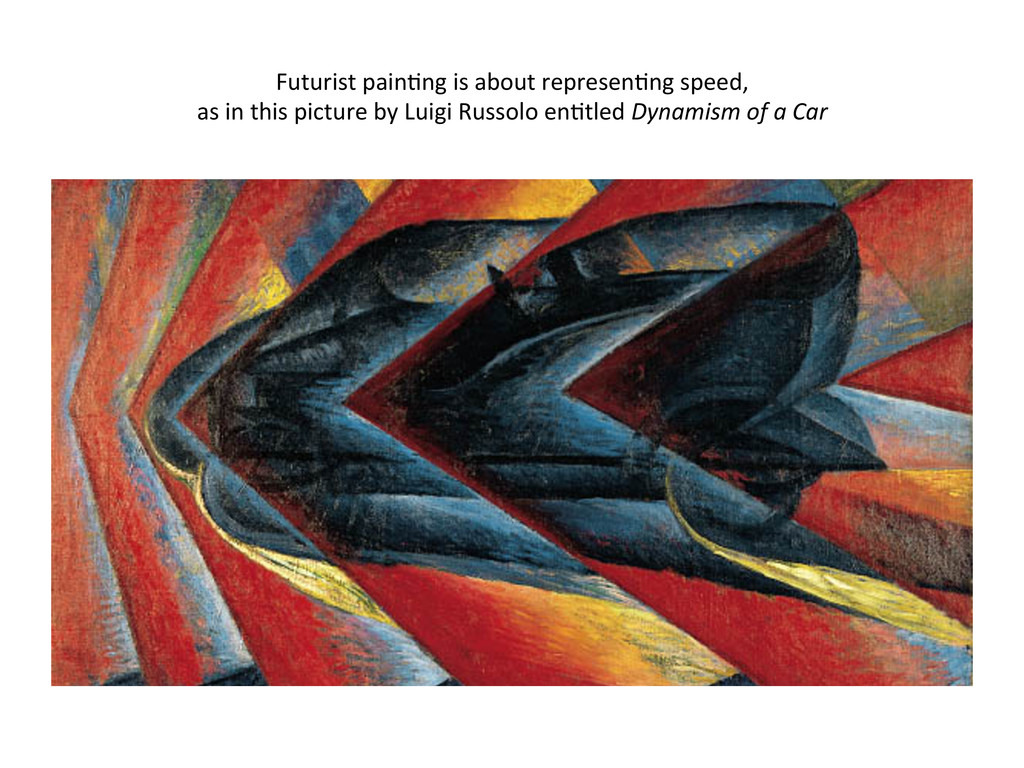
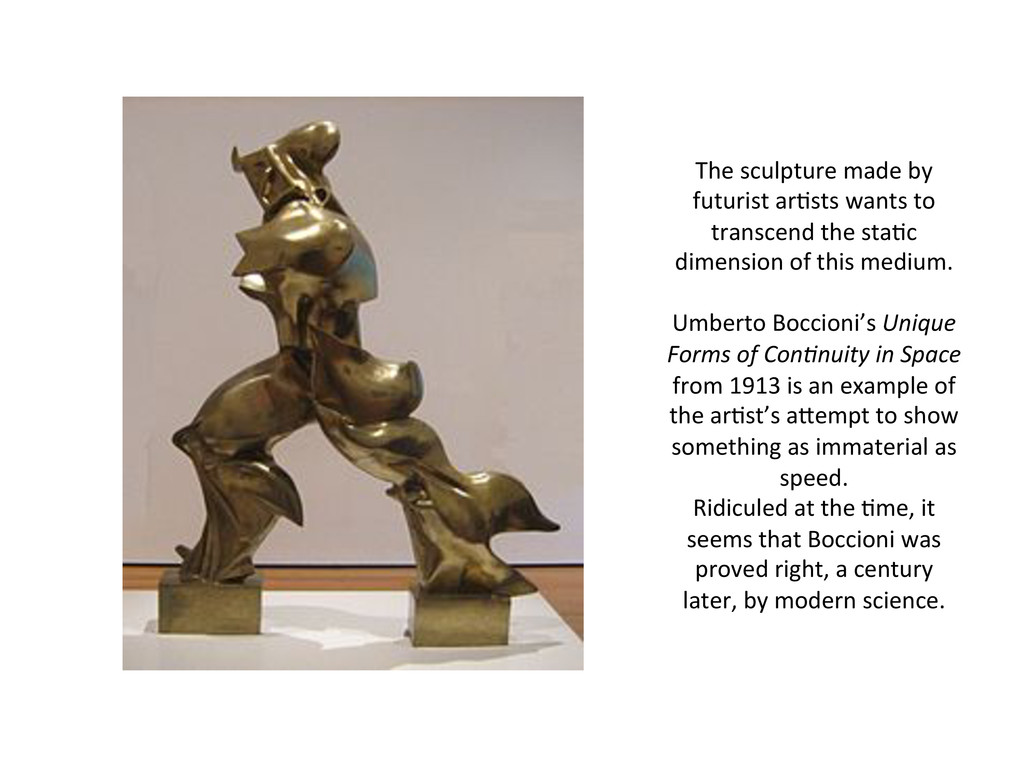
transcend the sta;c dimension of this medium. Umberto Boccioni’s Unique Forms of Con+nuity in Space from 1913 is an example of the ar;st’s aRempt to show something as immaterial as speed. Ridiculed at the ;me, it seems that Boccioni was proved right, a century later, by modern science.
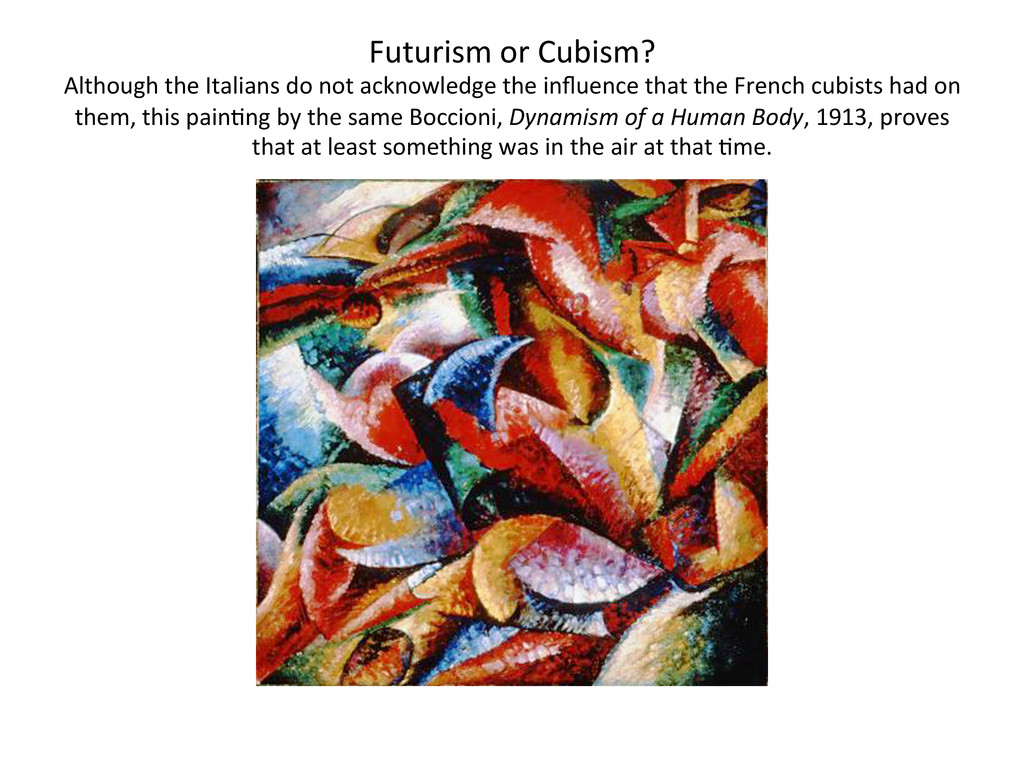
the influence that the French cubists had on them, this pain;ng by the same Boccioni, Dynamism of a Human Body, 1913, proves that at least something was in the air at that ;me.
beginning of the 20th C. was the passion for science, for looking at the world through the eyes of a scien;st. For ar;sts, this meant decomposing material and immaterial nature into mul;ple facets, all linked together by the con;nuous flow of speed. A new world vision was being created, in which the old, sta;c tradi;ons had no more room. The locus of the futurists was the noisy, heated city, and their ac;ons violent and scandalous.
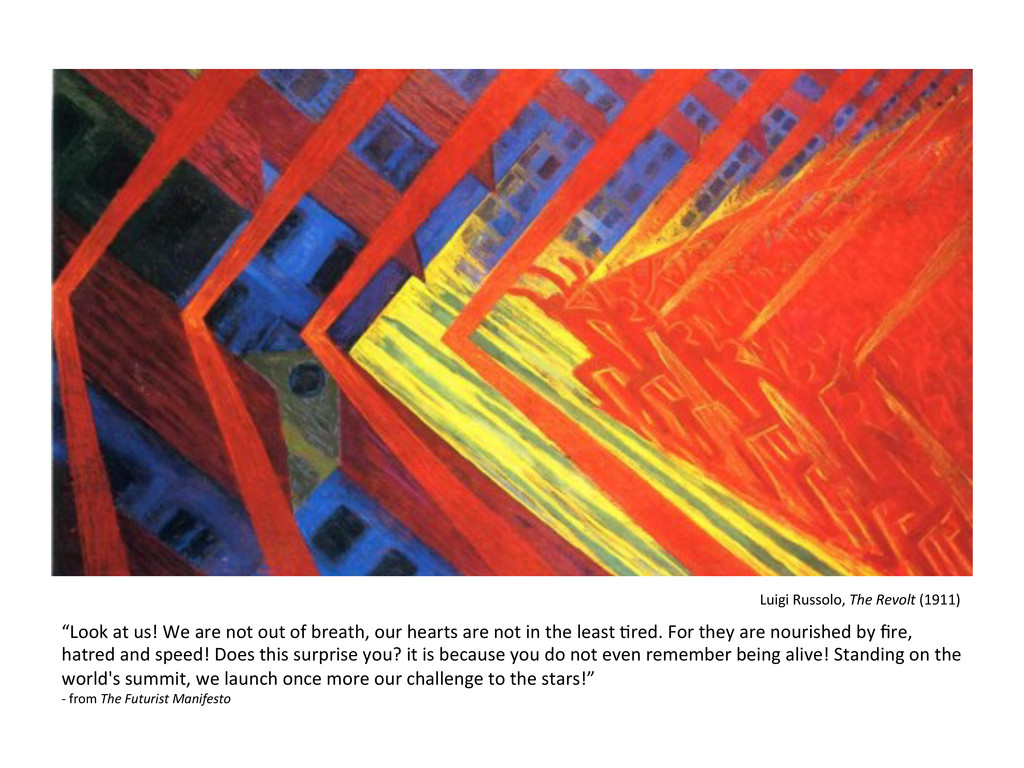
hearts are not in the least ;red. For they are nourished by fire, hatred and speed! Does this surprise you? it is because you do not even remember being alive! Standing on the world's summit, we launch once more our challenge to the stars!” -‐ from The Futurist Manifesto Luigi Russolo, The Revolt (1911)


 benwhately
 tonyrice
 techseoconnect
 aleyda
 addyosmani
 davetheseo
 reverentgeek
 paigeccino
 lara
 twada
 ipullrank