Upgrade to Pro — share decks privately, control downloads, hide ads and more …

Make GenAI Production-Ready with Kubernetes Pat...

Sponsored · Your Podcast. Everywhere. Effortlessly. Share. Educate. Inspire. Entertain. You do you. We'll handle the rest.

Make GenAI Production-Ready with Kubernetes Patterns

Running LLM and AI workloads on Kubernetes should not feel like a leap into the unknown. This talk uses familiar Kubernetes patterns to make GenAI systems easier to build and operate in production. It covers controllers and custom resources for stable model endpoints, startup patterns for predictable rollouts, GPU-aware scheduling, token-aware traffic management, gateway policies for latency control, and a practical RAG architecture with stateless orchestration, vector storage, and background ingestion.

Avatar for Bilgin Ibryam

Bilgin Ibryam

March 24, 2026
Tweet

More Decks by Bilgin Ibryam

Other Decks in Programming

Transcript

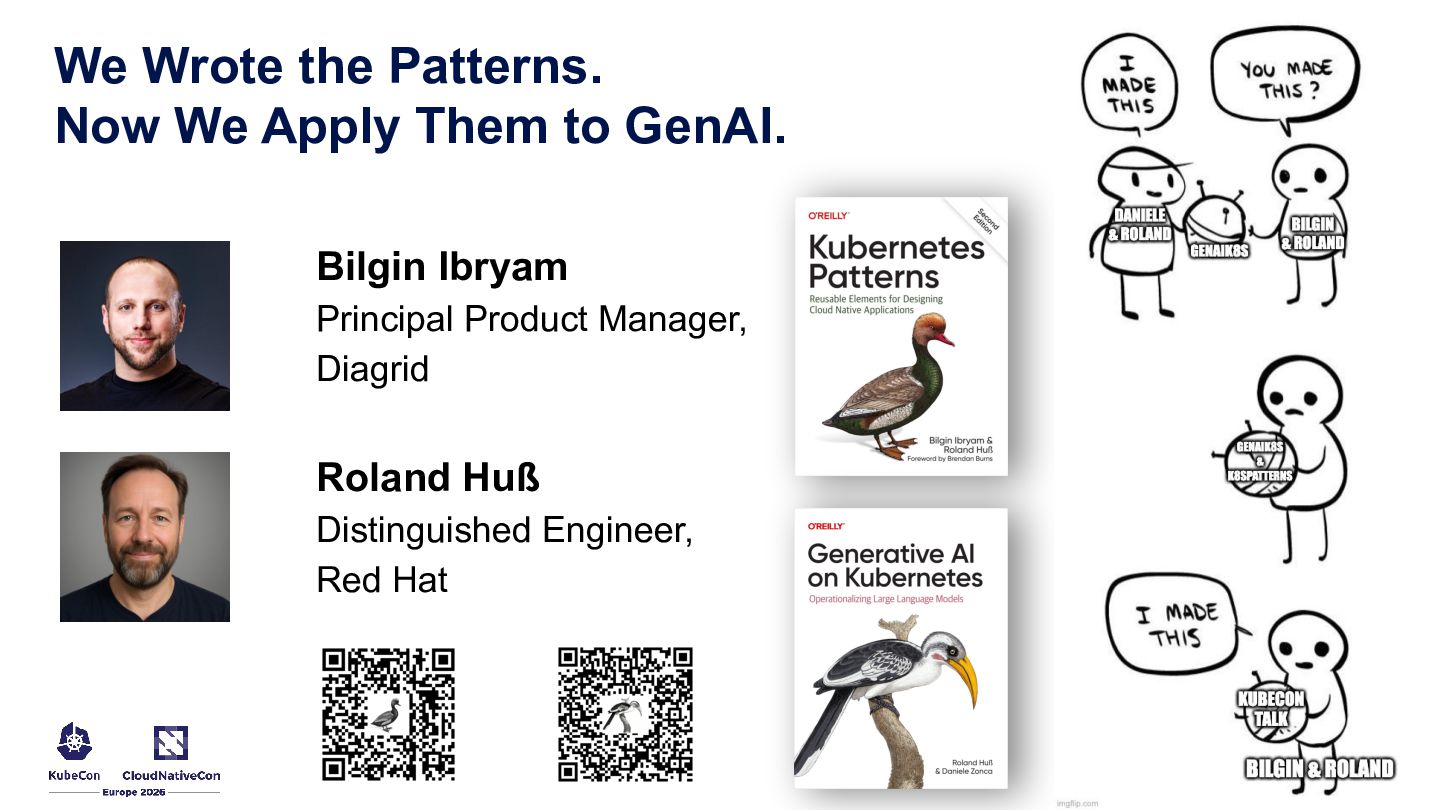
  1. We Wrote the Patterns. Now We Apply Them to GenAI.

    Bilgin Ibryam Principal Product Manager, Diagrid Roland Huß Distinguished Engineer, Red Hat
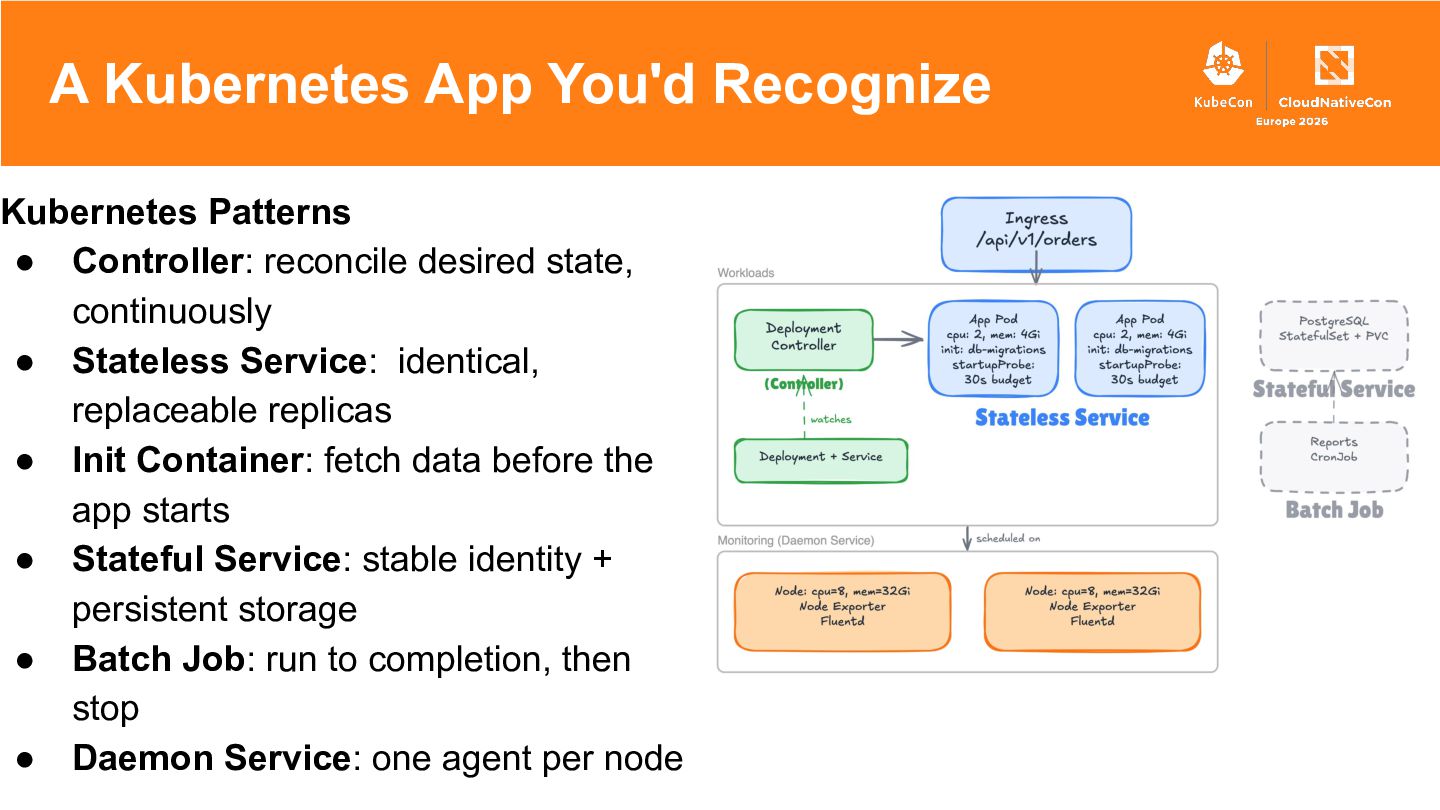
  2. A Kubernetes App You'd Recognize Kubernetes Patterns • Controller: reconcile

    desired state, continuously • Stateless Service: identical, replaceable replicas • Init Container: fetch data before the app starts • Stateful Service: stable identity + persistent storage • Batch Job: run to completion, then stop • Daemon Service: one agent per node
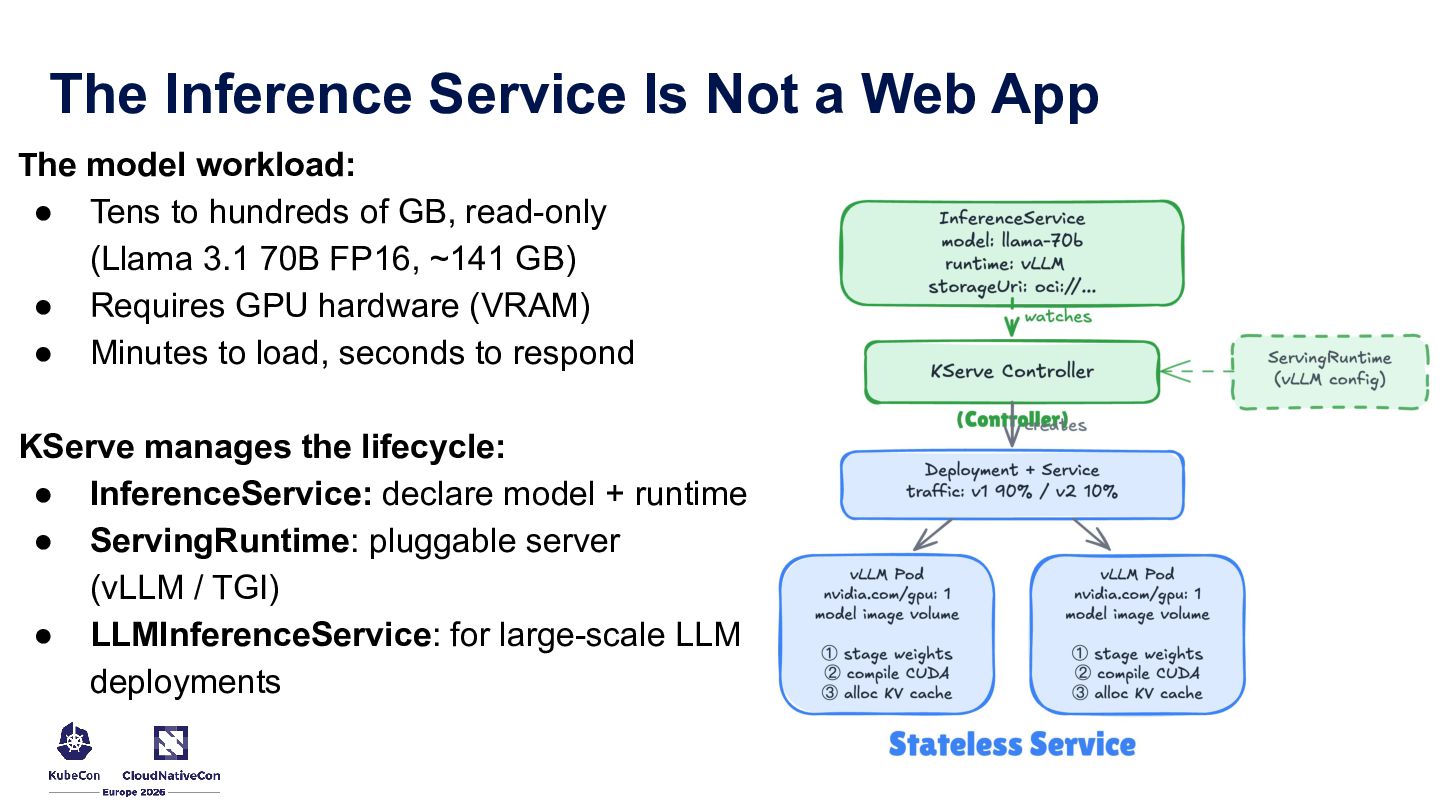
  3. The Inference Service Is Not a Web App The model

    workload: • Tens to hundreds of GB, read-only (Llama 3.1 70B FP16, ~141 GB) • Requires GPU hardware (VRAM) • Minutes to load, seconds to respond KServe manages the lifecycle: • InferenceService: declare model + runtime • ServingRuntime: pluggable server (vLLM / TGI) • LLMInferenceService: for large-scale LLM deployments
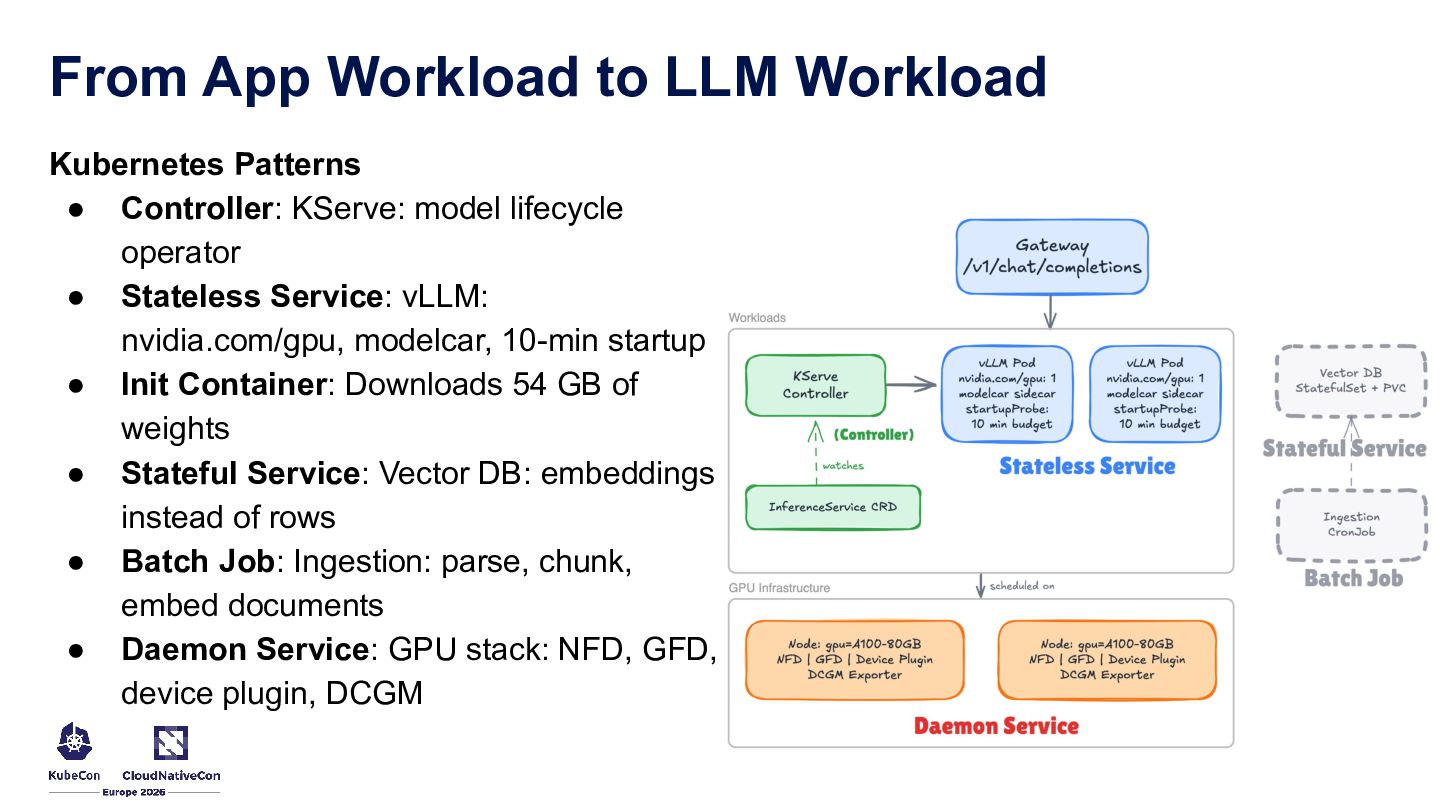
  4. From App Workload to LLM Workload Kubernetes Patterns • Controller:

    KServe: model lifecycle operator • Stateless Service: vLLM: nvidia.com/gpu, modelcar, 10-min startup • Init Container: Downloads 54 GB of weights • Stateful Service: Vector DB: embeddings instead of rows • Batch Job: Ingestion: parse, chunk, embed documents • Daemon Service: GPU stack: NFD, GFD, device plugin, DCGM
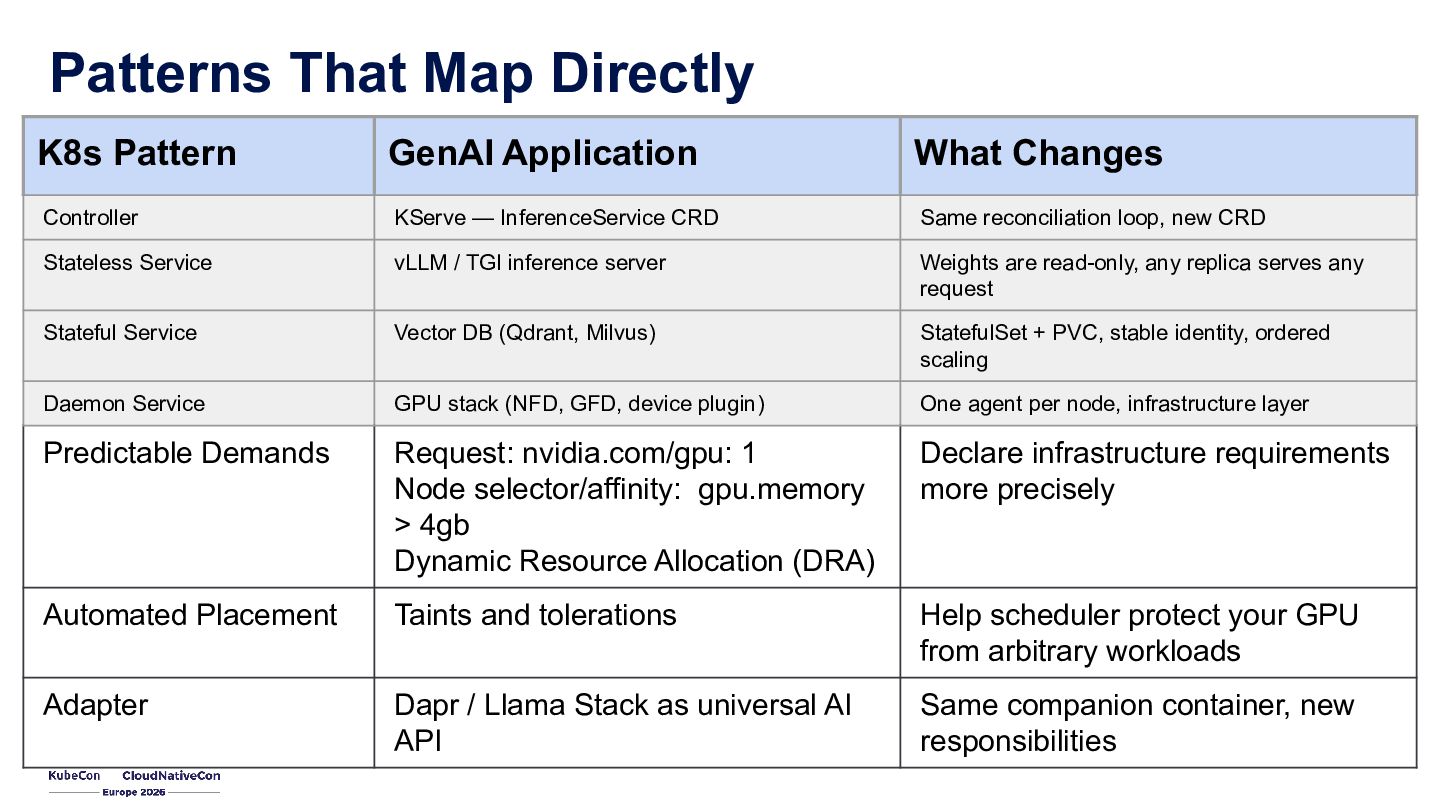
  5. Patterns That Map Directly K8s Pattern GenAI Application What Changes

    Controller KServe — InferenceService CRD Same reconciliation loop, new CRD Stateless Service vLLM / TGI inference server Weights are read-only, any replica serves any request Stateful Service Vector DB (Qdrant, Milvus) StatefulSet + PVC, stable identity, ordered scaling Daemon Service GPU stack (NFD, GFD, device plugin) One agent per node, infrastructure layer Predictable Demands Request: nvidia.com/gpu: 1 Node selector/affinity: gpu.memory > 4gb Dynamic Resource Allocation (DRA) Declare infrastructure requirements more precisely Automated Placement Taints and tolerations Help scheduler protect your GPU from arbitrary workloads Adapter Dapr / Llama Stack as universal AI API Same companion container, new responsibilities
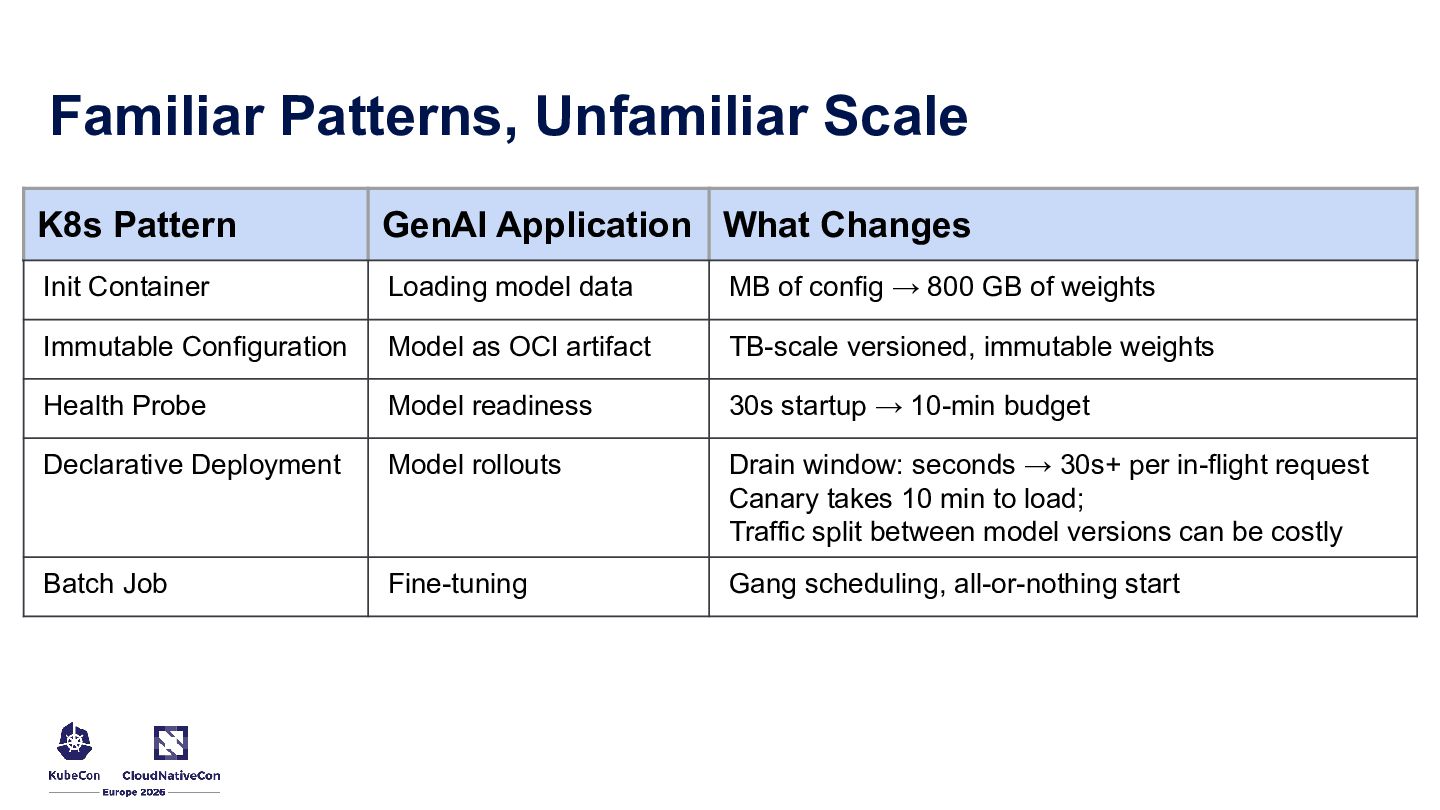
  6. Familiar Patterns, Unfamiliar Scale K8s Pattern GenAI Application What Changes

    Init Container Loading model data MB of config → 800 GB of weights Immutable Configuration Model as OCI artifact TB-scale versioned, immutable weights Health Probe Model readiness 30s startup → 10-min budget Declarative Deployment Model rollouts Drain window: seconds → 30s+ per in-flight request Canary takes 10 min to load; Traffic split between model versions can be costly Batch Job Fine-tuning Gang scheduling, all-or-nothing start
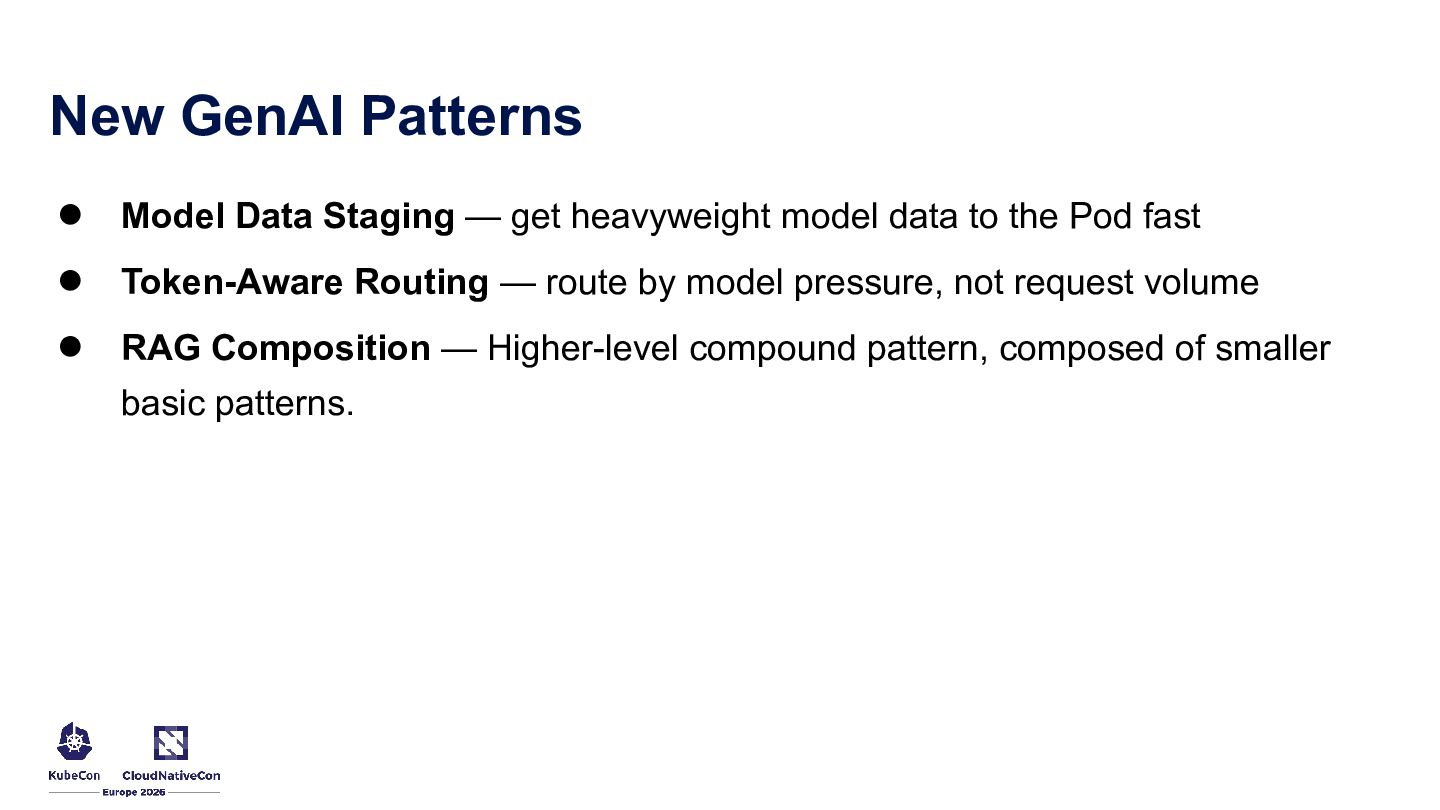
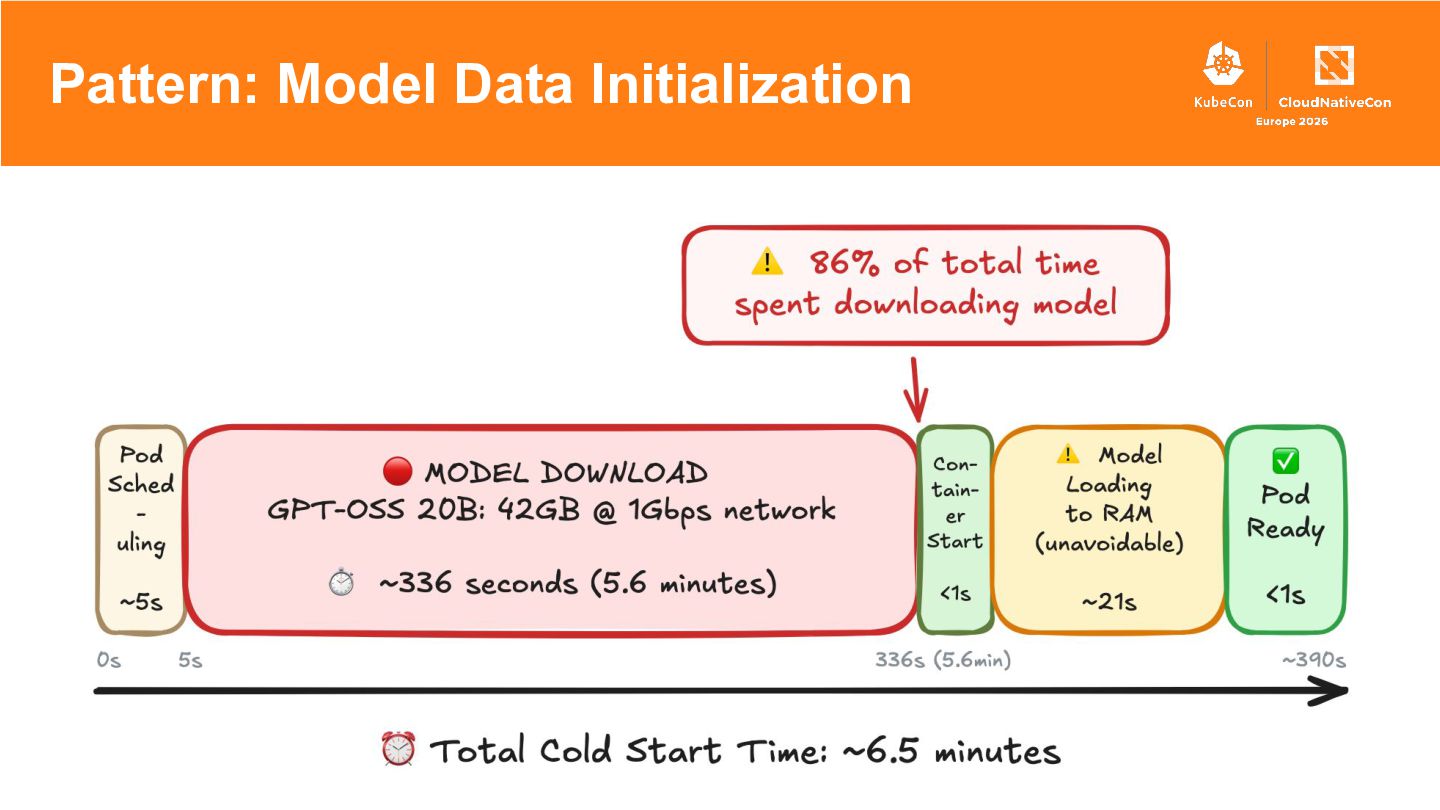
  7. New GenAI Patterns • Model Data Staging — get heavyweight

    model data to the Pod fast • Token-Aware Routing — route by model pressure, not request volume • RAG Composition — Higher-level compound pattern, composed of smaller basic patterns.
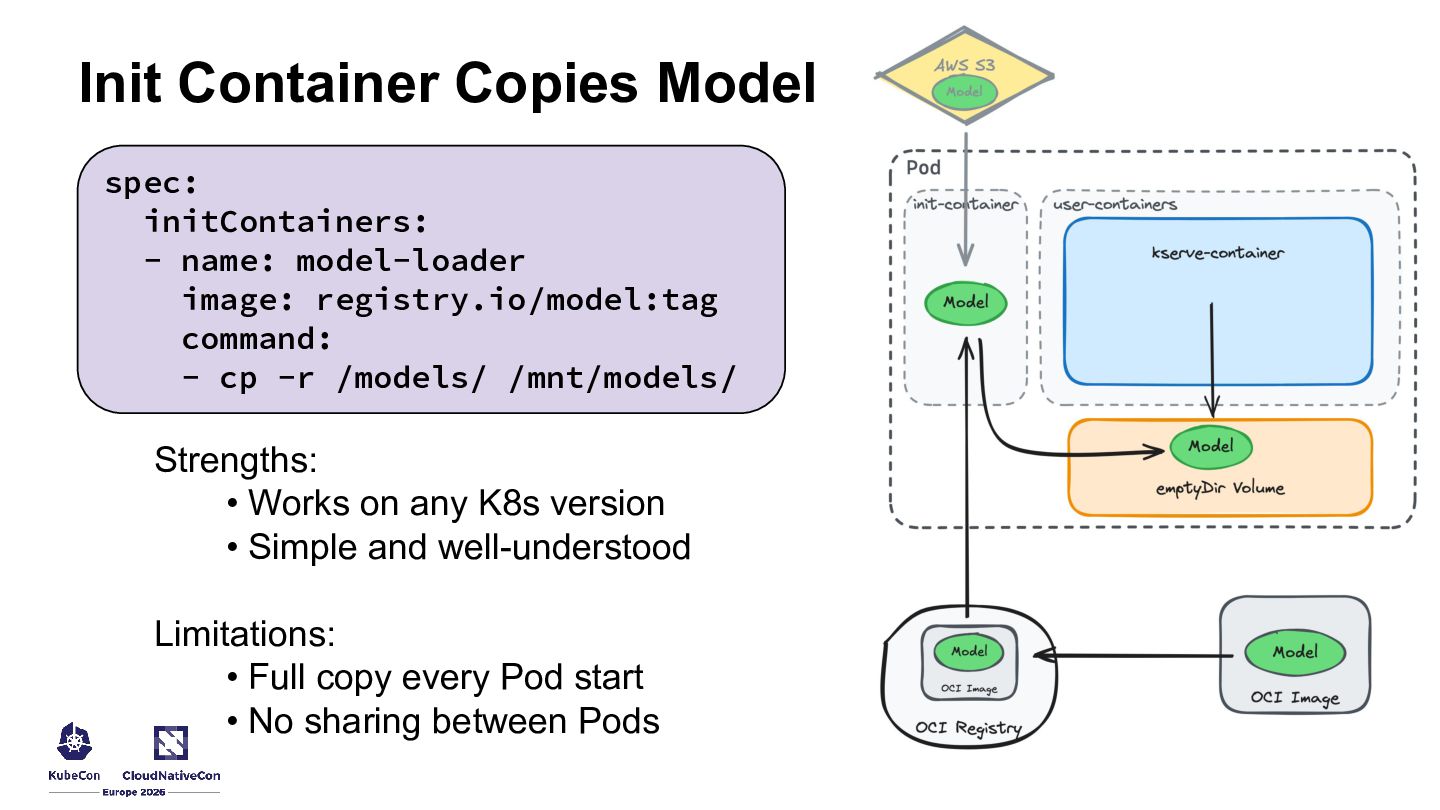
  8. Init Container Copies Model Strengths: • Works on any K8s

    version • Simple and well-understood Limitations: • Full copy every Pod start • No sharing between Pods spec: initContainers: - name: model-loader image: registry.io/model:tag command: - cp -r /models/ /mnt/models/
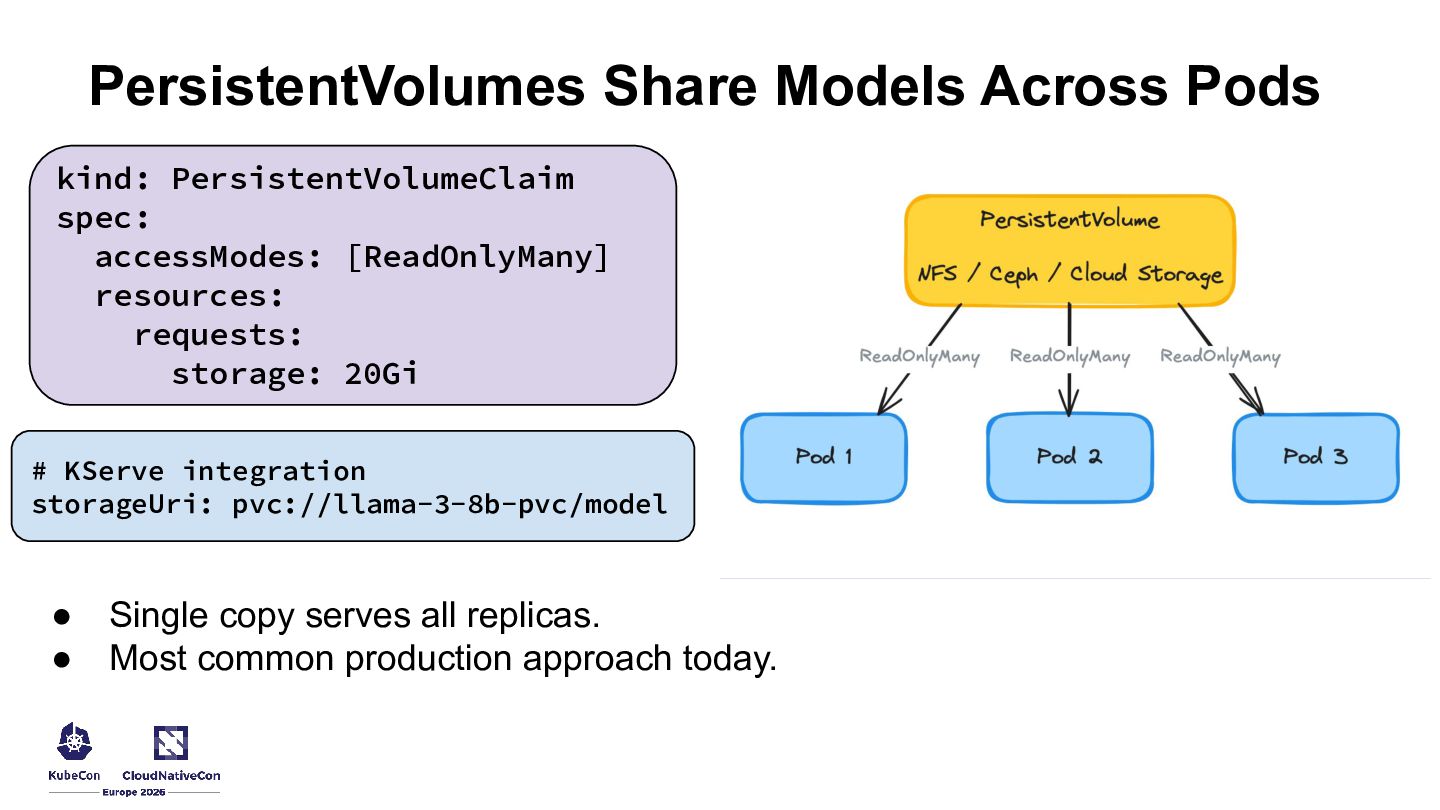
  9. PersistentVolumes Share Models Across Pods • Single copy serves all

    replicas. • Most common production approach today. kind: PersistentVolumeClaim spec: accessModes: [ReadOnlyMany] resources: requests: storage: 20Gi # KServe integration storageUri: pvc://llama-3-8b-pvc/model
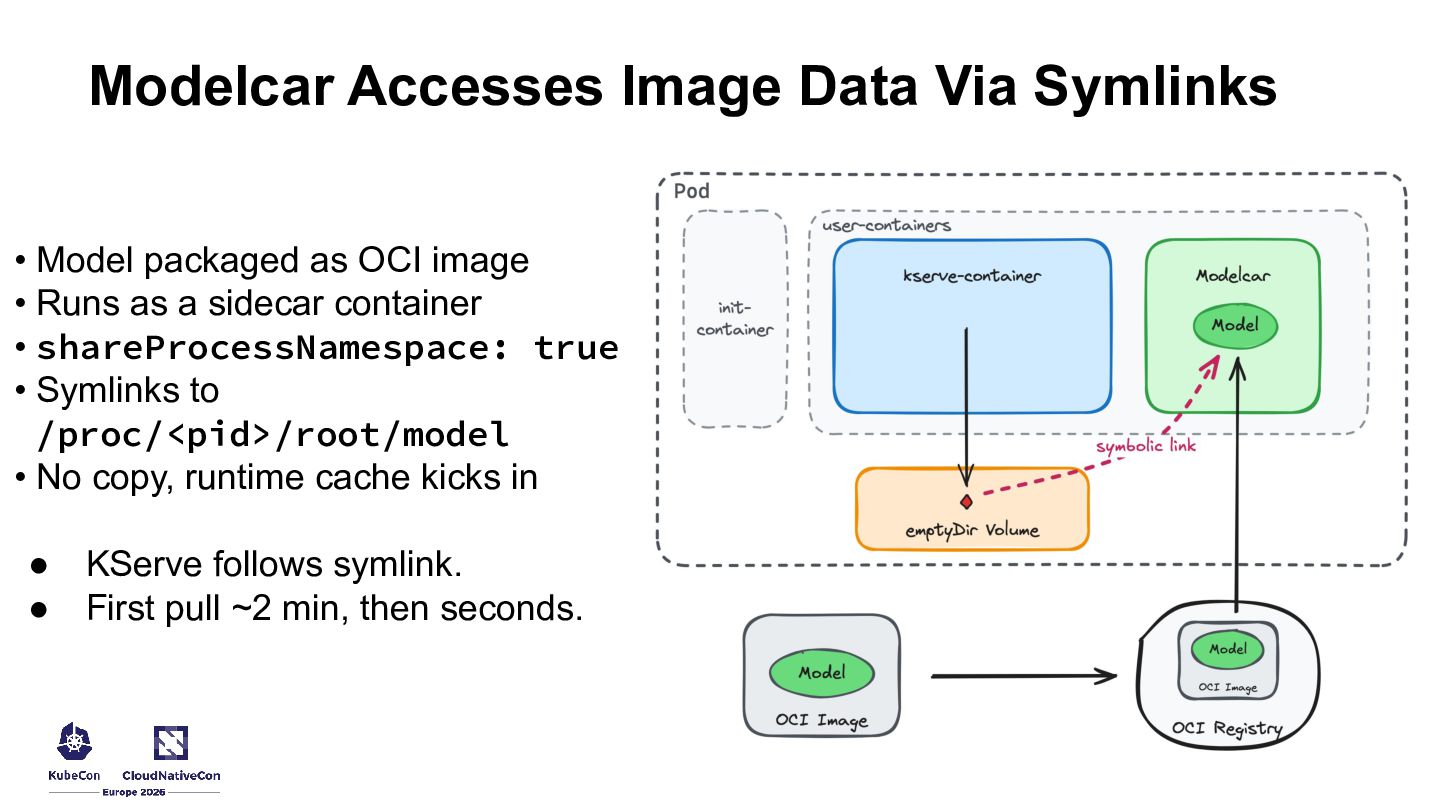
  10. Modelcar Accesses Image Data Via Symlinks • Model packaged as

    OCI image • Runs as a sidecar container • shareProcessNamespace: true • Symlinks to /proc/<pid>/root/model • No copy, runtime cache kicks in • KServe follows symlink. • First pull ~2 min, then seconds.
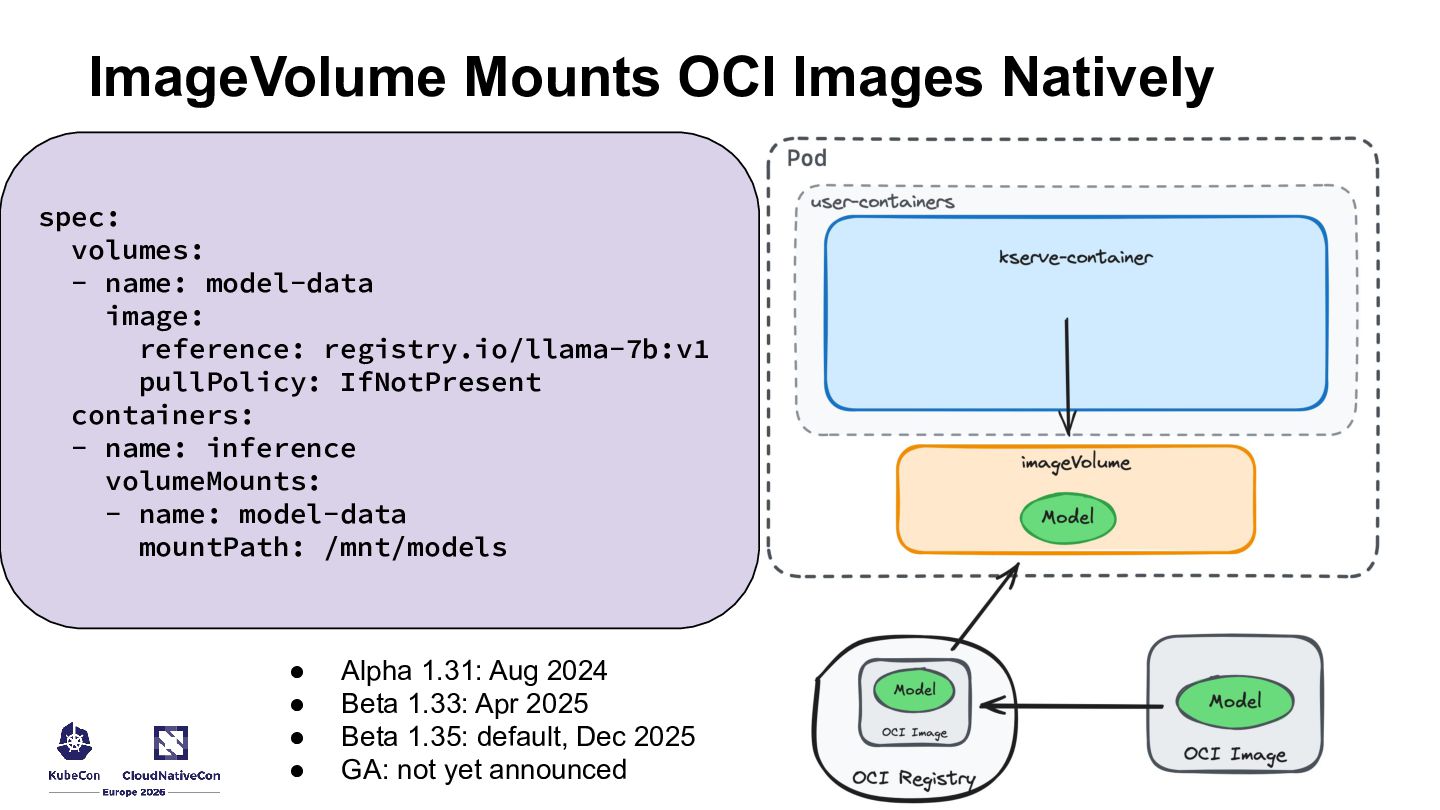
  11. ImageVolume Mounts OCI Images Natively • Alpha 1.31: Aug 2024

    • Beta 1.33: Apr 2025 • Beta 1.35: default, Dec 2025 • GA: not yet announced spec: volumes: - name: model-data image: reference: registry.io/llama-7b:v1 pullPolicy: IfNotPresent containers: - name: inference volumeMounts: - name: model-data mountPath: /mnt/models
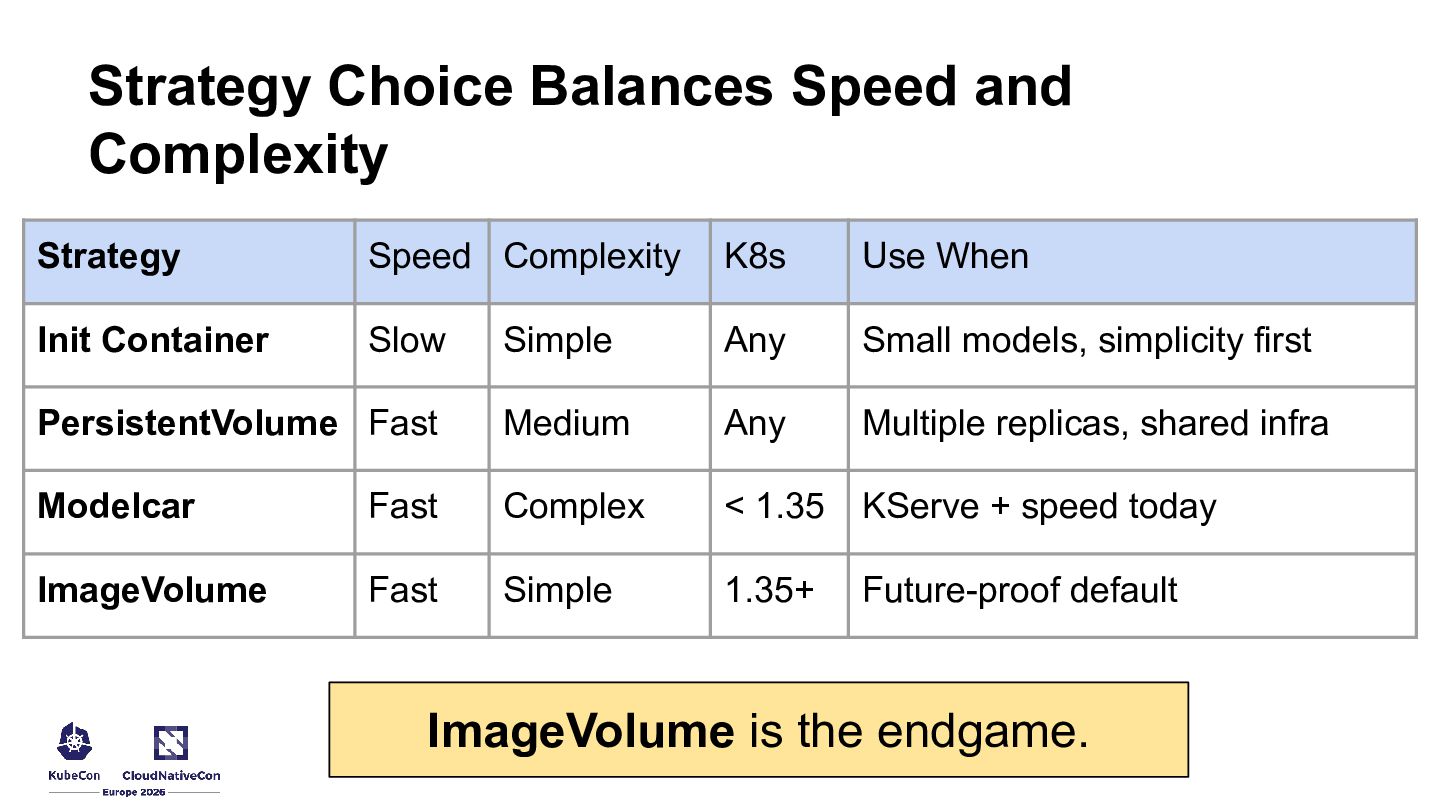
  12. Strategy Choice Balances Speed and Complexity Strategy Speed Complexity K8s

    Use When Init Container Slow Simple Any Small models, simplicity first PersistentVolume Fast Medium Any Multiple replicas, shared infra Modelcar Fast Complex < 1.35 KServe + speed today ImageVolume Fast Simple 1.35+ Future-proof default ImageVolume is the endgame.
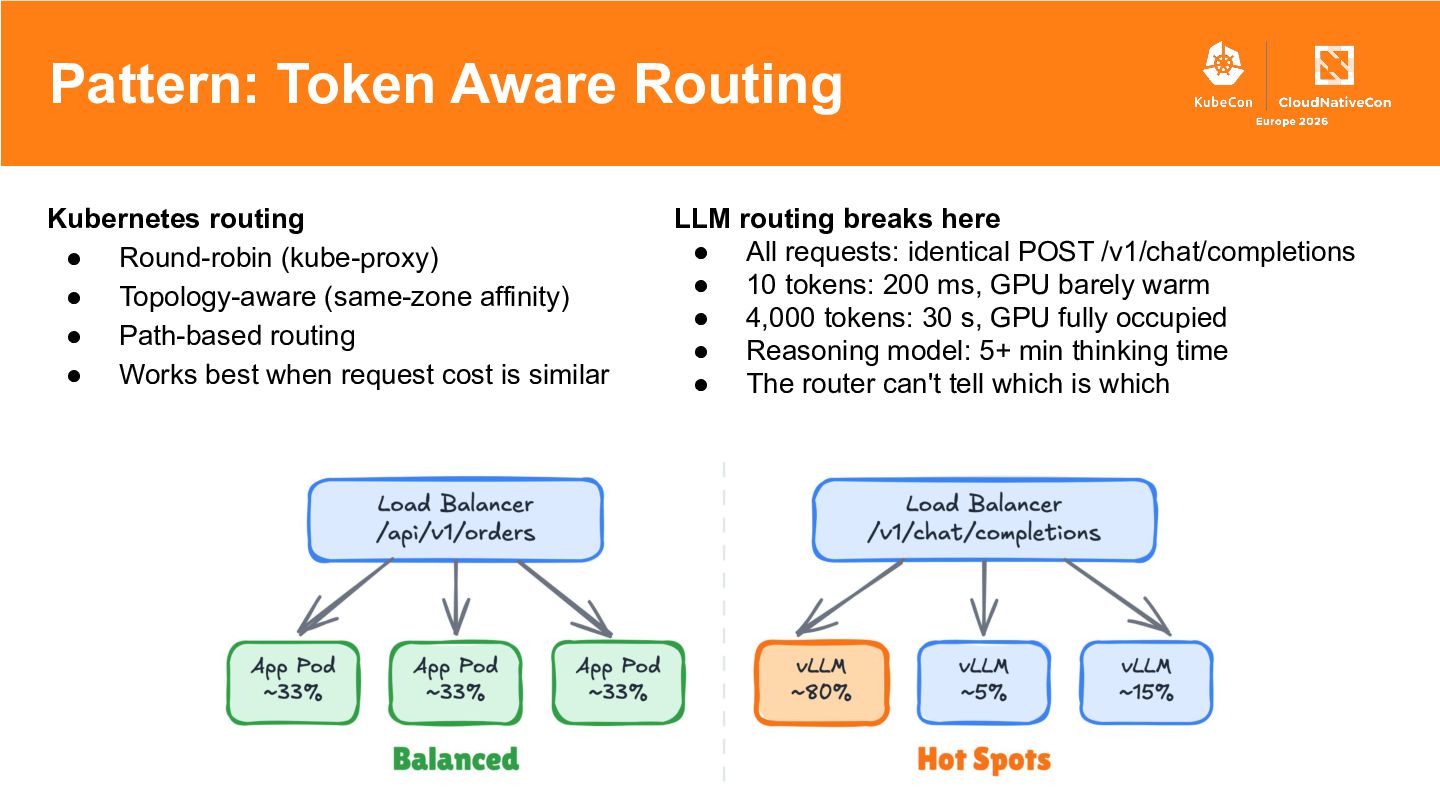
  13. Pattern: Token Aware Routing LLM routing breaks here • All

    requests: identical POST /v1/chat/completions • 10 tokens: 200 ms, GPU barely warm • 4,000 tokens: 30 s, GPU fully occupied • Reasoning model: 5+ min thinking time • The router can't tell which is which Kubernetes routing • Round-robin (kube-proxy) • Topology-aware (same-zone affinity) • Path-based routing • Works best when request cost is similar
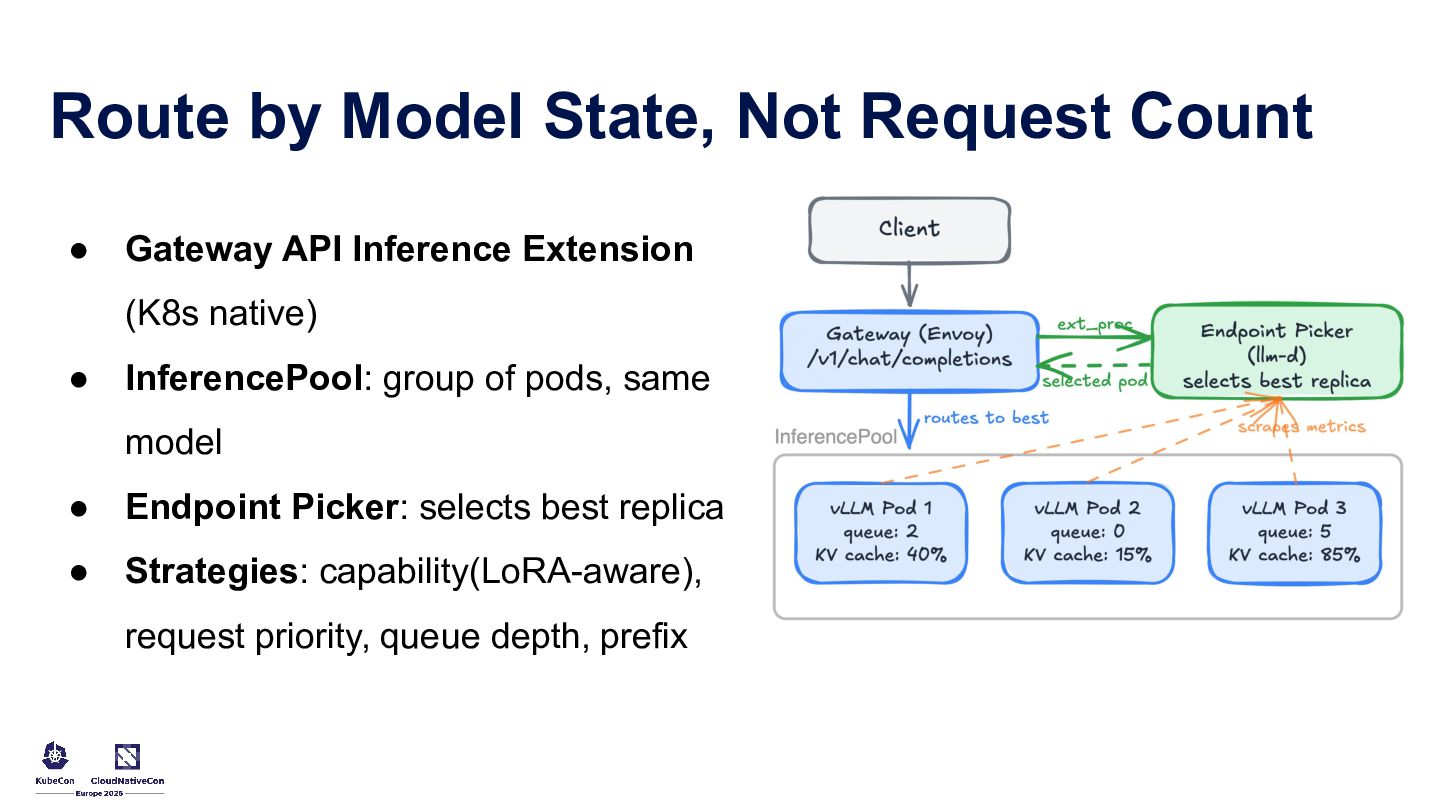
  14. Route by Model State, Not Request Count • Gateway API

    Inference Extension (K8s native) • InferencePool: group of pods, same model • Endpoint Picker: selects best replica • Strategies: capability(LoRA-aware), request priority, queue depth, prefix
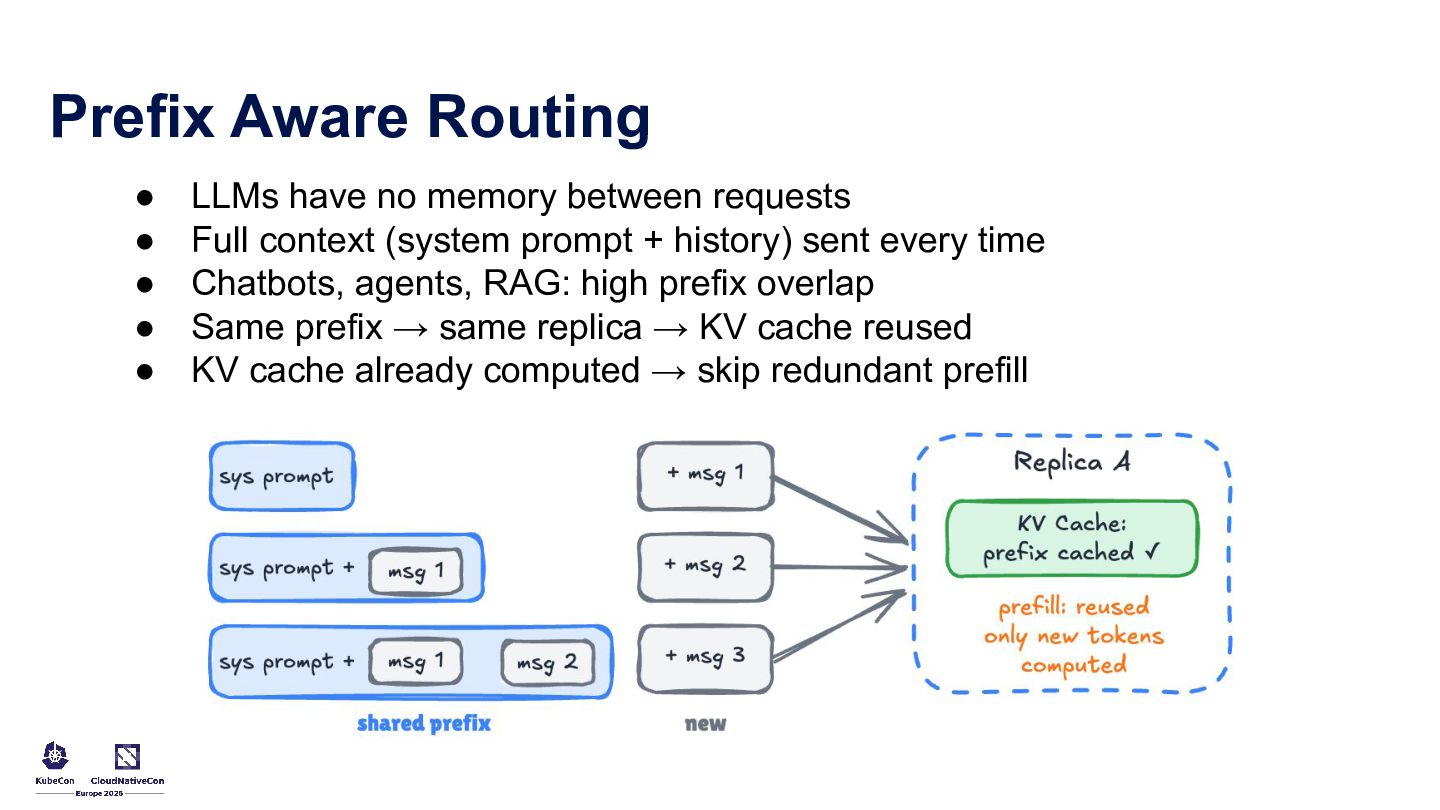
  15. Prefix Aware Routing • LLMs have no memory between requests

    • Full context (system prompt + history) sent every time • Chatbots, agents, RAG: high prefix overlap • Same prefix → same replica → KV cache reused • KV cache already computed → skip redundant prefill
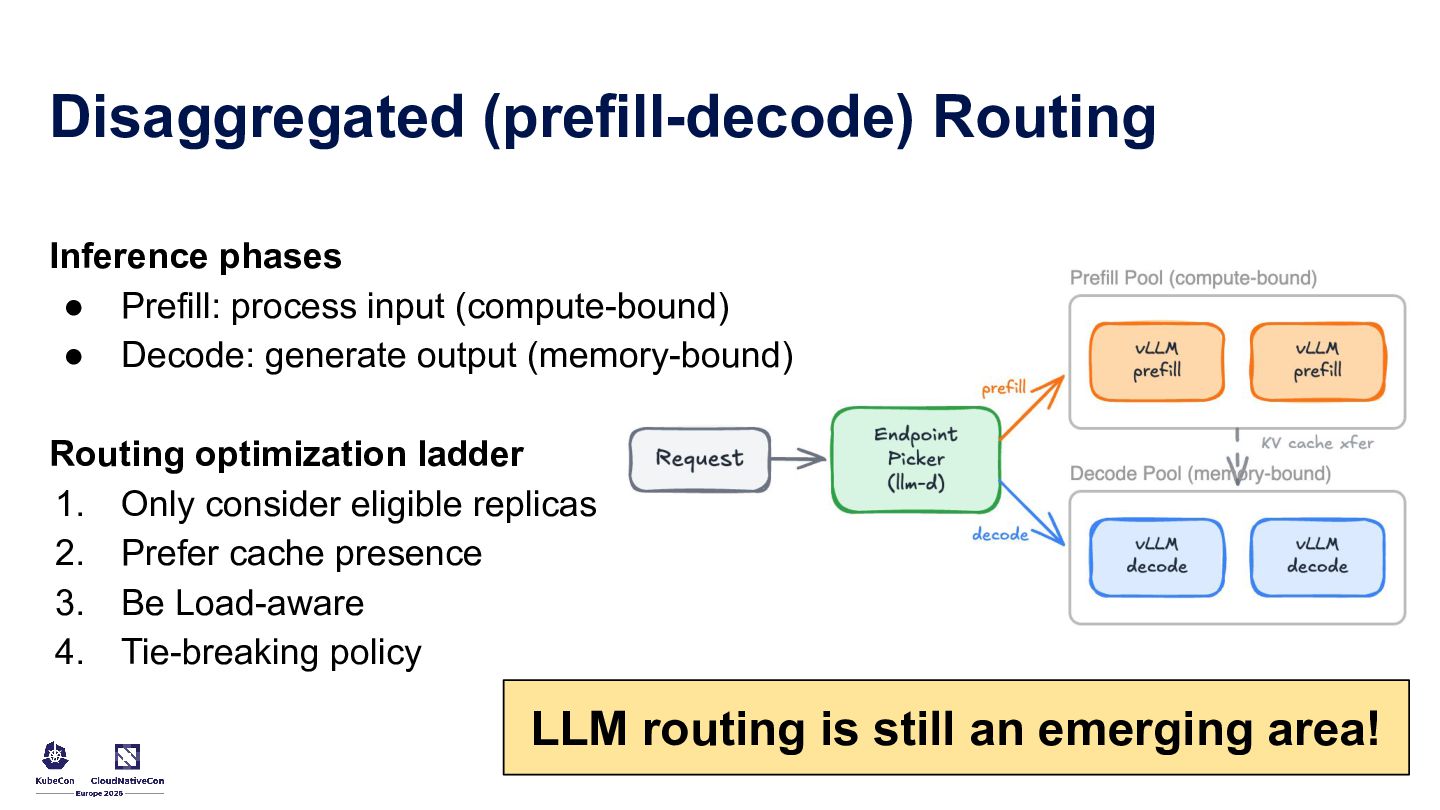
  16. Disaggregated (prefill-decode) Routing Inference phases • Prefill: process input (compute-bound)

    • Decode: generate output (memory-bound) Routing optimization ladder 1. Only consider eligible replicas 2. Prefer cache presence 3. Be Load-aware 4. Tie-breaking policy LLM routing is still an emerging area!
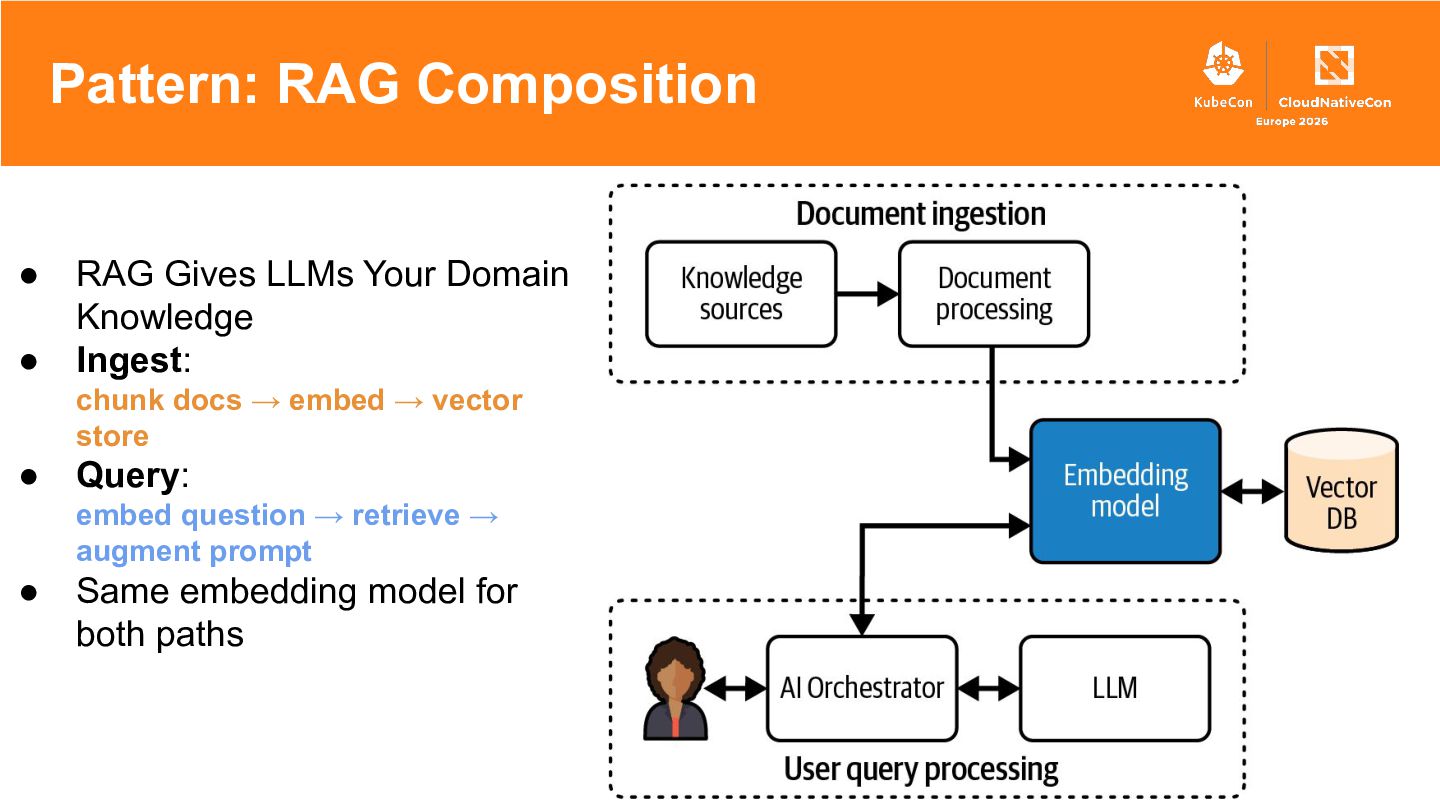
  17. Pattern: RAG Composition • RAG Gives LLMs Your Domain Knowledge

    • Ingest: chunk docs → embed → vector store • Query: embed question → retrieve → augment prompt • Same embedding model for both paths
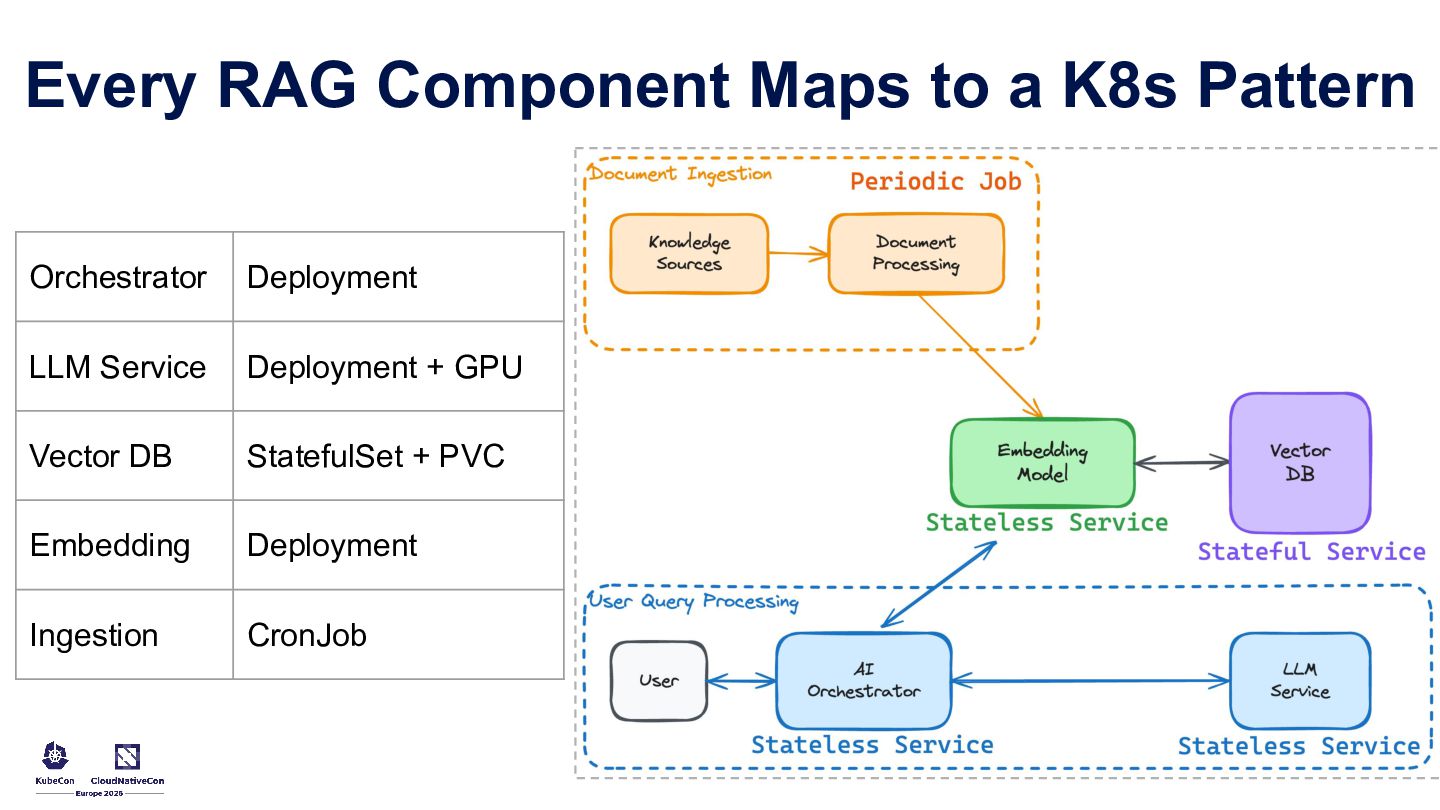
  18. Every RAG Component Maps to a K8s Pattern Orchestrator Deployment

    LLM Service Deployment + GPU Vector DB StatefulSet + PVC Embedding Deployment Ingestion CronJob
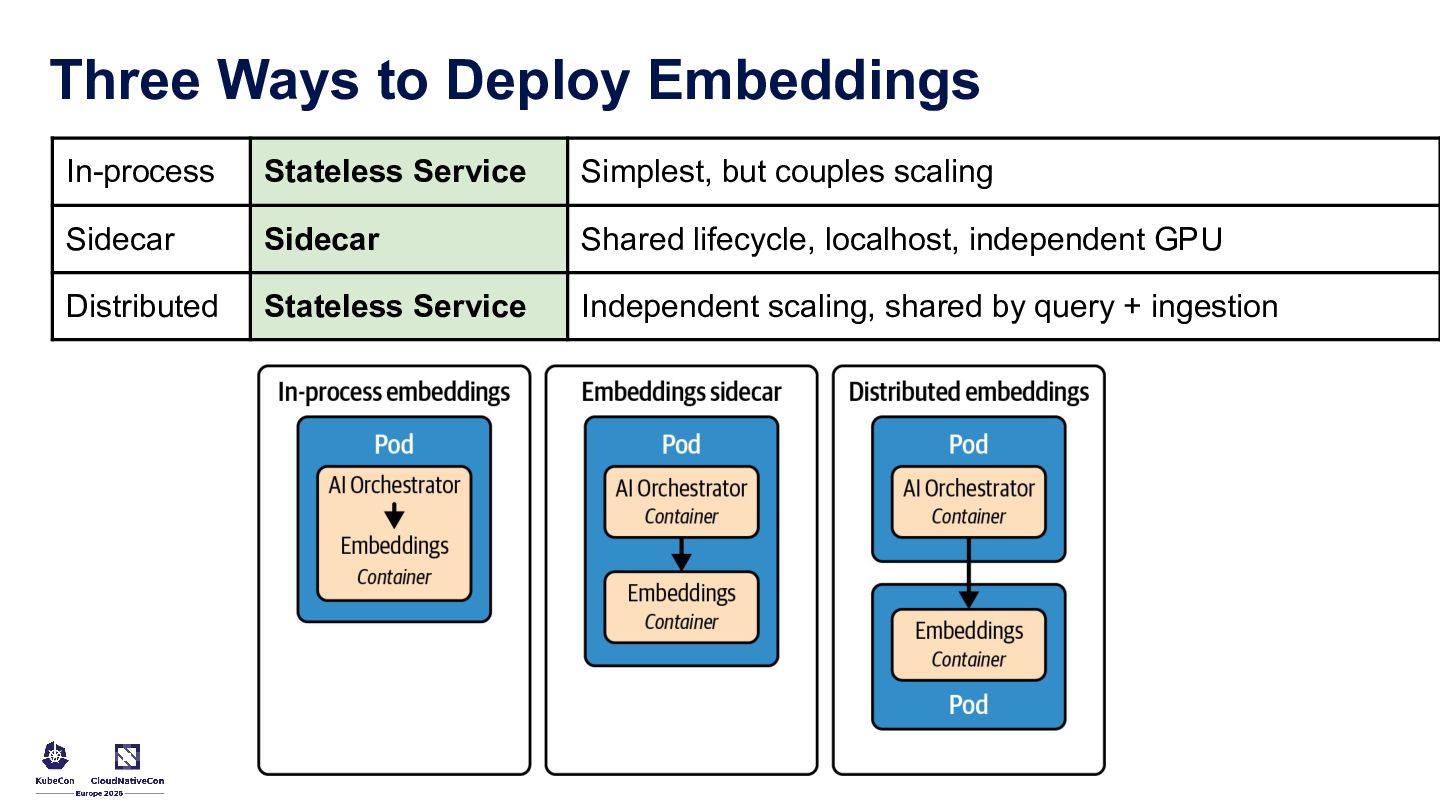
  19. Three Ways to Deploy Embeddings In-process Stateless Service Simplest, but

    couples scaling Sidecar Sidecar Shared lifecycle, localhost, independent GPU Distributed Stateless Service Independent scaling, shared by query + ingestion