Upgrade to Pro — share decks privately, control downloads, hide ads and more …

Efficient network design --- Miao, Founder of F...

Sponsored · Your Podcast. Everywhere. Effortlessly. Share. Educate. Inspire. Entertain. You do you. We'll handle the rest. →
Avatar for Jimmy Jimmy
August 24, 2017

Efficient network design --- Miao, Founder of FreeLinguist.com

The future success of communication networks hinges on the ability to overcome the mismatch between requested quality of service (QoS) and limited network resources. Spectrum is a natural resource that cannot be replenished and therefore must be used efficiently. On the other hand, energy efficiency is increasingly important for the society, especially for mobile data networks because of the growing demand in mobile communications, shortage in energy supply, and need of environmental protection. To meet the energy efficiency demand, traditional design philosophies of existing network architectures and protocols should be revisited. More importantly, many of them need to be broken to come up with new ones. This tutorial introduces state-of-the-art cross-layer technologies to improve both spectral and energy efficiencies from different perspectives of mobile data networks. We will first discuss basic wireless channel properties and methodologies needed to enable high-performance wireless networks. Then we introduce recent spectrum- and energy-efficient communication technologies for both individual- and multi-user networks. To be more specific, our treatment will cover not only centralized wireless networks like cellular access networks, but also distributed ones like ad hoc and sensor networks. We will discuss in detail the relation between SE and EE in different types of wireless networks and introduce new guidelines that will significantly improve SE and EE for future network design.

FreeLinguist® is a cloud platform for you to connect with native linguists for quality language services, such as translation, editing, or writing services. Dr. Miao has applied numerous efficient communications and AI techniques in the cloud platform to ensure the delivery of quality services to the customers at the lowest cost possible. Some of the techniques are inspired by the presented materials in this slide set.

Avatar for Jimmy

Jimmy

August 24, 2017

Other Decks in Technology

Transcript

  1. [email protected] Presenter Introduction  Founder of FreeLinguist®, a cloud platform

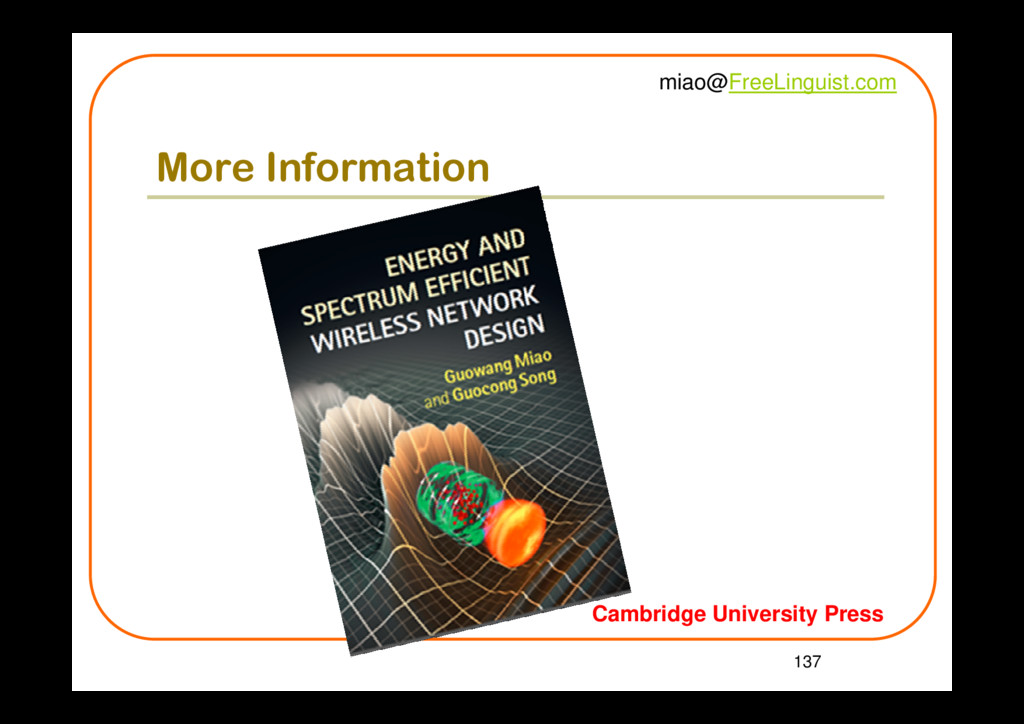
    for you to connect with native linguists for quality language services, such as translation, editing, or writing services.  World-class expert in the design of communications and networking  Well known world-wide for his original contributions in building a set of fundamental energy-efficient communications theories, which are widely accepted nowadays.  Inventor of energy-efficient scheduling and capacity- approaching transmission (United States Patent 7782829).  Author of the graduate textbook entitled Fundamentals of Mobile Data Networks (Cambridge University Press)  Author of the book entitled Energy and Spectrum Efficient Wireless Network Design (Cambridge University Press).  Fruitful inventor with many granted patents, some of which have been adopted as essential in 4G standards. 2
  2. [email protected] Outline  Introduction  Wireless Channel Properties  Basic

    Concepts  Spectrum Efficient Design  Energy Efficient Design  Energy-Efficient Mobile Access Networks: A Tradeoff Perspective  Conclusions and References 3
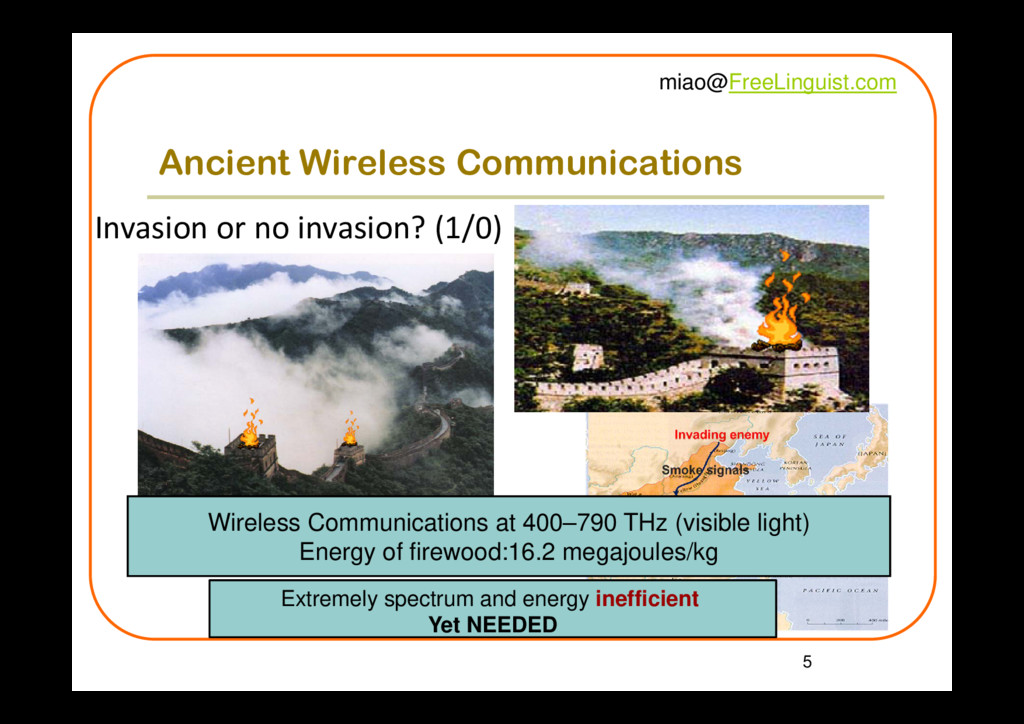
  3. [email protected] Ancient Wireless Communications Invasion or no invasion? (1/0) Wireless

    Communications at 400–790 THz (visible light) Energy of firewood:16.2 megajoules/kg Extremely spectrum and energy inefficient Yet NEEDED 5
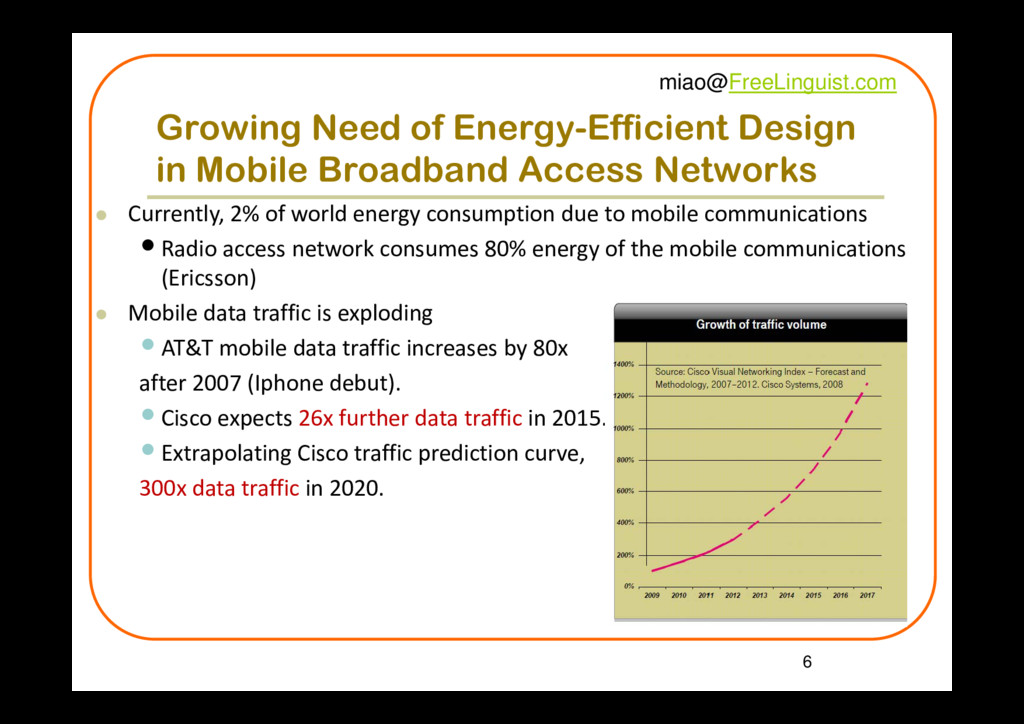
  4. [email protected] Growing Need of Energy-Efficient Design in Mobile Broadband Access

    Networks  Currently, 2% of world energy consumption due to mobile communications •Radio access network consumes 80% energy of the mobile communications (Ericsson)  Mobile data traffic is exploding •AT&T mobile data traffic increases by 80x after 2007 (Iphone debut). •Cisco expects 26x further data traffic in 2015. •Extrapolating Cisco traffic prediction curve, 300x data traffic in 2020. 6
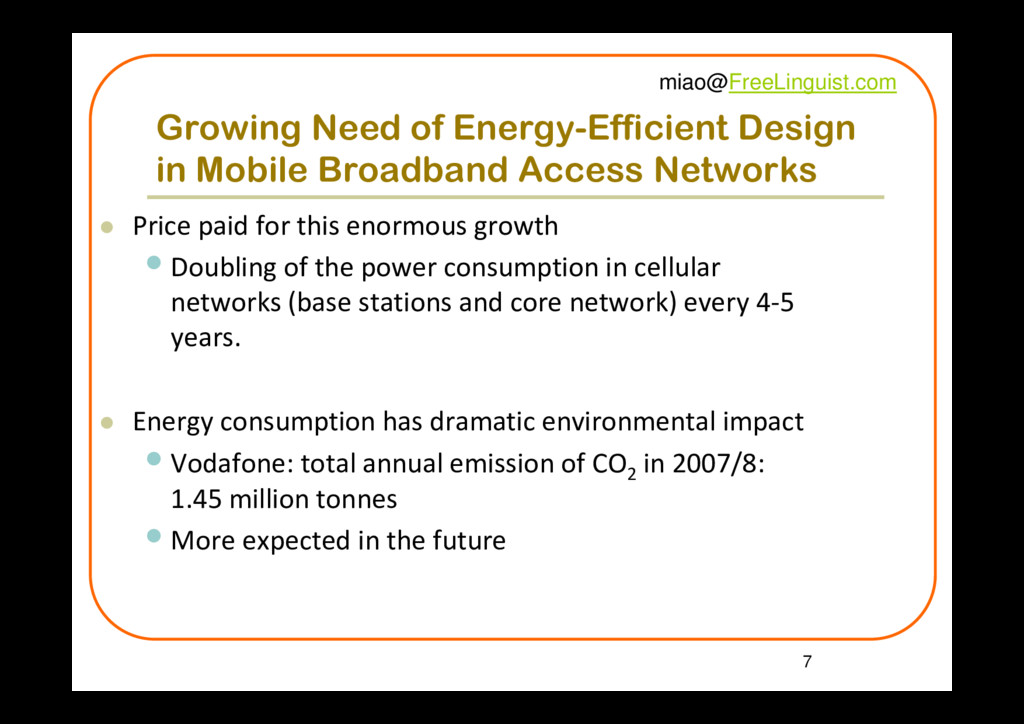
  5. [email protected] Growing Need of Energy-Efficient Design in Mobile Broadband Access

    Networks  Price paid for this enormous growth •Doubling of the power consumption in cellular networks (base stations and core network) every 4‐5 years.  Energy consumption has dramatic environmental impact •Vodafone: total annual emission of CO2 in 2007/8: 1.45 million tonnes •More expected in the future 7
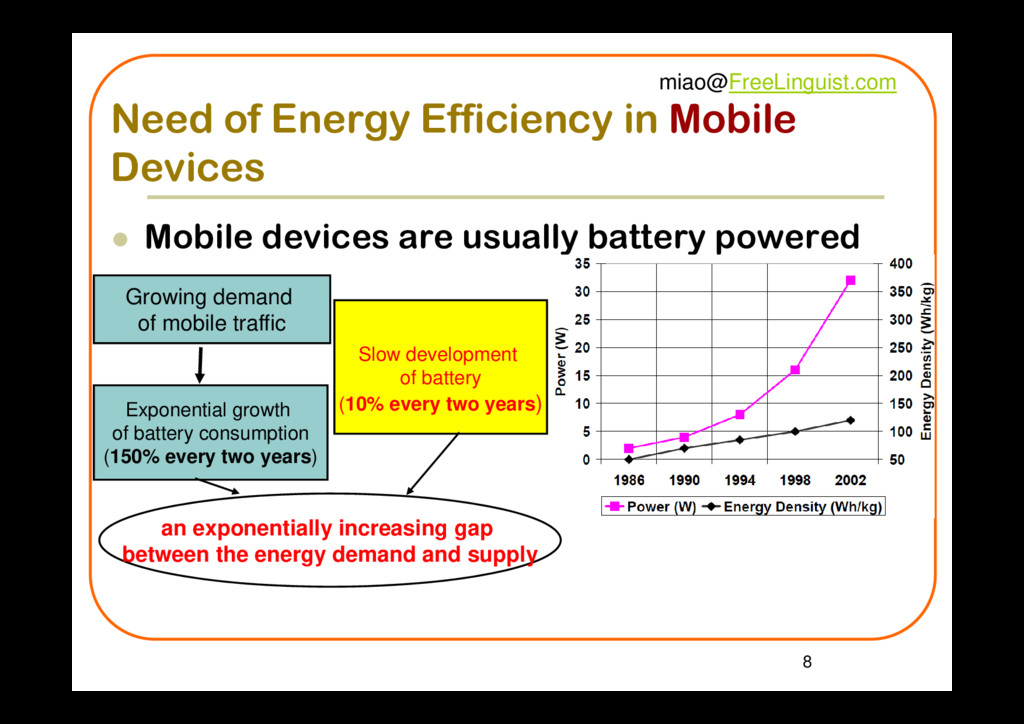
  6. [email protected] Need of Energy Efficiency in Mobile Devices  Mobile

    devices are usually battery powered Growing demand of mobile traffic Exponential growth of battery consumption (150% every two years) Slow development of battery (10% every two years) an exponentially increasing gap between the energy demand and supply 8
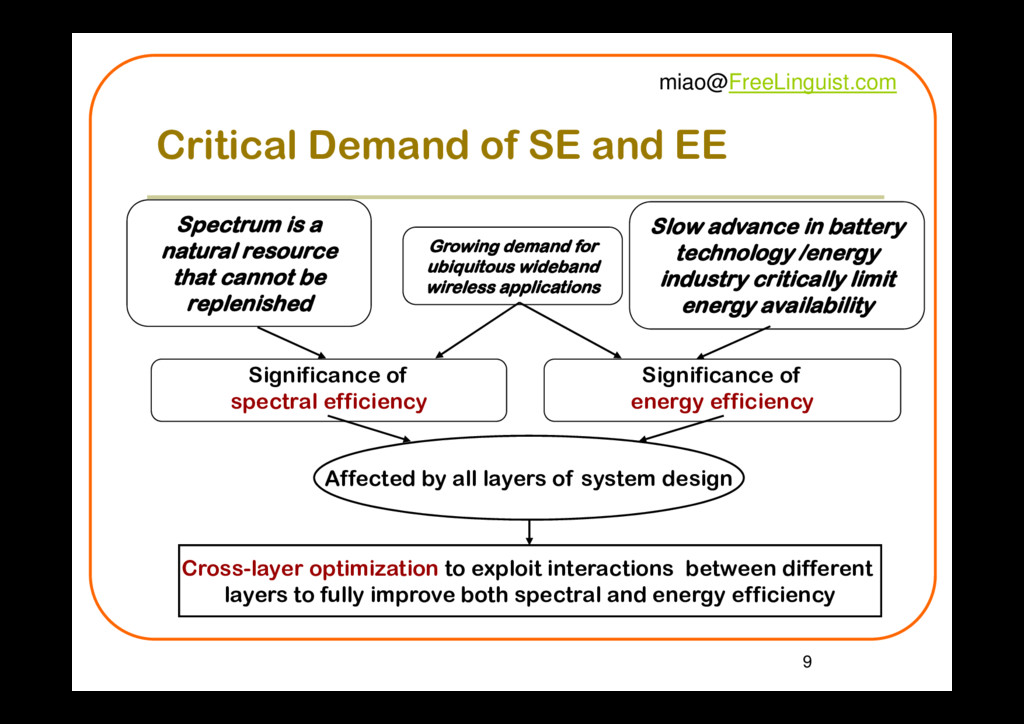
  7. [email protected] Slow advance in battery technology /energy industry critically limit

    energy availability Significance of energy efficiency Growing demand for ubiquitous wideband wireless applications Spectrum is a natural resource that cannot be replenished Significance of spectral efficiency Affected by all layers of system design Cross-layer optimization to exploit interactions between different layers to fully improve both spectral and energy efficiency Critical Demand of SE and EE 9
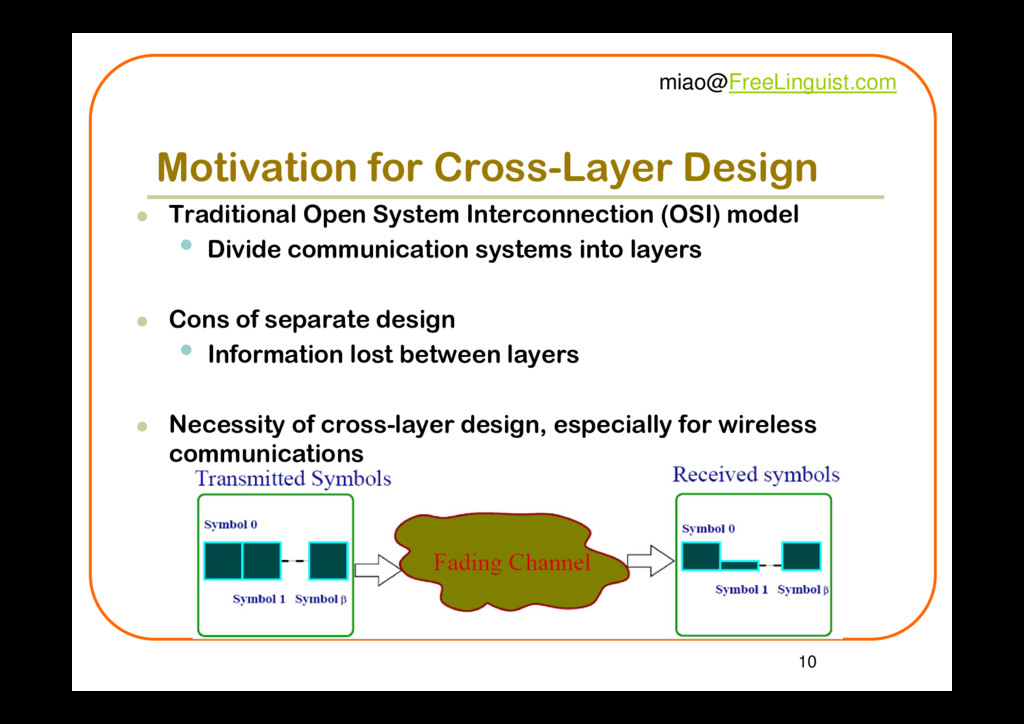
  8. [email protected] Motivation for Cross-Layer Design  Traditional Open System Interconnection

    (OSI) model • Divide communication systems into layers  Cons of separate design • Information lost between layers  Necessity of cross-layer design, especially for wireless communications 10
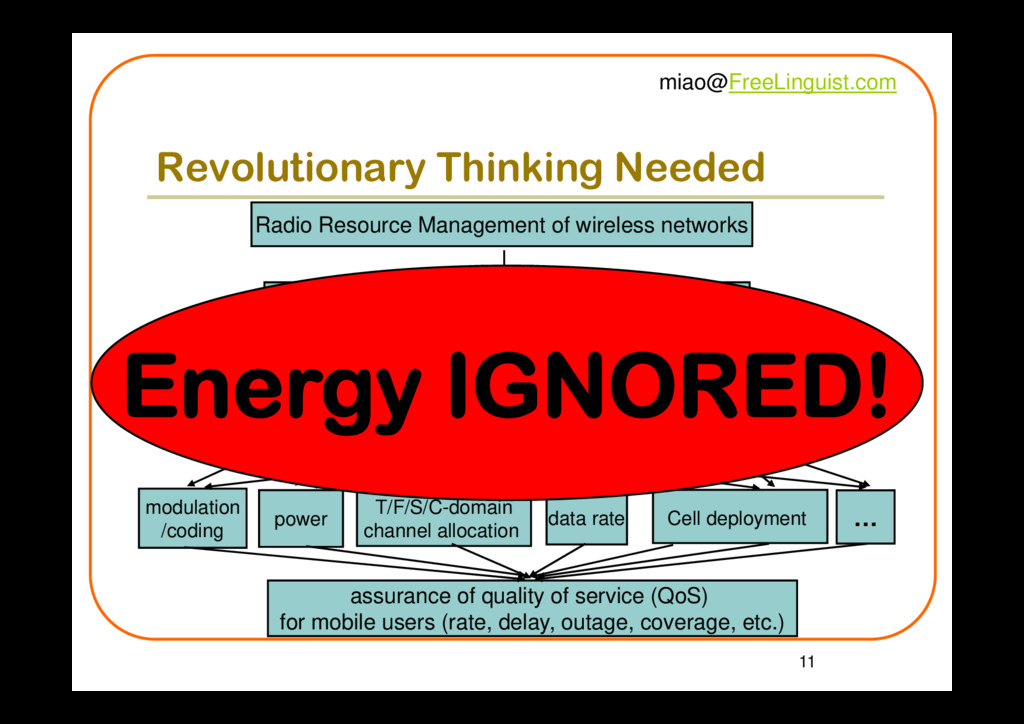
  9. [email protected] Revolutionary Thinking Needed Radio Resource Management of wireless networks

    allocate radio resources modulation /coding power Cell deployment T/F/S/C-domain channel allocation statically dynamically data rate … assurance of quality of service (QoS) for mobile users (rate, delay, outage, coverage, etc.) Energy IGNORED! 11
  10. [email protected] Revolutionary Thinking Needed 12 Radio Resource Management of wireless

    networks allocate radio resources modulation /coding power Cell deployment T/F/S/C-domain channel allocation statically dynamically data rate … assurance of quality of service (QoS) for mobile users (rate, delay, outage, coverage, etc.)
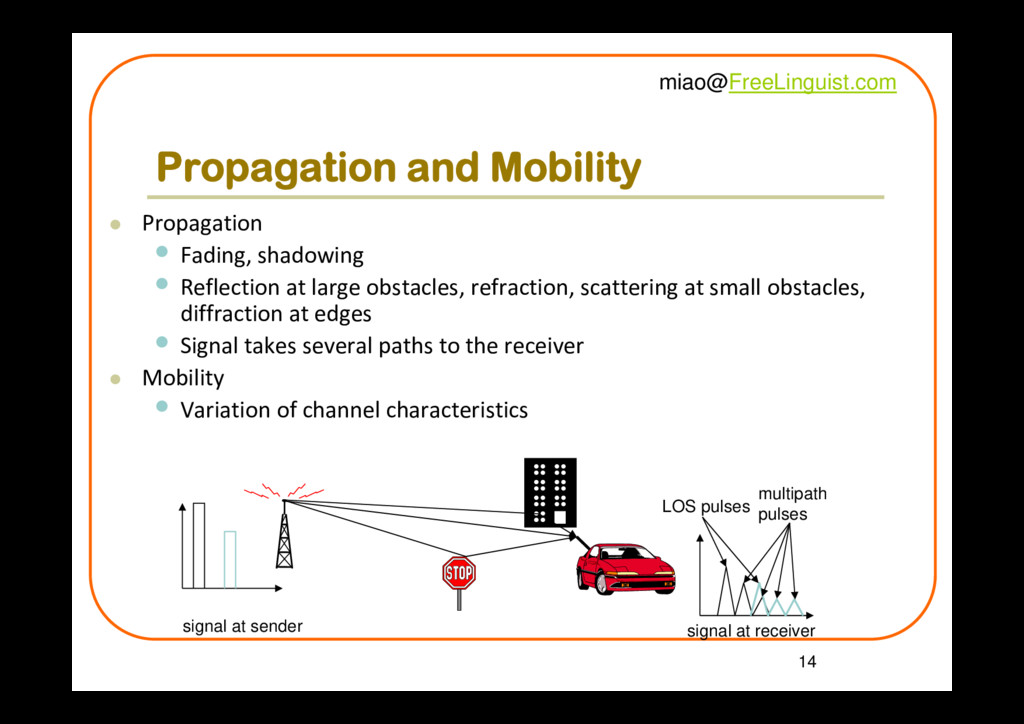
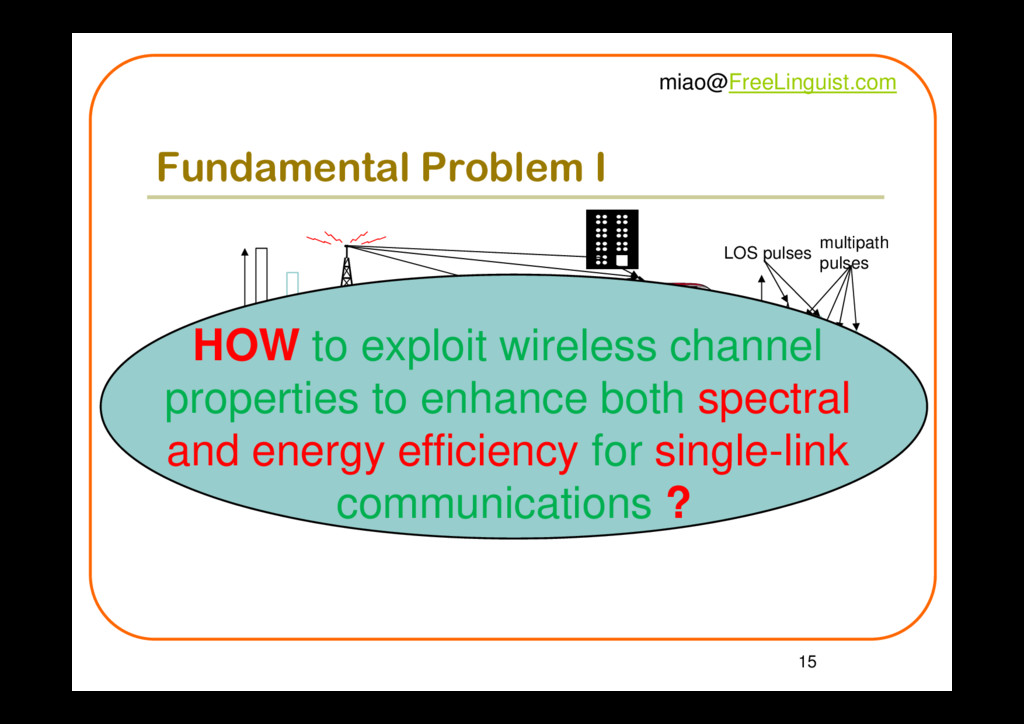
  11. [email protected] Propagation and Mobility  Propagation • Fading, shadowing •

    Reflection at large obstacles, refraction, scattering at small obstacles, diffraction at edges • Signal takes several paths to the receiver  Mobility • Variation of channel characteristics signal at sender signal at receiver LOS pulses multipath pulses 14
  12. [email protected] signals at sender signal at receiver LOS pulses multipath


    pulses Fundamental Problem I HOW to exploit wireless channel properties to enhance both spectral and energy efficiency for single-link communications ? 15
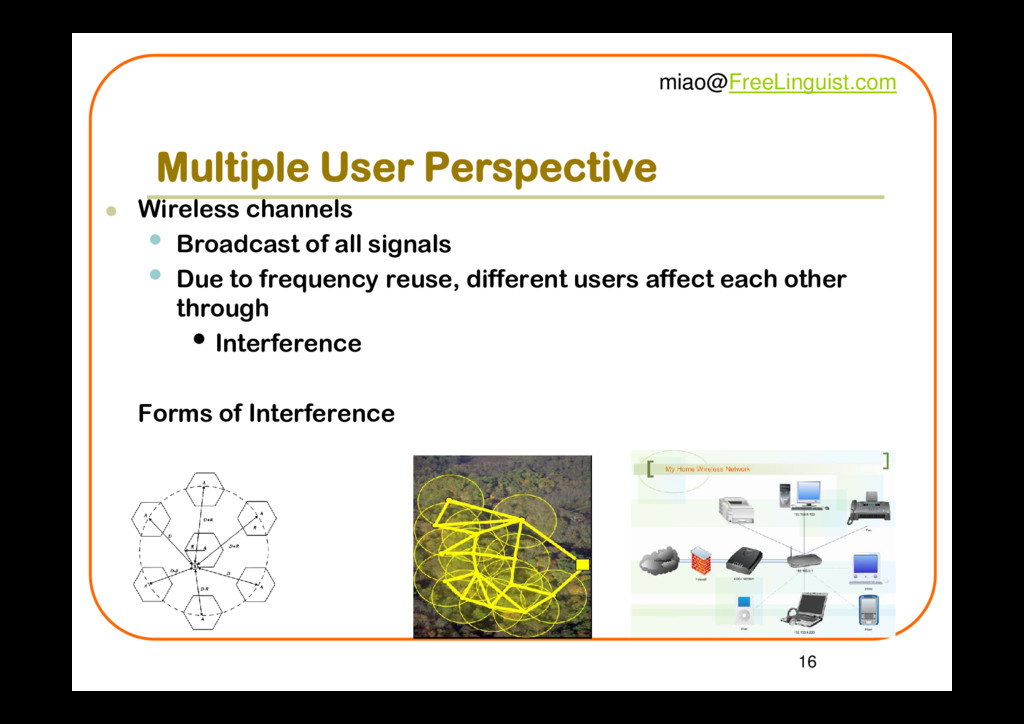
  13. [email protected] Multiple User Perspective  Wireless channels • Broadcast of

    all signals • Due to frequency reuse, different users affect each other through • Interference Forms of Interference 16
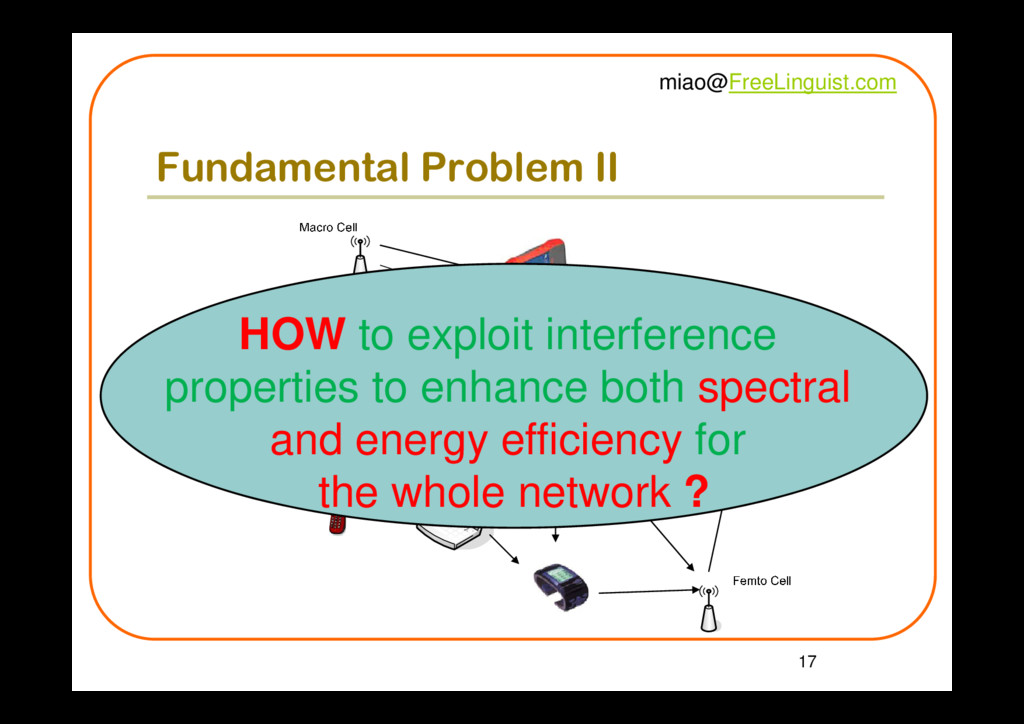
  14. [email protected] Fundamental Problem II HOW to exploit interference properties to

    enhance both spectral and energy efficiency for the whole network ? 17
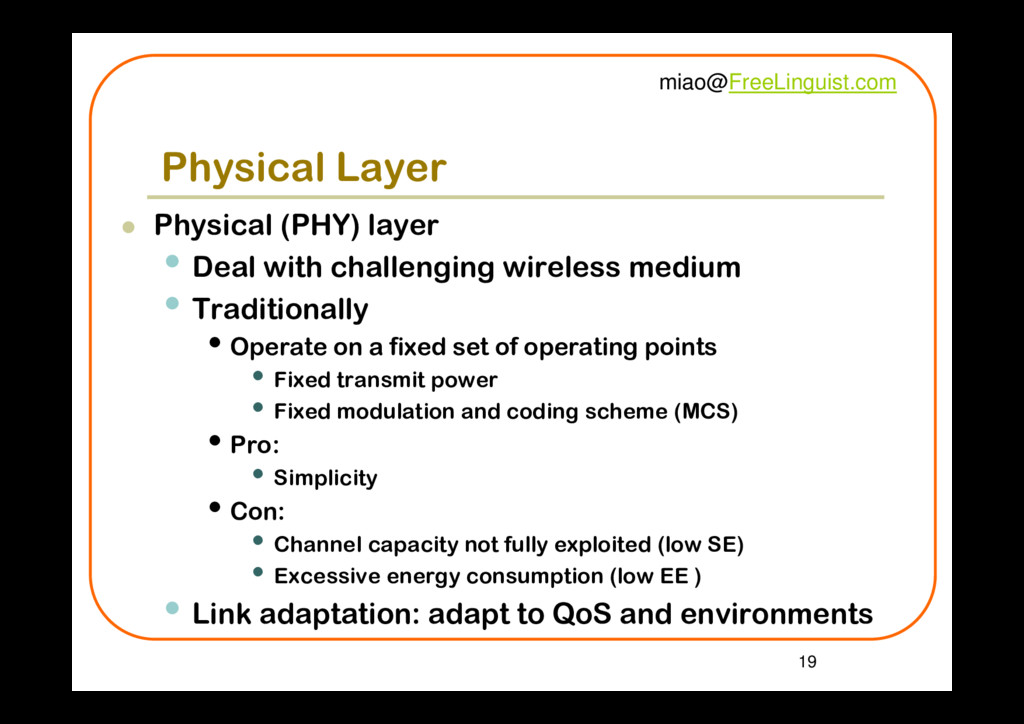
  15. [email protected] Physical Layer  Physical (PHY) layer • Deal with

    challenging wireless medium • Traditionally • Operate on a fixed set of operating points • Fixed transmit power • Fixed modulation and coding scheme (MCS) • Pro: • Simplicity • Con: • Channel capacity not fully exploited (low SE) • Excessive energy consumption (low EE ) • Link adaptation: adapt to QoS and environments 19
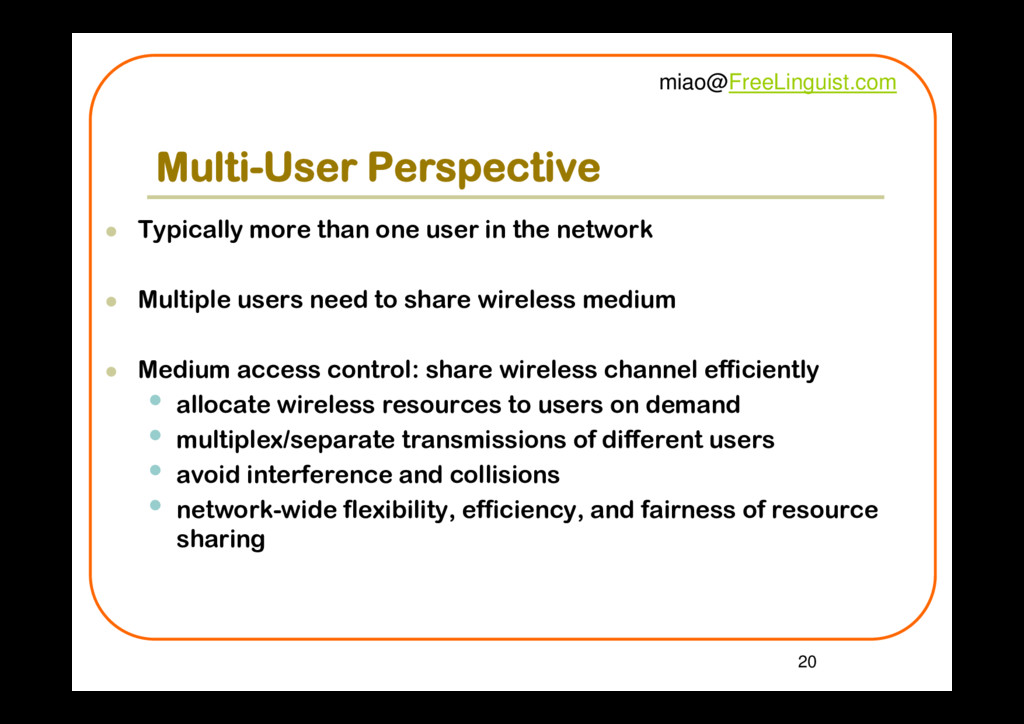
  16. [email protected] Multi-User Perspective  Typically more than one user in

    the network  Multiple users need to share wireless medium  Medium access control: share wireless channel efficiently • allocate wireless resources to users on demand • multiplex/separate transmissions of different users • avoid interference and collisions • network-wide flexibility, efficiency, and fairness of resource sharing 20
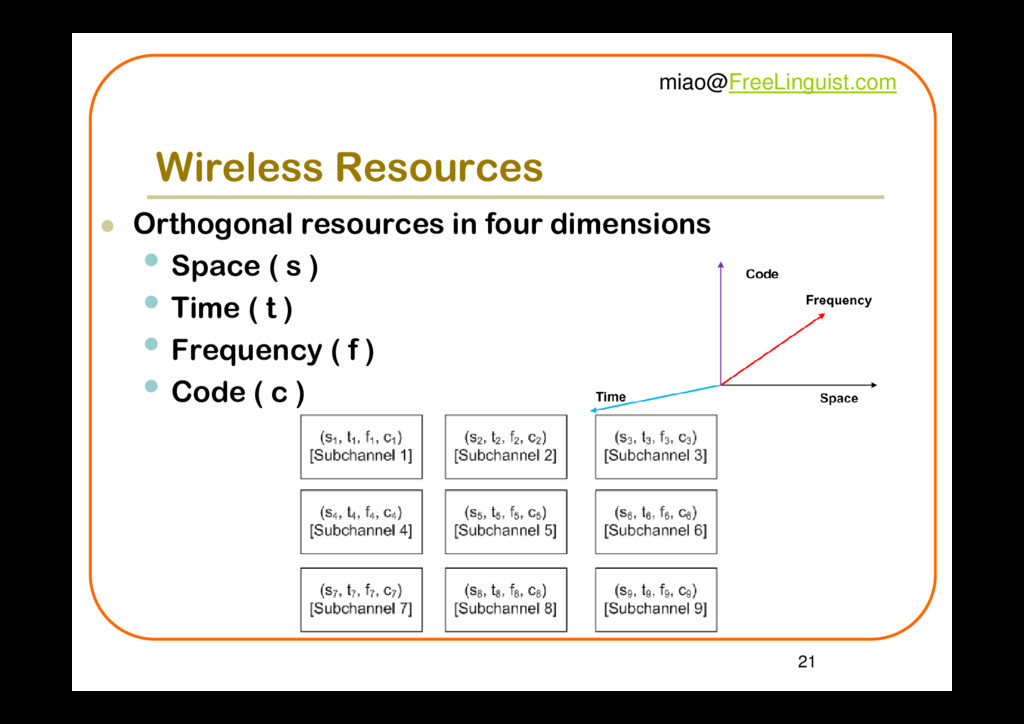
  17. [email protected] Wireless Resources  Orthogonal resources in four dimensions •

    Space ( s ) • Time ( t ) • Frequency ( f ) • Code ( c ) 21
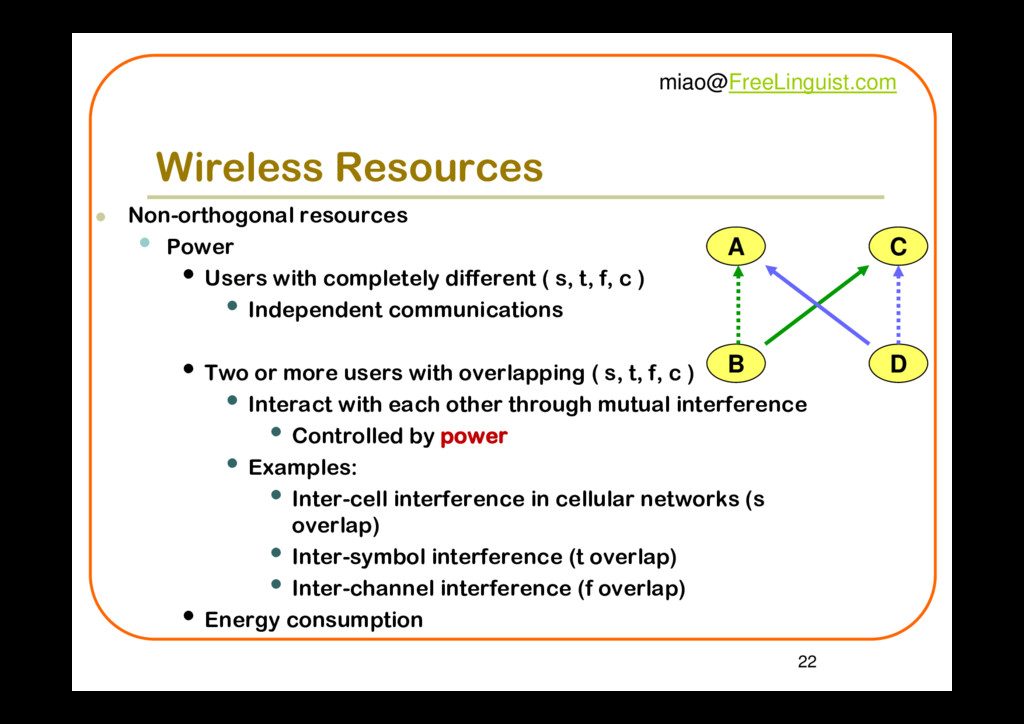
  18. [email protected] Wireless Resources  Non-orthogonal resources • Power • Users

    with completely different ( s, t, f, c ) • Independent communications • Two or more users with overlapping ( s, t, f, c ) • Interact with each other through mutual interference • Controlled by power • Examples: • Inter-cell interference in cellular networks (s overlap) • Inter-symbol interference (t overlap) • Inter-channel interference (f overlap) • Energy consumption B C A D 22
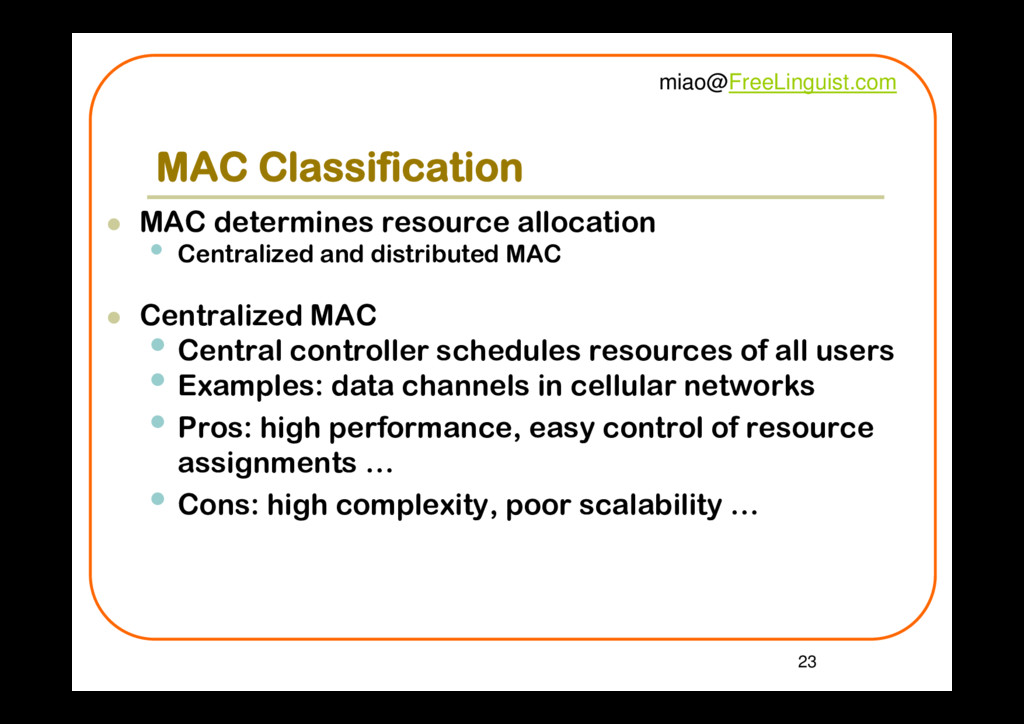
  19. [email protected] MAC Classification  MAC determines resource allocation • Centralized

    and distributed MAC  Centralized MAC • Central controller schedules resources of all users • Examples: data channels in cellular networks • Pros: high performance, easy control of resource assignments … • Cons: high complexity, poor scalability … 23
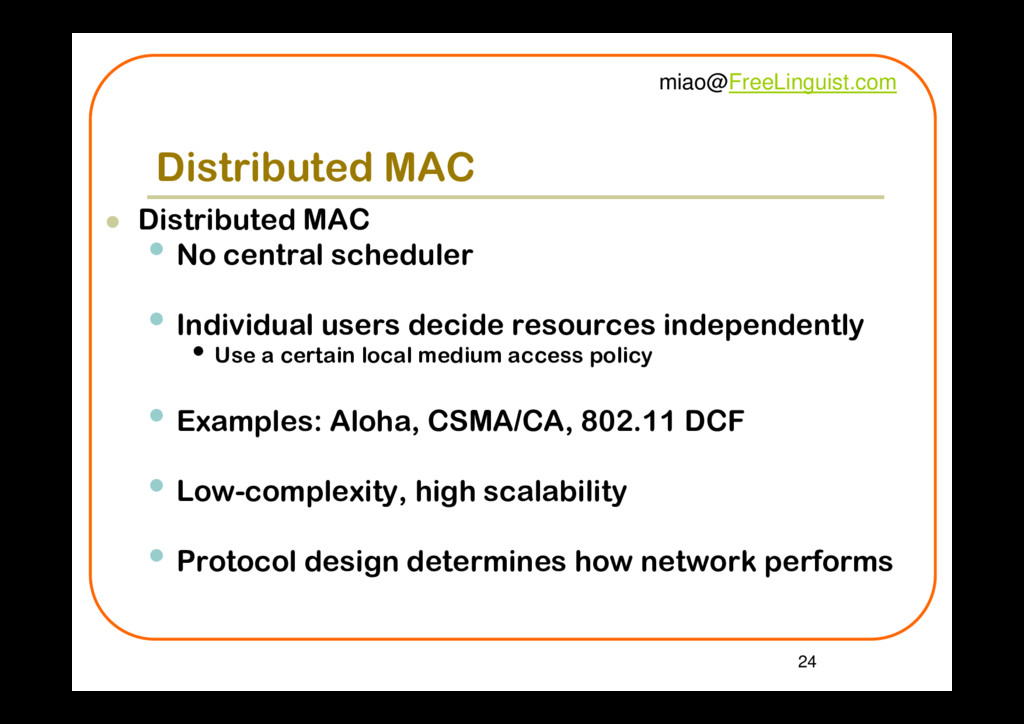
  20. [email protected] Distributed MAC  Distributed MAC • No central scheduler

    • Individual users decide resources independently • Use a certain local medium access policy • Examples: Aloha, CSMA/CA, 802.11 DCF • Low-complexity, high scalability • Protocol design determines how network performs 24
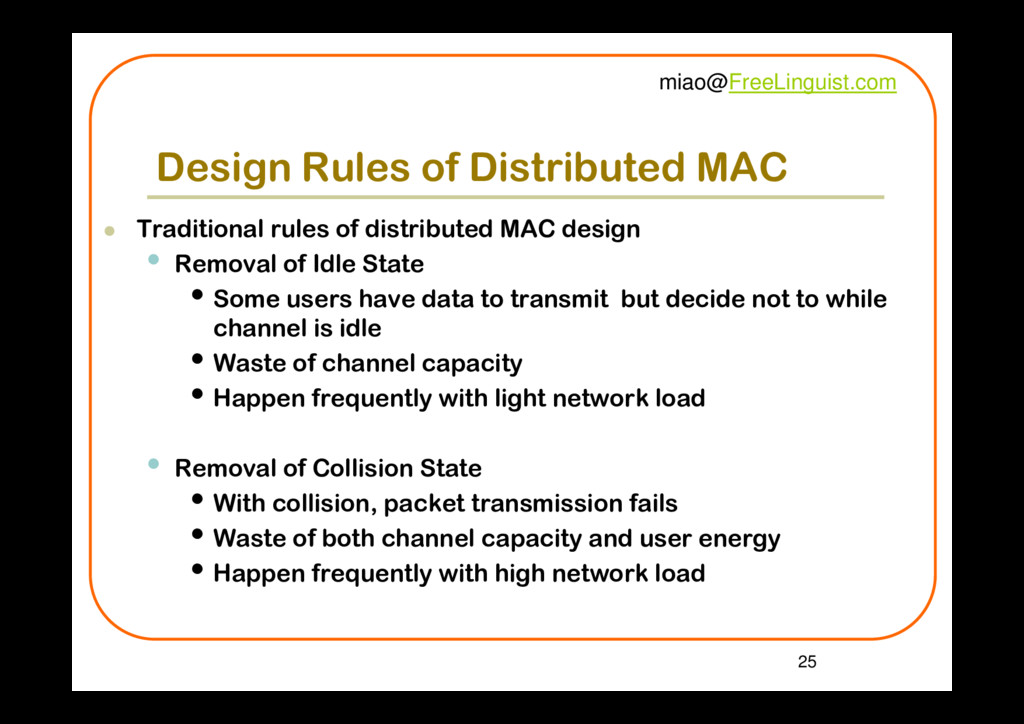
  21. [email protected] Design Rules of Distributed MAC  Traditional rules of

    distributed MAC design • Removal of Idle State • Some users have data to transmit but decide not to while channel is idle • Waste of channel capacity • Happen frequently with light network load • Removal of Collision State • With collision, packet transmission fails • Waste of both channel capacity and user energy • Happen frequently with high network load 25
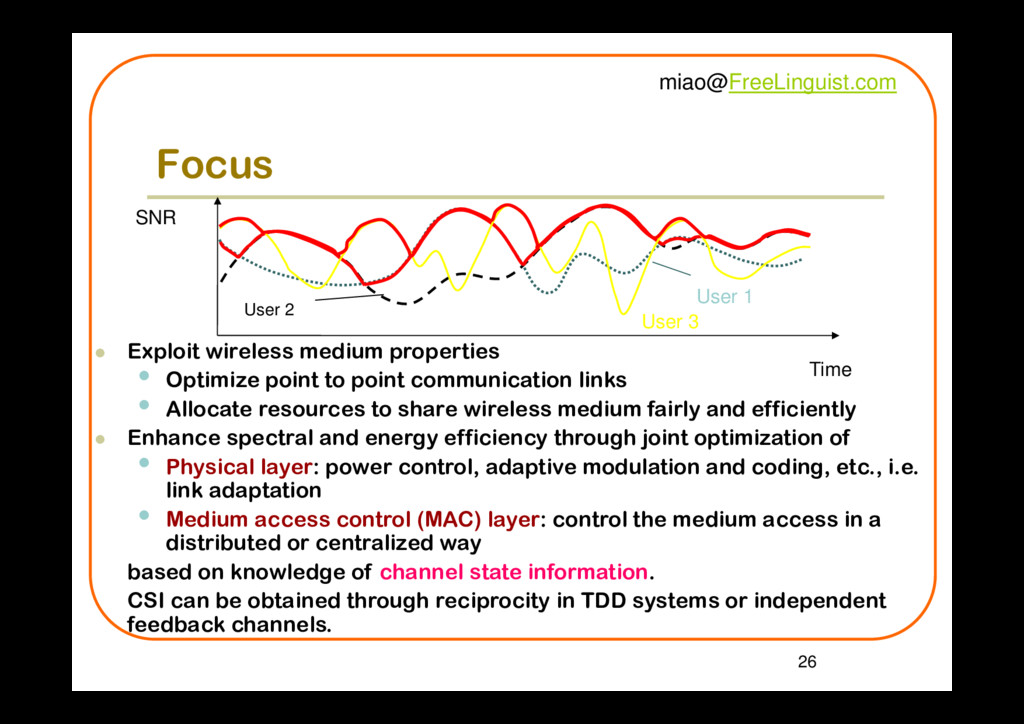
  22. [email protected]  Exploit wireless medium properties • Optimize point to

    point communication links • Allocate resources to share wireless medium fairly and efficiently  Enhance spectral and energy efficiency through joint optimization of • Physical layer: power control, adaptive modulation and coding, etc., i.e. link adaptation • Medium access control (MAC) layer: control the medium access in a distributed or centralized way based on knowledge of channel state information. CSI can be obtained through reciprocity in TDD systems or independent feedback channels. Focus Time User 1 SNR User 2 User 3 26
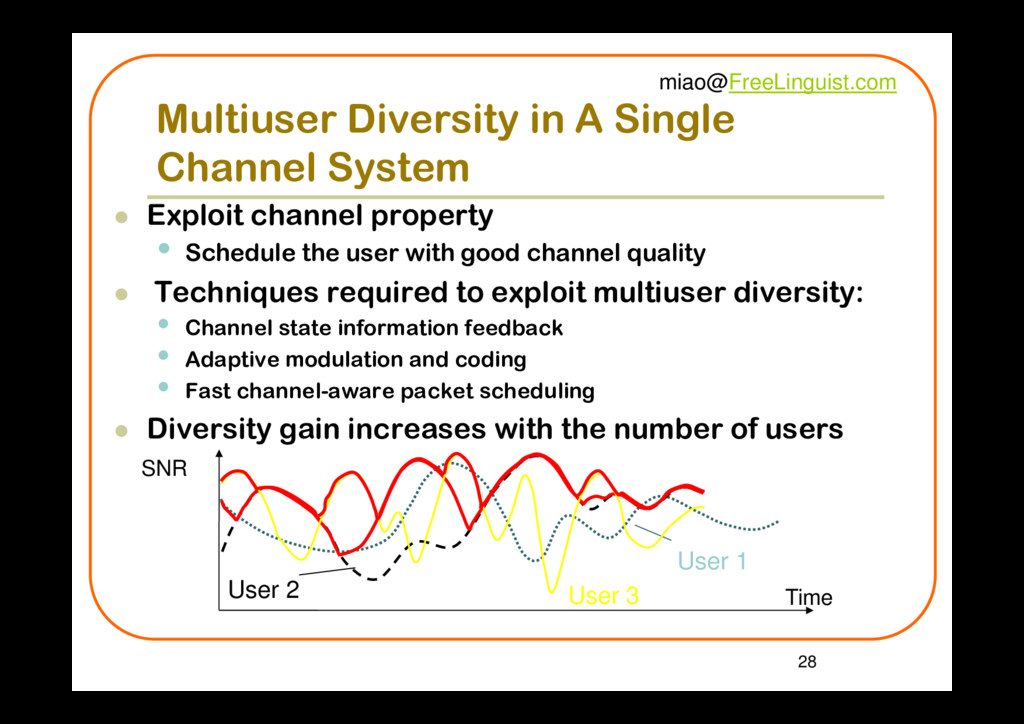
  23. [email protected] Multiuser Diversity in A Single Channel System  Exploit

    channel property • Schedule the user with good channel quality  Techniques required to exploit multiuser diversity: • Channel state information feedback • Adaptive modulation and coding • Fast channel-aware packet scheduling  Diversity gain increases with the number of users Time User 1 SNR User 2 User 3 28
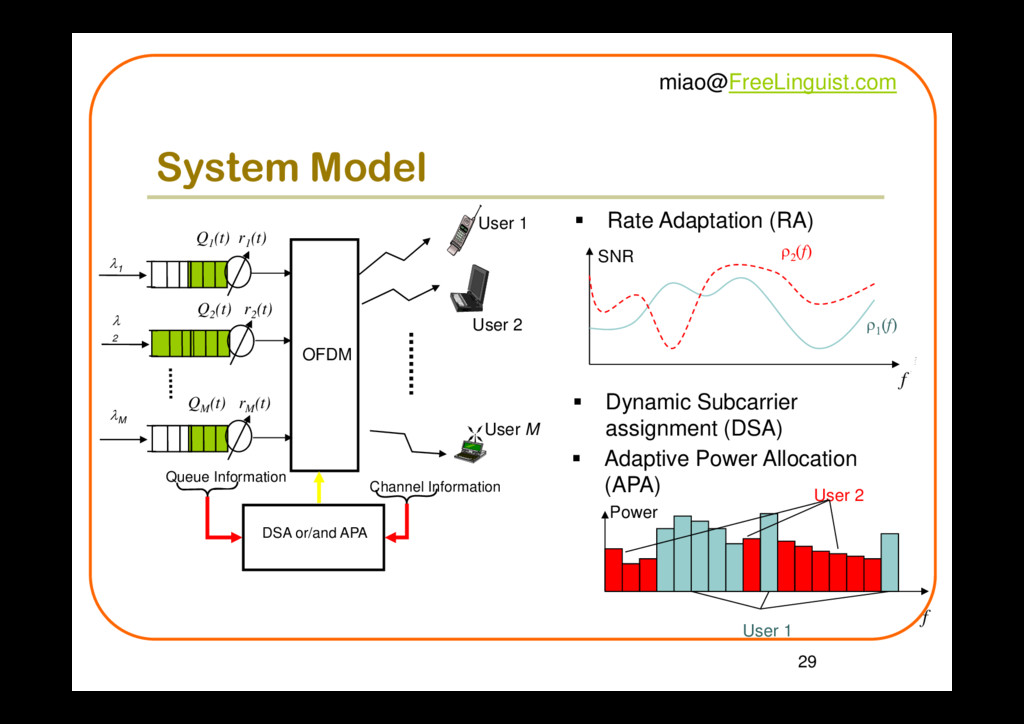
  24. [email protected] System Model  1 Q1 (t) r1 (t) 

    2 Q2 (t) r2 (t)  M QM (t) rM (t) OFDM DSA or/and APA Queue Information Channel Information User 1 User 2 User M  Rate Adaptation (RA)  Dynamic Subcarrier assignment (DSA)  Adaptive Power Allocation (APA) f SNR  2 (f)  1 (f) User 1 User 2 f Power 29
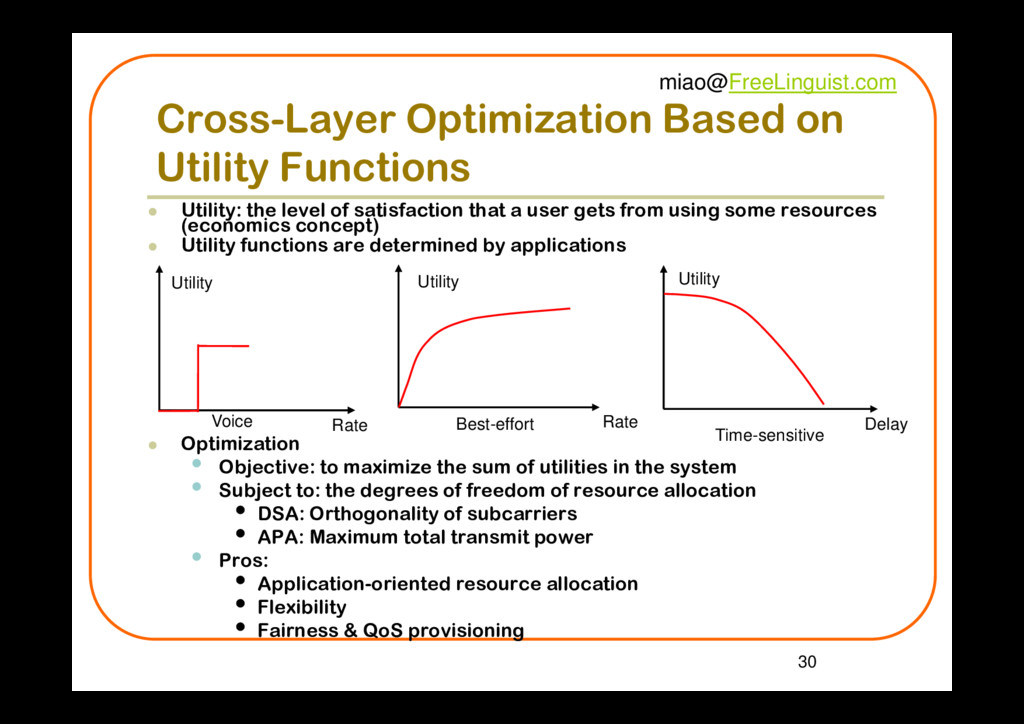
  25. [email protected]  Utility: the level of satisfaction that a user

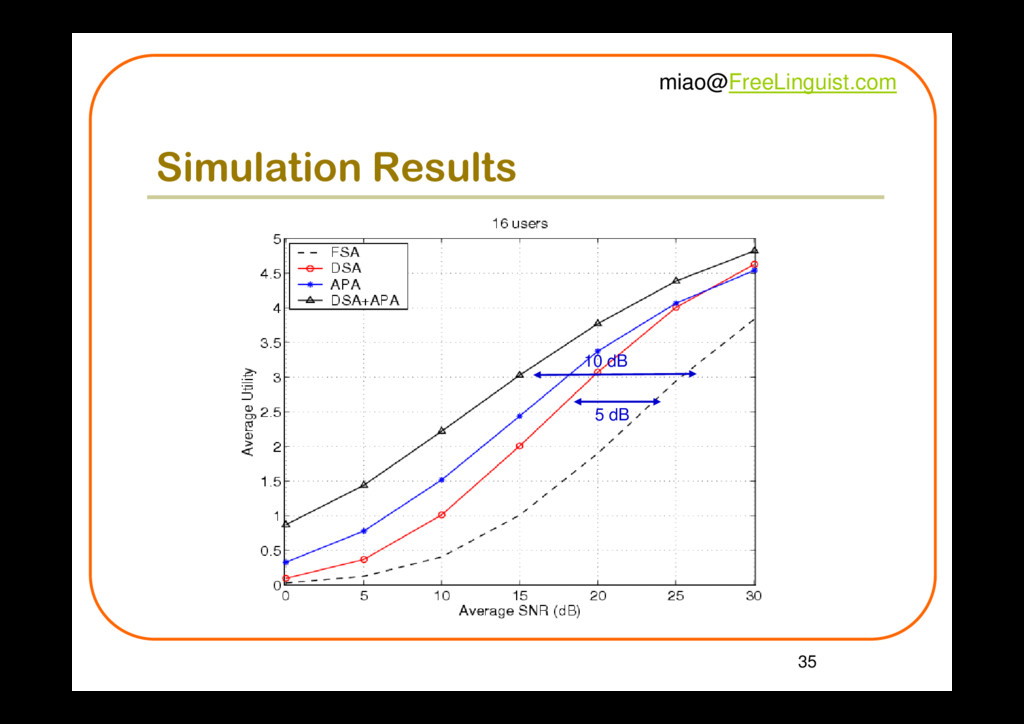
    gets from using some resources (economics concept)  Utility functions are determined by applications  Optimization • Objective: to maximize the sum of utilities in the system • Subject to: the degrees of freedom of resource allocation • DSA: Orthogonality of subcarriers • APA: Maximum total transmit power • Pros: • Application-oriented resource allocation • Flexibility • Fairness & QoS provisioning Cross-Layer Optimization Based on Utility Functions Utility Rate Utility Rate Delay Utility Voice Best-effort Time-sensitive 30
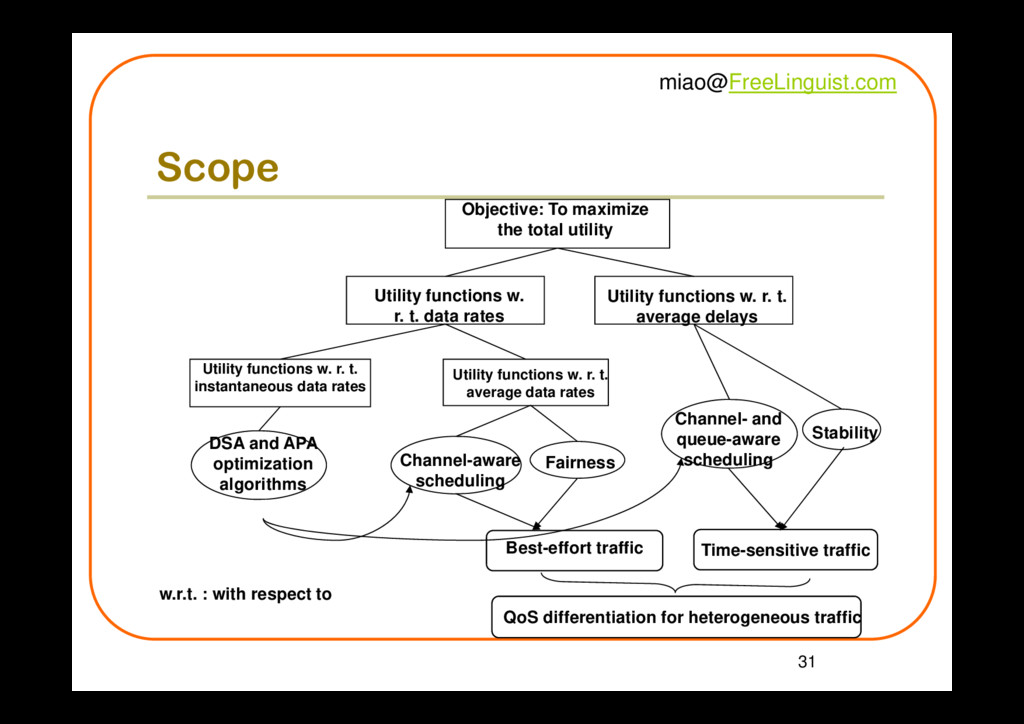
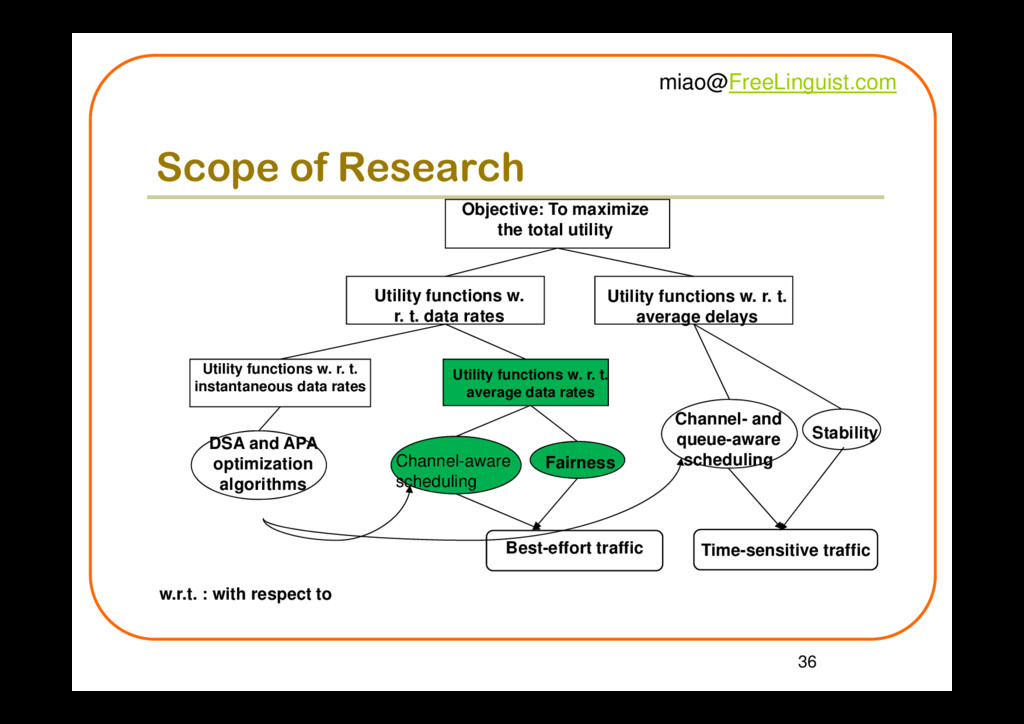
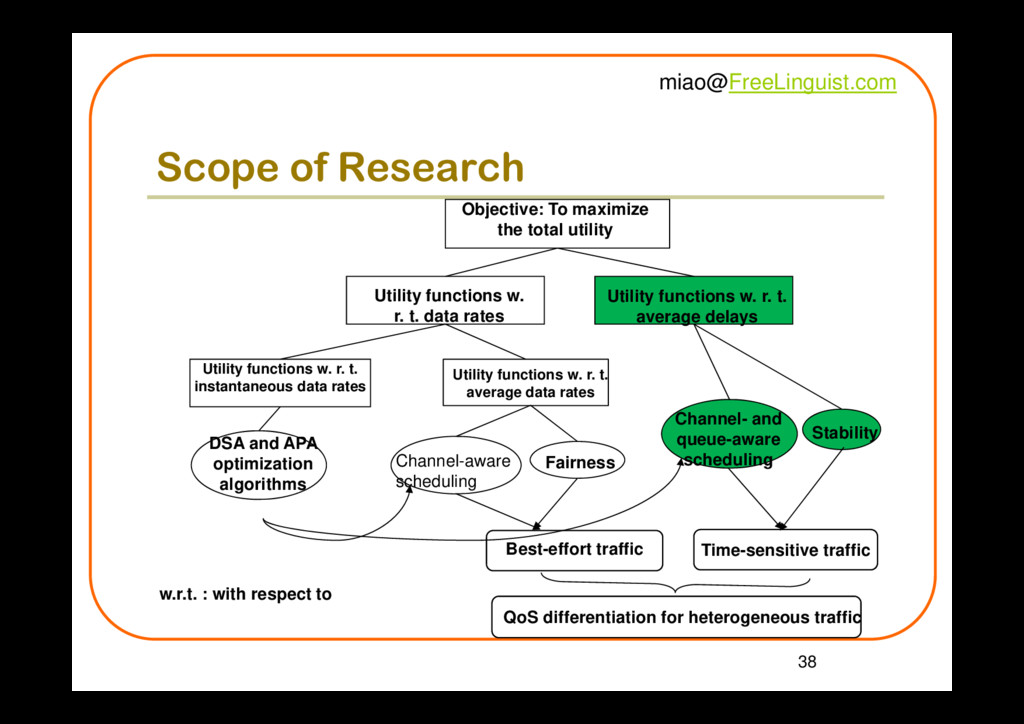
  26. [email protected] Scope Objective: To maximize the total utility Utility functions

    w. r. t. average delays Utility functions w. r. t. instantaneous data rates Utility functions w. r. t. average data rates Best-effort traffic DSA and APA optimization algorithms Fairness Stability QoS differentiation for heterogeneous traffic Utility functions w. r. t. data rates Channel-aware scheduling Channel- and queue-aware scheduling Time-sensitive traffic w.r.t. : with respect to 31
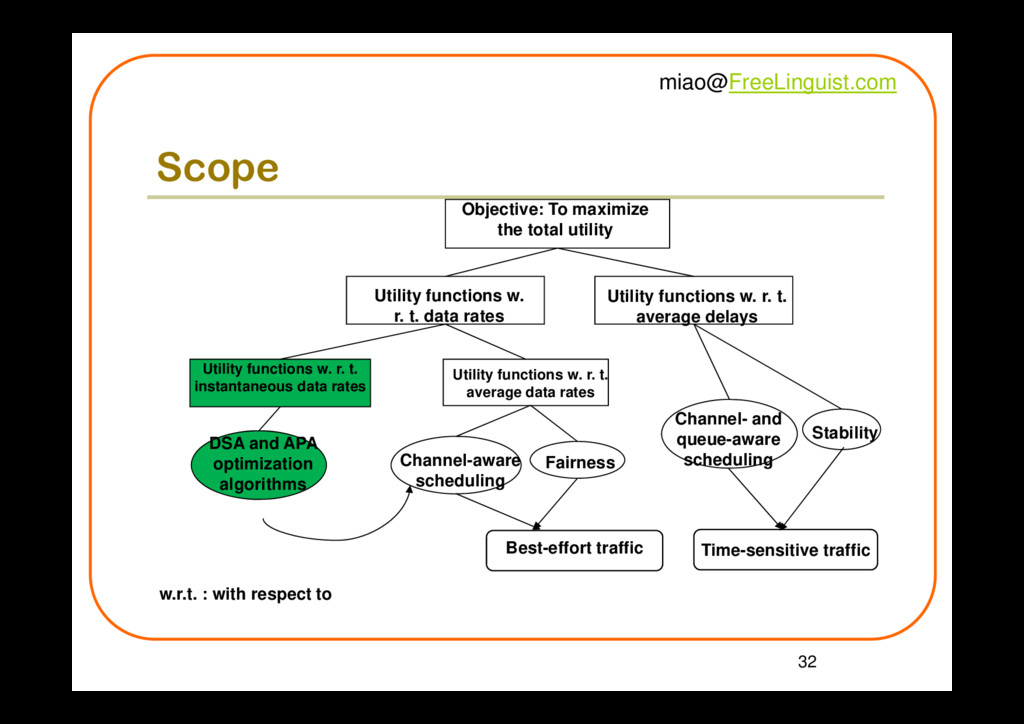
  27. [email protected] Scope Objective: To maximize the total utility Utility functions

    w. r. t. average delays Utility functions w. r. t. instantaneous data rates Utility functions w. r. t. average data rates Best-effort traffic DSA and APA optimization algorithms Fairness Stability Utility functions w. r. t. data rates Channel-aware scheduling Channel- and queue-aware scheduling Time-sensitive traffic w.r.t. : with respect to 32
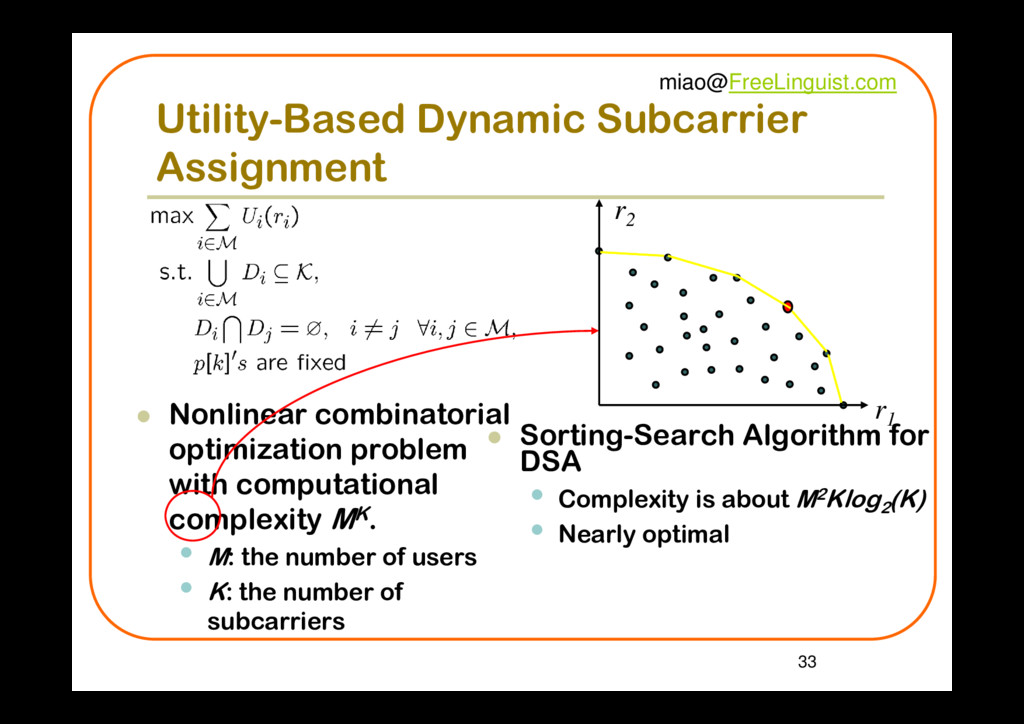
  28. [email protected] Utility-Based Dynamic Subcarrier Assignment  Sorting-Search Algorithm for DSA

    • Complexity is about M2Klog2 (K) • Nearly optimal  Nonlinear combinatorial optimization problem with computational complexity MK. • M: the number of users • K: the number of subcarriers r2 r1 33
  29. [email protected] Scope of Research Objective: To maximize the total utility

    Utility functions w. r. t. average delays Utility functions w. r. t. instantaneous data rates Utility functions w. r. t. average data rates Best-effort traffic DSA and APA optimization algorithms Fairness Stability Utility functions w. r. t. data rates Channel-aware scheduling Channel- and queue-aware scheduling Time-sensitive traffic w.r.t. : with respect to 36
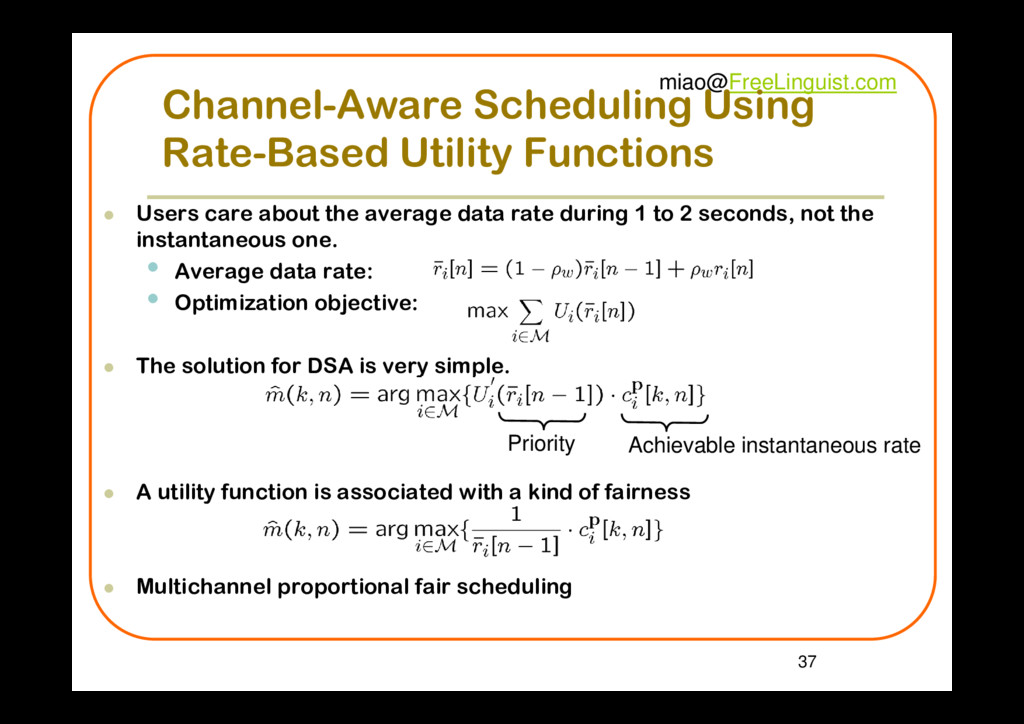
  30. [email protected] Channel-Aware Scheduling Using Rate-Based Utility Functions  Users care

    about the average data rate during 1 to 2 seconds, not the instantaneous one. • Average data rate: • Optimization objective:  The solution for DSA is very simple.  A utility function is associated with a kind of fairness  Multichannel proportional fair scheduling Priority Achievable instantaneous rate 37
  31. [email protected] Scope of Research Objective: To maximize the total utility

    Utility functions w. r. t. average delays Utility functions w. r. t. instantaneous data rates Utility functions w. r. t. average data rates Best-effort traffic DSA and APA optimization algorithms Fairness Stability QoS differentiation for heterogeneous traffic Utility functions w. r. t. data rates Channel-aware scheduling Channel- and queue-aware scheduling Time-sensitive traffic w.r.t. : with respect to 38
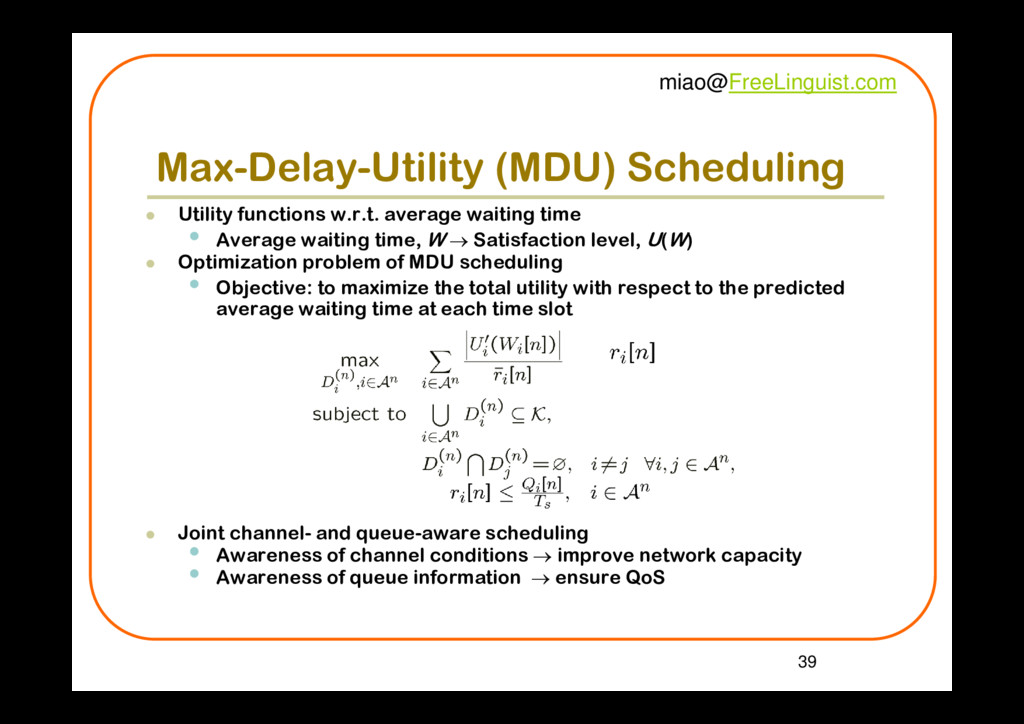
  32. [email protected]  Utility functions w.r.t. average waiting time • Average

    waiting time, W  Satisfaction level, U(W)  Optimization problem of MDU scheduling • Objective: to maximize the total utility with respect to the predicted average waiting time at each time slot  Joint channel- and queue-aware scheduling • Awareness of channel conditions  improve network capacity • Awareness of queue information  ensure QoS Max-Delay-Utility (MDU) Scheduling 39
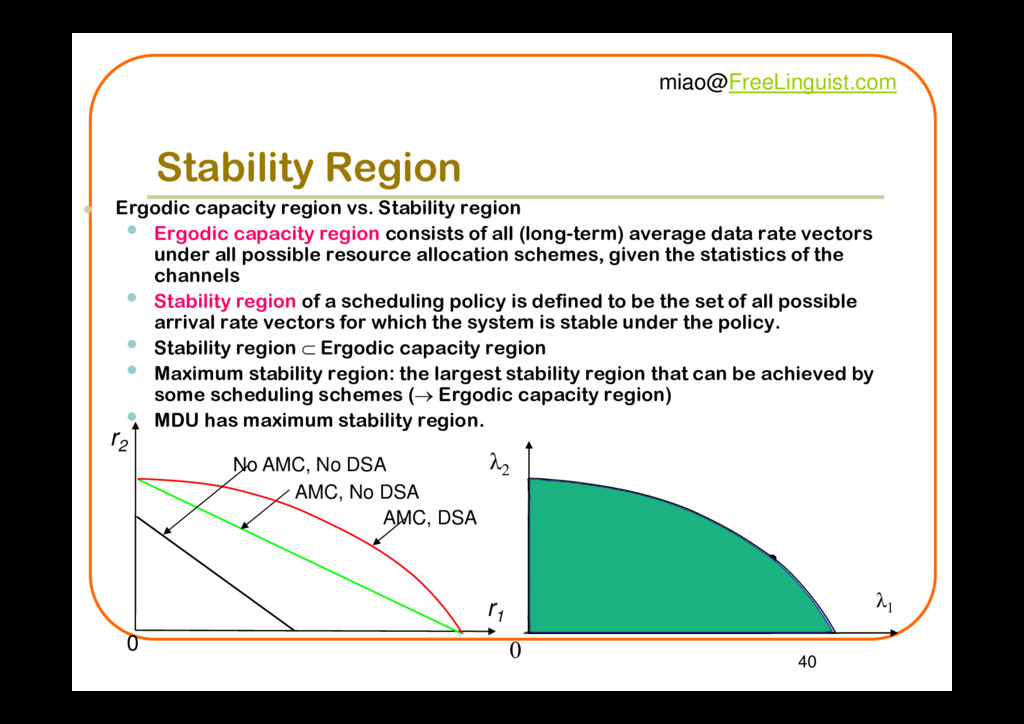
  33. [email protected] Stability Region  Ergodic capacity region vs. Stability region

    • Ergodic capacity region consists of all (long-term) average data rate vectors under all possible resource allocation schemes, given the statistics of the channels • Stability region of a scheduling policy is defined to be the set of all possible arrival rate vectors for which the system is stable under the policy. • Stability region  Ergodic capacity region • Maximum stability region: the largest stability region that can be achieved by some scheduling schemes ( Ergodic capacity region) • MDU has maximum stability region. 0 λ1 λ2 r1 r2 0 AMC, No DSA AMC, DSA No AMC, No DSA 40
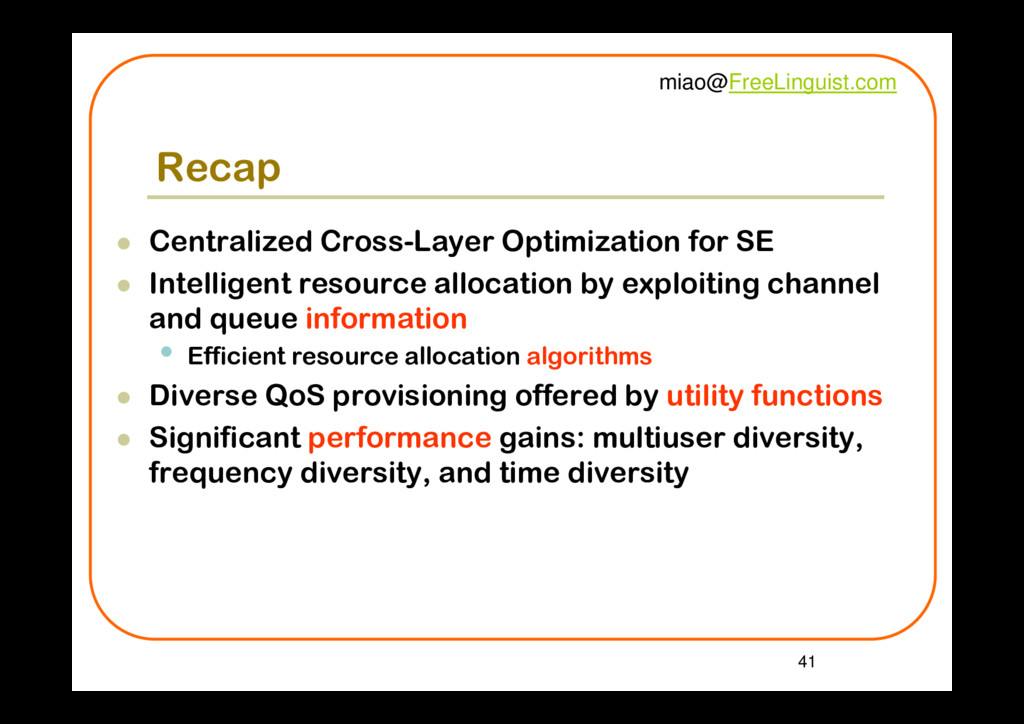
  34. [email protected] Recap  Centralized Cross-Layer Optimization for SE  Intelligent

    resource allocation by exploiting channel and queue information • Efficient resource allocation algorithms  Diverse QoS provisioning offered by utility functions  Significant performance gains: multiuser diversity, frequency diversity, and time diversity 41
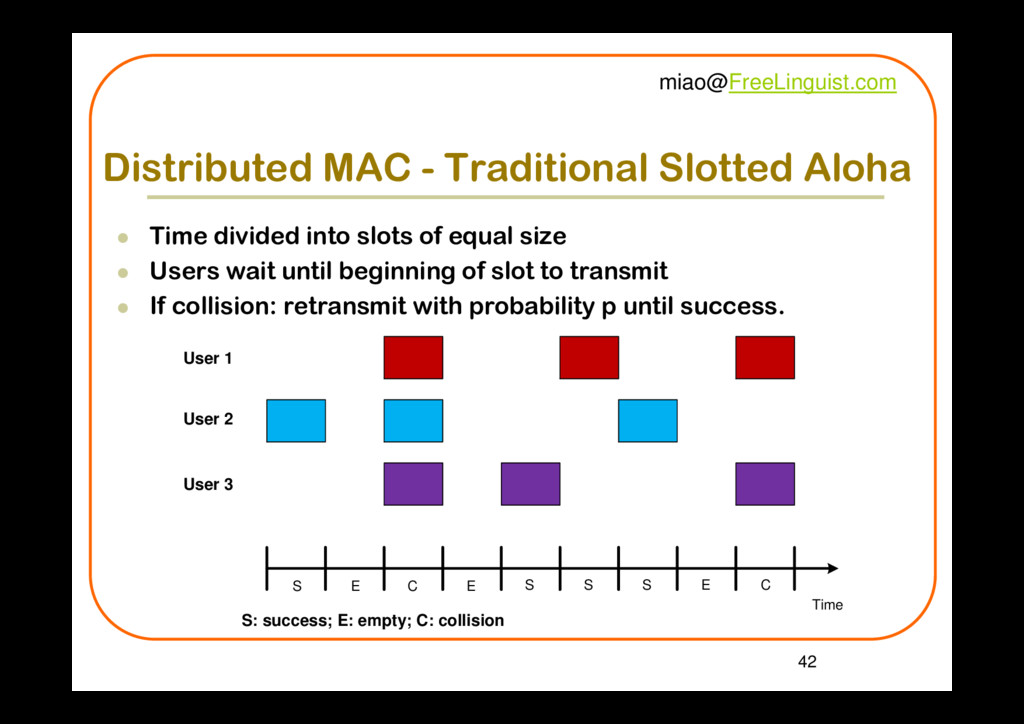
  35. [email protected] Distributed MAC - Traditional Slotted Aloha  Time divided

    into slots of equal size  Users wait until beginning of slot to transmit  If collision: retransmit with probability p until success. User 1 User 2 User 3 S E C E S S S E C S: success; E: empty; C: collision Time 42
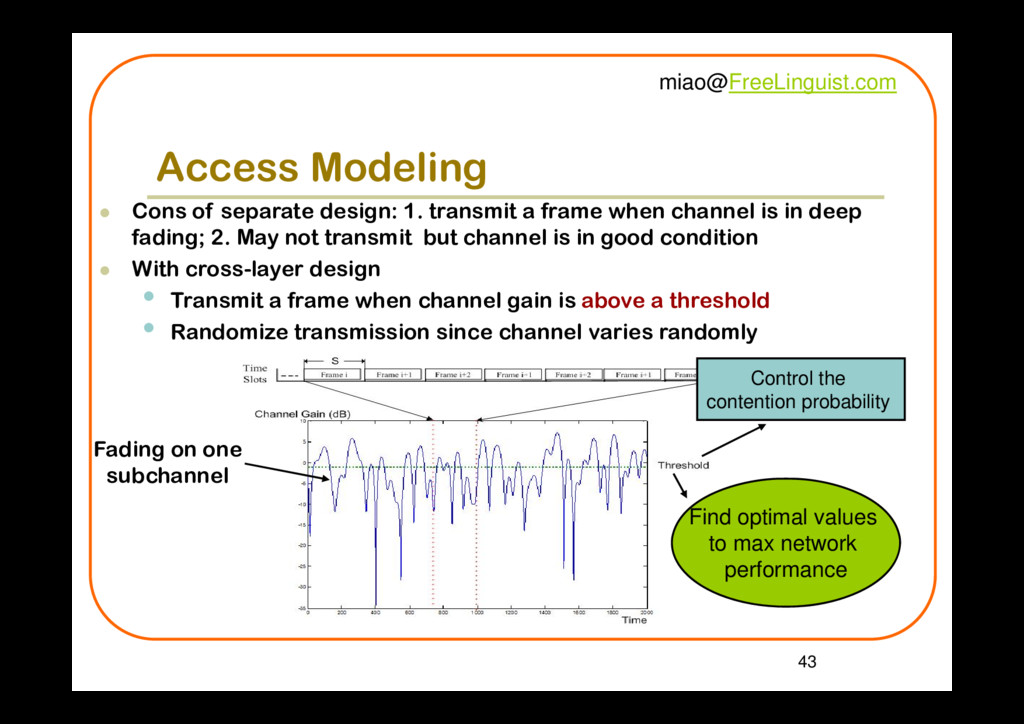
  36. [email protected] Access Modeling Control the contention probability Fading on one

    subchannel  Cons of separate design: 1. transmit a frame when channel is in deep fading; 2. May not transmit but channel is in good condition  With cross-layer design • Transmit a frame when channel gain is above a threshold • Randomize transmission since channel varies randomly Find optimal values to max network performance 43
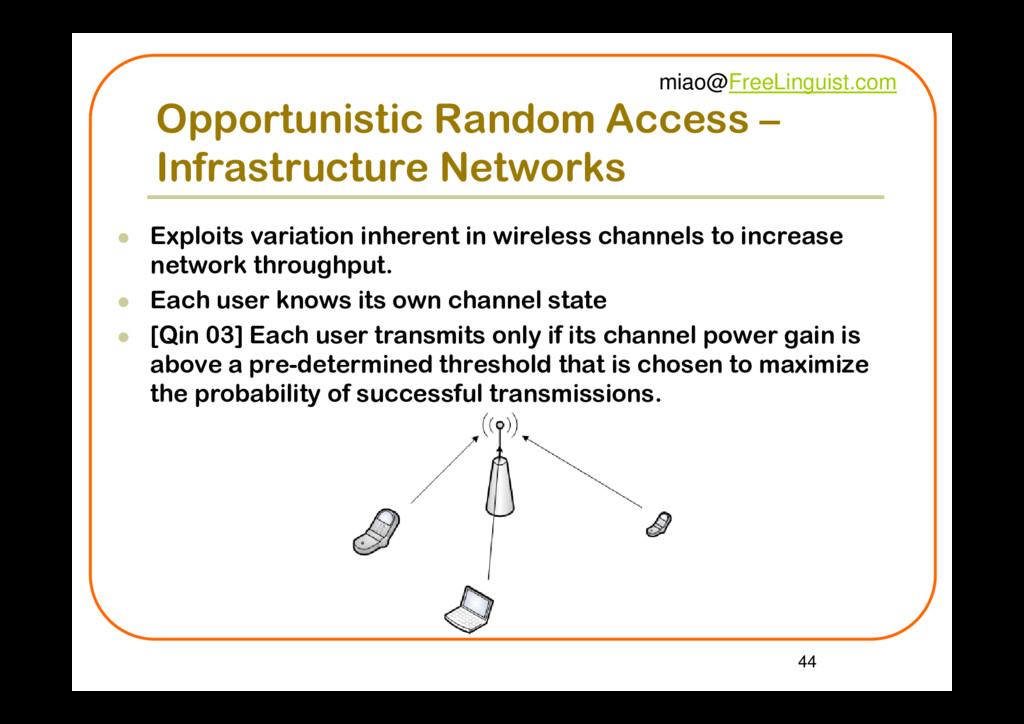
  37. [email protected] Opportunistic Random Access – Infrastructure Networks  Exploits variation

    inherent in wireless channels to increase network throughput.  Each user knows its own channel state  [Qin 03] Each user transmits only if its channel power gain is above a pre-determined threshold that is chosen to maximize the probability of successful transmissions. 44
  38. [email protected] Channel-Aware Aloha  N users in the system to

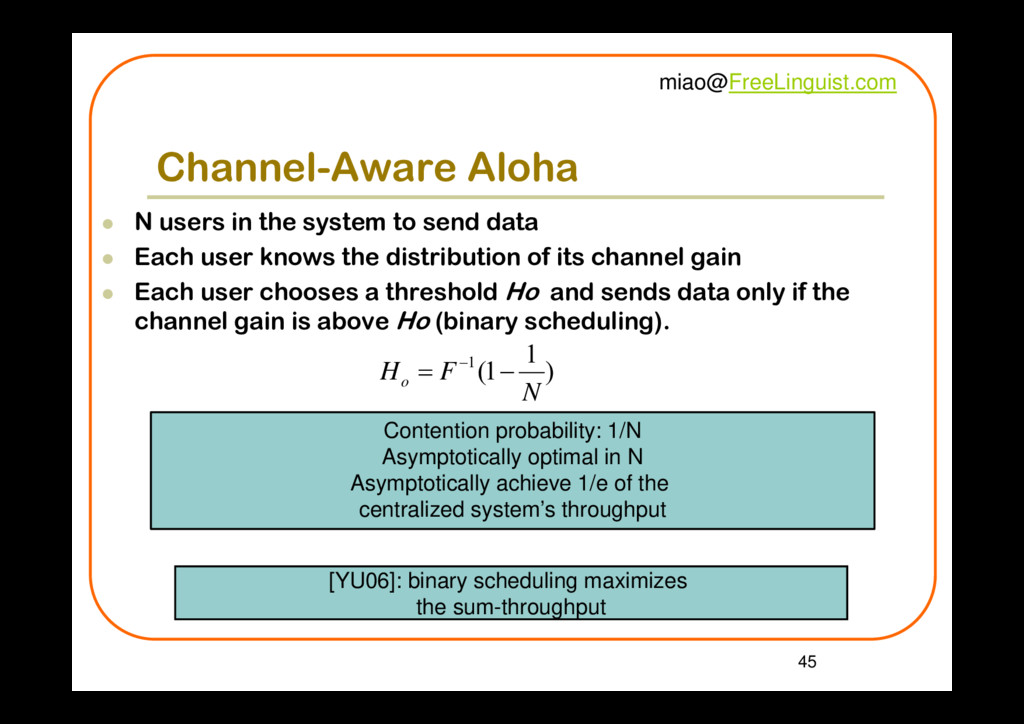
    send data  Each user knows the distribution of its channel gain  Each user chooses a threshold Ho and sends data only if the channel gain is above Ho (binary scheduling). 1 1 (1 ) o H F N    Contention probability: 1/N Asymptotically optimal in N Asymptotically achieve 1/e of the centralized system’s throughput [YU06]: binary scheduling maximizes the sum-throughput 45
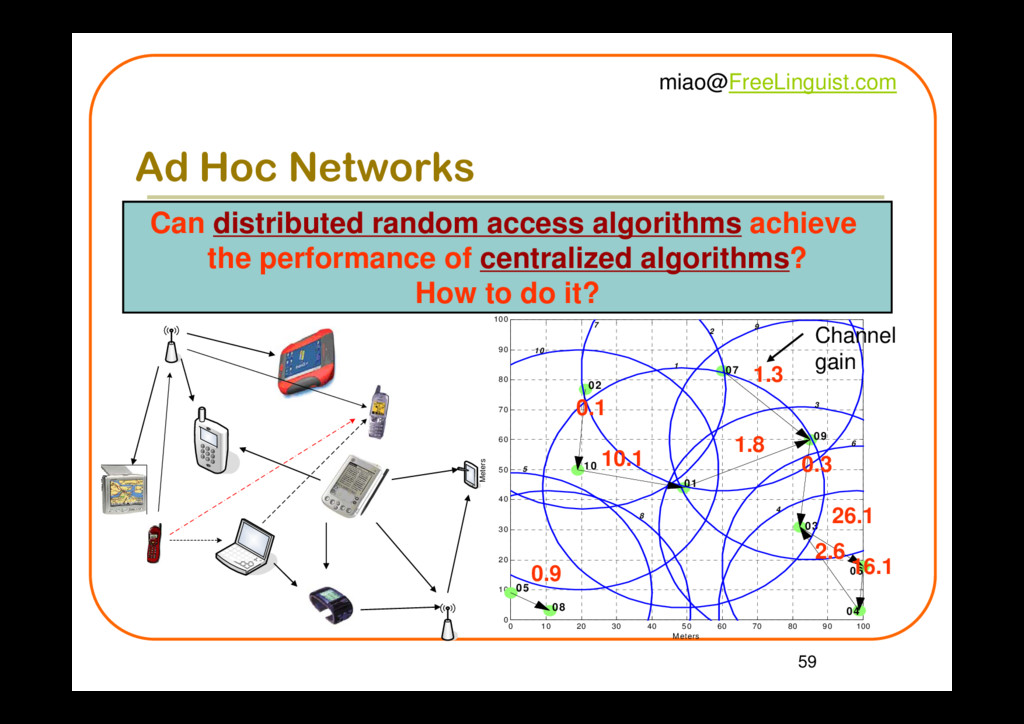
  39. [email protected] Opportunistic Random Access – Ad Hoc Networks  Ubiquitous

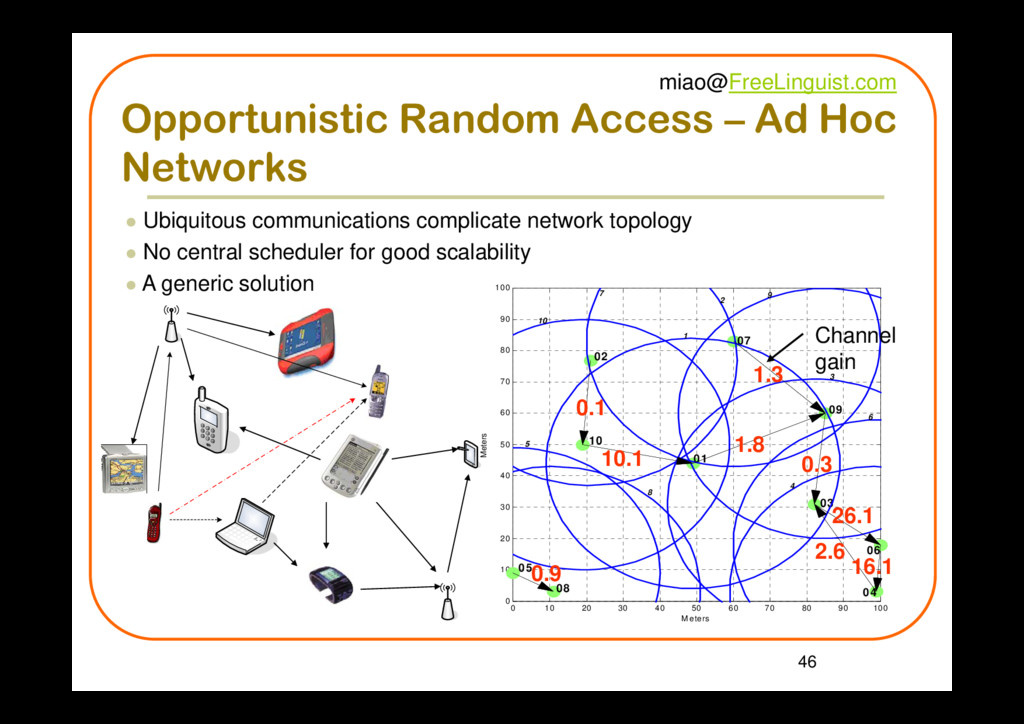
    communications complicate network topology  No central scheduler for good scalability  A generic solution 0 10 20 30 40 50 60 70 80 90 100 0 10 20 30 40 50 60 70 80 90 100 M eters Meters 01 02 03 04 05 06 07 08 09 10 1 3 2 4 5 6 7 8 9 10 0.1 10.1 1.8 1.3 0.3 0.9 2.6 26.1 16.1 Channel gain 46
  40. [email protected] Cross-Layer Design Objective  Objective: • Consider both overall

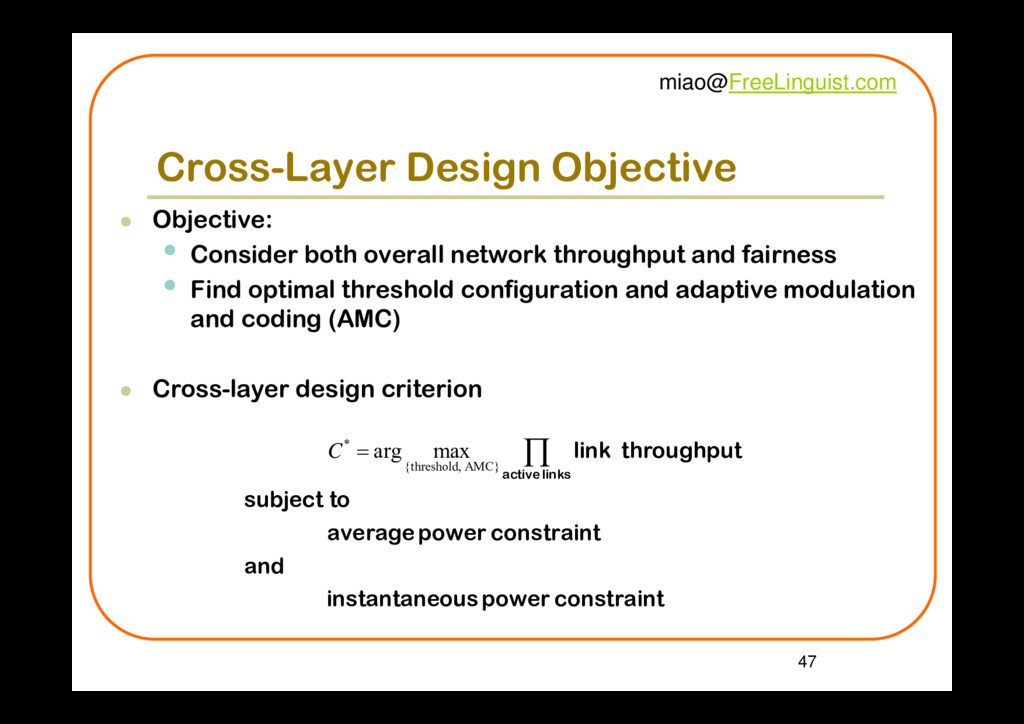
    network throughput and fairness • Find optimal threshold configuration and adaptive modulation and coding (AMC)  Cross-layer design criterion * {threshold, AMC} arg max C   active links link throughput subject to average power constraint and instantaneous power constraint 47
  41. [email protected] Decentralized Optimization for Multichannel Random Access (DOMRA)  Original

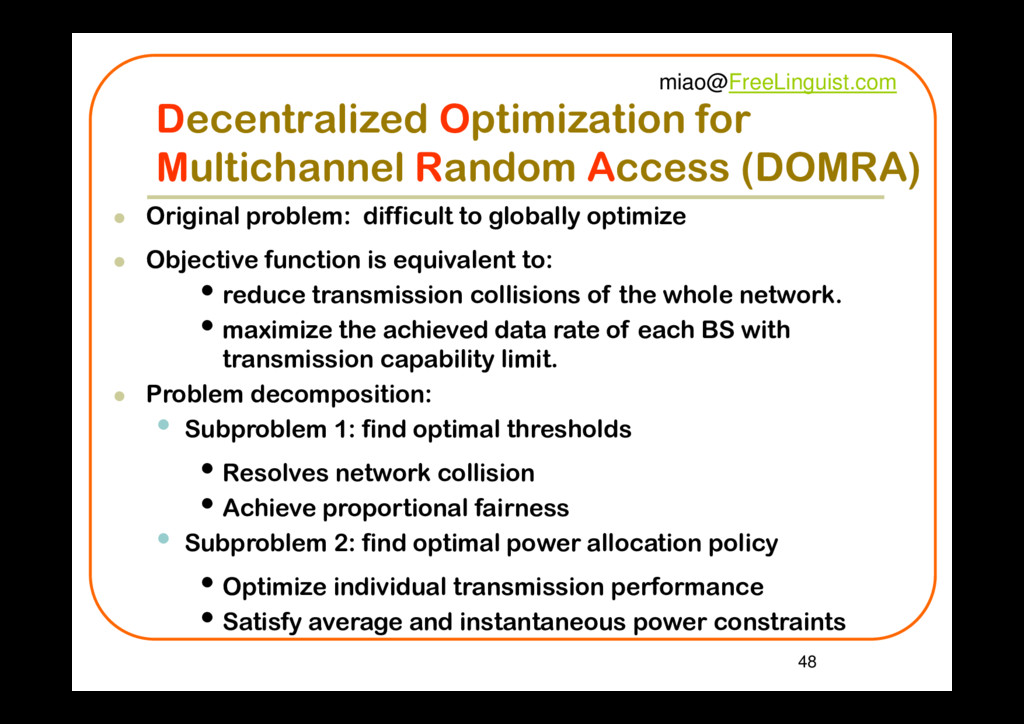
    problem: difficult to globally optimize  Objective function is equivalent to: • reduce transmission collisions of the whole network. • maximize the achieved data rate of each BS with transmission capability limit.  Problem decomposition: • Subproblem 1: find optimal thresholds • Resolves network collision • Achieve proportional fairness • Subproblem 2: find optimal power allocation policy • Optimize individual transmission performance • Satisfy average and instantaneous power constraints 48
  42. [email protected] Optimal DOMRA - MAC Layer 1 * | |

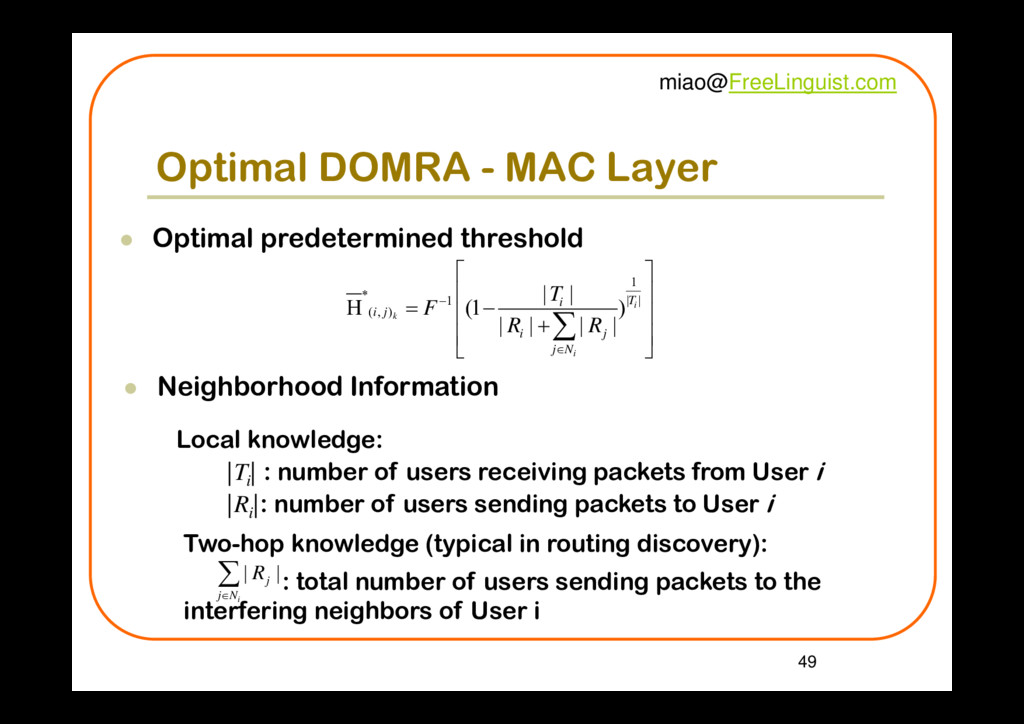
    1 ( , ) | | H (1 ) | | | | i k i T i i j i j j N T F R R                 Local knowledge: |Ti | : number of users receiving packets from User i |Ri |: number of users sending packets to User i Two-hop knowledge (typical in routing discovery): : total number of users sending packets to the interfering neighbors of User i | | i j j N R    Optimal predetermined threshold  Neighborhood Information 49
  43. [email protected] Threshold Adaptation 0 10 20 30 40 50 60

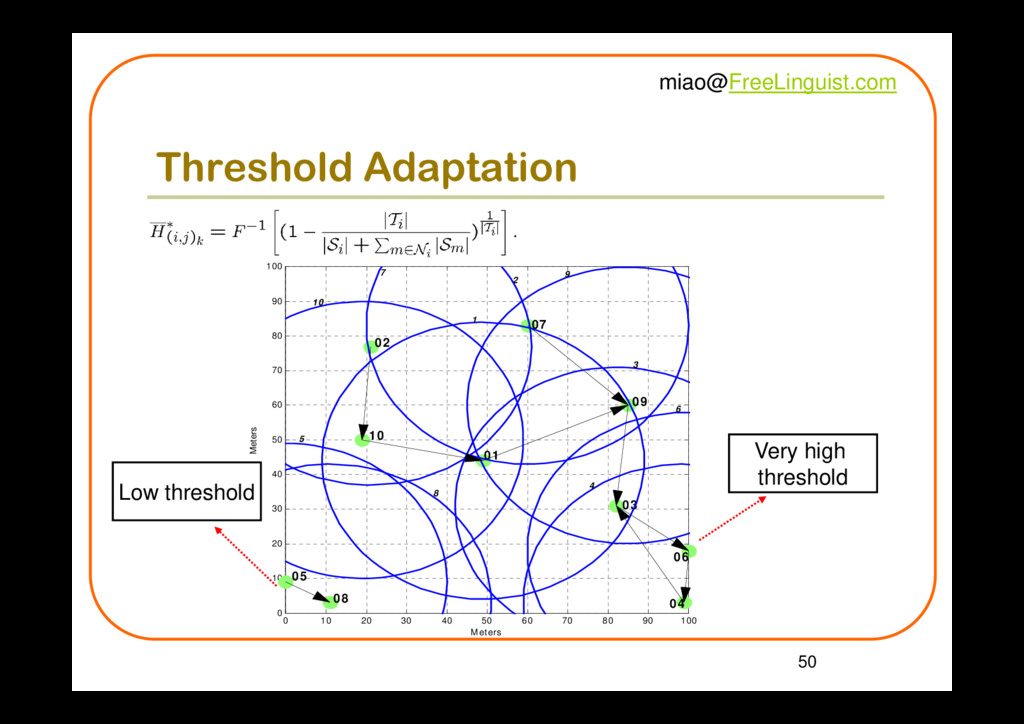
    70 80 90 100 0 10 20 30 40 50 60 70 80 90 100 M eters Meters 01 02 03 04 05 06 07 08 09 10 1 3 2 4 5 6 7 8 9 10 Low threshold Very high threshold 50
  44. [email protected] Link Adaptation • Capability-limited water-filling power allocation 2 Kh

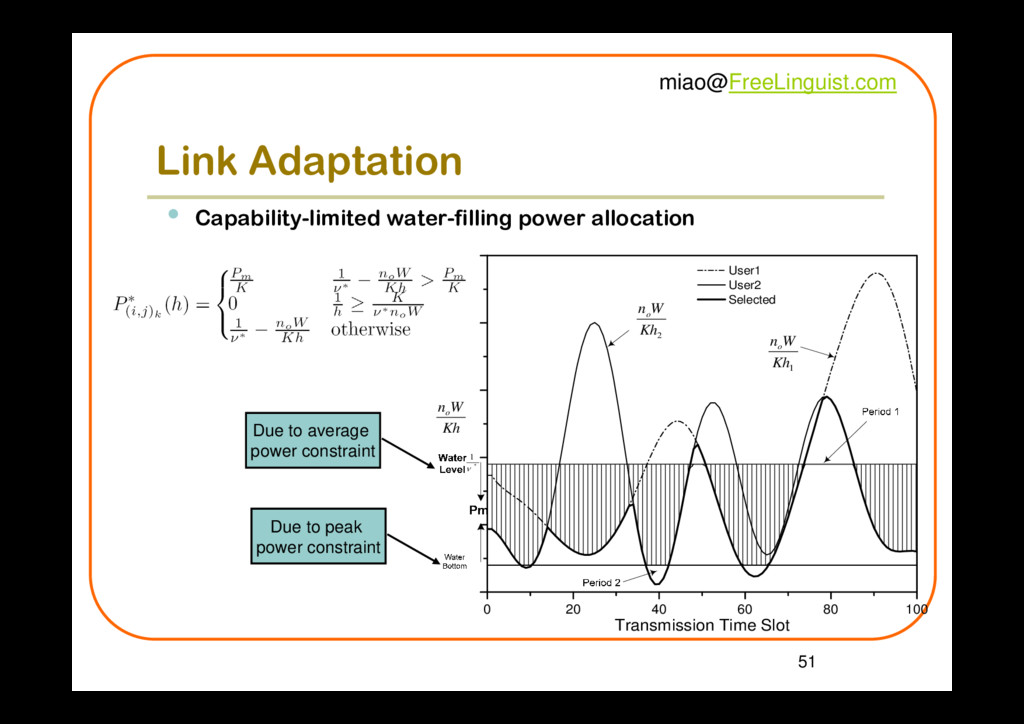
    W n o 1 Kh W n o Kh W n o * 1  0 20 40 60 80 100 User1 User2 Selected Transmission Time Slot Due to peak power constraint Due to average power constraint 51
  45. [email protected] Sub-Optimality Gap  Gap to the global optimum. •

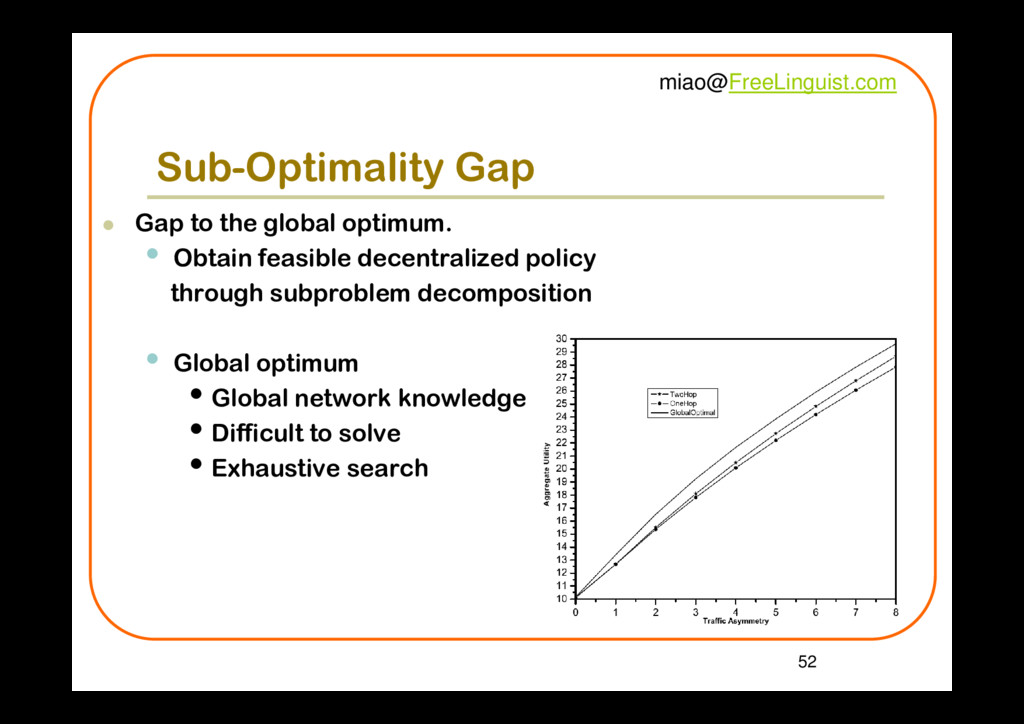
    Obtain feasible decentralized policy through subproblem decomposition • Global optimum • Global network knowledge • Difficult to solve • Exhaustive search 52
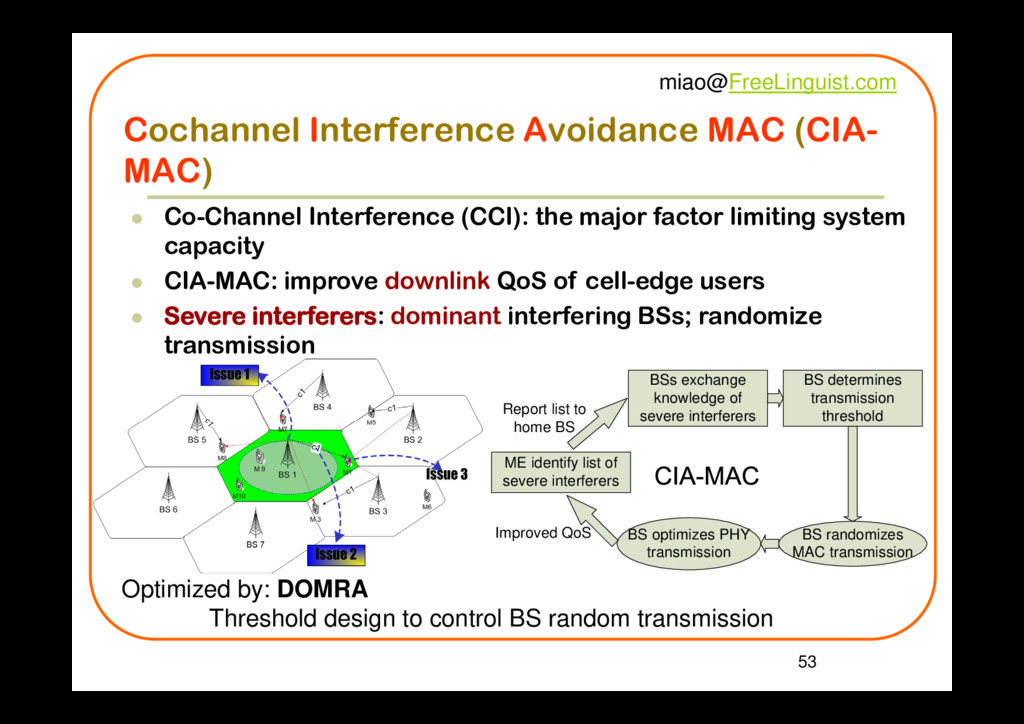
  46. [email protected] Cochannel Interference Avoidance MAC (CIA- MAC)  Co-Channel Interference

    (CCI): the major factor limiting system capacity  CIA-MAC: improve downlink QoS of cell-edge users  Severe interferers: dominant interfering BSs; randomize transmission ME identify list of severe interferers BS randomizes MAC transmission BS optimizes PHY transmission Improved QoS Report list to home BS BSs exchange knowledge of severe interferers BS determines transmission threshold Optimized by: DOMRA Threshold design to control BS random transmission 53
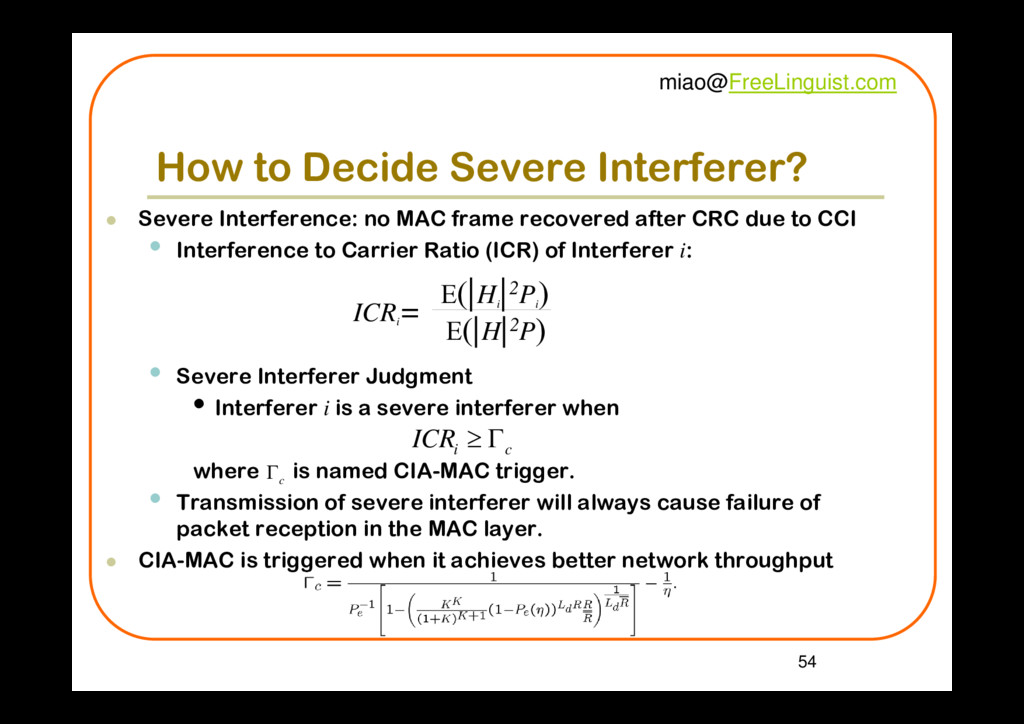
  47. [email protected] How to Decide Severe Interferer?  Severe Interference: no

    MAC frame recovered after CRC due to CCI • Interference to Carrier Ratio (ICR) of Interferer i: • Severe Interferer Judgment • Interferer i is a severe interferer when where is named CIA-MAC trigger. • Transmission of severe interferer will always cause failure of packet reception in the MAC layer.  CIA-MAC is triggered when it achieves better network throughput i c ICR   E(|H i |2P i ) ICR i = E(|H|2P) c  54
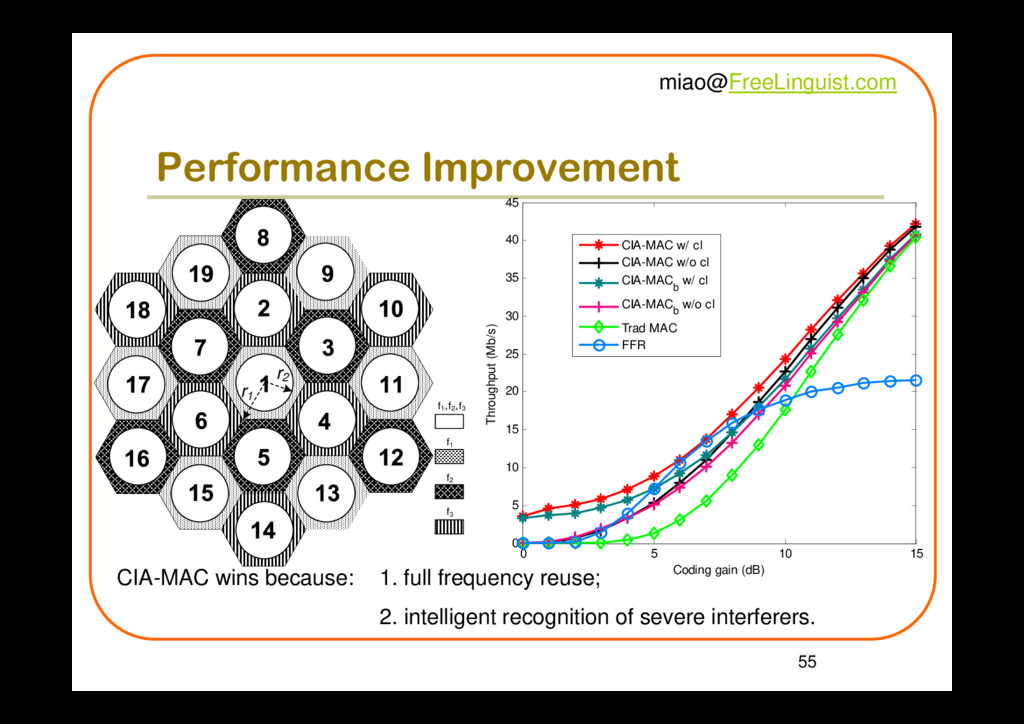
  48. [email protected] Performance Improvement f1+ f2+ f3 f1 f2 f3 r1

    r2 0 5 10 15 0 5 10 15 20 25 30 35 40 45 Coding gain (dB) Throughput (Mb/s) CIA-MAC w/ cl CIA-MAC w/o cl CIA-MAC b w/ cl CIA-MAC b w/o cl Trad MAC FFR CIA-MAC wins because: 1. full frequency reuse; 2. intelligent recognition of severe interferers. 55
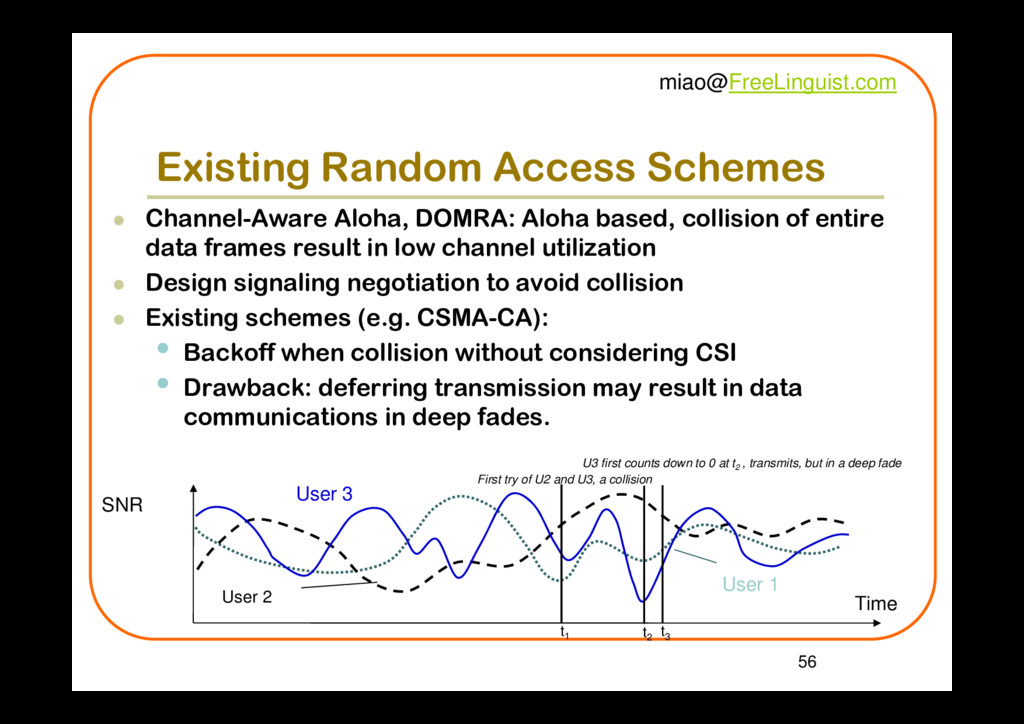
  49. [email protected] Existing Random Access Schemes  Channel-Aware Aloha, DOMRA: Aloha

    based, collision of entire data frames result in low channel utilization  Design signaling negotiation to avoid collision  Existing schemes (e.g. CSMA-CA): • Backoff when collision without considering CSI • Drawback: deferring transmission may result in data communications in deep fades. Time User 1 SNR User 2 User 3 First try of U2 and U3, a collision t1 t2 t3 U3 first counts down to 0 at t2 , transmits, but in a deep fade 56
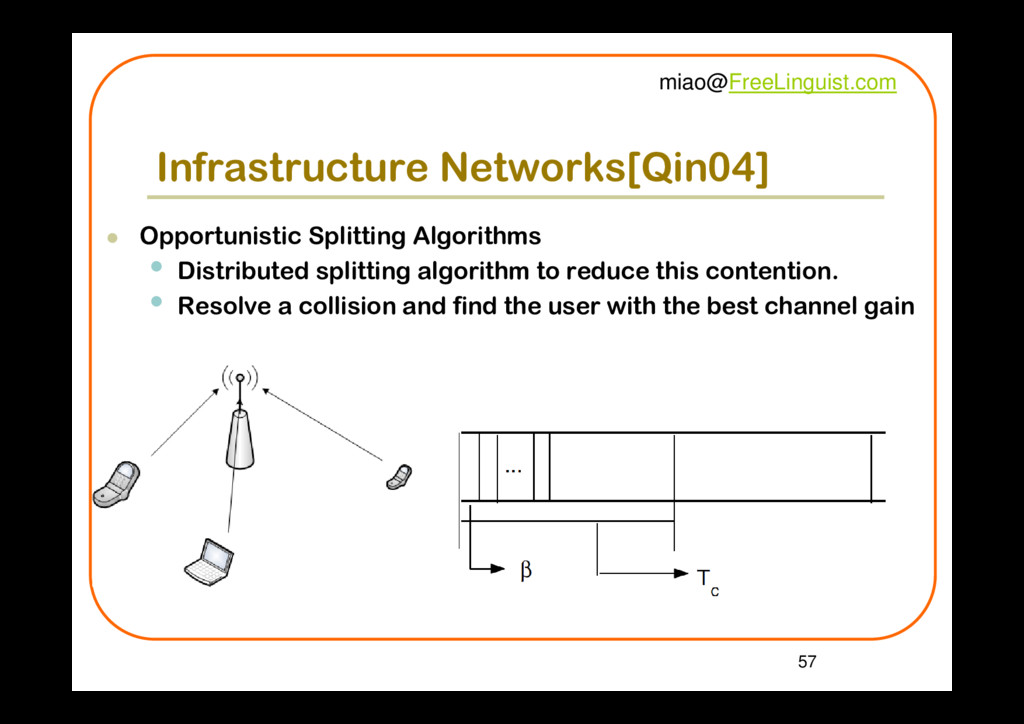
  50. [email protected] Infrastructure Networks[Qin04]  Opportunistic Splitting Algorithms • Distributed splitting

    algorithm to reduce this contention. • Resolve a collision and find the user with the best channel gain 57
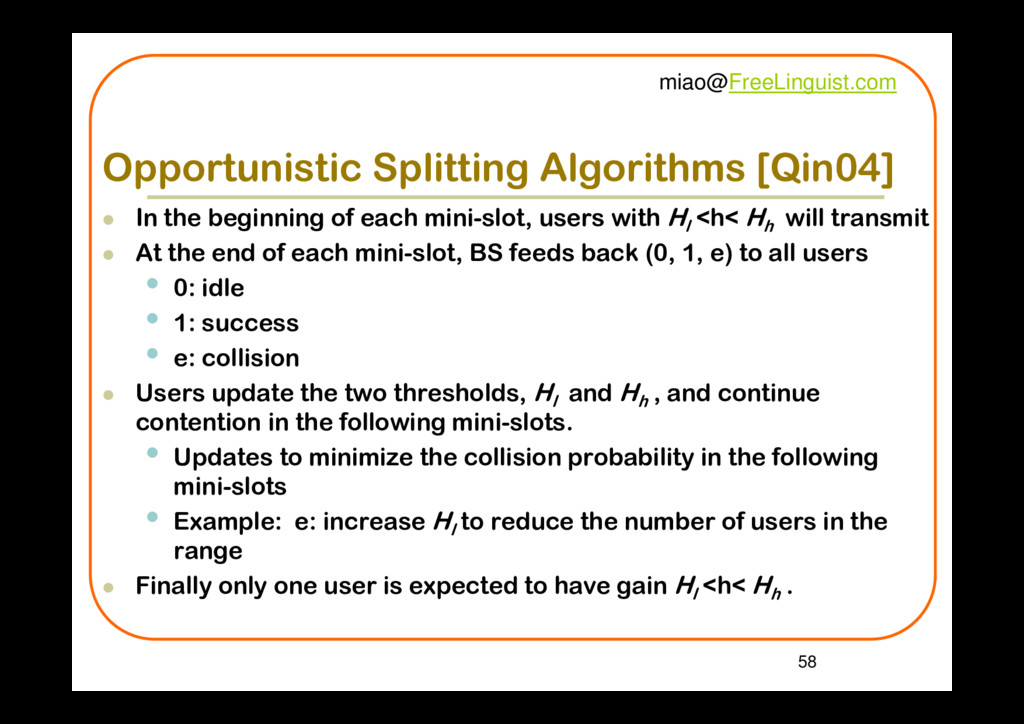
  51. [email protected] Opportunistic Splitting Algorithms [Qin04]  In the beginning of

    each mini-slot, users with Hl <h< Hh will transmit  At the end of each mini-slot, BS feeds back (0, 1, e) to all users • 0: idle • 1: success • e: collision  Users update the two thresholds, Hl and Hh , and continue contention in the following mini-slots. • Updates to minimize the collision probability in the following mini-slots • Example: e: increase Hl to reduce the number of users in the range  Finally only one user is expected to have gain Hl <h< Hh . 58
  52. [email protected] Ad Hoc Networks 0 10 20 30 40 50

    60 70 80 90 100 0 10 20 30 40 50 60 70 80 90 100 M eters Meters 01 02 03 04 05 06 07 08 09 10 1 3 2 4 5 6 7 8 9 10 0.1 10.1 1.8 1.3 0.3 0.9 2.6 26.1 16.1 Channel gain Can distributed random access algorithms achieve the performance of centralized algorithms? How to do it? 59
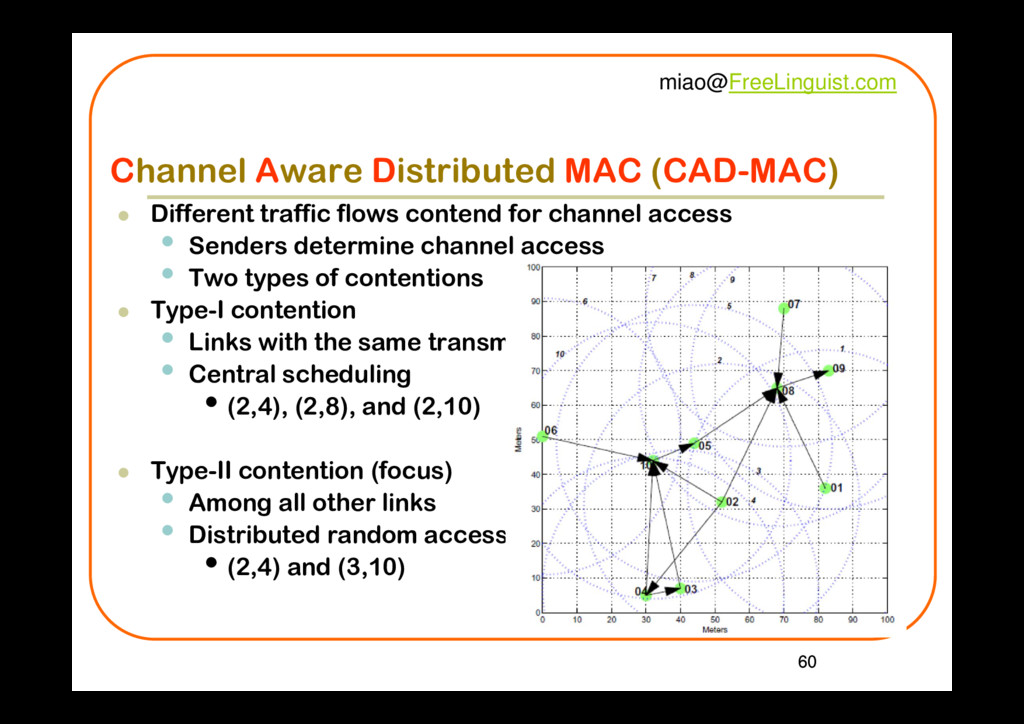
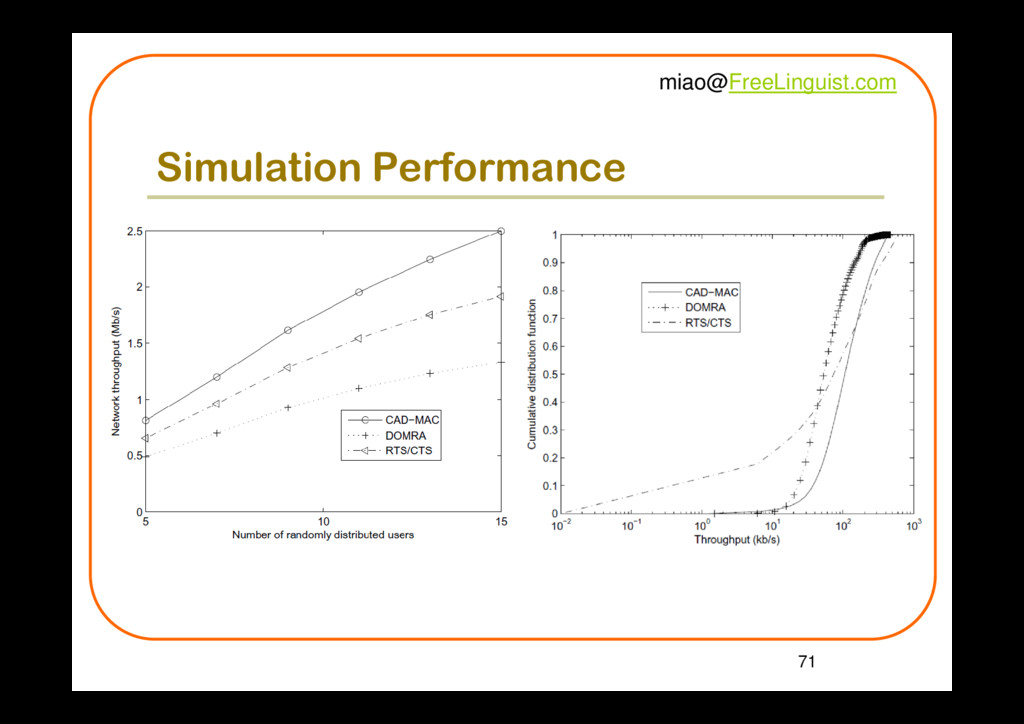
  53. [email protected] 60 Channel Aware Distributed MAC (CAD-MAC)  Different traffic

    flows contend for channel access • Senders determine channel access • Two types of contentions  Type-I contention • Links with the same transmitter • Central scheduling • (2,4), (2,8), and (2,10)  Type-II contention (focus) • Among all other links • Distributed random access • (2,4) and (3,10) 60
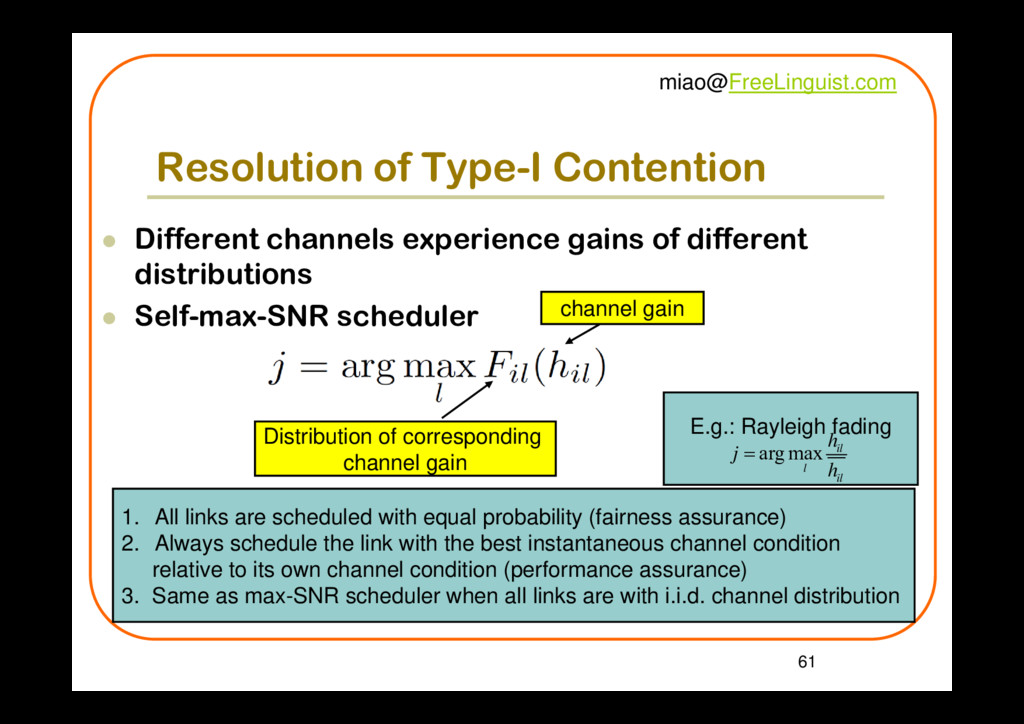
  54. [email protected] Resolution of Type-I Contention  Different channels experience gains

    of different distributions  Self-max-SNR scheduler Distribution of corresponding channel gain channel gain 1. All links are scheduled with equal probability (fairness assurance) 2. Always schedule the link with the best instantaneous channel condition relative to its own channel condition (performance assurance) 3. Same as max-SNR scheduler when all links are with i.i.d. channel distribution E.g.: Rayleigh fading arg max il l il h j h  61
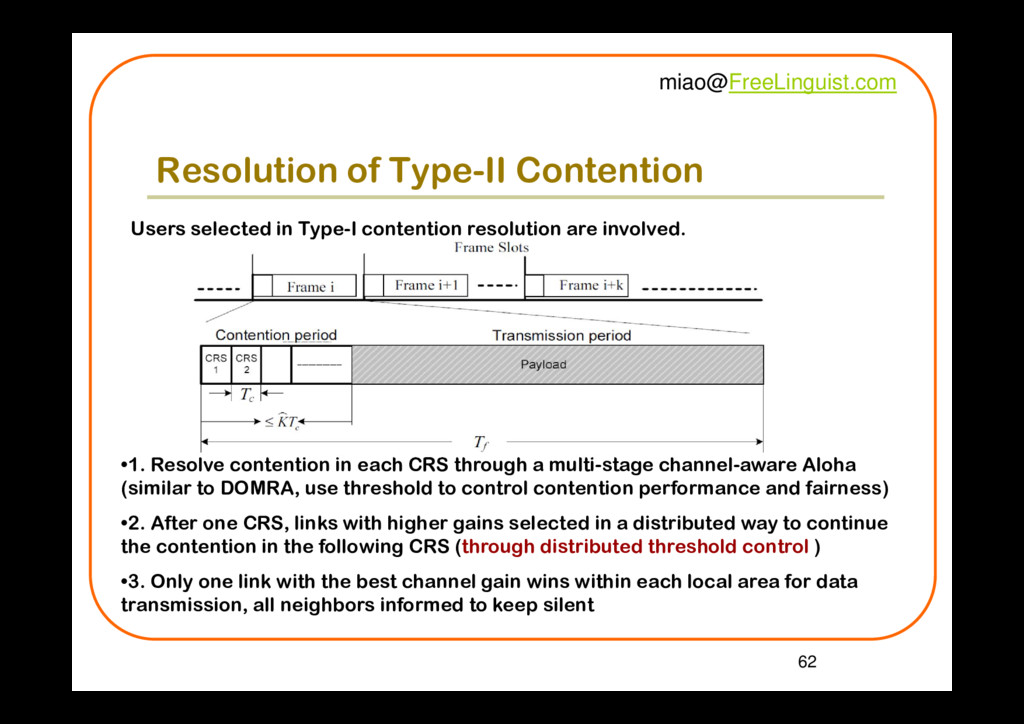
  55. [email protected] Resolution of Type-II Contention •1. Resolve contention in each

    CRS through a multi-stage channel-aware Aloha (similar to DOMRA, use threshold to control contention performance and fairness) •2. After one CRS, links with higher gains selected in a distributed way to continue the contention in the following CRS (through distributed threshold control ) •3. Only one link with the best channel gain wins within each local area for data transmission, all neighbors informed to keep silent Users selected in Type-I contention resolution are involved. 62
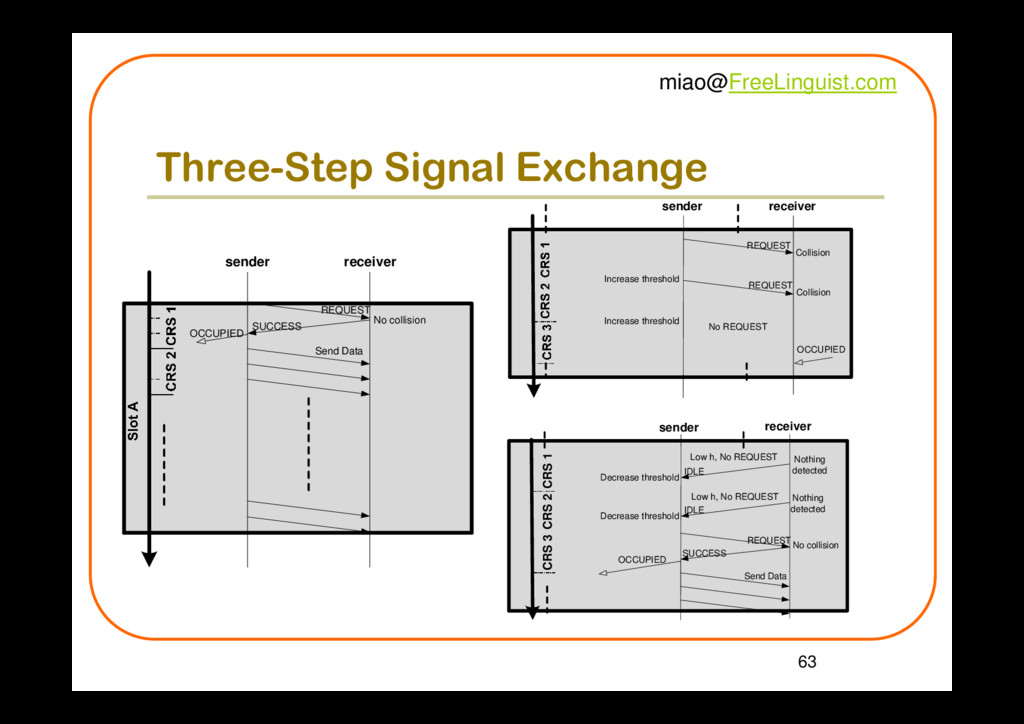
  56. [email protected] Three-Step Signal Exchange sender receiver REQUEST SUCCESS OCCUPIED Send

    Data No collision sender receiver REQUEST Collision Increase threshold Increase threshold Collision No REQUEST REQUEST OCCUPIED sender receiver CRS 1 CRS 2 Low h, No REQUEST Nothing detected IDLE Decrease threshold Low h, No REQUEST Nothing detected IDLE Decrease threshold CRS 3 REQUEST SUCCESS No collision OCCUPIED Send Data 63
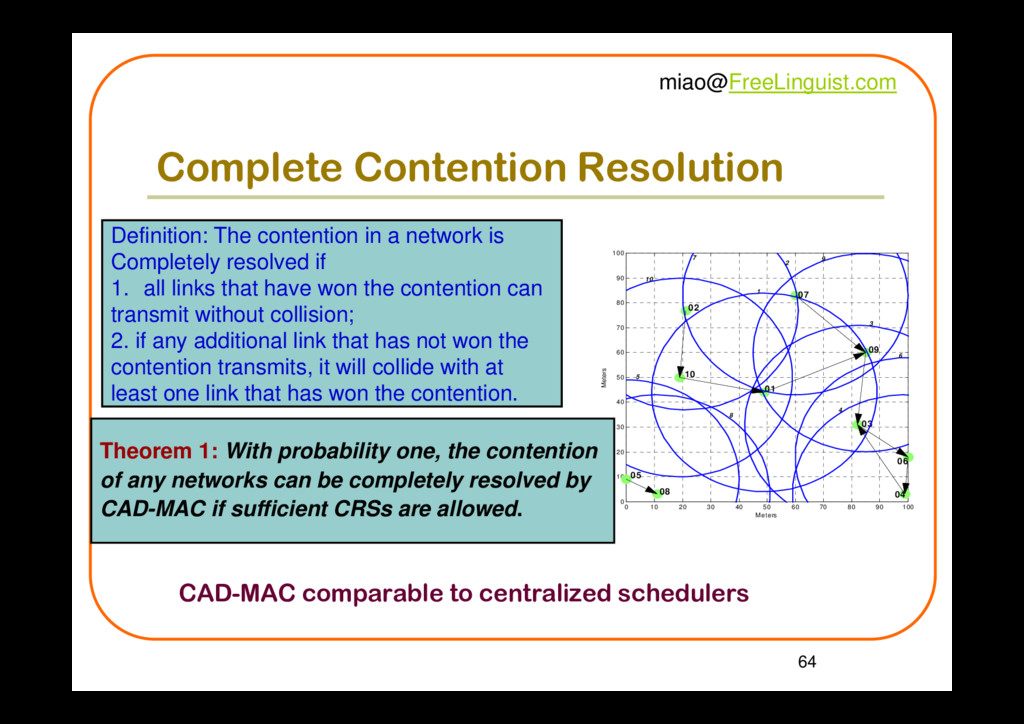
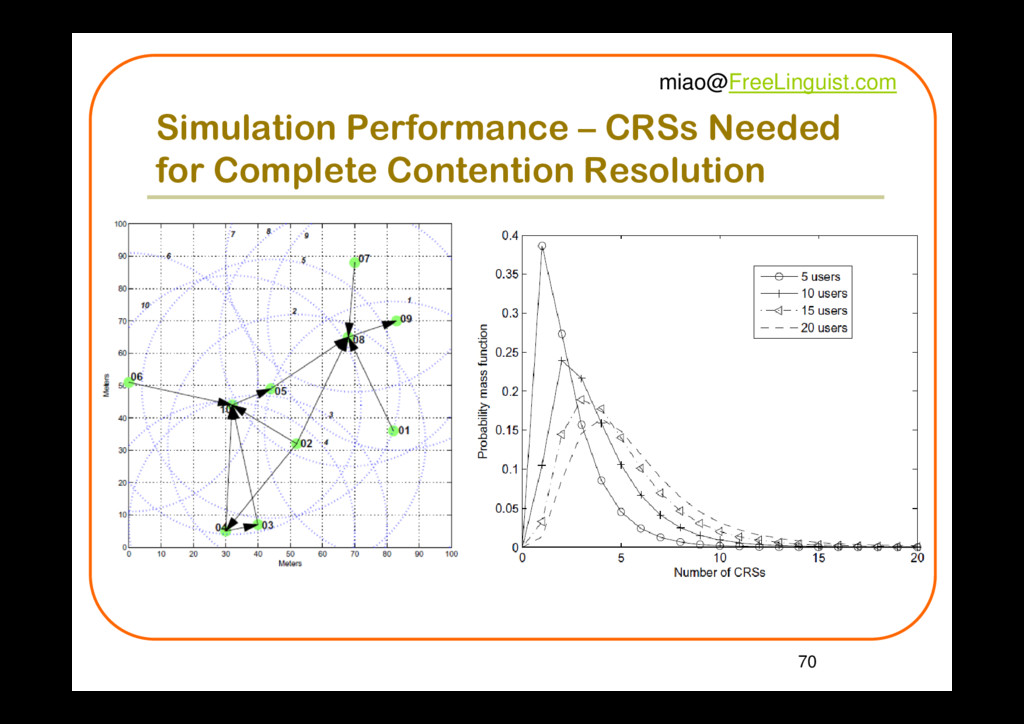
  57. [email protected] Complete Contention Resolution CAD-MAC comparable to centralized schedulers Theorem

    1: With probability one, the contention of any networks can be completely resolved by CAD-MAC if sufficient CRSs are allowed. 0 10 20 30 40 50 60 70 80 90 100 0 10 20 30 40 50 60 70 80 90 100 Meters Meters 01 02 03 04 05 06 07 08 09 10 1 3 2 4 5 6 7 8 9 10 Definition: The contention in a network is Completely resolved if 1. all links that have won the contention can transmit without collision; 2. if any additional link that has not won the contention transmits, it will collide with at least one link that has won the contention. 64
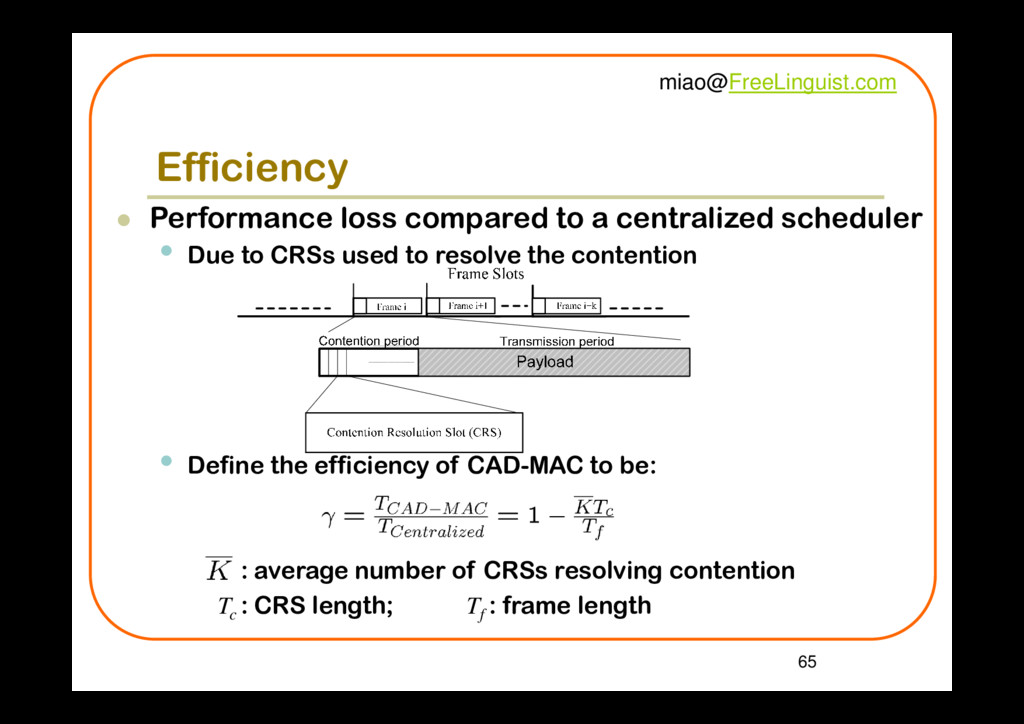
  58. [email protected]  Performance loss compared to a centralized scheduler •

    Due to CRSs used to resolve the contention • Define the efficiency of CAD-MAC to be: : average number of CRSs resolving contention Tc : CRS length; Tf : frame length Efficiency 65
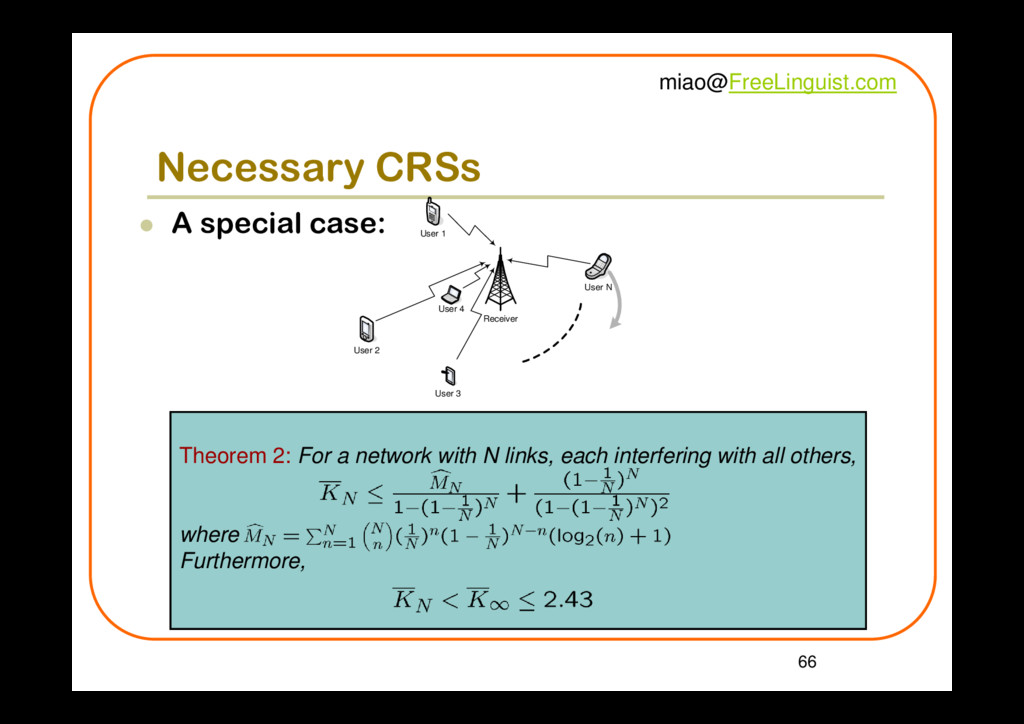
  59. [email protected] Necessary CRSs User 1 User N Receiver User 2

    User 3 User 4 Theorem 2: For a network with N links, each interfering with all others, where Furthermore,  A special case: 66
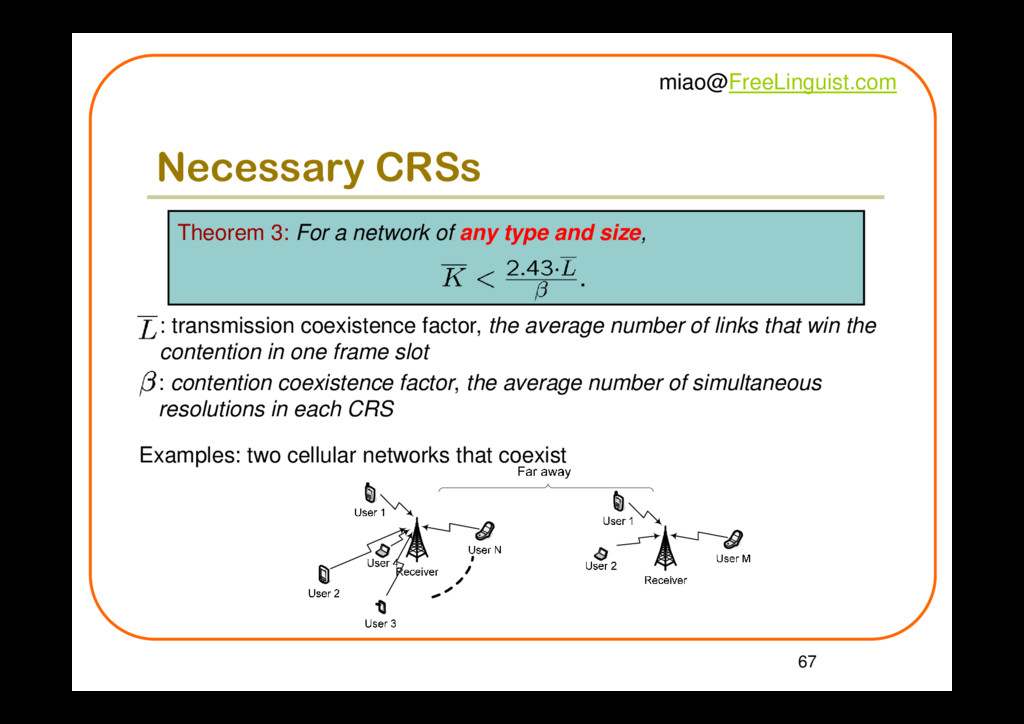
  60. [email protected] Theorem 3: For a network of any type and

    size, Necessary CRSs : transmission coexistence factor, the average number of links that win the contention in one frame slot : contention coexistence factor, the average number of simultaneous resolutions in each CRS Examples: two cellular networks that coexist 67
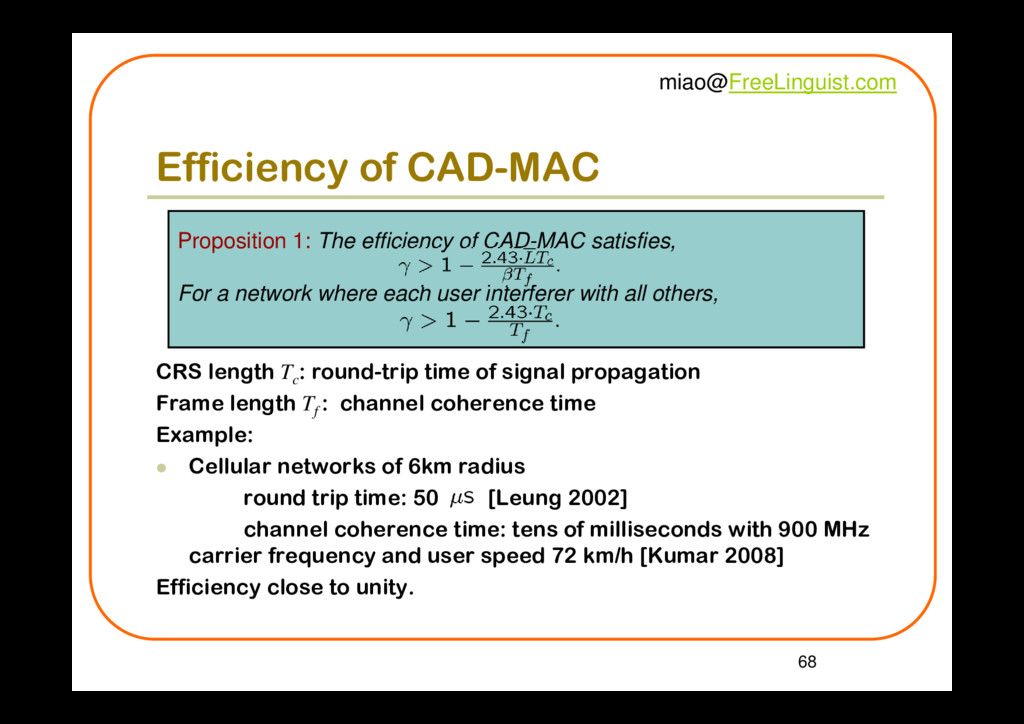
  61. [email protected] Efficiency of CAD-MAC CRS length Tc : round-trip time

    of signal propagation Frame length Tf : channel coherence time Example:  Cellular networks of 6km radius round trip time: 50 [Leung 2002] channel coherence time: tens of milliseconds with 900 MHz carrier frequency and user speed 72 km/h [Kumar 2008] Efficiency close to unity. Proposition 1: The efficiency of CAD-MAC satisfies, For a network where each user interferer with all others, 68
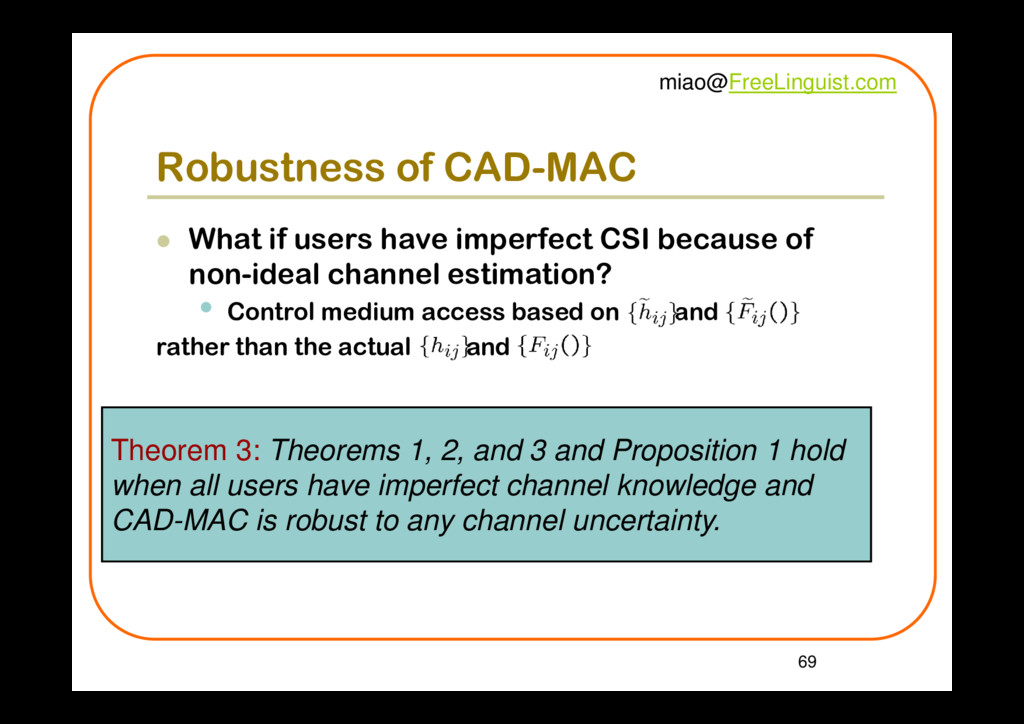
  62. [email protected] Robustness of CAD-MAC  What if users have imperfect

    CSI because of non-ideal channel estimation? • Control medium access based on and rather than the actual and Theorem 3: Theorems 1, 2, and 3 and Proposition 1 hold when all users have imperfect channel knowledge and CAD-MAC is robust to any channel uncertainty. 69
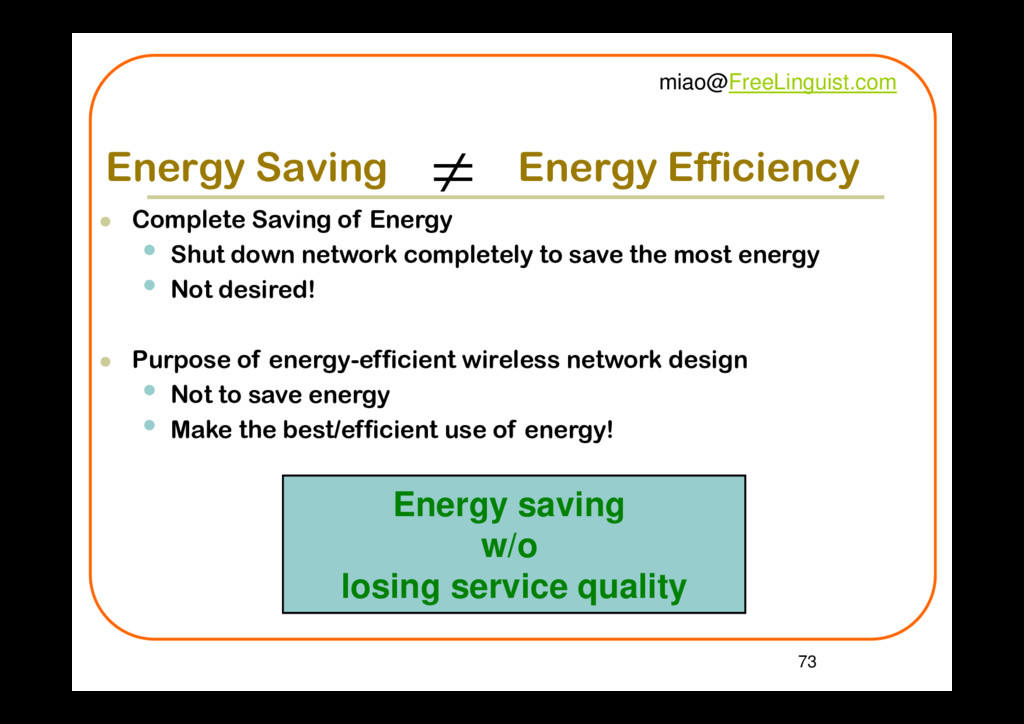
  63. [email protected] Energy Saving Energy Efficiency   Complete Saving of

    Energy • Shut down network completely to save the most energy • Not desired!  Purpose of energy-efficient wireless network design • Not to save energy • Make the best/efficient use of energy! Energy saving w/o losing service quality 73
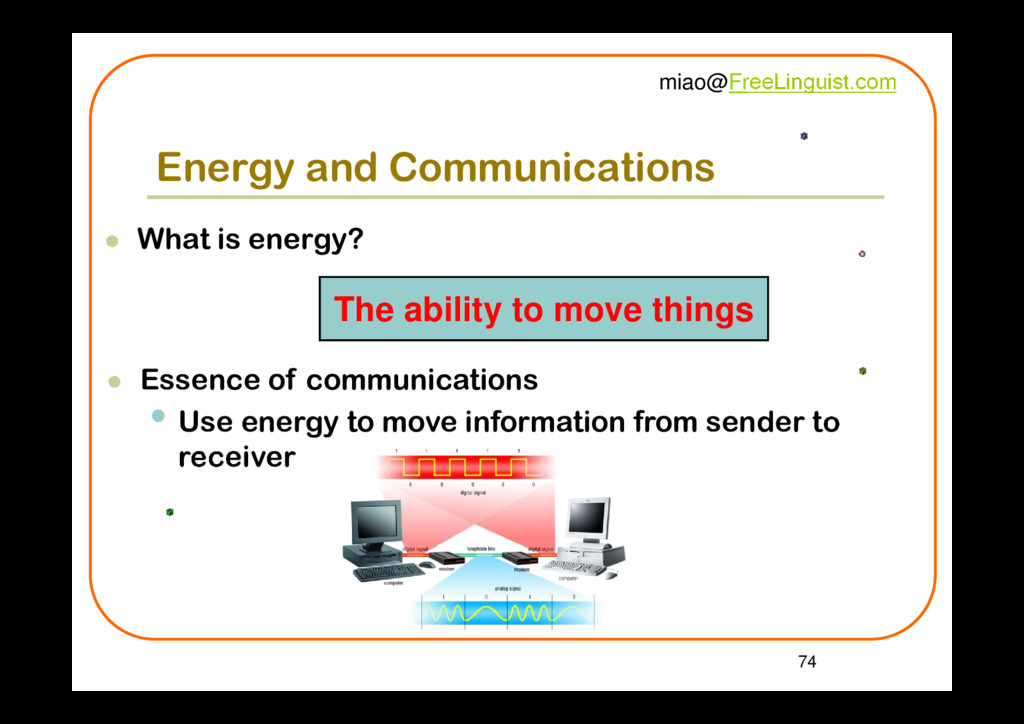
  64. [email protected]  Essence of communications • Use energy to move

    information from sender to receiver Energy and Communications  What is energy? The ability to move things 74
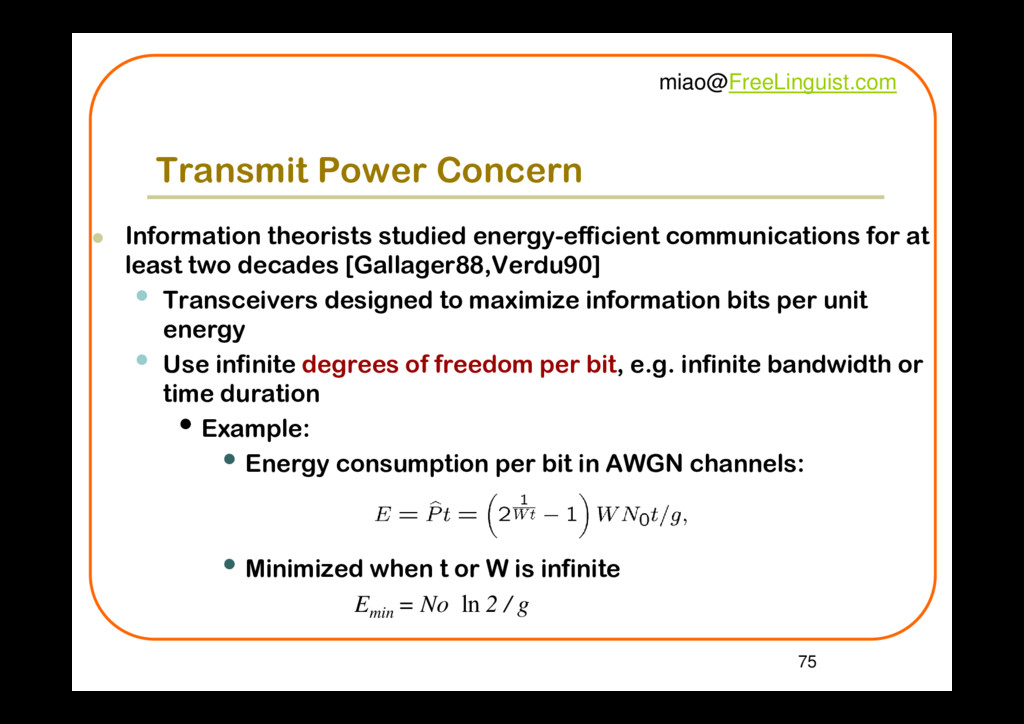
  65. [email protected] Transmit Power Concern  Information theorists studied energy-efficient communications

    for at least two decades [Gallager88,Verdu90] • Transceivers designed to maximize information bits per unit energy • Use infinite degrees of freedom per bit, e.g. infinite bandwidth or time duration • Example: • Energy consumption per bit in AWGN channels: • Minimized when t or W is infinite Emin = No ln 2 / g 75
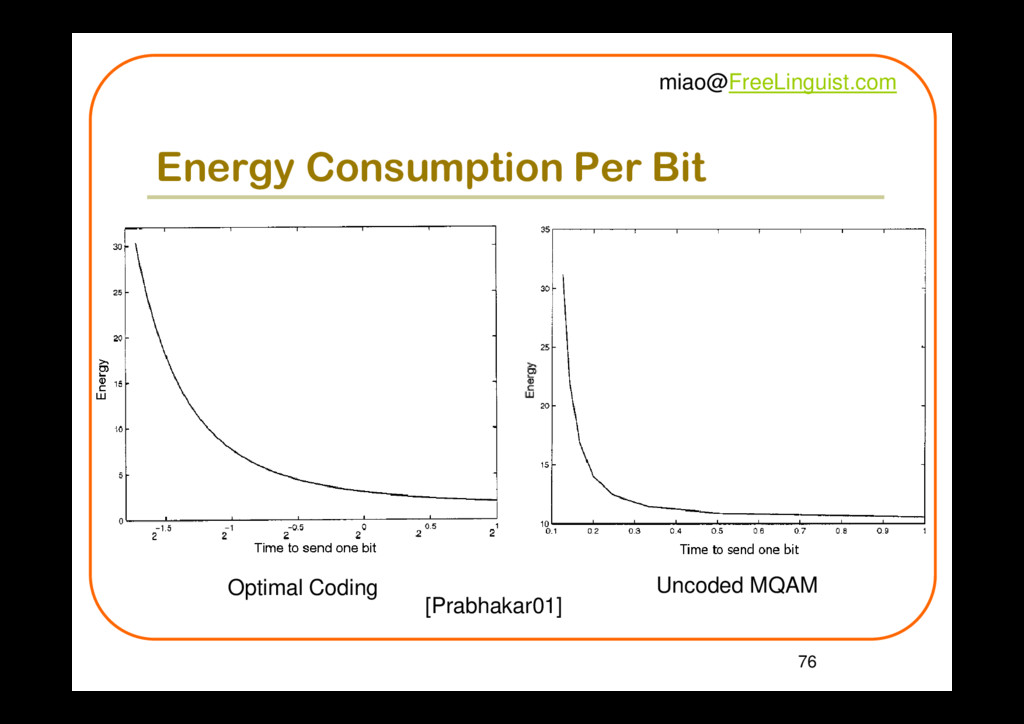
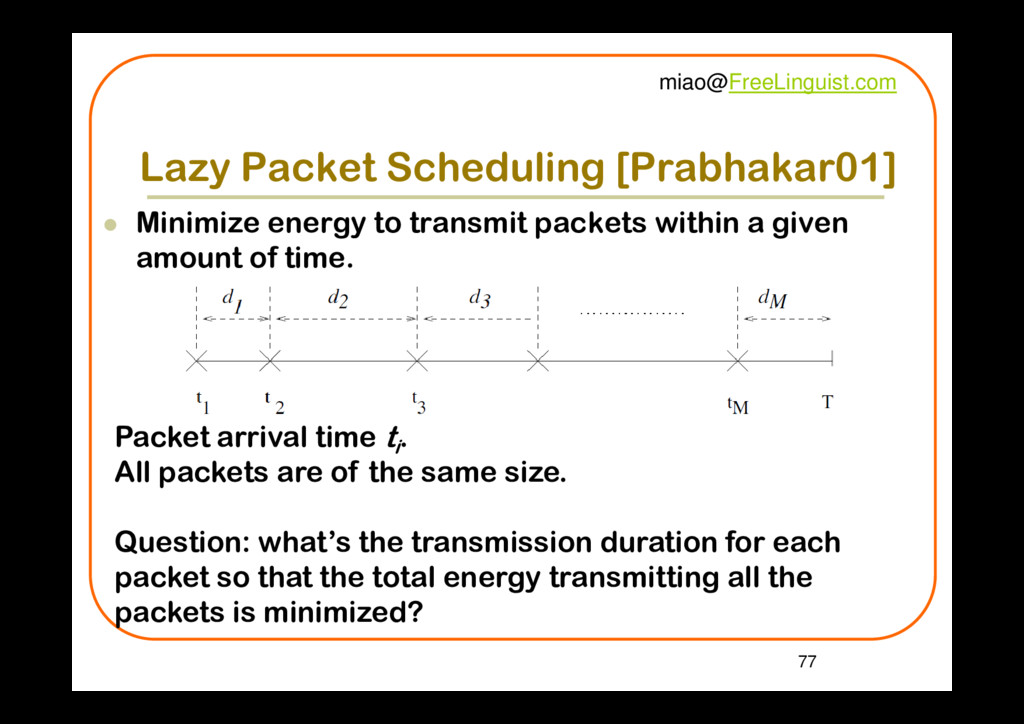
  66. [email protected] Lazy Packet Scheduling [Prabhakar01]  Minimize energy to transmit

    packets within a given amount of time. Packet arrival time ti . All packets are of the same size. Question: what’s the transmission duration for each packet so that the total energy transmitting all the packets is minimized? 77
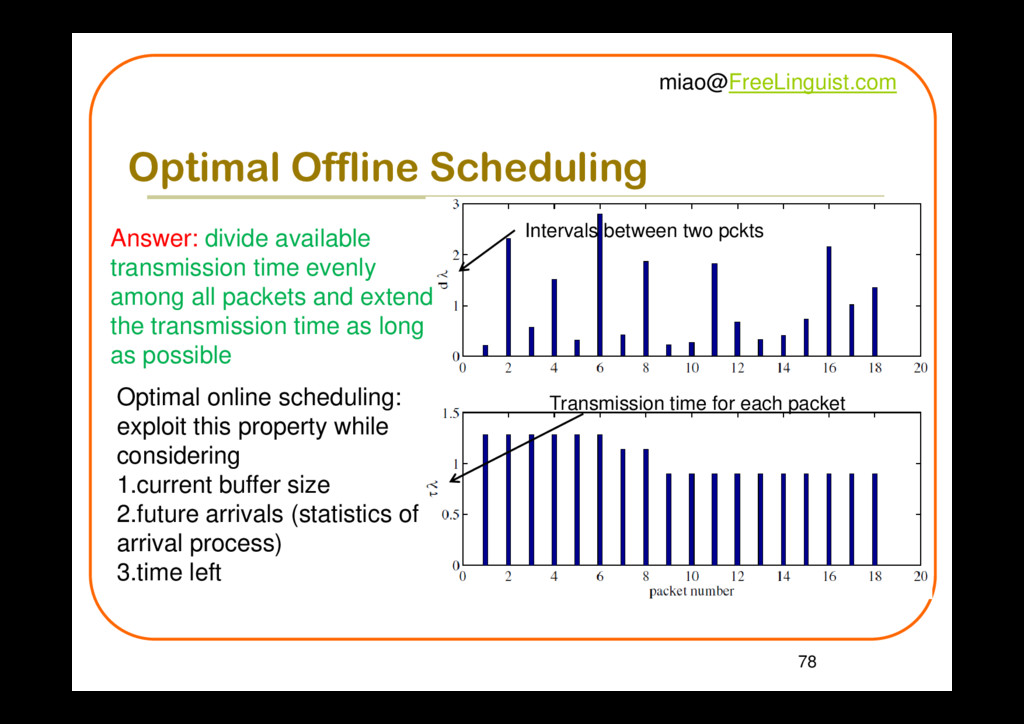
  67. [email protected] Optimal Offline Scheduling Intervals between two pckts Transmission time

    for each packet Answer: divide available transmission time evenly among all packets and extend the transmission time as long as possible Optimal online scheduling: exploit this property while considering 1.current buffer size 2.future arrivals (statistics of arrival process) 3.time left 78
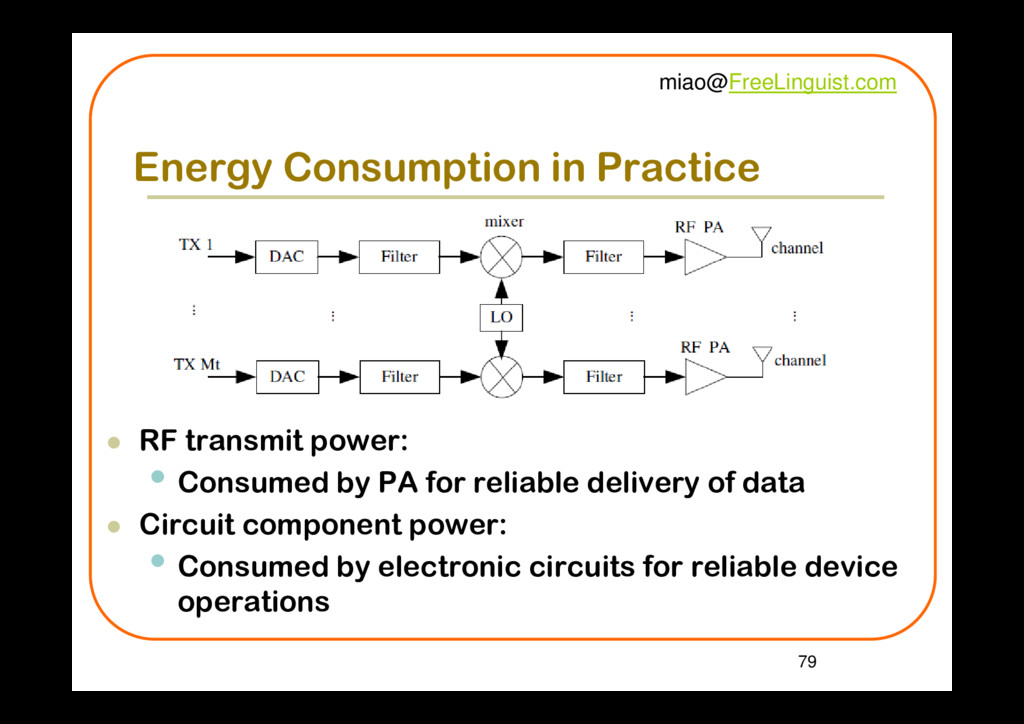
  68. [email protected] Energy Consumption in Practice  RF transmit power: •

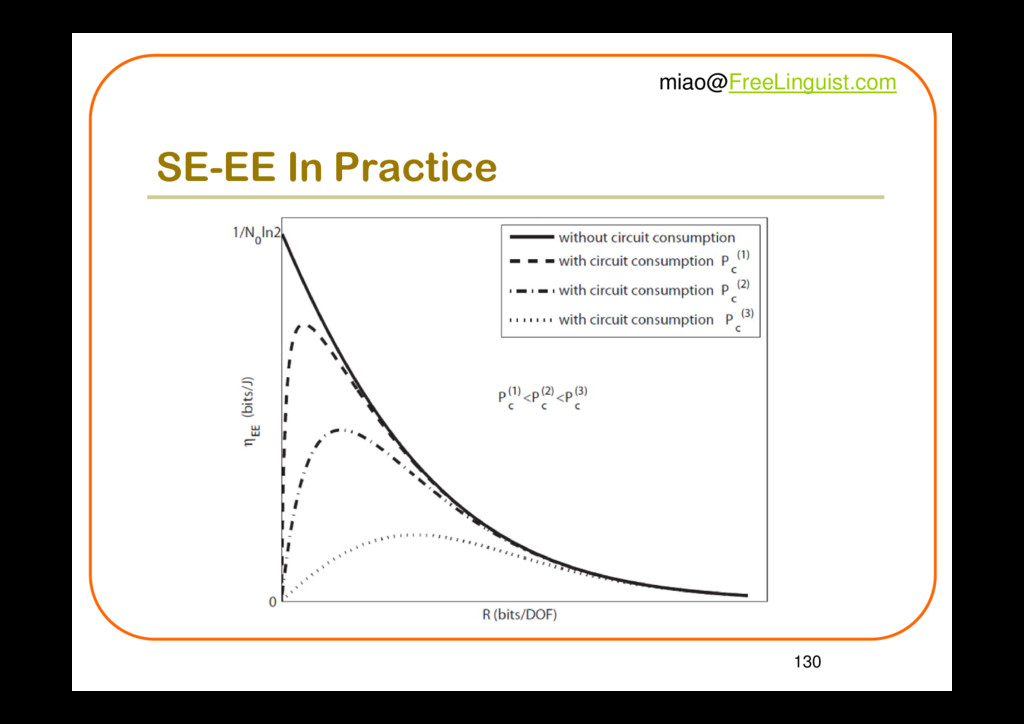
    Consumed by PA for reliable delivery of data  Circuit component power: • Consumed by electronic circuits for reliable device operations 79
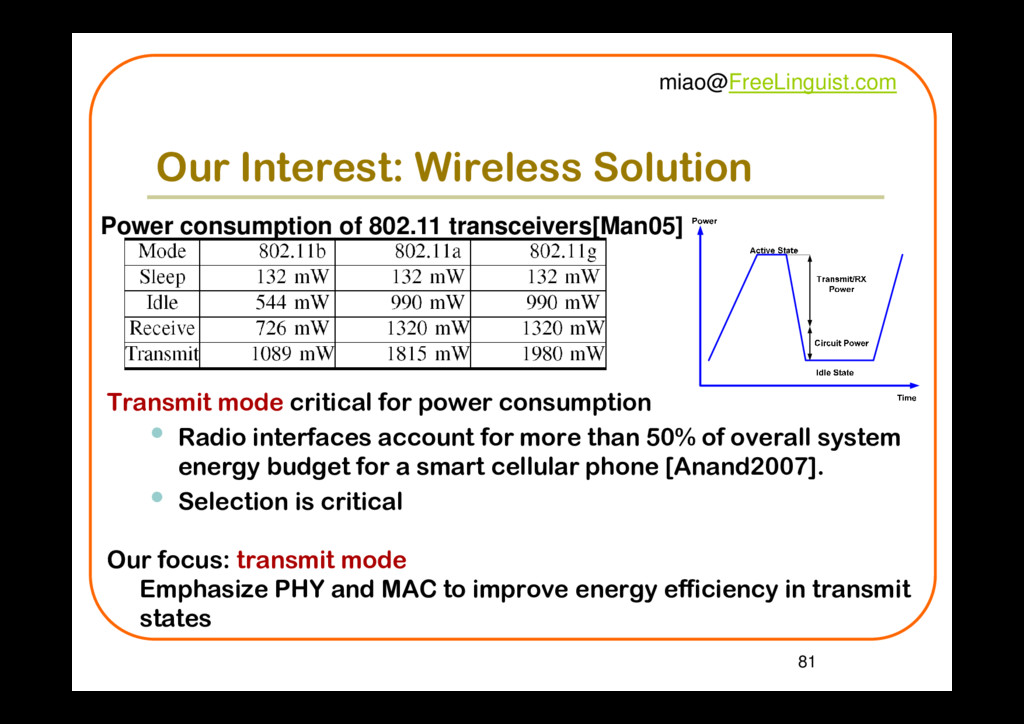
  69. [email protected] Our Interest: Wireless Solution Transmit mode critical for power

    consumption • Radio interfaces account for more than 50% of overall system energy budget for a smart cellular phone [Anand2007]. • Selection is critical Our focus: transmit mode Emphasize PHY and MAC to improve energy efficiency in transmit states Power consumption of 802.11 transceivers[Man05] 81
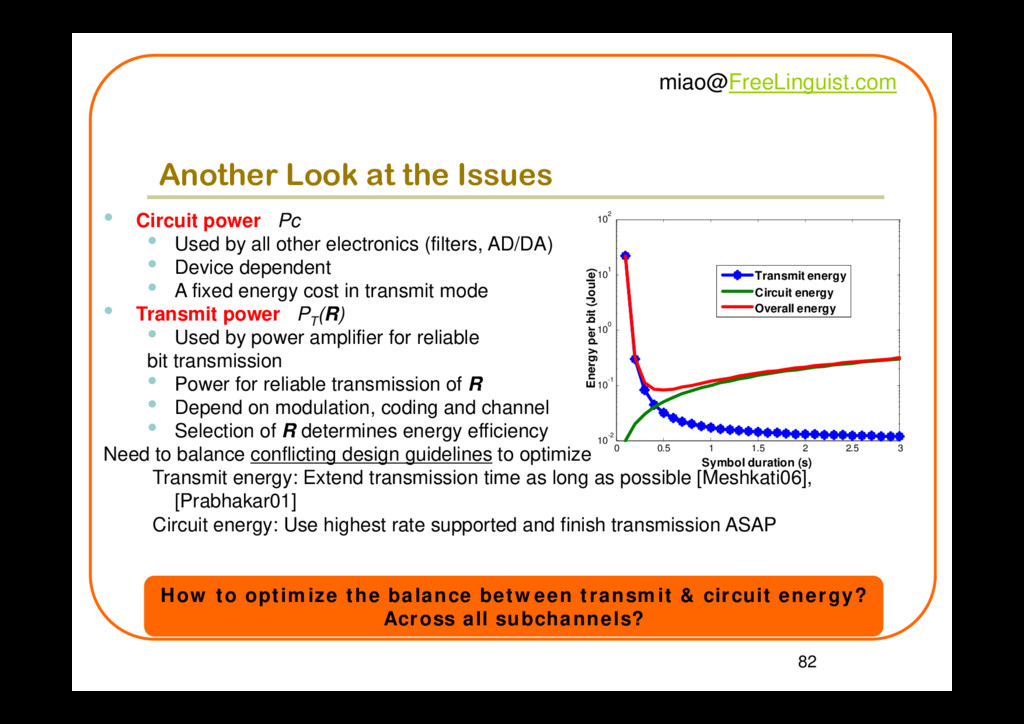
  70. [email protected] Another Look at the Issues • Circuit power Pc

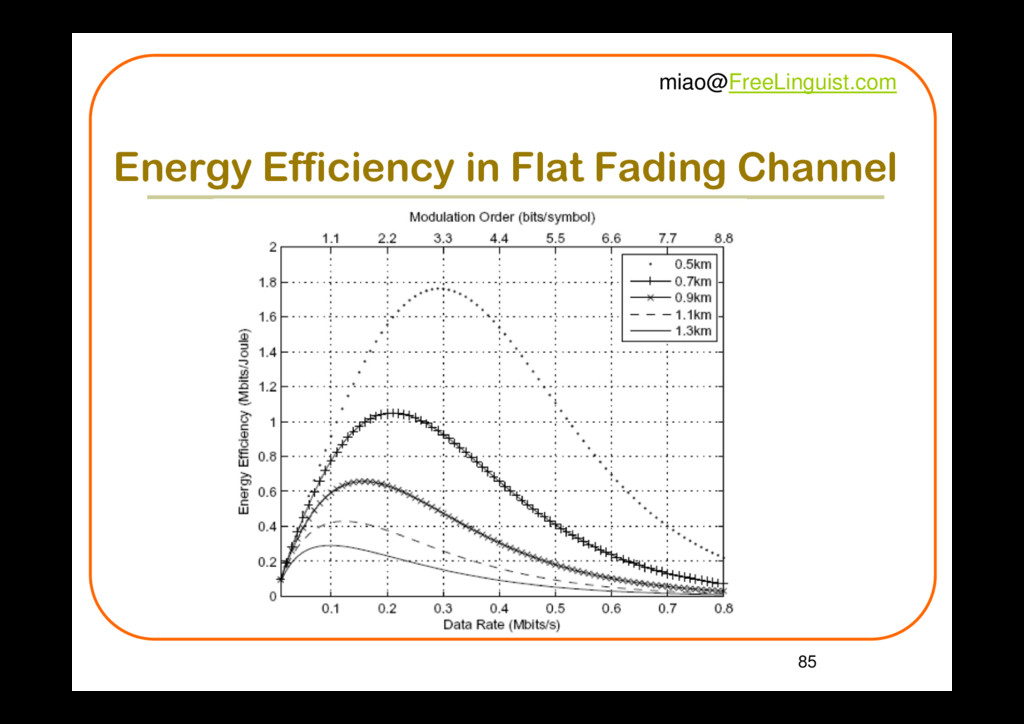
    • Used by all other electronics (filters, AD/DA) • Device dependent • A fixed energy cost in transmit mode • Transmit power PT (R) • Used by power amplifier for reliable bit transmission • Power for reliable transmission of R • Depend on modulation, coding and channel • Selection of R determines energy efficiency Need to balance conflicting design guidelines to optimize Transmit energy: Extend transmission time as long as possible [Meshkati06], [Prabhakar01] Circuit energy: Use highest rate supported and finish transmission ASAP 0 0.5 1 1.5 2 2.5 3 10-2 10-1 100 101 102 Symbol duration (s) Energy per bit (Joule) Transmit energy Circuit energy Overall energy How to optimize the balance between transmit & circuit energy? Across all subchannels? 82
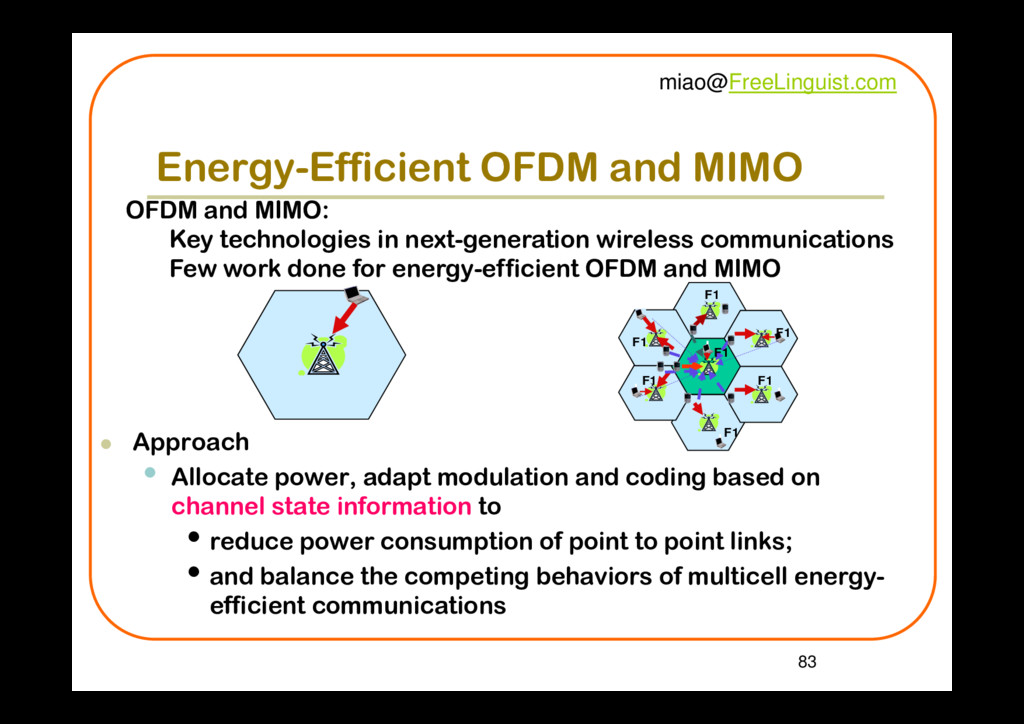
  71. [email protected]  Approach • Allocate power, adapt modulation and coding

    based on channel state information to • reduce power consumption of point to point links; • and balance the competing behaviors of multicell energy- efficient communications Energy-Efficient OFDM and MIMO F1 F1 F1 F1 F1 F1 F1 OFDM and MIMO: Key technologies in next-generation wireless communications Few work done for energy-efficient OFDM and MIMO 83
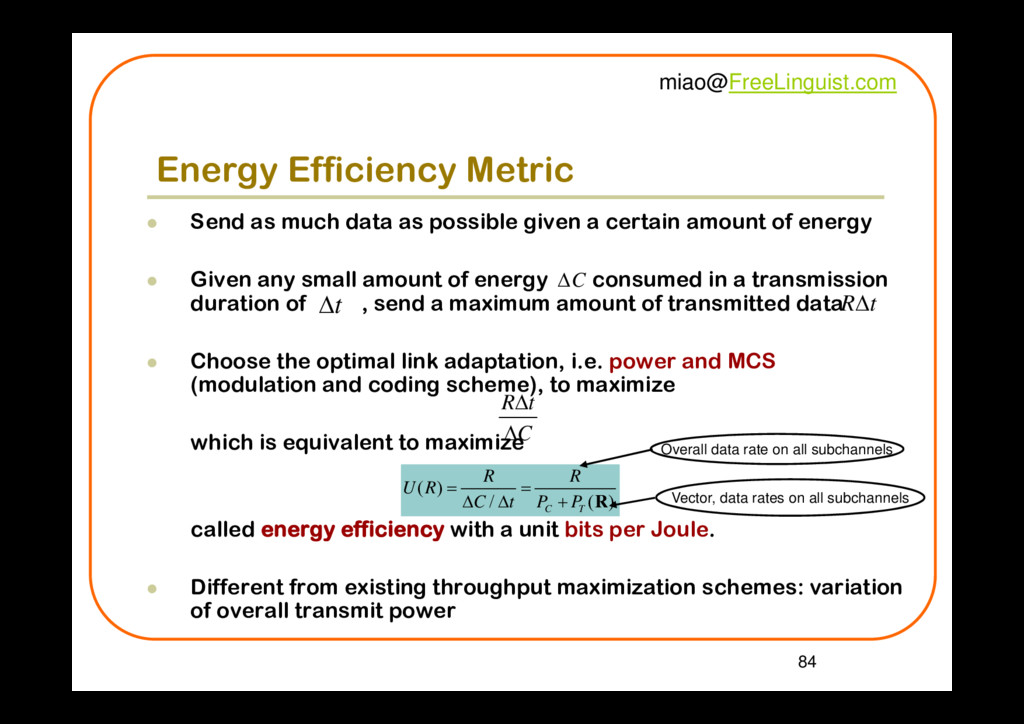
  72. [email protected] Energy Efficiency Metric  Send as much data as

    possible given a certain amount of energy  Given any small amount of energy consumed in a transmission duration of , send a maximum amount of transmitted data  Choose the optimal link adaptation, i.e. power and MCS (modulation and coding scheme), to maximize which is equivalent to maximize called energy efficiency with a unit bits per Joule.  Different from existing throughput maximization schemes: variation of overall transmit power C  t  R t  R t C   ( ) / ( ) C T R R U R C t P P      R Overall data rate on all subchannels Vector, data rates on all subchannels 84
  73. [email protected] 0.4 0.6 0.8 1.0 1.2 1.4 0 1 2

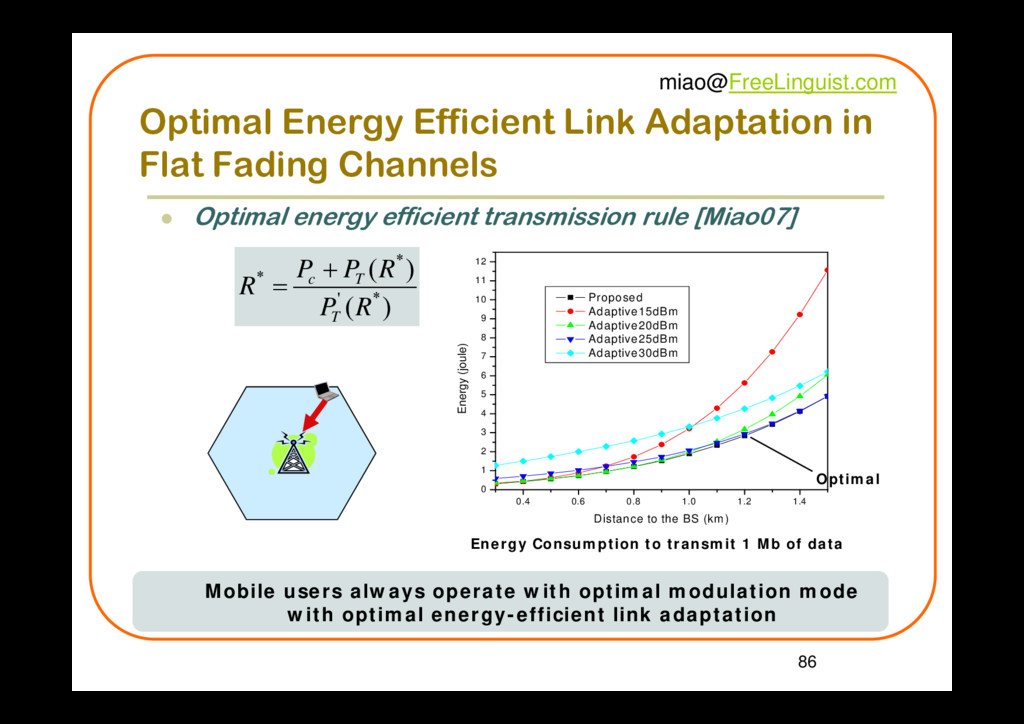
    3 4 5 6 7 8 9 10 11 12 Energy (joule) Distance to the BS (km) Proposed Adaptive15dBm Adaptive20dBm Adaptive25dBm Adaptive30dBm Optimal Energy Efficient Link Adaptation in Flat Fading Channels  Optimal energy efficient transmission rule [Miao07] ) ( ) ( * ' * * R P R P P R T T c   Mobile users always operate with optimal modulation mode with optimal energy-efficient link adaptation Energy Consumption to transmit 1 Mb of data Optimal 86
  74. [email protected] Properties of Energy-Efficient Link Adaptation • To improve energy

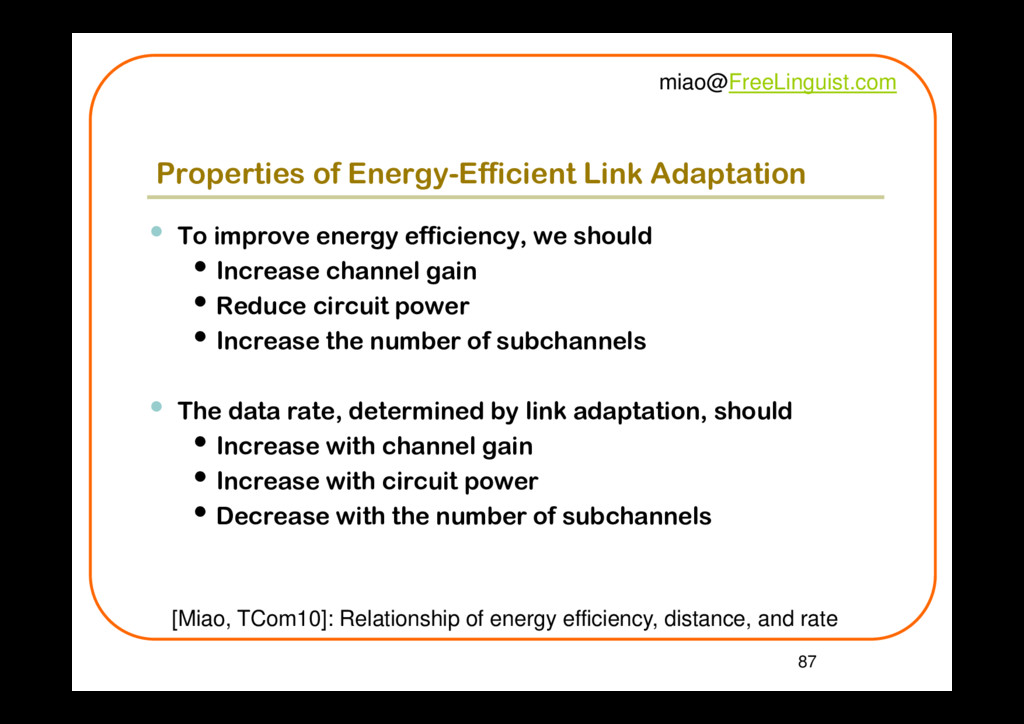
    efficiency, we should • Increase channel gain • Reduce circuit power • Increase the number of subchannels • The data rate, determined by link adaptation, should • Increase with channel gain • Increase with circuit power • Decrease with the number of subchannels [Miao, TCom10]: Relationship of energy efficiency, distance, and rate 87
  75. [email protected] Upper Bound  Upper bound of energy efficiency With

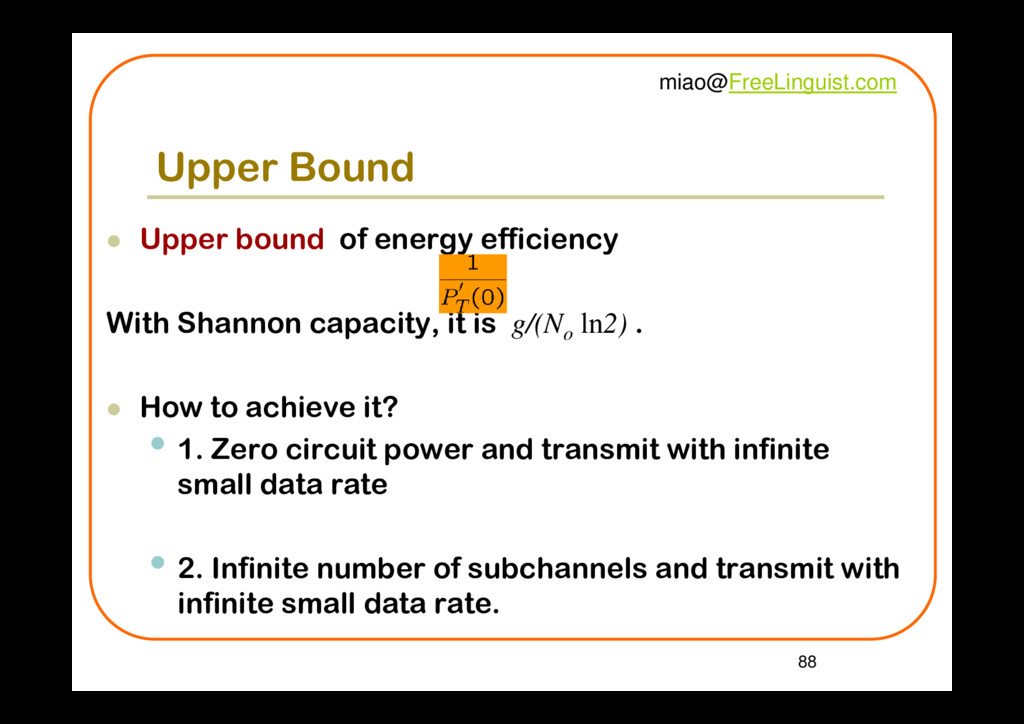
    Shannon capacity, it is g/(No ln2) .  How to achieve it? • 1. Zero circuit power and transmit with infinite small data rate • 2. Infinite number of subchannels and transmit with infinite small data rate. 88
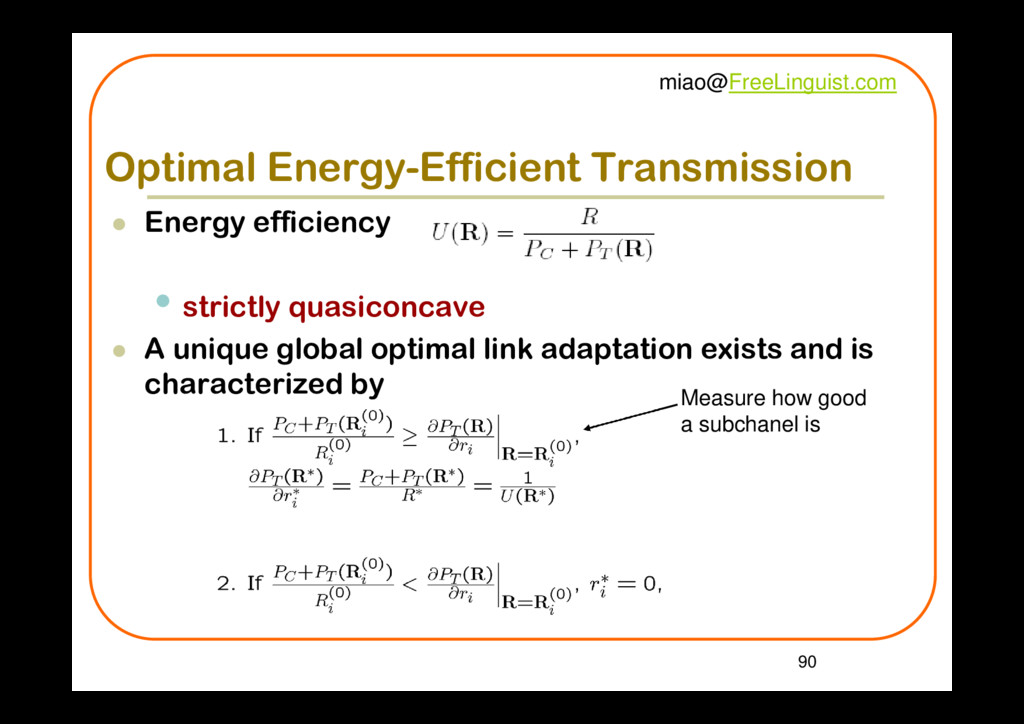
  76. [email protected] Optimal Energy-Efficient Transmission  Energy efficiency • strictly quasiconcave

     A unique global optimal link adaptation exists and is characterized by Measure how good a subchanel is 90
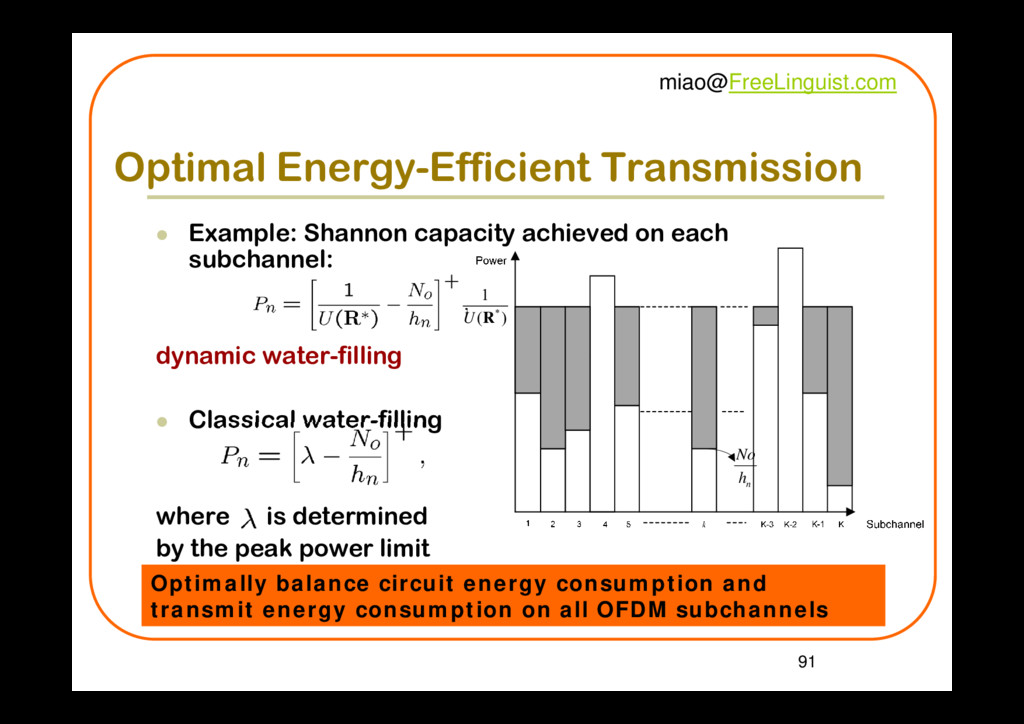
  77. [email protected] Optimal Energy-Efficient Transmission  Example: Shannon capacity achieved on

    each subchannel: dynamic water-filling  Classical water-filling where is determined by the peak power limit ) ( 1 * R U n h No Optimally balance circuit energy consumption and transmit energy consumption on all OFDM subchannels 91
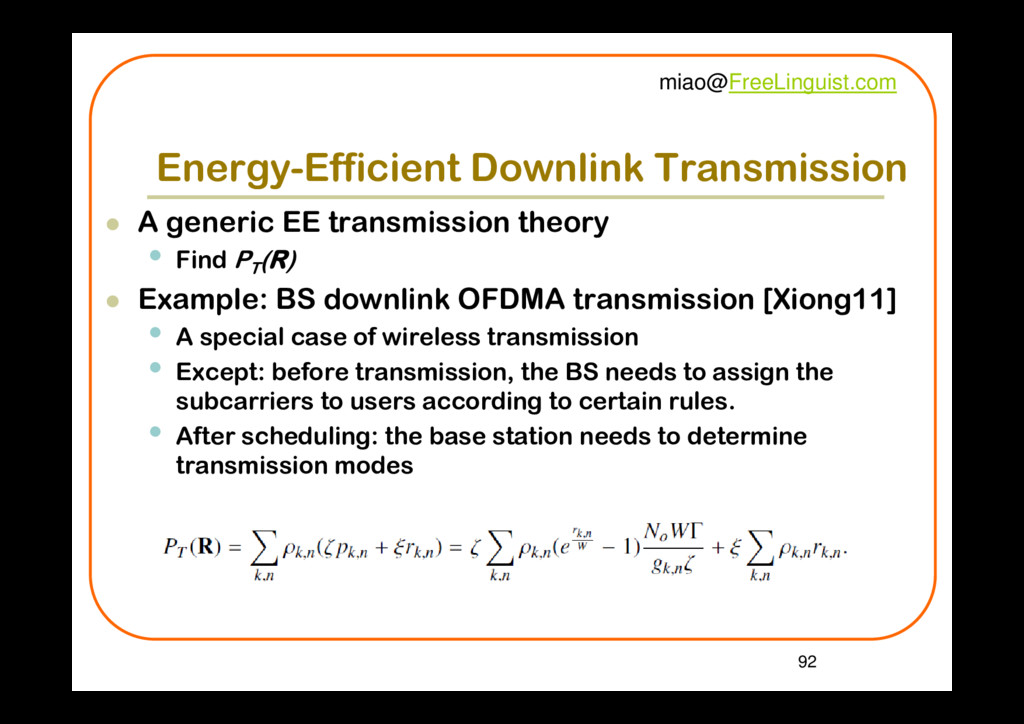
  78. [email protected] Energy-Efficient Downlink Transmission  A generic EE transmission theory

    • Find PT (R)  Example: BS downlink OFDMA transmission [Xiong11] • A special case of wireless transmission • Except: before transmission, the BS needs to assign the subcarriers to users according to certain rules. • After scheduling: the base station needs to determine transmission modes 92
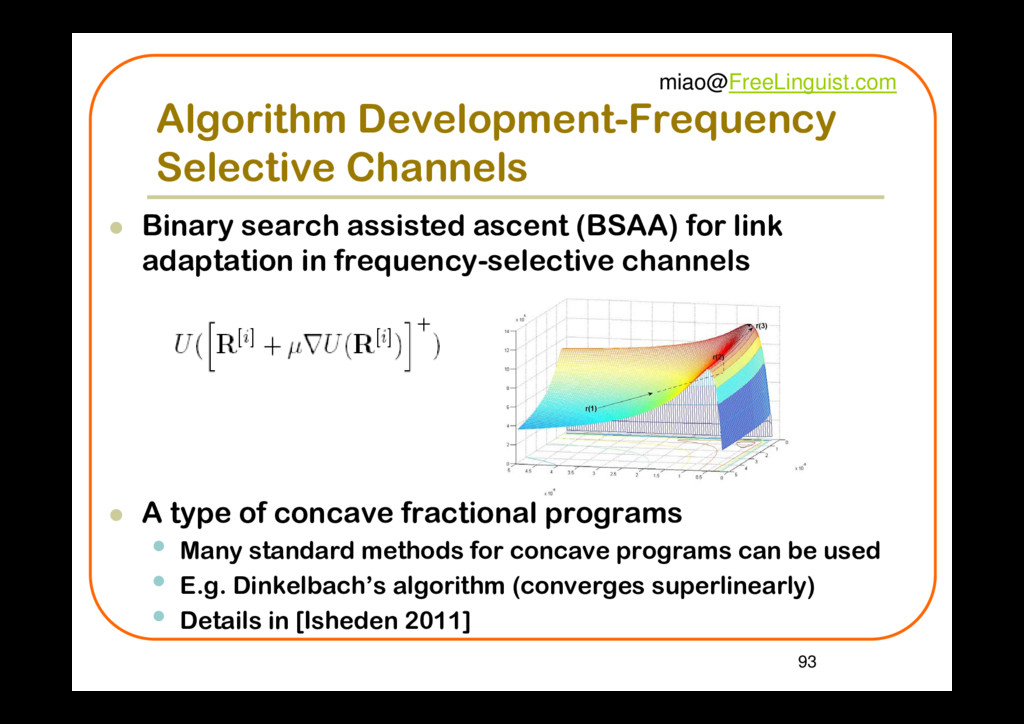
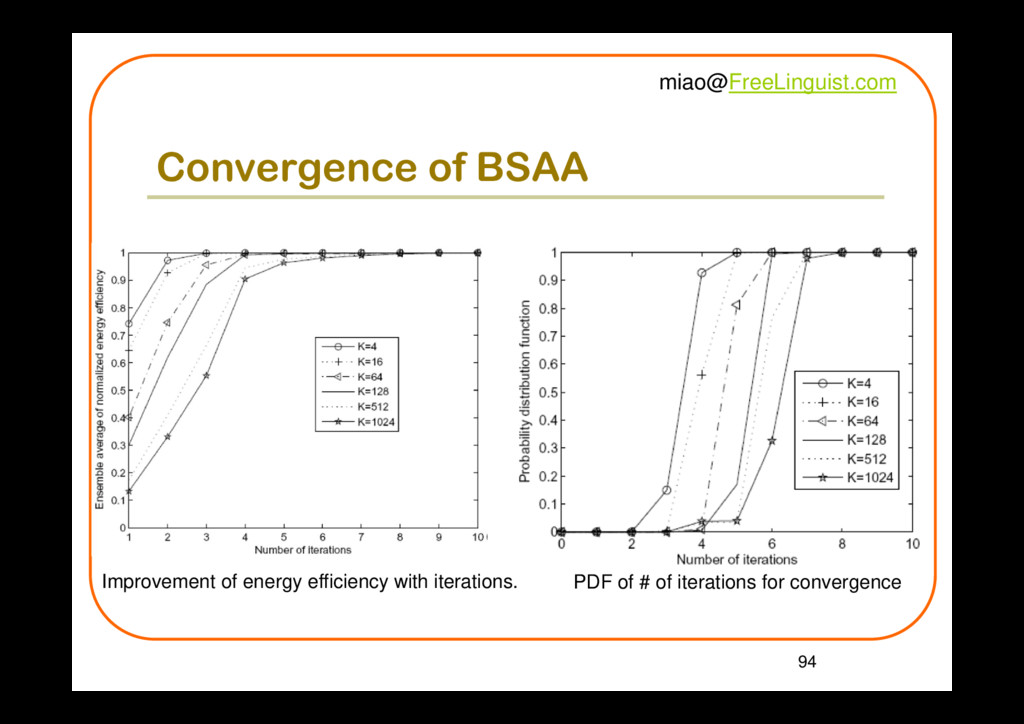
  79. [email protected]  Binary search assisted ascent (BSAA) for link adaptation

    in frequency-selective channels  A type of concave fractional programs • Many standard methods for concave programs can be used • E.g. Dinkelbach’s algorithm (converges superlinearly) • Details in [Isheden 2011] Algorithm Development-Frequency Selective Channels 93
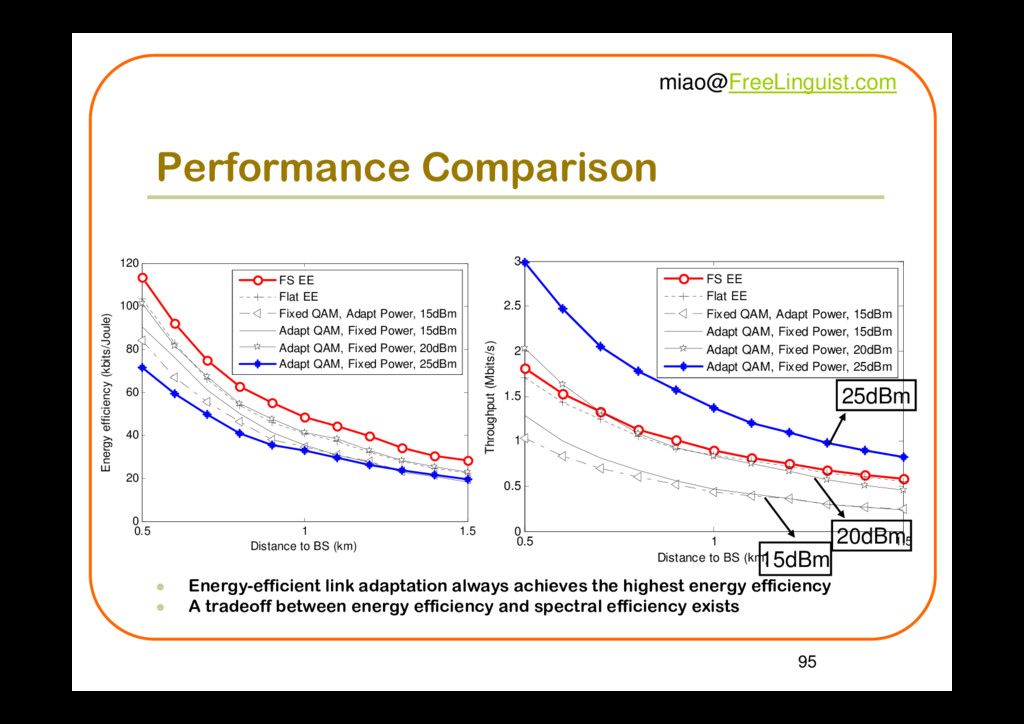
  80. [email protected] Performance Comparison  Energy-efficient link adaptation always achieves the

    highest energy efficiency  A tradeoff between energy efficiency and spectral efficiency exists 0.5 1 1.5 0 20 40 60 80 100 120 Distance to BS (km) Energy efficiency (kbits/Joule) FS EE Flat EE Fixed QAM, Adapt Power, 15dBm Adapt QAM, Fixed Power, 15dBm Adapt QAM, Fixed Power, 20dBm Adapt QAM, Fixed Power, 25dBm 0.5 1 1.5 0 0.5 1 1.5 2 2.5 3 Distance to BS (km) Throughput (Mbits/s) FS EE Flat EE Fixed QAM, Adapt Power, 15dBm Adapt QAM, Fixed Power, 15dBm Adapt QAM, Fixed Power, 20dBm Adapt QAM, Fixed Power, 25dBm 15dBm 20dBm 25dBm 95
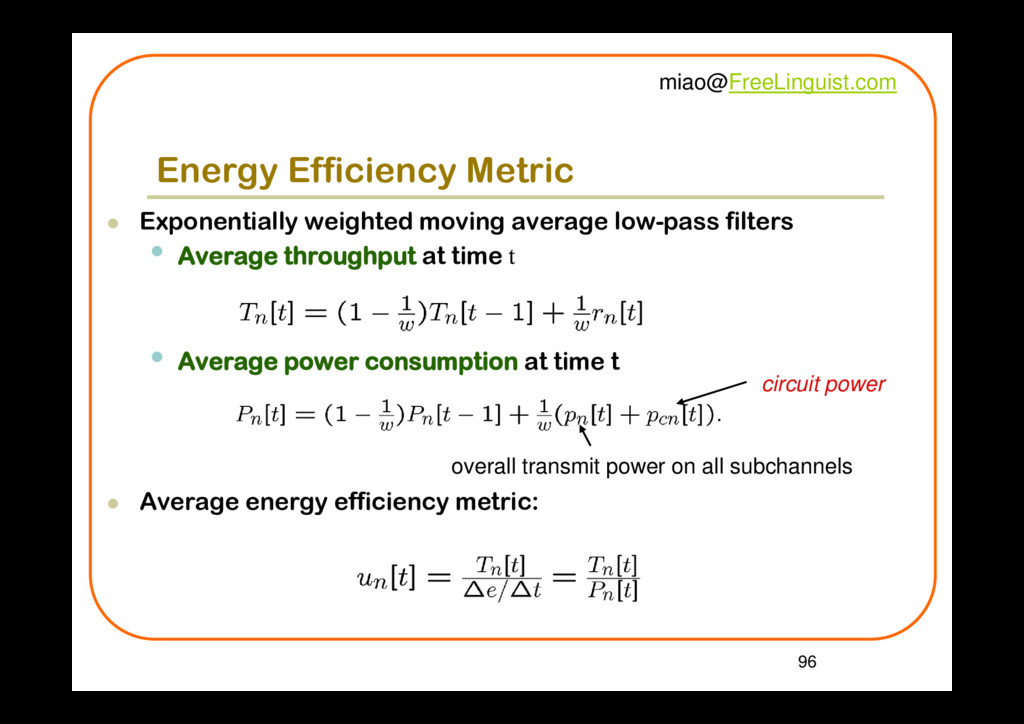
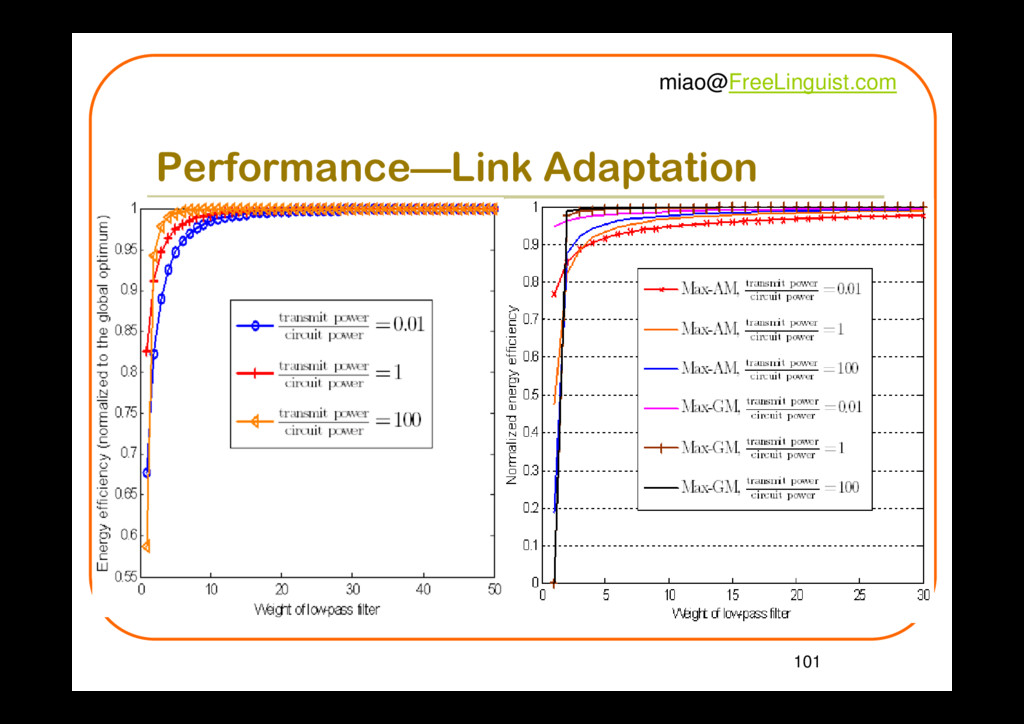
  81. [email protected] Energy Efficiency Metric  Exponentially weighted moving average low-pass

    filters • Average throughput at time t • Average power consumption at time t  Average energy efficiency metric: circuit power overall transmit power on all subchannels 96
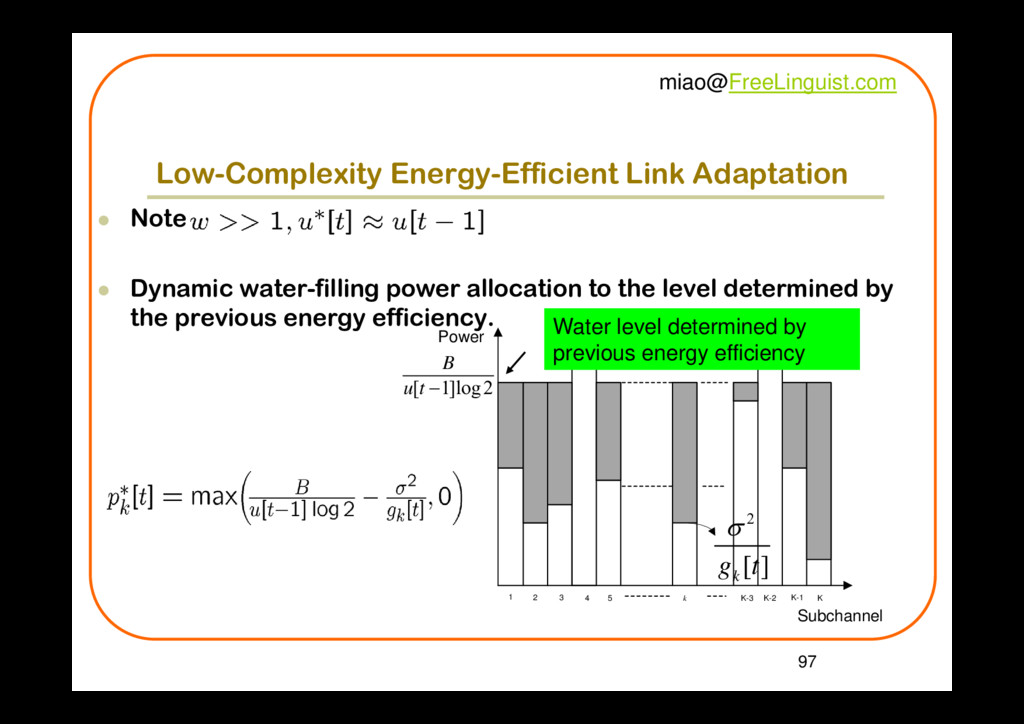
  82. [email protected] 2 [ ] k g t  1 2

    3 4 K-2 K-1 K Power Subchannel [ 1]log2 B u t  5 K-3 k Low-Complexity Energy-Efficient Link Adaptation  Note  Dynamic water-filling power allocation to the level determined by the previous energy efficiency. Water level determined by previous energy efficiency 97
  83. [email protected] Multi-User Energy Aware Resource Allocation  Max arithmetic average

    of energy efficiency (w/o fairness)  Max geometric average of energy efficiency (w/ fairness) Energy aware resource allocation based on maximizing network “throughput per joule” metric  In a multi-user system, all subchannels cannot be assigned to one user  How to assign subchannels? 98
  84. [email protected] Resource Allocation w/o Fairness  Allocation metric: • For

    user n on subchannel k • Assign subchannel k to the user with the highest metric Closed-form resource allocation w/o fairness • Circuit power >> transmit power (short distance commun.) and circuit power the same for all users Max-SINR scheduler 99
  85. [email protected] Resource Allocation w/ Fairness  Allocation metric: • For

    user n on subchannel k • Assign subchannel k to the user with the highest metric Closed-form resource allocation w/ fairness • Circuit power >> Transmit power (short distance commun.) Traditional Proportional Fair scheduler 100
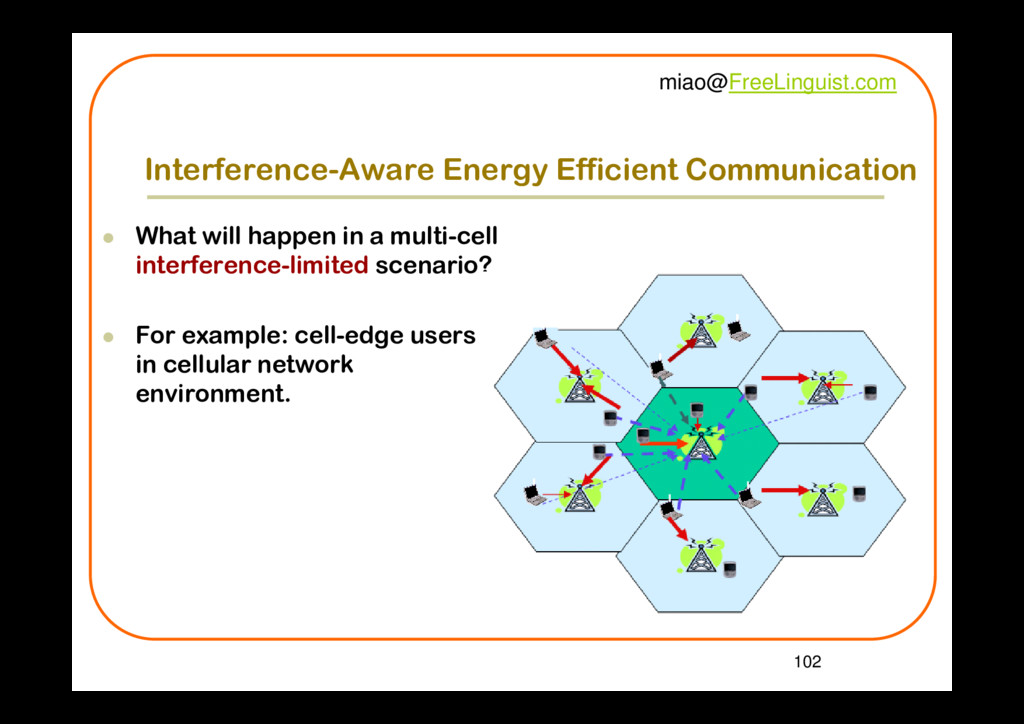
  86. [email protected] Interference-Aware Energy Efficient Communication  What will happen in

    a multi-cell interference-limited scenario?  For example: cell-edge users in cellular network environment. 102
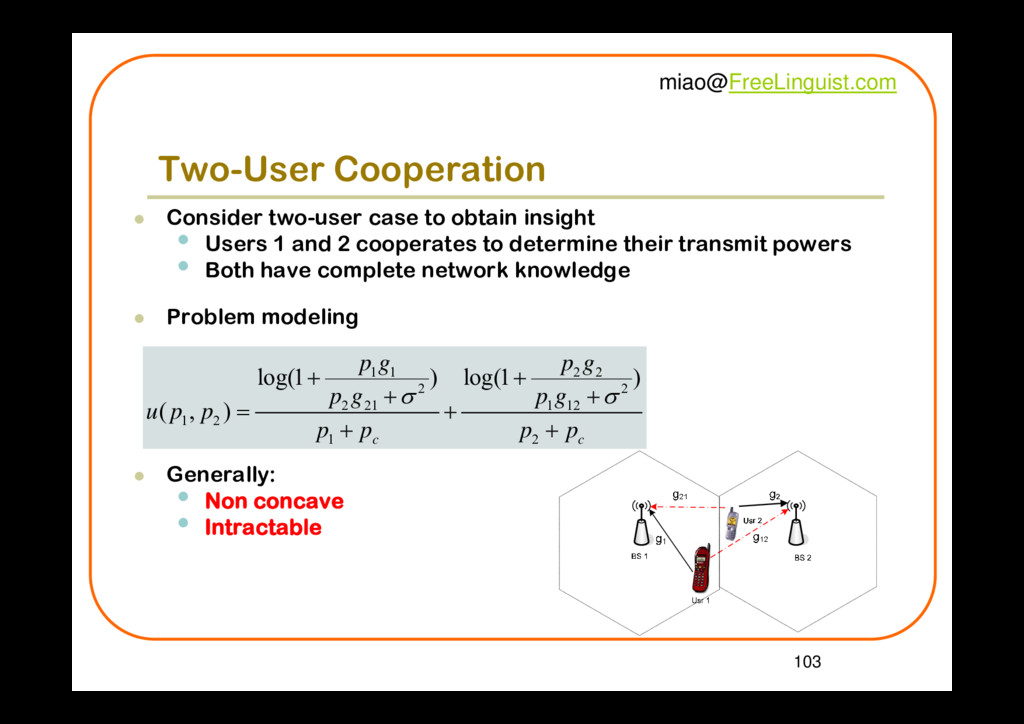
  87. [email protected] Two-User Cooperation  Consider two-user case to obtain insight

    • Users 1 and 2 cooperates to determine their transmit powers • Both have complete network knowledge  Problem modeling  Generally: • Non concave • Intractable 1 1 2 2 2 2 2 21 1 12 1 2 1 2 log(1 ) log(1 ) ( , ) c c p g p g p g p g u p p p p p p           103
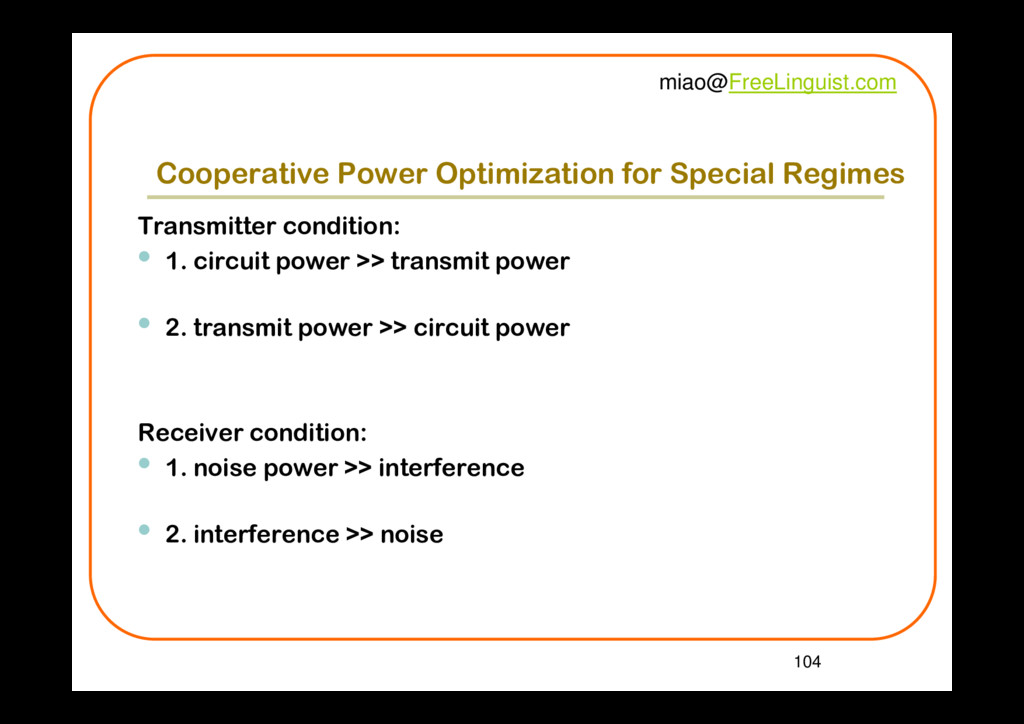
  88. [email protected] Cooperative Power Optimization for Special Regimes Transmitter condition: •

    1. circuit power >> transmit power • 2. transmit power >> circuit power Receiver condition: • 1. noise power >> interference • 2. interference >> noise 104
  89. [email protected] Circuit Power Dominated Regime  When circuit power dominates

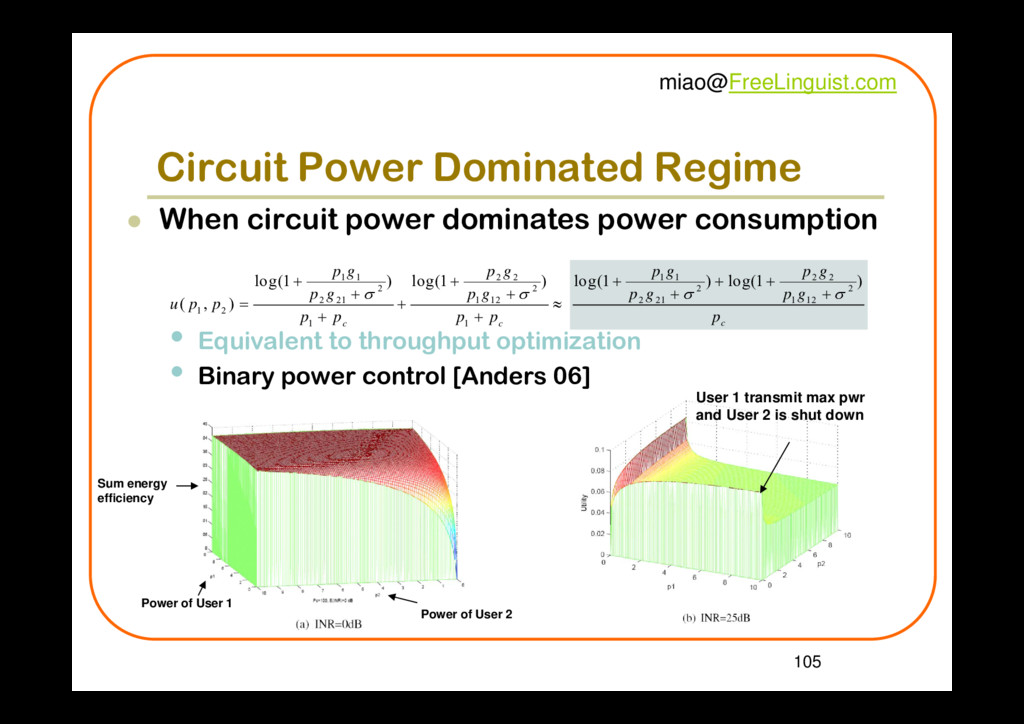
    power consumption • Equivalent to throughput optimization • Binary power control [Anders 06] 1 1 2 2 2 2 2 21 1 12 1 2 1 1 log(1 ) log(1 ) ( , ) c c p g p g p g p g u p p p p p p            1 1 2 2 2 2 2 21 1 12 log(1 ) log(1 ) c p g p g p g p g p        Power of User 2 Power of User 1 Sum energy efficiency User 1 transmit max pwr and User 2 is shut down 105
  90. [email protected] Transmit Power Dominated Regime  When the circuit power

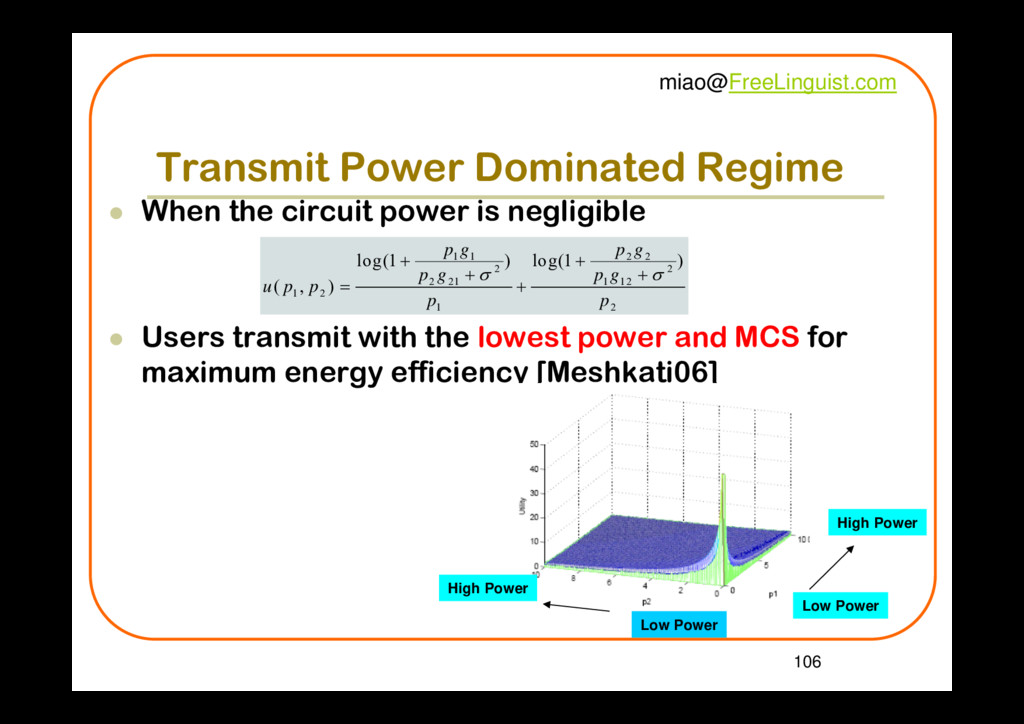
    is negligible  Users transmit with the lowest power and MCS for maximum energy efficiency [Meshkati06] 1 1 2 2 2 2 2 21 1 12 1 2 1 2 log(1 ) log(1 ) ( , ) p g p g p g p g u p p p p         Low Power High Power Low Power High Power 106
  91. [email protected] Noise Dominated Regime  When noise power dominates interference

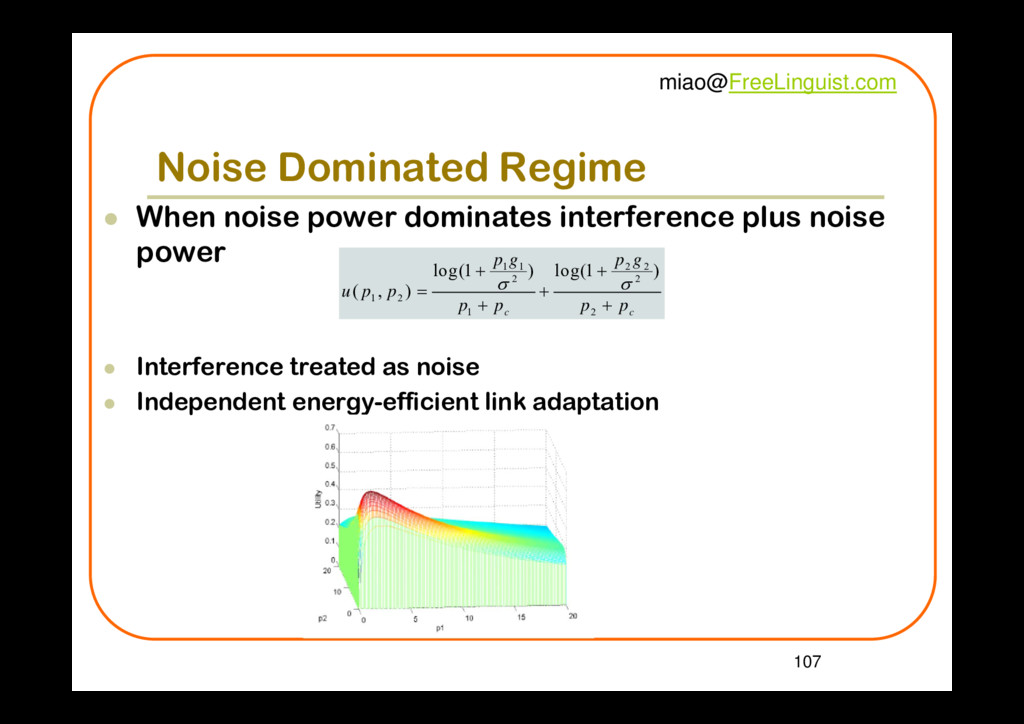
    plus noise power  Interference treated as noise  Independent energy-efficient link adaptation 1 1 2 2 2 2 1 2 1 2 log(1 ) log(1 ) ( , ) c c p g p g u p p p p p p         107
  92. [email protected] Interference Dominated Regime  Interference far larger than noise

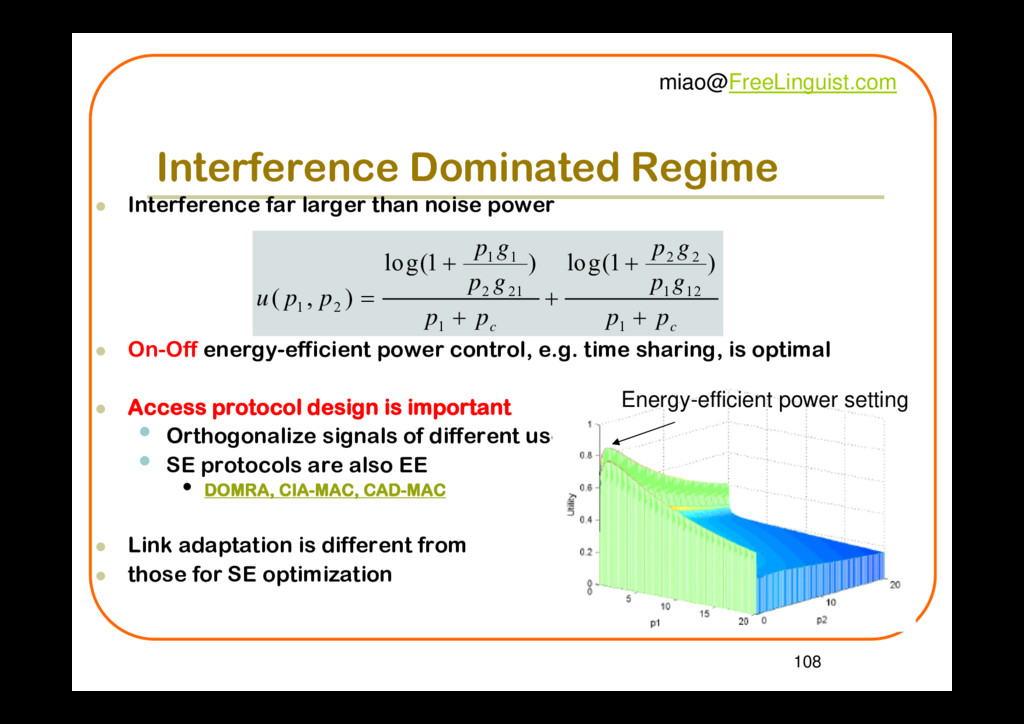
    power  On-Off energy-efficient power control, e.g. time sharing, is optimal  Access protocol design is important • Orthogonalize signals of different users • SE protocols are also EE • DOMRA, CIA-MAC, CAD-MAC  Link adaptation is different from  those for SE optimization 1 1 2 2 2 21 1 12 1 2 1 1 log(1 ) log(1 ) ( , ) c c p g p g p g p g u p p p p p p       Energy-efficient power setting 108
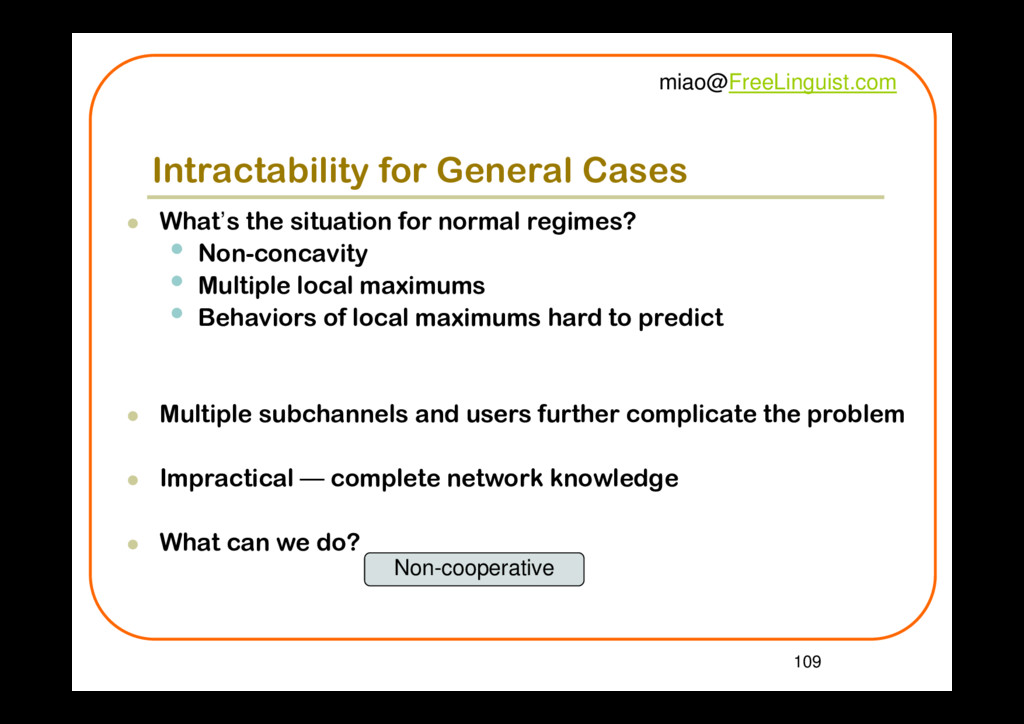
  93. [email protected] Intractability for General Cases  What’s the situation for

    normal regimes? • Non-concavity • Multiple local maximums • Behaviors of local maximums hard to predict  Multiple subchannels and users further complicate the problem  Impractical — complete network knowledge  What can we do? Non-cooperative 109
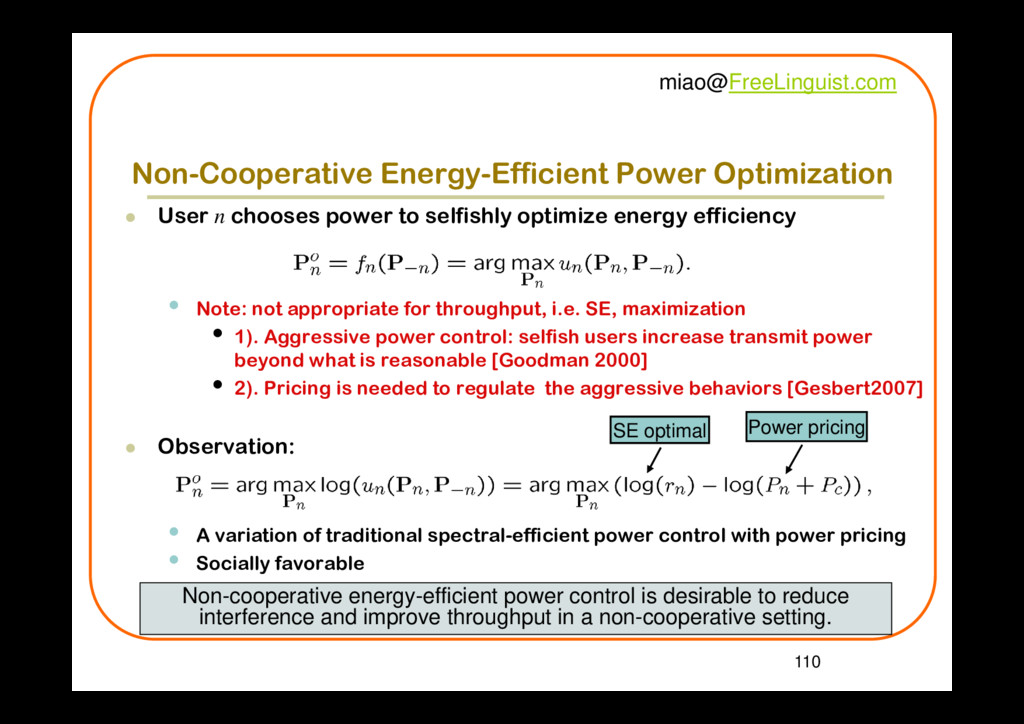
  94. [email protected] Non-Cooperative Energy-Efficient Power Optimization  User n chooses power

    to selfishly optimize energy efficiency • Note: not appropriate for throughput, i.e. SE, maximization • 1). Aggressive power control: selfish users increase transmit power beyond what is reasonable [Goodman 2000] • 2). Pricing is needed to regulate the aggressive behaviors [Gesbert2007]  Observation: • A variation of traditional spectral-efficient power control with power pricing • Socially favorable SE optimal Power pricing Non-cooperative energy-efficient power control is desirable to reduce interference and improve throughput in a non-cooperative setting. 110
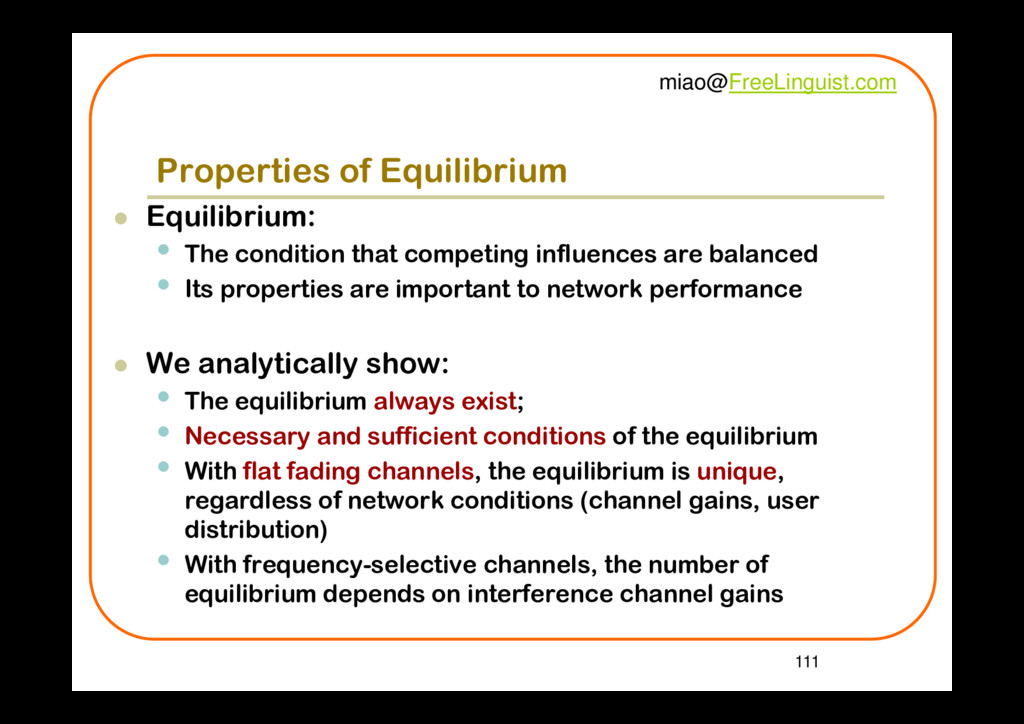
  95. [email protected] Properties of Equilibrium  Equilibrium: • The condition that

    competing influences are balanced • Its properties are important to network performance  We analytically show: • The equilibrium always exist; • Necessary and sufficient conditions of the equilibrium • With flat fading channels, the equilibrium is unique, regardless of network conditions (channel gains, user distribution) • With frequency-selective channels, the number of equilibrium depends on interference channel gains 111
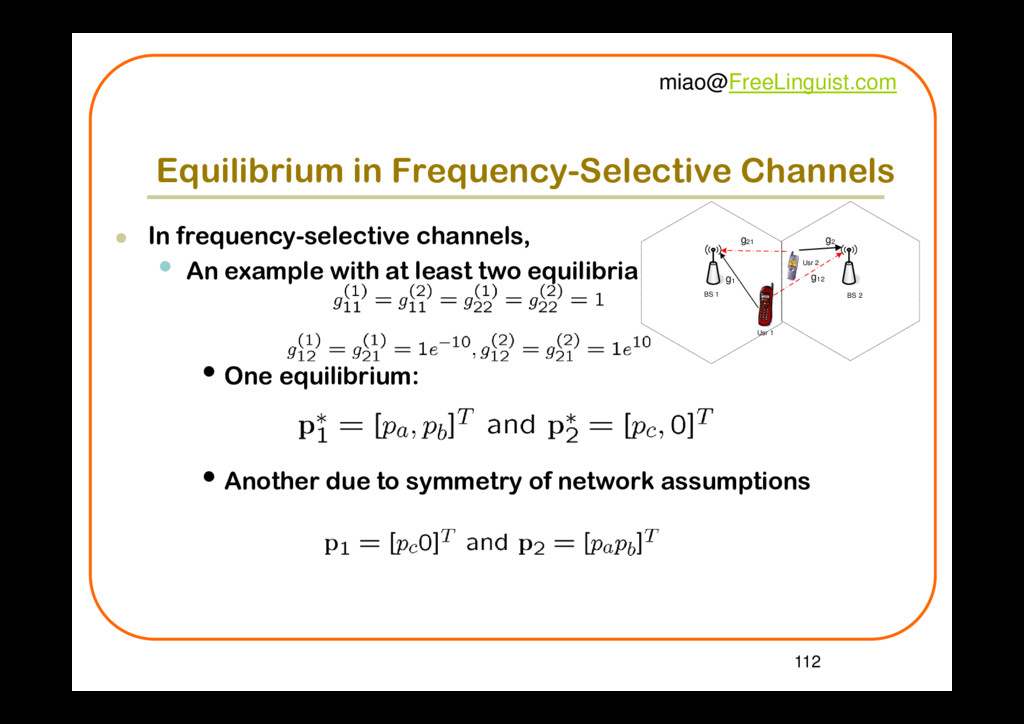
  96. [email protected] Equilibrium in Frequency-Selective Channels  In frequency-selective channels, •

    An example with at least two equilibria • One equilibrium: • Another due to symmetry of network assumptions BS 1 BS 2 g1 g2 g12 g21 Usr 1 Usr 2 112
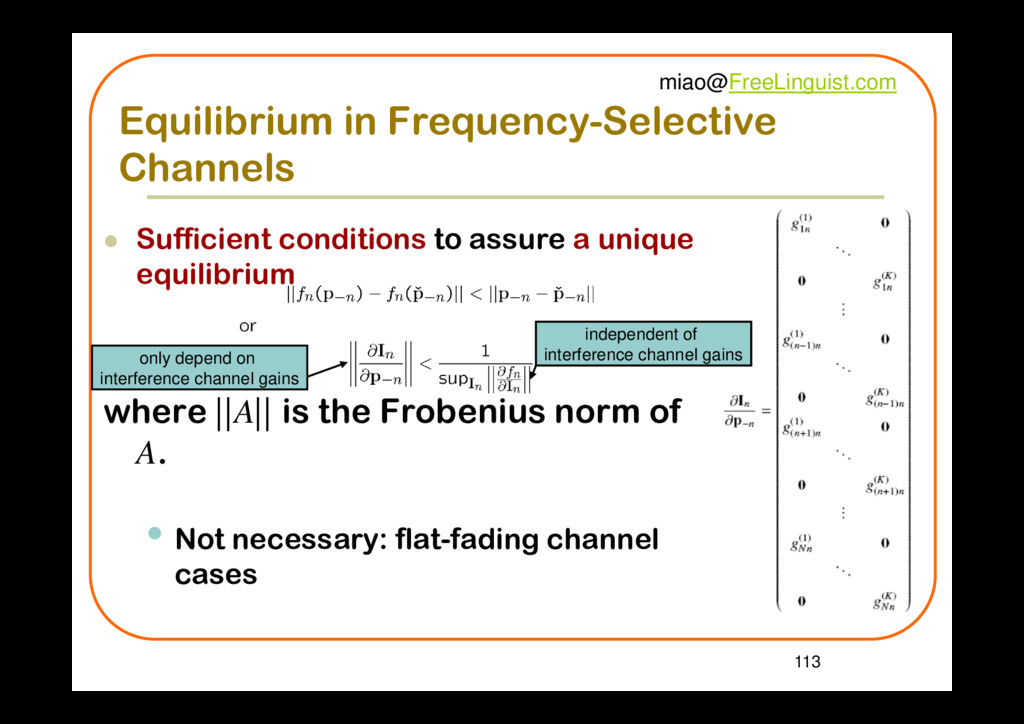
  97. [email protected] Equilibrium in Frequency-Selective Channels  Sufficient conditions to assure

    a unique equilibrium where ||A|| is the Frobenius norm of A. • Not necessary: flat-fading channel cases only depend on interference channel gains independent of interference channel gains 113
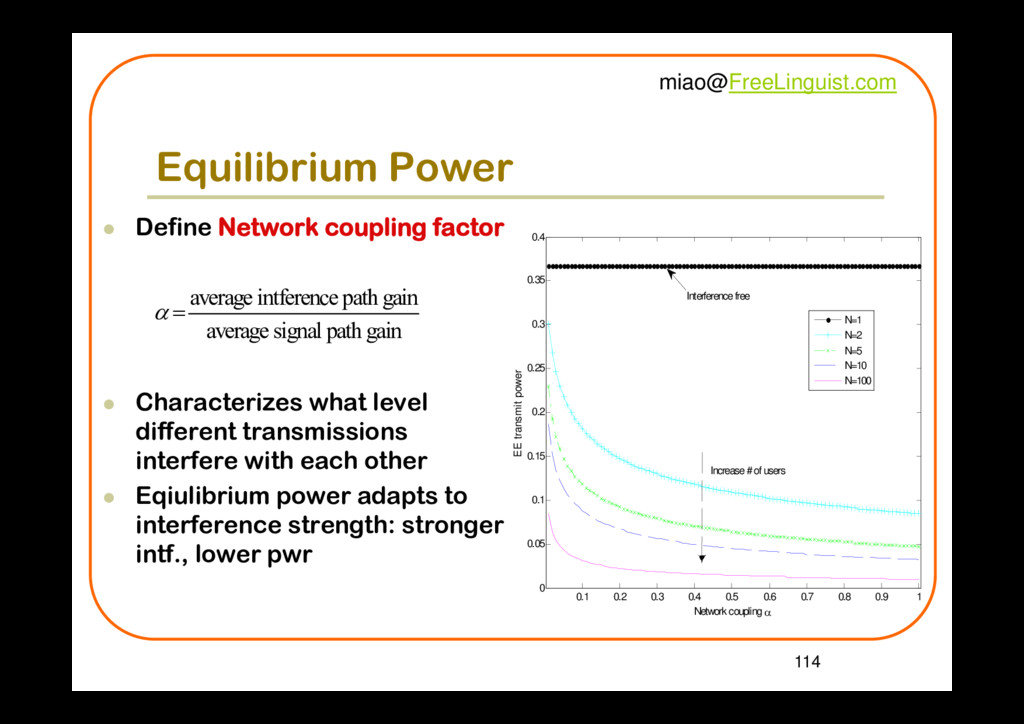
  98. [email protected] Equilibrium Power  Define Network coupling factor  Characterizes

    what level different transmissions interfere with each other  Eqiulibrium power adapts to interference strength: stronger intf., lower pwr 0.1 0.2 0.3 0.4 0.5 0.6 0.7 0.8 0.9 1 0 0.05 0.1 0.15 0.2 0.25 0.3 0.35 0.4 Network coupling  EE transmit power N=1 N=2 N=5 N=10 N=100 Interference free Increase # of users average intference path gain average signal path gain   114
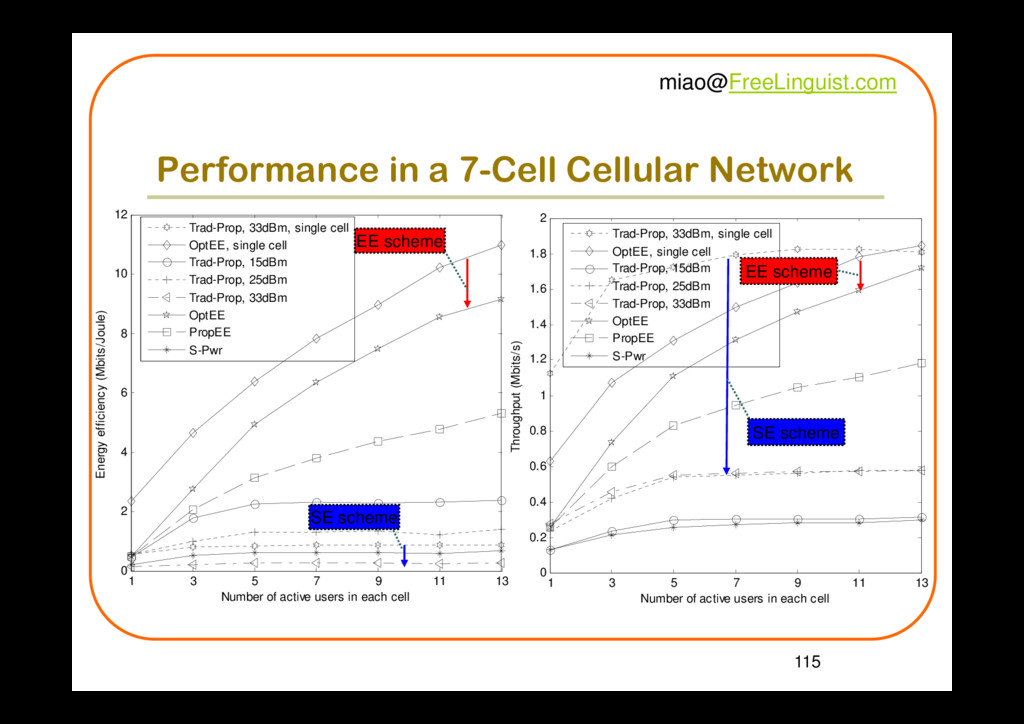
  99. [email protected] Performance in a 7-Cell Cellular Network 1 3 5

    7 9 11 13 0 0.2 0.4 0.6 0.8 1 1.2 1.4 1.6 1.8 2 Number of active users in each cell Throughput (Mbits/s) Trad-Prop, 33dBm, single cell OptEE, single cell Trad-Prop, 15dBm Trad-Prop, 25dBm Trad-Prop, 33dBm OptEE PropEE S-Pwr 1 3 5 7 9 11 13 0 2 4 6 8 10 12 Number of active users in each cell Energy efficiency (Mbits/Joule) Trad-Prop, 33dBm, single cell OptEE, single cell Trad-Prop, 15dBm Trad-Prop, 25dBm Trad-Prop, 33dBm OptEE PropEE S-Pwr EE scheme EE scheme SE scheme SE scheme 115
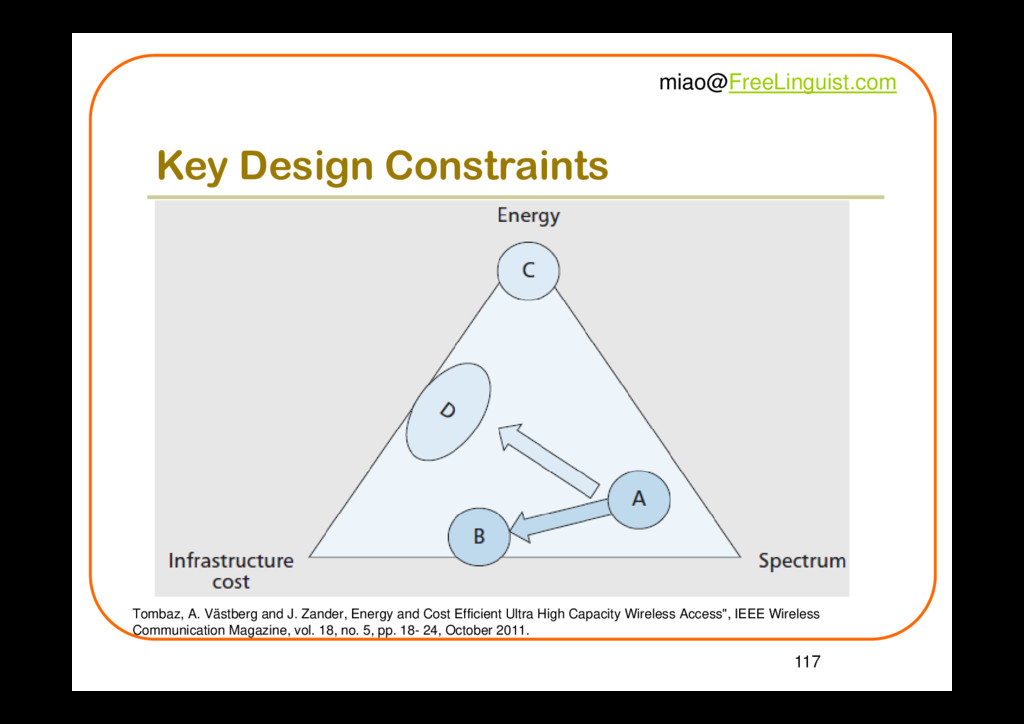
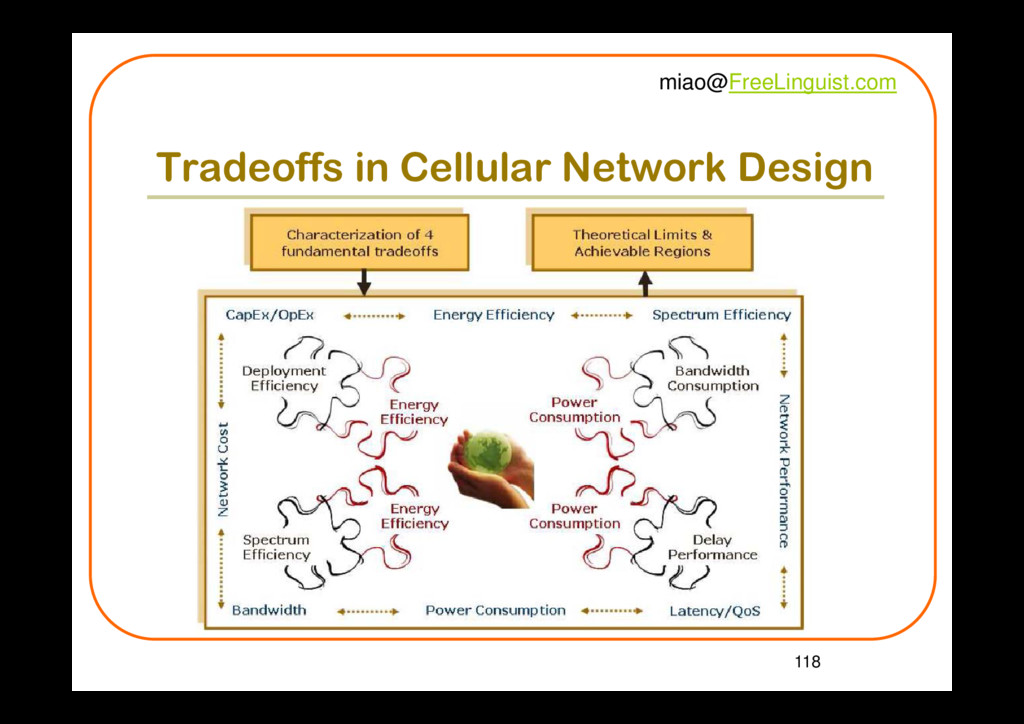
  100. [email protected] Key Design Constraints Tombaz, A. Västberg and J. Zander,

    Energy and Cost Efficient Ultra High Capacity Wireless Access", IEEE Wireless Communication Magazine, vol. 18, no. 5, pp. 18- 24, October 2011. 117
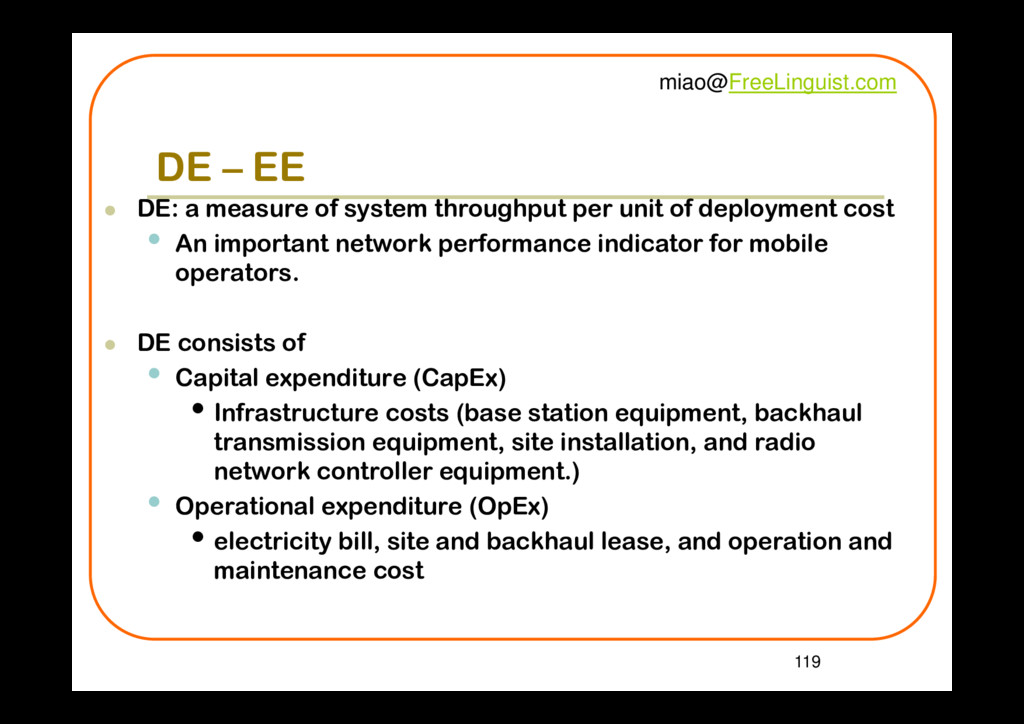
  101. [email protected] DE – EE  DE: a measure of system

    throughput per unit of deployment cost • An important network performance indicator for mobile operators.  DE consists of • Capital expenditure (CapEx) • Infrastructure costs (base station equipment, backhaul transmission equipment, site installation, and radio network controller equipment.) • Operational expenditure (OpEx) • electricity bill, site and backhaul lease, and operation and maintenance cost 119
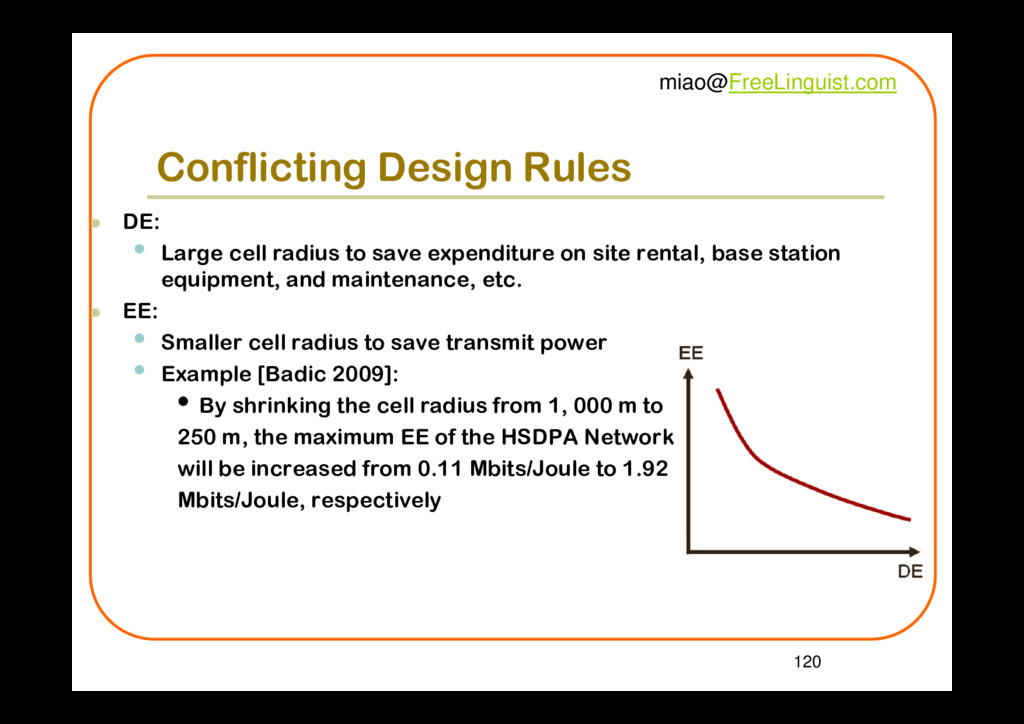
  102. [email protected] Conflicting Design Rules  DE: • Large cell radius

    to save expenditure on site rental, base station equipment, and maintenance, etc.  EE: • Smaller cell radius to save transmit power • Example [Badic 2009]: • By shrinking the cell radius from 1, 000 m to 250 m, the maximum EE of the HSDPA Network will be increased from 0.11 Mbits/Joule to 1.92 Mbits/Joule, respectively 120
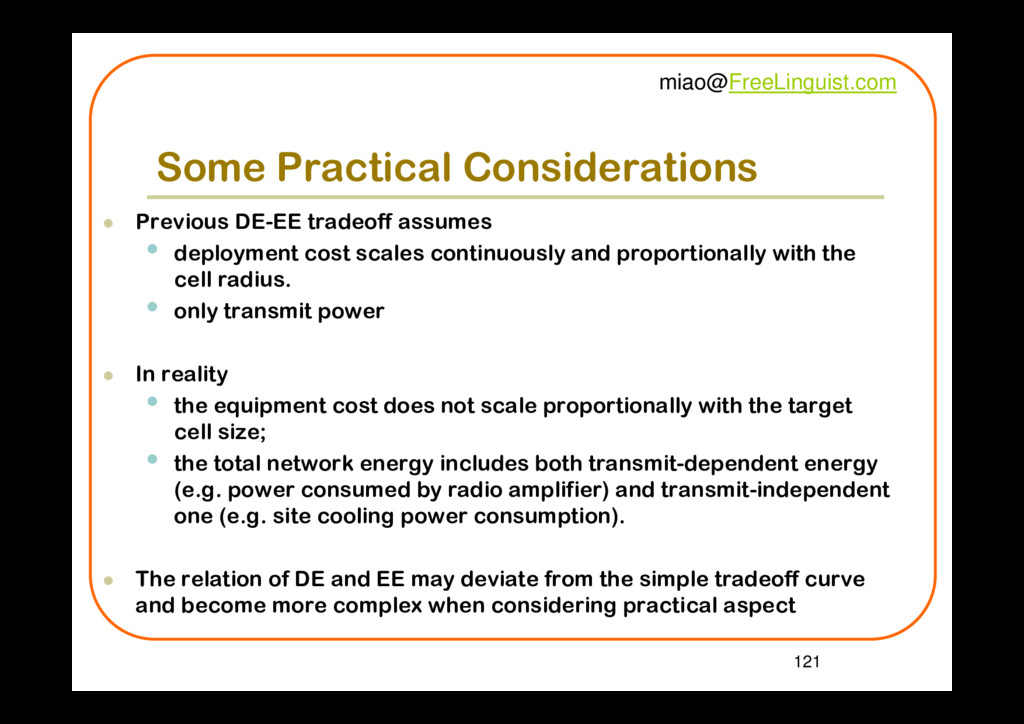
  103. [email protected] Some Practical Considerations  Previous DE-EE tradeoff assumes •

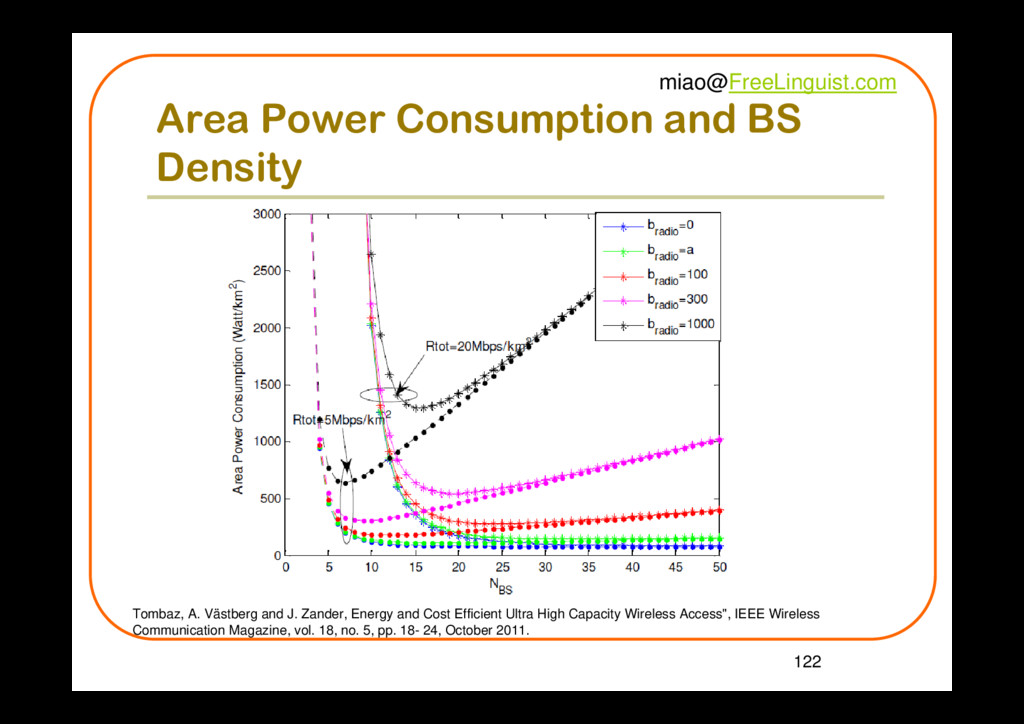
    deployment cost scales continuously and proportionally with the cell radius. • only transmit power  In reality • the equipment cost does not scale proportionally with the target cell size; • the total network energy includes both transmit-dependent energy (e.g. power consumed by radio amplifier) and transmit-independent one (e.g. site cooling power consumption).  The relation of DE and EE may deviate from the simple tradeoff curve and become more complex when considering practical aspect 121
  104. [email protected] Area Power Consumption and BS Density Tombaz, A. Västberg

    and J. Zander, Energy and Cost Efficient Ultra High Capacity Wireless Access", IEEE Wireless Communication Magazine, vol. 18, no. 5, pp. 18- 24, October 2011. 122
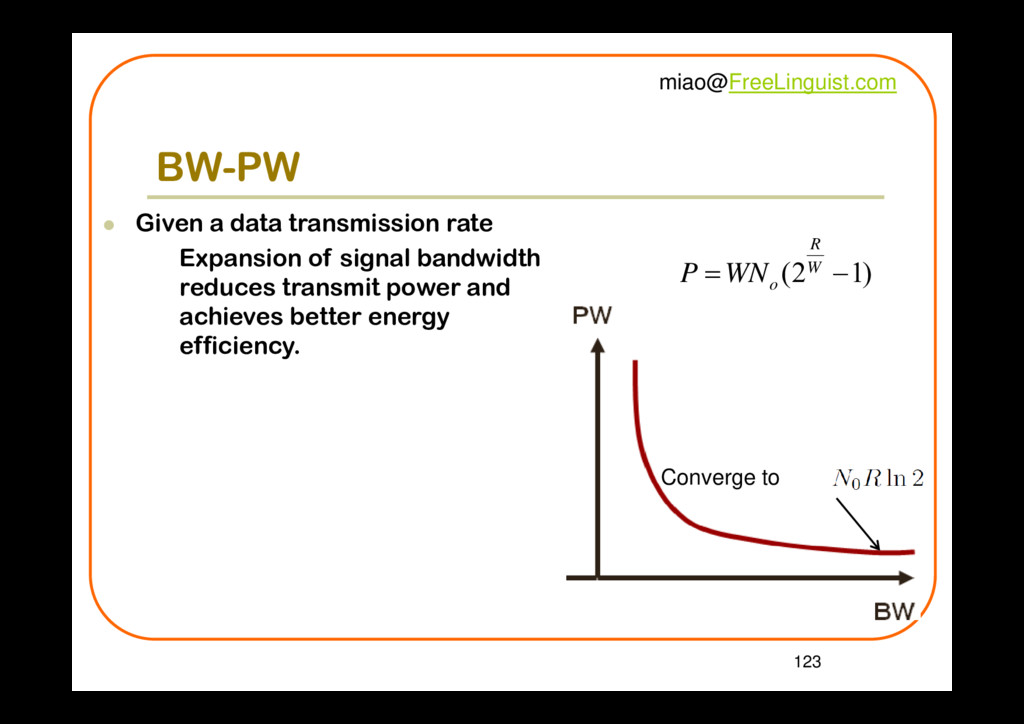
  105. [email protected] BW-PW (2 1) R W o P WN 

     Converge to  Given a data transmission rate Expansion of signal bandwidth reduces transmit power and achieves better energy efficiency. 123
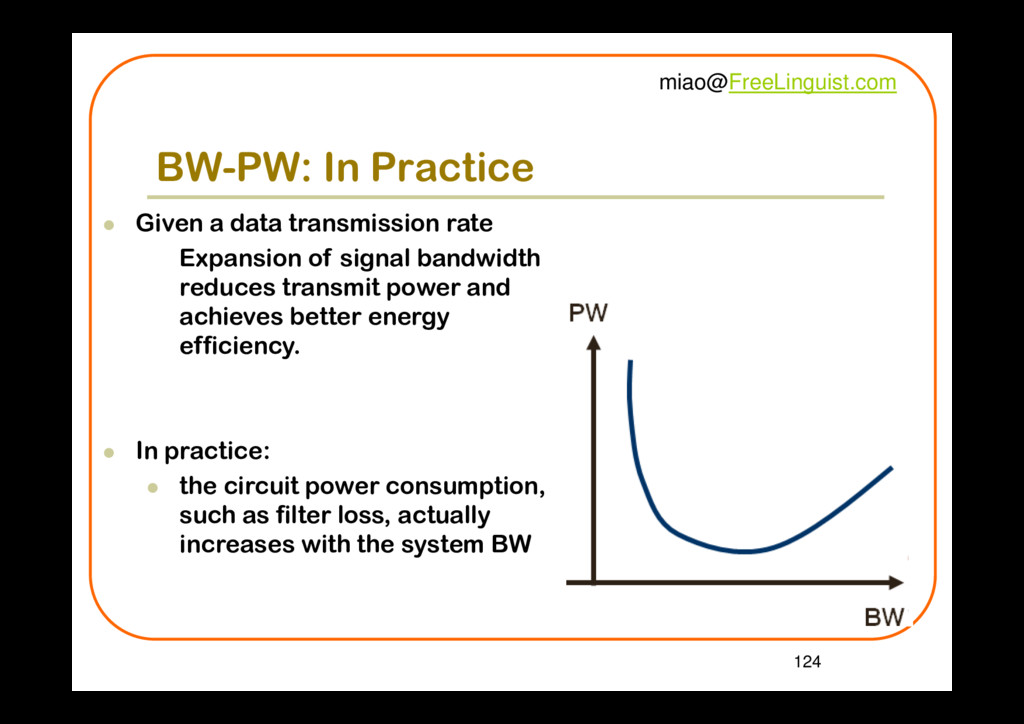
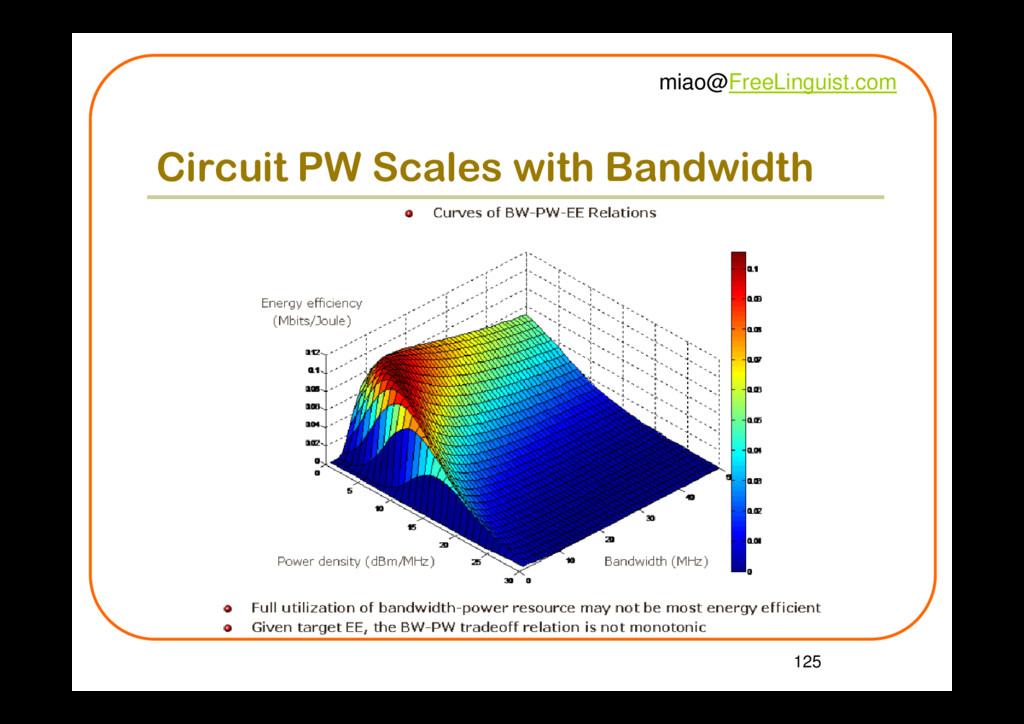
  106. [email protected] BW-PW: In Practice  Given a data transmission rate

    Expansion of signal bandwidth reduces transmit power and achieves better energy efficiency.  In practice:  the circuit power consumption, such as filter loss, actually increases with the system BW 124
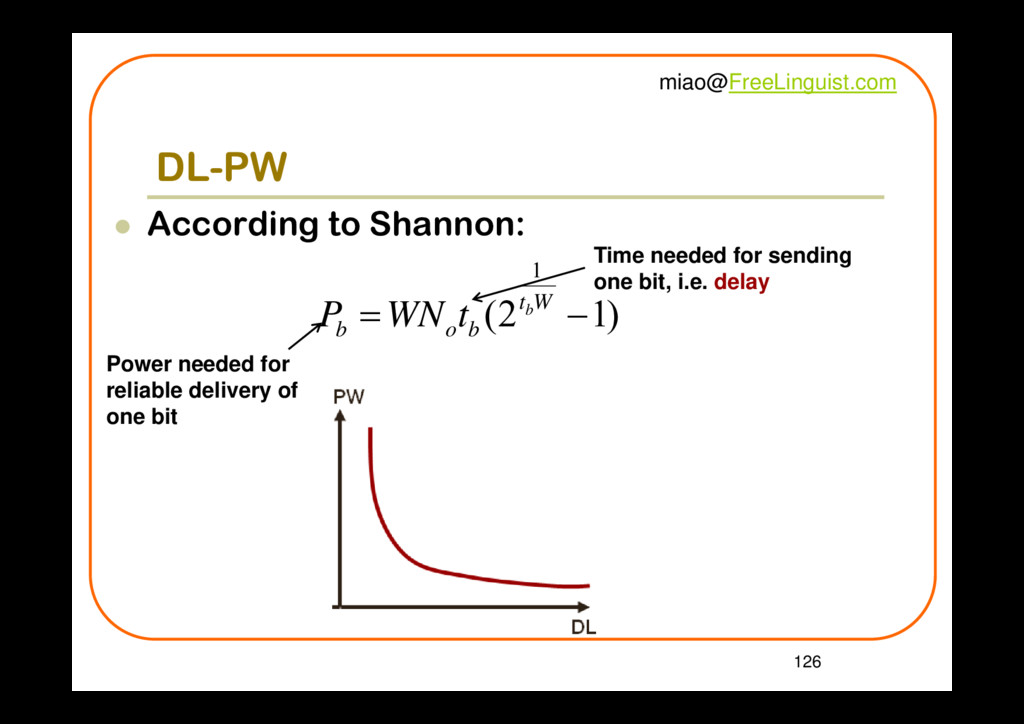
  107. [email protected] DL-PW  According to Shannon: 1 (2 1) b

    t W b o b P WN t   Power needed for reliable delivery of one bit Time needed for sending one bit, i.e. delay 126
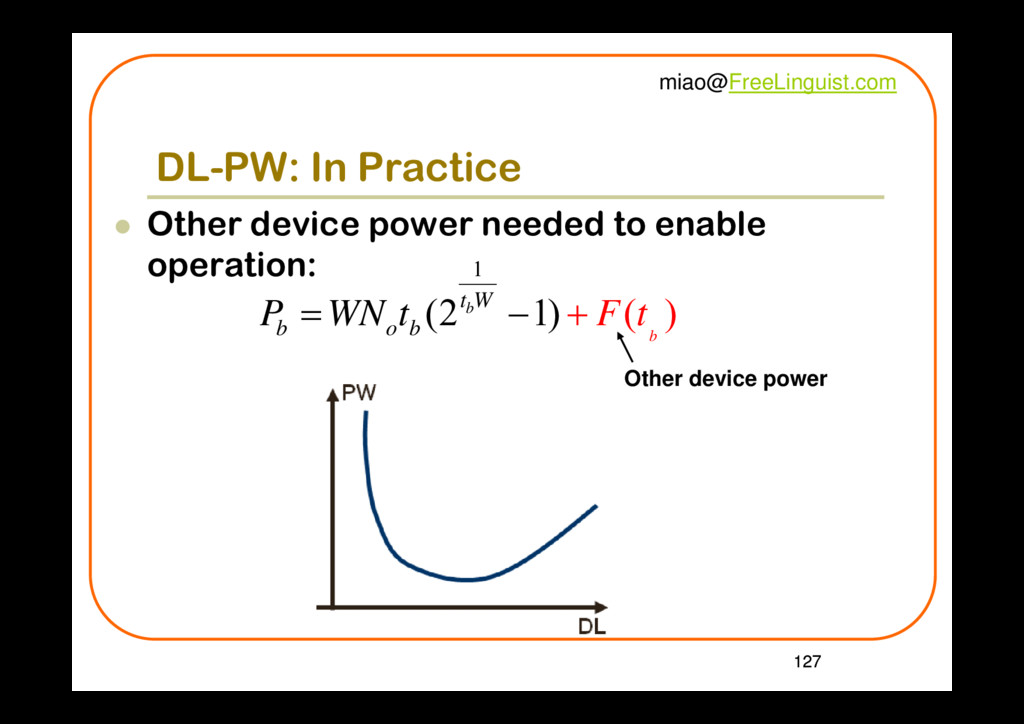
  108. [email protected] DL-PW: In Practice  Other device power needed to

    enable operation: 127 1 (2 1) ( ) b b t W b o b P WN F t t    Other device power 127
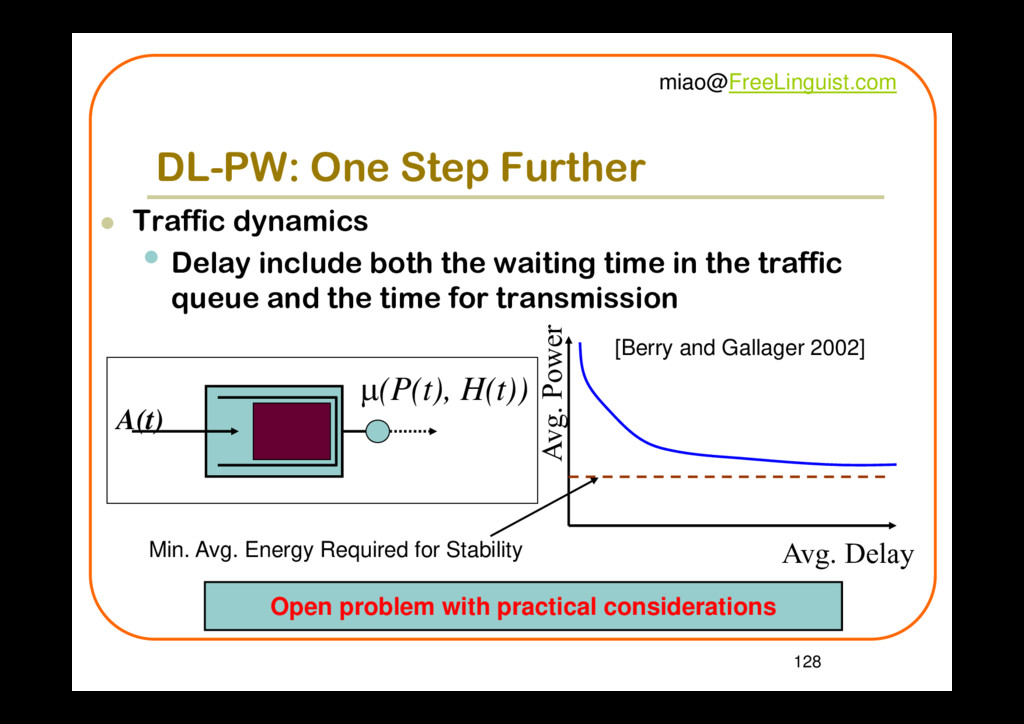
  109. [email protected] DL-PW: One Step Further  Traffic dynamics • Delay

    include both the waiting time in the traffic queue and the time for transmission A(t) (P(t), H(t)) Avg. Power Avg. Delay Min. Avg. Energy Required for Stability [Berry and Gallager 2002] Open problem with practical considerations 128
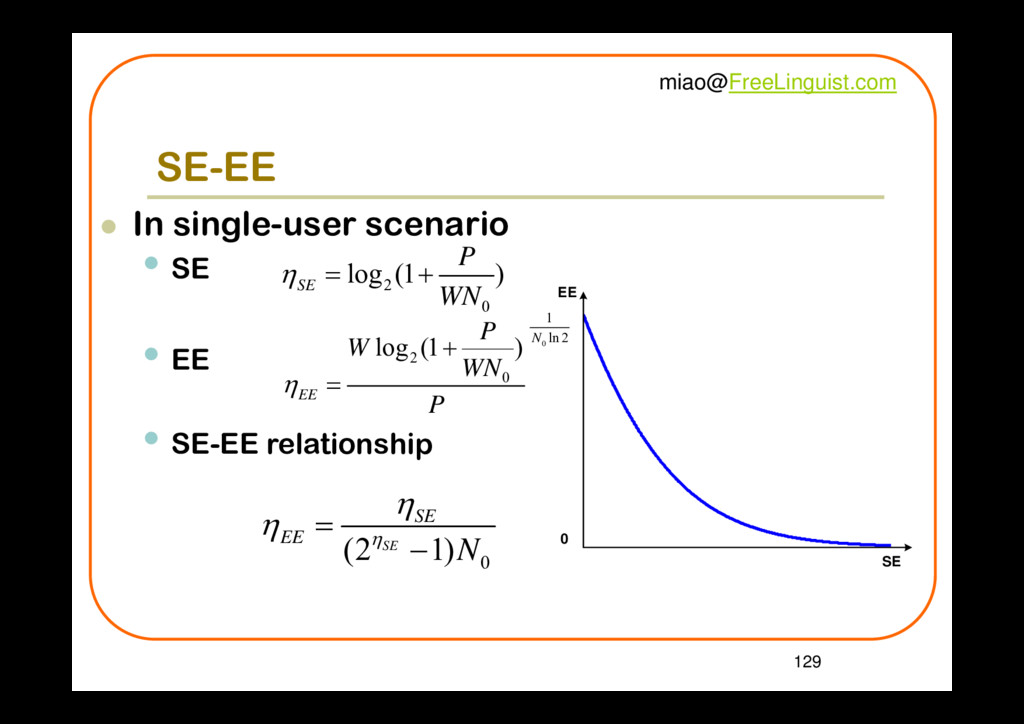
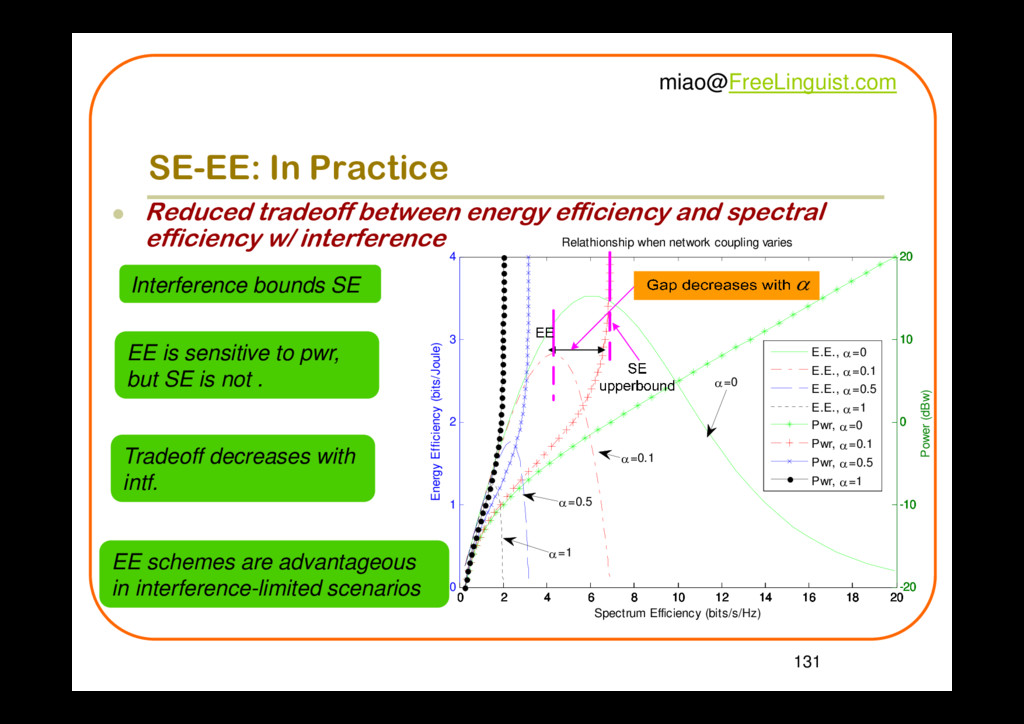
  110. [email protected] SE-EE  In single-user scenario • SE • EE

    • SE-EE relationship 2 0 log (1 ) SE P WN    2 0 log (1 ) EE P W WN P    0 (2 1) SE SE EE N      0 EE SE 0 1 ln 2 N 129
  111. [email protected] SE-EE: In Practice  Reduced tradeoff between energy efficiency

    and spectral efficiency w/ interference Interference bounds SE EE is sensitive to pwr, but SE is not . 0 2 4 6 8 10 12 14 16 18 20 0 1 2 3 4 Relathionship when network coupling varies Energy Efficiency (bits/Joule) Spectrum Efficiency (bits/s/Hz) 0 2 4 6 8 10 12 14 16 18 20 -20 -10 0 10 20 0 2 4 6 8 10 12 14 16 18 20 -20 -10 0 10 20 0 2 4 6 8 10 12 14 16 18 20 -20 -10 0 10 20 0 2 4 6 8 10 12 14 16 18 20 -20 -10 0 10 20 Power (dBw) E.E., =0 E.E., =0.1 E.E., =0.5 E.E., =1 Pwr, =0 Pwr, =0.1 Pwr, =0.5 Pwr, =1 =0.1 =0.5 =1 =0  EE schemes are advantageous in interference-limited scenarios Tradeoff decreases with intf. 131
  112. [email protected] Conclusion  Cross-layer optimization for SE • Spectral-efficient link

    adaptation • Spectral-efficient centralized MAC • Spectral-efficient distributed MAC  Cross-layer optimization for EE • Energy-efficient link adaptation • Energy-efficient centralized MAC • Energy-efficient distributed MAC  Energy-Efficient Mobile Access Networks: A Tradeoff Perspective 133
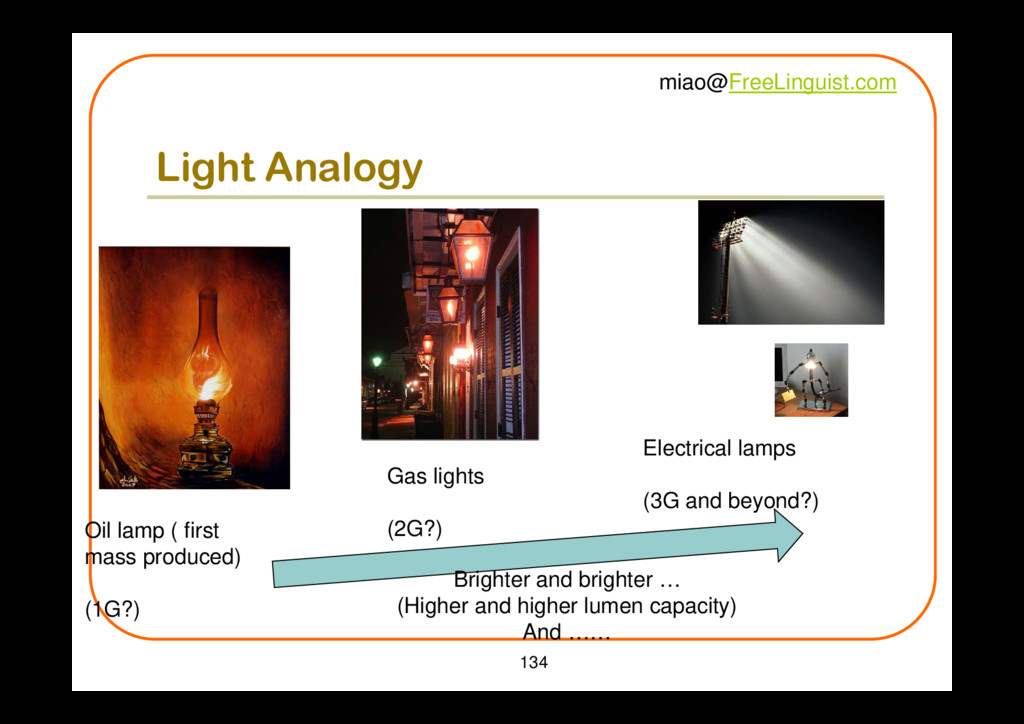
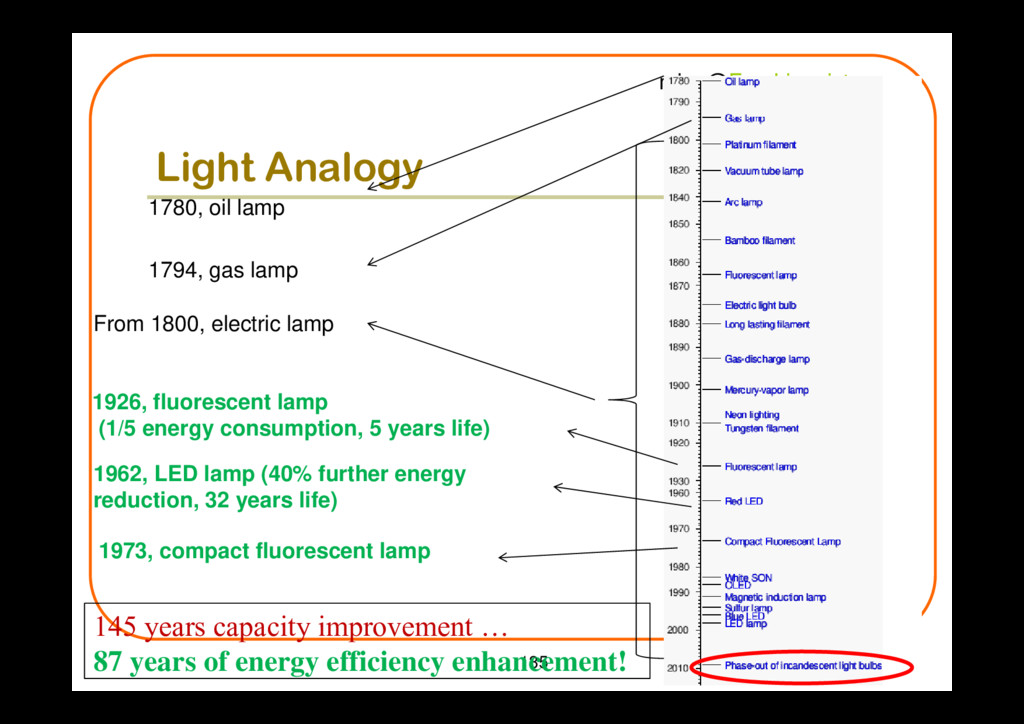
  113. [email protected] Light Analogy 134 Oil lamp ( first mass produced)

    (1G?) Gas lights (2G?) Electrical lamps (3G and beyond?) Brighter and brighter … (Higher and higher lumen capacity) And ……
  114. [email protected] Light Analogy 135 1780, oil lamp 1794, gas lamp

    From 1800, electric lamp 1926, fluorescent lamp (1/5 energy consumption, 5 years life) 1962, LED lamp (40% further energy reduction, 32 years life) 1973, compact fluorescent lamp 145 years capacity improvement … 87 years of energy efficiency enhancement!
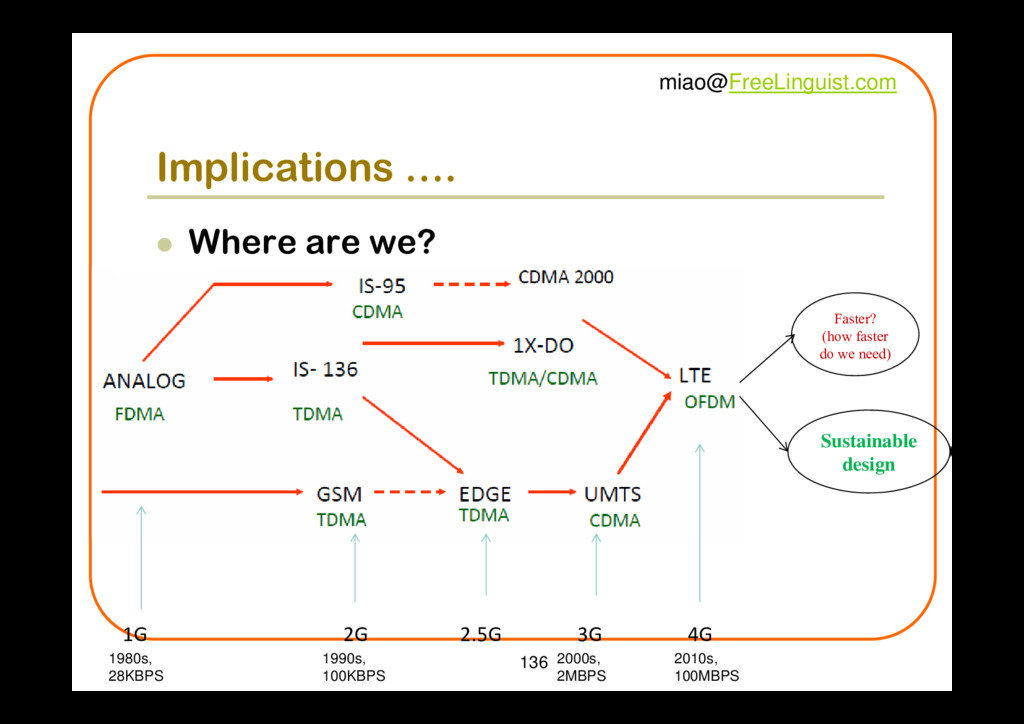
  115. [email protected] Implications ….  Where are we? 136 1G 2G

    3G 4G 2.5G Faster? (how faster do we need) Sustainable design 1980s, 28KBPS 1990s, 100KBPS 2000s, 2MBPS 2010s, 100MBPS
  116. [email protected] References  S. Sampei, S. Komaki, S., and N.

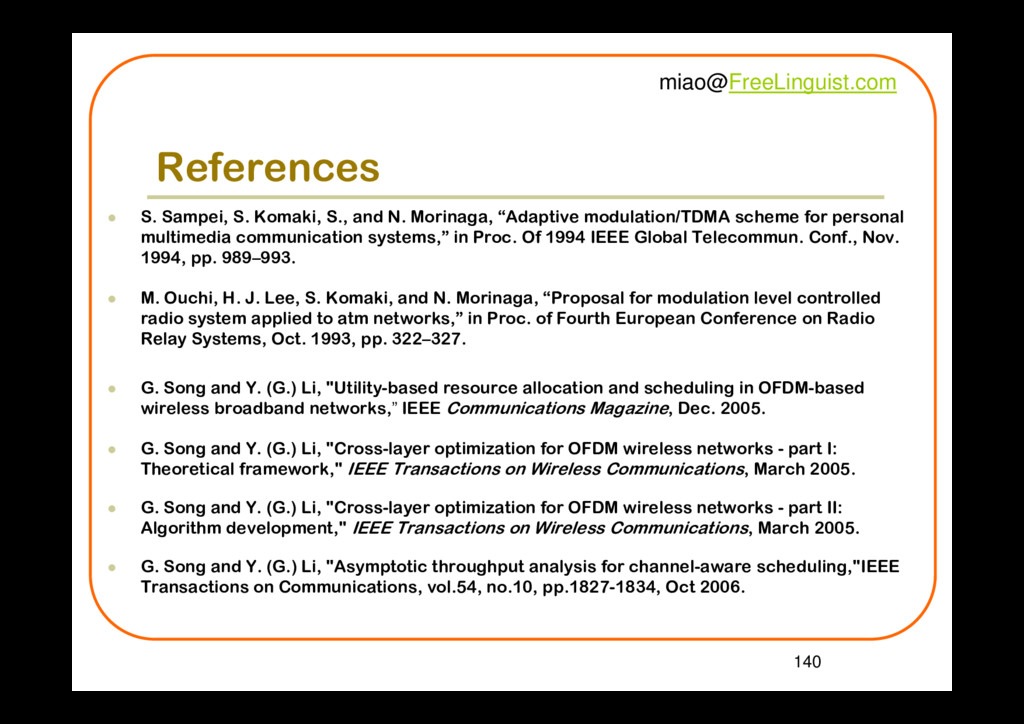
    Morinaga, “Adaptive modulation/TDMA scheme for personal multimedia communication systems,” in Proc. Of 1994 IEEE Global Telecommun. Conf., Nov. 1994, pp. 989–993.  M. Ouchi, H. J. Lee, S. Komaki, and N. Morinaga, “Proposal for modulation level controlled radio system applied to atm networks,” in Proc. of Fourth European Conference on Radio Relay Systems, Oct. 1993, pp. 322–327.  G. Song and Y. (G.) Li, "Utility-based resource allocation and scheduling in OFDM-based wireless broadband networks,” IEEE Communications Magazine, Dec. 2005.  G. Song and Y. (G.) Li, "Cross-layer optimization for OFDM wireless networks - part I: Theoretical framework," IEEE Transactions on Wireless Communications, March 2005.  G. Song and Y. (G.) Li, "Cross-layer optimization for OFDM wireless networks - part II: Algorithm development," IEEE Transactions on Wireless Communications, March 2005.  G. Song and Y. (G.) Li, "Asymptotic throughput analysis for channel-aware scheduling,"IEEE Transactions on Communications, vol.54, no.10, pp.1827-1834, Oct 2006. 140
  117. [email protected] References  G. Song, Y. (G.) Li, and L.

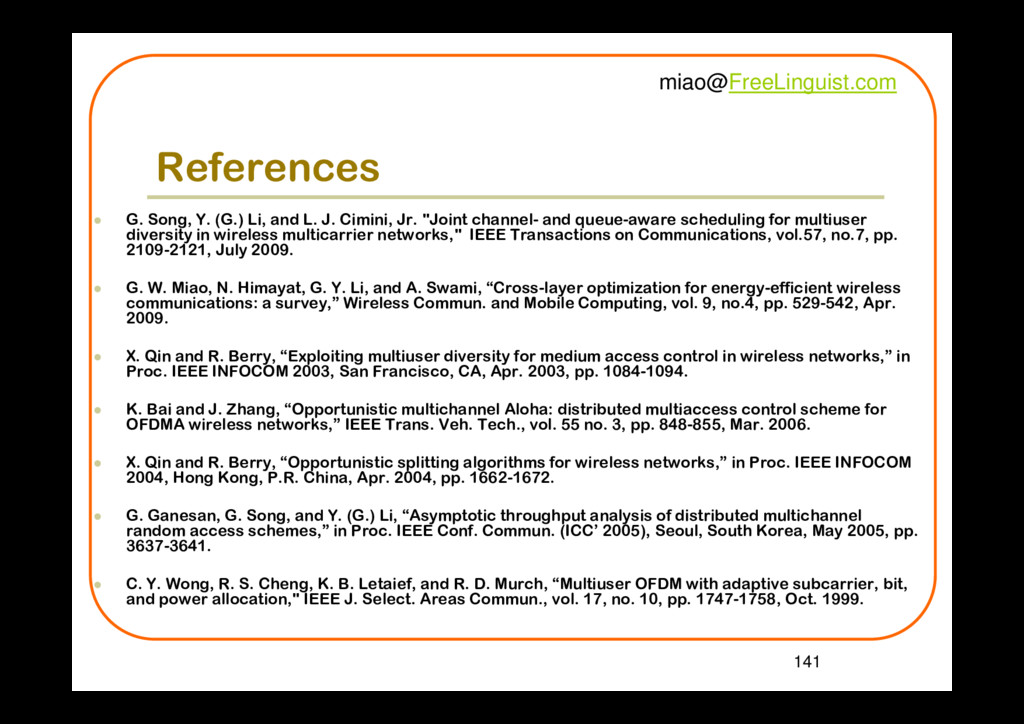
    J. Cimini, Jr. "Joint channel- and queue-aware scheduling for multiuser diversity in wireless multicarrier networks," IEEE Transactions on Communications, vol.57, no.7, pp. 2109-2121, July 2009.  G. W. Miao, N. Himayat, G. Y. Li, and A. Swami, “Cross-layer optimization for energy-efficient wireless communications: a survey,” Wireless Commun. and Mobile Computing, vol. 9, no.4, pp. 529-542, Apr. 2009.  X. Qin and R. Berry, “Exploiting multiuser diversity for medium access control in wireless networks,” in Proc. IEEE INFOCOM 2003, San Francisco, CA, Apr. 2003, pp. 1084-1094.  K. Bai and J. Zhang, “Opportunistic multichannel Aloha: distributed multiaccess control scheme for OFDMA wireless networks,” IEEE Trans. Veh. Tech., vol. 55 no. 3, pp. 848-855, Mar. 2006.  X. Qin and R. Berry, “Opportunistic splitting algorithms for wireless networks,” in Proc. IEEE INFOCOM 2004, Hong Kong, P.R. China, Apr. 2004, pp. 1662-1672.  G. Ganesan, G. Song, and Y. (G.) Li, “Asymptotic throughput analysis of distributed multichannel random access schemes,” in Proc. IEEE Conf. Commun. (ICC’ 2005), Seoul, South Korea, May 2005, pp. 3637-3641.  C. Y. Wong, R. S. Cheng, K. B. Letaief, and R. D. Murch, “Multiuser OFDM with adaptive subcarrier, bit, and power allocation," IEEE J. Select. Areas Commun., vol. 17, no. 10, pp. 1747-1758, Oct. 1999. 141
  118. [email protected] References  Okada,T., Aikawa,S., 1992, "The Design of All

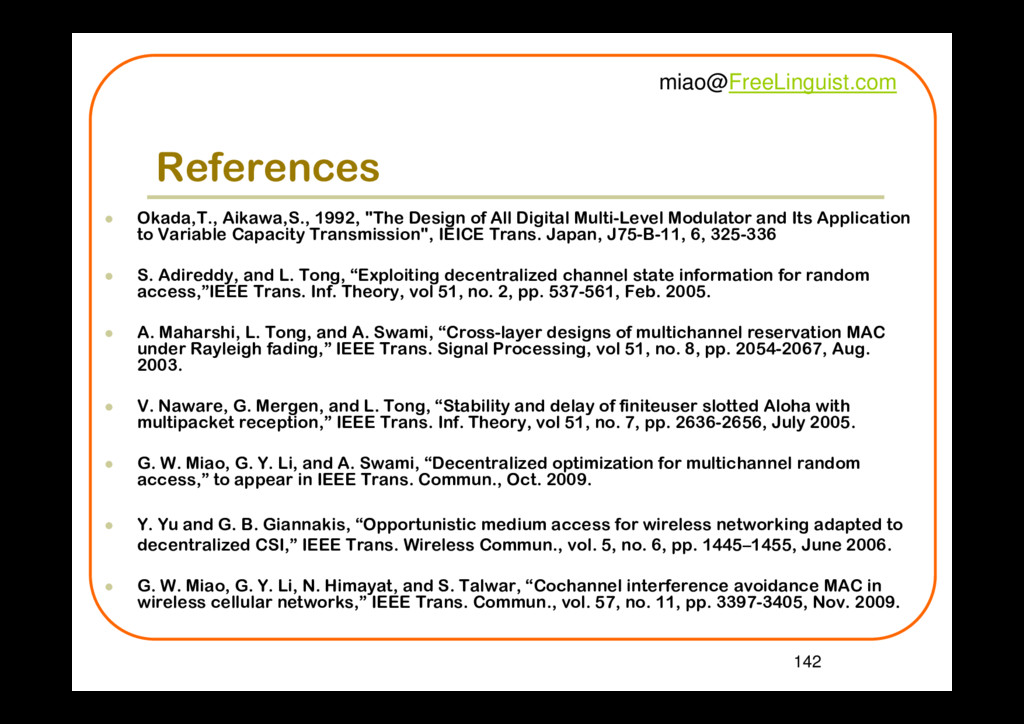
    Digital Multi-Level Modulator and Its Application to Variable Capacity Transmission", IEICE Trans. Japan, J75-B-11, 6, 325-336  S. Adireddy, and L. Tong, “Exploiting decentralized channel state information for random access,”IEEE Trans. Inf. Theory, vol 51, no. 2, pp. 537-561, Feb. 2005.  A. Maharshi, L. Tong, and A. Swami, “Cross-layer designs of multichannel reservation MAC under Rayleigh fading,” IEEE Trans. Signal Processing, vol 51, no. 8, pp. 2054-2067, Aug. 2003.  V. Naware, G. Mergen, and L. Tong, “Stability and delay of finiteuser slotted Aloha with multipacket reception,” IEEE Trans. Inf. Theory, vol 51, no. 7, pp. 2636-2656, July 2005.  G. W. Miao, G. Y. Li, and A. Swami, “Decentralized optimization for multichannel random access,” to appear in IEEE Trans. Commun., Oct. 2009.  Y. Yu and G. B. Giannakis, “Opportunistic medium access for wireless networking adapted to decentralized CSI,” IEEE Trans. Wireless Commun., vol. 5, no. 6, pp. 1445–1455, June 2006.  G. W. Miao, G. Y. Li, N. Himayat, and S. Talwar, “Cochannel interference avoidance MAC in wireless cellular networks,” IEEE Trans. Commun., vol. 57, no. 11, pp. 3397-3405, Nov. 2009. 142
  119. [email protected] References  K. Lahiri, A. Raghunathan, S. Dey, and

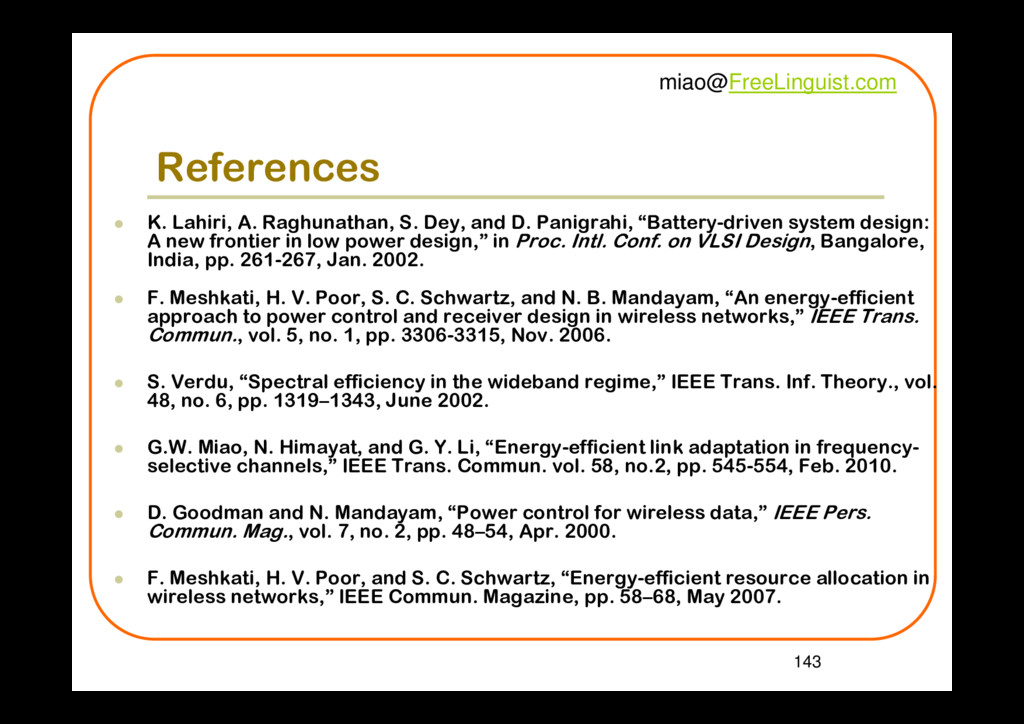
    D. Panigrahi, “Battery-driven system design: A new frontier in low power design,” in Proc. Intl. Conf. on VLSI Design, Bangalore, India, pp. 261-267, Jan. 2002.  F. Meshkati, H. V. Poor, S. C. Schwartz, and N. B. Mandayam, “An energy-efficient approach to power control and receiver design in wireless networks,” IEEE Trans. Commun., vol. 5, no. 1, pp. 3306-3315, Nov. 2006.  S. Verdu, “Spectral efficiency in the wideband regime,” IEEE Trans. Inf. Theory., vol. 48, no. 6, pp. 1319–1343, June 2002.  G.W. Miao, N. Himayat, and G. Y. Li, “Energy-efficient link adaptation in frequency- selective channels,” IEEE Trans. Commun. vol. 58, no.2, pp. 545-554, Feb. 2010.  D. Goodman and N. Mandayam, “Power control for wireless data,” IEEE Pers. Commun. Mag., vol. 7, no. 2, pp. 48–54, Apr. 2000.  F. Meshkati, H. V. Poor, and S. C. Schwartz, “Energy-efficient resource allocation in wireless networks,” IEEE Commun. Magazine, pp. 58–68, May 2007. 143
  120. [email protected] References  G. W. Miao, N. Himayat, G. Y.

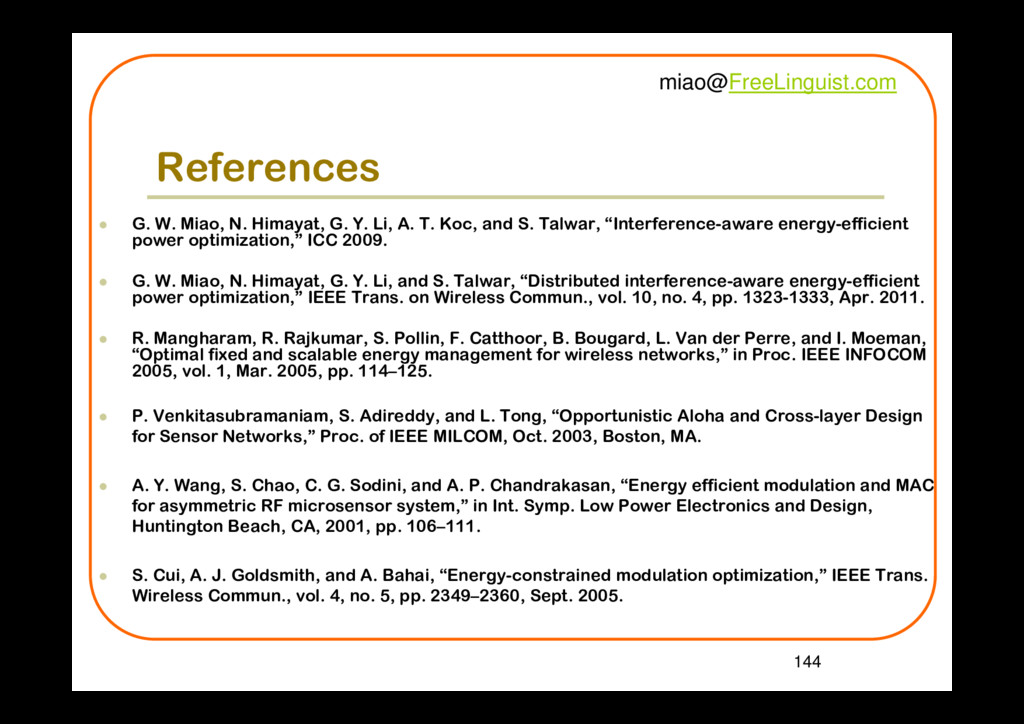
    Li, A. T. Koc, and S. Talwar, “Interference-aware energy-efficient power optimization,” ICC 2009.  G. W. Miao, N. Himayat, G. Y. Li, and S. Talwar, “Distributed interference-aware energy-efficient power optimization,” IEEE Trans. on Wireless Commun., vol. 10, no. 4, pp. 1323-1333, Apr. 2011.  R. Mangharam, R. Rajkumar, S. Pollin, F. Catthoor, B. Bougard, L. Van der Perre, and I. Moeman, “Optimal fixed and scalable energy management for wireless networks,” in Proc. IEEE INFOCOM 2005, vol. 1, Mar. 2005, pp. 114–125.  P. Venkitasubramaniam, S. Adireddy, and L. Tong, “Opportunistic Aloha and Cross-layer Design for Sensor Networks,” Proc. of IEEE MILCOM, Oct. 2003, Boston, MA.  A. Y. Wang, S. Chao, C. G. Sodini, and A. P. Chandrakasan, “Energy efficient modulation and MAC for asymmetric RF microsensor system,” in Int. Symp. Low Power Electronics and Design, Huntington Beach, CA, 2001, pp. 106–111.  S. Cui, A. J. Goldsmith, and A. Bahai, “Energy-constrained modulation optimization,” IEEE Trans. Wireless Commun., vol. 4, no. 5, pp. 2349–2360, Sept. 2005. 144
  121. [email protected] References  G. W. Miao, G. Y. Li, A.

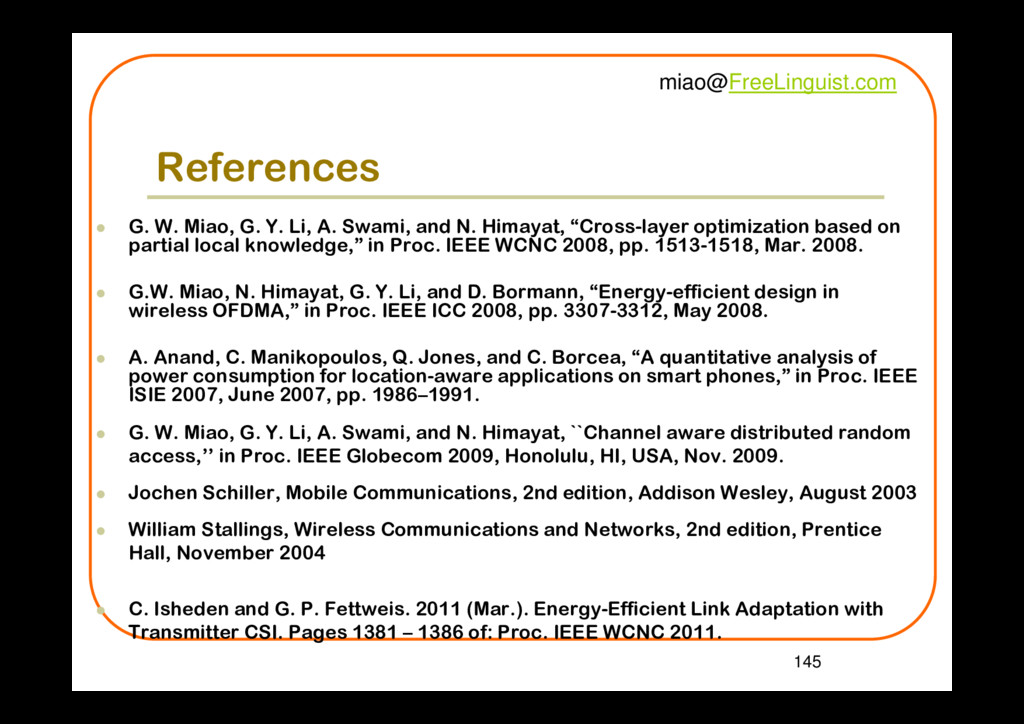
    Swami, and N. Himayat, “Cross-layer optimization based on partial local knowledge,” in Proc. IEEE WCNC 2008, pp. 1513-1518, Mar. 2008.  G.W. Miao, N. Himayat, G. Y. Li, and D. Bormann, “Energy-efficient design in wireless OFDMA,” in Proc. IEEE ICC 2008, pp. 3307-3312, May 2008.  A. Anand, C. Manikopoulos, Q. Jones, and C. Borcea, “A quantitative analysis of power consumption for location-aware applications on smart phones,” in Proc. IEEE ISIE 2007, June 2007, pp. 1986–1991.  G. W. Miao, G. Y. Li, A. Swami, and N. Himayat, ``Channel aware distributed random access,’’ in Proc. IEEE Globecom 2009, Honolulu, HI, USA, Nov. 2009.  Jochen Schiller, Mobile Communications, 2nd edition, Addison Wesley, August 2003  William Stallings, Wireless Communications and Networks, 2nd edition, Prentice Hall, November 2004  C. Isheden and G. P. Fettweis. 2011 (Mar.). Energy-Efficient Link Adaptation with Transmitter CSI. Pages 1381 – 1386 of: Proc. IEEE WCNC 2011. 145
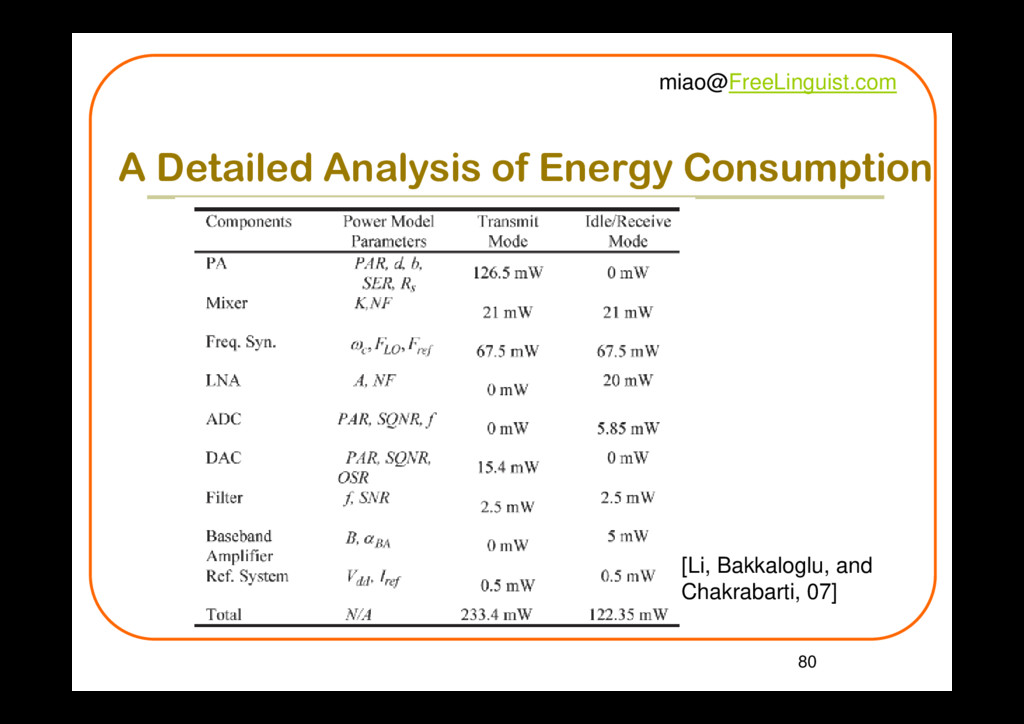
  122. [email protected] References  Y. Li, B. Bakkaloglu, and C. Chakrabarti,

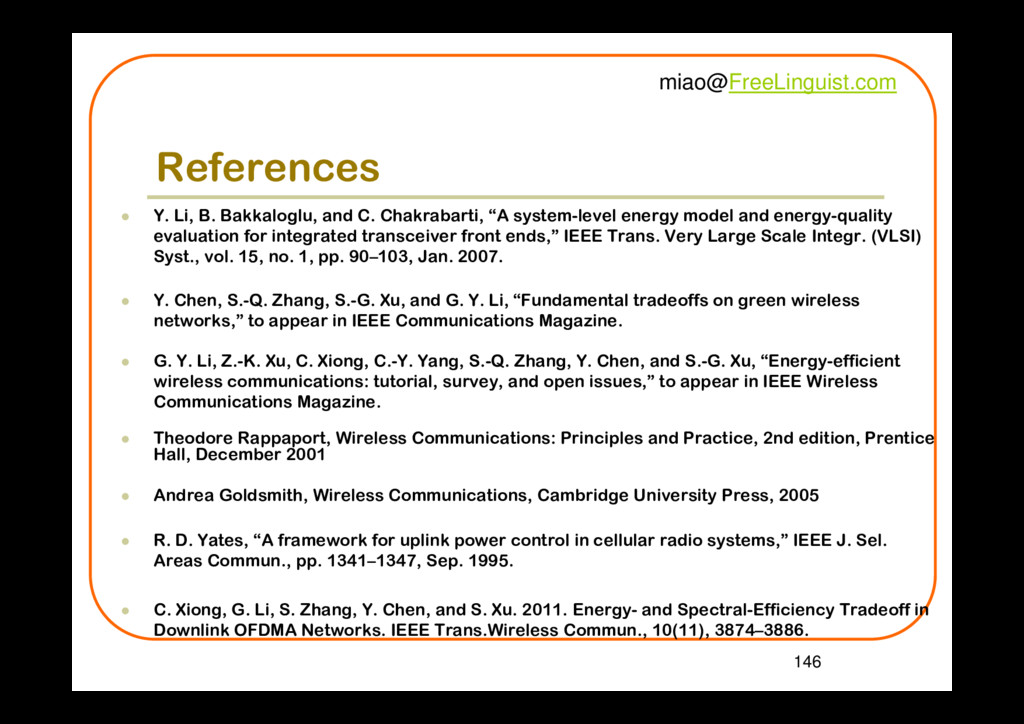
    “A system-level energy model and energy-quality evaluation for integrated transceiver front ends,” IEEE Trans. Very Large Scale Integr. (VLSI) Syst., vol. 15, no. 1, pp. 90–103, Jan. 2007.  Y. Chen, S.-Q. Zhang, S.-G. Xu, and G. Y. Li, “Fundamental tradeoffs on green wireless networks,” to appear in IEEE Communications Magazine.  G. Y. Li, Z.-K. Xu, C. Xiong, C.-Y. Yang, S.-Q. Zhang, Y. Chen, and S.-G. Xu, “Energy-efficient wireless communications: tutorial, survey, and open issues,” to appear in IEEE Wireless Communications Magazine.  Theodore Rappaport, Wireless Communications: Principles and Practice, 2nd edition, Prentice Hall, December 2001  Andrea Goldsmith, Wireless Communications, Cambridge University Press, 2005  R. D. Yates, “A framework for uplink power control in cellular radio systems,” IEEE J. Sel. Areas Commun., pp. 1341–1347, Sep. 1995.  C. Xiong, G. Li, S. Zhang, Y. Chen, and S. Xu. 2011. Energy- and Spectral-Efficiency Tradeoff in Downlink OFDMA Networks. IEEE Trans.Wireless Commun., 10(11), 3874–3886. 146
  123. [email protected] References  Y. Xue, T. Kaiser, and A. B.

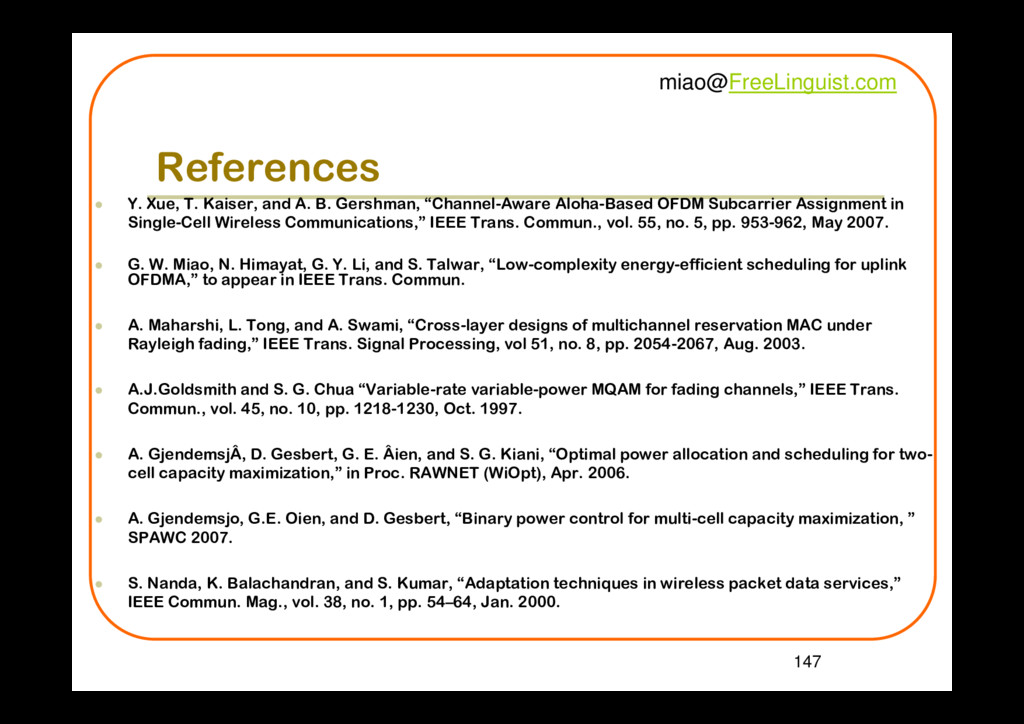
    Gershman, “Channel-Aware Aloha-Based OFDM Subcarrier Assignment in Single-Cell Wireless Communications,” IEEE Trans. Commun., vol. 55, no. 5, pp. 953-962, May 2007.  G. W. Miao, N. Himayat, G. Y. Li, and S. Talwar, “Low-complexity energy-efficient scheduling for uplink OFDMA,” to appear in IEEE Trans. Commun.  A. Maharshi, L. Tong, and A. Swami, “Cross-layer designs of multichannel reservation MAC under Rayleigh fading,” IEEE Trans. Signal Processing, vol 51, no. 8, pp. 2054-2067, Aug. 2003.  A.J.Goldsmith and S. G. Chua “Variable-rate variable-power MQAM for fading channels,” IEEE Trans. Commun., vol. 45, no. 10, pp. 1218-1230, Oct. 1997.  A. GjendemsjÂ, D. Gesbert, G. E. Âien, and S. G. Kiani, “Optimal power allocation and scheduling for two- cell capacity maximization,” in Proc. RAWNET (WiOpt), Apr. 2006.  A. Gjendemsjo, G.E. Oien, and D. Gesbert, “Binary power control for multi-cell capacity maximization, ” SPAWC 2007.  S. Nanda, K. Balachandran, and S. Kumar, “Adaptation techniques in wireless packet data services,” IEEE Commun. Mag., vol. 38, no. 1, pp. 54–64, Jan. 2000. 147
  124. [email protected] References  K. Kar, S. Sarkar, and L. Tassiulas,

    “Achieving proportional fairness using local information in Aloha networks,” IEEE Trans. Autom. Control, vol. 49, no. 10, pp. 1858-1863, Oct. 2004.  C. Schurgers, O. Aberthorne, and M. B. Srivastava, “Modulation scaling for energy aware communication systems,” International Symposium on Low Power Electronics and Design, pp. 96-99, 2001.  S. Cui, A. J. Goldsmith, an A. Bahai, “Energy-efficiency of MIMO and cooperative MIMO techniques in sensor networks,”IEEE JSAC, vol 22 no. 6, Aug. 2004.  J. F. Kiang, “Something You Should Know about Electromagnetic Applications,” online at http://cc.ee.ntu.edu.tw/~jfkiang/electromagnetic%20wave/electromagnetic%20applications(v1).pdf.  G. Y. Li, Z.-K. Xu, C. Xiong, C.-Y. Yang, S.-Q. Zhang, Y. Chen, and S.-G. Xu, “Energy-efficient wireless communications: tutorial, survey, and open issues,” to appear in IEEE Wireless Communications Magazine.  B. Badic, T. O’Farrel, P. Loskot, and J. He, “Energy efficiency radio access architectures for green radio: Large versus small cell size deployment,” in Proc. of IEEE 70th Vehicular Technology Conference (VTC Fall), Anchorage, USA, Sept 2009.  W. Yu and J. M. Cioffi, “FDMA capacity of Gaussian multiple-access channels with ISI,” IEEE Trans. Commun., vol. 50, no. 1, pp. 102–111, Jan. 2002. 148
  125. [email protected] References  K. Lahiri, et. al., “Battery-Driven System Design:

    A New Frontier in Low Power Design”  R. G. Gallager, Information Theory and Reliable Communication. John Wiley & Sons, Inc., 1968.  B. Badic, T. O’Farrel, P. Loskot, and J. He, “Energy efficiency radio access architectures for green radio: Large versus small cell size deployment,” in Proc. of IEEE 70th Vehicular Technology Conference (VTC Fall), Anchorage, USA, Sept 2009.  Y. Chen, S. Zhang, and S. Xu, “Characterizing energy efficiency and deployment efficiency relations for green architecture design,” in Proc. of IEEE International Communications Conference (ICC), Cape Town, South Africa, May 2010.  R. Berry and R. Gallager. Communication over fading channels with delay constraints. IEEE Transactions on Information Theory, vol. 48, no. 5, pp. 1135-1149, May 2002.  C. Zeng, L. M. C. Hoo, and J. M. Cioffi, “Efficient water-filling algorithms for a Gaussian multiaccess channel with ISI,” in Proc. IEEE Vehicular Technology Conf., 2000, pp. 1072–1077  Tombaz, A. Västberg and J. Zander, Energy and Cost Efficient Ultra High Capacity Wireless Access", IEEE Wireless Communication Magazine, vol. 18, no. 5, pp. 18- 24, October 2011.  Numerous slides and other resources publicly available on the Internet 149