Share
Embed
Introduction to GNU/Linux
Public Linux introduction conference held in October 2009 (Release of Ubuntu Karmic) in Kerman Province, Mohamad ARAB (boynux) was main lecturer.
Thanks to Didehbannet Co. Ltd. who made this happen.
Boynux
August 17, 2013
Transcript
15 slides
-
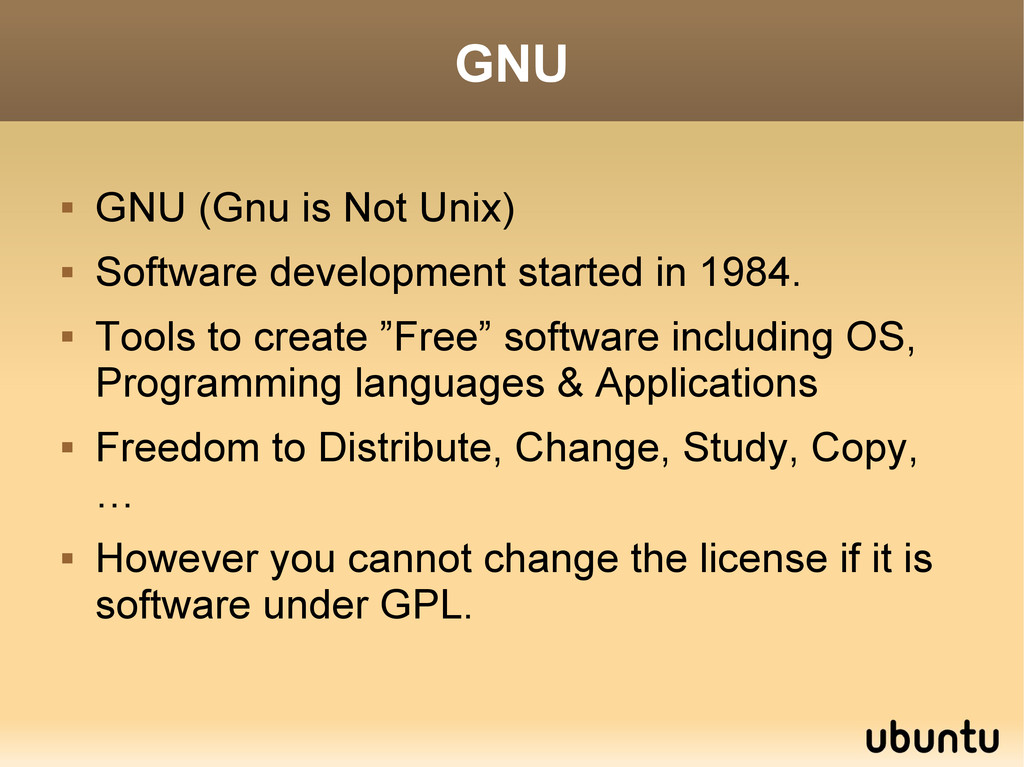
GNU GNU (Gnu is Not Unix) Software development
started in 1984. Tools to create ”Free” software including OS, Programming languages & Applications Freedom to Distribute, Change, Study, Copy, … However you cannot change the license if it is software under GPL. -
Open Source 'Open source' concept was existing from years
ago. In the early years of automative development, a group of manufacturers owned the license of engines, but this monopolicy broken in 1911. ARPANET used the same concept to develope network telecomunication protocols which is started in 1960 and led to birth of the Internet in 1969. Netscape in 1998 announced the source code realese for ”Navigator”. -
GNU/Linux GNU/Linux is a general name for any OS
based on Linux Kernel & GNU. GNU/Linux is one of greatest collections of ”Free” and ”Open-Source” software. Linux name is actually comes from Linux-Kernel Linux-Kernel development started by Linux Torvalds in 1991. GNU/Linux name is pomoted by Free Software Foundation (FSF) -
GNU/Linux GNU/Linux specifically is very famous because of ”Linux
Servers”. GNU/Linux is installable on various computer hardware, embeded systems, cellphones, wrist watches and even super computers. GNU/Linux now a days is popular among desktop and notebook computer users. Ubuntu distibution has the largest desktop and specially notebook installations. -
Is a 'Free' Unix-like operating sysem, developed by 'Brekeley
Software Distribution' Known as unknown 'Free OS' gaint. Is not Unix, but behaviour, internal structure and API is very similar to Unix. Is a full-featured OS. Works on most common CPUs and Hardware. Most Linux software run on BSD FreeBSD/OpenBSD -
Copyright/GPL GNU - General Public License Most of
GNU software released under GPL. This license obliges developers to release source code along software binary. Most GNU/Linux libraries are released under LGPL LGPL: Lesser GNU General Public License. Linux Kernel released under GPL v2 license. Lastest GPL license version is 3 -
Linux Distros Prior to the release of first GNU/Linux
distributions, GNU/Linux users should be a professional Unix user. GNU/Linux distributions created after first GNU/Linux bundles developed by other than Linux-Kernel developer. GNU/Linux attracted users to be replacement for proprietary OS like: Windows, MS-DOS, Mac-OS. GNU/Linux is attractive mainly because of Stability, Low-cost and free access to source codes. -
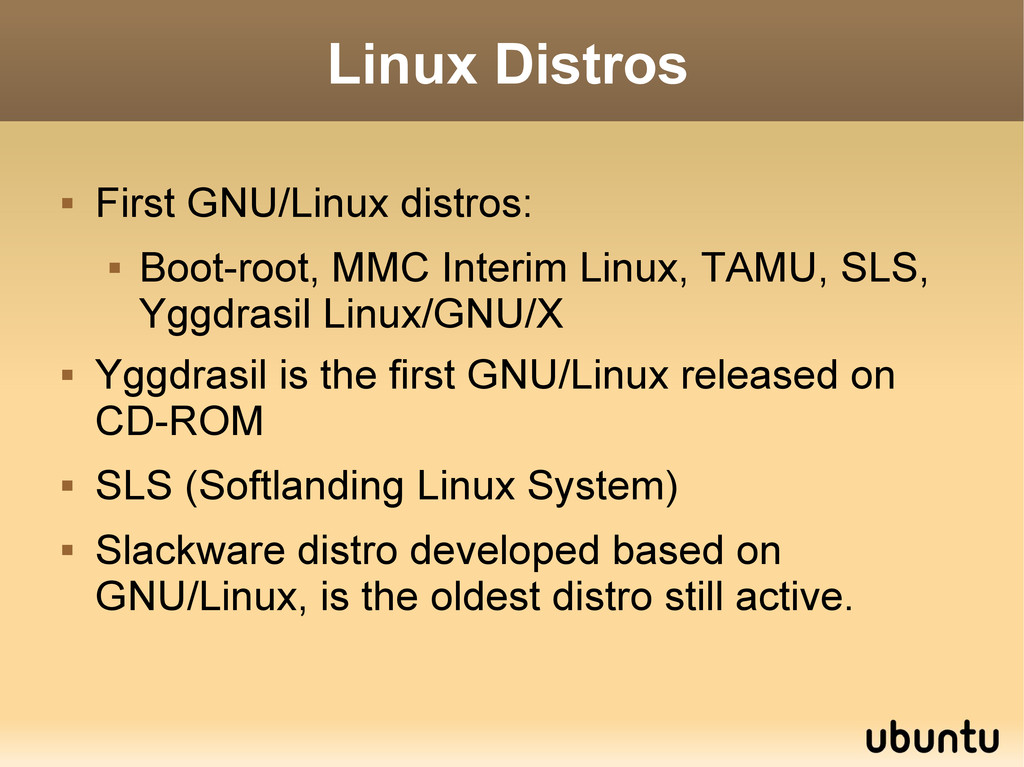
Linux Distros First GNU/Linux distros: Boot-root, MMC Interim
Linux, TAMU, SLS, Yggdrasil Linux/GNU/X Yggdrasil is the first GNU/Linux released on CD-ROM SLS (Softlanding Linux System) Slackware distro developed based on GNU/Linux, is the oldest distro still active. -
Linux Distros Some of famous GNU/Linux distros: Arch
Linux CentOS (Based on RedHat) Debian Fedora (Owned by Red Hat Co.) Gentoo (For power users) gOS (Netbook) Knoppix (First live CD, Based on Debian) Kubuntu (KDE Version of Ubuntu) Linux Mint (Based on Ubuntu) -
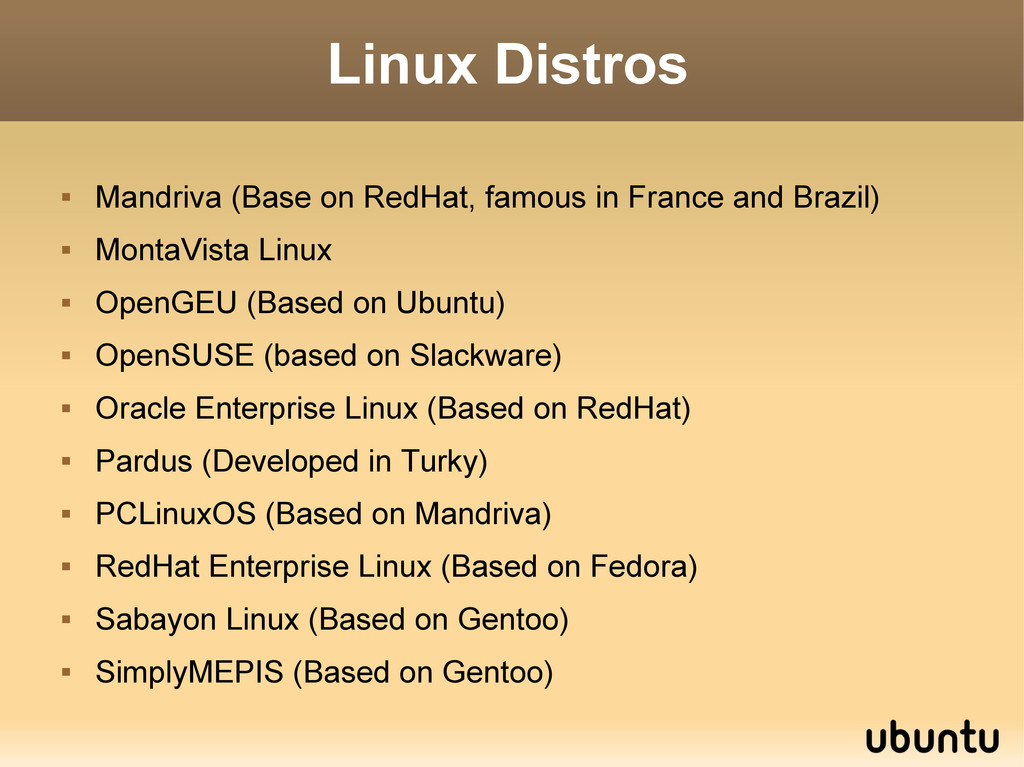
Linux Distros Mandriva (Base on RedHat, famous in France
and Brazil) MontaVista Linux OpenGEU (Based on Ubuntu) OpenSUSE (based on Slackware) Oracle Enterprise Linux (Based on RedHat) Pardus (Developed in Turky) PCLinuxOS (Based on Mandriva) RedHat Enterprise Linux (Based on Fedora) Sabayon Linux (Based on Gentoo) SimplyMEPIS (Based on Gentoo) -
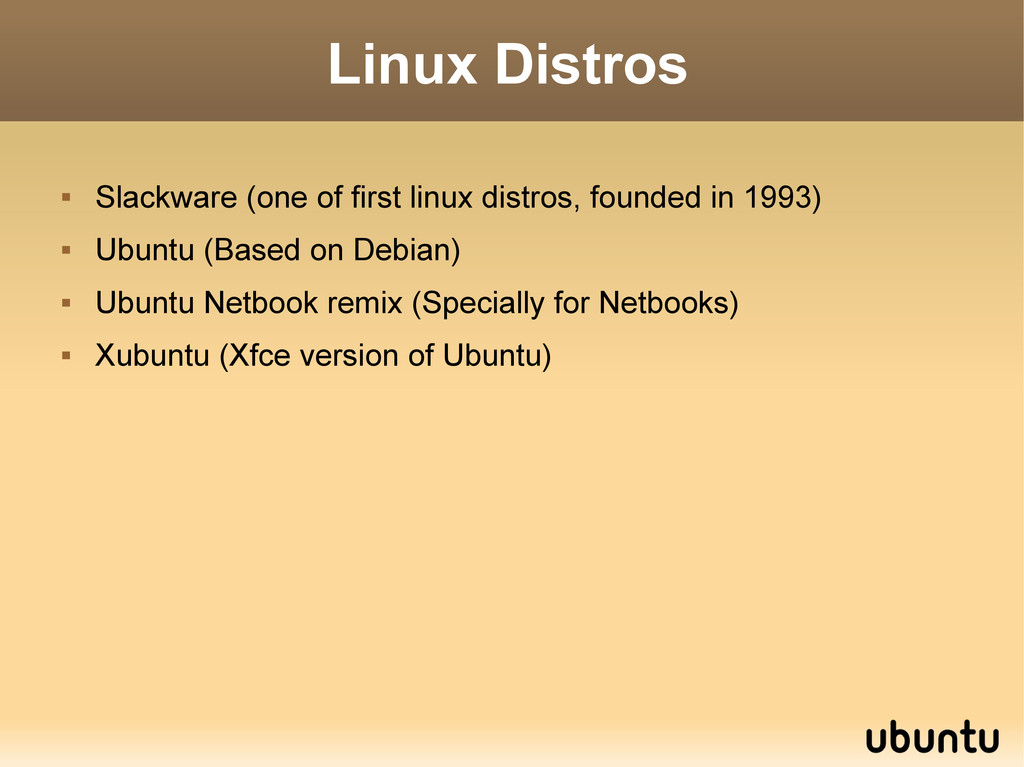
Linux Distros Slackware (one of first linux distros, founded
in 1993) Ubuntu (Based on Debian) Ubuntu Netbook remix (Specially for Netbooks) Xubuntu (Xfce version of Ubuntu) -
Thanks Any Questions? Mohamad ARAB Summer 2009 / Kerman Special
thanks to Didehbannet Co. sponsoring this conference.