If you've got no plans to monitor your cloud infrastructure then there's no need to go for cloud in the first place. Monitoring is a measure of how well internal states of a system can be inferred by the knowledge of it’s external outputs.
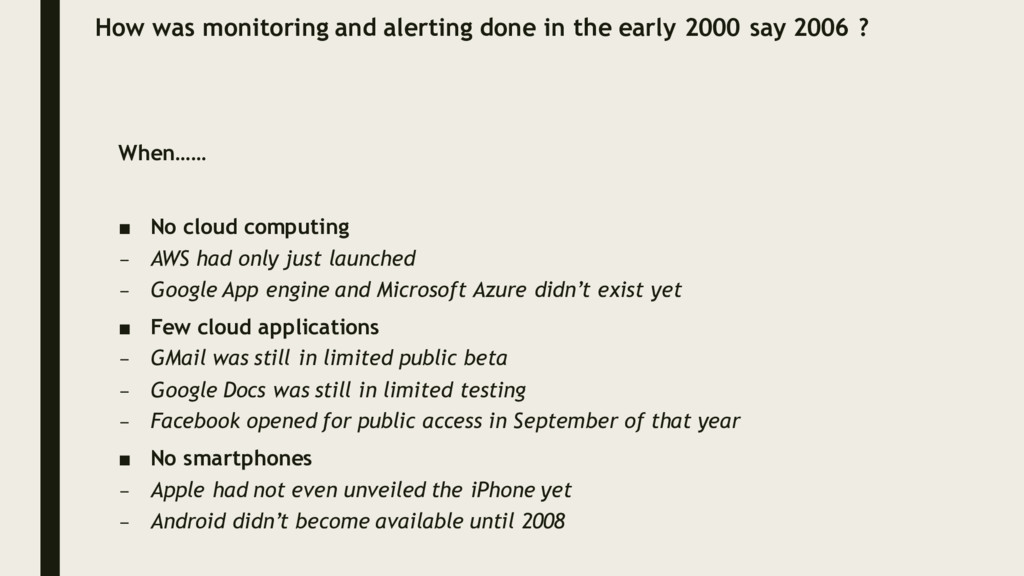
say 2006 ? When…… ▪ No cloud computing – AWS had only just launched – Google App engine and Microsoft Azure didn’t exist yet ▪ Few cloud applications – GMail was still in limited public beta – Google Docs was still in limited testing – Facebook opened for public access in September of that year ▪ No smartphones – Apple had not even unveiled the iPhone yet – Android didn’t become available until 2008
graphs all the time; day and night; weekends. And he would start calling up people, when something looked wrong.” Emil Fredriksson, Operations director at Spotify (Slightly paragraphed)
not only is the old saying “If you can’t measure it, you can’t improve it” true, but visibility into your metrics allows you to identify WHERE you can make the easiest and most impactful improvements.
“heavy lifting”—all the discovery and analysis that take teams of experts hours or days, AI does in milliseconds—to proactively identify problems and pinpoint the underlying root cause. ▪ Self-healing troubleshooting. ▪ Accelerated time to delivery. ▪ Future-proof scalability. https://www.dynatrace.com/platform/artificial-intelligence/ The future is now…..
probably haven’t installed your last monitoring system. ▪ A technically superior solution is worthless, if your users don’t understand it. ▪ Avoid hype driven development. Be slow to jump into the next new and shiny thing in town… ▪ Monitoring is suppose to be reliable, but not necessarily accurate. ▪ Monitoring is also cost intensive. Take it one step at a time. ▪ Build your systems like it’s serving users all over the world.


 bube
 tanahiro2010
 ivargrimstad
 oniak3ibm
 optim
 falcon8823
 rollbear
 sylph01
 syumai
 taiseiue
 yumnumm
 akihisaikeda
 timakin
 kristinabergwall1
 inesmontani
 codingconduct
 palkan
 cromwellryan
 thekraken
 elsirapls
 minecr
 baasie
 popppiees