is the direct translation of the Arabic word Rub' Al Khali, which is the original name of this massive desert area. The name was given due to its continuous and expansive nature.
or 'Rub Al Khali' in Arabic, is the world's largest sand desert that so intrigued the likes of Lawrence of Arabia and the explorer Wilfred Thesiger. It stretches across vast swaths of Arabia, including the south western corner of Oman, Saudi Arabia, Yemen and the United Arab Emirates. The place is known for its great sand dunes and a ride through those hilly dunes, finally reaching 'Tal Moreeb' which in English means 'Moreeb Dune', one of the highest in the Middle East region. Also LIWA is famous for its Dates festival.
it lies in Saudi Arabia, while its eastern edges extend to the United Arab Emirates, and its southern border is in Oman. Parts of its southern and southwestern limits lie in Yemen. Though its name suggests that no one lives there, many tribes have lived and still inhabit the region.
“hyper-arid”, which means that it lacks water for the growth of plants or survival of animals. Rainfall is less than 3 cm (1.2 in) every year. The daily temperatures are between 47 °C (117 °F) and 51 °C (124 °F).
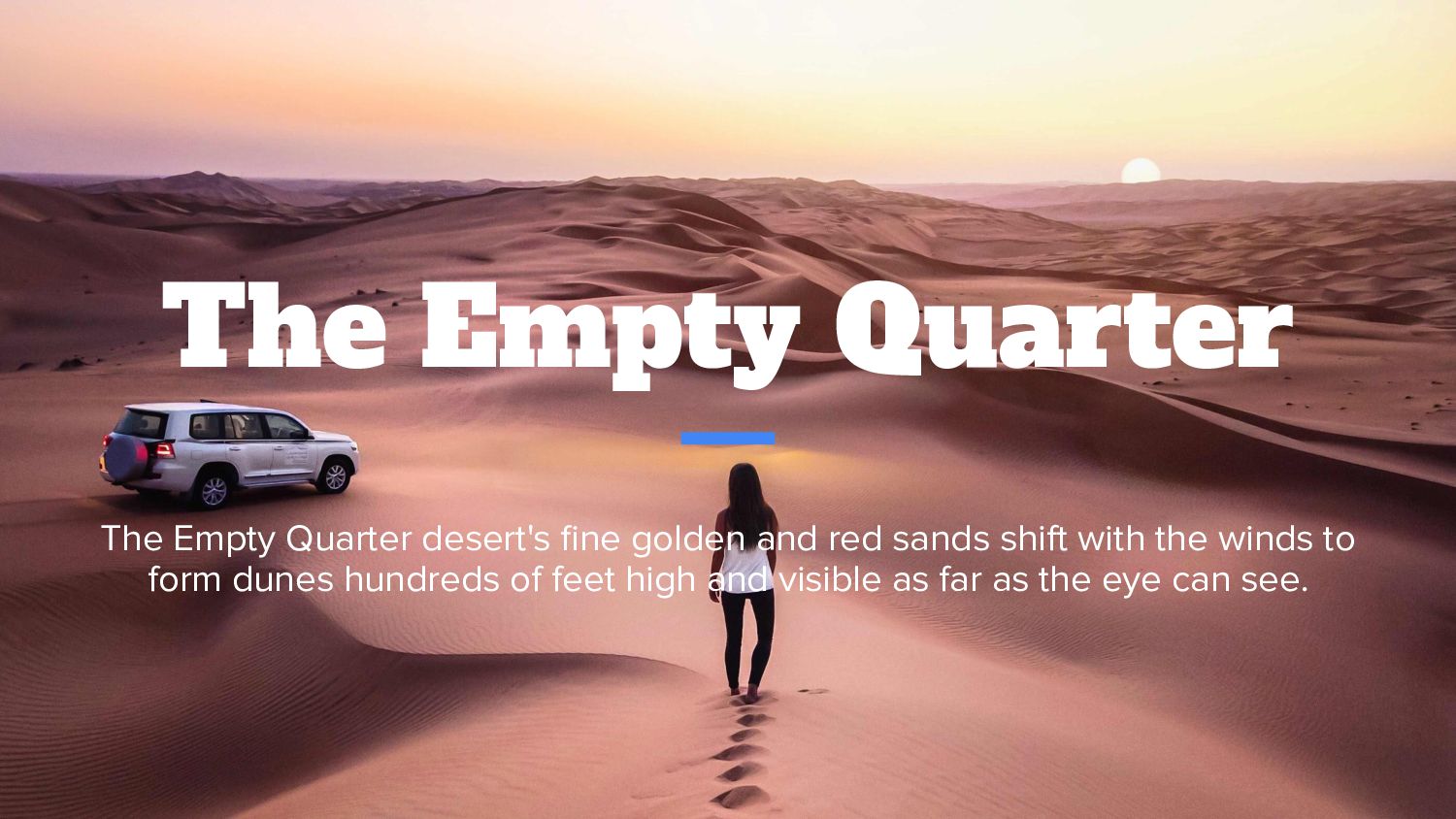
Quarter, known as Rub' al Khali, is the world's largest sand sea, holding about half as much sand as the Sahara Desert. The Empty Quarter covers 583,000 square kilometers (225,000 square miles), and stretches over parts of Saudi Arabia, Yemen, Oman, and the United Arab Emirates. The Empty Quarter is a magnificent sea of dunes that has been untouched by mankind.
safari on request; all camping equipment, breakfast, lunch, dinner included. Liwa days tours and Liwa overnight camping in Rub Al Khali gives you chance to discover the best parts of Rub Al khali and to understand the Bedouins life. We also provide fixed camp for special request.
includes a few towns, not many people live in the Empty Quarter because of the intense heat and scarce water. Sand dunes themselves present challenges, impeding the movement of people and vehicles. In the sandy terrain of the United Arab Emirates, on the northern edge of the Rub' al Khali, an oasis brings green to the desert. The T-shaped, 100-kilometer stretch of date plantations and small towns comprise the Liwa Oasis, home to about 20,000 people in Abu Dhabi.
is an small patch of vegetation surrounded by desert. Communities have traditionally planted strong trees, such as palms, around the perimeter of oases to keep the desert sands from their delicate crops and water. An oasis is an area made fertile by a source of freshwater in an otherwise dry and arid region.


 terasawat
 frievea
 ytapples613
 dragon2
 hiola
 juanmartin2026
 bvr7352
 cbtlibrary
 pawan_pharm
 soudai
 rashwhitman
 eileencodes
 marktimemedia
 csswizardry
 tammyeverts
 chrisshort
 aleyda
 greggifford
 pedronauck
 rocio
 marketingsoph
 twada
 techseoconnect