Upgrade to Pro — share decks privately, control downloads, hide ads and more …

Introduction to Accounting

Avatar for Dr. Bharath V Dr. Bharath V
September 11, 2026

Introduction to Accounting

Basis of Accounting – Cash, and Accrual Basis, Accounting Equations – Meaning, Effects of Transactions on Accounting Equations, Process of Preparing Accounting Equation, Accounting Procedures- Rules of Debit and Credit, Classification of Accounts, Balancing of Account, Significance of Debit and Credit in Balance in Accounts. Sources of Document. Journalising, Ledger Posting, Trial Balance.

Avatar for Dr. Bharath V

Dr. Bharath V

September 11, 2026

More Decks by Dr. Bharath V

Other Decks in Education

Transcript

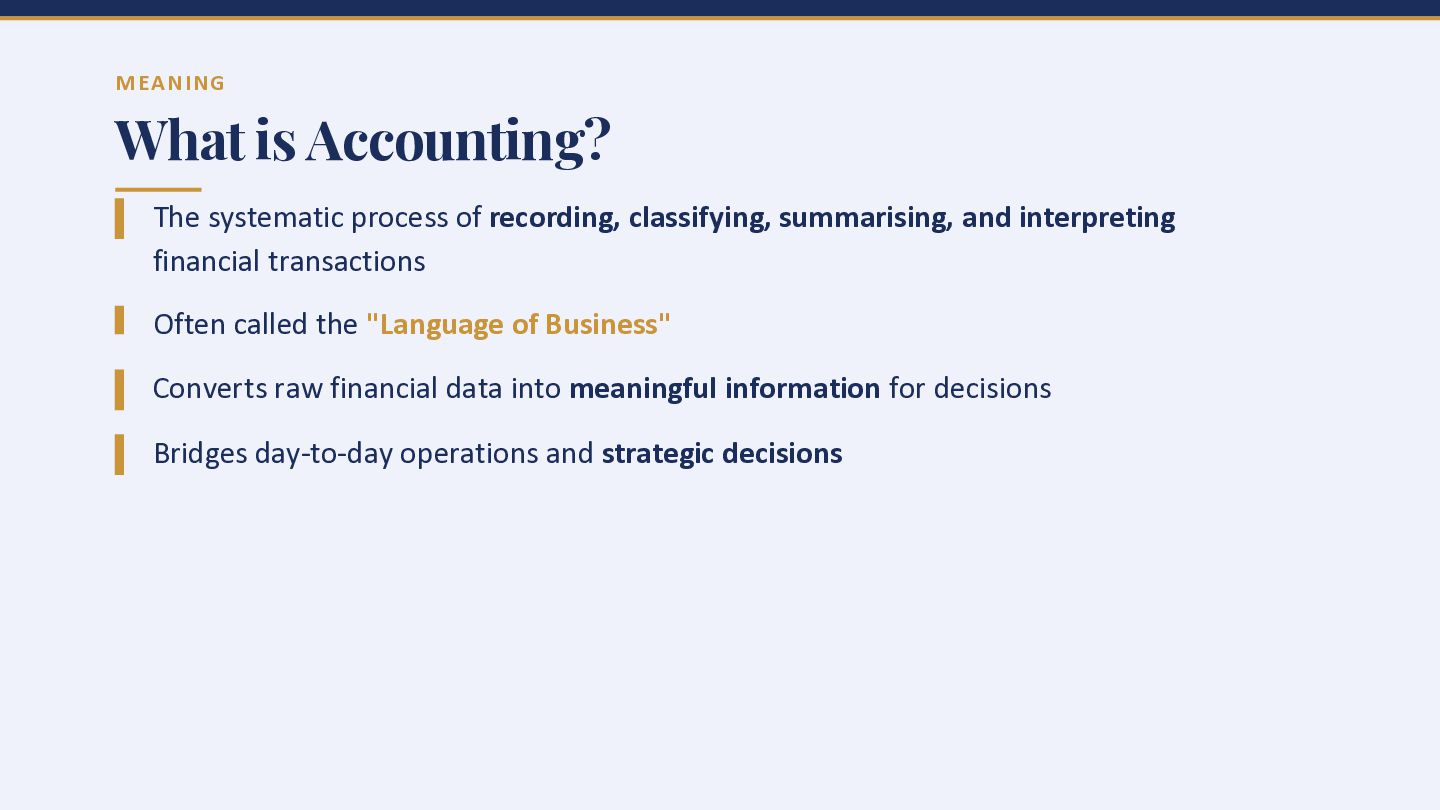
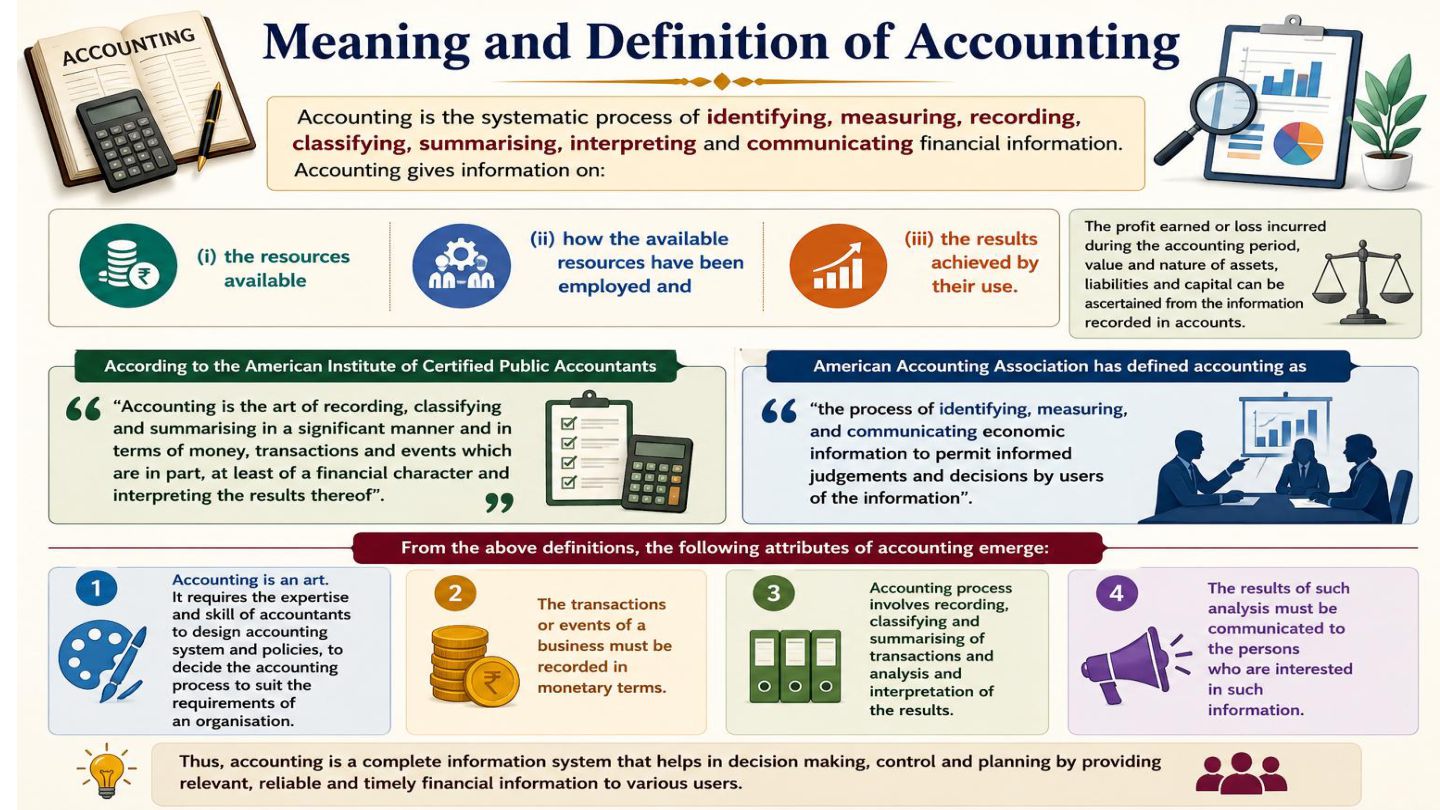
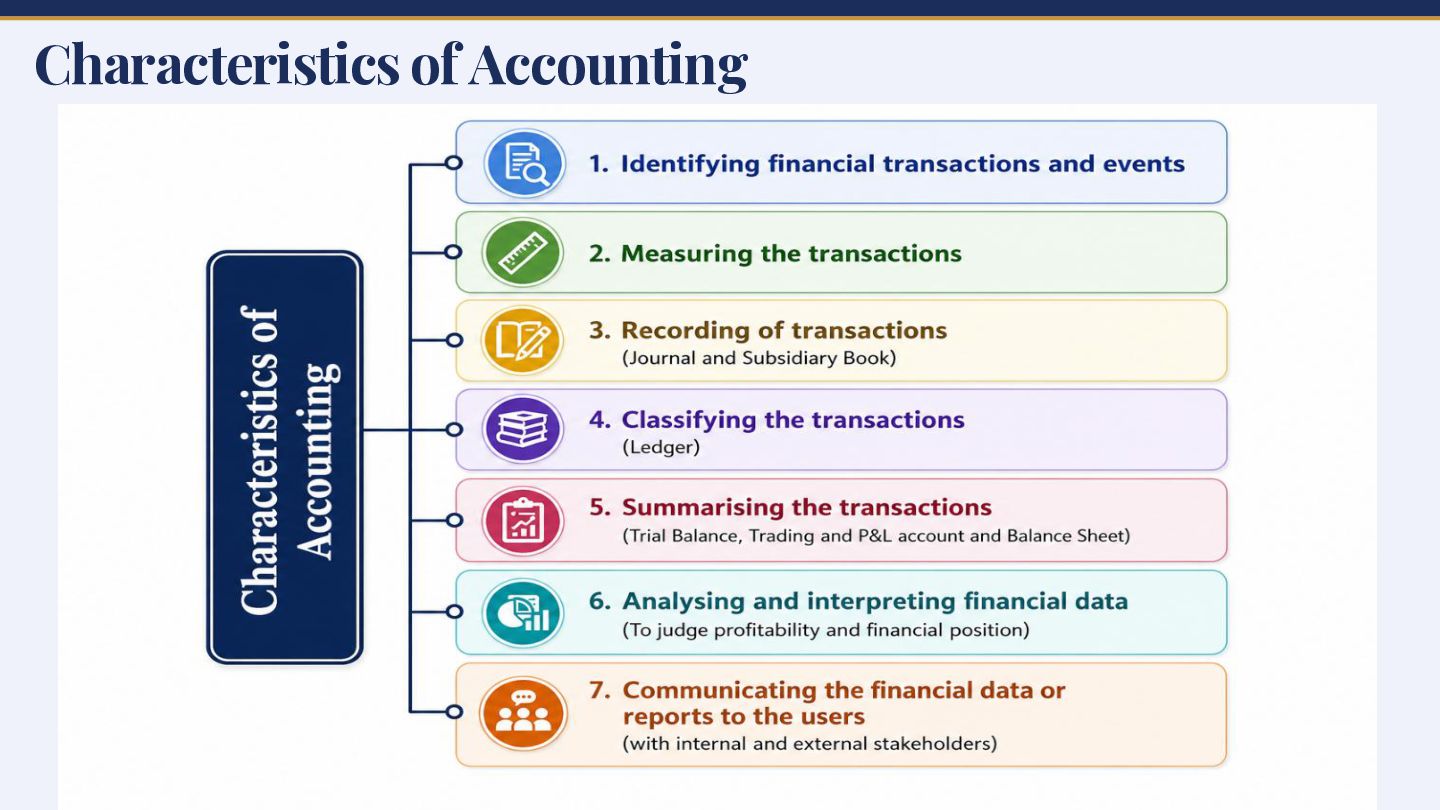
  1. ME ANING What is Accounting? The systematic process of recording,

    classifying, summarising, and interpreting financial transactions Often called the "Language of Business" Converts raw financial data into meaningful information for decisions Bridges day-to-day operations and strategic decisions
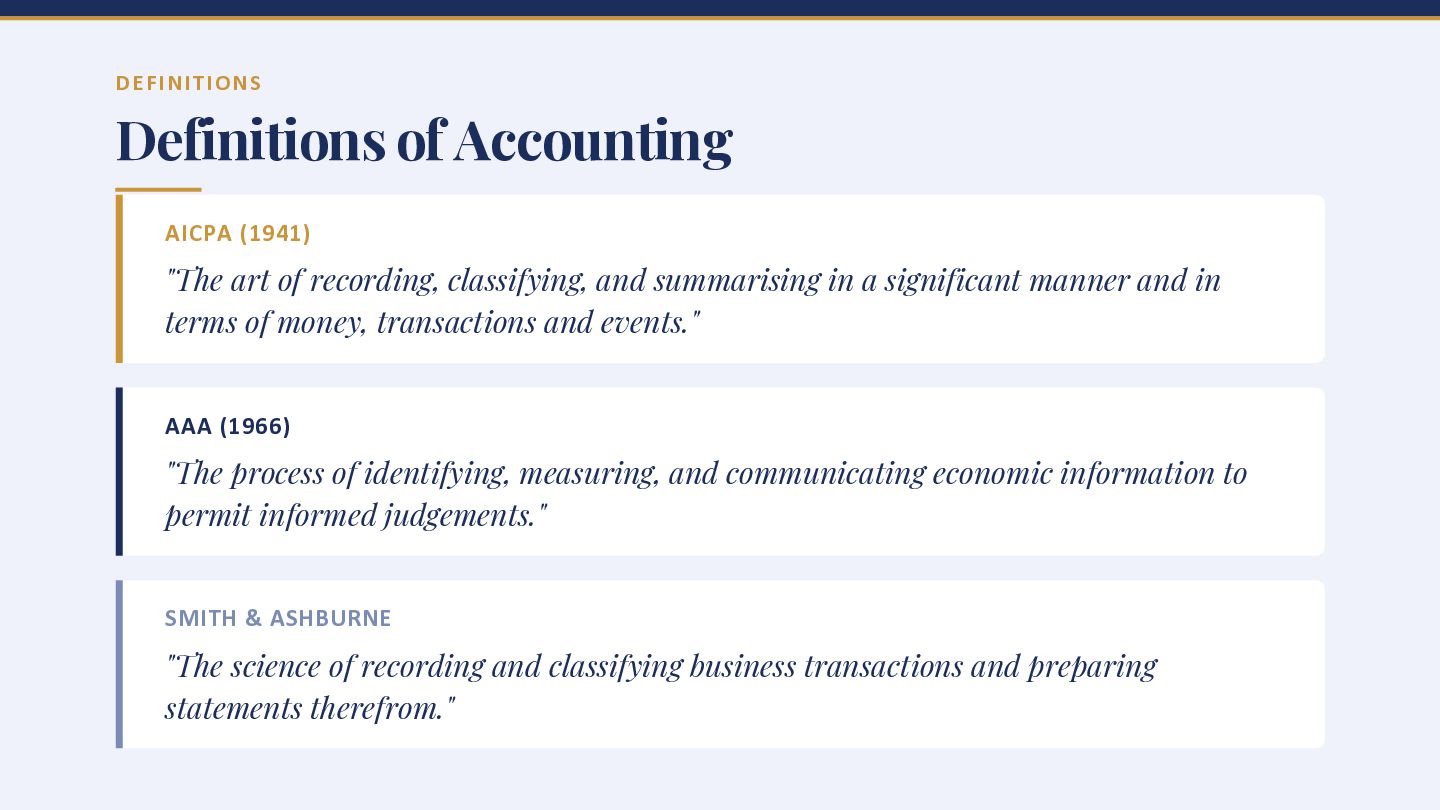
  2. DE FINIT IONS Definitions of Accounting AICPA (1941) "The art

    of recording, classifying, and summarising in a significant manner and in terms of money, transactions and events." AAA (1966) "The process of identifying, measuring, and communicating economic information to permit informed judgements." SMITH & ASHBURNE "The science of recording and classifying business transactions and preparing statements therefrom."
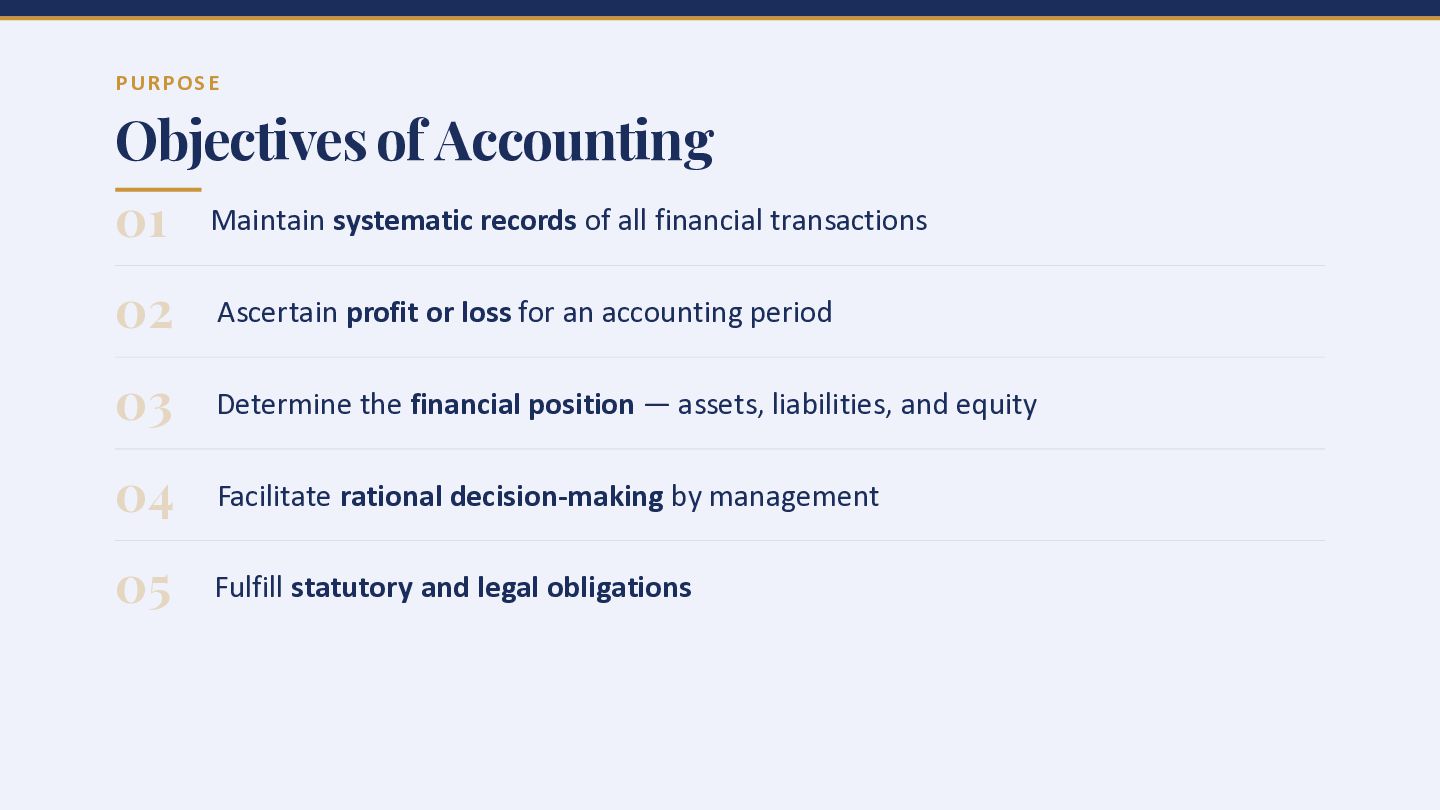
  3. PURPOSE Objectives of Accounting 01 Maintain systematic records of all

    financial transactions 02 Ascertain profit or loss for an accounting period 03 Determine the financial position — assets, liabilities, and equity 04 Facilitate rational decision-making by management 05 Fulfill statutory and legal obligations
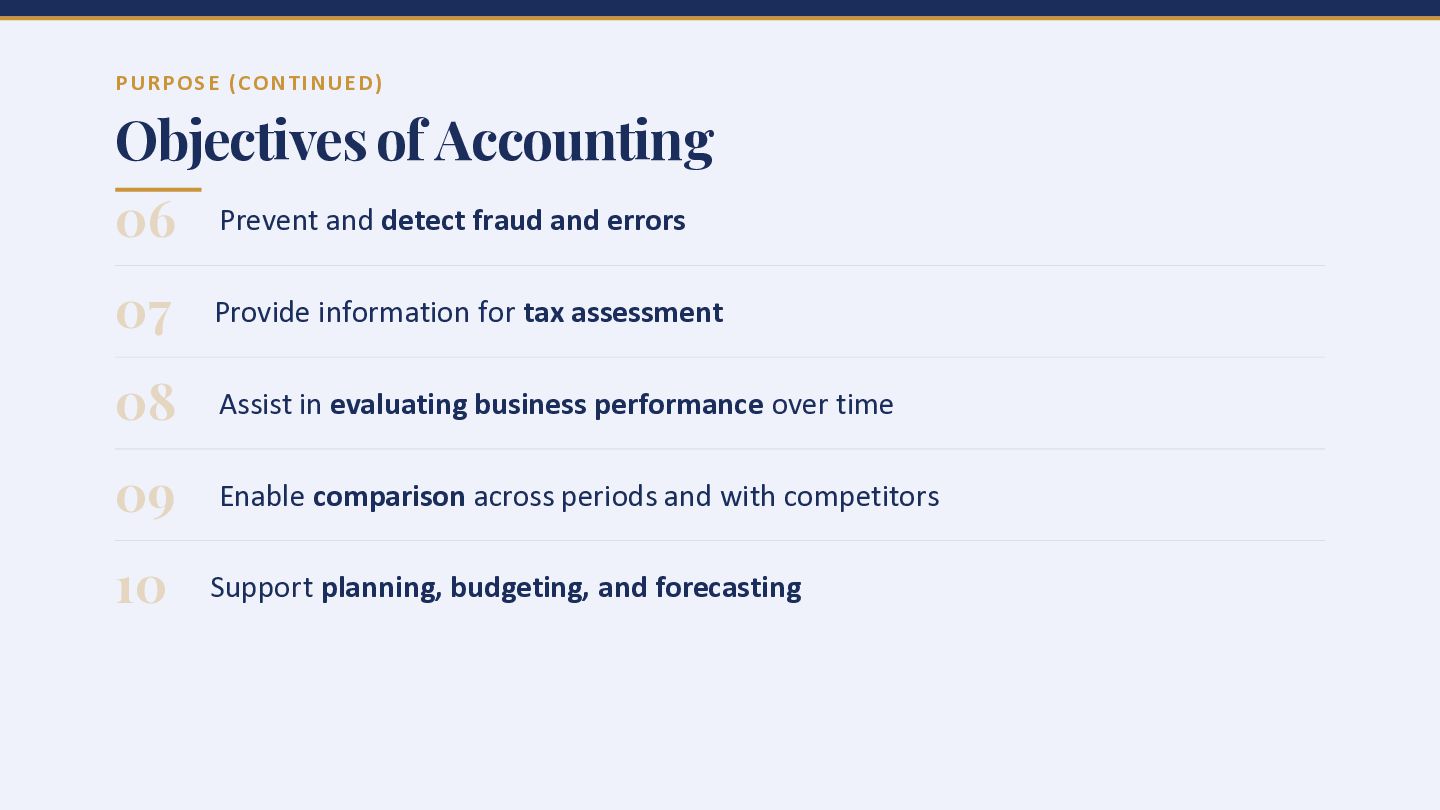
  4. PURPOSE (C ONTINUED ) Objectives of Accounting 06 Prevent and

    detect fraud and errors 07 Provide information for tax assessment 08 Assist in evaluating business performance over time 09 Enable comparison across periods and with competitors 10 Support planning, budgeting, and forecasting
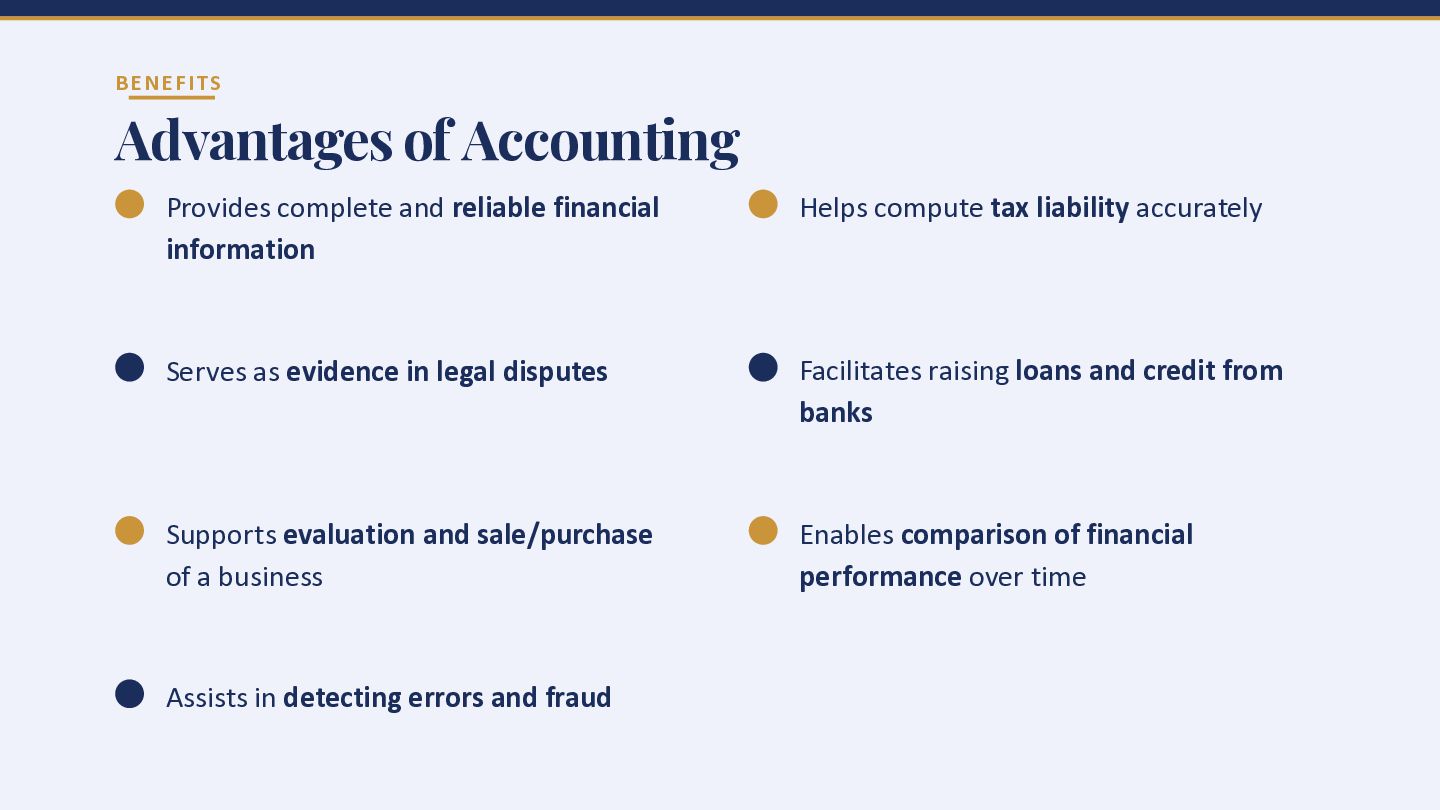
  5. BE NE FITS Advantages of Accounting Provides complete and reliable

    financial information Helps compute tax liability accurately Serves as evidence in legal disputes Facilitates raising loans and credit from banks Supports evaluation and sale/purchase of a business Enables comparison of financial performance over time Assists in detecting errors and fraud
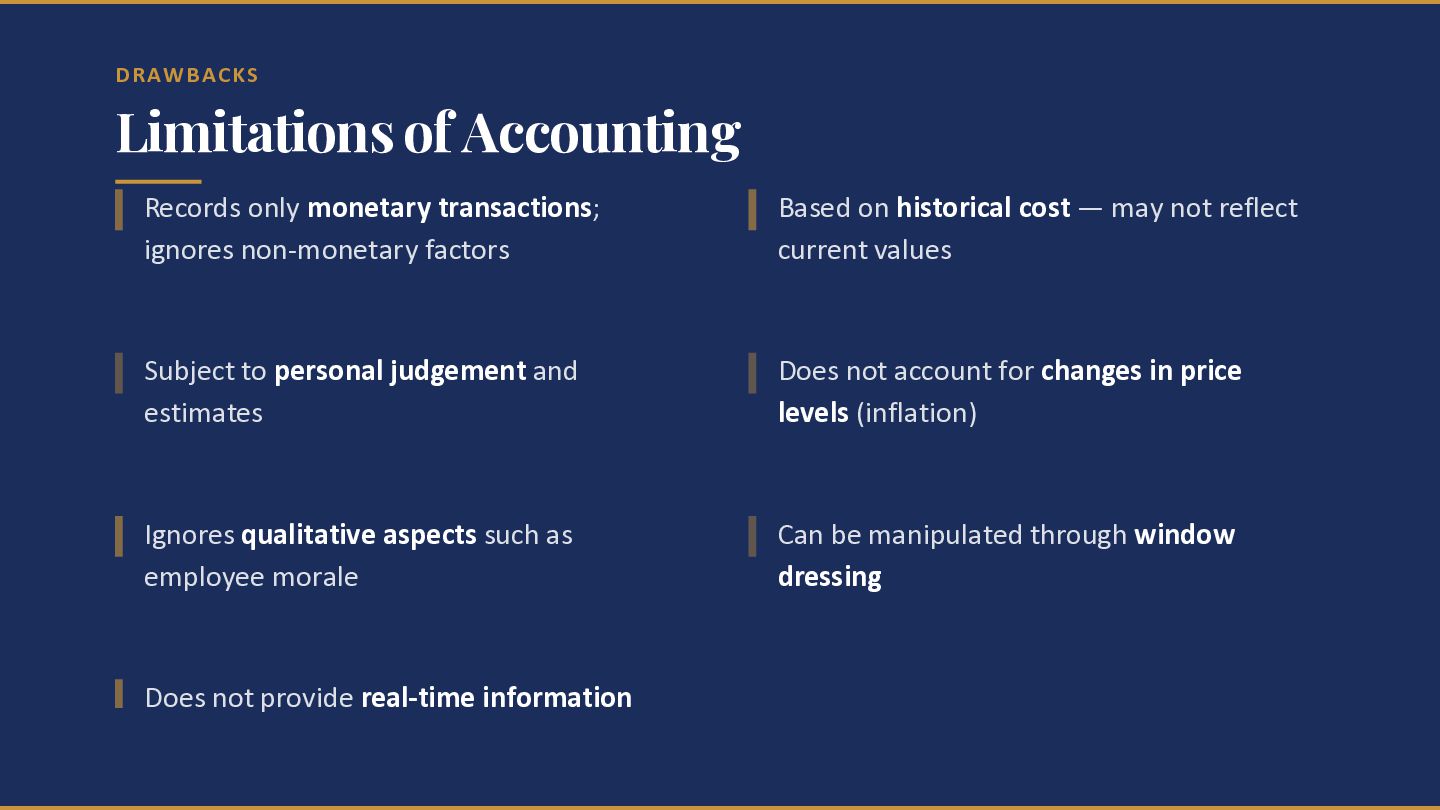
  6. DRAWBAC KS Limitations of Accounting Records only monetary transactions; ignores

    non-monetary factors Based on historical cost — may not reflect current values Subject to personal judgement and estimates Does not account for changes in price levels (inflation) Ignores qualitative aspects such as employee morale Can be manipulated through window dressing Does not provide real-time information
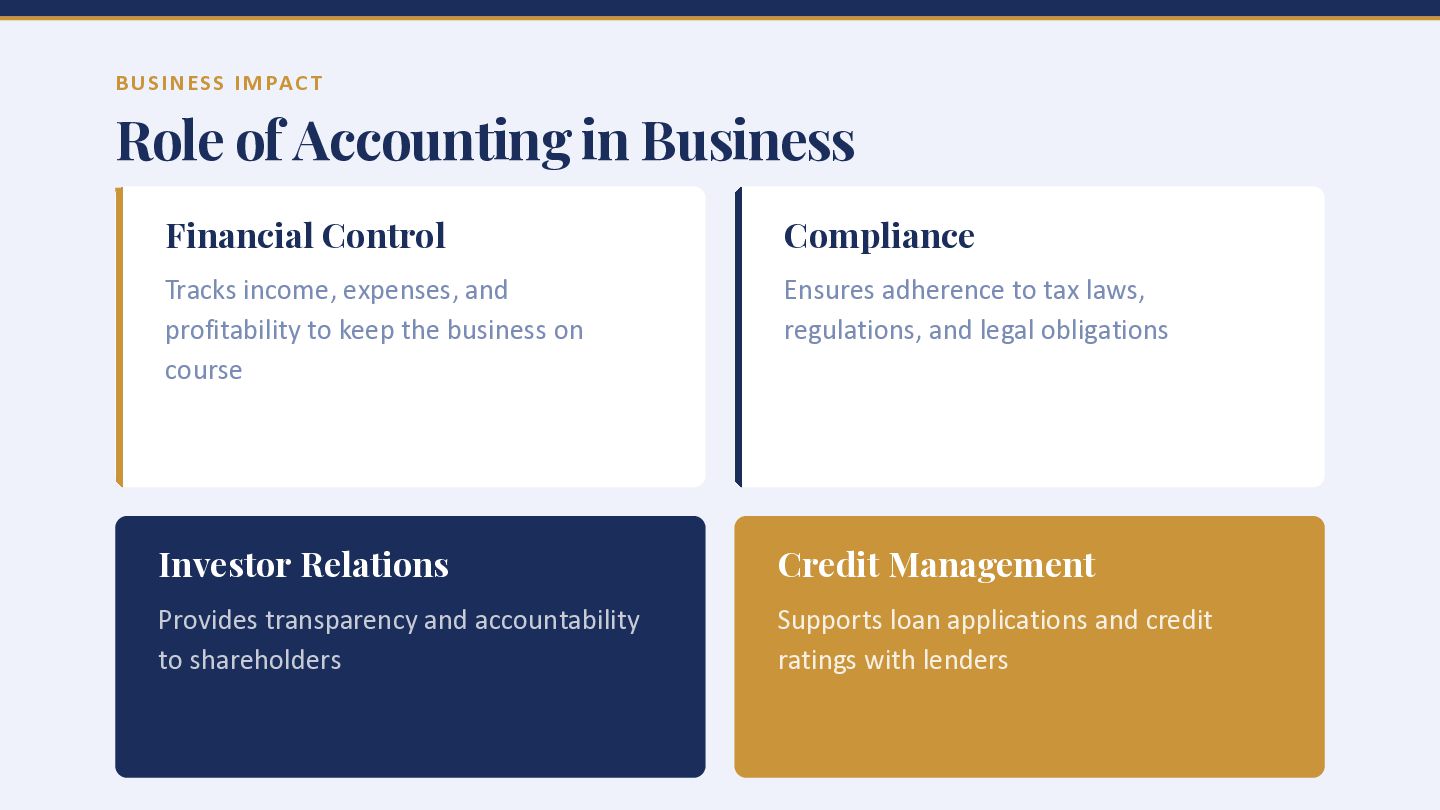
  7. BUSINE SS IMPACT Role of Accounting in Business Financial Control

    Compliance Tracks income, expenses, and profitability to keep the business on course Ensures adherence to tax laws, regulations, and legal obligations Investor Relations Credit Management Provides transparency and accountability to shareholders Supports loan applications and credit ratings with lenders
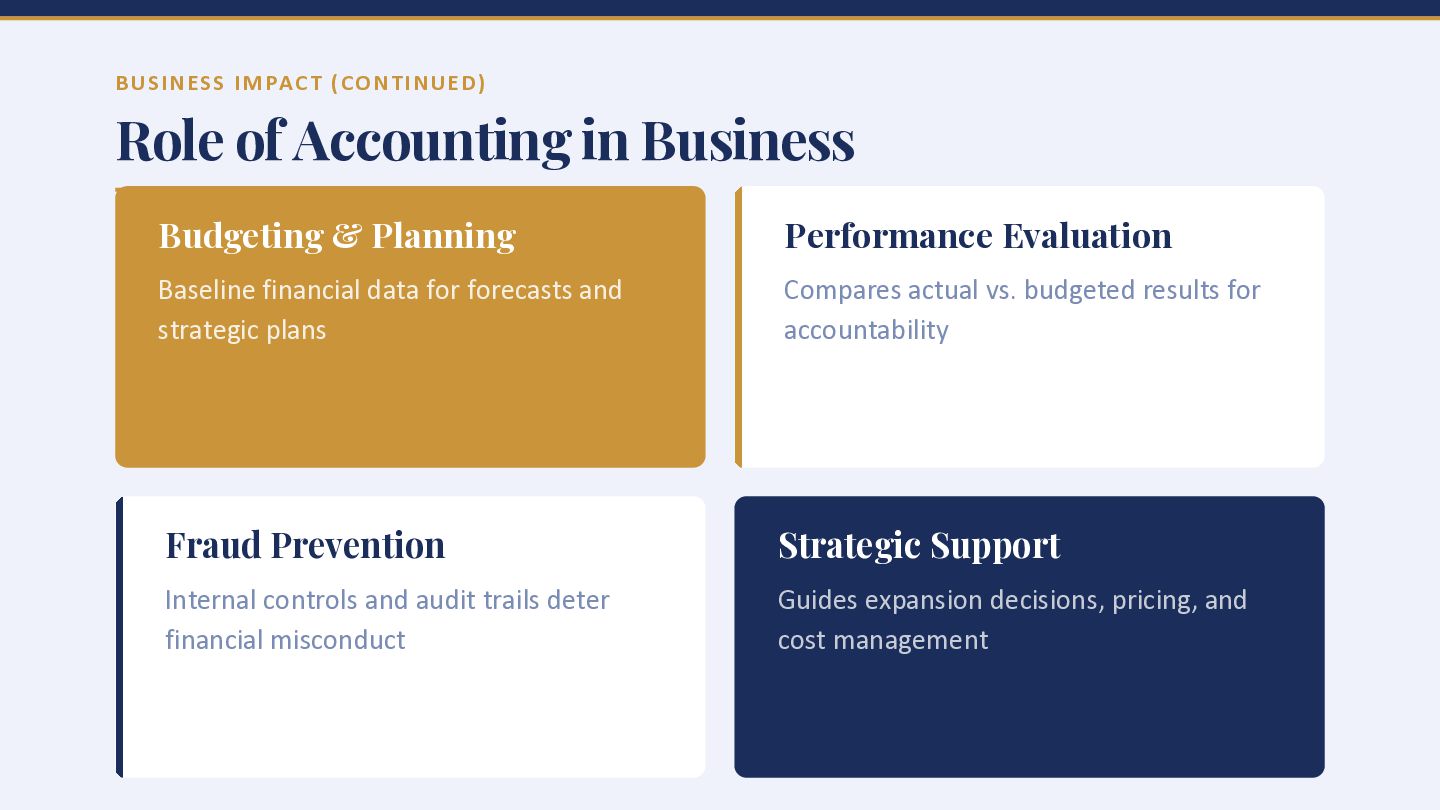
  8. BUSINE SS IMPACT (CONTINUED) Role of Accounting in Business Budgeting

    & Planning Performance Evaluation Baseline financial data for forecasts and strategic plans Compares actual vs. budgeted results for accountability Fraud Prevention Strategic Support Internal controls and audit trails deter financial misconduct Guides expansion decisions, pricing, and cost management
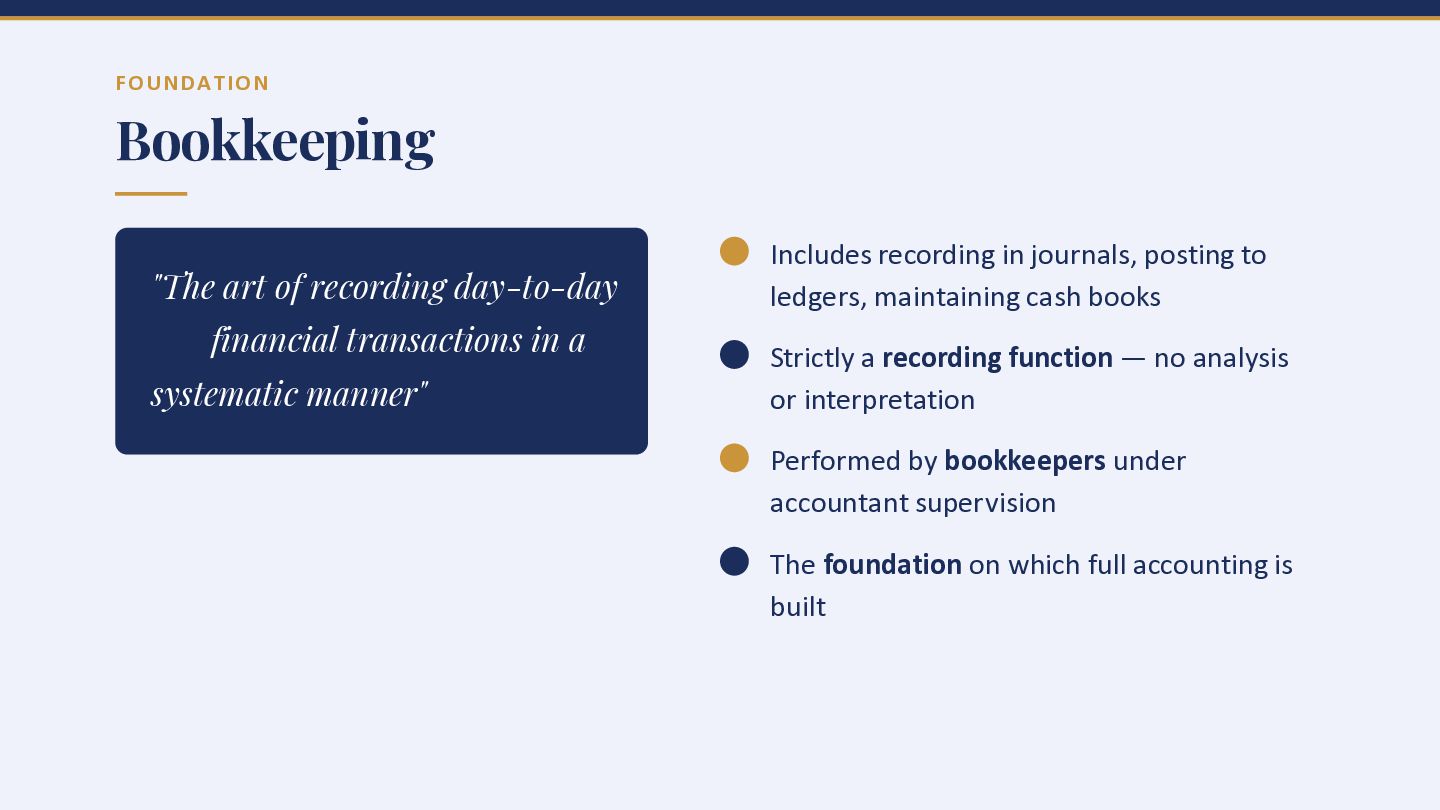
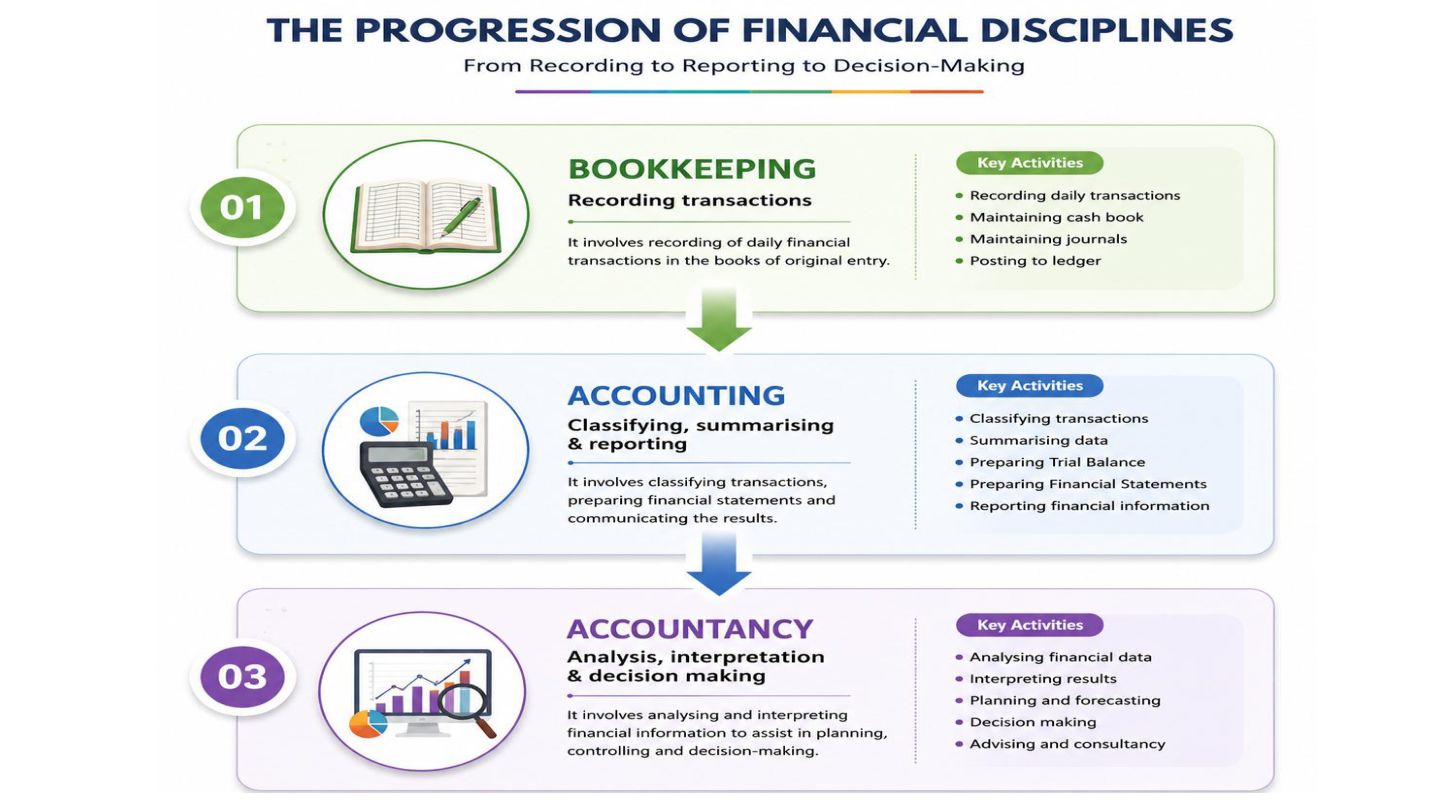
  9. FOUNDATION Bookkeeping "The art of recording day-to-day financial transactions in

    a systematic manner" Includes recording in journals, posting to ledgers, maintaining cash books Strictly a recording function — no analysis or interpretation Performed by bookkeepers under accountant supervision The foundation on which full accounting is built
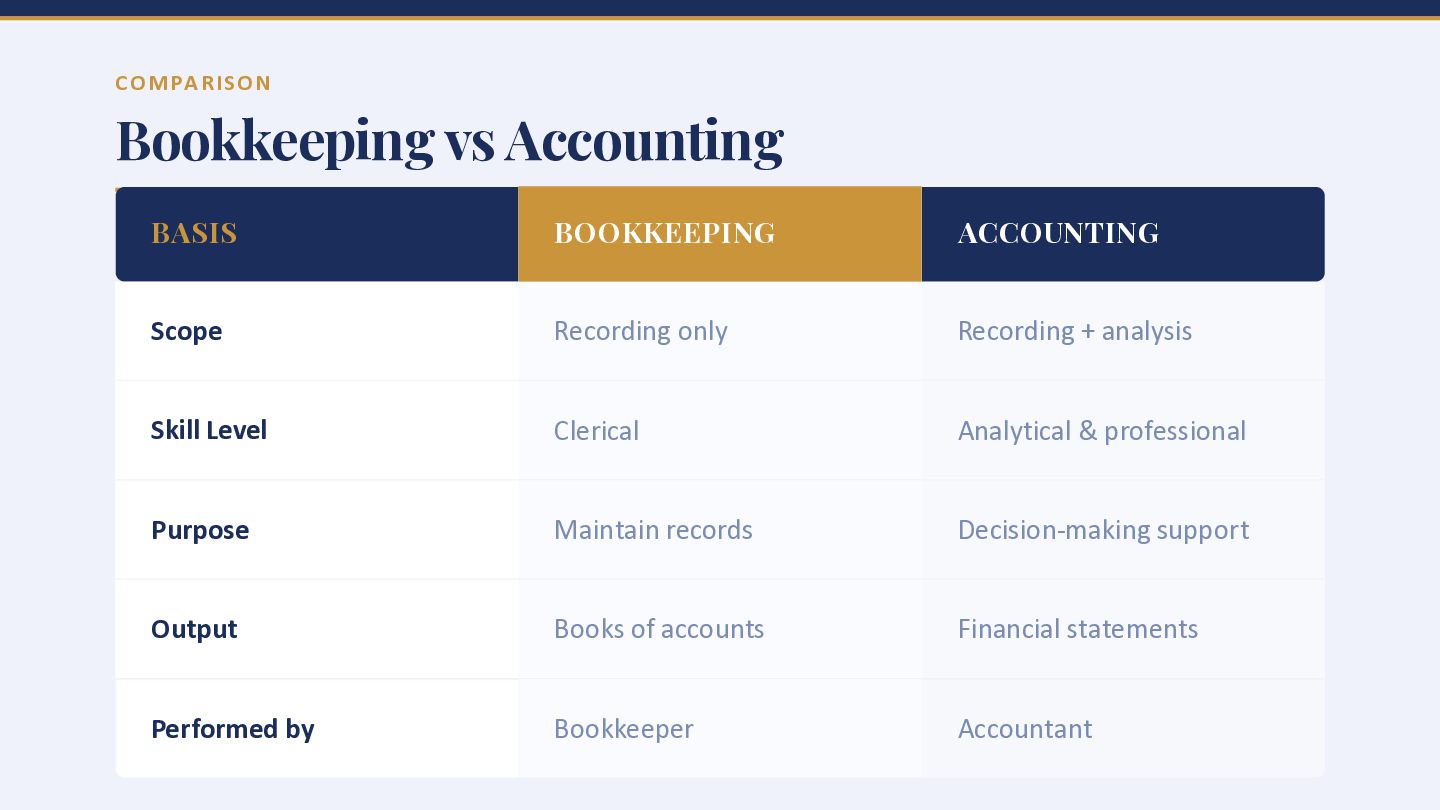
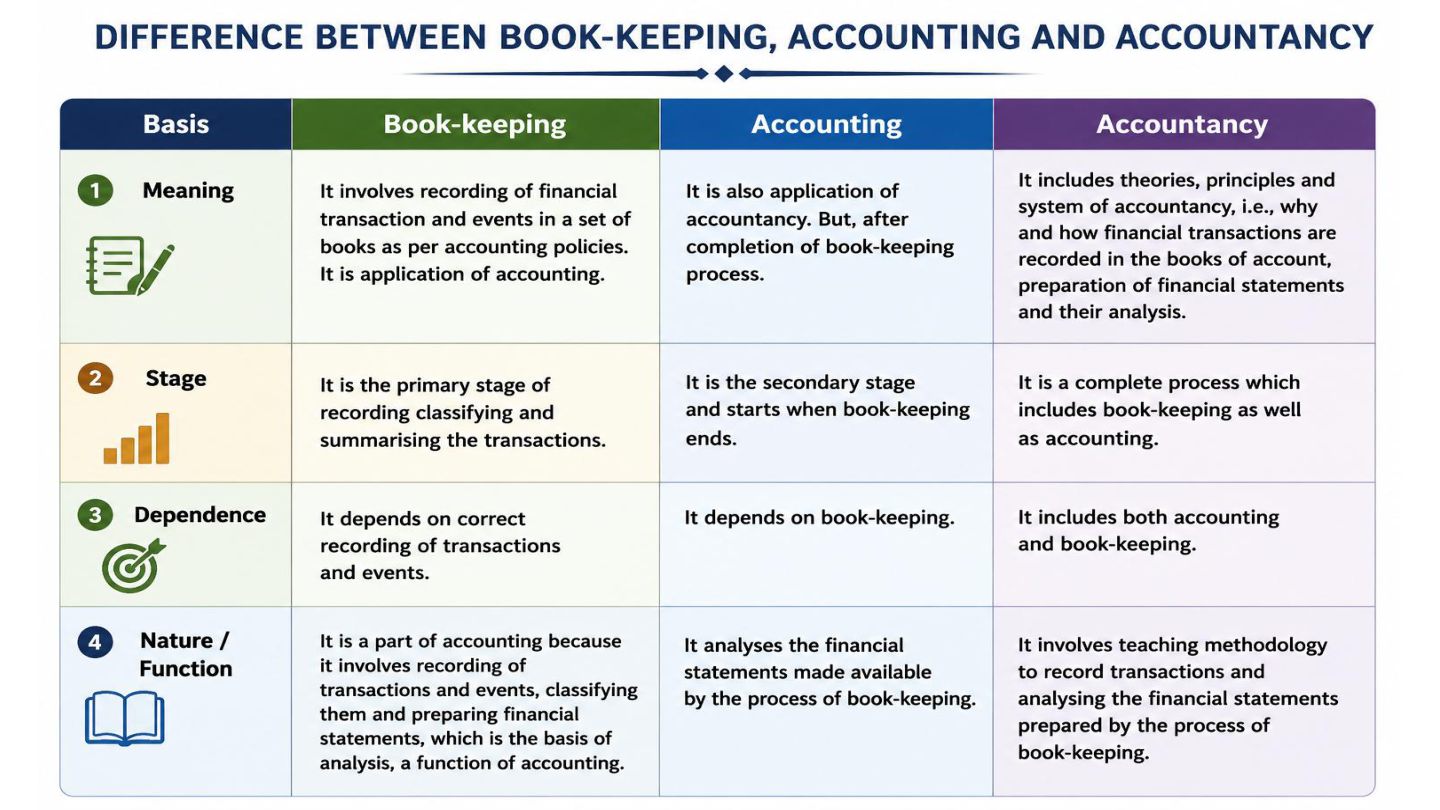
  10. C OMPARISON Bookkeeping vs Accounting BASIS BOOKKEEPING ACCOUNTING Scope Recording

    only Recording + analysis Skill Level Clerical Analytical & professional Purpose Maintain records Decision-making support Output Books of accounts Financial statements Performed by Bookkeeper Accountant
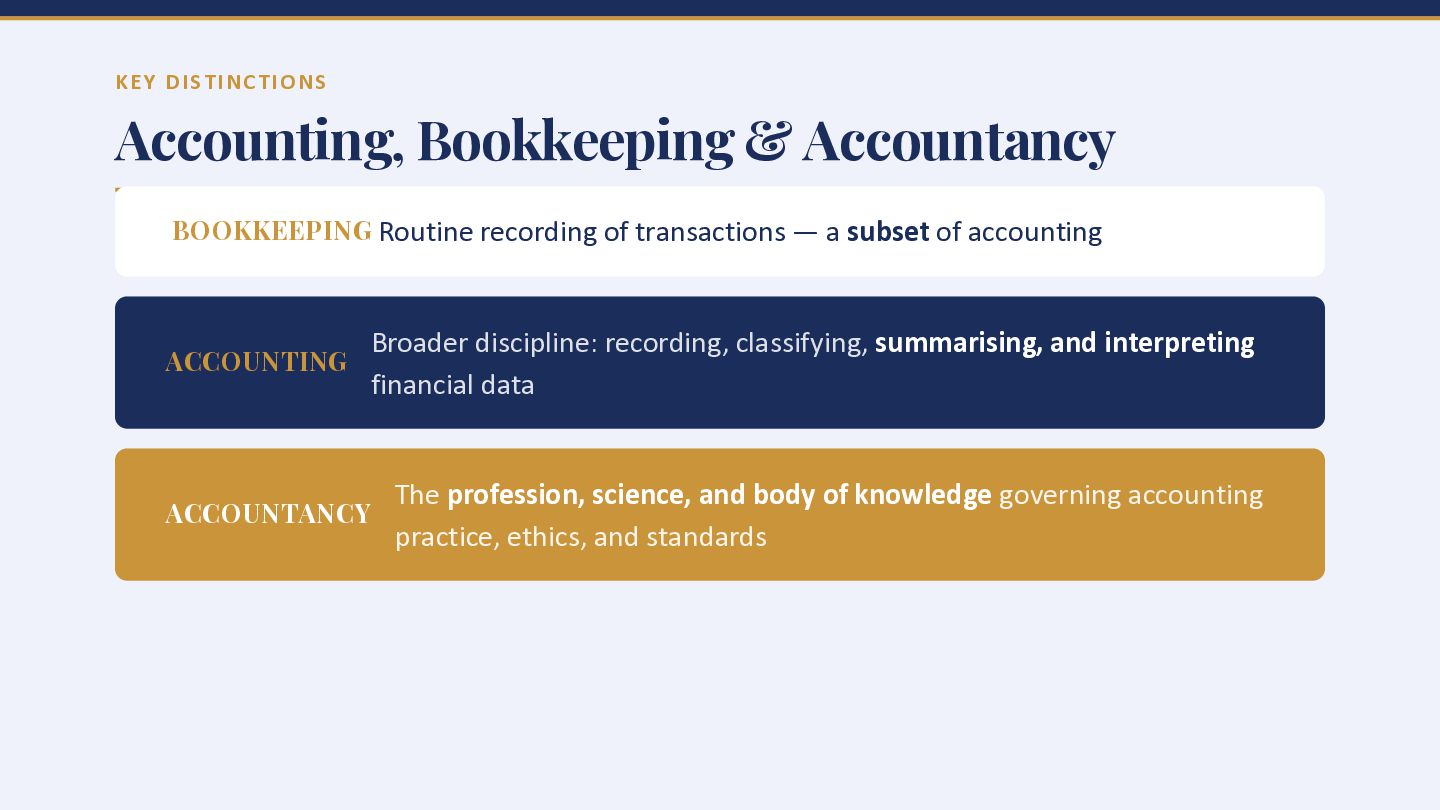
  11. KE Y DISTINC T IO NS Accounting, Bookkeeping & Accountancy

    BOOKKEEPING Routine recording of transactions — a subset of accounting ACCOUNTING Broader discipline: recording, classifying, summarising, and interpreting financial data ACCOUNTANCY The profession, science, and body of knowledge governing accounting practice, ethics, and standards
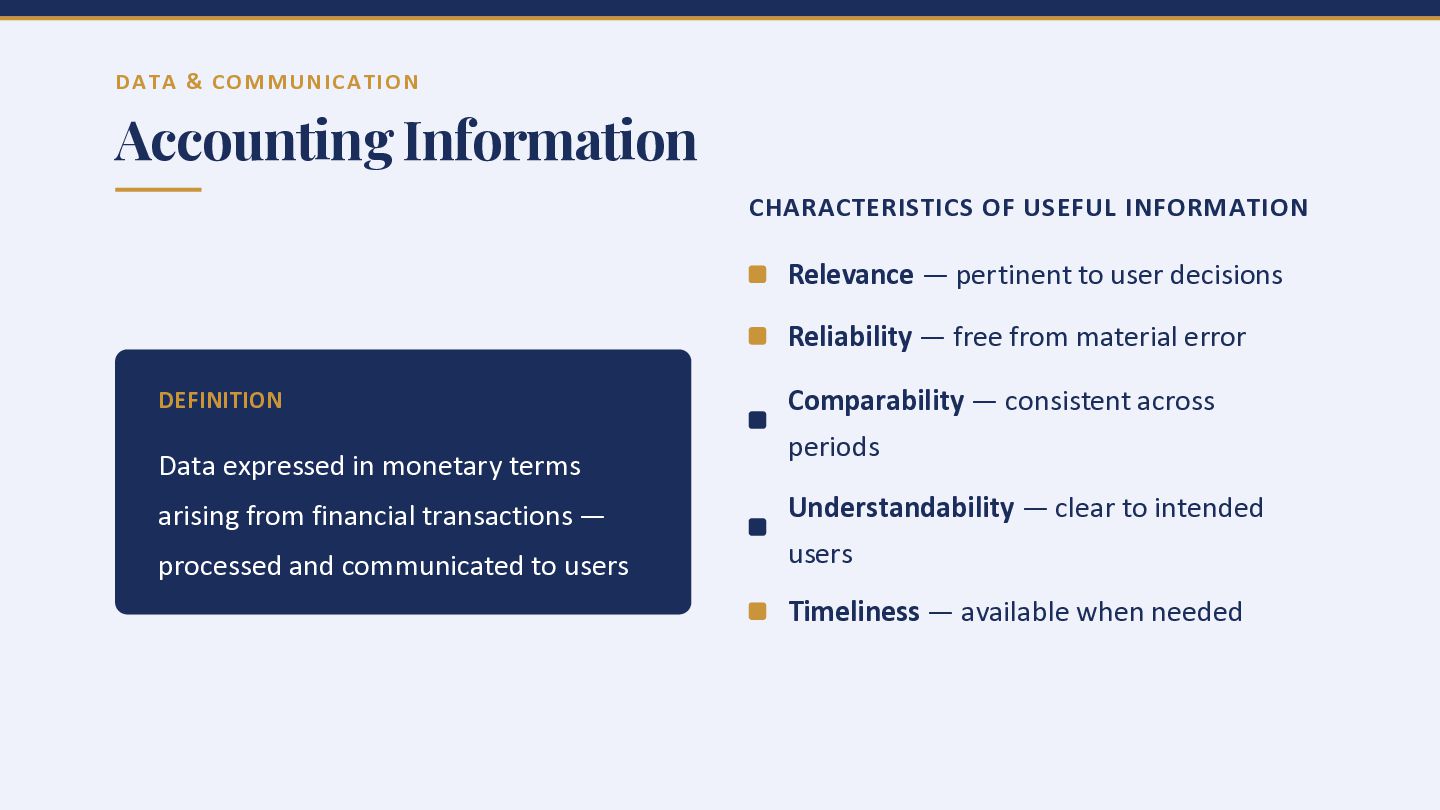
  12. DATA & C OMMUNICATION Accounting Information CHARACTERISTICS OF USEFUL INFORMATION

    Relevance — pertinent to user decisions Reliability — free from material error DEFINITION Data expressed in monetary terms Comparability — consistent across periods arising from financial transactions — Understandability — clear to intended processed and communicated to users users Timeliness — available when needed
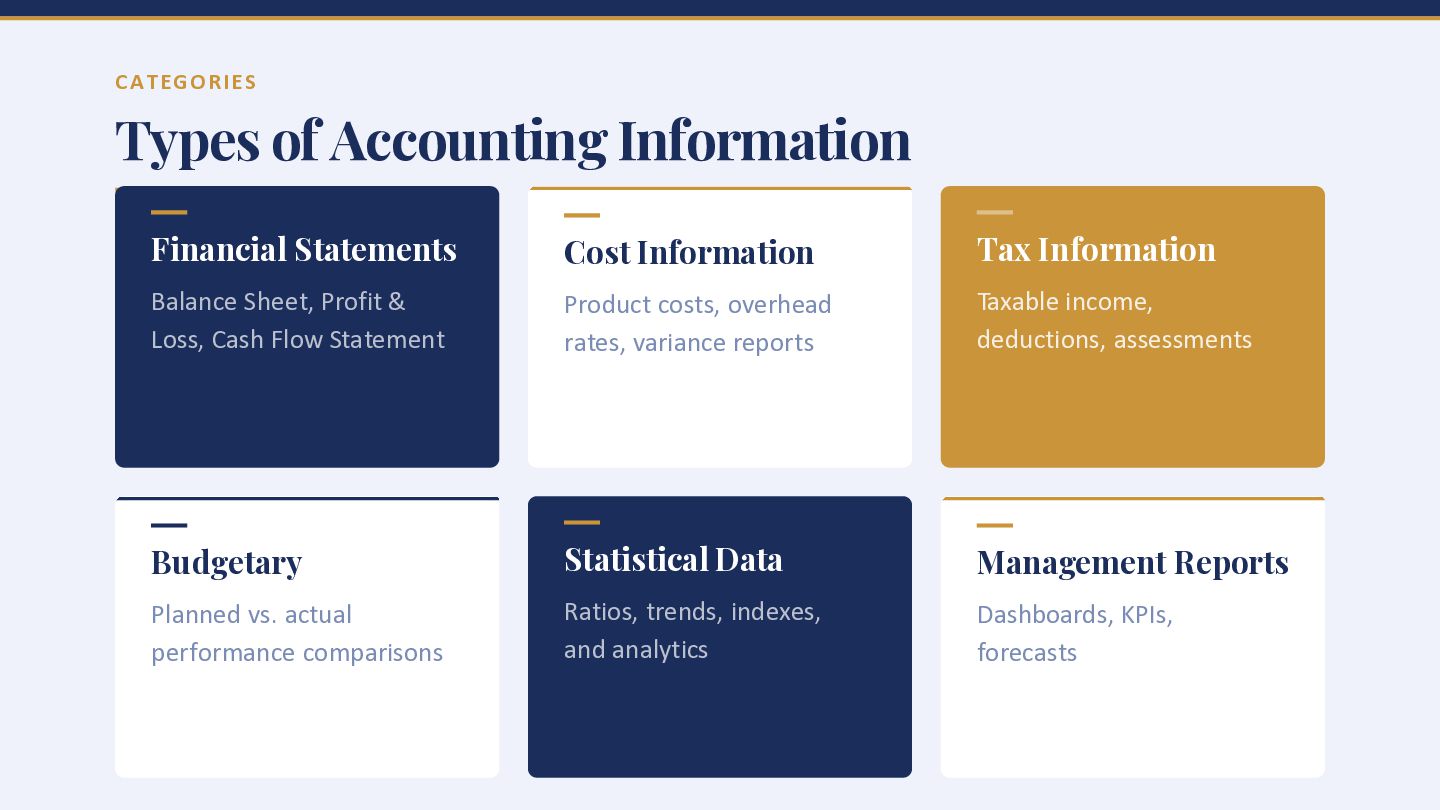
  13. C ATE GORIE S Types of Accounting Information Financial Statements

    Cost Information Tax Information Balance Sheet, Profit & Loss, Cash Flow Statement Product costs, overhead rates, variance reports Taxable income, deductions, assessments Budgetary Statistical Data Management Reports Planned vs. actual performance comparisons Ratios, trends, indexes, and analytics Dashboards, KPIs, forecasts
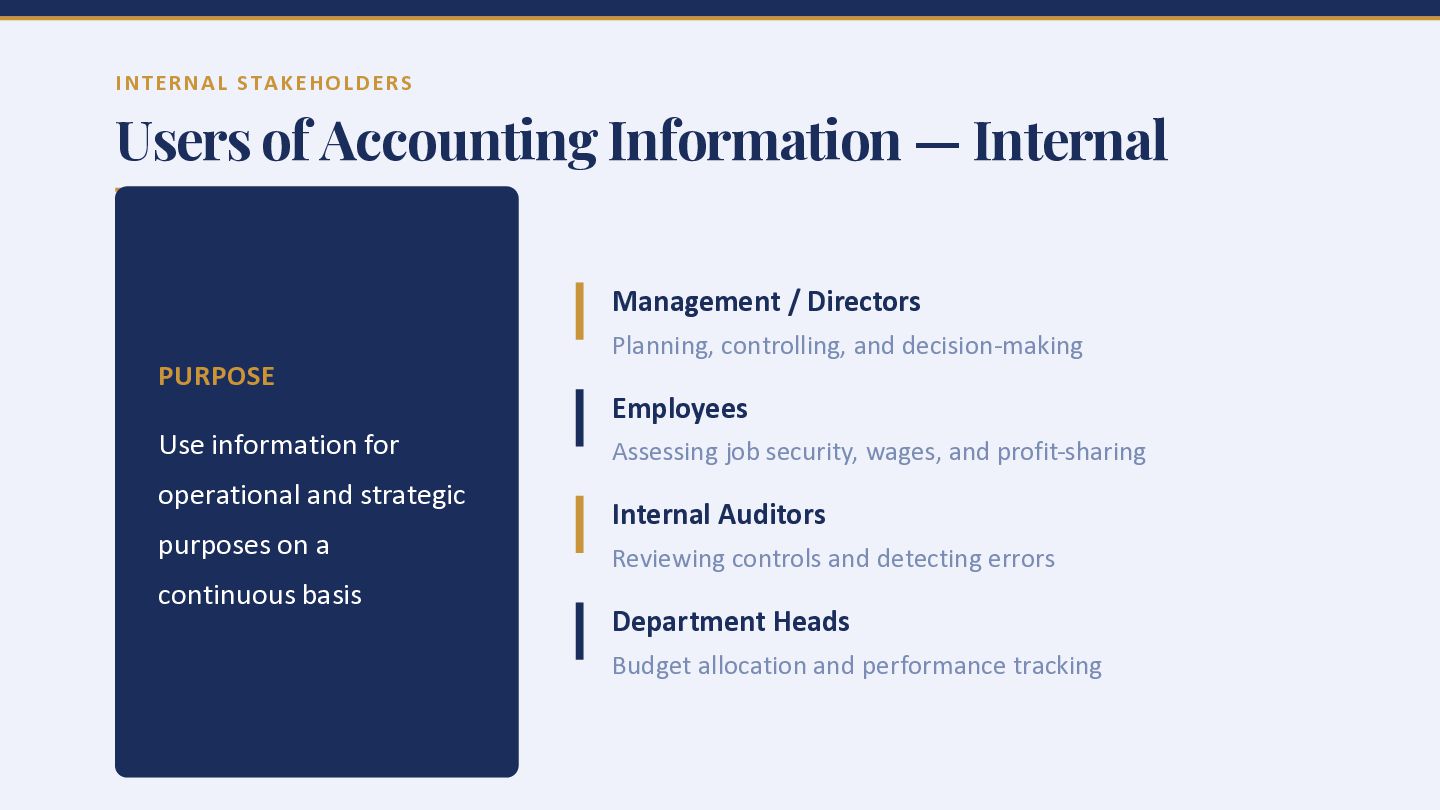
  14. INTE RN AL STAKEHOLDERS Users of Accounting Information — Internal

    Management / Directors Planning, controlling, and decision-making PURPOSE Employees Use information for operational and strategic purposes on a continuous basis Assessing job security, wages, and profit-sharing Internal Auditors Reviewing controls and detecting errors Department Heads Budget allocation and performance tracking
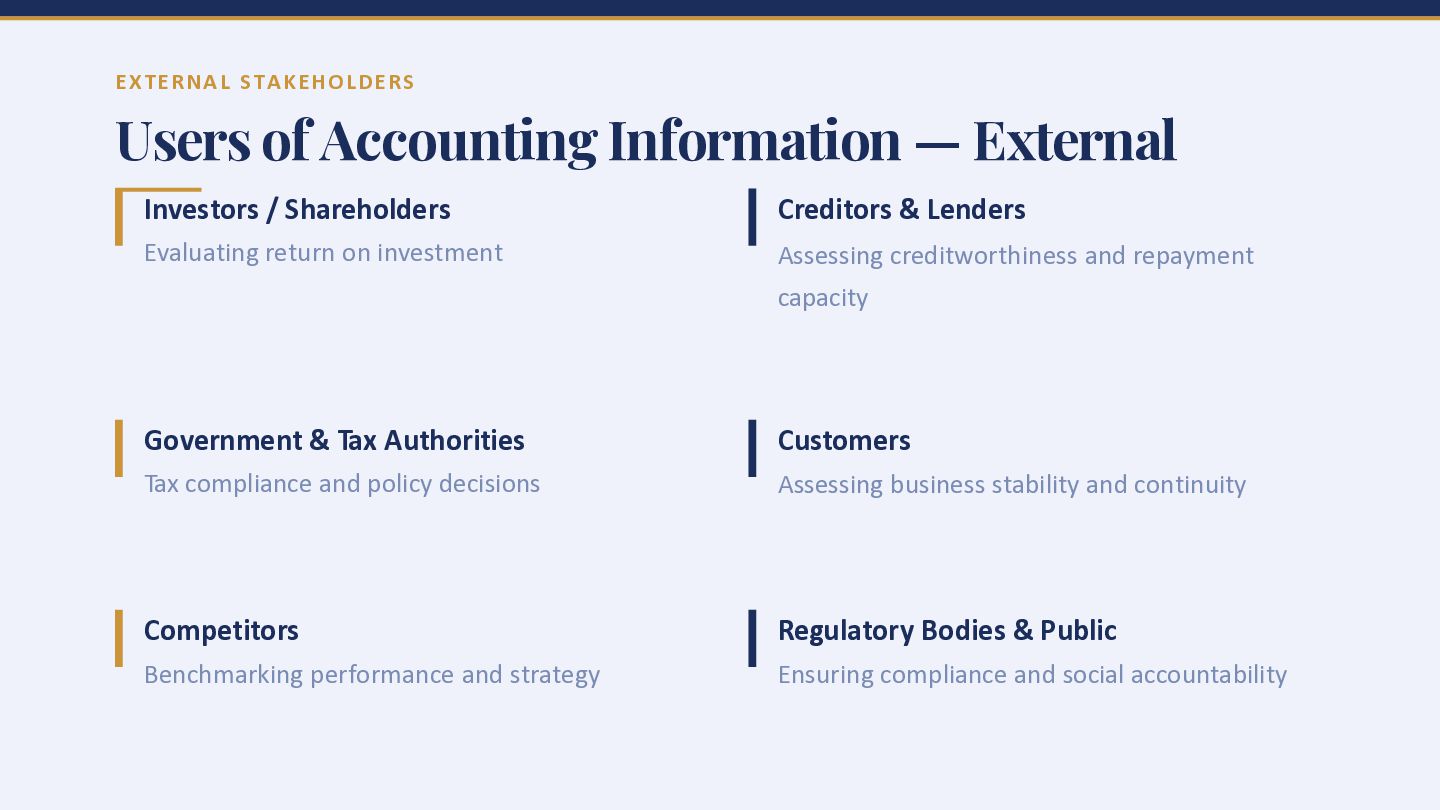
  15. E XTE RNAL STAKEHOLDERS Users of Accounting Information — External

    Investors / Shareholders Creditors & Lenders Evaluating return on investment Assessing creditworthiness and repayment capacity Government & Tax Authorities Customers Tax compliance and policy decisions Assessing business stability and continuity Competitors Regulatory Bodies & Public Benchmarking performance and strategy Ensuring compliance and social accountability
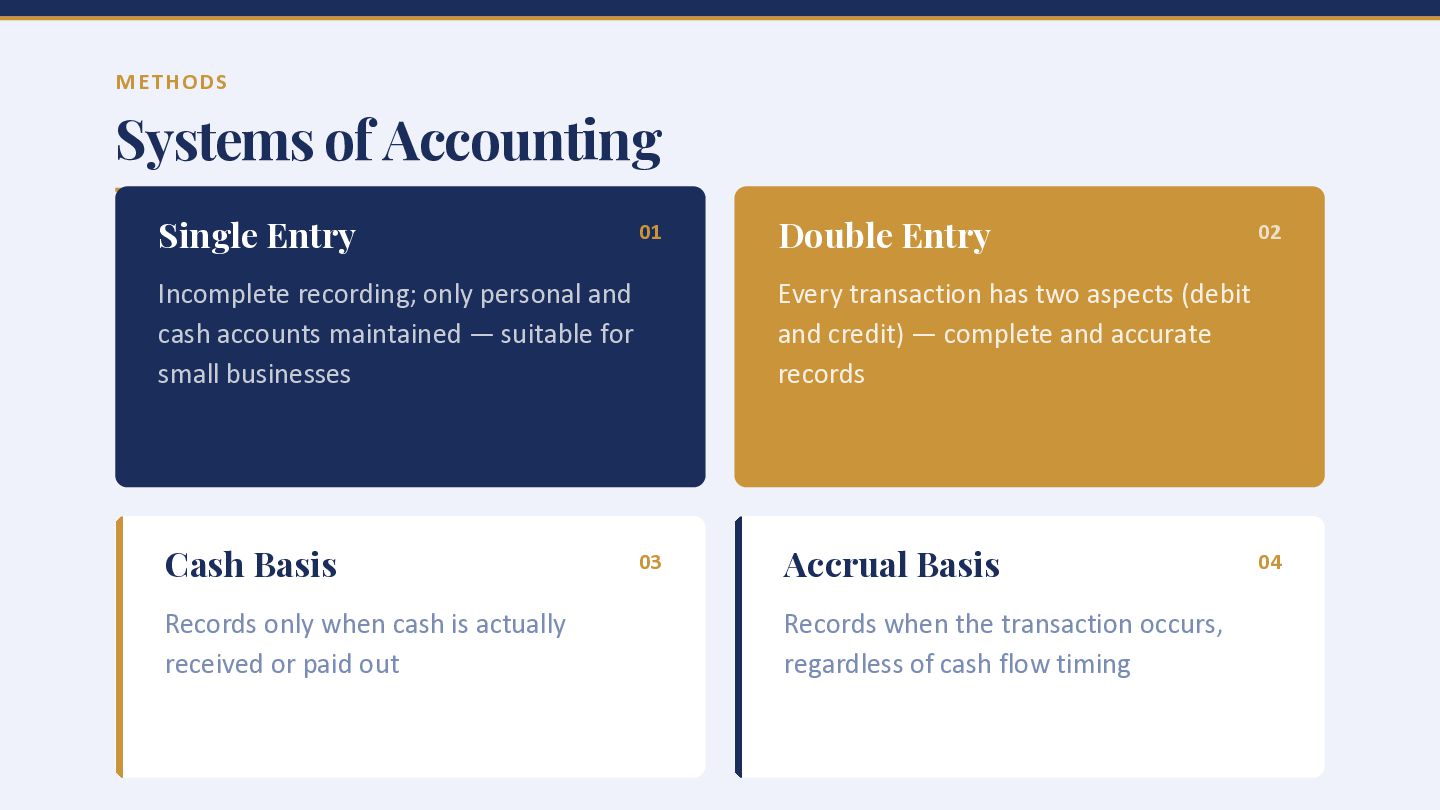
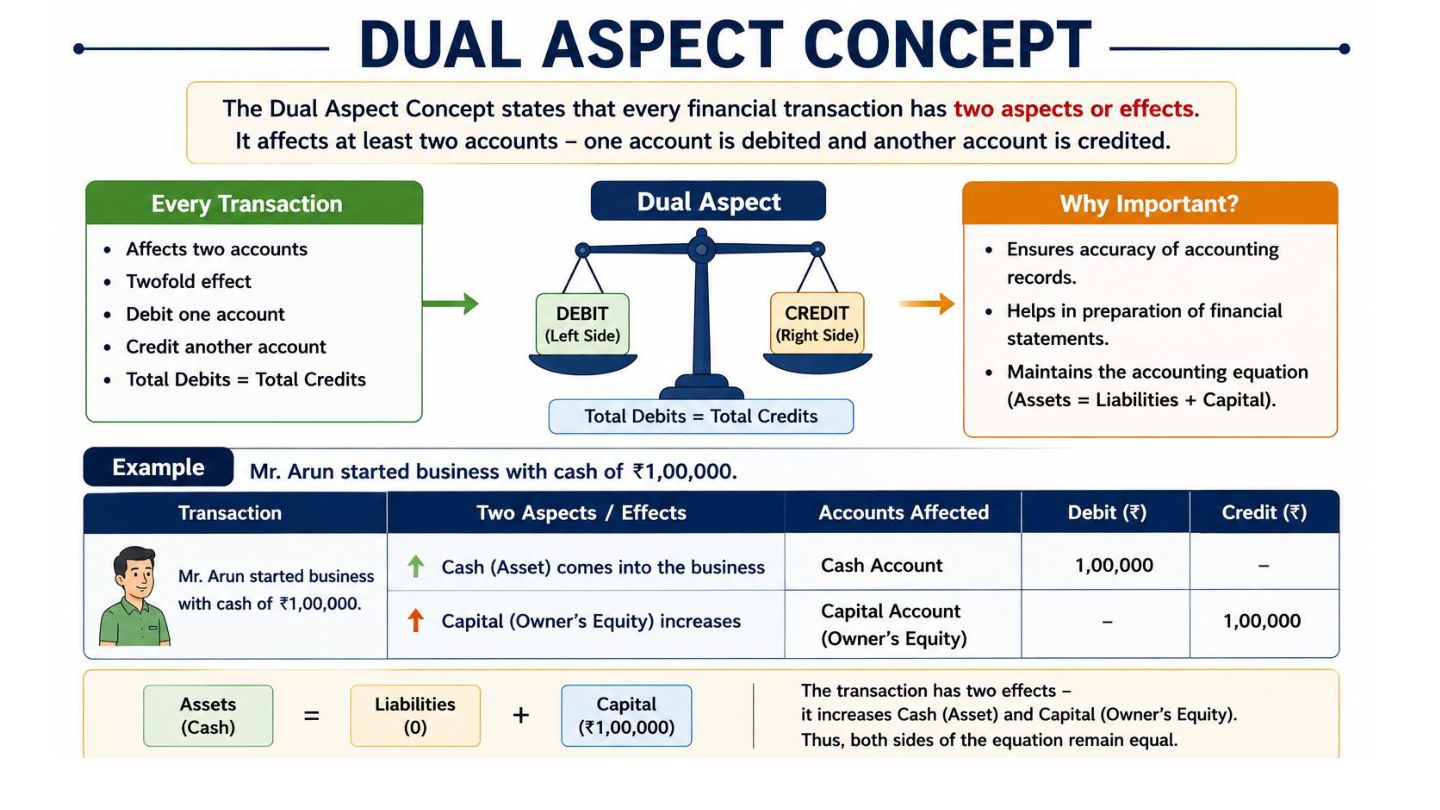
  16. ME THODS Systems of Accounting Single Entry 01 Incomplete recording;

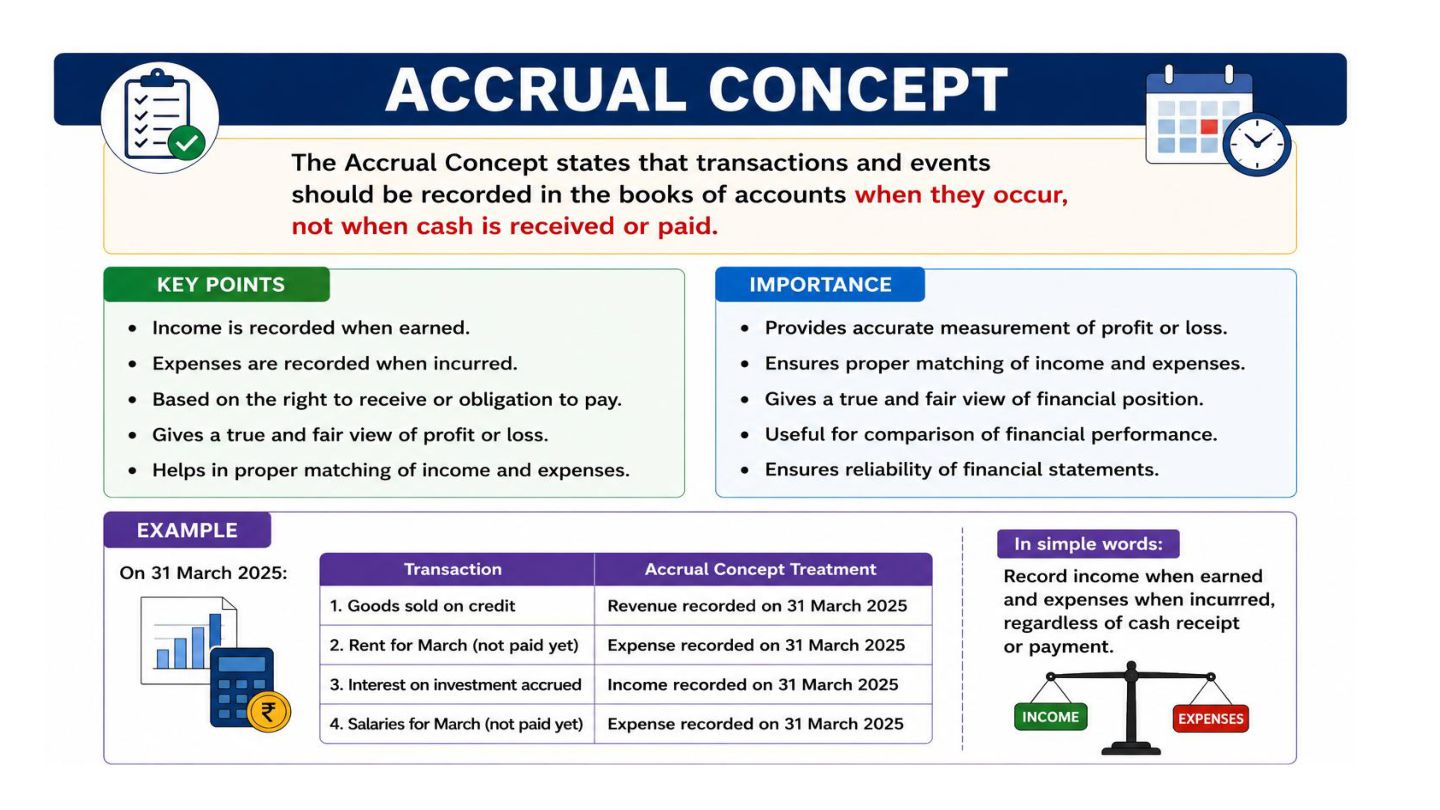
    only personal and cash accounts maintained — suitable for small businesses Cash Basis Records only when cash is actually received or paid out Double Entry 02 Every transaction has two aspects (debit and credit) — complete and accurate records 03 Accrual Basis Records when the transaction occurs, regardless of cash flow timing 04
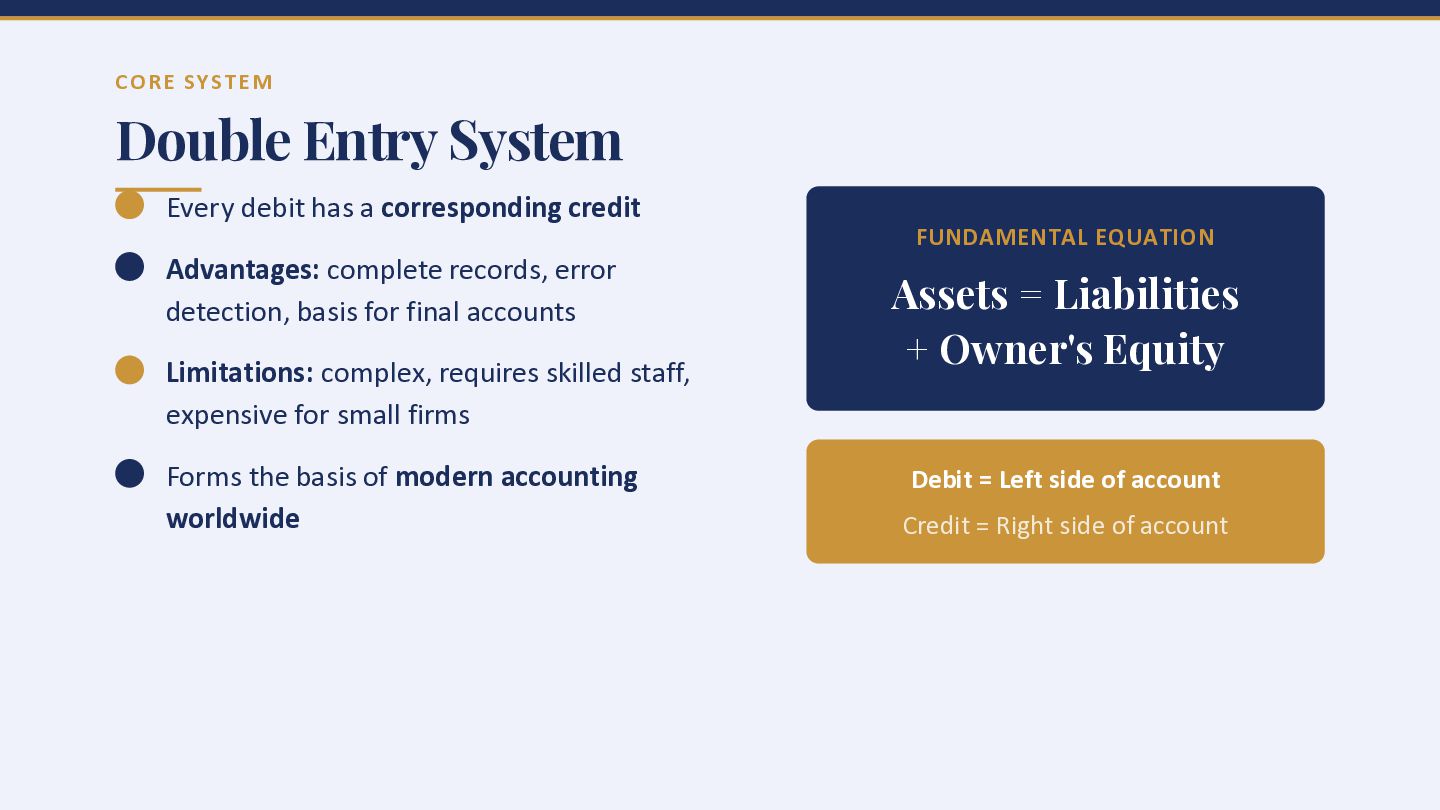
  17. C ORE SYSTE M Double Entry System Every debit has

    a corresponding credit FUNDAMENTAL EQUATION Advantages: complete records, error detection, basis for final accounts Limitations: complex, requires skilled staff, expensive for small firms Forms the basis of modern accounting worldwide Assets = Liabilities + Owner's Equity Debit = Left side of account Credit = Right side of account
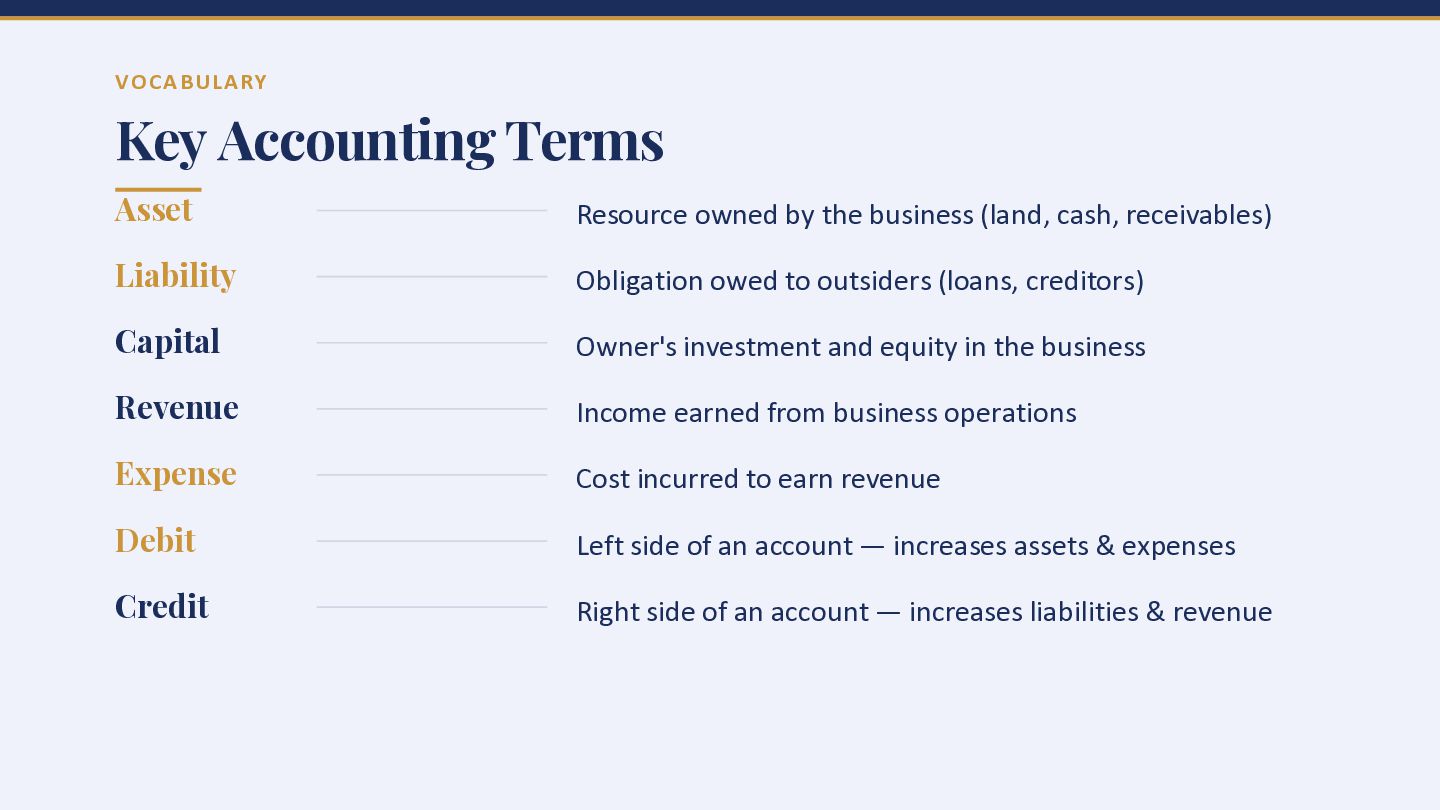
  18. V OC ABULARY Key Accounting Terms Asset Resource owned by

    the business (land, cash, receivables) Liability Obligation owed to outsiders (loans, creditors) Capital Owner's investment and equity in the business Revenue Income earned from business operations Expense Cost incurred to earn revenue Debit Left side of an account — increases assets & expenses Credit Right side of an account — increases liabilities & revenue
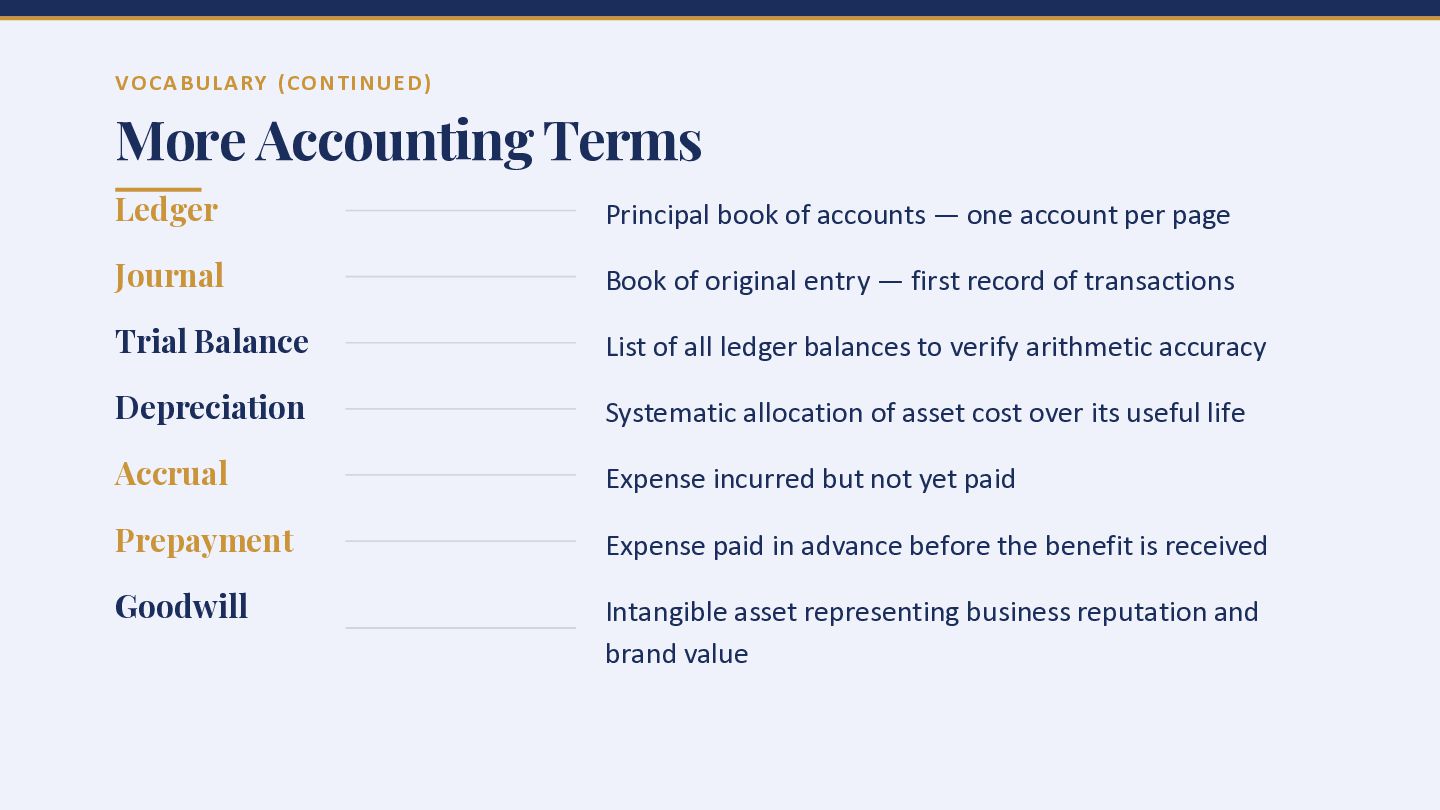
  19. V OC ABULARY (CONTINUED) More Accounting Terms Ledger Principal book

    of accounts — one account per page Journal Book of original entry — first record of transactions Trial Balance List of all ledger balances to verify arithmetic accuracy Depreciation Systematic allocation of asset cost over its useful life Accrual Expense incurred but not yet paid Prepayment Expense paid in advance before the benefit is received Goodwill Intangible asset representing business reputation and brand value
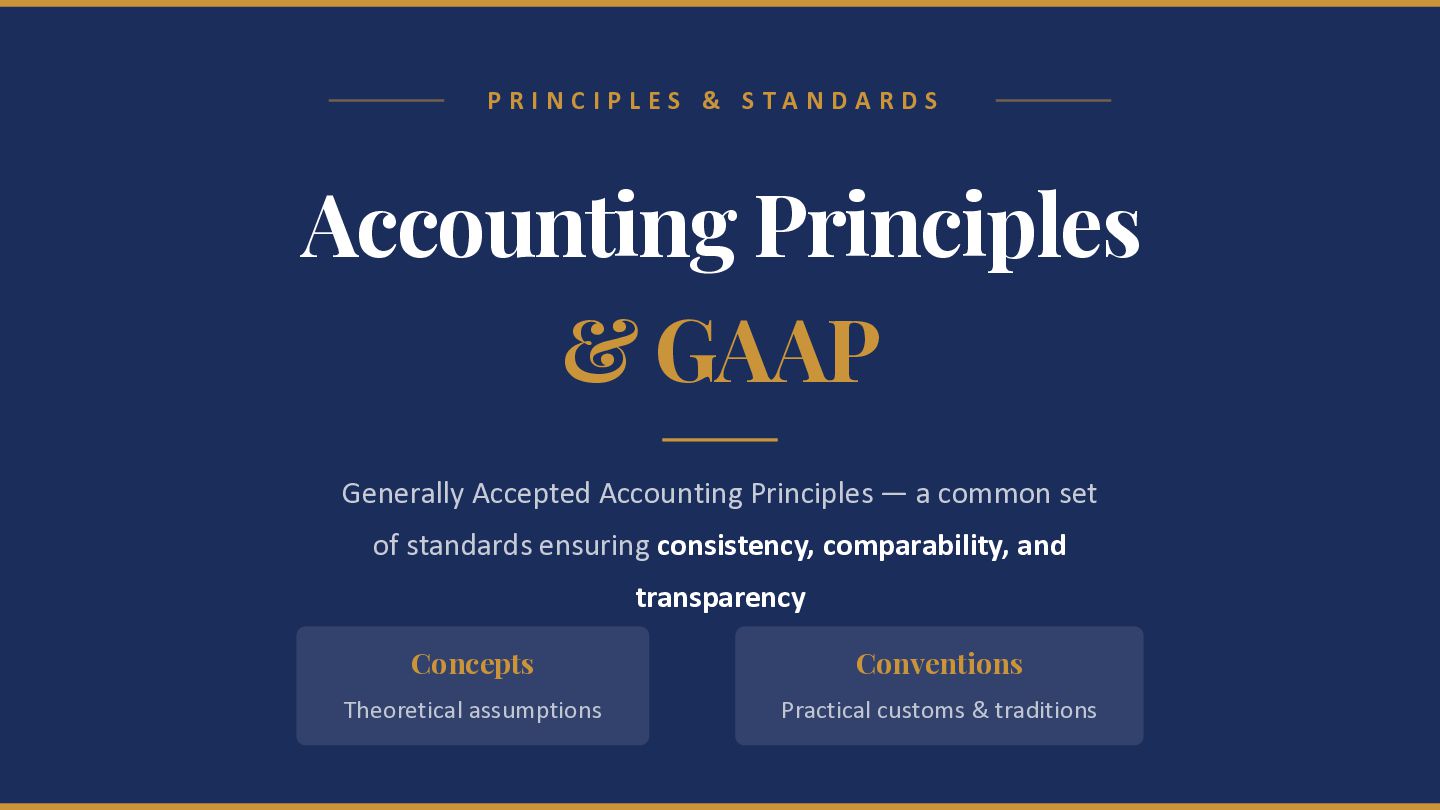
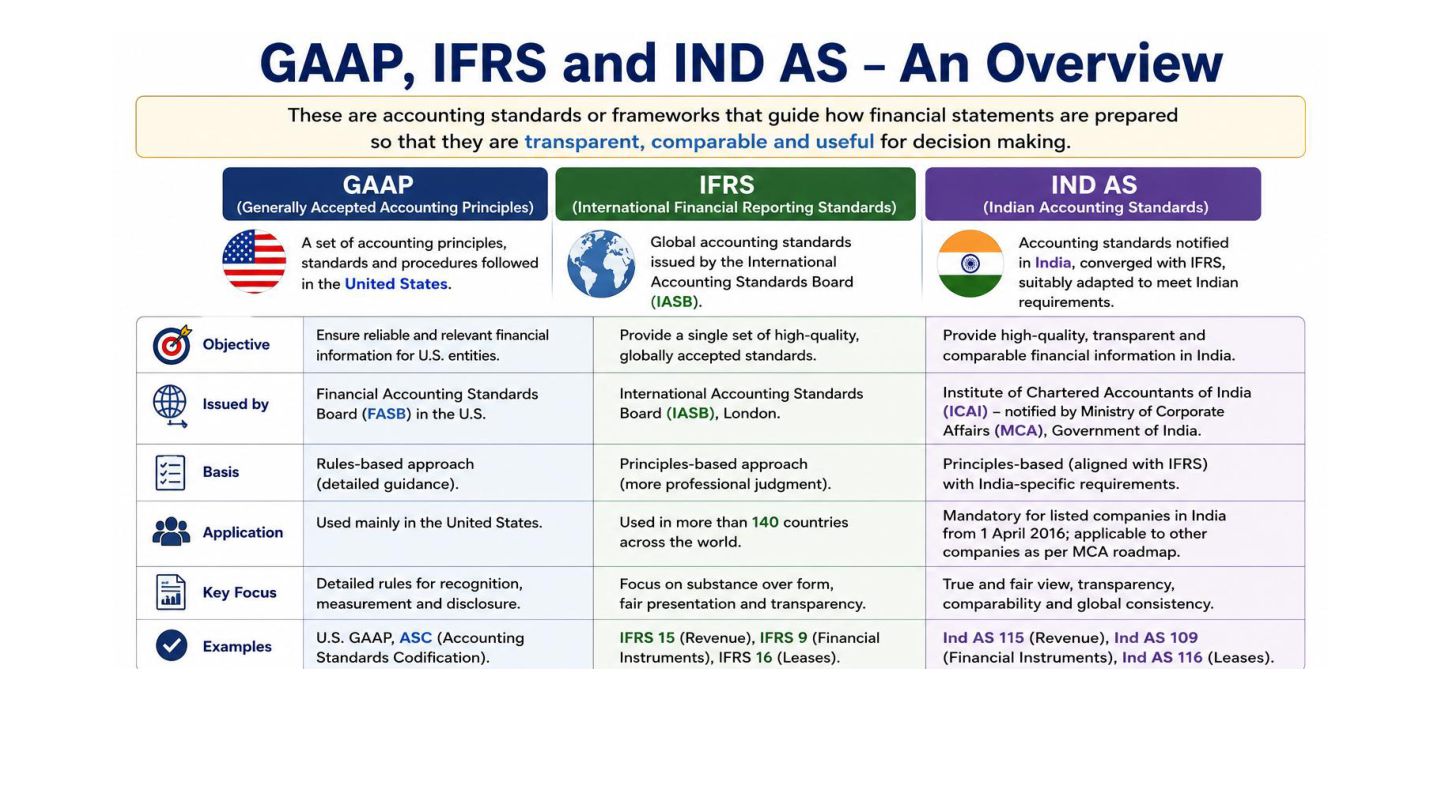
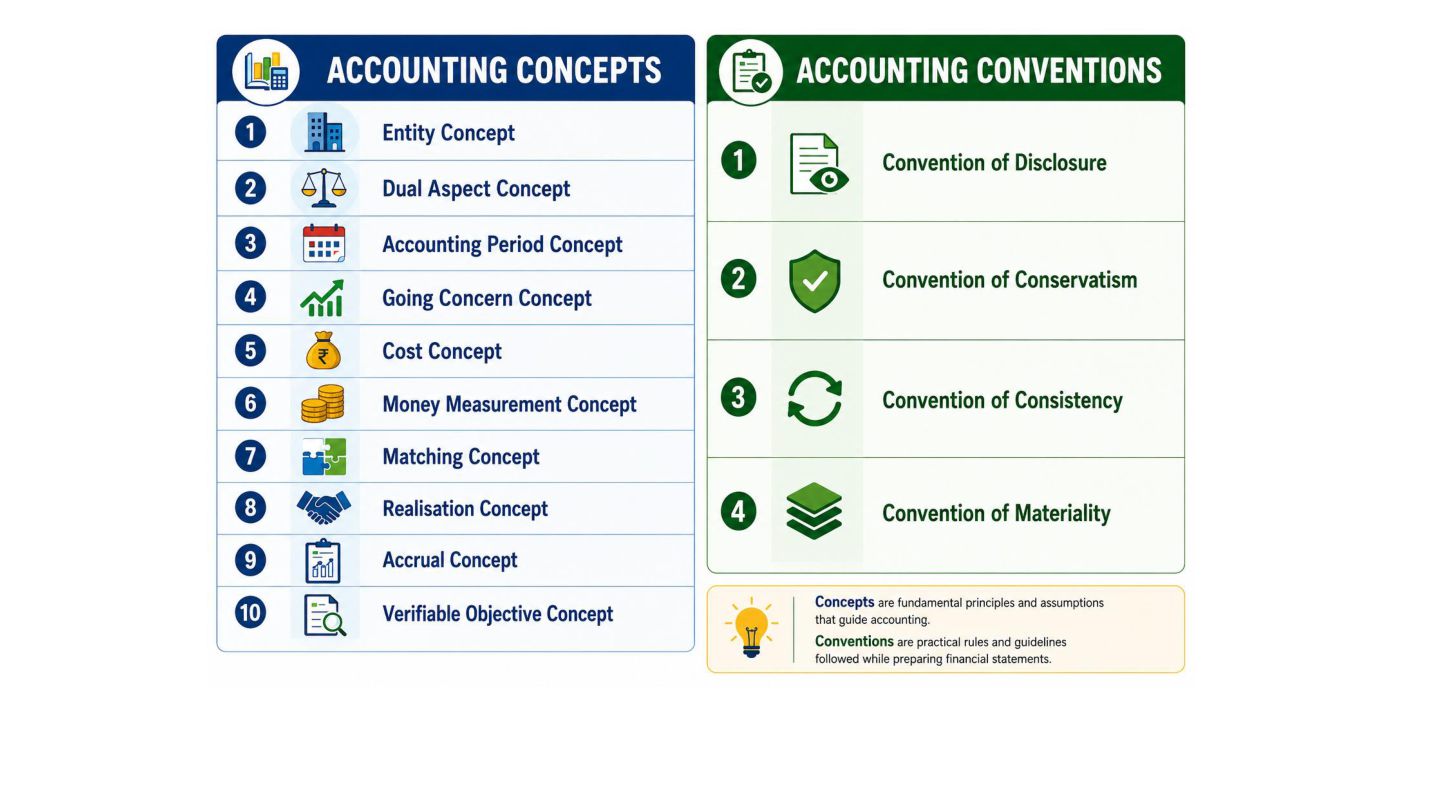
  20. PRINCIPLES & STANDARDS Accounting Principles & GAAP Generally Accepted Accounting

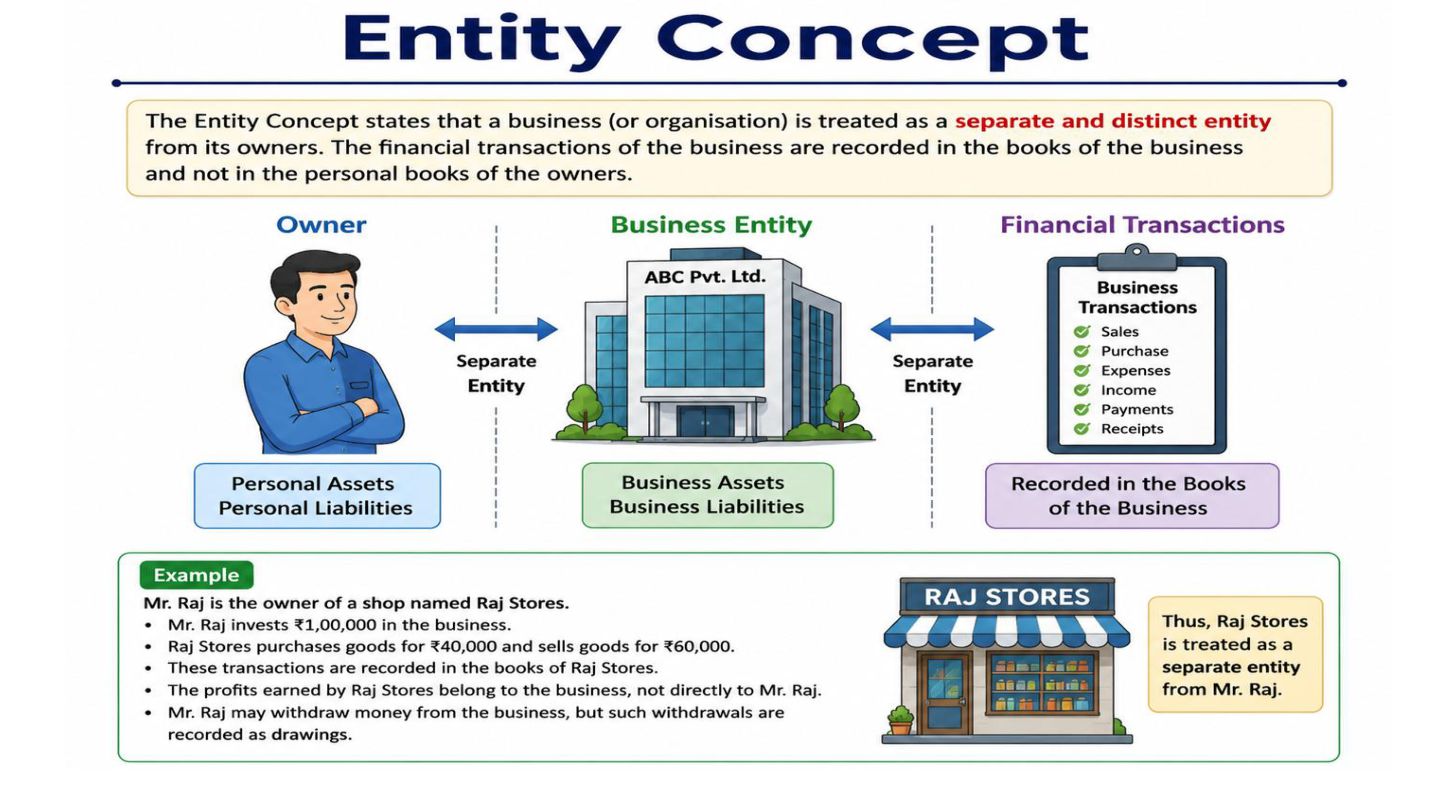
    Principles — a common set of standards ensuring consistency, comparability, and transparency Concepts Conventions Theoretical assumptions Practical customs & traditions