Share
Embed

Transcript
31 slides
-
Apache Hadoop YARN and Tez Future of Data Processing with
Hadoop Page 1 Chris Harris [email protected] -
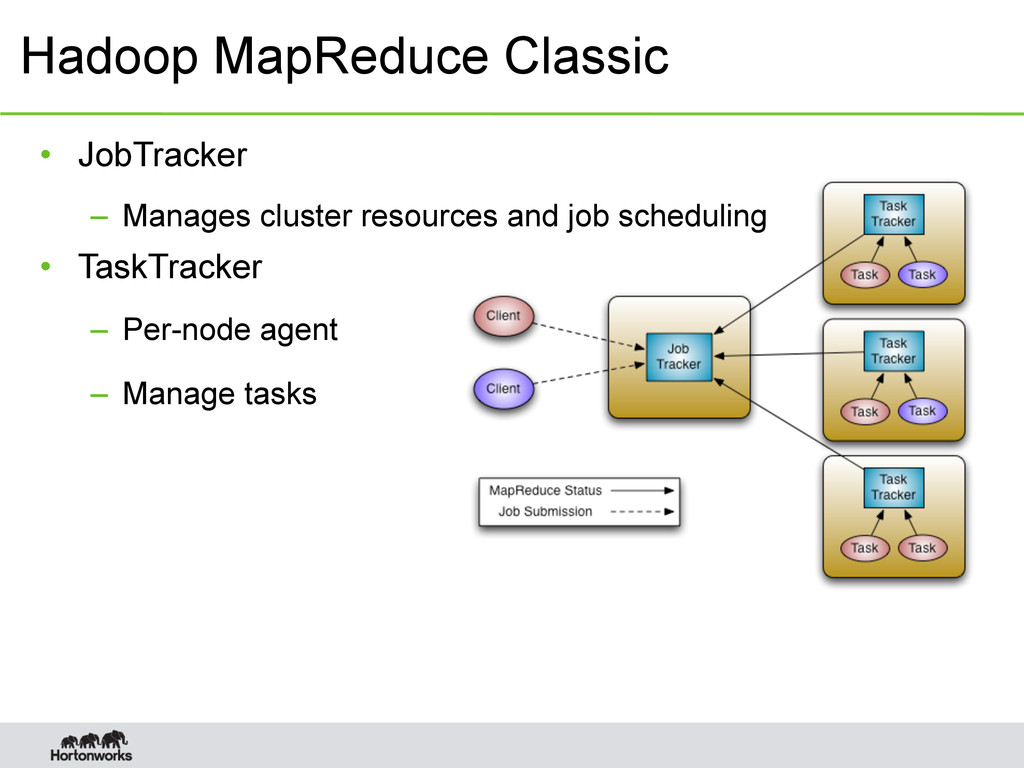
Hadoop MapReduce Classic • JobTracker – Manages cluster resources and
job scheduling • TaskTracker – Per-node agent – Manage tasks -
Current Limitations • Scalability – Maximum Cluster size – 4,000
nodes – Maximum concurrent tasks – 40,000 – Coarse synchronization in JobTracker • Single point of failure – Failure kills all queued and running jobs – Jobs need to be re-submitted by users • Restart is very tricky due to complex state 4 -
Current Limitations • Hard partition of resources into map and
reduce slots – Low resource utilization • Lacks support for alternate paradigms – Iterative applications implemented using MapReduce are 10x slower – Hacks for the likes of MPI/Graph Processing • Lack of wire-compatible protocols – Client and cluster must be of same version – Applications and workflows cannot migrate to different clusters 5 -
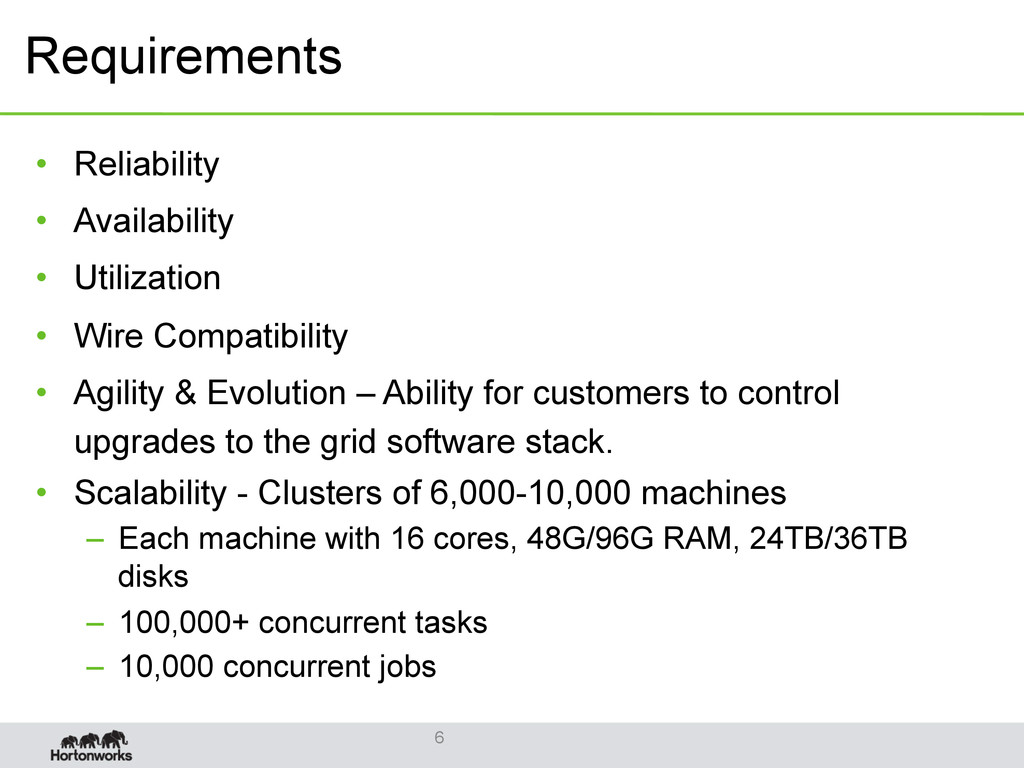
Requirements • Reliability • Availability • Utilization • Wire Compatibility
• Agility & Evolution – Ability for customers to control upgrades to the grid software stack. • Scalability - Clusters of 6,000-10,000 machines – Each machine with 16 cores, 48G/96G RAM, 24TB/36TB disks – 100,000+ concurrent tasks – 10,000 concurrent jobs 6 -
Design Centre • Split up the two major functions of
JobTracker – Cluster resource management – Application life-cycle management • MapReduce becomes user-land library 7 -
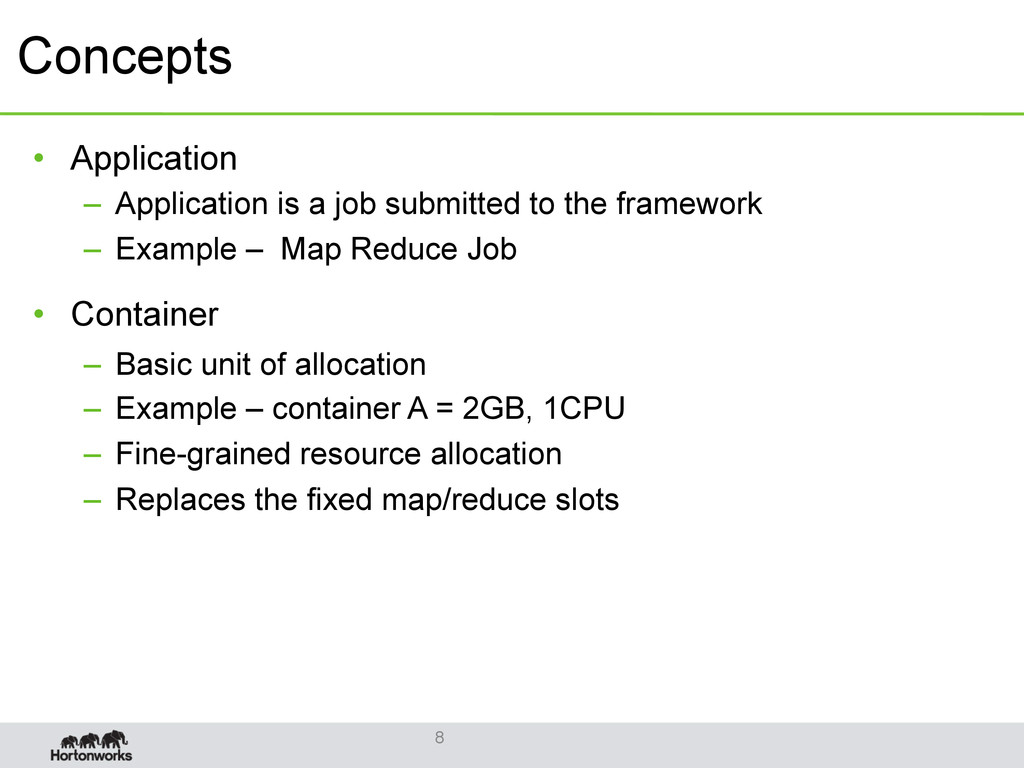
Concepts • Application – Application is a job submitted to
the framework – Example – Map Reduce Job • Container – Basic unit of allocation – Example – container A = 2GB, 1CPU – Fine-grained resource allocation – Replaces the fixed map/reduce slots 8 -
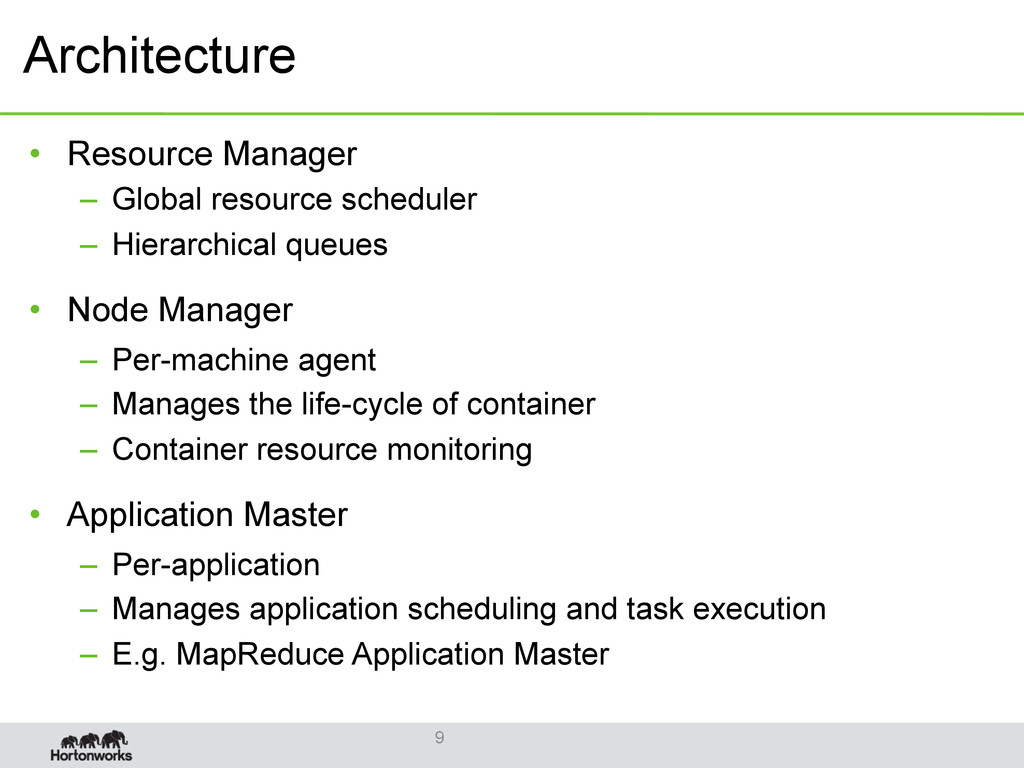
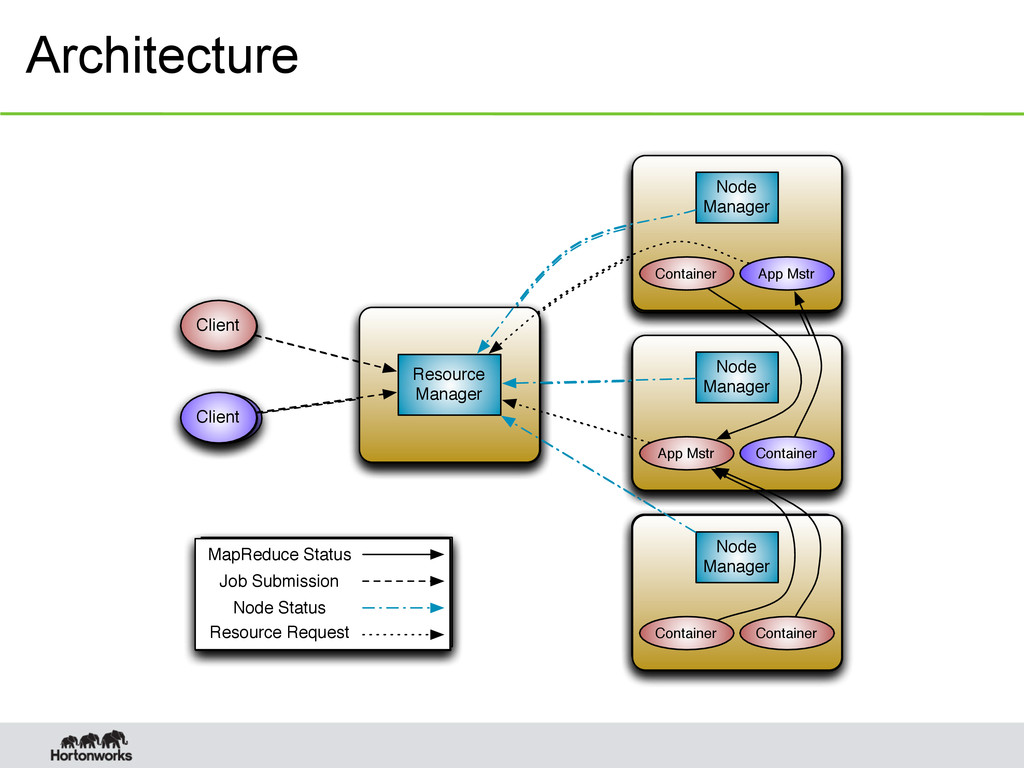
Architecture • Resource Manager – Global resource scheduler – Hierarchical
queues • Node Manager – Per-machine agent – Manages the life-cycle of container – Container resource monitoring • Application Master – Per-application – Manages application scheduling and task execution – E.g. MapReduce Application Master 9 -
Architecture Resource Manager MapReduce Status Job Submission Client Node Manager
Node Manager Container Node Manager App Mstr Node Status Resource Request Resource Manager Client MapReduce Status Job Submission Client Node Manager Node Manager App Mstr Container Node Manager App Mstr Node Status Resource Request Resource Manager Client MapReduce Status Job Submission Client Node Manager Container Container Node Manager App Mstr Container Node Manager Container App Mstr Node Status Resource Request -
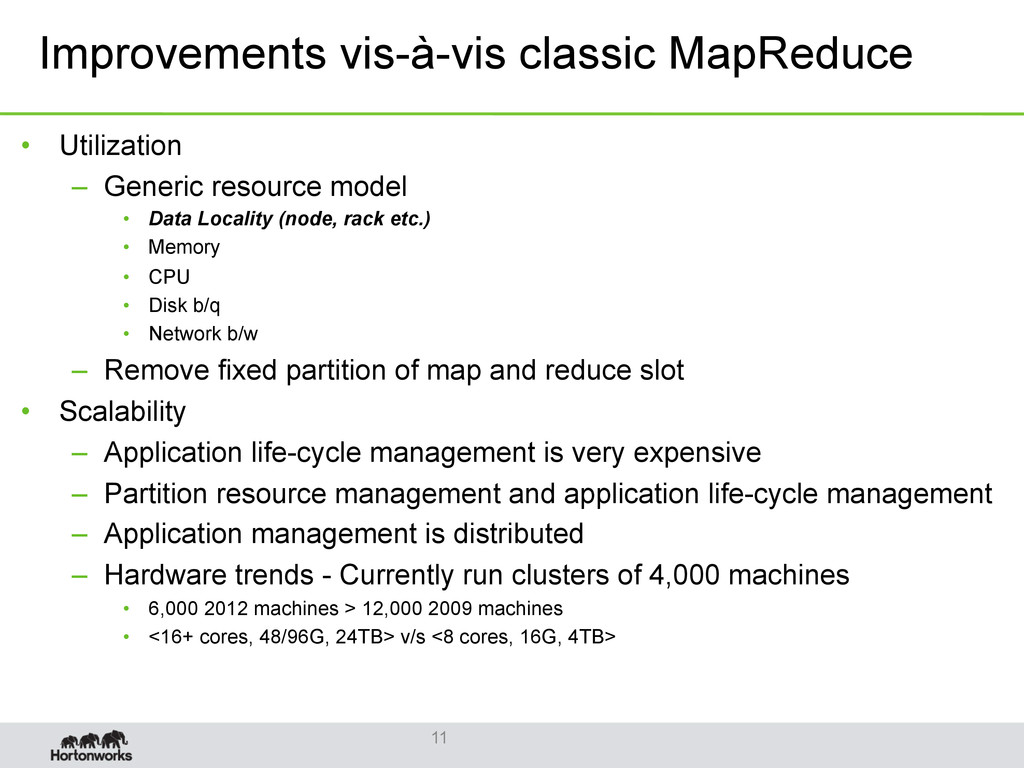
Improvements vis-à-vis classic MapReduce 11 • Utilization – Generic resource
model • Data Locality (node, rack etc.) • Memory • CPU • Disk b/q • Network b/w – Remove fixed partition of map and reduce slot • Scalability – Application life-cycle management is very expensive – Partition resource management and application life-cycle management – Application management is distributed – Hardware trends - Currently run clusters of 4,000 machines • 6,000 2012 machines > 12,000 2009 machines • <16+ cores, 48/96G, 24TB> v/s <8 cores, 16G, 4TB> -
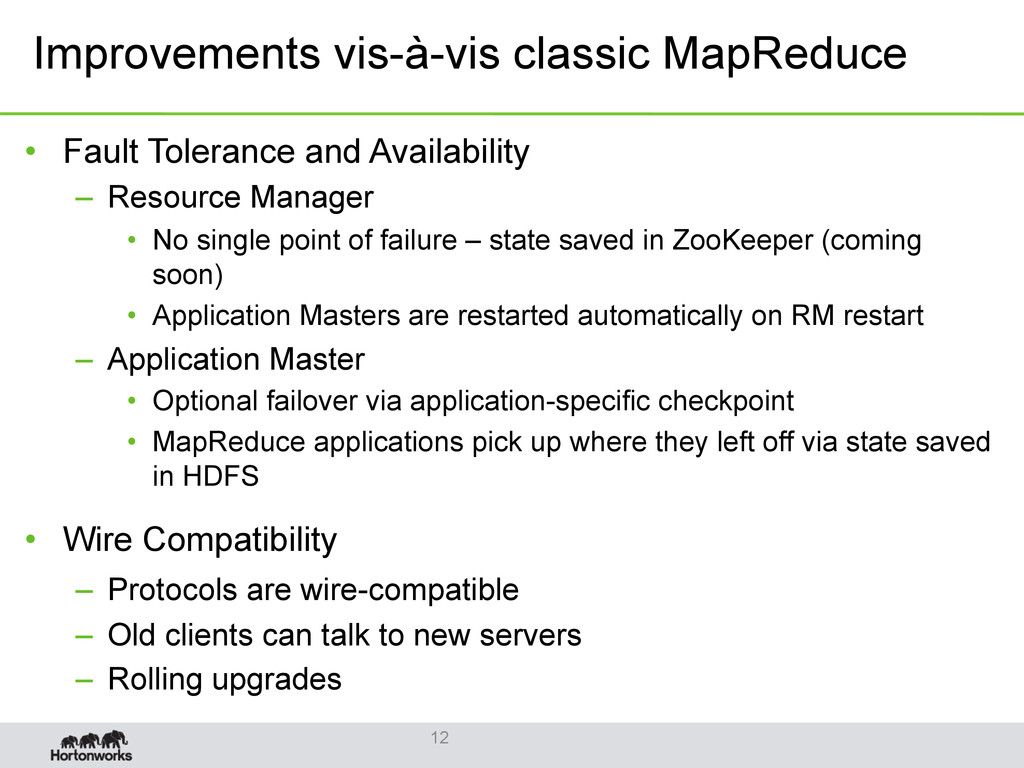
• Fault Tolerance and Availability – Resource Manager • No
single point of failure – state saved in ZooKeeper (coming soon) • Application Masters are restarted automatically on RM restart – Application Master • Optional failover via application-specific checkpoint • MapReduce applications pick up where they left off via state saved in HDFS • Wire Compatibility – Protocols are wire-compatible – Old clients can talk to new servers – Rolling upgrades 12 Improvements vis-à-vis classic MapReduce -
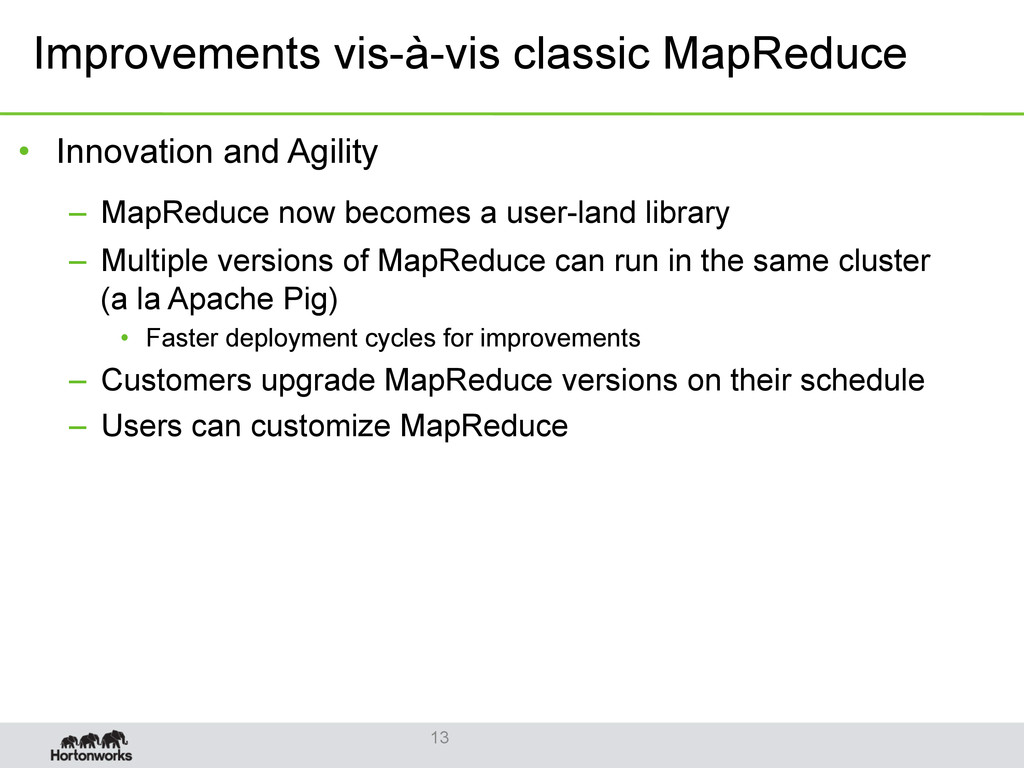
• Innovation and Agility – MapReduce now becomes a user-land
library – Multiple versions of MapReduce can run in the same cluster (a la Apache Pig) • Faster deployment cycles for improvements – Customers upgrade MapReduce versions on their schedule – Users can customize MapReduce 13 Improvements vis-à-vis classic MapReduce -
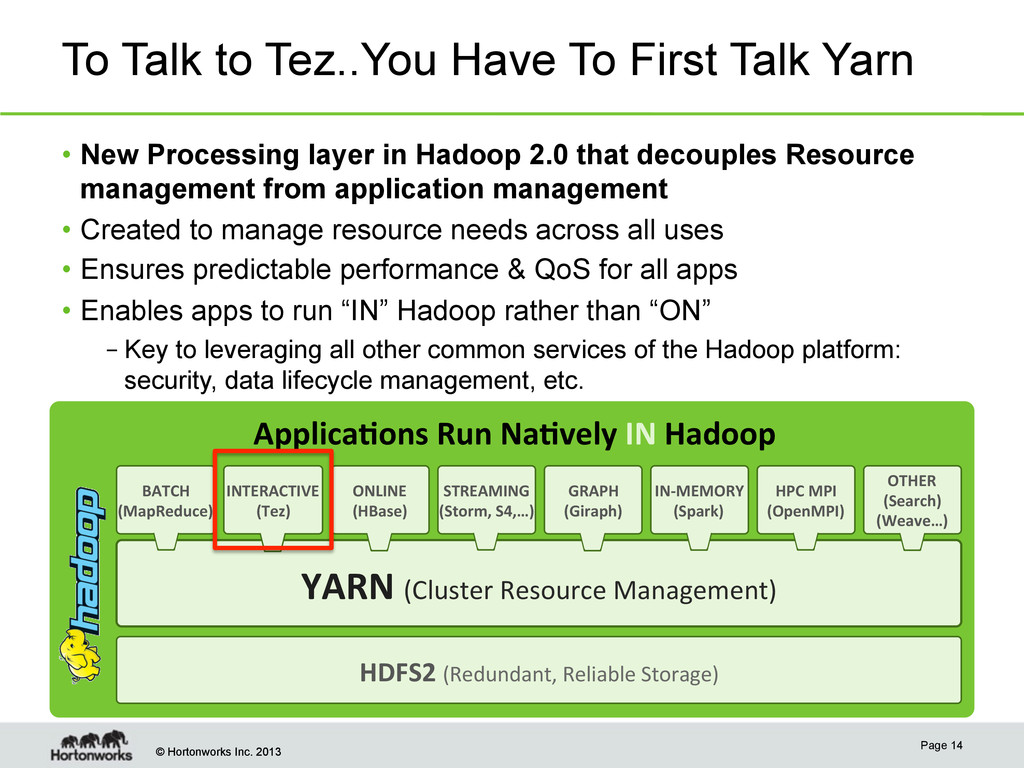
© Hortonworks Inc. 2013 © Hortonworks Inc. 2013 To Talk
to Tez..You Have To First Talk Yarn • New Processing layer in Hadoop 2.0 that decouples Resource management from application management • Created to manage resource needs across all uses • Ensures predictable performance & QoS for all apps • Enables apps to run “IN” Hadoop rather than “ON” – Key to leveraging all other common services of the Hadoop platform: security, data lifecycle management, etc. Page 14 Applica'ons Run Na'vely IN Hadoop HDFS2 (Redundant, Reliable Storage) YARN (Cluster Resource Management) BATCH (MapReduce) INTERACTIVE (Tez) STREAMING (Storm, S4,…) GRAPH (Giraph) IN-‐MEMORY (Spark) HPC MPI (OpenMPI) ONLINE (HBase) OTHER (Search) (Weave…) -
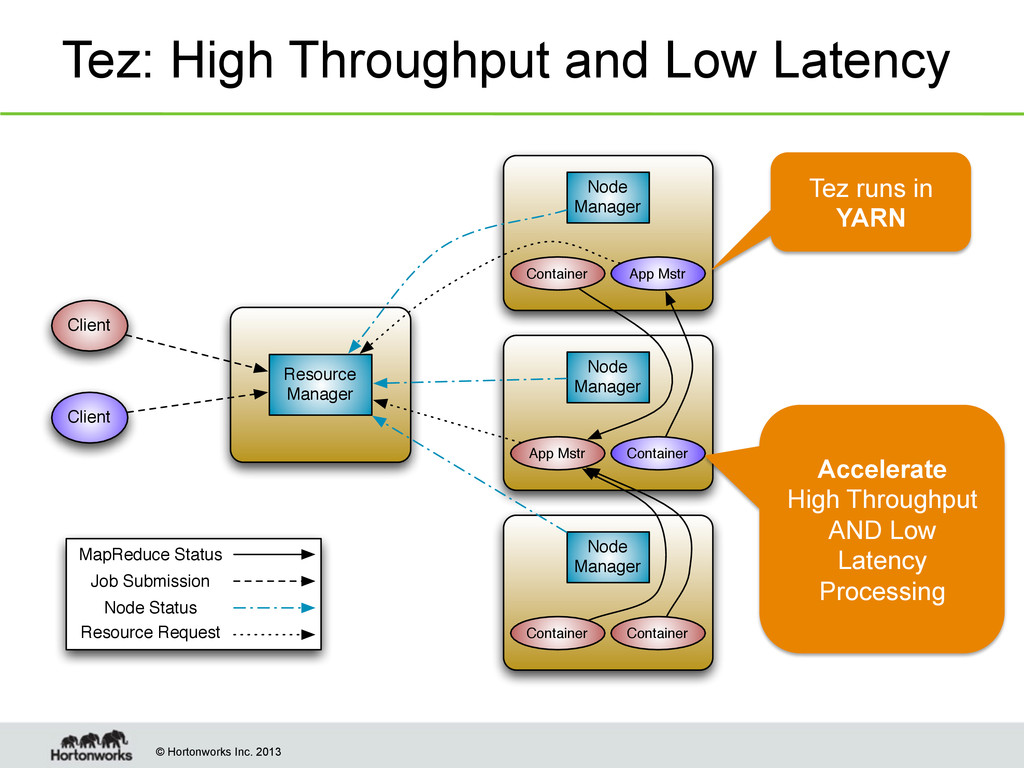
© Hortonworks Inc. 2013 Resource Manager Client MapReduce Status Job
Submission Client Node Manager Container Container Node Manager App Mstr Container Node Manager Container App Mstr Node Status Resource Request Tez: High Throughput and Low Latency Tez runs in YARN Accelerate High Throughput AND Low Latency Processing -
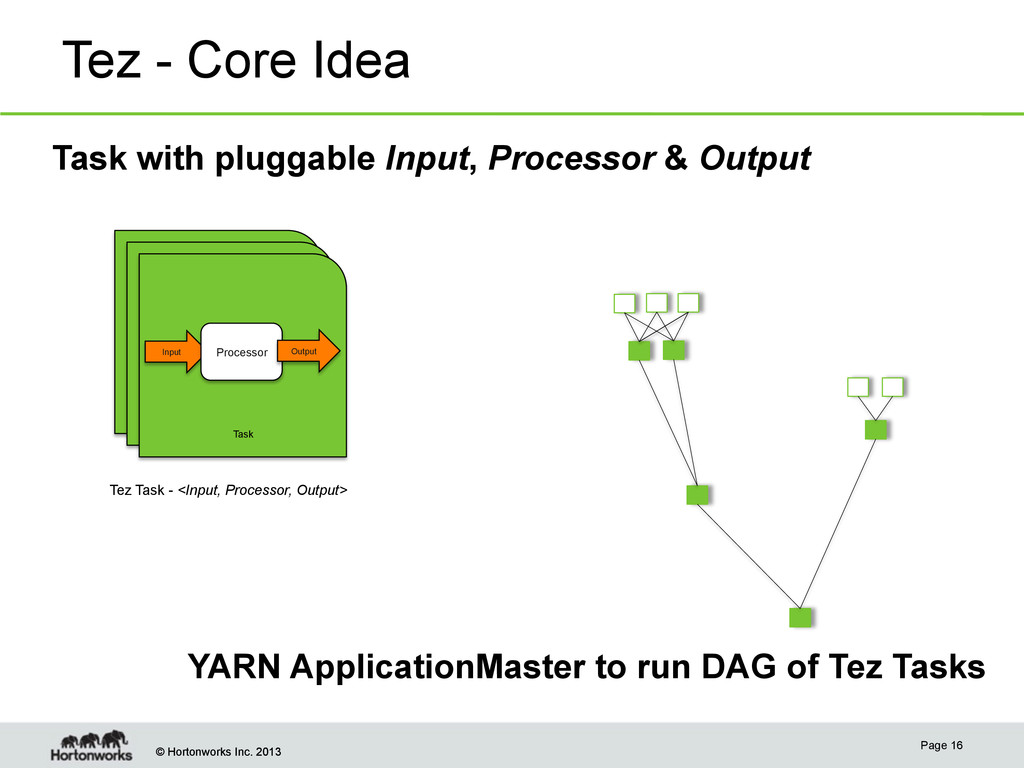
© Hortonworks Inc. 2013 © Hortonworks Inc. 2013 Tez -
Core Idea Task with pluggable Input, Processor & Output Page 16 YARN ApplicationMaster to run DAG of Tez Tasks Input Processor Task Output Tez Task - <Input, Processor, Output> -
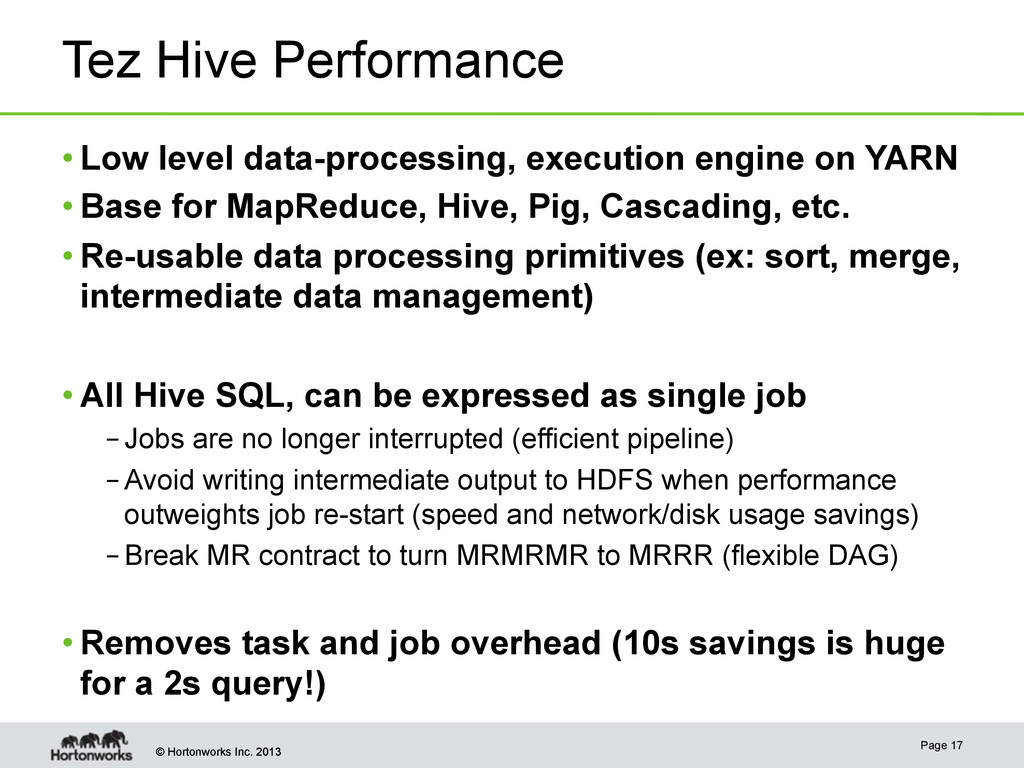
© Hortonworks Inc. 2013 © Hortonworks Inc. 2013 Tez Hive
Performance • Low level data-processing, execution engine on YARN • Base for MapReduce, Hive, Pig, Cascading, etc. • Re-usable data processing primitives (ex: sort, merge, intermediate data management) • All Hive SQL, can be expressed as single job – Jobs are no longer interrupted (efficient pipeline) – Avoid writing intermediate output to HDFS when performance outweights job re-start (speed and network/disk usage savings) – Break MR contract to turn MRMRMR to MRRR (flexible DAG) • Removes task and job overhead (10s savings is huge for a 2s query!) Page 17 -
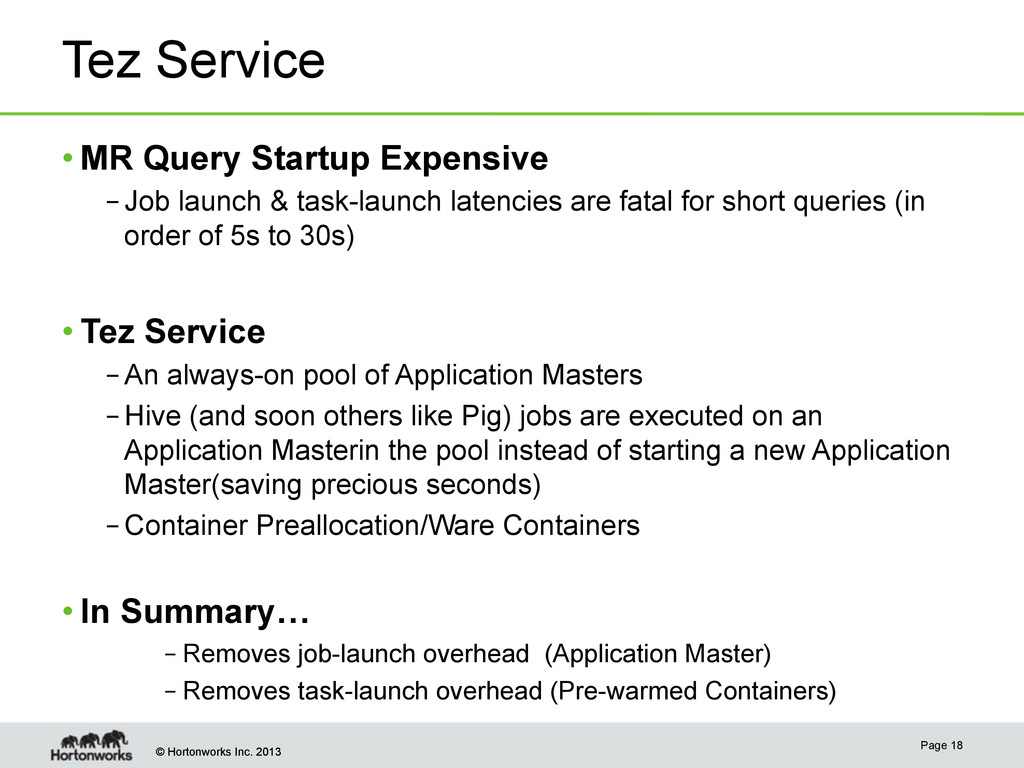
© Hortonworks Inc. 2013 © Hortonworks Inc. 2013 Tez Service
• MR Query Startup Expensive – Job launch & task-launch latencies are fatal for short queries (in order of 5s to 30s) • Tez Service – An always-on pool of Application Masters – Hive (and soon others like Pig) jobs are executed on an Application Masterin the pool instead of starting a new Application Master(saving precious seconds) – Container Preallocation/Ware Containers • In Summary… – Removes job-launch overhead (Application Master) – Removes task-launch overhead (Pre-warmed Containers) Page 18 -
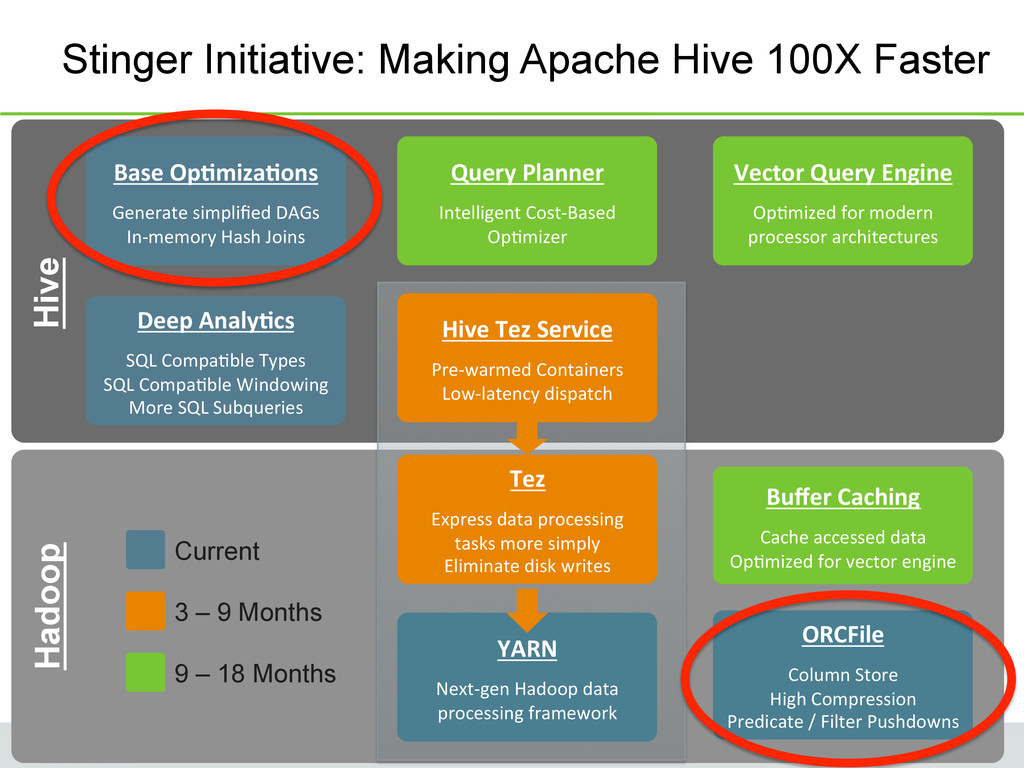
© Hortonworks Inc. 2013 © Hortonworks Inc. 2013 Stinger Initiative:
Making Apache Hive 100X Faster Page 19 © Hortonworks Inc. 2013 Page 19 DO NOT SHARE. CONTAINS HORTONWORKS CONFIDENTIAL & SENSITIVE INFORMATION Hadoop Base Op'miza'ons Generate simplified DAGs In-‐memory Hash Joins Current 3 – 9 Months 9 – 18 Months Deep Analy'cs SQL CompaEble Types SQL CompaEble Windowing More SQL Subqueries Hive YARN Next-‐gen Hadoop data processing framework Tez Express data processing tasks more simply Eliminate disk writes Hive Tez Service Pre-‐warmed Containers Low-‐latency dispatch ORCFile Column Store High Compression Predicate / Filter Pushdowns Buffer Caching Cache accessed data OpEmized for vector engine Query Planner Intelligent Cost-‐Based OpEmizer Vector Query Engine OpEmized for modern processor architectures -
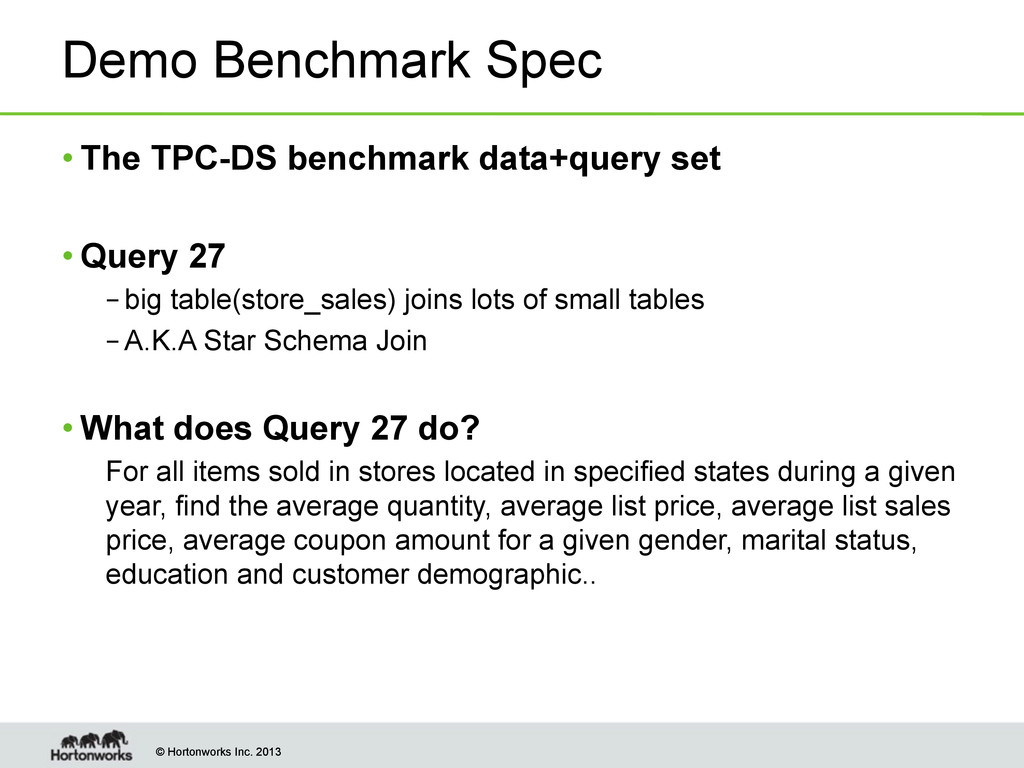
© Hortonworks Inc. 2013 © Hortonworks Inc. 2013 Demo Benchmark
Spec • The TPC-DS benchmark data+query set • Query 27 – big table(store_sales) joins lots of small tables – A.K.A Star Schema Join • What does Query 27 do? For all items sold in stores located in specified states during a given year, find the average quantity, average list price, average list sales price, average coupon amount for a given gender, marital status, education and customer demographic.. -
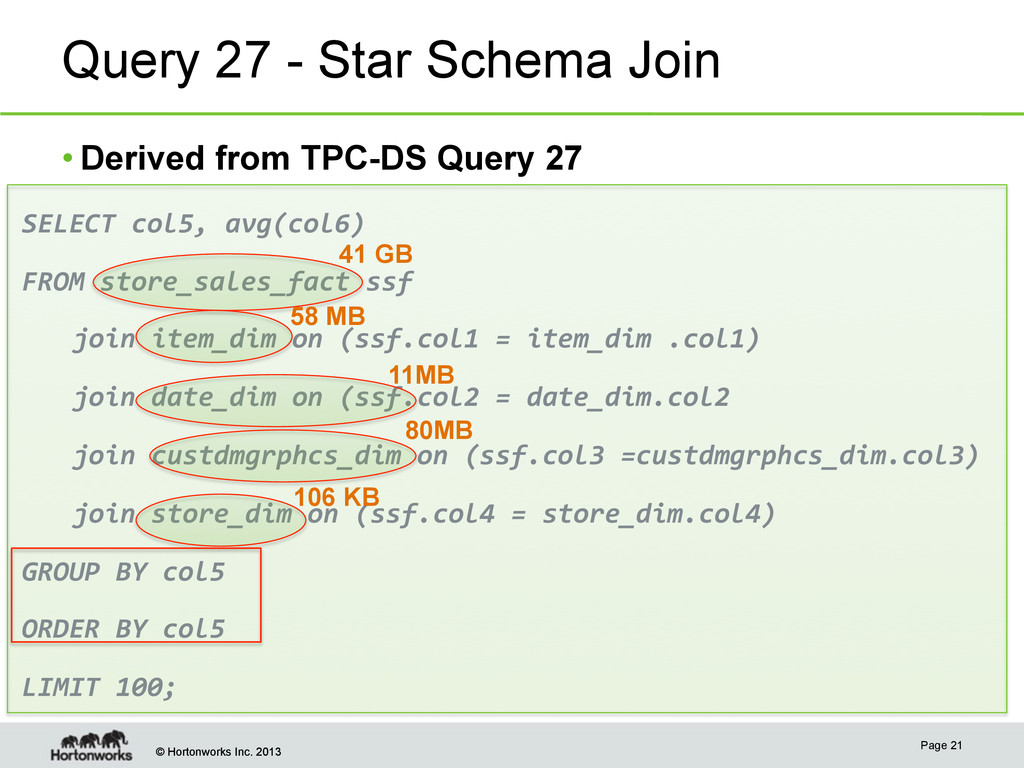
© Hortonworks Inc. 2013 © Hortonworks Inc. 2013 SELECT col5,
avg(col6) FROM store_sales_fact ssf join item_dim on (ssf.col1 = item_dim .col1) join date_dim on (ssf.col2 = date_dim.col2 join custdmgrphcs_dim on (ssf.col3 =custdmgrphcs_dim.col3) join store_dim on (ssf.col4 = store_dim.col4) GROUP BY col5 ORDER BY col5 LIMIT 100; Query 27 - Star Schema Join • Derived from TPC-DS Query 27 Page 21 41 GB 58 MB 11MB 80MB 106 KB -
© Hortonworks Inc. 2013 © Hortonworks Inc. 2013 Benchmark Cluster
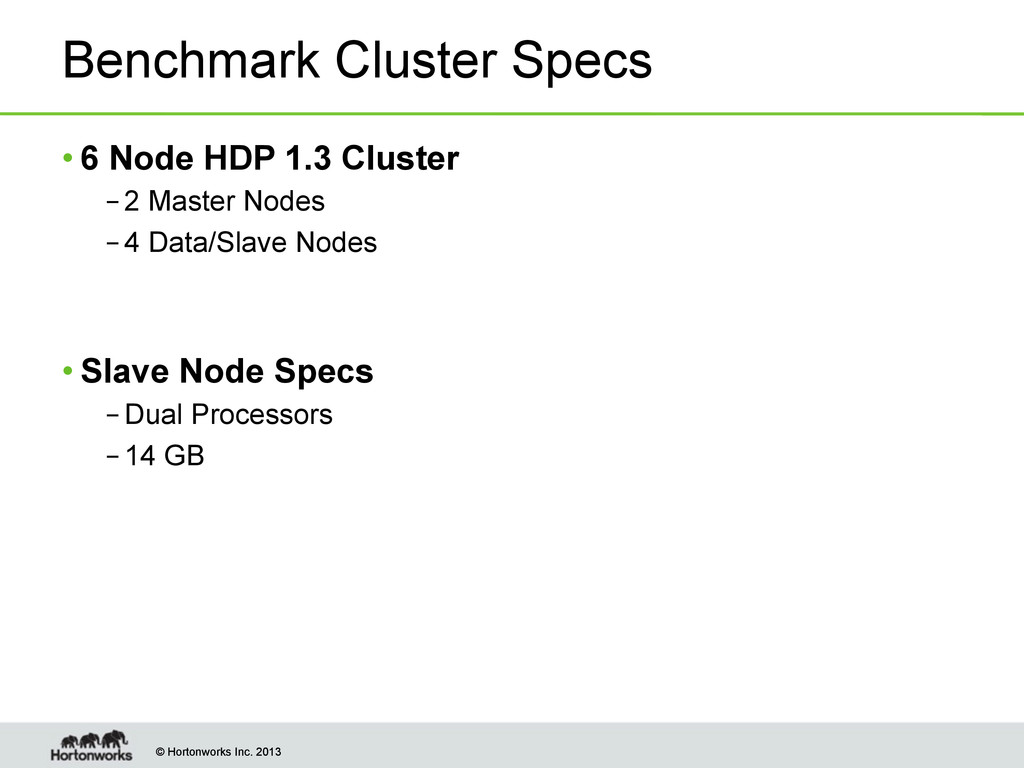
Specs • 6 Node HDP 1.3 Cluster – 2 Master Nodes – 4 Data/Slave Nodes • Slave Node Specs – Dual Processors – 14 GB -
© Hortonworks Inc. 2013 © Hortonworks Inc. 2013 Query27 Execution
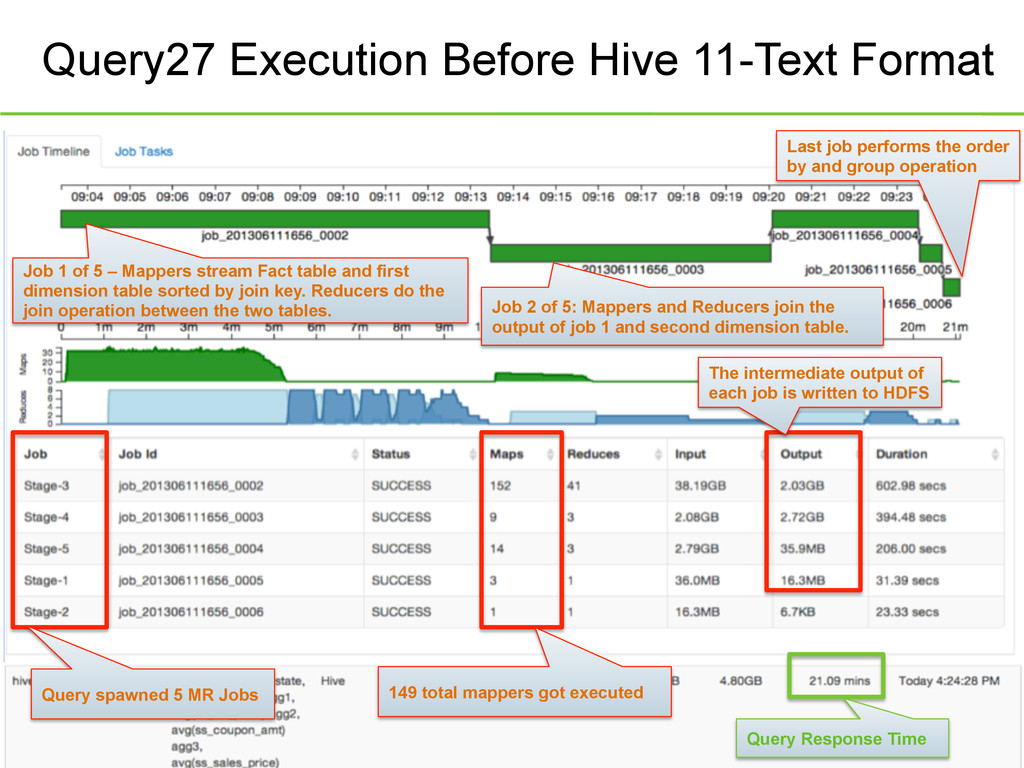
Before Hive 11-Text Format Query spawned 5 MR Jobs The intermediate output of each job is written to HDFS Job 1 of 5 – Mappers stream Fact table and first dimension table sorted by join key. Reducers do the join operation between the two tables. Job 2 of 5: Mappers and Reducers join the output of job 1 and second dimension table. Last job performs the order by and group operation Query Response Time 149 total mappers got executed -
© Hortonworks Inc. 2013 © Hortonworks Inc. 2013 Query27 Execution
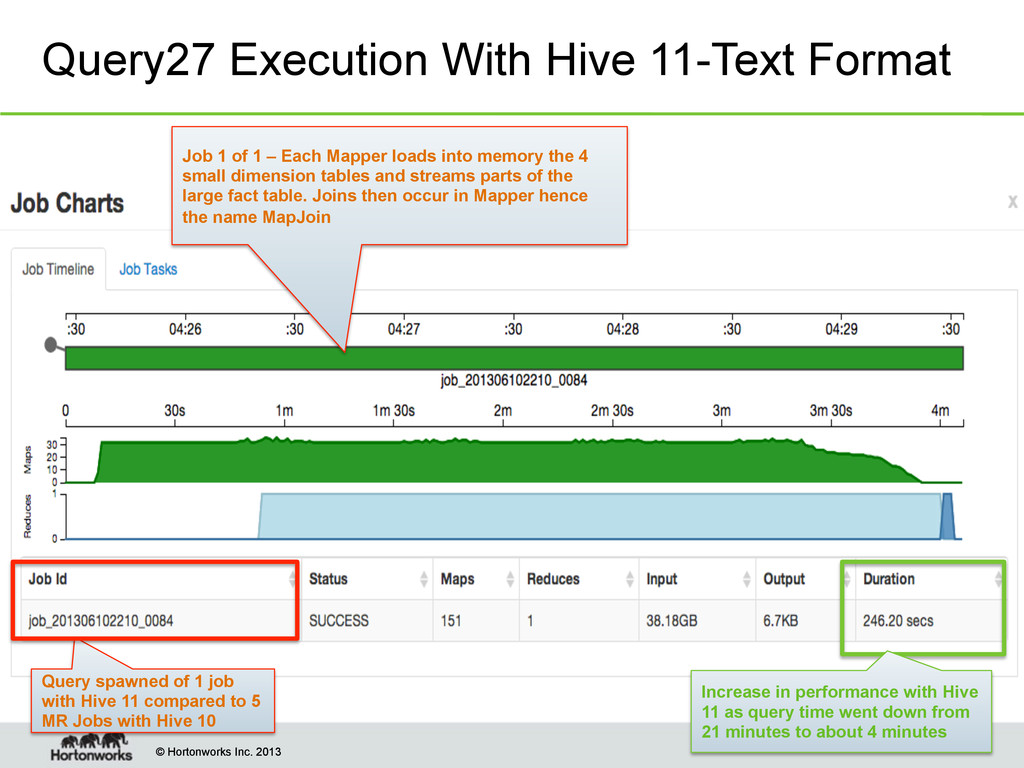
With Hive 11-Text Format Query spawned of 1 job with Hive 11 compared to 5 MR Jobs with Hive 10 Job 1 of 1 – Each Mapper loads into memory the 4 small dimension tables and streams parts of the large fact table. Joins then occur in Mapper hence the name MapJoin Increase in performance with Hive 11 as query time went down from 21 minutes to about 4 minutes -
© Hortonworks Inc. 2013 © Hortonworks Inc. 2013 Query27 Execution
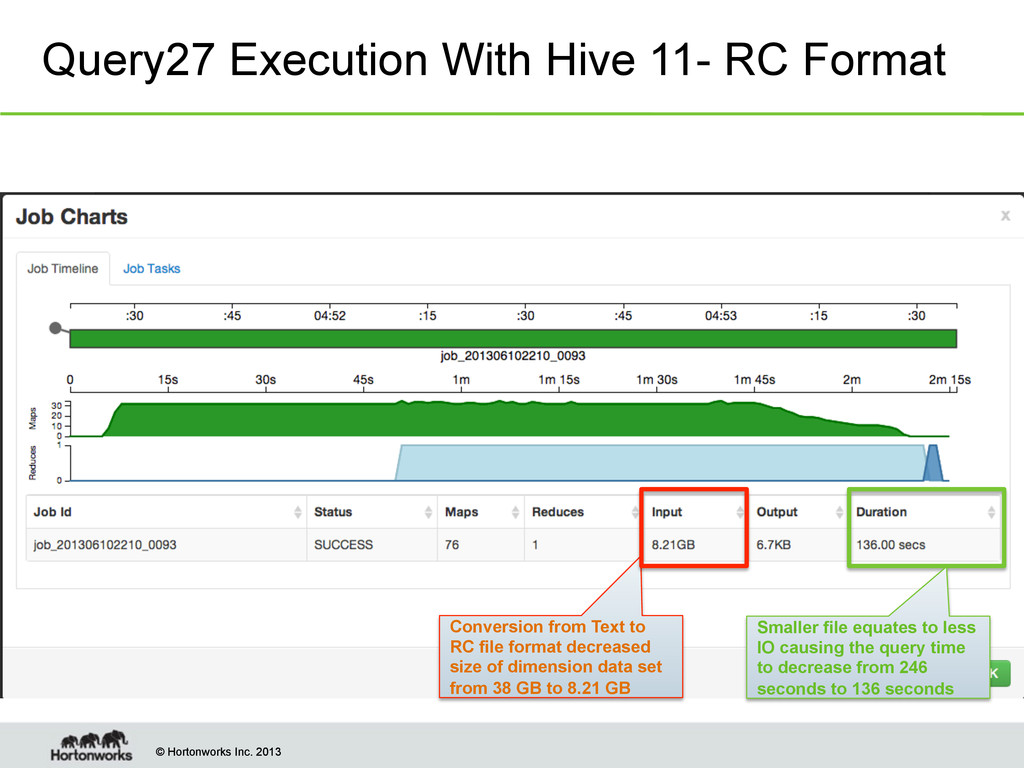
With Hive 11- RC Format Conversion from Text to RC file format decreased size of dimension data set from 38 GB to 8.21 GB Smaller file equates to less IO causing the query time to decrease from 246 seconds to 136 seconds -
© Hortonworks Inc. 2013 © Hortonworks Inc. 2013 Query27 Execution
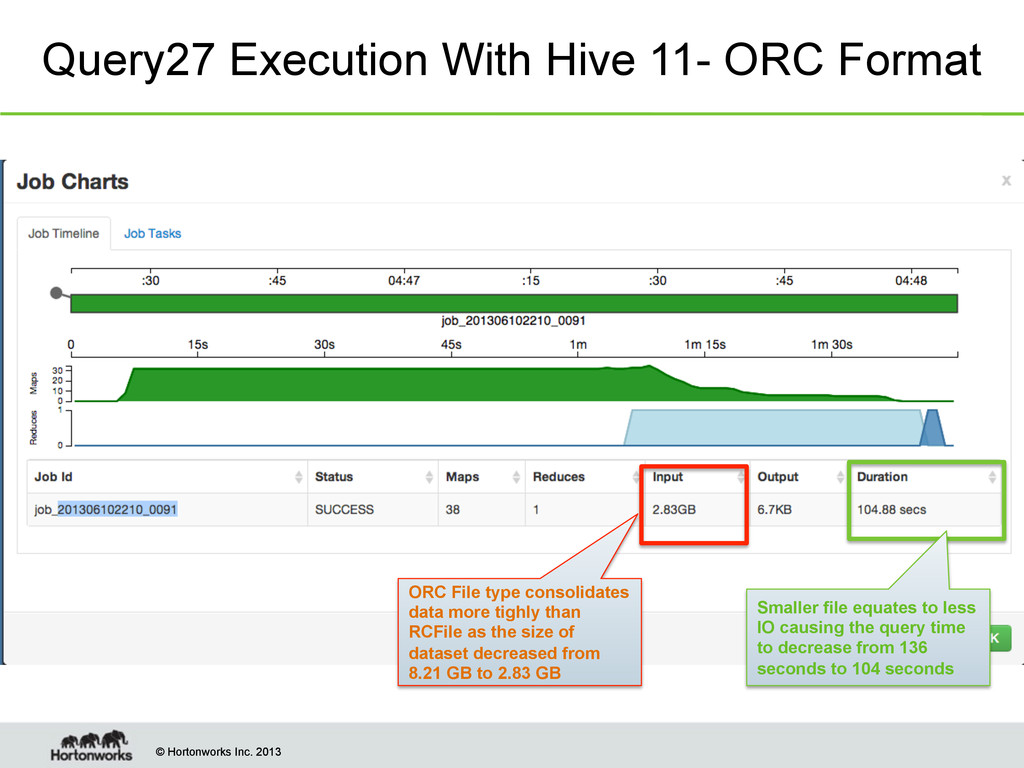
With Hive 11- ORC Format ORC File type consolidates data more tighly than RCFile as the size of dataset decreased from 8.21 GB to 2.83 GB Smaller file equates to less IO causing the query time to decrease from 136 seconds to 104 seconds -
© Hortonworks Inc. 2013 © Hortonworks Inc. 2013 Query27 Execution
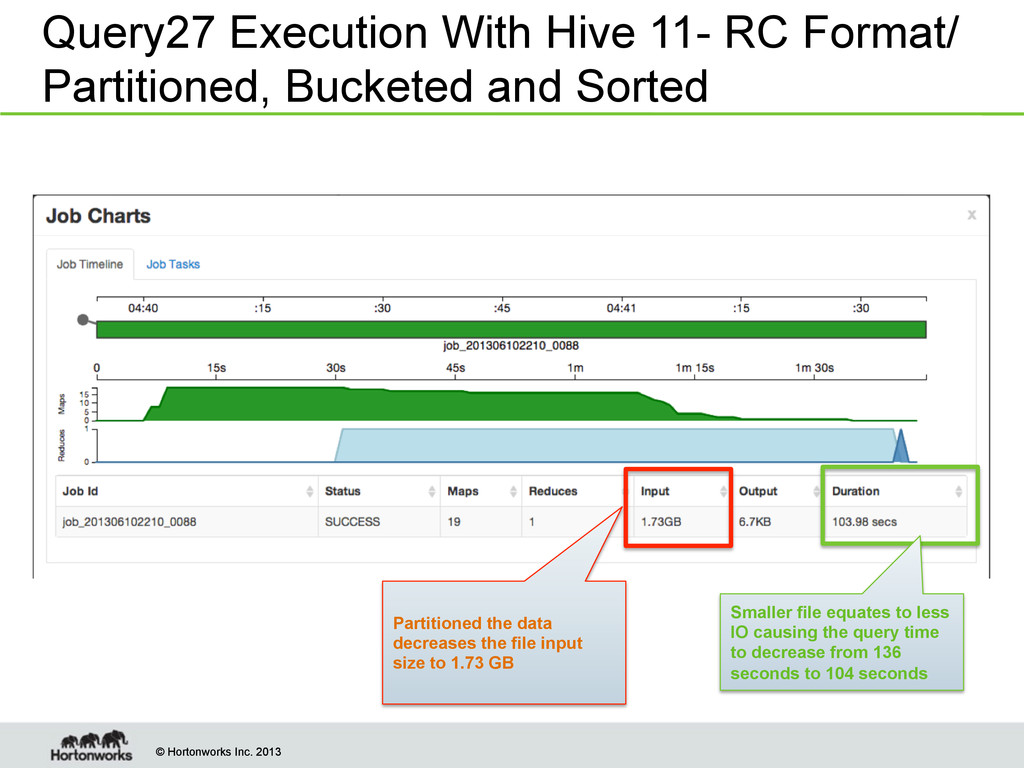
With Hive 11- RC Format/ Partitioned, Bucketed and Sorted Partitioned the data decreases the file input size to 1.73 GB Smaller file equates to less IO causing the query time to decrease from 136 seconds to 104 seconds -
© Hortonworks Inc. 2013 © Hortonworks Inc. 2013 Query27 Execution
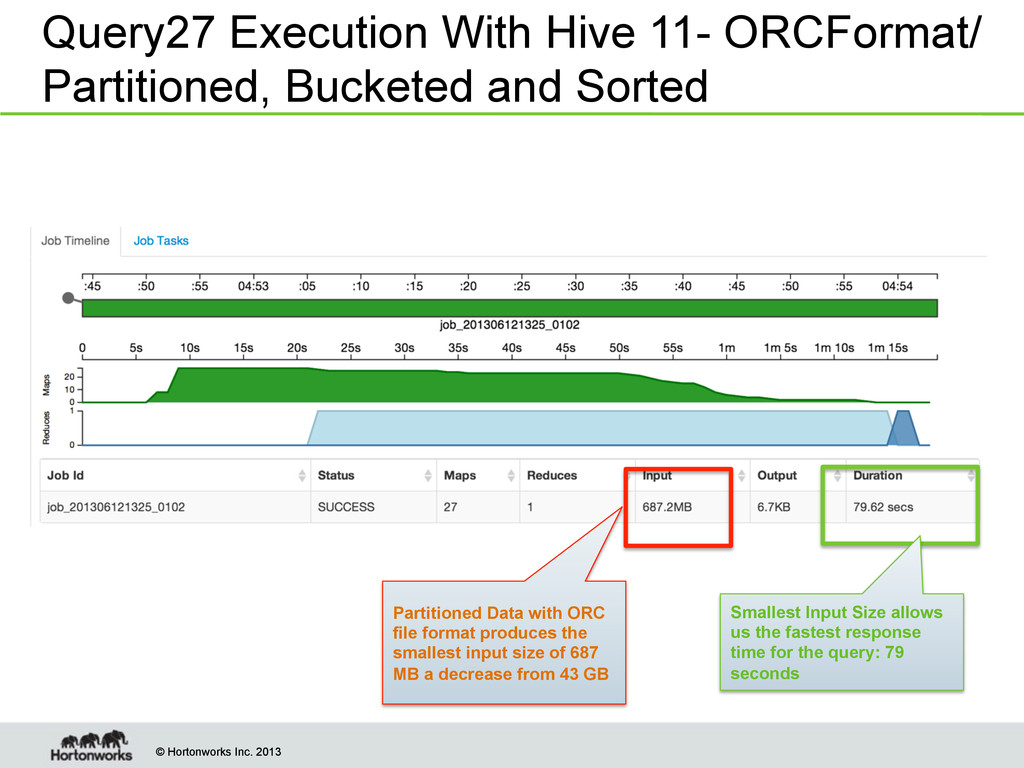
With Hive 11- ORCFormat/ Partitioned, Bucketed and Sorted Partitioned Data with ORC file format produces the smallest input size of 687 MB a decrease from 43 GB Smallest Input Size allows us the fastest response time for the query: 79 seconds -
© Hortonworks Inc. 2013 © Hortonworks Inc. 2013 Summary of
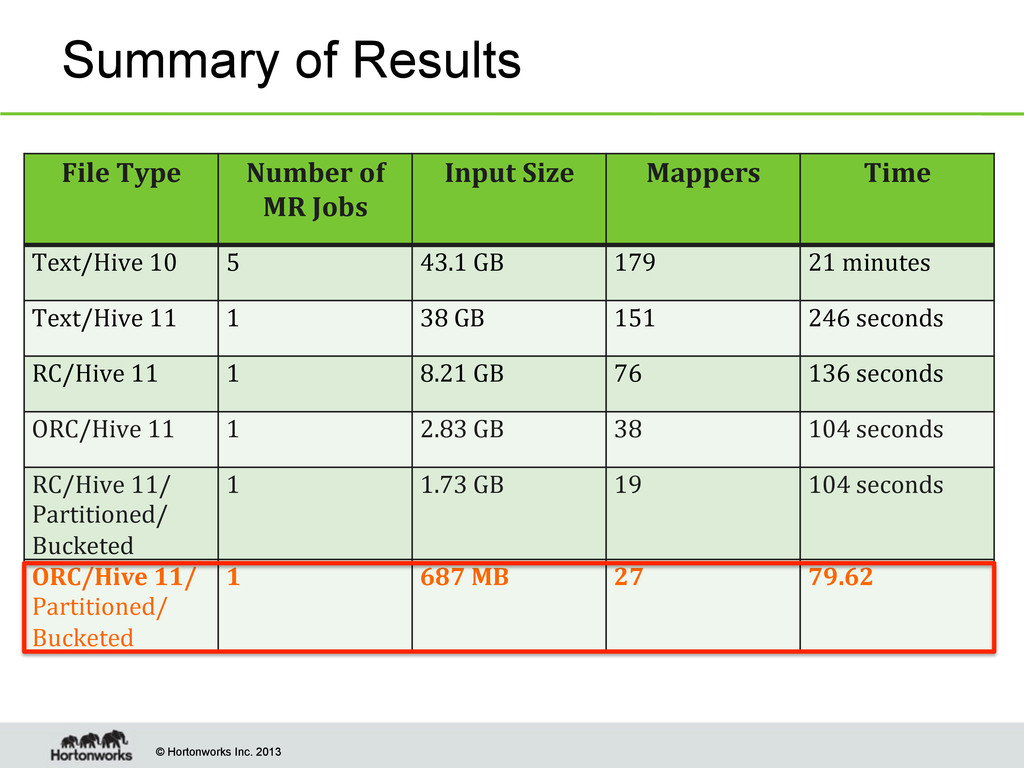
Results File Type Number of MR Jobs Input Size Mappers Time Text/Hive 10 5 43.1 GB 179 21 minutes Text/Hive 11 1 38 GB 151 246 seconds RC/Hive 11 1 8.21 GB 76 136 seconds ORC/Hive 11 1 2.83 GB 38 104 seconds RC/Hive 11/ Partitioned/ Bucketed 1 1.73 GB 19 104 seconds ORC/Hive 11/ Partitioned/ Bucketed 1 687 MB 27 79.62 -
Resources Page 30 hadoop-2.0.3-alpha: http://hadoop.apache.org/common/releases.html Release Documentation: http://hadoop.apache.org/common/docs/r2.0.3-alpha/ Blogs: http://hortonworks.com/blog/category/apache-hadoop/yarn/
http://hortonworks.com/blog/introducing-apache-hadoop-yarn/ http://hortonworks.com/blog/apache-hadoop-yarn-background-and-an- overview/ http://hortonworks.com/blog/apache-hadoop-yarn-background-and-an- overview/ -
© Hortonworks Inc. 2012: DO NOT SHARE. CONTAINS HORTONWORKS CONFIDENTIAL
& PROPRIETARY INFORMATION Thank You! Questions & Answers Page 31
 cj_harris5
 keitah
 csswizardry
 atalie2m
 bengo4com
 mikanichinose
 imuta
 shotashiratori
 yama3133
 junjikoide
 hagino3000
 yusuke427
 kasada
 aleyda
 reverentgeek
 twada
 62gerente
 akosma
 szymonslowik
 mongodb
 gr2m
 hannesfritz
 orderedlist
 keithpitt
 katiecoart