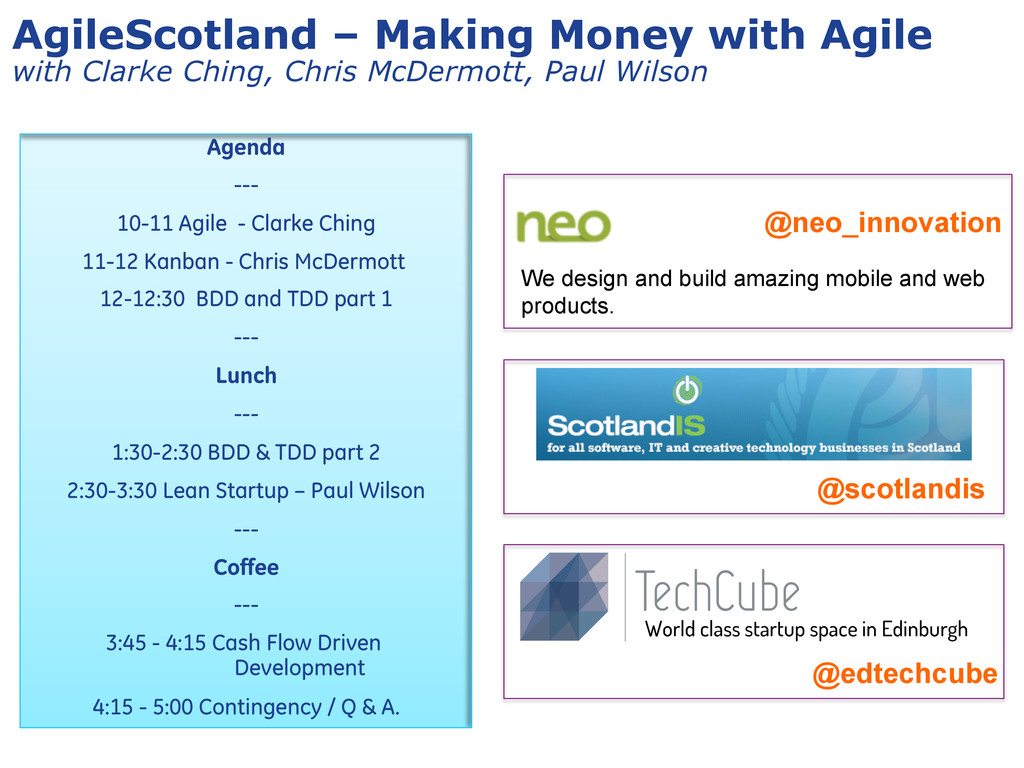
McDermott, Paul Wilson Agenda --- 10-11 Agile - Clarke Ching 11-12 Kanban - Chris McDermott 12-12:30 BDD and TDD part 1 --- Lunch --- 1:30-2:30 BDD & TDD part 2 2:30-3:30 Lean Startup – Paul Wilson --- Coffee --- 3:45 - 4:15 Cash Flow Driven Development 4:15 - 5:00 Contingency / Q & A. We design and build amazing mobile and web products. @neo_innovation @scotlandis @edtechcube
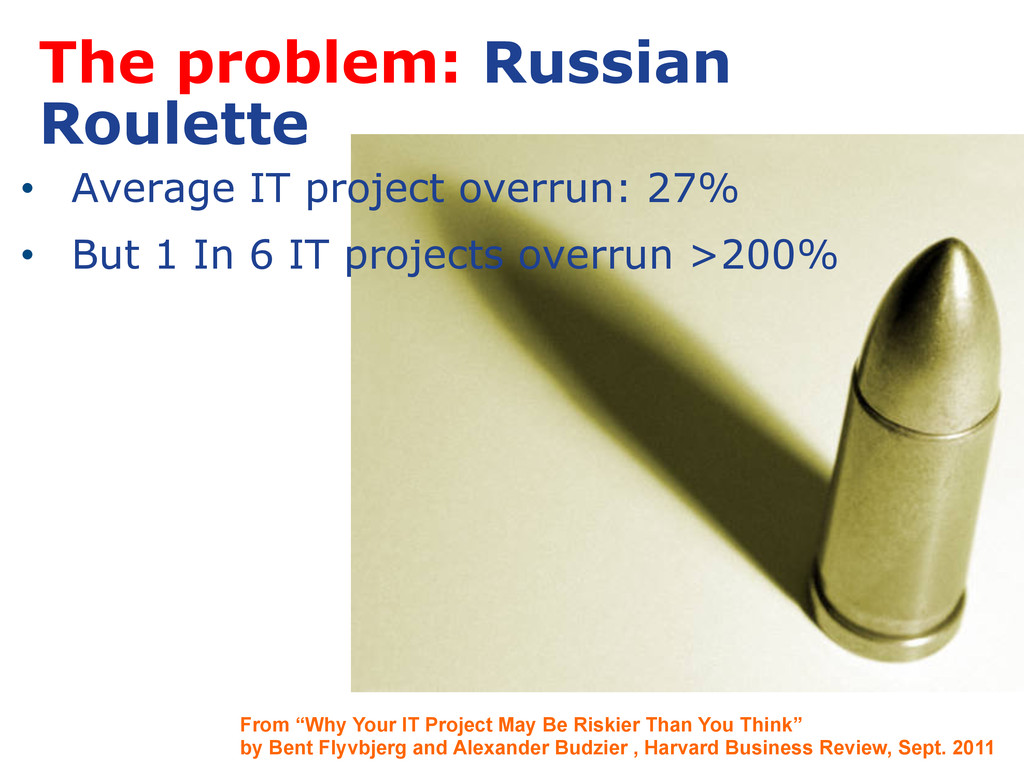
• But 1 In 6 IT projects overrun >200% From “Why Your IT Project May Be Riskier Than You Think” by Bent Flyvbjerg and Alexander Budzier , Harvard Business Review, Sept. 2011
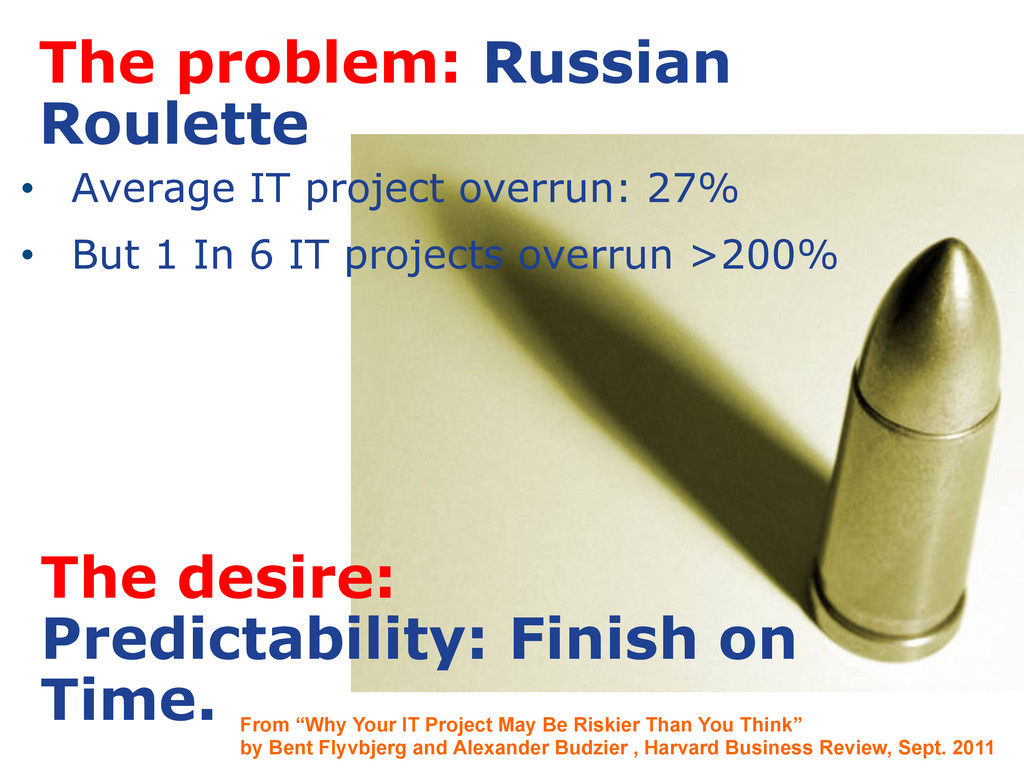
• But 1 In 6 IT projects overrun >200% From “Why Your IT Project May Be Riskier Than You Think” by Bent Flyvbjerg and Alexander Budzier , Harvard Business Review, Sept. 2011 The desire: Predictability: Finish on Time.
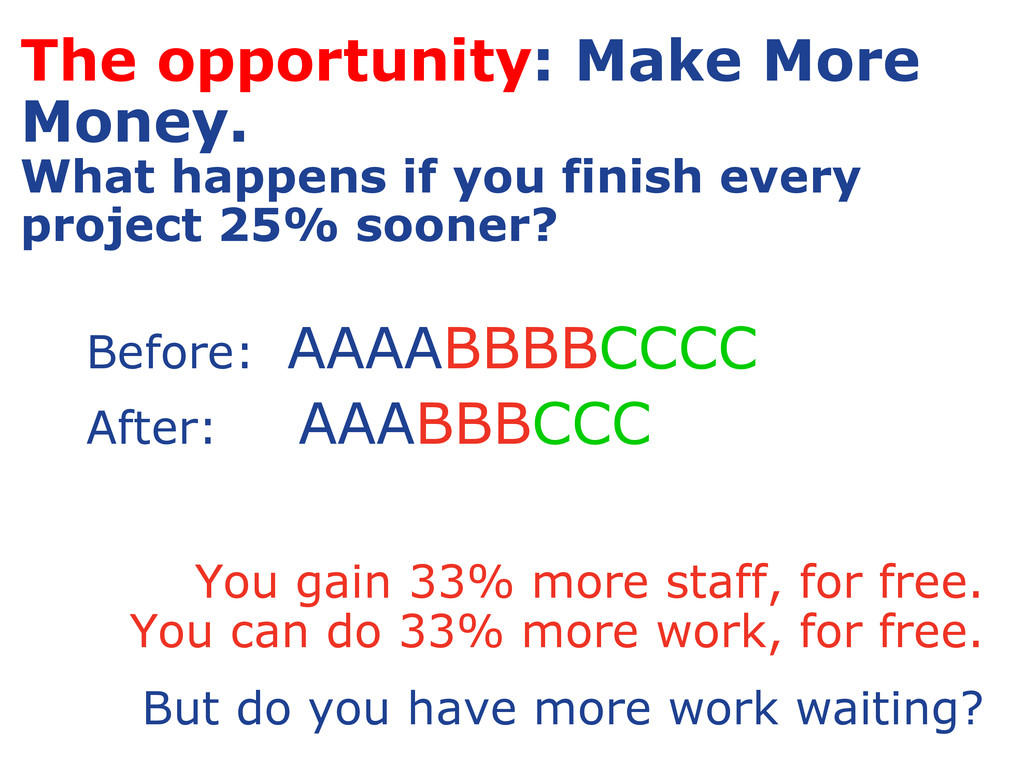
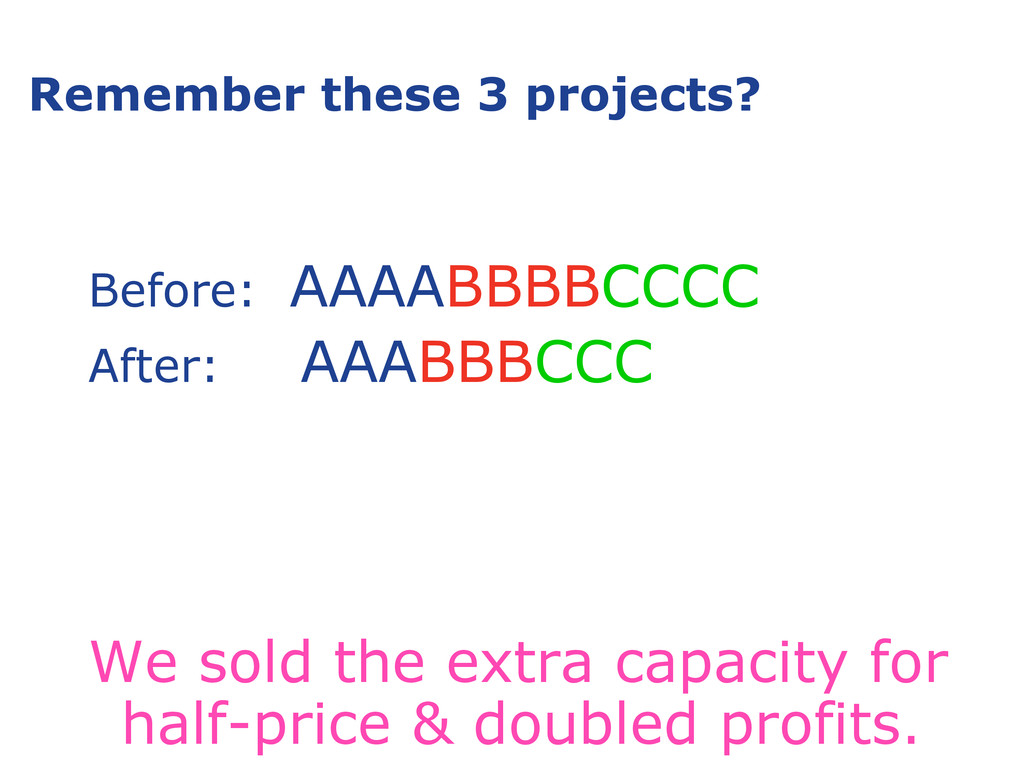
every project 25% sooner? Before: AAAABBBBCCCC After: AAABBBCCC You gain 33% more staff, for free. You can do 33% more work, for free. But do you have more work waiting?
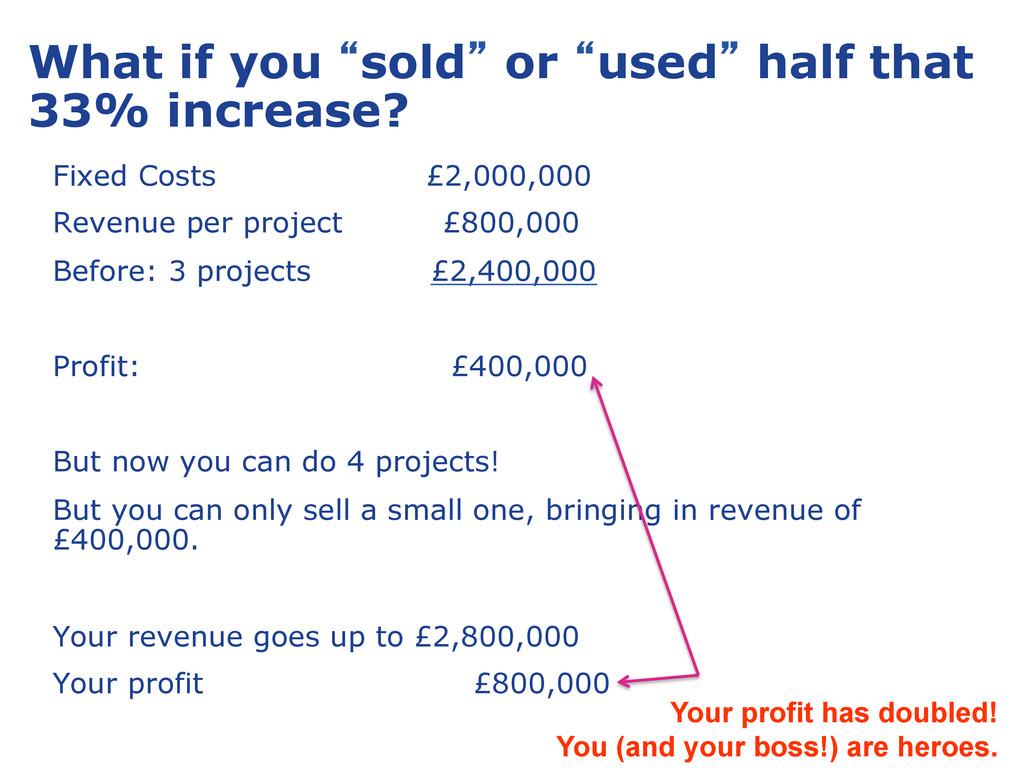
Fixed Costs £2,000,000 Revenue per project £800,000 Before: 3 projects £2,400,000 Profit: £400,000 But now you can do 4 projects! But you can only sell a small one, bringing in revenue of £400,000. Your revenue goes up to £2,800,000 Your profit £800,000 Your profit has doubled! You (and your boss!) are heroes.
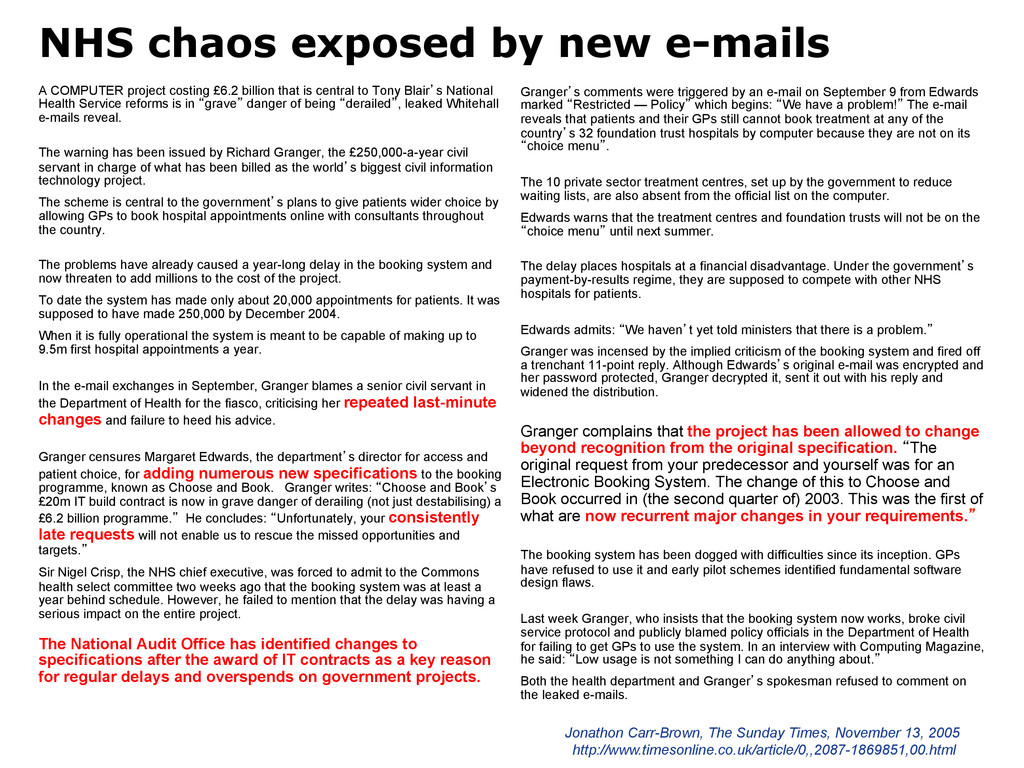
chaos exposed by new e-mails A COMPUTER project costing £6.2 billion that is central to Tony Blair’s National Health Service reforms is in “grave” danger of being “derailed”, leaked Whitehall e-mails reveal. The warning has been issued by Richard Granger, the £250,000-a-year civil servant in charge of what has been billed as the world’s biggest civil information technology project. The scheme is central to the government’s plans to give patients wider choice by allowing GPs to book hospital appointments online with consultants throughout the country. The problems have already caused a year-long delay in the booking system and now threaten to add millions to the cost of the project. To date the system has made only about 20,000 appointments for patients. It was supposed to have made 250,000 by December 2004. When it is fully operational the system is meant to be capable of making up to 9.5m first hospital appointments a year. In the e-mail exchanges in September, Granger blames a senior civil servant in the Department of Health for the fiasco, criticising her repeated last-minute changes and failure to heed his advice. Granger censures Margaret Edwards, the department’s director for access and patient choice, for adding numerous new specifications to the booking programme, known as Choose and Book. Granger writes: “Choose and Book’s £20m IT build contract is now in grave danger of derailing (not just destabilising) a £6.2 billion programme.” He concludes: “Unfortunately, your consistently late requests will not enable us to rescue the missed opportunities and targets.” Sir Nigel Crisp, the NHS chief executive, was forced to admit to the Commons health select committee two weeks ago that the booking system was at least a year behind schedule. However, he failed to mention that the delay was having a serious impact on the entire project. The National Audit Office has identified changes to specifications after the award of IT contracts as a key reason for regular delays and overspends on government projects. Granger’s comments were triggered by an e-mail on September 9 from Edwards marked “Restricted — Policy” which begins: “We have a problem!” The e-mail reveals that patients and their GPs still cannot book treatment at any of the country’s 32 foundation trust hospitals by computer because they are not on its “choice menu”. The 10 private sector treatment centres, set up by the government to reduce waiting lists, are also absent from the official list on the computer. Edwards warns that the treatment centres and foundation trusts will not be on the “choice menu” until next summer. The delay places hospitals at a financial disadvantage. Under the government’s payment-by-results regime, they are supposed to compete with other NHS hospitals for patients. Edwards admits: “We haven’t yet told ministers that there is a problem.” Granger was incensed by the implied criticism of the booking system and fired off a trenchant 11-point reply. Although Edwards’s original e-mail was encrypted and her password protected, Granger decrypted it, sent it out with his reply and widened the distribution. Granger complains that the project has been allowed to change beyond recognition from the original specification. “The original request from your predecessor and yourself was for an Electronic Booking System. The change of this to Choose and Book occurred in (the second quarter of) 2003. This was the first of what are now recurrent major changes in your requirements.” The booking system has been dogged with difficulties since its inception. GPs have refused to use it and early pilot schemes identified fundamental software design flaws. Last week Granger, who insists that the booking system now works, broke civil service protocol and publicly blamed policy officials in the Department of Health for failing to get GPs to use the system. In an interview with Computing Magazine, he said: “Low usage is not something I can do anything about.” Both the health department and Granger’s spokesman refused to comment on the leaked e-mails.
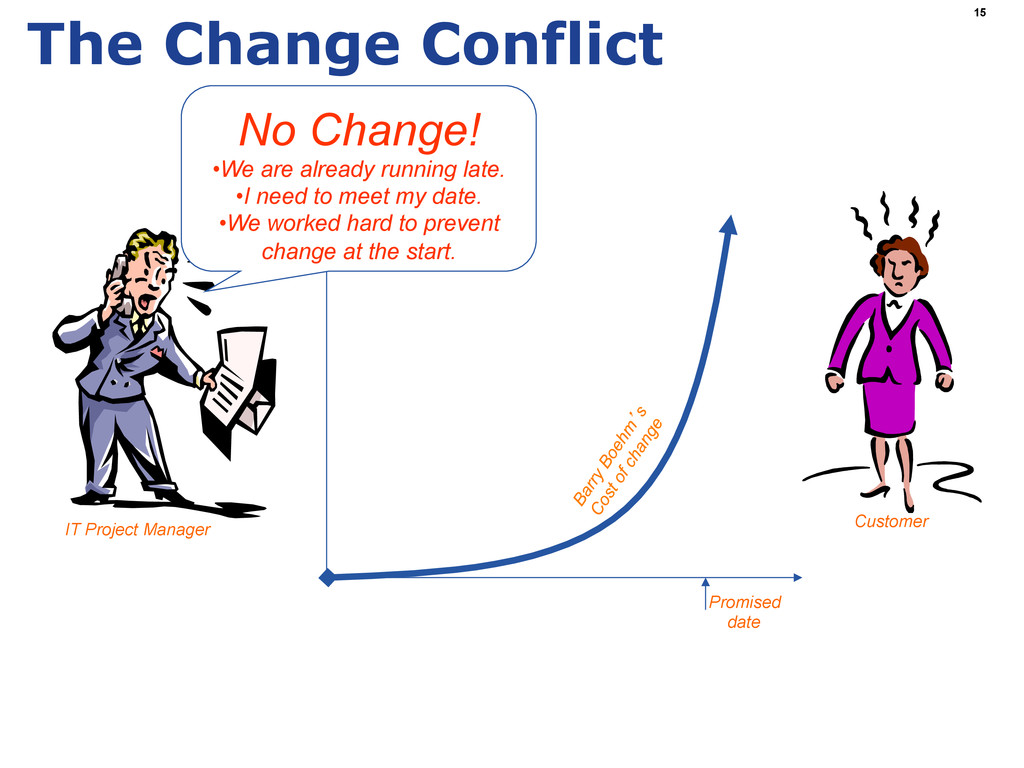
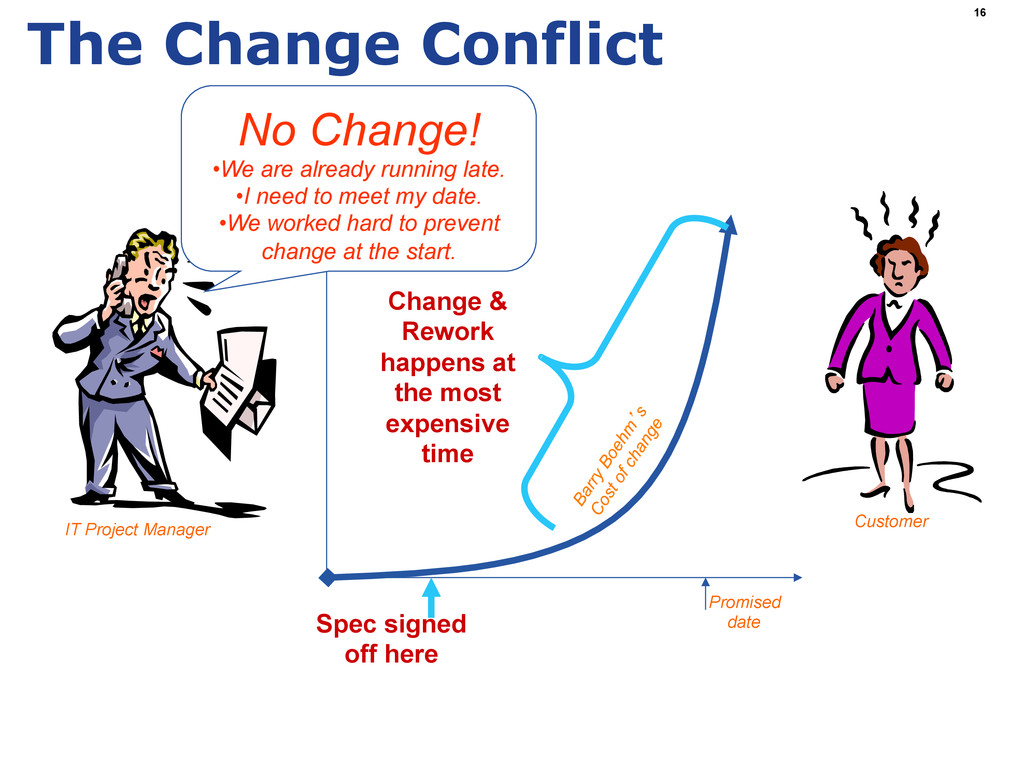
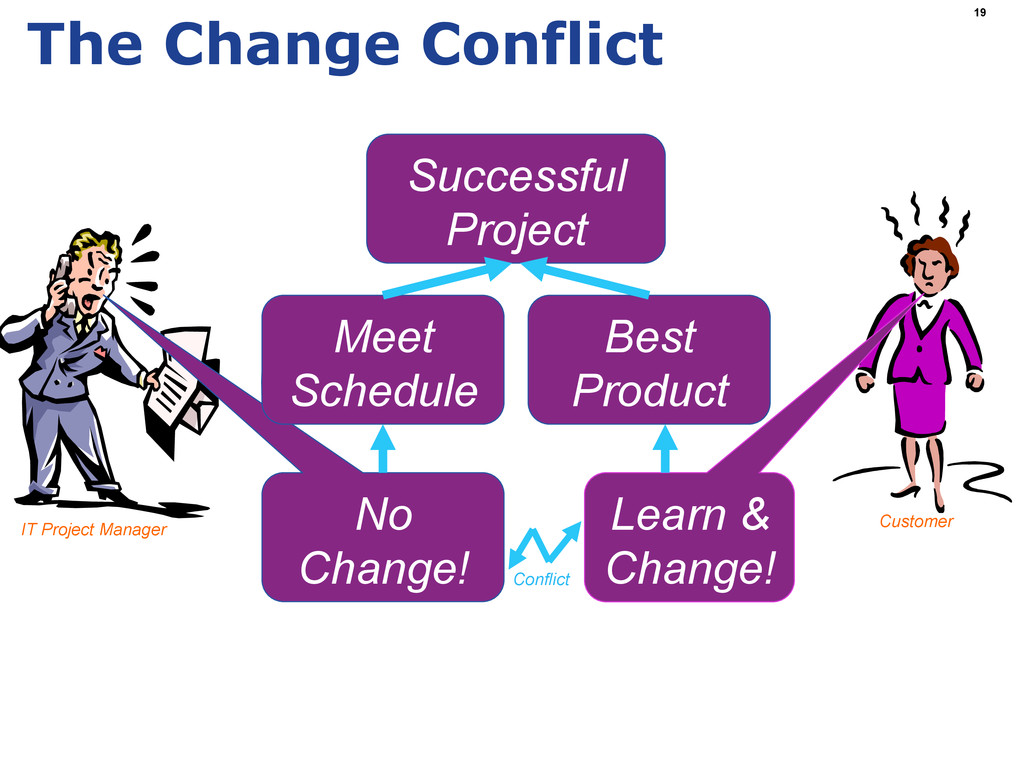
already running late. • I need to meet my date. • We worked hard to prevent change at the start. Change & Rework happens at the most expensive time Spec signed off here IT Project Manager Customer
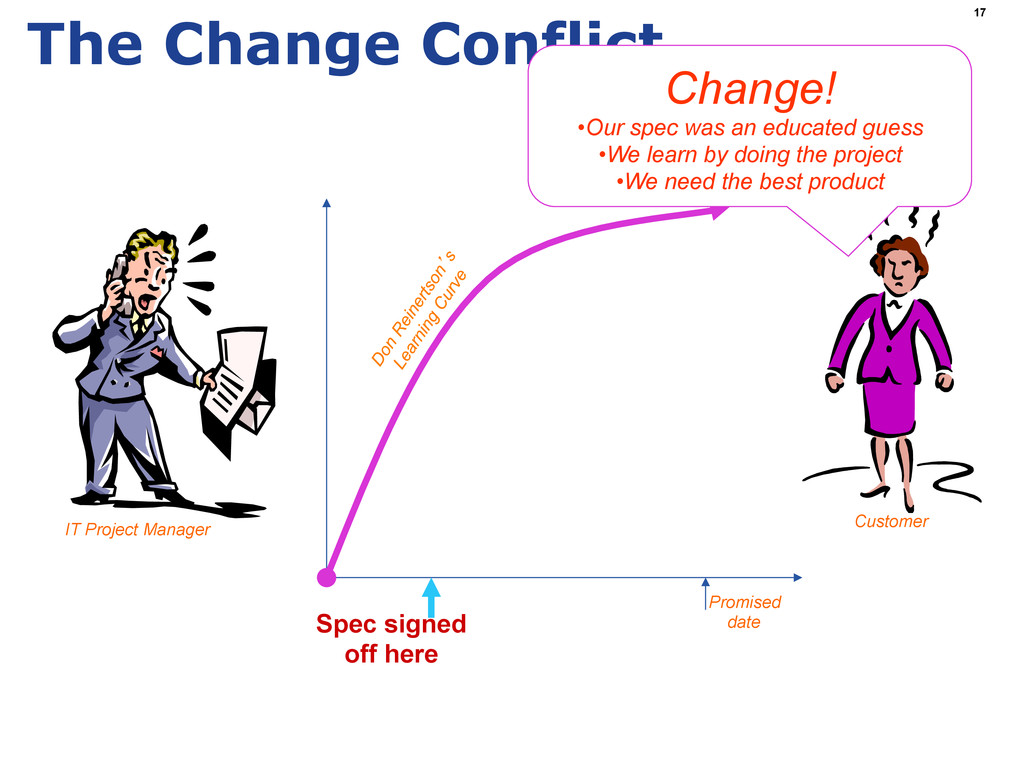
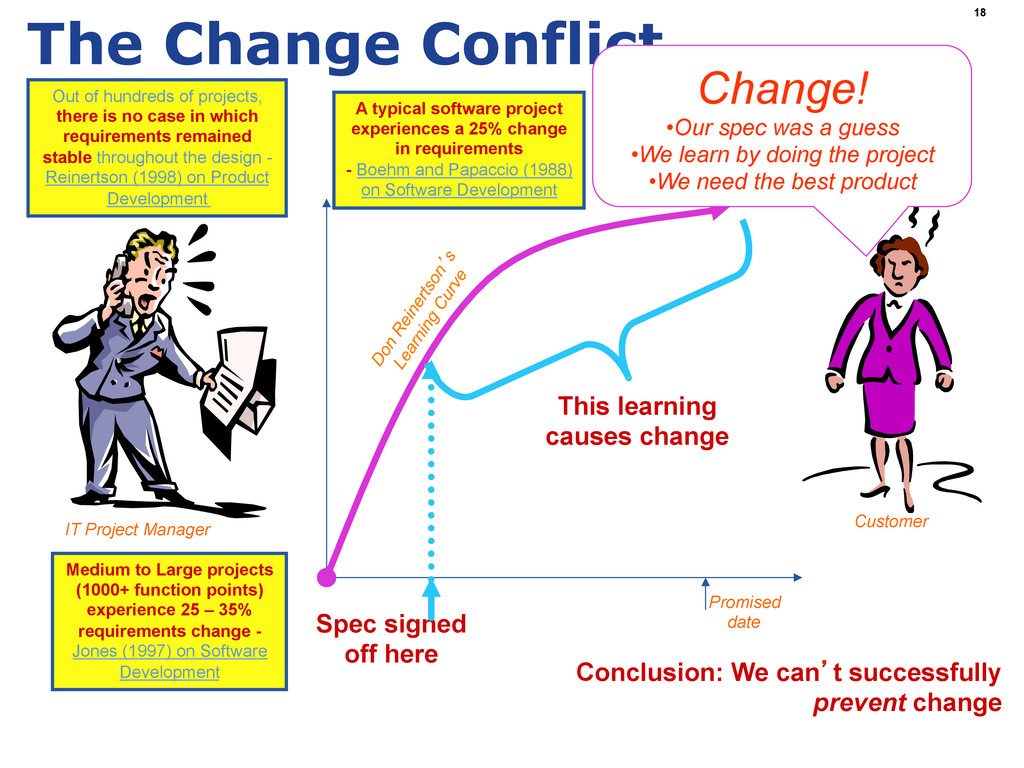
a guess • We learn by doing the project • We need the best product Out of hundreds of projects, there is no case in which requirements remained stable throughout the design - Reinertson (1998) on Product Development A typical software project experiences a 25% change in requirements - Boehm and Papaccio (1988) on Software Development Medium to Large projects (1000+ function points) experience 25 – 35% requirements change - Jones (1997) on Software Development Conclusion: We can’t successfully prevent change Spec signed off here This learning causes change IT Project Manager Customer
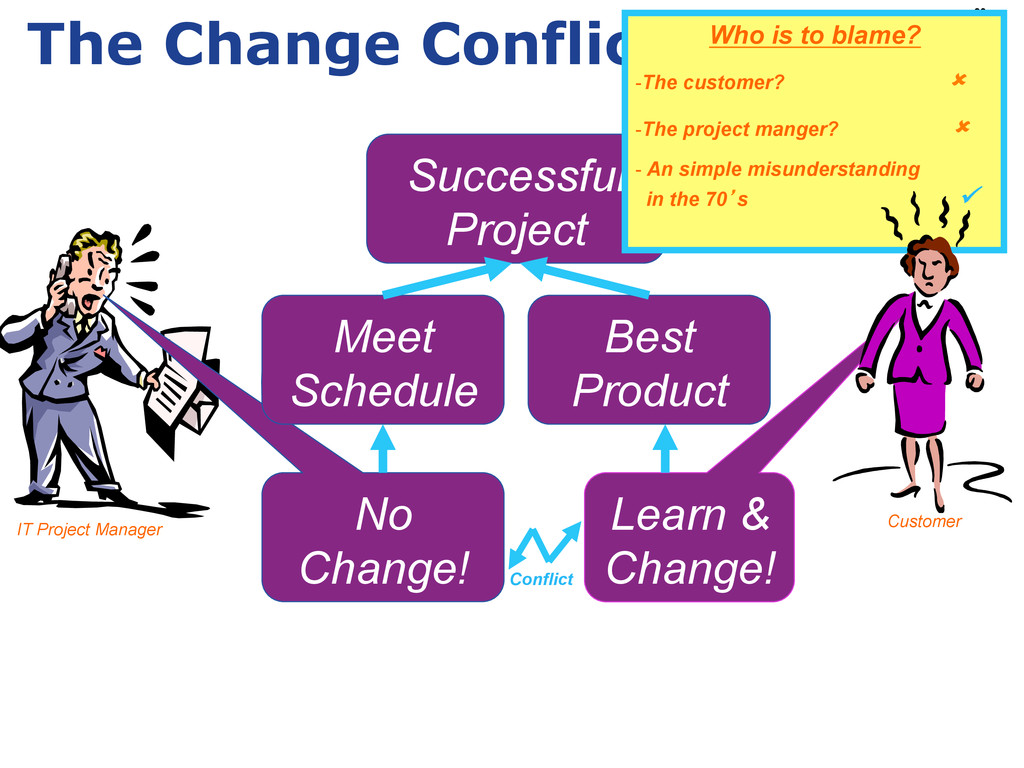
Meet Schedule Best Product Successful Project Who is to blame? - The customer? û - The project manger? û - An simple misunderstanding in the 70’s ü IT Project Manager Customer
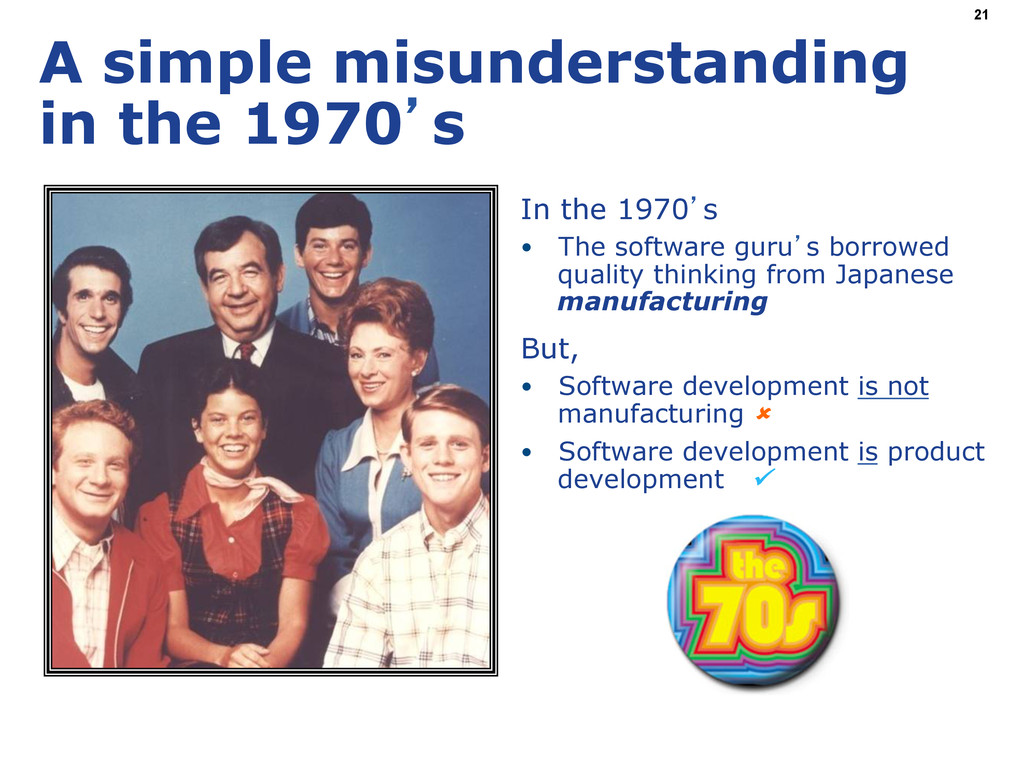
The software guru’s borrowed quality thinking from Japanese manufacturing But, • Software development is not manufacturing û • Software development is product development ü 21
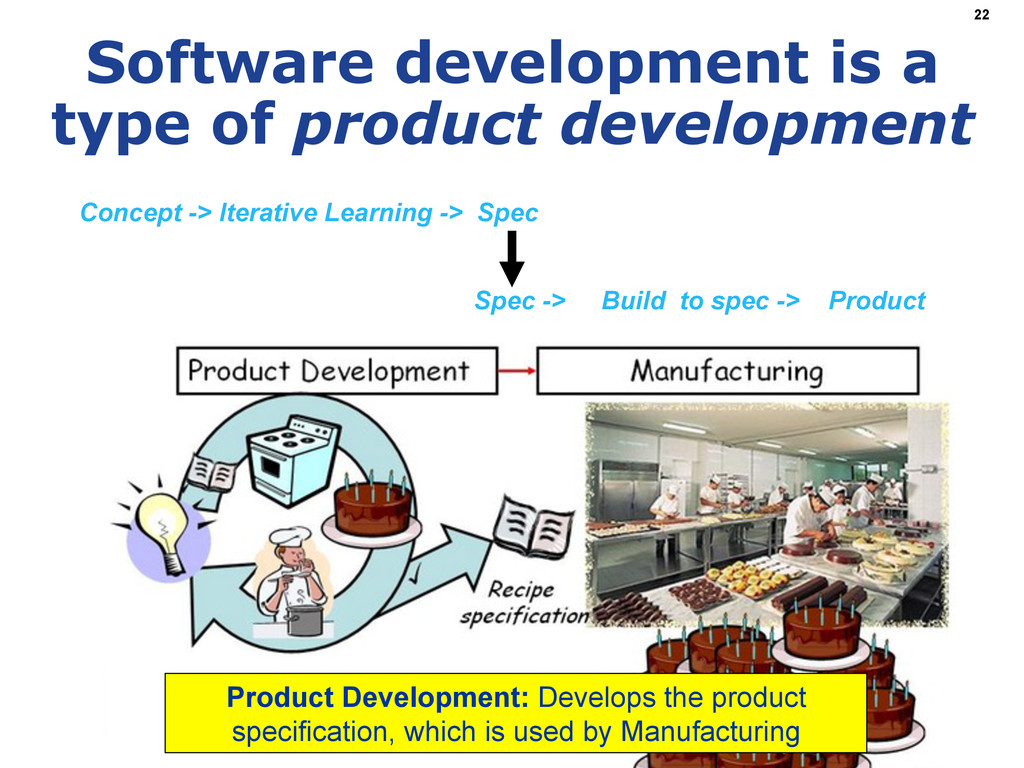
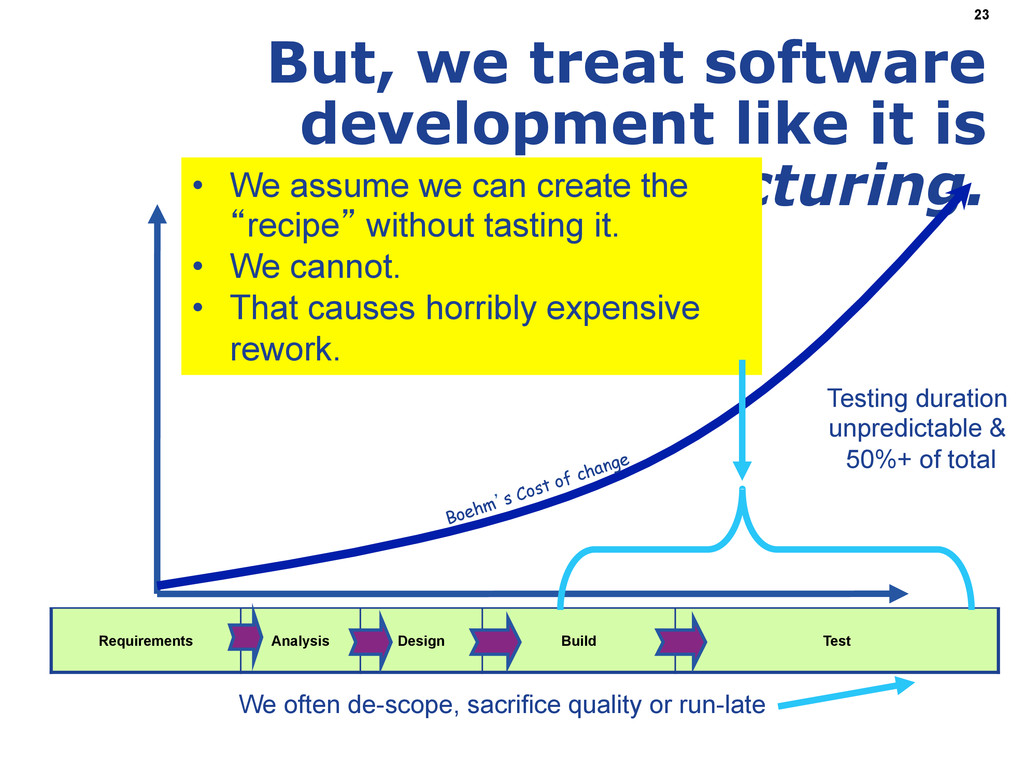
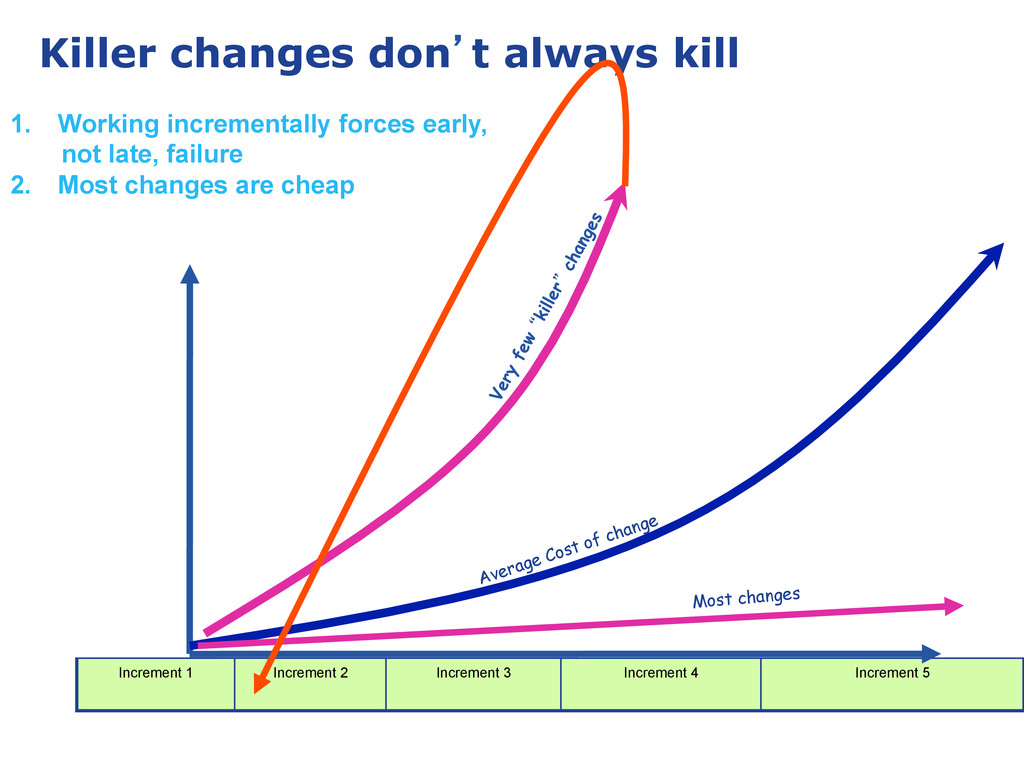
Analysis Design Build Test 23 Boehm’s Cost of change • We assume we can create the “recipe” without tasting it. • We cannot. • That causes horribly expensive rework. Testing duration unpredictable & 50%+ of total We often de-scope, sacrifice quality or run-late
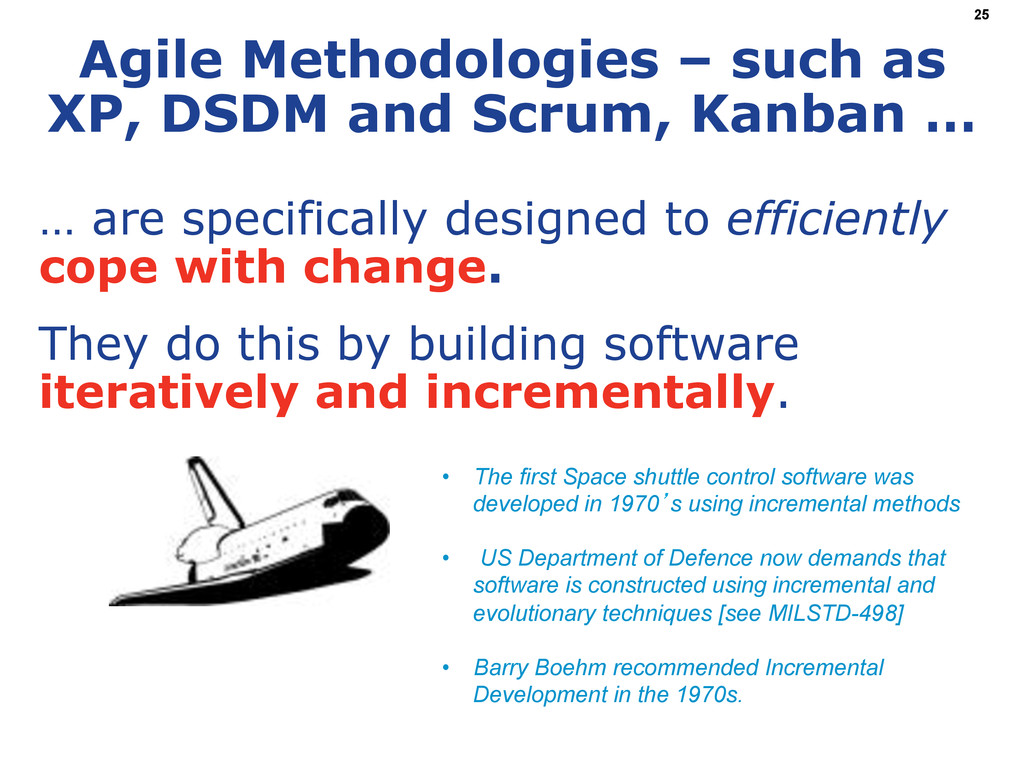
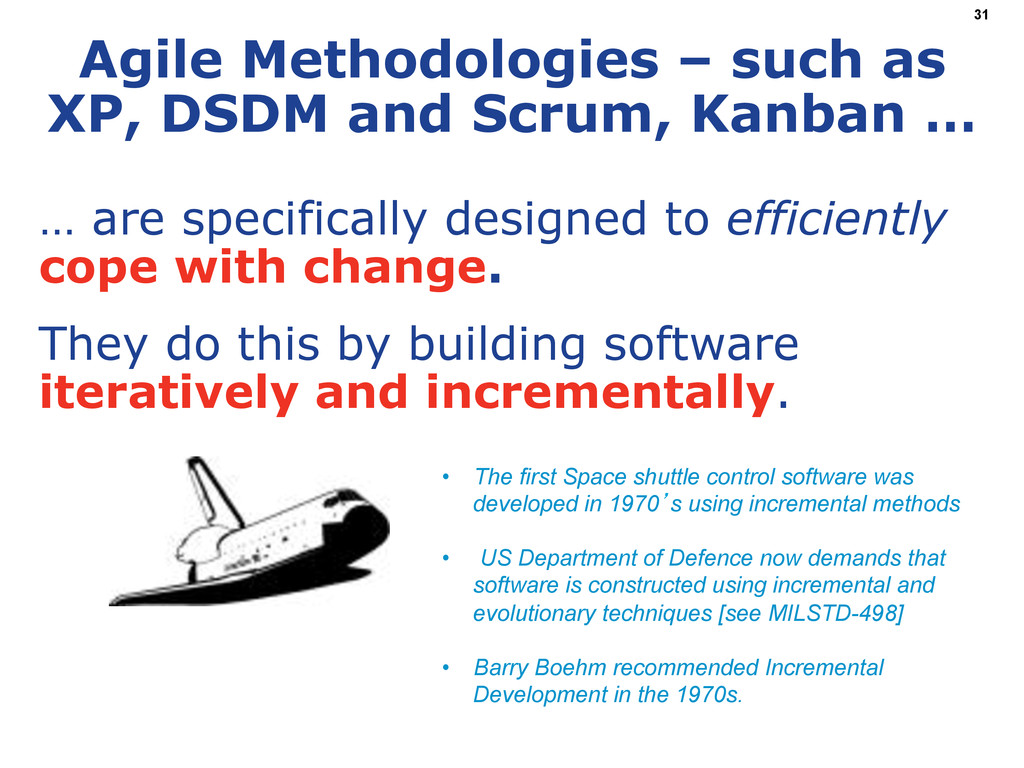
… … are specifically designed to efficiently cope with change. They do this by building software iteratively and incrementally. 25 • The first Space shuttle control software was developed in 1970’s using incremental methods • US Department of Defence now demands that software is constructed using incremental and evolutionary techniques [see MILSTD-498] • Barry Boehm recommended Incremental Development in the 1970s.
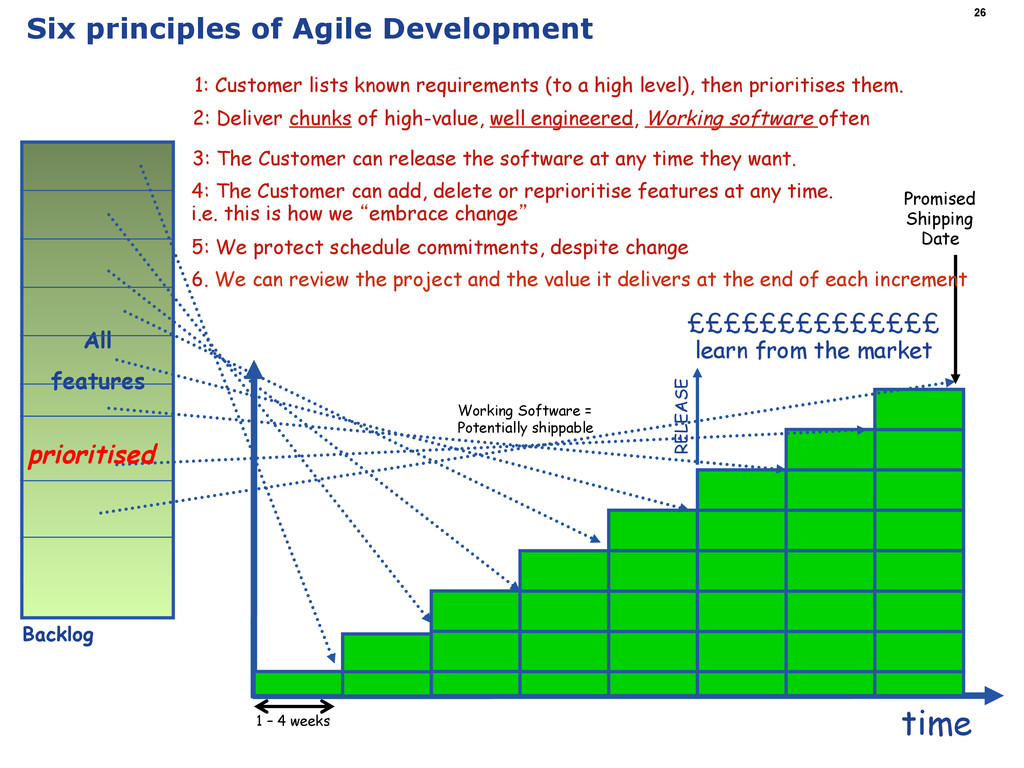
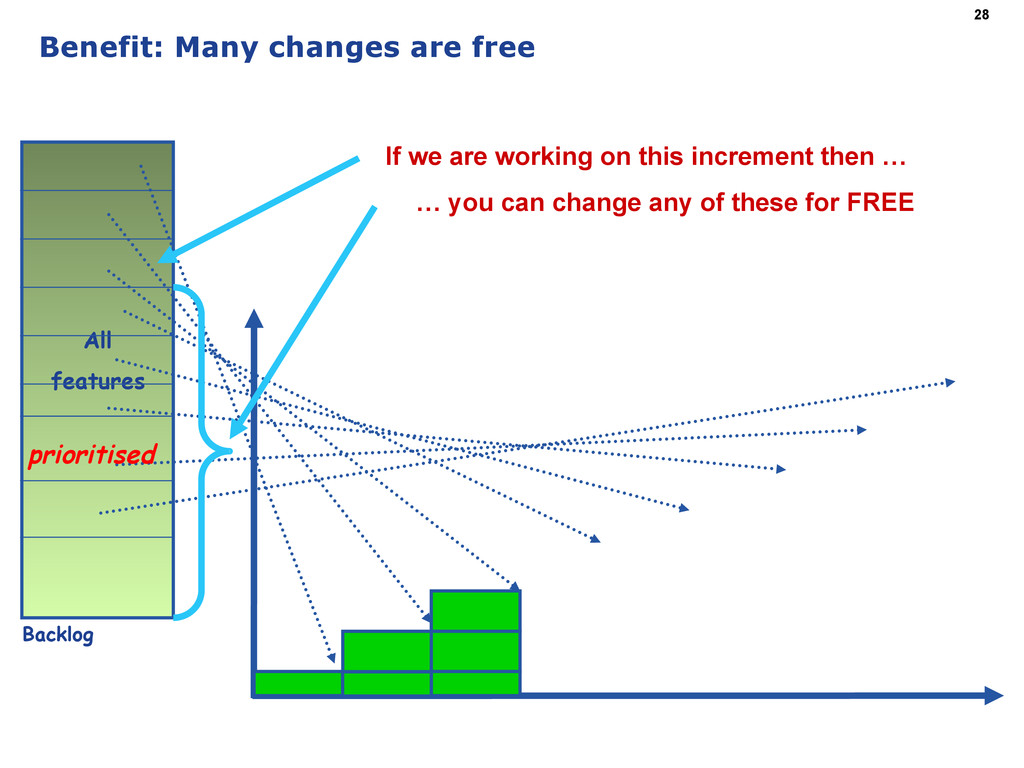
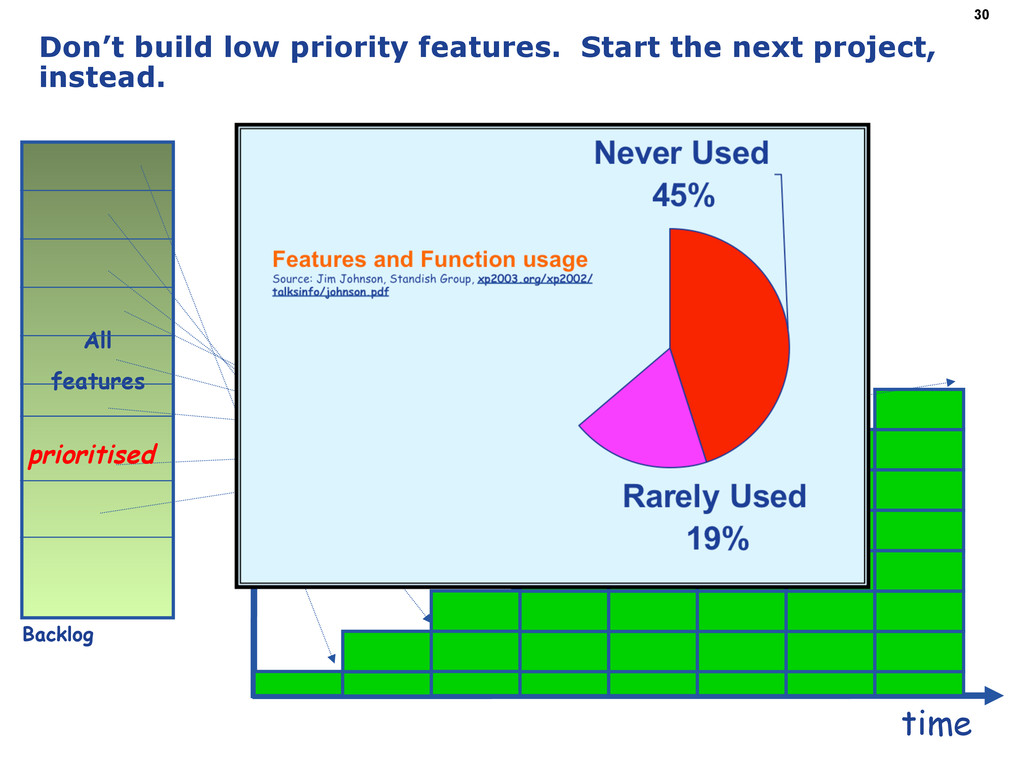
1 – 4 weeks All features time Working Software = Potentially shippable 2: Deliver chunks of high-value, well engineered, Working software often 4: The Customer can add, delete or reprioritise features at any time. i.e. this is how we “embrace change” 1: Customer lists known requirements (to a high level), then prioritises them. prioritised 3: The Customer can release the software at any time they want. ££££££££££££££ learn from the market 5: We protect schedule commitments, despite change Backlog 6. We can review the project and the value it delivers at the end of each increment
… … are specifically designed to efficiently cope with change. They do this by building software iteratively and incrementally. 31 • The first Space shuttle control software was developed in 1970’s using incremental methods • US Department of Defence now demands that software is constructed using incremental and evolutionary techniques [see MILSTD-498] • Barry Boehm recommended Incremental Development in the 1970s.
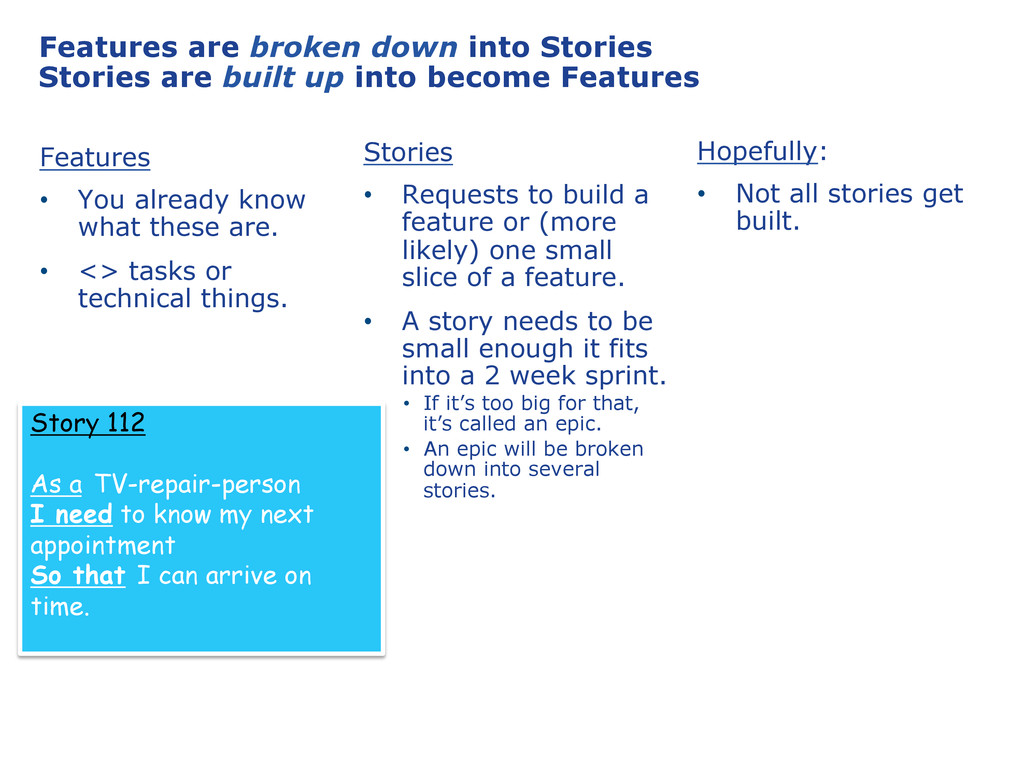
into become Features Features • You already know what these are. • <> tasks or technical things. Stories • Requests to build a feature or (more likely) one small slice of a feature. • A story needs to be small enough it fits into a 2 week sprint. • If it’s too big for that, it’s called an epic. • An epic will be broken down into several stories. Hopefully: • Not all stories get built. Story 112 As a TV-repair-person I need to know my next appointment So that I can arrive on time.
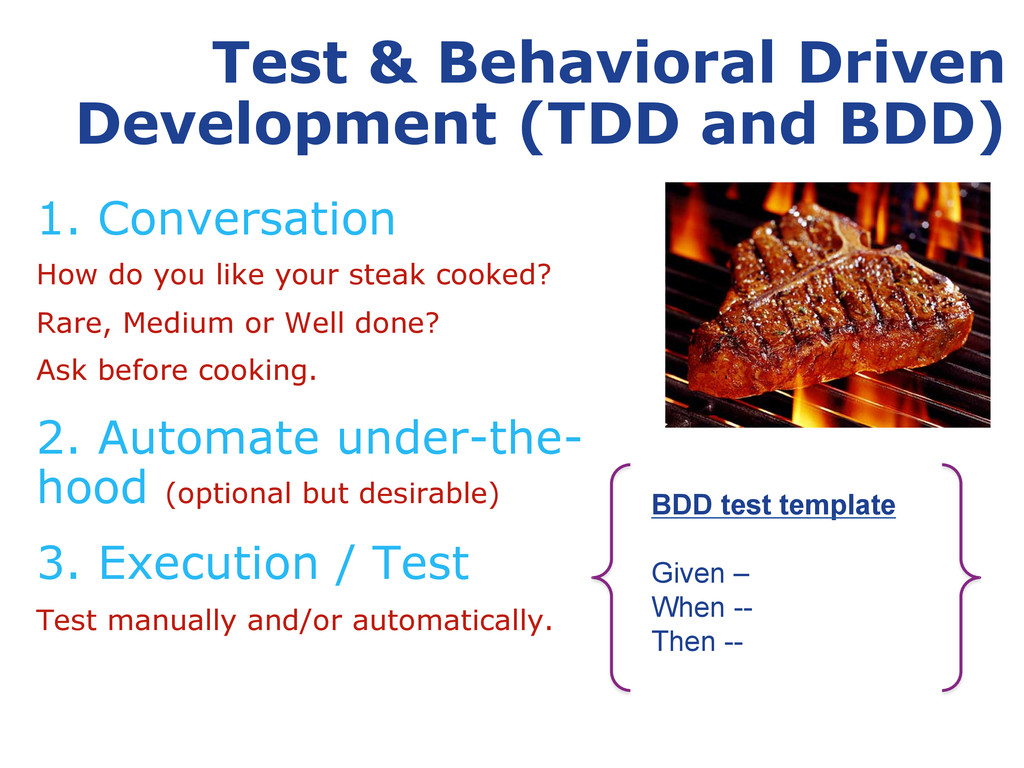
How do you like your steak cooked? Rare, Medium or Well done? Ask before cooking. 2. Automate under-the- hood (optional but desirable) 3. Execution / Test Test manually and/or automatically. BDD test template Given – When -- Then --
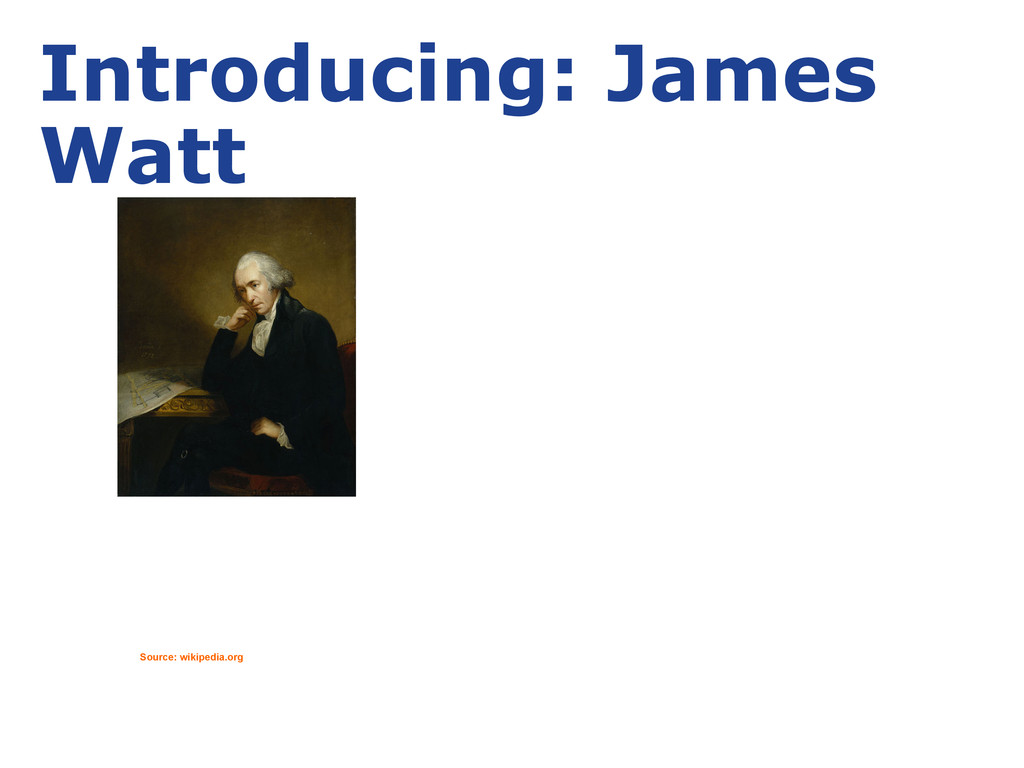
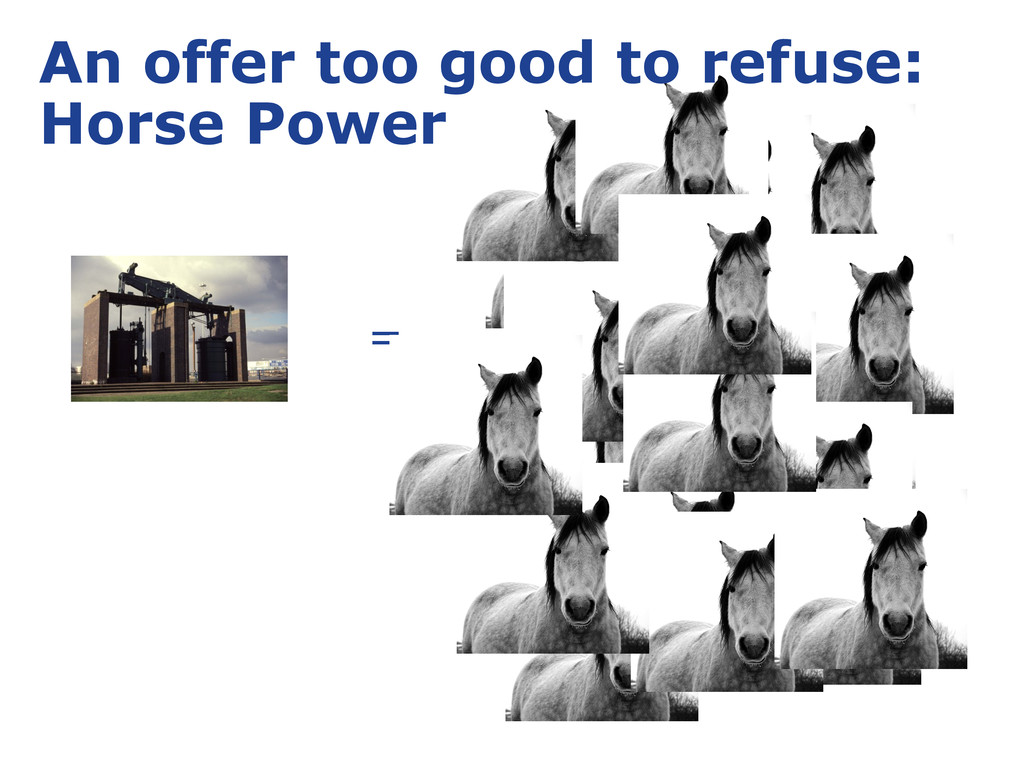
Watt beam blowing engine re-erected on the Dartmouth Circus roundabout, on the A38(M) in Birmingham, UK. It was built in 1817 and used in Netherton at the ironworks of M W Grazebrook.
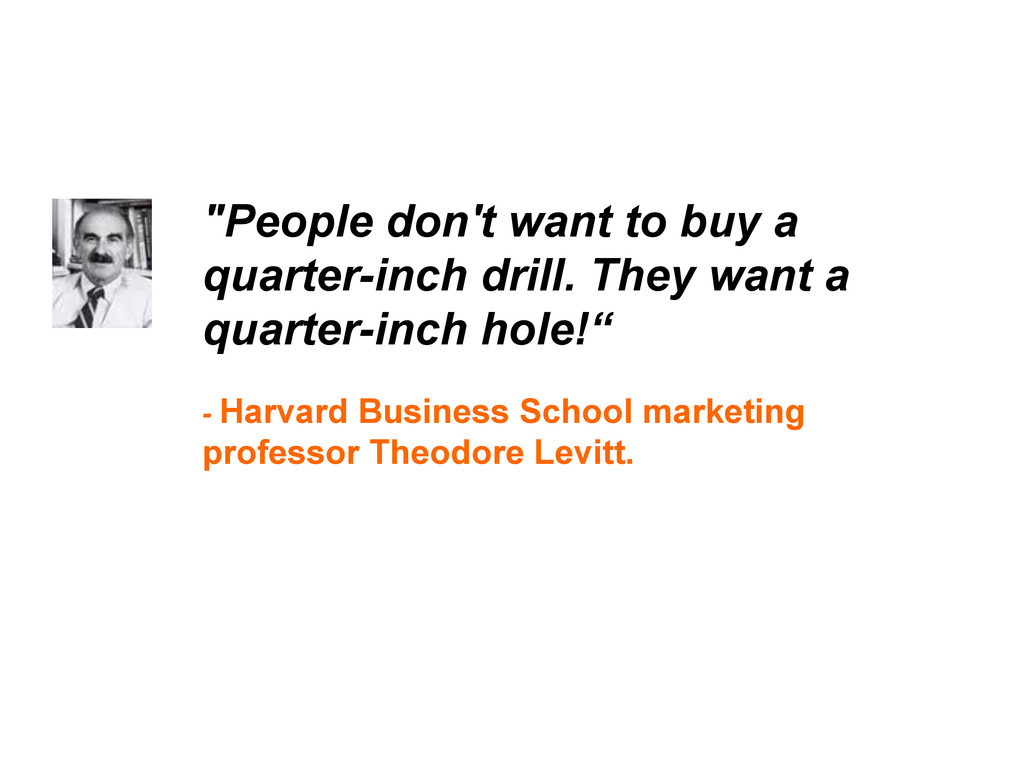
a quarter-inch hole!“ - Harvard Business School marketing professor Theodore Levitt. Agile is our Drill. More profitable business is our quarter inch hole. A Happier workplace is the 100inch 3D HD TV we hang from the hole.
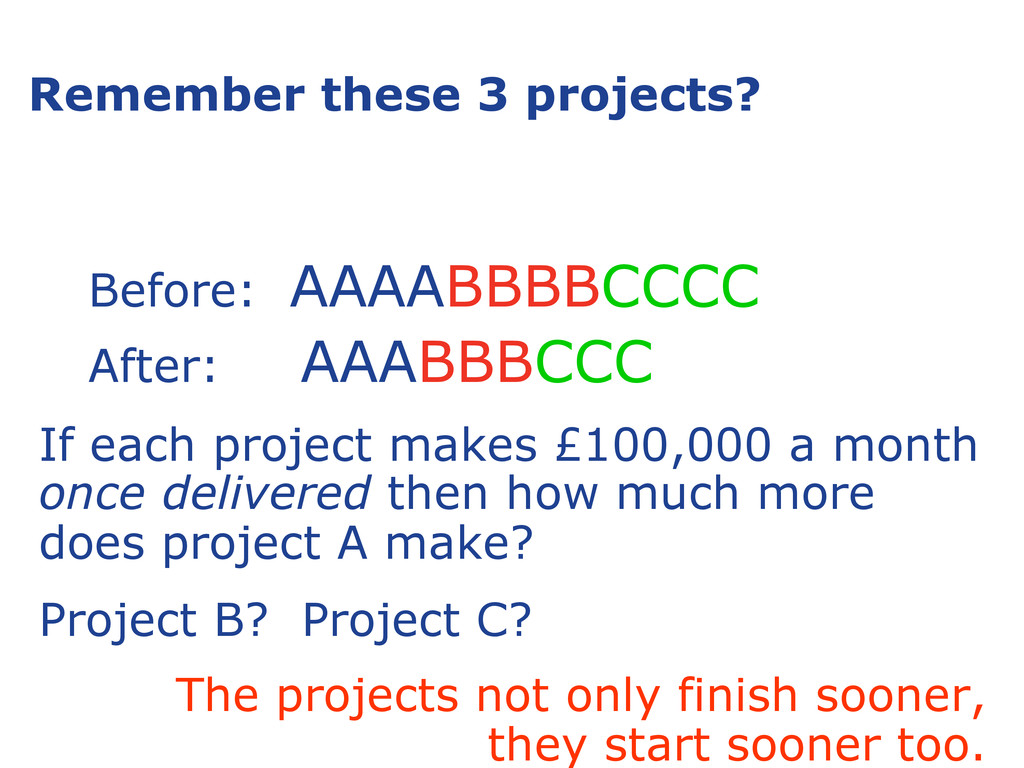
project makes £100,000 a month once delivered then how much more does project A make? Project B? Project C? The projects not only finish sooner, they start sooner too.
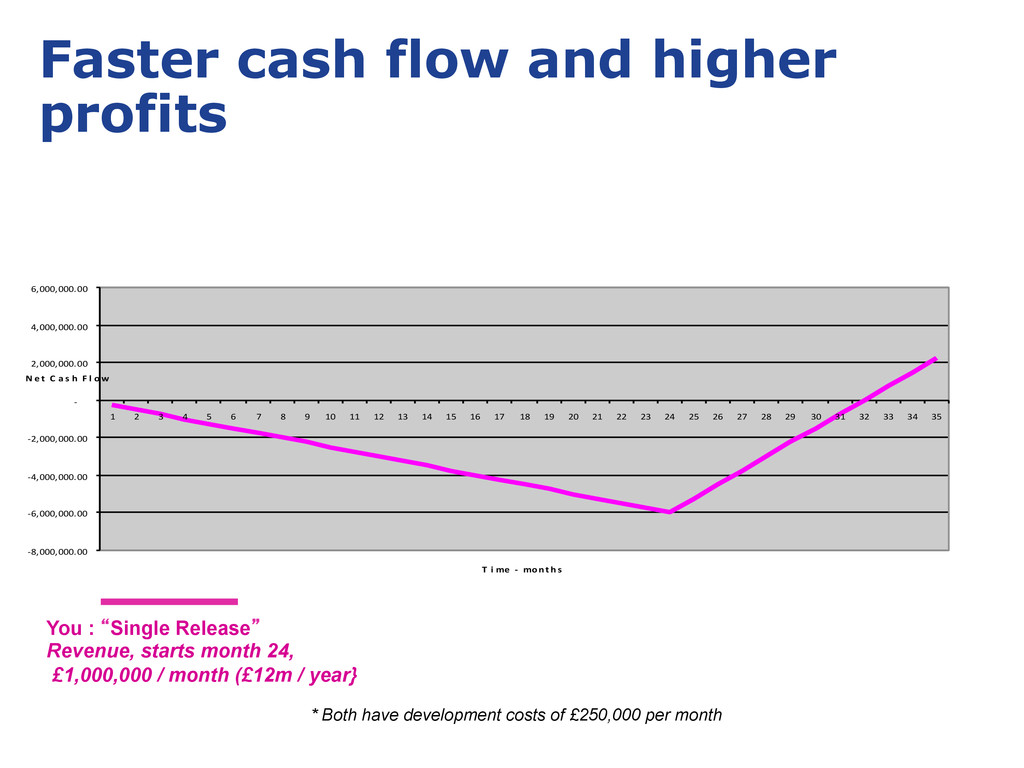
-‐ 2,000,000.00 4,000,000.00 6,000,000.00 1 2 3 4 5 6 7 8 9 10 11 12 13 14 15 16 17 18 19 20 21 22 23 24 25 26 27 28 29 30 31 32 33 34 35 T i me -‐ mont hs N e t C a s h F l ow * Both have development costs of £250,000 per month You : “Single Release” Revenue, starts month 24, £1,000,000 / month (£12m / year}
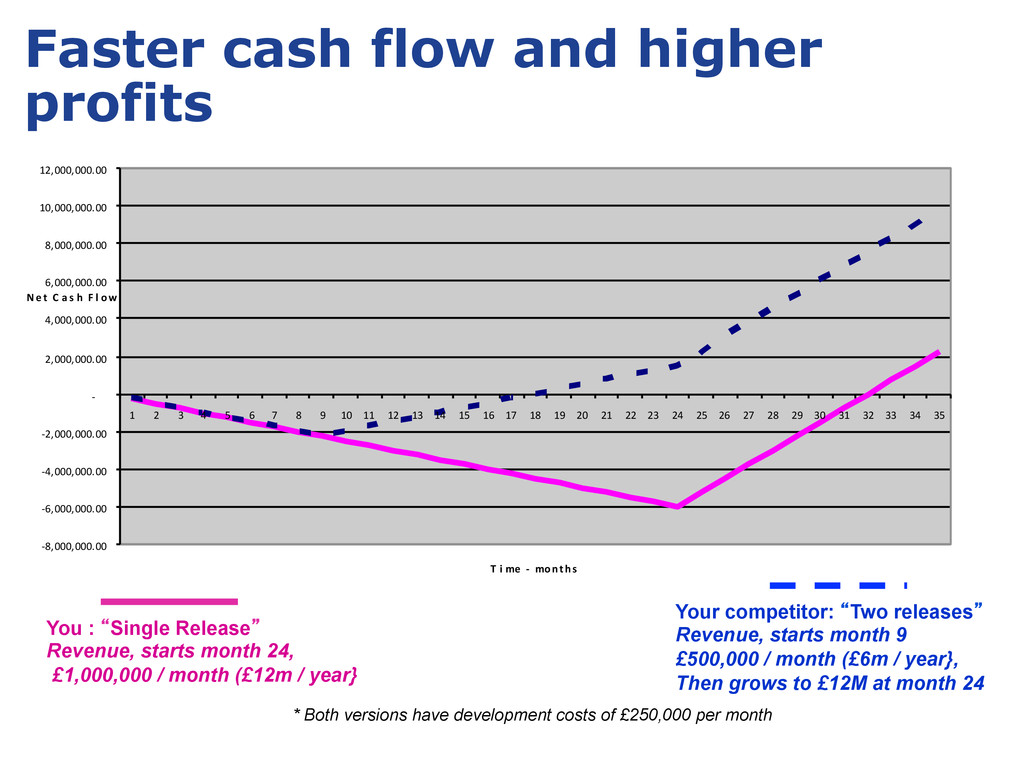
-‐ 2,000,000.00 4,000,000.00 6,000,000.00 8,000,000.00 10,000,000.00 12,000,000.00 1 2 3 4 5 6 7 8 9 10 11 12 13 14 15 16 17 18 19 20 21 22 23 24 25 26 27 28 29 30 31 32 33 34 35 T i me -‐ months N e t C a s h F l ow Your competitor: “Two releases” Revenue, starts month 9 £500,000 / month (£6m / year}, Then grows to £12M at month 24 * Both versions have development costs of £250,000 per month You : “Single Release” Revenue, starts month 24, £1,000,000 / month (£12m / year}
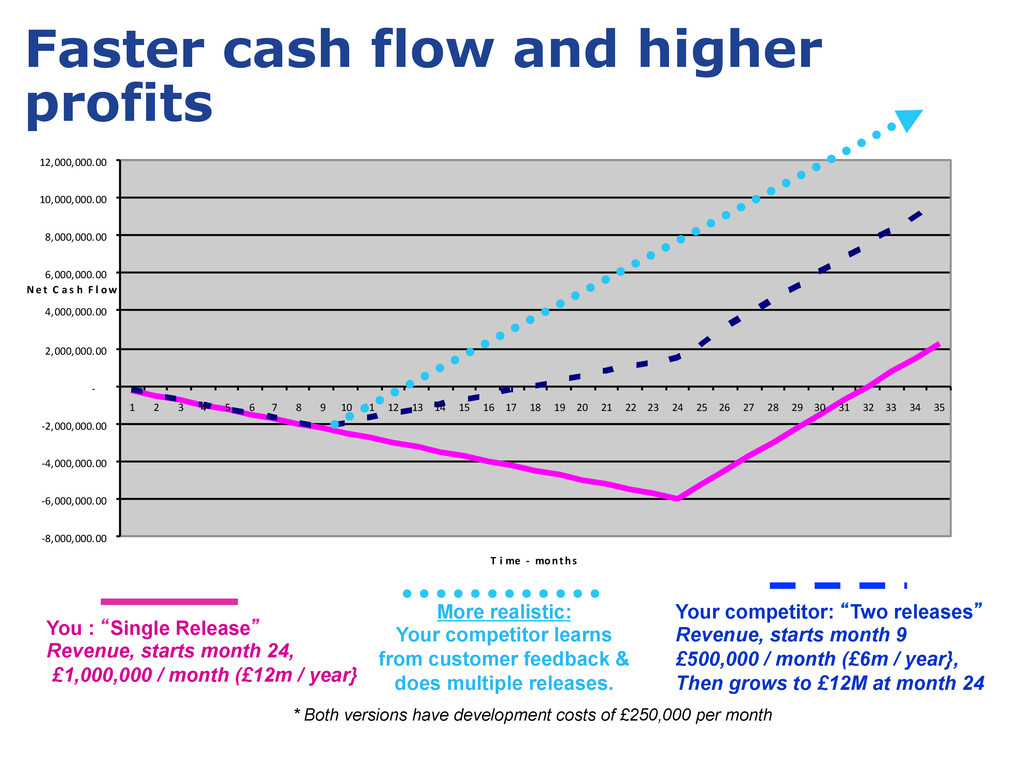
-‐ 2,000,000.00 4,000,000.00 6,000,000.00 8,000,000.00 10,000,000.00 12,000,000.00 1 2 3 4 5 6 7 8 9 10 11 12 13 14 15 16 17 18 19 20 21 22 23 24 25 26 27 28 29 30 31 32 33 34 35 T i me -‐ months N e t C a s h F l ow Your competitor: “Two releases” Revenue, starts month 9 £500,000 / month (£6m / year}, Then grows to £12M at month 24 * Both versions have development costs of £250,000 per month You : “Single Release” Revenue, starts month 24, £1,000,000 / month (£12m / year} More realistic: Your competitor learns from customer feedback & does multiple releases.


 aemeredith
 dugsong
 bryan
 tammyeverts
 danielanewman
 andyhume
 axbom
 yeseniaperezcruz
 uxyall
 sergeychernyshev
 retrage
 ivargrimstad