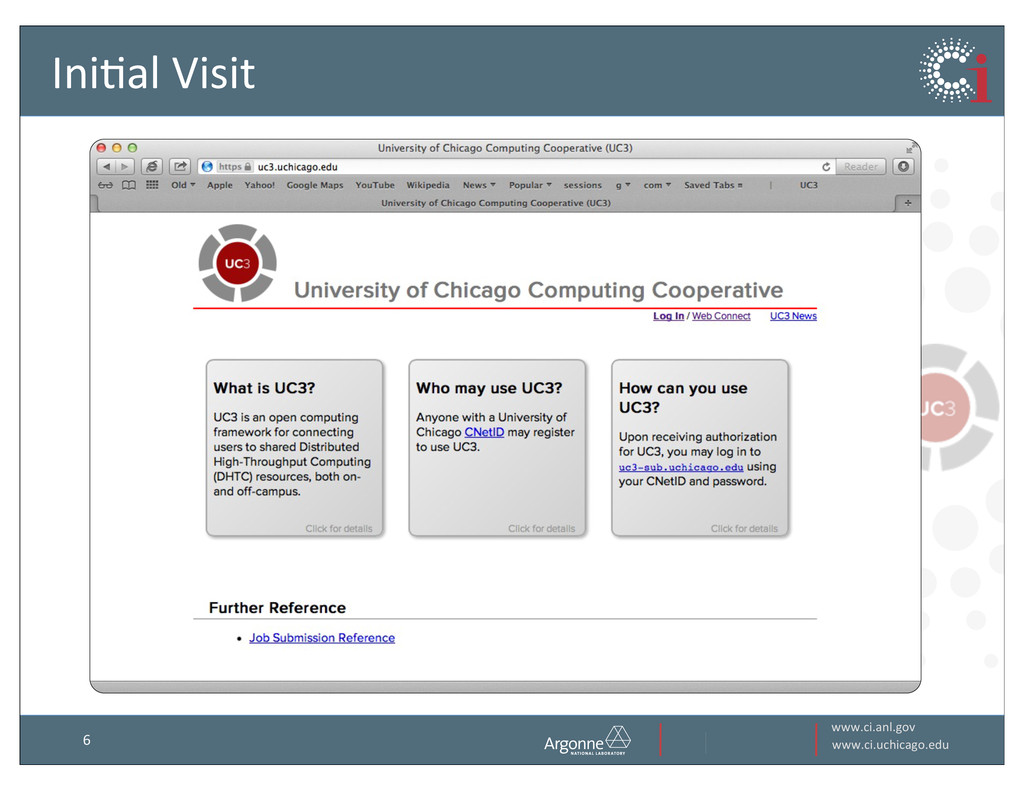
plaCorm for connec/ng research to distributed HTC resources across campus. » Condor cluster that can flock to other Condor clusters on campus » 4-‐5 other facili/es on campus, upwards of 10,000 job slots accessible • Users could be anyone on campus. • Users should be validated as legi/mate campus personnel. • Shared facili/es should have a common basis for iden/fying owners of data and users of resources. 3
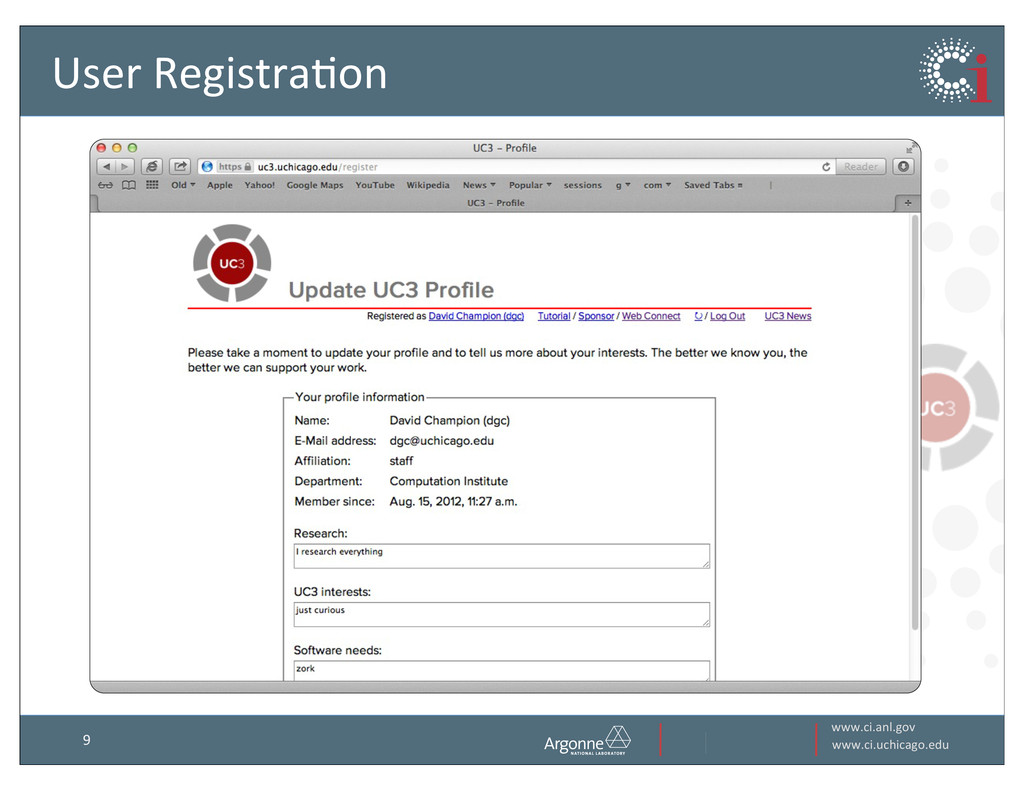
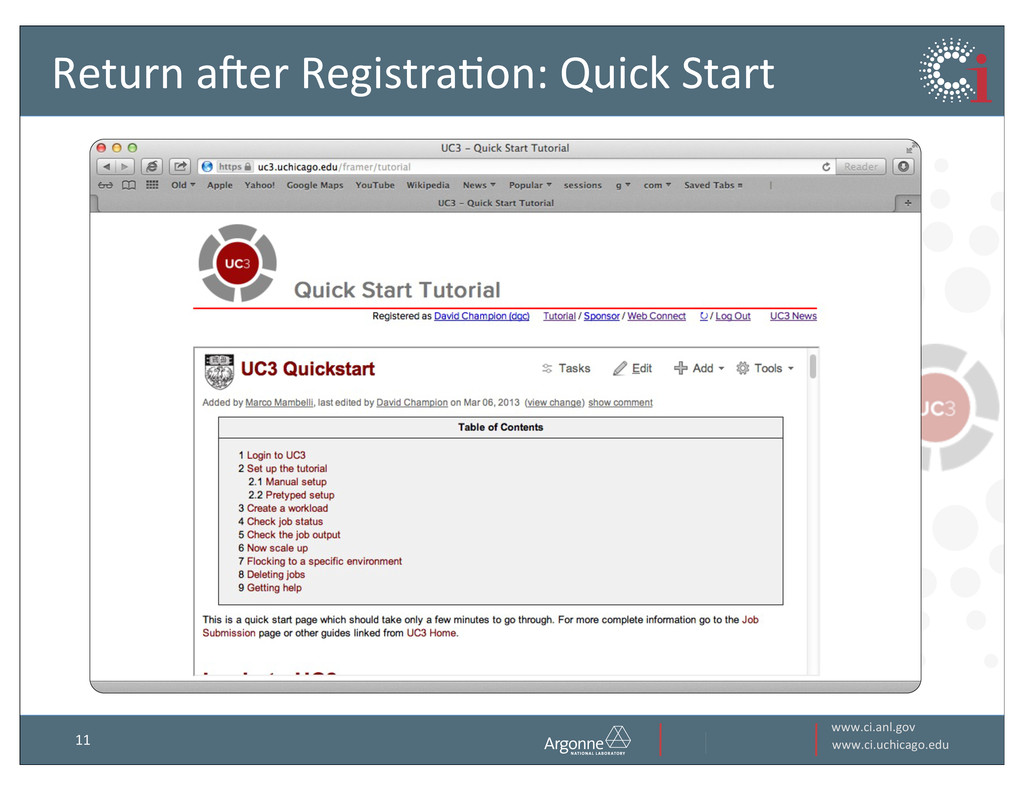
poten/al users online: 1. quickly » minimally opera/onal within 60 minutes 2. simply » use exis/ng connec/on tools and iden/ty frameworks 3. cheaply » no new username and passwords » no complicated registra/on process, when the University already knows all users • Campus iden/ty is the obvious solu/on, but not all the pieces were there. To integrate our local access, we needed to improvise. 4
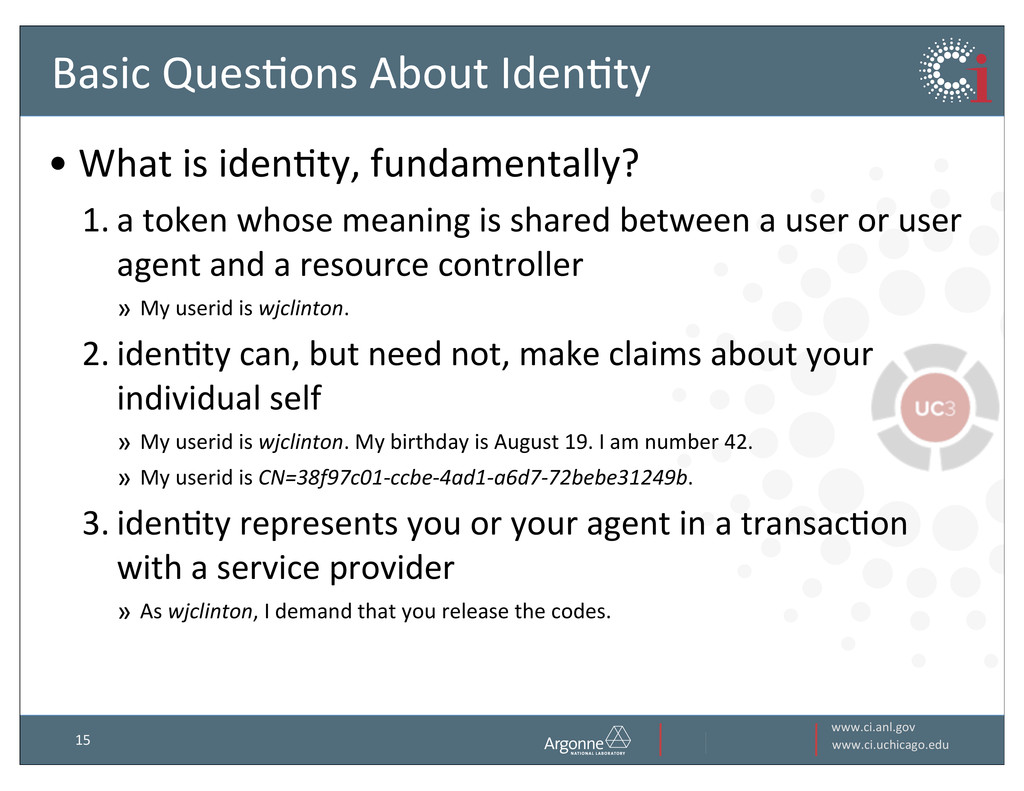
fundamentally? 1. a token whose meaning is shared between a user or user agent and a resource controller » My userid is wjclinton. 2. iden/ty can, but need not, make claims about your individual self » My userid is wjclinton. My birthday is August 19. I am number 42. » My userid is CN=38f97c01-‐ccbe-‐4ad1-‐a6d7-‐72bebe31249b. 3. iden/ty represents you or your agent in a transac/on with a service provider » As wjclinton, I demand that you release the codes. 15
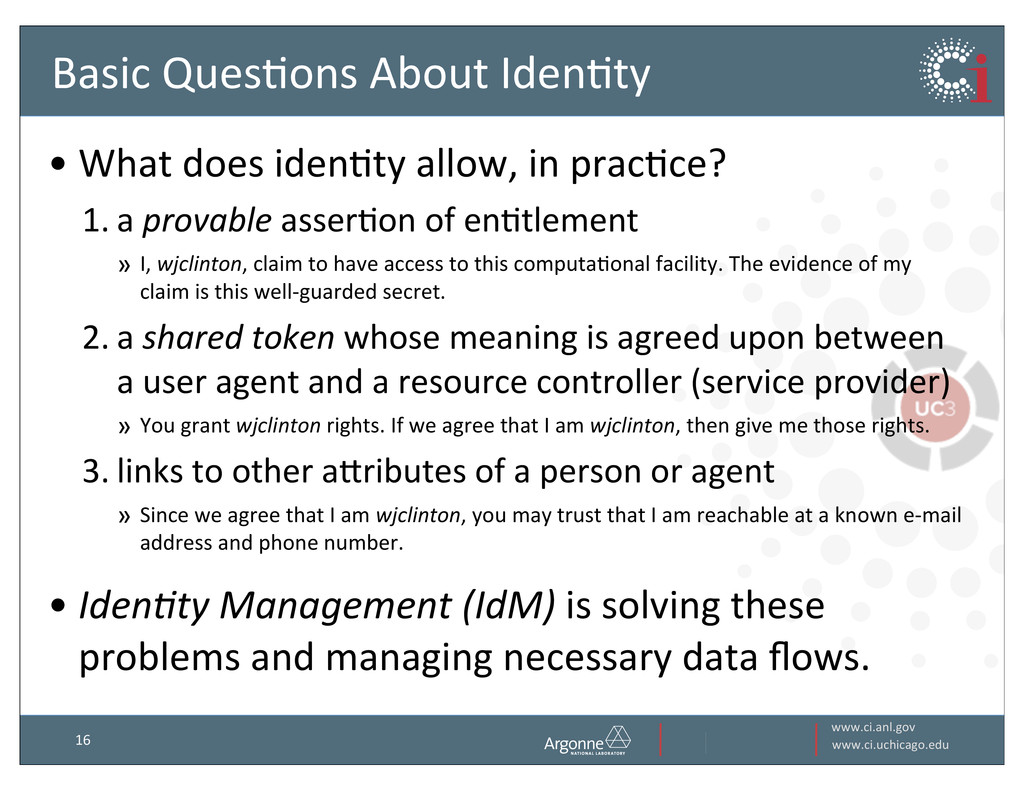
allow, in prac/ce? 1. a provable asser/on of en/tlement » I, wjclinton, claim to have access to this computa/onal facility. The evidence of my claim is this well-‐guarded secret. 2. a shared token whose meaning is agreed upon between a user agent and a resource controller (service provider) » You grant wjclinton rights. If we agree that I am wjclinton, then give me those rights. 3. links to other a\ributes of a person or agent » Since we agree that I am wjclinton, you may trust that I am reachable at a known e-‐mail address and phone number. • Iden%ty Management (IdM) is solving these problems and managing necessary data flows. 16
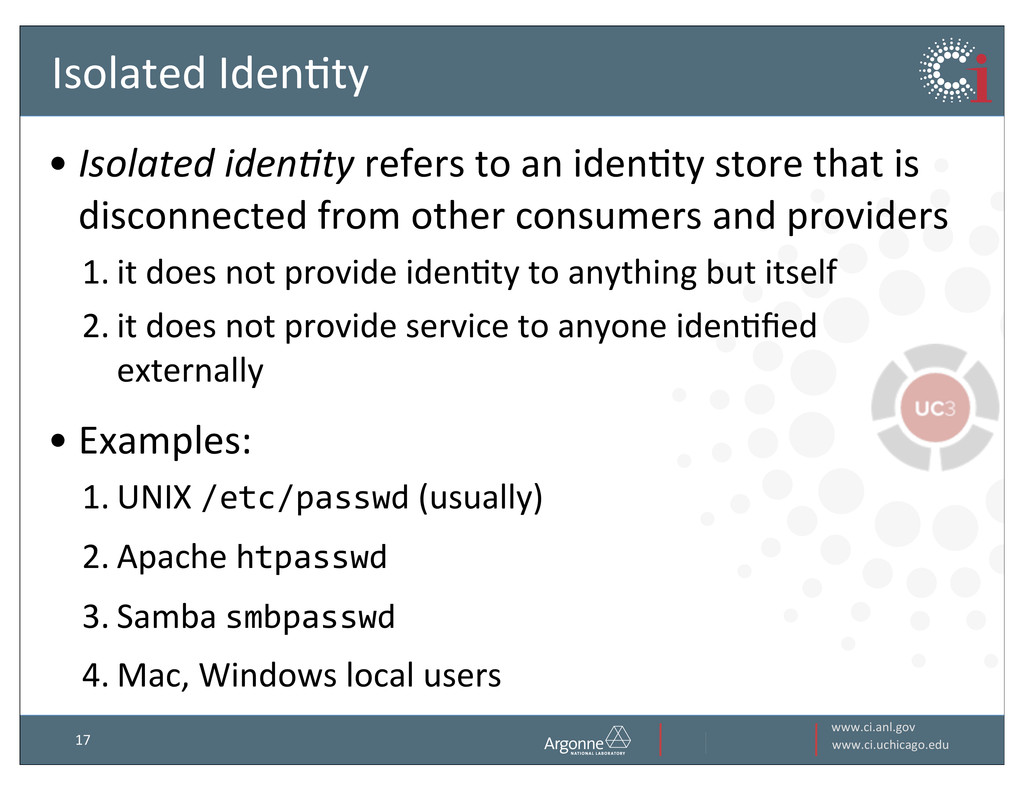
iden/ty store that is disconnected from other consumers and providers 1. it does not provide iden/ty to anything but itself 2. it does not provide service to anyone iden/fied externally • Examples: 1. UNIX /etc/passwd (usually) 2. Apache htpasswd 3. Samba smbpasswd 4. Mac, Windows local users 17
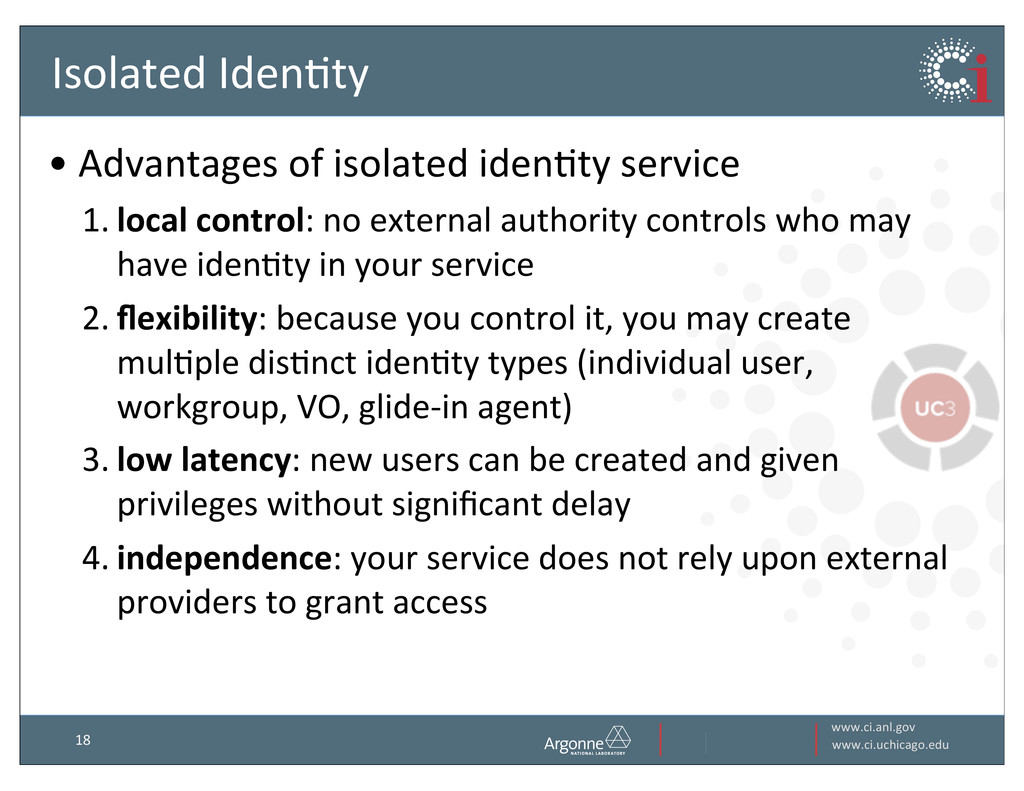
1. local control: no external authority controls who may have iden/ty in your service 2. flexibility: because you control it, you may create mul/ple dis/nct iden/ty types (individual user, workgroup, VO, glide-‐in agent) 3. low latency: new users can be created and given privileges without significant delay 4. independence: your service does not rely upon external providers to grant access 18
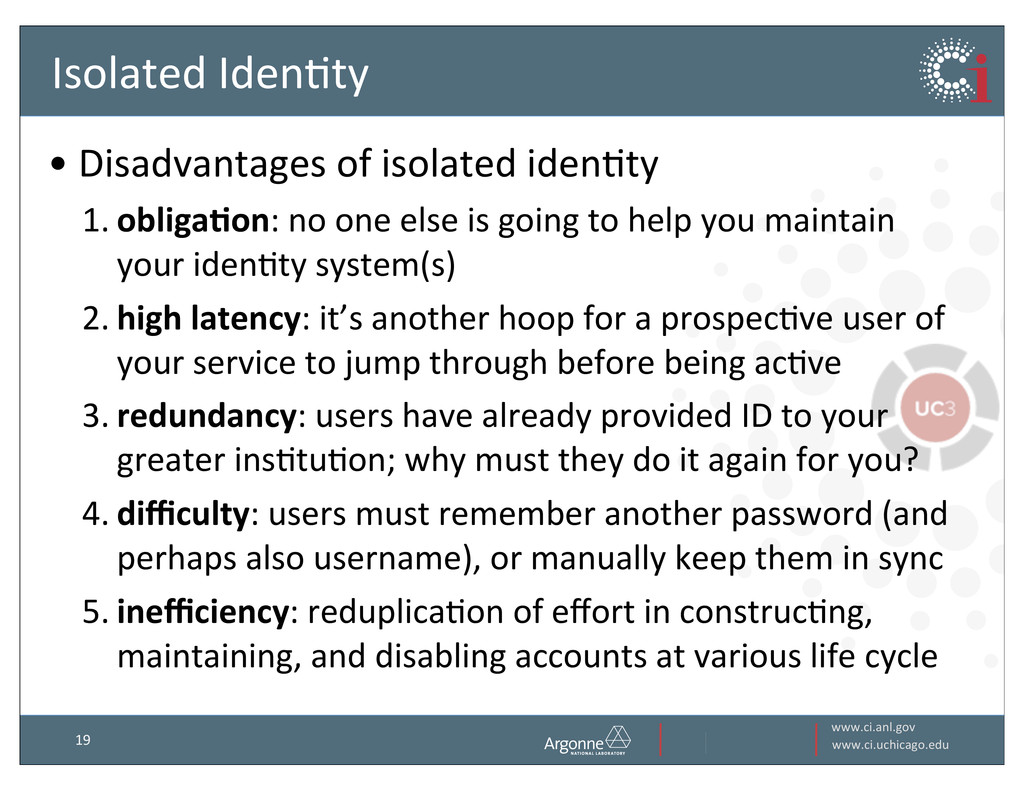
obliga3on: no one else is going to help you maintain your iden/ty system(s) 2. high latency: it’s another hoop for a prospec/ve user of your service to jump through before being ac/ve 3. redundancy: users have already provided ID to your greater ins/tu/on; why must they do it again for you? 4. difficulty: users must remember another password (and perhaps also username), or manually keep them in sync 5. inefficiency: reduplica/on of effort in construc/ng, maintaining, and disabling accounts at various life cycle 19
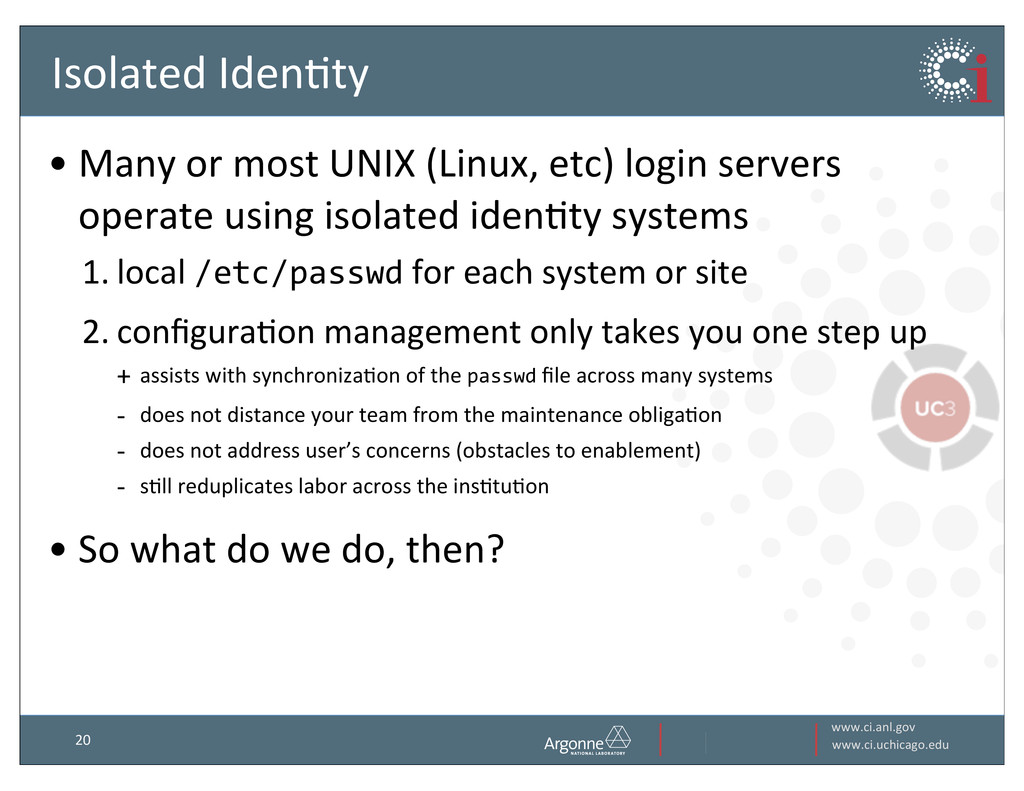
etc) login servers operate using isolated iden/ty systems 1. local /etc/passwd for each system or site 2. configura/on management only takes you one step up + assists with synchroniza/on of the passwd file across many systems -‐ does not distance your team from the maintenance obliga/on -‐ does not address user’s concerns (obstacles to enablement) -‐ s/ll reduplicates labor across the ins/tu/on • So what do we do, then? 20
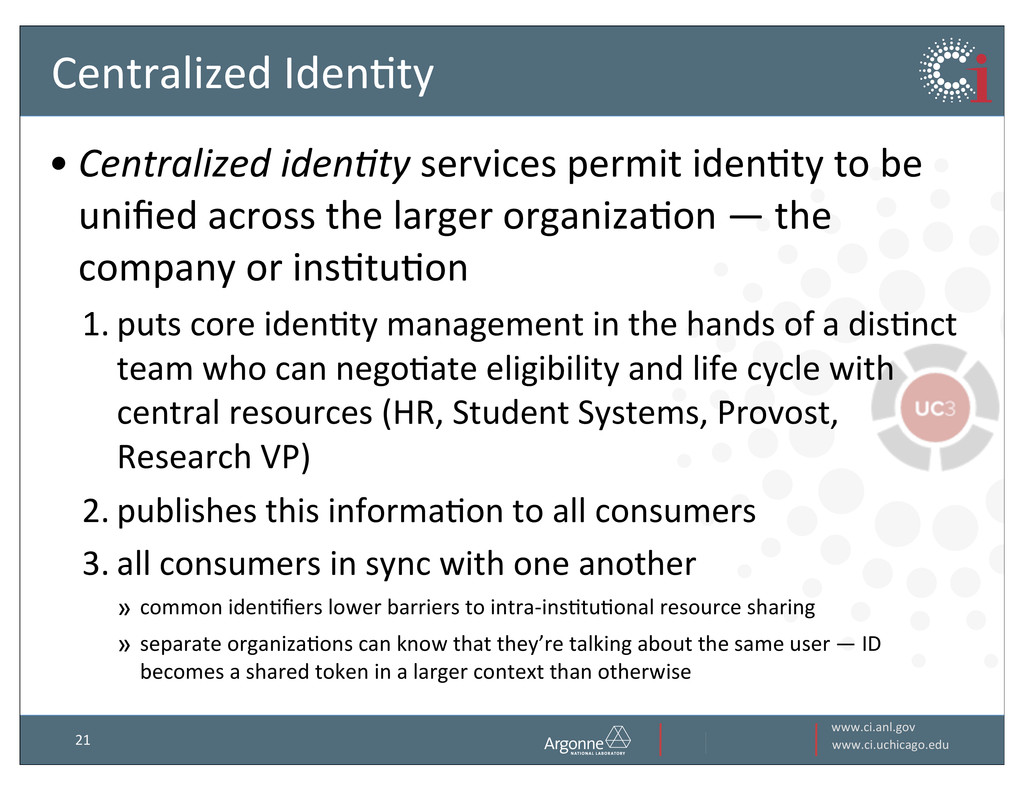
to be unified across the larger organiza/on — the company or ins/tu/on 1. puts core iden/ty management in the hands of a dis/nct team who can nego/ate eligibility and life cycle with central resources (HR, Student Systems, Provost, Research VP) 2. publishes this informa/on to all consumers 3. all consumers in sync with one another » common iden/fiers lower barriers to intra-‐ins/tu/onal resource sharing » separate organiza/ons can know that they’re talking about the same user — ID becomes a shared token in a larger context than otherwise 21
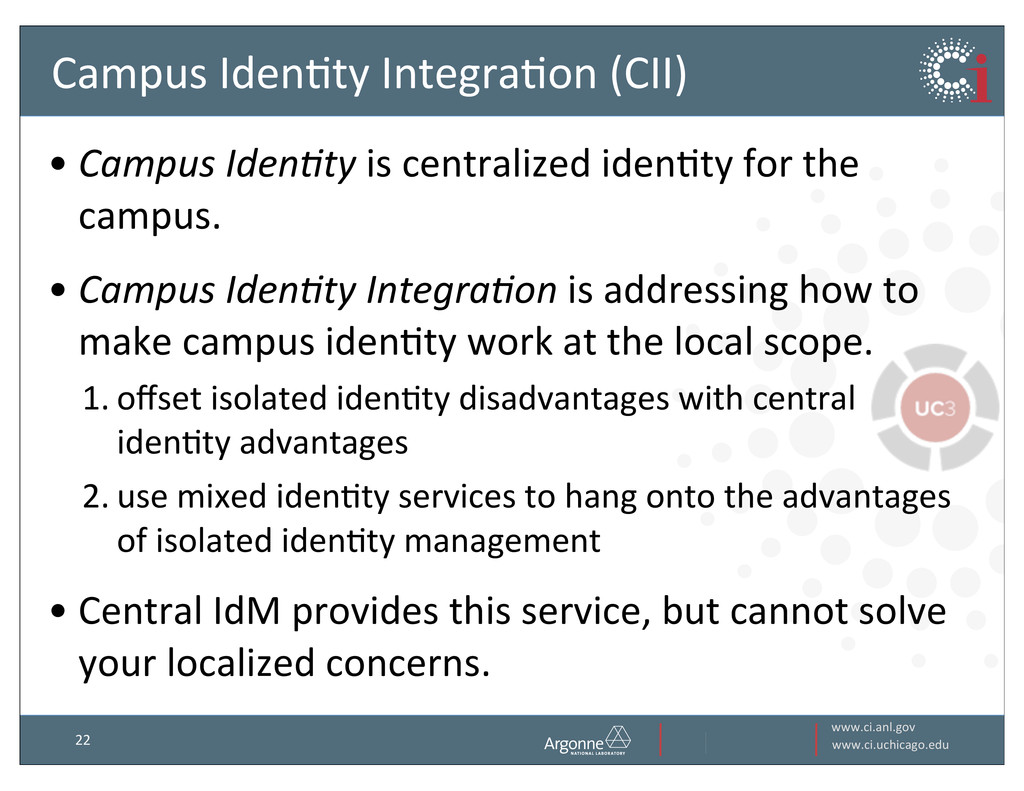
centralized iden/ty for the campus. • Campus Iden%ty Integra%on is addressing how to make campus iden/ty work at the local scope. 1. offset isolated iden/ty disadvantages with central iden/ty advantages 2. use mixed iden/ty services to hang onto the advantages of isolated iden/ty management • Central IdM provides this service, but cannot solve your localized concerns. 22
IdM should be visible and meaningful locally. 2. Authen/ca/on (authN) using these iden//es should be possible using centralized authN creden/als. 3. Resource authoriza/on (authZ) policy should be managed locally. a. Central IdM may, however, act as a disburser of authZ policy that is defined by a resource manager (you). 23
have liberty to augment central iden/ty with local iden/ty (for VO, etc). 5. The resource manager should have liberty to supersede iden/ty a\ributes from central IdM as necessary, to ensure correct behavior and sustainability in the resource environment. 24
out of the box, provided a sufficiently enabling campus directory. » Today, this generally means an LDAP or Ac/ve Directory (AD) service. » LDAP provides both directory service and authen/ca/on service using only OpenLDAP client solware. » AD is LDAP + Kerberos + Microsol magic sprinkles. OpenLDAP client solware provides directory service, while Samba’s winbind provides authen/ca/on. • Out of box success requires complete provisioning of the a\ributes required by the posixAccount object class. 25
challenge? 1. Anecdotally, almost nobody provides this completely. 2. When they provide it par/ally, they come up short in different ways. » Some central IdM services do not publish all users, or give clients only limited views. » Some IdM services don’t incorporate posixAccount at all, making them no more than authen/ca/on services. Don’t expect posixAccount from an AD, for example. » Some IdM services provide posixAccount, but put useless data in some a\ributes. » Some IdM services provide posixAccount, but put no data some a\ributes. » Your central IdM probably provides no useful groups service at all. 3. It’s each resource manager’s individual burden to address — few common tools exist. 26
understand first where central IdM is coming from: 1. They have a large and disparate user base, and must fit their service curve to widely sca\ered data points. 2. Administra/ve and business applica/ons will usually carry more weight than instruc/on or research. » At core they are a business service, called upon to enable integra/ons and cost management that make all other lines of work possible. » Don’t let this frustrate you; it’s unavoidable and they didn’t make that decision. 3. Central IdM probably cannot contribute directly to solving your problems. » They’re really busy too, and you’d be surprised in what aggrava/ng ways they have to spend their /me. 28
is coming from (cont’d): 4. They are, however, interested in your problems, and are probably happy to discuss them in the abstract. 5. They are also interested in enhancing their service, provided that you present a cohesive case: » why you need the change or new capability; » why this won’t harm any current applica/on or use of their service; » why your request cons/tutes an overall improvement to the ins/tu/on as a whole, and not just to your “business unit”. 6. In short: they can be a good partner, but they can never work for you. » There are too many other people they also work for. » You’re going to be doing a lot by yourself — but keep them informed! 29
currently provides to you. a. Services: LDAP? AD? Other? b. Extent of service: all ins/tu/onal cons/tuents? Only certain classes? c. Specific a\ributes provisioned and provided: cn, uid? posixAccount a\ributes? (which ones?) d. Is a service DN (bind DN) required? If so, can that DN read the a\ributes that you need? e. Preferably, can your service bind as an authen/ca/ng user, then as that user retrieve required a\ributes? 30
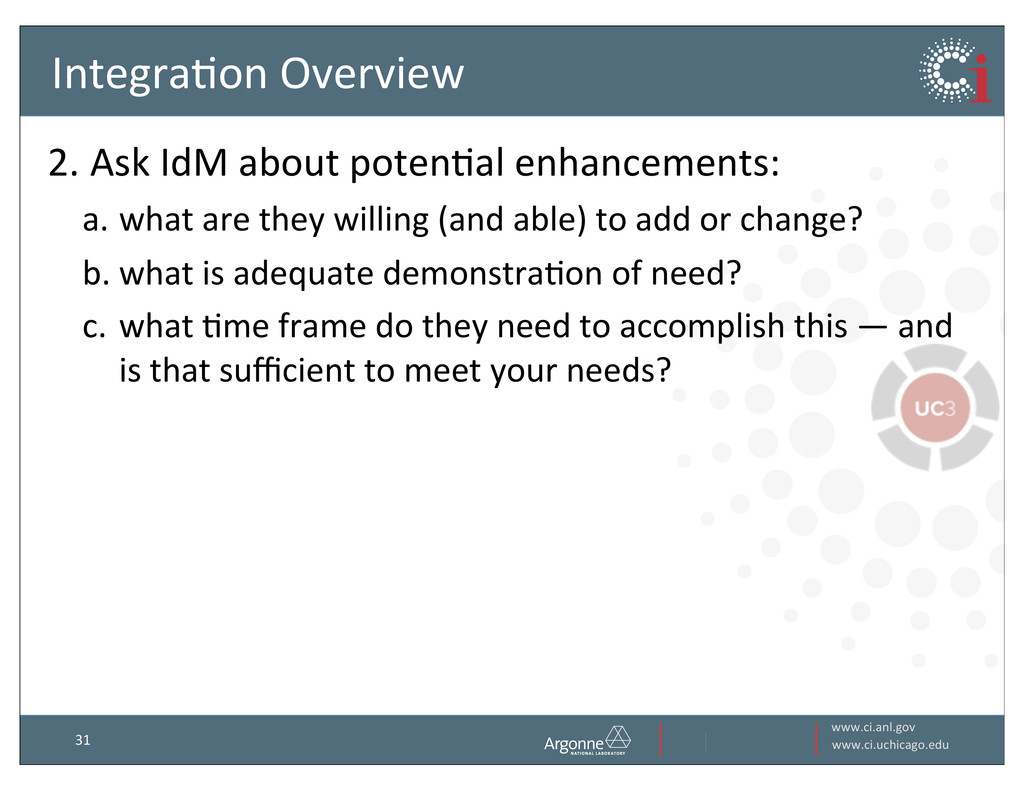
a. what are they willing (and able) to add or change? b. what is adequate demonstra/on of need? c. what /me frame do they need to accomplish this — and is that sufficient to meet your needs? 31
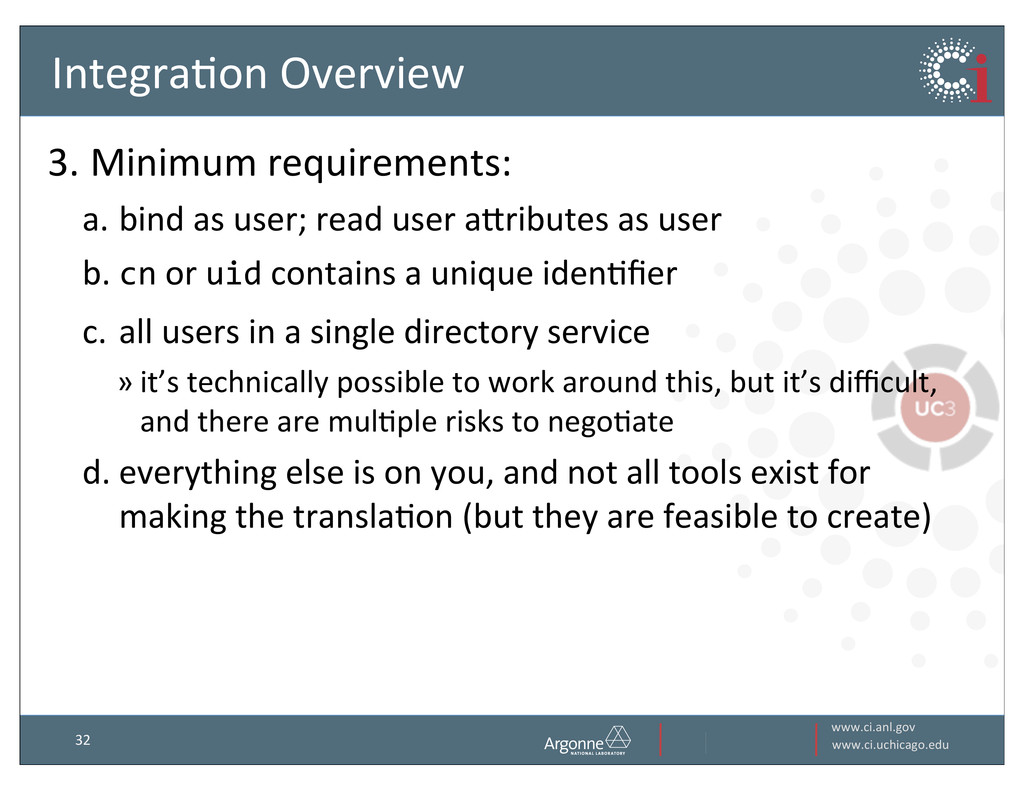
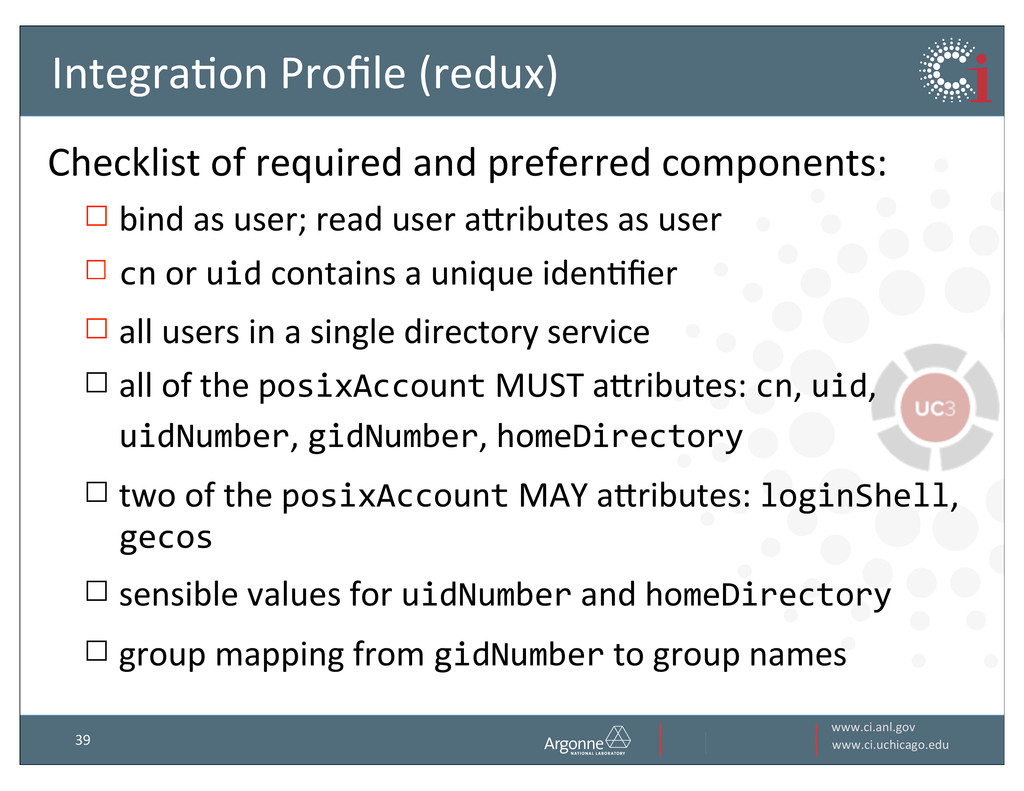
user; read user a\ributes as user b. cn or uid contains a unique iden/fier c. all users in a single directory service » it’s technically possible to work around this, but it’s difficult, and there are mul/ple risks to nego/ate d. everything else is on you, and not all tools exist for making the transla/on (but they are feasible to create) 32
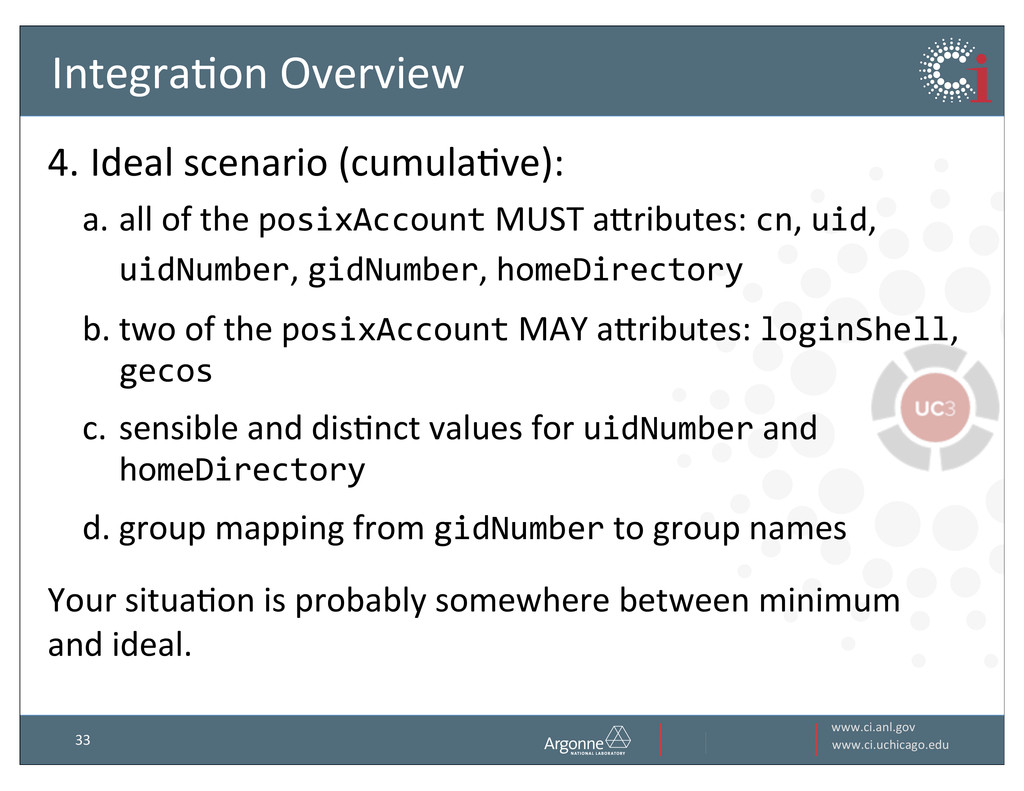
of the posixAccount MUST a\ributes: cn, uid, uidNumber, gidNumber, homeDirectory b. two of the posixAccount MAY a\ributes: loginShell, gecos c. sensible and dis/nct values for uidNumber and homeDirectory d. group mapping from gidNumber to group names Your situa/on is probably somewhere between minimum and ideal. 33
middleware for the campus • it aims to be a flexible toolkit for addressing iden/ty integra/on problems for distributed environments embedded within, or with access to, larger campus infrastructures 35
two NSS modules to address problems arising from limita/ons in a campus LDAP environment 1. nss_identity to provide forward and reverse group mapping for ar/ficial groups not in LDAP 2. nss_filter to provide unique home directory mapping when LDAP does not » nss_filter also allows op/onal mapping of pw_gecos and pw_shell • It is a work in progress; contribu/ons are welcomed 36
success in that it has addressed iden/ty integra/on for our site • Major objec/ve is to be able to piggyback on any LDAP or AD authen/ca/on service without any a\ribute visibility whatsoever: no uid • no gid • no gecos • no home directory • no shell • However, when such a\ributes are visible, we should use them 37
components: ☐ bind as user; read user a\ributes as user ☐ cn or uid contains a unique iden/fier ☐ all users in a single directory service ☐ all of the posixAccount MUST a\ributes: cn, uid, uidNumber, gidNumber, homeDirectory ☐ two of the posixAccount MAY a\ributes: loginShell, gecos ☐ sensible values for uidNumber and homeDirectory ☐ group mapping from gidNumber to group names 39
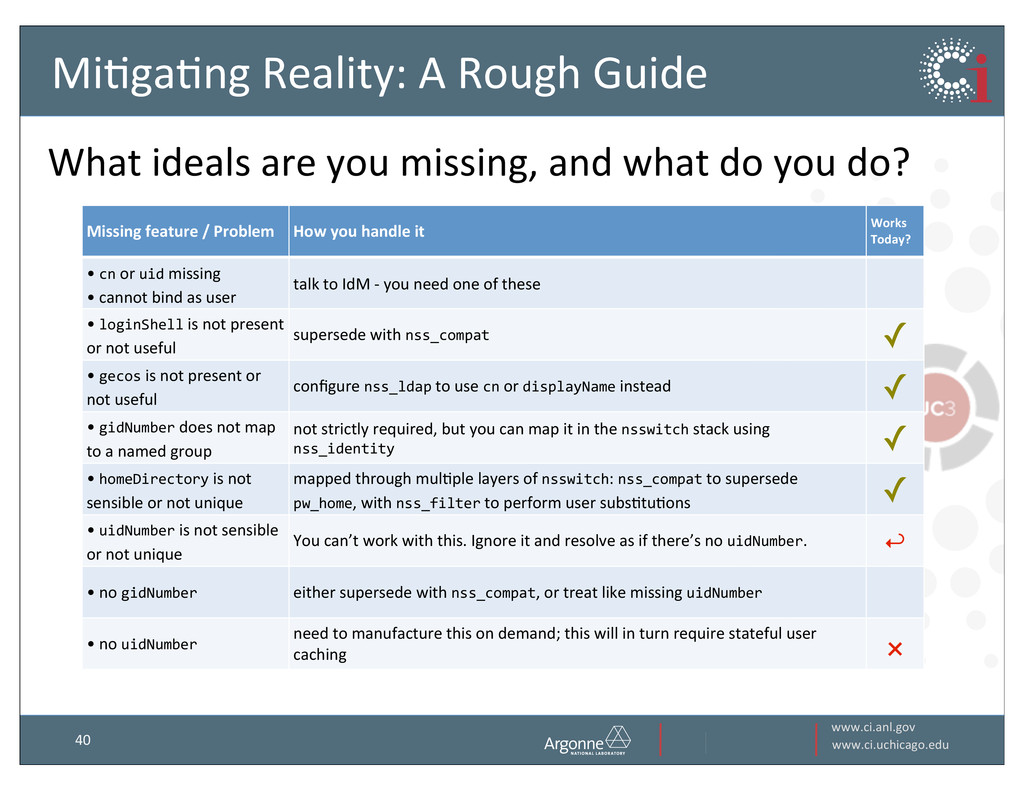
you missing, and what do you do? 40 Missing feature / Problem How you handle it Works Today? • cn or uid missing • cannot bind as user talk to IdM -‐ you need one of these • loginShell is not present or not useful supersede with nss_compat ✓ • gecos is not present or not useful configure nss_ldap to use cn or displayName instead ✓ • gidNumber does not map to a named group not strictly required, but you can map it in the nsswitch stack using nss_identity ✓ • homeDirectory is not sensible or not unique mapped through mul/ple layers of nsswitch: nss_compat to supersede pw_home, with nss_filter to perform user subs/tu/ons ✓ • uidNumber is not sensible or not unique You can’t work with this. Ignore it and resolve as if there’s no uidNumber. ↩ • no gidNumber either supersede with nss_compat, or treat like missing uidNumber • no uidNumber need to manufacture this on demand; this will in turn require stateful user caching
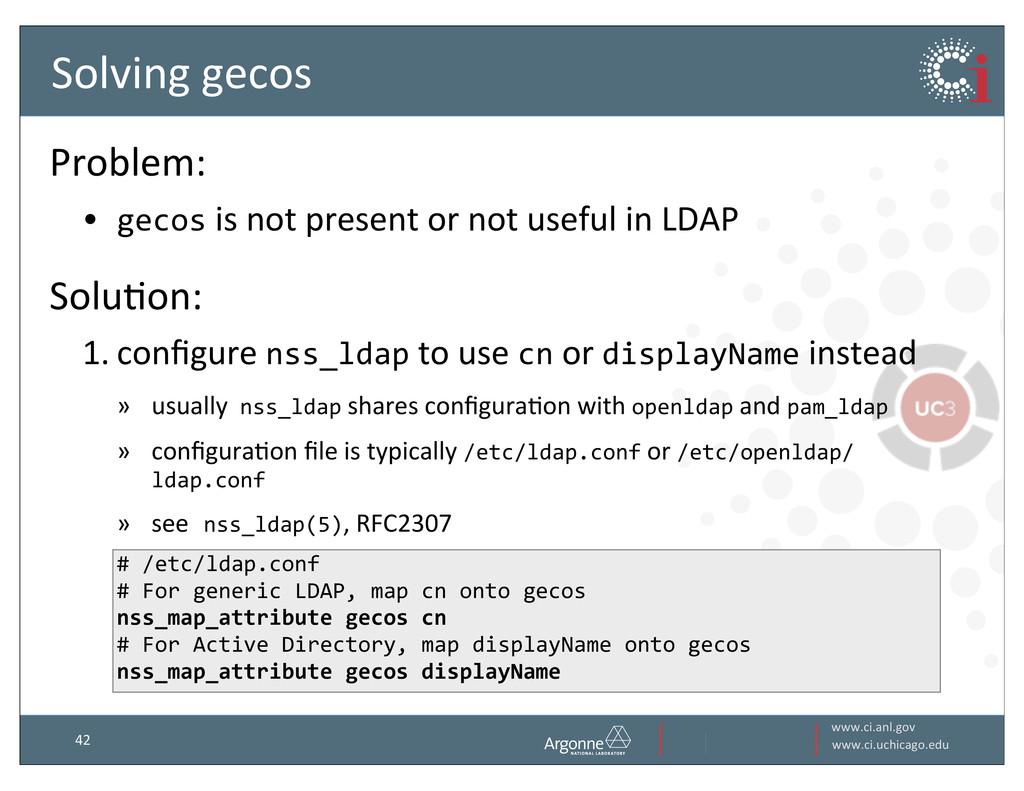
or not useful in LDAP Solu/on: 1. configure nss_ldap to use cn or displayName instead » usually nss_ldap shares configura/on with openldap and pam_ldap » configura/on file is typically /etc/ldap.conf or /etc/openldap/ ldap.conf » see nss_ldap(5), RFC2307 42 # /etc/ldap.conf # For generic LDAP, map cn onto gecos nss_map_attribute gecos cn # For Active Directory, map displayName onto gecos nss_map_attribute gecos displayName
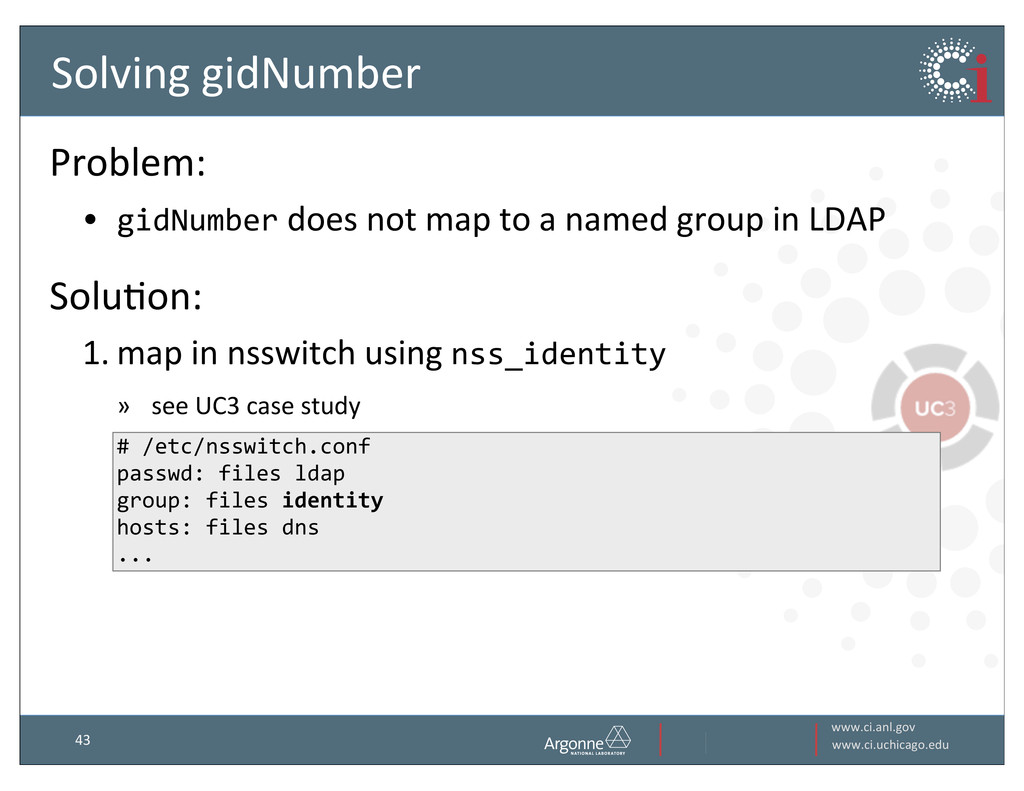
to a named group in LDAP Solu/on: 1. map in nsswitch using nss_identity » see UC3 case study 43 # /etc/nsswitch.conf passwd: files ldap group: files identity hosts: files dns ...
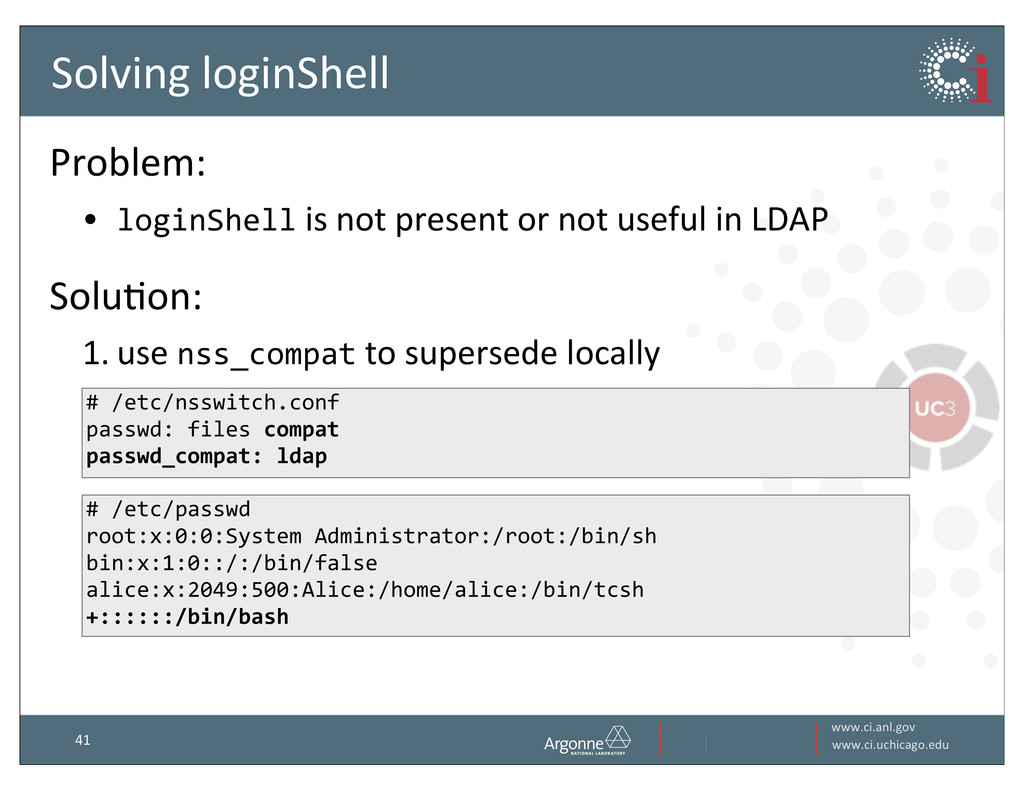
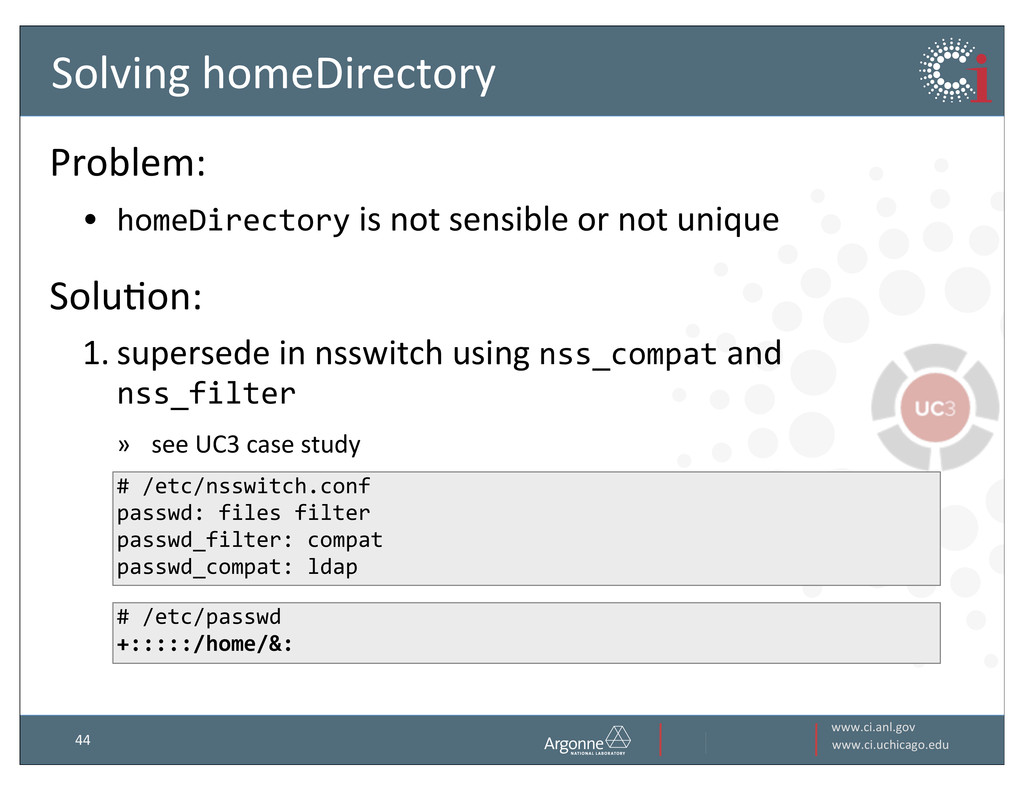
or not unique Solu/on: 1. supersede in nsswitch using nss_compat and nss_filter » see UC3 case study 44 # /etc/nsswitch.conf passwd: files filter passwd_filter: compat passwd_compat: ldap # /etc/passwd +:::::/home/&:
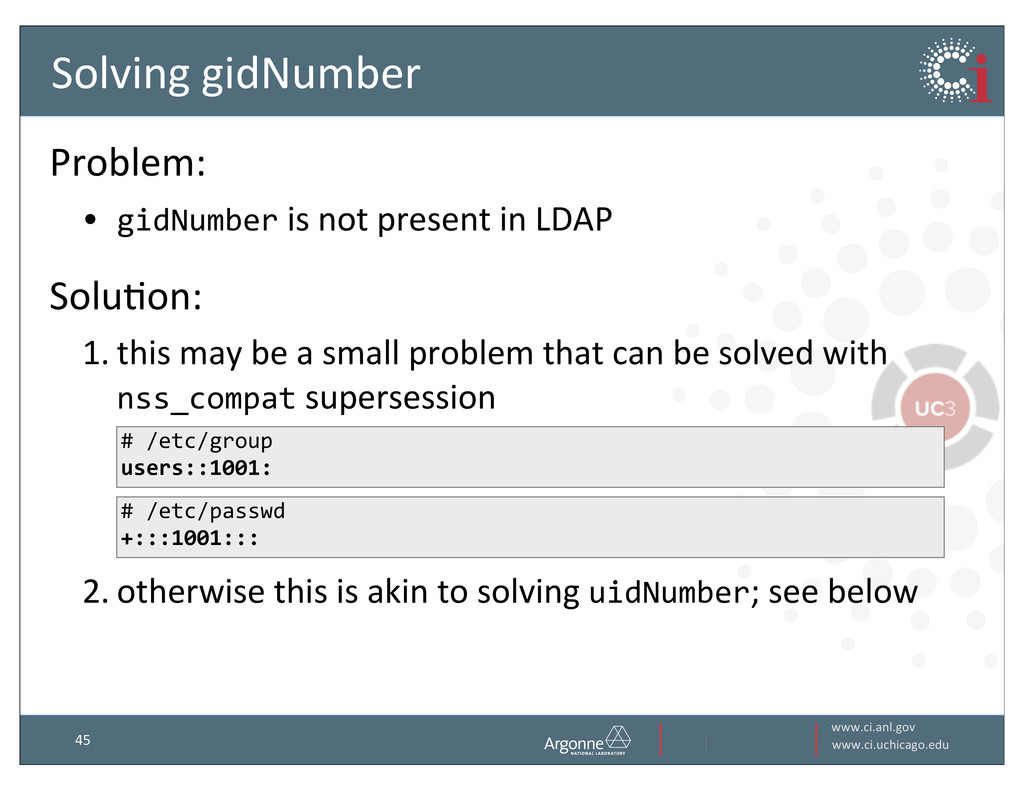
in LDAP Solu/on: 1. this may be a small problem that can be solved with nss_compat supersession 2. otherwise this is akin to solving uidNumber; see below 45 # /etc/group users::1001: # /etc/passwd +:::1001:::
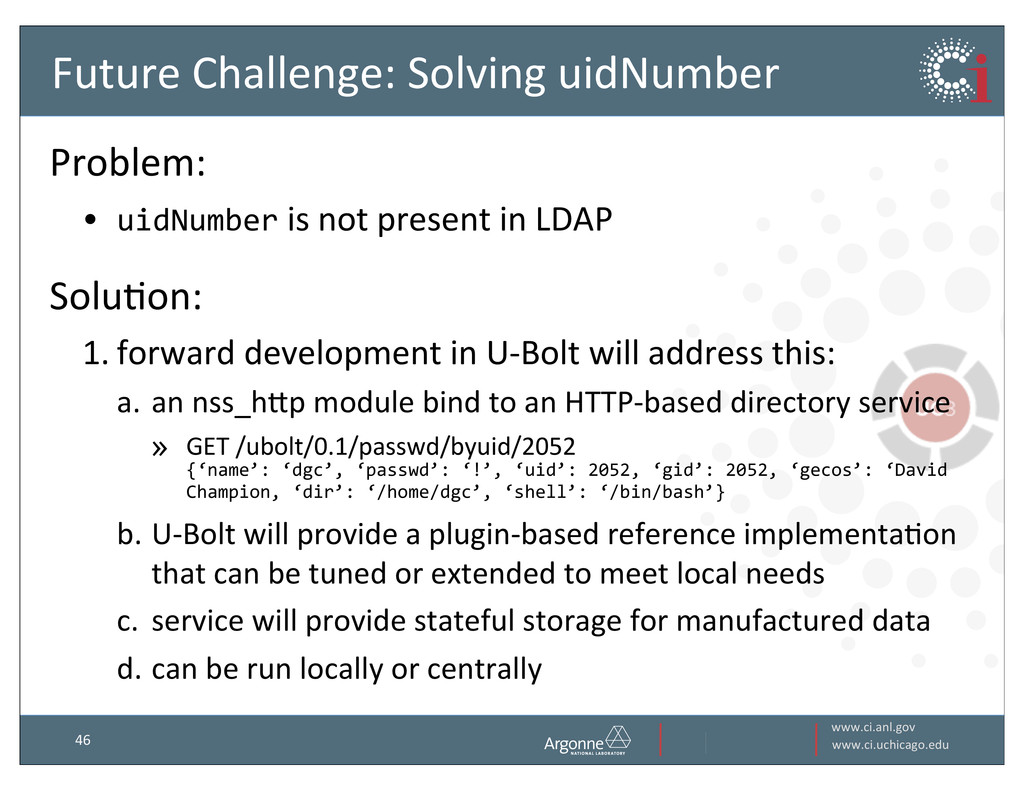
not present in LDAP Solu/on: 1. forward development in U-‐Bolt will address this: a. an nss_h\p module bind to an HTTP-‐based directory service » GET /ubolt/0.1/passwd/byuid/2052 {‘name’: ‘dgc’, ‘passwd’: ‘!’, ‘uid’: 2052, ‘gid’: 2052, ‘gecos’: ‘David Champion, ‘dir’: ‘/home/dgc’, ‘shell’: ‘/bin/bash’} b. U-‐Bolt will provide a plugin-‐based reference implementa/on that can be tuned or extended to meet local needs c. service will provide stateful storage for manufactured data d. can be run locally or centrally 46
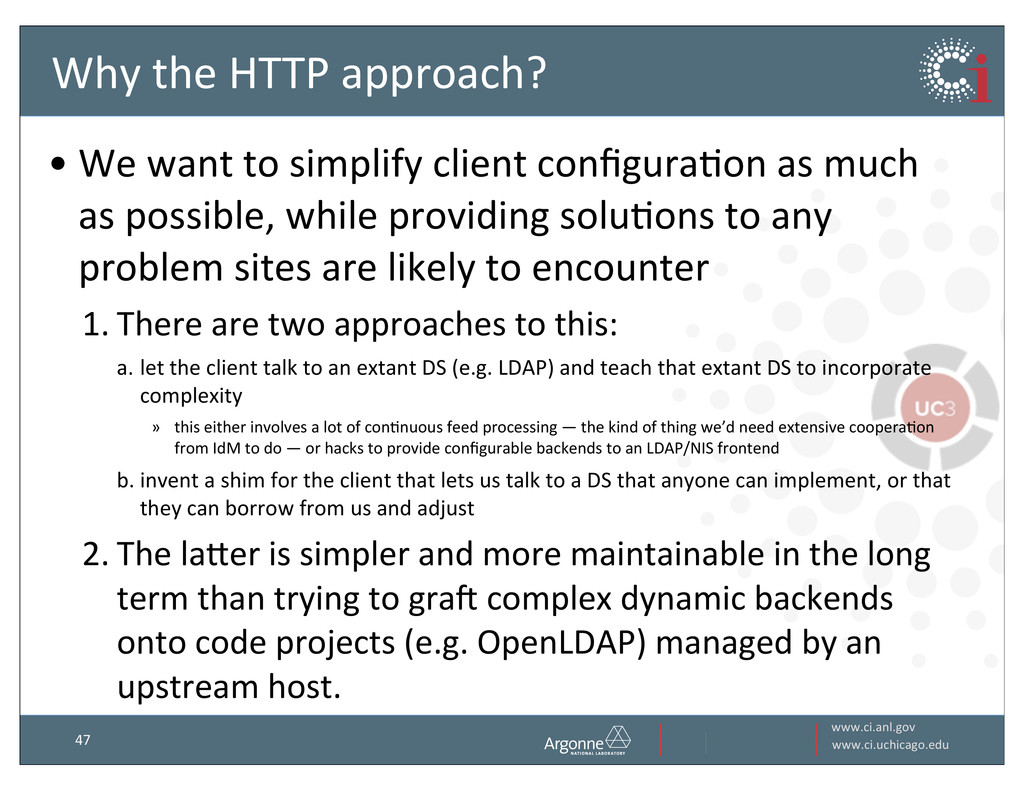
simplify client configura/on as much as possible, while providing solu/ons to any problem sites are likely to encounter 1. There are two approaches to this: a. let the client talk to an extant DS (e.g. LDAP) and teach that extant DS to incorporate complexity » this either involves a lot of con/nuous feed processing — the kind of thing we’d need extensive coopera/on from IdM to do — or hacks to provide configurable backends to an LDAP/NIS frontend b. invent a shim for the client that lets us talk to a DS that anyone can implement, or that they can borrow from us and adjust 2. The la\er is simpler and more maintainable in the long term than trying to gral complex dynamic backends onto code projects (e.g. OpenLDAP) managed by an upstream host. 47
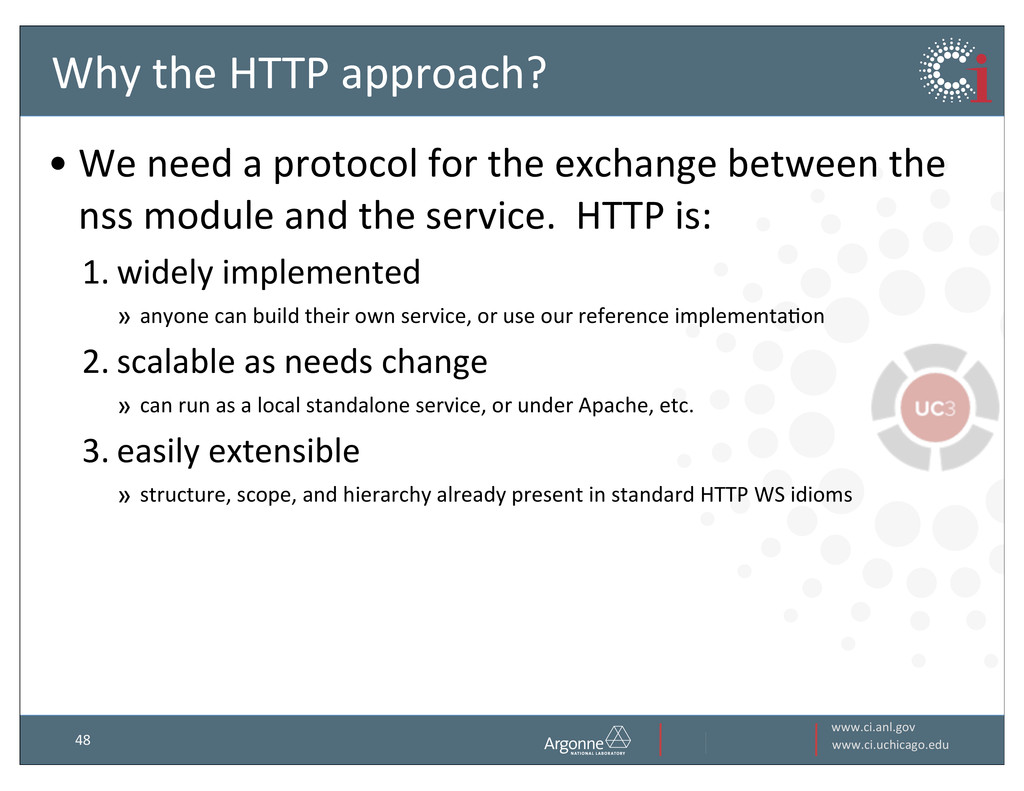
protocol for the exchange between the nss module and the service. HTTP is: 1. widely implemented » anyone can build their own service, or use our reference implementa/on 2. scalable as needs change » can run as a local standalone service, or under Apache, etc. 3. easily extensible » structure, scope, and hierarchy already present in standard HTTP WS idioms 48


 occhi
 terurou
 ymotongpoo
 recruitengineers
 takonda
 pfn
 takanorip
 yahonda
 yut0naga1_fa
 maimyyym
 iktakahiro
 ykanoh
 skoyamalab
 baasie
 skipperchong
 kevinliebholz
 cromwellryan
 lara
 garrettdimon
 samlambert
 raygrieselhuber
 uxyall
 mongodb
 brettharned