Share
Embed
Transcript
31 slides
-
Business logic of user interface application • Select savings account
• Select pay service • Input pay service requisities • Input payment amount • Wait payment processed • Take cheque Sequence of domain user requests: -
Business logic of user interface application Sequence of primitive user
requests: • Select item from list • Edit item • Wait something • Look at item -
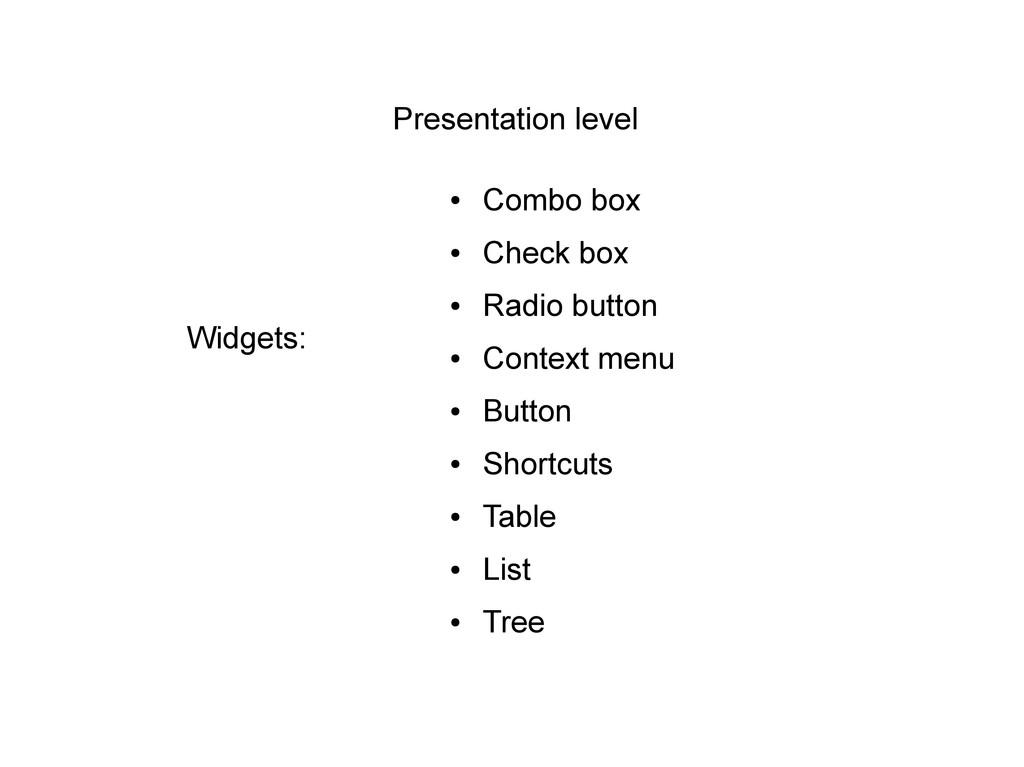
Presentation level • Combo box • Check box • Radio
button • Context menu • Button • Shortcuts • Table • List • Tree Widgets: -
Presentation level • Combo box • Check box • Radio
button • Context menu • Button • Shortcut • Table • List • Tree It's all designer terminology -
Classic browser, Alt-browser, Whisker browser, Newspeak browser • Select package
• Select class from selected package • Select protocol from selected class • Select method from selected protocol Same business logic -
Classic browser, Alt-browser, Whisker browser, Newspeak browser • Select package
• Select class from selected package • Select protocol from selected class • Select method from selected protocol Same business logic Can be presented by million ways, by million widgets -
at application programming level • Combo box • Check box
• Radio button • Context menu • Button • Shortcut • Table • List • Tree No widgets! -
Simple package browser with Presenty PtyBrowsePackagesTask>>body | package class method
protocol | package := user select: 'Package' from: PackageOrganizer default packages. class := user select: 'Class' from: package classes. protocol := user select: 'Protocol' from: class protocols. method := user select: 'Method' from: (class methodsInProtocol: protocol). user lookAt: method sourceCodePreviewPresenter -
Modal browser with filters and items paging Kernel selected Float
selected Arithmetic selected -
How all this work • PtyGuide is central object which
drive all application • PtyUser presents domain user of application. It implements domain specific requests • user payForService • user selectSavingsAccount • … • User interacts with guide to call new tasks • Task describes business logic as sequence of user requests • Task can call other tasks • Task can add UI items (presenters) to view area • UI items are presenters which connect model to view • Task can inherit UI items from other tasks -
How all this work PtyViewAreaPresenter • context • items PtyTask
• user • guide • activationStrategy (default) • parentContext • prototype PtyTaskActivationStrategy • context • parentViewArea • shouldRememberTask • shouldForgetCompleteTask • shouldRestoreParentArea PtyTaskContext • task • continuation • activation parentContext task activation context parentViewArea context -
How all this work PtyTaskActivationStrategy SeparatedAreaActivationStrategy InheritedActivationStrategy PtyViewAreaActivator PtyInlinedAreaActivator PtyPopUpAreaActivator
PtyEmbeddedAreaActivator PtyNewAreaActivator PtyNewWindowActivator PtyModalAreaActivator areaActivator show view area to user -
Tree UI element package := user select: 'Package' from: PackageOrganizer
default packages. class := user select: 'Class' from: package classes. • Class selection task configured to be activated on separated view area near selected package item • With same way any task which executed by button can show its items near this button • Not implemented yet -
Combo box UI element guide addTask: [model value: (user select:
'Item' from: possibleItems)]. user lookAt: model preferredPreviewPresenter • #lookAt: shows user current value of model • #addTask: adds extra task to view area • #addTask: can be configured as button which executes extra task • Extra task with items selection can be configured to show popup view area with items list -
PtyForkTask • PtyForkTask is one way to add extra task
to view area • PtyForkTask just executed target task and when user request happen parent task continue execution • There are many ways to share «fork task items» with parent task • Add all items to parent view area • Put all items on separated panel • Put first request items on one panel but next on other • ... -
What about buttons? • Presenty has no ButtonPresenter or ButtonView
(Morph) • Button is just specific way to execute some action. It's same as: • Shortcuts • Voice command • Gesture • Million other ways -
User actions PtyPresenter PtyUserActionConnector PtyButtonUserActionActivator PtyMouseClickUserActionActivator PtyShortcutActionActivator Implements #hookupPresenter PtyUserAction
connector PtyUserActionActivator * userActions action activators presenter * -
User actions Any list item has user action which executes
PtyReturnValueFromPresenterTask User action PtyReturnToPreviousTask -
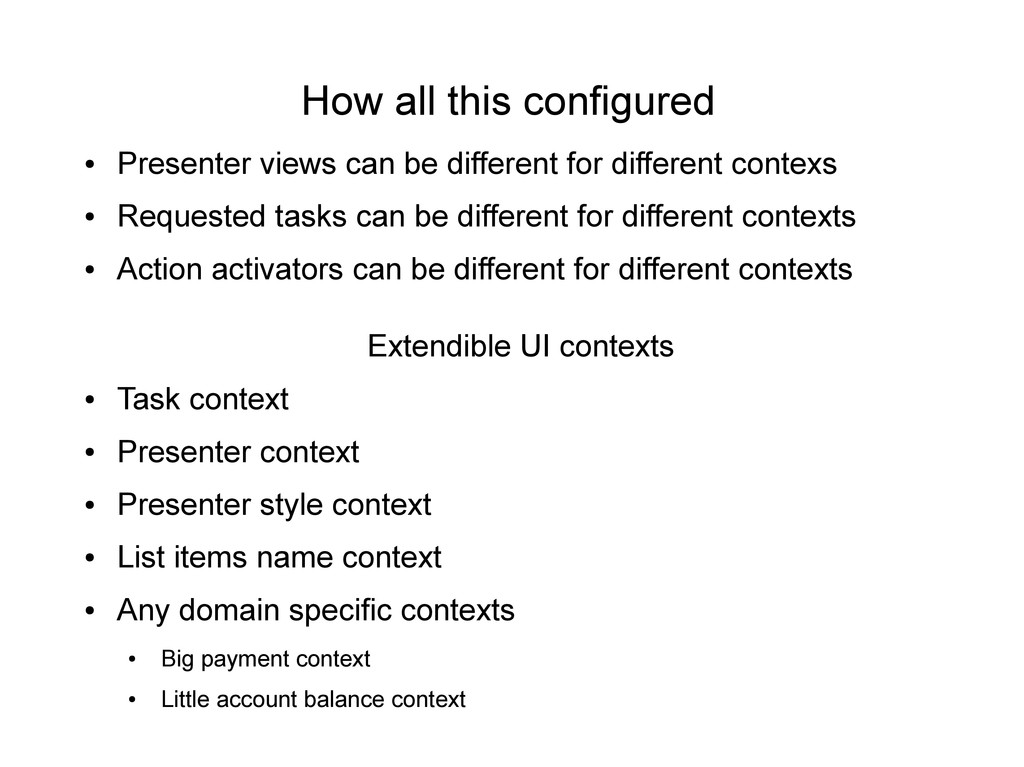
How all this configured • Presenter views can be different
for different contexs • Requested tasks can be different for different contexts • Action activators can be different for different contexts Extendible UI contexts • Task context • Presenter context • Presenter style context • List items name context • Any domain specific contexts • Big payment context • Little account balance context -
UISettings and PtyPrototypesManager • Each configured object has prototype •
Prototype can create new instances by copy its sample • PtyPrototypesManager contains collections of prototypes • Manager know how to find appropriate prototype • manager prototypeFor: someContextObject • special lookup logic which can be extended by domain specific contexts • Separated managers for presenters, tasks and user actions • UISettings contains all managers • UISettings know how to prepare new instances created from prototype • PrototypesManager is separated package. It is not depends on Presenty. It is MIT -
Future work • Extendible object editor • user edit: object
• Extendible object explorer • user lookAt: object • User actions with parameters. Drag and drop activators • Text editor based on presenter and user actions • More forking task strategies • More view area activators • Improvements for basic stuff like tables • Docs • ...