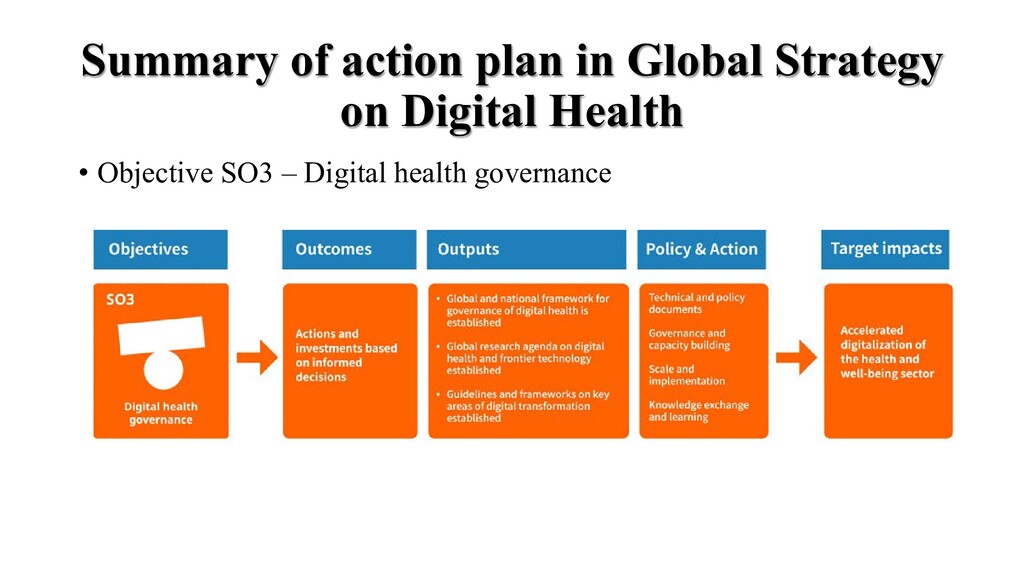
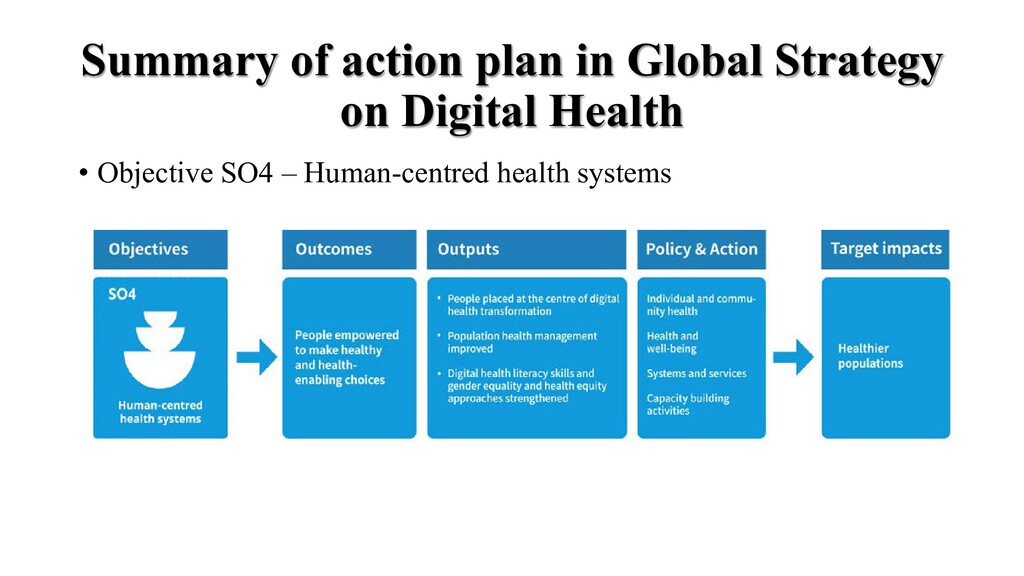
and use of computer systems, software, and networks for the processing and distribution of data.1 1. “Information technology.” Merriam-Webster.com Dictionary, Merriam-Webster, https://www.merriam-webster.com/dictionary/information%20technology. Accessed 11 Sep. 2021.
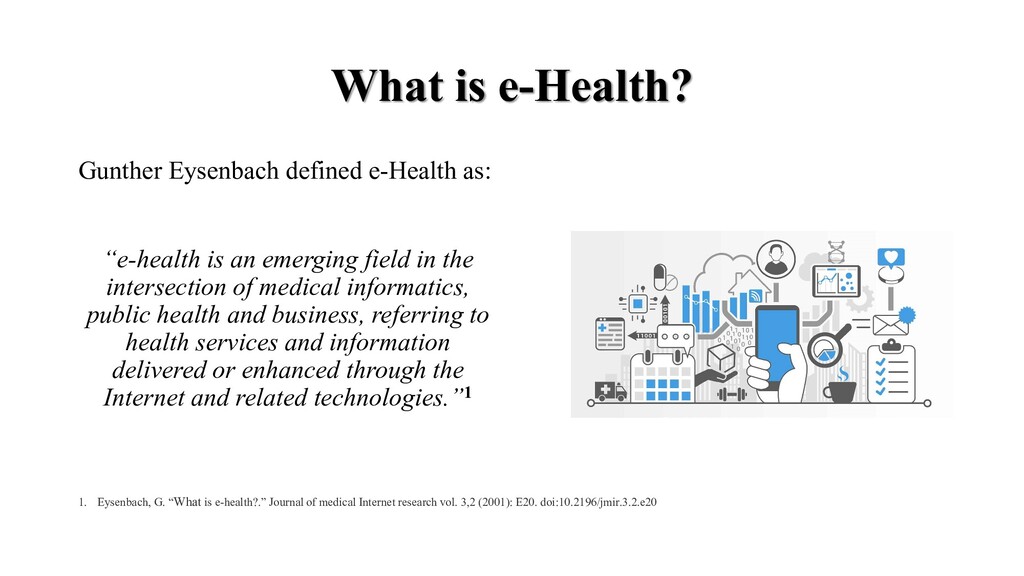
an emerging field in the intersection of medical informatics, public health and business, referring to health services and information delivered or enhanced through the Internet and related technologies.”1 1. Eysenbach, G. “What is e-health?.” Journal of medical Internet research vol. 3,2 (2001): E20. doi:10.2196/jmir.3.2.e20
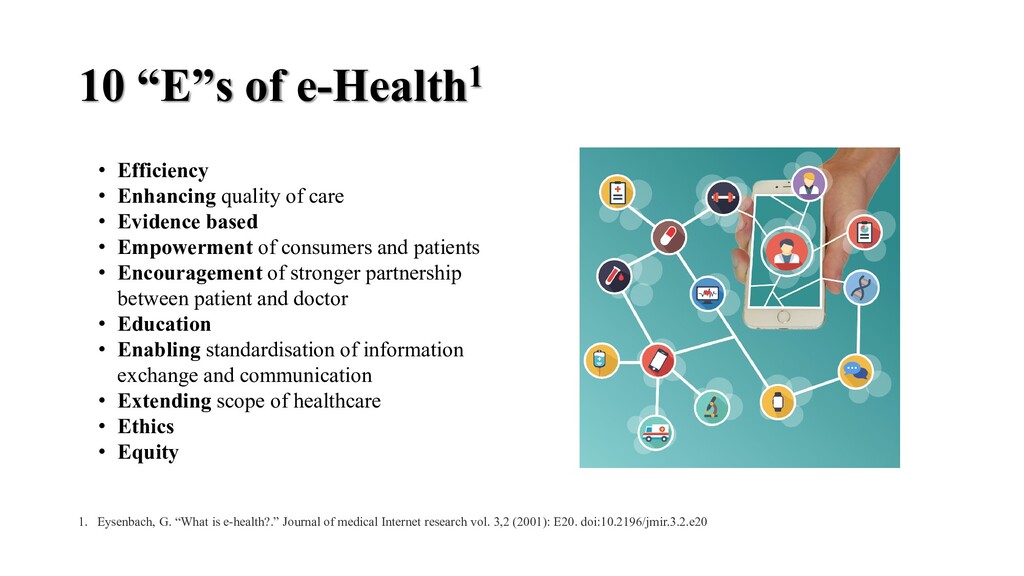
care • Evidence based • Empowerment of consumers and patients • Encouragement of stronger partnership between patient and doctor • Education • Enabling standardisation of information exchange and communication • Extending scope of healthcare • Ethics • Equity 1. Eysenbach, G. “What is e-health?.” Journal of medical Internet research vol. 3,2 (2001): E20. doi:10.2196/jmir.3.2.e20
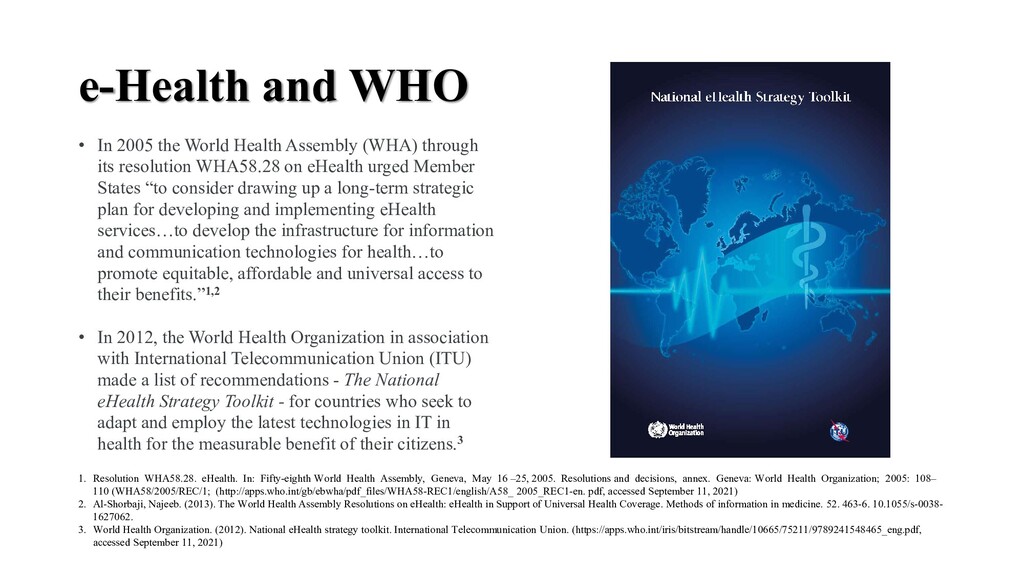
(WHA) through its resolution WHA58.28 on eHealth urged Member States “to consider drawing up a long-term strategic plan for developing and implementing eHealth services…to develop the infrastructure for information and communication technologies for health…to promote equitable, affordable and universal access to their benefits.”1,2 • In 2012, the World Health Organization in association with International Telecommunication Union (ITU) made a list of recommendations - The National eHealth Strategy Toolkit - for countries who seek to adapt and employ the latest technologies in IT in health for the measurable benefit of their citizens.3 1. Resolution WHA58.28. eHealth. In: Fifty-eighth World Health Assembly, Geneva, May 16 –25, 2005. Resolutions and decisions, annex. Geneva: World Health Organization; 2005: 108– 110 (WHA58/2005/REC/1; (http://apps.who.int/gb/ebwha/pdf_files/WHA58-REC1/english/A58_ 2005_REC1-en. pdf, accessed September 11, 2021) 2. Al-Shorbaji, Najeeb. (2013). The World Health Assembly Resolutions on eHealth: eHealth in Support of Universal Health Coverage. Methods of information in medicine. 52. 463-6. 10.1055/s-0038- 1627062. 3. World Health Organization. (2012). National eHealth strategy toolkit. International Telecommunication Union. (https://apps.who.int/iris/bitstream/handle/10665/75211/9789241548465_eng.pdf, accessed September 11, 2021)
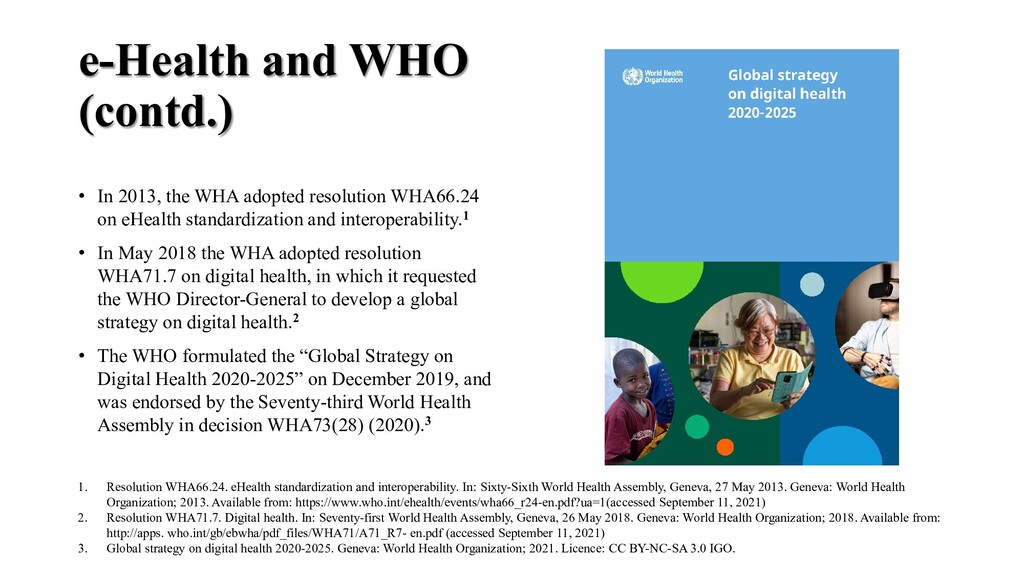
resolution WHA66.24 on eHealth standardization and interoperability.1 • In May 2018 the WHA adopted resolution WHA71.7 on digital health, in which it requested the WHO Director-General to develop a global strategy on digital health.2 • The WHO formulated the “Global Strategy on Digital Health 2020-2025” on December 2019, and was endorsed by the Seventy-third World Health Assembly in decision WHA73(28) (2020).3 1. Resolution WHA66.24. eHealth standardization and interoperability. In: Sixty-Sixth World Health Assembly, Geneva, 27 May 2013. Geneva: World Health Organization; 2013. Available from: https://www.who.int/ehealth/events/wha66_r24-en.pdf?ua=1(accessed September 11, 2021) 2. Resolution WHA71.7. Digital health. In: Seventy-first World Health Assembly, Geneva, 26 May 2018. Geneva: World Health Organization; 2018. Available from: http://apps. who.int/gb/ebwha/pdf_files/WHA71/A71_R7- en.pdf (accessed September 11, 2021) 3. Global strategy on digital health 2020-2025. Geneva: World Health Organization; 2021. Licence: CC BY-NC-SA 3.0 IGO.
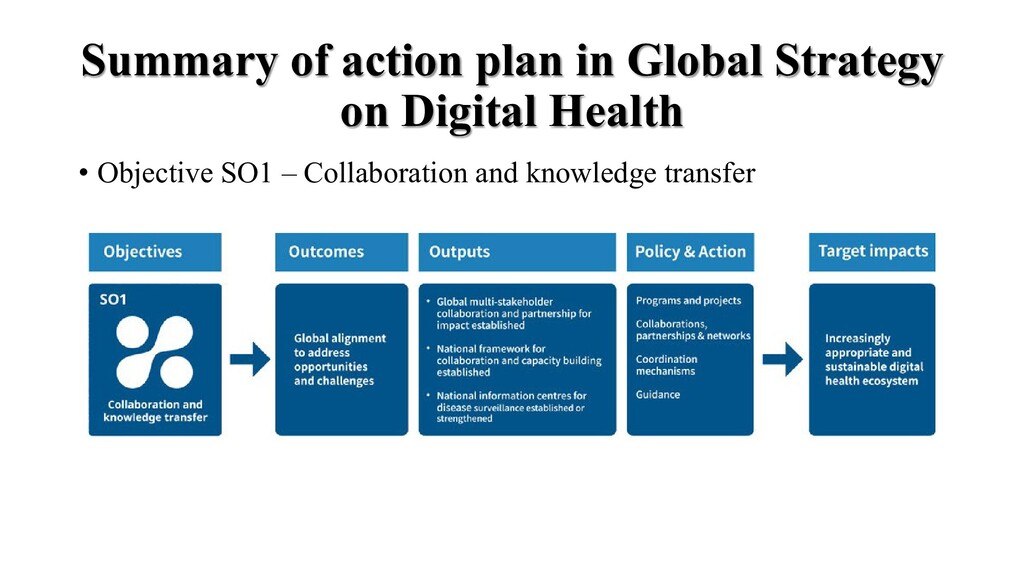
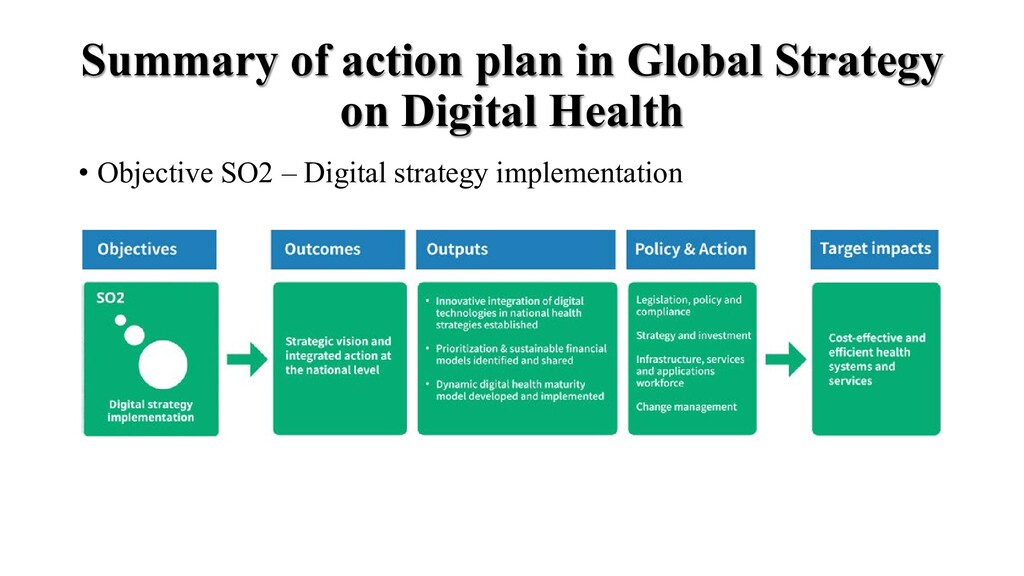
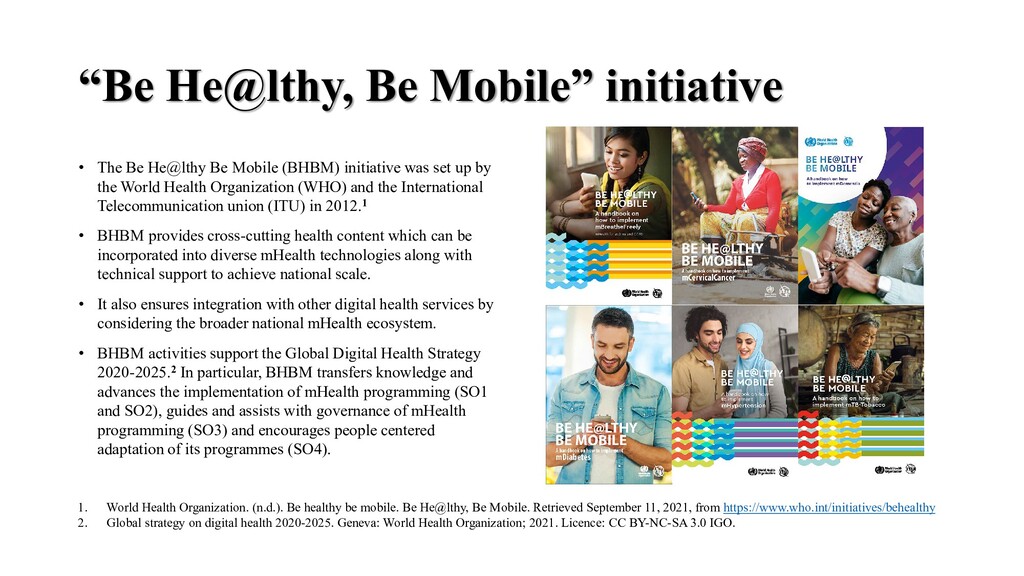
Mobile (BHBM) initiative was set up by the World Health Organization (WHO) and the International Telecommunication union (ITU) in 2012.1 • BHBM provides cross-cutting health content which can be incorporated into diverse mHealth technologies along with technical support to achieve national scale. • It also ensures integration with other digital health services by considering the broader national mHealth ecosystem. • BHBM activities support the Global Digital Health Strategy 2020-2025.2 In particular, BHBM transfers knowledge and advances the implementation of mHealth programming (SO1 and SO2), guides and assists with governance of mHealth programming (SO3) and encourages people centered adaptation of its programmes (SO4). 1. World Health Organization. (n.d.). Be healthy be mobile. Be He@lthy, Be Mobile. Retrieved September 11, 2021, from https://www.who.int/initiatives/behealthy 2. Global strategy on digital health 2020-2025. Geneva: World Health Organization; 2021. Licence: CC BY-NC-SA 3.0 IGO.
the general public to use regularly, providing Yoga learning and practice sessions of varying durations. • The app was developed through review of scientific of literature and extensive international expert consultation processes. • The app can be used as a daily yoga companion for persons aged 12-65 years. • It is currently available in English and in Hindi • The app comprises a collection of videos and audio practice sessions that users can do in the comfort of their own home, as and when they wish. 1. World Health Organization. (n.d.). WHO mYoga Application. WHO MYoga App. Retrieved September 11, 2021, from https://www.who.int/initiatives/behealthy/who-myoga-app
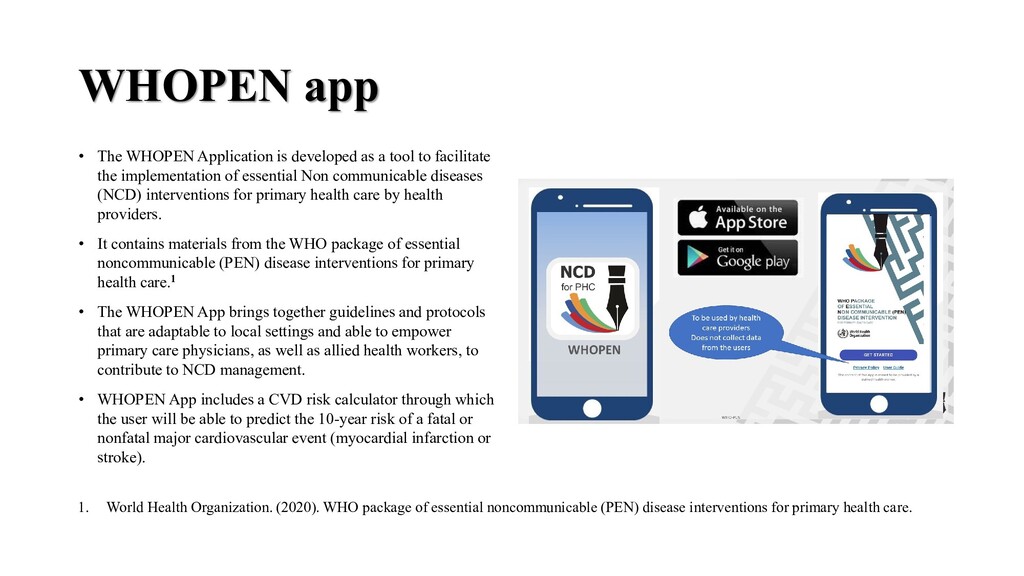
tool to facilitate the implementation of essential Non communicable diseases (NCD) interventions for primary health care by health providers. • It contains materials from the WHO package of essential noncommunicable (PEN) disease interventions for primary health care.1 • The WHOPEN App brings together guidelines and protocols that are adaptable to local settings and able to empower primary care physicians, as well as allied health workers, to contribute to NCD management. • WHOPEN App includes a CVD risk calculator through which the user will be able to predict the 10-year risk of a fatal or nonfatal major cardiovascular event (myocardial infarction or stroke). 1. World Health Organization. (2020). WHO package of essential noncommunicable (PEN) disease interventions for primary health care.
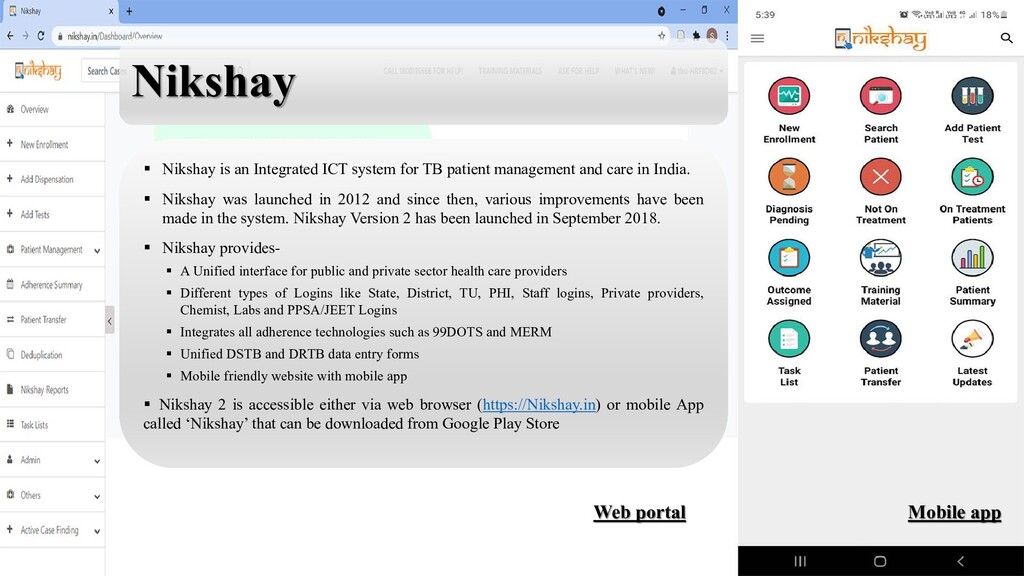
patient management and care in India. Nikshay was launched in 2012 and since then, various improvements have been made in the system. Nikshay Version 2 has been launched in September 2018. Nikshay provides- A Unified interface for public and private sector health care providers Different types of Logins like State, District, TU, PHI, Staff logins, Private providers, Chemist, Labs and PPSA/JEET Logins Integrates all adherence technologies such as 99DOTS and MERM Unified DSTB and DRTB data entry forms Mobile friendly website with mobile app Nikshay 2 is accessible either via web browser (https://Nikshay.in) or mobile App called ‘Nikshay’ that can be downloaded from Google Play Store Web portal Mobile app
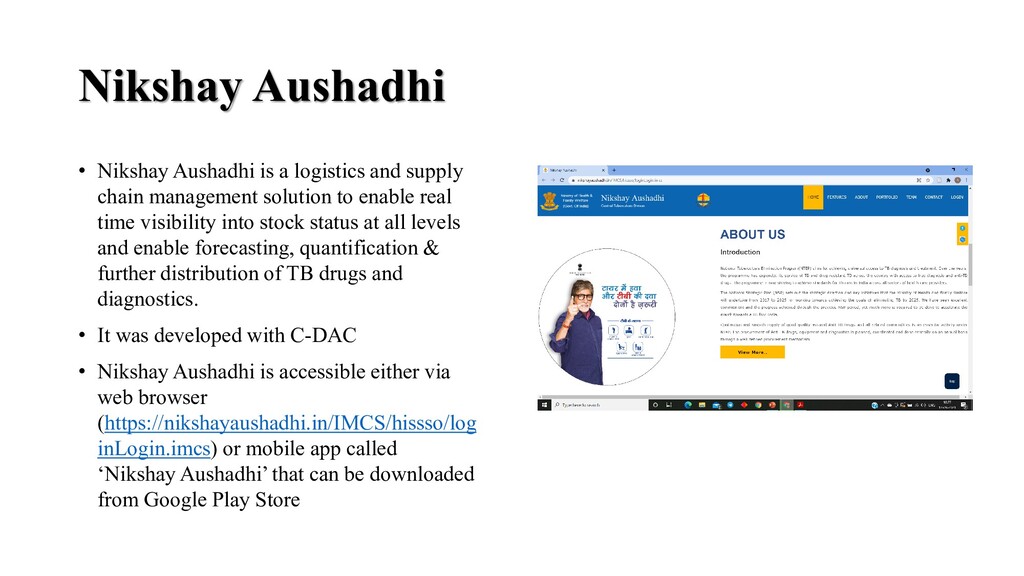
chain management solution to enable real time visibility into stock status at all levels and enable forecasting, quantification & further distribution of TB drugs and diagnostics. • It was developed with C-DAC • Nikshay Aushadhi is accessible either via web browser (https://nikshayaushadhi.in/IMCS/hissso/log inLogin.imcs) or mobile app called ‘Nikshay Aushadhi’ that can be downloaded from Google Play Store
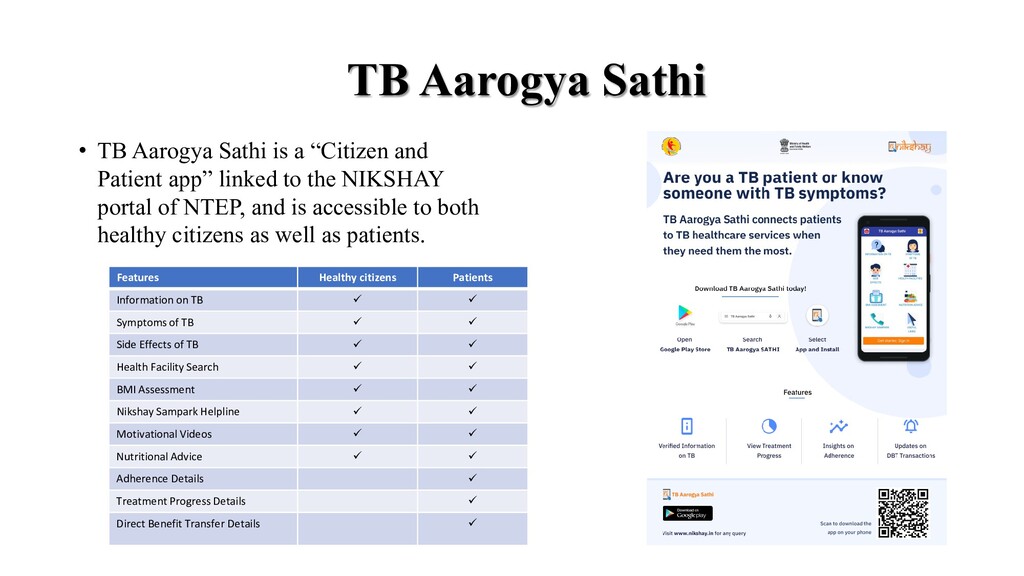
and Patient app” linked to the NIKSHAY portal of NTEP, and is accessible to both healthy citizens as well as patients. Features Healthy citizens Patients Information on TB Symptoms of TB Side Effects of TB Health Facility Search BMI Assessment Nikshay Sampark Helpline Motivational Videos Nutritional Advice Adherence Details Treatment Progress Details Direct Benefit Transfer Details
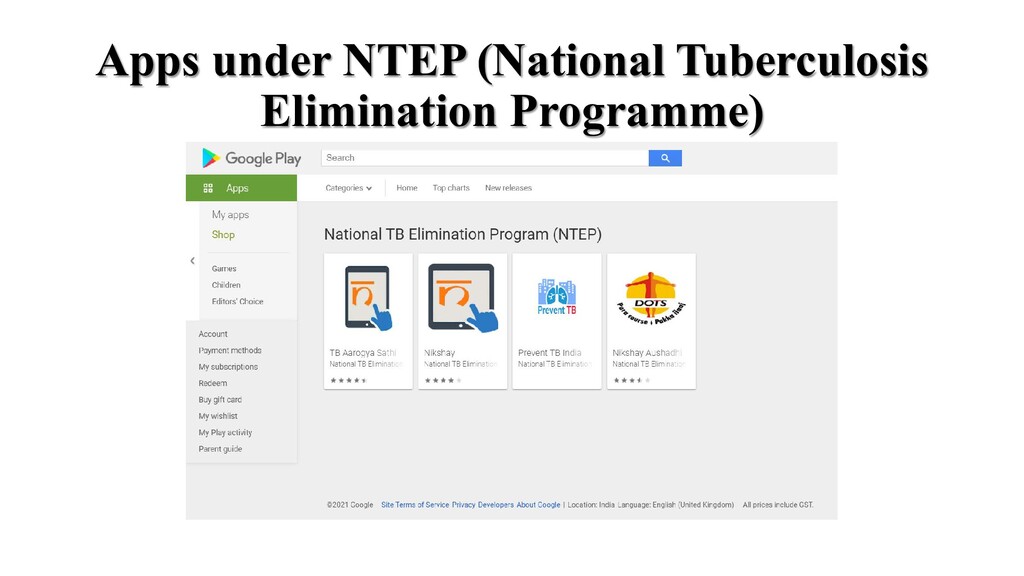
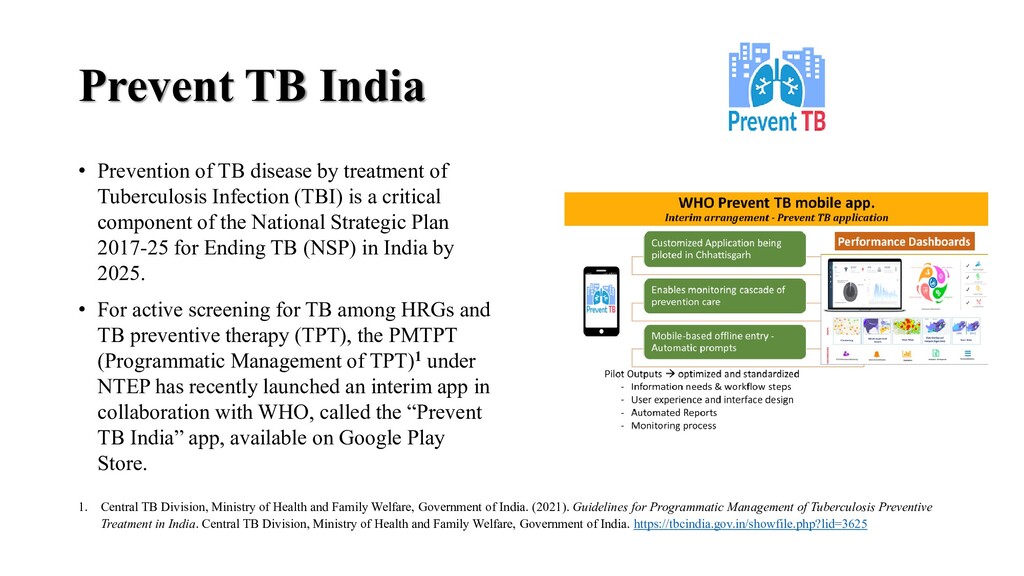
of Tuberculosis Infection (TBI) is a critical component of the National Strategic Plan 2017-25 for Ending TB (NSP) in India by 2025. • For active screening for TB among HRGs and TB preventive therapy (TPT), the PMTPT (Programmatic Management of TPT)1 under NTEP has recently launched an interim app in collaboration with WHO, called the “Prevent TB India” app, available on Google Play Store. 1. Central TB Division, Ministry of Health and Family Welfare, Government of India. (2021). Guidelines for Programmatic Management of Tuberculosis Preventive Treatment in India. Central TB Division, Ministry of Health and Family Welfare, Government of India. https://tbcindia.gov.in/showfile.php?lid=3625


 ykanoh
 pfn
pfn
 iktakahiro
 riyaamemiya
 techtekt
 kenichiodo
 shogo4131
 gionn
gionn
 ishikawa_satoru
 shumei_ito
 puhitaku
 daidaidai
 techseoconnect
 jacobtomlinson
 andyhume
 cassininazir
 watany
 samanthasiow
 apolaine
 erikaheidi
 charlesmeaden
 stuffmc
 3n
3n