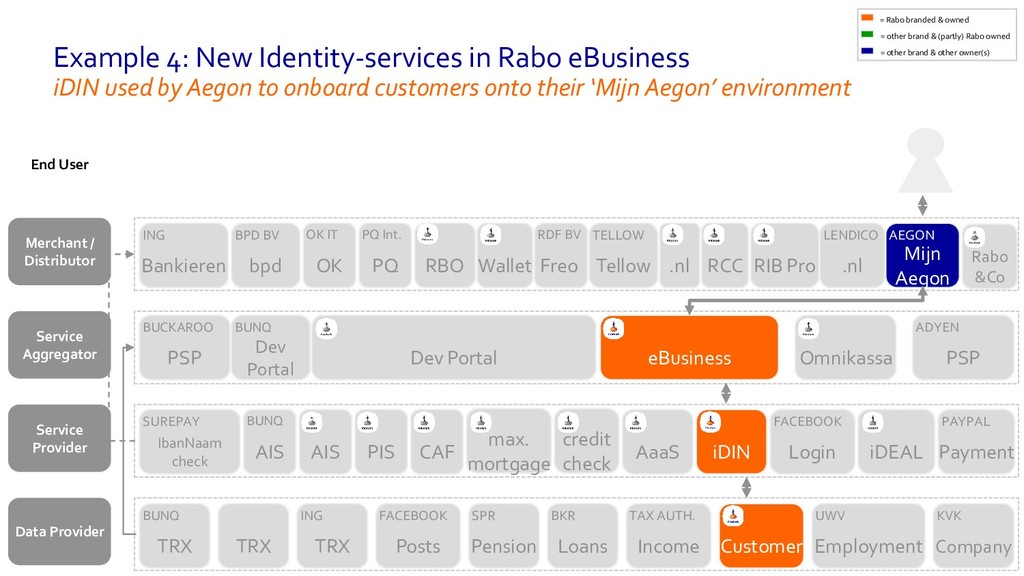
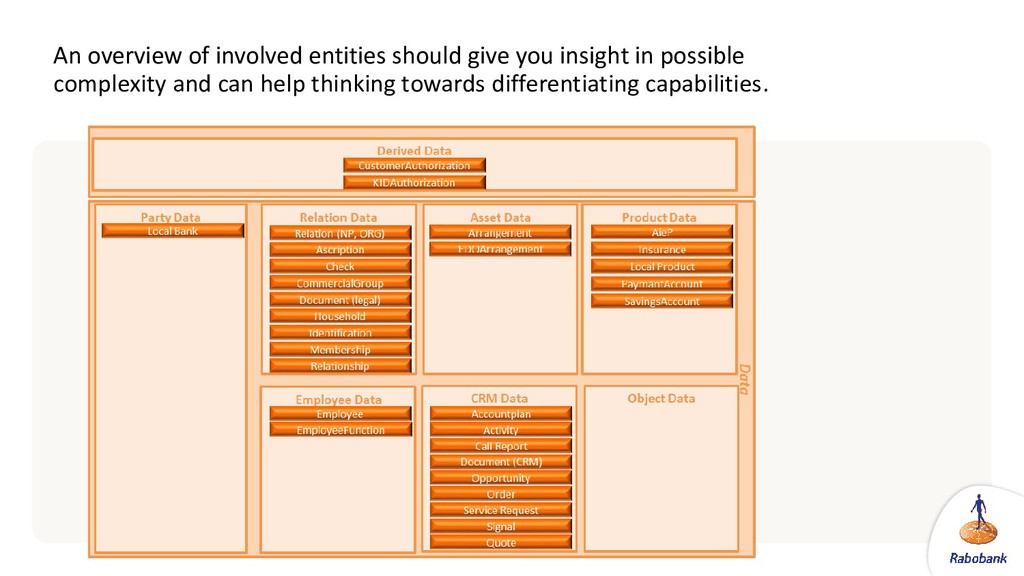
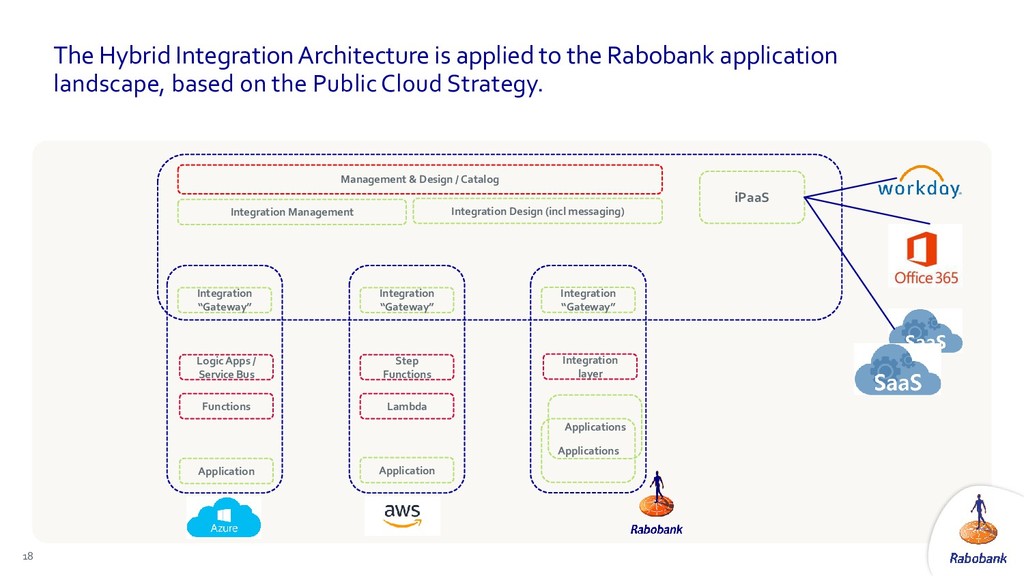
In Open banking new challenges in IT need to be addressed. Two challenges have been presented to a crowd of 200 Cloud Application Innovation people from IBM. Challenge one targeted at new data models and challenge 2 targeted at messaging patterns.
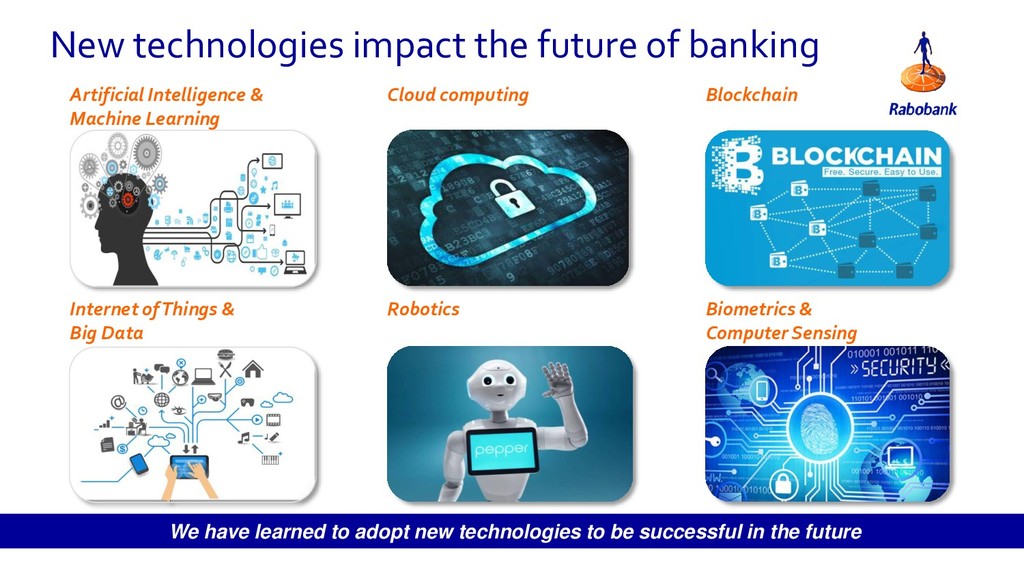
Computer Sensing Cloud computing Artificial Intelligence & Machine Learning Blockchain Internet of Things & Big Data We have learned to adopt new technologies to be successful in the future
as part of financial technology that refers to: The use of OpenAPIs that enable third party developers to build applications and services around the financial institution. Greater financial transparency options for account holders ranging from Open Data to private data.
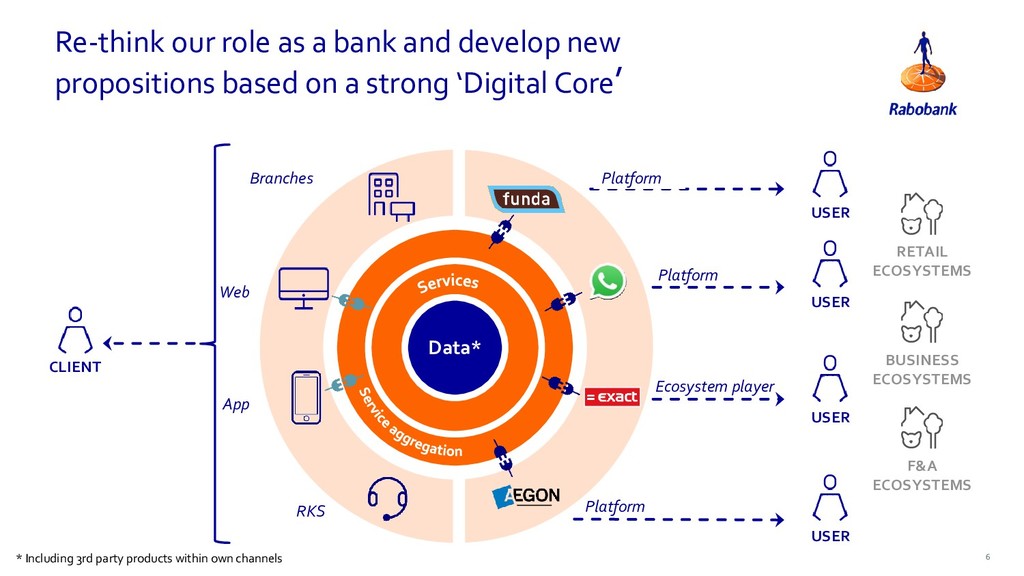
Data* USER USER USER USER RETAIL ECOSYSTEMS F&A ECOSYSTEMS BUSINESS ECOSYSTEMS CLIENT 6 Re-think our role as a bank and develop new propositions based on a strong ‘Digital Core’ * Including 3rd party products within own channels
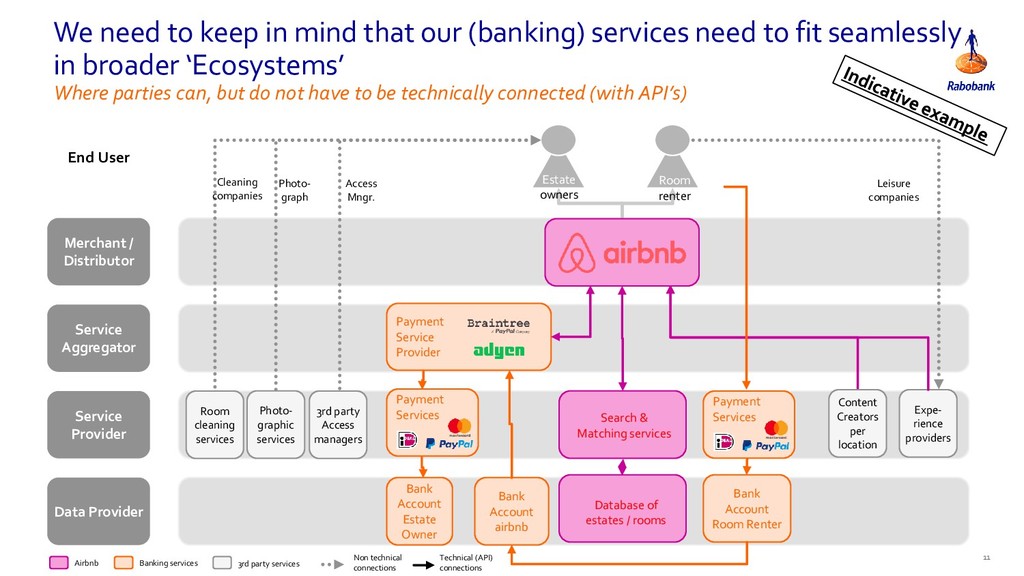
need to fit seamlessly in broader ‘Ecosystems’ Where parties can, but do not have to be technically connected (with API’s) End User Merchant / Distributor Service Aggregator Service Provider Data Provider Expe- rience providers Estate owners Room renter Room cleaning services Search & Matching services Database of estates / rooms Photo- graphic services 3rd party Access managers Content Creators per location Bank Account Estate Owner Payment Services Payment Service Provider Bank Account airbnb Bank Account Room Renter Payment Services Cleaning companies Photo- graph Access Mngr. Leisure companies Airbnb Banking services 3rd party services Non technical connections Technical (API) connections 11
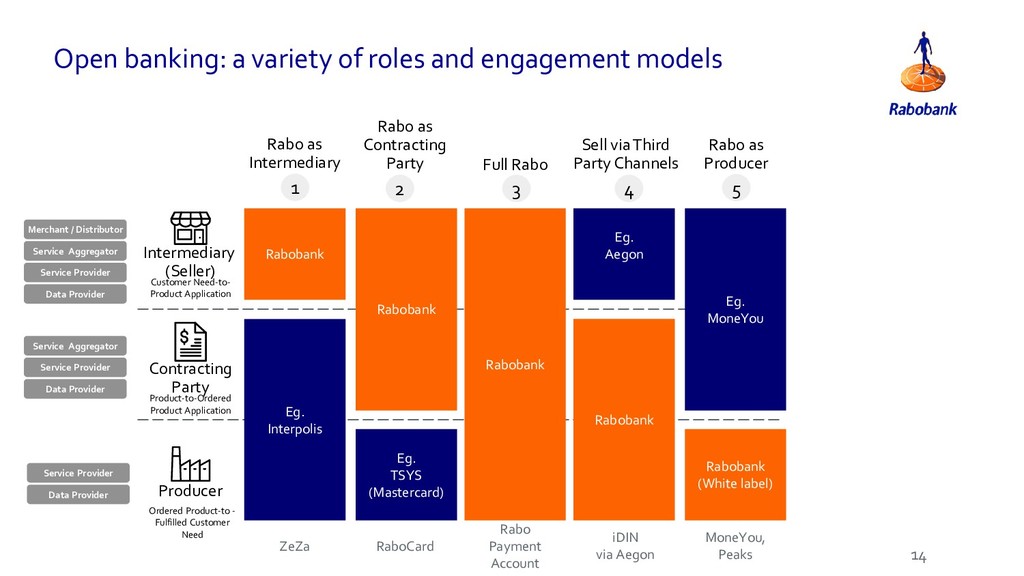
ZeZa Rabo Payment Account RaboCard iDIN via Aegon MoneYou, Peaks Rabobank Eg. Interpolis Rabobank Rabobank Eg. TSYS (Mastercard) Eg. Aegon Rabobank Eg. MoneYou Rabobank (White label) 1 Rabo as Intermediary 2 Rabo as Contracting Party Full Rabo 3 Sell via Third Party Channels 4 Rabo as Producer 5 Intermediary (Seller) Producer Customer Need-to- Product Application Contracting Party Product-to-Ordered Product Application Ordered Product-to - Fulfilled Customer Need Merchant / Distributor Service Aggregator Service Provider Data Provider Service Aggregator Service Provider Data Provider Service Provider Data Provider
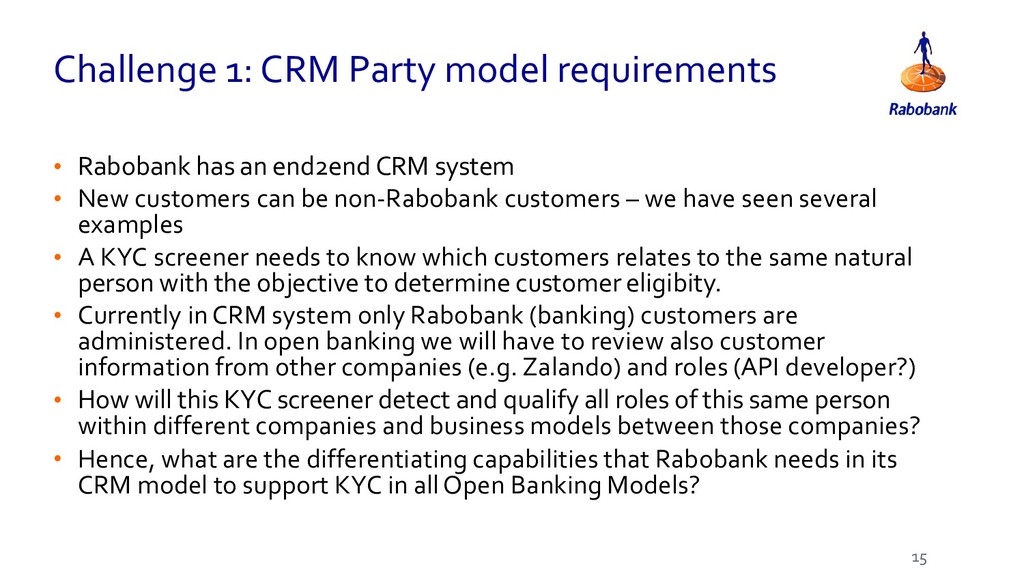
an end2end CRM system • New customers can be non-Rabobank customers – we have seen several examples • A KYC screener needs to know which customers relates to the same natural person with the objective to determine customer eligibity. • Currently in CRM system only Rabobank (banking) customers are administered. In open banking we will have to review also customer information from other companies (e.g. Zaland0) and roles (API developer?) • How will this KYC screener detect and qualify all roles of this same person within different companies and business models between those companies? • Hence, what are the differentiating capabilities that Rabobank needs in its CRM model to support KYC in all Open Banking Models?
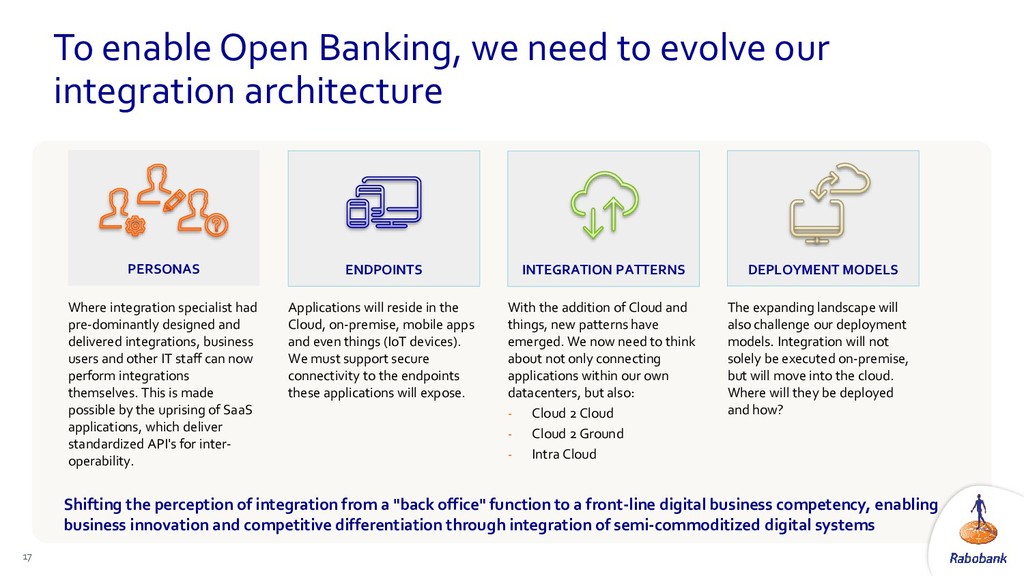
architecture 17 Where integration specialist had pre-dominantly designed and delivered integrations, business users and other IT staff can now perform integrations themselves. This is made possible by the uprising of SaaS applications, which deliver standardized API's for inter- operability. PERSONAS ENDPOINTS INTEGRATION PATTERNS DEPLOYMENT MODELS Applications will reside in the Cloud, on-premise, mobile apps and even things (IoT devices). We must support secure connectivity to the endpoints these applications will expose. With the addition of Cloud and things, new patterns have emerged. We now need to think about not only connecting applications within our own datacenters, but also: - Cloud 2 Cloud - Cloud 2 Ground - Intra Cloud The expanding landscape will also challenge our deployment models. Integration will not solely be executed on-premise, but will move into the cloud. Where will they be deployed and how? Shifting the perception of integration from a "back office" function to a front-line digital business competency, enabling business innovation and competitive differentiation through integration of semi-commoditized digital systems
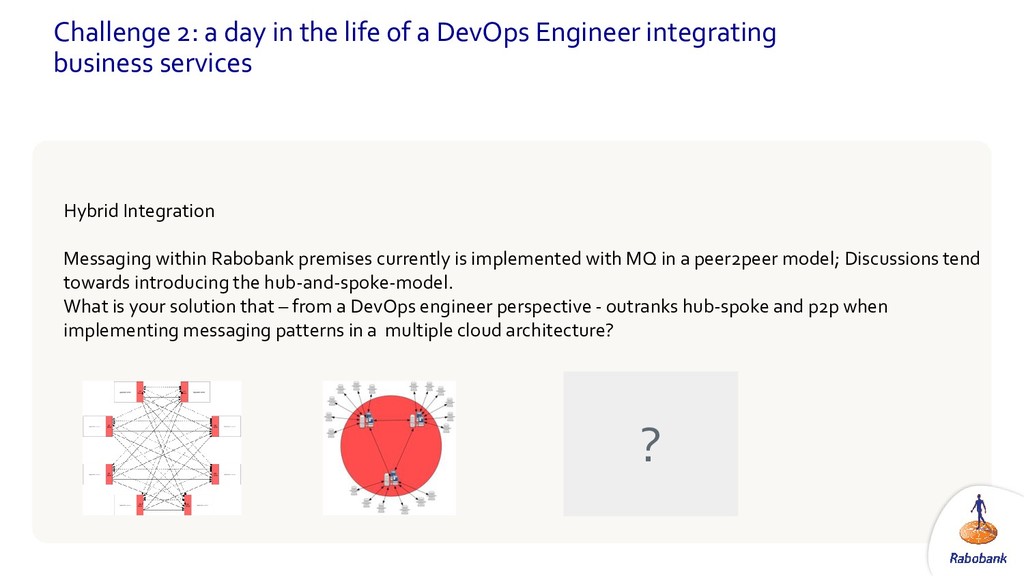
Engineer integrating business services Hybrid Integration Messaging within Rabobank premises currently is implemented with MQ in a peer2peer model; Discussions tend towards introducing the hub-and-spoke-model. What is your solution that – from a DevOps engineer perspective - outranks hub-spoke and p2p when implementing messaging patterns in a multiple cloud architecture? ?


 kash1064
 pfn
 hiracky16
 grimoh
 ymotongpoo
 shugo
 teamlab
 ivry_presentationmaterials
 nealle
 kairim0
 takuroabe
 tenderlove
 cassininazir
 michielstock
 mongodb
 akihiro_kokubo
 samtorres
 portentint
 khoart
 iamctodd
 samanthasiow
 jlugia
 schroneko