dentists Most typical dentist • Primarily concerned with patient care • Worried about costs • Optimizes lifestyle and income Uses technology to up-sell additional procedures • Typically in high-income areas • State-of-the-art facilities and technologies • Early adopter of dental devices Equipment handled by purchasing department • Uses financial metrics to make decisions • Technologies standardized across all offices
2300 visits per year average • Consumable for each patient • ~$5 cost per consumable • 10% of visits • $0-100 cost per tool • 20% of dentists $25 B dental equipment industry Source: US BLS, ADA, dentist interviews, industry research" $200 M serviceable diagnostic tool market TAM: $2B
2300 visits per year average • Consumable for each patient • ~$5 cost per consumable • 10% of visits • $0-100 cost per tool • 20% of dentists $25 B dental equipment industry Source: US BLS, ADA, dentist interviews, industry research" $200 M serviceable diagnostic tool market TAM: $2B Consumables are key
Key Takeaways 1 2 3 4 5 Imaging back teeth is essential Market would be somewhat limited / niche Dentist # Interest in prototype None Very Positive Neutral
inaccurate piece of data we get from dentists. Fraud and abuse are common” Dental Policy Committee • Meets regularly to evaluate new technologies • Determines which technologies will be added to annual contracts based on efficacy and cost savings to insurance company Willing to recommend use of new technology Need more clinical data, but are enthusiastic about the idea!
pick, gloves, toothbrush) Class II (eg, dental fillings, ceramics, drills) Class III (eg, stent, implantable pacemaker) Criteria FDA Requirements Minimal health and safety risks, established precedent Need to register with FDA but not get approval before putting it on the market Presents safety and health risks that aren't completely controlled by GMP (good manufacturing processes) Submit 510-K application to FDA, include detail about device, marketing materials, device safety features, and other paperwork Invasive, inflammable, or presents other significant significant safety risks. Often times a new type of device Very thorough process similar to drug approval. Requires clinical trails and mountains of paperwork
our device will be class II Intra-oral, non-invasive laser light caries (tooth decay) detector Approved as class II medical device. Clinical tests conducted to prove accuracy Device carries little direct risk • Intra-oral, non-invasive probe • Uses non-harmful wavelengths of radiation Key risk: misdiagnosis • Clinical evidence required to establish efficacy Source: Iowa Dental Supply
• Determine device diagnostic capabilities • Begin FDA 510(k) documentation • Enroll 1-2 periodontists in preliminary efficacy study Feasibility study 0 18 9 3 6 12 15 Month Class II device FDA trials and approval • Determine predicate device(s) • Enroll 4-7 sites and 10+ periodontists in study • Fix critical end-points based on device capability (eg, 1 mm measurement error) • Submit 510(k) to FDA and obtain approval $200 K 30 patients $200 - 400 K 200-400 patients $1,000 – 2,000 K 1000-2000 patients Without a predicate Costs Trial Size
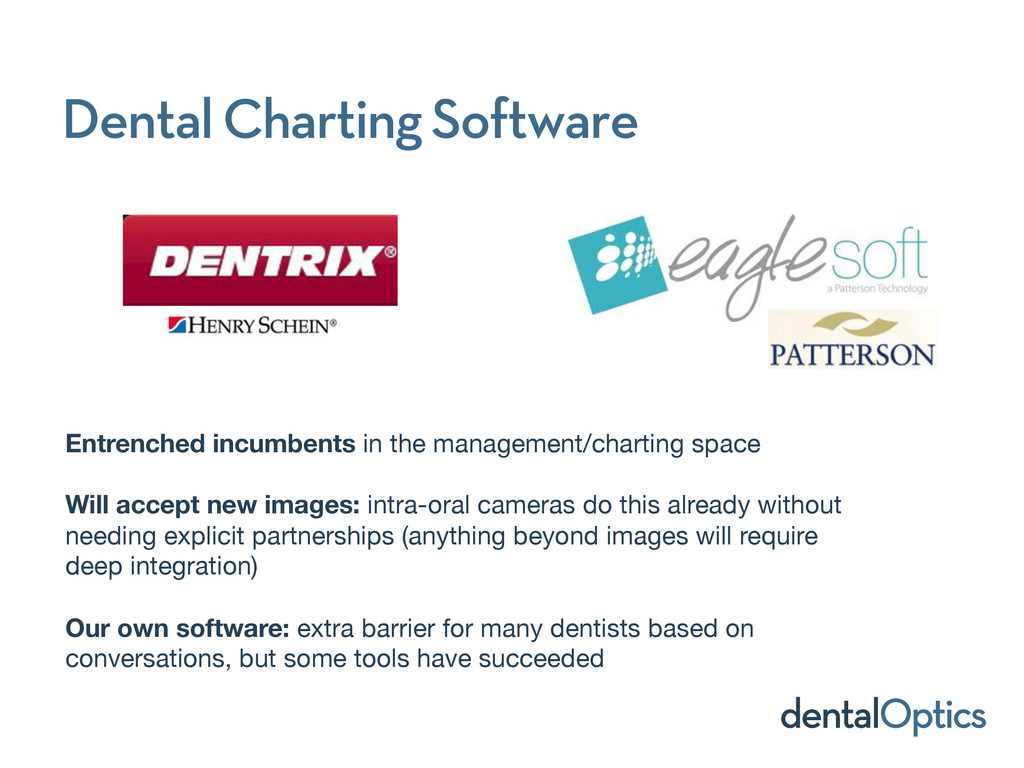
Will accept new images: intra-oral cameras do this already without needing explicit partnerships (anything beyond images will require deep integration) Our own software: extra barrier for many dentists based on conversations, but some tools have succeeded
Device 0 50 100 150 200 250 300 350 400 450 Device sales Consumables Total $400 MM $320 MM $75 MM • Device cost - $2000 • Amortized over 4 years • $2.5 consumables per patient • 128 MM patients per year Total addressable market ($MM) Source: Department of Health and Human Services
trials and approval $300 K $1.5-2 M Costs Regulatory Product Development Scale-up Preparation Early Prototype Dev. Planning with Manufacturers Product Cycle I Product Cycle II 0 24 6 12 18
trials and approval $300 K $1.5-2 M Costs Regulatory Product Development Scale-up Preparation Early Prototype Dev. Planning with Manufacturers Product Cycle I Product Cycle II $500* Unit Economics Cost of Goods Margin $900 $600 Distributor Revenue Cost to Dentist: $2000 *At scale: 10K units 0 24 6 12 18
key to revenue models in dental devices Listen to your customers for new directions Caregivers don’t think exclusively like businesspeople: the patient experience is paramount “Hi, I’m a Stanford student…” gets you a conversation with pretty much anyone
don’t regularly do a full probe test of all teeth! Time & effort 50% of US population has mild-severe periodontitis, only 5-10% of are treated “The number-one reason dentists are sued is failure to diagnose periodontal disease”* 30% of patients don’t feel the need for the recommended treatment* Increases with aging population *K. Esler, Sidekick (2009)


 terasawat
 auctria
 mariooc
 kekekenta
 sciencetokyo
 juanmartin2026
 akiraasano
 matleenalaakso
 cbtlibrary
 hiola
 tmiket
 bkeepers
 427marketing
 moore
 aleyda
 csswizardry
 mojombo
 paigeccino
 rkaga
 tonyrice
 irinanazarova