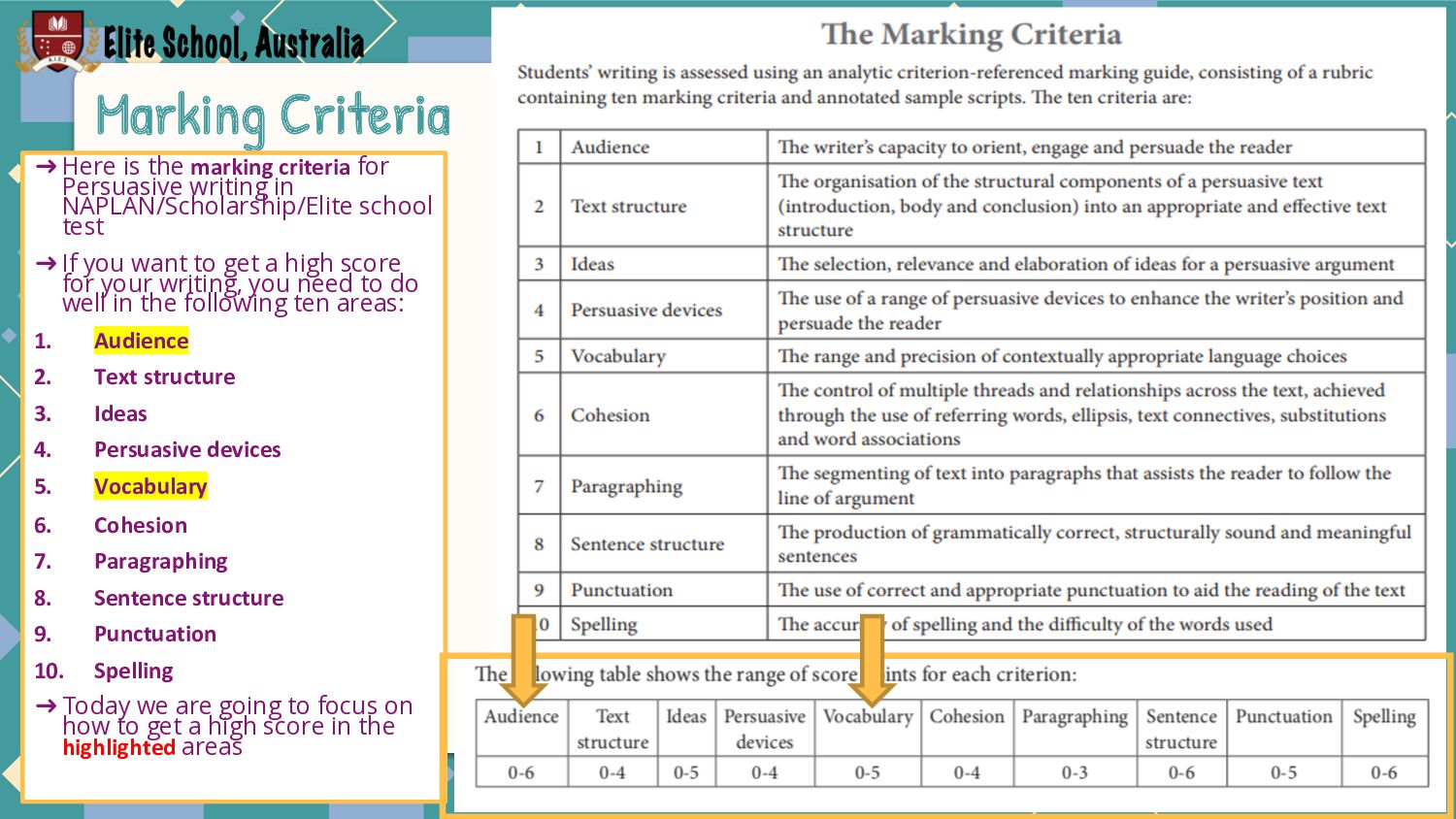
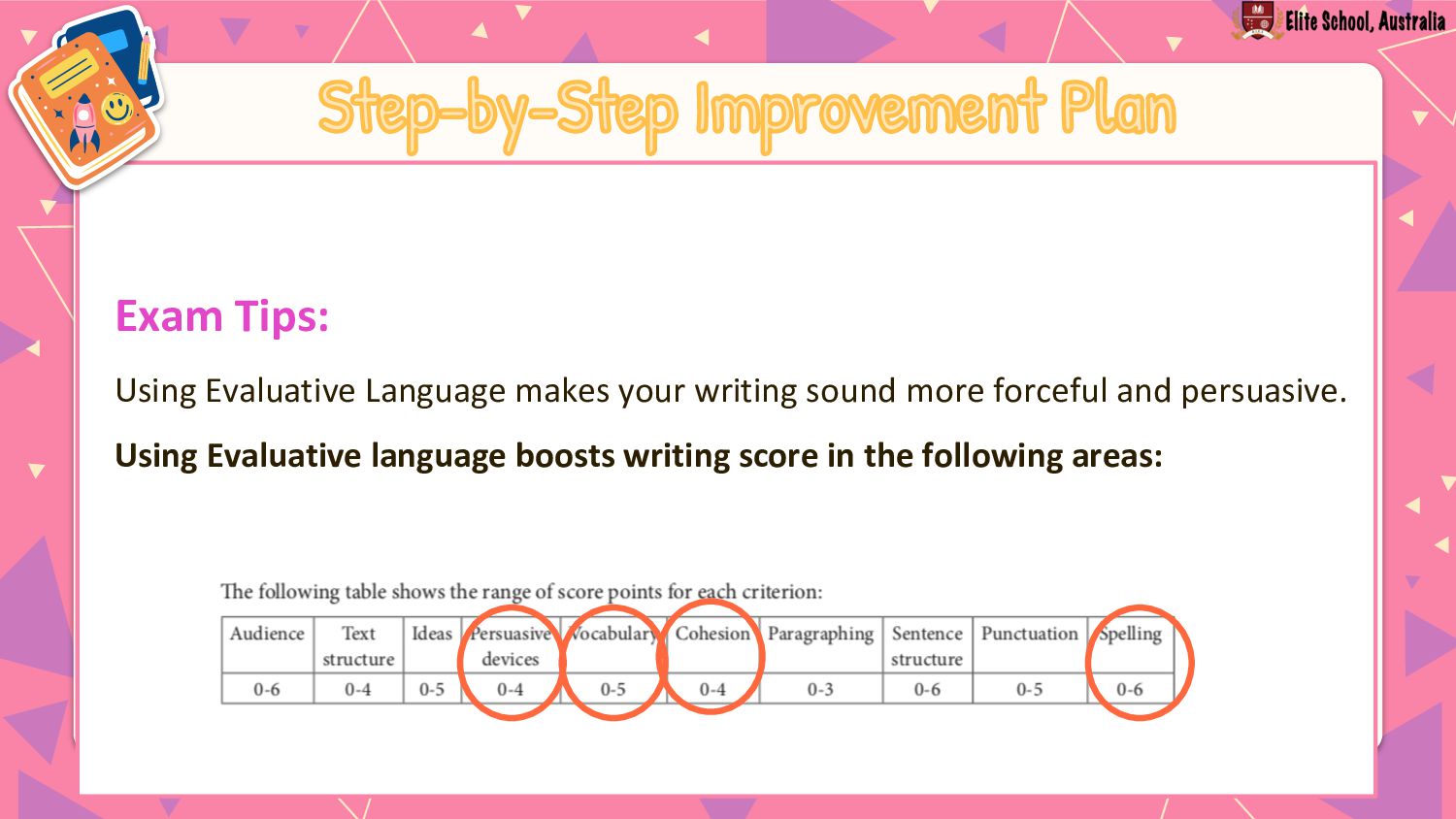
writing in NAPLAN/Scholarship/Elite school test ➜ If you want to get a high score for your writing, you need to do well in the following ten areas: 1. Audience 2. Text structure 3. Ideas 4. Persuasive devices 5. Vocabulary 6. Cohesion 7. Paragraphing 8. Sentence structure 9. Punctuation 10. Spelling ➜ Today we are going to focus on how to get a high score in the highlighted areas
detailed persuasive text Learning Intention: I am learning to make my writing more precise, more formal and more advanced. Success Criteria: - I can use evaluative words and terms in my writing.
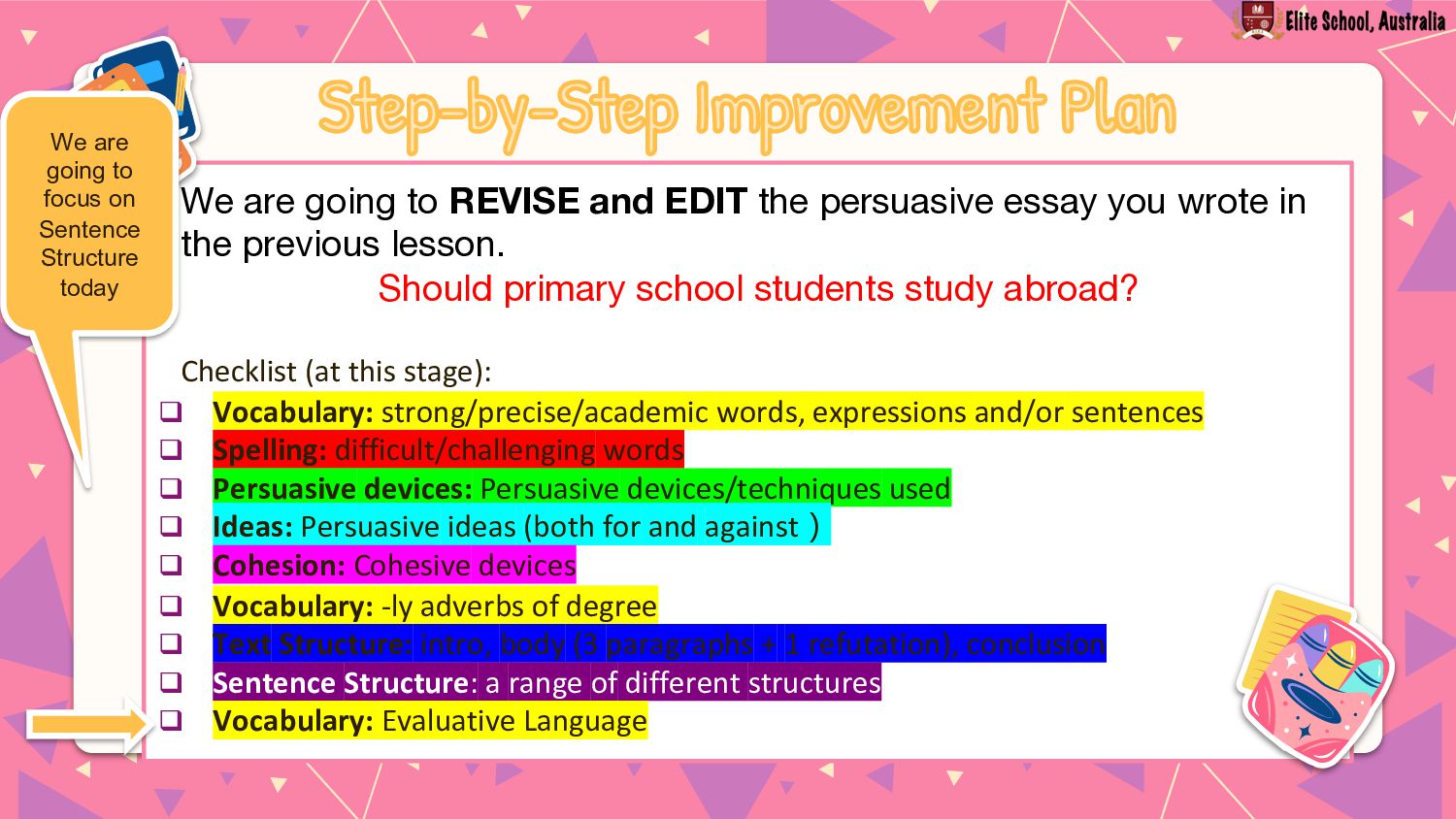
you wrote in the previous lesson. Should primary school students study abroad? Checklist (at this stage): q Vocabulary: strong/precise/academic words, expressions and/or sentences q Spelling: difficult/challenging words q Persuasive devices: Persuasive devices/techniques used q Ideas: Persuasive ideas (both for and against) q Cohesion: Cohesive devices q Vocabulary: -ly adverbs of degree q Text Structure: intro, body (3 paragraphs + 1 refutation), conclusion q Sentence Structure: a range of different structures q Vocabulary: Evaluative Language We are going to focus on Sentence Structure today
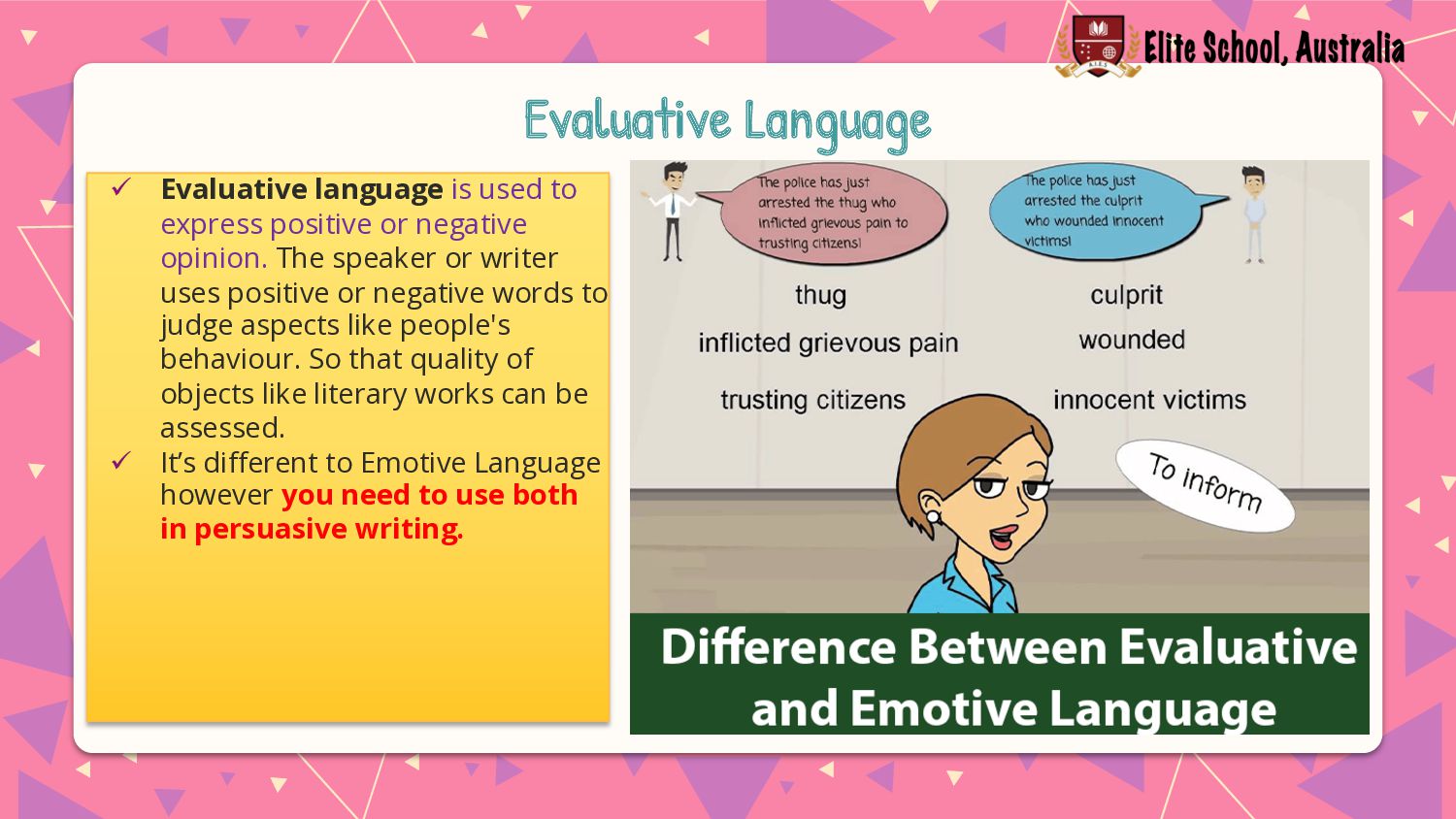
or negative opinion. The speaker or writer uses positive or negative words to judge aspects like people's behaviour. So that quality of objects like literary works can be assessed. ü It’s different to Emotive Language however you need to use both in persuasive writing.
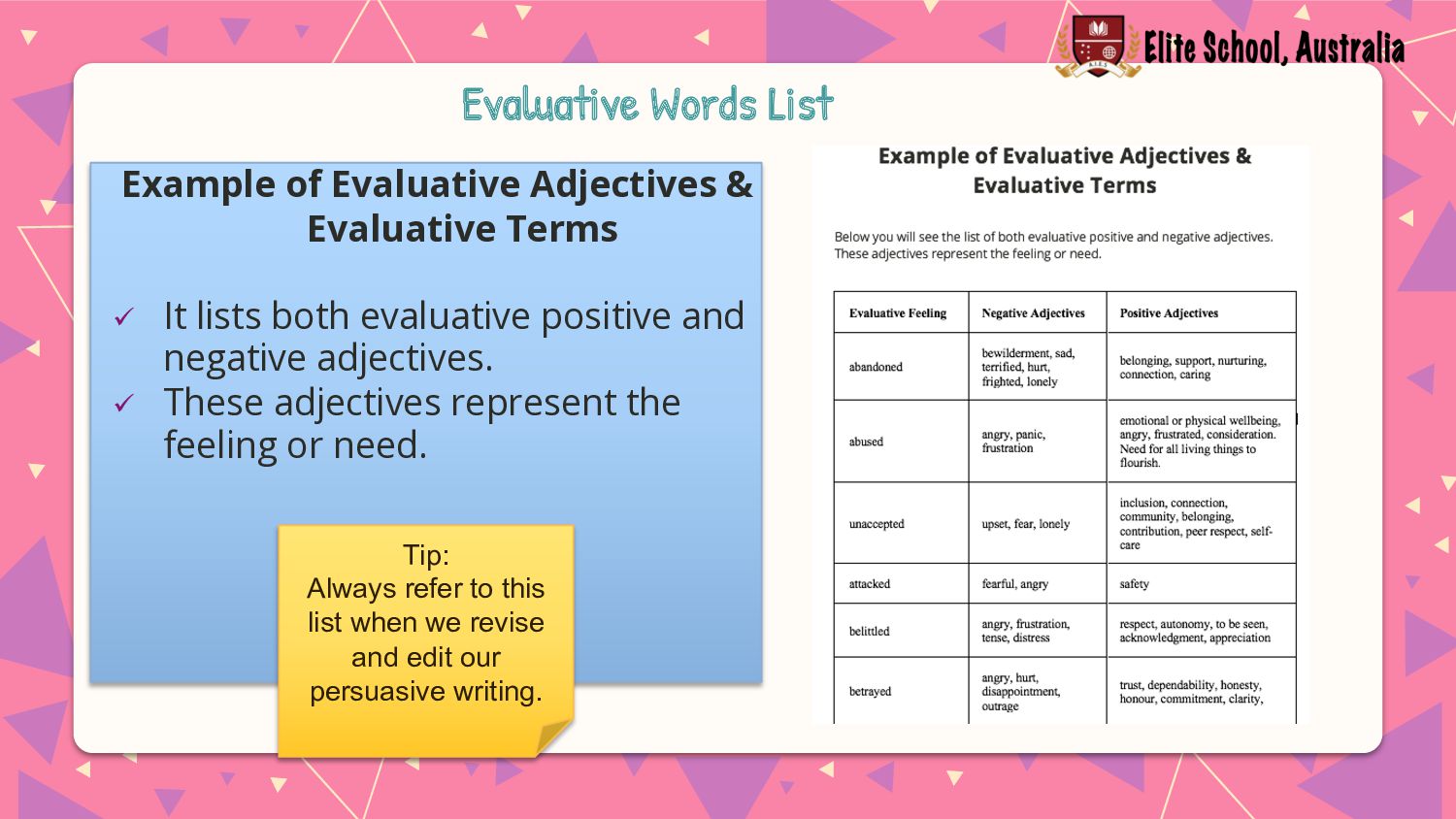
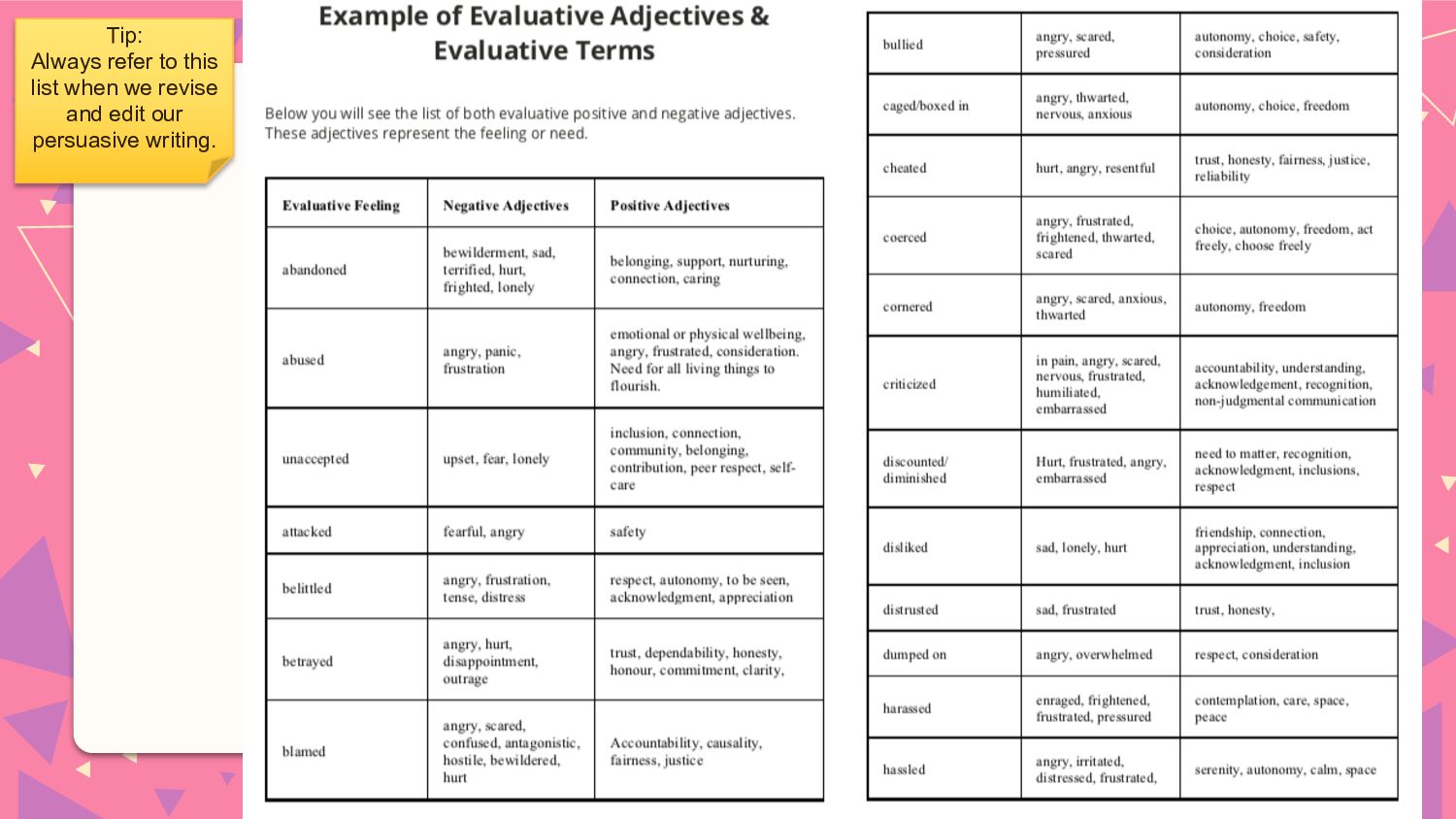
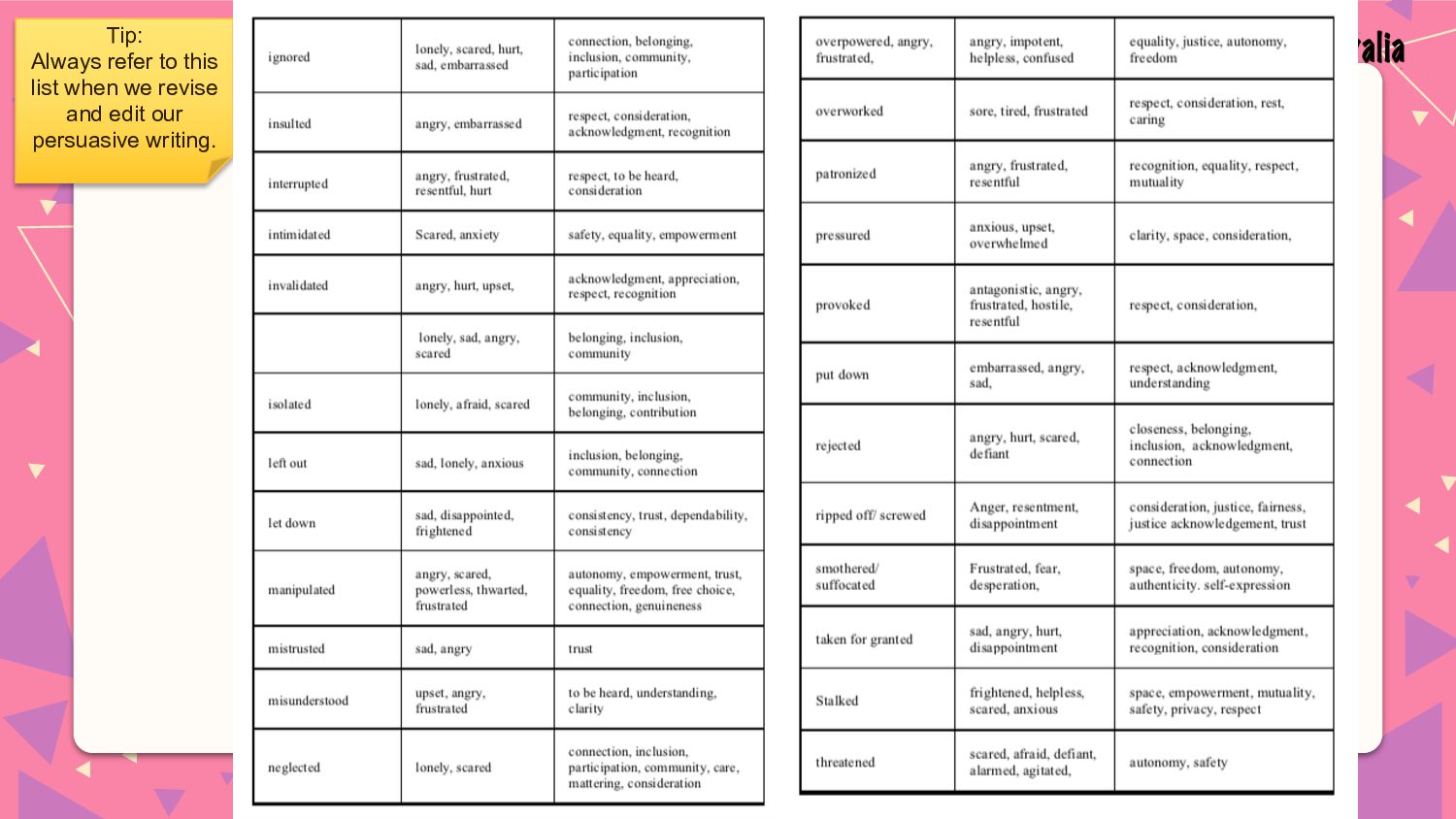
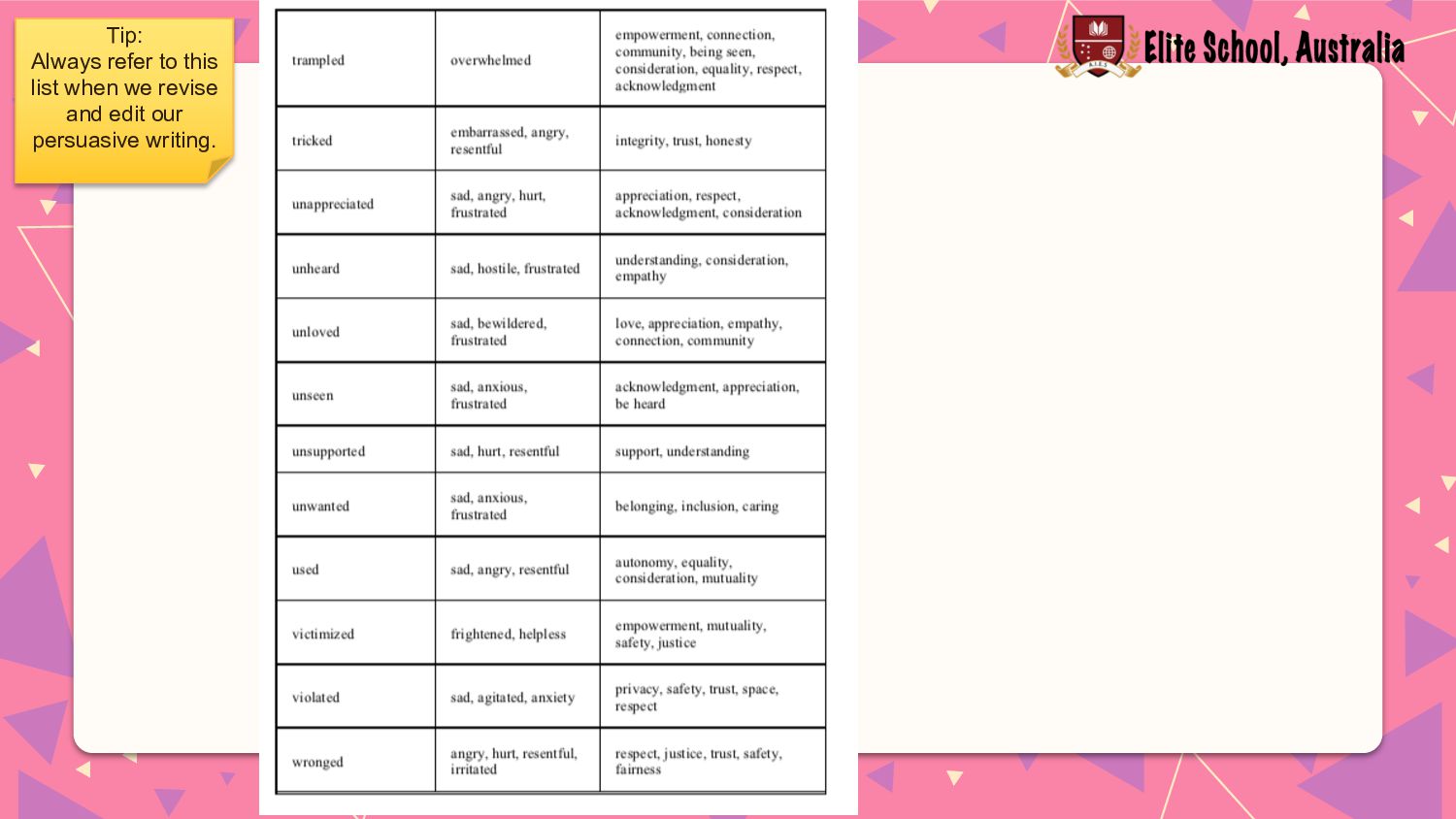
ü It lists both evaluative positive and negative adjectives. ü These adjectives represent the feeling or need. Tip: Always refer to this list when we revise and edit our persuasive writing.
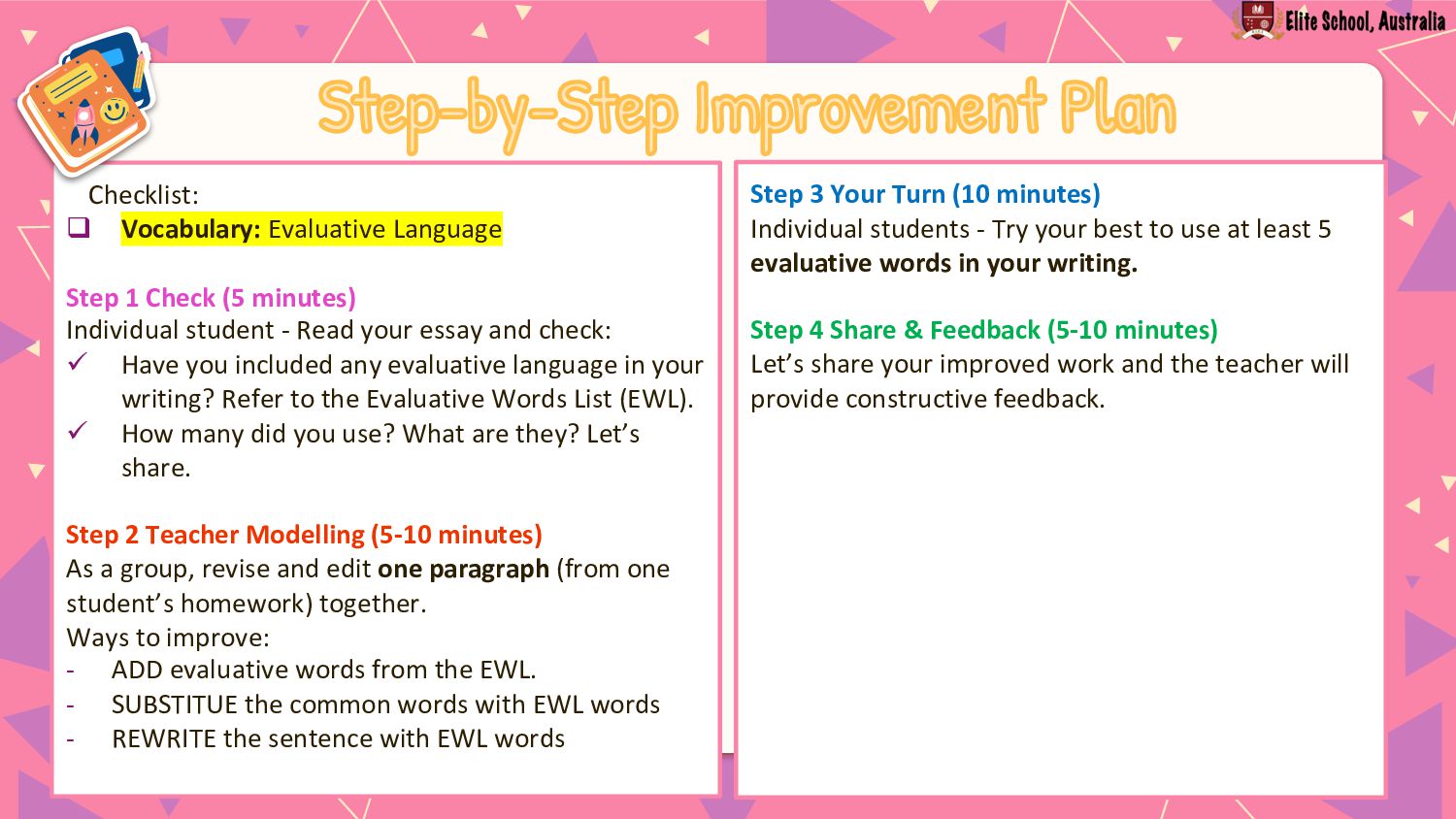
Individual student - Read your essay and check: ü Have you included any evaluative language in your writing? Refer to the Evaluative Words List (EWL). ü How many did you use? What are they? Let’s share. Step 2 Teacher Modelling (5-10 minutes) As a group, revise and edit one paragraph (from one student’s homework) together. Ways to improve: - ADD evaluative words from the EWL. - SUBSTITUE the common words with EWL words - REWRITE the sentence with EWL words Step 3 Your Turn (10 minutes) Individual students - Try your best to use at least 5 evaluative words in your writing. Step 4 Share & Feedback (5-10 minutes) Let’s share your improved work and the teacher will provide constructive feedback.
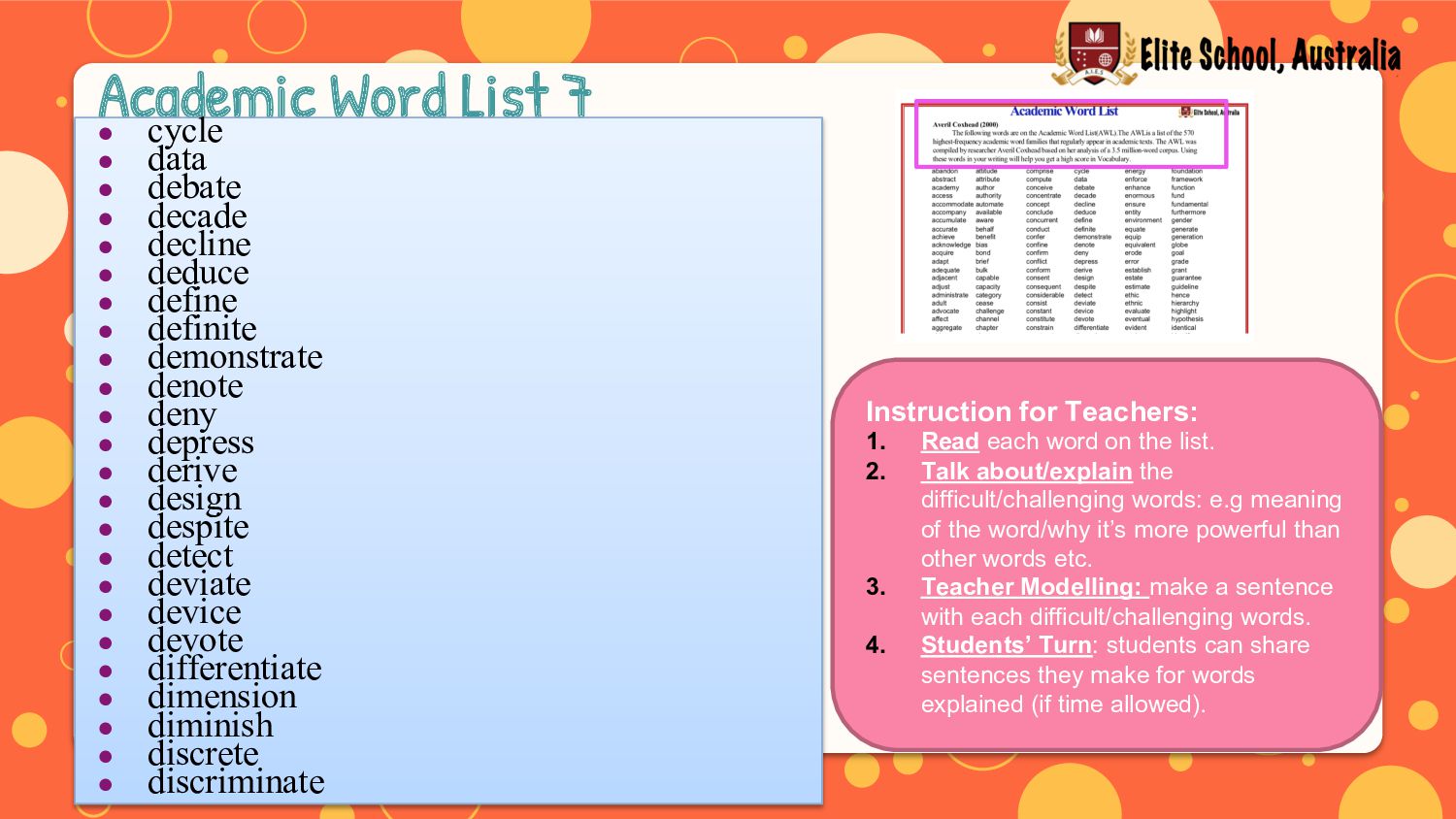
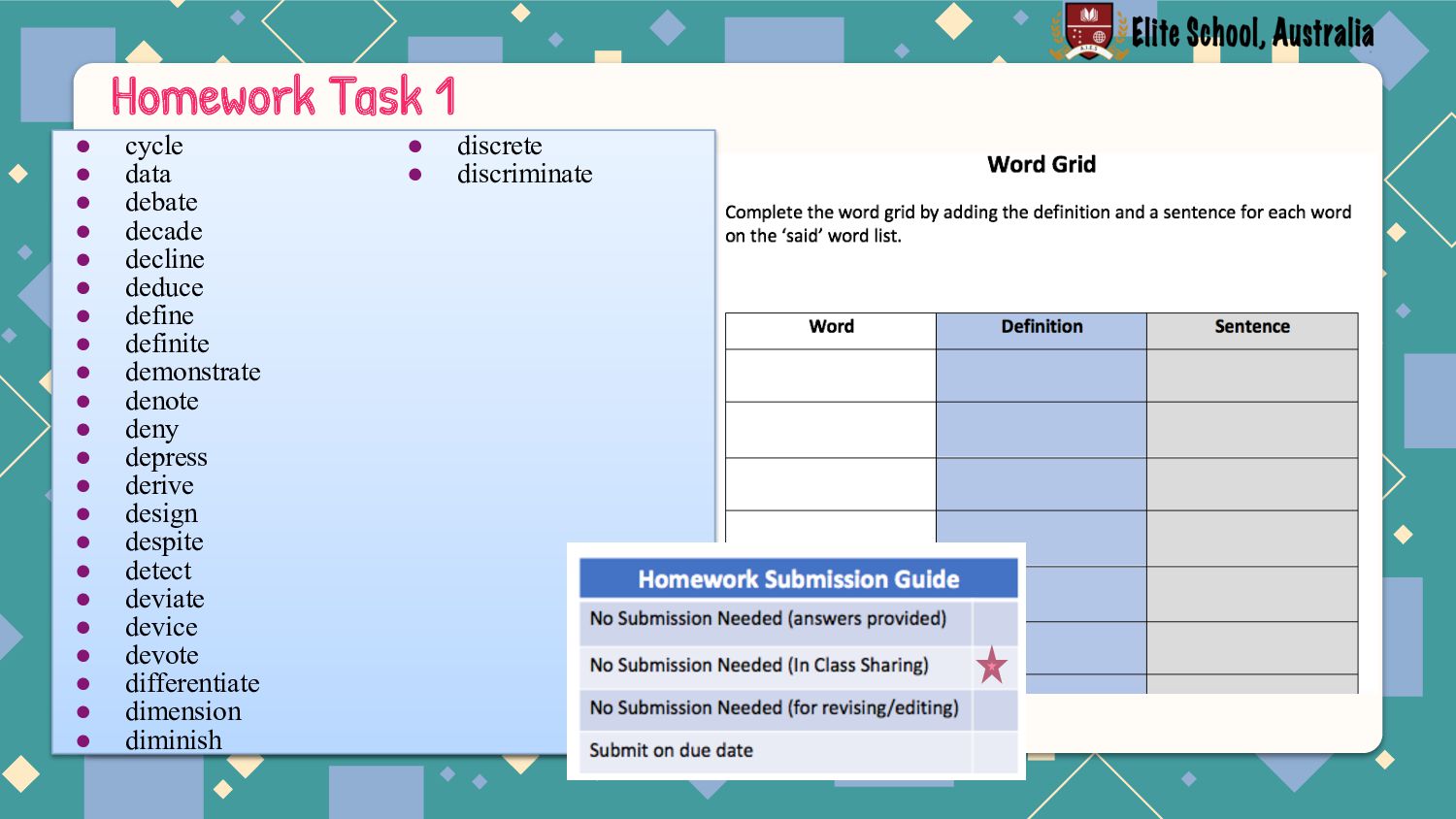
• decade • decline • deduce • define • definite • demonstrate • denote • deny • depress • derive • design • despite • detect • deviate • device • devote • differentiate • dimension • diminish • discrete • discriminate Instruction for Teachers: 1. Read each word on the list. 2. Talk about/explain the difficult/challenging words: e.g meaning of the word/why it’s more powerful than other words etc. 3. Teacher Modelling: make a sentence with each difficult/challenging words. 4. Students’ Turn: students can share sentences they make for words explained (if time allowed).
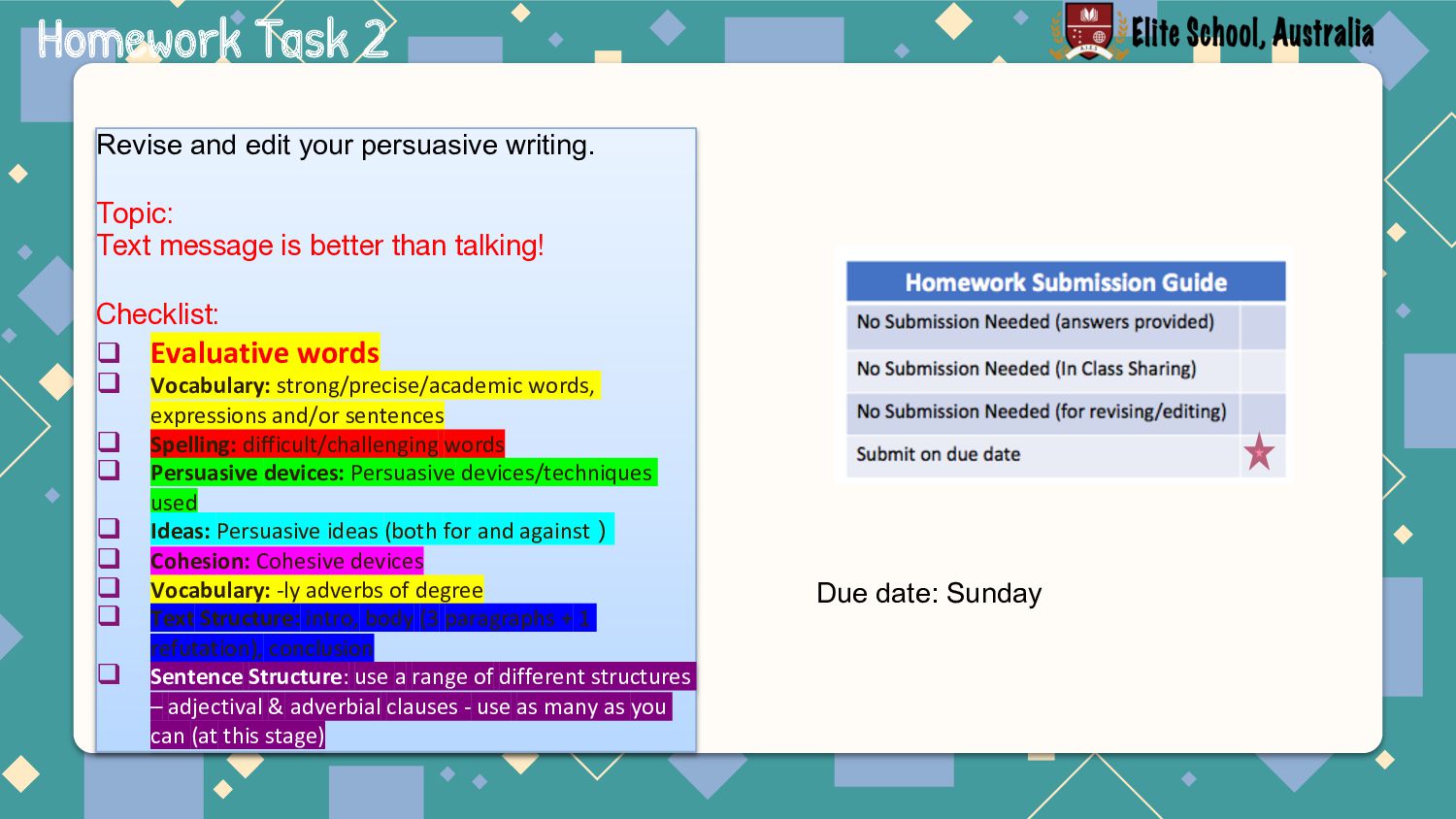
Text message is better than talking! Checklist: q Evaluative words q Vocabulary: strong/precise/academic words, expressions and/or sentences q Spelling: difficult/challenging words q Persuasive devices: Persuasive devices/techniques used q Ideas: Persuasive ideas (both for and against) q Cohesion: Cohesive devices q Vocabulary: -ly adverbs of degree q Text Structure: intro, body (3 paragraphs + 1 refutation), conclusion q Sentence Structure: use a range of different structures – adjectival & adverbial clauses - use as many as you can (at this stage) Due date: Sunday


 eliteschoolaustralia
 bluesmoon
 lynnandtonic
 aleyda
 orderedlist
 iamctodd
 ryanjones
 apolaine
 thoeni
 techseoconnect
 marcduiker
 jct
jct
 katarinadahlin