Upgrade to Pro — share decks privately, control downloads, hide ads and more …

Baruco 2014: How I Built My Own Twitch-Plays-Po...

Sponsored · Ship Features Fearlessly Turn features on and off without deploys. Used by thousands of Ruby developers. →

Baruco 2014: How I Built My Own Twitch-Plays-Pokémon

As the slides don't really say much, the content of the talk is going to be published as a series of blogposts.
http://ajipirijou.com/talks/how-i-built-my-own-tpp-part-1

This talk was given at Baruco 2014.
It explains the story of How I built my own TPP.

José Tomás Albornoz

September 12, 2014

Transcript

144 slides
  1. When was the last time you worked on a non

    productive project, just for the fun of it?
  2. OMG

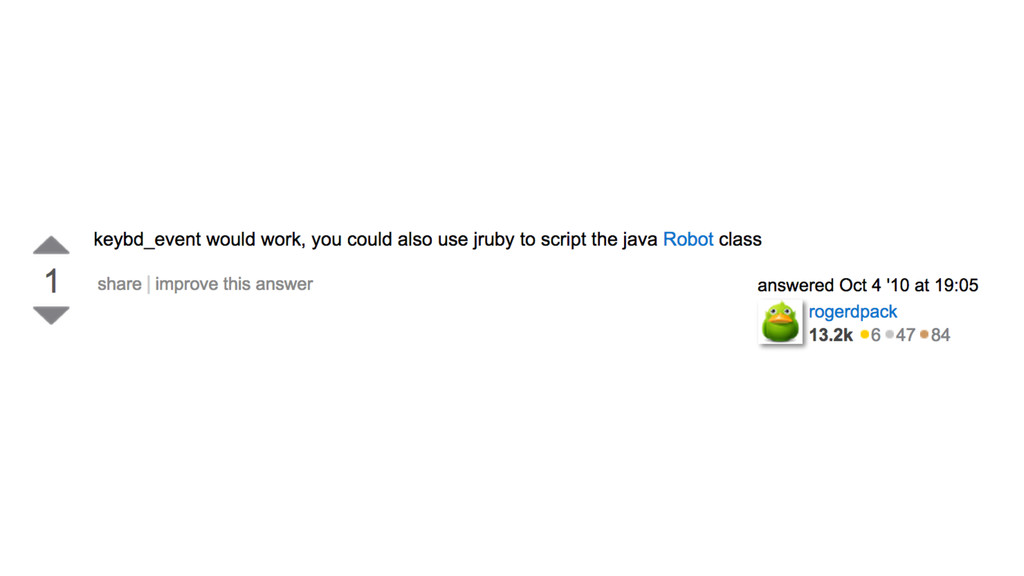
  3. Problems with the Windows solution • WINDOWS!!!!!111! • I have

    no Windows machine • I want to run this on a server with no desktop environment
  4. require 'sinatra' mappings = { "a" => java.awt.event::KeyEvent::VK_Z, "b" =>

    java.awt.event::KeyEvent::VK_X, "up" => java.awt.event::KeyEvent::VK_UP, "down" => java.awt.event::KeyEvent::VK_DOWN, } robot = java.awt.Robot.new get '/:key' do |key| if key_code = mappings[key.downcase] robot.keyPress(key_code) robot.delay(100) robot.keyRelease(key_code) end end
  5. The perfect emulator • requires no desktop environment • streams

    the video online • has an API that allows to send button presses
  6. address operation 0x00 nop 0x04 inc_b 0x80 add_a_b 0xA0 and_b

    0xC0 jp_nn CPU Instruction Table class CPU OPS = [ :nop, … … :inc_b, … :add_a_b, … :and_b, … :jp_nn, ]
  7. “the” loop class Emulator def step next_byte = @ram[@program_counter] next_instruction

    = OPS[next_byte] @cpu.send(next_instruction) @program_counter += 1 end end
  8. “the” loop class Emulator def step next_byte = @ram[@program_counter] #

    => 0xC0 next_instruction = OPS[next_byte] @cpu.send(next_instruction) @program_counter += 1 end end
  9. “the” loop class Emulator def step next_byte = @ram[@program_counter] #

    => 0xC0 next_instruction = OPS[next_byte] # => :jp_nn @cpu.send(next_instruction) @program_counter += 1 end end
  10. “the” loop class Emulator def step next_byte = @ram[@program_counter] #

    => 0xC0 next_instruction = OPS[next_byte] # => :jp_nn @cpu.send(next_instruction) @program_counter += 1 end end
  11. “the” loop class Emulator def step next_byte = @ram[@program_counter] #

    => 0xC0 next_instruction = OPS[next_byte] # => :jp_nn @cpu.send(next_instruction) @program_counter += 1 end end
  12. “the” loop class Emulator def step next_byte = @ram[@program_counter] #

    => 0xC0 next_instruction = OPS[next_byte] # => :jp_nn @cpu.send(next_instruction) @program_counter += 1 end end
  13. Advantages • No need for keypresses • We can run

    on a headless server • We can stream closer to real-time
  14. Advantages • No need for keypresses • We can run

    on a headless server • We can stream closer to real-time • We control the memory!
  15. Advantages • version controlling of gameplays • rewind game sessions

    • forking and branching • machine learning
  16. Advantages • No need for keypresses • We can run

    on a headless server • We can stream closer to real-time • We control the memory!
  17. if you want to succeed at conferences you should totally

    promise stuff you have no idea about that’s p good
  18. “Ruby code that you wouldn't deploy at your day job

    because it's just too interesting or creative” - Steve Klabnik
  19. “If you worry too much about being clean and tidy,

    you can’t push the boundaries” - _why
  20. CPU Steps Step Operation A B C D E F

    1 nop 0 15 232 22 19 10 2 dec_d 0 15 232 21 19 10 3 inc_b 0 16 232 21 19 10

More Decks by José Tomás Albornoz

Other Decks in Technology