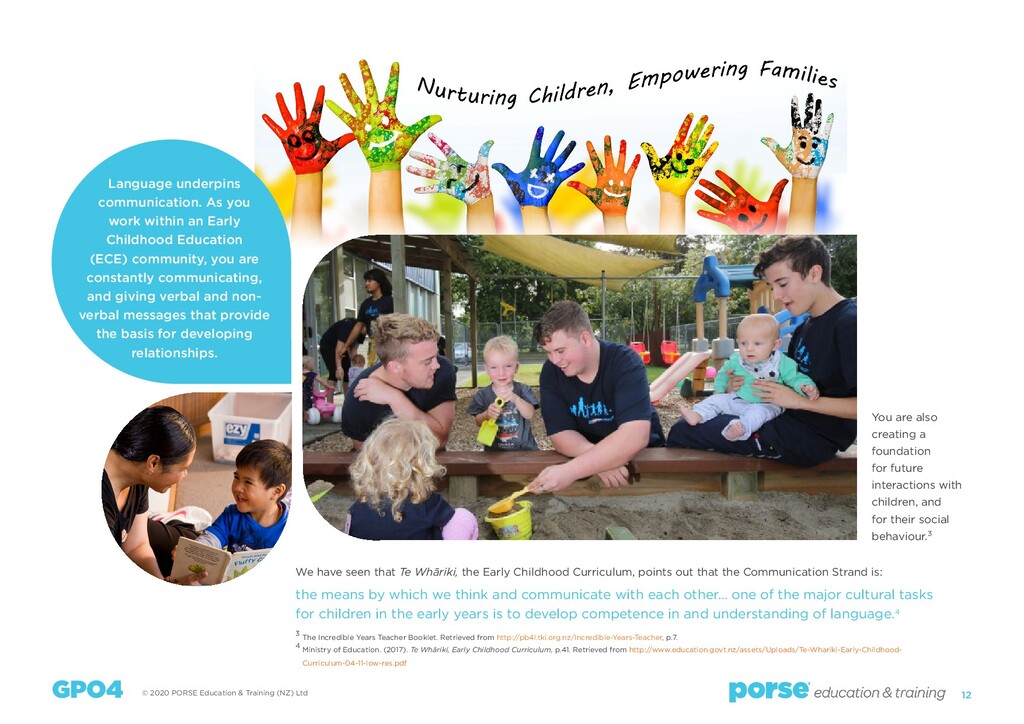
Language underpins communication. As you work within an Early Childhood Education (ECE) community, you are constantly communicating, and giving verbal and non- verbal messages that provide the basis for developing relationships. 3 The Incredible Years Teacher Booklet. Retrieved from http://pb4l.tki.org.nz/Incredible-Years-Teacher, p.7. 4 Ministry of Education. (2017). Te Whāriki, Early Childhood Curriculum, p.41. Retrieved from http://www.education.govt.nz/assets/Uploads/Te-Whariki-Early-Childhood- Curriculum-04-11-low-res.pdf We have seen that Te Whāriki, the Early Childhood Curriculum, points out that the Communication Strand is: the means by which we think and communicate with each other… one of the major cultural tasks for children in the early years is to develop competence in and understanding of language.4 You are also creating a foundation for future interactions with children, and for their social behaviour.3
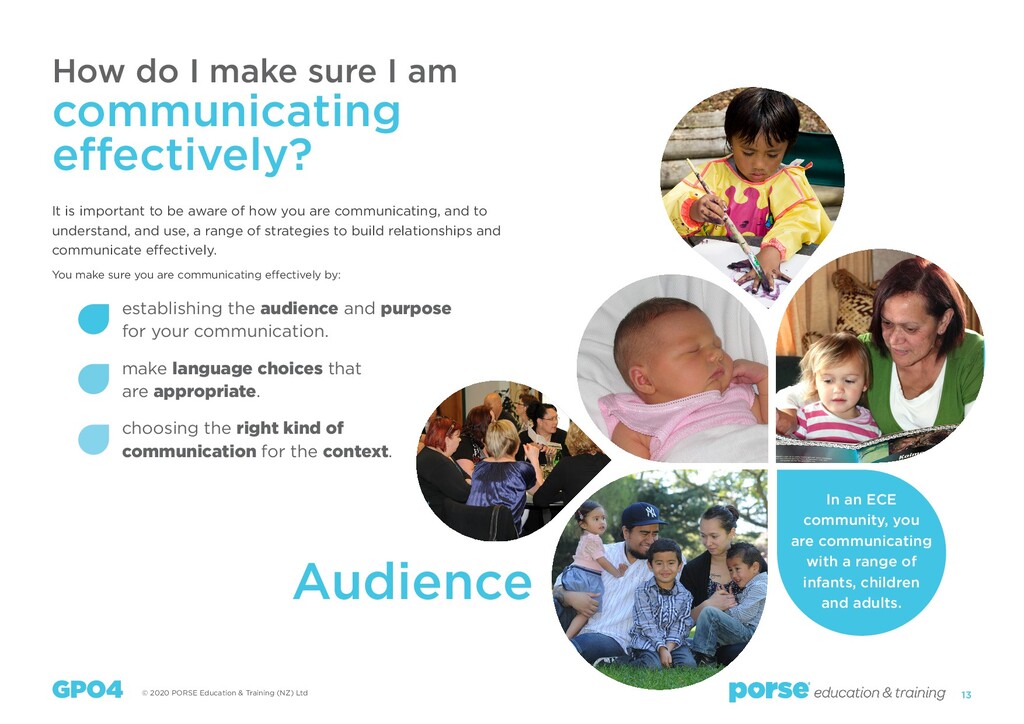
How do I make sure I am communicating effectively? It is important to be aware of how you are communicating, and to understand, and use, a range of strategies to build relationships and communicate effectively. You make sure you are communicating effectively by: establishing the audience and purpose for your communication. make language choices that are appropriate. choosing the right kind of communication for the context. In an ECE community, you are communicating with a range of infants, children and adults. Audience
Purpose The purpose of any communication, together with the person, group or organisation that is your audience, decides how you are going to frame your communication, for example: You would use more formal language, usually structured in sentences, if you were addressing a parent group in your ECE community: It is wonderful to see the support we have here for this exciting new programme. It will help you to learn about emotional regulation and help your child… When we look at how our children’s language develops, we need to take into account… We look forward to having your feedback on the changes we are proposing to the timings of our sessions. PDF 16 Staff Directory BLOG WIKI
Speaking You would use less formal language, often structured in fragments, if you were telling a parent about their child’s day: Yes, Jared had a great day outside - water play and on the slide, you know – his favourites… and he ate all his lunch… Woo hoo! As you know, Amy just loves bags at the moment - carries them around - so funny today - filled a bag with books… then sat on a beanbag with Nikau, and they looked through them together… Has Maia told you about the strawberries? I thought they would never get ripe enough to eat - but today was the day, and they tasted good! At last, after all that watering!
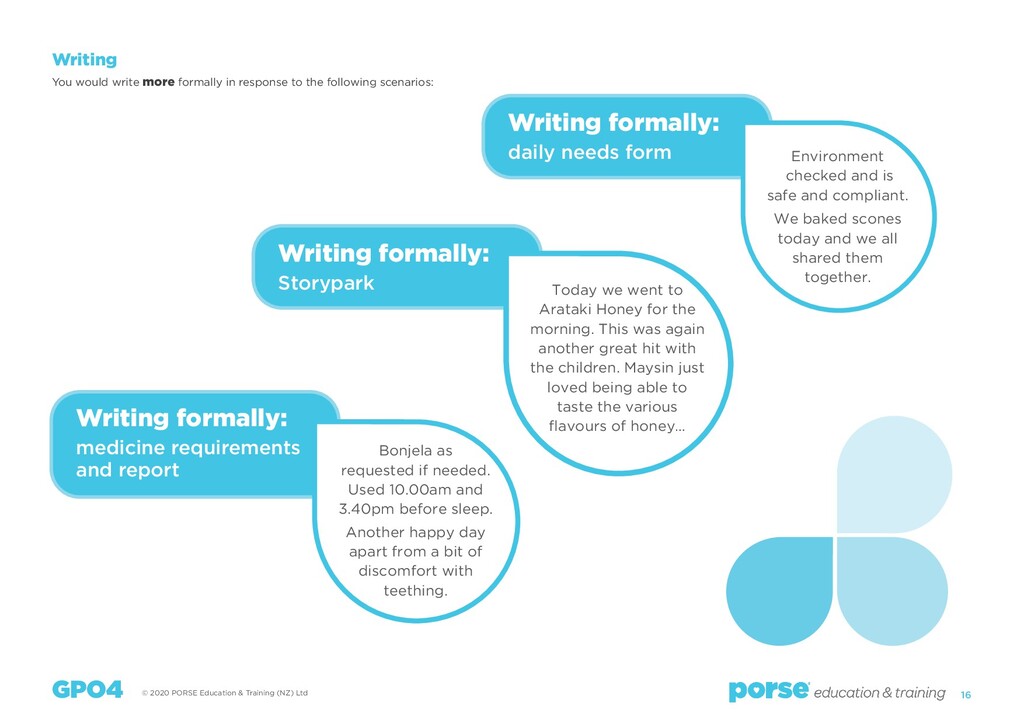
Writing You would write more formally in response to the following scenarios: Writing formally: daily needs form Environment checked and is safe and compliant. We baked scones today and we all shared them together. Writing formally: Storypark Today we went to Arataki Honey for the morning. This was again another great hit with the children. Maysin just loved being able to taste the various flavours of honey… Writing formally: medicine requirements and report Bonjela as requested if needed. Used 10.00am and 3.40pm before sleep. Another happy day apart from a bit of discomfort with teething.
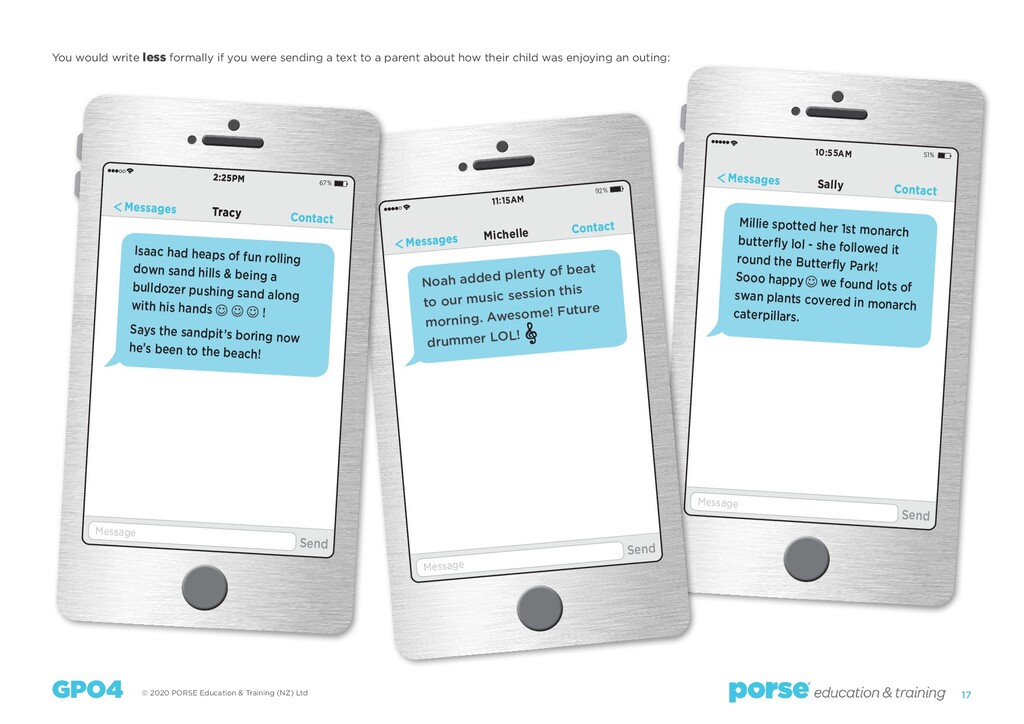
51% Message Send 10:55AM Sally Millie spotted her 1st monarch butterfly lol - she followed it round the Butterfly Park! Sooo happy we found lots of swan plants covered in monarch caterpillars. 92% Message Send 11:15AM Michelle Noah added plenty of beat to our music session this morning. Awesome! Future drummer LOL! Isaac had heaps of fun rolling down sand hills & being a bulldozer pushing sand along with his hands ! Says the sandpit’s boring now he’s been to the beach! 67% Message Send You would write less formally if you were sending a text to a parent about how their child was enjoying an outing:
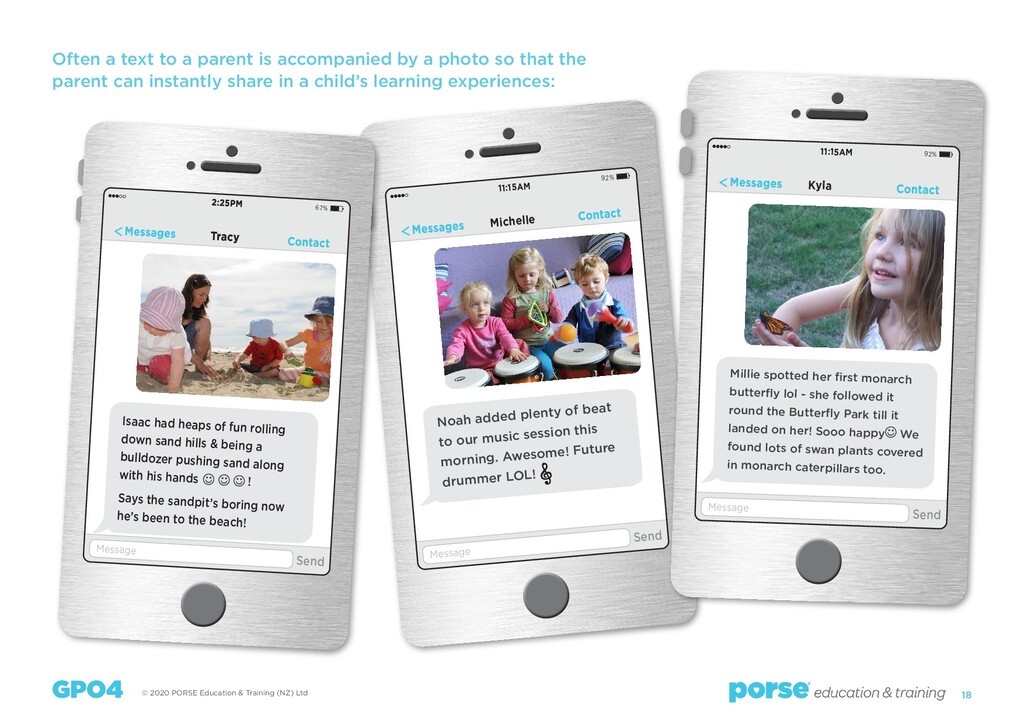
92% Message Send 11:15AM Michelle Noah added plenty of beat to our music session this morning. Awesome! Future drummer LOL! Isaac had heaps of fun rolling down sand hills & being a bulldozer pushing sand along with his hands ! Says the sandpit’s boring now he’s been to the beach! 67% Message Send Often a text to a parent is accompanied by a photo so that the parent can instantly share in a child’s learning experiences: 92% Message Send 11:15AM Kyla Millie spotted her first monarch butterfly lol - she followed it round the Butterfly Park till it landed on her! Sooo happy We found lots of swan plants covered in monarch caterpillars too.
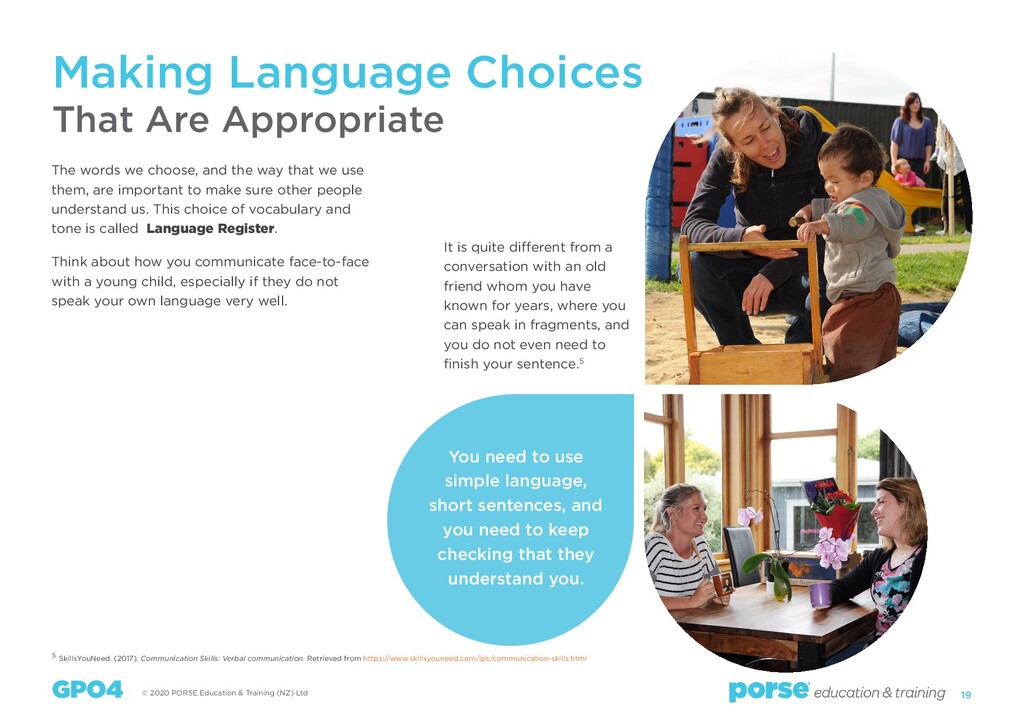
Making Language Choices That Are Appropriate The words we choose, and the way that we use them, are important to make sure other people understand us. This choice of vocabulary and tone is called Language Register. Think about how you communicate face-to-face with a young child, especially if they do not speak your own language very well. It is quite different from a conversation with an old friend whom you have known for years, where you can speak in fragments, and you do not even need to finish your sentence.5 5 SkillsYouNeed. (2017). Communication Skills: Verbal communication. Retrieved from https://www.skillsyouneed.com/ips/communication-skills.html You need to use simple language, short sentences, and you need to keep checking that they understand you.
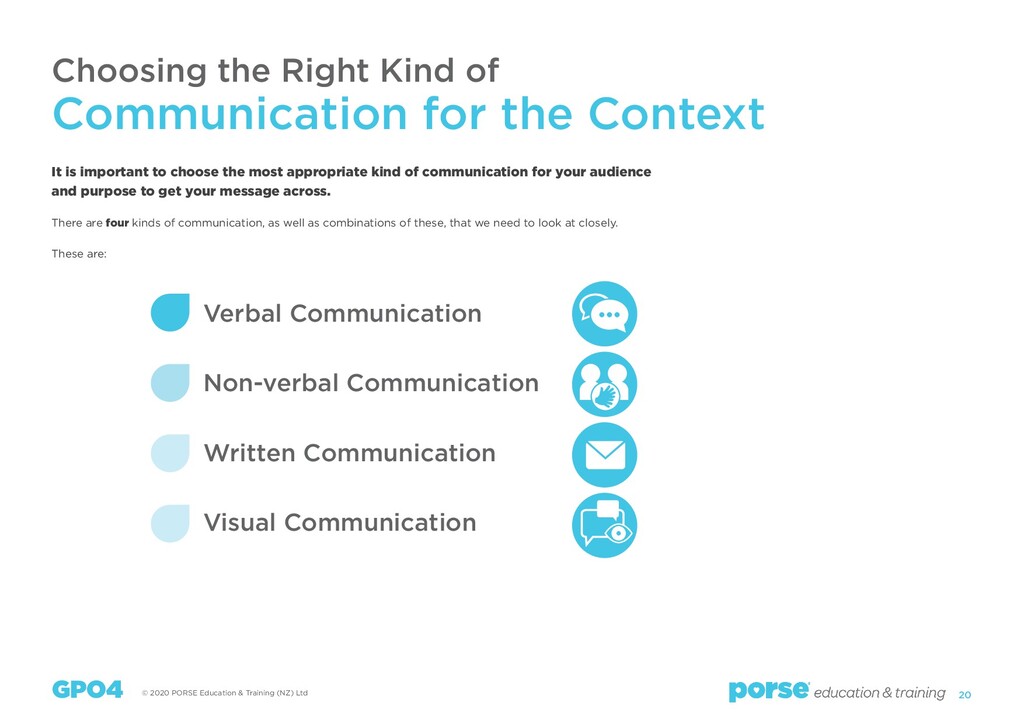
Choosing the Right Kind of Communication for the Context It is important to choose the most appropriate kind of communication for your audience and purpose to get your message across. There are four kinds of communication, as well as combinations of these, that we need to look at closely. These are: Verbal Communication Non-verbal Communication Written Communication Visual Communication
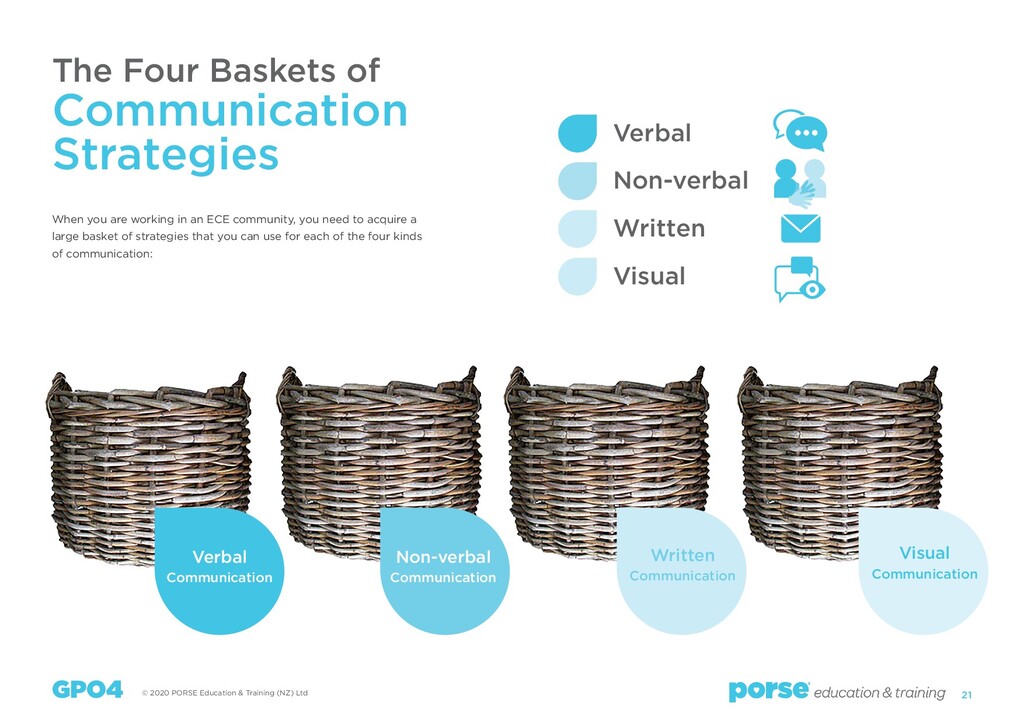
The Four Baskets of Communication Strategies When you are working in an ECE community, you need to acquire a large basket of strategies that you can use for each of the four kinds of communication: Verbal Non-verbal Written Visual Written Communication Visual Communication Non-verbal Communication Verbal Communication
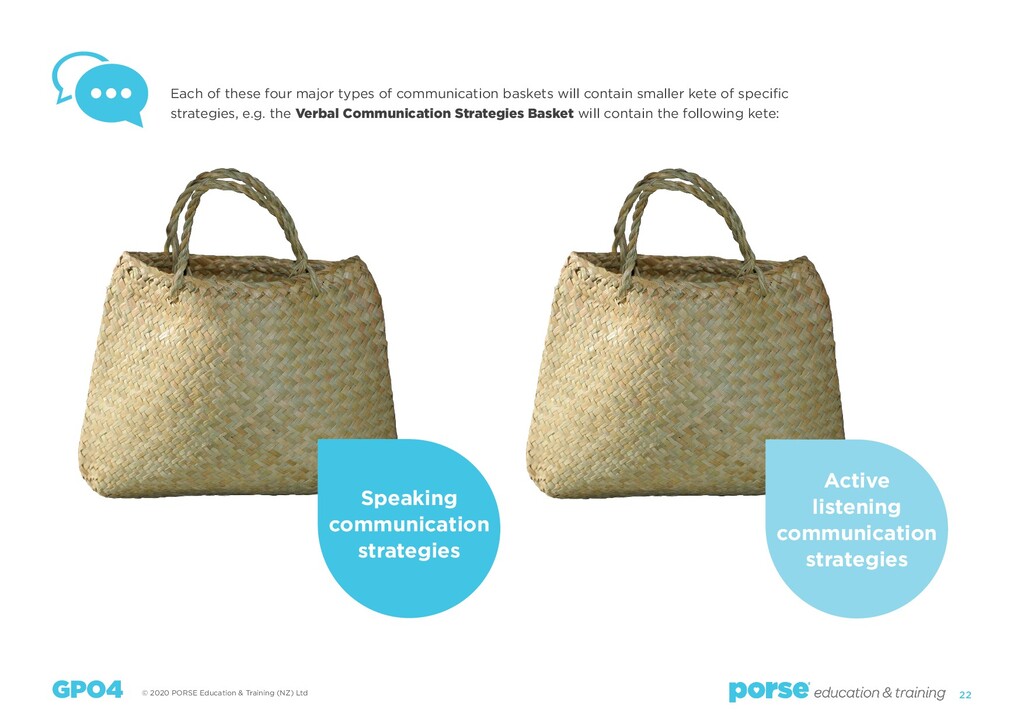
Speaking communication strategies Active listening communication strategies Each of these four major types of communication baskets will contain smaller kete of specific strategies, e.g. the Verbal Communication Strategies Basket will contain the following kete:


 mutomasa
 ssmedikasda
 dragon2
 juanmartin2026
 auctria
 signer
 ainischool
 moriyuya
 frievea
 akiraasano
 naoji_taniguchi_ksk_0827
 yoshimura_datam
 varn
 aleyda
 joshbly
 skipperchong
 popppiees
 lauravandoore
 charlesmeaden
 mfonobong
 eileencodes
 jacobian
 holman