Upgrade to Pro — share decks privately, control downloads, hide ads and more …

Abstract Machines for Great Good #railsclub14

Avatar for epicmonkey epicmonkey
September 27, 2014

Abstract Machines for Great Good #railsclub14

Space. It seems to go on and on forever. But then you get to the end and the gorilla starts throwing barrels at you.

So, my charming, I invite you to my Ultimate Abstract Space Zoo, and to prove it I will show you a spherical cow that jumps over the Moon, and then (no cheating!) functional programming with Bananas, Lenses, and Barbed Wire.

I believe that Lambda is an essential part for the symbolic computations that threats both functions and variables as first-class citizens, so this talk will briefly run through basic Lambda calculus, specifically making a stop at nameless version suitable for the machine implementation, and then will continue to describe various Lambda calculus abstract machines that strongly influenced most of today's programming paradigms.

Please enter. Come forward. Close the gates. Dear visitors, it is my great pleasure to welcome you to my humble Zoo.

We will soon abstract from programming languages, whether imperative or functional, from architectures and will build our own lunar lander and abstract Lambda machine.

Avatar for epicmonkey

epicmonkey

September 27, 2014

Other Decks in Programming

Transcript

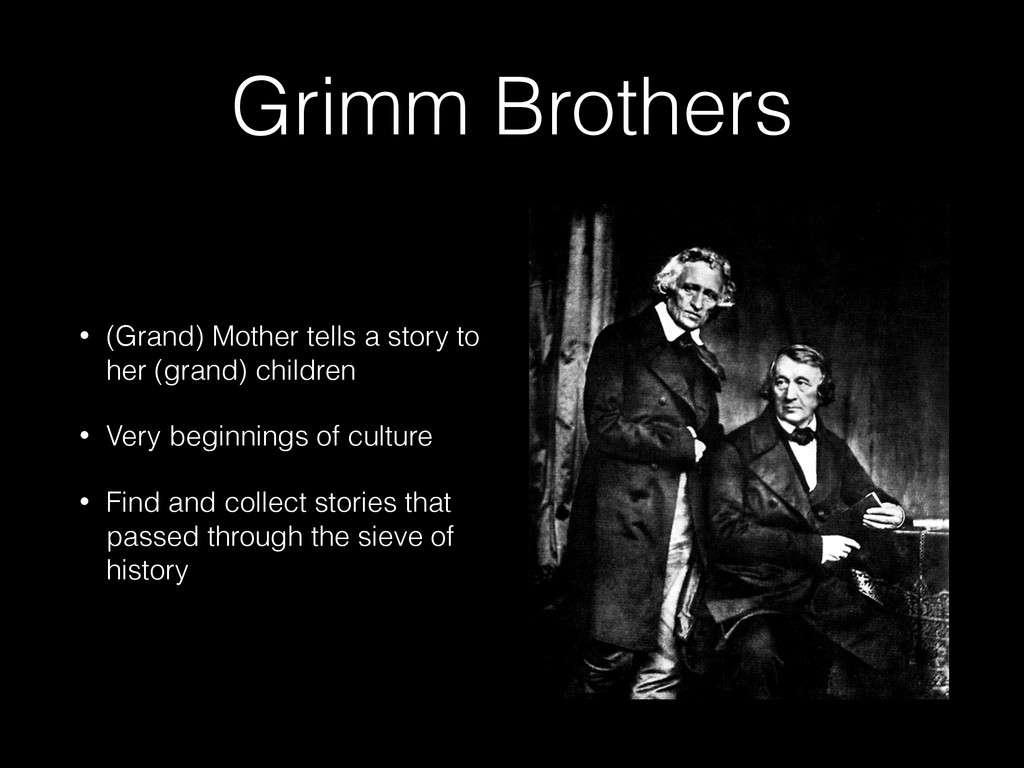
  1. Grimm Brothers • (Grand) Mother tells a story to her

    (grand) children • Very beginnings of culture • Find and collect stories that passed through the sieve of history
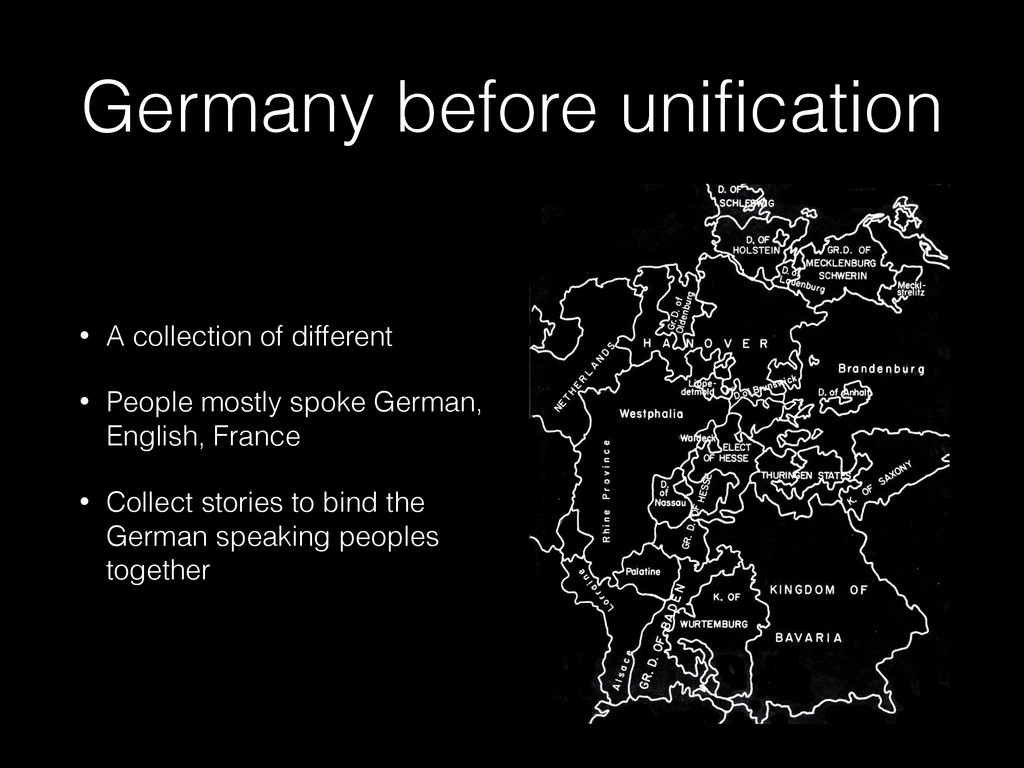
  2. Germany before unification • A collection of different • People

    mostly spoke German, English, France • Collect stories to bind the German speaking peoples together
  3. JFK Moon Speech We choose to go to the moon.

    We choose to go to the moon in this decade and do the other things, not because they are easy, but because they are hard, because that goal will serve to organize and measure the best of our energies and skills, because that challenge is one that we are willing to accept, one we are unwilling to postpone, and one which we intend to win, and the others, too.
  4. • 1920s: Birth of Combinatory Logic • Schonfinkel to eliminate

    bound variables • Briefly covered high order functions • Von Neumann's doctoral thesis on set theory • Curry's combinators History of Lambda Calculus
  5. • 1930s: Birth of Lambda calculus • Alonzo Church invented

    Lambda calculus (explicit formal convertion rules) • Representation of positive integers — Church numerals • Turing published first fixed-point combinator History of Lambda Calculus
  6. History of Lambda Calculus • 1940s and 1950s: • Research

    sort of is frozen, though - - - • Simple type theory • Weak reduction
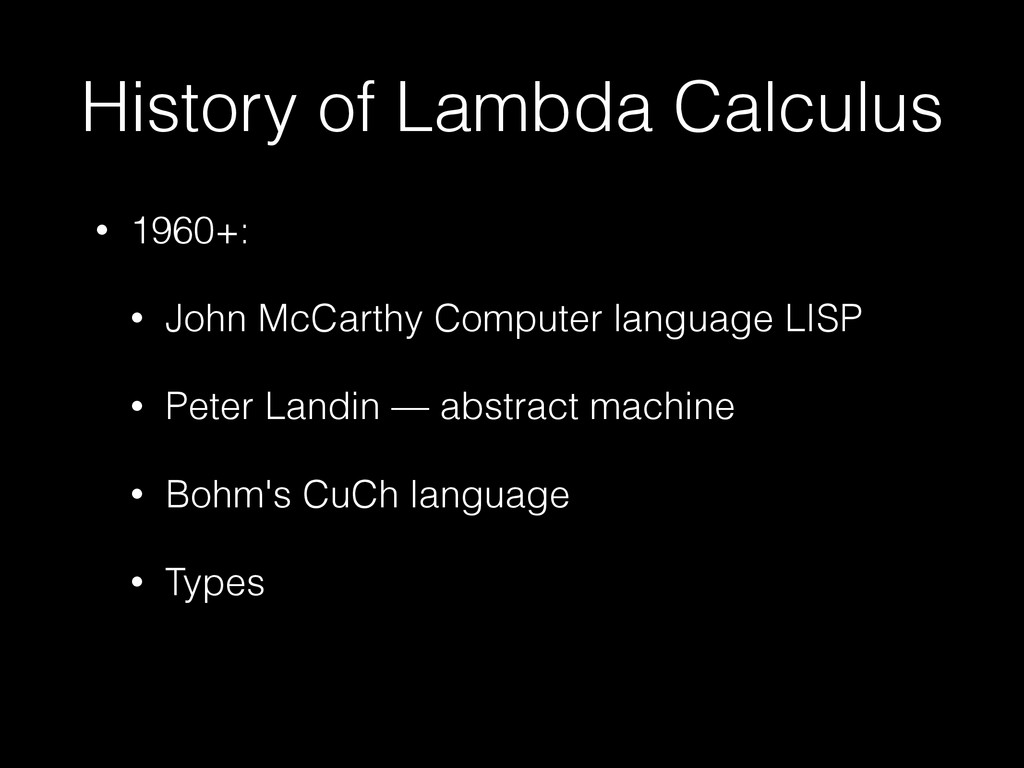
  7. History of Lambda Calculus • 1960+: • John McCarthy Computer

    language LISP • Peter Landin — abstract machine • Bohm's CuCh language • Types
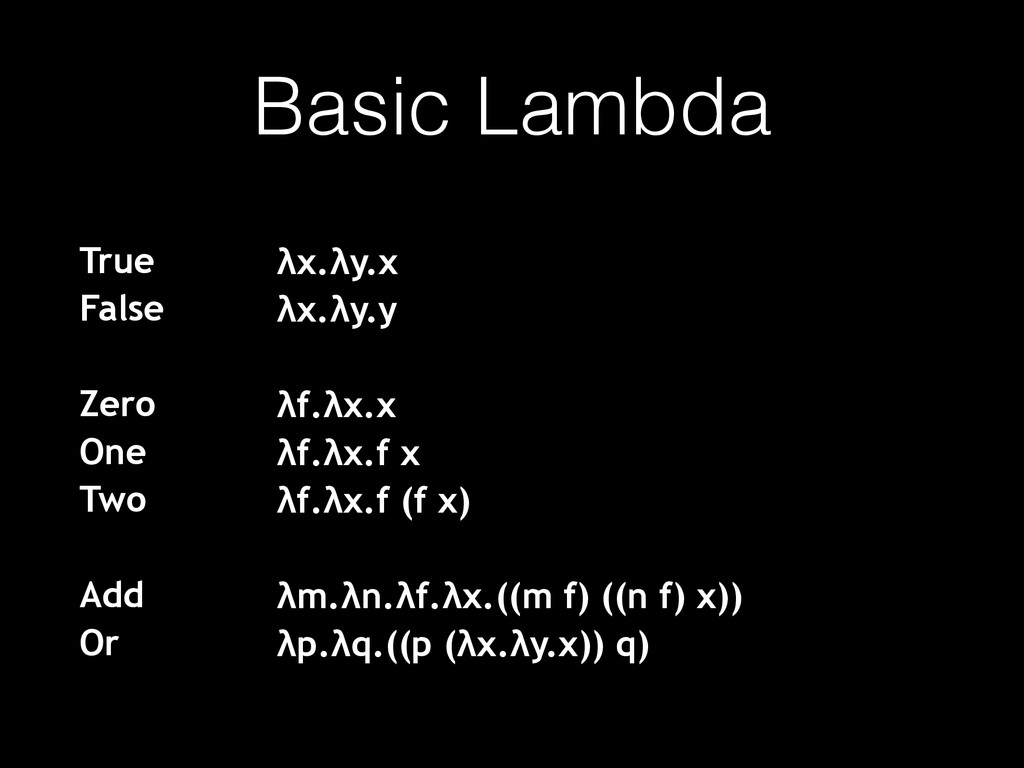
  8. λx.λy.x λx.λy.y λf.λx.x λf.λx.f x λf.λx.f (f x) λm.λn.λf.λx.((m f)

    ((n f) x)) λp.λq.((p (λx.λy.x)) q) Basic Lambda True False Zero One Two Add Or
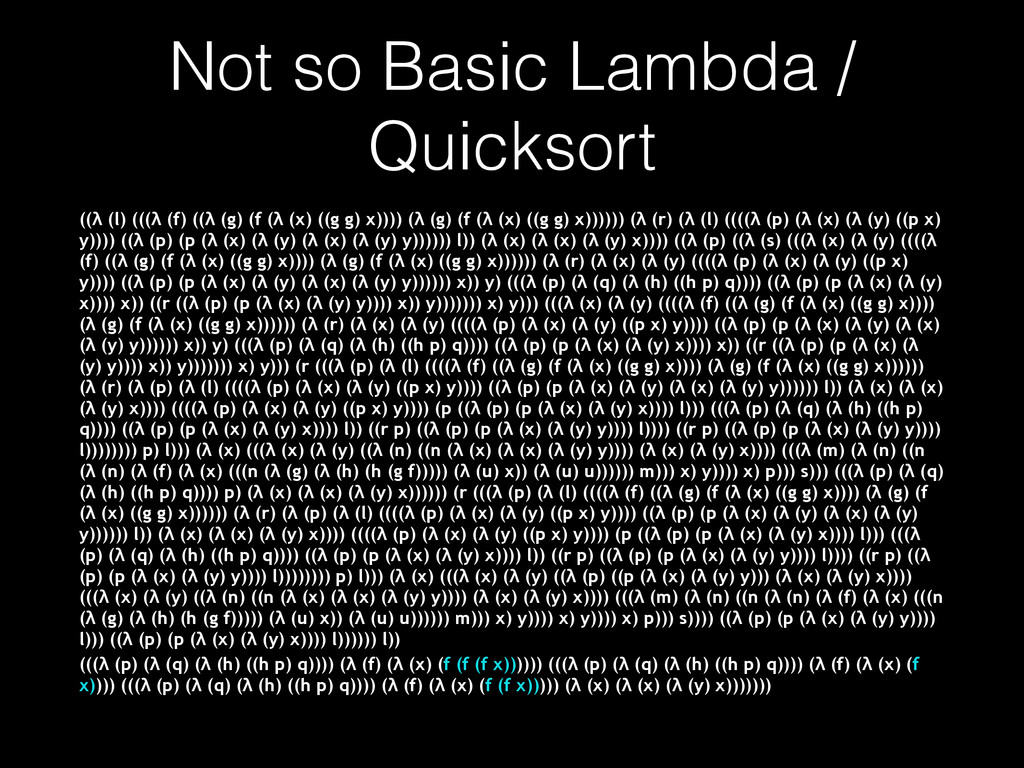
  9. ((λ (l) (((λ (f) ((λ (g) (f (λ (x) ((g

    g) x)))) (λ (g) (f (λ (x) ((g g) x)))))) (λ (r) (λ (l) ((((λ (p) (λ (x) (λ (y) ((p x) y)))) ((λ (p) (p (λ (x) (λ (y) (λ (x) (λ (y) y)))))) l)) (λ (x) (λ (x) (λ (y) x)))) ((λ (p) ((λ (s) (((λ (x) (λ (y) ((((λ (f) ((λ (g) (f (λ (x) ((g g) x)))) (λ (g) (f (λ (x) ((g g) x)))))) (λ (r) (λ (x) (λ (y) ((((λ (p) (λ (x) (λ (y) ((p x) y)))) ((λ (p) (p (λ (x) (λ (y) (λ (x) (λ (y) y)))))) x)) y) (((λ (p) (λ (q) (λ (h) ((h p) q)))) ((λ (p) (p (λ (x) (λ (y) x)))) x)) ((r ((λ (p) (p (λ (x) (λ (y) y)))) x)) y))))))) x) y))) (((λ (x) (λ (y) ((((λ (f) ((λ (g) (f (λ (x) ((g g) x)))) (λ (g) (f (λ (x) ((g g) x)))))) (λ (r) (λ (x) (λ (y) ((((λ (p) (λ (x) (λ (y) ((p x) y)))) ((λ (p) (p (λ (x) (λ (y) (λ (x) (λ (y) y)))))) x)) y) (((λ (p) (λ (q) (λ (h) ((h p) q)))) ((λ (p) (p (λ (x) (λ (y) x)))) x)) ((r ((λ (p) (p (λ (x) (λ (y) y)))) x)) y))))))) x) y))) (r (((λ (p) (λ (l) ((((λ (f) ((λ (g) (f (λ (x) ((g g) x)))) (λ (g) (f (λ (x) ((g g) x)))))) (λ (r) (λ (p) (λ (l) ((((λ (p) (λ (x) (λ (y) ((p x) y)))) ((λ (p) (p (λ (x) (λ (y) (λ (x) (λ (y) y)))))) l)) (λ (x) (λ (x) (λ (y) x)))) ((((λ (p) (λ (x) (λ (y) ((p x) y)))) (p ((λ (p) (p (λ (x) (λ (y) x)))) l))) (((λ (p) (λ (q) (λ (h) ((h p) q)))) ((λ (p) (p (λ (x) (λ (y) x)))) l)) ((r p) ((λ (p) (p (λ (x) (λ (y) y)))) l)))) ((r p) ((λ (p) (p (λ (x) (λ (y) y)))) l)))))))) p) l))) (λ (x) (((λ (x) (λ (y) ((λ (n) ((n (λ (x) (λ (x) (λ (y) y)))) (λ (x) (λ (y) x)))) (((λ (m) (λ (n) ((n (λ (n) (λ (f) (λ (x) (((n (λ (g) (λ (h) (h (g f))))) (λ (u) x)) (λ (u) u)))))) m))) x) y)))) x) p))) s))) (((λ (p) (λ (q) (λ (h) ((h p) q)))) p) (λ (x) (λ (x) (λ (y) x)))))) (r (((λ (p) (λ (l) ((((λ (f) ((λ (g) (f (λ (x) ((g g) x)))) (λ (g) (f (λ (x) ((g g) x)))))) (λ (r) (λ (p) (λ (l) ((((λ (p) (λ (x) (λ (y) ((p x) y)))) ((λ (p) (p (λ (x) (λ (y) (λ (x) (λ (y) y)))))) l)) (λ (x) (λ (x) (λ (y) x)))) ((((λ (p) (λ (x) (λ (y) ((p x) y)))) (p ((λ (p) (p (λ (x) (λ (y) x)))) l))) (((λ (p) (λ (q) (λ (h) ((h p) q)))) ((λ (p) (p (λ (x) (λ (y) x)))) l)) ((r p) ((λ (p) (p (λ (x) (λ (y) y)))) l)))) ((r p) ((λ (p) (p (λ (x) (λ (y) y)))) l)))))))) p) l))) (λ (x) (((λ (x) (λ (y) ((λ (p) ((p (λ (x) (λ (y) y))) (λ (x) (λ (y) x)))) (((λ (x) (λ (y) ((λ (n) ((n (λ (x) (λ (x) (λ (y) y)))) (λ (x) (λ (y) x)))) (((λ (m) (λ (n) ((n (λ (n) (λ (f) (λ (x) (((n (λ (g) (λ (h) (h (g f))))) (λ (u) x)) (λ (u) u)))))) m))) x) y)))) x) y)))) x) p))) s)))) ((λ (p) (p (λ (x) (λ (y) y)))) l))) ((λ (p) (p (λ (x) (λ (y) x)))) l)))))) l)) (((λ (p) (λ (q) (λ (h) ((h p) q)))) (λ (f) (λ (x) (f (f (f x)))))) (((λ (p) (λ (q) (λ (h) ((h p) q)))) (λ (f) (λ (x) (f x)))) (((λ (p) (λ (q) (λ (h) ((h p) q)))) (λ (f) (λ (x) (f (f x))))) (λ (x) (λ (x) (λ (y) x))))))) Not so Basic Lambda / Quicksort
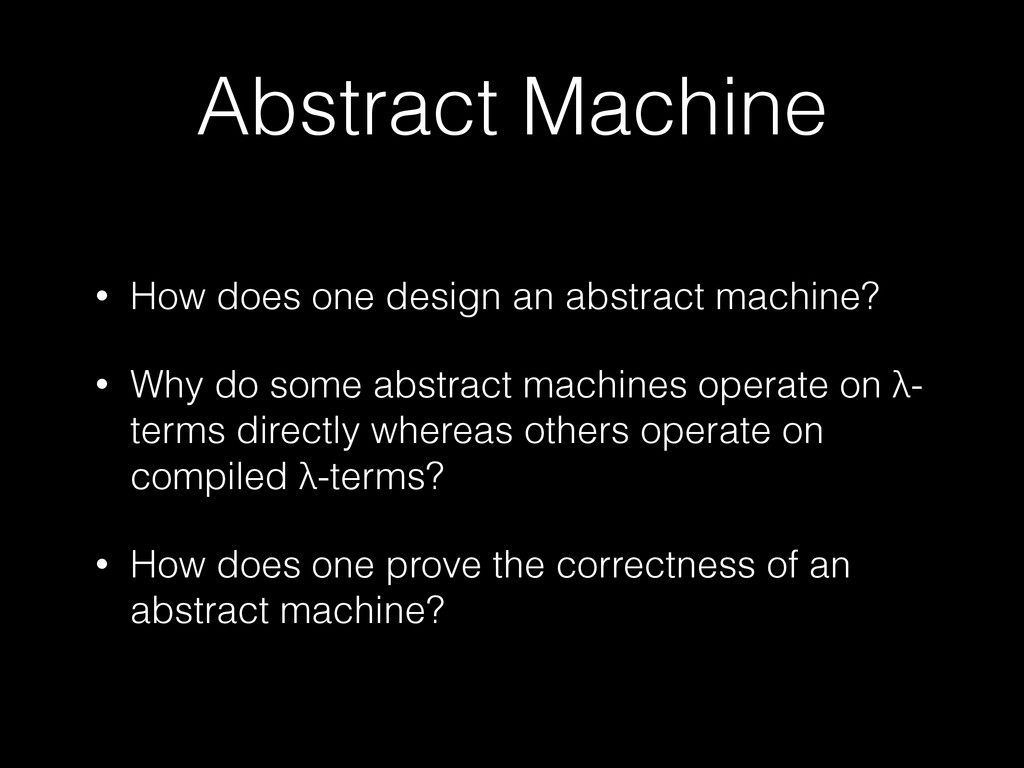
  10. Abstract Machine • How does one design an abstract machine?

    • Why do some abstract machines operate on λ- terms directly whereas others operate on compiled λ-terms? • How does one prove the correctness of an abstract machine?
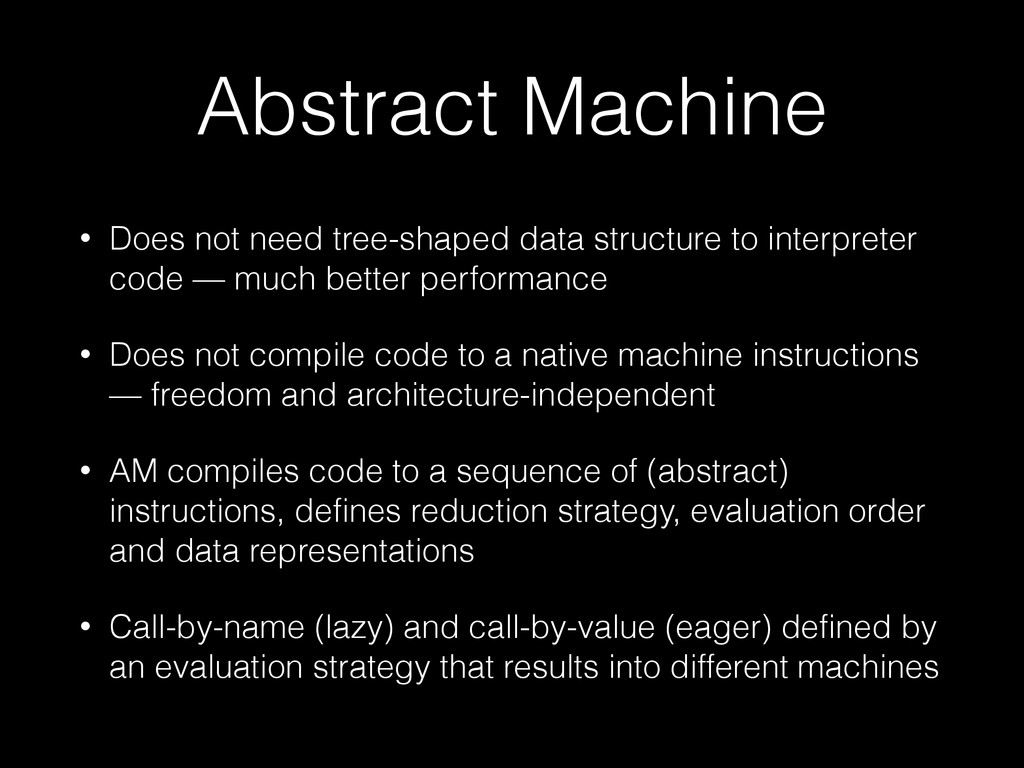
  11. Abstract Machine • Does not need tree-shaped data structure to

    interpreter code — much better performance • Does not compile code to a native machine instructions — freedom and architecture-independent • AM compiles code to a sequence of (abstract) instructions, defines reduction strategy, evaluation order and data representations • Call-by-name (lazy) and call-by-value (eager) defined by an evaluation strategy that results into different machines
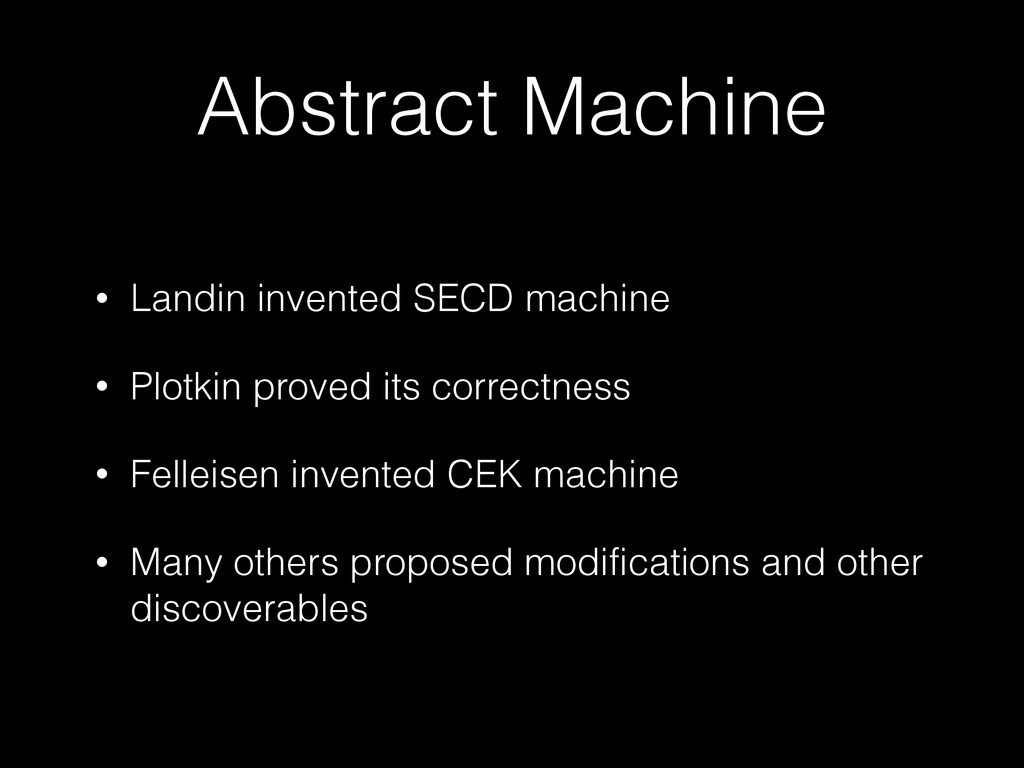
  12. Abstract Machine • Landin invented SECD machine • Plotkin proved

    its correctness • Felleisen invented CEK machine • Many others proposed modifications and other discoverables
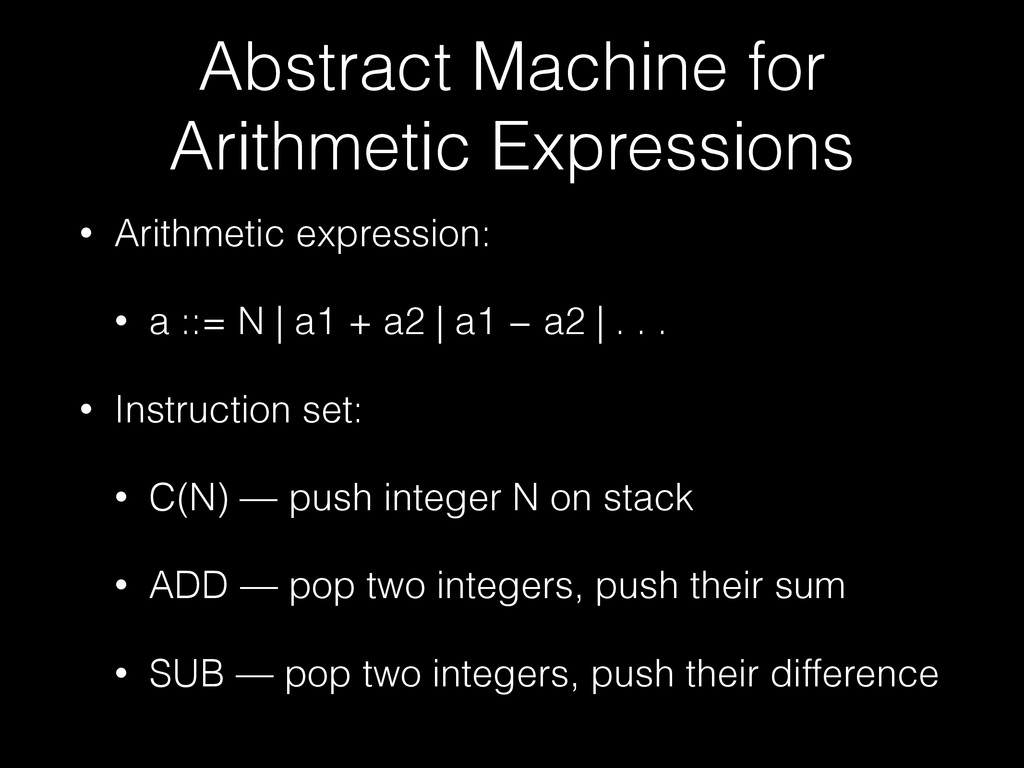
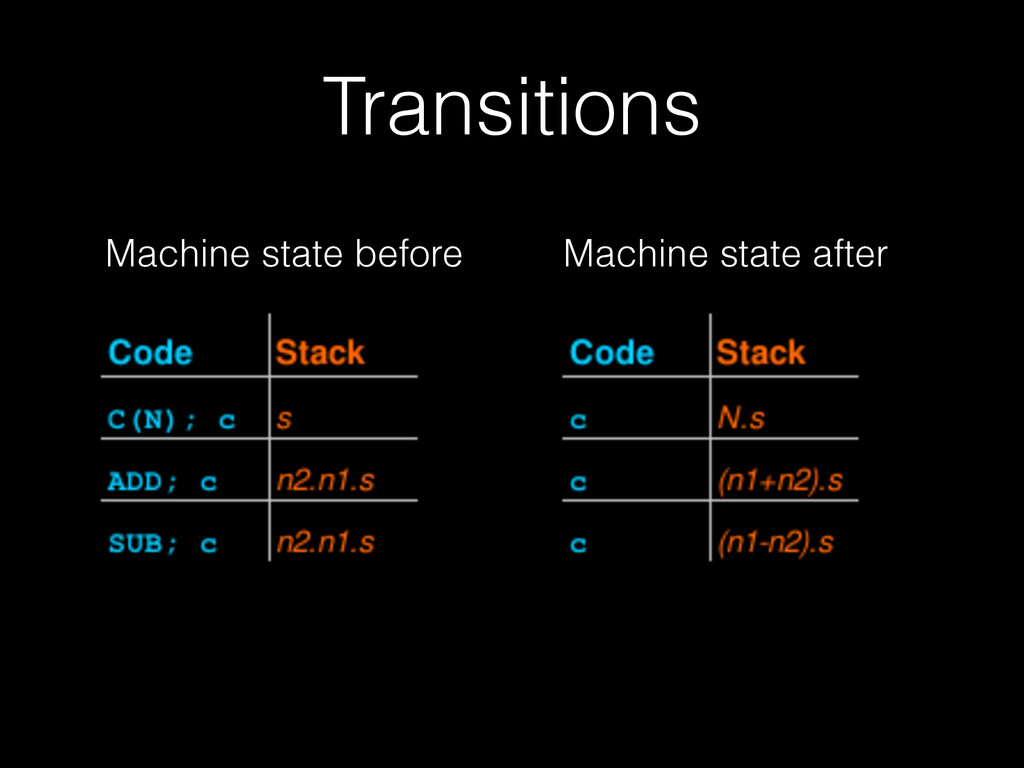
  13. Abstract Machine for Arithmetic Expressions • Arithmetic expression: • a

    ::= N | a1 + a2 | a1 − a2 | . . . • Instruction set: • C(N) — push integer N on stack • ADD — pop two integers, push their sum • SUB — pop two integers, push their difference
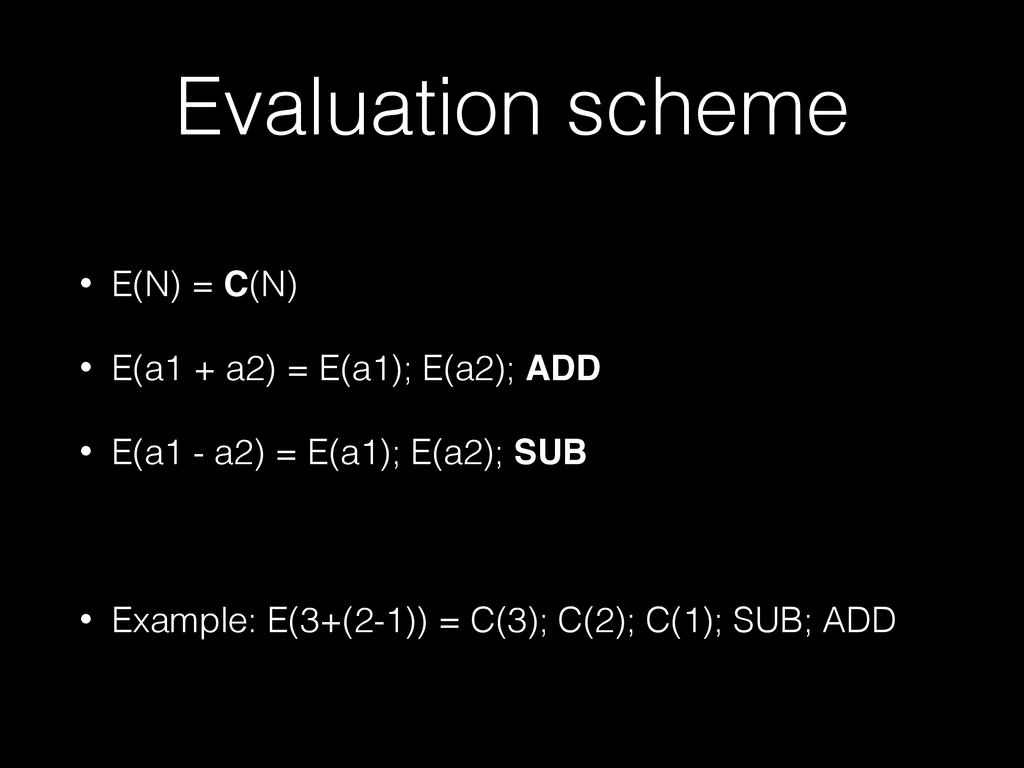
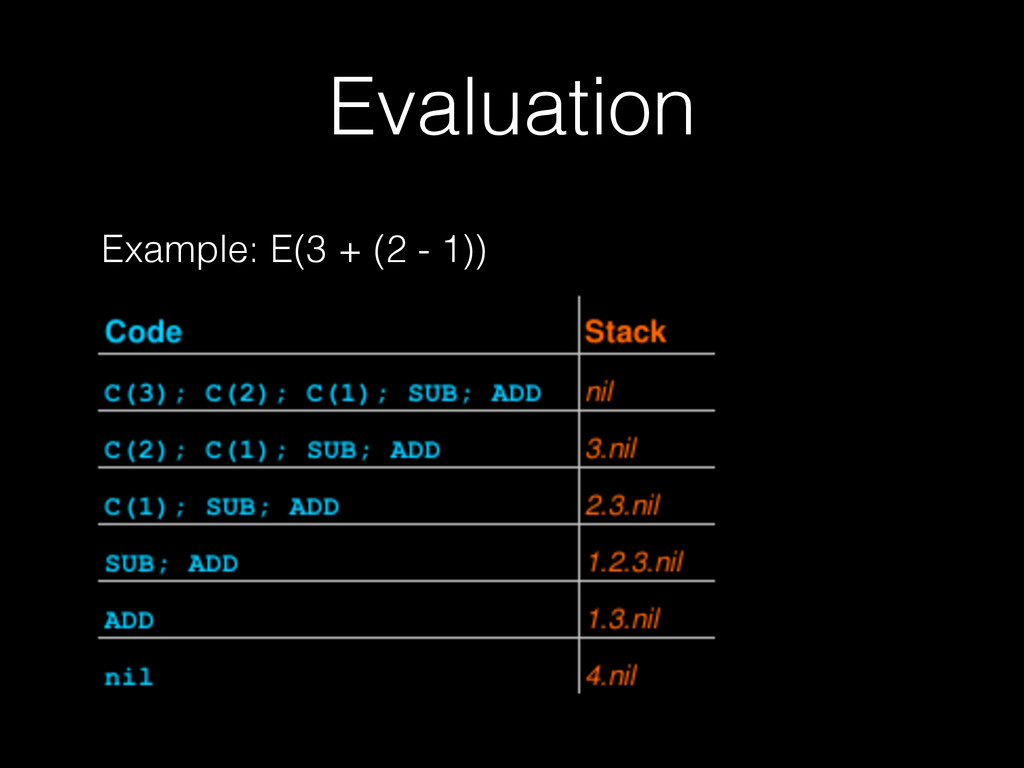
  14. Evaluation scheme • E(N) = C(N) • E(a1 + a2)

    = E(a1); E(a2); ADD • E(a1 - a2) = E(a1); E(a2); SUB • Example: E(3+(2-1)) = C(3); C(2); C(1); SUB; ADD
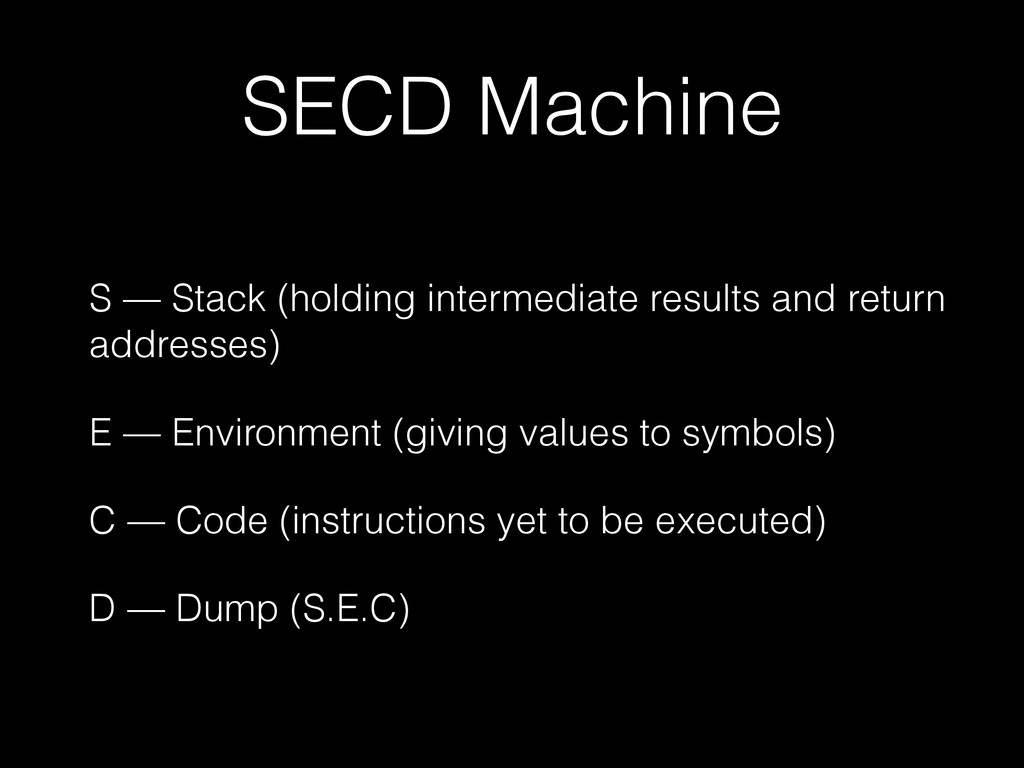
  15. SECD Machine S — Stack (holding intermediate results and return

    addresses) E — Environment (giving values to symbols) C — Code (instructions yet to be executed) D — Dump (S.E.C)
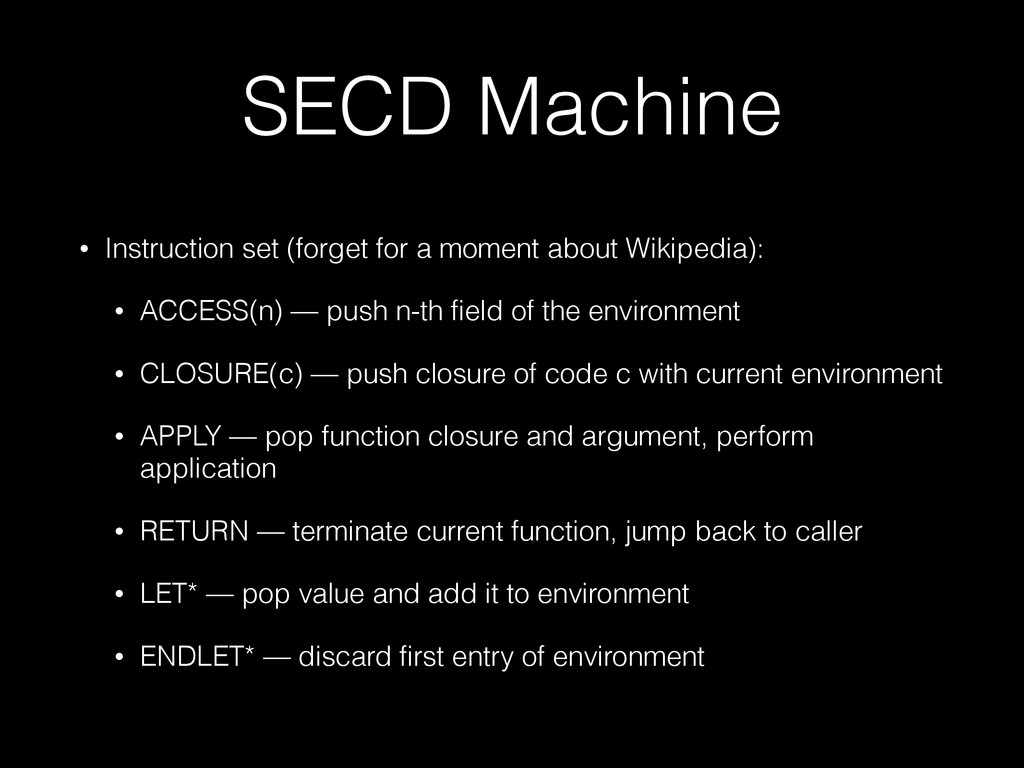
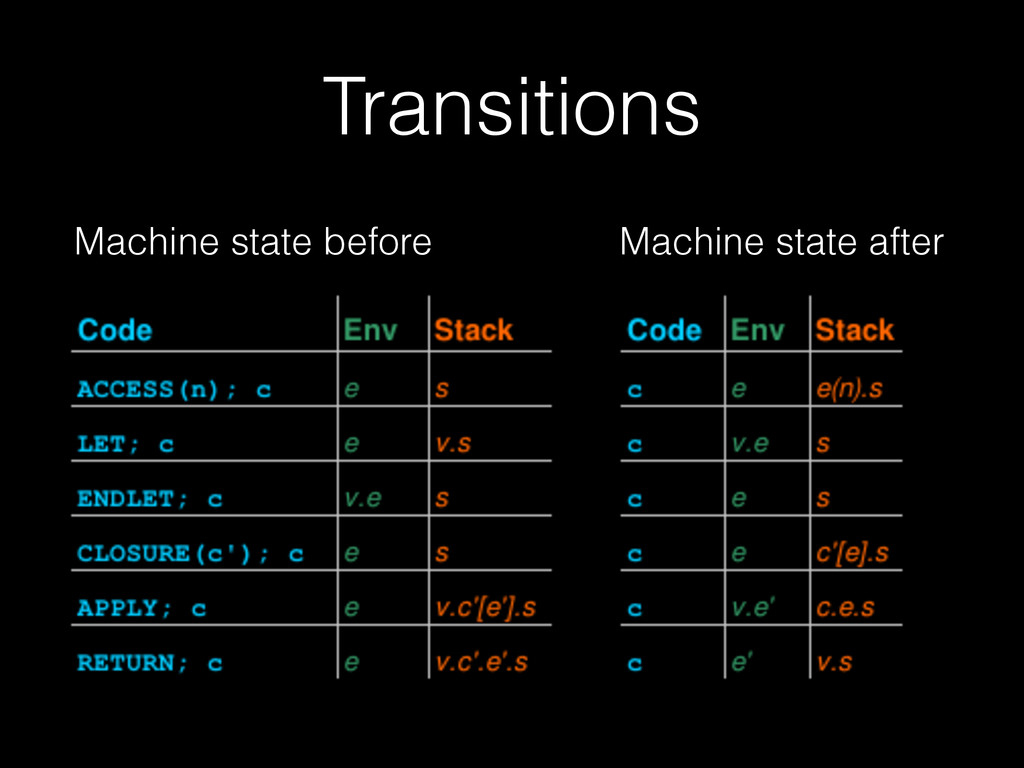
  16. SECD Machine • Instruction set (forget for a moment about

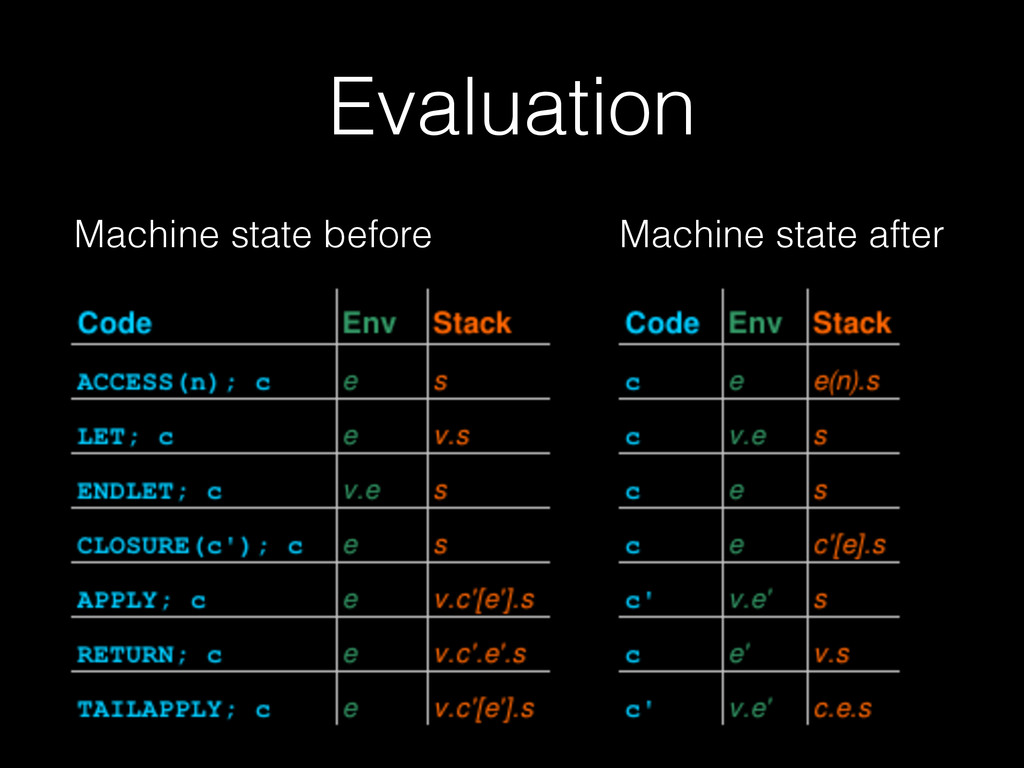
    Wikipedia): • ACCESS(n) — push n-th field of the environment • CLOSURE(c) — push closure of code c with current environment • APPLY — pop function closure and argument, perform application • RETURN — terminate current function, jump back to caller • LET* — pop value and add it to environment • ENDLET* — discard first entry of environment
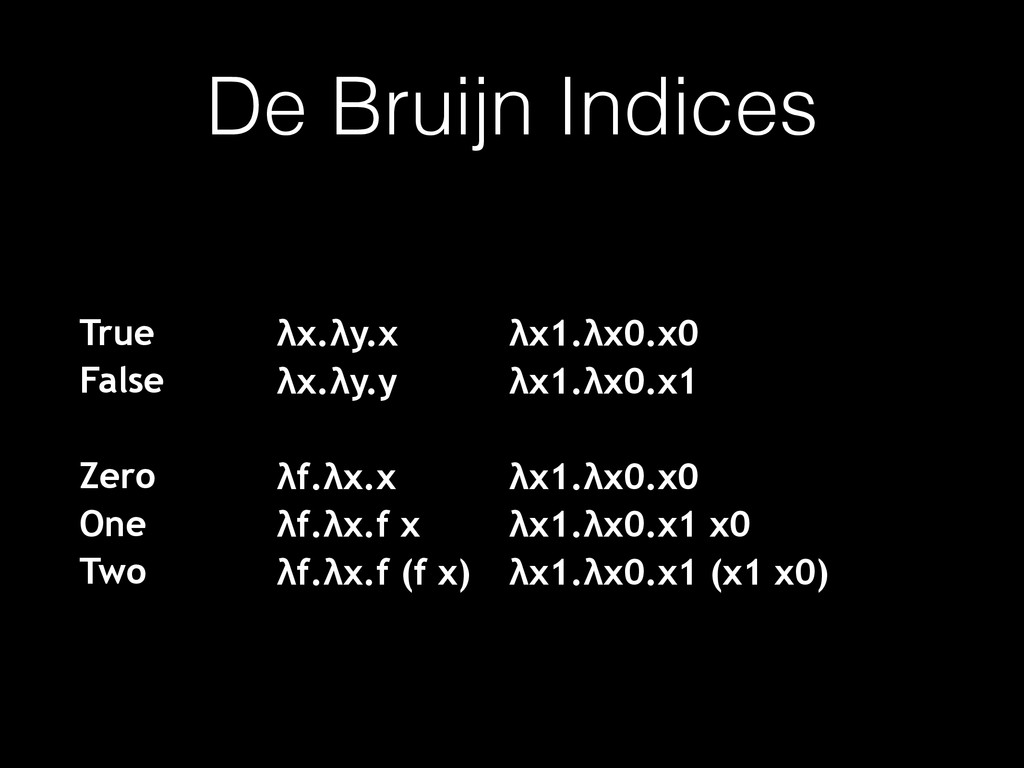
  17. De Bruijn Indices λx.λy.x λx.λy.y λf.λx.x λf.λx.f x λf.λx.f (f

    x) True False Zero One Two λx1.λx0.x0 λx1.λx0.x1 λx1.λx0.x0 λx1.λx0.x1 x0 λx1.λx0.x1 (x1 x0)
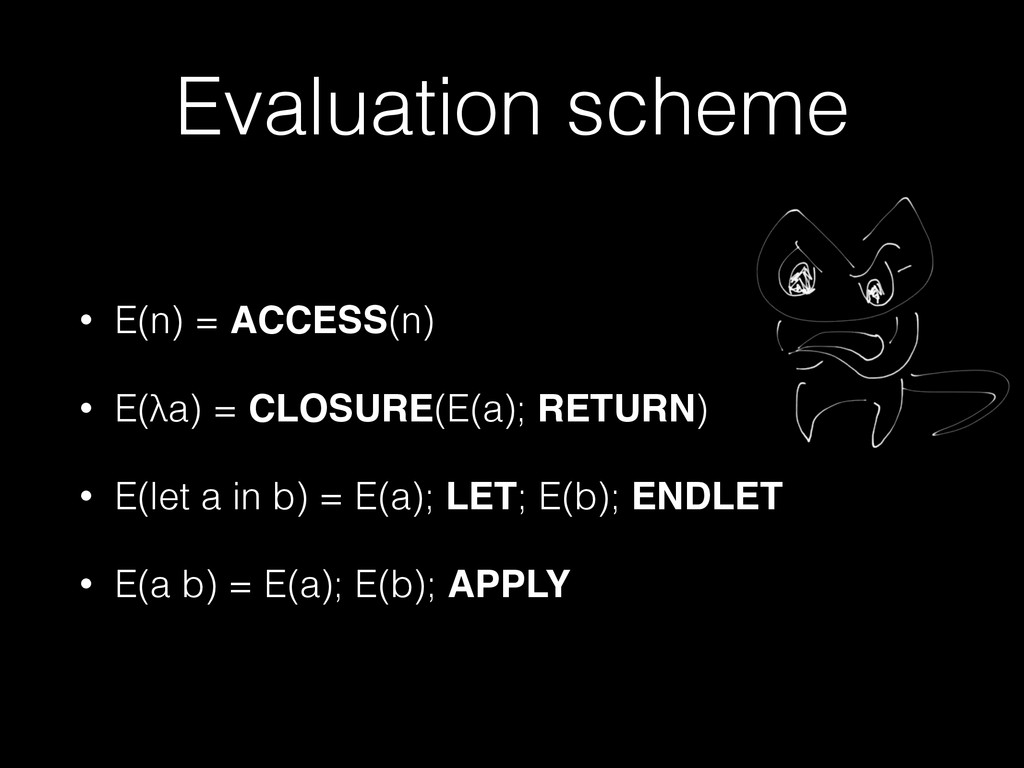
  18. Evaluation scheme • E(n) = ACCESS(n) • E(λa) = CLOSURE(E(a);

    RETURN) • E(let a in b) = E(a); LET; E(b); ENDLET • E(a b) = E(a); E(b); APPLY
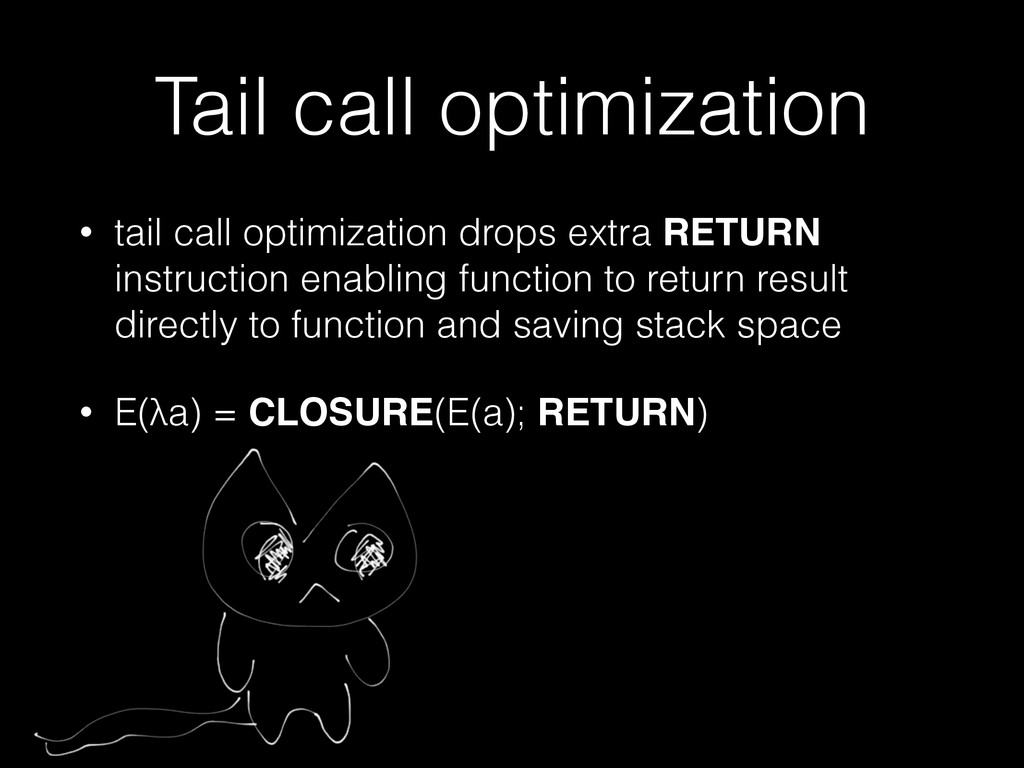
  19. Tail call optimization • tail call optimization drops extra RETURN

    instruction enabling function to return result directly to function and saving stack space • E(λa) = CLOSURE(E(a); RETURN)
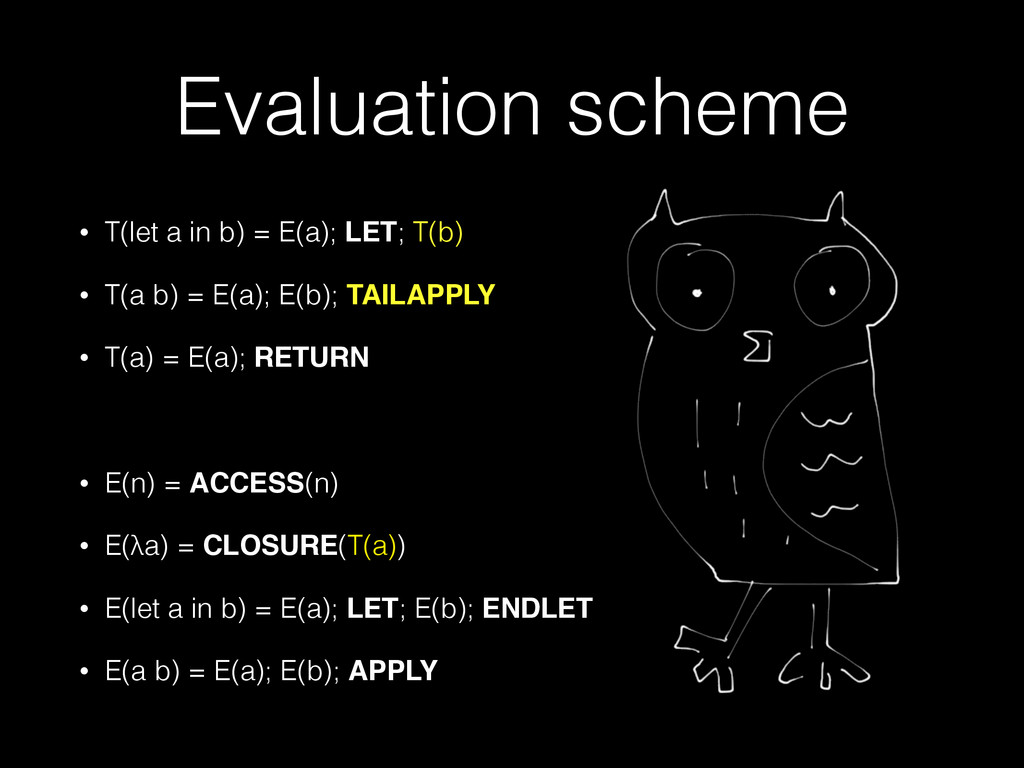
  20. Evaluation scheme • T(let a in b) = E(a); LET;

    T(b) • T(a b) = E(a); E(b); TAILAPPLY • T(a) = E(a); RETURN • E(n) = ACCESS(n) • E(λa) = CLOSURE(T(a)) • E(let a in b) = E(a); LET; E(b); ENDLET • E(a b) = E(a); E(b); APPLY
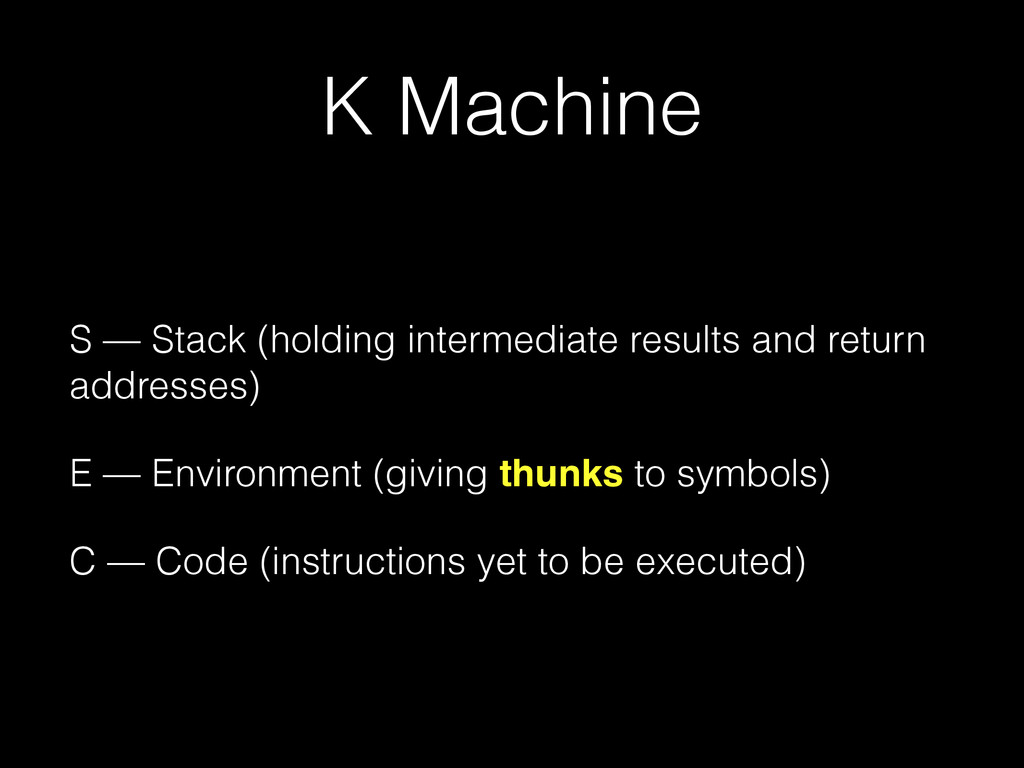
  21. K Machine S — Stack (holding intermediate results and return

    addresses) E — Environment (giving thunks to symbols) C — Code (instructions yet to be executed)
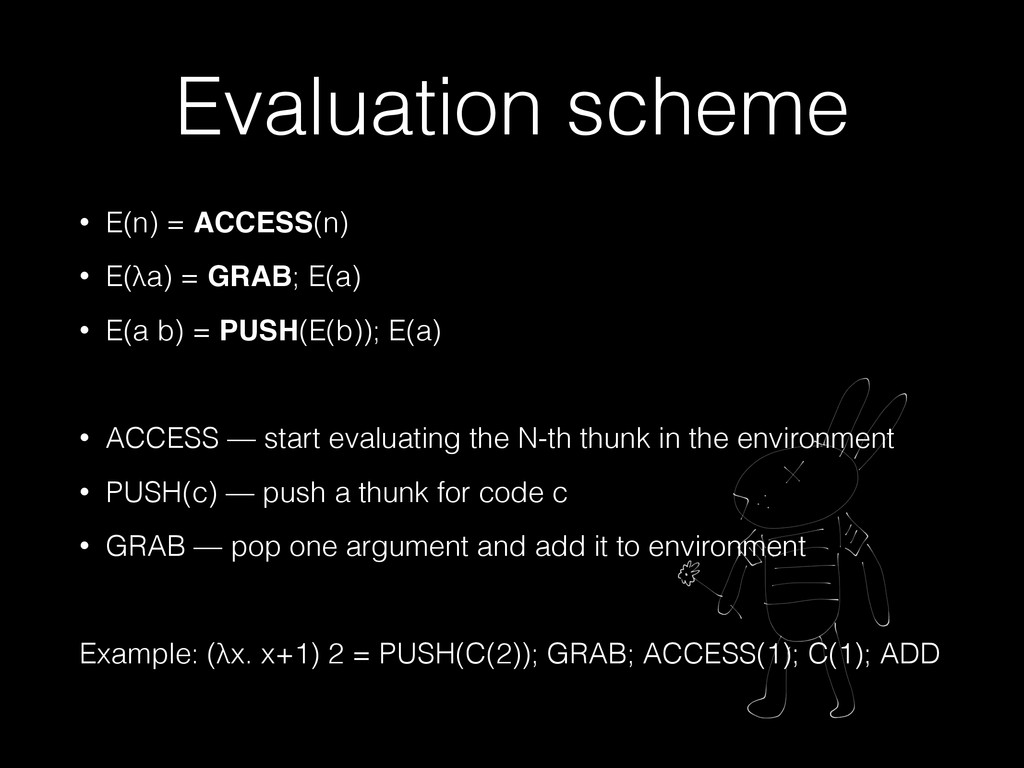
  22. Evaluation scheme • E(n) = ACCESS(n) • E(λa) = GRAB;

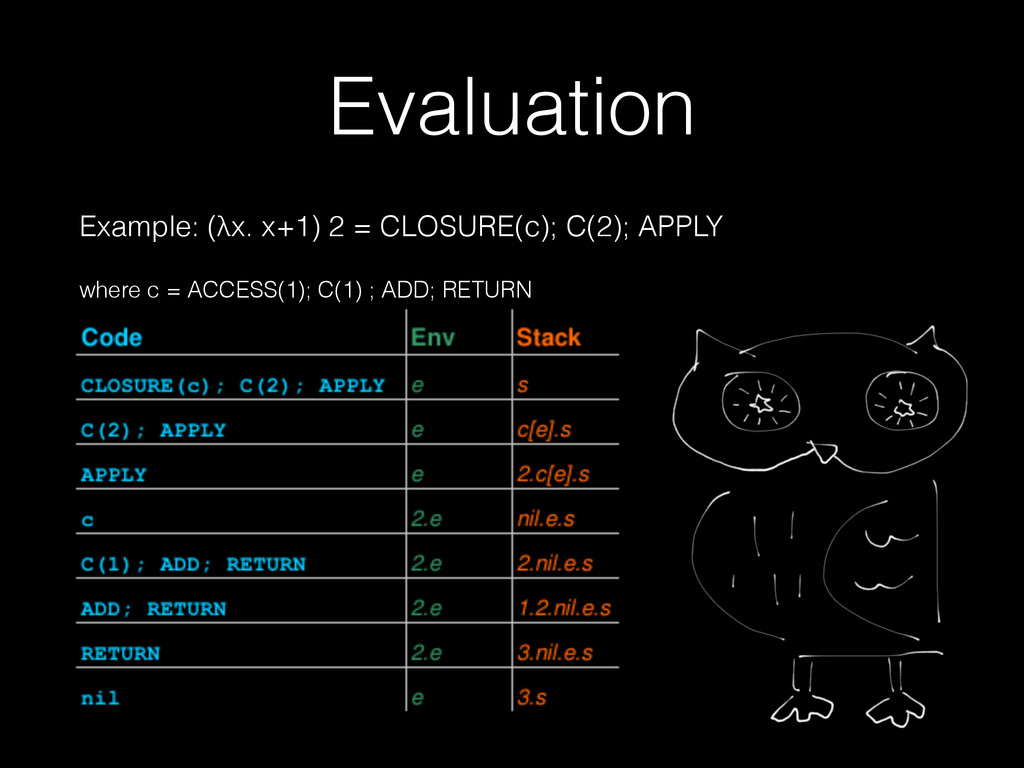
    E(a) • E(a b) = PUSH(E(b)); E(a) • ACCESS — start evaluating the N-th thunk in the environment • PUSH(c) — push a thunk for code c • GRAB — pop one argument and add it to environment Example: (λx. x+1) 2 = PUSH(C(2)); GRAB; ACCESS(1); C(1); ADD
  23. Yes

  24. Wanna know more? • ZAM-, B-, G- machines • BLC

    • Cata-, Hylo-, Ana- morphisms as a reduction • P-numerals vs Church version • Ultimately, Read T.S.Eliot