Upgrade to Pro — share decks privately, control downloads, hide ads and more …

Perspectives on Architecture

Avatar for Emily Sager Emily Sager
April 18, 2024
46

Perspectives on Architecture

Avatar for Emily Sager

Emily Sager

April 18, 2024

Transcript

  1. Introduction My thesis studies the connection between architecture and culture

    as they are interwoven through history. The research I have completed for Perspectives on Architecture explores different facets of this connection both domestically and abroad. Through my thesis I interpret the wider effects of sociocultural change influences the world in which we built, and how the environment in which we live shapes our lives and communities. In Perspectives on Architecture, I present two research-based essays on a variety of topics related to architectural history and resto- ration. Flipping the Masses looks at the changing nature of housing in the United States and how communities are affected by house flipping. Often, mass house flipping can be the cause or the result of gentrifica- tion. By researching these communities, I look at how historically rich areas are disproportionately altered. Looking abroad, Memories Within Concrete seeks to look at the remnants of a government long gone, and questions the ethical problems regarding revisionist history. By observ- ing the targeted destruction of brutalist buildings in the city of Prague, we observe the importance of how architecture is shaped by politics and the importance of preservation. By researching these two topics, we can view the way commu- nities are altered by social and political elements. Perhaps by gaining a better understanding of the ways in which history is contained within buildings and communities we can better understand how to approach them with due sensitivity. While houses will always be flipped and sold, an ideal approach would not sacrifice entire communities. Like- wise, brutalist buildings may stand as reminders to an imperfect polit- ical past, yet they are important nonetheless. By evaluating a series of buildings from Prague that have been at risk for demolition, or have already been demolished, we can see just how important they truly are. Perspectives on Architecture explores how a society reshapes itself through its buildings. 1
  2. Introduction There is likely no architectural style more polarizing than

    brutalism. This style is characterized by its imposing nature and blunt forms made from exposed material. By its aesthetic alone it has been viewed critically since its inception in the 1940’s. Though this style is regarded to have lost its popularity after the 1970s, its impact resounds still today in the infrastructure of Europe, where it gained the most popularity. The Czech Republic, formerly known as Czechoslovakia, is one of many European countries that has a complicated history with brutalism. Between 1948 and 1989, Czechoslovakia was led by a monolithic communist regime that ruled with a heavy hand. Much to the dissatisfaction of its citizens, the infrastructure of Czechoslovakia was heavily altered to the needs and desires of the communist party. Though the Velvet Revolution saw the end of the communist lead- ership in Czechoslovakia in 1989, its remnants remain in the Czech Republic through the imposing brutalist buildings. Brutalist architectural remains of the communist era have left Czech people today with a dilemma. This period is thought to be best forgotten by many such as the ordinary citizen or the Ministry of Culture. The presence of buildings created specifically by and for the past government that have a distinctly engineered and utilitarian style serve as constant reminders of a history that some believe should be left behind. Others view this time as a disturbing yet valid period of history that ought to be preserved like any other. This dichotomy is particularly visible in Prague, the political center of the Czech Repub- lic. Prague may be known for its rich mix of styles that have been con- structed together over the centuries, yet its involvement with brutalism is understated. Within this city, there are a multitude of brutalist build- ings that are in disrepair, are condemned, or have already been demol- ished. The ones that remain have a contested fate; should their brutalist character be preserved, or should they be changed to return the area to its pre-communist aesthetic? Despite its controversial history, the discriminant destruction of brutalist buildings in Prague is concerning. While some buildings will deteriorate past the point of saving and others may be necessary to remove for natural expansion, many cases 4
  3. of demolition are unnatural and have been actively fought against

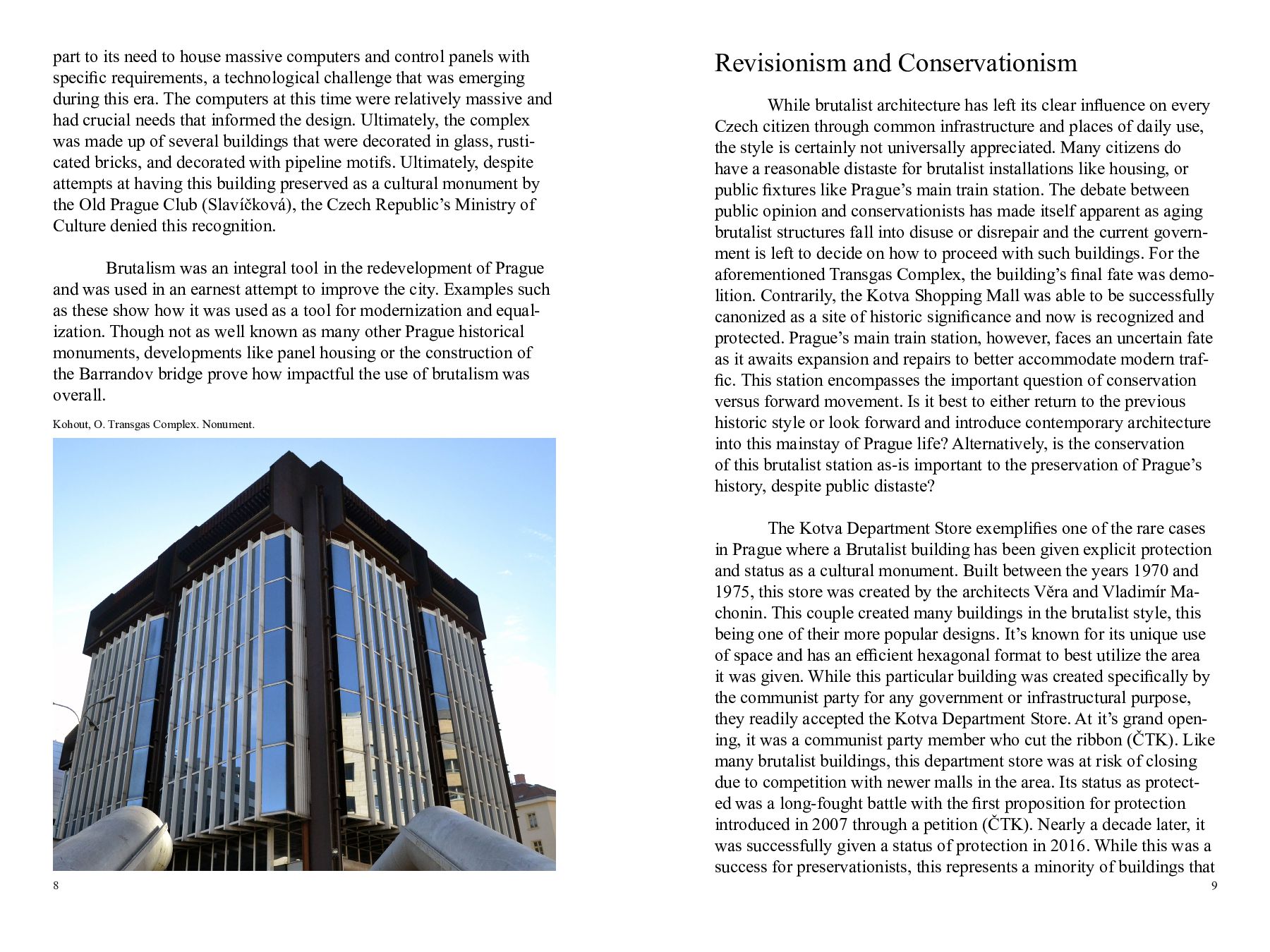
    by Prague citizens and historical clubs. Any type of historical erasure can be dangerous, especially when brutalism in the Czech Republic has such a clear connection to the past political party. Brutalism became the style promoted by communist govern- ments of the 1940s through the 1970s. While part of this was logis- tical, brutalist architecture aligned itself philosophically with the communist government at the time. It was honest, technologically adaptive, and equalizing when utilized residentially. For that reason, brutalism was used and promoted directly by the government and for government programs. While many architects were faithful to brutal- ism in their own right and were eager to support these programs, such as Zdeněk Zavřel, Ivo Oberstein (Roubal) and the well-known Věra and Vladimír Machonin (Nováková), it was the government-sponsored programs that spurred on the redevelopment of Prague. Some projects were purported by the Military Project Institute (Slavíčková), while others were headed by the Office of the Chief Architect, and the State Institute for Reconstruction of Heritage Towns and Objects (Roubal). These are just some examples of the organizations that were responsi- ble for refitting Prague for its new regime after it took power, and they demonstrate the government’s heavy hand in this process. The Czechoslovakian government’s influence heavily impact- ed residential quarters as well as commonly used infrastructure. One of the most influential decisions made by the government was the introduction of panel housing into the daily lives of Czechoslovakian citizens. Also known as “paneláks”, these buildings were able to be constructed efficiently and systematically. Prefabricated housing such as panel housing became incredibly common in central and eastern Europe, with panel housing built at this time still housing millions of Europeans to this day (Kubečková). These housing units were rev- olutionary in their technological advancements as they were highly engineered and efficient to create, in theory. Panel housing was perfect for government architects who idealized uniformity and equalization. It utilized standard amounts of materials and standardized construction plans, and in this way was ideal to replace and restructure neighbor- hoods to function more efficiently. The unfortunate cost was the poten- tial destruction of entire quarters, which was deemed necessary to erect these new buildings with the proper machinery. This form of housing proved to be more energy efficient than previous types of housing and is still lived in by at least 1/4th of all Czech citizens (Baker) despite its considerably short 50-year lifespan (Kubečková). While the public has a mixed perception of panel housing due to its political originals and brutalist aesthetic, it is a prime example of how deeply affected current citizens are still impacted by the past regime. Prague’s public infrastructure saw a massive overhaul under- neath the communist government at the time. The Barrandov Bridge, Prague’s most used highway, was constructed in a brutalist style over the course of five years from 1983-1988. (Mašínová). This bridge, like many brutalist structures, has fallen into relative disrepair despite its common use and daily importance. Neglected over time, it now re- quires deep structural revisions (Mena Report) and the possible style in which it will be created is unsure, if there will be any significant aesthetic changes at all. While not as identifiably brutalist as some buildings in the city, this bridge is symbolic of the past government’s preoccupation with modernization and technological advancement. While these previous examples demonstrate the influence of the government’s proposed architectural projects on the daily lives of civilians, many of its projects were for military or governmental use as well. The Transgas Complex was one of such buildings dedicated to technological advance and military use. This project was headed by the Military Institute, and its construction spanned a decade from 1966- 1976 during the height of brutalism in Czechoslovakia. It was repre- sentative of many of the ideals held by the communist party in both advancement, modernization, and representing a national identity built on such ideals. These ideas were reflected in its design, which was headed by the architects Ivo Loos, Jindřich Malátka, Václav Aulický, and Jan Eisenreich all of whom were employed by the institute. De- spite being a government complex, it was designed at a time of relative political ease and thus the architects were given more freedom in their work. The resulting complex was unique in its design, which emulated massive gas pipelines, which reflected its purpose as a control center for a transit pipeline (Slavíčková). Its unique design was also due in Government Use 6 7
  4. part to its need to house massive computers and control

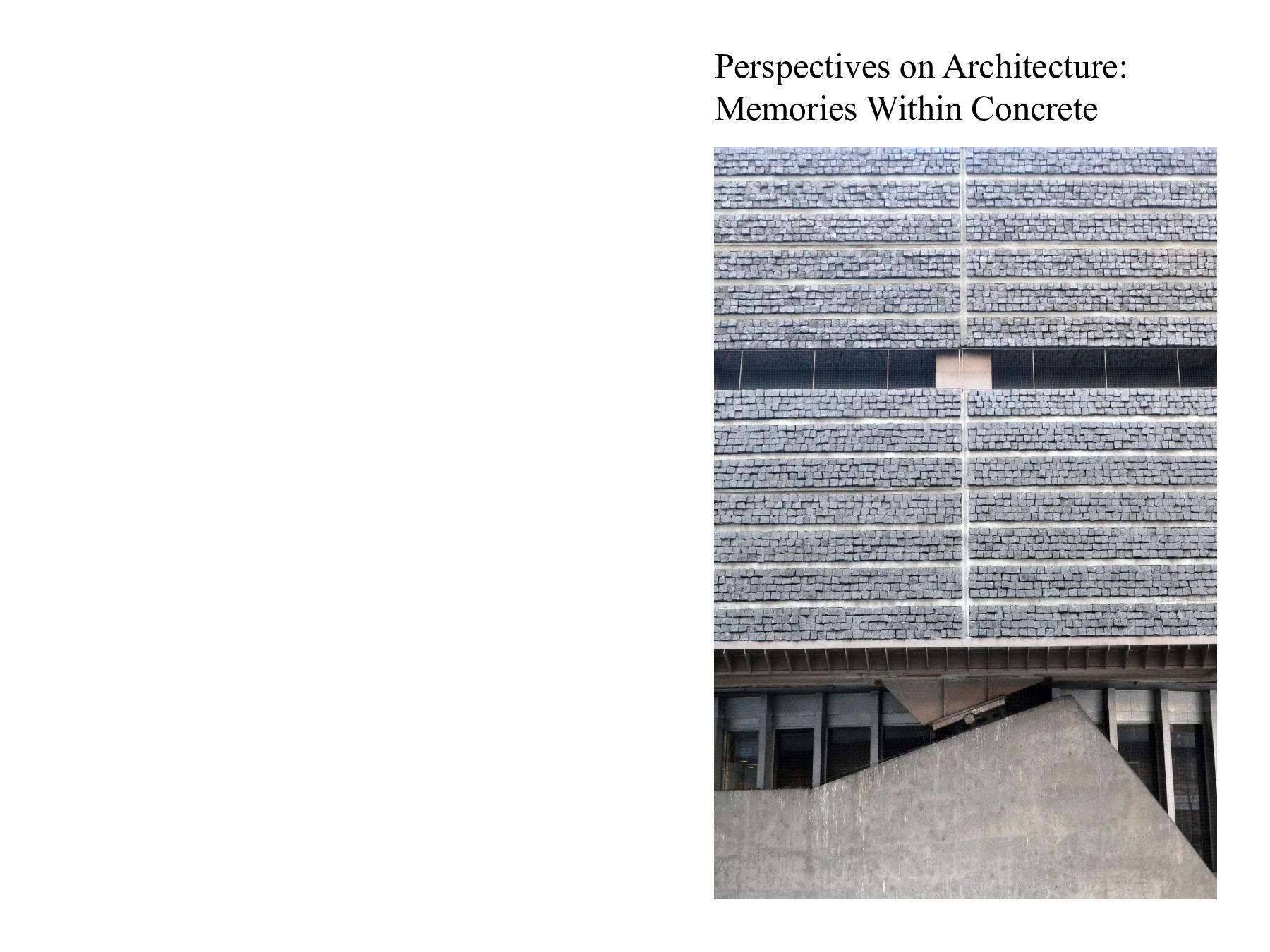
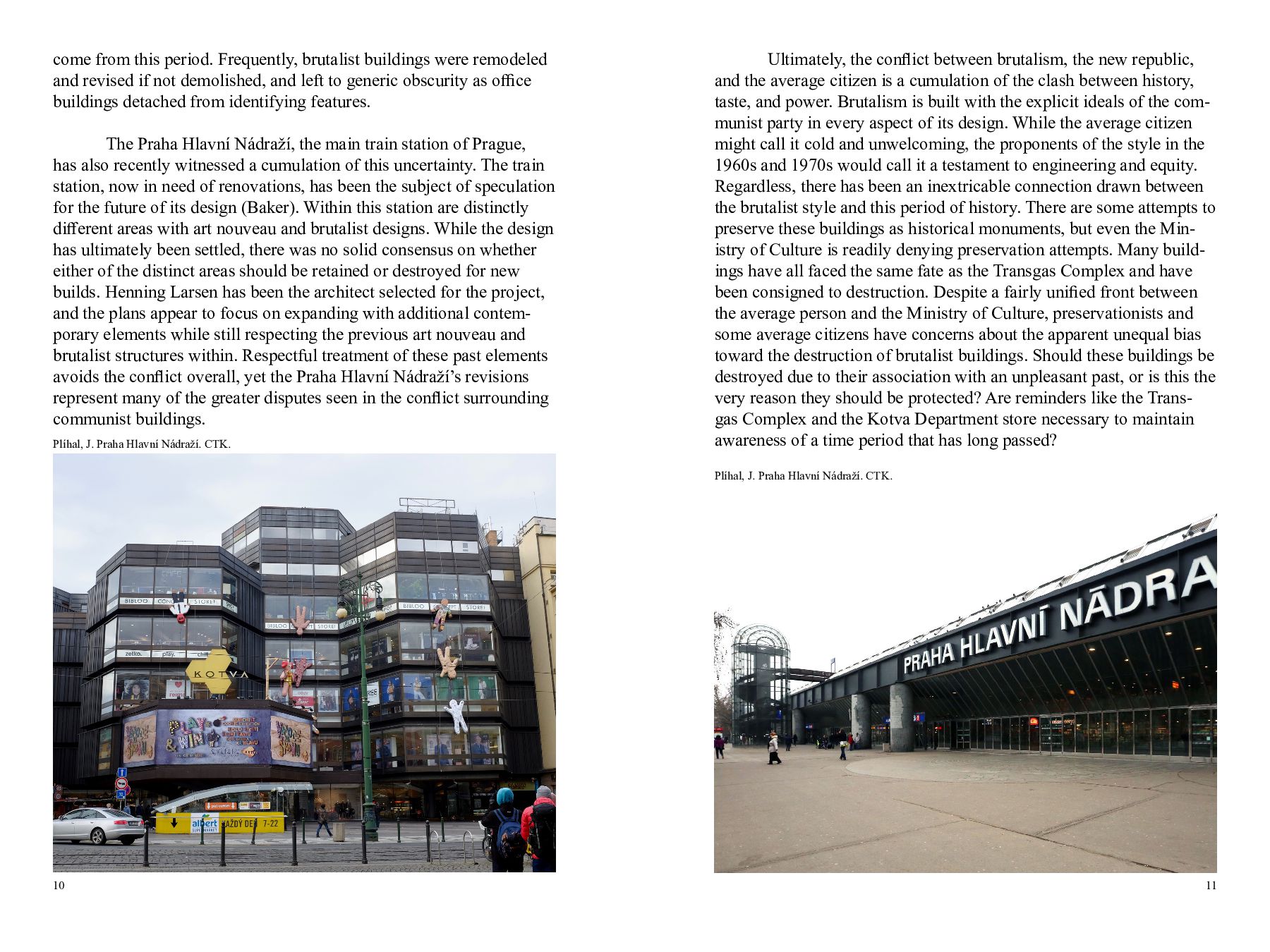
    panels with specific requirements, a technological challenge that was emerging during this era. The computers at this time were relatively massive and had crucial needs that informed the design. Ultimately, the complex was made up of several buildings that were decorated in glass, rusti- cated bricks, and decorated with pipeline motifs. Ultimately, despite attempts at having this building preserved as a cultural monument by the Old Prague Club (Slavíčková), the Czech Republic’s Ministry of Culture denied this recognition. Brutalism was an integral tool in the redevelopment of Prague and was used in an earnest attempt to improve the city. Examples such as these show how it was used as a tool for modernization and equal- ization. Though not as well known as many other Prague historical monuments, developments like panel housing or the construction of the Barrandov bridge prove how impactful the use of brutalism was overall. While brutalist architecture has left its clear influence on every Czech citizen through common infrastructure and places of daily use, the style is certainly not universally appreciated. Many citizens do have a reasonable distaste for brutalist installations like housing, or public fixtures like Prague’s main train station. The debate between public opinion and conservationists has made itself apparent as aging brutalist structures fall into disuse or disrepair and the current govern- ment is left to decide on how to proceed with such buildings. For the aforementioned Transgas Complex, the building’s final fate was demo- lition. Contrarily, the Kotva Shopping Mall was able to be successfully canonized as a site of historic significance and now is recognized and protected. Prague’s main train station, however, faces an uncertain fate as it awaits expansion and repairs to better accommodate modern traf- fic. This station encompasses the important question of conservation versus forward movement. Is it best to either return to the previous historic style or look forward and introduce contemporary architecture into this mainstay of Prague life? Alternatively, is the conservation of this brutalist station as-is important to the preservation of Prague’s history, despite public distaste? The Kotva Department Store exemplifies one of the rare cases in Prague where a Brutalist building has been given explicit protection and status as a cultural monument. Built between the years 1970 and 1975, this store was created by the architects Věra and Vladimír Ma- chonin. This couple created many buildings in the brutalist style, this being one of their more popular designs. It’s known for its unique use of space and has an efficient hexagonal format to best utilize the area it was given. While this particular building was created specifically by the communist party for any government or infrastructural purpose, they readily accepted the Kotva Department Store. At it’s grand open- ing, it was a communist party member who cut the ribbon (ČTK). Like many brutalist buildings, this department store was at risk of closing due to competition with newer malls in the area. Its status as protect- ed was a long-fought battle with the first proposition for protection introduced in 2007 through a petition (ČTK). Nearly a decade later, it was successfully given a status of protection in 2016. While this was a success for preservationists, this represents a minority of buildings that Kohout, O. Transgas Complex. Nonument. Revisionism and Conservationism 8 9
  5. come from this period. Frequently, brutalist buildings were remodeled and

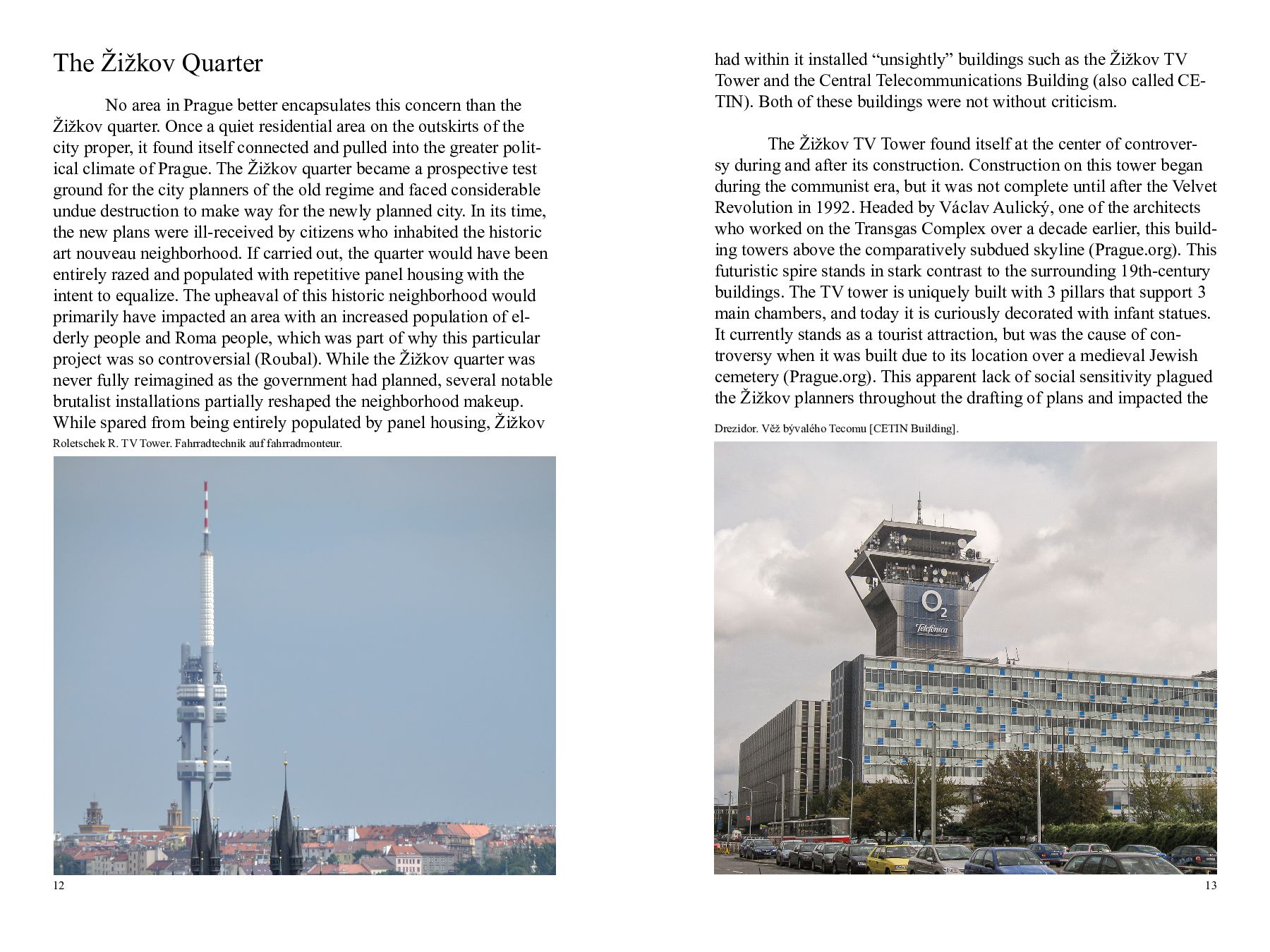
    revised if not demolished, and left to generic obscurity as office buildings detached from identifying features. The Praha Hlavní Nádraží, the main train station of Prague, has also recently witnessed a cumulation of this uncertainty. The train station, now in need of renovations, has been the subject of speculation for the future of its design (Baker). Within this station are distinctly different areas with art nouveau and brutalist designs. While the design has ultimately been settled, there was no solid consensus on whether either of the distinct areas should be retained or destroyed for new builds. Henning Larsen has been the architect selected for the project, and the plans appear to focus on expanding with additional contem- porary elements while still respecting the previous art nouveau and brutalist structures within. Respectful treatment of these past elements avoids the conflict overall, yet the Praha Hlavní Nádraží’s revisions represent many of the greater disputes seen in the conflict surrounding communist buildings. Ultimately, the conflict between brutalism, the new republic, and the average citizen is a cumulation of the clash between history, taste, and power. Brutalism is built with the explicit ideals of the com- munist party in every aspect of its design. While the average citizen might call it cold and unwelcoming, the proponents of the style in the 1960s and 1970s would call it a testament to engineering and equity. Regardless, there has been an inextricable connection drawn between the brutalist style and this period of history. There are some attempts to preserve these buildings as historical monuments, but even the Min- istry of Culture is readily denying preservation attempts. Many build- ings have all faced the same fate as the Transgas Complex and have been consigned to destruction. Despite a fairly unified front between the average person and the Ministry of Culture, preservationists and some average citizens have concerns about the apparent unequal bias toward the destruction of brutalist buildings. Should these buildings be destroyed due to their association with an unpleasant past, or is this the very reason they should be protected? Are reminders like the Trans- gas Complex and the Kotva Department store necessary to maintain awareness of a time period that has long passed? Plíhal, J. Praha Hlavní Nádraží. CTK. Plíhal, J. Praha Hlavní Nádraží. CTK. 10 11
  6. No area in Prague better encapsulates this concern than the

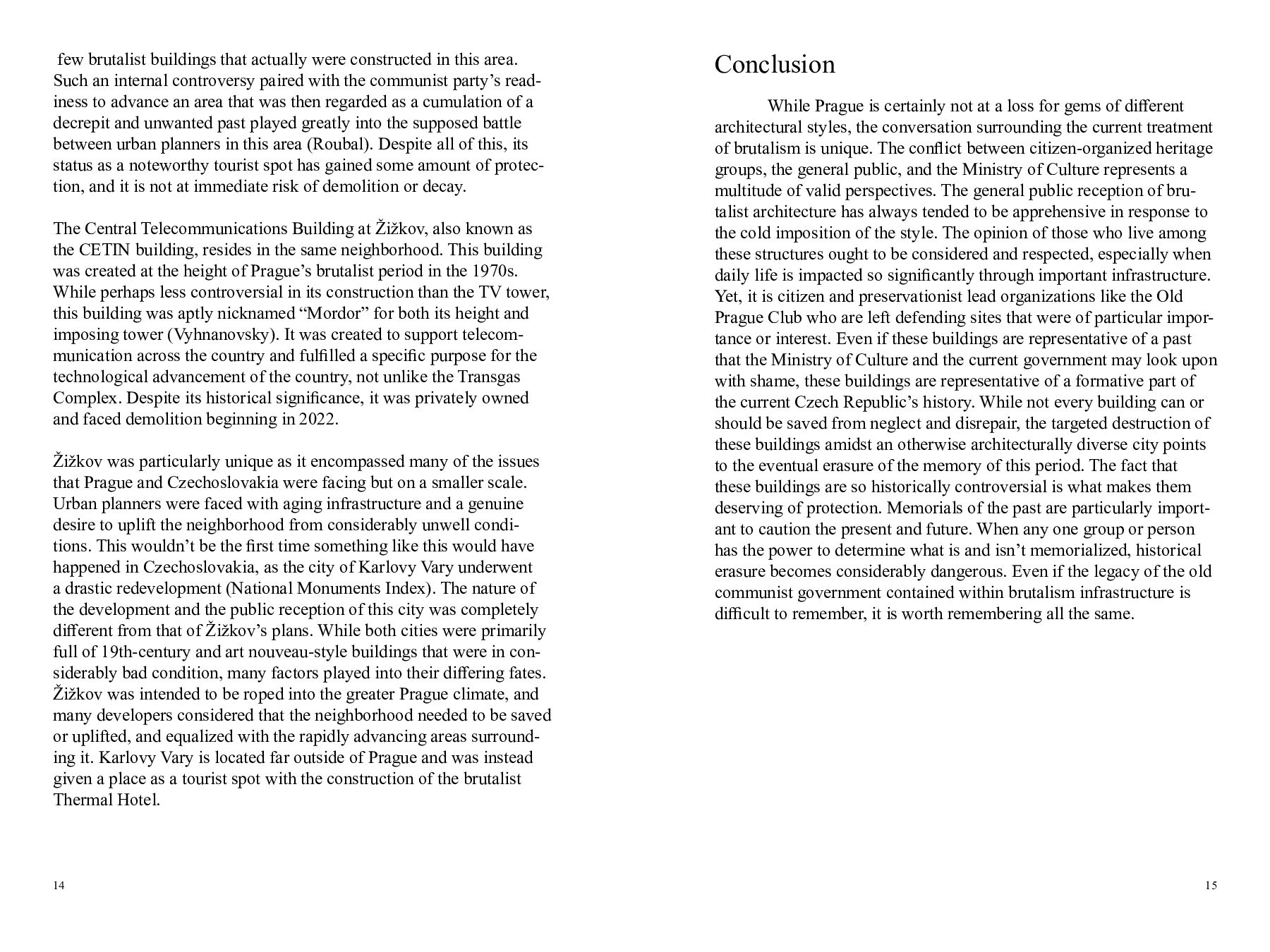
    Žižkov quarter. Once a quiet residential area on the outskirts of the city proper, it found itself connected and pulled into the greater polit- ical climate of Prague. The Žižkov quarter became a prospective test ground for the city planners of the old regime and faced considerable undue destruction to make way for the newly planned city. In its time, the new plans were ill-received by citizens who inhabited the historic art nouveau neighborhood. If carried out, the quarter would have been entirely razed and populated with repetitive panel housing with the intent to equalize. The upheaval of this historic neighborhood would primarily have impacted an area with an increased population of el- derly people and Roma people, which was part of why this particular project was so controversial (Roubal). While the Žižkov quarter was never fully reimagined as the government had planned, several notable brutalist installations partially reshaped the neighborhood makeup. While spared from being entirely populated by panel housing, Žižkov had within it installed “unsightly” buildings such as the Žižkov TV Tower and the Central Telecommunications Building (also called CE- TIN). Both of these buildings were not without criticism. The Žižkov TV Tower found itself at the center of controver- sy during and after its construction. Construction on this tower began during the communist era, but it was not complete until after the Velvet Revolution in 1992. Headed by Václav Aulický, one of the architects who worked on the Transgas Complex over a decade earlier, this build- ing towers above the comparatively subdued skyline (Prague.org). This futuristic spire stands in stark contrast to the surrounding 19th-century buildings. The TV tower is uniquely built with 3 pillars that support 3 main chambers, and today it is curiously decorated with infant statues. It currently stands as a tourist attraction, but was the cause of con- troversy when it was built due to its location over a medieval Jewish cemetery (Prague.org). This apparent lack of social sensitivity plagued the Žižkov planners throughout the drafting of plans and impacted the The Žižkov Quarter Drezidor. Věž bývalého Tecomu [CETIN Building]. Roletschek R. TV Tower. Fahrradtechnik auf fahrradmonteur. 12 13
  7. few brutalist buildings that actually were constructed in this area.

    Such an internal controversy paired with the communist party’s read- iness to advance an area that was then regarded as a cumulation of a decrepit and unwanted past played greatly into the supposed battle between urban planners in this area (Roubal). Despite all of this, its status as a noteworthy tourist spot has gained some amount of protec- tion, and it is not at immediate risk of demolition or decay. The Central Telecommunications Building at Žižkov, also known as the CETIN building, resides in the same neighborhood. This building was created at the height of Prague’s brutalist period in the 1970s. While perhaps less controversial in its construction than the TV tower, this building was aptly nicknamed “Mordor” for both its height and imposing tower (Vyhnanovsky). It was created to support telecom- munication across the country and fulfilled a specific purpose for the technological advancement of the country, not unlike the Transgas Complex. Despite its historical significance, it was privately owned and faced demolition beginning in 2022. Žižkov was particularly unique as it encompassed many of the issues that Prague and Czechoslovakia were facing but on a smaller scale. Urban planners were faced with aging infrastructure and a genuine desire to uplift the neighborhood from considerably unwell condi- tions. This wouldn’t be the first time something like this would have happened in Czechoslovakia, as the city of Karlovy Vary underwent a drastic redevelopment (National Monuments Index). The nature of the development and the public reception of this city was completely different from that of Žižkov’s plans. While both cities were primarily full of 19th-century and art nouveau-style buildings that were in con- siderably bad condition, many factors played into their differing fates. Žižkov was intended to be roped into the greater Prague climate, and many developers considered that the neighborhood needed to be saved or uplifted, and equalized with the rapidly advancing areas surround- ing it. Karlovy Vary is located far outside of Prague and was instead given a place as a tourist spot with the construction of the brutalist Thermal Hotel. Conclusion While Prague is certainly not at a loss for gems of different architectural styles, the conversation surrounding the current treatment of brutalism is unique. The conflict between citizen-organized heritage groups, the general public, and the Ministry of Culture represents a multitude of valid perspectives. The general public reception of bru- talist architecture has always tended to be apprehensive in response to the cold imposition of the style. The opinion of those who live among these structures ought to be considered and respected, especially when daily life is impacted so significantly through important infrastructure. Yet, it is citizen and preservationist lead organizations like the Old Prague Club who are left defending sites that were of particular impor- tance or interest. Even if these buildings are representative of a past that the Ministry of Culture and the current government may look upon with shame, these buildings are representative of a formative part of the current Czech Republic’s history. While not every building can or should be saved from neglect and disrepair, the targeted destruction of these buildings amidst an otherwise architecturally diverse city points to the eventual erasure of the memory of this period. The fact that these buildings are so historically controversial is what makes them deserving of protection. Memorials of the past are particularly import- ant to caution the present and future. When any one group or person has the power to determine what is and isn’t memorialized, historical erasure becomes considerably dangerous. Even if the legacy of the old communist government contained within brutalism infrastructure is difficult to remember, it is worth remembering all the same. 14 15
  8. Works Cited Baker, Mark. “The Battle Over Communist Buildings.” Mark

    Baker | Travel Writer in Prague, 14 Nov. 2022, https://markbakerprague.com/ the-battle-over-communist-buildings/. “Barrandov Bridge - A Total Renovation Of Phase I Redevelopment Substructure Prague 4 And 5, No. 999174|1 Action.” Mena Report, 4 Mar. 2020, p. NA. Gale Academic OneFile, link.gale.com/apps/ doc/A616226785/AONE?u=sara21078&sid=bookmark-AONE&x- id=127c2734. ČTK. “Kotva Se Definitivně Stala Památkou. Proti Rozhodnutí Se Neodvolal Ani Vlastník Obchodního Domu.” ČT24, 14 May 2019, ct24.ceskatelevize.cz/clanek/regiony/kotva-se-definitivne-sta- la-pamatkou-proti-rozhodnuti-se-neodvolal-ani-vlastnik-obchodni- ho-domu-64326. “Exceptional Broadcasting TV Tower in Prague.” Prague.Org, 5 Feb. 2024, prague.org/tv-tower/. “Hotelový Komplex Thermal.” Hotelový Komplex Thermal - Památ- kový Katalog, National Monuments Index, pamatkovykatalog.cz/ho- telovy-komplex-thermal-2282670. Kubečková, Darja. “Regeneration of Panel Housing Estates from the Perspective of Thermal Technology, Sustainability and Environmental Context (Case Study of the City of Ostrava, Czech Republic).” Sus- tainability, vol. 15, no. 11, May 2023, p. NA. Gale Academic OneFile, link.gale.com/apps/doc/A752560126/AONE?u=sara21078&sid=book- mark-AONE&xid=92b5d03c. Mašínová, Jana. “Barrandov Bridge Has Had a Successful Two Months of Reconstruction.” PORR Tschechien, 20 July 2022, porr.cz/ en/media/press-release/press-release/news/barrandov-bridge-has-had- a-successful-two-months-of-reconstruction/. Nováková, Jana. “Will Kotva Become a Monument?” Lidovky.Cz, Lidovky.cz, 15 Feb. 2007, www.lidovky.cz/domov/stane-se-kotva- pamatkou.A070215_102929_ln_praha_hlm. Roubal, Petr. “The battle of žižkov: Urban planners’ transition from heritage protection to neoliberal discursive planning.” Journal of Urban History, vol. 47, no. 3, 14 Mar. 2020, pp. 495–510, https://doi. org/10.1177/0096144220908881. Slavíčková, Barbara. “Transgas.” Nonument, Nonument, nonument. org/nonuments/transgas/. Vyhnanovsky, Ondřej. “‘Mordor’ Is as Depopulated as a Ghost Town. Žižkov’s Icon Is Decaying.” Lidovky.Cz, Lidovky.cz, 31 July 2016, www.lidovky.cz/byznys/v-mordoru-je-vylidneno-jako-ve-meste-du- chu-ikona-zizkova-chatra.A160729_155005_firmy-trhy_pave. Cover Images: Xosema. Žižkov Television Tower, Prague. Kohout, O. Detail of the facade covered in cobble stones [Transgas Complex]. Nonument. 16 17
  9. Introduction During the 1980’s, the idea of house flipping took

    root in America. Offering the promise of easy passive income to younger buyers, its popularity increased throughout the 1990s and onward. Today, millennials have taken up the mantle of pursuing the spectacle of turning old and undesirable houses into a source of their livelihood. Young buyers are promised that with a little bit of elbow grease and do-it-yourself know-how, they can ensure themselves enough profit to jumpstart their lives. The truth about house flipping is less optimistic than advertised. The market is extremely unstable, and countless flips remain unsold for years with overly optimistic prices. Likewise, the “do it yourself” nature of these projects is well documented online to produce both dangerous and disappointing results for buyers. The victims of failed flips are often old, damaged, or foreclosed houses in historic communities and had community value before falling into disrepair. Ultimately, the real harm of these flips is seen in the damage done to the community where flippers congregate. Historically, the upheaval of these homes often occurs in tandem with gentrification. To the detriment of existing communities, the redone and repriced houses in “up and coming” cities overtake areas that were once affordable and lived in primarily by minority groups. The difficult truth of flipping is that often it is not young upstart entrepreneurs profiting from their own efforts, but corporations that buy and sterilize these communities en masse. While flipping an old property in itself is not inherently dan- gerous, many flips are done in a way that is damaging overall to the community in the cities in which they’re primarily done. The issue of poorly conceived flips lies at the intersection of community liveliness and the preservation of local history. This is an issue that is markedly entwined with socioeconomic prosperity, and while historic relevance is at the base of the issue it is far from the most pressing issue related to flipping. This essay will study the multifaceted area of house flip- ping and a variety of factors regarding both the harms and potential 21
  10. benefits will be observed as well as the interconnecting network

    of in- fluences. It is ultimately an issue of both social, economic, and historic conditions that has been in development for years, especially after the COVID-19 pandemic established itself as a massive contributor. In the context of this essay, flipping will be discussed at both an individual house/building level and at a neighborhood and community level. The flipping of a building typically involves the purchase and quick relist- ing of it following renovations (Depken, 2009). Flipping at the level of the community involves both wholesale reinvention of neighborhoods as well as the destruction and rebuilding of facilities or apartments to change the overall community. Material Issues As a field, house flipping suffers from several common mate- rial issues. Many of the houses that buyers choose to flip are needier in nature than the average house on the market. Often they suffer from extensive damage, age, foreclosure, or other severe issues that close the house off from the typical buyer (Dow Jones Institutional News) . Likewise, older houses like these more frequently require urgent up- dates and repairs. This alone is a potentially manageable issue through research and care, but it is often exacerbated by the demographic that is most vocal about flipping: hobbyists. The hobbyist passion for flipping isn’t inherently bad, nor are all flips done by non-professionals. Yet, it is also true these practi- tioners are often the ones who cut corners, proceed without research, and avoid professional intervention for the sake of bolstering profit. Several online guides that are marketed toward new flippers guide them toward this ideal. For example, this readily available online guide instructs the reader “the more repairs you can handle without a contractor, the more profit you can bank” (IntelligentHQ). Another online guide, House Flipping School, has many blogs by both the cre- ator Mike LaCava and guest bloggers who emphasize the importance of profit and DIY over safe contracting. To their credit, some of the contributors of this site subscribe to safe practices, but these free and accessible resources typically coincide at the same point; that the sole goal is to profit. In addition to many flips by individuals and independent investors simply being poorly done, the houses that they frequently choose to work on are older than other houses on the market. A study of houses in Las Vegas shows that the average flipped houses from the flipping boom in the 2000s were from 1998 or earlier (Depken). Flippers recently have been trending online for the disregard for the historical value of homes, taking features symbolic of local history and sterilizing them for a marketable aesthetic. This has been widely documented online through social media accounts that, like the earlier online guides, encourage beginners to take on projects that might re- quire more tact with the buildings’ age. Disruption of established older neighborhoods brings the concern of historical value into question re- garding house flipping. Is the value of the historical identity contained within these buildings worth potentially stagnating these communities, or are they even stagnated at all? While flippers such as LaCava at House Flipping School might argue that flipping older houses is key to revitalizing these older neighborhoods (LaCava) , it is possible that the wholesale flipping of these established neighborhoods causes deep harm at the community level. Community Disruption While there may be inconvenience at best, and danger at worst with poorly flipped properties, there is a larger overarching problem that has haunted the housing market. Independent flippers may truly benefit from the revival and reselling of an older house, and on small scales within a community, the damage is not immediately apparent. However, the reality is that most houses to be flipped are bought out by massive corporations in the hundreds to thousands. Companies like the well-known Zillow have been engaging in whole- sale flipping, yet have seen little results for their ventures. In 2021, Zillow lost $528 million (Dow Jones Institutional News) in no small part due to their participation in house flipping. The company had thousands of unsold homes that were unsuccessful on the market. The solution was to sell 2,000 of their houses to a company called Pretium Partners (Dow Jones Institutional News), an investment and manage- ment company that aimed to rent these houses. According to the Wall Street Journal, this company heavily invests in new builds, spending $1.5 billion to build new rental houses in 2023 (Parker). According to 22 23
  11. the Dow Jones International News, over 1 in 10 houses

    sold in 2019 were purchased by investors, rather than homeowners. In the same evaluation, struggle to sell post-COVID lead to many of these proper- ties being rented rather than sold (Dow Jones Institutional News) The implications of the increased number of rental properties on communi- ties will be discussed later, but this is one example of the multitude of businesses that have further stressed the housing market. When massive corporations are buying out massive portions of communities, the reality is that they often have no vested interest in the vibrance of the local community. Many of these cities where large levels of flipping occur are cities that have a higher percentage of mi- norities and people living below the poverty line. Atlanta, for example, was one of the cities for flipping houses in the year 2023. According to the United States Census, 47.7% of citizens were recorded to be Afri- can American, and around a fifth of the population was recorded to be living in poverty (United States Census Bureau). This cannot be called anything but gentrification. When massive corporations such as Black- Stone Inc. buy and flip hundreds of housing units at a time (Dow Jones Institutional News), there is little concern for the residents who already live there or the demographic that can afford this community. Gentri- fication often targets communities with minorities and those who live in poverty and seeks to seed a new demographic by advertising charm and luxury. While these “revived” communities may deliver, it is at the expense of current residents and demographics. These newly repainted luxury neighborhoods typically rely on renting out both houses and apartments for numerous reasons. These areas tend to appear to have an increasing average in- come over time, and a surface look at those numbers may appear to be beneficial to the area. It could be interpreted as a sign of an improving local economy, which often happens as new residents move to the area. This, unfortunately, is often at the expense of minority groups and those who live below the poverty line as they are forced out. Detroit, for example, has had its population change from around 85% African American (Kusisto) to 77% (United States Census Bureau). While this may not be a massive decrease, it is understood that Detroit is in the early phases of gentrification, and the flipping scene there has only just started gaining traction (Kusisto). The unstable market has led to a drastic change in the housing makeup of an area. It is largely massive corporations that buy and flip houses en masse that result in community change and damage. What once may have been affordable housing in vibrant areas with historic roots has been bought out and repackaged as “luxury” in recent sweeps of gentrification. City Studies Several cities have been impacted by gentrification as a side effect of house flipping more so than others. Cities like Chicago, New York City neighborhoods, Philadelphia, and Minneapolis are all partic- ularly affected by gentrification. In Cities like Detroit and Milwaukee, there is a sufficient link between the changing culture surrounding housing and community changes to suggest that flipping and gentrifi- cation go hand in hand. These cities will be examined in terms of pop- ulation change, community change, and the recent changes in housing. The aforementioned city of Detroit, a predominantly African American city, has been affected particularly by recent changes in housing and city culture. Historically, Detroit has been a cultural mix of minorities and has a rich history in both culture and architecture. The fixing and revitalization of old houses, as well as new construc- tions may appeal as a solution to refresh the old city. Yet, the division between this and gentrification is thin, and the change to the city has not gone unnoticed. The addition of new luxury builds and flipped historical houses has increased the cost of living in this city. With a poverty rate of nearly one-third (United States Census Bureau), many of the residents who live here are being pushed out of their homes. Even for those whose roots run deep in Detroit, it is the nature of gen- trification to price them out as regular necessities and commodities are given a luxury price tag. Milwaukee is another city that has seen the impacts of desta- bilized housing as a vehicle for gentrification (City of Milwaukee). Neighborhoods in Milwaukee are seeing the cost of rent and housing increase gradually, one of the most marked indicators of gentrification. Flipping affects both owners and renters in different ways that are seen in Milwaukee. First, many flips are initially intended to be sold on the 23 25
  12. market as houses ready for owners, yet their price points

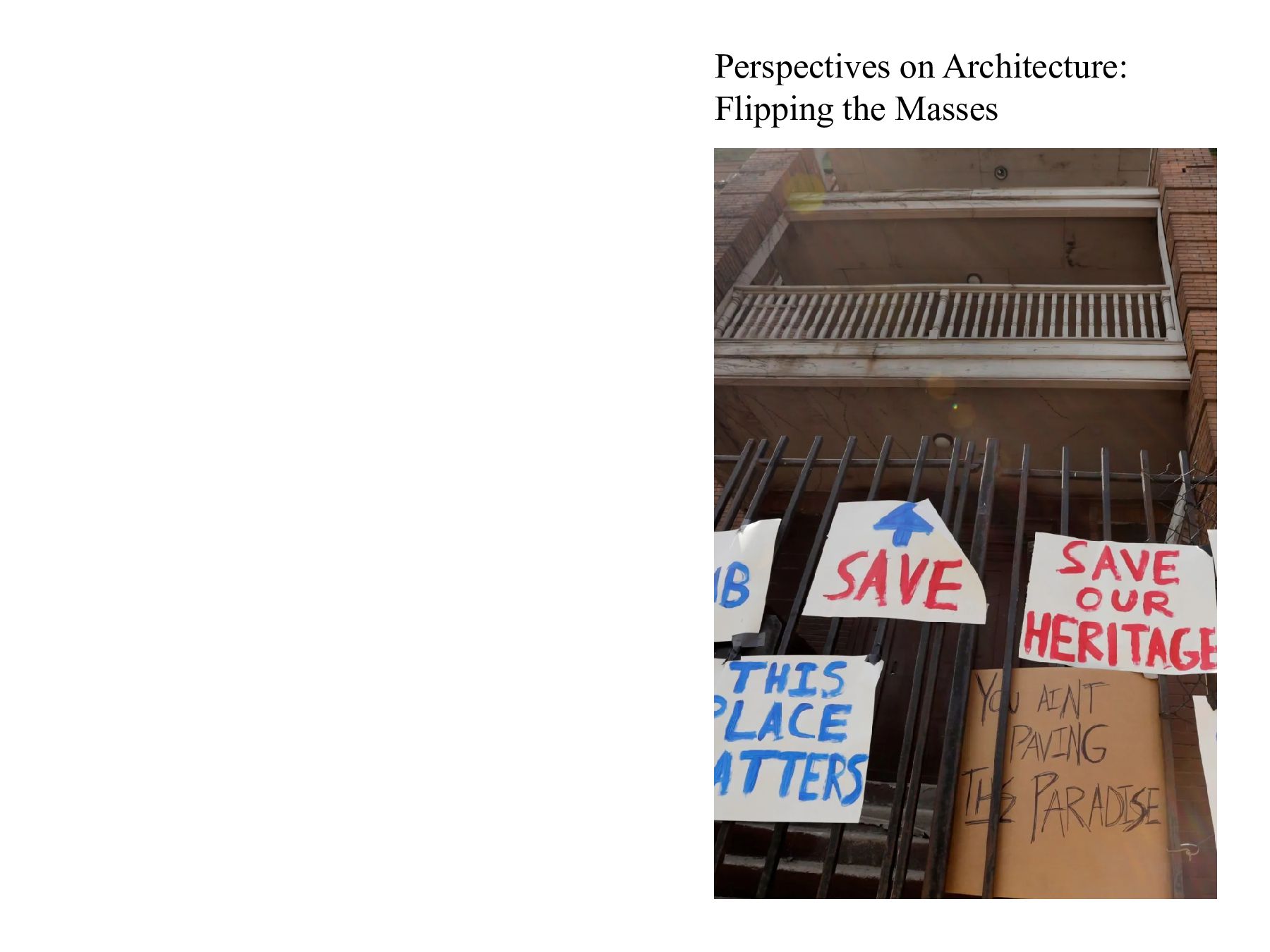
    are far be- yond what the average American can afford. While some flippers may attempt to reduce their price, they often resort to selling to property management companies that then rent out the properties. By slowly changing the community to having a housing market based solely on hiked rental prices, the individuals already present find themselves un- able to maintain their lives. This predatory practice has led to gentrifi- cation in the Milwaukee area, evident in communities like Shorewood, South Milwaukee, and Downtown Milwaukee. All of these places, once accessible to many, are slowly pricing out their old residents and commodifying the community through rebranding. These cities, along with many others, have seen gentrification increase in ways that correlate with housing problems. Housing is only one of many of the tools used either intentionally, or in some cases where it occurs unintentionally, to push out current communities. Ar- eas with the majority of their population living below the poverty lines or with a large minority makeup are seeing themselves further steril- ized often as a result of corporate greed. Some cities, like Milwaukee, may show signs of hope for neighborhoods rich in history though even these few cases are still im- perfect. While surrounded by an expanding area of visible community change through flipping, Brewer’s Hill is a protected neighborhood. Founded by a majority immigrant population, and later inhabited by a majority African-American population. (Rindfleisch) Initially found- ed in the 1830s, this neighborhood has a wide variety of architectural styles that span almost two centuries. Despite a period of decline and disrepair, Brewers Hill gained the attention of historical preservation- ists, and many of its salvageable buildings were restored in the 1970s and 1980s. This residential neighborhood gained status as a local and national historic district (Historic Brewers Hill Association) While this movement to restore the area was able to bring new life to and protect the integrity of the buildings in the area, the original minority popula- tion was not spared from the upheaval. The neighborhood may have seen an increase in available housing as well through the conversion of old businesses, yet it failed the original communities who built it. While a considerable start to the conversation regarding the protection of historic areas, the need to protect and support the people within these areas is often not considered. The neighborhood of Brewer’s Hill shows a fairly common issue. While the historical integrity of this area may be visually pre- served in the diverse set of buildings, developers sacrificed the security of the residents within. In the desire to avoid this area being sold to flippers and housing companies, the residents of the area were over- looked and eventually pushed out, causing those who promoted it to be critiqued for their participation in the gentrification of Milwaukee. The problems surrounding this type of historic housing are typically twofold as both social and material. Even the most earnest attempt to protect the integrity of these areas from complete modernization and sanitization that comes with flipping and corporatizing of these areas can be flawed. Brewer’s Hill may be a testament to the possibility of protecting the visual record of the city’s development, but preserva- tionists still have yet to preserve the social vibrancy of these areas. House flipping is a complex subject in terms of both technical and historical value. Some individuals can indeed reap the benefits of flipping houses without causing deep harm to the community. The oc- casional remodel of a historic house might be considered tasteless by the wider public, but does not have the same implication of wholesale neighborhood flipping. The true danger becomes apparent as corpora- tions buy thousands of homes and revise neighborhoods and communi- ties entirely. While there may be some damage to the historical identity of the area where flipping has occurred, the more potent harm is done to the community. The process of gentrification is spurred on by the process of corporate flipping, and many of the tools used by corpo- rations to assure profits cause drastic social and economic changes within the area. While a poorly done flip may be annoying or expen- sive to remedy, the pricing out of minority communities has much more drastic implications. While it is impossible to entirely condemn flipping, the need for stricter observance of the field is evident. Houses will always need to be repaired and remodeled, but the oversaturation of corporate-owned neighborhoods in the market is not a sustainable way to renew communities as is promised by investors. Conclusion 26 27
  13. Works Cited “A Place in the Neighborhood: An Anti-Displacement Plan

    for Neigh- borhoods Surrounding Downtown Milwaukee.” City of Milwaukee, Feb. 2018. https://city.milwaukee.gov/ImageLibrary/Groups/cityDCD/planning/ plans/AntiDisplacement/Anti-DisplacementPlanSummary.pdf Atlanta City, Georgia. United States Census Bureau. https://www.cen- sus.gov/quickfacts/fact/table/atlantacitygeorgia/INC110222f. “Cleveland is a House-Flipping Hot Spot, and Covid is Helping.” Dow Jones Institutional News, Jun 08 2020, ProQuest. Depken,Craig A.,,II, Harris Hollans, and Steve Swidler. “An Empiri- cal Analysis of Residential Property Flipping.” Journal of Real Estate Finance and Economics 39.3 (2009): 248-63. ProQuest. Detroit City, Michigan. United States Census Bureau. https://www. census.gov/quickfacts/fact/table/detroitcitymichigan/PST120219. “History of the HBHA.” Historic Brewers Hill Association, historic- brewershill.com/about/history/. IntelligentHQ. 3 Things to Avoid when Flipping Houses. London: Newstex, 2019. ProQuest. Web. Kusisto, Laura. Detroit’s Resurgence Brings New Housing Concerns, Wall Street Journal, 20 Mar. 2017, www.wsj.com/articles/detroits-re- surgence-brings-new-housing-concerns-1489982402. LaCava, Mike. “About House Flipping School.” House Flipping School, houseflippingschool.com/why-house-flipping-school-2/. Park, Will. Pretium to Pay $1.5 Billion to Biggest Home Builder for 4,000 Rental Homes, Wall Street Journal, 1 June 2023, www.wsj.com/ articles/pretium-to-pay-1-5-billion-to-biggest-home-builder-for-4-000- rental-homes-8d6bbd51. Rindfleisch, Jacob. “Brewer’s Hill.” Encyclopedia of Milwaukee, 25 Feb. 2020, emke.uwm.edu/entry/brewers-hill/. “Zillow Lost Big on House Flipping -- WSJ.” Dow Jones Institutional News, Feb 11 2022, ProQuest. Web. Cover Image: Blanquart, R.. Disputes over Gentrification In Detroit. Detroit Free Press. 28 29