TEST SOFTWARE exactpro.com Beyond message injection: Advanced load testing capabilities for trading systems with th2-shark: A framework for benchmarking, latency analysis and functional validation under load Alyona Bulda, SVP, Emerging Technologies, Exactpro Presentation Track 4 May 2026
Alyona has been leading diverse teams of software testing and development engineers, business analysts, and DevOps specialists across time zones and agile streams for over 15 years – facilitating software quality excellence for leading FMIs and financial technology providers. Client systems that Alyona has worked with have included a leading European multilateral trading facility, one of the world’s largest interdealer brokers in OTC financial and commodity related products, a premier technology solutions provider, a leading global rates and multi-asset clearing house and a multi-national central counterparty. She has also managed software testing of LSEG’s FPGA-accelerated Market Data Dissemination platform. Alyona’s area of expertise spans project management and delivery of large-scale technology transformations related to both traditional and decentralised financial instruments (TradFi and DeFi domains, respectively), the latter including Central Bank Digital Assets issuance and distribution. A deep understanding of both established systems and emerging technologies informs Alyona’s consultancy and project management roles, enriching them with a unique perspective. With experience covering the full enterprise software delivery lifecycle, Alyona has an advanced skill set for analysing complex trading, market data and post-trade solutions, with a focus on test strategy development, integration testing, test execution, automation approaches and regulatory compliance. Alyona has been combining work on software testing projects for Exactpro clients and R&D work, having authored and co-authored several research papers, including some published by the IEEE Computer Society. Alyona Bulda Emerging Technologies, Exactpro
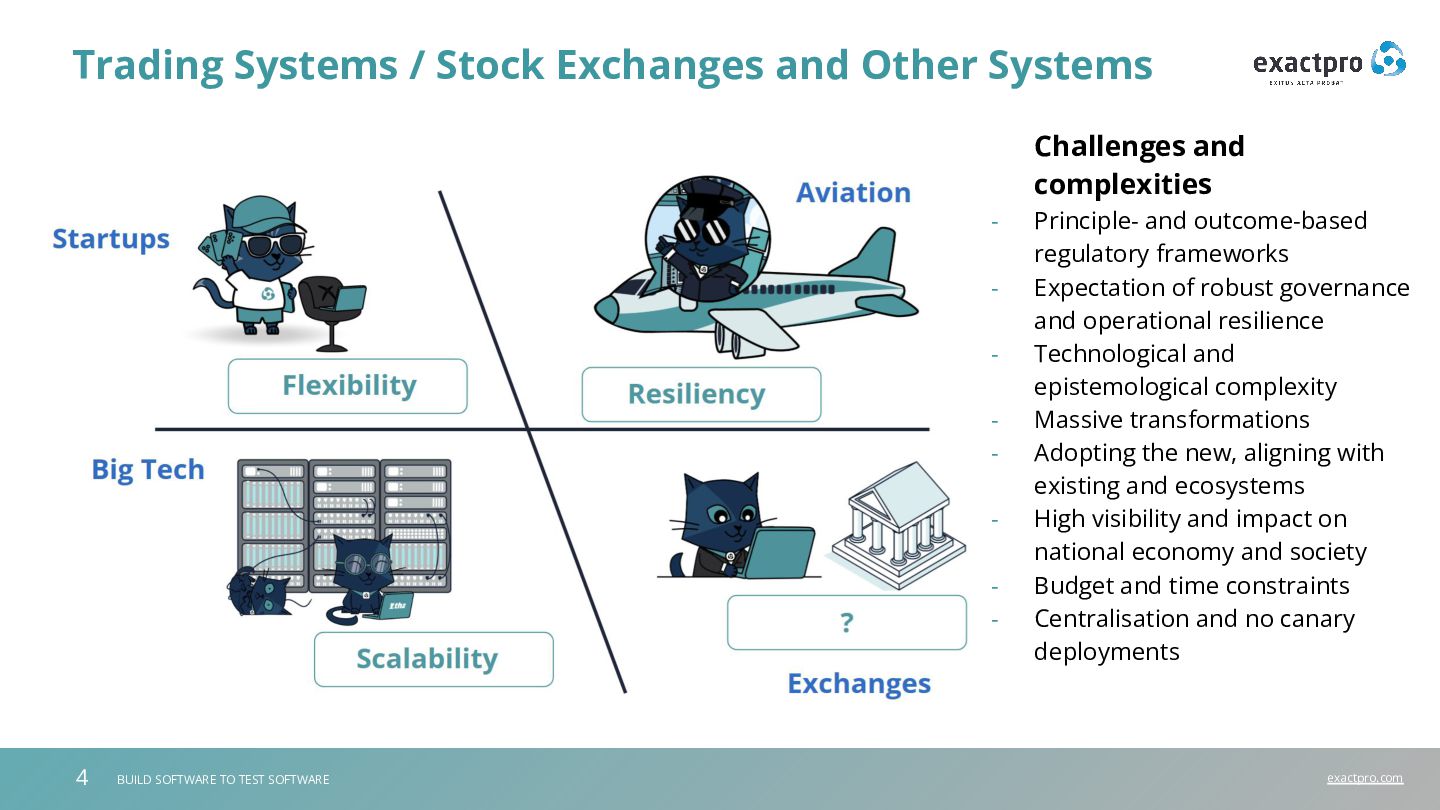
Stock Exchanges and Other Systems Challenges and complexities - Principle- and outcome-based regulatory frameworks - Expectation of robust governance and operational resilience - Technological and epistemological complexity - Massive transformations - Adopting the new, aligning with existing and ecosystems - High visibility and impact on national economy and society - Budget and time constraints - Centralisation and no canary deployments
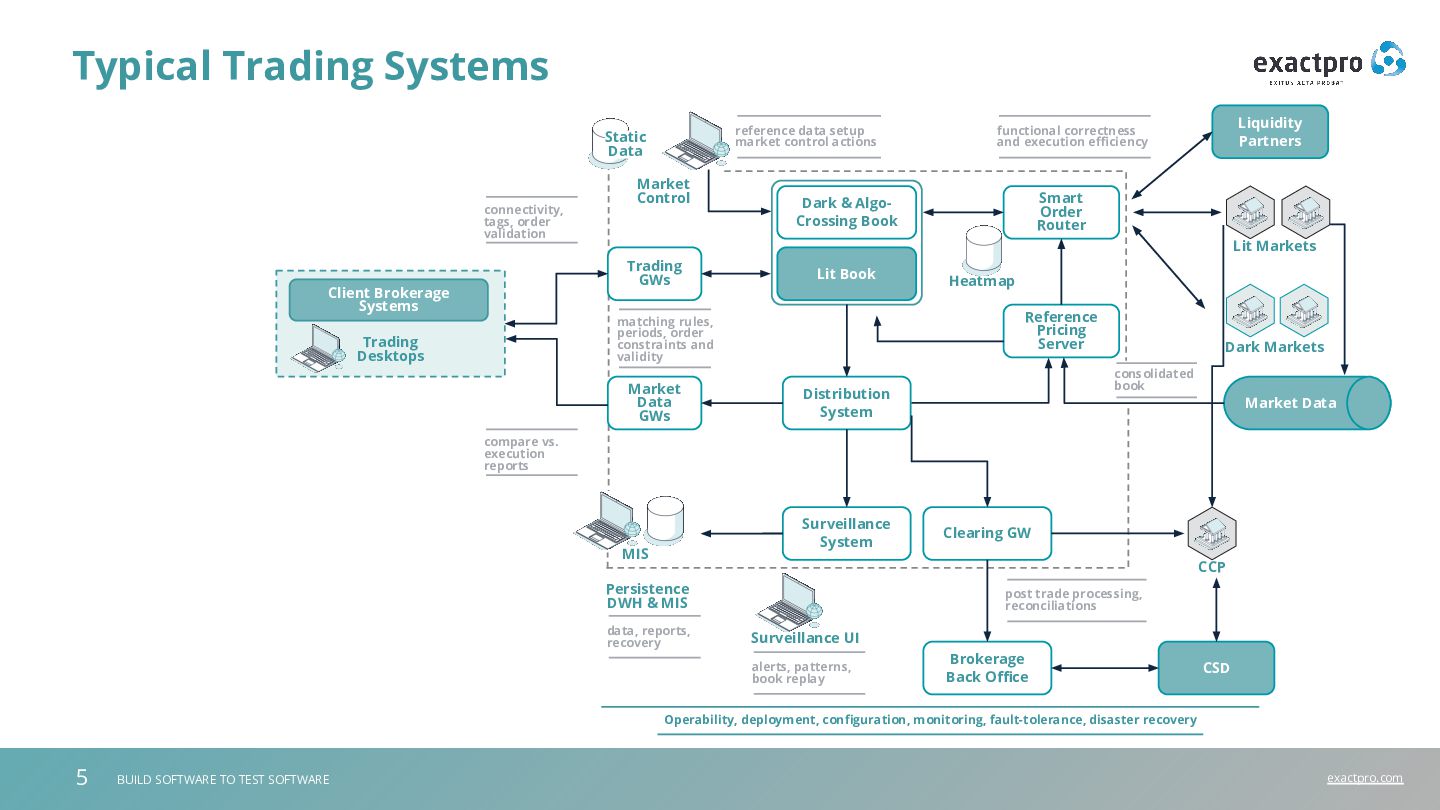
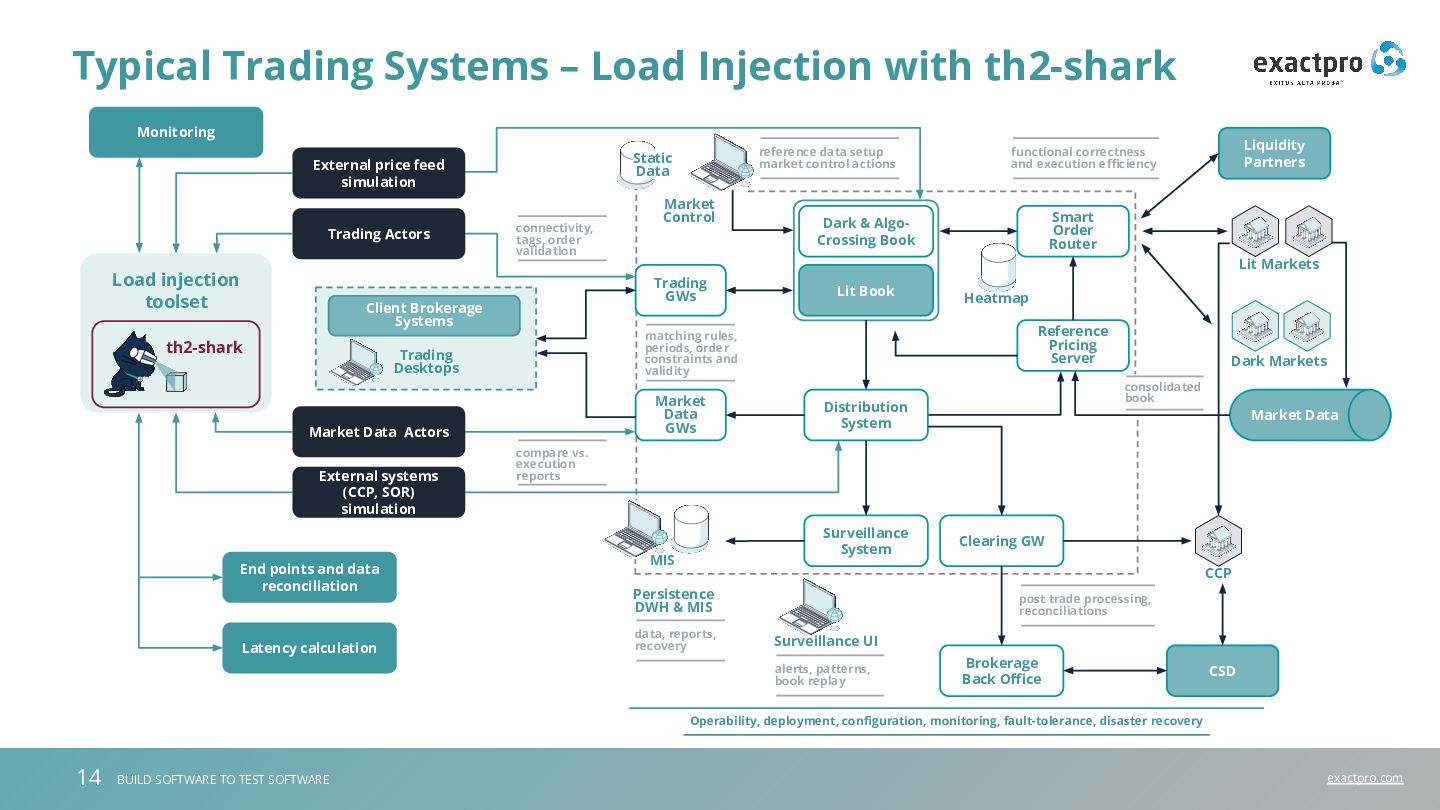
Trading GWs Lit Book Liquidity Partners CSD Trading Desktops Client Brokerage Systems Market Data GWs Distribution System Surveillance System Dark & Algo- Crossing Book Smart Order Router Reference Pricing Server Static Data MIS Heatmap CCP Dark Markets Lit Markets Clearing GW Brokerage Back Office Market Control Persistence DWH & MIS Surveillance UI connectivity, tags, order validation compare vs. execution reports data, reports, recovery alerts, patterns, book replay post trade processing, reconciliations consolidated book functional correctness and execution efficiency reference data setup market control actions matching rules, periods, order constraints and validity Operability, deployment, configuration, monitoring, fault-tolerance, disaster recovery Market Data
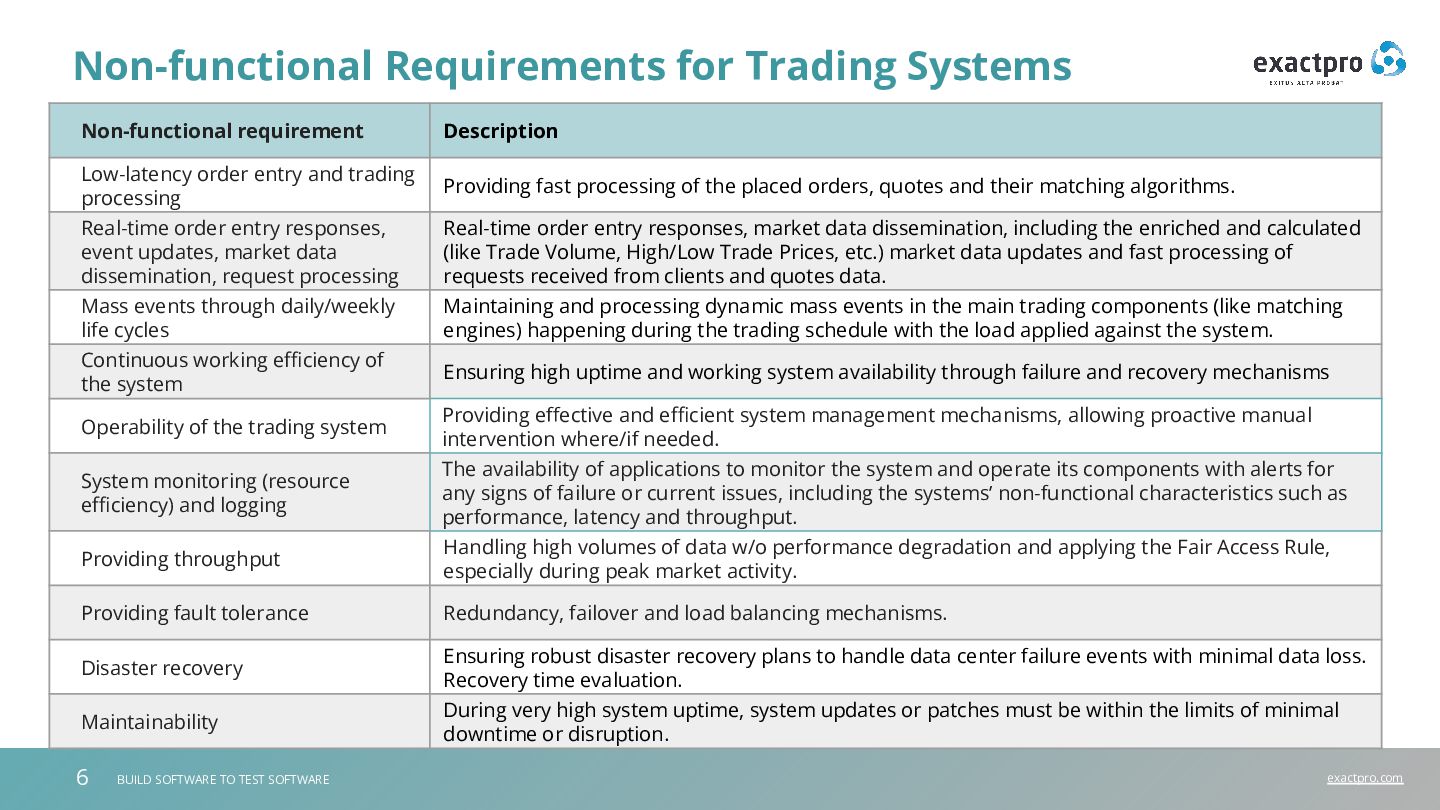
Trading Systems Non-functional requirement Description Low-latency order entry and trading processing Providing fast processing of the placed orders, quotes and their matching algorithms. Real-time order entry responses, event updates, market data dissemination, request processing Real-time order entry responses, market data dissemination, including the enriched and calculated (like Trade Volume, High/Low Trade Prices, etc.) market data updates and fast processing of requests received from clients and quotes data. Mass events through daily/weekly life cycles Maintaining and processing dynamic mass events in the main trading components (like matching engines) happening during the trading schedule with the load applied against the system. Continuous working efficiency of the system Ensuring high uptime and working system availability through failure and recovery mechanisms Operability of the trading system Providing effective and efficient system management mechanisms, allowing proactive manual intervention where/if needed. System monitoring (resource efficiency) and logging The availability of applications to monitor the system and operate its components with alerts for any signs of failure or current issues, including the systems’ non-functional characteristics such as performance, latency and throughput. Providing throughput Handling high volumes of data w/o performance degradation and applying the Fair Access Rule, especially during peak market activity. Providing fault tolerance Redundancy, failover and load balancing mechanisms. Disaster recovery Ensuring robust disaster recovery plans to handle data center failure events with minimal data loss. Recovery time evaluation. Maintainability During very high system uptime, system updates or patches must be within the limits of minimal downtime or disruption.
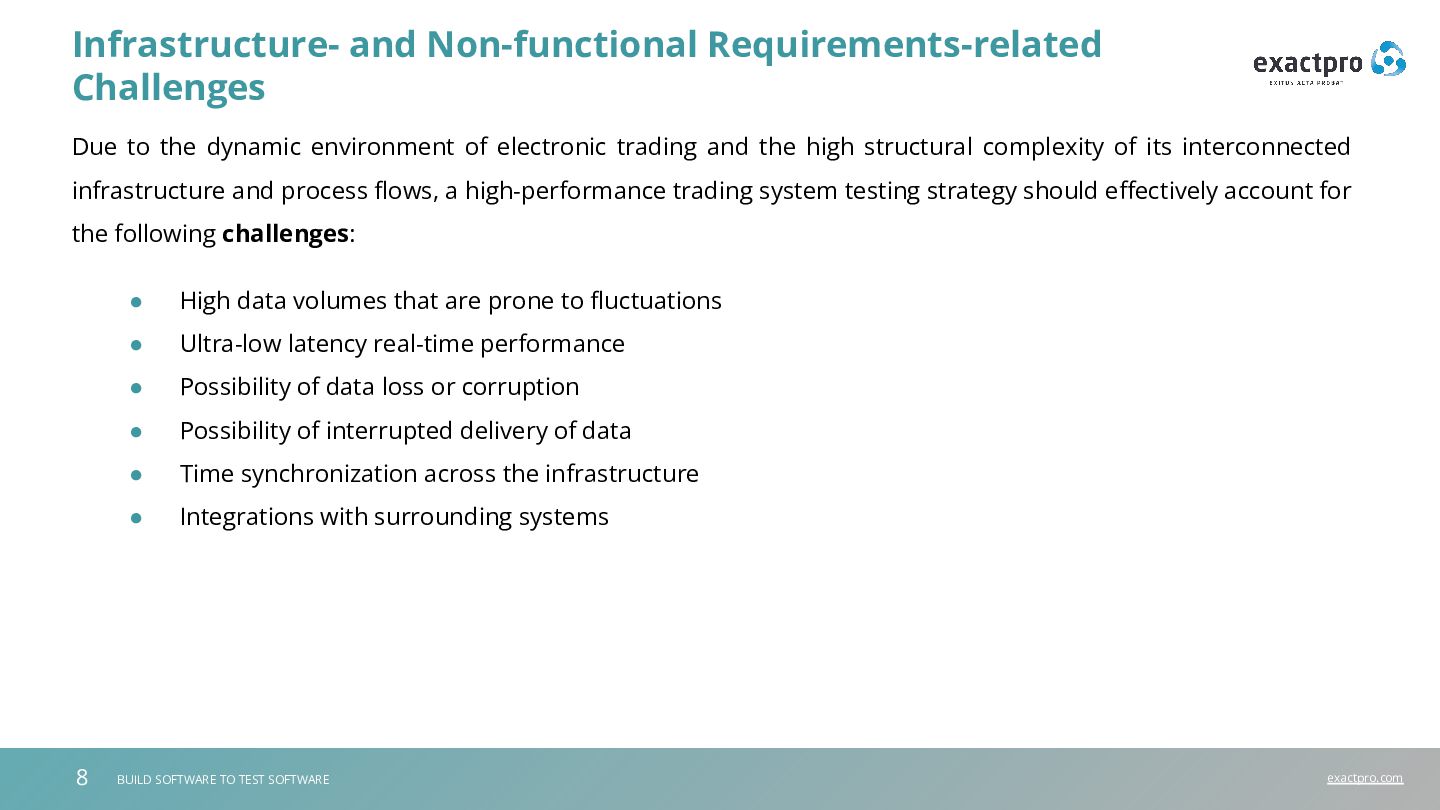
Requirements-related Challenges Due to the dynamic environment of electronic trading and the high structural complexity of its interconnected infrastructure and process flows, a high-performance trading system testing strategy should effectively account for the following challenges: • High data volumes that are prone to fluctuations • Ultra-low latency real-time performance • Possibility of data loss or corruption • Possibility of interrupted delivery of data • Time synchronization across the infrastructure • Integrations with surrounding systems
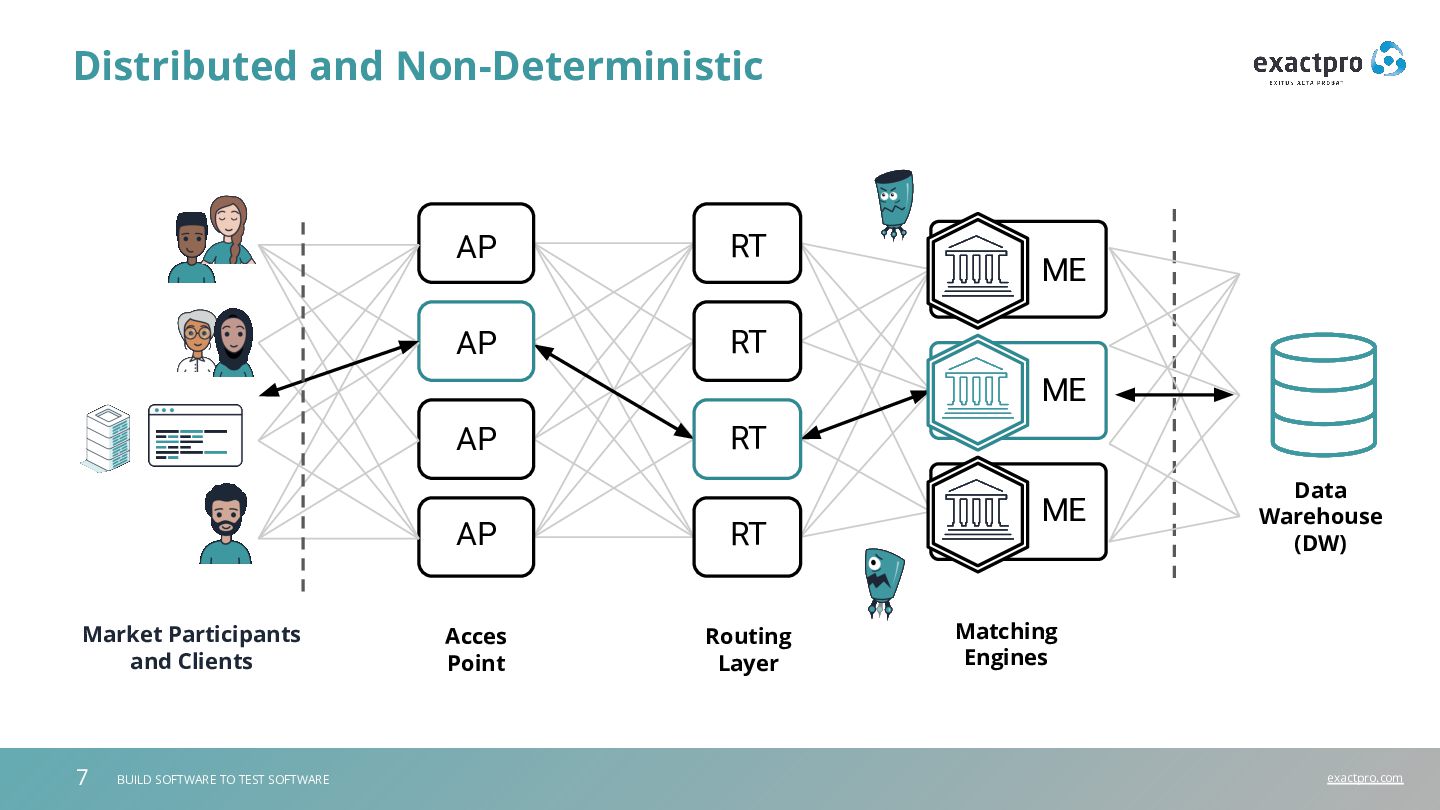
In a complex distributed system, it is crucial to understand the possibility of hidden interdependencies that will only reveal themselves at the intersection of functional and non-functional testing. Some potential situations of non-determinism occurring under specific non-functional conditions can be found in the below scenarios: • Any complex system must sustain a certain level of concurrency especially when a high-frequency load is applied. • Production-like randomisation combined with load conditions. • Integer overflow in certain scenarios, requiring calculation and ID incrementation. • Dynamic mass events in the main trading components happening during the Daily Life Cycle (DLC) with the load applied against the system.
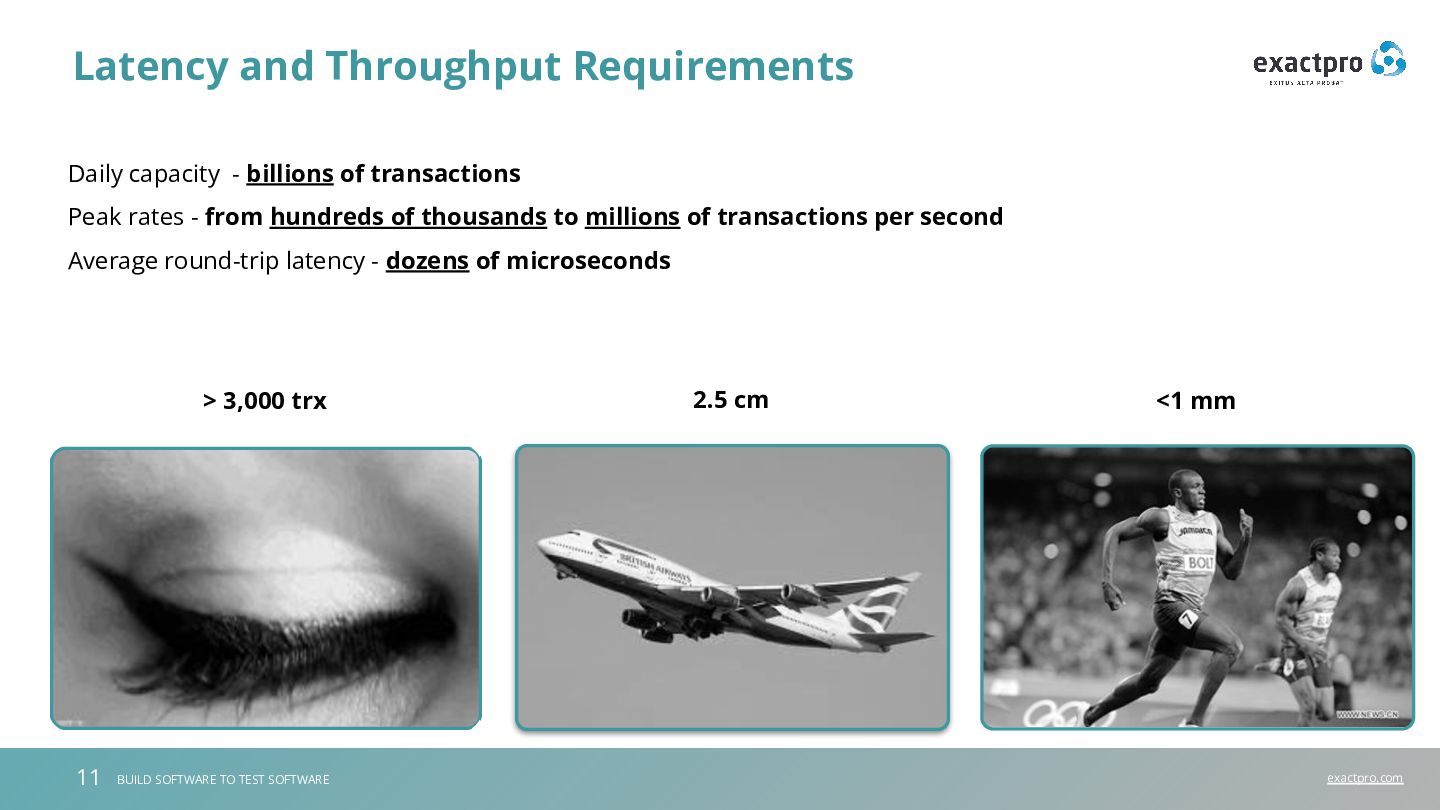
billions of transactions Peak rates - from hundreds of thousands to millions of transactions per second Average round-trip latency - dozens of microseconds > 3,000 trx 2.5 cm <1 mm Latency and Throughput Requirements
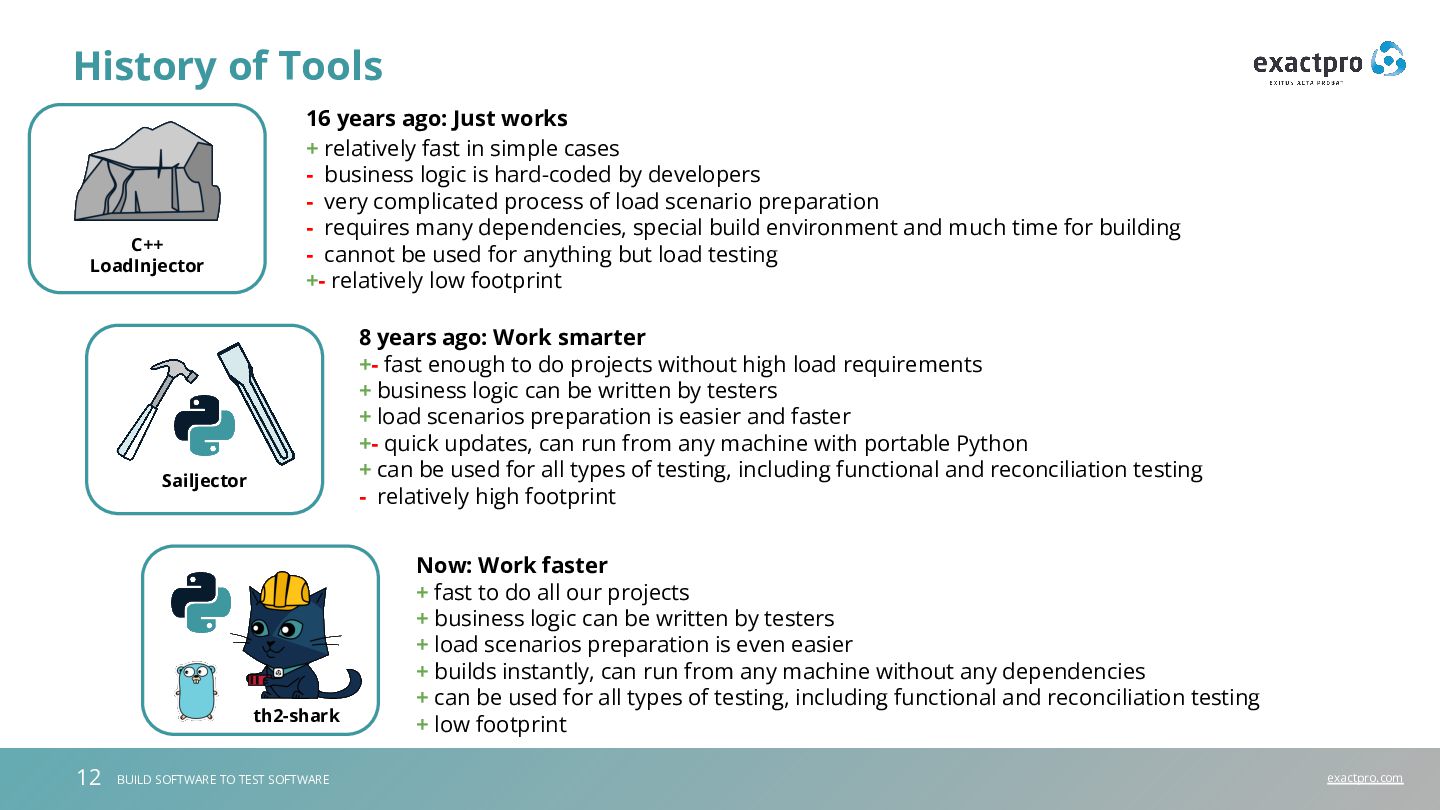
Work smarter +- fast enough to do projects without high load requirements + business logic can be written by testers + load scenarios preparation is easier and faster +- quick updates, can run from any machine with portable Python + can be used for all types of testing, including functional and reconciliation testing - relatively high footprint History of Tools Now: Work faster + fast to do all our projects + business logic can be written by testers + load scenarios preparation is even easier + builds instantly, can run from any machine without any dependencies + can be used for all types of testing, including functional and reconciliation testing + low footprint 16 years ago: Just works + relatively fast in simple cases - business logic is hard-coded by developers - very complicated process of load scenario preparation - requires many dependencies, special build environment and much time for building - cannot be used for anything but load testing +- relatively low footprint Sailjector th2-shark C++ LoadInjector
Industry Context High-performance trading systems operate in environments where microsecond-level latency differences determine competitive outcomes and where instability under load is as damaging as functional defects. Validating such systems demands load testing tooling purpose-built for the unique demands of electronic trading infrastructure capable of sustaining millions of messages per second, simulating realistic market participant behavior, supporting a wide range of financial protocols, and producing actionable, analyst-ready performance reports. th2-shark is a high-throughput load generation and benchmarking tool designed specifically for these requirements. Its core design principle is that test scenarios should be expressive, portable, and impose minimal overhead on the system under test. It can be deployed against matching engines, smart order routers, market data systems, clearing and settlement infrastructure, and risk management platforms without protocol-specific tooling gaps.
th2-shark Trading GWs Lit Book Liquidity Partners CSD Trading Desktops Client Brokerage Systems Market Data GWs Distribution System Surveillance System Dark & Algo- Crossing Book Smart Order Router Reference Pricing Server Static Data MIS Heatmap CCP Dark Markets Lit Markets Clearing GW Brokerage Back Office Market Control Persistence DWH & MIS Surveillance UI connectivity, tags, order validation compare vs. execution reports data, reports, recovery alerts, patterns, book replay post trade processing, reconciliations consolidated book functional correctness and execution efficiency reference data setup market control actions matching rules, periods, order constraints and validity Operability, deployment, configuration, monitoring, fault-tolerance, disaster recovery Market Data Monitoring End points and data reconciliation Latency calculation External price feed simulation Trading Actors Market Data Actors External systems (CCP, SOR) simulation Typical Trading Systems – Load Injection with th2-shark
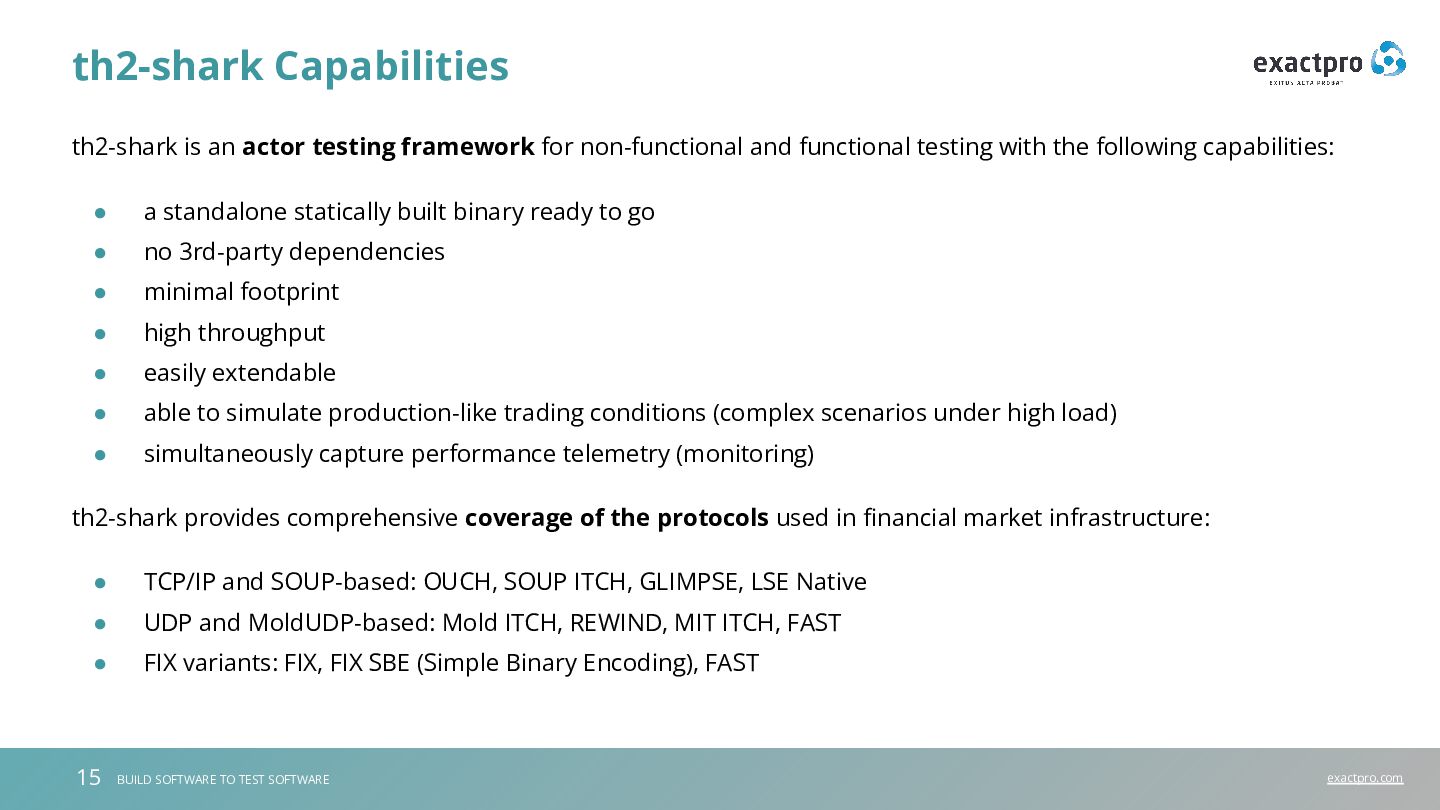
is an actor testing framework for non-functional and functional testing with the following capabilities: • a standalone statically built binary ready to go • no 3rd-party dependencies • minimal footprint • high throughput • easily extendable • able to simulate production-like trading conditions (complex scenarios under high load) • simultaneously capture performance telemetry (monitoring) th2-shark provides comprehensive coverage of the protocols used in financial market infrastructure: • TCP/IP and SOUP-based: OUCH, SOUP ITCH, GLIMPSE, LSE Native • UDP and MoldUDP-based: Mold ITCH, REWIND, MIT ITCH, FAST • FIX variants: FIX, FIX SBE (Simple Binary Encoding), FAST
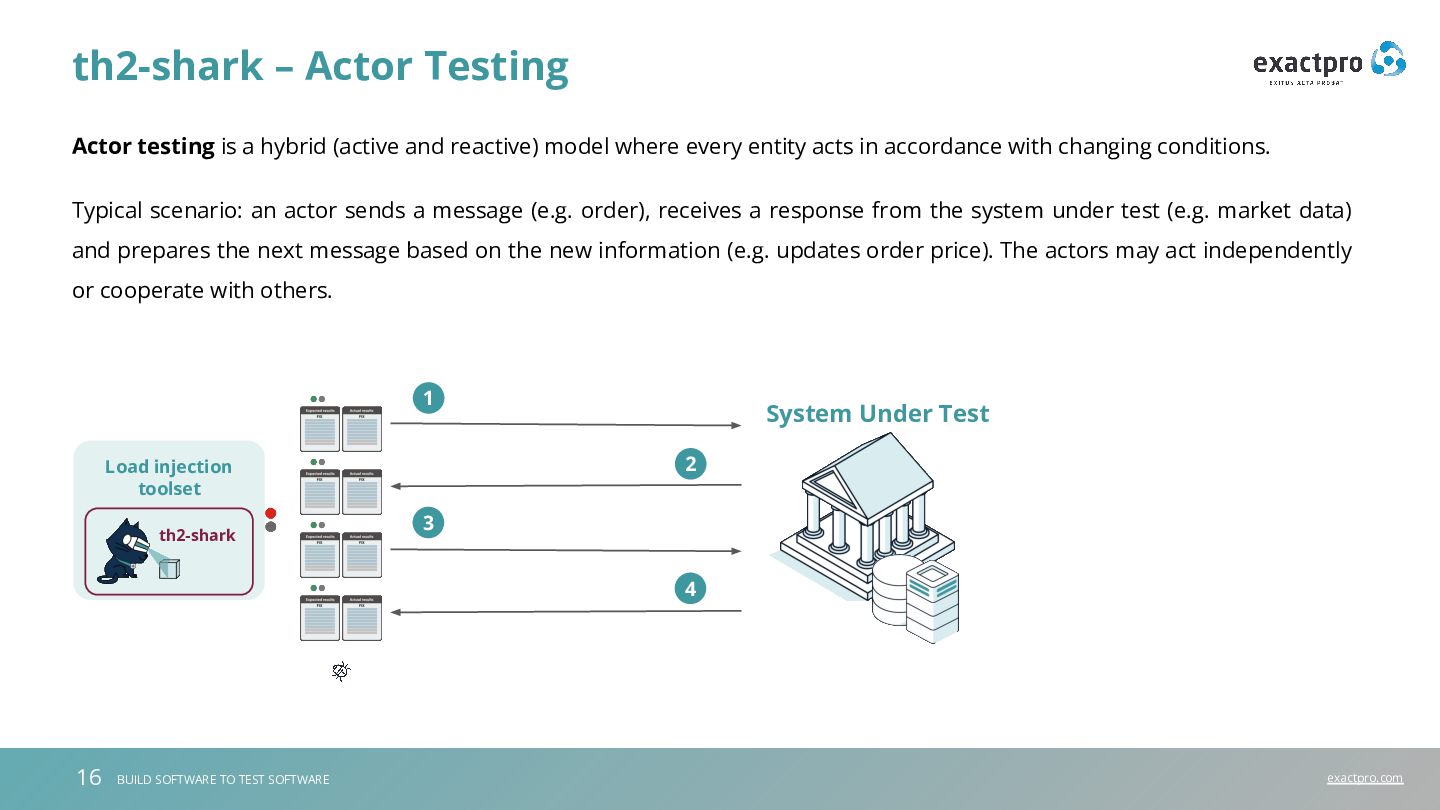
Testing Actor testing is a hybrid (active and reactive) model where every entity acts in accordance with changing conditions. Typical scenario: an actor sends a message (e.g. order), receives a response from the system under test (e.g. market data) and prepares the next message based on the new information (e.g. updates order price). The actors may act independently or cooperate with others. System Under Test Load injection toolset th2-shark 1 2 3 4
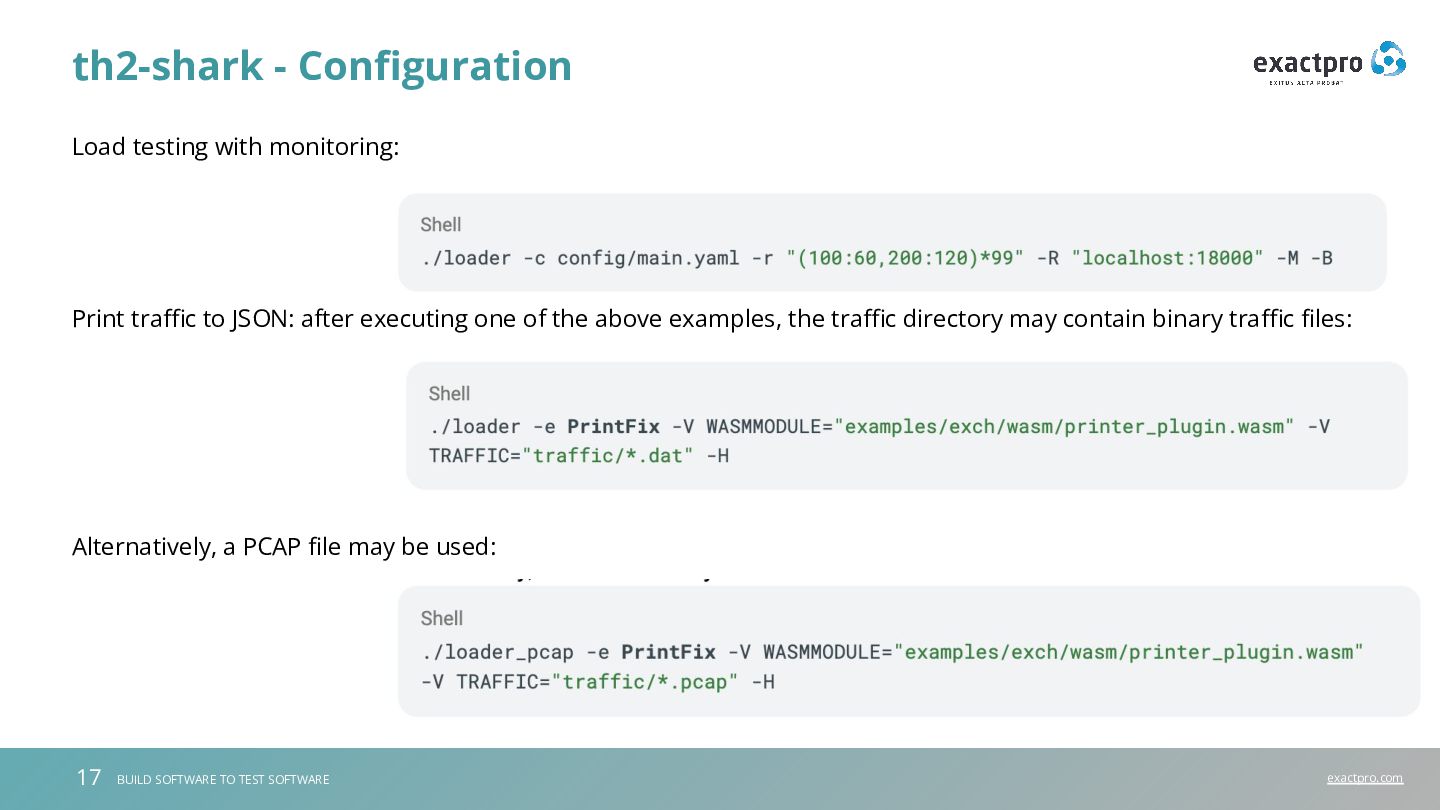
Load testing with monitoring: Print traffic to JSON: after executing one of the above examples, the traffic directory may contain binary traffic files: Alternatively, a PCAP file may be used:
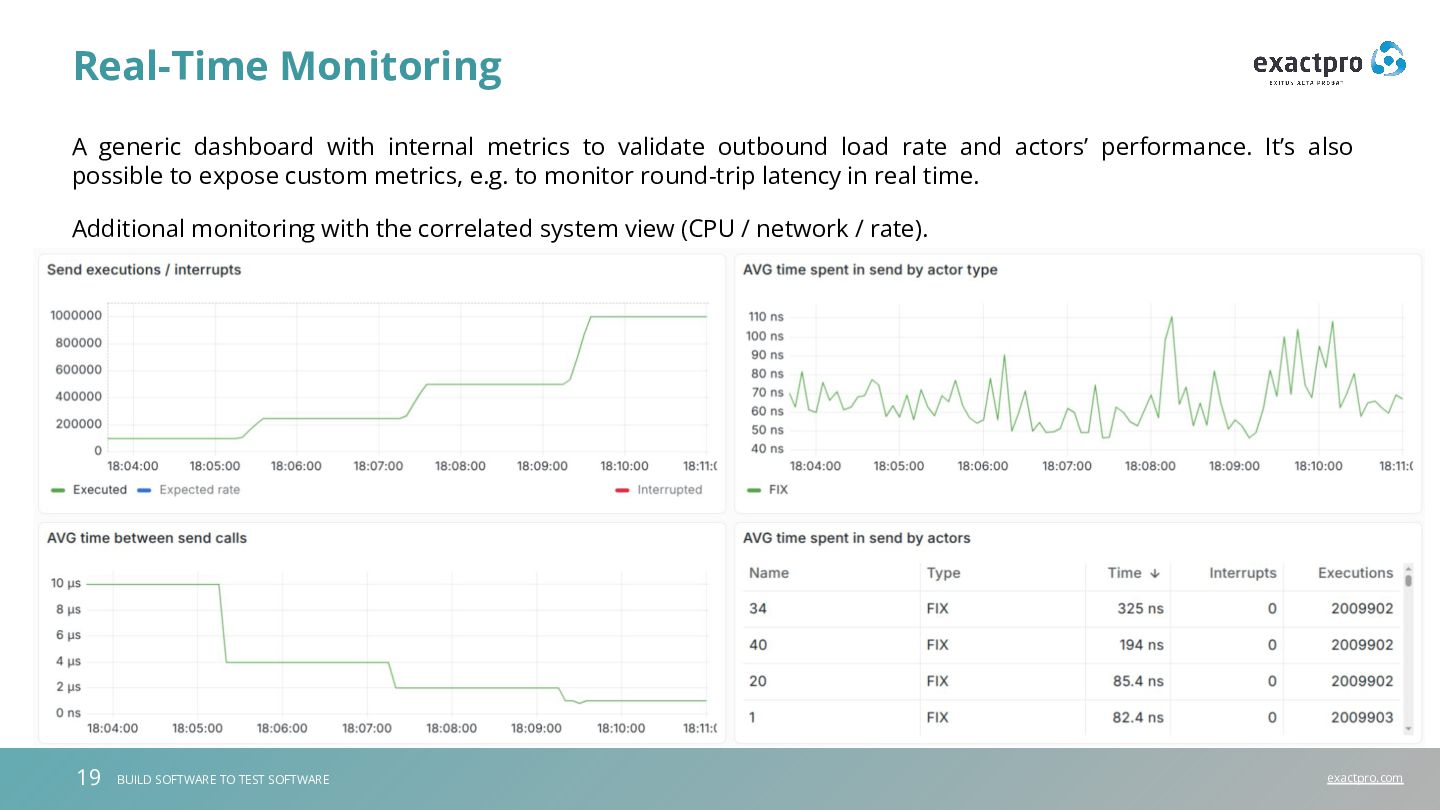
generic dashboard with internal metrics to validate outbound load rate and actors’ performance. It’s also possible to expose custom metrics, e.g. to monitor round-trip latency in real time. Additional monitoring with the correlated system view (CPU / network / rate).


 exactpro
 madoxten
 sarafernandez
 badams
 raygrieselhuber
 danielanewman
 paigeccino
 mza
mza
 holman
 irinanazarova
 techseoconnect
 eileencodes
 tmiket