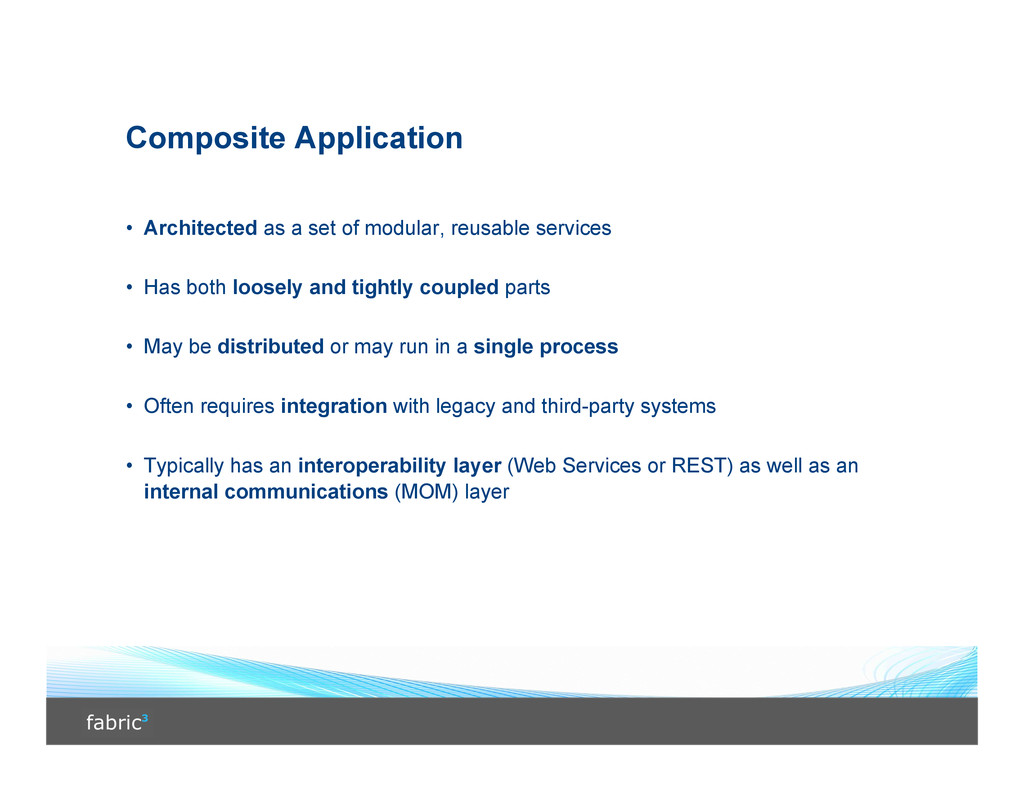
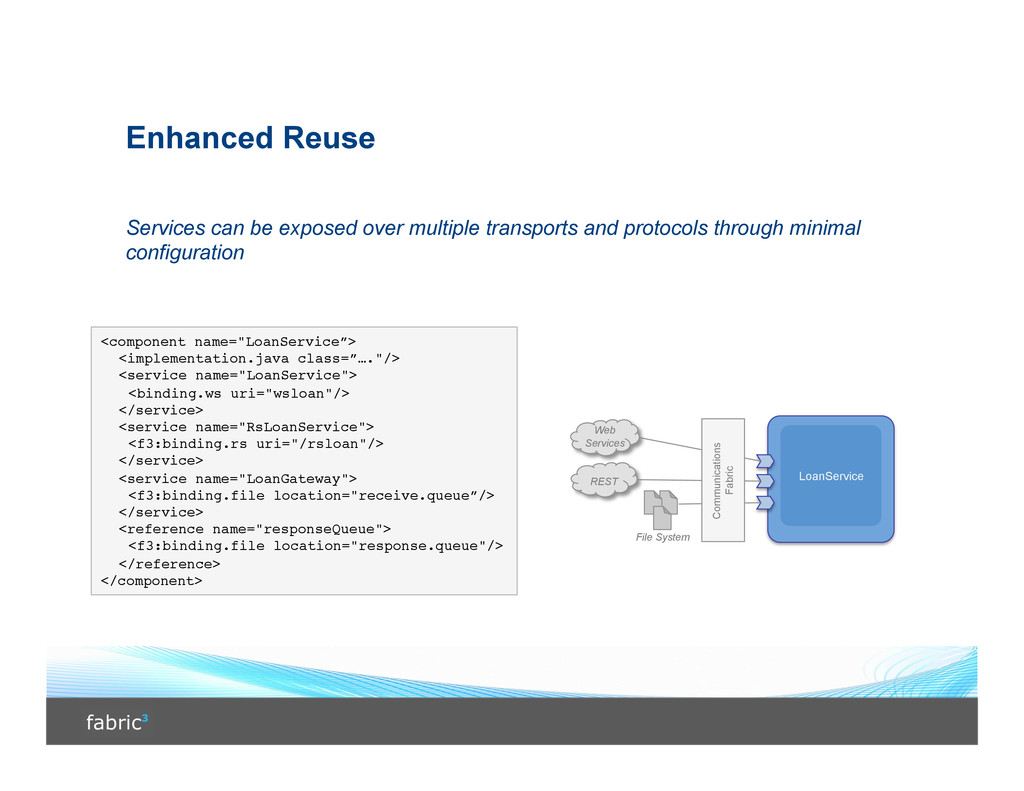
services • Has both loosely and tightly coupled parts • May be distributed or may run in a single process • Often requires integration with legacy and third-party systems • Typically has an interoperability layer (Web Services or REST) as well as an internal communications (MOM) layer
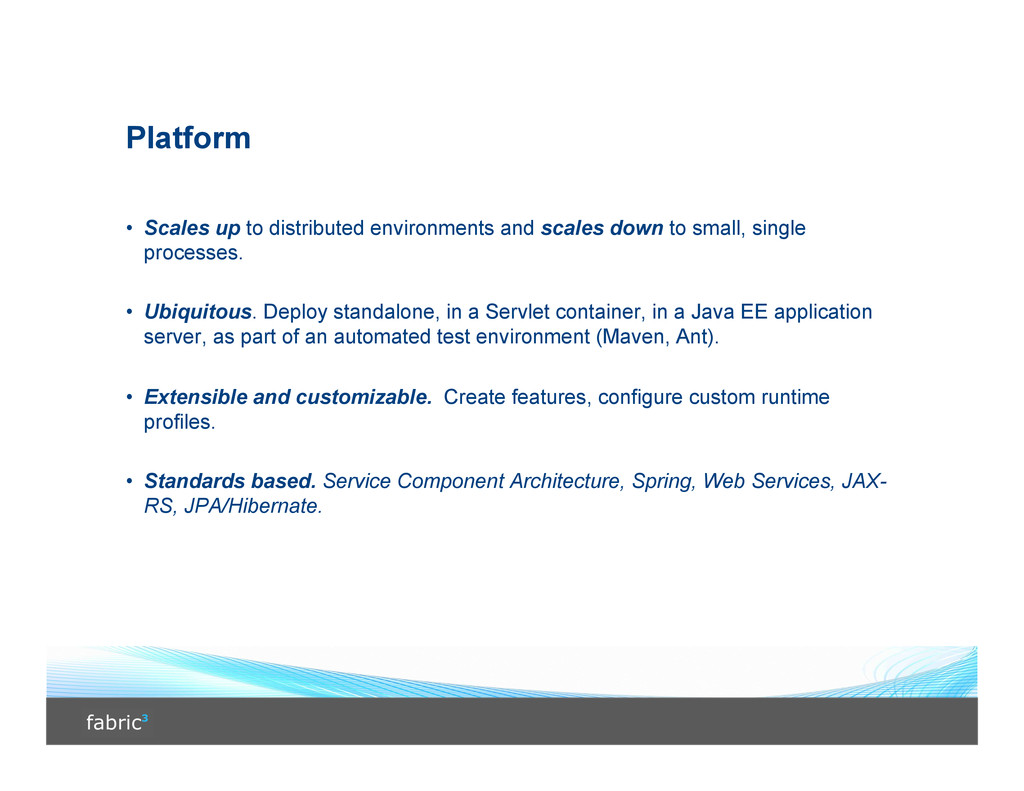
to small, single processes. • Ubiquitous. Deploy standalone, in a Servlet container, in a Java EE application server, as part of an automated test environment (Maven, Ant). • Extensible and customizable. Create features, configure custom runtime profiles. • Standards based. Service Component Architecture, Spring, Web Services, JAX- RS, JPA/Hibernate.
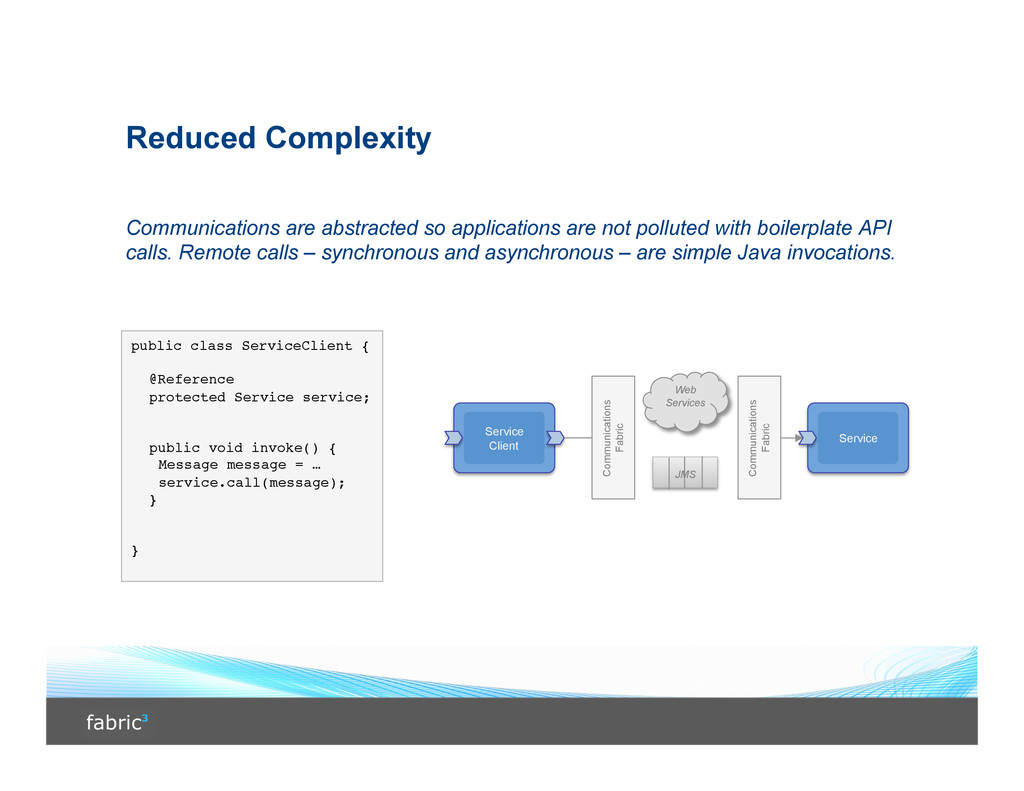
with boilerplate API calls. Remote calls – synchronous and asynchronous – are simple Java invocations. public class ServiceClient {! !@Reference! !protected Service service;! !public void invoke() {! !!Message message = …! !!service.call(message);! !}! }! Service Service Client JMS Web Services Communications Fabric Communications Fabric
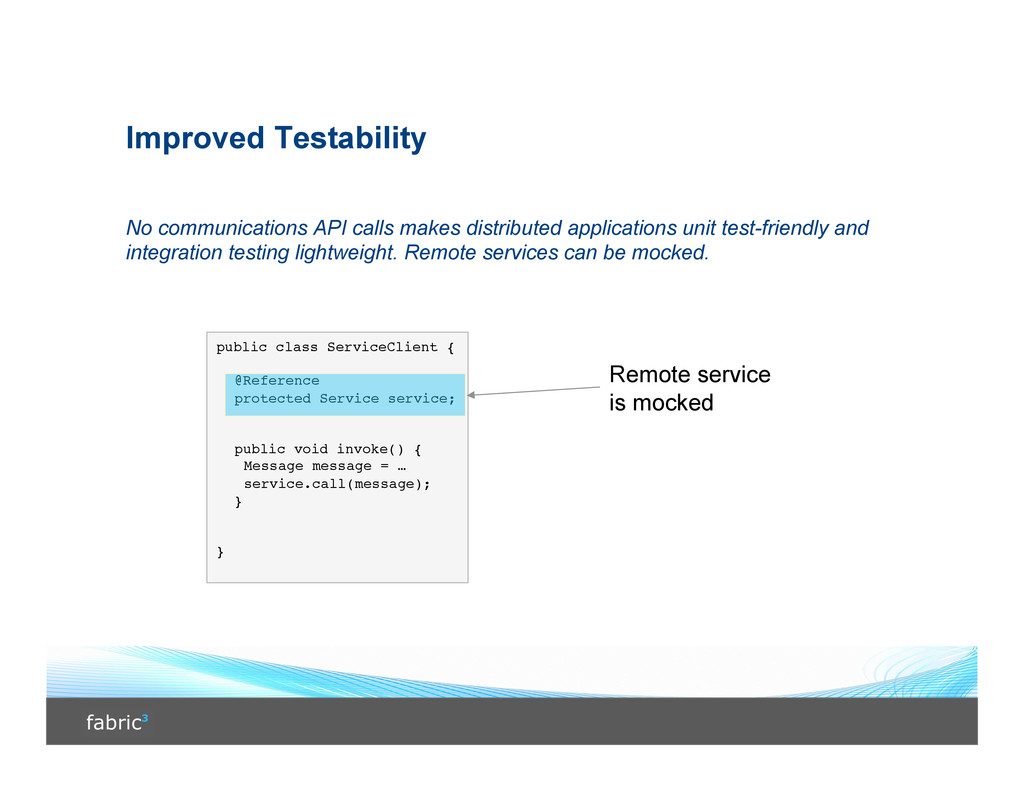
integration testing lightweight. Remote services can be mocked. Improved Testability public class ServiceClient {! !@Reference! !protected Service service;! !public void invoke() {! !!Message message = …! !!service.call(message);! !}! }! Remote service is mocked
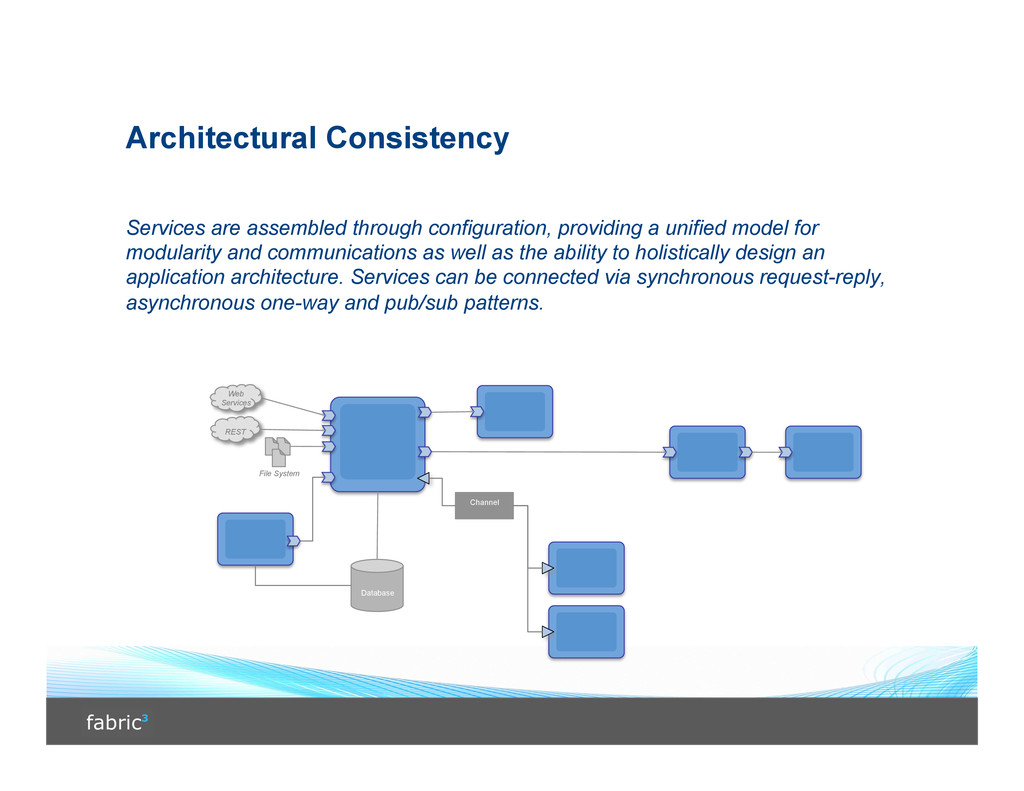
modularity and communications as well as the ability to holistically design an application architecture. Services can be connected via synchronous request-reply, asynchronous one-way and pub/sub patterns. Architectural Consistency REST Web Services File System Channel Database


 gam0022
 hollycummins
 nokomoro3
 artoy
artoy
 kaityo256
 satoshi256kbyte
 akihisaikeda
 gonta
gonta
 shihochan
 yub0n
yub0n
 uyuki234
 ryu1013
 ivargrimstad
 charlesmeaden
 bcantrill
 ipullrank
 cromwellryan
 sabderemane
 tammielis
 inesmontani
 aleyda
 apolaine
 nmsamuel
 portentint