to edit (delete, reorder, copy–paste) Legible for everyone (no messy handwriting issues) Easier to share/collaborate in real time Cloud backup and version history Less hand fatigue on long tasks Works well for multitasking (tabs, references) Accessible on any device; sync across platforms
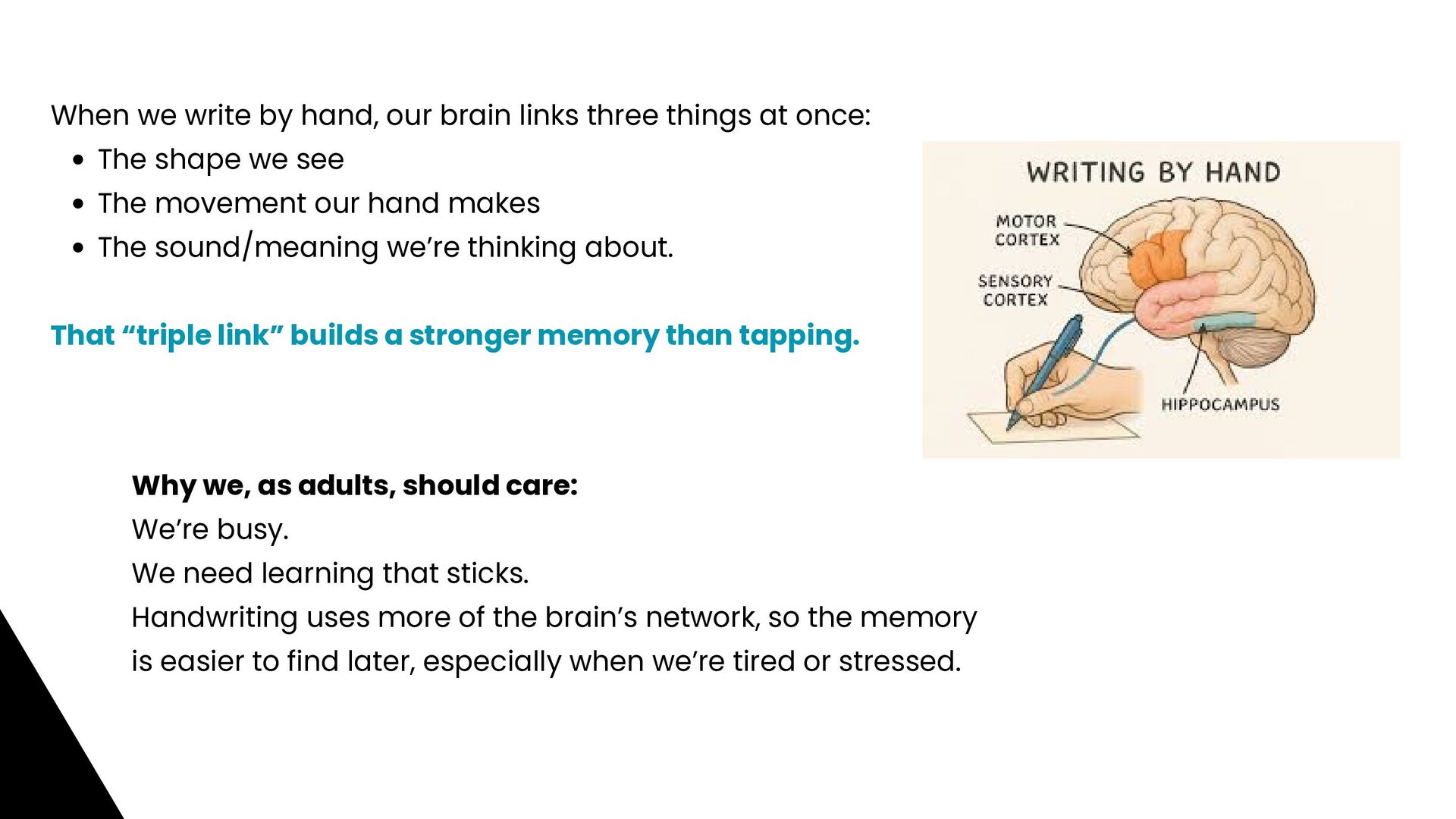
at once: The shape we see The movement our hand makes The sound/meaning we’re thinking about. That “triple link” builds a stronger memory than tapping. Why we, as adults, should care: We’re busy. We need learning that sticks. Handwriting uses more of the brain’s network, so the memory is easier to find later, especially when we’re tired or stressed.
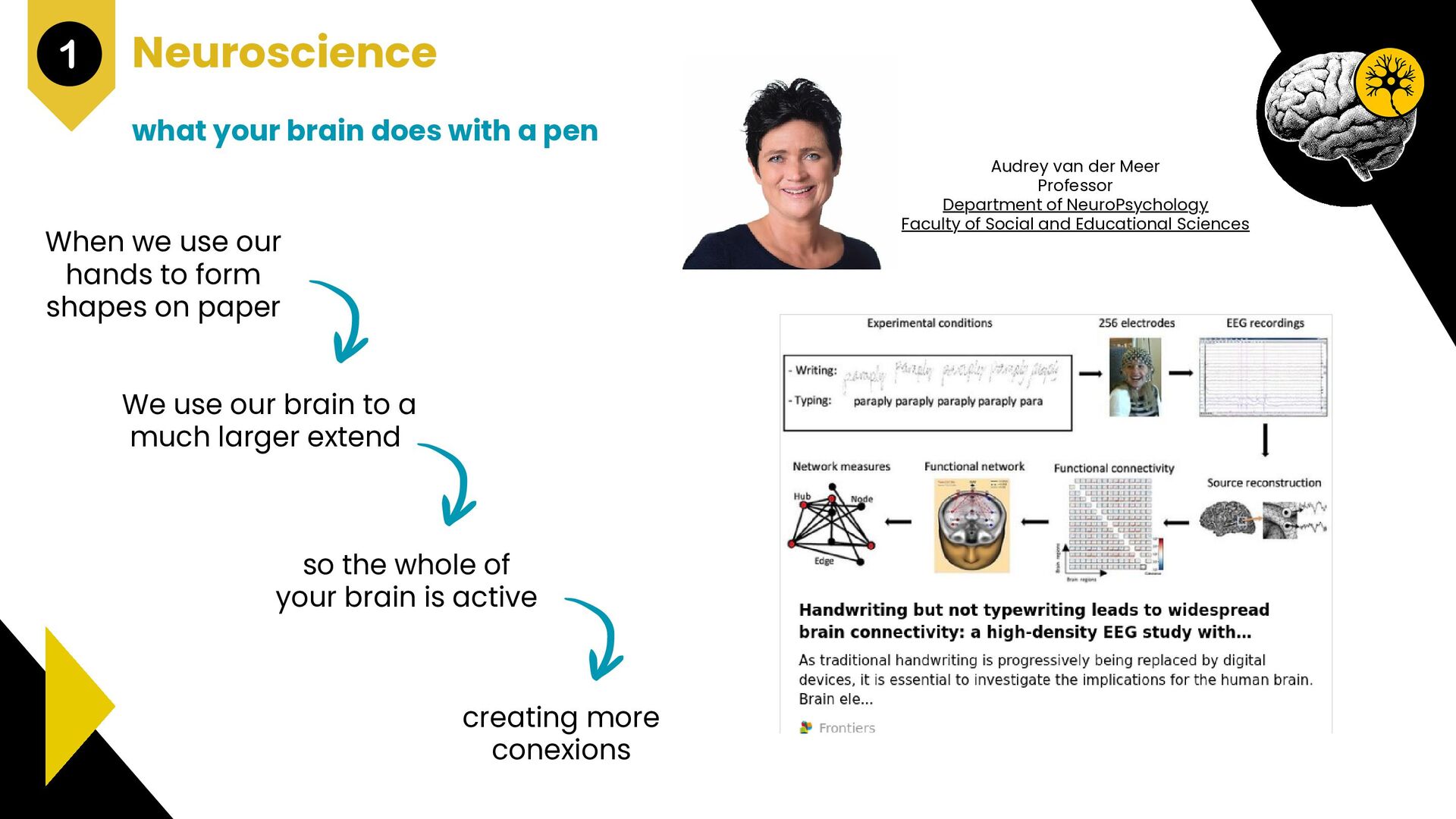
your brain does with a pen Neuroscience When we use our hands to form shapes on paper so the whole of your brain is active creating more conexions Audrey van der Meer Professor Department of NeuroPsychology Faculty of Social and Educational Sciences
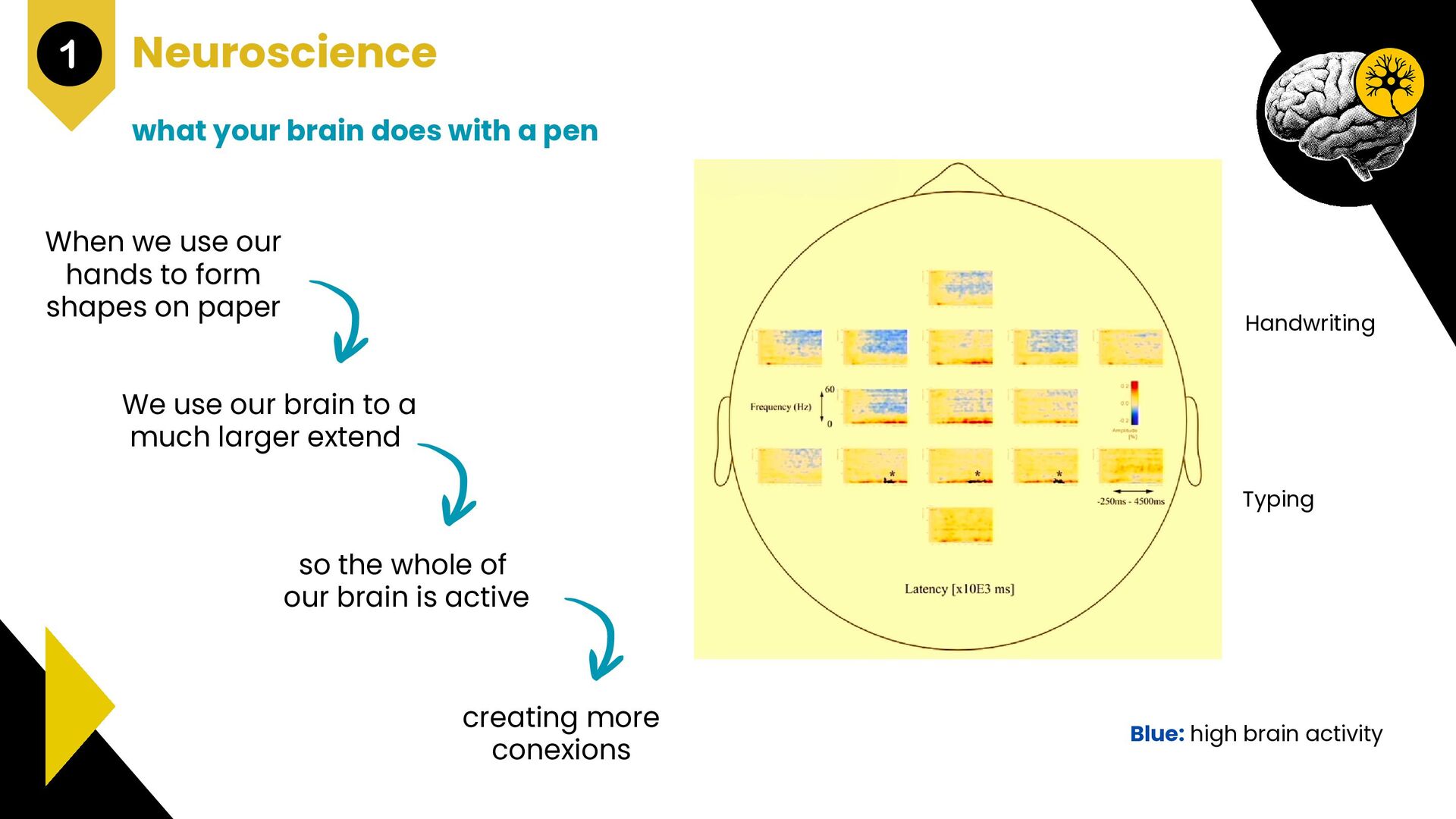
use our hands to form shapes on paper We use our brain to a much larger extend so the whole of our brain is active creating more conexions Blue: high brain activity Handwriting Typing
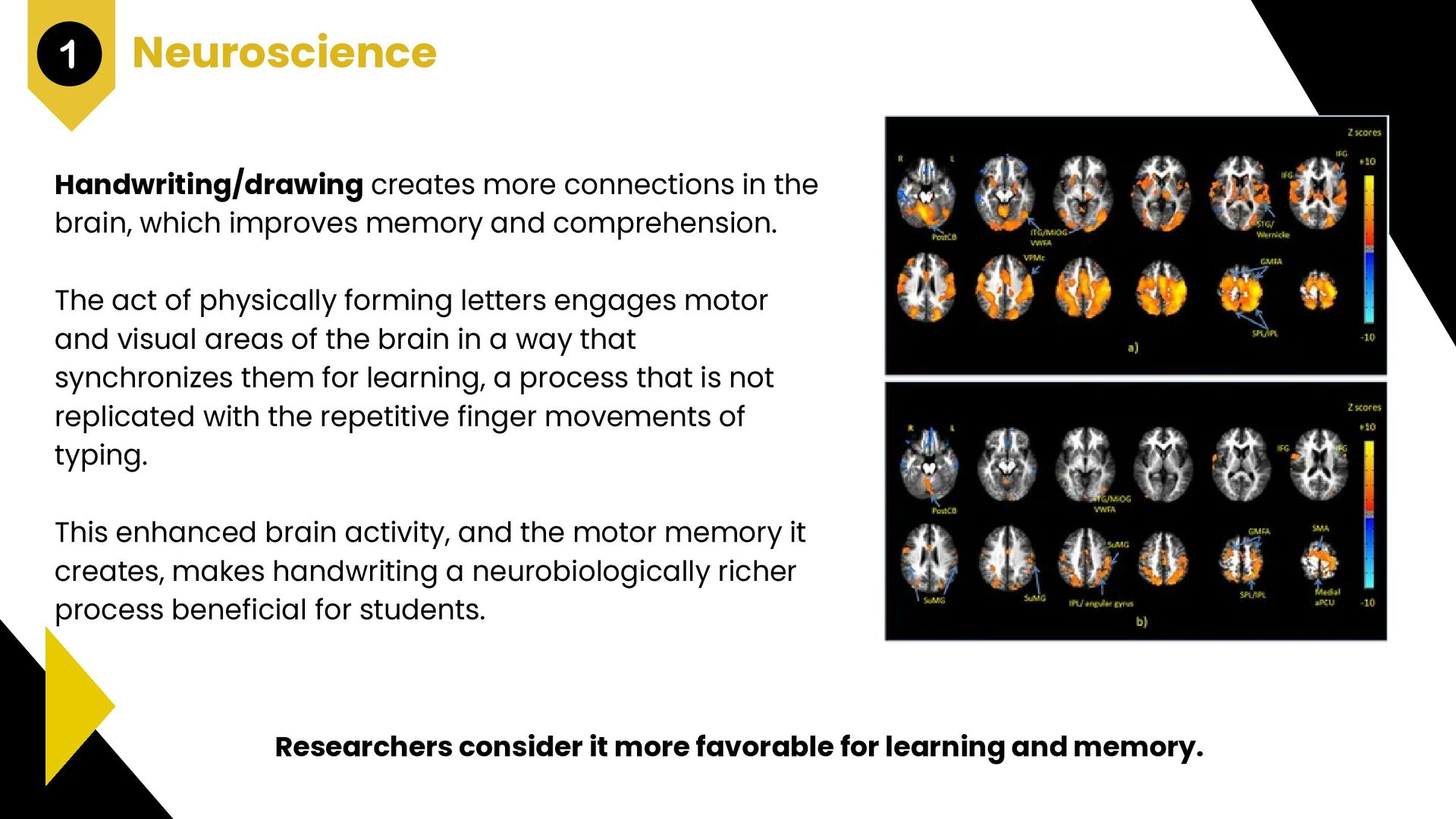
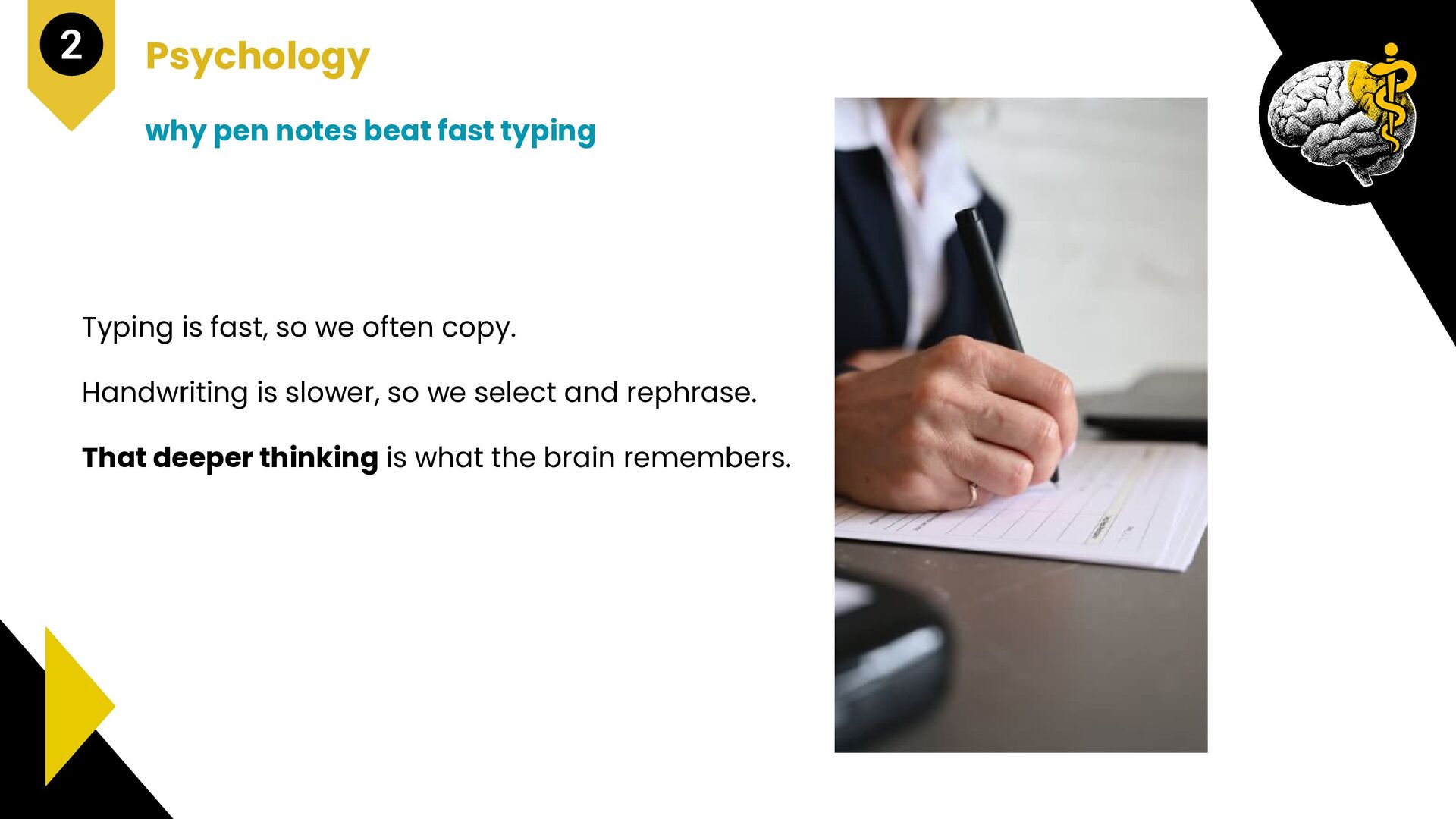
and comprehension. The act of physically forming letters engages motor and visual areas of the brain in a way that synchronizes them for learning, a process that is not replicated with the repetitive finger movements of typing. This enhanced brain activity, and the motor memory it creates, makes handwriting a neurobiologically richer process beneficial for students. Neuroscience Researchers consider it more favorable for learning and memory.
by hand, brain areas for motor and visual processing sync up more with areas crucial for memory formation. Activates more brain cells: Brain activity scans show more connections are formed when people write by hand compared to typing. Creates motor memory: The physical act of forming letters with your fingers creates a "motor memory" that links what you see, hear, and physically produce. Slows down the process: Writing by hand is slower than typing, which forces more deliberate processing and can improve long-term retention.
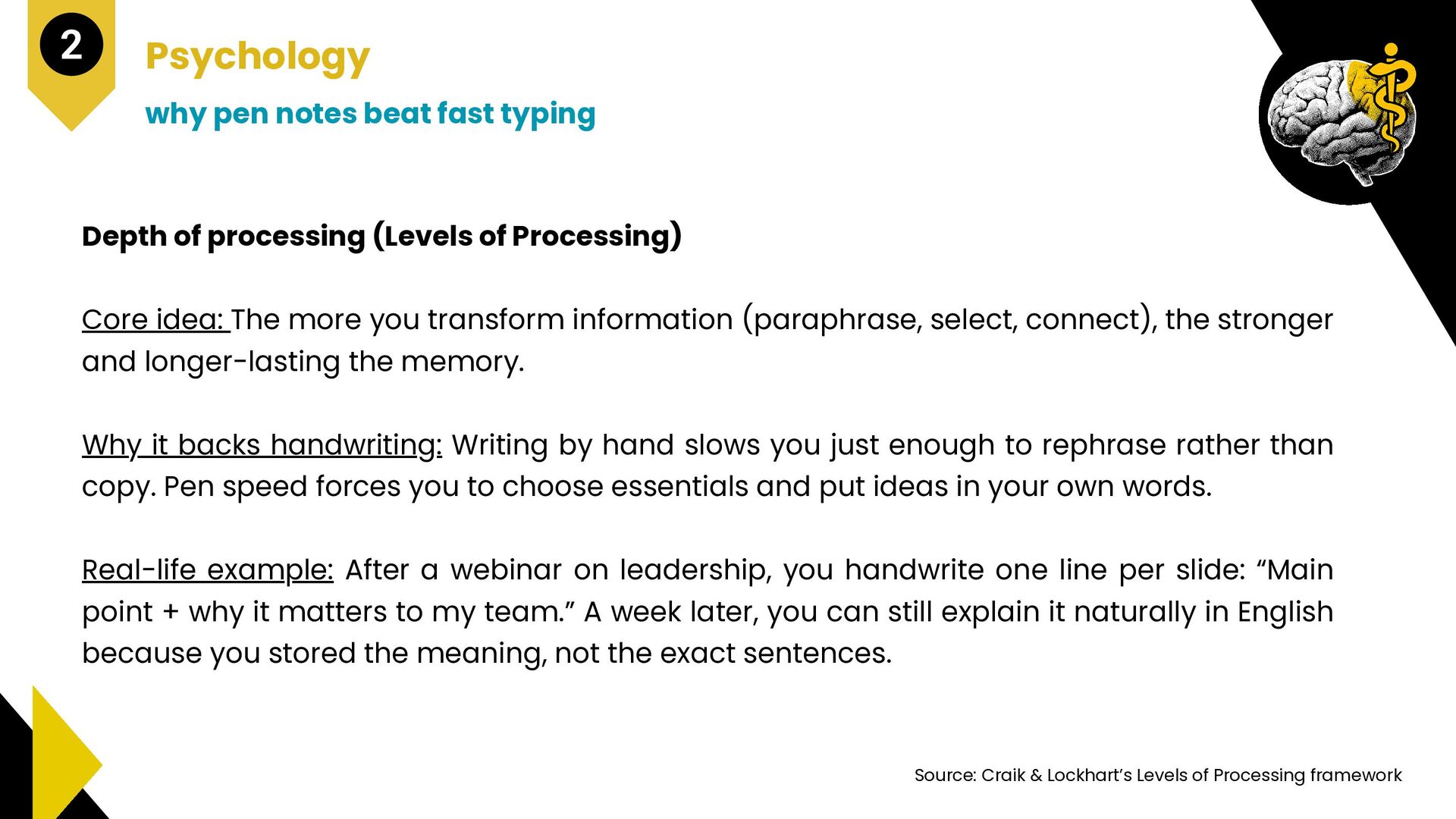
you transform information (paraphrase, select, connect), the stronger and longer-lasting the memory. Why it backs handwriting: Writing by hand slows you just enough to rephrase rather than copy. Pen speed forces you to choose essentials and put ideas in your own words. Real-life example: After a webinar on leadership, you handwrite one line per slide: “Main point + why it matters to my team.” A week later, you can still explain it naturally in English because you stored the meaning, not the exact sentences. why pen notes beat fast typing Psychology Source: Craik & Lockhart’s Levels of Processing framework
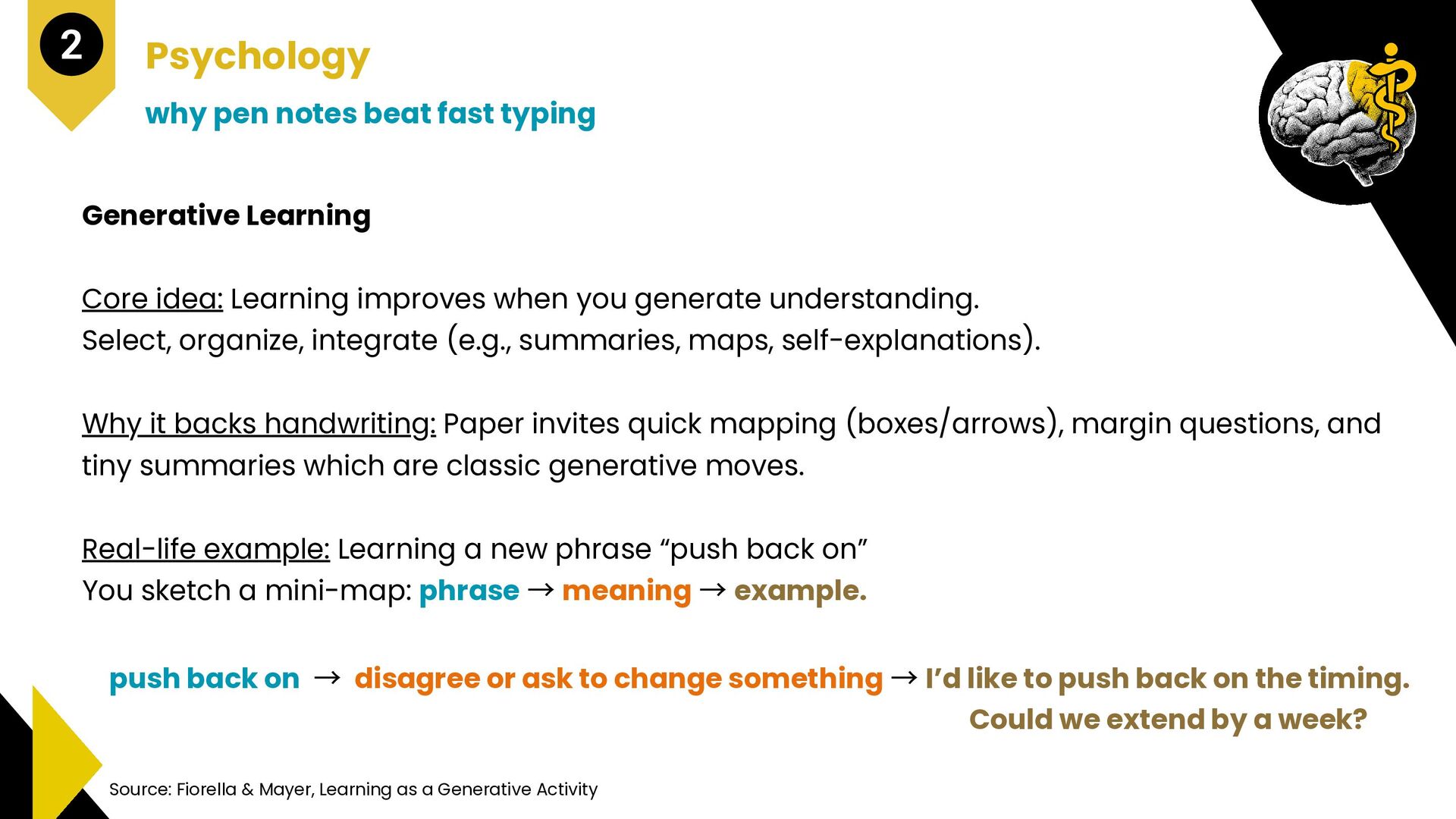
Select, organize, integrate (e.g., summaries, maps, self-explanations). Why it backs handwriting: Paper invites quick mapping (boxes/arrows), margin questions, and tiny summaries which are classic generative moves. Real-life example: Learning a new phrase “push back on” You sketch a mini-map: phrase → meaning → example. why pen notes beat fast typing Psychology Source: Fiorella & Mayer, Learning as a Generative Activity push back on → disagree or ask to change something → I’d like to push back on the timing. Could we extend by a week?
improves when we reduce the irrelevant information. Why it backs handwriting: Paper naturally filters: you write less, focus more, and avoid tab- switching and notifications. Real-life example: While reading an article, you handwrite a two-column note: left = keywords, right = your paraphrase. Your brain stays focused, so later you can explain it. why pen notes beat fast typing Psychology Source: Sweller’s Cognitive Load Theory (1988) and overviews
when used for notes, laptops and phones increase the temptation to divide attention. Why it backs handwriting: Pen-and-paper minimizes digital multitasking, protecting attention. Real-life example: In a training session, you keep the laptop closed and write three questions you’ll ask at the end. You leave with solid understanding and can craft a concise English recap for your team. why pen notes beat fast typing Psychology Source: Sana, Weston & Cepeda (Computers & Education, 2013)
promotes conceptual understanding. Why handwriting fits: Brief handwritten explanations promote knowledge-transforming rather than knowledge-telling. Real-life example: Write specific notes on paper after a meeting: Decision: Deadline: Next step: why pen notes beat fast typing Pedagogy Source: Kiewra, K. A. (1985–2005). Meta-analyses and experiments on note-taking.
monitoring understanding improves transfer and problem solving. Why handwriting fits: Margin questions (“why/how/so what?”), brief reflections, and two-line summaries make self-explanation concrete and visible. Real-life example: write 3 margin questions and answer briefly Why does this matter? Where/How will I use it this week? What’s one example I can say/write today? why pen notes beat fast typing Pedagogy Source: Chi, M. T. H. (2000; 2009) on self-explanation.


 gabbyrincon7
 tammyeverts
 garrettdimon
 reverentgeek
 morganepeng
 mkilby
 helmedeiros
 jonoalderson
 eileencodes
 ipullrank
 mlcsv
mlcsv
 konakalab