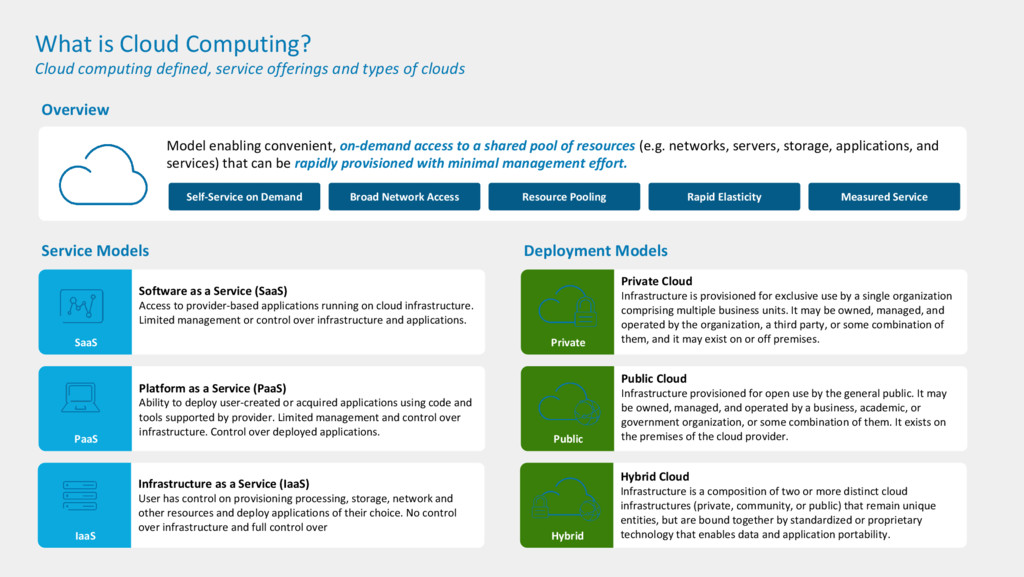
provider-based applications running on cloud infrastructure. Limited management or control over infrastructure and applications. Deployment Models PaaS Platform as a Service (PaaS) Ability to deploy user-created or acquired applications using code and tools supported by provider. Limited management and control over infrastructure. Control over deployed applications. IaaS Infrastructure as a Service (IaaS) User has control on provisioning processing, storage, network and other resources and deploy applications of their choice. No control over infrastructure and full control over Private Private Cloud Infrastructure is provisioned for exclusive use by a single organization comprising multiple business units. It may be owned, managed, and operated by the organization, a third party, or some combination of them, and it may exist on or off premises. Public Public Cloud Infrastructure provisioned for open use by the general public. It may be owned, managed, and operated by a business, academic, or government organization, or some combination of them. It exists on the premises of the cloud provider. Hybrid Hybrid Cloud Infrastructure is a composition of two or more distinct cloud infrastructures (private, community, or public) that remain unique entities, but are bound together by standardized or proprietary technology that enables data and application portability. What is Cloud Computing? Cloud computing defined, service offerings and types of clouds Overview Model enabling convenient, on-demand access to a shared pool of resources (e.g. networks, servers, storage, applications, and services) that can be rapidly provisioned with minimal management effort. Self-Service on Demand Broad Network Access Resource Pooling Rapid Elasticity Measured Service
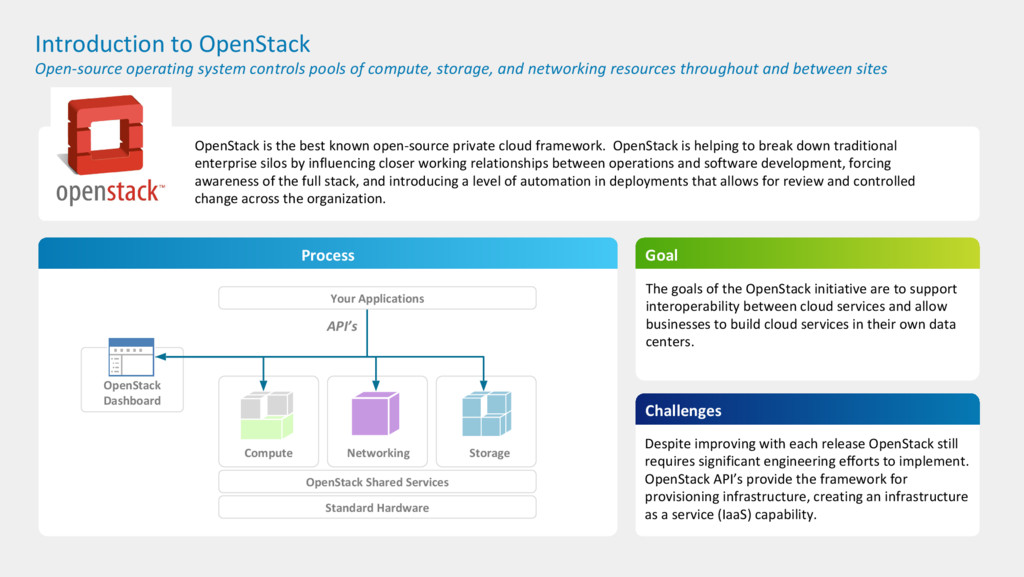
storage, and networking resources throughout and between sites OpenStack is the best known open-source private cloud framework. OpenStack is helping to break down traditional enterprise silos by influencing closer working relationships between operations and software development, forcing awareness of the full stack, and introducing a level of automation in deployments that allows for review and controlled change across the organization. OpenStack Dashboard Compute Networking Storage API’s OpenStack Shared Services Standard Hardware Your Applications The goals of the OpenStack initiative are to support interoperability between cloud services and allow businesses to build cloud services in their own data centers. Goal Despite improving with each release OpenStack still requires significant engineering efforts to implement. OpenStack API’s provide the framework for provisioning infrastructure, creating an infrastructure as a service (IaaS) capability. Challenges Process
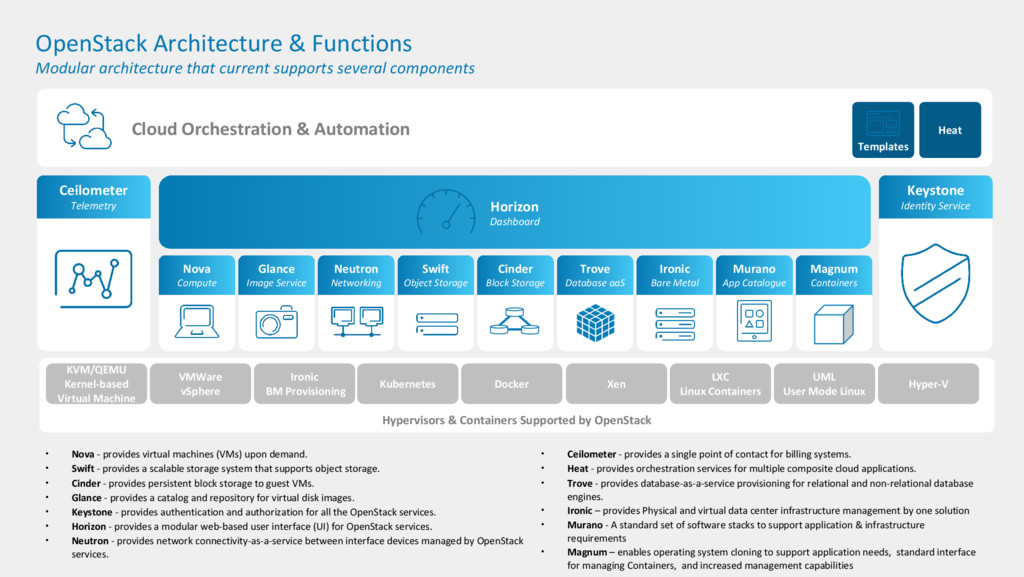
components Cloud Orchestration & Automation Templates Heat Ceilometer Telemetry Horizon Dashboard Nova Compute Glance Image Service Neutron Networking Cinder Block Storage Swift Object Storage Trove Database aaS Murano App Catalogue Ironic Bare Metal Magnum Containers Keystone Identity Service ∙ Nova - provides virtual machines (VMs) upon demand. ∙ Swift - provides a scalable storage system that supports object storage. ∙ Cinder - provides persistent block storage to guest VMs. ∙ Glance - provides a catalog and repository for virtual disk images. ∙ Keystone - provides authentication and authorization for all the OpenStack services. ∙ Horizon - provides a modular web-based user interface (UI) for OpenStack services. ∙ Neutron - provides network connectivity-as-a-service between interface devices managed by OpenStack services. Hypervisors & Containers Supported by OpenStack KVM/QEMU Kernel-based Virtual Machine UML User Mode Linux VMWare vSphere LXC Linux Containers Xen Hyper-V Ironic BM Provisioning Docker Kubernetes ∙ Ceilometer - provides a single point of contact for billing systems. ∙ Heat - provides orchestration services for multiple composite cloud applications. ∙ Trove - provides database-as-a-service provisioning for relational and non-relational database engines. ∙ Ironic – provides Physical and virtual data center infrastructure management by one solution ∙ Murano - A standard set of software stacks to support application & infrastructure requirements ∙ Magnum – enables operating system cloning to support application needs, standard interface for managing Containers, and increased management capabilities
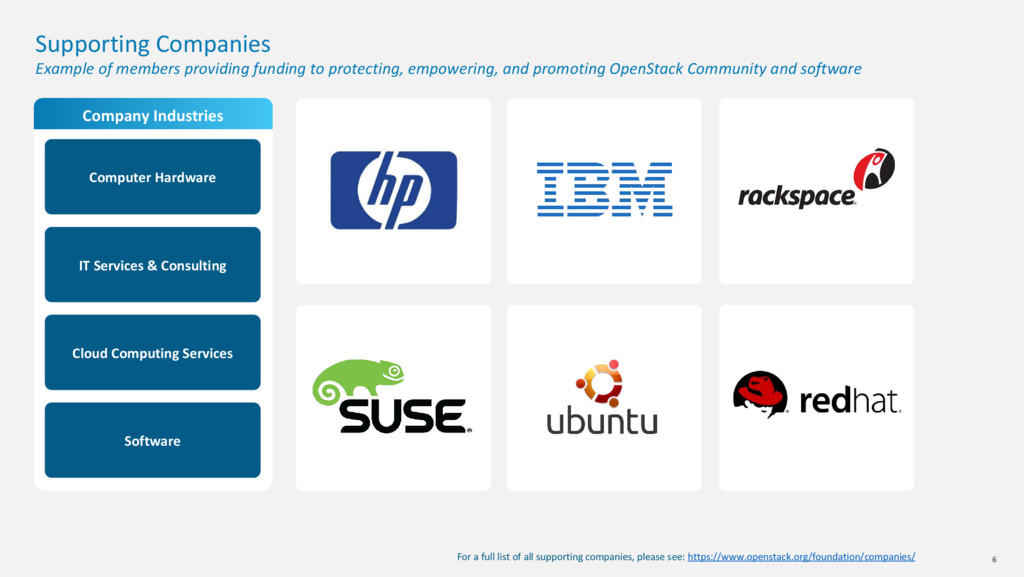
to protecting, empowering, and promoting OpenStack Community and software For a full list of all supporting companies, please see: https://www.openstack.org/foundation/companies/ Computer Hardware IT Services & Consulting Cloud Computing Services Software
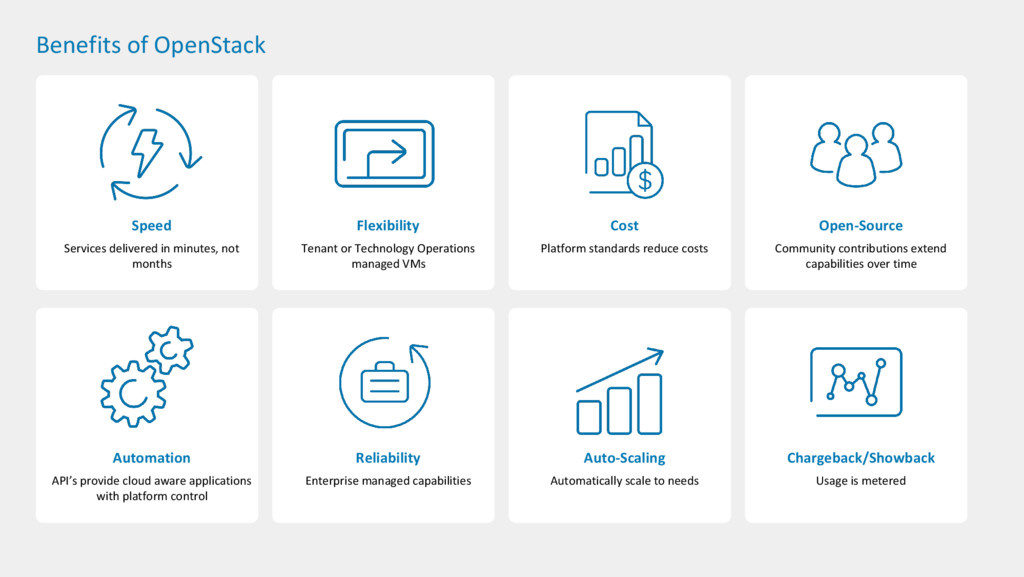
cloud aware applications with platform control Flexibility Tenant or Technology Operations managed VMs Reliability Enterprise managed capabilities Cost Platform standards reduce costs Auto-Scaling Automatically scale to needs Open-Source Community contributions extend capabilities over time Chargeback/Showback Usage is metered Benefits of OpenStack


 codmoninc
 nttcom
 ykanoh
 puhitaku
 masakiokuda
 yut0naga1_fa
 shuta13
 usanchuu
 kakehashi
 yu23ki14
 ishikawa_satoru
 rfdnxbro
 skipperchong
 lcolladotor
 smashingmag
 nwiizo
 aki_iinuma
 danielanewman
 honnibal
 destraynor
 bkeepers
 jeffersonlam
 bluesmoon
 bcantrill