Director Green UiO University of Oslo Email: [email protected] Twitter: @grontuio / @JorulfBS Green UiO – Sustainability in Research, Education and Operation How we started the journey to become a green university by mapping it all
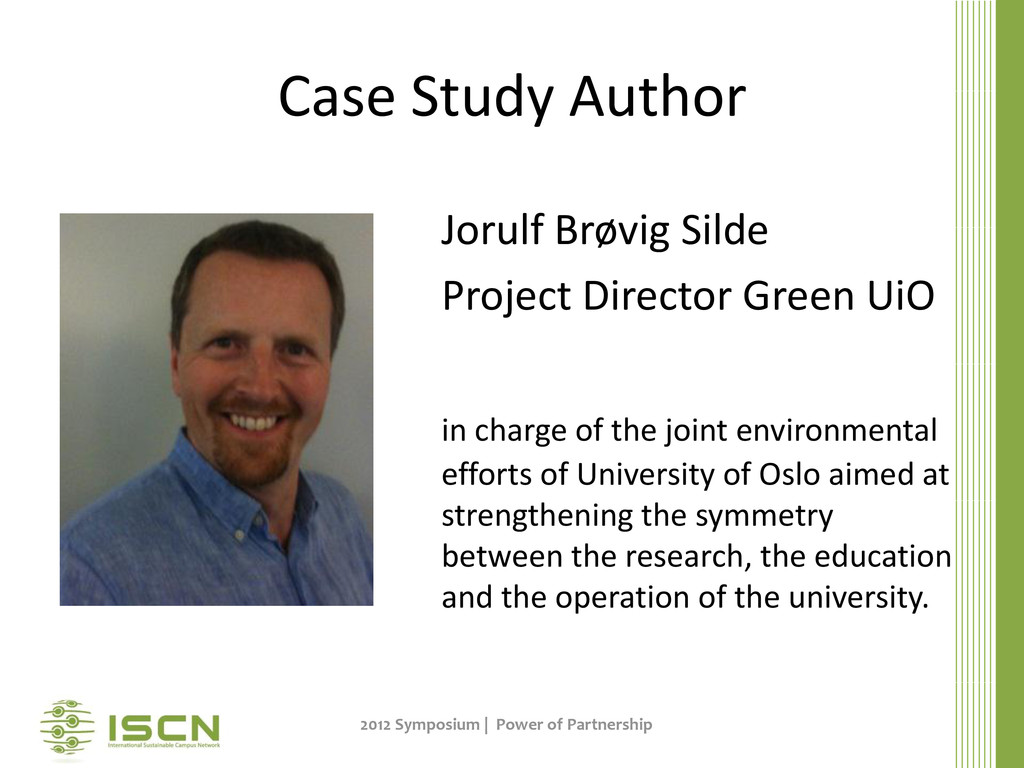
Brøvig Silde Project Director Green UiO in charge of the joint environmental efforts of University of Oslo aimed at strengthening the symmetry between the research, the education and the operation of the university.
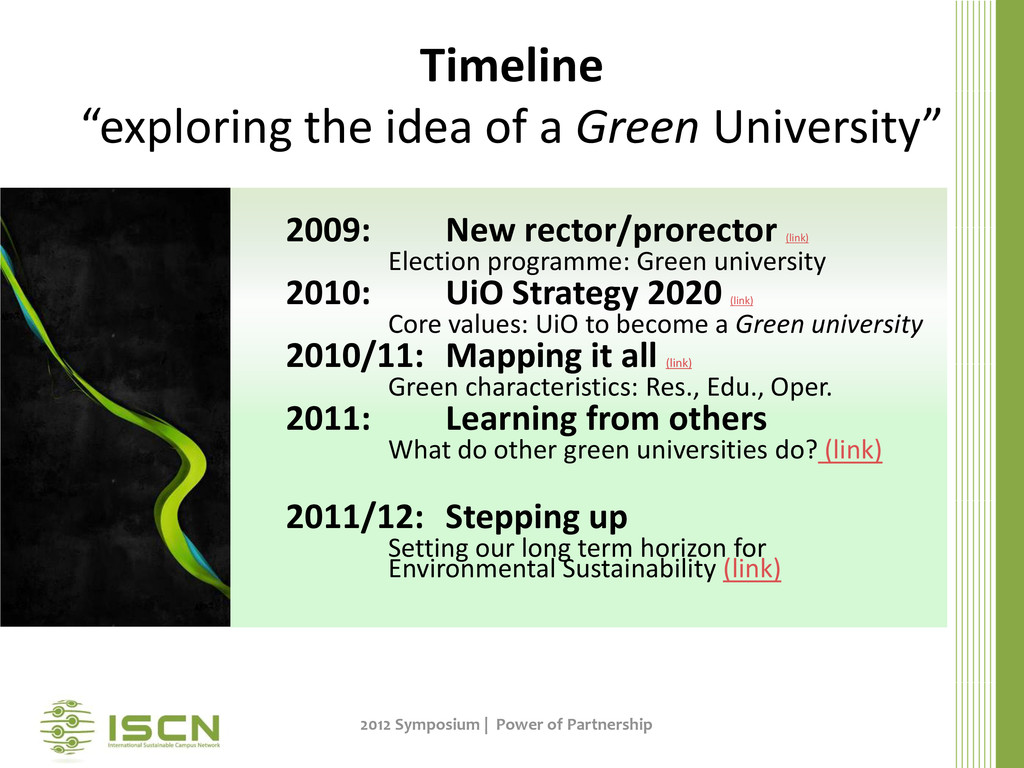
of a Green University” 2009: New rector/prorector (link) Election programme: Green university 2010: UiO Strategy 2020 (link) Core values: UiO to become a Green university 2010/11: Mapping it all (link) Green characteristics: Res., Edu., Oper. 2011: Learning from others What do other green universities do? (link) 2011/12: Stepping up Setting our long term horizon for Environmental Sustainability (link)
of UiO • Research: Amount and examples of research related to environmental sustainability at UiO. • Education: Share of total programmes and subjects relevant for environmental sustainability • Operation: Where do we take environment in consideration? And where do we not? How big is our CO2 -Footprint*? • Learning from others: What is the best green university practice globally?
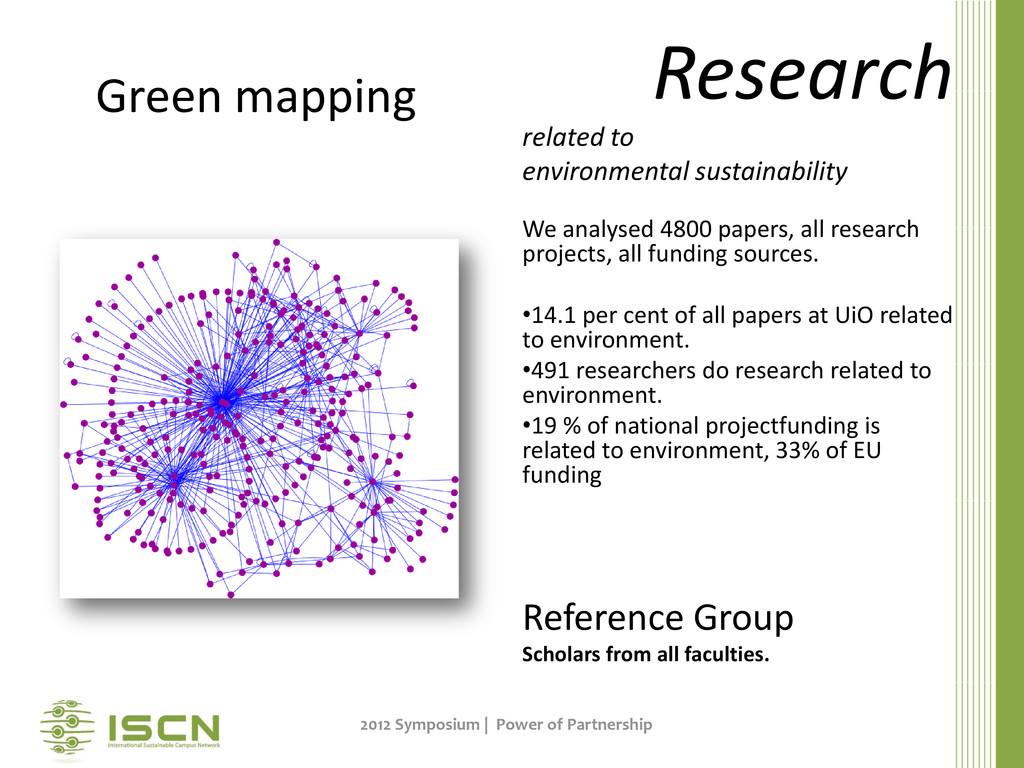
to environmental sustainability We analysed 4800 papers, all research projects, all funding sources. •14.1 per cent of all papers at UiO related to environment. •491 researchers do research related to environment. •19 % of national projectfunding is related to environment, 33% of EU funding Reference Group Scholars from all faculties.
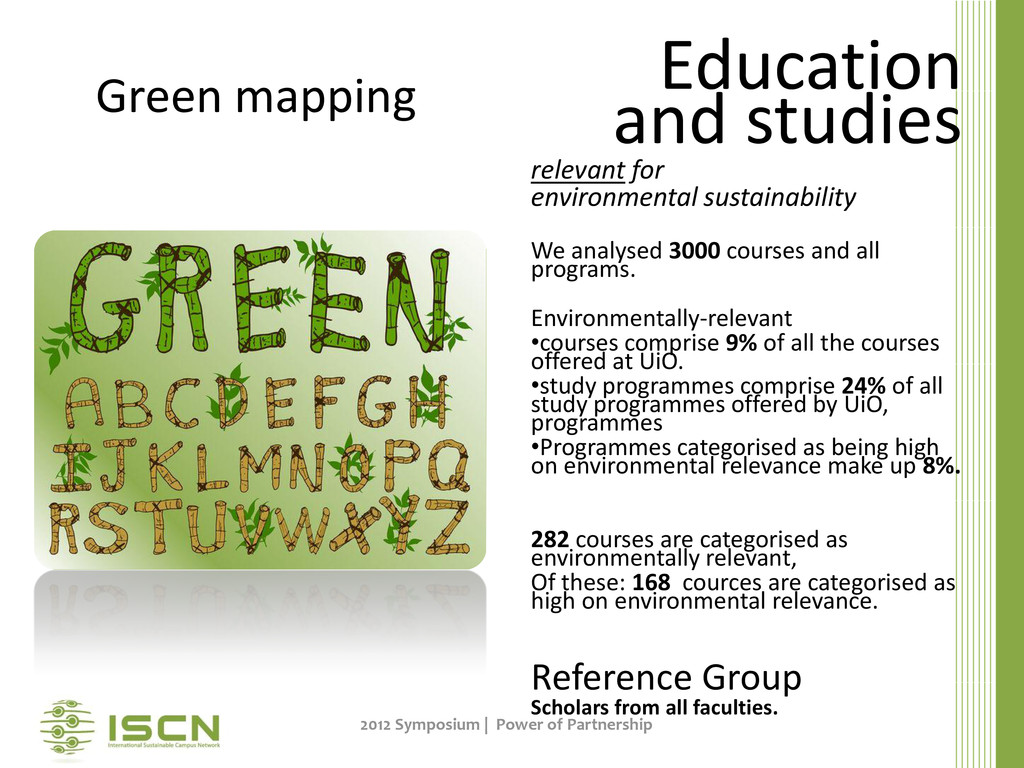
for environmental sustainability We analysed 3000 courses and all programs. Environmentally-relevant •courses comprise 9% of all the courses offered at UiO. •study programmes comprise 24% of all study programmes offered by UiO, programmes •Programmes categorised as being high on environmental relevance make up 8%. 282 courses are categorised as environmentally relevant, Of these: 168 cources are categorised as high on environmental relevance. Reference Group Scholars from all faculties. Green mapping
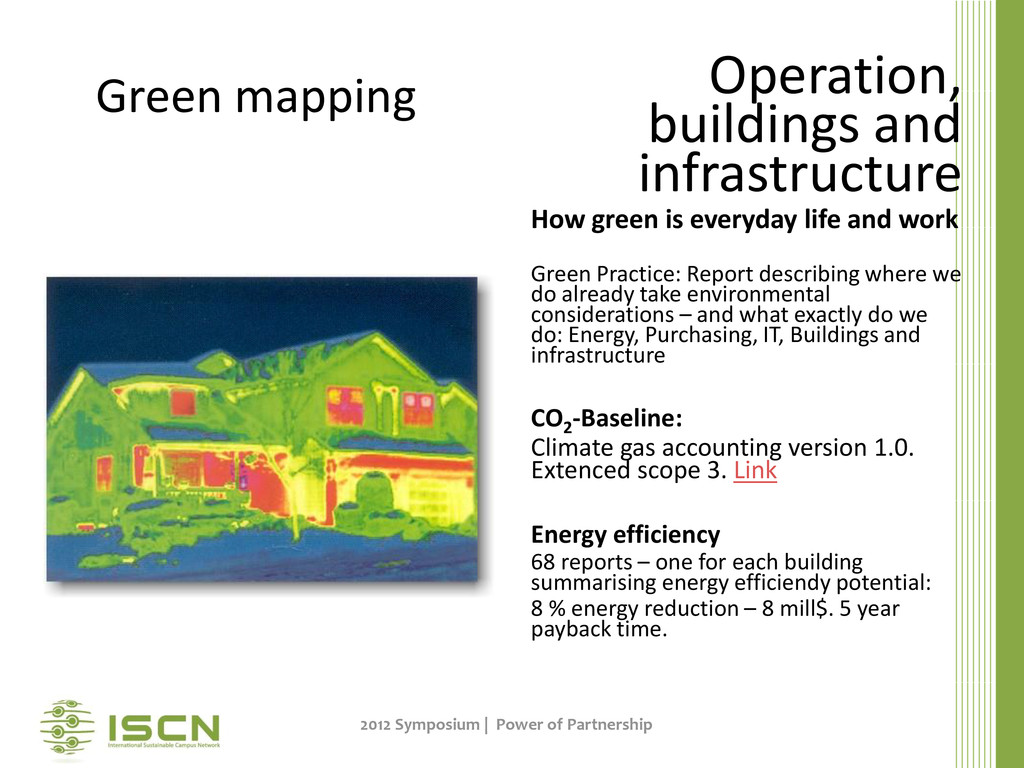
How green is everyday life and work Green Practice: Report describing where we do already take environmental considerations – and what exactly do we do: Energy, Purchasing, IT, Buildings and infrastructure CO2 -Baseline: Climate gas accounting version 1.0. Extenced scope 3. Link Energy efficiency 68 reports – one for each building summarising energy efficiendy potential: 8 % energy reduction – 8 mill$. 5 year payback time. Green mapping
A study by M.Faghihimani (LINK) Etablishing a set of 50 indicators related to environmental sustainability i 4 categories: Research , Education, Governance, Operation. Measuring commitment among 20 universities. Top 3: UBC, MIT, Gothenburg U.: 48/50 Green mapping
green mapping Main results • Authoritative baseline established. • Increased ownership: Different stakeholders involved in the mapping process. • Mapping of the Non-countable ensures relevance. • Mapping of ongoing activity enables continuity.
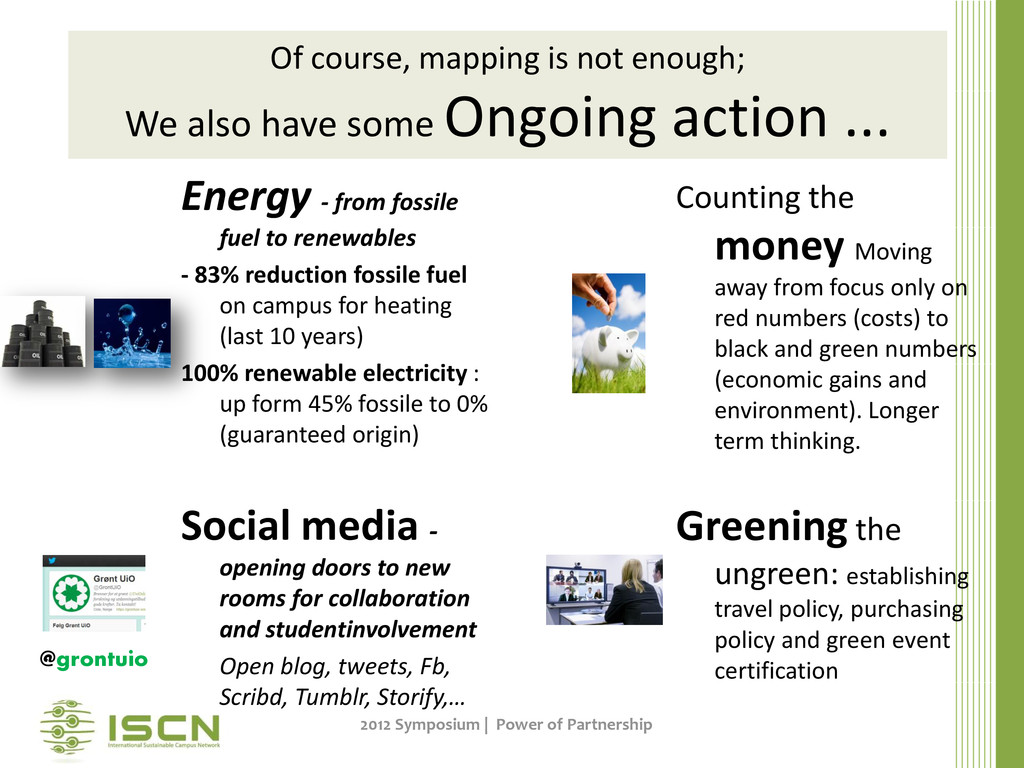
not enough; We also have some Ongoing action ... Energy - from fossile fuel to renewables - 83% reduction fossile fuel on campus for heating (last 10 years) 100% renewable electricity : up form 45% fossile to 0% (guaranteed origin) Social media - opening doors to new rooms for collaboration and studentinvolvement Open blog, tweets, Fb, Scribd, Tumblr, Storify,… Counting the money Moving away from focus only on red numbers (costs) to black and green numbers (economic gains and environment). Longer term thinking. Greening the ungreen: establishing travel policy, purchasing policy and green event certification @grontuio
• Plan for next 3-5 years. • Climate action plan and energy projects. • Organisational consolidation • Students involvement • The whole university: Visibility and effects How to go from mapping to action? “Heros, pilot projects and spearheads” vs “environmental sustainability in all and everything”


 grontuio
 caitiem20
 thekraken
 eileencodes
 aleyda
 sachag
 khoart
 moore
 kristinabergwall1
 tanoku
 orderedlist
 mongodb
 akihiro_kokubo