Upgrade to Pro — share decks privately, control downloads, hide ads and more …

technology_industry.pdf

Avatar for ilyas ilyas
June 24, 2012
44

 technology_industry.pdf

Avatar for ilyas

ilyas

June 24, 2012

Transcript

  1. KPMG INTERNATIONAL Issues Monitor Sharing knowledge on topical issues in

    the Electronics, Software & Services industry January 2011, Volume Six kpmg.com KPMG INTERNATIONAL Issues Monitor Sharing knowledge on topical issues in the Technology Industry February 2012, Volume Nine kpmg.com
  2. b | Issues Monitor: February 2012, Volume Nine © 2012

    KPMG International Cooperative (“KPMG International”), a Swiss entity. Member firms of the KPMG network of independent firms are affiliated with KPMG International. KPMG International provides no client services. All rights reserved. Gary Matuszak Global Chair, Technology Keeping up to date with the very latest and most pressing issues facing your organization can be a challenge, and while there is no shortage of information in the public domain, filtering and prioritizing the knowledge you need can be time consuming and unrewarding. Issues Monitor – Technology is published to help you navigate the multitude of information out in the market. I hope that you find it useful and I welcome the opportunity to further discuss the issues presented and their impact on your business. Welcome to the February edition of Issues Monitor – Technology. Each edition pulls together and shares industry knowledge to help you quickly and easily get briefed on the issues that affect your sector. ISSUE 1: Tough economic conditions and handheld hit PC market . Growth in the PC market has been adversely affected by weak customer demand, driven largely by the economic slowdown in the US and Europe, and the introduction of tablets. Amid such challenging conditions, PC companies are finding it difficult to grow. ISSUE 2: Mobile payments – Growth opportunity for technology industry . Along with the increasing demand for convenience and accessibility, the rising penetration of smartphones is driving growth in the mobile payments (m-payments) market. This market offers a lucrative opportunity for the technology sector. While handset manufacturers are developing near field communication-enabled (NFC) handsets, smartphone operating system providers are providing platforms to support m-payment applications. In order to tap the potential of this market, technology players are also developing innovative solutions such as m-wallets (Google Wallet). However, issues such as security and competition are creating a need for greater “co-opetition” between technology companies and other industry players such as telecom companies and banks.
  3. Issues Monitor: February 2012, Volume Nine | 1 1 Tough

    economic conditions and handheld hit PC market . © 2012 KPMG International Cooperative (“KPMG International”), a Swiss entity. Member firms of the KPMG network of independent firms are affiliated with KPMG International. KPMG International provides no client services. All rights reserved. Growth in the PC market has been adversely affected by weak customer demand, driven largely by the economic slowdown in the US and Europe, and the introduction of tablets. Amid such challenging conditions, PC companies are finding it difficult to grow.
  4. 2 | Issues Monitor: February 2012, Volume Nine Introduction .

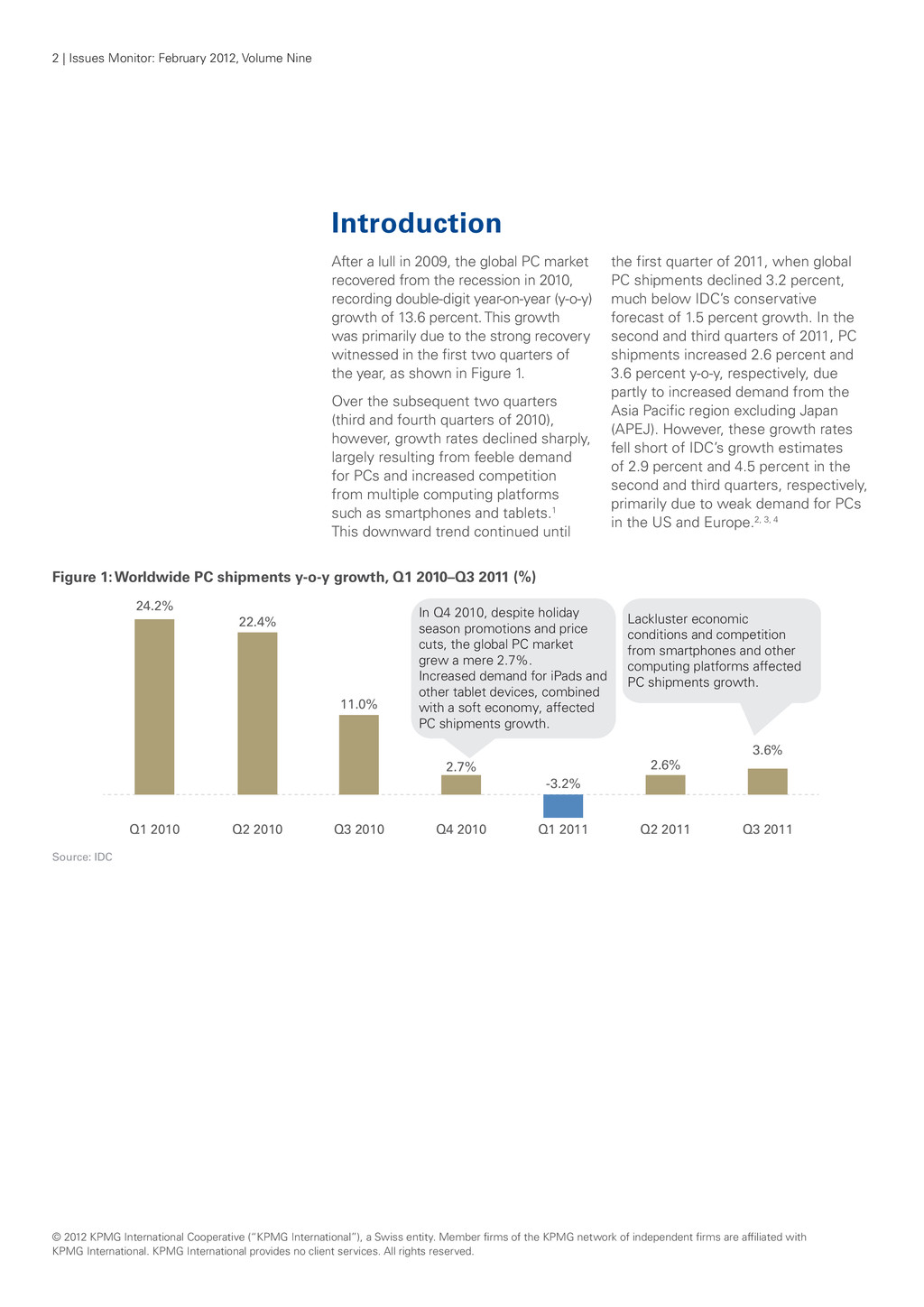
    After a lull in 2009, the global PC market recovered from the recession in 2010, recording double-digit year-on-year (y-o-y) growth of 13.6 percent. This growth was primarily due to the strong recovery witnessed in the first two quarters of the year, as shown in Figure 1. Over the subsequent two quarters (third and fourth quarters of 2010), however, growth rates declined sharply, largely resulting from feeble demand for PCs and increased competition from multiple computing platforms such as smartphones and tablets.1 This downward trend continued until the first quarter of 2011, when global PC shipments declined 3.2 percent, much below IDC’s conservative forecast of 1.5 percent growth. In the second and third quarters of 2011, PC shipments increased 2.6 percent and 3.6 percent y-o-y, respectively, due partly to increased demand from the Asia Pacific region excluding Japan (APEJ). However, these growth rates fell short of IDC’s growth estimates of 2.9 percent and 4.5 percent in the second and third quarters, respectively, primarily due to weak demand for PCs in the US and Europe.2, 3, 4 Figure 1: Worldwide PC shipments y-o-y growth, Q1 2010–Q3 2011 (%) 24.2% 22.4% 11.0% 2.7% -3.2% 2.6% 3.6% Q1 2010 Q2 2010 Q3 2010 Q4 2010 Q1 2011 Q2 2011 Q3 2011 In Q4 2010, despite holiday season promotions and price cuts, the global PC market grew a mere 2.7%. Increased demand for iPads and other tablet devices, combined with a soft economy, affected PC shipments growth. Lackluster economic conditions and competition from smartphones and other computing platforms affected PC shipments growth. Source: IDC © 2012 KPMG International Cooperative (“KPMG International”), a Swiss entity. Member firms of the KPMG network of independent firms are affiliated with KPMG International. KPMG International provides no client services. All rights reserved.
  5. Issues Monitor: February 2012, Volume Nine | 3 The rise

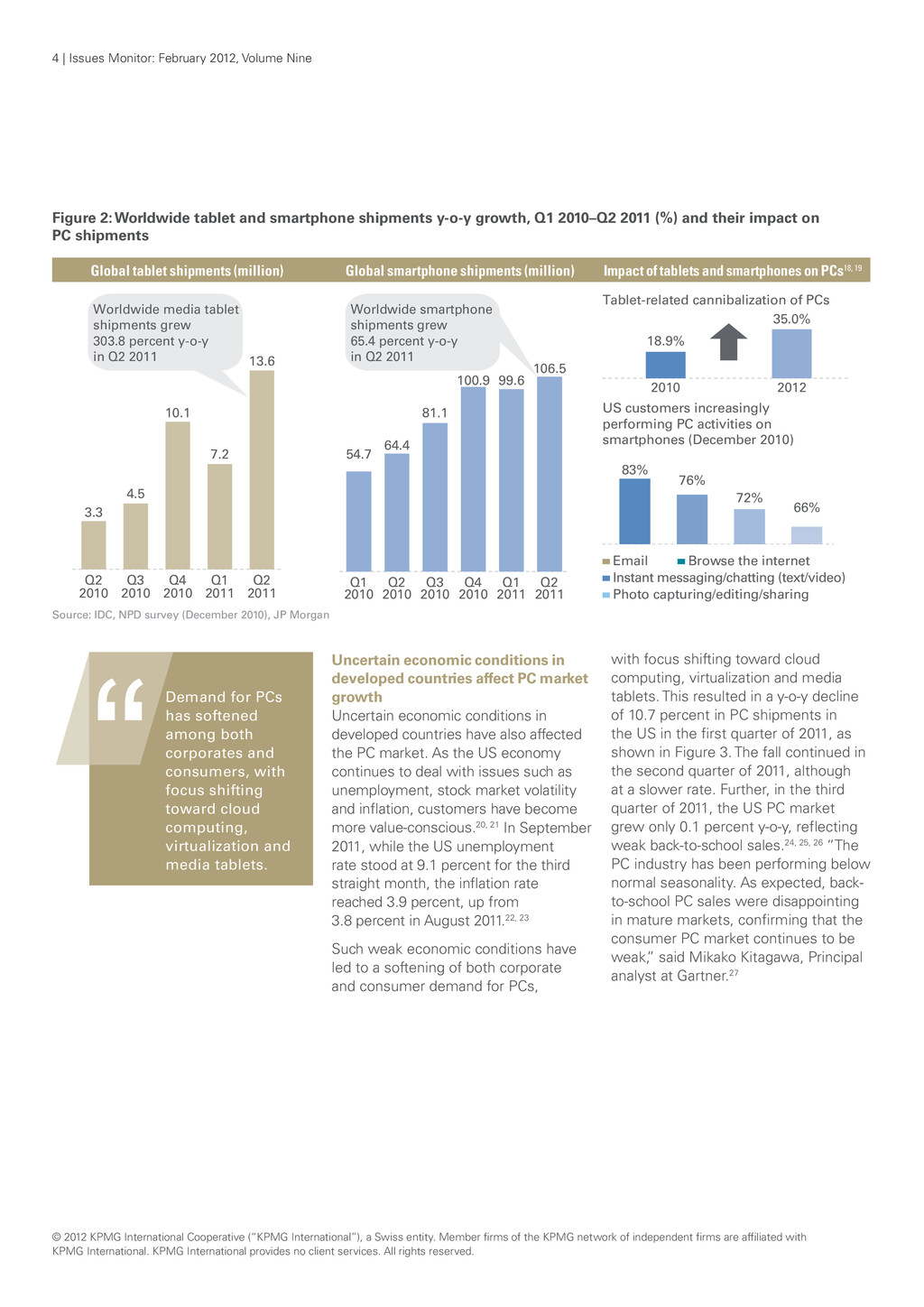
    of tablets and smartphones has triggered a shift from PCs to handheld devices. Tablets and smartphones drive customers away from PC market . The rise of tablets and smartphones has triggered a shift from PCs to handheld devices.5 The pull of handheld devices, particularly Apple’s iPad, contributed to a surge in the sales of handheld computing devices during the holiday season of 2010 (quarter ended December 2010). During this period, iPad unit sales reached 7 .3 million, up nearly 75 percent from the 4.2 million units sold in the third quarter of 2010. In March 2011, Apple launched iPad 2, which boosted its shipments to 9.3 million units in the second quarter of 2011. Various superior features, particularly its portability, entertainment and document management capabilities, have been the key drivers behind this increase in sales of iPad2. Further, the development of iCloud (cloud storage and cloud computing service) and the addition of various built-in applications have also been pushing its sales upward.6, 7 Similarly, Research in Motion (RIM) introduced its Playbook tablet in the second quarter of 2011, which captured 4.9 percent of the global tablet market.8 The consumer shift from PCs to tablets is driven mostly by attributes that tablets offer — connectivity options, high-pixel resolution, portability, video recording and multitasking.9, 10 In Consumers & Convergence V — KPMG’s survey of 9,600 consumers in 30 countries published in December 2011 — 27 percent of the respondents said that mobile phones or smartphones are their preferred device to chat or send instant messages, 25 percent to access maps and 19 percent to play games. Further, in order to attract consumers, tablet manufacturers are focusing on longer battery lives, besides upgrading their operating systems (OS) and printing capabilities.11 These features not only support all PC-specific tasks — enabling users to surf the web, watch movies, play games and have access to built-in applications — but also deliver a better user experience that will drive more consumers away from PCs.12, 13, 14 Rising popularity of tablets is eroding PC market sales. In 2012, more than 35 percent of all tablets sold are expected to replace sales of netbook and notebook PCs, up from 28.9 percent in 2010, according to an analysis by JP Morgan in February 2011, as shown in Figure 2.15 Similarly, the extension of traditional PC functionalities on smartphones has led to high growth in smartphone shipments. In the fourth quarter of 2010, smartphone sales exceeded global PC sales for the first time. During the first and second quarters of 2011, the widespread availability of smartphones, particularly the iPhone and various lower-priced Android-based devices, spurred growth in the market, as shown in Figure 2. Further, the launch of new flagship models (e.g. Windows OS-based Lumia 800 and Lumia 710, introduced by Nokia in October 2011) and OS upgrades are likely to push smartphone shipments.16, 17 © 2012 KPMG International Cooperative (“KPMG International”), a Swiss entity. Member firms of the KPMG network of independent firms are affiliated with KPMG International. KPMG International provides no client services. All rights reserved.
  6. 4 | Issues Monitor: February 2012, Volume Nine Figure 2:

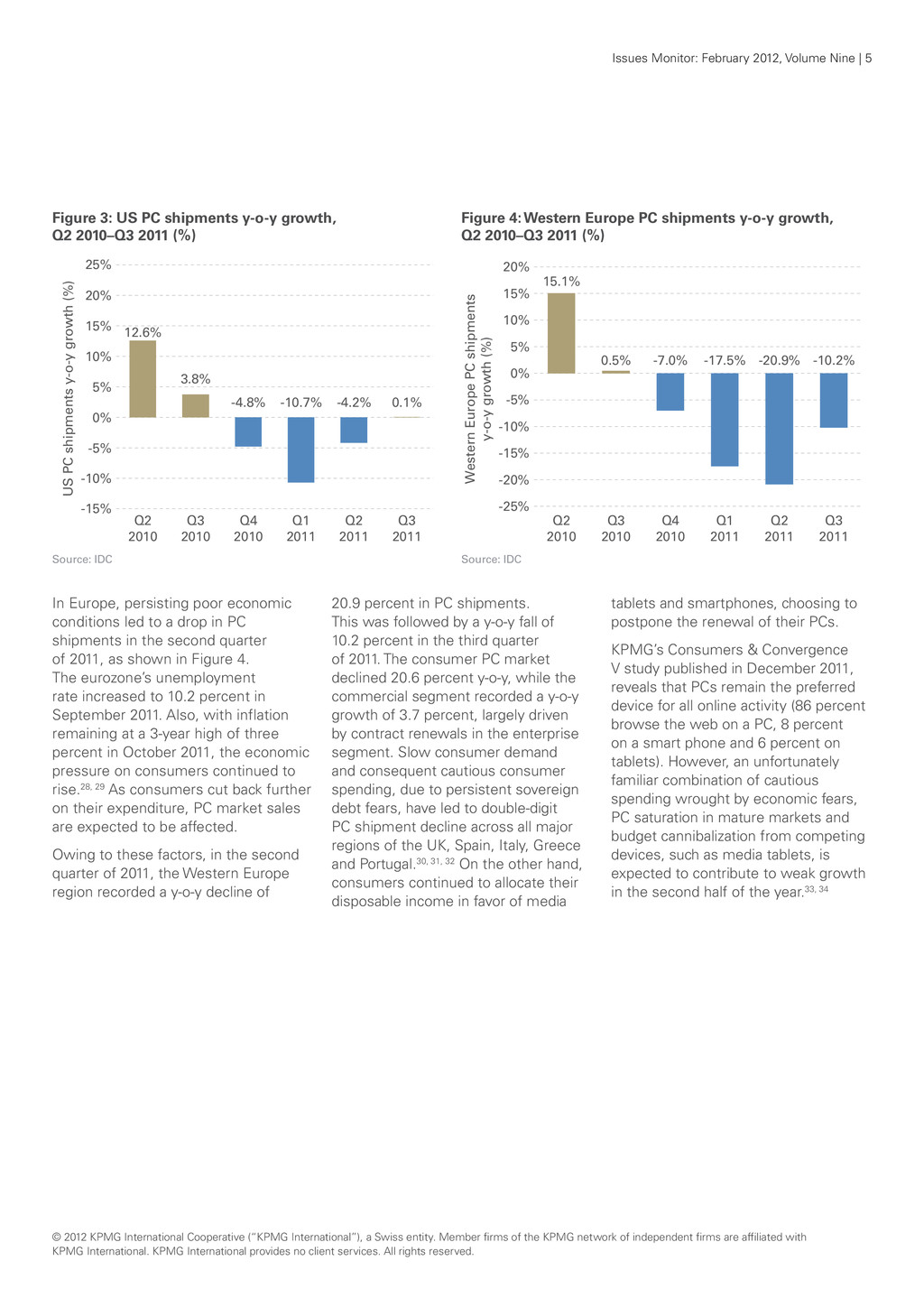
    Worldwide tablet and smartphone shipments y-o-y growth, Q1 2010–Q2 2011 (%) and their impact on PC shipments . Global tablet shipments (million) Global smartphone shipments (million) Impact of tablets and smartphones on PCs18, 19 3.3 4.5 10.1 7.2 13.6 Q2 2010 Q3 2010 Q4 2010 Q1 2011 Q2 2011 Worldwide media tablet shipments grew 303.8 percent y-o-y in Q2 2011 54.7 64.4 81.1 100.9 106.5 99.6 Q1 2010 Q2 2010 Q3 2010 Q4 2010 Q1 2011 Q2 2011 Worldwide smartphone shipments grew 65.4 percent y-o-y in Q2 2011 Tablet-related cannibalization of PCs US customers increasingly performing PC activities on smartphones (December 2010) 72% 66% 83% 76% Email Browse the internet Instant messaging/chatting (text/video) Photo capturing/editing/sharing 18.9% 35.0% 2010 2012 Source: IDC, NPD survey (December 2010), JP Morgan Uncertain economic conditions in developed countries affect PC market growth Uncertain economic conditions in developed countries have also affected the PC market. As the US economy continues to deal with issues such as unemployment, stock market volatility and inflation, customers have become more value-conscious.20, 21 In September 2011, while the US unemployment rate stood at 9.1 percent for the third straight month, the inflation rate reached 3.9 percent, up from 3.8 percent in August 2011.22, 23 Such weak economic conditions have led to a softening of both corporate and consumer demand for PCs, with focus shifting toward cloud computing, virtualization and media tablets. This resulted in a y-o-y decline of 10.7 percent in PC shipments in the US in the first quarter of 2011, as shown in Figure 3. The fall continued in the second quarter of 2011, although at a slower rate. Further, in the third quarter of 2011, the US PC market grew only 0.1 percent y-o-y, reflecting weak back-to-school sales.24, 25, 26 “The PC industry has been performing below normal seasonality. As expected, back- to-school PC sales were disappointing in mature markets, confirming that the consumer PC market continues to be weak, ” said Mikako Kitagawa, Principal analyst at Gartner.27 Demand for PCs has softened among both corporates and consumers, with focus shifting toward cloud computing, virtualization and media tablets. © 2012 KPMG International Cooperative (“KPMG International”), a Swiss entity. Member firms of the KPMG network of independent firms are affiliated with KPMG International. KPMG International provides no client services. All rights reserved.
  7. Issues Monitor: February 2012, Volume Nine | 5 Figure 3:

    US PC shipments y-o-y growth, Q2 2010–Q3 2011 (%) Source: IDC Figure 4: Western Europe PC shipments y-o-y growth, Q2 2010–Q3 2011 (%) 12.6% 3.8% -4.8% -10.7% -4.2% 0.1% -15% -10% -5% 0% 5% 10% 15% 20% 25% Q2 2010 Q3 2010 Q4 2010 Q1 2011 Q2 2011 Q3 2011 US PC shipments y-o-y growth (%) 15.1% 0.5% -7.0% -17.5% -20.9% -10.2% 0% 5% -25% -20% -15% -10% -5% 10% 15% 20% Q2 2010 Q3 2010 Q4 2010 Q1 2011 Q2 2011 Q3 2011 Western Europe PC shipments y-o-y growth (%) Source: IDC In Europe, persisting poor economic conditions led to a drop in PC shipments in the second quarter of 2011, as shown in Figure 4. The eurozone’s unemployment rate increased to 10.2 percent in September 2011. Also, with inflation remaining at a 3-year high of three percent in October 2011, the economic pressure on consumers continued to rise.28, 29 As consumers cut back further on their expenditure, PC market sales are expected to be affected. Owing to these factors, in the second quarter of 2011, the Western Europe region recorded a y-o-y decline of 20.9 percent in PC shipments. This was followed by a y-o-y fall of 10.2 percent in the third quarter of 2011. The consumer PC market declined 20.6 percent y-o-y, while the commercial segment recorded a y-o-y growth of 3.7 percent, largely driven by contract renewals in the enterprise segment. Slow consumer demand and consequent cautious consumer spending, due to persistent sovereign debt fears, have led to double-digit PC shipment decline across all major regions of the UK, Spain, Italy, Greece and Portugal.30, 31, 32 On the other hand, consumers continued to allocate their disposable income in favor of media tablets and smartphones, choosing to postpone the renewal of their PCs. KPMG’s Consumers & Convergence V study published in December 2011, reveals that PCs remain the preferred device for all online activity (86 percent browse the web on a PC, 8 percent on a smart phone and 6 percent on tablets). However, an unfortunately familiar combination of cautious spending wrought by economic fears, PC saturation in mature markets and budget cannibalization from competing devices, such as media tablets, is expected to contribute to weak growth in the second half of the year.33, 34 © 2012 KPMG International Cooperative (“KPMG International”), a Swiss entity. Member firms of the KPMG network of independent firms are affiliated with KPMG International. KPMG International provides no client services. All rights reserved.
  8. 6 | Issues Monitor: February 2012, Volume Nine Slow growth

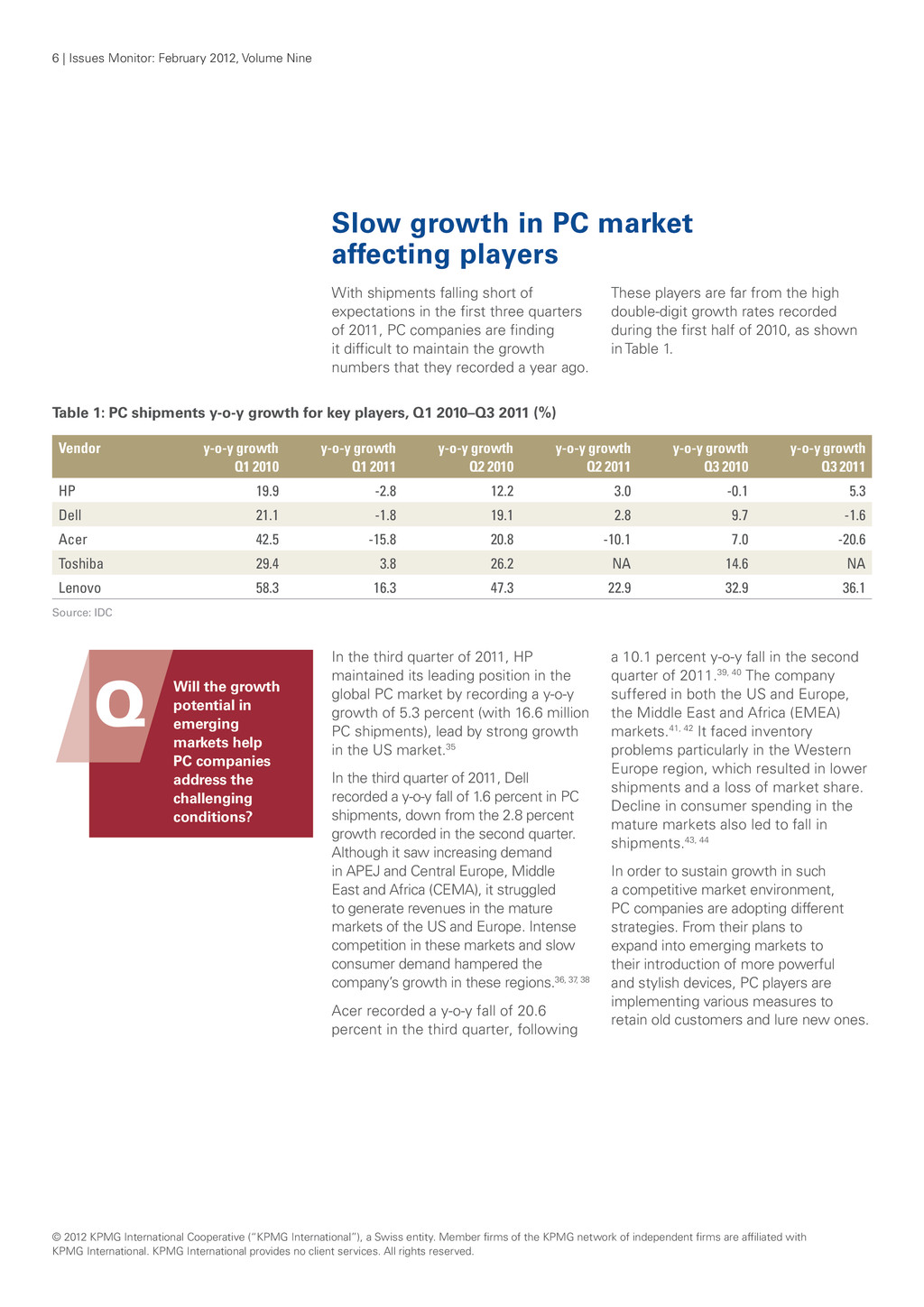
    in PC market affecting players . With shipments falling short of expectations in the first three quarters of 2011, PC companies are finding it difficult to maintain the growth numbers that they recorded a year ago. These players are far from the high double-digit growth rates recorded during the first half of 2010, as shown in Table 1. Vendor y-o-y growth Q1 2010 y-o-y growth Q1 2011 y-o-y growth Q2 2010 y-o-y growth Q2 2011 y-o-y growth Q3 2010 y-o-y growth Q3 2011 HP 19.9 -2.8 12.2 3.0 -0.1 5.3 Dell 21.1 -1.8 19.1 2.8 9.7 -1.6 Acer 42.5 -15.8 20.8 -10.1 7.0 -20.6 Toshiba 29.4 3.8 26.2 NA 14.6 NA Lenovo 58.3 16.3 47.3 22.9 32.9 36.1 Table 1: PC shipments y-o-y growth for key players, Q1 2010–Q3 2011 (%) Source: IDC In the third quarter of 2011, HP maintained its leading position in the global PC market by recording a y-o-y growth of 5.3 percent (with 16.6 million PC shipments), lead by strong growth in the US market.35 In the third quarter of 2011, Dell recorded a y-o-y fall of 1.6 percent in PC shipments, down from the 2.8 percent growth recorded in the second quarter. Although it saw increasing demand in APEJ and Central Europe, Middle East and Africa (CEMA), it struggled to generate revenues in the mature markets of the US and Europe. Intense competition in these markets and slow consumer demand hampered the company’s growth in these regions.36, 37 , 38 Acer recorded a y-o-y fall of 20.6 percent in the third quarter, following a 10.1 percent y-o-y fall in the second quarter of 2011.39, 40 The company suffered in both the US and Europe, the Middle East and Africa (EMEA) markets.41, 42 It faced inventory problems particularly in the Western Europe region, which resulted in lower shipments and a loss of market share. Decline in consumer spending in the mature markets also led to fall in shipments.43, 44 In order to sustain growth in such a competitive market environment, PC companies are adopting different strategies. From their plans to expand into emerging markets to their introduction of more powerful and stylish devices, PC players are implementing various measures to retain old customers and lure new ones. Will the growth potential in emerging markets help PC companies address the challenging conditions? © 2012 KPMG International Cooperative (“KPMG International”), a Swiss entity. Member firms of the KPMG network of independent firms are affiliated with KPMG International. KPMG International provides no client services. All rights reserved.
  9. Issues Monitor: February 2012, Volume Nine | 7 Strategies adopted

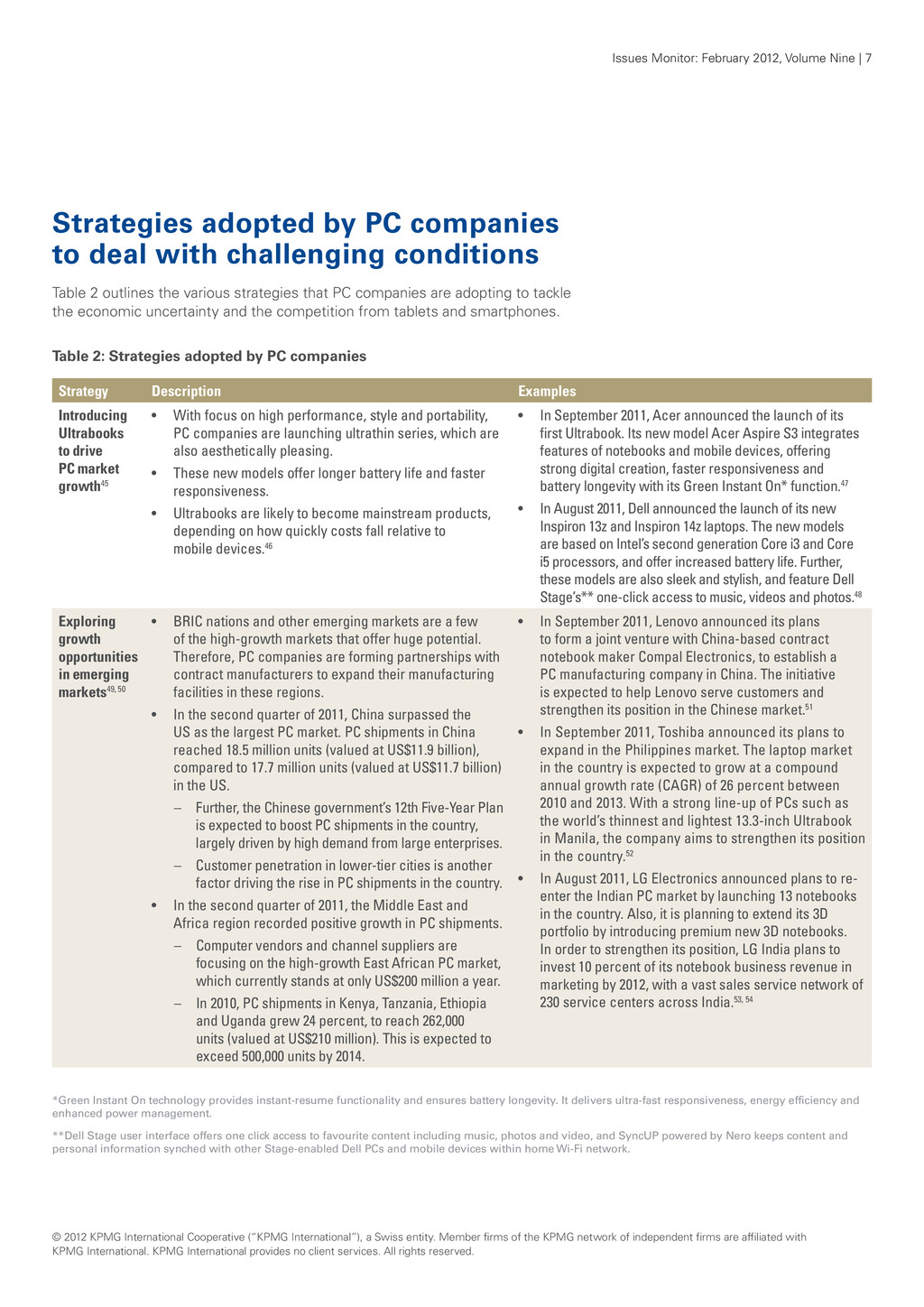
    by PC companies to deal with challenging conditions . Table 2 outlines the various strategies that PC companies are adopting to tackle the economic uncertainty and the competition from tablets and smartphones. Table 2: Strategies adopted by PC companies . Strategy Description Examples Introducing Ultrabooks to drive PC market growth45 • With focus on high performance, style and portability, PC companies are launching ultrathin series, which are also aesthetically pleasing. • These new models offer longer battery life and faster responsiveness. • Ultrabooks are likely to become mainstream products, depending on how quickly costs fall relative to mobile devices.46 • In September 2011, Acer announced the launch of its first Ultrabook. Its new model Acer Aspire S3 integrates features of notebooks and mobile devices, offering strong digital creation, faster responsiveness and battery longevity with its Green Instant On* function.47 • In August 2011, Dell announced the launch of its new Inspiron 13z and Inspiron 14z laptops. The new models are based on Intel’s second generation Core i3 and Core i5 processors, and offer increased battery life. Further, these models are also sleek and stylish, and feature Dell Stage’s** one-click access to music, videos and photos.48 Exploring growth opportunities in emerging markets49, 50 • BRIC nations and other emerging markets are a few of the high-growth markets that offer huge potential. Therefore, PC companies are forming partnerships with contract manufacturers to expand their manufacturing facilities in these regions. • In the second quarter of 2011, China surpassed the US as the largest PC market. PC shipments in China reached 18.5 million units (valued at US$11.9 billion), compared to 17.7 million units (valued at US$11.7 billion) in the US. – Further, the Chinese government’s 12th Five-Year Plan is expected to boost PC shipments in the country, largely driven by high demand from large enterprises. – Customer penetration in lower-tier cities is another factor driving the rise in PC shipments in the country. • In the second quarter of 2011, the Middle East and Africa region recorded positive growth in PC shipments. – Computer vendors and channel suppliers are focusing on the high-growth East African PC market, which currently stands at only US$200 million a year. – In 2010, PC shipments in Kenya, Tanzania, Ethiopia and Uganda grew 24 percent, to reach 262,000 units (valued at US$210 million). This is expected to exceed 500,000 units by 2014. • In September 2011, Lenovo announced its plans to form a joint venture with China-based contract notebook maker Compal Electronics, to establish a PC manufacturing company in China. The initiative is expected to help Lenovo serve customers and strengthen its position in the Chinese market.51 • In September 2011, Toshiba announced its plans to expand in the Philippines market. The laptop market in the country is expected to grow at a compound annual growth rate (CAGR) of 26 percent between 2010 and 2013. With a strong line-up of PCs such as the world’s thinnest and lightest 13.3-inch Ultrabook in Manila, the company aims to strengthen its position in the country.52 • In August 2011, LG Electronics announced plans to re- enter the Indian PC market by launching 13 notebooks in the country. Also, it is planning to extend its 3D portfolio by introducing premium new 3D notebooks. In order to strengthen its position, LG India plans to invest 10 percent of its notebook business revenue in marketing by 2012, with a vast sales service network of 230 service centers across India.53, 54 *Green Instant On technology provides instant-resume functionality and ensures battery longevity. It delivers ultra-fast responsiveness, energy efficiency and enhanced power management. **Dell Stage user interface offers one click access to favourite content including music, photos and video, and SyncUP powered by Nero keeps content and personal information synched with other Stage-enabled Dell PCs and mobile devices within home Wi-Fi network. © 2012 KPMG International Cooperative (“KPMG International”), a Swiss entity. Member firms of the KPMG network of independent firms are affiliated with KPMG International. KPMG International provides no client services. All rights reserved.
  10. 8 | Issues Monitor: February 2012, Volume Nine Strategy Description

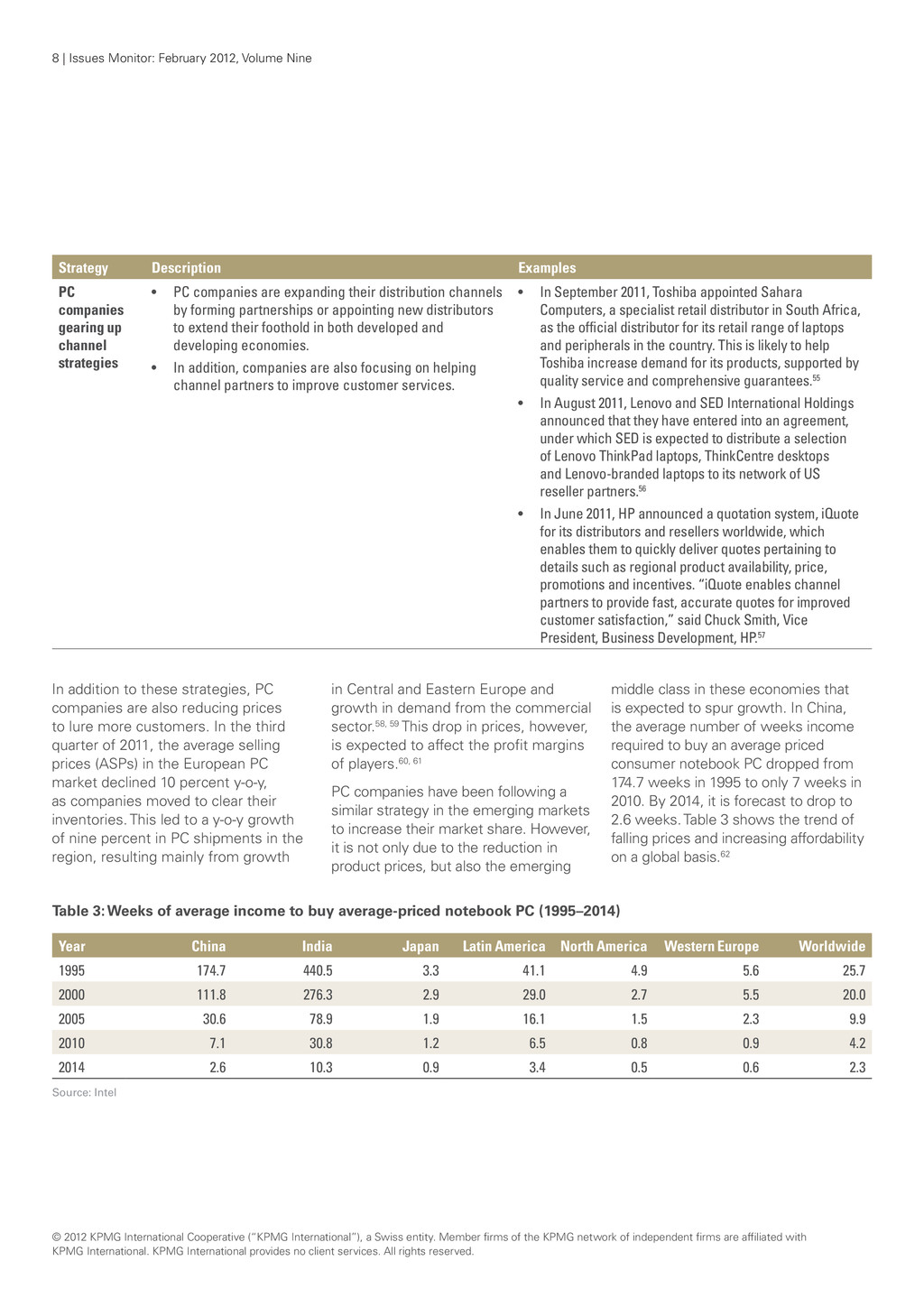
    Examples PC companies gearing up channel strategies • PC companies are expanding their distribution channels by forming partnerships or appointing new distributors to extend their foothold in both developed and developing economies. • In addition, companies are also focusing on helping channel partners to improve customer services. • In September 2011, Toshiba appointed Sahara Computers, a specialist retail distributor in South Africa, as the official distributor for its retail range of laptops and peripherals in the country. This is likely to help Toshiba increase demand for its products, supported by quality service and comprehensive guarantees.55 • In August 2011, Lenovo and SED International Holdings announced that they have entered into an agreement, under which SED is expected to distribute a selection of Lenovo ThinkPad laptops, ThinkCentre desktops and Lenovo-branded laptops to its network of US reseller partners.56 • In June 2011, HP announced a quotation system, iQuote for its distributors and resellers worldwide, which enables them to quickly deliver quotes pertaining to details such as regional product availability, price, promotions and incentives. “iQuote enables channel partners to provide fast, accurate quotes for improved customer satisfaction,” said Chuck Smith, Vice President, Business Development, HP.57 In addition to these strategies, PC companies are also reducing prices to lure more customers. In the third quarter of 2011, the average selling prices (ASPs) in the European PC market declined 10 percent y-o-y, as companies moved to clear their inventories. This led to a y-o-y growth of nine percent in PC shipments in the region, resulting mainly from growth in Central and Eastern Europe and growth in demand from the commercial sector.58, 59 This drop in prices, however, is expected to affect the profit margins of players.60, 61 PC companies have been following a similar strategy in the emerging markets to increase their market share. However, it is not only due to the reduction in product prices, but also the emerging middle class in these economies that is expected to spur growth. In China, the average number of weeks income required to buy an average priced consumer notebook PC dropped from 174.7 weeks in 1995 to only 7 weeks in 2010. By 2014, it is forecast to drop to 2.6 weeks. Table 3 shows the trend of falling prices and increasing affordability on a global basis.62 Table 3: Weeks of average income to buy average-priced notebook PC (1995–2014) Year China India Japan Latin America North America Western Europe Worldwide 1995 174.7 440.5 3.3 41.1 4.9 5.6 25.7 2000 111.8 276.3 2.9 29.0 2.7 5.5 20.0 2005 30.6 78.9 1.9 16.1 1.5 2.3 9.9 2010 7.1 30.8 1.2 6.5 0.8 0.9 4.2 2014 2.6 10.3 0.9 3.4 0.5 0.6 2.3 Source: Intel © 2012 KPMG International Cooperative (“KPMG International”), a Swiss entity. Member firms of the KPMG network of independent firms are affiliated with KPMG International. KPMG International provides no client services. All rights reserved.
  11. Issues Monitor: February 2012, Volume Nine | 9 Outlook .

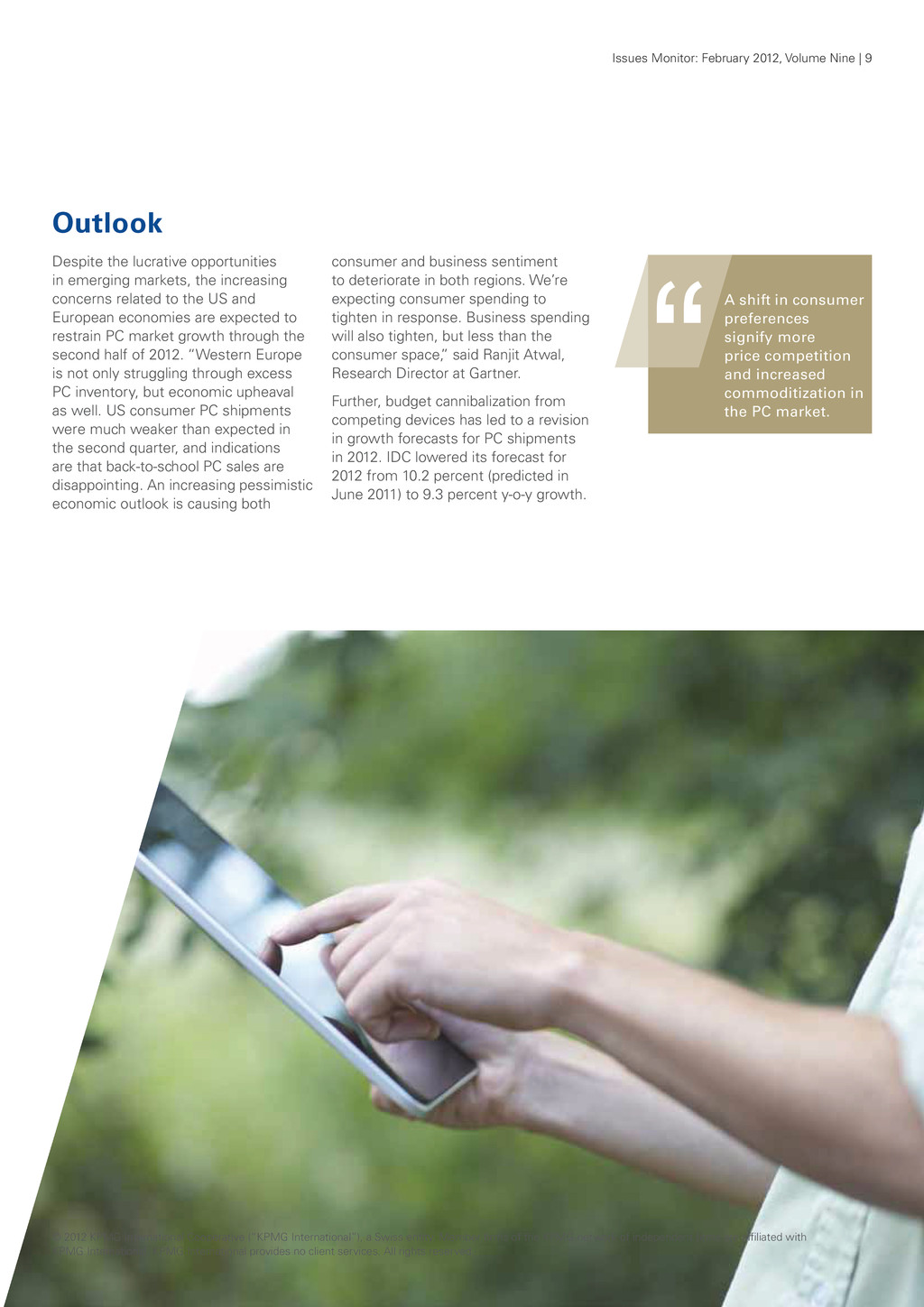
    Despite the lucrative opportunities in emerging markets, the increasing concerns related to the US and European economies are expected to restrain PC market growth through the second half of 2012. “Western Europe is not only struggling through excess PC inventory, but economic upheaval as well. US consumer PC shipments were much weaker than expected in the second quarter, and indications are that back-to-school PC sales are disappointing. An increasing pessimistic economic outlook is causing both consumer and business sentiment to deteriorate in both regions. We’re expecting consumer spending to tighten in response. Business spending will also tighten, but less than the consumer space, ” said Ranjit Atwal, Research Director at Gartner. Further, budget cannibalization from competing devices has led to a revision in growth forecasts for PC shipments in 2012. IDC lowered its forecast for 2012 from 10.2 percent (predicted in June 2011) to 9.3 percent y-o-y growth. A shift in consumer preferences signify more price competition and increased commoditization in the PC market. © 2012 KPMG International Cooperative (“KPMG International”), a Swiss entity. Member firms of the KPMG network of independent firms are affiliated with KPMG International. KPMG International provides no client services. All rights reserved.
  12. 10 | Issues Monitor: February 2012, Volume Nine Region 2011

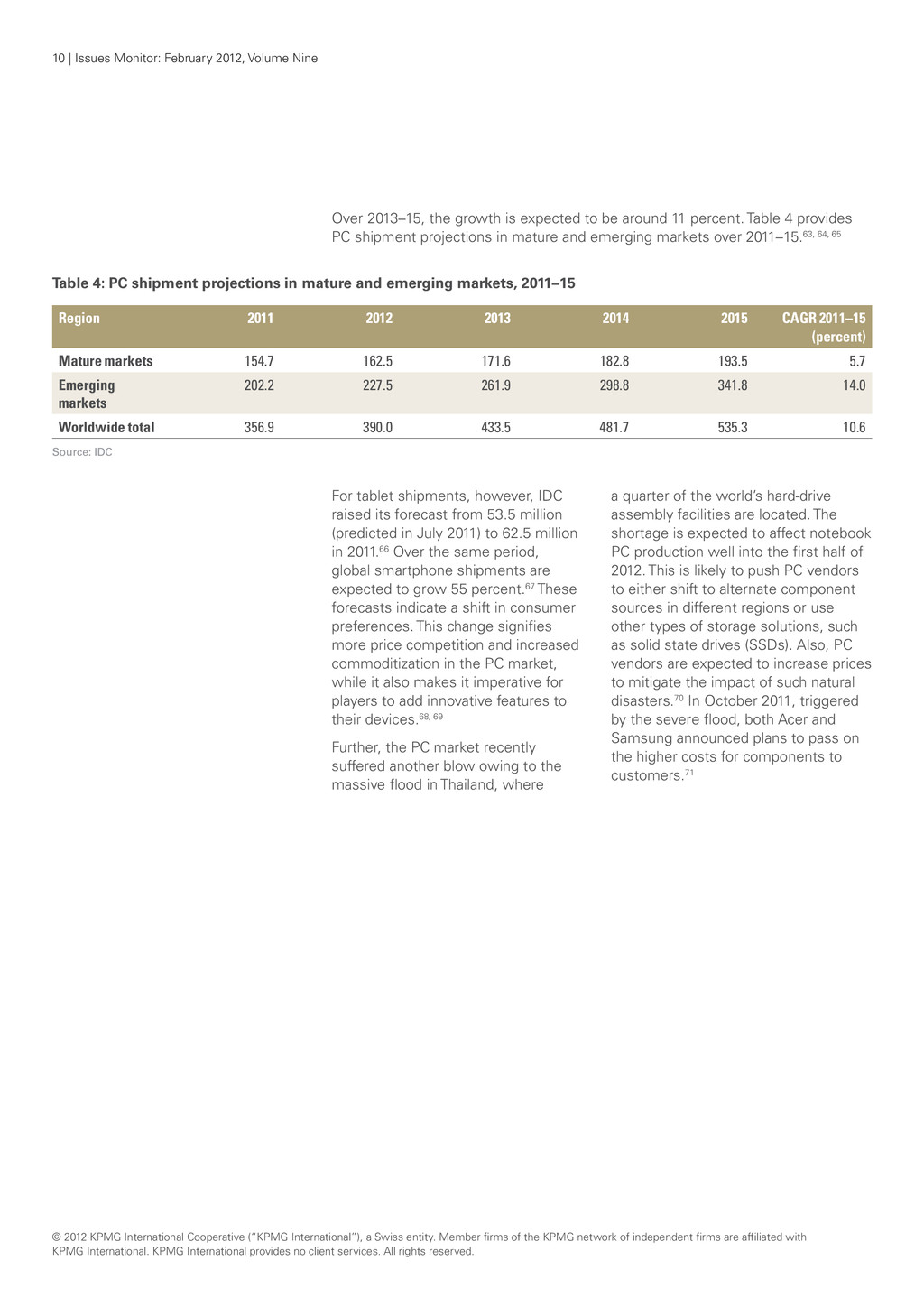
    2012 2013 2014 2015 CAGR 2011–15 (percent) Mature markets 154.7 162.5 171.6 182.8 193.5 5.7 Emerging markets 202.2 227.5 261.9 298.8 341.8 14.0 Worldwide total 356.9 390.0 433.5 481.7 535.3 10.6 Over 2013–15, the growth is expected to be around 11 percent. Table 4 provides PC shipment projections in mature and emerging markets over 2011–15.63, 64, 65 Table 4: PC shipment projections in mature and emerging markets, 2011–15 Source: IDC For tablet shipments, however, IDC raised its forecast from 53.5 million (predicted in July 2011) to 62.5 million in 2011.66 Over the same period, global smartphone shipments are expected to grow 55 percent.67 These forecasts indicate a shift in consumer preferences. This change signifies more price competition and increased commoditization in the PC market, while it also makes it imperative for players to add innovative features to their devices.68, 69 Further, the PC market recently suffered another blow owing to the massive flood in Thailand, where a quarter of the world’s hard-drive assembly facilities are located. The shortage is expected to affect notebook PC production well into the first half of 2012. This is likely to push PC vendors to either shift to alternate component sources in different regions or use other types of storage solutions, such as solid state drives (SSDs). Also, PC vendors are expected to increase prices to mitigate the impact of such natural disasters.70 In October 2011, triggered by the severe flood, both Acer and Samsung announced plans to pass on the higher costs for components to customers.71 © 2012 KPMG International Cooperative (“KPMG International”), a Swiss entity. Member firms of the KPMG network of independent firms are affiliated with KPMG International. KPMG International provides no client services. All rights reserved.
  13. Issues Monitor: February 2012, Volume Nine | 11 Further Information

    Visit kpmg.com for the following related publications . • • The Converged Lifestyle: Consumers and Convergence 5 • • Embracing the Cloud – Global forces shaping the service provider market • • Leading Practices in Effective Channel Management How KPMG firms can help . Margin Enhancement Services Working alongside clients, KPMG’s professionals help to streamline processes, to enhance controls and to contain costs and business risks. KPMG member firms look at systems, supply chains, capital structures and contracts with third parties to see how they can best be utilized. KPMG member firms examine the entire revenue process and helps to effectively integrate the critical business processes and systems that process, provision, deliver, and bill services to a client’s customers. Business Effectiveness Business Effectiveness teams focus on fundamental business issues — managing risk, increasing revenues and controlling costs — which all organizations, in all industries, should address in order to flourish. KPMG member firms help companies identify risks and optimize operations that are used to support their strategic business objectives and financial goals. KPMG’s professionals bring extensive experience and work collaboratively with clients, advising them on managing and reducing materials costs, optimizing overall internal supply chain costs, reducing supply chain risk, improving service to the customer, globalization and product design efficiency. Supply Chain Optimization KPMG’s Supply Chain Optimization services helps clients optimize the balance between cost and risk, align processes with the organization’s strategic goals and objectives, and drive competitive advantage and shareholder value. The key focus of this offering is on optimizing supply chain efficiency across the following operational impact areas: cost, cash, and working capital, tax, technology, operational, and financial risk, sustainability, and people issues. Key contacts Gary Matuszak Global Chair Technology KPMG in the US Tel.+1 650 404 4858 [email protected] David McAllister Global Executive Technology KPMG in Australia Tel.+61 2 9335 8143 [email protected] © 2012 KPMG International Cooperative (“KPMG International”), a Swiss entity. Member firms of the KPMG network of independent firms are affiliated with KPMG International. KPMG International provides no client services. All rights reserved.
  14. 12 | Issues Monitor: February 2012, Volume Nine 2 ©

    2012 KPMG International Cooperative (“KPMG International”), a Swiss entity. Member firms of the KPMG network of independent firms are affiliated with KPMG International. KPMG International provides no client services. All rights reserved. Mobile payments – Growth opportunity for technology industry . Along with the increasing demand for convenience and accessibility, the rising penetration of smartphones is driving growth in the mobile payments (m-payments) market. This market offers a lucrative opportunity for the technology sector. While handset manufacturers are developing near field communication-enabled (NFC) handsets, smartphone operating system providers are providing platforms to support m-payment applications. In order to tap the potential of this market, technology players are also developing innovative solutions such as m-wallets (Google Wallet). However, issues such as security and competition are creating a need for greater “co-opetition” between technology companies and other industry players such as telecom companies and banks.
  15. Issues Monitor: February 2012, Volume Nine | 13 M-payments is

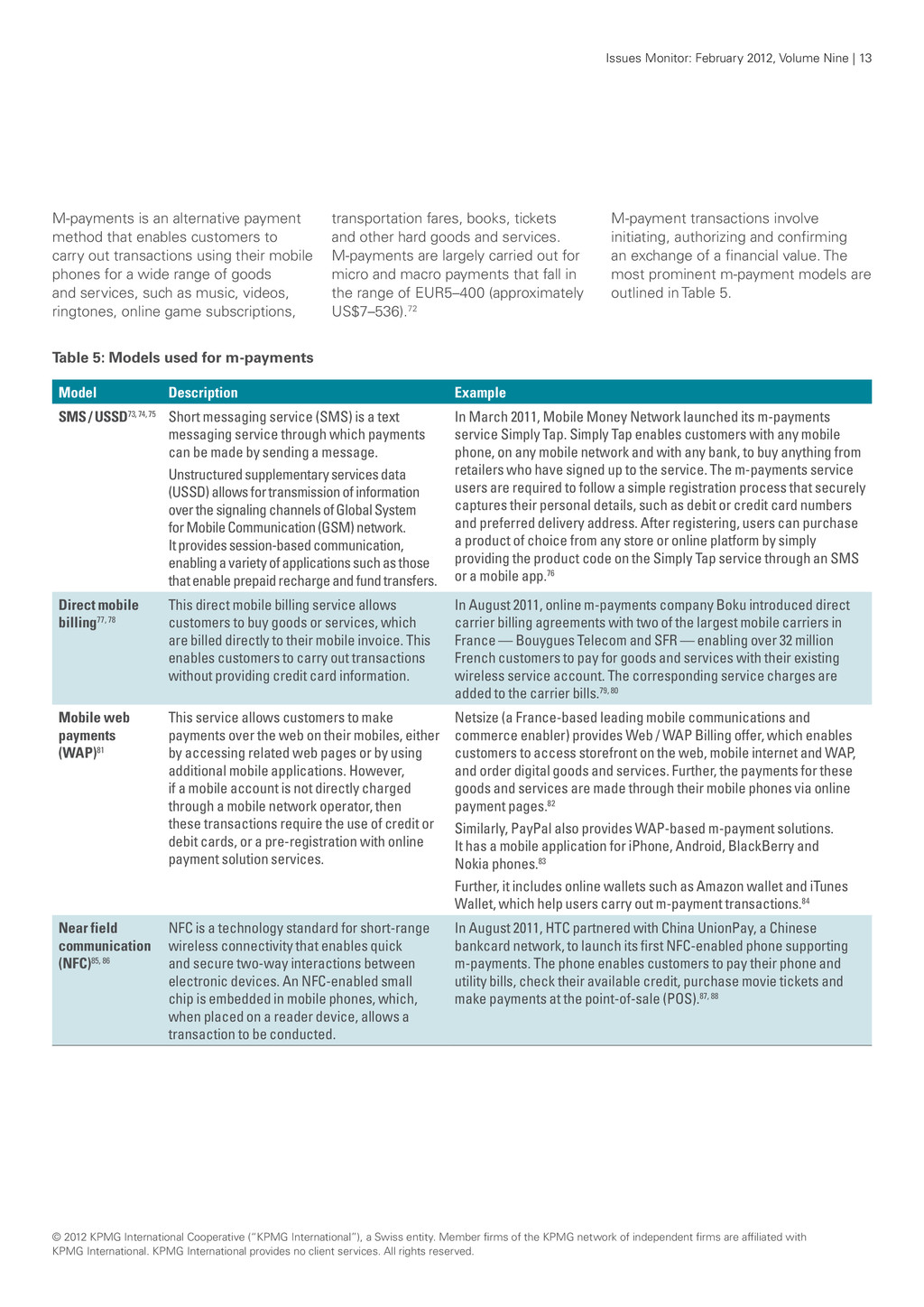
    an alternative payment method that enables customers to carry out transactions using their mobile phones for a wide range of goods and services, such as music, videos, ringtones, online game subscriptions, transportation fares, books, tickets and other hard goods and services. M-payments are largely carried out for micro and macro payments that fall in the range of EUR5–400 (approximately US$7–536).72 M-payment transactions involve initiating, authorizing and confirming an exchange of a financial value. The most prominent m-payment models are outlined in Table 5. Table 5: Models used for m-payments Model Description Example SMS / USSD73, 74, 75 Short messaging service (SMS) is a text messaging service through which payments can be made by sending a message. Unstructured supplementary services data (USSD) allows for transmission of information over the signaling channels of Global System for Mobile Communication (GSM) network. It provides session-based communication, enabling a variety of applications such as those that enable prepaid recharge and fund transfers. In March 2011, Mobile Money Network launched its m-payments service Simply Tap. Simply Tap enables customers with any mobile phone, on any mobile network and with any bank, to buy anything from retailers who have signed up to the service. The m-payments service users are required to follow a simple registration process that securely captures their personal details, such as debit or credit card numbers and preferred delivery address. After registering, users can purchase a product of choice from any store or online platform by simply providing the product code on the Simply Tap service through an SMS or a mobile app.76 Direct mobile billing77, 78 This direct mobile billing service allows customers to buy goods or services, which are billed directly to their mobile invoice. This enables customers to carry out transactions without providing credit card information. In August 2011, online m-payments company Boku introduced direct carrier billing agreements with two of the largest mobile carriers in France — Bouygues Telecom and SFR — enabling over 32 million French customers to pay for goods and services with their existing wireless service account. The corresponding service charges are added to the carrier bills.79, 80 Mobile web payments (WAP)81 This service allows customers to make payments over the web on their mobiles, either by accessing related web pages or by using additional mobile applications. However, if a mobile account is not directly charged through a mobile network operator, then these transactions require the use of credit or debit cards, or a pre-registration with online payment solution services. Netsize (a France-based leading mobile communications and commerce enabler) provides Web / WAP Billing offer, which enables customers to access storefront on the web, mobile internet and WAP, and order digital goods and services. Further, the payments for these goods and services are made through their mobile phones via online payment pages.82 Similarly, PayPal also provides WAP-based m-payment solutions. It has a mobile application for iPhone, Android, BlackBerry and Nokia phones.83 Further, it includes online wallets such as Amazon wallet and iTunes Wallet, which help users carry out m-payment transactions.84 Near field communication (NFC)85, 86 NFC is a technology standard for short-range wireless connectivity that enables quick and secure two-way interactions between electronic devices. An NFC-enabled small chip is embedded in mobile phones, which, when placed on a reader device, allows a transaction to be conducted. In August 2011, HTC partnered with China UnionPay, a Chinese bankcard network, to launch its first NFC-enabled phone supporting m-payments. The phone enables customers to pay their phone and utility bills, check their available credit, purchase movie tickets and make payments at the point-of-sale (POS).87, 88 © 2012 KPMG International Cooperative (“KPMG International”), a Swiss entity. Member firms of the KPMG network of independent firms are affiliated with KPMG International. KPMG International provides no client services. All rights reserved.
  16. 14 | Issues Monitor: February 2012, Volume Nine The m-payments

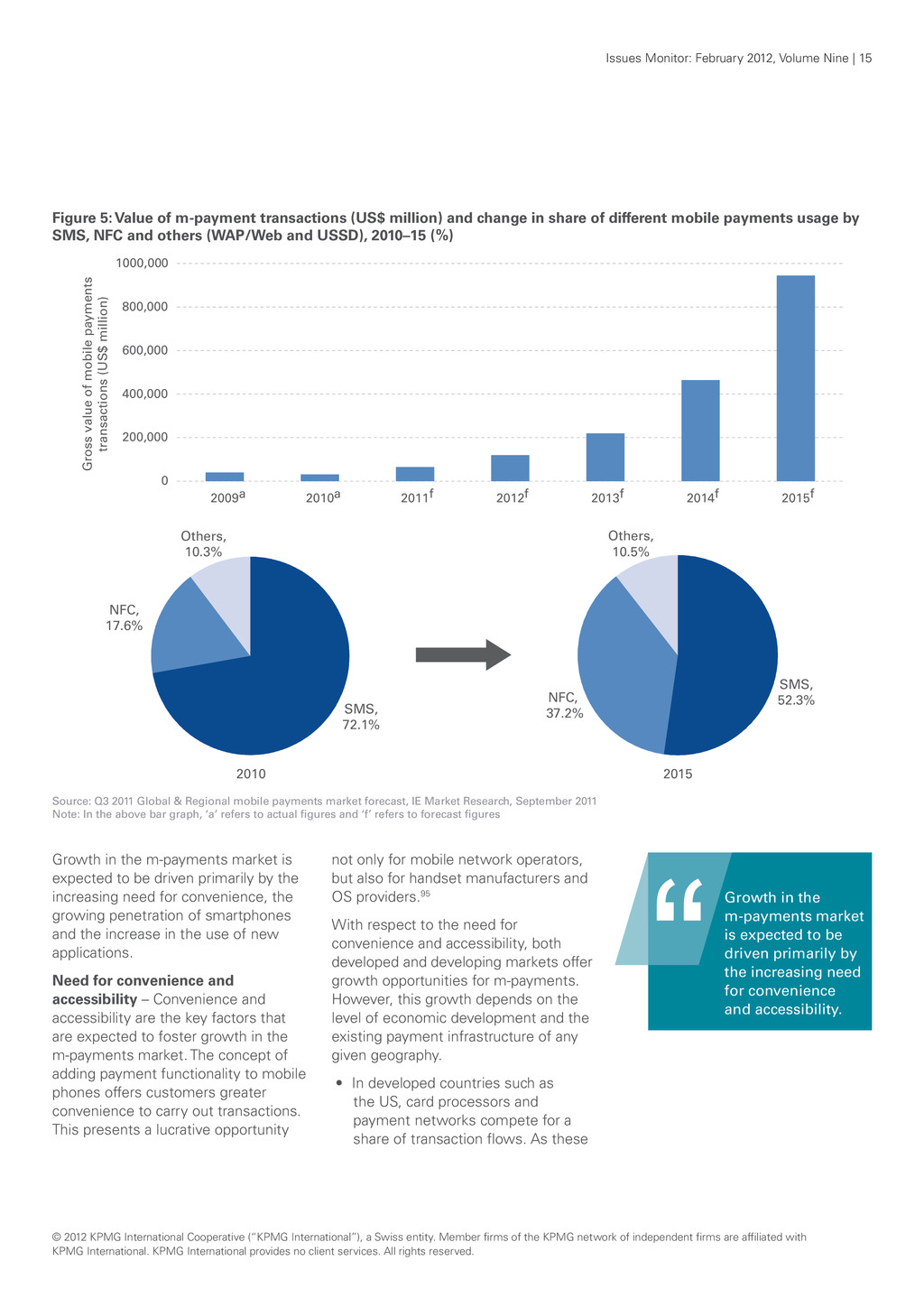
    concept started to attract attention in the early 2000s. However, it did not gain much traction over its first few years, as the solutions launched at that time lacked adequate standardization for introducing such technical solutions. This, in turn, restrained its growth among both merchants and customers.89, 90 Further, in 2002, the internet bubble deterred industry players from investing in such technologies. Over the past few years, however, the increase in demand for mobile phones and the development in m-commerce shifted their focus on m-payments. Moreover, mobile technologies such as contactless smartphones and tablets are further driving the demand for m-payments.91, 92, 93 M-payments market – Growth drivers . Over 2010–15, global m-payment transactions are expected to grow at a compound annual growth rate (CAGR) of 97.4 percent, to reach US$945 billion, as shown in Figure 5. Over the same period, however, the share of m-payments through SMS is forecast to decline, from nearly 75 percent in 2010 to 52.3 percent in 2015, due mainly to the increasing adoption of NFC technology.94 © 2012 KPMG International Cooperative (“KPMG International”), a Swiss entity. Member firms of the KPMG network of independent firms are affiliated with KPMG International. KPMG International provides no client services. All rights reserved.
  17. Issues Monitor: February 2012, Volume Nine | 15 0 200,000

    400,000 600,000 800,000 1000,000 2009a 2010a 2011f 2012f 2013f 2014f 2015f Gross value of mobile payments transactions (US$ million) SMS, 72.1% 2010 2015 NFC, 17.6% Others, 10.3% SMS, 52.3% NFC, 37.2% Others, 10.5% Growth in the m-payments market is expected to be driven primarily by the increasing need for convenience and accessibility. Figure 5: Value of m-payment transactions (US$ million) and change in share of different mobile payments usage by SMS, NFC and others (WAP/Web and USSD), 2010–15 (%) Source: Q3 2011 Global & Regional mobile payments market forecast, IE Market Research, September 2011 Note: In the above bar graph, ‘a’ refers to actual figures and ‘f’ refers to forecast figures Growth in the m-payments market is expected to be driven primarily by the increasing need for convenience, the growing penetration of smartphones and the increase in the use of new applications. Need for convenience and accessibility – Convenience and accessibility are the key factors that are expected to foster growth in the m-payments market. The concept of adding payment functionality to mobile phones offers customers greater convenience to carry out transactions. This presents a lucrative opportunity not only for mobile network operators, but also for handset manufacturers and OS providers.95 With respect to the need for convenience and accessibility, both developed and developing markets offer growth opportunities for m-payments. However, this growth depends on the level of economic development and the existing payment infrastructure of any given geography. • In developed countries such as the US, card processors and payment networks compete for a share of transaction flows. As these © 2012 KPMG International Cooperative (“KPMG International”), a Swiss entity. Member firms of the KPMG network of independent firms are affiliated with KPMG International. KPMG International provides no client services. All rights reserved.
  18. 16 | Issues Monitor: February 2012, Volume Nine economies already

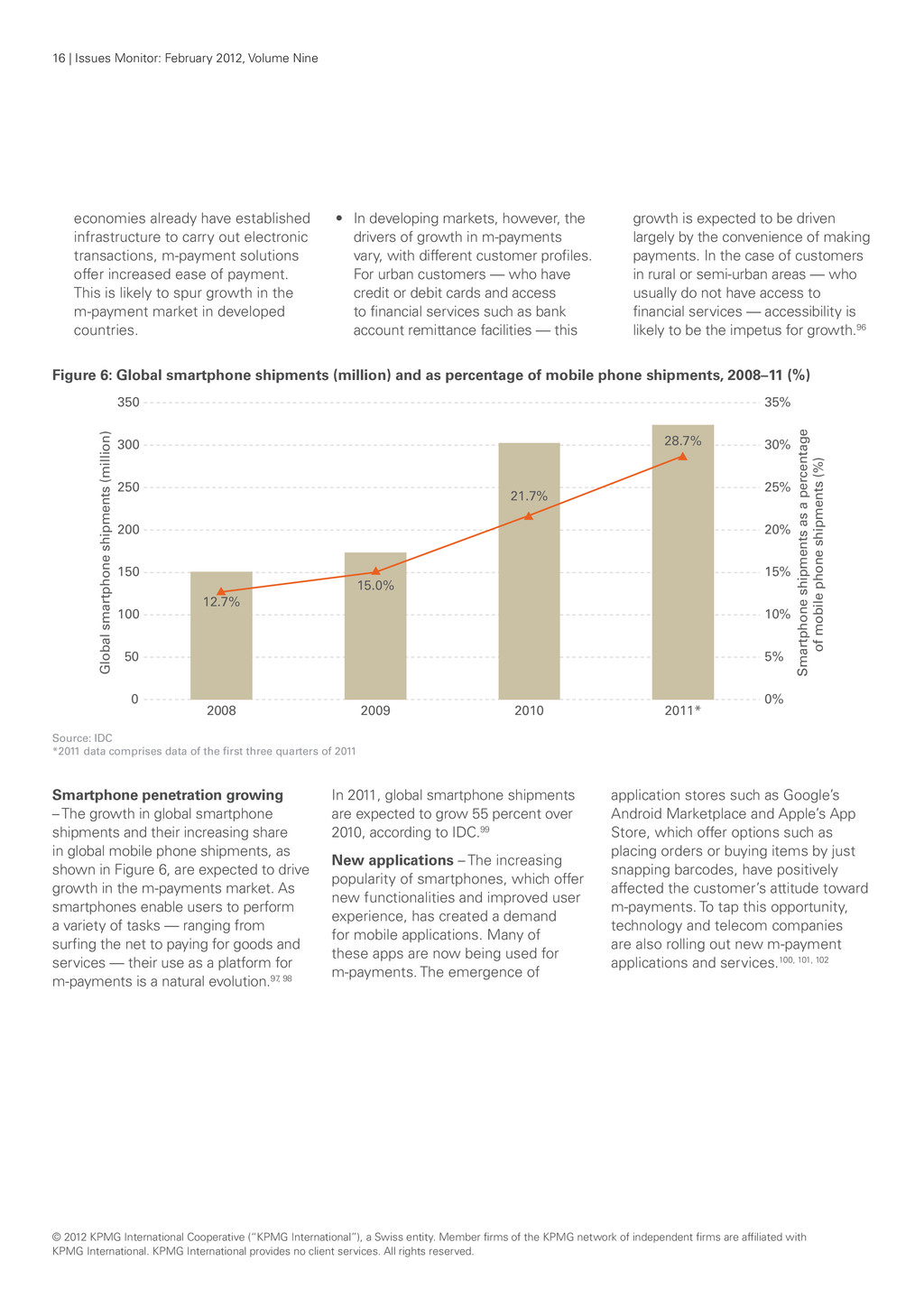
    have established infrastructure to carry out electronic transactions, m-payment solutions offer increased ease of payment. This is likely to spur growth in the m-payment market in developed countries. • In developing markets, however, the drivers of growth in m-payments vary, with different customer profiles. For urban customers — who have credit or debit cards and access to financial services such as bank account remittance facilities — this growth is expected to be driven largely by the convenience of making payments. In the case of customers in rural or semi-urban areas — who usually do not have access to financial services — accessibility is likely to be the impetus for growth.96 Figure 6: Global smartphone shipments (million) and as percentage of mobile phone shipments, 2008–11 (%) 12.7% 15.0% 21.7% 28.7% 0 50 100 150 200 250 300 350 2008 2009 2010 2011* Global smartphone shipments (million) 0% 5% 10% 15% 20% 25% 30% 35% Smartphone shipments as a percentage of mobile phone shipments (%) Source: IDC *2011 data comprises data of the first three quarters of 2011 Smartphone penetration growing – The growth in global smartphone shipments and their increasing share in global mobile phone shipments, as shown in Figure 6, are expected to drive growth in the m-payments market. As smartphones enable users to perform a variety of tasks — ranging from surfing the net to paying for goods and services — their use as a platform for m-payments is a natural evolution.97 , 98 In 2011, global smartphone shipments are expected to grow 55 percent over 2010, according to IDC.99 New applications – The increasing popularity of smartphones, which offer new functionalities and improved user experience, has created a demand for mobile applications. Many of these apps are now being used for m-payments. The emergence of application stores such as Google’s Android Marketplace and Apple’s App Store, which offer options such as placing orders or buying items by just snapping barcodes, have positively affected the customer’s attitude toward m-payments. To tap this opportunity, technology and telecom companies are also rolling out new m-payment applications and services.100, 101, 102 © 2012 KPMG International Cooperative (“KPMG International”), a Swiss entity. Member firms of the KPMG network of independent firms are affiliated with KPMG International. KPMG International provides no client services. All rights reserved.
  19. Issues Monitor: February 2012, Volume Nine | 17 Further, governments

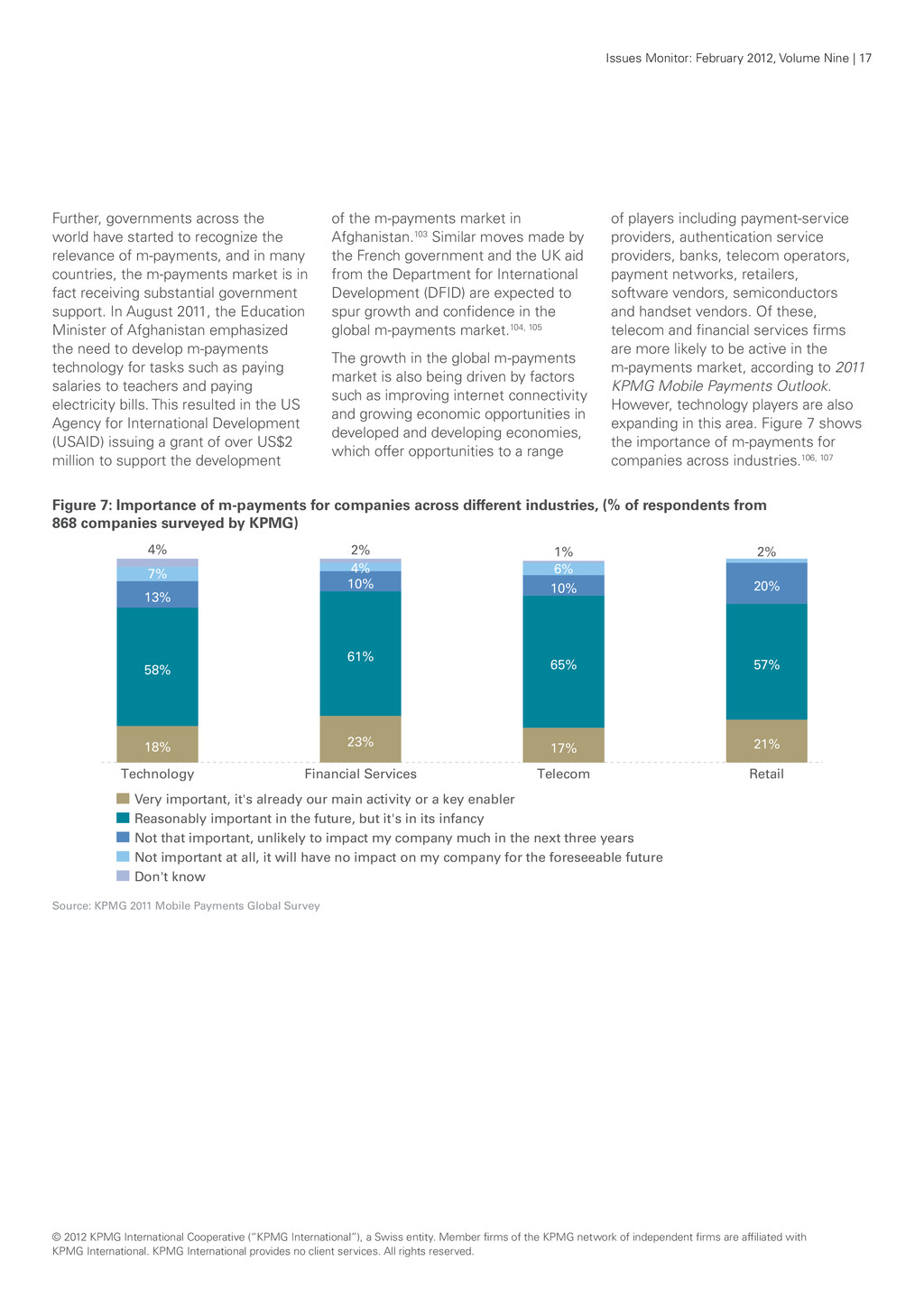
    across the world have started to recognize the relevance of m-payments, and in many countries, the m-payments market is in fact receiving substantial government support. In August 2011, the Education Minister of Afghanistan emphasized the need to develop m-payments technology for tasks such as paying salaries to teachers and paying electricity bills. This resulted in the US Agency for International Development (USAID) issuing a grant of over US$2 million to support the development of the m-payments market in Afghanistan.103 Similar moves made by the French government and the UK aid from the Department for International Development (DFID) are expected to spur growth and confidence in the global m-payments market.104, 105 The growth in the global m-payments market is also being driven by factors such as improving internet connectivity and growing economic opportunities in developed and developing economies, which offer opportunities to a range of players including payment-service providers, authentication service providers, banks, telecom operators, payment networks, retailers, software vendors, semiconductors and handset vendors. Of these, telecom and financial services firms are more likely to be active in the m-payments market, according to 2011 KPMG Mobile Payments Outlook. However, technology players are also expanding in this area. Figure 7 shows the importance of m-payments for companies across industries.106, 107 Figure 7: Importance of m-payments for companies across different industries, (% of respondents from 868 companies surveyed by KPMG) 4% 2% 1% 2% 18% 23% 17% 21% 58% 61% 65% 57% 13% 10% 10% 20% 7% 4% 6% Technology Financial Services Telecom Retail Don't know Not important at all, it will have no impact on my company for the foreseeable future Not that important, unlikely to impact my company much in the next three years Reasonably important in the future, but it's in its infancy Very important, it's already our main activity or a key enabler Source: KPMG 2011 Mobile Payments Global Survey © 2012 KPMG International Cooperative (“KPMG International”), a Swiss entity. Member firms of the KPMG network of independent firms are affiliated with KPMG International. KPMG International provides no client services. All rights reserved.
  20. 18 | Issues Monitor: February 2012, Volume Nine Technology players

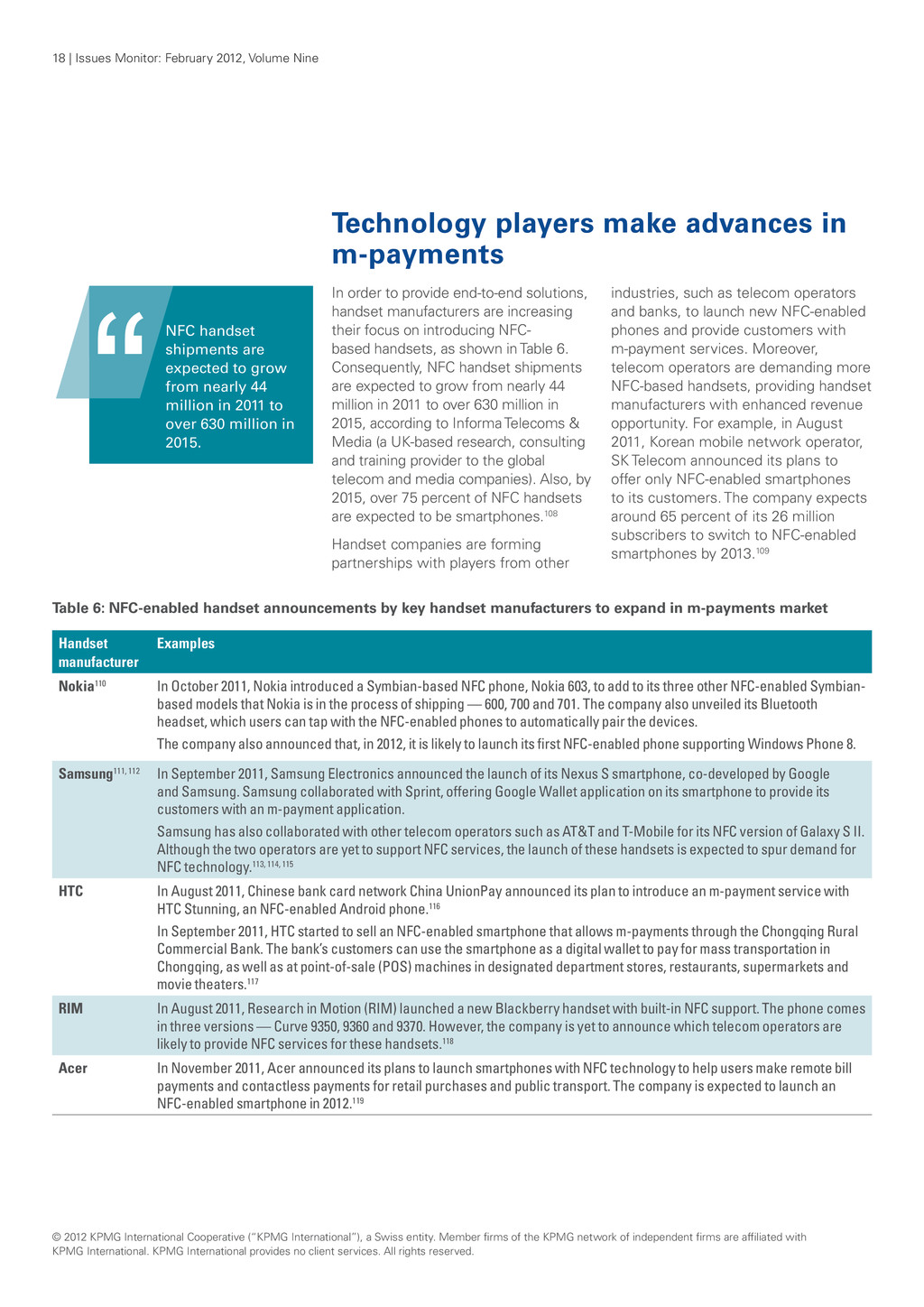
    make advances in m-payments . In order to provide end-to-end solutions, handset manufacturers are increasing their focus on introducing NFC- based handsets, as shown in Table 6. Consequently, NFC handset shipments are expected to grow from nearly 44 million in 2011 to over 630 million in 2015, according to Informa Telecoms & Media (a UK-based research, consulting and training provider to the global telecom and media companies). Also, by 2015, over 75 percent of NFC handsets are expected to be smartphones.108 Handset companies are forming partnerships with players from other industries, such as telecom operators and banks, to launch new NFC-enabled phones and provide customers with m-payment services. Moreover, telecom operators are demanding more NFC-based handsets, providing handset manufacturers with enhanced revenue opportunity. For example, in August 2011, Korean mobile network operator, SK Telecom announced its plans to offer only NFC-enabled smartphones to its customers. The company expects around 65 percent of its 26 million subscribers to switch to NFC-enabled smartphones by 2013.109 NFC handset shipments are expected to grow from nearly 44 million in 2011 to over 630 million in 2015. Table 6: NFC-enabled handset announcements by key handset manufacturers to expand in m-payments market Handset manufacturer Examples Nokia110 In October 2011, Nokia introduced a Symbian-based NFC phone, Nokia 603, to add to its three other NFC-enabled Symbian- based models that Nokia is in the process of shipping — 600, 700 and 701. The company also unveiled its Bluetooth headset, which users can tap with the NFC-enabled phones to automatically pair the devices. The company also announced that, in 2012, it is likely to launch its first NFC-enabled phone supporting Windows Phone 8. Samsung111, 112 In September 2011, Samsung Electronics announced the launch of its Nexus S smartphone, co-developed by Google and Samsung. Samsung collaborated with Sprint, offering Google Wallet application on its smartphone to provide its customers with an m-payment application. Samsung has also collaborated with other telecom operators such as AT&T and T-Mobile for its NFC version of Galaxy S II. Although the two operators are yet to support NFC services, the launch of these handsets is expected to spur demand for NFC technology.113, 114, 115 HTC In August 2011, Chinese bank card network China UnionPay announced its plan to introduce an m-payment service with HTC Stunning, an NFC-enabled Android phone.116 In September 2011, HTC started to sell an NFC-enabled smartphone that allows m-payments through the Chongqing Rural Commercial Bank. The bank’s customers can use the smartphone as a digital wallet to pay for mass transportation in Chongqing, as well as at point-of-sale (POS) machines in designated department stores, restaurants, supermarkets and movie theaters.117 RIM In August 2011, Research in Motion (RIM) launched a new Blackberry handset with built-in NFC support. The phone comes in three versions — Curve 9350, 9360 and 9370. However, the company is yet to announce which telecom operators are likely to provide NFC services for these handsets.118 Acer In November 2011, Acer announced its plans to launch smartphones with NFC technology to help users make remote bill payments and contactless payments for retail purchases and public transport. The company is expected to launch an NFC-enabled smartphone in 2012.119 © 2012 KPMG International Cooperative (“KPMG International”), a Swiss entity. Member firms of the KPMG network of independent firms are affiliated with KPMG International. KPMG International provides no client services. All rights reserved.
  21. Issues Monitor: February 2012, Volume Nine | 19 This increasing

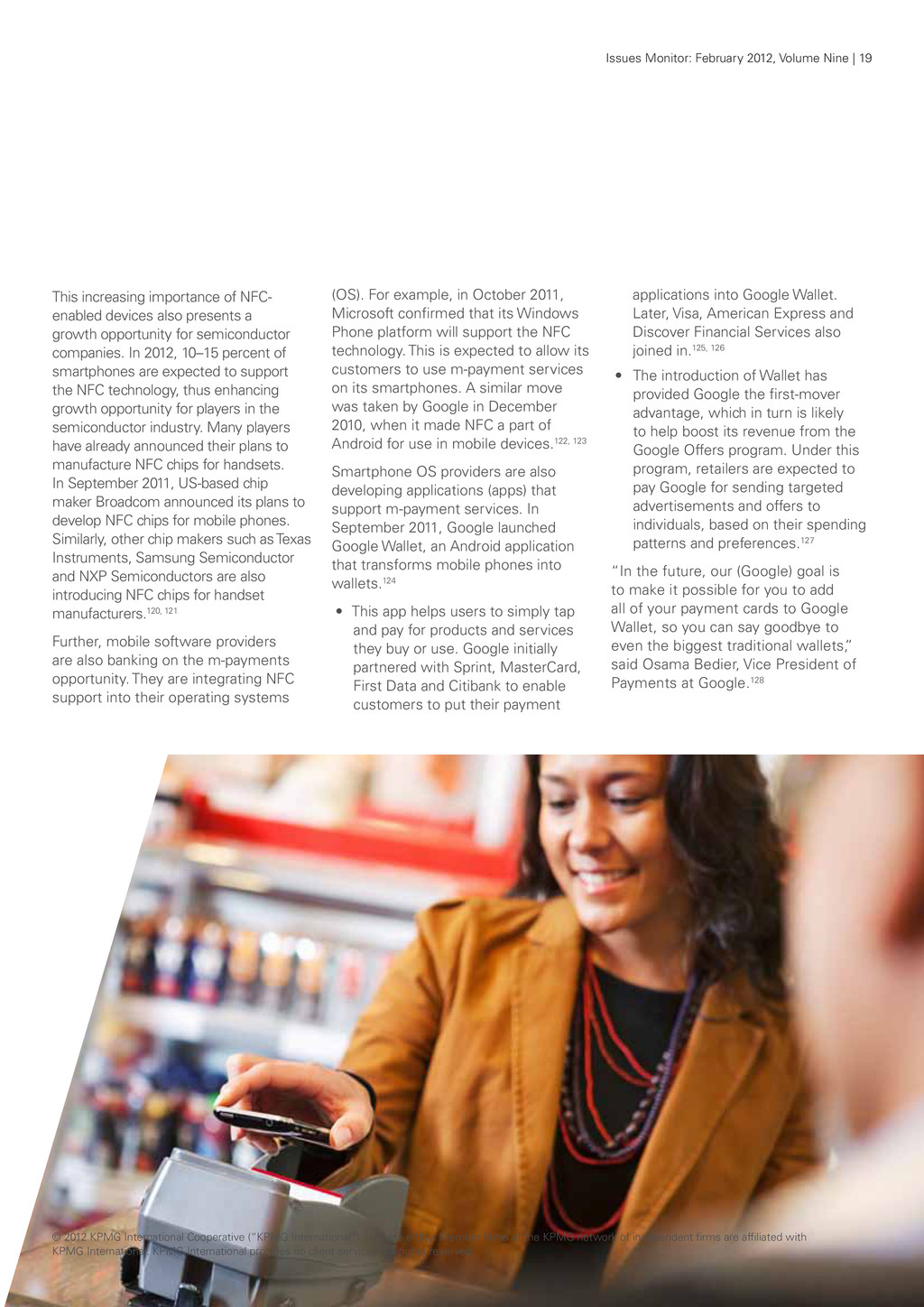
    importance of NFC- enabled devices also presents a growth opportunity for semiconductor companies. In 2012, 10–15 percent of smartphones are expected to support the NFC technology, thus enhancing growth opportunity for players in the semiconductor industry. Many players have already announced their plans to manufacture NFC chips for handsets. In September 2011, US-based chip maker Broadcom announced its plans to develop NFC chips for mobile phones. Similarly, other chip makers such as Texas Instruments, Samsung Semiconductor and NXP Semiconductors are also introducing NFC chips for handset manufacturers.120, 121 Further, mobile software providers are also banking on the m-payments opportunity. They are integrating NFC support into their operating systems (OS). For example, in October 2011, Microsoft confirmed that its Windows Phone platform will support the NFC technology. This is expected to allow its customers to use m-payment services on its smartphones. A similar move was taken by Google in December 2010, when it made NFC a part of Android for use in mobile devices.122, 123 Smartphone OS providers are also developing applications (apps) that support m-payment services. In September 2011, Google launched Google Wallet, an Android application that transforms mobile phones into wallets.124 • • This app helps users to simply tap and pay for products and services they buy or use. Google initially partnered with Sprint, MasterCard, First Data and Citibank to enable customers to put their payment applications into Google Wallet. Later, Visa, American Express and Discover Financial Services also joined in.125, 126 • • The introduction of Wallet has provided Google the first-mover advantage, which in turn is likely to help boost its revenue from the Google Offers program. Under this program, retailers are expected to pay Google for sending targeted advertisements and offers to individuals, based on their spending patterns and preferences.127 “In the future, our (Google) goal is to make it possible for you to add all of your payment cards to Google Wallet, so you can say goodbye to even the biggest traditional wallets, ” said Osama Bedier, Vice President of Payments at Google.128 © 2012 KPMG International Cooperative (“KPMG International”), a Swiss entity. Member firms of the KPMG network of independent firms are affiliated with KPMG International. KPMG International provides no client services. All rights reserved.
  22. 20 | Issues Monitor: February 2012, Volume Nine Challenges faced

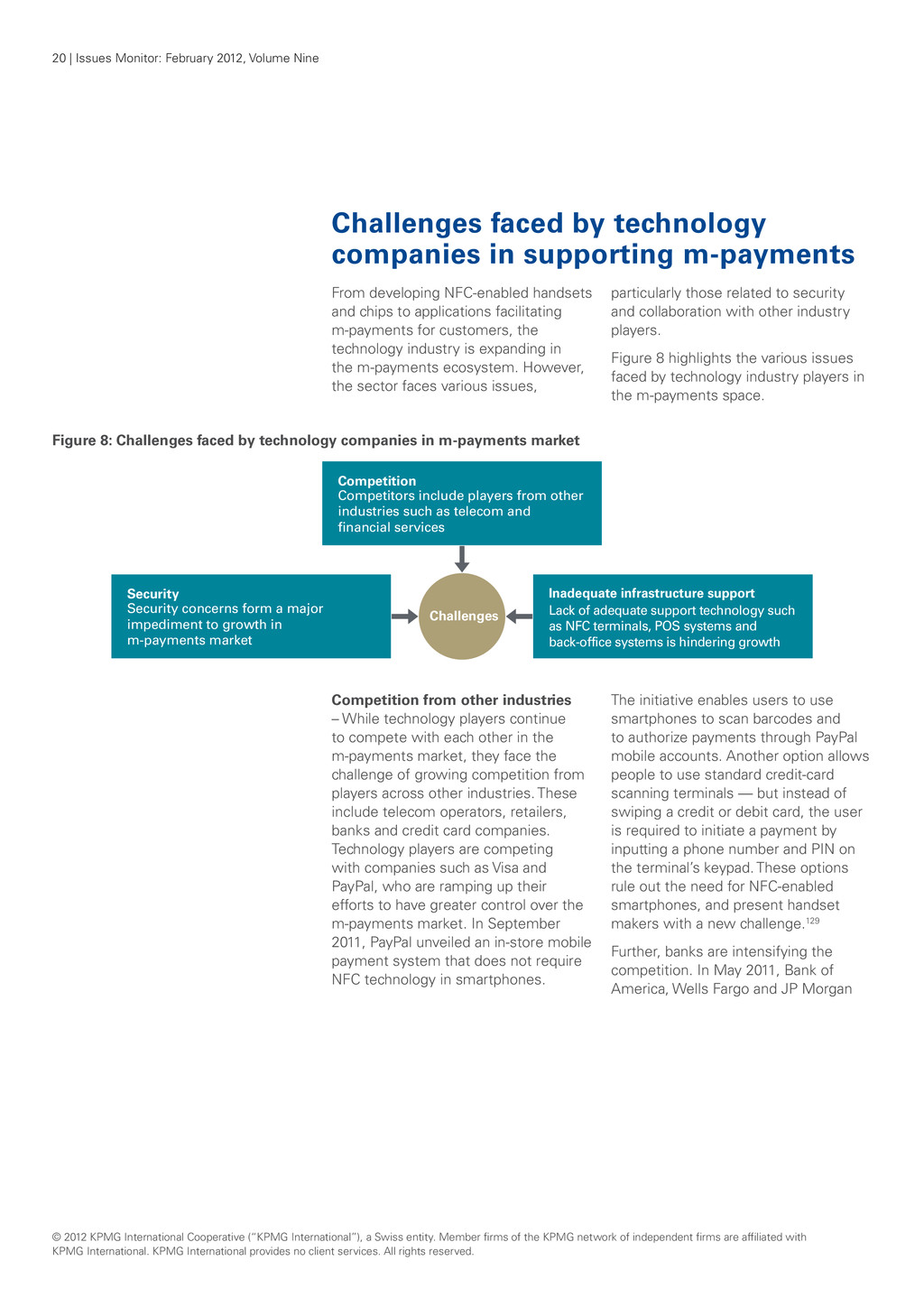
    by technology companies in supporting m-payments . From developing NFC-enabled handsets and chips to applications facilitating m-payments for customers, the technology industry is expanding in the m-payments ecosystem. However, the sector faces various issues, particularly those related to security and collaboration with other industry players. Figure 8 highlights the various issues faced by technology industry players in the m-payments space. Figure 8: Challenges faced by technology companies in m-payments market . Challenges Competition Competitors include players from other industries such as telecom and financial services Security Security concerns form a major impediment to growth in m-payments market Inadequate infrastructure support Lack of adequate support technology such as NFC terminals, POS systems and back-office systems is hindering growth Competition from other industries – While technology players continue to compete with each other in the m-payments market, they face the challenge of growing competition from players across other industries. These include telecom operators, retailers, banks and credit card companies. Technology players are competing with companies such as Visa and PayPal, who are ramping up their efforts to have greater control over the m-payments market. In September 2011, PayPal unveiled an in-store mobile payment system that does not require NFC technology in smartphones. The initiative enables users to use smartphones to scan barcodes and to authorize payments through PayPal mobile accounts. Another option allows people to use standard credit-card scanning terminals — but instead of swiping a credit or debit card, the user is required to initiate a payment by inputting a phone number and PIN on the terminal’s keypad. These options rule out the need for NFC-enabled smartphones, and present handset makers with a new challenge.129 Further, banks are intensifying the competition. In May 2011, Bank of America, Wells Fargo and JP Morgan © 2012 KPMG International Cooperative (“KPMG International”), a Swiss entity. Member firms of the KPMG network of independent firms are affiliated with KPMG International. KPMG International provides no client services. All rights reserved.
  23. Issues Monitor: February 2012, Volume Nine | 21 announced a

    partnership to buy payment service ClearXchange, to provide their customers with facilities such as moving money through their mobile phones and checking accounts.130 Moreover, the collaboration between telecom players and financial companies is driving the need for technology players to also form partnerships with telecom players.131, 132 For example, in September 2011, handset manufacturers HTC, LG, Motorola Mobility, RIM, Samsung and Sony Ericsson joined hands with ISIS, a joint venture (JV) between AT&T, T-Mobile and Verizon Wireless, to develop an open mobile commerce platform that enables customers to make m-payments. The manufacturers are likely to ship NFC-enabled handsets that implement ISIS’ NFC and technology standards, which enable tap-and-go payment capability for customers. Also, the ISIS’ technology standards provide the direction and certainty needed for the development and deployment of NFC devices and the mobile commerce ecosystem.133, 134 Inadequate infrastructure support – While m-payments are becoming increasingly popular, technology companies lack adequate support technology to fully utilize this opportunity.135 One major concern is interoperability, as retailers lack the NFC terminals and the POS and back-office systems necessary to ensure smooth m-payments. Also, retailers need to carefully assess the cost of developing a unique payment solution for each mobile device.136, 137 , 138 Currently, only about 10 percent of POS terminals support contactless payments. However, this number is expected to rise over the next few years, as contactless payment cards and NFC-enabled smartphones are expected to proliferate.139 Security – Security is perceived as one of the major issues in the adoption of m-payments services. As these mobile transactions involve customers’ money, ensuring security becomes imperative. According to the 2011 KPMG Mobile Payments Outlook report, 71 percent of the companies surveyed mentioned security as a major challenge inhibiting the growth of mobile payments.140 As the use of mobile payments is expected to increase, so is the risk of mobile payment fraud. Further, various issues related to the financial system — such as banking facilities and money transfers that characterize a mature financial system — are expected to hamper the adoption and use of m-payment services by customers.141, 142, 143 Amid the growing concerns regarding the safety of m-payments, governments around the world are tightening their regulatory environment. For example, with China becoming a significant market for m-payments, the country’s government and central bank have introduced several new regulations for payments and card applications, including new license requirements for third-party payment providers. In June 2010, People’s Bank of China (PBOC)* issued its Non-financial Institution Payment Service Management Measures, which clarify that nonfinancial institutions are required to apply for a “payment service license” to become legal. Also, in November 2010, in a meeting of the PBOC, the Ministry of Industry and Information Technology (MIIT)* and the Standardization Administration of the Peoples Republic of China (SAC)*, it was determined that China’s three mobile operators would be required to apply for third-party payment licenses from the PBOC in order to develop financial services. Also, all new mobile payment trials are subject to PBOC and MIIT approval. These regulations are expected to regulate the third-party payment companies and are likely to help avoid various monetary and security issues.144, 145, 146, 147 Similarly, the European Payments Council and the US government have issued draft guidelines to develop standards and schemes to help the m-payments market evolve.148, 149 * The People’s Bank of China (PBC or PBOC) is the central bank of the People’s Republic of China with the power to control monetary policy and regulate financial institutions in mainland China. **Ministry of Industry and Information Technology is the state agency of the People’s Republic of China responsible for regulation and development of the postal service, Internet, wireless, broadcasting, communications, production of electronic and information goods, software industry and the promotion of the national knowledge economy. ***Standardization Administration of China (SAC) the Standards organization authorized by the State Council of China to exercise administrative responsibilities by undertaking unified management, supervision and overall coordination of standardization work in China. © 2012 KPMG International Cooperative (“KPMG International”), a Swiss entity. Member firms of the KPMG network of independent firms are affiliated with KPMG International. KPMG International provides no client services. All rights reserved.
  24. 22 | Issues Monitor: February 2012, Volume Nine M-payments market

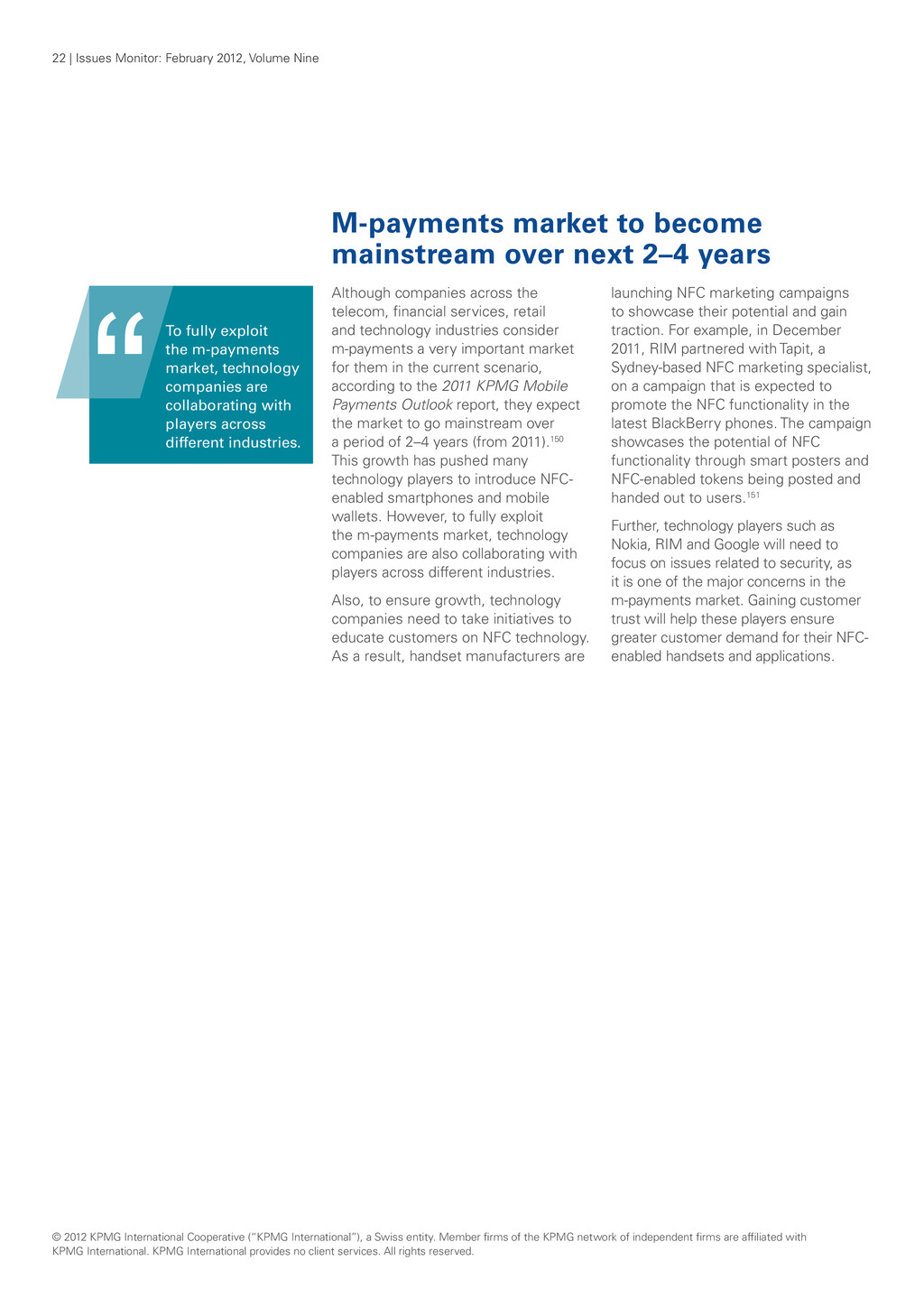
    to become mainstream over next 2–4 years . Although companies across the telecom, financial services, retail and technology industries consider m-payments a very important market for them in the current scenario, according to the 2011 KPMG Mobile Payments Outlook report, they expect the market to go mainstream over a period of 2–4 years (from 2011).150 This growth has pushed many technology players to introduce NFC- enabled smartphones and mobile wallets. However, to fully exploit the m-payments market, technology companies are also collaborating with players across different industries. Also, to ensure growth, technology companies need to take initiatives to educate customers on NFC technology. As a result, handset manufacturers are launching NFC marketing campaigns to showcase their potential and gain traction. For example, in December 2011, RIM partnered with Tapit, a Sydney-based NFC marketing specialist, on a campaign that is expected to promote the NFC functionality in the latest BlackBerry phones. The campaign showcases the potential of NFC functionality through smart posters and NFC-enabled tokens being posted and handed out to users.151 Further, technology players such as Nokia, RIM and Google will need to focus on issues related to security, as it is one of the major concerns in the m-payments market. Gaining customer trust will help these players ensure greater customer demand for their NFC- enabled handsets and applications. To fully exploit the m-payments market, technology companies are collaborating with players across different industries. © 2012 KPMG International Cooperative (“KPMG International”), a Swiss entity. Member firms of the KPMG network of independent firms are affiliated with KPMG International. KPMG International provides no client services. All rights reserved.
  25. Issues Monitor: February 2012, Volume Nine | 23 Further Information

    . Visit kpmg.com for the following related publications . • • 2011 KPMG Mobile Payments Outlook How KPMG firms can help . IT Advisory Services KPMG member firms work with clients to analyze business technology issues within their businesses. A client might approach a member firm for assistance with developing an appropriate IT strategy, sourcing, cost optimization, logistics and supply chain issues, and regulatory and compliance. KPMG’s professionals have a great deal of experience in identifying and controlling financial and operational risks embedded in business systems. They focus on the business impact of technology rather than systems implementation, and are not tied to any hardware or software suppliers. As a result, KPMG professionals’ advice is independent and geared to the specific needs of each client. Process Improvement Services KPMG’s Process Improvement Services, helps evaluate how business processes are affected by risk and how an organization can improve performance by addressing risk. Focusing on key business processes, it can help develop an action plan to accomplish improvement objectives. Key contacts Gary Matuszak Global Chair Technology KPMG in the US Tel.+1 650 404 4858 [email protected] David McAllister Global Executive Technology KPMG in Australia Tel.+61 2 9335 8143 [email protected] © 2012 KPMG International Cooperative (“KPMG International”), a Swiss entity. Member firms of the KPMG network of independent firms are affiliated with KPMG International. KPMG International provides no client services. All rights reserved.
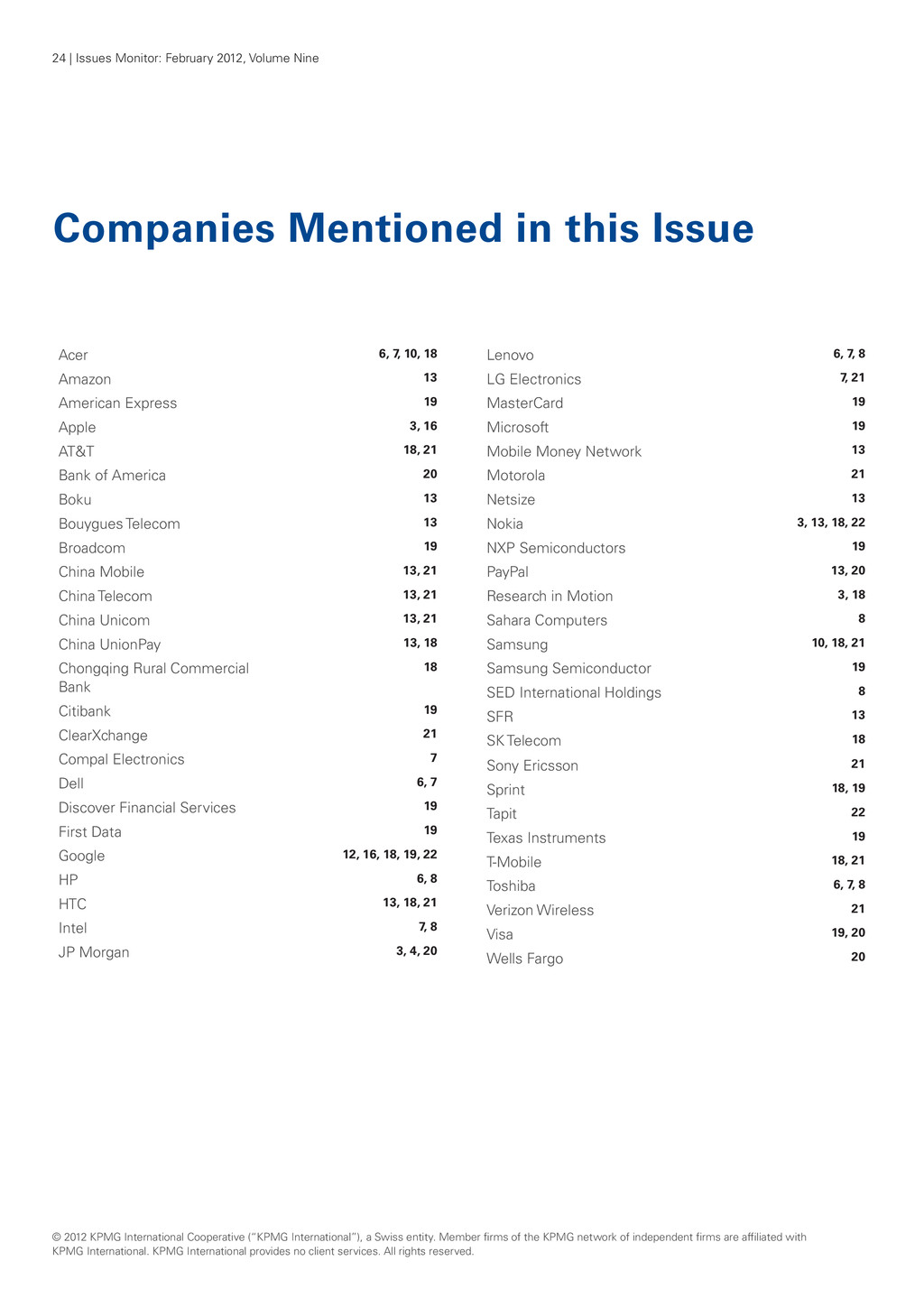
  26. 24 | Issues Monitor: February 2012, Volume Nine Companies Mentioned

    in this Issue . Acer 6, 7, 10, 18 Amazon 13 American Express 19 Apple 3, 16 AT&T 18, 21 Bank of America 20 Boku 13 Bouygues Telecom 13 Broadcom 19 China Mobile 13, 21 China Telecom 13, 21 China Unicom 13, 21 China UnionPay 13, 18 Chongqing Rural Commercial Bank 18 Citibank 19 ClearXchange 21 Compal Electronics 7 Dell 6, 7 Discover Financial Services 19 First Data 19 Google 12, 16, 18, 19, 22 HP 6, 8 HTC 13, 18, 21 Intel 7, 8 JP Morgan 3, 4, 20 Lenovo 6, 7, 8 LG Electronics 7, 21 MasterCard 19 Microsoft 19 Mobile Money Network 13 Motorola 21 Netsize 13 Nokia 3, 13, 18, 22 NXP Semiconductors 19 PayPal 13, 20 Research in Motion 3, 18 Sahara Computers 8 Samsung 10, 18, 21 Samsung Semiconductor 19 SED International Holdings 8 SFR 13 SK Telecom 18 Sony Ericsson 21 Sprint 18, 19 Tapit 22 Texas Instruments 19 T-Mobile 18, 21 Toshiba 6, 7, 8 Verizon Wireless 21 Visa 19, 20 Wells Fargo 20 © 2012 KPMG International Cooperative (“KPMG International”), a Swiss entity. Member firms of the KPMG network of independent firms are affiliated with KPMG International. KPMG International provides no client services. All rights reserved.
  27. Issues Monitor: February 2012, Volume Nine | 25 Sources .

    1 PC Market Records Modest Gains During Fourth Quarter of 2010, IDC, January 12, 2011 2 Global PC Market Contracts in the First Quarter, But Swaths of Growth Remain, IDC, April 13, 2011 3 PC Market Returns to Positive Growth in Line with Expectations, Though Gains Remain Small, IDC, July 13, 2011 4 Worldwide PC Market Grapples with Slow Growth in Second Quarter as Lenovo Rises to Number 2 Position, IDC, October 12, 2011 5 Tablets and Smartphones Will Truly Start Killing the PC in 2015, ReadWriteWeb, September 12, 2011 6 Apple - iPad 7 Early iPad 2 demand outstrips supply, ComputerWorld, March 11, 2011 8 Media Tablet and eReader Markets Beat Second Quarter Targets, Forecast Increased for 2011, IDC, September 14, 2011 9 Giving You The Functionality Of A Computer With The Convenience Of A Smart Phone, Cellcom 10 iPad Features, Apple.com 11 iPad Features, Apple.com 12 Samsung Galaxy Tab™ 7 .0" Features, Samsung 13 iPad Features, Apple.com 14 Gartner Says Apple iOS to Dominate the Media Tablet Market Through 2015, Owning More Than Half of It for the Next Three Years, Gartner, April 11, 2011 15 Tablets Eating PC Market Share, Allthings - JP Morgan, February 28, 2011 16 Apple Rises to the Top as Worldwide Smartphone Market Grows 65.4% in the Second Quarter of 2011, IDC, August 4, 2011 17 Smartphone Market Grows 79.7% Year Over Year in First Quarter of 2011, IDC, May 5, 2011 18 Wave of tablets cannibalizing PCs, Fox News, February 28, 2011 19 Evolving technology trends: PC activities on non-PC devices, NPD, 2011 2 0 Riots possible if U.S. economic conditions persist, NationalPost, September 16, 2011 2 1 U.S. Consumer Confidence Rises More Than Estimated on Outlook for Economy, Bloomberg, September 17 , 2011 2 2 Job growth fails to dent US unemployment rate, Aljazeera, October 7 , 2011 2 3 United States Inflation Rate, TradingEconomics, October 19, 2011 2 4 PC Market Returns to Positive Growth in Line with Expectations, Though Gains Remain Small, IDC, July 13, 2011 2 5 Worldwide PC Market Grapples with Slow Growth in Second Quarter as Lenovo Rises to Number 2 Position, IDC, October 12, 2011 2 6 Worldwide PC Shipments Grew 3.2 Percent in Third Quarter of 2011, Gartner, October 12, 2011 2 7 Apple and Lenovo make shocking Q3 PC sales gains, BetaNews, 2011 2 8 Euro zone October inflation 3%, September unemployment 10.2%, The Economic Times, October 31, 2011 2 9 Europe Inflation Unexpectedly Stays at 3%, Jobless Rises, Bloomberg BusinessWeek, October 31, 2011 3 0 EMEA PC Market Remains Constrained by Slow Consumer Demand and Contracts 3.8% in 3Q11, IDC, October 20, 2011 3 1 Gartner Says Western Europe PC Market Declined 19 Percent in Second Quarter of 2011, Gartner, August 17, 2011 © 2012 KPMG International Cooperative (“KPMG International”), a Swiss entity. Member firms of the KPMG network of independent firms are affiliated with KPMG International. KPMG International provides no client services. All rights reserved.
  28. 26 | Issues Monitor: February 2012, Volume Nine Sources 3

    2 Modest PC Growth Meets Expectations with Little Change for 2011 Before Recovering in 2012, IDC, September 13, 2011 3 3 Gartner Says Western Europe PC Market Declined 19 Percent in Second Quarter of 2011, Gartner, August 17 , 2011 3 4 Modest PC Growth Meets Expectations with Little Change for 2011 Before Recovering in 2012, IDC, September 13, 2011 3 5 HP Earnings Transcript, SeekingAlpha, August 18, 2011 3 6 Worldwide PC Market Grapples with Slow Growth in Second Quarter as Lenovo Rises to Number 2 Position, IDC, October 12, 2011 3 7 PC Market Returns to Positive Growth in Line with Expectations, Though Gains Remain Small, IDC, July 13, 2011 3 8 EMEA PC Market Remains Constrained by Slow Consumer Demand and Contracts 3.8% in 3Q11, IDC, October 20, 2011 3 9 Worldwide PC Market Grapples with Slow Growth in Second Quarter as Lenovo Rises to Number 2 Position, IDC, October 12, 2011 4 0 PC Market Returns to Positive Growth in Line with Expectations, Though Gains Remain Small, IDC, July 13, 2011 4 1 Worldwide PC Market Grapples with Slow Growth in Second Quarter as Lenovo Rises to Number 2 Position, IDC, October 12, 2011 4 2 Worldwide PC Shipments Grew 3.2 Percent in Third Quarter of 2011, Gartner, October 12, 2011 4 3 Acer posts another loss as Q3 revenues fall 30%, TMC.net, October 23, 2011 4 4 Acer's PC shipments slump in Q2, Focus Taiwan, September 20, 2011 4 5 Thin is in for laptops competing with tablets, Timesleader.com, September 15, 2011 4 6 PC industry continues to feel ‘Apple shock’ effects, TaipeiTimes, October 11, 2011 4 7 Acer Debuts First Ultrabook: Aspire S3, Acer, September 2, 2011 4 8 Dell unveils the Inspiron 13z and Inspiron 14z, Dell, August 11, 2011 4 9 China Surpassed the United States to Become the Largest PC Market in the World in the Second Quarter of 2011, IDC, August 23, 2011 5 0 East African PC sector 'inconsequential' compared to mature markets, Balancing act, 2011 5 1 Compal, Lenovo form PC manufacturing company in China, Focus Taiwan, September 27 , 2011 5 2 Toshiba Announces New Business Strategy for the Philippines, Toshiba, September 28, 2011 5 3 LG Electronics re-enters India's laptop market, launches 3D laptop LG A530 among 13 notebooks, The Economic Times, August 31, 2011 5 4 LG launches range of notebooks, The Hindu, August 31, 2011 5 5 Toshiba appoints Sahara Computers as retail distributor, ITWEB, September 23, 2011 5 6 Lenovo and SED International Agreement Brings Lenovo PCs to More Small-to-Medium Businesses, Lenovo, August 15, 2011 5 7 HP Helps Channel Partners Improve Customer Service, Drive Growth, HP , June 28, 2011 5 8 European PC sales tumble in Q3, MicroScope.co.uk, October 11, 2011 5 9 As Prices Fall China Ousts The U.S. As Top PC Market, SiliconValleyWatcher, September 22, 2011 © 2012 KPMG International Cooperative (“KPMG International”), a Swiss entity. Member firms of the KPMG network of independent firms are affiliated with KPMG International. KPMG International provides no client services. All rights reserved.
  29. Issues Monitor: February 2012, Volume Nine | 27 Sources 6

    0 European PC sales tumble in Q3, MicroScope.co.uk, October 11, 2011 6 1 As Prices Fall China Ousts The U.S. As Top PC Market, SiliconValleyWatcher, September 22, 2011 6 2 Intel data shows laptops getting more affordable in emerging markets, Gizmag - Intel, September 13, 2011 6 3 PC Shipments to Slow to 3.8 Percent Growth in 2011; Units to Increase 10.9 Percent in 2012, Gartner, September 8, 2011 6 4 Modest PC Growth Meets Expectations with Little Change for 2011 Before Recovering in 2012, IDC, September 13, 2011 6 5 Slowing Consumer Demand Reduces PC Growth for 2011 While Longer-Term Growth Will Remain In Double Digits, IDC, June 6, 2011 6 6 Tablet sales will be equivalent to 15% of PC market in 2011, Guardian.co.uk, September 15, 2011 6 7 Apple Rises to the Top as Worldwide Smartphone Market Grows 65.4% in the Second Quarter of 2011, IDC, August 4, 2011 6 8 As Prices Fall China Ousts The U.S. As Top PC Market, SiliconValleyWatcher, September 22, 2011 6 9 PC Commoditisation Continues - margins Squeezed to Drive Sales, IDC, September 21, 2011 7 0 IHS iSuppli Assesses Flooding Impact, EBN, October 31, 2011 7 1 Computer makers caught in wake of Thai floods, FT, October 28, 2011 7 2 Mobile payments evolution, SAEC Round Table, June 8, 2011 7 3 Mobile Payment Systems and Services: An Introduction, MPF .org 74 Unstructured Supplementary Services Data, Telecomspace.com 7 5 Mitigating Security Risks in USSD-based Mobile Payment Applications, CTOForum, May 31, 2011 76 Mobile Money Network to launch Simply Tap payments in the UK, NFC World, March 28, 2011 7 7 Add online purchases to T-Mobile bill with direct carrier billing, TechFlash, August 2, 2011 7 8 Mobile Payment Systems and Services: An Introduction, MPF .org 7 9 BOKU Brings Carrier Billing to the Whole of France With New Partnerships, BusinessWire, August 24, 2011 8 0 Mobile Payments Company Boku Expands Direct Carrier Billing Deals In France, TechCrunch, August 24, 2011 8 1 Mobile Payment Systems and Services: An Introduction, MPF .org 8 2 Mobile Payments with Netsize WAP/Web Billing 8 3 eBay Launches Must-Have iPhone App RedLaser 3.0, BusinessWire, November 18, 2011 8 4 The road to mobile payments services, McKinsey 8 5 NFC 8 6 Mobile Payment Systems and Services: An Introduction, MPF .org 8 7 HTC NFC phone to go on sale in China, NFC World, August 10, 2011 8 8 HTC’s 1st NFC Phone HTC Stunning is Actually Incredible S, TechCrunch, August 12, 2011 8 9 Why Mobile Payments Fail? Towards a Dynamic and Multi-perspective, janondrus, 2008 9 0 An Introduction to Mobile Payments, pfmsoftwareoverview.com, July 20, 2011 9 1 An Introduction to Mobile Payments, PFMsoftwareoverview.com, July 20, 2011 © 2012 KPMG International Cooperative (“KPMG International”), a Swiss entity. Member firms of the KPMG network of independent firms are affiliated with KPMG International. KPMG International provides no client services. All rights reserved.
  30. 28 | Issues Monitor: February 2012, Volume Nine Sources 9

    2 Mobile Payment Market and Research - Past, Present and Future, Sprouts 9 3 Mobile Payments Evolution not Revolution, Finextra, January 17, 2011 9 4 Q3 2011 Global & Regional mobile payments market forecast, IE Market Research, September 2011 9 5 Mobile payments evolution, SAEC Round Table, June 8, 2011 9 6 2011 KPMG Mobile Payments Outlook, KPMG, 2011 9 7 Africa, Europe, M’East, Asia Pacific, drivers of mobile payment growth, Nigeriancompass.com, August 31, 2011 9 8 2011 KPMG Mobile Payments Outlook, KPMG, 2011 9 9 Apple Rises to the Top as Worldwide Smartphone Market Grows 65.4% in the Second Quarter of 2011, IDC, August 4, 2011 10 0 2011 KPMG Mobile Payments Outlook, KPMG, 2011 101 Mobile payments 2012, Innopay, September 2011 10 2 Does the new Apple Store App set the bar for mobile payments?, Yahoo News, November 8, 2011 10 3 USAID Grants Aim to Help Create Mobile Banking System in Afghanistan, MobilePaymentMagazine, September 22, 2011 10 4 French Government to Offer Up to €20 million in NFC Funding for Cities, NFC Times, May 30, 2011 10 5 This World Anti-Corruption Day, see how a new mobile technology is helping to clean up salary payments to Afghan police officers, DFID, December 9, 2010 10 6 2011 KPMG Mobile Payments Outlook, KPMG, 2011 10 7 Mobile NFC Facing Hurdles, Opportunities, Say Analysts, NFC Times, September 7 , 2011 10 8 Android to account for largest number of NFC handset shipments from 2012 onwards, SmartCardsTrends, September 29, 2011 10 9 SK Telecom: All new smartphones must come with NFC, NFC World, August 1, 2011 110 Nokia Unveils Another Entry-Level Symbian NFC Phone, NFCTimes, October 13, 2011 111 AT&T Samsung Galaxy S II, Droidmatters.com, October 4, 2011 112 T-Mobile Samsung Galaxy S II 4G Smartphone Coming, eWeek.com, September 27 , 2011 113 Samsung: More NFC Devices to Come, Led by Galaxy S II, NFC Times, September 29, 2011 114 Google Wallet now available on Sprint Nexus S 4G, coming soon to other carriers’ version?, Androidandme, September 19, 2011 115 Google Wallet opens for business, CNET, September 19, 2011 116 China UnionPay to Launch NFC Mobile-Payment with HTC Android Phone, NFC Times, August 12, 2011 117 HTC mobile banking phone goes on sale in Chongqing, Taipei Times, September 27 , 2011 118 RIM Announces New NFC-Enabled BlackBerry, NFC Times, August 23, 2011 119 Acer to launch mobile payment smartphones next year, WantChinaTimes, November 25, 2011 12 0 NXP Confirms Chip Supply for Huawei Android Phone, NFC Times, August 30, 2011 12 1 Broadcom to Introduce Standalone NFC Chip as Competition Heats Up, NFC Times, September 9, 2011 12 2 Microsoft Confirms NFC Support in Windows Phone, NFC Times, October 20, 2011 © 2012 KPMG International Cooperative (“KPMG International”), a Swiss entity. Member firms of the KPMG network of independent firms are affiliated with KPMG International. KPMG International provides no client services. All rights reserved.
  31. Issues Monitor: February 2012, Volume Nine | 29 Sources 12

    3 Microsoft Is Said to Plan Mobile Payments in Phone Software, BusinessWeek, March 30, 2011 12 4 Google Wallet Launches as Other Payment Networks Sign On, NFC Times, September 19, 2011 12 5 Google Wallet Launches as Other Payment Networks Sign On, NFC Times, September 19, 2011 12 6 Google, NFC Times 12 7 Google Wallet gets an upgrade, CNET, October 17 , 2011 12 8 Google Wallet opens for business, CNET, September 19, 2011 12 9 PayPal unveils mobile payments for in-store shopping, Computerworld, September 15, 2011 13 0 Major Banks Join in Mobile Payment Venture, Mobiledia.com, May 25, 2011 13 1 American Express, Verizon in mobile payments deal, Reuters, August 1, 2011 13 2 Mobile Payments To Triple To $670B By 2015, Techcrunch, July 5, 2011 13 3 Isis mobile-payment group lines up handset backers, CNET, September 27 , 2011 13 4 Major Handset Manufacturers to Implement Isis NFC Technology Standards, Payments News, September 2011 13 5 Mobile payments and the potential of NFC in 2011: A story about the Android that wanted to share, the BlackBerry that didn’t and the Apple that could take a bite out of anybody, GFK, May 2011 13 6 The Death of Retail POS Terminals, Mobilestrategypartners.com, August 5, 2011 13 7 The Challenges of Mobile Payments, Business News Daily, July 13, 2011 13 8 Verifone: All New Point of Sale Terminals Will Get NFC, Gigaom.com, March 4, 2011 13 9 Wireless Mobile Payments to Reach 85% of POS Terminals by 2016, Sucherman Consulting Group, August 16, 2011 14 0 2011 KPMG Mobile Payments Outlook, KPMG, 2011 14 1 Fraud Risk in Mobile Payments - Neural Technologies' Survey Results, SFGate, October 13, 2011 14 2 Mobile Wallets: Security and Privacy Questions Raised By New Google App, Huffingtonpost, September 20, 2011 14 3 Mobile Wallets: Security and Privacy Questions Raised By New Google App, MobileMagazine, October 14, 2011 14 4 Mobile Payment In China:2010 Edition, Alibaba, January 25, 2011 14 5 World Cards and Payments China Focus will be held in Shanghai, Interfax, September 21, 2011 14 6 China to accelerate third-party licensing, China Briefing, December 2, 2010 14 7 13.56MHz Favored in China's Contactless Payment Standards Battle, Marbridgeconsulting. com, April 14, 2011 14 8 Government agencies discuss future of mobile payments, Retailpro 14 9 Mobile Payments in the United States, FRBAtlanta.org, March 25, 2011 15 0 2011 KPMG Mobile Payments Outlook, KPMG, 2011 15 1 RIM begins NFC marketing campaign, NFC World, December 6, 2011 © 2012 KPMG International Cooperative (“KPMG International”), a Swiss entity. Member firms of the KPMG network of independent firms are affiliated with KPMG International. KPMG International provides no client services. All rights reserved.
  32. Contact us Gary Matuszak Global Chair, Technology KPMG in the

    US T: +1 650 404 4858 E: [email protected] David McAllister Global Executive, Technology KPMG in Australia T: +61 2 9335 8143 E: [email protected] The information contained herein is of a general nature and is not intended to address the circumstances of any particular individual or entity. Although we endeavor to provide accurate and timely information, there can be no guarantee that such information is accurate as of the date it is received or that it will continue to be accurate in the future. No one should act upon such information without appropriate professional advice after a thorough examination of the particular situation. © 2012 KPMG International Cooperative (“KPMG International”), a Swiss entity. Member firms of the KPMG network of independent firms are affiliated with KPMG International. KPMG International provides no client services. No member firm has any authority to obligate or bind KPMG International or any other member firm vis-à-vis third parties, nor does KPMG International have any such authority to obligate or bind any member firm. All rights reserved. The KPMG name, logo and “cutting through complexity” are registered trademarks or trademarks of KPMG International. Designed and produced by Evalueserve Contact: Vipin Kumar Head of Global Markets Research KPMG in India Tel.+91 124 612 9321 Publication name: Issues Monitor Publication number: 07 - 009 Publication date: February 2012