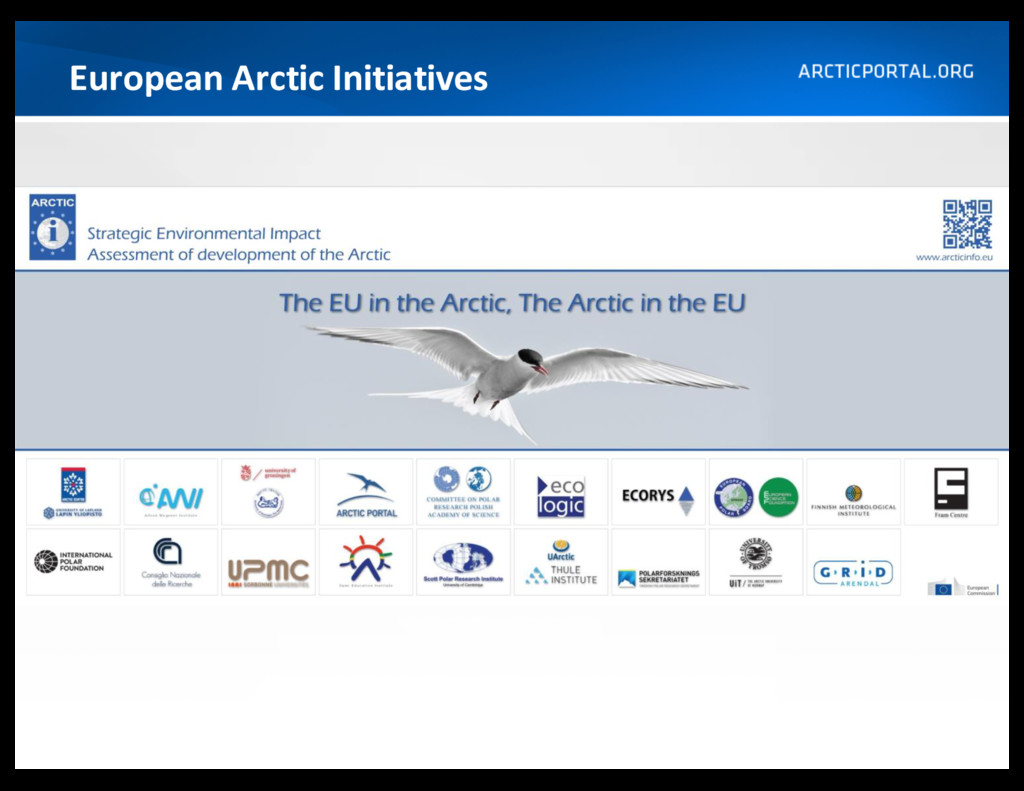
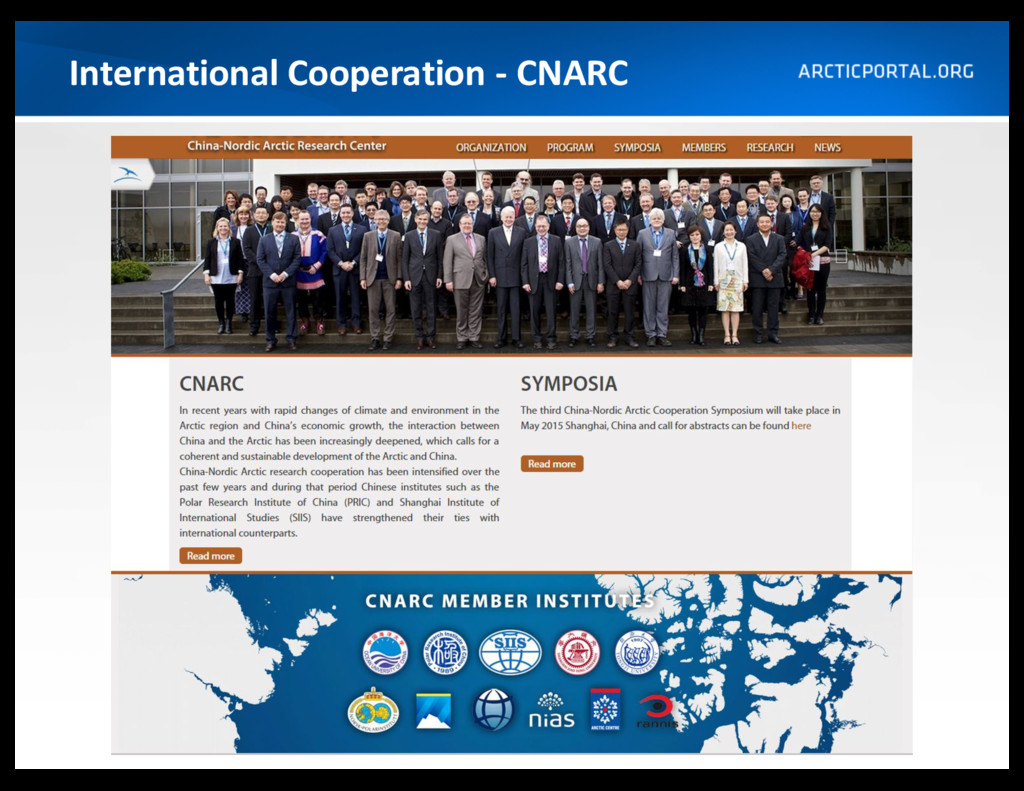
Gateway to Arctic Information and Data • Welcomed in the Arctic Council Ministerial Declaration in 2006 • Well educated staff members from 6 nationalities • Partners in serveral international projects and forums: – European Polar Board, SAON, ADC, CNARC, CIAO, NVF, Iceland Arctic Cooperation Network, EU Arctic Information Centre, Uarctic, Arctic Energy Summit, AREA, APPLICATE, IPA, GTN-P .....
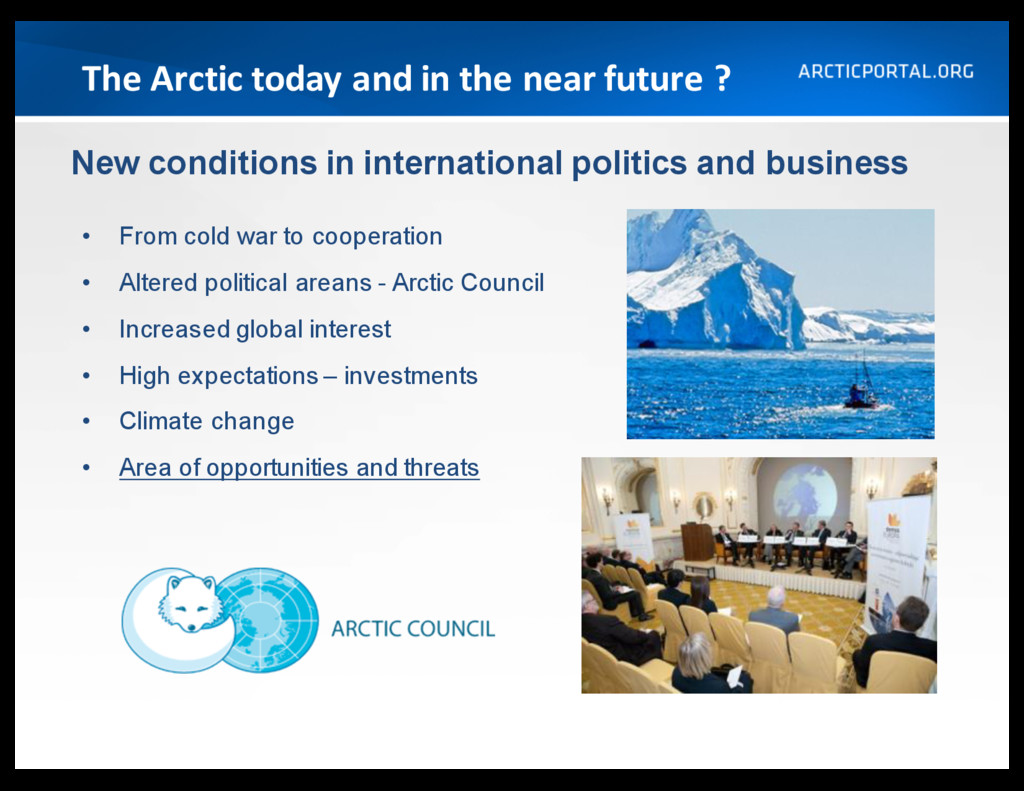
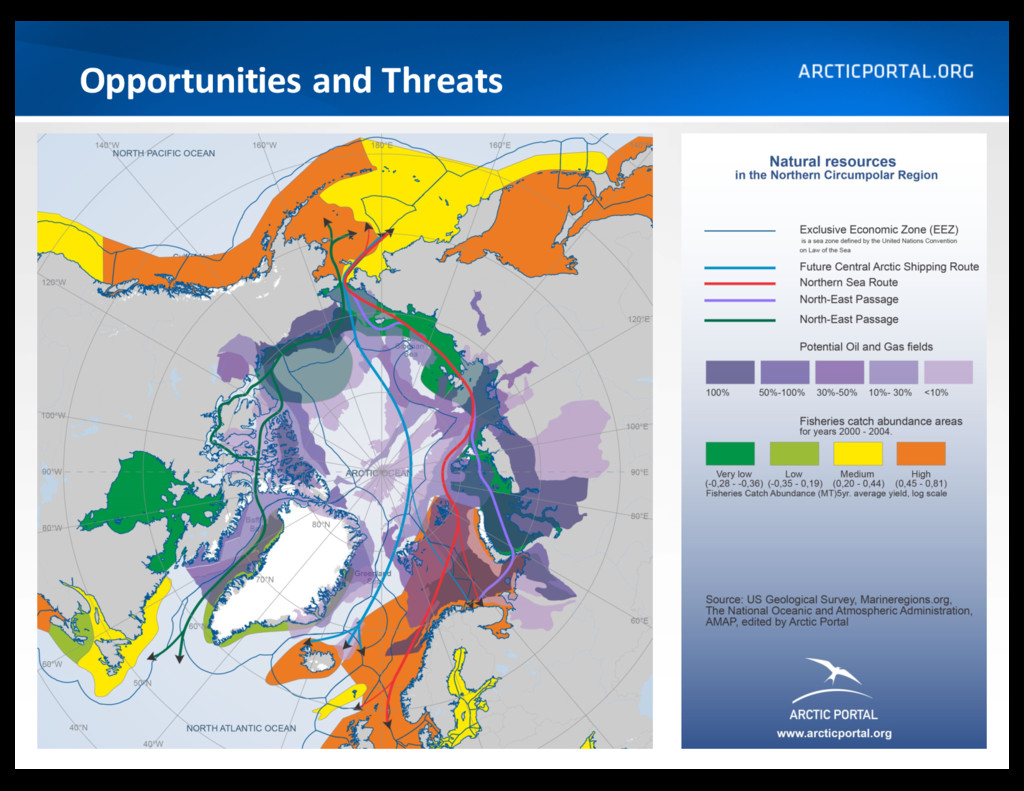
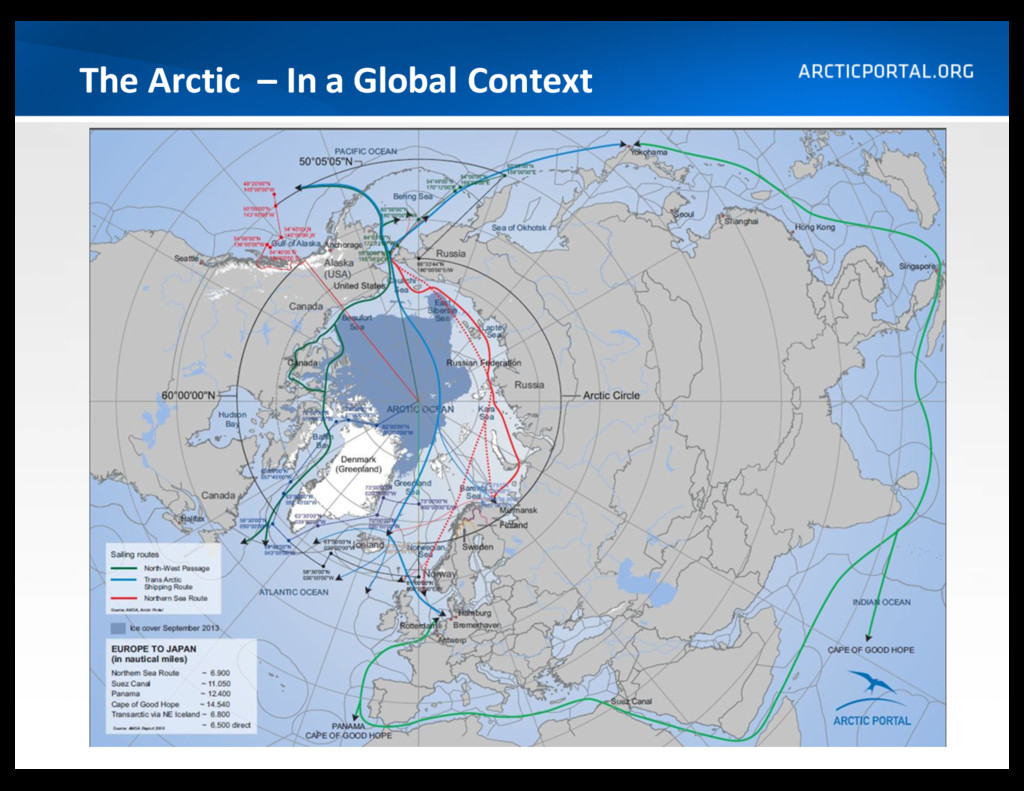
war to cooperation • Altered political areans - Arctic Council • Increased global interest • High expectations – investments • Climate change • Area of opportunities and threats The Arctic today and in the near future ?
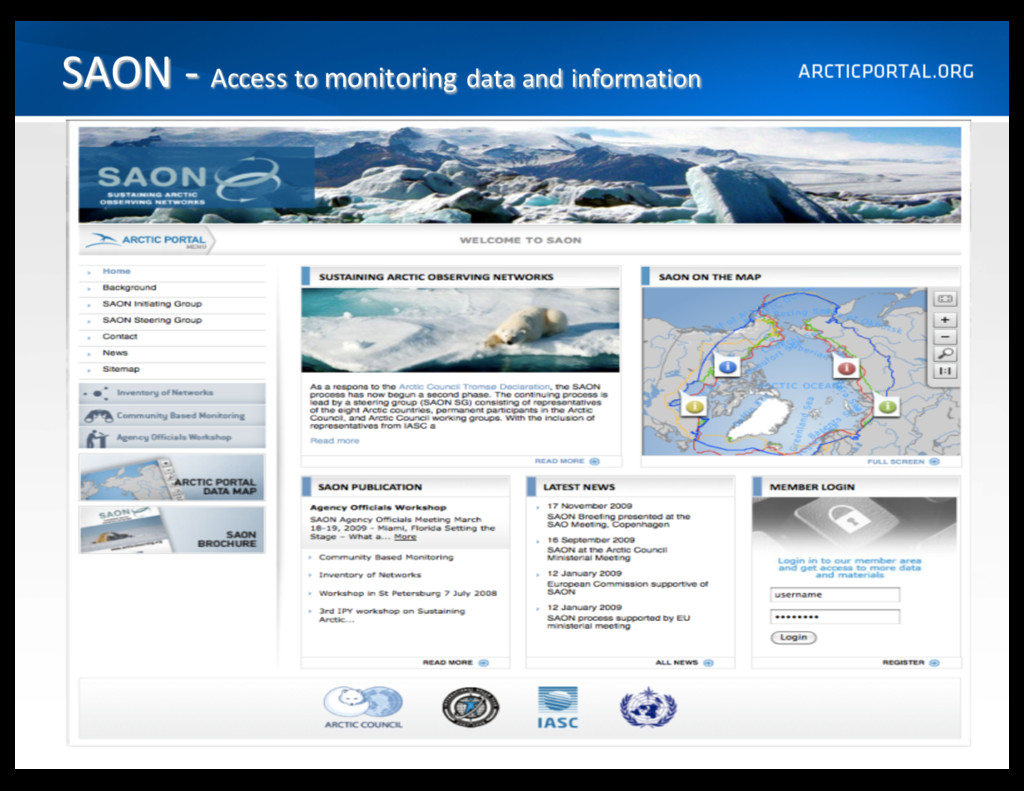
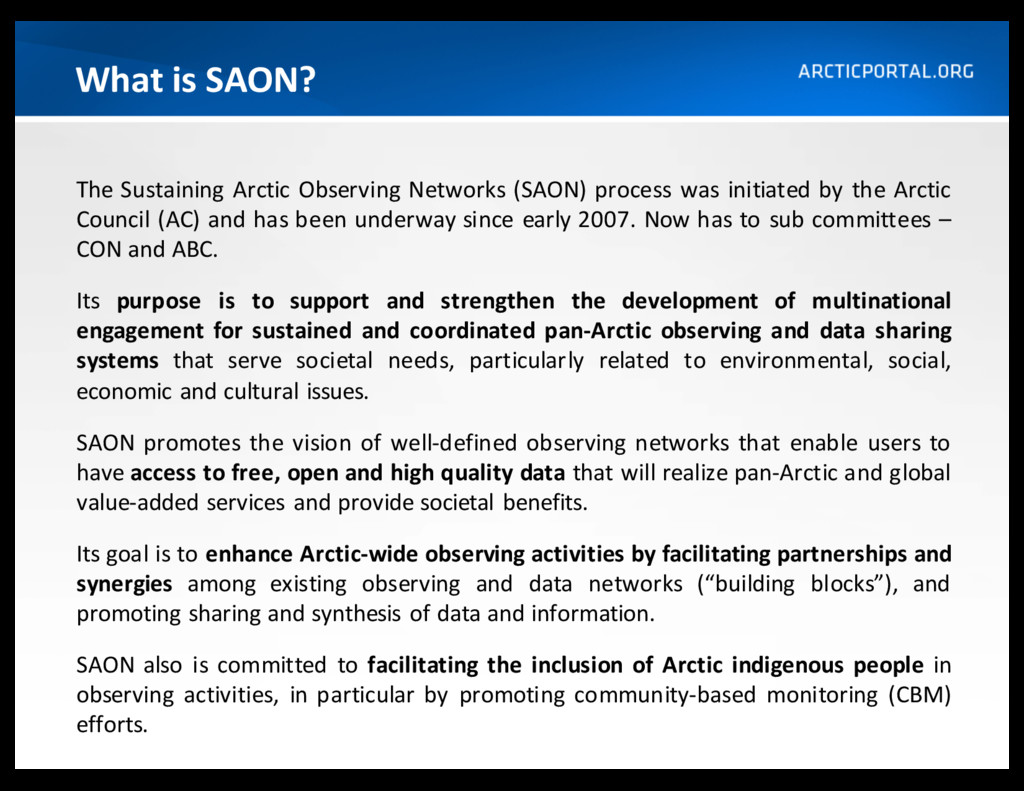
was initiated by the Arctic Council (AC) and has been underway since early 2007. Now has to sub committees – CON and ABC. Its purpose is to support and strengthen the development of multinational engagement for sustained and coordinated pan-‐Arctic observing and data sharing systems that serve societal needs, particularly related to environmental, social, economic and cultural issues. SAON promotes the vision of well-‐defined observing networks that enable users to have access to free, open and high quality data that will realize pan-‐Arctic and global value-‐added services and provide societal benefits. Its goal is to enhance Arctic-‐wide observing activities by facilitating partnerships and synergies among existing observing and data networks (“building blocks”), and promoting sharing and synthesis of data and information. SAON also is committed to facilitating the inclusion of Arctic indigenous people in observing activities, in particular by promoting community-‐based monitoring (CBM) efforts.
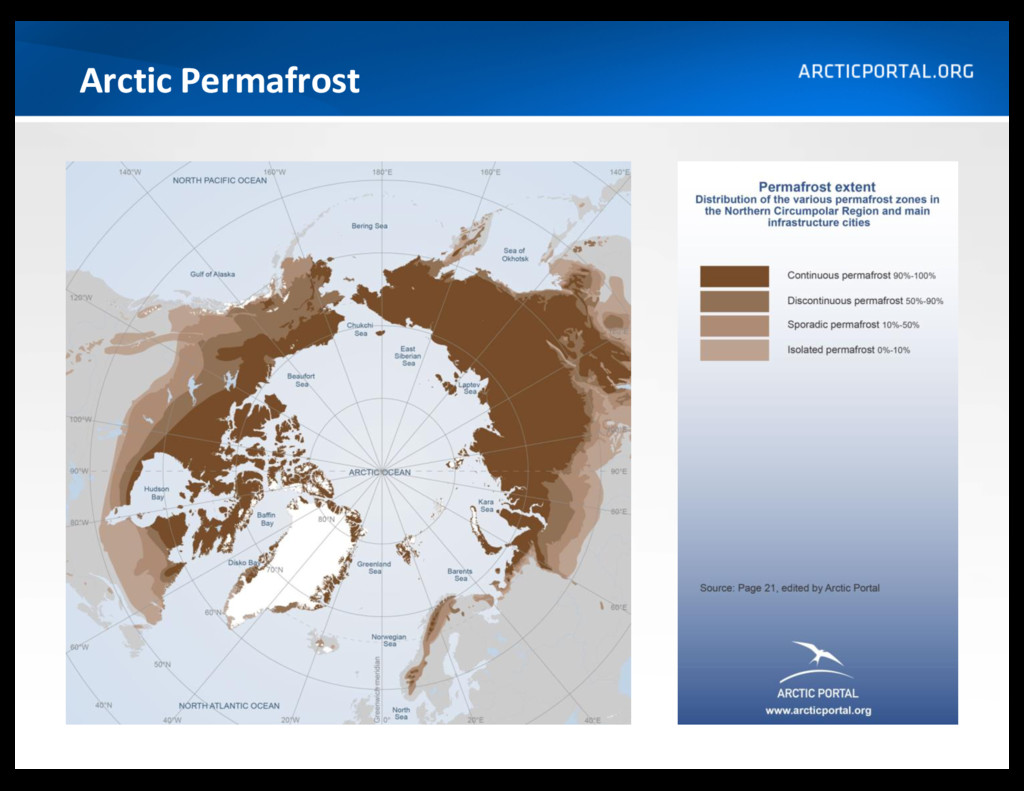
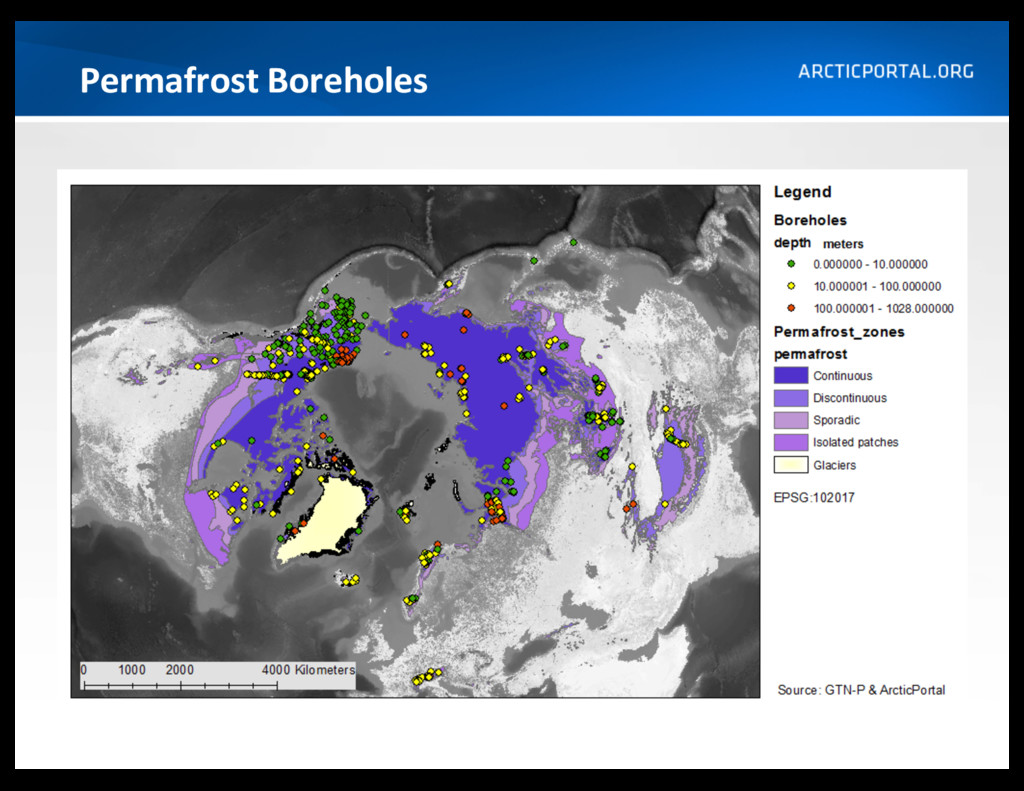
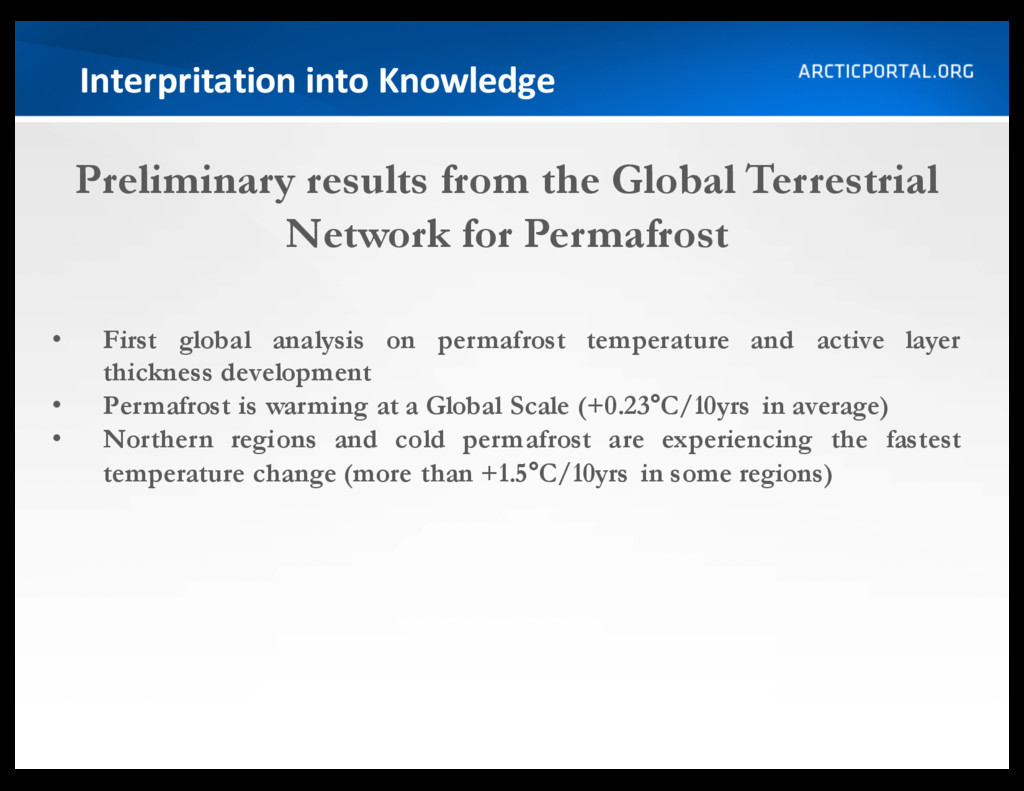
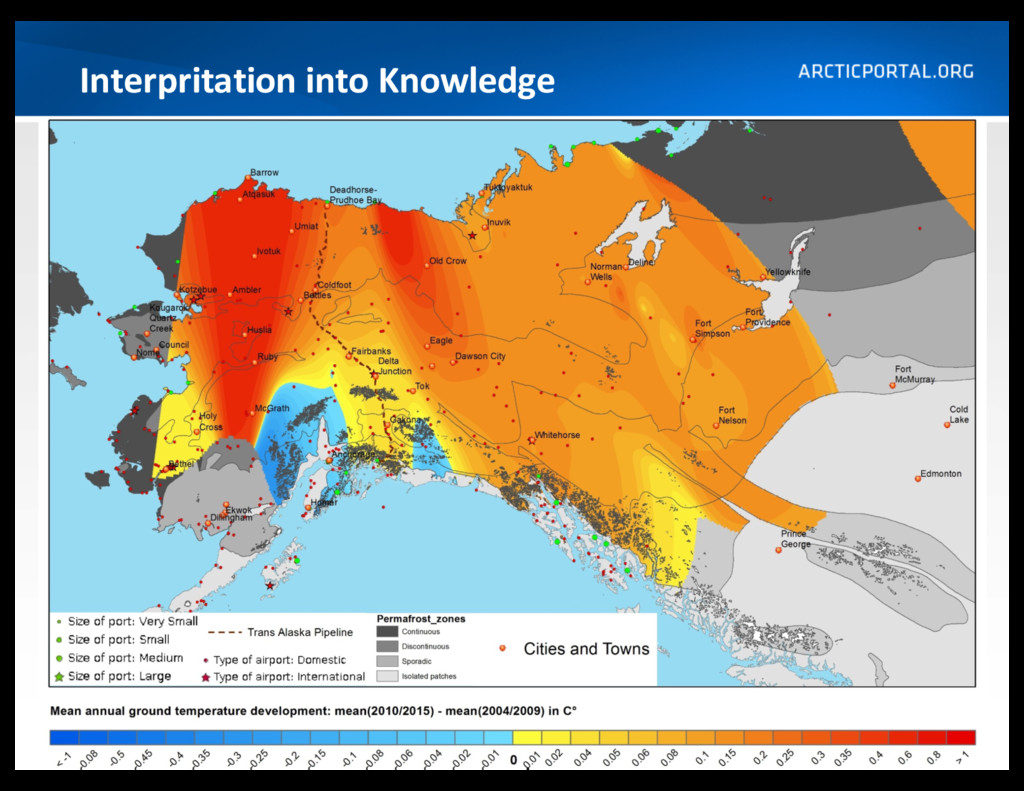
First global analysis on permafrost temperature and active layer thickness development • Permafrost is warming at a Global Scale (+0.23°C/10yrs in average) • Northern regions and cold permafrost are experiencing the fastest temperature change (more than +1.5°C/10yrs in some regions) Interpritation into Knowledge
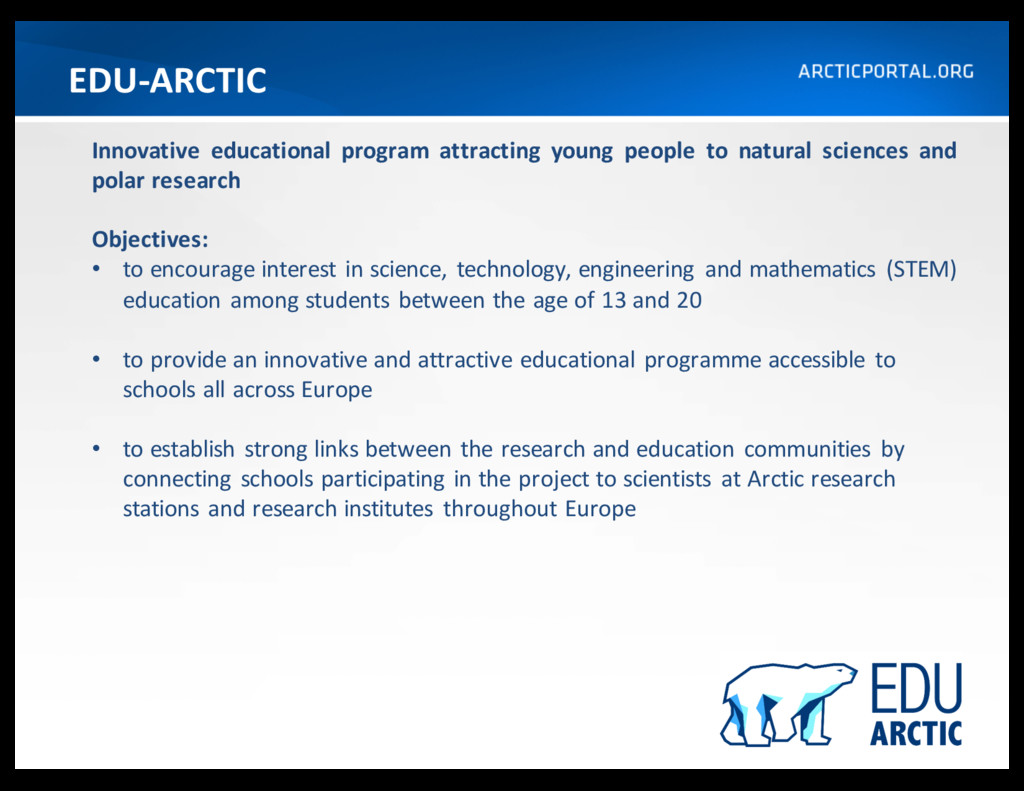
polar research Objectives: • to encourage interest in science, technology, engineering and mathematics (STEM) education among students between the age of 13 and 20 • to provide an innovative and attractive educational programme accessible to schools all across Europe • to establish strong links between the research and education communities by connecting schools participating in the project to scientists at Arctic research stations and research institutes throughout Europe EDU-‐ARCTIC
polar research Funding: Horizon 2020 Partners: • Institute of Geophysics Polish Academy of Sciences, Poland • American Systems Ltd., Poland • Norwegian Institute of Bioeconomy, Norway • Faroe Islands Nature Investigation, Denmark • Université de Versailles Saint-‐Quentin-‐en-‐Yvelines, France • Arctic Portal, Iceland Arctic Portal Role: Leader of WP6 Dissemination and promotion of EDU-‐Arctic program Budget: 2 000 000 EUR EDU-‐ARCTIC
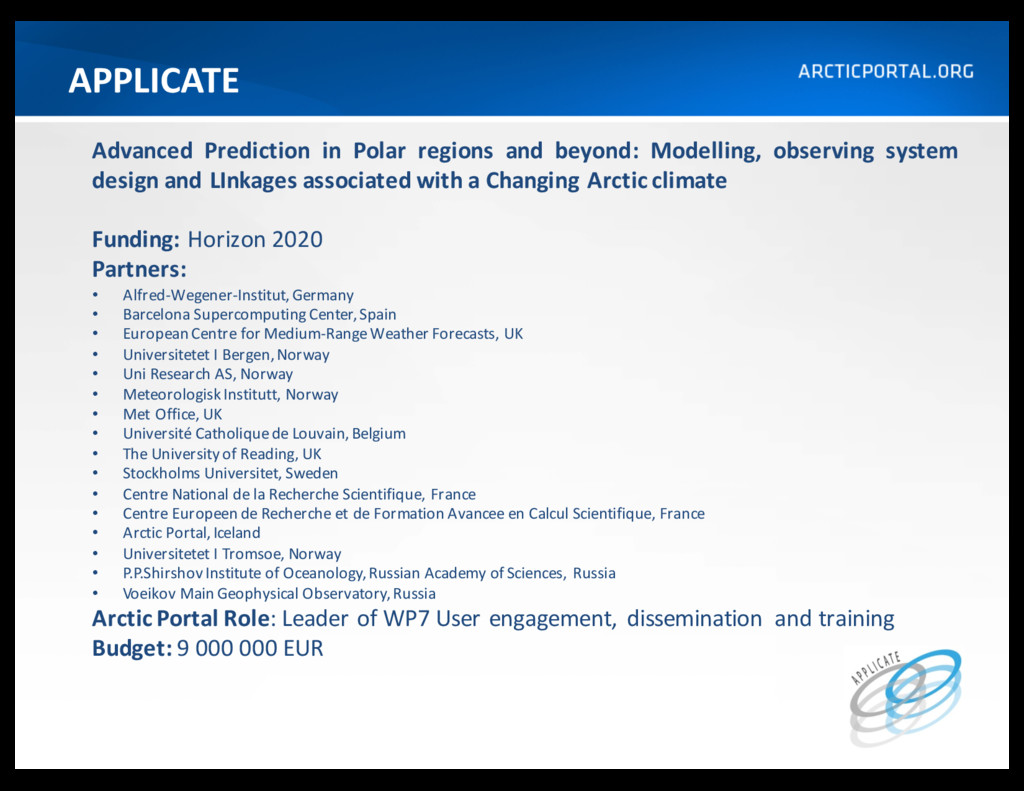
design and LInkages associated with a Changing Arctic climate Overall objective: To develop enhanced predictive capacity for weather and climate in the Arctic and beyond, and to determine the influence of Arctic climate change on Northern Hemisphere midlatitudes, for the benefit of policy makers, businesses and society. Specific objectives: • to develop a set of metrics and diagnostics that target key processes in the Arctic atmosphere, sea ice and ocean • to evelop enhanced weather and climate models • to determine the impact of Arctic climate change on midlatitudes through atmospheric and oceanic linkages • to contribute to the design of the future Arctic observing system • to enhance the capacity to predict Northern Hemisphere weather and climate • to develop and implement APPLICATE’s research programme • to transfer the knowledge generated through APPLICATE to stakeholders including training of early career scientists APPLICATE
design and LInkages associated with a Changing Arctic climate Funding: Horizon 2020 Partners: • Alfred-‐Wegener-‐Institut, Germany • Barcelona Supercomputing Center, Spain • European Centre for Medium-‐Range Weather Forecasts, UK • Universitetet I Bergen, Norway • Uni Research AS, Norway • Meteorologisk Institutt, Norway • Met Office, UK • Université Catholiquede Louvain, Belgium • The University of Reading, UK • Stockholms Universitet, Sweden • Centre National de la Recherche Scientifique, France • Centre Europeen de Recherche et de Formation Avancee en Calcul Scientifique, France • Arctic Portal, Iceland • Universitetet I Tromsoe, Norway • P.P.Shirshov Institute of Oceanology, Russian Academy of Sciences, Russia • Voeikov Main Geophysical Observatory, Russia Arctic Portal Role: Leader of WP7 User engagement, dissemination and training Budget: 9 000 000 EUR APPLICATE
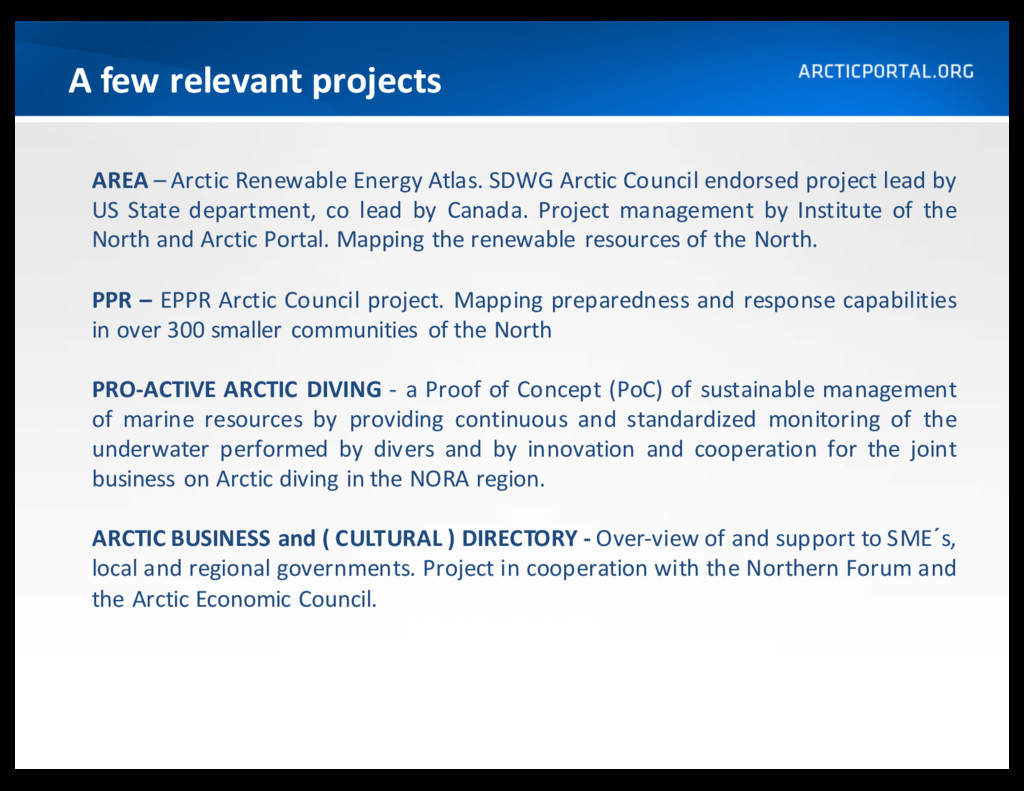
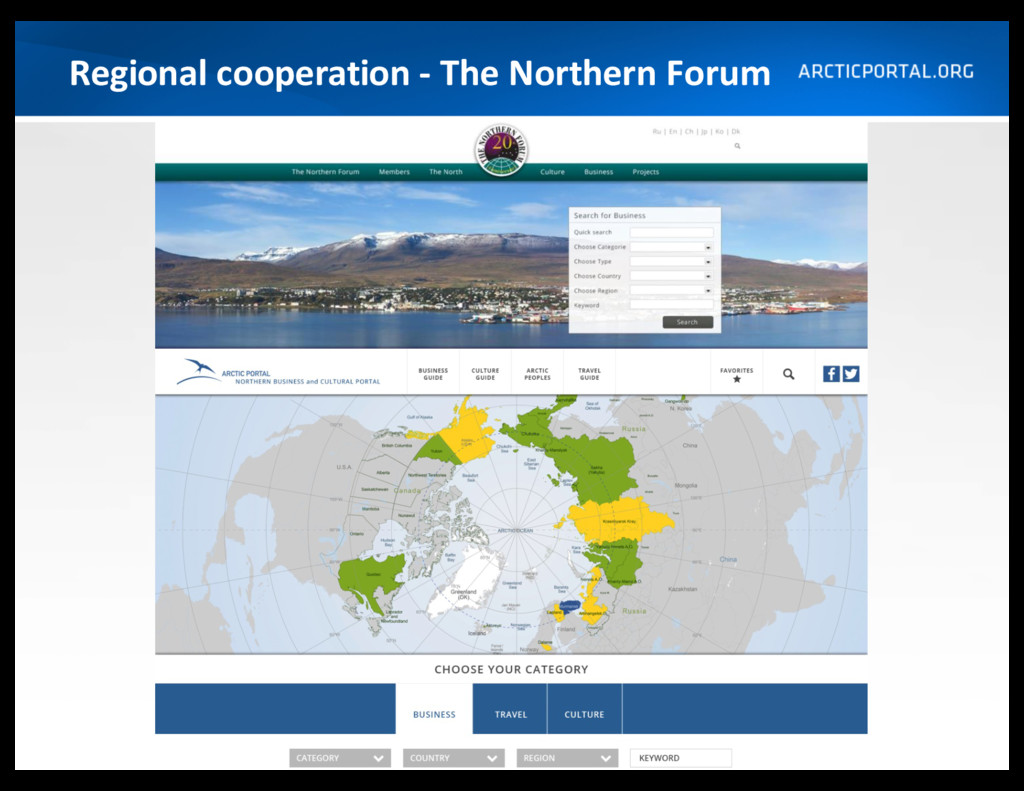
project lead by US State department, co lead by Canada. Project management by Institute of the North and Arctic Portal. Mapping the renewable resources of the North. PPR – EPPR Arctic Council project. Mapping preparedness and response capabilities in over 300 smaller communities of the North PRO-‐ACTIVE ARCTIC DIVING -‐ a Proof of Concept (PoC) of sustainable management of marine resources by providing continuous and standardized monitoring of the underwater performed by divers and by innovation and cooperation for the joint business on Arctic diving in the NORA region. ARCTIC BUSINESS and ( CULTURAL ) DIRECTORY -‐ Over-‐view of and support to SME´s, local and regional governments. Project in cooperation with the Northern Forum and the Arctic Economic Council. A few relevant projects
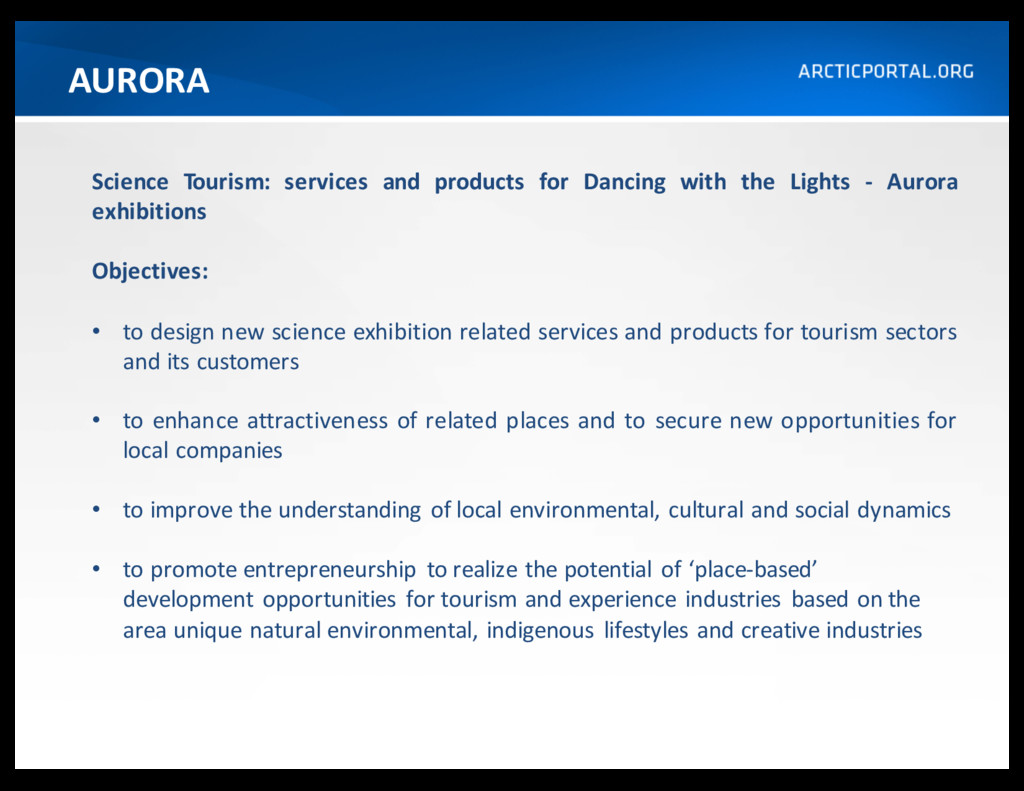
-‐ Aurora exhibitions Objectives: • to design new science exhibition related services and products for tourism sectors and its customers • to enhance attractiveness of related places and to secure new opportunities for local companies • to improve the understanding of local environmental, cultural and social dynamics • to promote entrepreneurship to realize the potential of ‘place-‐based’ development opportunities for tourism and experience industries based on the area unique natural environmental, indigenous lifestyles and creative industries AURORA


 ipfbrussels
 lara
 tmiket
 geoffreycrofte
 skipperchong
 axbom
 csswizardry
 lemiorhan
 productmarketing
 ianozsvald
 reverentgeek
 trallard
 addyosmani